Appendix — Diagram, Quote & Personality Banks
Cross-cutting study fodder usable across all papers.
GS Diagram Bank
Topper handwritten notes#Page 1
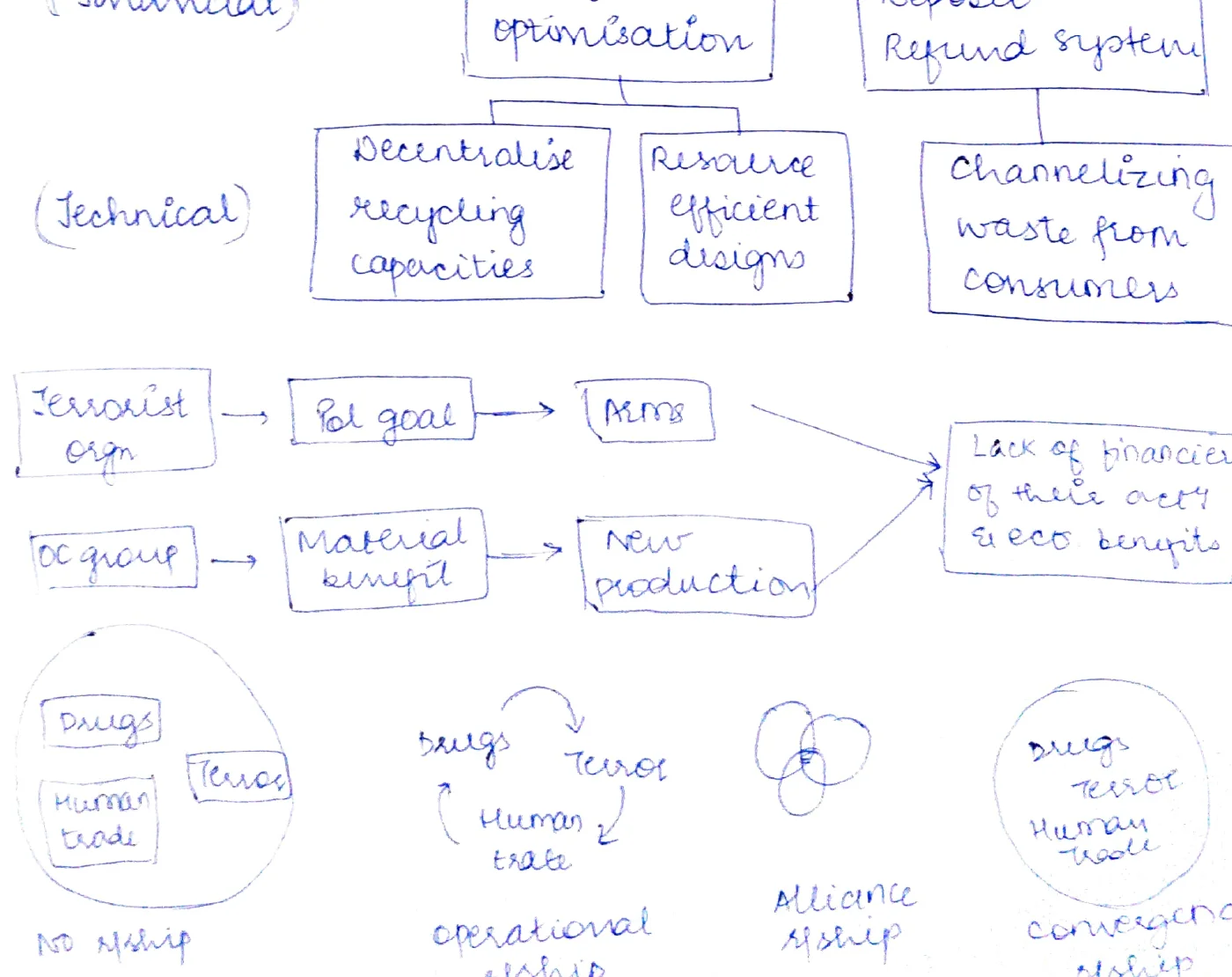
#Diagram 1 — GS Diagrams (Title) + Convergence b/w OC & Terrorism (Flowchart)
Topic: Internal Security / Organised Crime
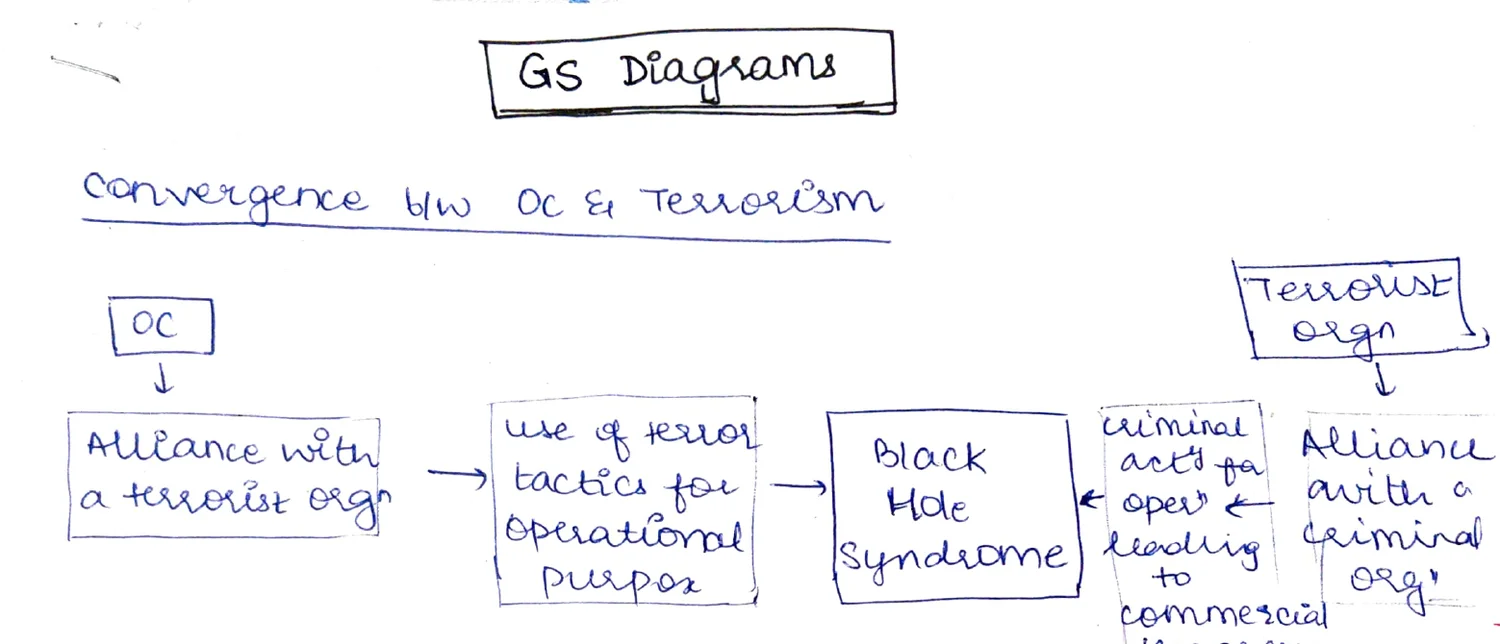
- Title box: GS Diagrams
- Section heading: Convergence b/w OC [Organised Crime] & Terrorism
- Flowchart — two parallel entry points:
- OC (box, top-left)
- ↓ Alliance with a terrorist org[anisation]
- → Use of terror tactics for operational purposes
- → Black Hole Syndrome
- ← criminal acts pa[y] open ← leading to commercial terrorism
- Alliance with a criminal org[anisation]
- Terrorist Org[anisation] (box, top-right)
- ↓ Alliance with a criminal org[anisation]
- OC (box, top-left)
- The two chains converge at Black Hole Syndrome (centre box)
#Diagram 2 — EIA Flowchart + Projects under EIA 2006
Topic: Environment — Environmental Impact Assessment
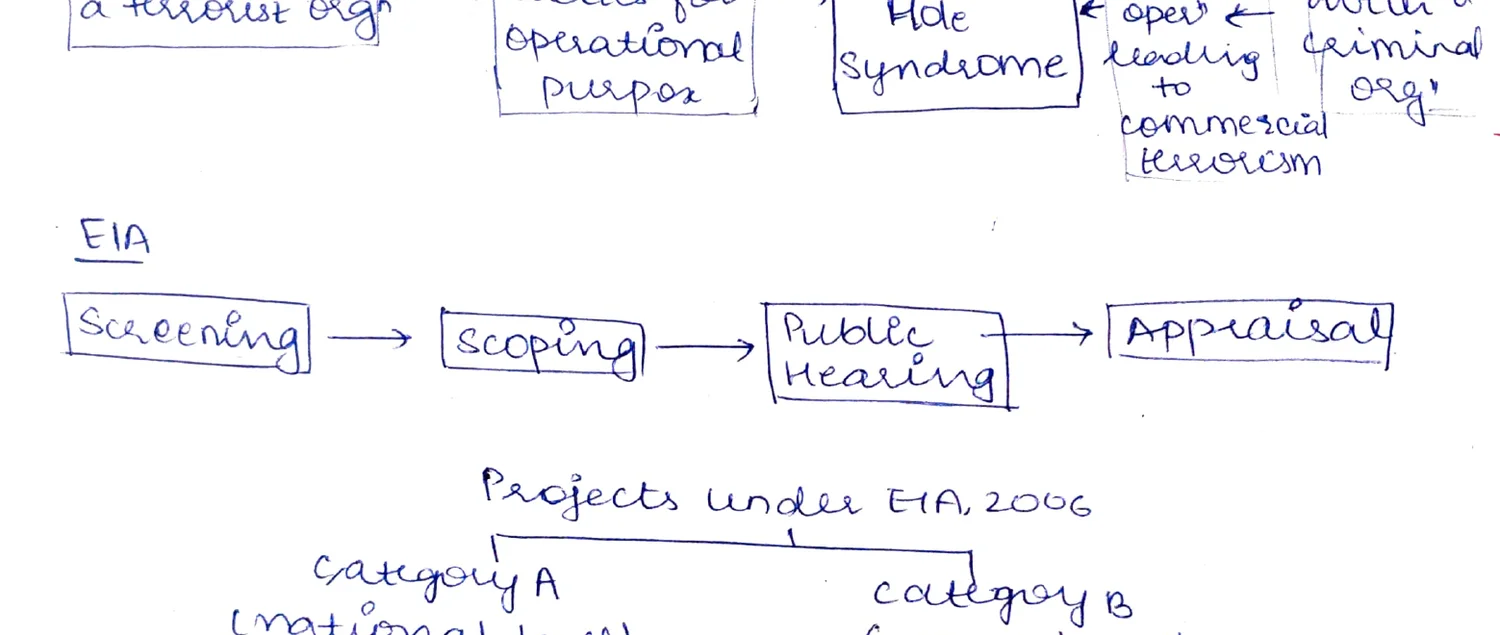
- Section heading: EIA
- Linear flowchart (left → right):
- Screening → Scoping → Public Hearing → Appraisal
- Sub-section: Projects under EIA 2006
- Category A (National level)
- Category B (State level)
- B1 — Mandatory EIA
- B2 — Do not require EIA
#Diagram 3 — Transgenders: Vicious Cycle (Cycle Diagram)
Topic: Social Justice — Transgender Rights
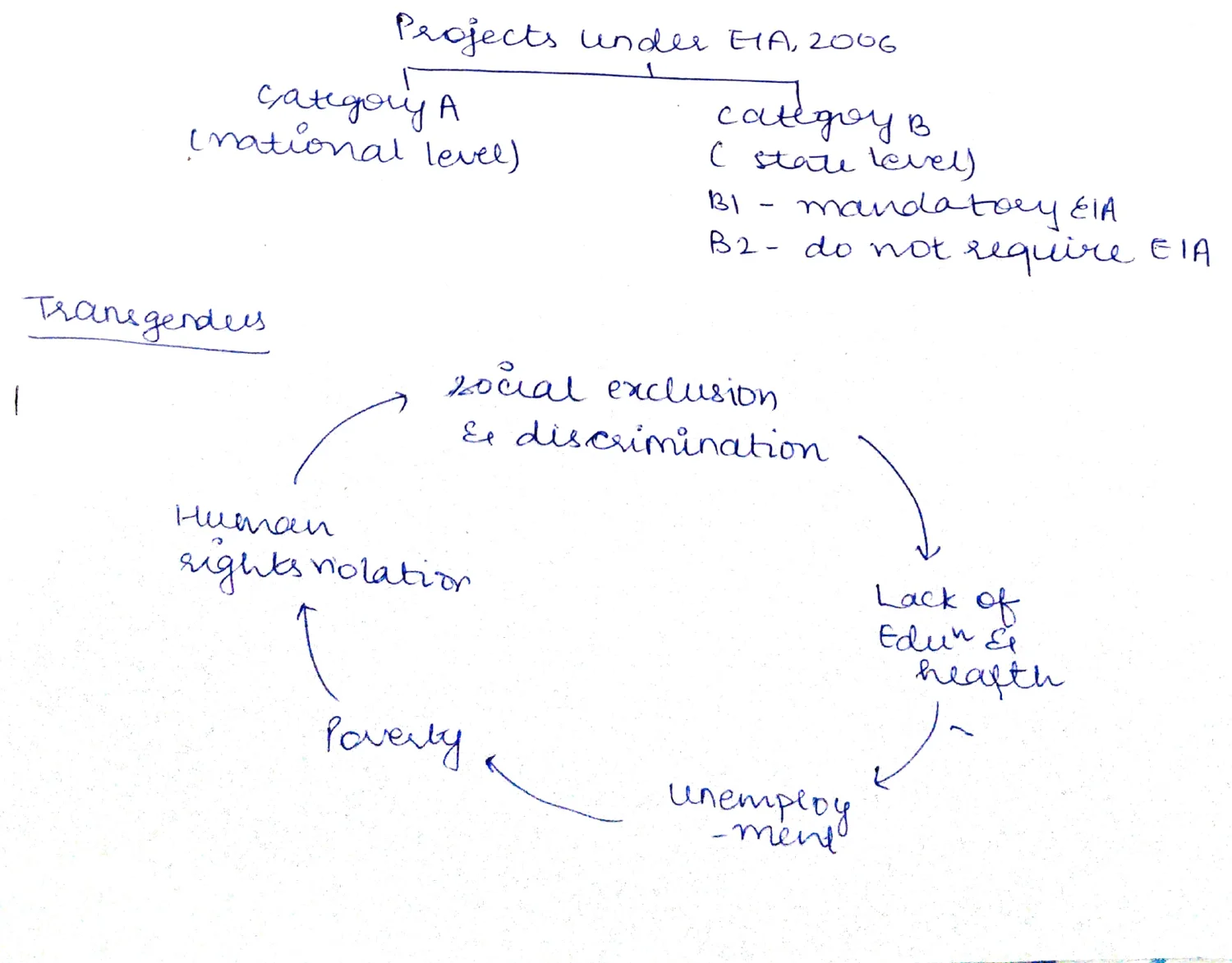
- Section heading: Transgenders
- Circular/cycle diagram (clockwise arrows):
- Social exclusion & discrimination
- ↓
- Lack of Educ[ation] & health
- ↓
- Unemploy[ment]
- ↓
- Poverty
- ↓
- Human rights violation
- ↑ (back to Social exclusion)
- Social exclusion & discrimination
#Page 2
#Diagram 1 — Hazard & Disaster: Venn Diagram
Topic: Disaster Management
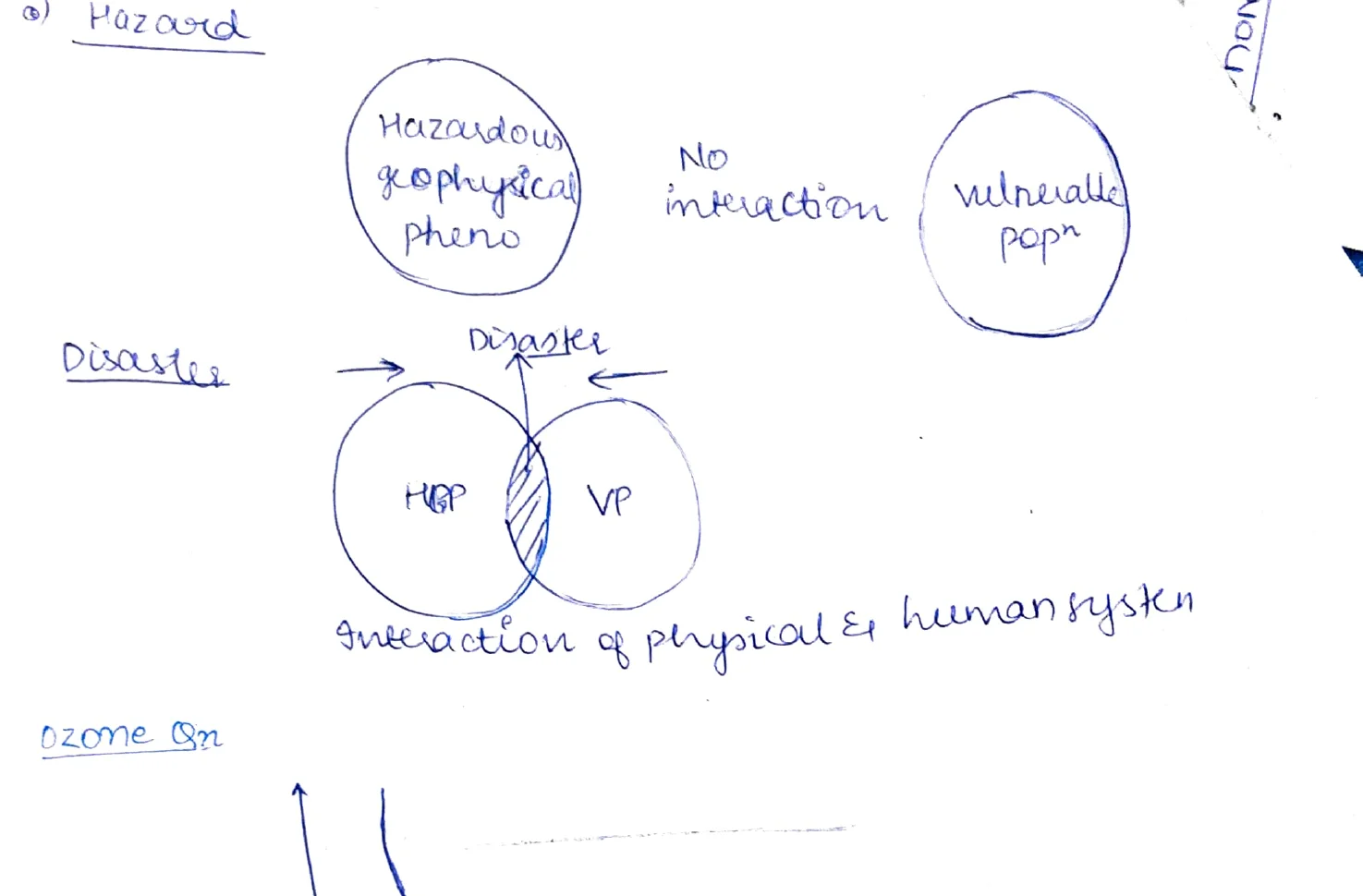
- Label (a) Hazard — two separate circles (no overlap):
- Left circle: Hazardous geophysical pheno[menon] (HGP)
- Right circle: Vulnerable pop[ulation] (VP)
- Between circles: No interaction
- Label Disaster — two overlapping circles (Venn):
- Left circle: HGP [Hazardous Geophysical Phenomenon]
- Right circle: VP [Vulnerable Population]
- Overlap (hatched): Disaster
- Arrows from both circles pointing inward to overlap
- Caption: Interaction of physical & human system
#Diagram 2 — Ozone Concentration in Various Layers (Line Graph)
Topic: Environment — Atmosphere / Ozone Layer
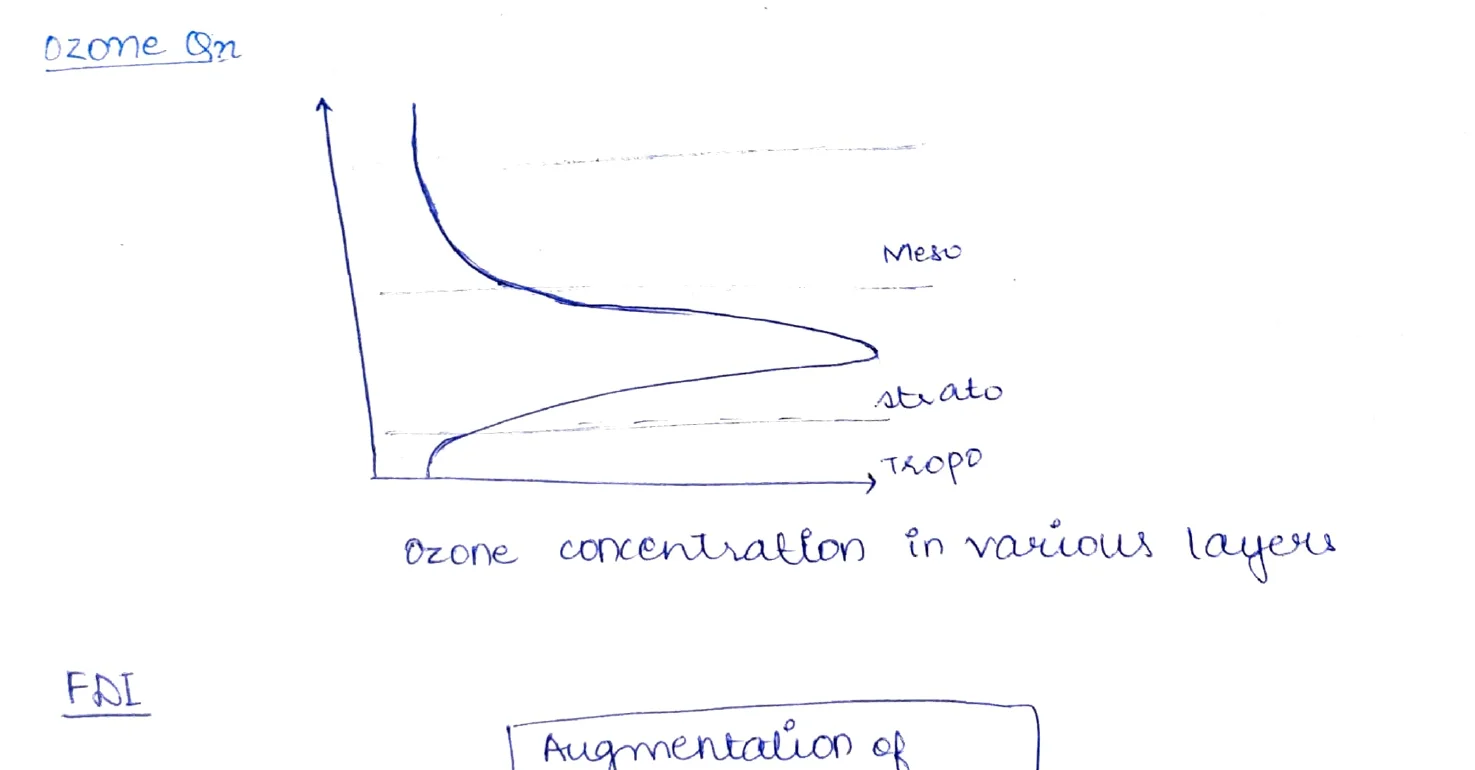
- Section heading: Ozone Gn [Generation/Concentration]
- X-axis: [Ozone concentration — implied]
- Y-axis: altitude (↑)
- Two curves:
- Meso[sphere] — labelled on right; smaller secondary peak at high altitude
- Strato[sphere] — labelled on right; main large peak at lower altitude
- Caption: Ozone concentration in various layers
#Diagram 3 — FDI Inflow: Impact Flowchart
Topic: Economy — Foreign Direct Investment
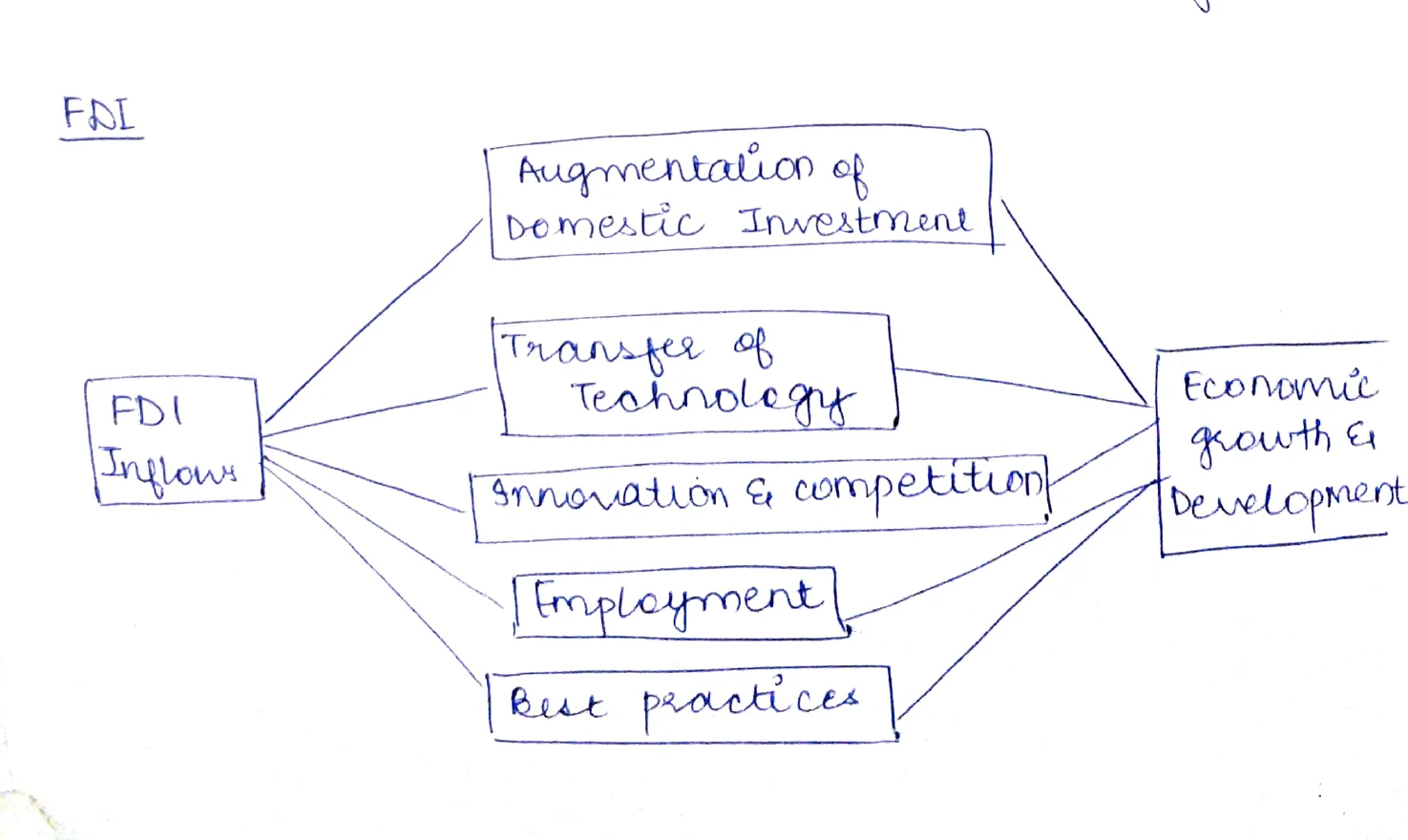
- Section heading: FDI
- Entry node (left box): FDI Inflow
- Arrows fan out to five intermediate boxes:
- Augmentation of Domestic Investment
- Transfer of Technology
- Innovation & competition
- Employment
- Best practices
- All five arrows converge → right box: Economic Growth & Development
#Page 3
#Diagram 1 — Austerity / Economy Cycle (Cycle Diagram)
Topic: Economy — Fiscal Policy / Austerity
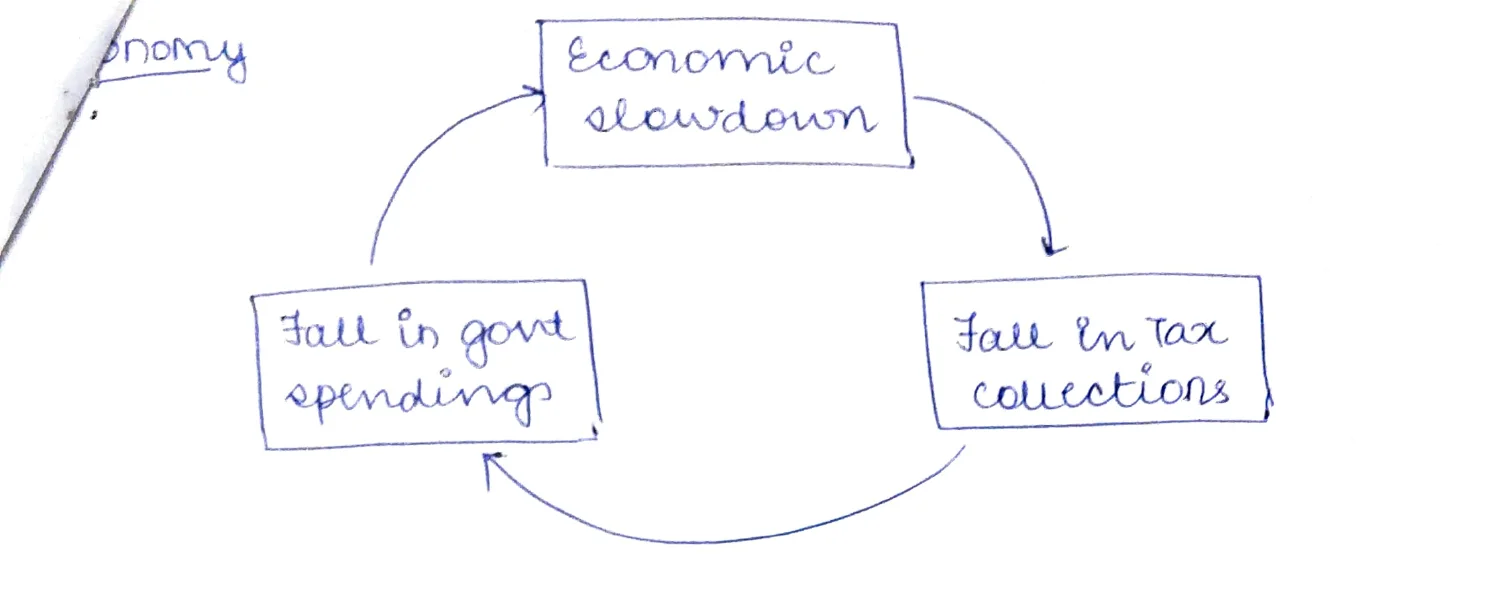
- Label at top-left: [Auster]nomy [Austerity/Economy — top of word cut; likely "Austerity" or "Economy"]
- Circular (3-node) cycle:
- Economic slowdown (top box)
- → Fall in tax collections (right box)
- → Fall in govt spending (left box)
- → back to Economic slowdown ↑
- Economic slowdown (top box)
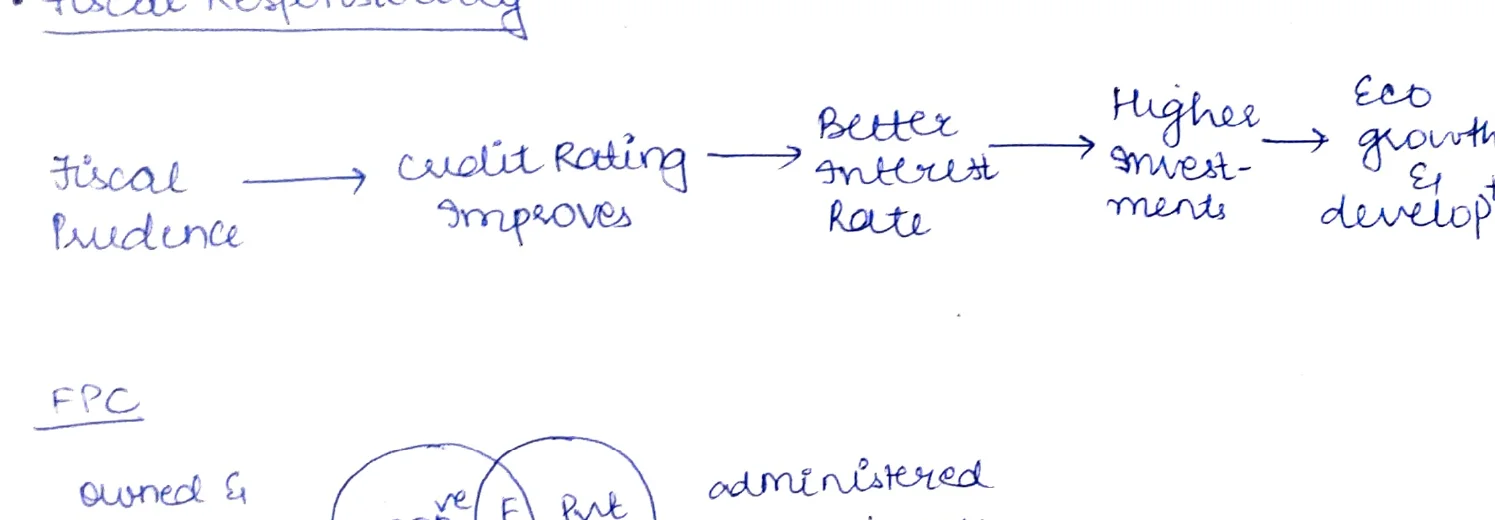
#Diagram 2 — Fiscal Responsibility: Chain Flowchart
Topic: Economy — Fiscal Responsibility
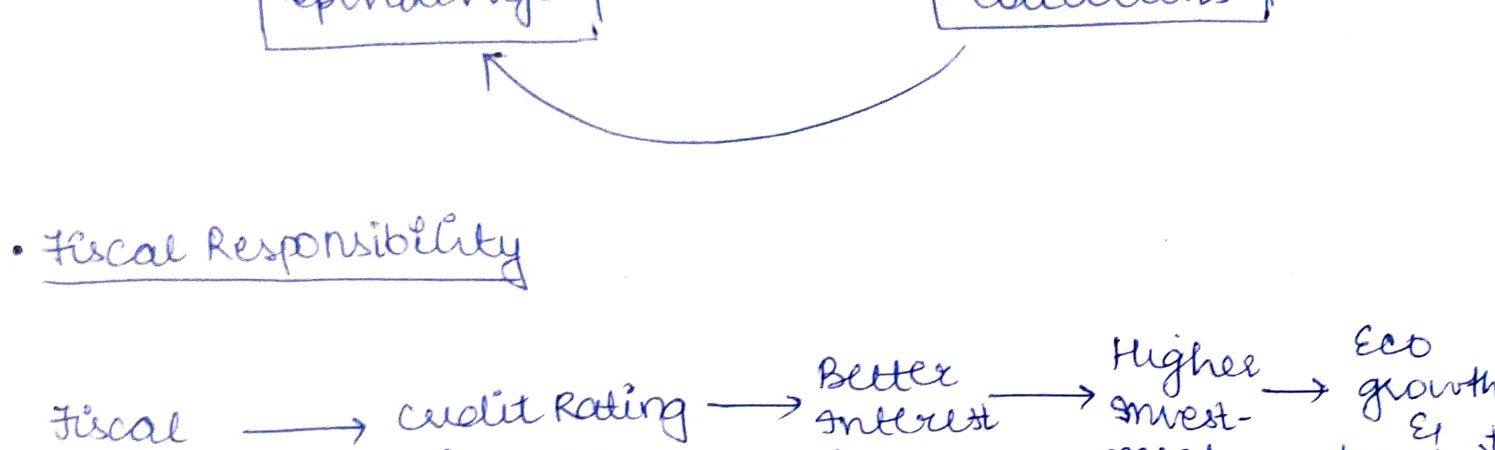
- Bullet: Fiscal Responsibility
- Linear chain (left → right):
- Fiscal prudence → Credit Rating improves → Better interest rate → Higher investment → Eco[nomic] growth & develop[ment]
#Diagram 3 — FPC: Venn Diagram
Topic: Economy — Farmer Producer Company / Cooperative
- Section heading: FPC [Farmer Producer Company]
- Venn diagram (two overlapping circles):
- Left circle: Owned & governed by SH [Shareholders — i.e.] farmers
- Label reads: occ[upational] co[mpany] [left lobe label, partly [illegible]]
- Right circle: Administered professionally
- Label reads: Pvt Ltd co[mpany] [right lobe label]
- Overlap centre: F [FPC — the intersection]
- Left circle: Owned & governed by SH [Shareholders — i.e.] farmers
#Diagram 4 — Low Tax to GDP Ratio → Development Deficit (Flowchart)
Topic: Economy — Taxation / Development Finance
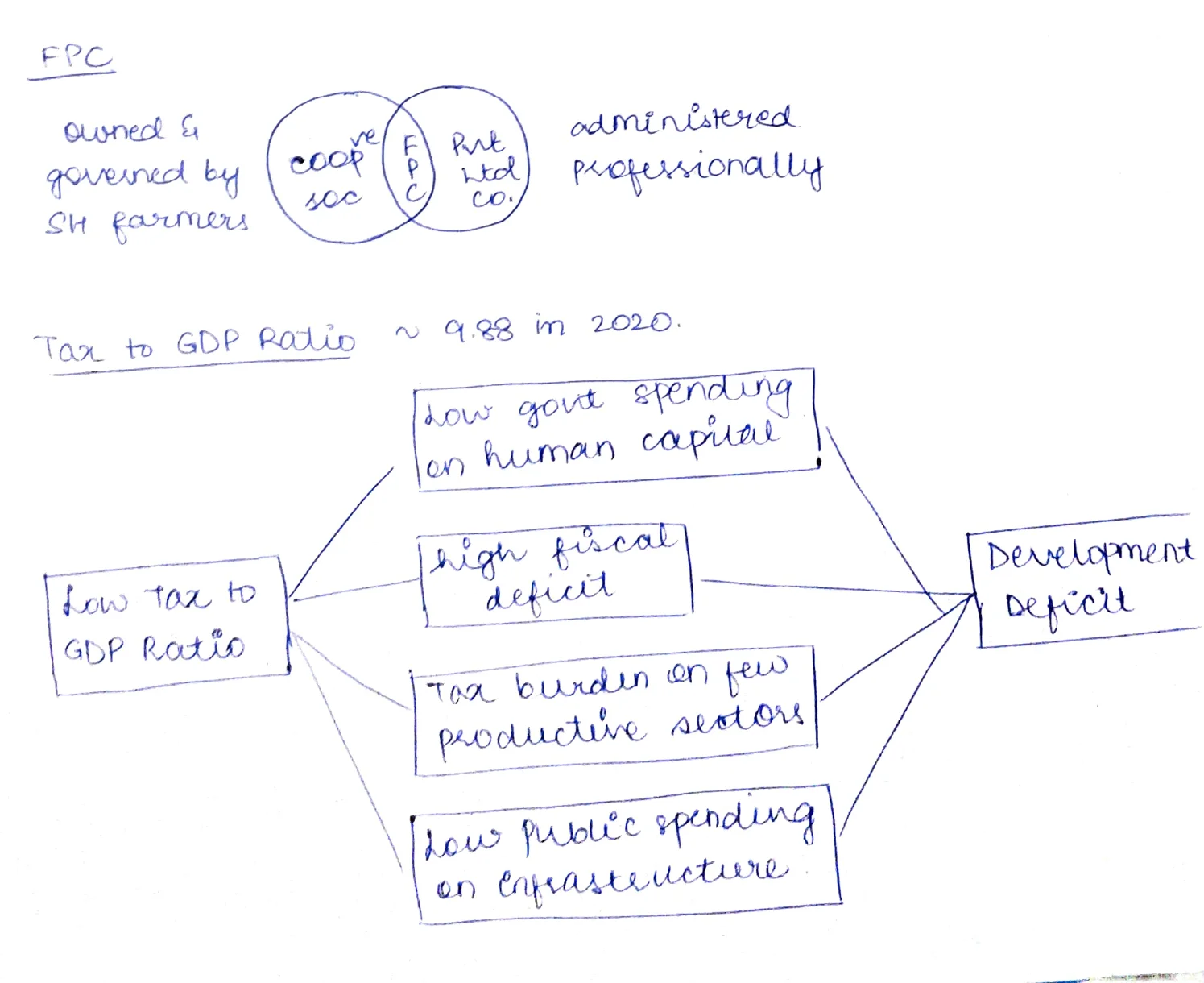
- Stat note: Tax to GDP Ratio ~ 9.88 in 2020
- Entry node (left box): Low tax to GDP ratio
- Arrows fan to four intermediate boxes:
- Low govt spending on human capital
- High fiscal deficit
- Tax burden on few productive sectors
- Low public spending on infrastructure
- All four → right box: Development Deficit
#Page 4
#Diagram 1 — Unemployment–Income Vicious Cycle
Topic: Economy / Social Issues — Poverty Trap
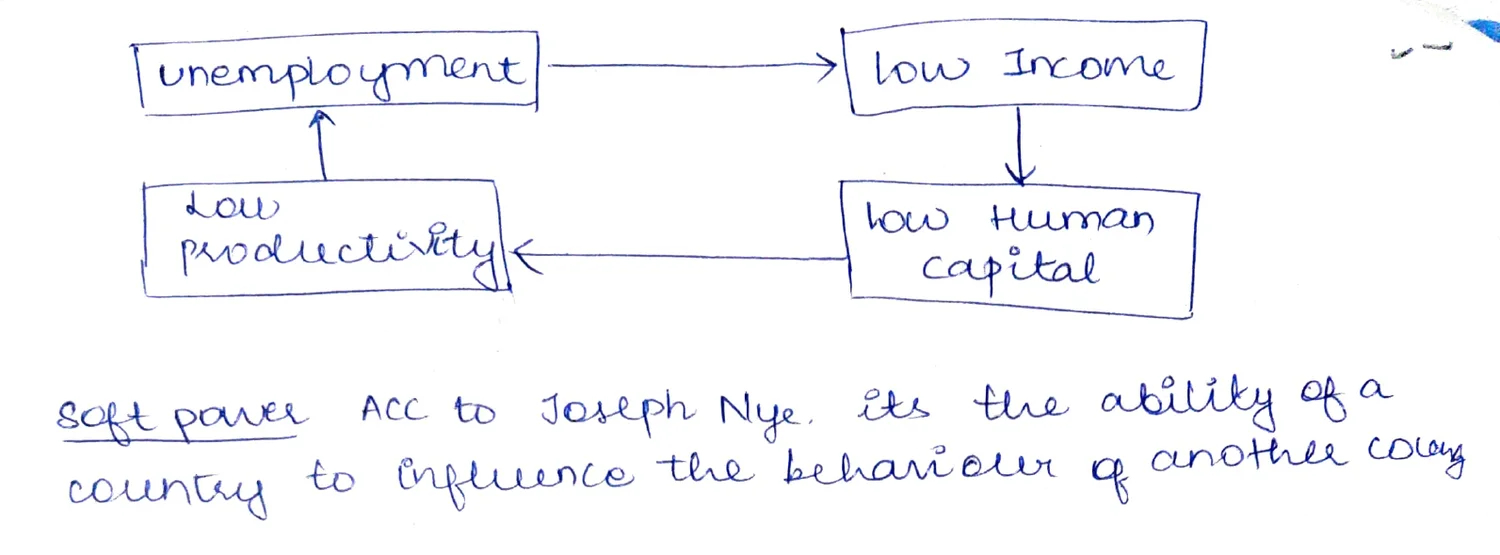
- Four-node rectangular cycle:
- Unemployment → Low Income (top row)
- Low Human capital → Low Productivity (bottom row)
- Arrows: Low Income → Low Human capital → Low Productivity → Unemployment → Low Income
#Diagram 2 — Soft Power Triangle
Topic: International Relations — Soft Power (Joseph Nye)
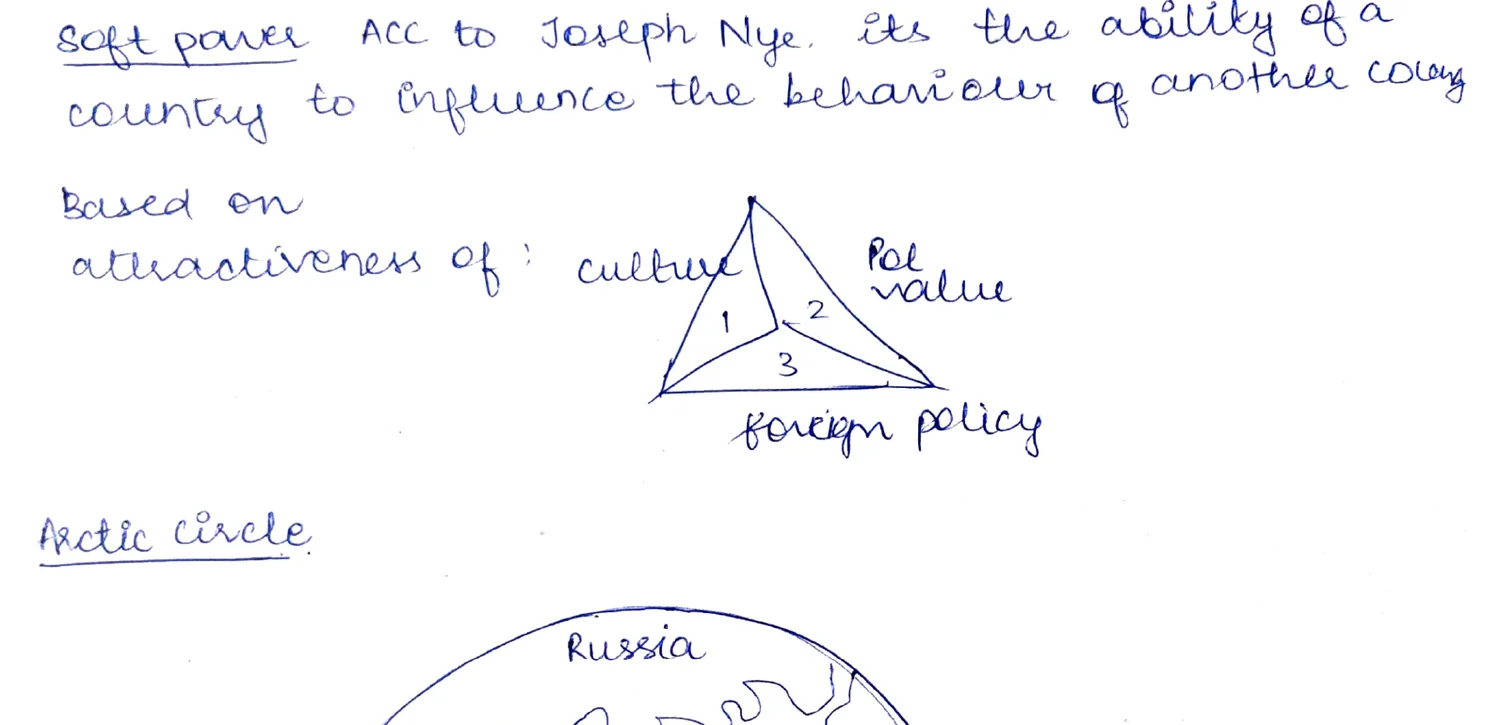
- Text note: Soft power: Acc[ording] to Joseph Nye, it is the ability of a country to influence the behaviour of another country
- Based on attractiveness of:
- Triangle diagram with three nodes:
- Apex (top): Pol[itical] Value [node 1 — label also has "Pol Value"]
- Bottom-left: Culture [node 2]
- Bottom-right: Foreign Policy [node 3]
- Numbers 1, 2, 3 mark the three corners inside the triangle
#Diagram 3 — Arctic Circle Map + India & Arctic: History of Cooperation (Timeline)
Topic: International Relations / Geography — Arctic
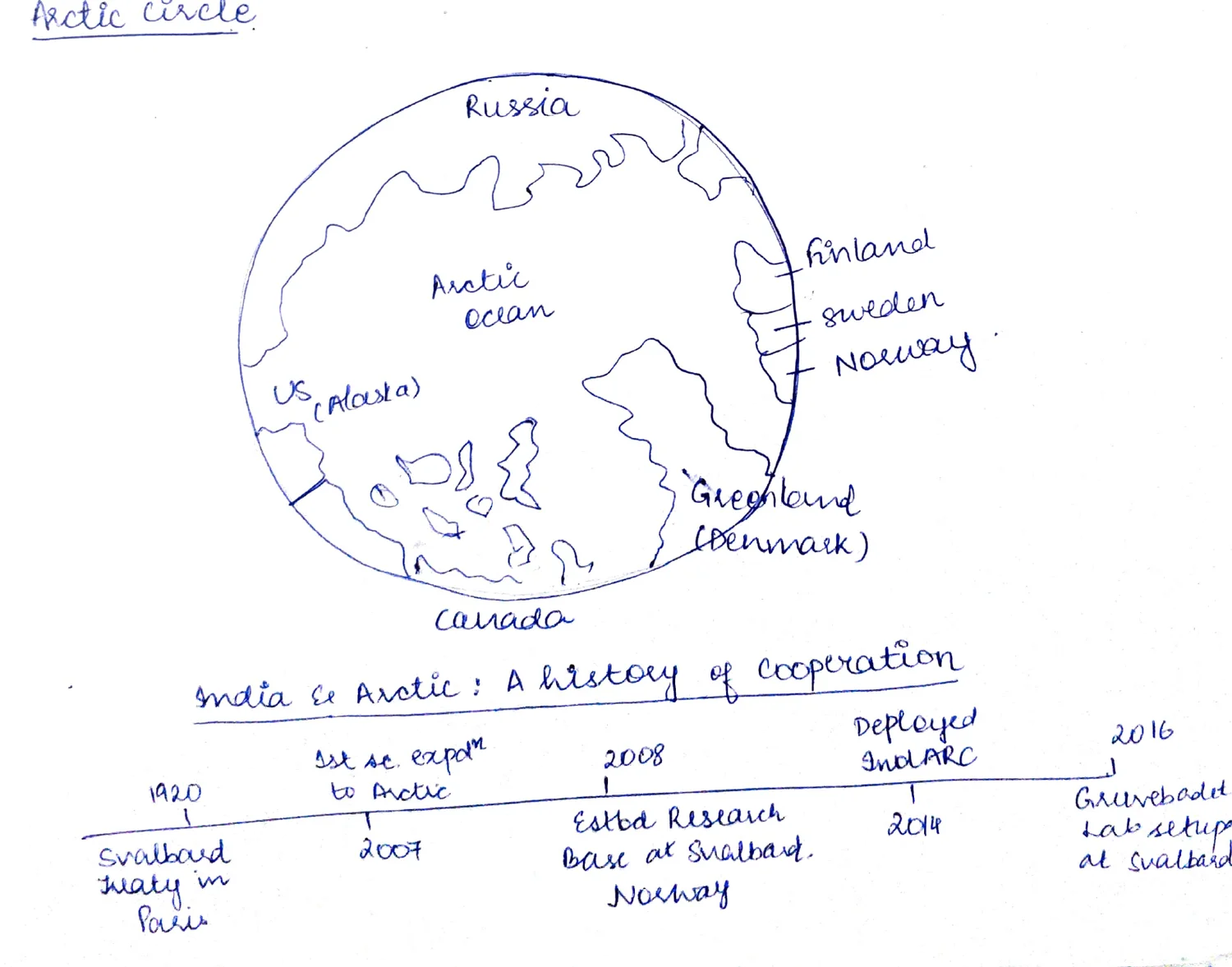
- Sub-heading: Arctic Circle
- Hand-drawn globe/circle map showing Arctic region:
- Russia (top)
- Arctic Ocean (centre)
- US (Alaska) (left)
- Canada (bottom-left)
- Greenland (Denmark) (bottom-right)
- Finland, Sweden, Norway (right)
- Timeline: India & Arctic: A History of Cooperation
- 1920 — Svalbard Treaty in Paris
- 2007 — 1st to be export to Arctic [India's first expedition to Arctic]
- 2008 — Establ[ished] Research Base at Svalbard, Norway
- 2014 — Deployed IndARC [India's first underwater moored observatory]
- 2016 — Greenhed [Himadri] Lab set up at Svalbard [possibly "Greenfield Lab" — partially [illegible]]
#Page 5
#Diagram 1 — IR Maps: India–Bangladesh (Hand-drawn Map)
Topic: International Relations — India's Neighbourhood
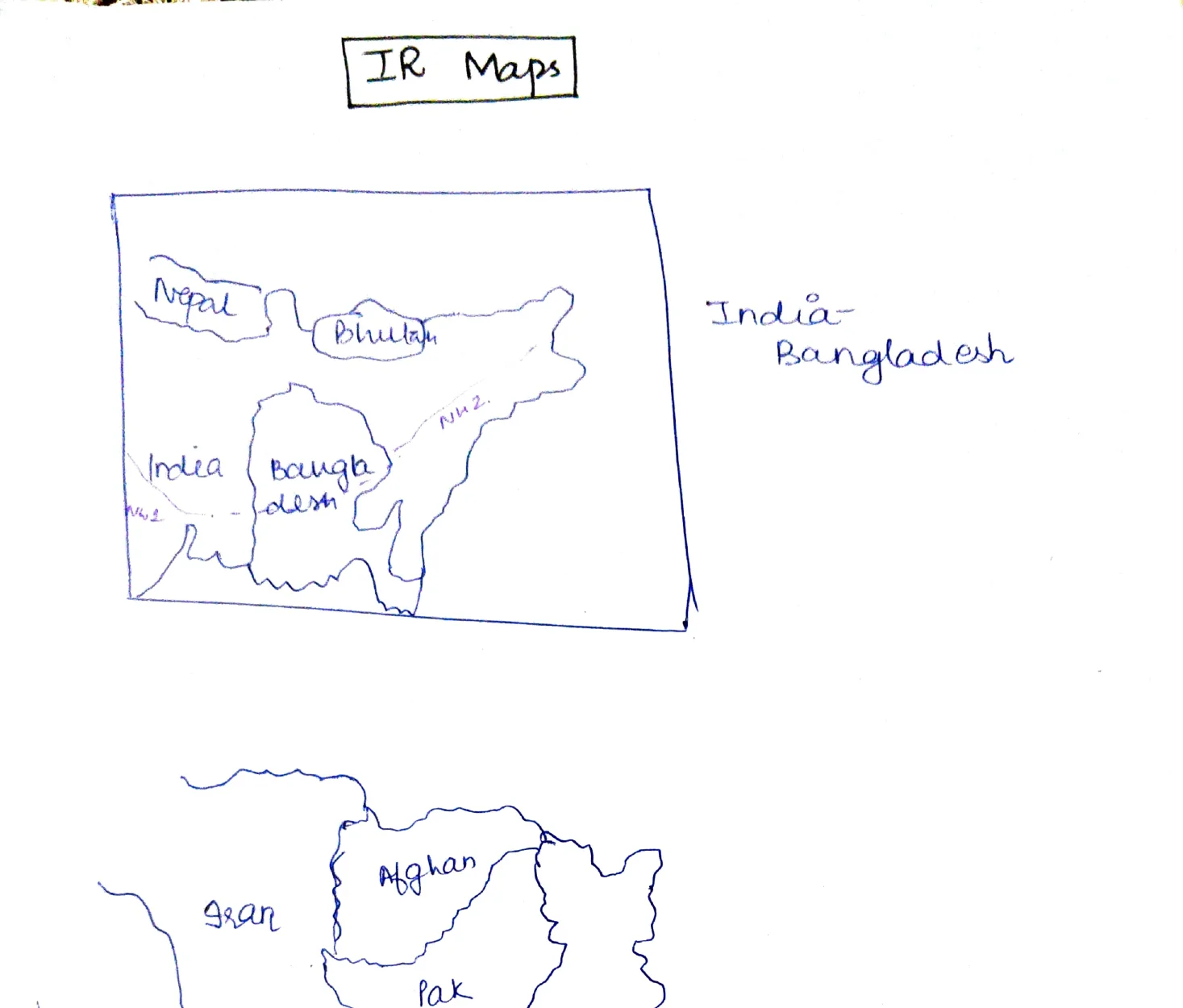
- Section heading (boxed): IR Maps
- Caption: India–Bangladesh
- Map contents (within border box):
- Nepal (top-left)
- Bhutan (top-centre)
- India (left — with NH 1 [National Highway] marked)
- Bangladesh (centre — with NH 2 marked)
- River outlines shown at bottom (delta region)
#Diagram 2 — India–Pakistan–Afghanistan–Iran (Hand-drawn Map)
Topic: International Relations — India's Neighbourhood / Extended Neighbourhood
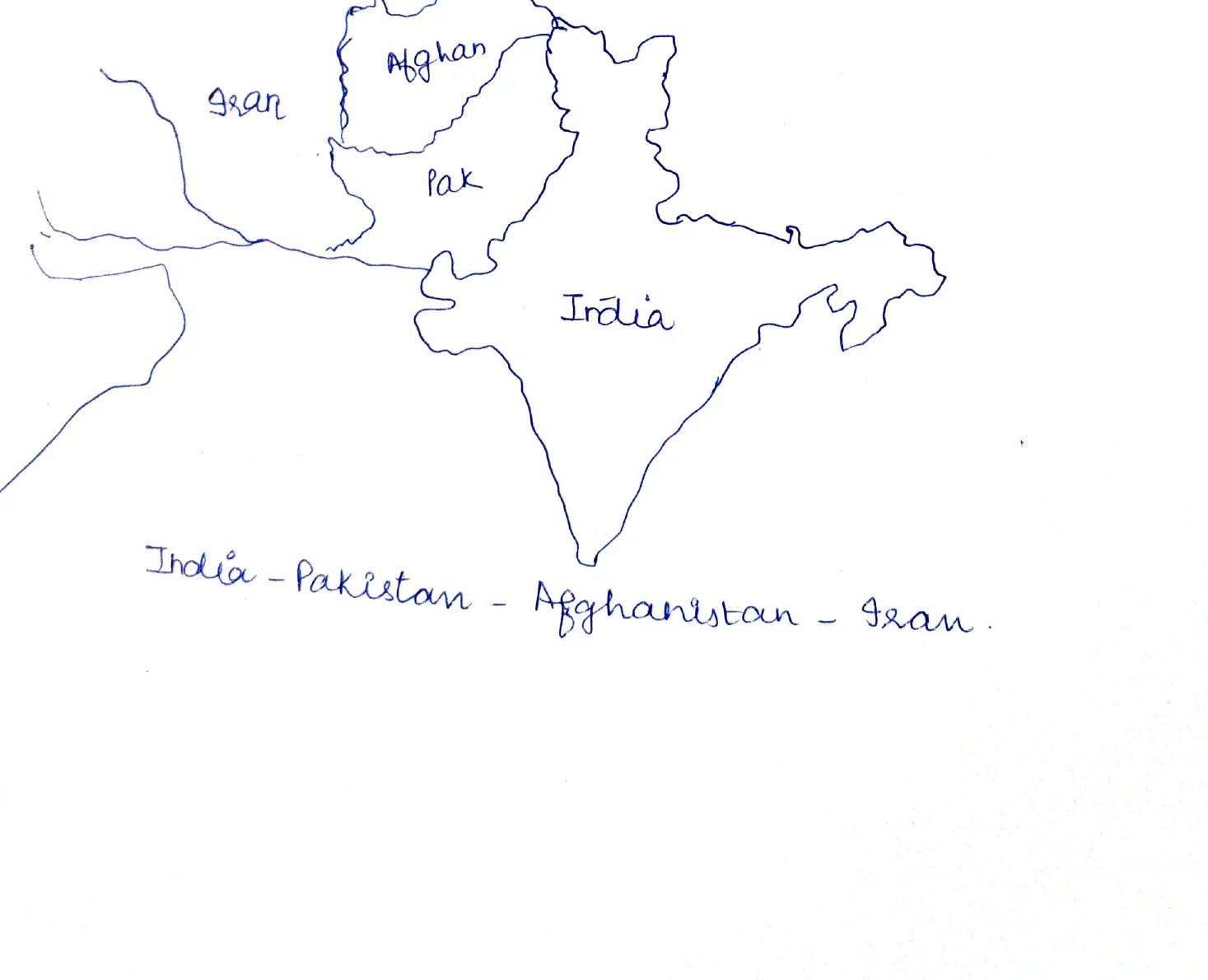
- Caption: India – Pakistan – Afghanistan – Iran
- Map contents:
- Afghan[istan] (top-centre)
- Iran (left)
- Pak[istan] (centre-left)
- India (right — large landmass shown)
- Coastline / sea boundary shown below India
#Page 6
#Diagram 1 — India–Sri Lanka Map
Topic: International Relations / Geography — India's Neighbourhood
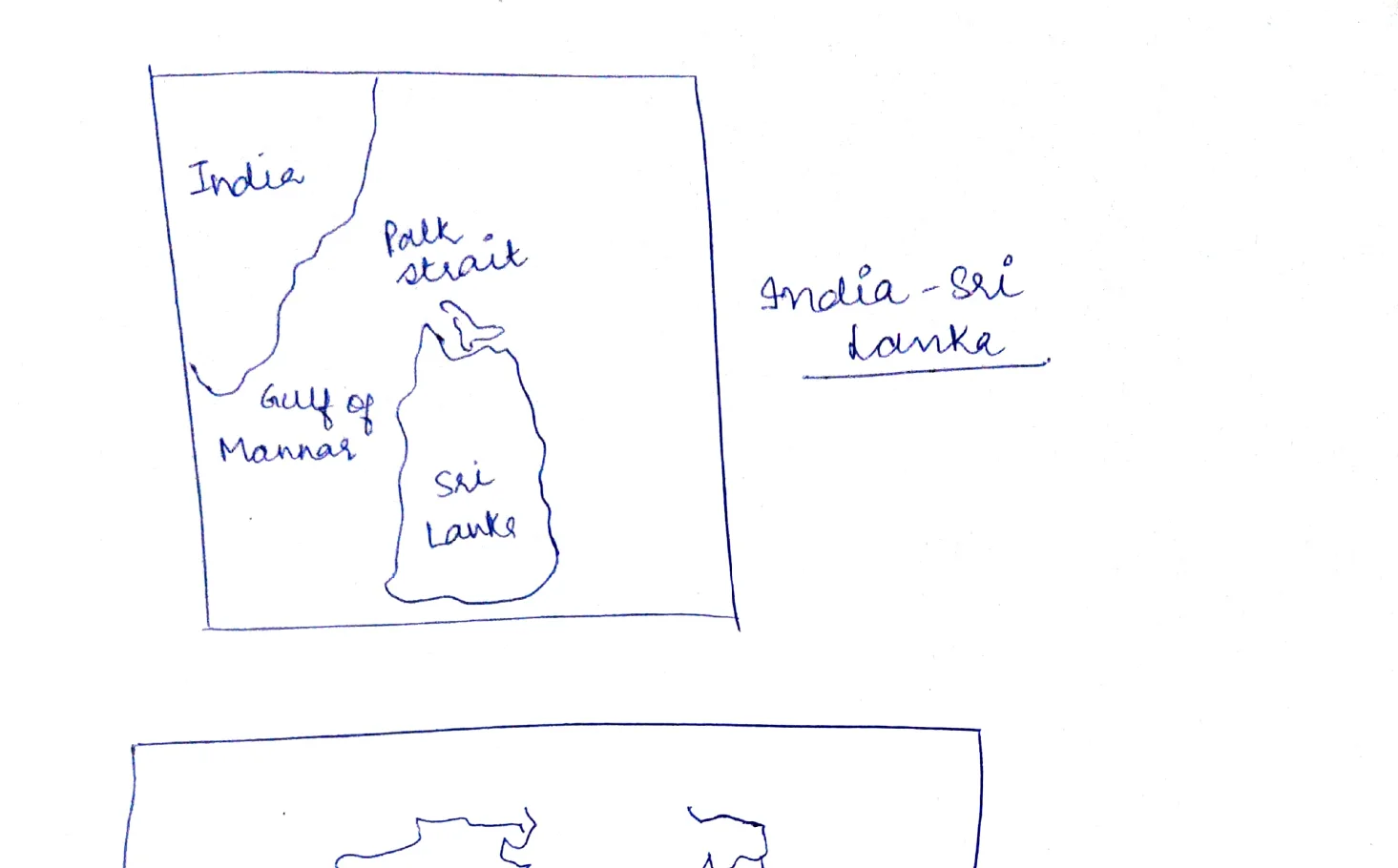
- Caption: India–Sri Lanka
- Map contents (within border box):
- India (top-left — southern tip shown)
- Palk Strait (between India and Sri Lanka — labelled)
- Gulf of Mannar (left of Sri Lanka — labelled)
- Sri Lanka (right — island shown)
#Diagram 2 — Indian Ocean Region Map
Topic: International Relations / Geography — IOR / Indian Ocean
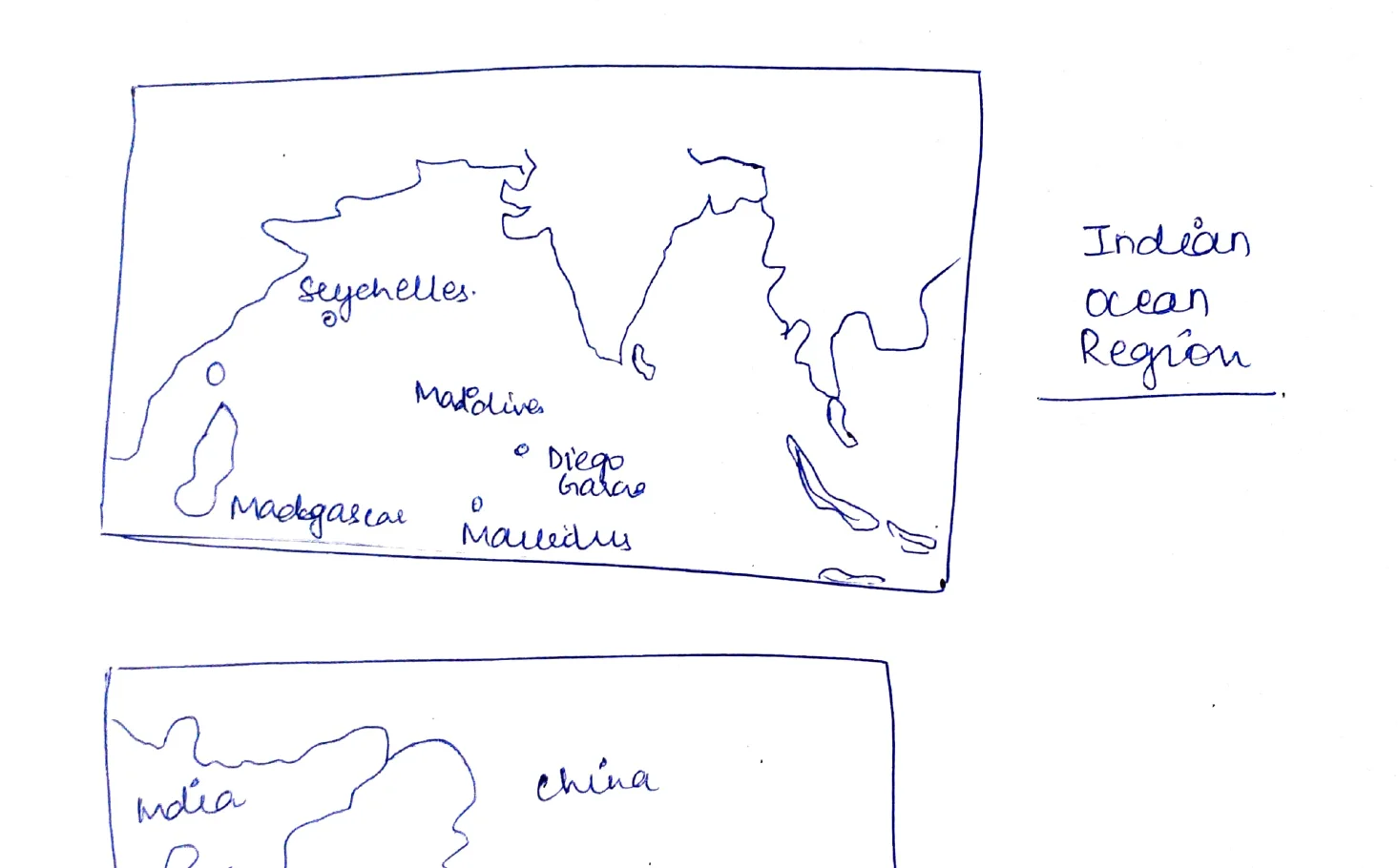
- Caption: Indian Ocean Region
- Map contents (within border box, wider regional view):
- Seychelles (marked with dot, left)
- Maldives (centre, dot)
- Diego [Garcia] (centre, dot — "o Diego" label)
- Madagascar (far left)
- Landmasses visible: India (top), African coast (left)
#Diagram 3 — India–Myanmar Map
Topic: International Relations — India's Neighbourhood
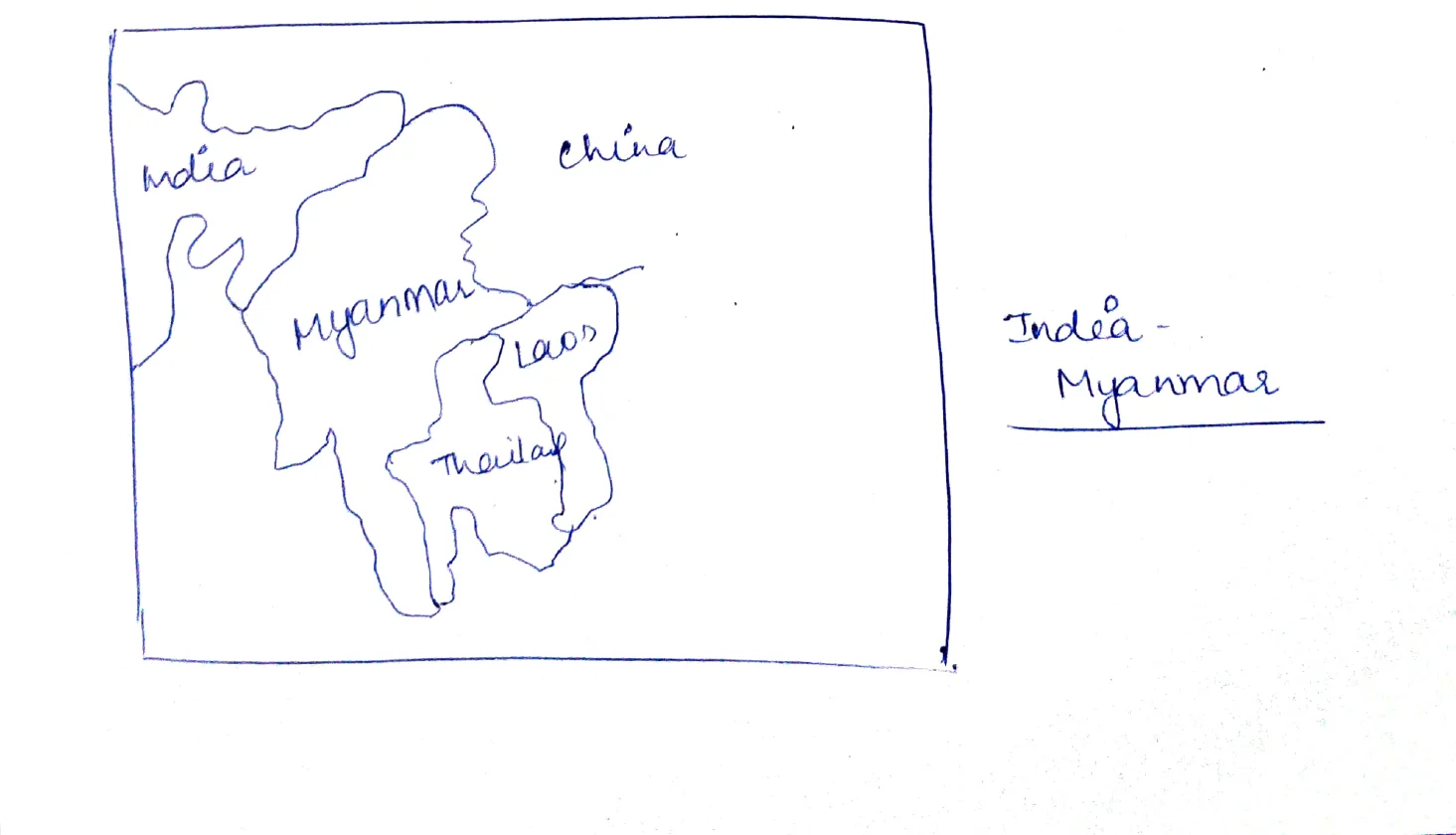
- Caption: India–Myanmar
- Map contents (within border box):
- India (left)
- China (top-right)
- Myanmar (centre)
- Laos (right of Myanmar)
- Thailand (bottom — partially visible)
#Page 7
#Diagram 1 — Malicious Cycle of Land Degradation (Flowchart)
Topic: Agriculture / Environment — Land Degradation
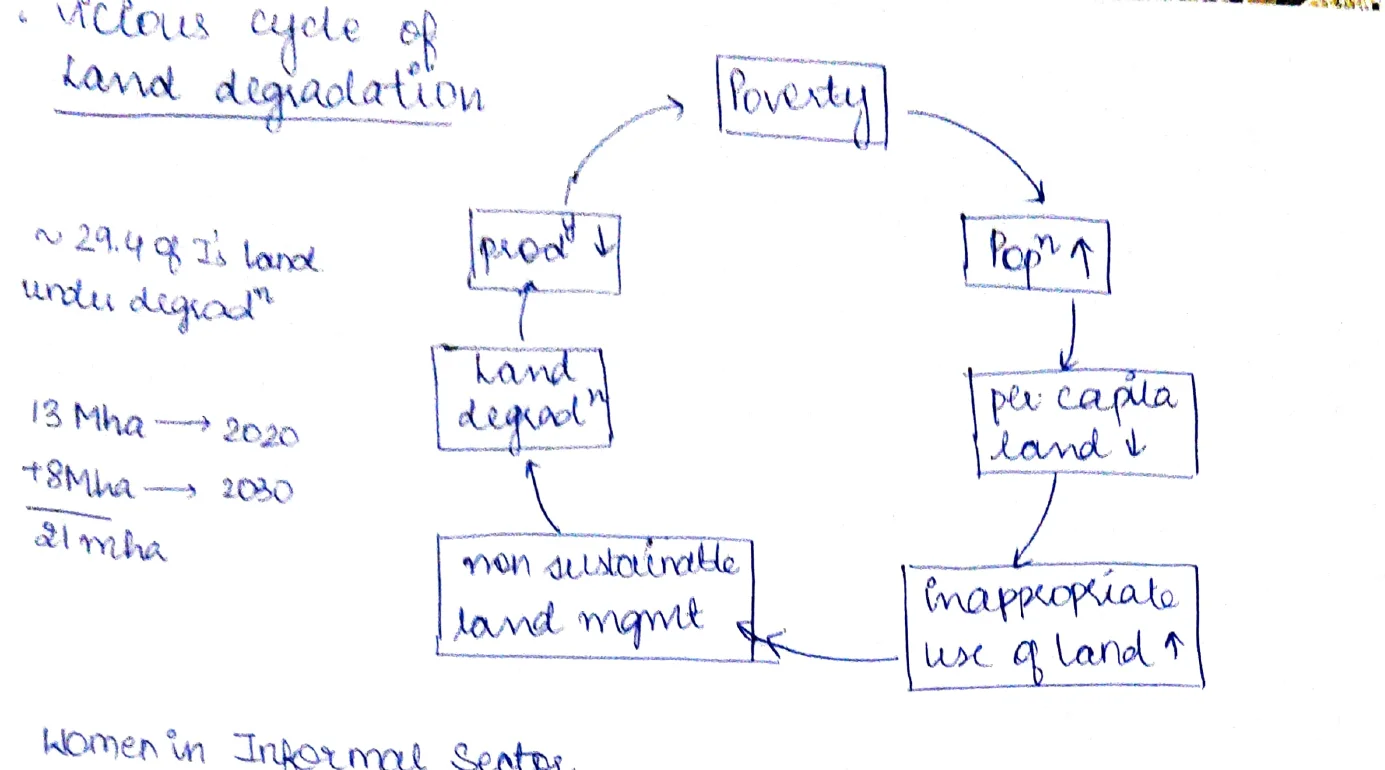
- Heading: Malicious [Vicious] cycle of land degradation
- Stats noted:
- ~29.4 of 21 lakh under degrad[ation]
- 13 Mha → 2020
- +8 Mha → 2030
- 21 mha [total target]
- Cycle (multi-node flowchart):
- Poverty (top box)
- → Pop[ulation] ↑ (right)
- → Per capita land ↓
- → Inappropriate use of land ↑
- → Per capita land ↓
- → Prod[uctivity] ↓ (left)
- → Land degrad[ation]
- → Non sustainable land mgmt [management]
- → Land degrad[ation]
- → Pop[ulation] ↑ (right)
- All paths feed back to → Poverty
- Poverty (top box)
#Diagram 2 — Women in Informal Sector (Flowchart)
Topic: Social Issues / Economy — Women's Labour
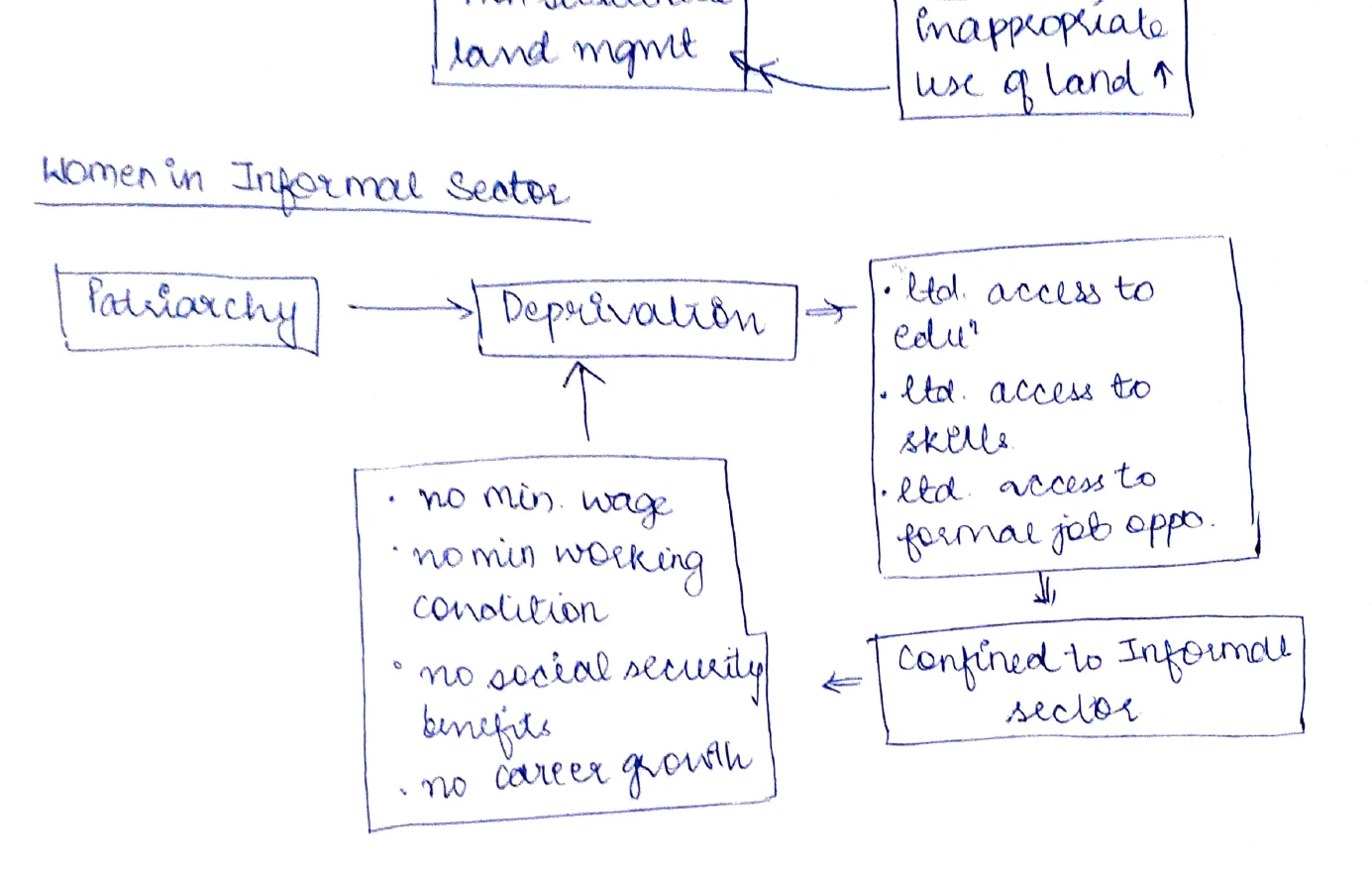
- Section heading: Women in Informal Sector
- Flow:
- Patriarchy → Deprivation
- → [ltd [limited] access to edu[cation]]
- → [ltd access to skills]
- → [ltd access to formal job opp[ortunities]]
- ↓ Confined to Informal sector
- Also feeding into Deprivation from below:
- No min[imum] wage
- No min[imum] working condition
- No social security benefit
- No career growth
- Bidirectional arrow: Deprivation ↔ [these conditions] (reinforcing loop)
- Patriarchy → Deprivation
#Diagram 3 — Indian Ocean Region Map (Strategic View)
Topic: International Relations / Geography — IOR
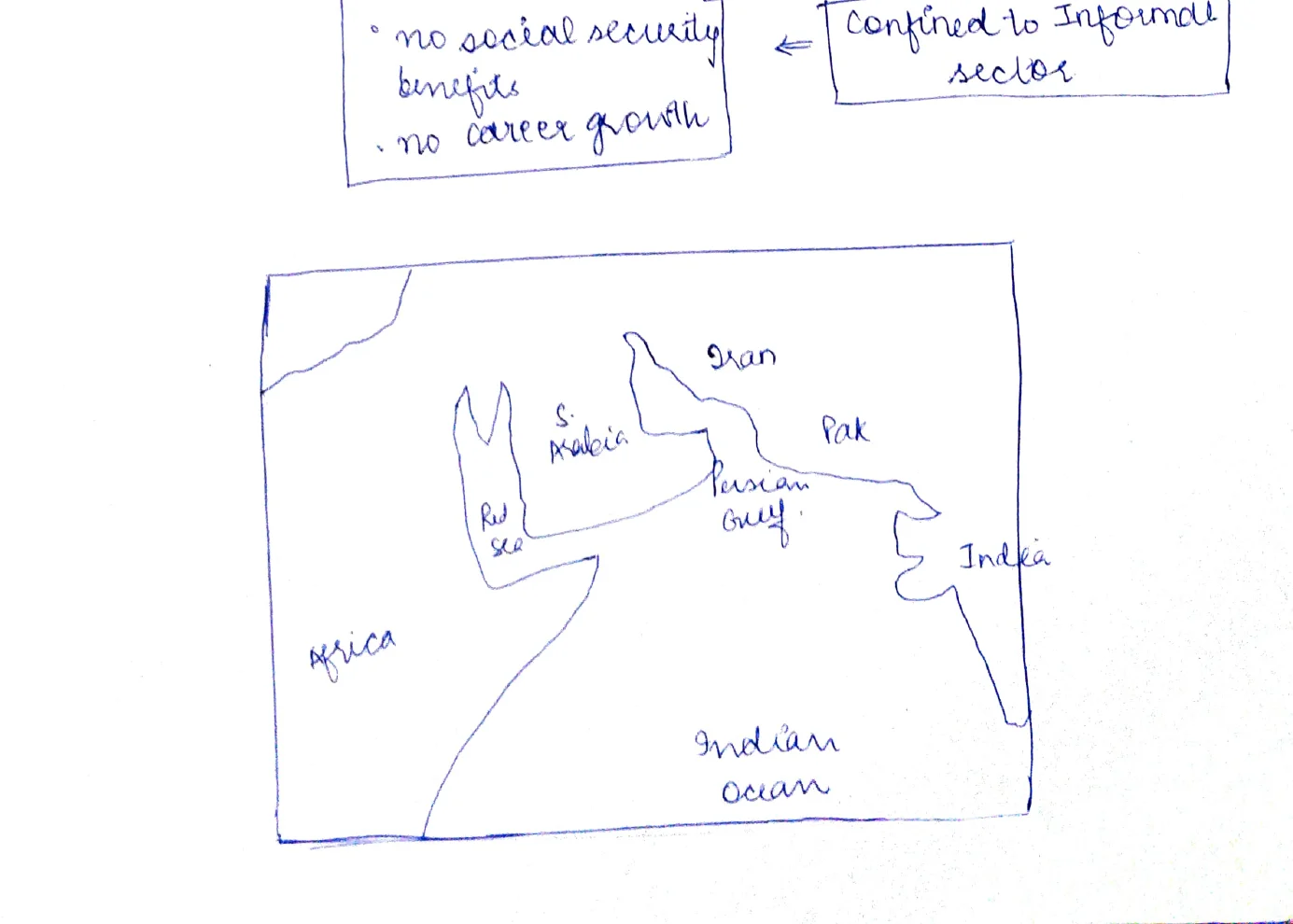
- Hand-drawn map of IOR showing:
- Africa (left)
- Arabia / Arabian Sea [label reads "S Arabia" — partial]
- Persian Gulf (centre-left — "Persian Gulf" label)
- Pak[istan] (upper centre)
- India (right)
- Indian Ocean (bottom, large label)
#Page 8
#Diagram 1 — Steps to Reduce IMR: Triangle / Pyramid
Topic: Health — Infant Mortality Rate / Maternal Health Schemes
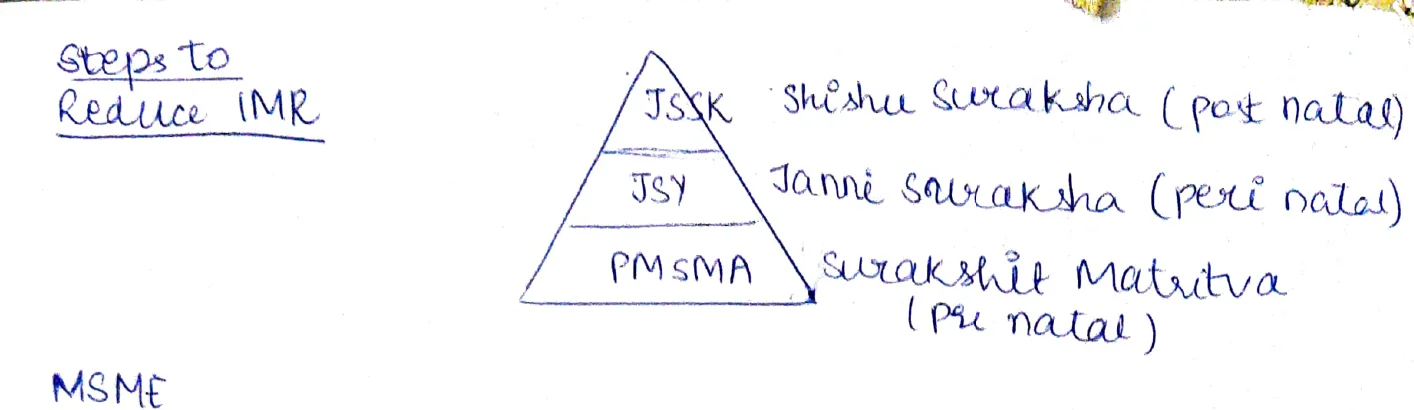
- Heading: Steps to Reduce IMR [Infant Mortality Rate]
- Triangle/pyramid (3 tiers, top to bottom):
- JSSK — Shishu Suraksha (post natal) [Janani Shishu Suraksha Karyakram]
- JSY — Janmi Suraksha (peri natal) [Janani Suraksha Yojana]
- PMSMA — Surakshit Matritva (pre natal) [Pradhan Mantri Surakshit Matritva Abhiyan]
#Diagram 2 — MSME Criteria Table (Matrix)
Topic: Economy — Micro Small Medium Enterprises
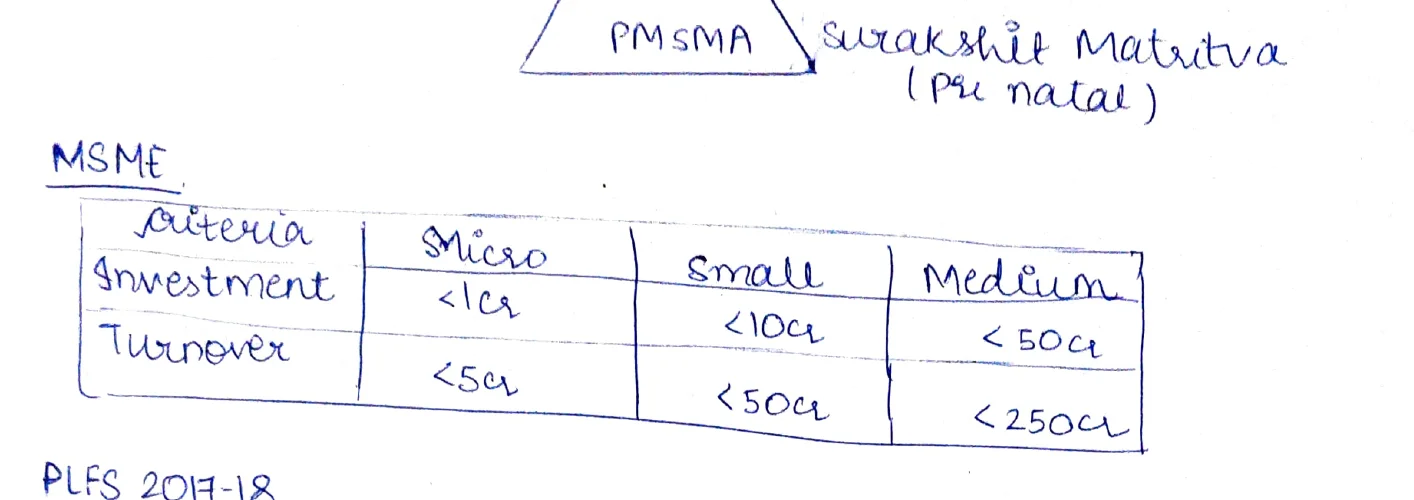
- Section heading: MSME
- Table (2 rows × 4 columns):
| Criteria | Micro | Small | Medium |
|---|---|---|---|
| Investment | < 1 cr | < 10 cr | < 50 cr |
| Turnover | < 5 cr | < 50 cr | < 250 cr |
#Diagram 3 — PLFS 2017–18: Employment Table (Data Table)
Topic: Economy — Labour Force / Employment Statistics
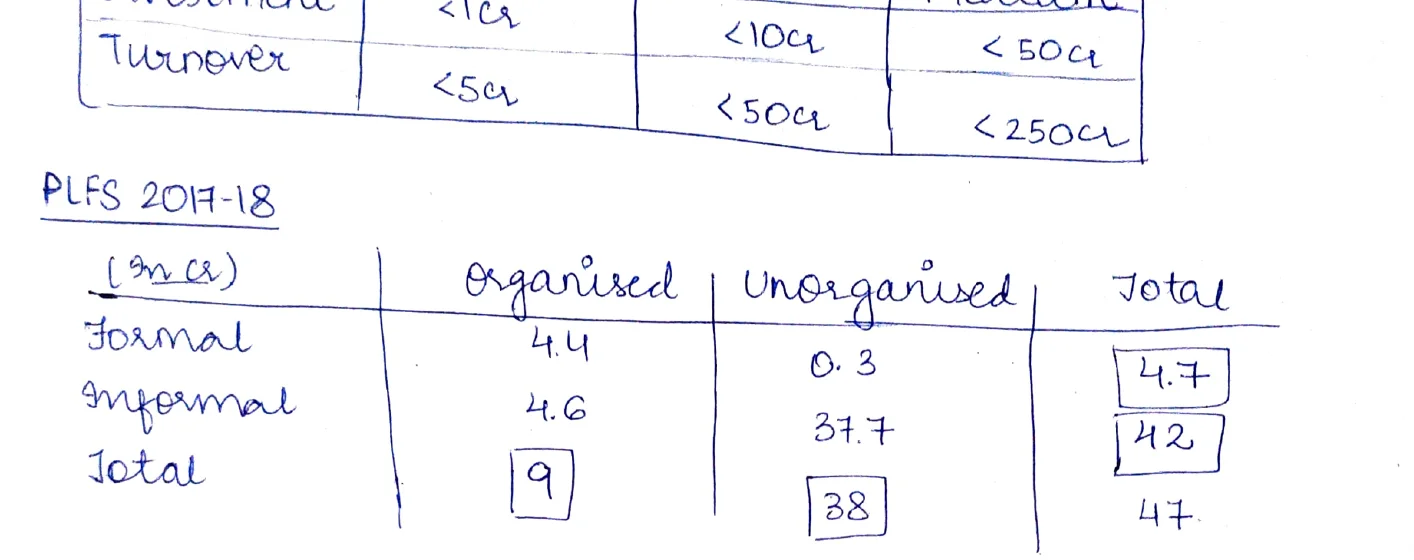
- Heading: PLFS 2017–18 [Periodic Labour Force Survey]
- Table (rows: formal/informal; columns: organised/unorganised/total) — values in crores:
| (in cr) | Organised | Unorganised | Total |
|---|---|---|---|
| Formal | 4.4 | 0.3 | 4.7 |
| Informal | 4.6 | 37.7 | 42 |
| Total | 9 | 38 | 47 |
#Diagram 4 — Ice Albedo Feedback: Positive Feedback Loop (Cycle)
Topic: Environment — Climate Change / Arctic
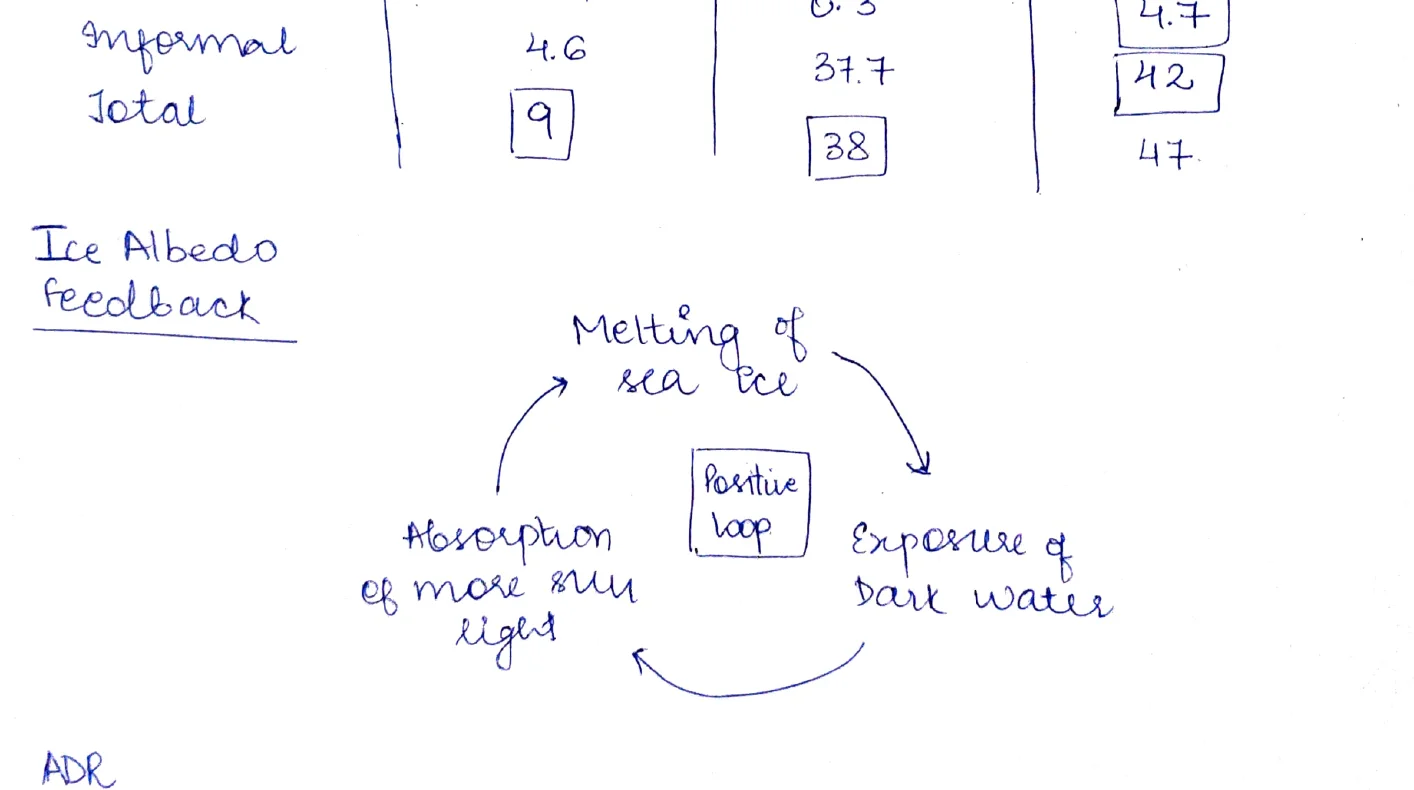
- Heading: Ice Albedo Feedback
- Circular positive feedback cycle (clockwise):
- Melting of sea ice
- → Exposure of bare water (dark surface)
- → Absorption of more solar light [less reflection]
- → centre: Positive loop (label in box)
- → back to Melting of sea ice
- Melting of sea ice
#Diagram 5 — ADR: Hub Diagram
Topic: Law / Governance — Alternative Dispute Resolution
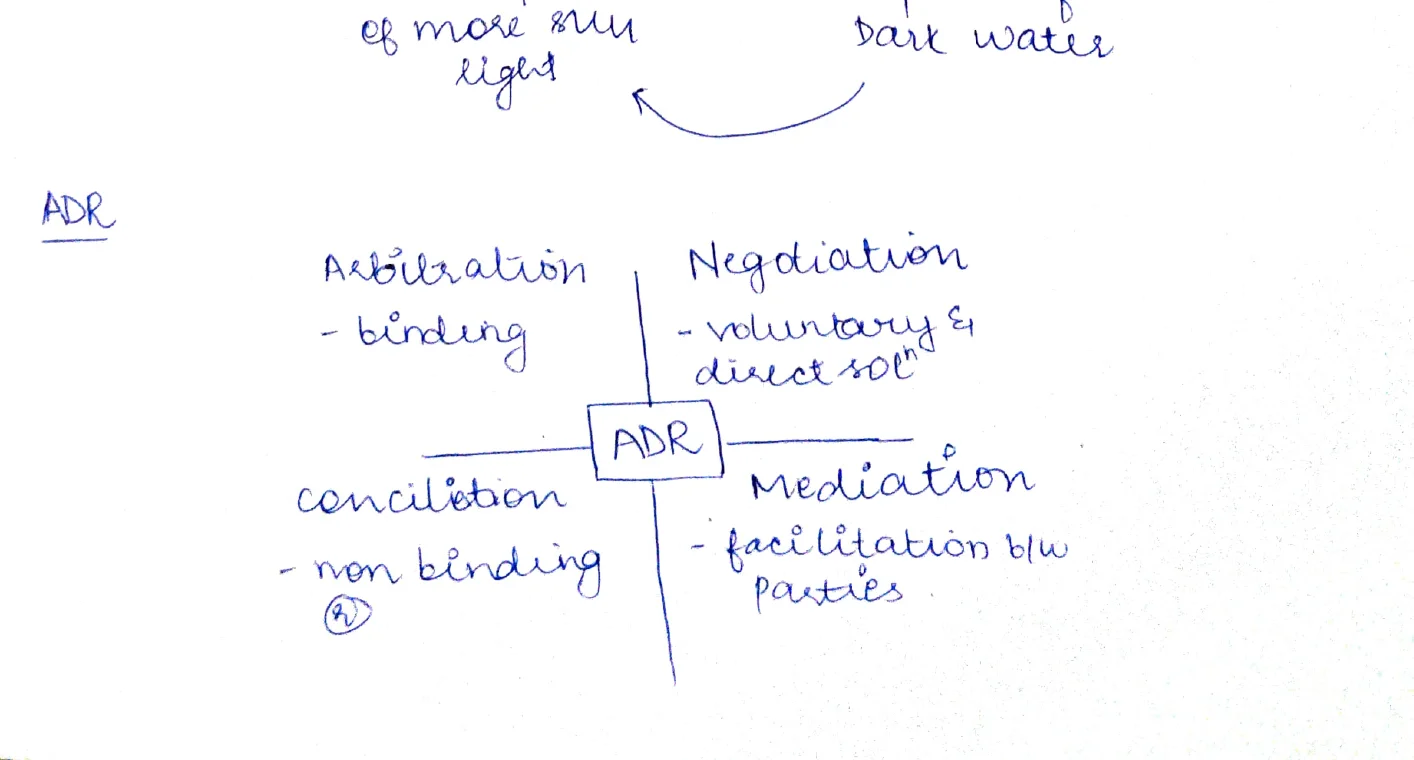
- Heading: ADR [Alternative Dispute Resolution]
- Central box: ADR
- Four spokes (two left, two right):
- Left spokes:
- Arbitration — binding
- Conciliation — non-binding ©
- Right spokes:
- Negotiation — voluntary & direct 1o1 [one-to-one]
- Mediation — facilitation b/w parties
- Left spokes:
#Page 9
#Diagram 1 — Mobile Users Bar Chart (Bar Chart)
Topic: Technology / Digital India — Mobile Penetration
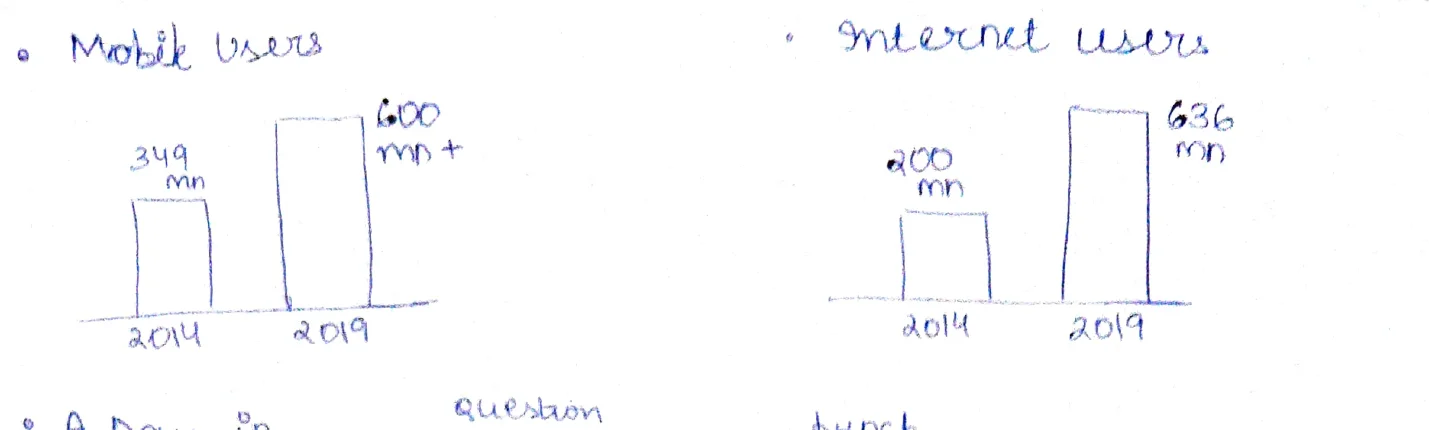
- Heading: Mobile Users
- Bar chart (2 bars):
- 2014: ~349 mn [million]
- 2019: ~600 mn+
- Y-axis: number (mn implied)
#Diagram 2 — Internet Users Bar Chart (Bar Chart)
Topic: Technology / Digital India — Internet Penetration
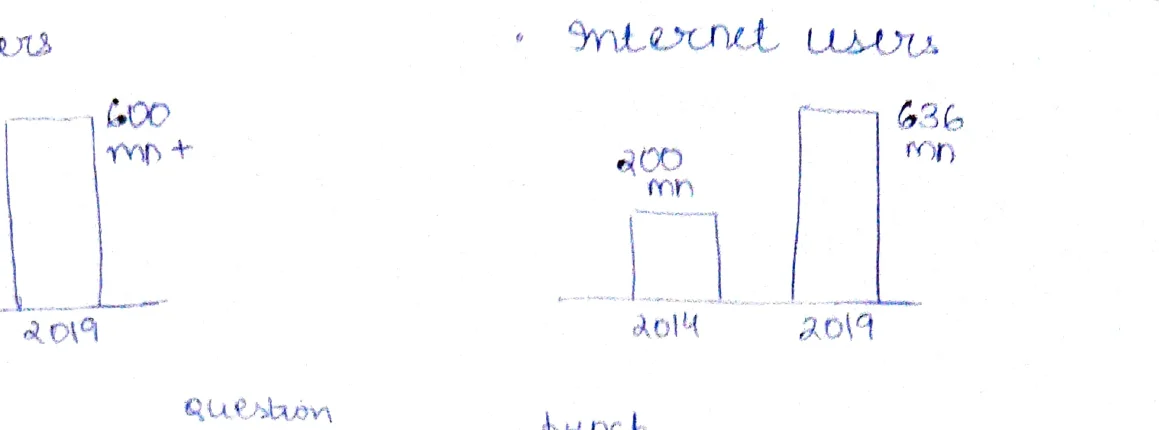
- Heading: Internet Users
- Bar chart (2 bars):
- 2014: ~400 mn
- 2019: ~636 mn
- Y-axis: number (mn implied)
#Diagram 3 — A Day in Parliament (Timeline)
Topic: Polity — Parliament / Legislative Process
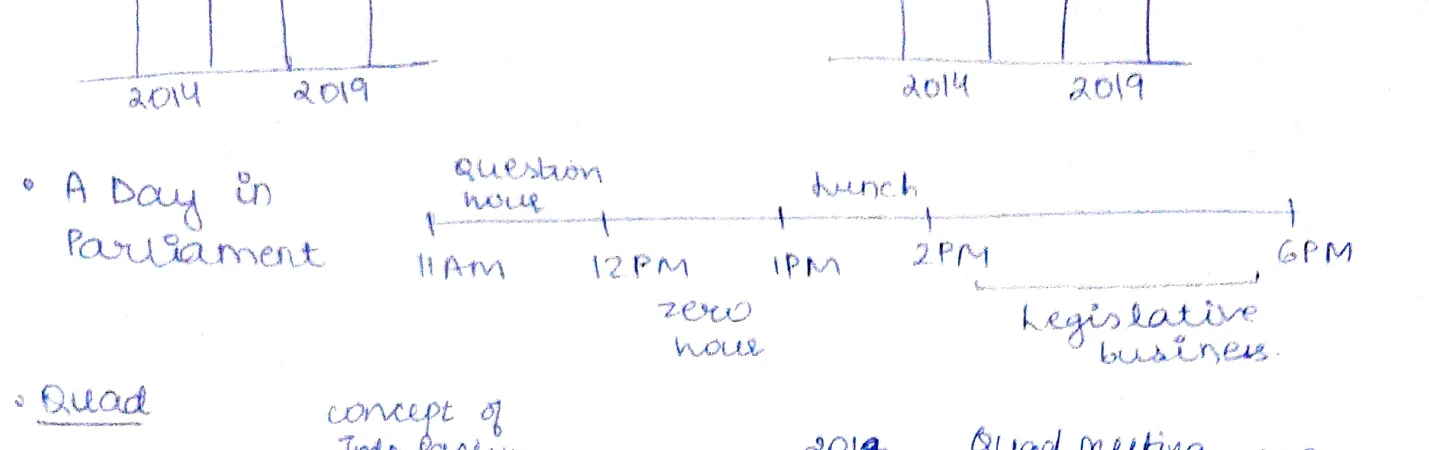
- Heading: A Day in Parliament
- Horizontal timeline (11am → 6pm):
- 11am — Question hour
- 12pm — Zero hour
- 1pm — [lunch break implied]
- 2pm — [illegible]
- 6pm — Legislative business
#Diagram 4 — Quad: History Timeline (Timeline)
Topic: International Relations — Quad / Indo-Pacific
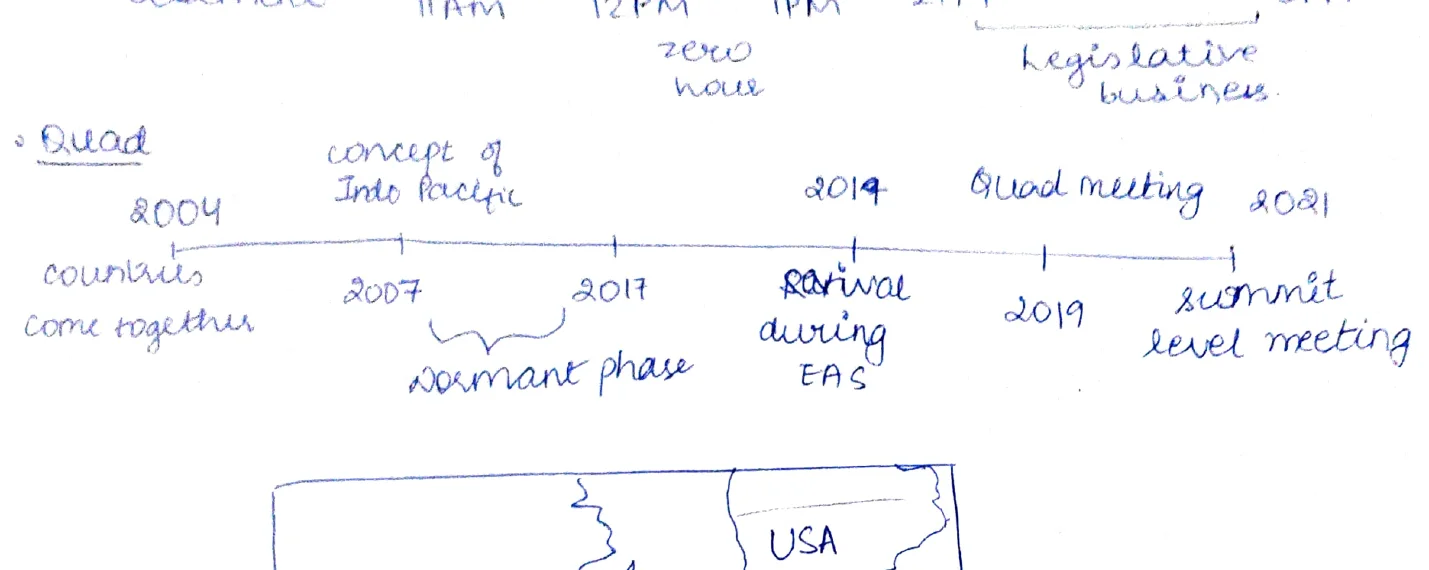
- Heading: Quad
- Concept of Indo Pacific
- Horizontal timeline:
- 2004 — Countries come together [post-tsunami humanitarian cooperation]
- 2007 — [Quad formed]
- 2007–2017 — Dormant phase
- 2017 — [Revival during EAS — East Asia Summit]
- 2019 — Revival during EAS [confirmed revival]
- 2019 — Quad meeting
- 2021 — Summit level meeting
#Diagram 5 — Quad Member Nations Map (Hand-drawn Map)
Topic: International Relations — Quad
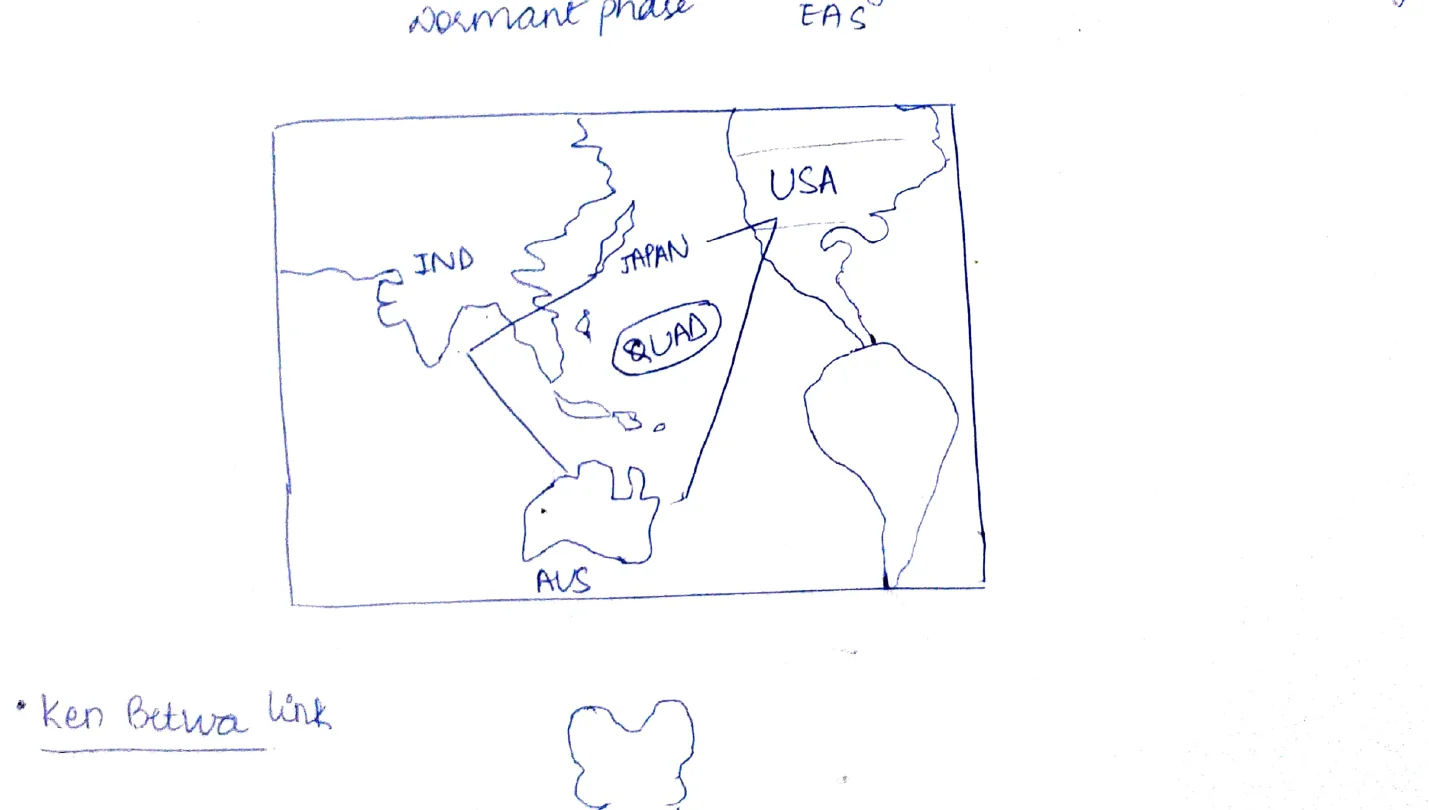
- Map showing four Quad members:
- USA (top-right — North America)
- IND [India] (centre-left)
- JPN [Japan] (centre)
- QLND [Queensland / Australia marked as "AUS"] (bottom)
- Also label: AUS [Australia] at bottom
#Diagram 6 — Ken–Betwa Link: Map of India (Hand-drawn Map)
Topic: Environment / Geography — Interlinking of Rivers
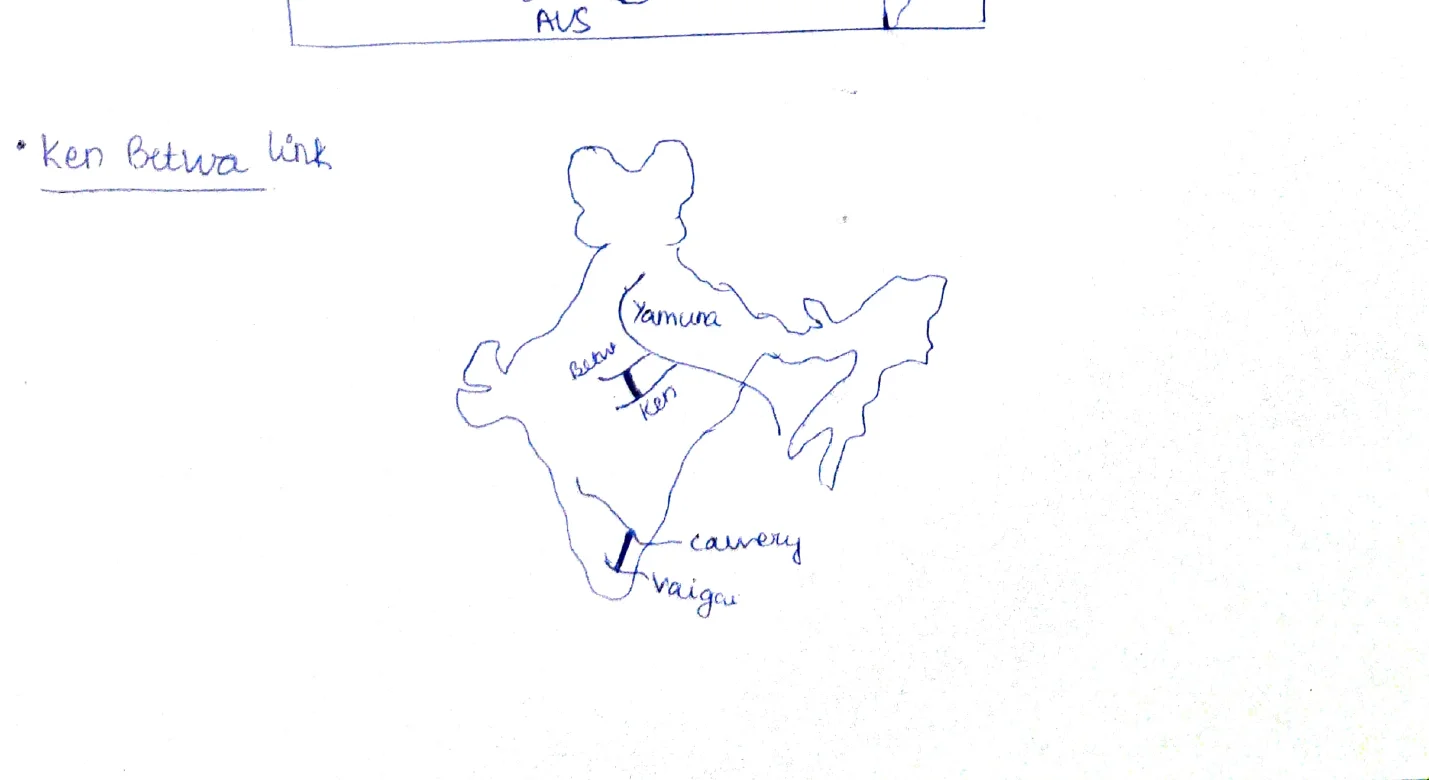
- Heading: Ken Betwa Link
- Outline map of India with rivers marked:
- Yamuna (north — label)
- Ken (central India — label "Ken" with arrow)
- Betwa (label with arrow — flows to join Yamuna)
- Cauvery (south — label)
- Vaig[ai] (south — label, partially [illegible])
#Page 10
#Diagram 1 — Flood Prone Areas of India (Map + Statistics)
Topic: Geography / Disaster Management — Floods
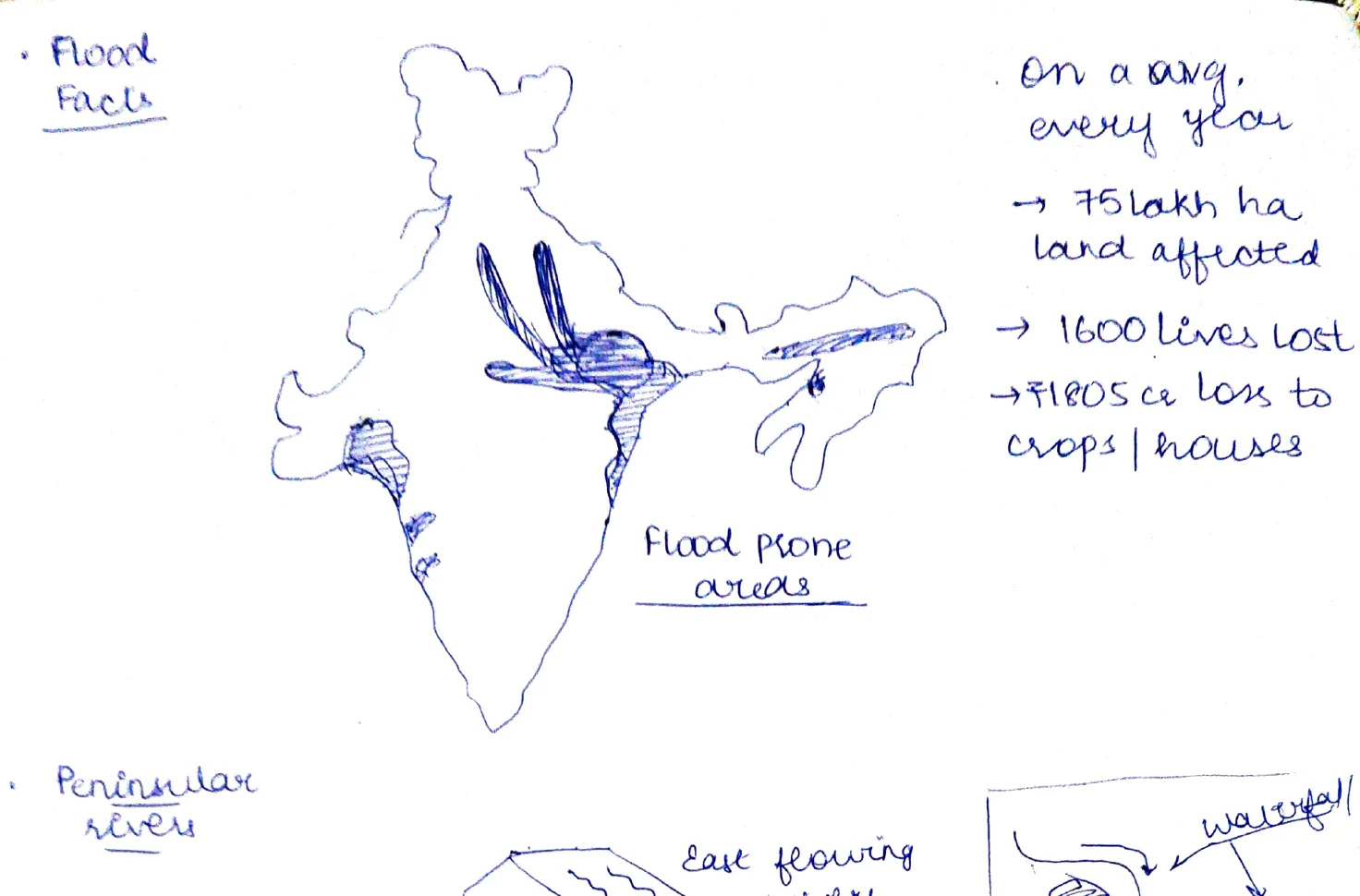
- Heading: Flood Facts
- Outline map of India with flood-prone areas marked (hatched/dotted region in northeastern + Gangetic areas)
- Label: Flood Prone Areas
- Statistics (right side):
- On a avg[erage], every year:
- → 75 lakh ha land affected
- → 1600 lives lost
- → ₹1805 cr loss to crops/houses
#Diagram 2 — Peninsular Rivers: Cross-section Diagrams
Topic: Geography — Peninsular Rivers
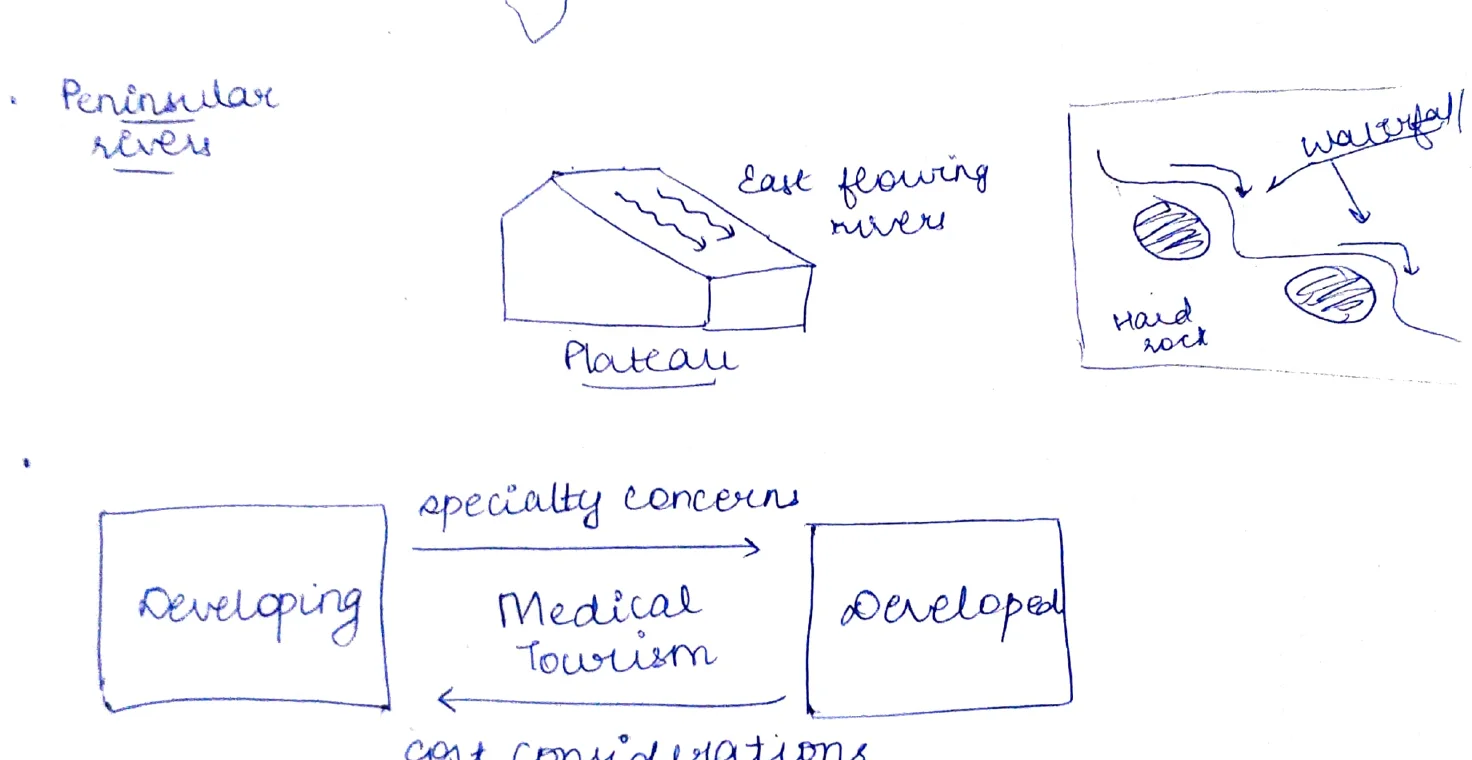
- Heading: Peninsular rivers
- Two small cross-section diagrams:
- Left diagram:
- Plateau (block shape)
- Label: East flowing rivers (arrow direction)
- Right diagram:
- Waterfall (arrow marked)
- Hard rock (label)
- Left diagram:
#Diagram 3 — Medical Tourism: Flow Between Developing & Developed Countries
Topic: Economy / Health — Medical Tourism
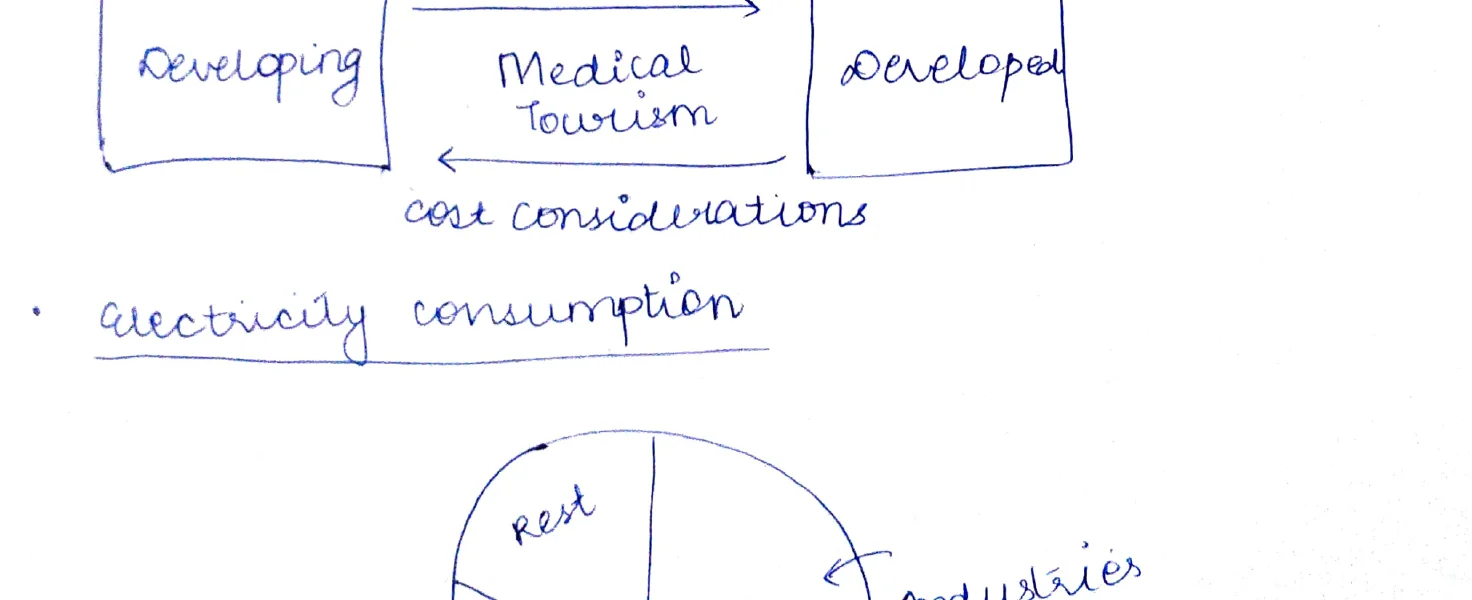
- Two-way flow diagram:
- Left box: Developing [countries]
- Centre box: Medical Tourism
- Right box: Developed [countries]
- Top arrow (L→R): Specialty concerns [developing to developed for specialty care]
- Bottom arrow (R→L): Cost considerations [developed to developing for cost savings]
#Diagram 4 — Electricity Consumption Pie Chart
Topic: Economy / Energy — Electricity Sector
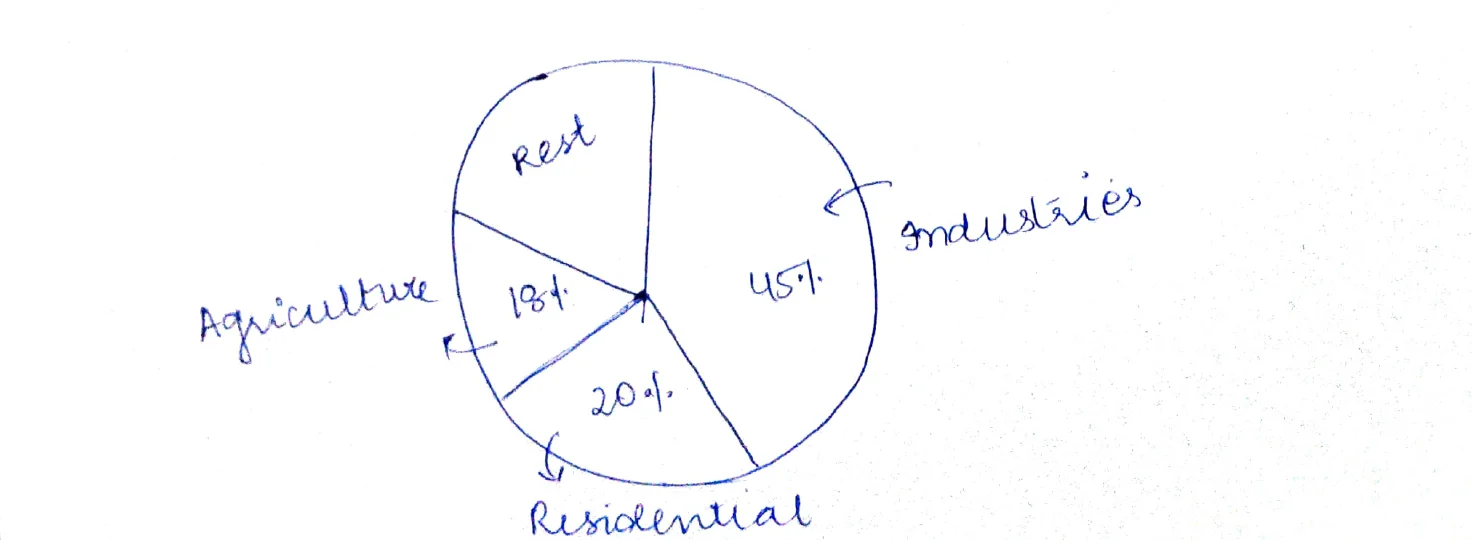
- Heading: Electricity consumption
- Pie chart segments:
- Industries: 45%
- Residential: 20%
- Agriculture: 19% [label reads "19%"]
- Rest: [remainder — implied ~16%]
#Page 11
#Diagram 1 — GDP Contribution: Sectoral Trend 1947–2018 (Line Chart)
Topic: Economy — Structural Change / Sectoral Composition
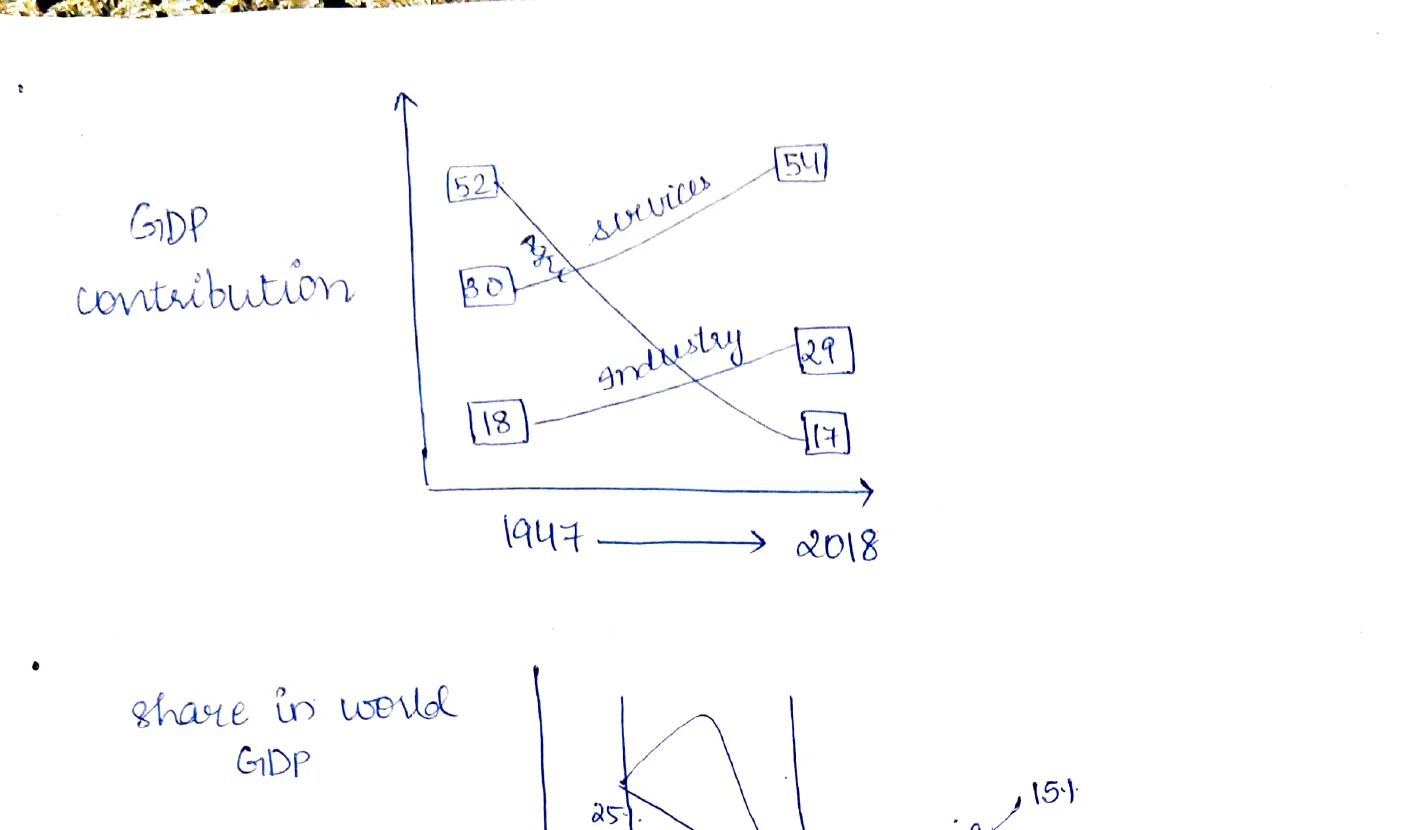
- Heading: GDP contribution
- X-axis: 1947 → 2018
- Y-axis: % share (implied)
- Two trend lines:
- Services:
- 1947: ~42% (boxed) [label "42"]
- 2018: ~54% (boxed) [label "54"] — upward trend
- Industry:
- 1947: ~18% (boxed) [label "18"]
- 2018: ~29% (boxed) [label "29"] — crossover / upward then stable
- Note: Agriculture line implied (not labelled separately) — declined from ~40% to ~17% (box "17" shown at bottom-right)
- Services:
#Diagram 2 — Share in World GDP: India & China 1750–2018 (Line Chart)
Topic: Economy / History — India's Economic Trajectory
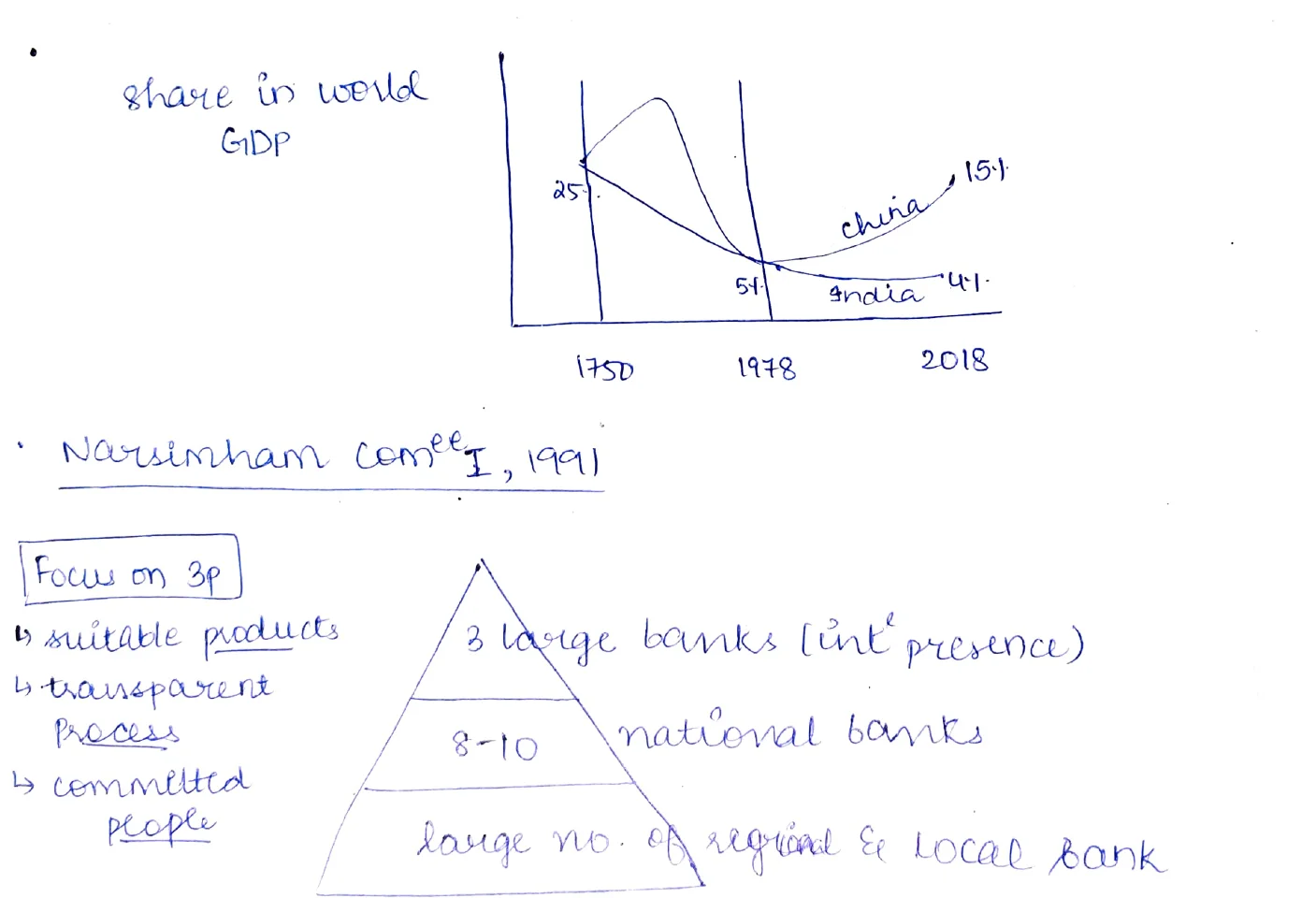
- Heading: Share in world GDP
- X-axis: 1750 → 1978 → 2018
- Y-axis: % share
- Two curves:
- China:
- 1750: ~25% → declines → 1978: low → 2018: ~15%
- India:
- 1750: ~25% → dramatic decline → 1978: ~5% → 2018: ~4%
- (India's decline sharper after colonisation)
- China:
#Diagram 3 — Narasimham Committee I (1991): Banking Pyramid
Topic: Economy — Banking Sector Reforms
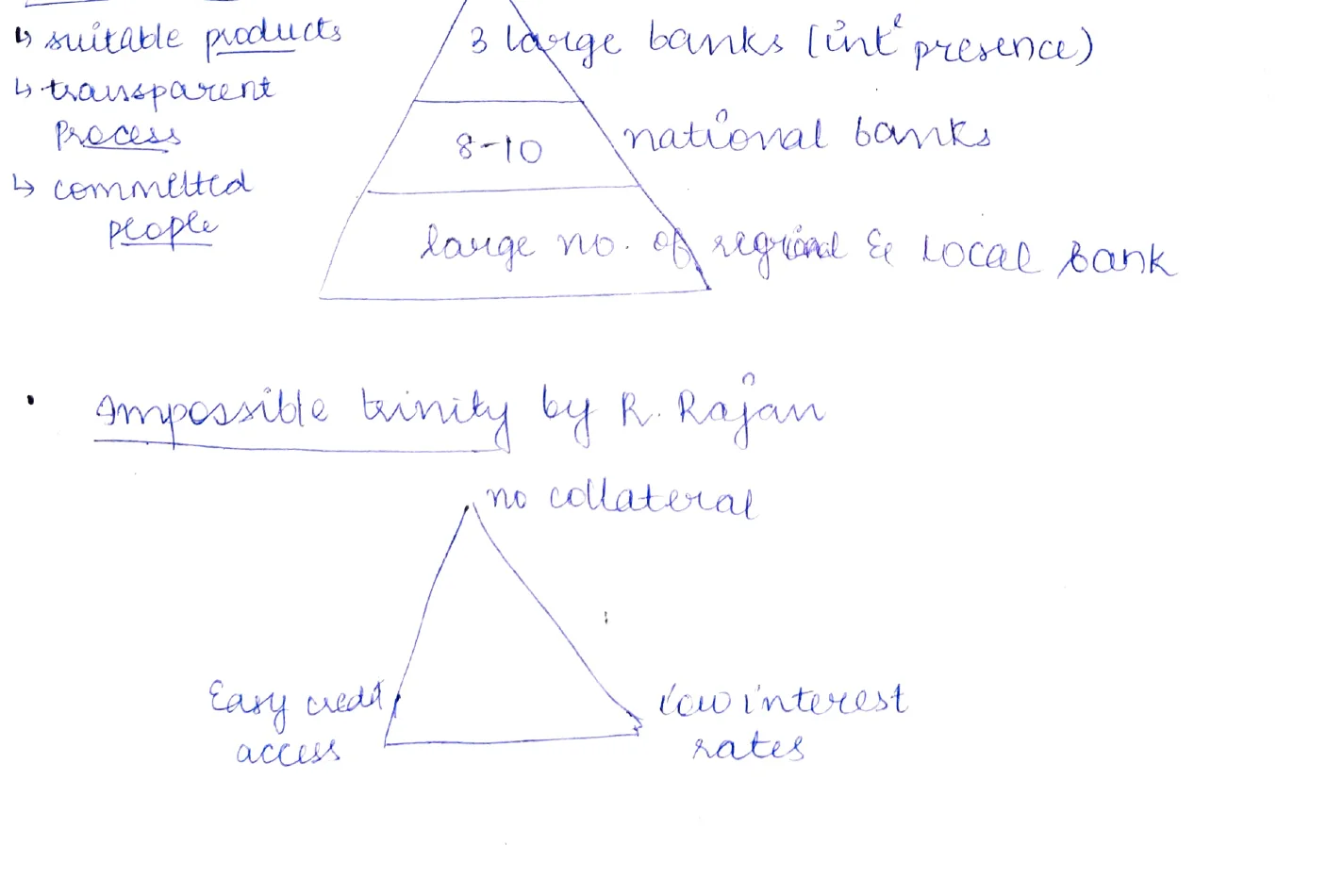
- Heading: Narasimham Comm[ittee] I, 1991
- Pyramid (3 tiers, top → bottom):
- Top tier: 3 large banks (int[ernational] presence)
- Middle tier: 8–10 national banks
- Base tier: Large no. of regional & local banks
#Page 12
#Diagram 1 — New Trilemma: Triangle Diagram
Topic: Economy / Finance — Central Banking / Monetary Policy
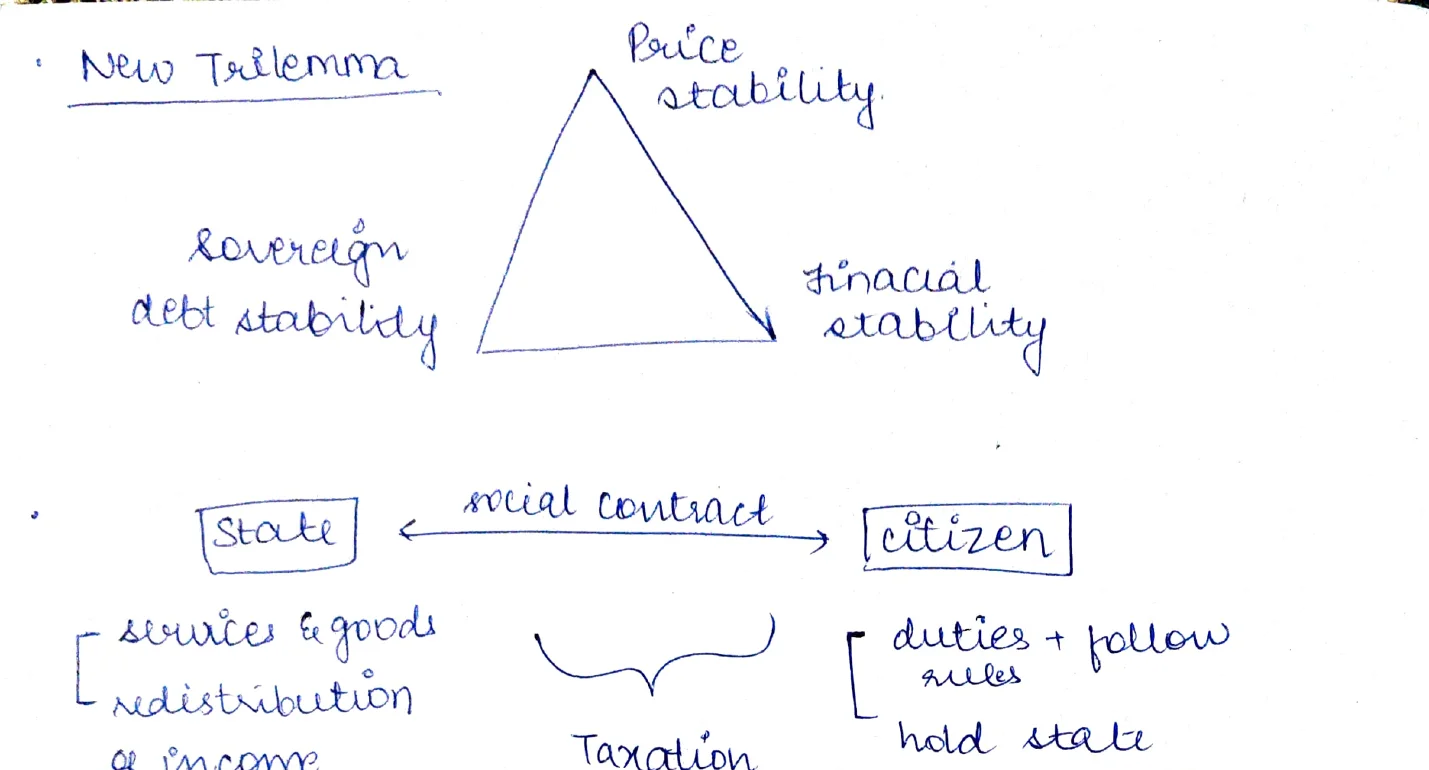
- Heading: New Trilemma
- Triangle with three corners:
- Price stability (apex/top)
- Sovereign debt stability (bottom-left)
- Financial stability (bottom-right)
#Diagram 2 — State ↔ Citizen: Social Contract (Hub Diagram)
Topic: Polity / Governance — Social Contract / Taxation
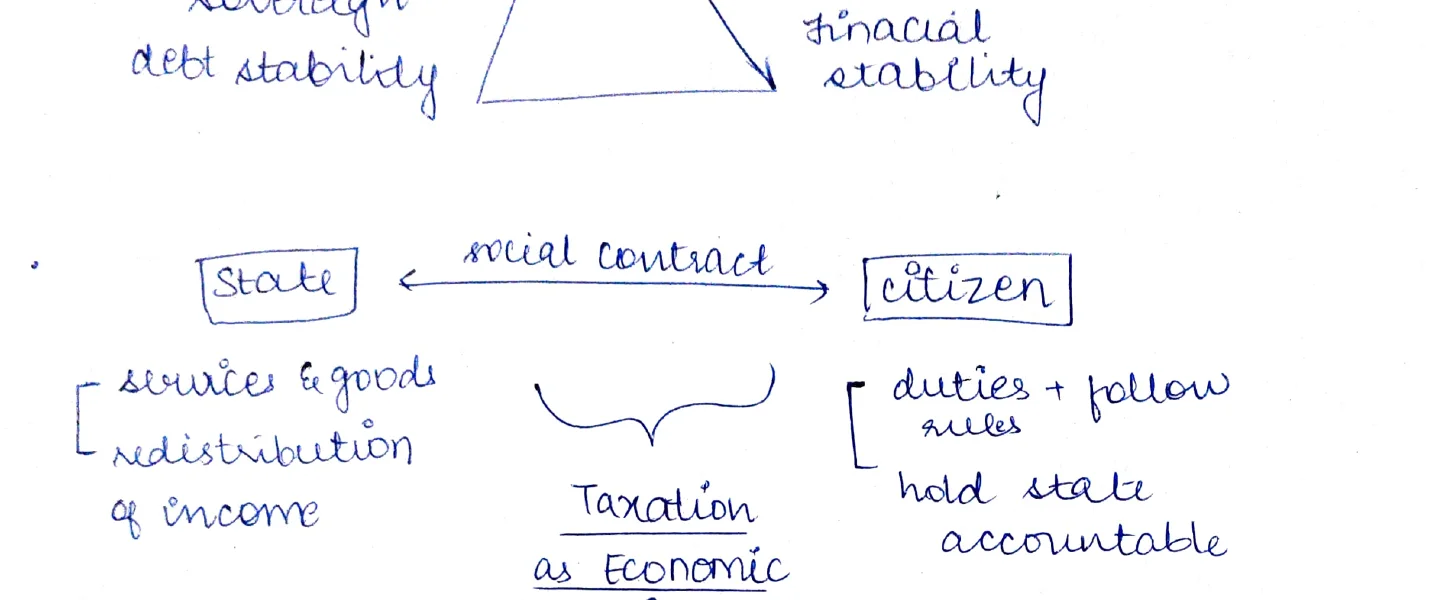
- Two outer boxes connected by Social contract arc:
- State (left box):
- Services & goods redistribution of income
- Citizen (right box):
- Duties + follow rules
- Hold state accountable
- State (left box):
- Centre label: Taxation as Economic Glue
#Diagram 3 — 4Cs of Skill India Mission (Hub Diagram)
Topic: Economy / Governance — Skill Development
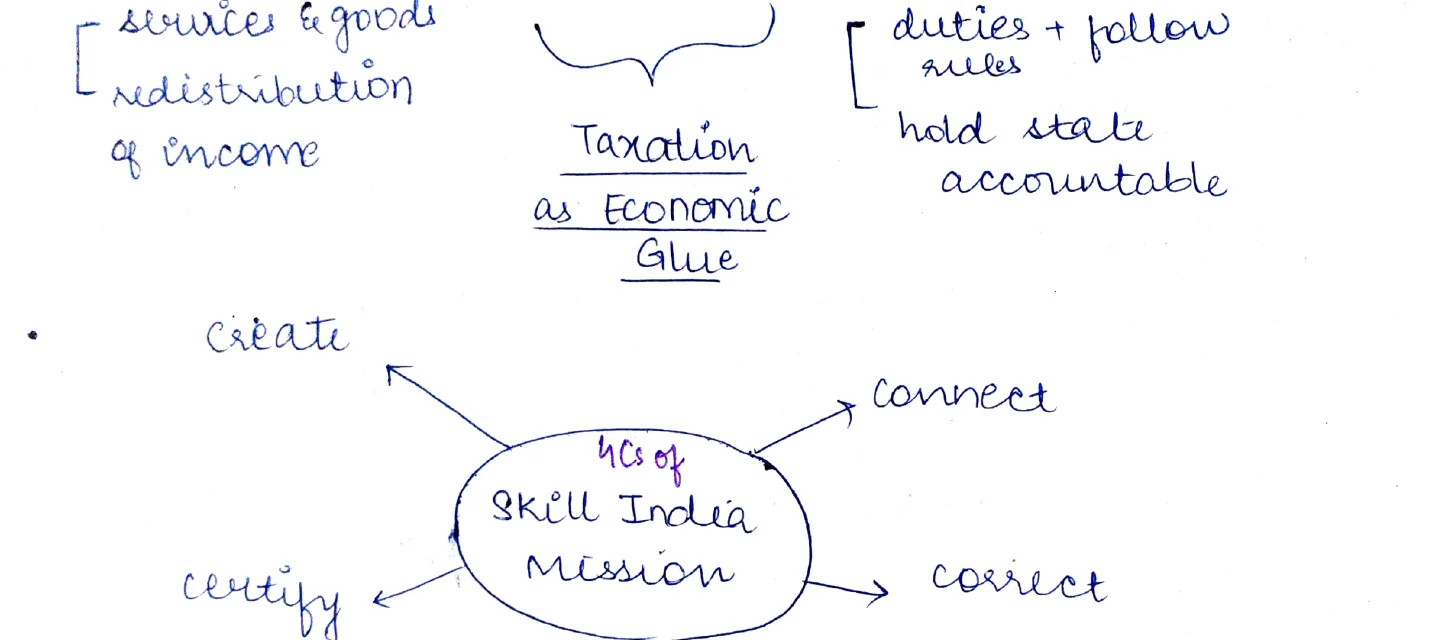
- Central oval: 4Cs of Skill India Mission
- Four spokes:
- Create (top-left)
- Connect (top-right)
- Correct (bottom-right)
- Certify (bottom-left)
#Diagram 4 — Kashmir Problem: Triple Venn + Identity Crisis Flow
Topic: Internal Security / Social Issues — Kashmir
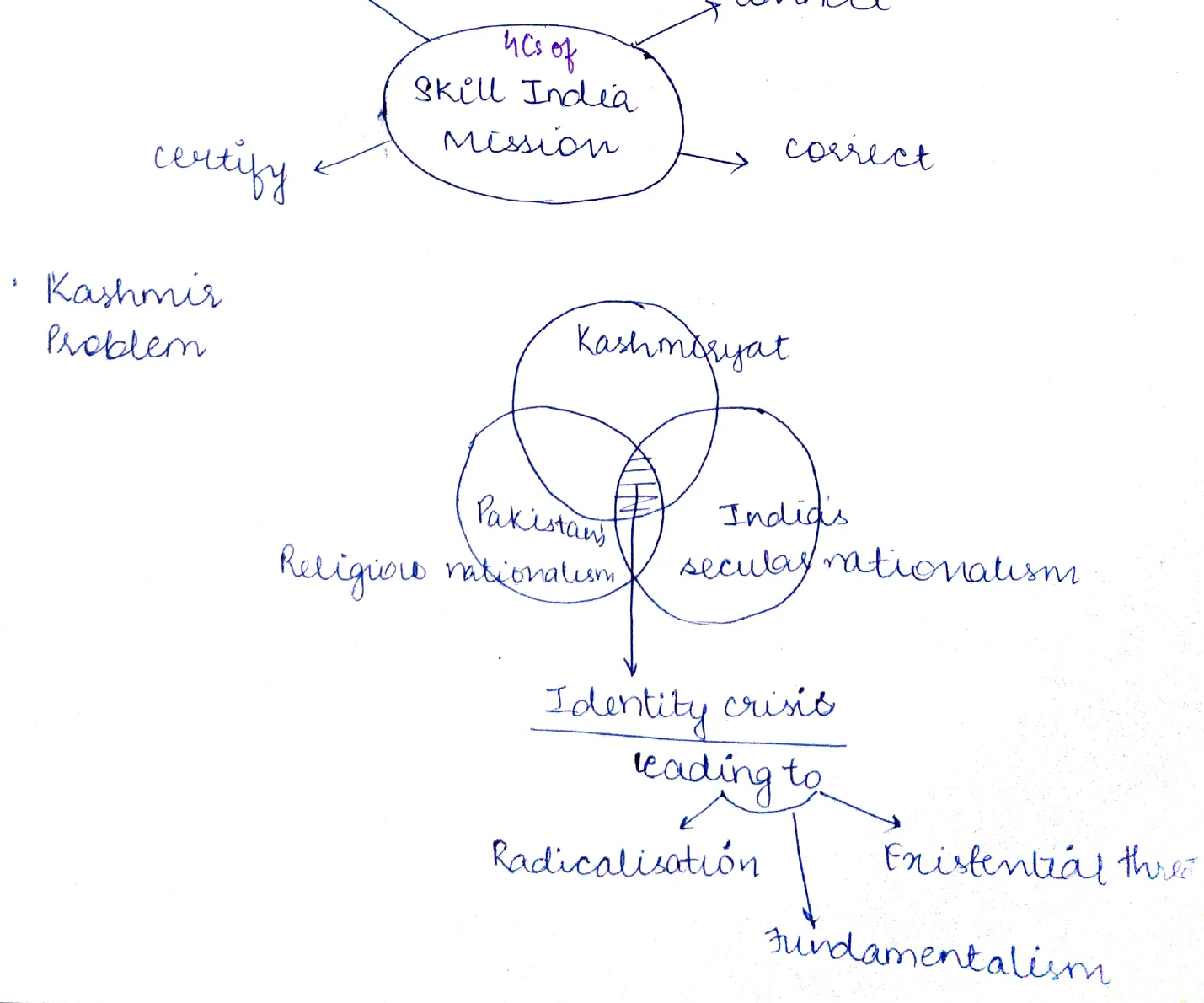
- Heading: Kashmir Problem
- Triple Venn diagram (three overlapping circles):
- Kashmiriyat (top circle — Kashmiri cultural identity)
- Pakistan / Religious nationalism (bottom-left circle)
- India / Secular nationalism (bottom-right circle)
- Overlap of all three at centre
- Below the Venn — downward flow:
- Identity crisis
- leading to:
- Radicalisation
- Existential thr[eat] [Existential Threat]
- Fundamentalism (bottom)
- leading to:
- Identity crisis
#Page 13
#Diagram 1 — Tribals: Assimilated / Integrated / Isolated (Map Diagram)
Topic: Social Issues / Governance — Tribal Policy
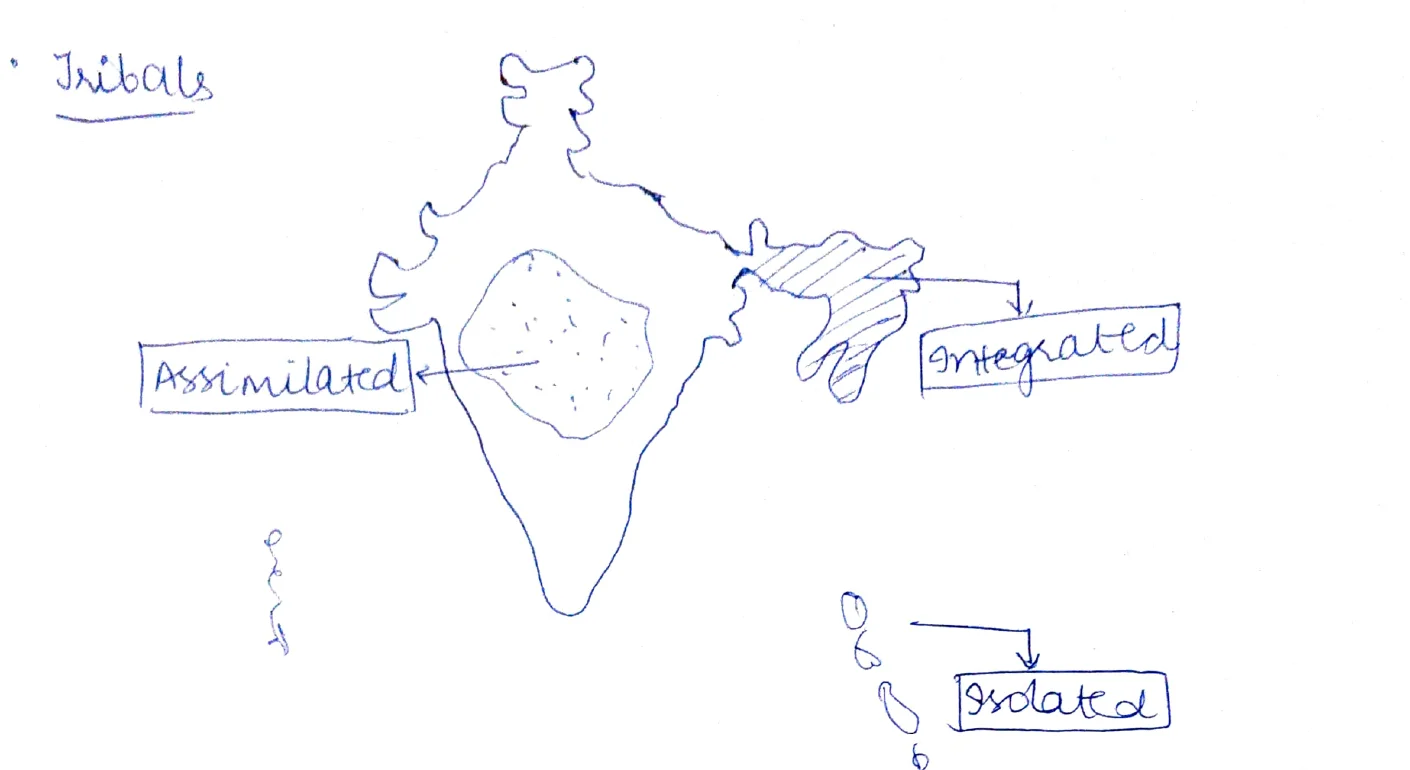
- Heading: Tribals
- Outline map of India:
- Centre (hatched region): Assimilated ← (arrow + box label) — tribal heartland integrated into mainstream
- North-East (hatched): Integrated → (box label on right)
- Islands below (Andaman implied, small shapes): Isolated → (box label on right)
#Diagram 2 — Issues with Sec 69 of IT Act: Three-Dimension Hub
Topic: Governance / Law — Cyber Law / Surveillance
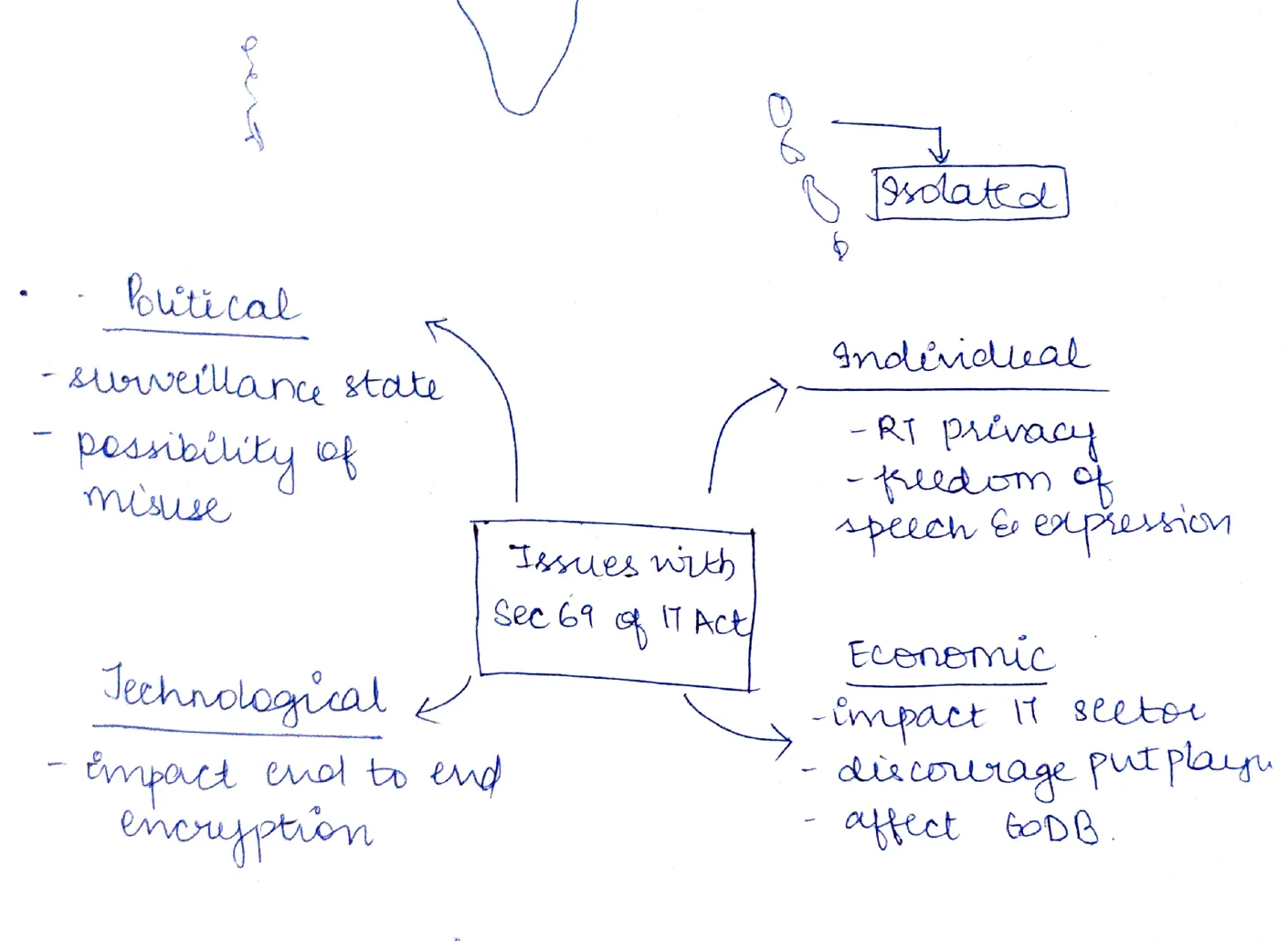
- Central box: Issues with Sec 69 of IT Act
- Three radiating dimension clusters:
- Political (top-left):
- Surveillance state
- Possibility of misuse
- Individual (top-right):
- Rt [Right to] privacy
- Freedom of speech & expression
- Technological (bottom-left):
- Impact [on] end to end encryption
- Economic (bottom-right):
- Impact IT sector
- Discourage pvt players
- Affect [G]DDB [illegible — possibly "GDDB" or "GDR"]
- Political (top-left):
#Diagram 3 — CPEC / BCIM / IOR Map + Alfred Mahan Quote
Topic: International Relations — Indian Ocean / China / Connectivity
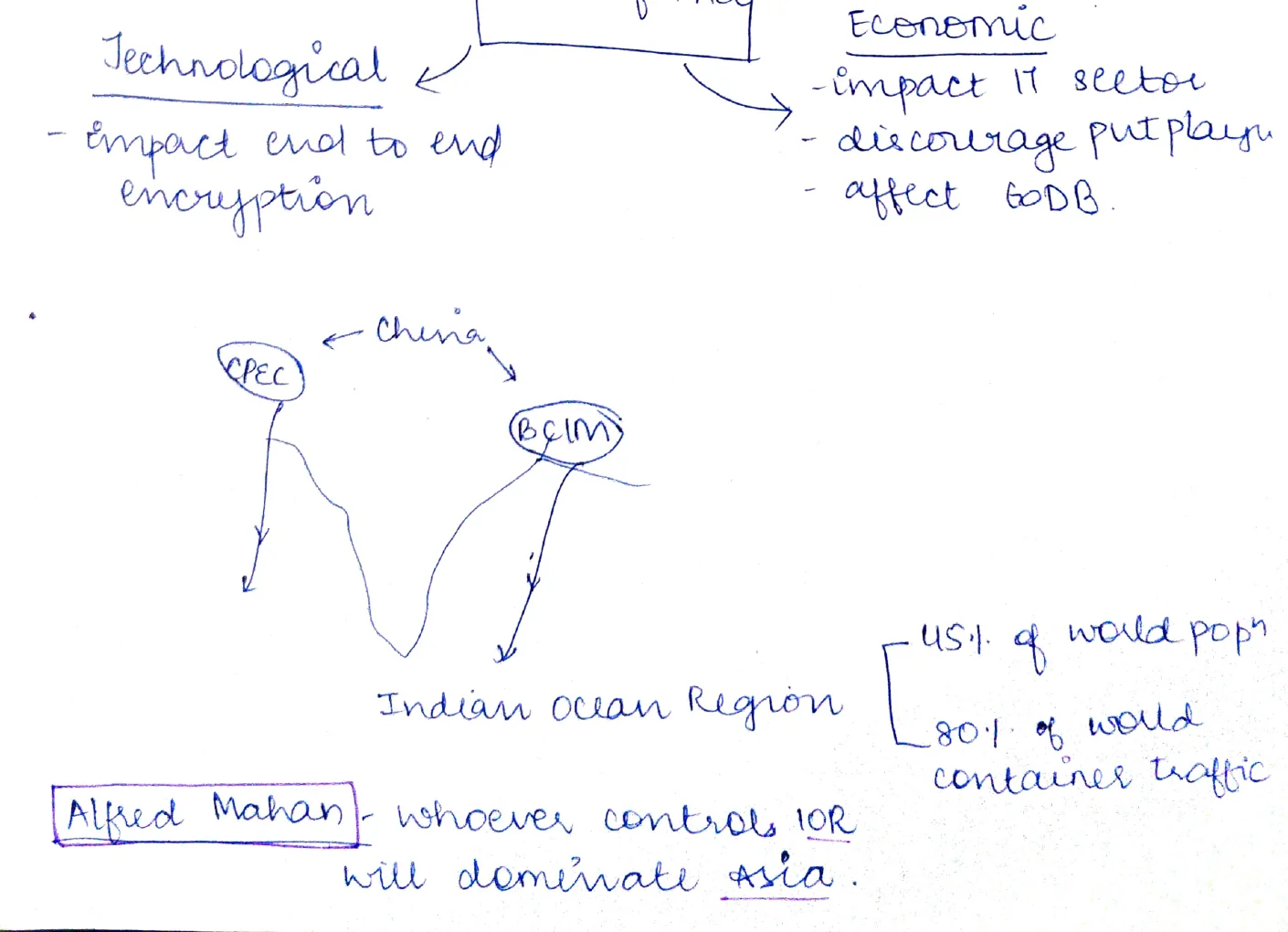
- Map of Indian Ocean Region showing:
- China ← (arrow label, top-right)
- CPEC [China–Pakistan Economic Corridor] (oval label, upper centre)
- BCIM [Bangladesh–China–India–Myanmar] (oval label, centre)
- Arrows suggesting connectivity routes from China through South Asia into IOR
- Indian Ocean Region (bottom caption)
- Statistics noted (right):
- 45% of world pop[ulation]
- 80% of world container[s] traffic
- Boxed quote (bottom-left):
- Alfred Mahan — "Whoever controls IOR [Indian Ocean Region] will dominate Asia"
#Page 14 — Diagram 1: Low Child Sex Ratio — Consequences Cycle (Social Issues / GS Paper 1)
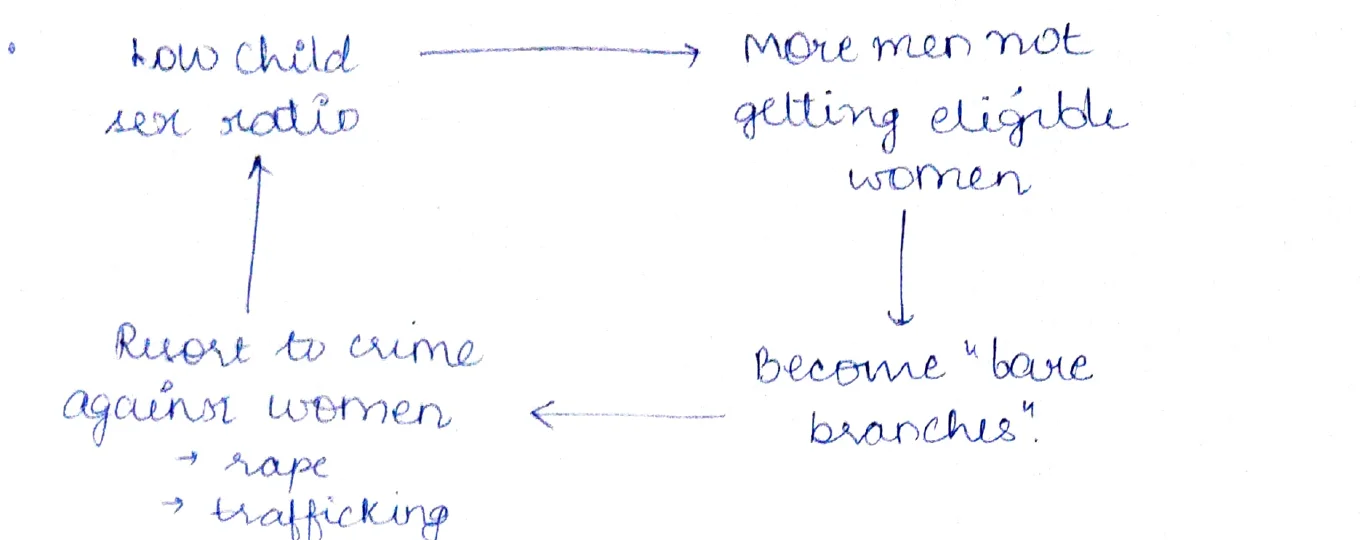
- Topic: Impact of low child sex ratio
- Flow (clockwise cycle):
- Low child sex ratio → (arrow right) More men not getting eligible women
- → (arrow down) Become "bare branches" [men with no family/social stake]
- → (arrow left) Resort to crime against women
- → rape
- → trafficking
- → (arrow up, back to) Low child sex ratio [reinforcing cycle]
- Low child sex ratio → (arrow right) More men not getting eligible women
#Page 14 — Diagram 2: Sex Ratio & Child Sex Ratio Trend Graph (Social Issues / GS Paper 1)
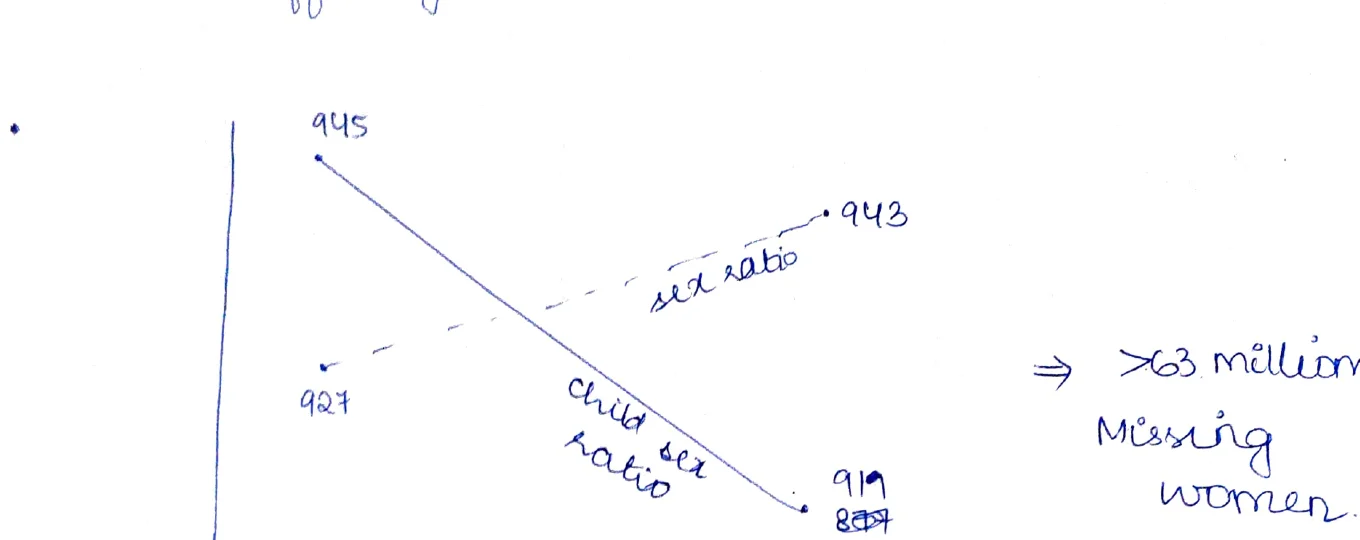
- Topic: Sex ratio trends in India
- X-axis: years — 1991, 2010, 2011 [axis label partially cut; approx. 2010/2011]
- Y-axis: ratio (females per 1000 males)
- Two lines plotted:
- Sex ratio (dashed line, higher): 927 (1991) → 943 (2011)
- Child sex ratio (solid declining line): 945 (1991) → 919 / 887 (2011) [two data points shown near bottom]
- Label on line: "child sex ratio"
- Note to the right: → >63 million Missing women
#Page 14 — Diagram 3: Economic Discrimination of Women — Venn Diagram (Social Issues / GS Paper 1)
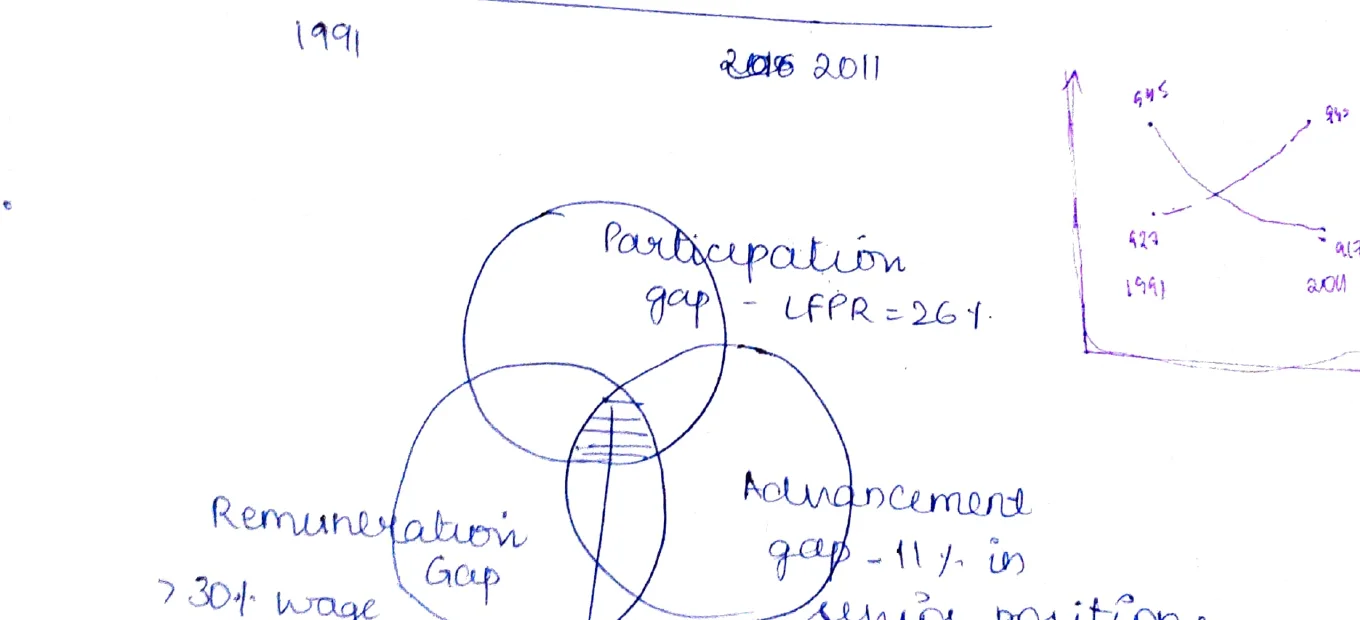
- Topic: Three overlapping causes of economic discrimination of women
- Three overlapping circles (Venn):
- Participation gap — LFPR [Labour Force Participation Rate] = 26.1%
- Advancement gap — 11% in senior positions
- Remuneration gap — >30% wage gap
- All three overlap → downward arrow → box: Economic discrimination of women
- Small graph inset (top right corner, partially visible): appears to show declining/crossing trend lines with years [details illegible]
#Page 15 — Diagram 1: E-Waste Stakeholder Chain (Environment / GS Paper 3)
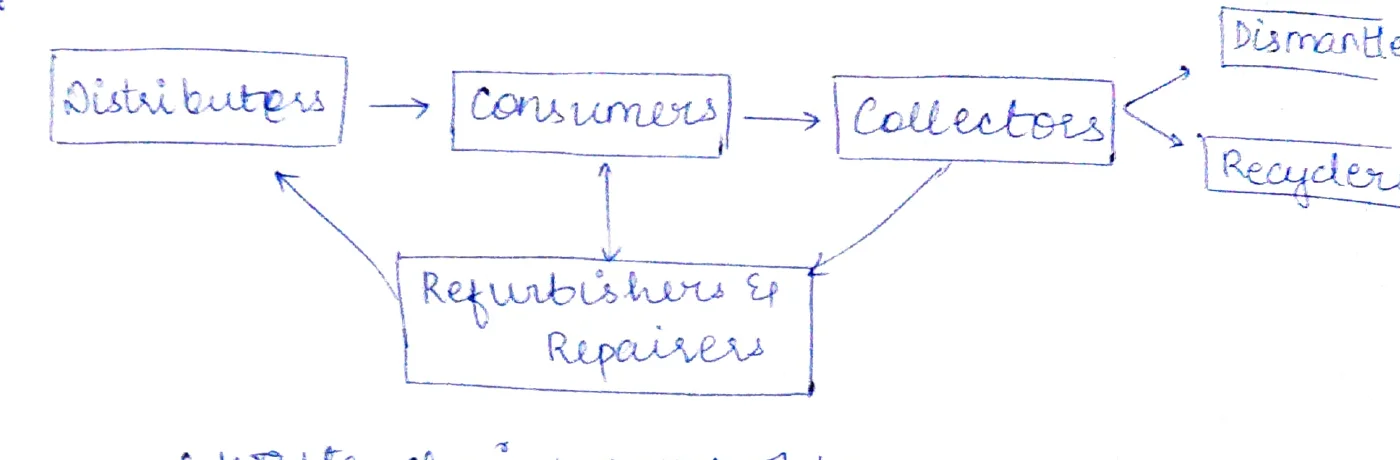
- Topic: E-waste chain / stakeholders
- Flow diagram (left to right):
- Distributors → Consumers → Collectors → branches to:
- Dismantler
- Recyclers
- Refurbishers & Repairers (below Consumers, with back-arrow from Consumers)
- Distributors → Consumers → Collectors → branches to:
- Notes below diagram:
- E-waste chain / stakeholders
- Less than 5% recycled in India formally
#Page 15 — Diagram 2: Solutions for E-Waste Problems (Environment / GS Paper 3)
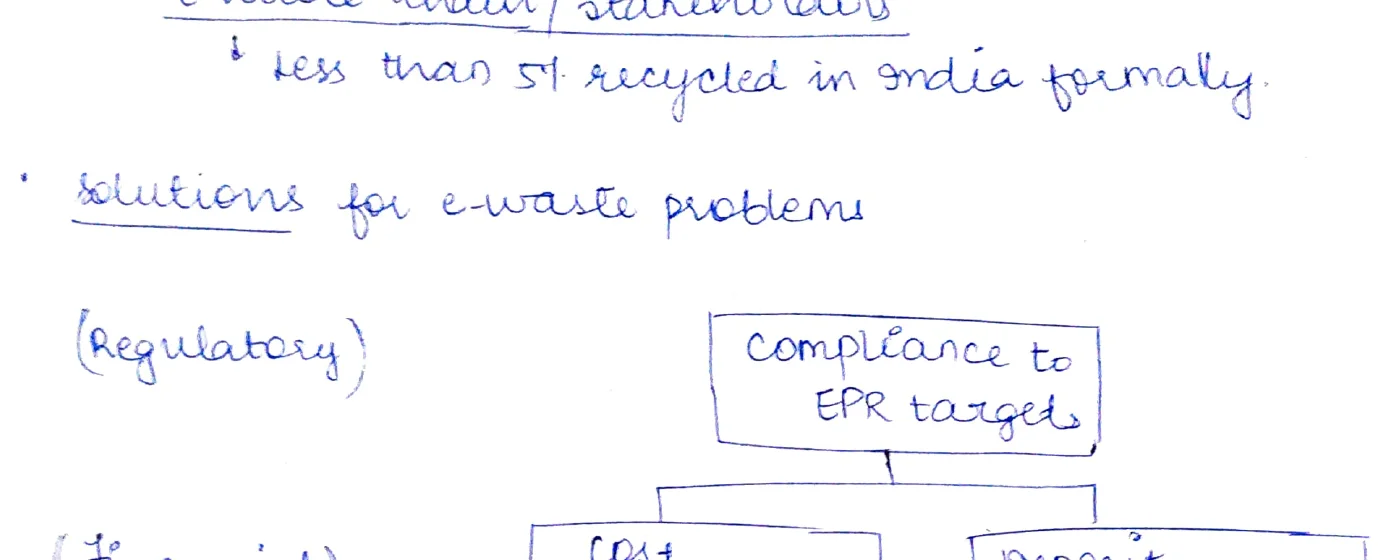
- Topic: Solutions for e-waste problems — three categories
- (Regulatory) → Compliance to EPR [Extended Producer Responsibility] targets
- (Financial)
- Cost optimisation
- Deposit Refund System
- (Technical)
- Decentralise recycling capacities
- Resource efficient designs
- Channelising waste from communities
#Page 15 — Diagram 3: NbS [Nature-based Solutions] / Nexus Flow Diagrams & Venn Circles (Environment / GS Paper 3)
- Topic: Nature-based solutions / inter-sector nexus linkages (multiple sub-diagrams)
- Sub-diagram A — flow (top portion):
- Terrorist sign [demand-side node] → Bg goal [broader goal] → INNS [Invasive Non-Native Species? or other abbreviation; partially legible]
- → (arrow right) Loss of finances of data [illegible] / Steep [illegible]
- TC group → Material disruption → New production
- → (dashed arrow right, same consequence box)
- Terrorist sign [demand-side node] → Bg goal [broader goal] → INNS [Invasive Non-Native Species? or other abbreviation; partially legible]
- Sub-diagram B — Venn circles (bottom portion), 4 overlapping circles showing types of NbS relationships:
- Circle 1 (bottom left): Drugs / Human body → label: Nt relationship [Natural relationship]
- Circle 2: [illegible] / Terres[trial] → label: Operational [illegible]
- Circle 3 (centre, two overlapping): Drugs / Terres / Human traits → label: Operational [illegible] / Alliance [illegible]
- Circle 4 (bottom right): Drugs / Terres / Human [illegible] → label: Convergence [illegible]
- [Several labels partially illegible due to handwriting density]
#Page 16 — Diagram 1: Rural-Urban Divide Table & Stepped Urban/Rural Migration (Geography / GS Paper 1)
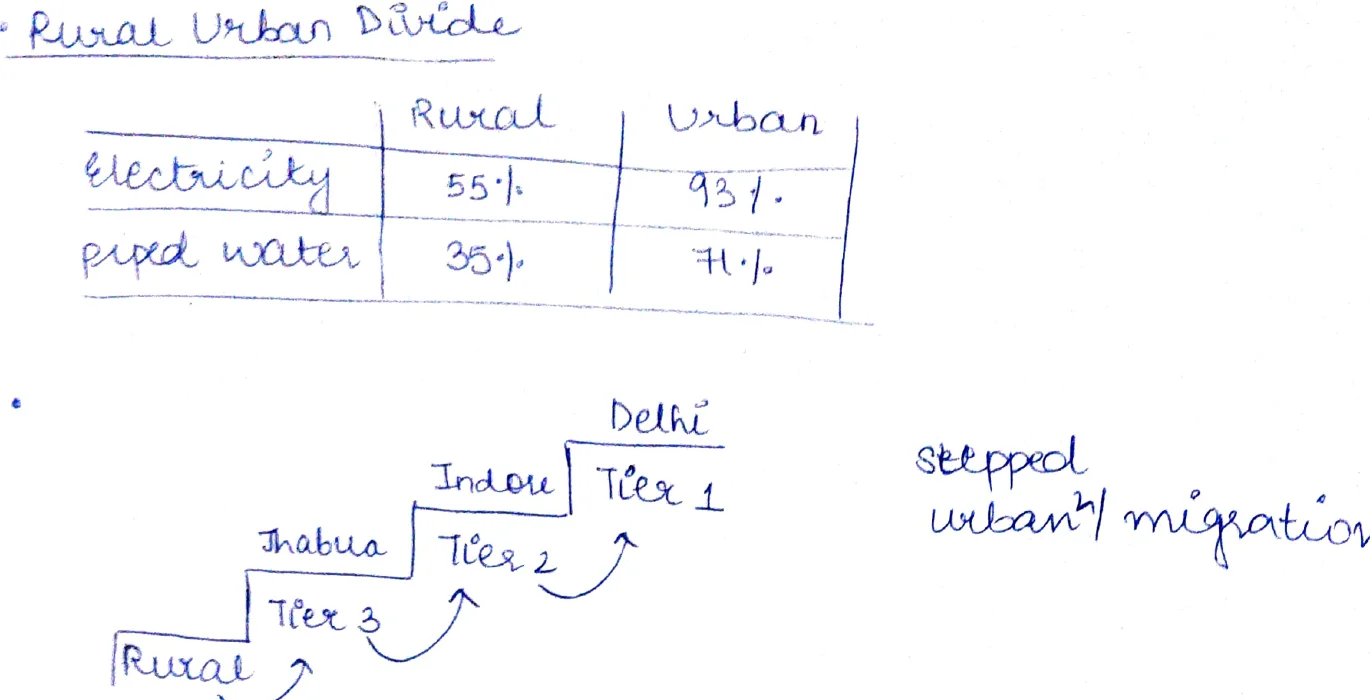
-
Topic: Rural-Urban Divide in India
-
Table — Rural Urban Divide:
Parameter Rural Urban Electricity 55% 93% Piped water 30% 71% -
Stepped urban/rural migration diagram:
- Hierarchy shown top-down:
- Delhi
- India / Tier 1 (city level)
- [illegible] / Tier 2 (↑↓ arrows between tiers)
- Rural / Tier 3
- Label: Stepped urban/rural migration
- Arrows indicate movement between tiers (bidirectional)
- Hierarchy shown top-down:
#Page 16 — Diagram 2: Urbanisation in India — Parameters Table (Geography / GS Paper 1)
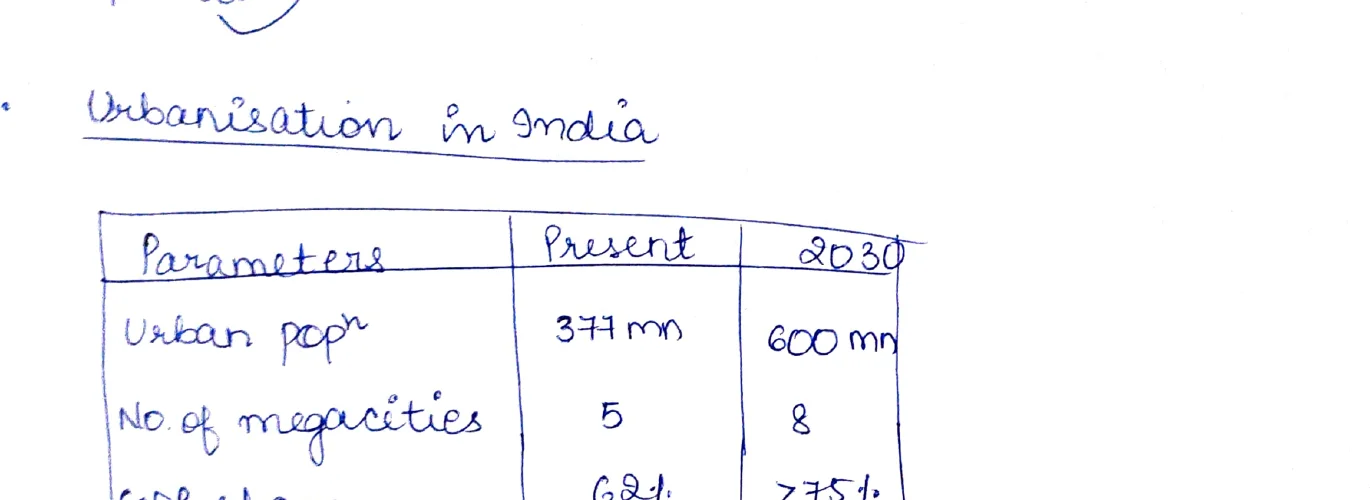
-
Topic: Urbanisation in India — present vs 2030 projections
Parameters Present 2030 Urban population 377 mn 600 mn No. of megacities 5 8 GDP share 62% >75%
#Page 16 — Diagram 3: Renewable Energy — Present Capacity Table (Environment / Economy / GS Paper 3)
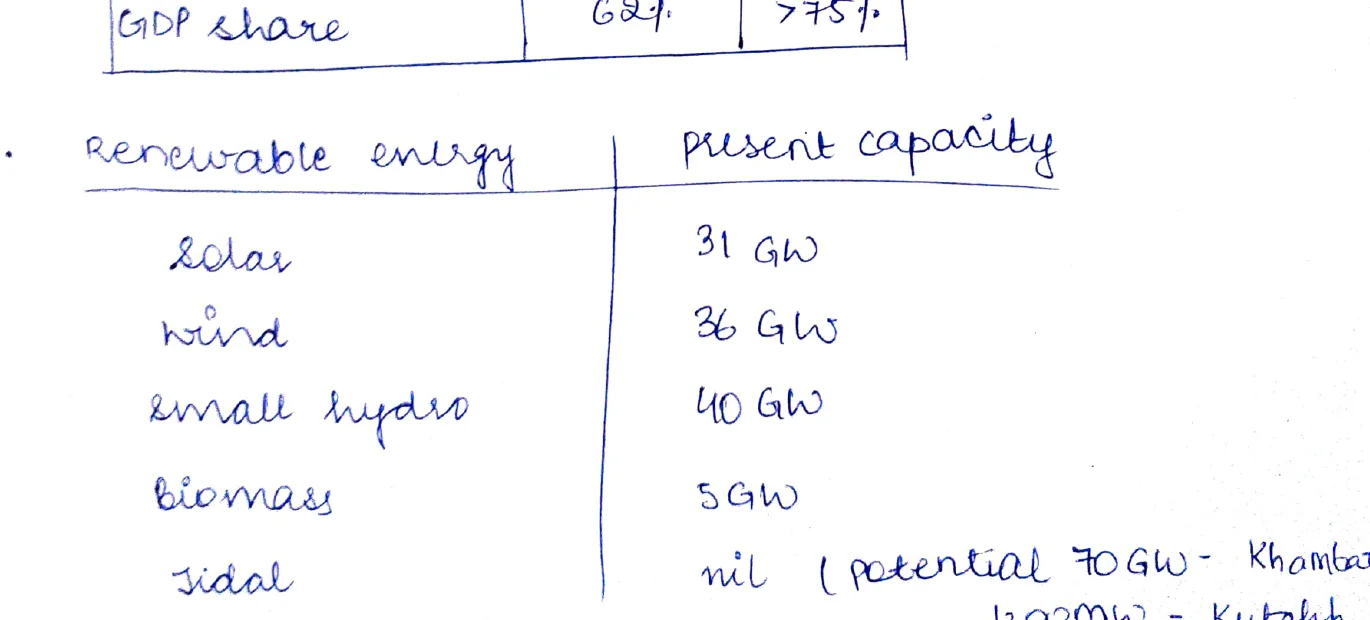
-
Topic: Renewable energy present installed capacity in India
Renewable Energy Present Capacity Solar 31 GW Wind 36 GW Small hydro 40 GW Biomass 5 GW Tidal Nil (potential 70 GW — Khambhat; 1600 MW — Kutch)
#Page 17 — Diagram 1: Structural Transformation Flowchart (Economy / GS Paper 3)
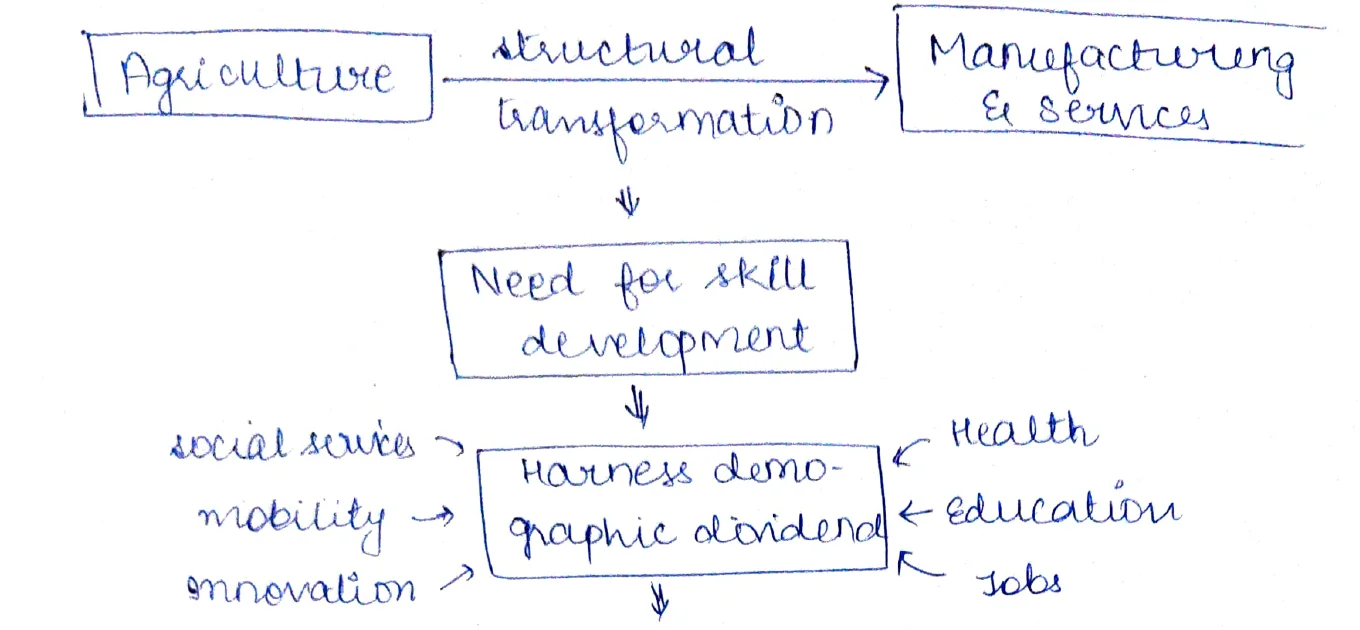
- Topic: Structural transformation of economy & demographic dividend
- Flow:
- Agriculture → (structural transformation) → Manufacturing & Services
- Both converge → Need for skill development (↓)
- → Harness demographic dividend ← inputs from:
- Social service mobility ↗
- Innovation ↗
- Health ↘
- Education ↘
- Jobs ↘
- → Inclusive economic sustainable growth
#Page 17 — Diagram 2: Drug Abuse — Supply/Addiction/Demand Triangle (Social Issues / GS Paper 1)

- Topic: Drug abuse dynamics
- Triangle diagram:
- Apex: Supply ↑ (reduction arrow downward into triangle interior)
- Left base vertex: Harm ↓
- Right base vertex: Demand ↓
- Relationship: Addiction sits at the nexus of supply, demand and harm
#Page 17 — Diagram 3: Farmers Face Dual Distress (Agriculture / GS Paper 3)
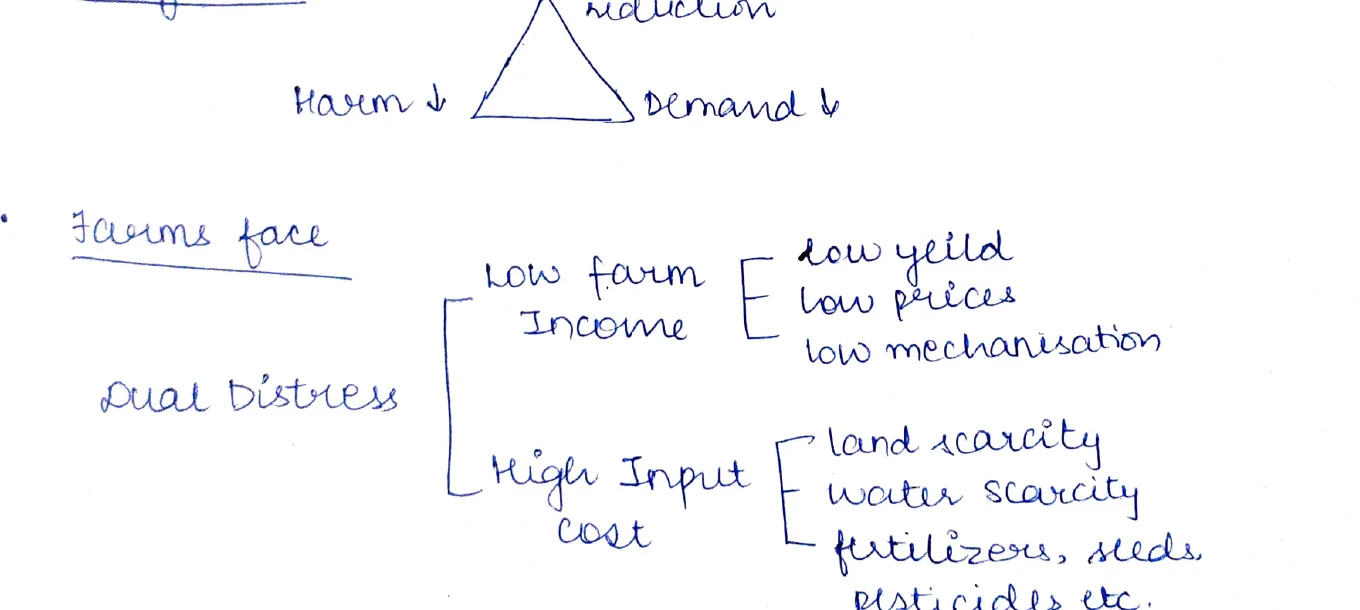
- Topic: Dual distress of Indian farmers
- Two-branch tree:
- Low farm income ←→
- Low yield
- Low prices
- Low mechanisation
- High input cost ←→
- Land scarcity
- Water scarcity
- Fertilisers, seeds, pesticides etc.
- Low farm income ←→
- Note below: (Bt women own land that they work on) [parenthetical remark about women land ownership]
#Page 17 — Diagram 4: Milk Production Bar Chart (Agriculture / GS Paper 3)
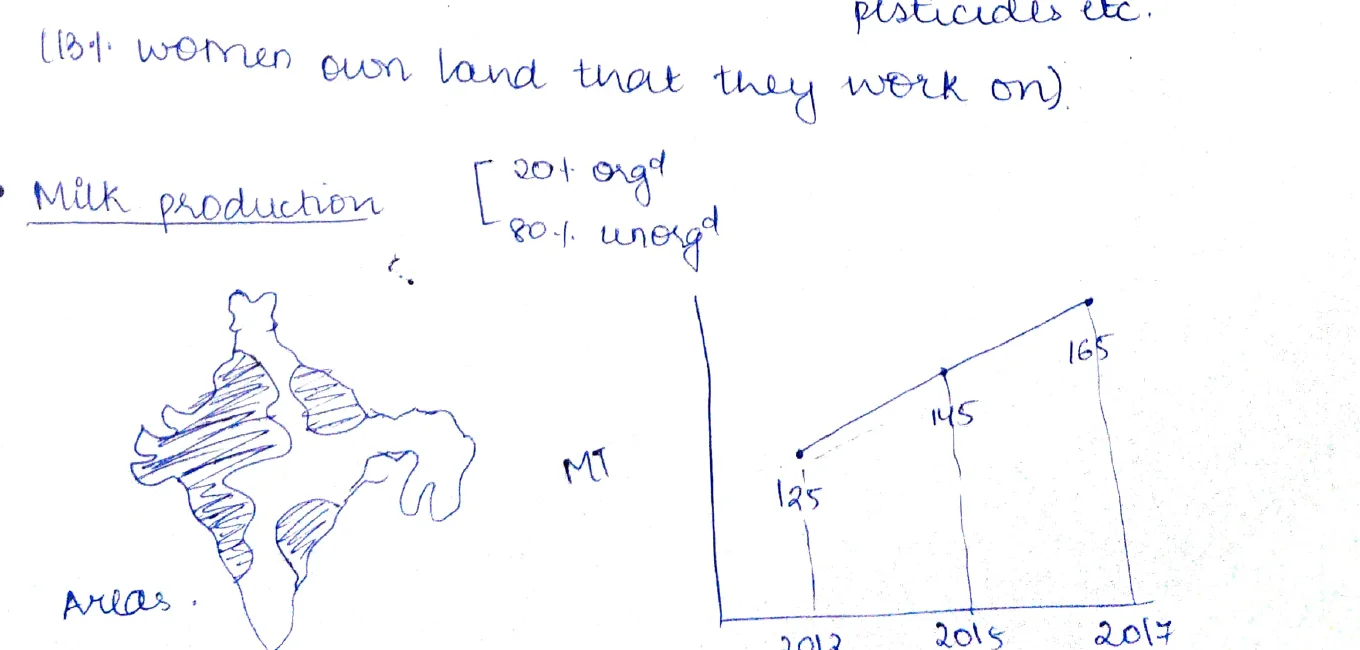
- Topic: India's milk production growth
- Y-axis: MT [Million Tonnes]
- X-axis: years — 2012, 2014, 2017
- Values (bar heights, read from chart):
- 2012: 125 MT
- 2014: 145 MT
- 2017: 165 MT
- Context: India is the world's largest milk producer
- 90% unorganised [noted in top portion of diagram on split page]
- 80% unorganised [alternate reading; values approximate from scan]
#Page 18 — Diagram 1: Cyber Space → Cyber Security Flowchart (Internal Security / GS Paper 3)
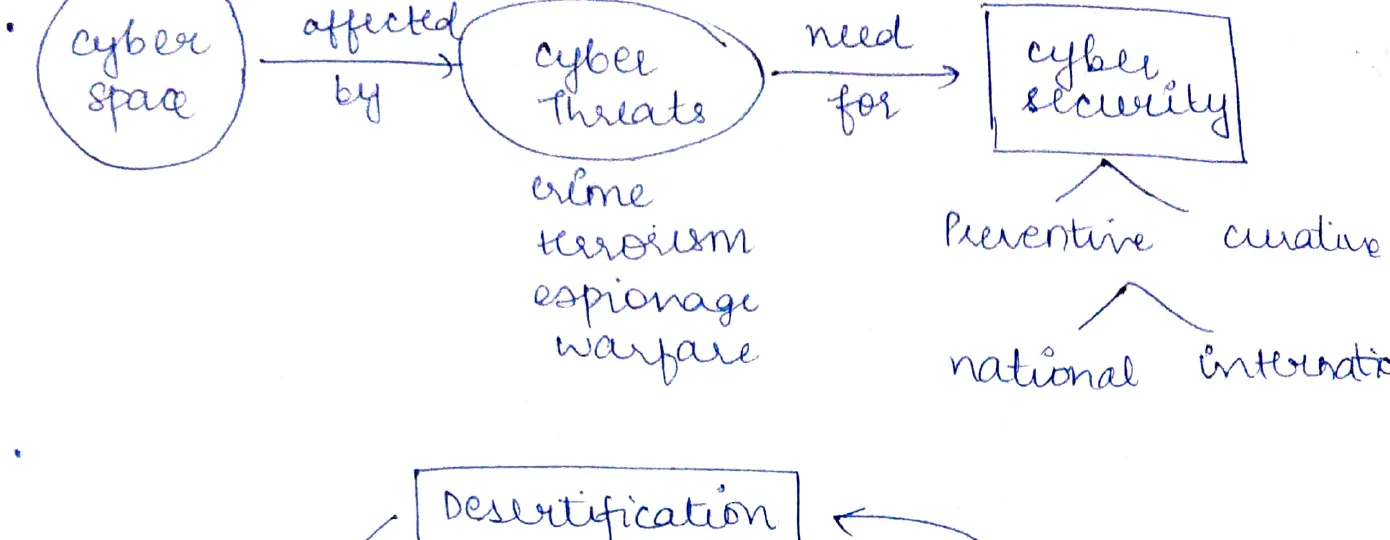
- Topic: Cyber security framework
- Flow (left to right):
- Cyber space → (affected by) → Cyber threats
- Crime
- Terrorism
- Espionage
- Warfare
- Cyber threats → (need for) → Cyber security
- Preventive | Curative
- National | International [four quadrants of response]
- Cyber space → (affected by) → Cyber threats
#Page 18 — Diagram 2: Desertification Cycle (Environment / GS Paper 3)
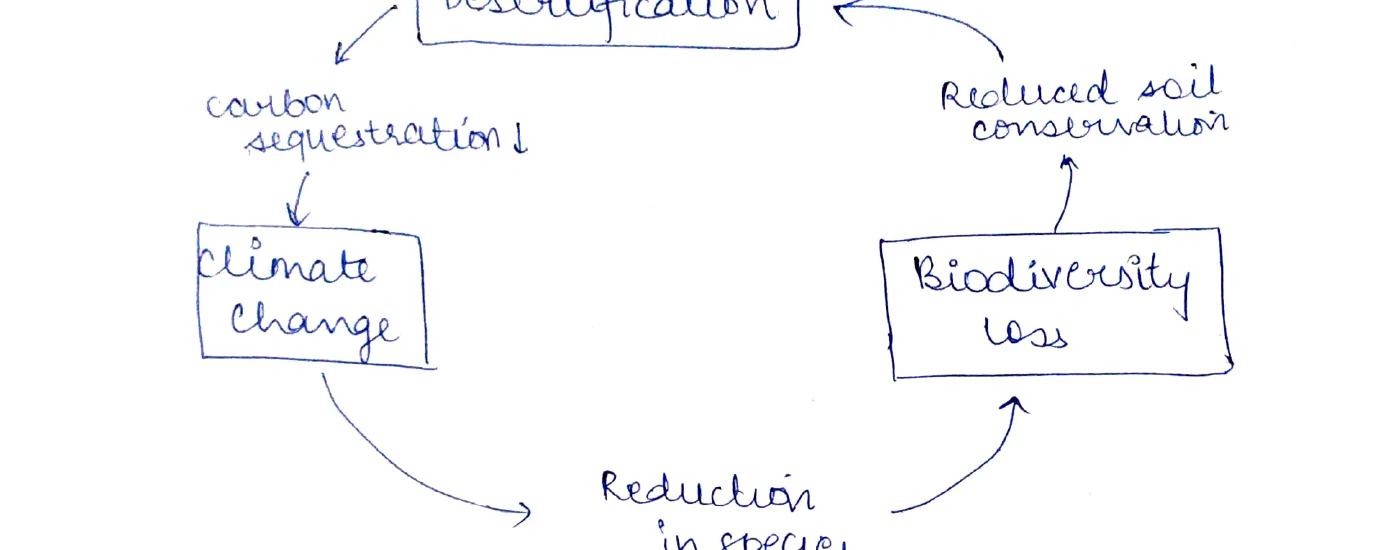
- Topic: Desertification feedback loop
- Cycle (three nodes, circular arrows):
- Desertification → (reduced soil conservation) → Biodiversity loss
- Biodiversity loss → (reduction in species) → Climate change
- Climate change → (carbon sequestration ↓) → Desertification
- All three reinforce each other in a vicious cycle
#Page 18 — Diagram 3: EV [Electric Vehicles] Advantages Flowchart (Economy / Environment / GS Paper 3)
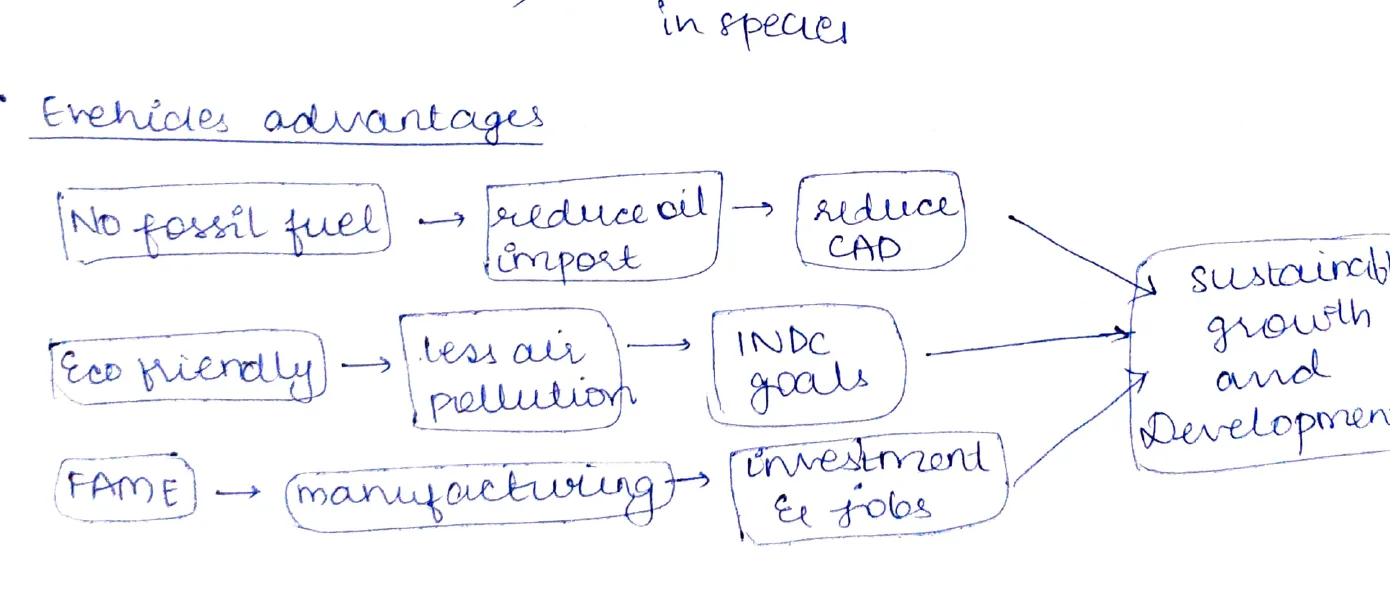
- Topic: Advantages of electric vehicles
- Three input streams → outcomes:
- No fossil fuel → Reduced oil import → Active CAD [Current Account Deficit reduction]
- Eco-friendly → Less air pollution → INDC goals [India's climate commitments]
- FAME [Faster Adoption and Manufacturing of EVs scheme] → Manufacturing → Investment & jobs
- All three → Sustainable growth and development
#Page 18 — Diagram 4: Unity — Mechanical vs Organic Solidarity (Sociology / GS Paper 1)
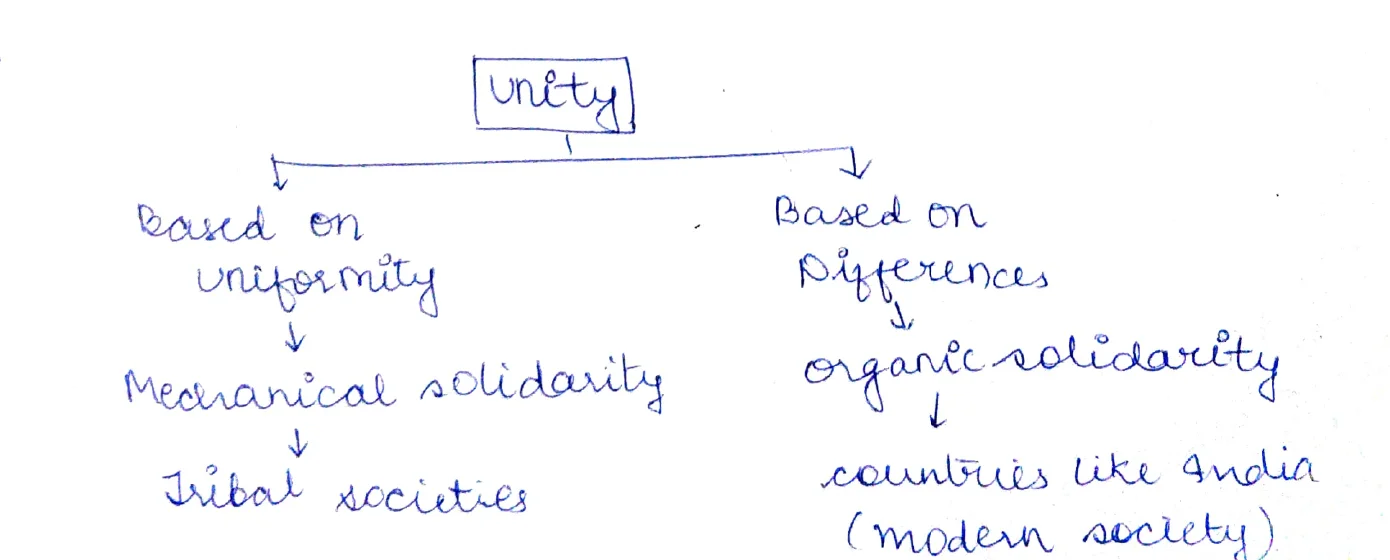
- Topic: Durkheim's types of social solidarity / Unity
- Unity (top, splits into two branches):
- Based on uniformity → Mechanical solidarity → Tribal societies
- Based on differences → Organic solidarity → Countries like India (modern society)
#Page 19 — Diagram 1: Women & Child Development — Historical Timeline (Social Issues / GS Paper 1 & 2)
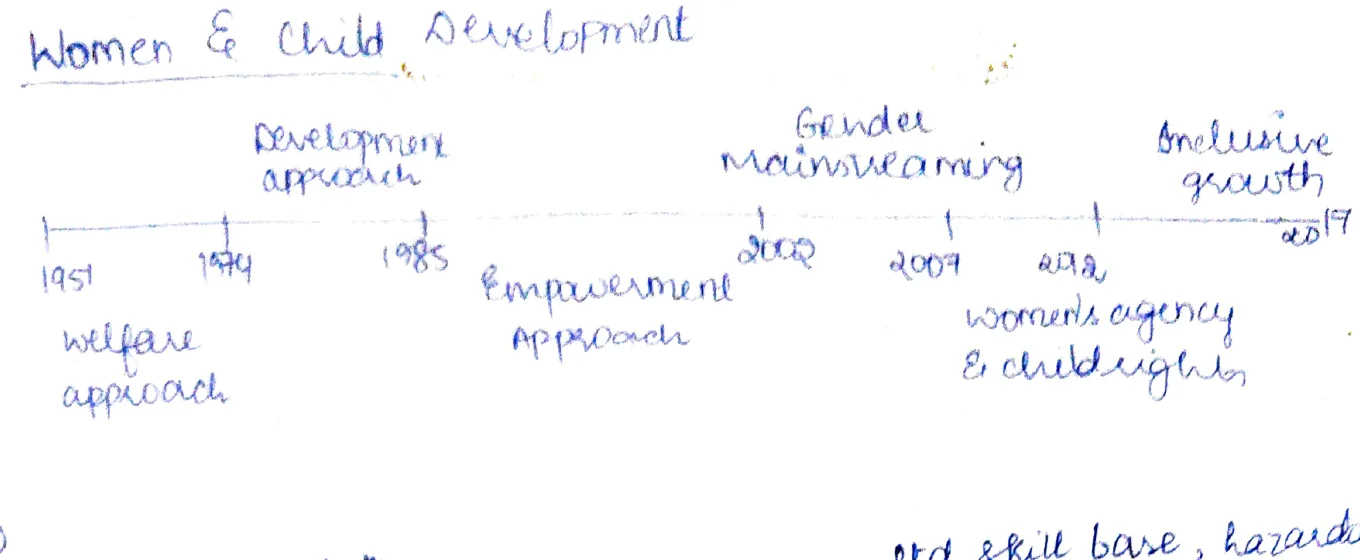
- Topic: Evolution of approach to Women & Child Development in India
- Timeline (left to right, with years):
- 1951 — Welfare approach
- 196_ — [year partially illegible]
- 1985 — Empowerment approach
- 2000 — Gender mainstreaming
- 200_ — [illegible year]
- 2017 — Inclusive growth / Bodily rights [label partially illegible]
- Development approaches shift: Welfare → Empowerment → Gender Mainstreaming → Inclusive Growth
#Page 19 — Diagram 2: Child Labour Lifecycle (Social Issues / GS Paper 1)
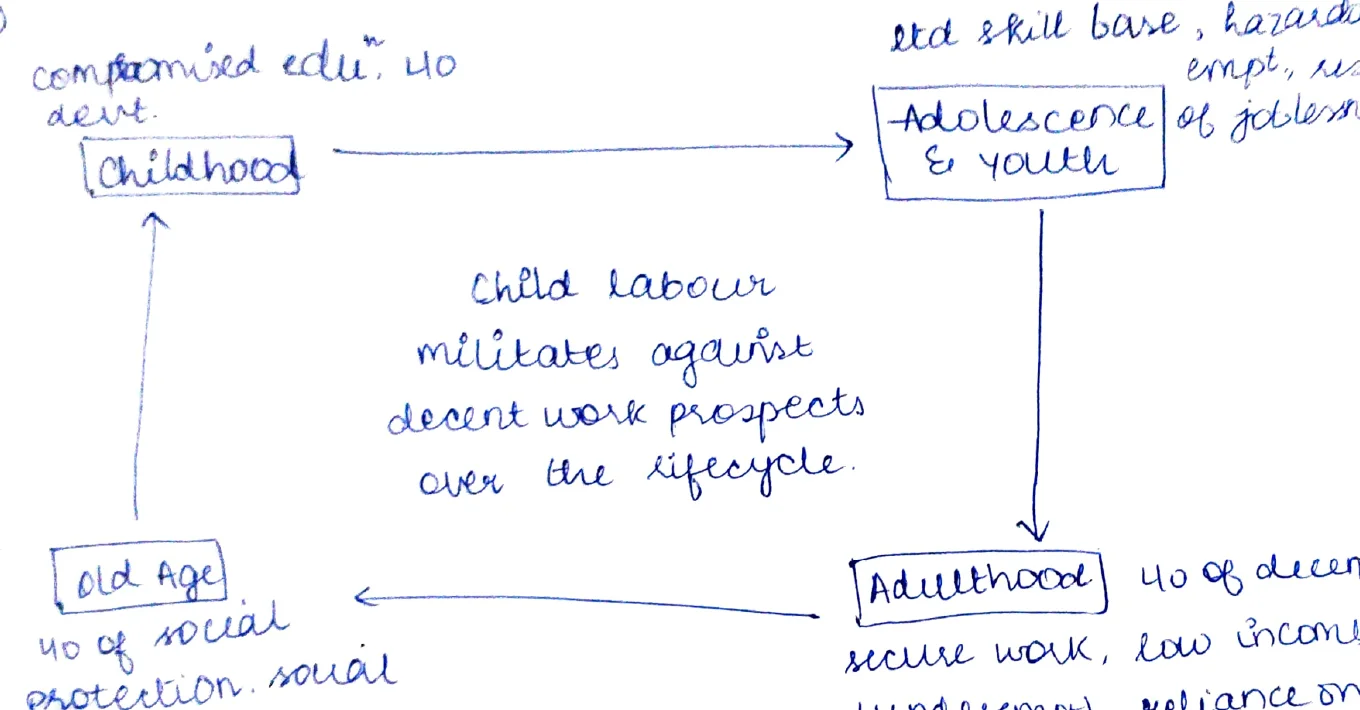
- Topic: Child labour lifecycle trap
- Cyclical flow (4 nodes):
- Childhood (box)
- Compromised education / deprived asset
- → Adolescence & Youth (box, arrow right)
- 2nd skill base, hazards, exposure, no prospects / at junctions [partially illegible]
- → Adulthood (box, arrow down)
- 40% decent secure work, low income (underemployed), reliance on child labour to survive
- → Old age (box, arrow left)
- No social protection / social shocks
- → back to Childhood (next generation)
- Note: Child labour militates against decent work prospects over the lifecycle
- Childhood (box)
#Page 19 — Diagram 3: Regulatory Pyramid (Governance / GS Paper 2)
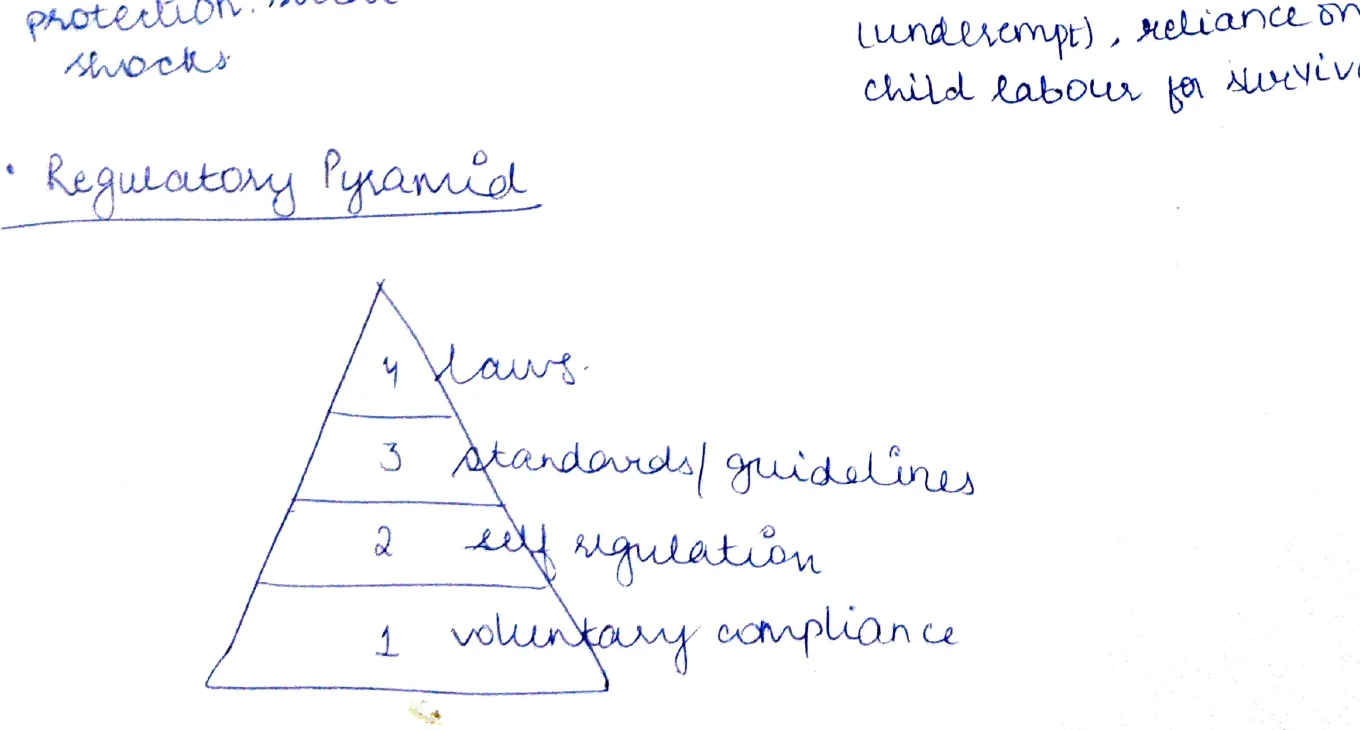
- Topic: Regulatory Pyramid — 4 levels of regulation
- Pyramid (base to apex):
- Level 1 (base): Voluntary compliance
- Level 2: Self regulation
- Level 3: Standards / guidelines
- Level 4 (apex): Laws
- Pyramid represents increasing enforceability from bottom to top
#Page 20 — Diagram 1: Climate Change → Warming Line → Consequences (Environment / GS Paper 3)
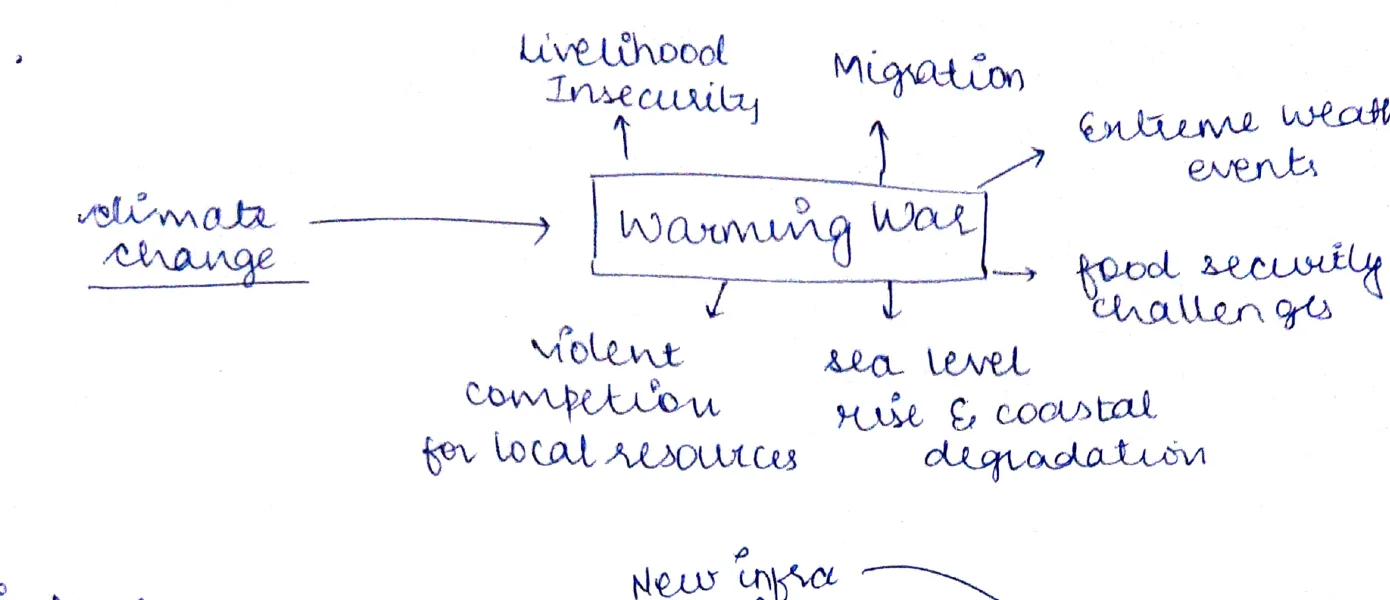
- Topic: Climate change impacts
- Flow:
- Climate change → Warming line (central node) → multiple consequences:
- Livelihood insecurity
- Migration
- Extreme weather events
- Food security challenges
- Violent competition for local resources
- Sea level rise & coastal degradation
- Climate change → Warming line (central node) → multiple consequences:
#Page 20 — Diagram 2: Asset Monetisation Cycle (Economy / GS Paper 3)
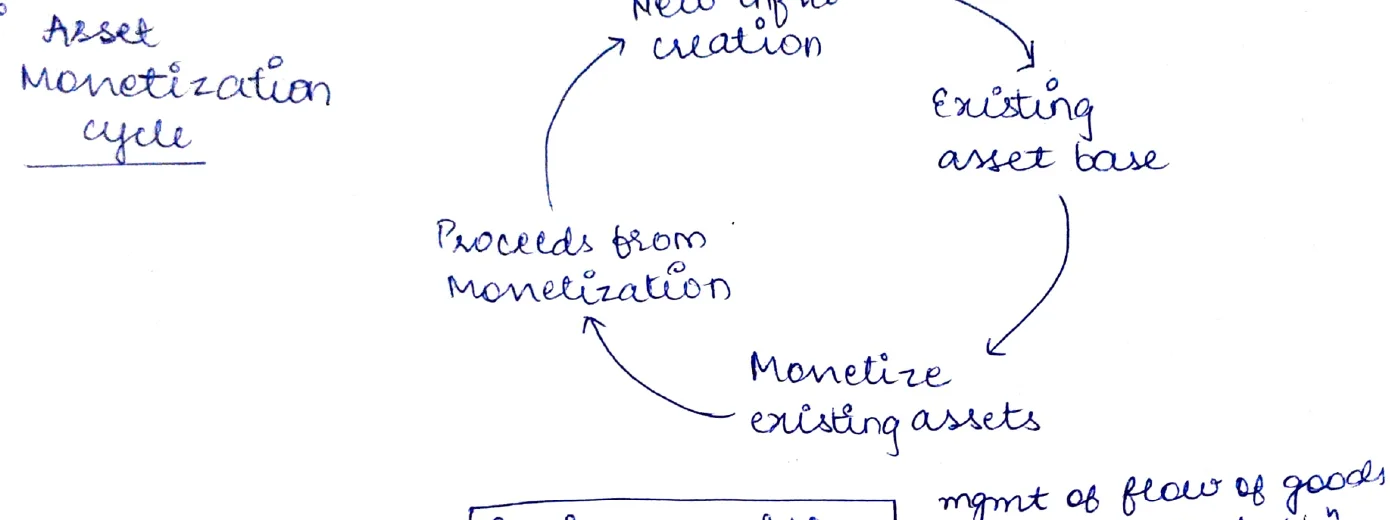
- Topic: Asset Monetisation Cycle
- Circular flow (4 nodes):
- New infra creation → Existing asset base → Monetise existing assets → Proceeds from monetisation → (feeds back to) New infra creation
- Label on central box: Asset Monetisation Cycle
#Page 20 — Diagram 3: Business Logistics Flowchart (Economy / GS Paper 3)
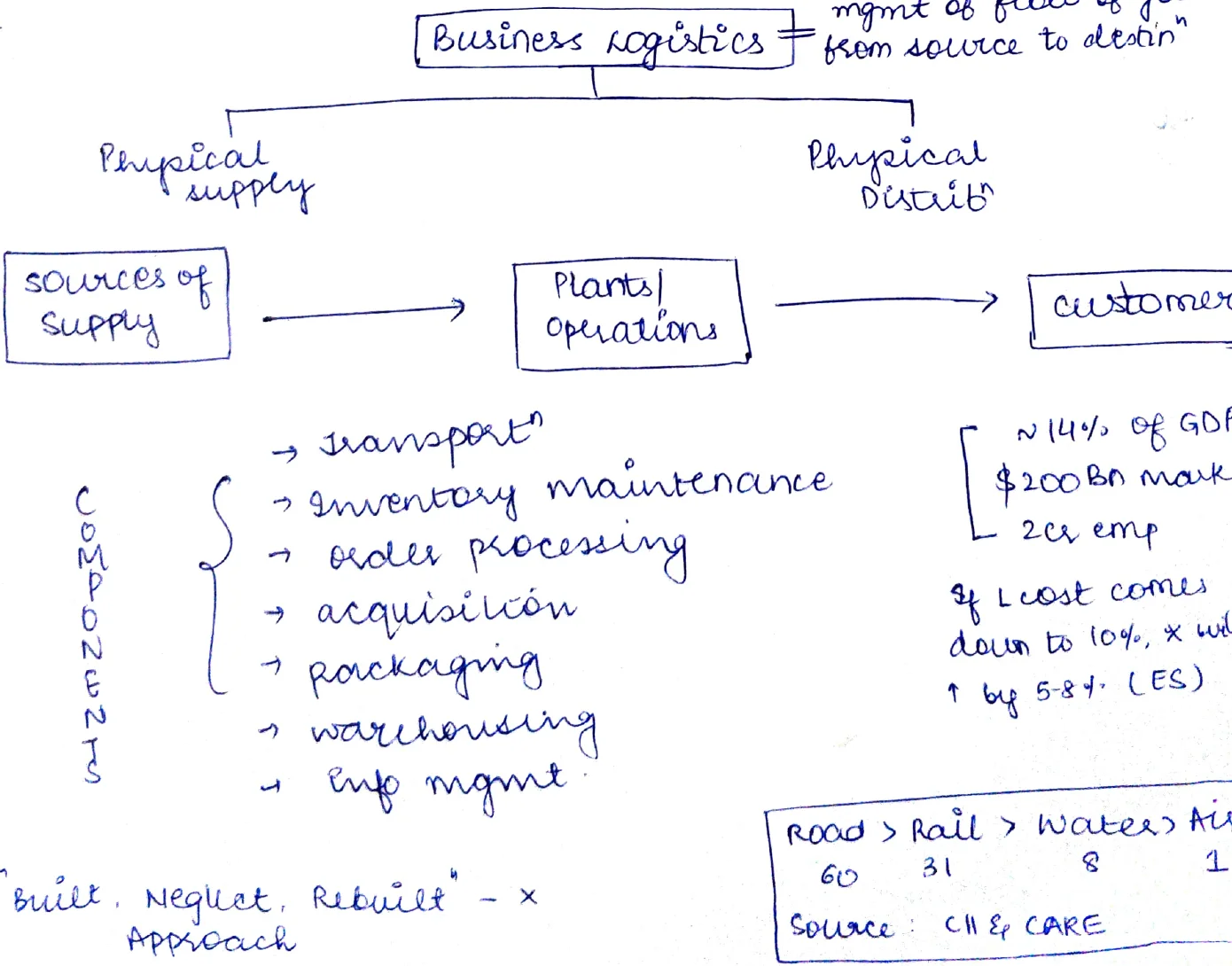
-
Topic: Business Logistics — management of flow of goods from source to destination
-
Definition box: Business logistics = mgmt of flow of goods from source to destination
-
Physical supply side:
- Sources of supply → Plants / Operations → Customers
-
Physical distribution side (right branch from Plants/Operations → Customers)
-
COMPONENTS (C-O-M-P-O-N-E-N-T-S listed vertically):
- Transport
- Inventory maintenance
- Order processing
- Acquisition
- Packaging
- Warehousing
- Inventory management [last item partially illegible]
-
Statistics (right column):
- ~14% of GDP
- $200 bn market
- 2 cr [crore] employees
- If cost comes down to 10%, it will ↑ by 5-8% (ES) [Economic Survey]
-
Data box bottom:
- Road > Rail > Waterways = All [ratio] 60 : 31 : 8 : 1
- Source: CII & CARE
-
Note: 'Build, Neglect, Rebuild' = X Approach [critique of current approach]
#Page 21 — Diagram 1: Inclusive Growth Virtuous Cycle (Economy / GS Paper 3)
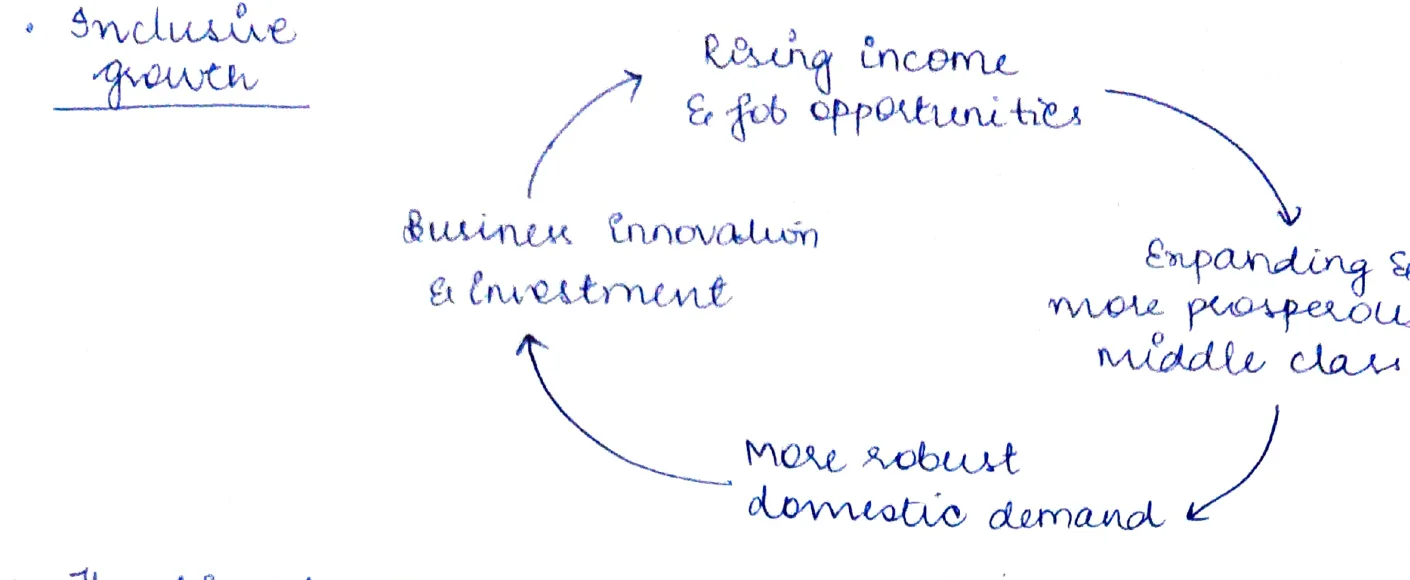
- Topic: Inclusive growth self-reinforcing cycle
- Circular flow (clockwise):
- Rising income & job opportunities → Expanding & more prosperous middle class → More robust domestic demand → Business innovation & investment → back to Rising income & job opportunities
- Central label: Inclusive growth
#Page 21 — Diagram 2: Flagship Schemes — Skill Development (Economy / GS Paper 3)
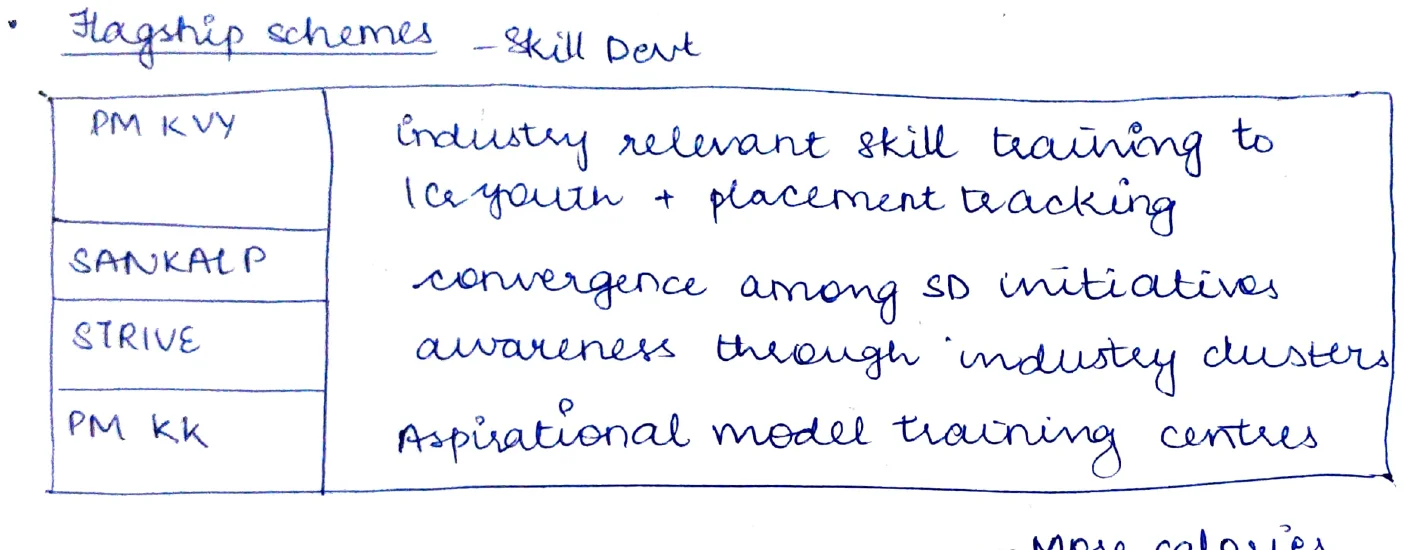
-
Topic: Flagship Skill Development schemes in India
Scheme Description PM KVY Industry-relevant skill training to 1 cr [crore] youth + placement tracking SANKALP Convergence among SD [Skill Development] initiatives STRIVE Awareness through industry clusters PM KK Aspirational Model Training Centres
#Page 21 — Diagram 3: Cheap Rice & Wheat — Substitution & Income Effects (Economy / GS Paper 3)
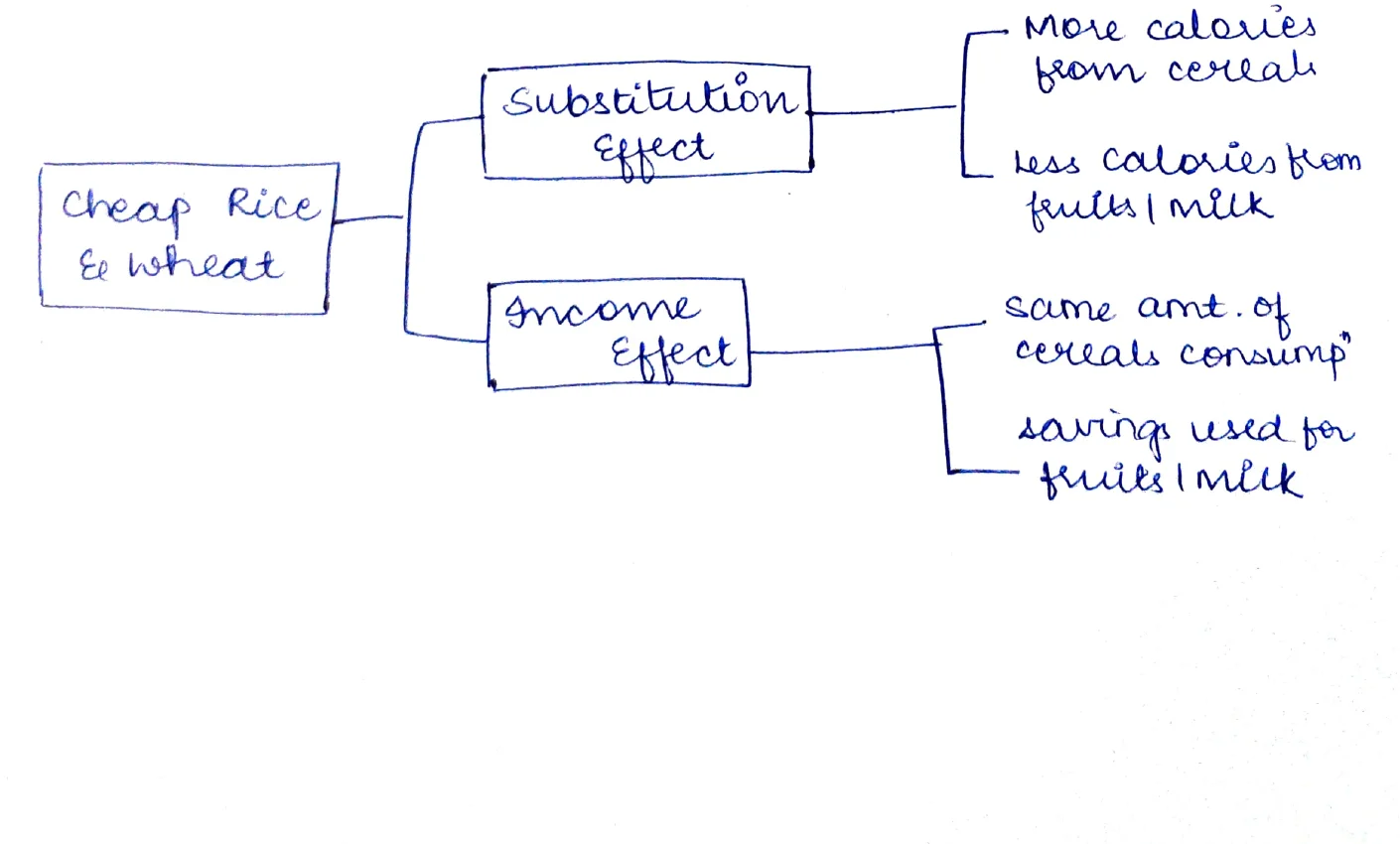
- Topic: Effects of cheap rice & wheat on food consumption patterns
- Root: Cheap Rice & Wheat → two branches:
- Substitution Effect:
- More calories from cereals
- Less calories from fruits/milk
- Income Effect:
- Same amount of cereals consumed
- Savings used for fruits & milk
- Substitution Effect:
#Page 22 — Diagram 1: PPP [Public-Private Partnership] Spectrum Chart (Economy / GS Paper 3)
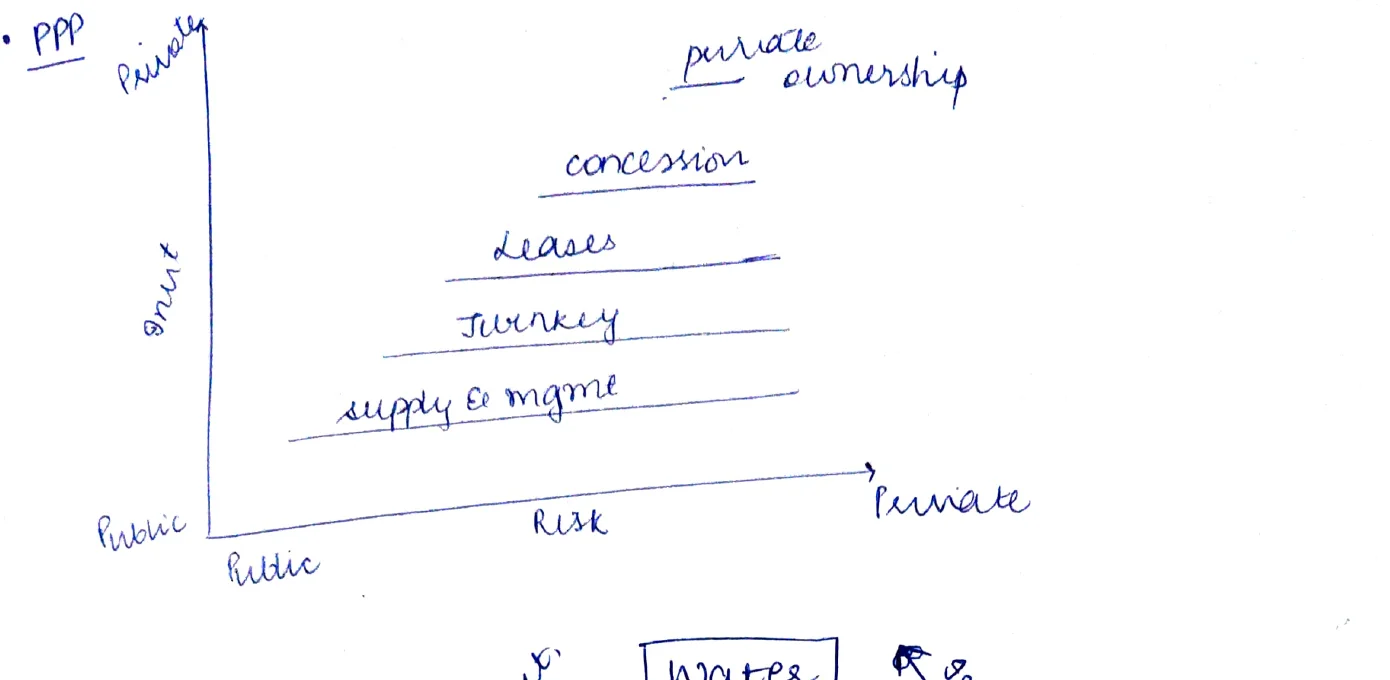
- Topic: PPP spectrum — risk and ownership transfer
- Axes:
- Y-axis: Private (top) to Public (bottom) — degree of private involvement
- X-axis: Public (left) → Risk → Private (right) — risk allocation
- Models plotted (ascending private risk from bottom-left to top-right):
- Supply & management (lowest private risk)
- Turnkey
- Leases
- Concession
- Private ownership (highest private risk / full privatisation)
#Page 22 — Diagram 2: Energy-Water-Food Nexus Triangle (Environment / GS Paper 3)
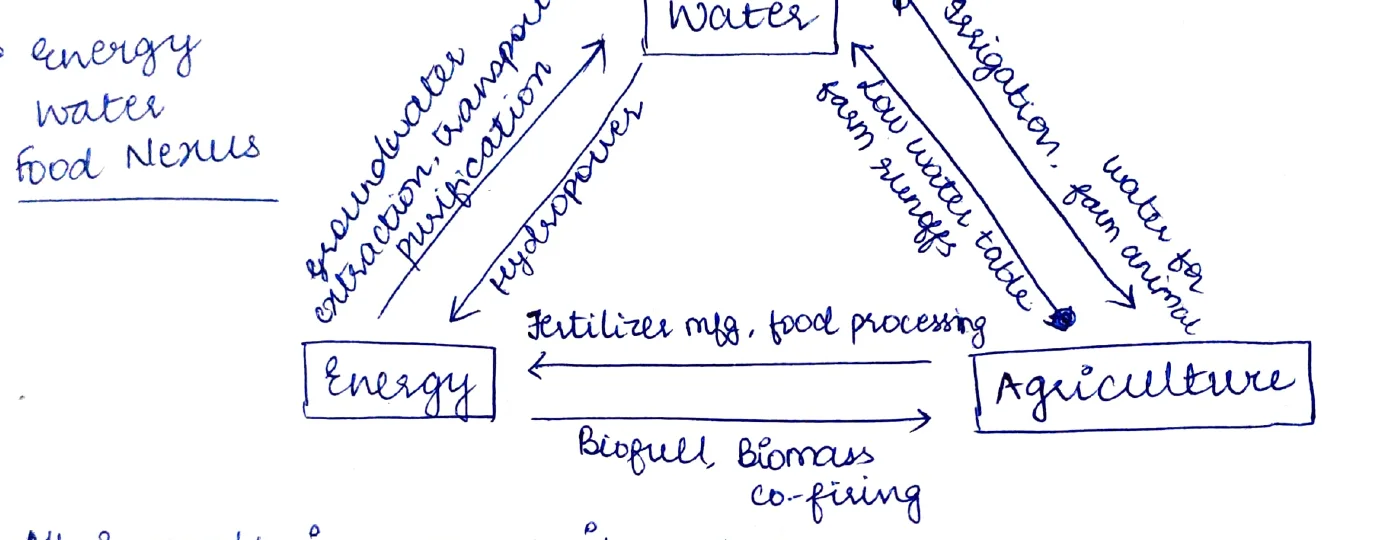
- Topic: Energy–Water–Food Nexus
- Triangle with three vertices:
- Water (apex/top)
- Energy (bottom-left)
- Agriculture (bottom-right)
- Inter-linkage labels on sides:
- Water → Energy: Hydropower / [illegible]
- Water → Agriculture: Irrigation / farming / water for food
- Energy → Agriculture: Biofuel / biomass co-firing
- Agriculture → Water: Fertilisers, agri food processing
- Agriculture → Energy: [illegible]
- Energy → Water: [illegible]
- Note below: All 3 equally important to strike a balance (e.g., PM's 'Saani Bachao Saani Kamao' [Save water scheme])
#Page 22 — Diagram 3: Agriculture Credit — Historical Timeline (Agriculture / GS Paper 3)
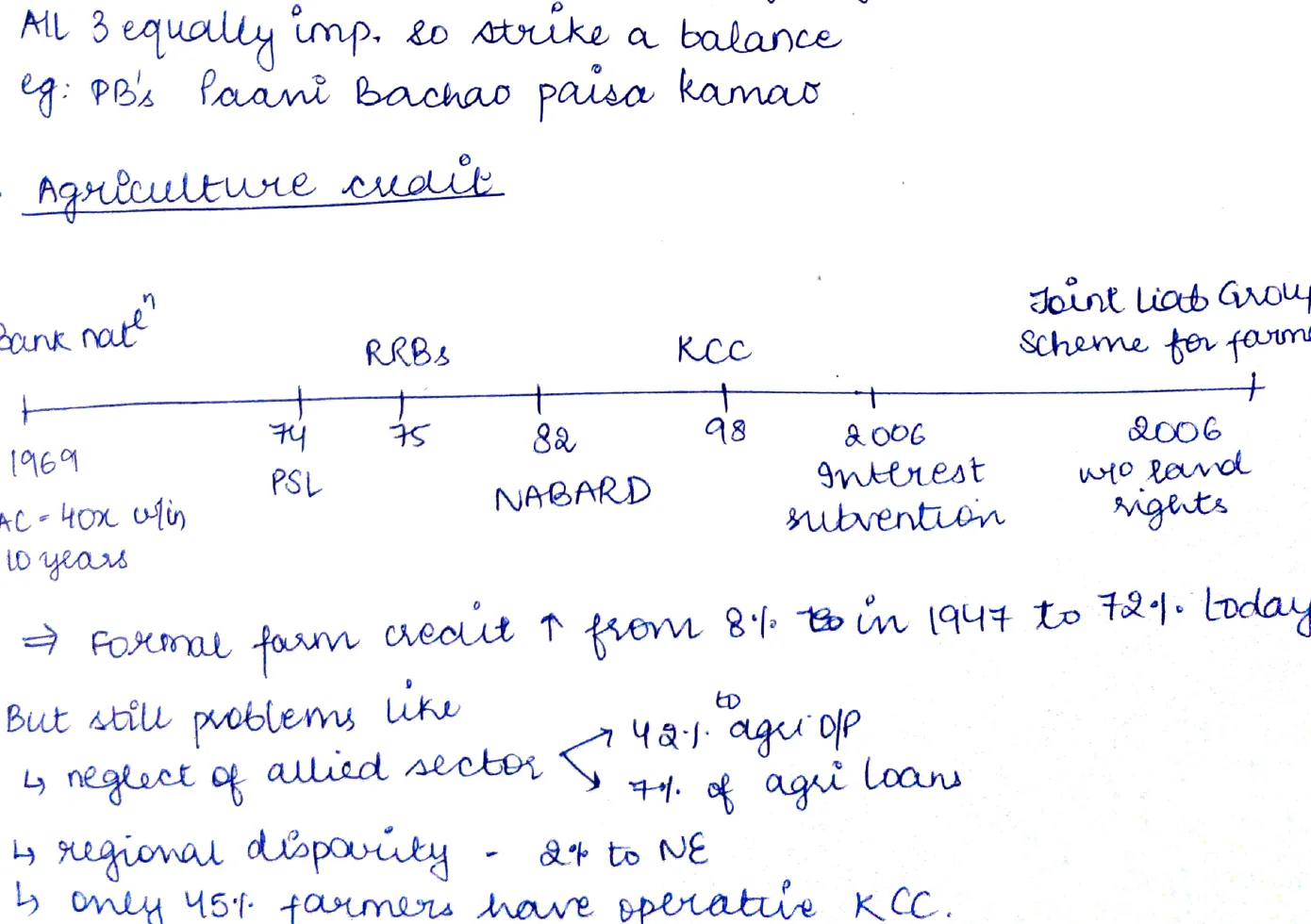
- Topic: Evolution of formal agricultural credit in India
- Timeline (left to right):
- 1969 — Bank nationalisation; AC [Agricultural Credit] 40% over 10 years
- 1971 — PSL [Priority Sector Lending]
- 1975 — RRBs [Regional Rural Banks]
- 1982 — NABARD [National Bank for Agriculture and Rural Development]
- 1998 — KCC [Kisan Credit Card]
- 2000 — Interest subvention
- 2006 — WTO land rights [Farmers' land rights milestone; exact label partially illegible]
- Right end: Joint Liability Group / Scheme for farmers
- Key findings noted below timeline:
- Formal farm credit ↑ from 8% to 18% in 1947 to 74% today [current share of institutional credit]
- But still problems:
- 42% agri GDP [concentration in certain sectors]
- Neglect of allied sectors
- 44% of agri loans
- Regional disparity — 24% to NE [North-East India]
- Only 45% farmers have operative KCC
#Page 23 — Diagram 1: Food Processing Value Addition (Agriculture / GS Paper 3)
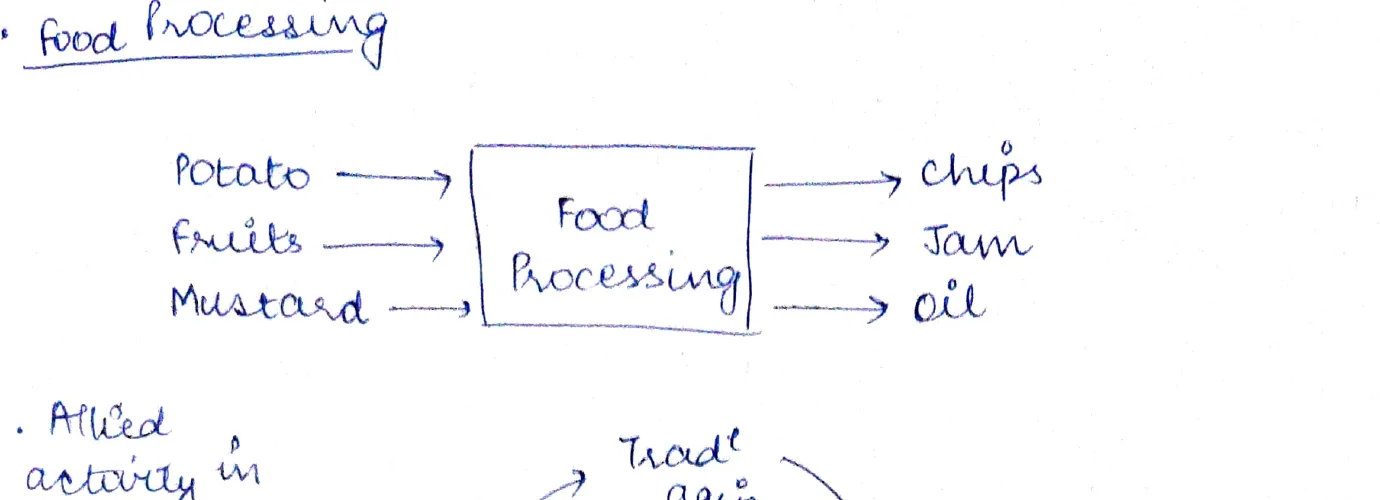
- Topic: Food Processing as allied activity
- Flow (left to right):
- Inputs → Food Processing (central box) → Outputs
- Potato → → Chips
- Fruits → → Jam
- Mustard → → Oil
- Inputs → Food Processing (central box) → Outputs
#Page 23 — Diagram 2: Allied Activity in Agriculture — Vicious & Virtuous Cycles (Agriculture / GS Paper 3)
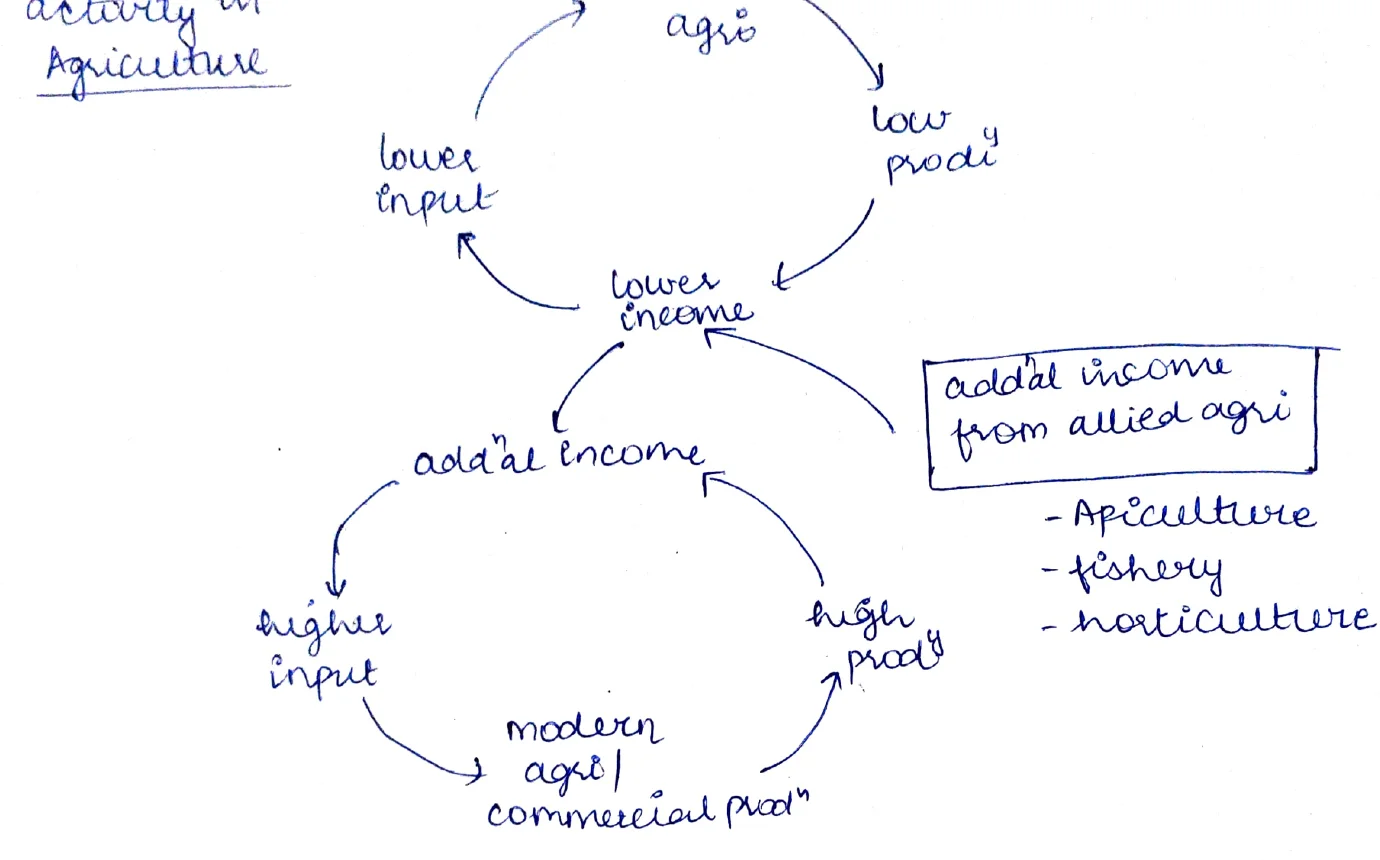
- Topic: Allied activity in agriculture — vicious cycle and virtuous cycle
- Vicious Cycle (inner loop):
- Traditional agri → Low productivity → Low prod[uction] → Lower income → Lower income → Lower input → back to Traditional agri
- Virtuous Cycle (outer loop, with allied income):
- Additional income from allied agri:
- Agriculture
- Fishery
- Horticulture
- → Higher input → Higher prod[uction] → Modern agri / commercial pace [modern agriculture at commercial pace]
- → Higher income → more additional income → (sustains virtuous cycle)
- Additional income from allied agri:
#Page 23 — Diagram 3: India-China Trade Map (International Relations / GS Paper 2)
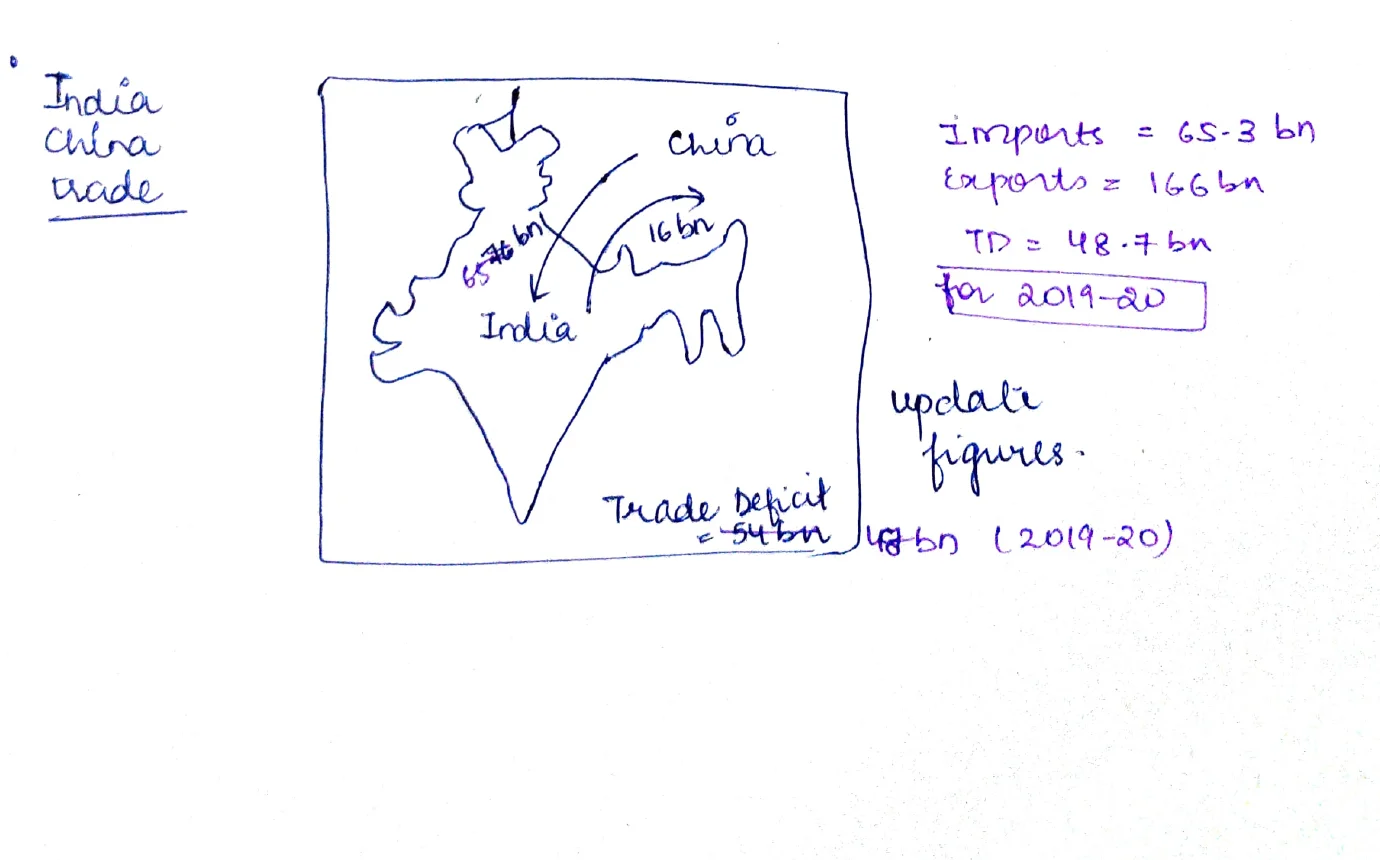
- Topic: India-China bilateral trade
- Sketch map of India with China shown above/adjacent
- Labels:
- Imports = 65.8 bn [billion USD] (approx., for 2019-20)
- Exports = 16.6 bn [billion USD] (approx., for 2019-20)
- TD [Trade Deficit] = ~54 bn [approximately 54 billion USD]
- Note: "Update figures" annotation
- For 2019-20: figures as listed above
#Page 24 — Diagram 1: CityMatrix — Urban Governance Framework (Governance / GS Paper 2)
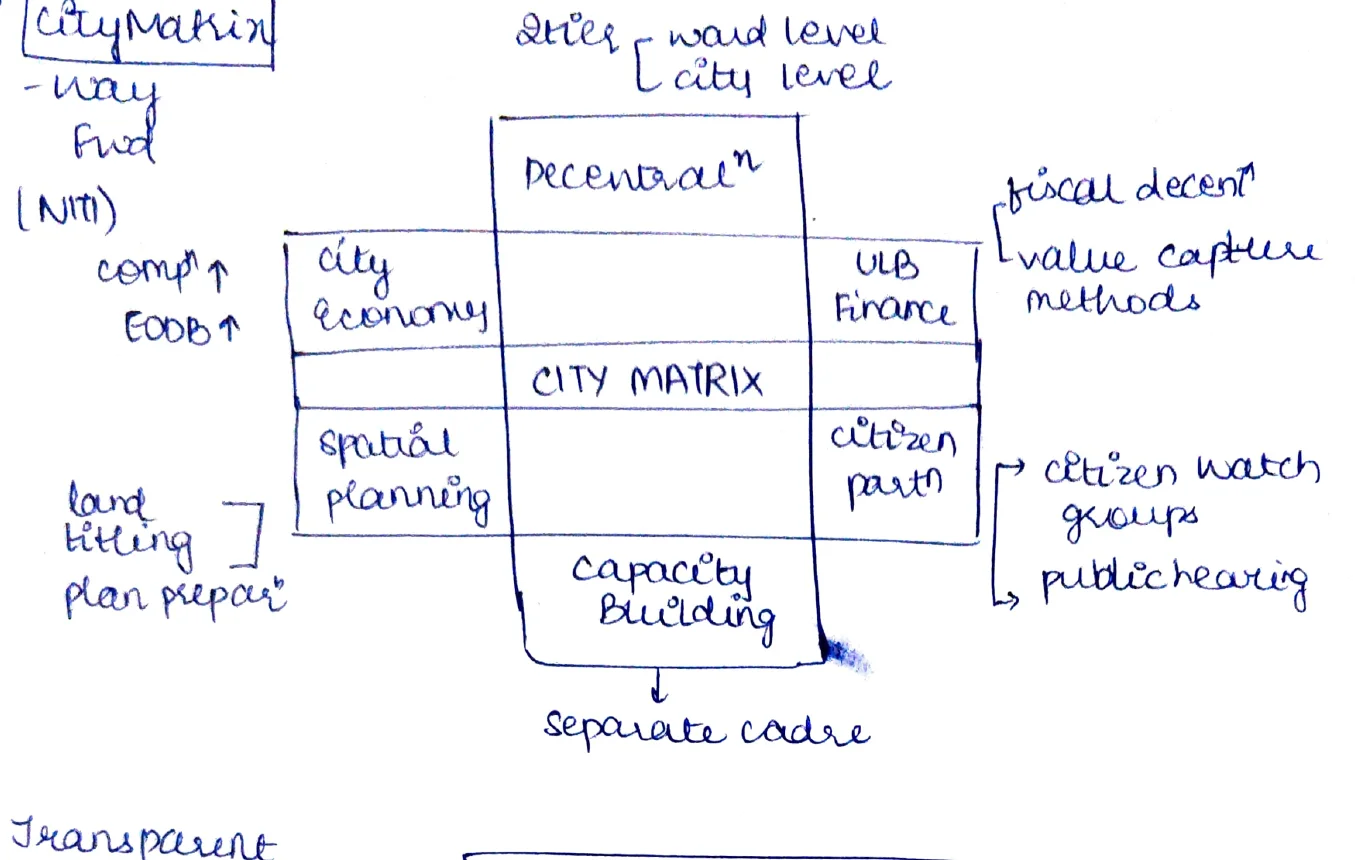
- Topic: CityMatrix — urban governance reform framework
- Header labels (above matrix):
- CityMatrix — ward level → city level
- Variants noted: -way fund / (NMI) [National Municipal Initiative?]
- Comp ↑ / EODB ↑ [Competition / Ease of Doing Business]
- Land titling / plan repeal
- CITY MATRIX (central grid):
- Rows:
- City economy
- Spatial planning
- Capacity building
- Columns:
- Decentralise [left side]
- Urban Finance [right side]
- Citizen participation [far right]
- Additional labels: Fiscal decentralisation / Value capture methods
- Citizen participation details: Citizen watch groups / Public hearing
- Rows:
- Note: Separate cadre (for urban management)
#Page 24 — Diagram 2: Transparent / Data-led Governance Framework (Governance / GS Paper 2)
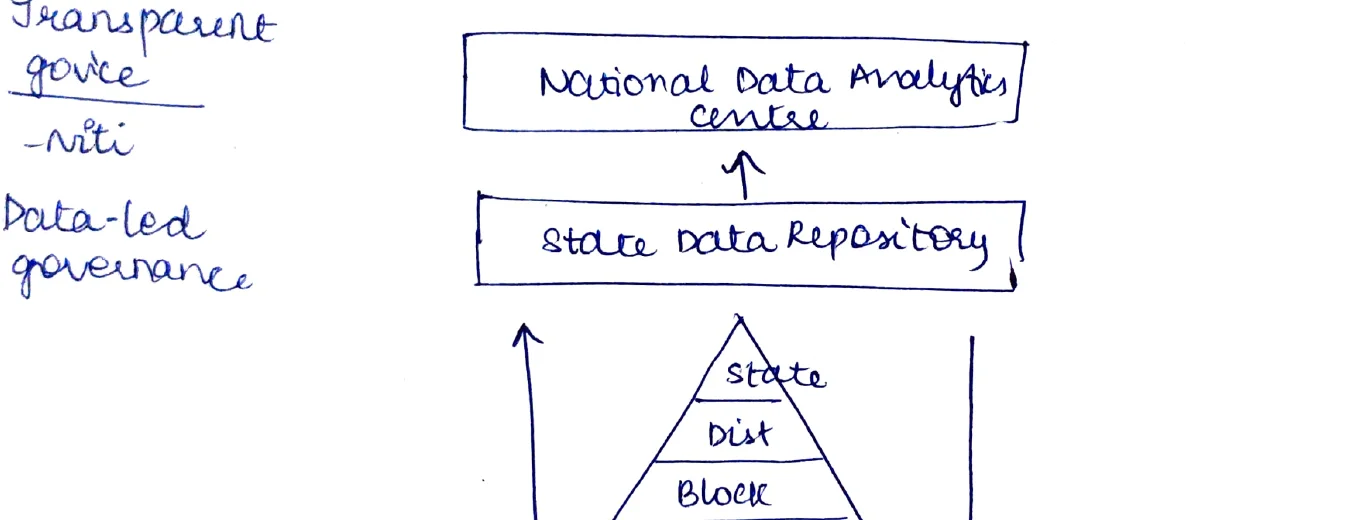
- Topic: Data-led governance / Transparent governance
- Hierarchy (top to bottom):
- National Data Analytics Centre
- ↕ (two-way arrows)
- State Data Repository
- ↕ (two-way arrows)
- Pyramid inside: State → Dist[rict] → Block → Village
- ↕
- Data-led Governance platform (sector specific)
#Page 24 — Diagram 3: Soil Pollution — India Map with Hotspots (Environment / GS Paper 3)
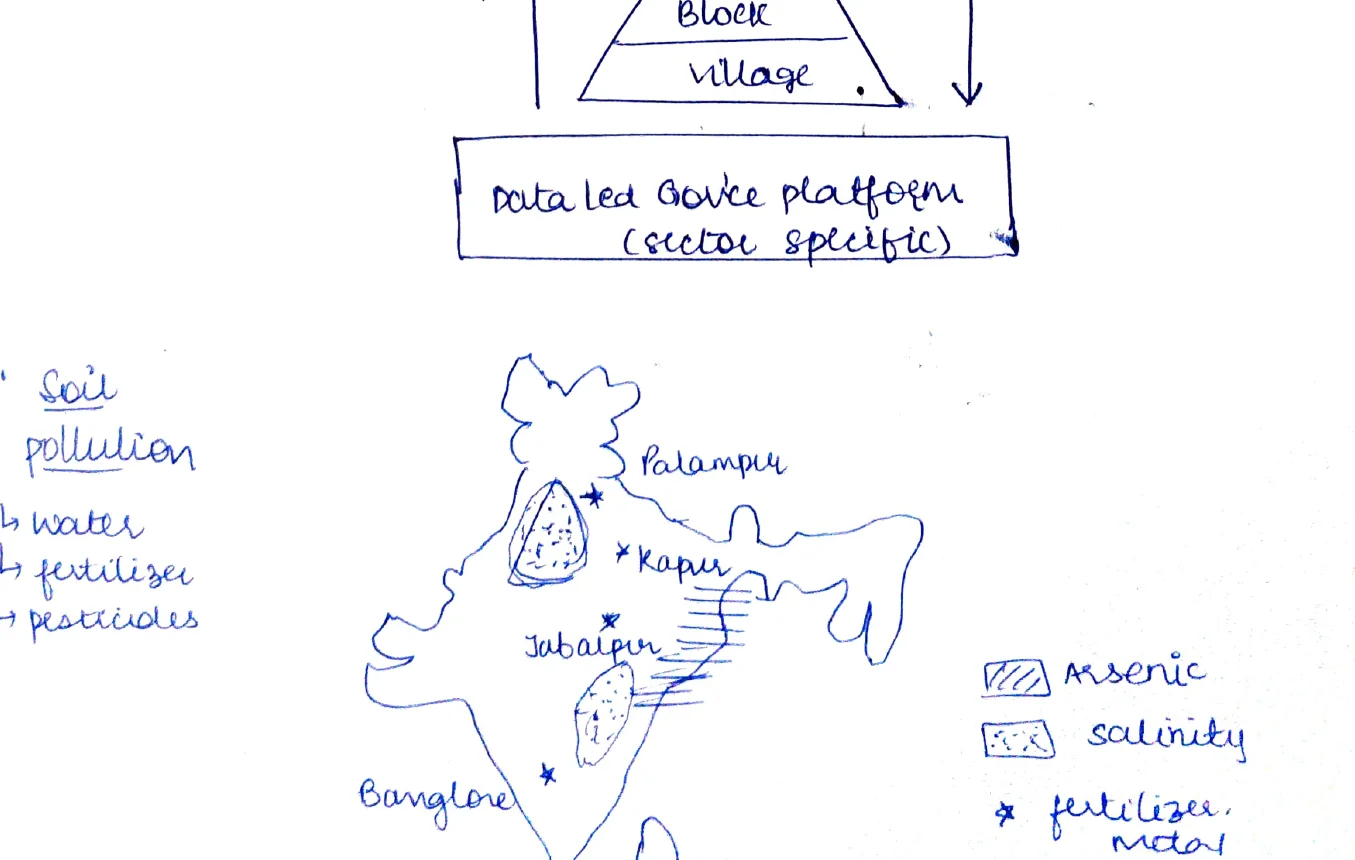
- Topic: Soil pollution hotspots in India
- Causes listed: Water, Fertiliser, Pesticides
- India map with marked locations:
- Palampur (North) — Arsenic [hatched pattern]
- Kapus (West/Central) — Arsenic
- Jabalpur (Central) — Salinity [dotted pattern]
- Bangalore (South) — Fertiliser / metal contamination [star marker]
- Legend:
- [hatched] = Arsenic
- [dotted] = Salinity
- [star *] = Fertiliser / metal
#Page 25 — Diagram 1: Urban Missions — Achievements Table (Governance / GS Paper 2)
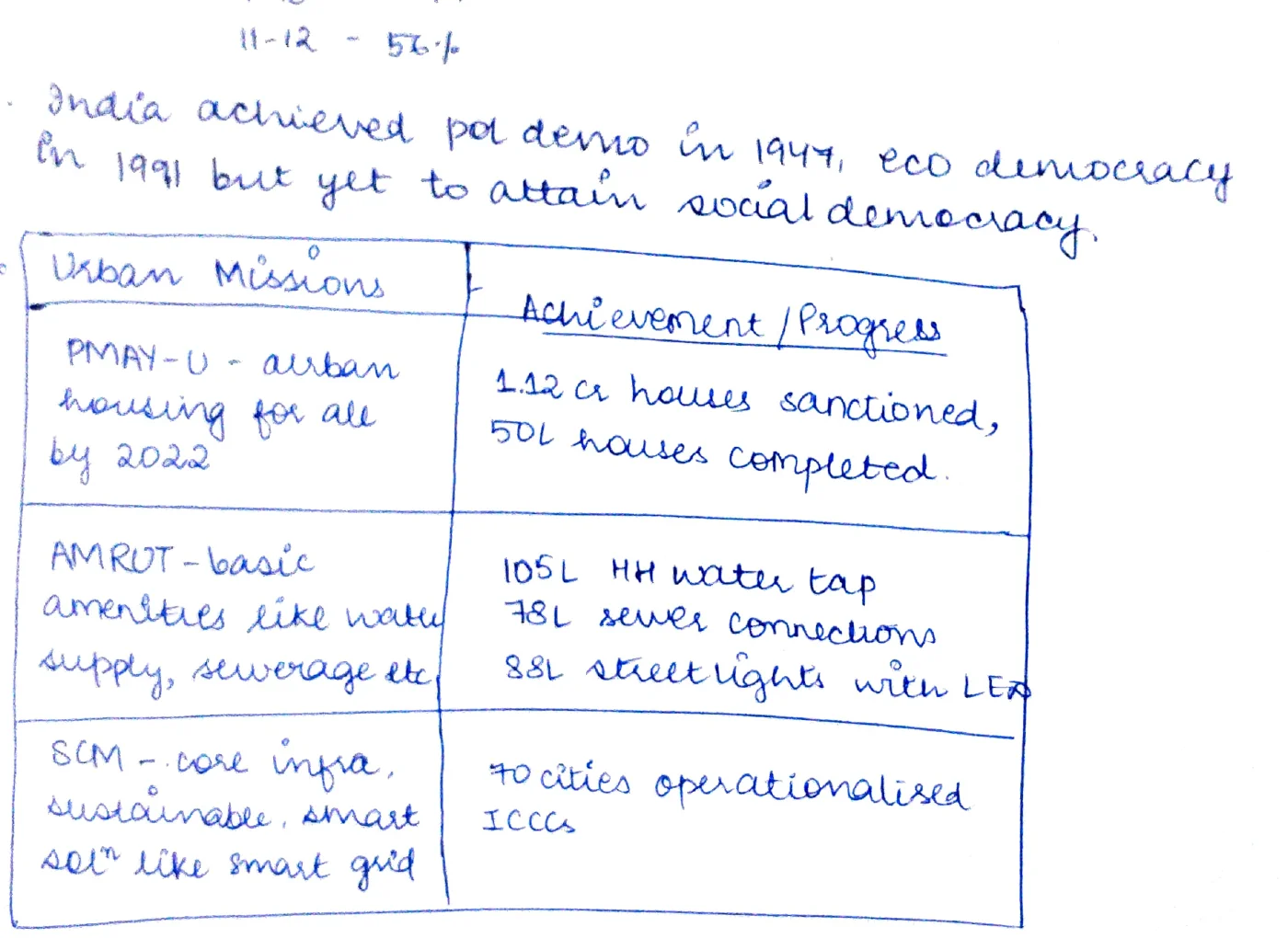
-
Topic: Urban missions progress in India
Scheme Description Achievement / Progress PMAY-U Affordable housing for all by 2022 1.12 cr [crore] houses sanctioned; 50 L [lakh] houses completed AMRUT Basic amenities like water supply, sewage etc. 105 L [lakh] MH water tap; 38 L sewer connections; 38 L street lights with LED SCM Core infrastructure; sustainable smart cities like smart grid 40 cities operationalised; 1 cr [crore] ICCAs [?] -
Note above table: NCRB data — conviction rate in rape cases is as low as 32% at national level
-
Education as a public good — NEP 2020
-
NSD 2017-18: 15% rural / 7 HH [households] have internet access; 42% urban
-
Namath Bami — Kerala govt's unique way of teaching tribal children in their mother tongue through YouTube → [PP / PPT]
-
GER [Gross Enrolment Ratio]:
- 6–5th: 91%
- 4–10: 79%
- 11–12: 56%
-
India achieved per demo[cracy] in 1949, eco[nomic] democracy in 1991 but yet to attain social democracy
#Page 25 — Diagram 2: Agri / Agro Tourism — India Map (Agriculture / Tourism / GS Paper 3)
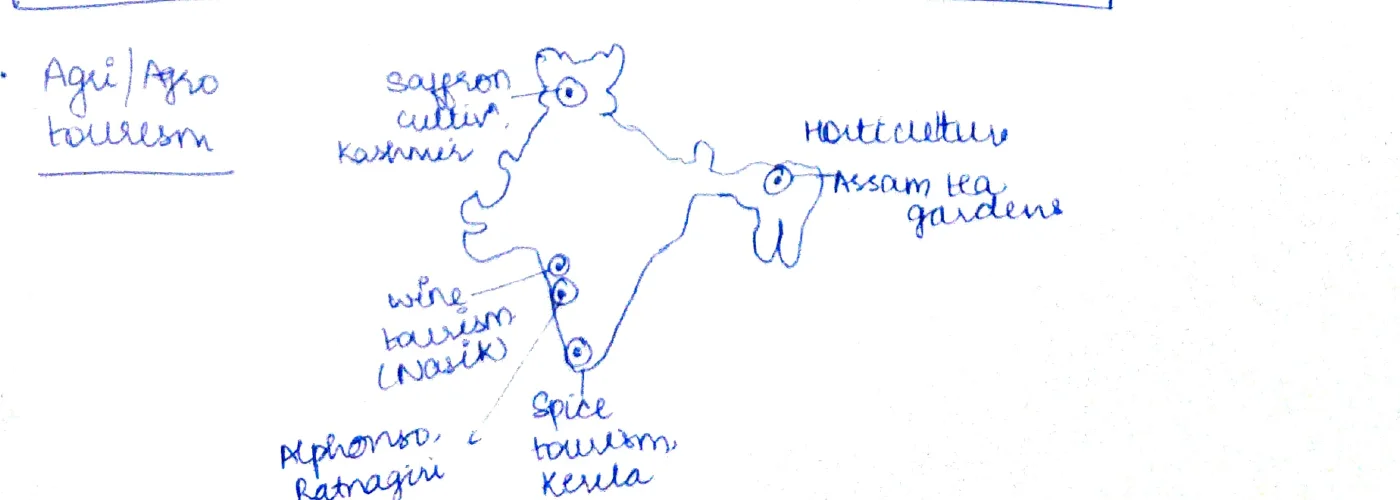
- Topic: Agri / Agro tourism sites in India
- India map with locations marked:
- Sagreen [Sangrur?] / [illegible] (North/Punjab region) — [illegible label]
- Why Tourism (Sikkim?) — [illegible]
- Horticulture / Masum Tea gardens (North-East region)
- Mythonom / Kottagiri (South-West, possibly Kerala/Tamil Nadu)
- Agri tourism / Kerala (South)
- [Several place names partially illegible due to handwriting]
#Page 26 — Diagram 1: Agri-Industry-Service Linkages Triangle (Agriculture / Economy / GS Paper 3)
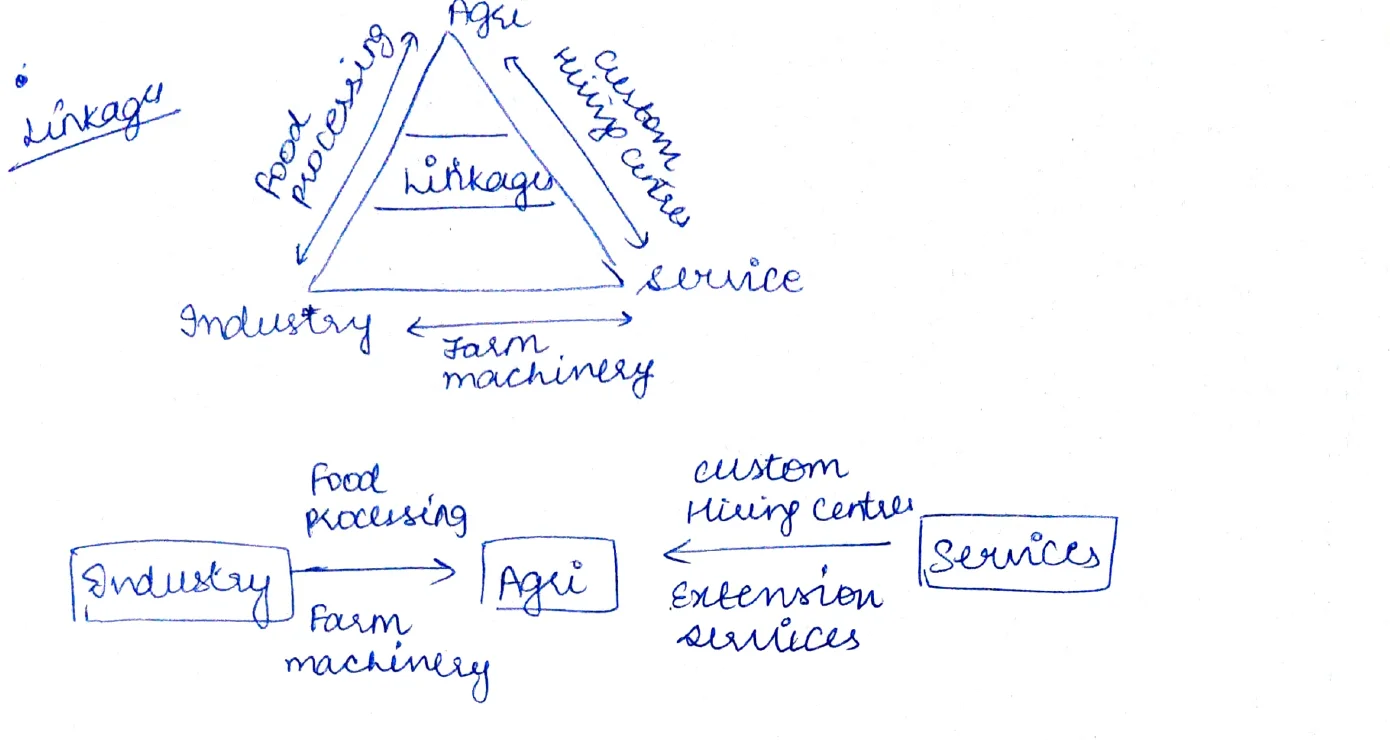
- Topic: Agri-Industry-Service sector linkages
- Triangle diagram:
- Apex: Agri [Agriculture]
- Bottom-left: Industry
- Bottom-right: Service
- Sides labelled:
- Agri ↔ Industry: Farm machinery
- Agri ↔ Service: Custom hiring / Extension services [top right side]
- Industry ↔ Service: [illegible label at base]
- Centre of triangle: Linkages / Food processing
- Additional labels on diagram:
- Industry ← Farm machinery ← Agri (directional arrows)
- → Service (right side)
#Page 26 — Diagram 2: Industry → Agri → Service Flow Diagram (Agriculture / Economy / GS Paper 3)

- Topic: Expanded agri-industry-service linkage (flow version of triangle above)
- Flow (left to right with branches):
- Industry → (Farm machinery) → Agri [Agriculture]
- Agri → (Food processing) → [back to Industry or market]
- Agri → (Custom hiring centre) → Extension services → Services (box, right)
- All ultimately feed → Services (rightmost box)
#Page 26 — Diagram 3: Millets Producers — India Map (Agriculture / GS Paper 3)
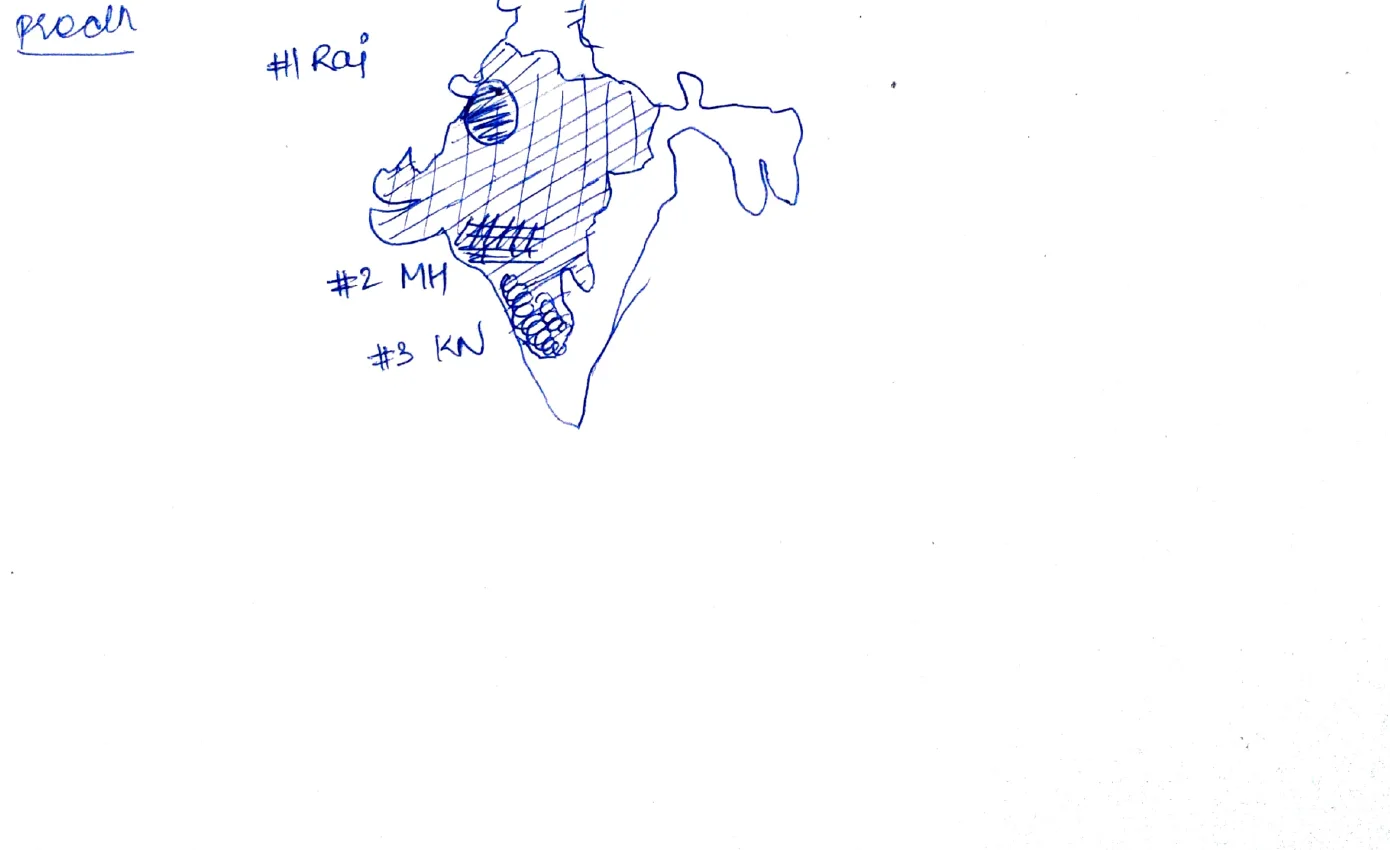
- Topic: Top millets [Siridhanya] producing states in India
- India map with hatched regions marking top producers:
- #1 Raj [Rajasthan] — largest hatched region (North-West India)
- #2 MH [Maharashtra] — second largest hatched region (West-Central India)
- #3 KN [Karnataka] — third hatched region (South India)
- Label: Millets prodr [producer]
Quotes, Examples & Diagrams (Ethics/Essay)
Topper handwritten notes#PART 1 — PHRASES & QUOTES
#Page 1 — Phrases & Quotes (Left Column)
- Yatha drishti, tatha srishti — "You see the world as you are"
- Money — food, not appetite; books — knowledge; bed — sleep
- Only a means to happiness, no guarantee of it (else it would enable/fuel corruption)
- Art of living
- Every saint has a past, every sinner has a future
- Ask not what the country can do for you, ask what you can do for the country — John F. Kennedy
- Easy to build strong children than repair broken men
- Prakrati rakshati rakshita — nature protects if protected
- Patience is the strength of the weak & impatience is the weakness of the strong — Kant
- Ounce of practice > tonnes of preaching
- Hell has 3 gates — lust, greed & anger
- Punished not for your anger but by your anger — Buddha
- Déficit = noble sin
- Honesty is the cheapest book of wisdom — Thomas Jefferson
- Aristotle — 4 cardinal values: courage, justice, temperance, wisdom (GS4 [GS Paper 4])
#Page 1 — Phrases & Quotes (Right Column)
- Lok Niti > Raj Niti
- What is possible for one is possible for all — (Malala)
- When whole world is silent, even 1 voice becomes powerful
- CS [Civil Servants] should be like the 4th lion patter of lion capital — invisible
- No victors in war
- Tagore said that it was Buddha & not Alexander who conquered the world
- Pen mightier than sword but the hand that holds it is the mightiest
- Genius can take you to heights but character will decide whether you stay there — Albert Einstein
- Devotion to duty is highest form of worship
- Co-existence or no existence — Bertrand Russell
- Ethics → ethos/habits = habit; corruption → corruptus = destroy; but today ethics is destroyed & corruption has become habit
- Demo[cracy] is not a spectators sport, it's a participatory sport
- If you want others to be happy, practice compassion. If you want to be happy, practice compassion — Dalai Lama
- Minimalistic life — 90/90 rule: used in past 90 days? Next 90? No. No → give up
#Page 1 — Bottom (Overlap Zone)
- Easy to build strong children than repair broken men
- Prakrati rakshati rakshita — nature protects if protected
- Patience is strength of weak, impatience weakness of strong — Kant
- Ounce of practice > tonnes of preaching
- Hell has 3 gates — lust, greed & anger
- Punished not for your anger but by your anger — Buddha
- Déficit = noble sin
- Honesty is cheapest book of wisdom — Thomas Jefferson
- Aristotle — 4 cardinal values: courage, justice, temperance, wisdom (CoJ [courage of justice?])
- Truth is — no one, lies to lie, even if everyone
#Page 2 — Phrases & Quotes (Left Column)
-
To err is human, to forgive divine
-
IQ + EQ + LQ = Success (Jack Ma)
-
Sheelam Param Bhushanam — character is highest virtue
-
"All my best ideas were born of anger" — Kailash Satyarthi
-
Weapons can kill terrorists but edu[cation] can kill terrorism — Malala
-
Institutional sclerosis — when institution fails to keep pace with time
-
Diffusion of Responsibility — someone else will save the world
-
Swami V[ivekananda] → prefer a man with a kind EQ [heart] but Mt [morally] intelligent EQ
-
Kautilya → guide/admin on 4/0 [40?] people
-
Broken window syndrome — crimes, waste mgmt, spitting etc.
-
Climate consequentialism → Climate Kantianism
Climate Consequentialism → Kantianism flow diagram - Arrow from "Climate consequentialism" to "Climate Kantianism"
- Gear/cycle icon on arrow
- Reference to Plato, but nearer still is Aristotle [→ Metaphysics]
-
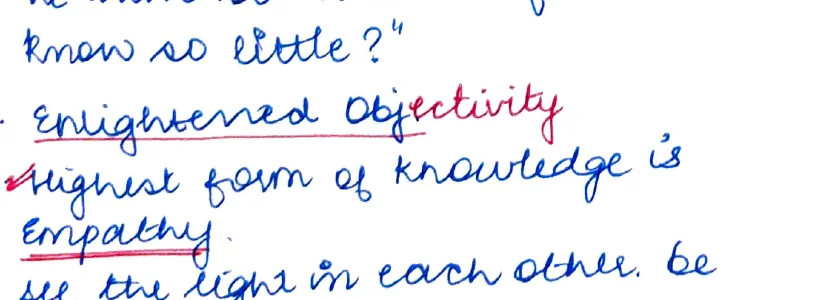
Noam Chomsky — "How is it that we have so much info but know so little?"
-
Enlightened Objectivity
-
Highest form of knowledge is Empathy
-
See the light in each other, be the light in each other — Homeo Empathicus
-
Prudence = guarantor of all virtues
-
स्वस्थो स्वस्थ्यम, समाजाय स्वस्थ्यं — "A little bit for yourself is a lot for the society"
#Page 2 — Phrases & Quotes (Right Column)
-
तत दूरे, तत वांतिके — "It is far, yet it is within"
-
Useless laws weaken necessary laws — Montesquieu
-
If you can't feed 100 people, then feed just one. There are no great things, only small things done with love — Mother Teresa
-
To do a great right, do a little wrong — Shakespeare
-
The difference between what we do & what we are capable of doing would be sufficient to solve most of world's problems — MK Gandhi
-
Blue & Pink model ⟹ Rainbow model of parenting [best]

Blue & Pink Model → Rainbow Model of Parenting - Left circle: Blue & Pink model
- Arrow pointing right to: Rainbow model of parenting [boxed, labeled "best"]
-
Moral eq[uanimity] / moral blind spot / moral fall
-
Harm principle — people should be free to act however they wish unless their actions cause harm to somebody else
-
[Gear/cycle icon] → Pygmalion Effect [cross-reference]
#Page 3 — Phrases & Quotes (Left Column)
- Cat on the wall / fence sitter
- Bystanders apathy
- Science of good men
- Unexamined life
- FD [Frederick Douglass?] — strive for excellence [boxed]
- Be a man of values, not success — Einstein [boxed]
- Artha / dharma / kama = instrumental values; while moksha is terminal [boxed] except time + exception
- Ethics = society's morals; morals = individual ethics
- No self mode, 1000 others!
- An avg of 5 persons you spend time with
- Destruction — treat or demo[lish]
- = unjust → Gandhiji
- Vritam [?] overwhelm > overpower
- 7 sins:
- W — wealth w/o work
- Sc — science w/o humanity
- CM — commerce w/o morality
- RS — religion w/o sacrifice
- PP — politics w/o principle
- KC — knowledge w/o character
- There is only 1 sin — lapse of conscience
- Graduation / Gurupad [?]
- Moral turpitude
- Relativism (when in Rome)
- Absolute universe
- Zero tolerance / slippery slope / broken window
- Ethical fading
#Page 3 — Phrases & Quotes (Right Column)
- Injustice shall never be answered with injustice — Socrates
- Hate the sin, not sinner [circled symbol]
- Peace breeds peace, violence breeds violence
- Smallest good deed v/s grandest good intention
- All are born free & equal in rights & dignity — UDHR [boxed]
- Exceptional measures & exceptional times — terminal except time + exception should not overwhelm the norm
- In a matter of conscience [circled], law of majority has no place [circled symbol]
- Hate can't drive out hate, only love can
- As the means so the ends — "Soya ped laboge ka, aam kaha se khaye" [you planted a neem tree, where will you get mangoes?]
- If you gain the world but lose your soul, it's not worth it
- Satyam vada, dharmam chara — speak the truth, pursue righteousness
- Honesty is more than not lying. It is truth telling, truth loving & truth living
- No higher religion than human service
- Greatest threat to our planet/system is that someone else will save it
- Youth should be combo of manliness [masculinity] & saintliness — Swami Vivekananda
#PART 2 — EXAMPLES
#Page 4 — Examples: Movies / Serials / Shows & Table
Serials / Shows
- Chak De India!
- Thapad
- Padman
- Swades
- Gabbar Is Back
- Oh My God!
- Dangal
- Pink
- (Chhapaak) — acid attack
- Toilet: Ek Prem Katha
- Laxmi Rocket
- Soorma — Sandeep Singh
Related serials / shows names:
- Watan [?]
- Baahubali
- Vaastu
- Satyamev Jayate
- KBC
C / A / B Table — Smoking Example
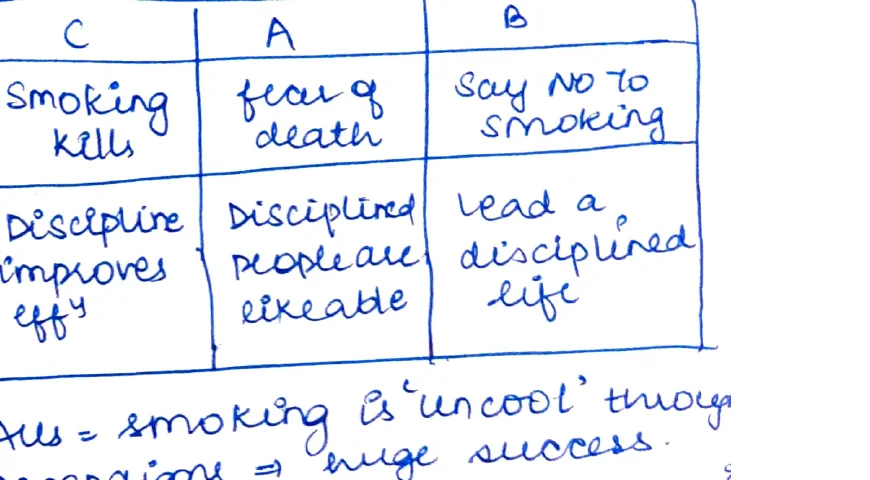
| C | A | B | |
|---|---|---|---|
| Smoking kills | Fear of death | Say no to smoking | |
| Discipline improves eff[ectiveness] | Disciplined, people are disease | Lead a disciplined life |
- Au[dio] — smoking & 'uncool' image campaigns = huge success
- Dentine in toothpaste ad = target; cognitive component
Kailam Satyarthi — Mukti Vahini [boxed] — Mahabharata
- Arjun & Duryodhana — both had aptitude; but Arjun right attitude
- Karna — daanveer, revengeful
- Dhritarashtra — mixed pub [public] & pvt [private] life
- Bhishma — accepted death but kept firm to his commitment [boxed]
- Kurusha — Ma [mother] Falsehu Kadachara
- Duryodhana — pride comes before fall
- Draupadi — think before you speak [boxed]
- Abhimanyu — half knowledge is dangerous / courageous/fortitude [boxed]
- Yudhishthira — righteousness is useless unless paired with foreign [force/strength]
- Gandhari — empathy [boxed]
- Eklavya — guru is god
- Mother / father / doctor / soldier → instant justice → Hyd [Hyderabad] encounter → constant delay → Nirbhaya (extremes)
#Page 4 (bottom) + Page 5 (top) — Examples Continued
Historical / Political / Social
- Bihar topper scam — IPS found cheating to become IAS
- British Rule, WWI, II, Treaty of Versailles
- Bhagat Singh [boxed]
- Savitribai Phule [boxed]
- Marital rape, 377, euthanasia, Sabrimala [Sabarimala], triple talaq, LGBTQ+
- He Jiankui — designer baby
- Women's hockey team in Olympics
- Aditi Ashok (#4 in hockey) [boxed]
- PV Sindhu
- Appu bai Deepika Kumari
- Neeraj Chopra — properly folded flag, henna [boxed]
- Hitler, Napoleon
- Kane Williamson — smile through defeat [boxed]
- Little wrong but got it right [annotation]
- Hira Das [boxed]
- Dhoni — captain cool
- AFSPA
- Give it up subsidy
- Medvedev [boxed]
- Mary Kom [boxed]
Page 5 — Examples (Left Column)
- Malala [boxed]
- Divyashakti Nagpal (Devotion to duty) [boxed]
- Neeraj George → Mt [Miriam?] Kilim on crutches (willpower) [boxed]
- XR [Extinction Rebellion] group — non-violent struggle against CC [Climate Change]
- Prabha Devi, 76 — planted entire forest in Rudraprayag [boxed]
- 16-yr old boy files petition over excessive plastic packaging by Amazon / Flipkart
- Aslik Ku Pandey (DC of Beed, MH) imposed ₹5k fine on himself for plastic cups [boxed]
- Pierre Curie rejected Nobel Prize unless shared with wife Marie in 1903 [boxed]
- R. Prasad — only 50+ salary, towards end only 85+ [boxed]
- Delhi HC asks man to plant 50? trees in an electricity theft case
- Mitchell Marsh — missed 4–6 weeks of cricket — broke hand by punching against a wall in anger — he was not even out! :) [boxed]
- Arunachal villagers forego land compen[sation] for road construction [boxed]
- Avnish Saran — 36th [36th batch] IAS, 4 daughters to govt school, to take MOM [mother] to eat in school [boxed]
- Langars — oxygen langar during Covid [boxed]
- Apple CEO Tim Cooke came out as a gay after reading letters from kids struggling with identity
- MP Min[ister] takes underprivileged kids to 5-star hotel on Diwali
Page 5 — Examples (Right Column)
- Aus PM Scott Morrison was working as a water boy during a match with [someone]
- 54-yr-old man in MH returned ₹40,000 bag — had ₹3 in pocket + Refused award
- Fb [Facebook] — GOAL
- Uber's #Leave Your Car Behind move to help Delhi breathe again
- Talisman by PM Modi invoked while taking RCEP decision
- Japanese Min[ister] resigned for taking melons & mangoes as bribe + PM apologised for having appointed such a Min! [boxed]
- Loss of coop gov[ernmen]t in PSB leads to high NPAs, bank frauds
- Zomato delivery boy rejected for being Muslim
- McD [McDonald's] gets FSSAI notice for spreading unhealthy habits — "Stuck with Ghiya Tori again? Make It! Combo you love!" [boxed]
- Sukhpal Singh Bedi donates plot of land for mosque in UP [boxed]
- Justice Arun Mishra offered to apologise to any lawyers he had unintentionally hurt in courtroom [boxed]
- Bannerjee & Duflo received Nobel in dhoti & sari
#Page 5 (bottom) + Page 6 — Examples Continued
Page 5 Bottom
- Odisha's JAGA Mission
- Russia banned by WADA for 4yrs
- Germany — hologram in circus [boxed]
- Villagers = sweaters for Ele[phants]
- Hairstylist in Coimbatore dressed as Santa & gave free haircuts to homeless
Page 6 — Examples (Left Column)
- Dr. Upadhyay (2009 batch officer in Odisha) — bulb of ₹11 (AIR 5)
- Jallikattu
- Deepika Padukone slammed for "recreating her Chapaak look" challenge on TikTok
- Dr. Li Wenliang — first warned about COVID, died fighting against it at 34 [boxed]
- Man asks Mumbai Police the punishment for suicide, thanked later for saving his life [boxed]
- Lifebuoy (in its ad) requested users to use any soap nearest to them & mentioned competitors' names like Lux, Dettol, Santoor etc. to create awareness about Covid [boxed]
- Narayana Murthy touched Ratan Tata's feet while presenting him Lifetime Achiever Award [boxed]
- Voluntary code of ethics by IMAI during LS [Lok Sabha] election 2019 [boxed]
- Mrinal Ghosh — covered her kit was in her last leg of pregnancy [boxed]
- 1983 — Jonas Salk dev[eloped] vaccine for polio & decided not to patent it; tested on himself [boxed]
- Migrant labourers painted the building they were quarantined in as degree courses
- Jacinda Ardern cancelled TV show despite earthquake
- Doctor slept in car after returning from Covid duty
- Chef Vikas Khanna fed 1000s in Amritsar acting in NYC during lockdown + couldn't go walk in childhood, mother → born to fly! [boxed]
Page 6 — Examples (Right Column)
- Kirsten [?] white rev[erend] didn't drink milk himself + was from a well-to-south Indian Christian family, yet sympathised with farmers of Anand
- Satish Dhawan — resp[ect] of failure [boxed]
- Sagayam — TN IAS discloses his assets online [boxed]
- Apple says no to built beauty/fairness enhancement features in its cam
- T HUL → Glow & Lovely
- Mizo & Naga govt banned dog meat after distressed photos went viral [boxed]
- Manjunath IPS — 40 tf [transfers] in 39 yrs; superseded thrice by juniors [boxed]
- Assam NEET topper → proxy
- Man sold 22L SUV for a cylinder district in Mumbai [boxed]
- Thief in Sind returned stolen vaccines with note "didn't know"
- Saudi Arabia to teach Ramayana & Mb [Mahabharata] lessons
- Justice Venkatesh — LGBTQ — cause/psycho-edu[cation] to remove his own prejudices [boxed]
- To make tree plant a part of degree courses
- Sanwaitouri — festival of forgiveness
- Pradeep Sangwan → Healing Him (plastic waste)
- Shores — Lucknow: café by acid attack survivors "pay as you wish"
- INS Tarini — all women contingent [boxed]
- Seshan Vs Nation
- Policeman walked 450 km from Kanpur to Jabalpur to join duty
#Page 7 — Examples Continued (Left Column)
- Sam Manekshaw — courage to say no / right time [boxed]
- Wall of Kindness [boxed]
- P. Naranhari — IAS made Gwalior disable friendly [boxed]
- Sal Pahari — injured etc. as she says no cosmetics [boxed]
- Tata Group — 65% SH [shareholders] with Tata Trust, not Ratan Tata
- Solapur Kasher, Ranjit Desale — shared ₹1m prize money with runner-up: "I can't change the world alone?" [boxed]
- Anand Ku — Super 30 [boxed]
- Afghan Kurd
- Afghan couple throwing babies on the other side of fence to save them
- NDTV — live footage of Pathankot attack [boxed]
- Vaccinemaitree [Vaccine Maitri]
- Our Const[itution] is a ray of HOPE — Harmony, Opportunity, Peace & Equality
#Page 7 — Examples (Right Column)
-
Amartya Sen: Niti vs Nyaya approach
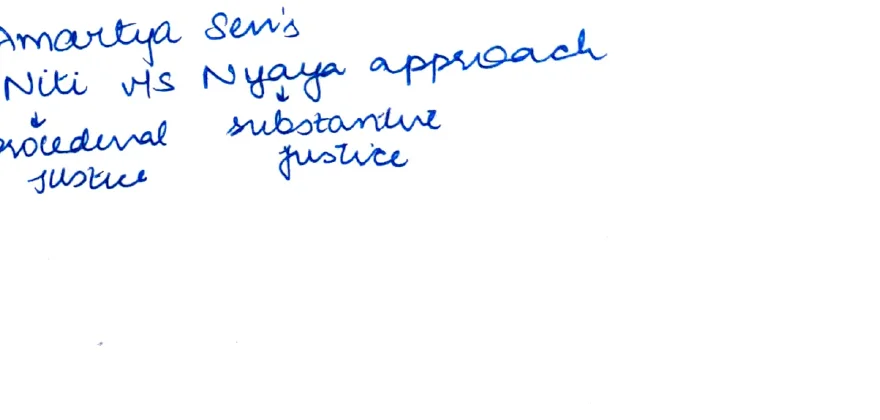
Amartya Sen — Niti vs Nyaya: Procedural vs Substantive Justice - Niti = procedural justice (formal / institutional)
- Nyaya = substantive justice (actual outcome felt by people)
#PART 3 — DIAGRAMS
#Page 8 — Diagram 1: Voice of Conscience Flowchart
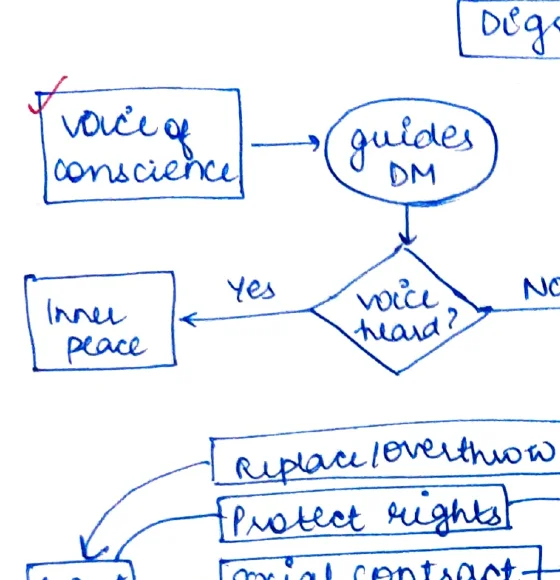
- Voice of conscience → guides DM [Decision Making] (oval)
- Diamond: Voice heard?
- Yes → Inner Peace
- No → Guilt / Remorse / Knowledge split
- People (box) ← connected via:
- Replace / overthrow
- Protect rights
- Social contract
- Give power
- Misuse power
- Loop back to conscience via enforcement by state / law
- Govt (box on left): voluntary → Structural obligation
- Criminal ← law → Ethics (Venn: overlapping circles)
#Page 8 — Diagram 2: Logos / Ethos / Pathos Triangle
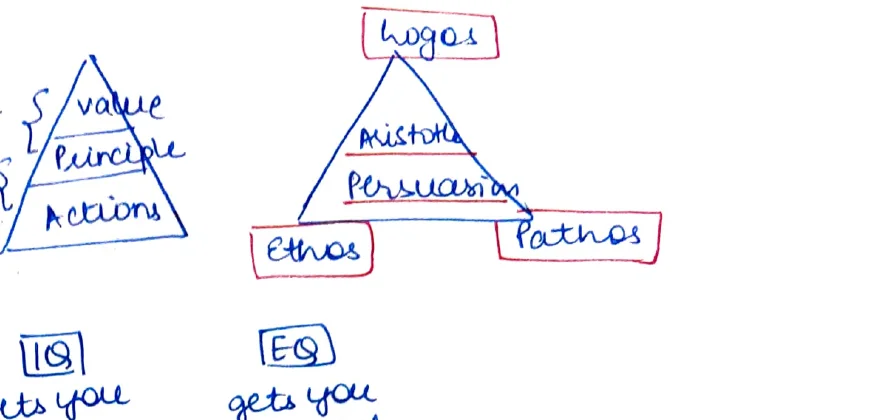
- Triangle:
- Top apex: Logos / [Austin] Permissive
- Bottom-left: Ethos
- Bottom-right: Pathos
- CoS [?]: Value / Function / Action (three corners)
#Page 8 — Diagram 3: IQ vs EQ

- IQ gets you hired
- EQ gets you promoted
- → Prof[essional] success
#Page 8 — Diagram 4: Strengthening Ethical Values (Graph)
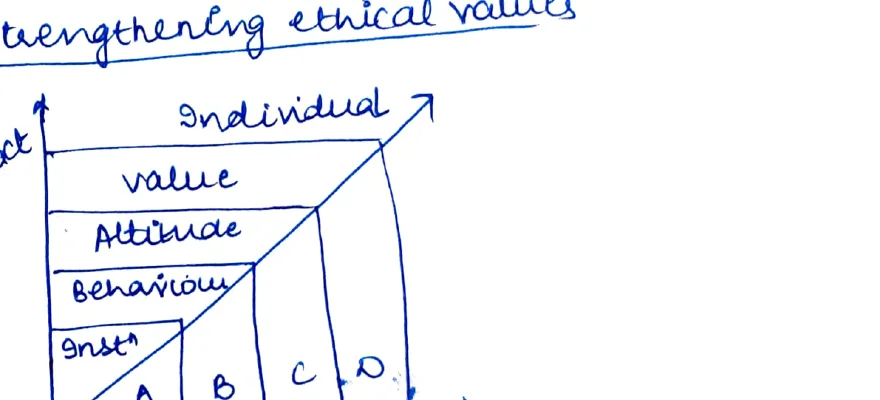
- X-axis: Time (points A, B, C, D)
- Y-axis: Impact (Individual ↑)
- Layers (bottom to top):
- Onset (baseline)
- Behaviour
- Attitude
- Value
- Upward-rising staircase / trajectory from A → D
#Page 8 — Diagram 5: Ethical / Legal Matrix
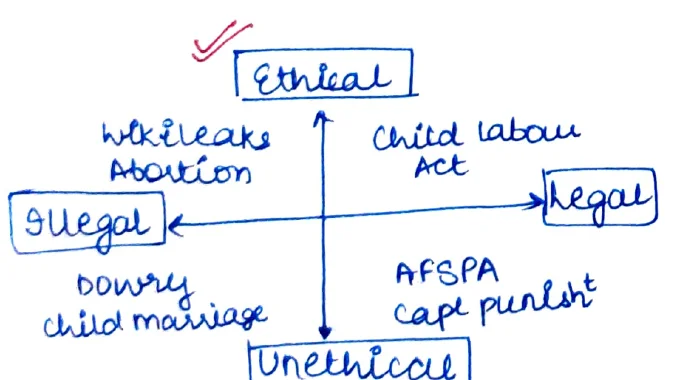
- Two axes:
- Vertical: Ethical (top) ↕ Unethical (bottom)
- Horizontal: Illegal (left) ↔ Legal (right)
- Quadrants:
- Ethical + Illegal: WikiLeaks, Abortion
- Ethical + Legal: Child Labour Act
- Unethical + Illegal: Dowry, Child Marriage
- Unethical + Legal: AFSPA, Capital Punishment
#Page 8 — Diagram 6: Pygmalion Effect / Aux Action Flowchart
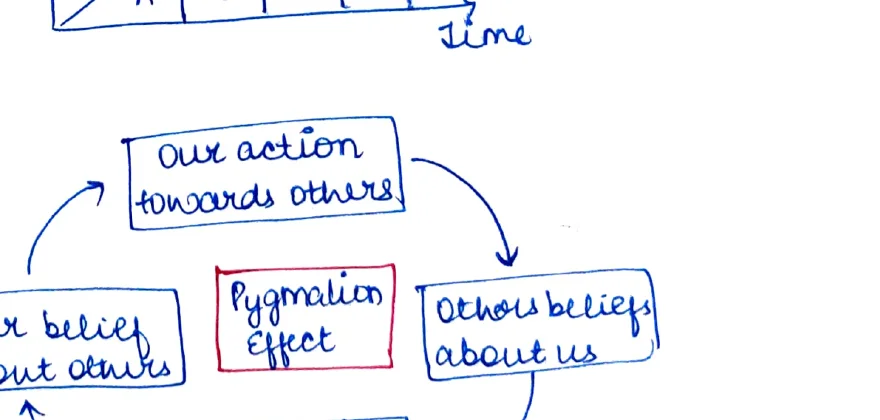
- Cycle (clockwise):
- Our belief about others → Pygmalion Effect [boxed] → Others' belief about us → Others' actions towards us → Our action towards others → back to start
- Team dev[elopment] [linked on page — see Diagram 9]
#Page 8 — Diagram 7: Needs / Values / Karma — Integrity Venn
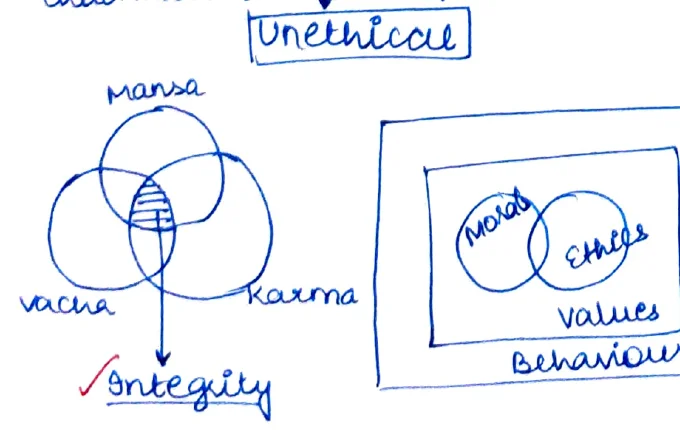
- Three circles overlapping:
- Manas [mind/thought]
- Karma [action]
- Vachan [speech/word]
- Centre intersection: Integrity
- Also within: Needs, Values, Behaviour
#Page 8 — Diagram 8: Product Recall / CSR Space (Venn + axis)
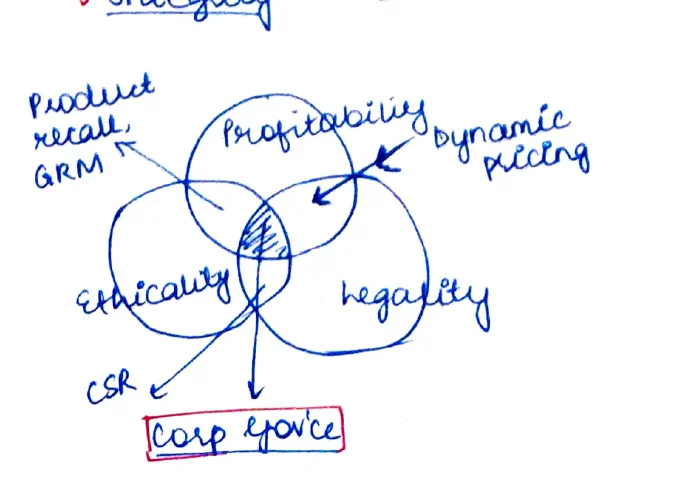
- Overlapping circles:
- Political recall / ARM [?]
- Stakeholder
- Legality
- Centre: CSR space [boxed]
- Elements: Discretionary, Dynamic filling, Ethicality, Legality
#Page 8 — Diagram 9: Team Development (Tuckman's Model)
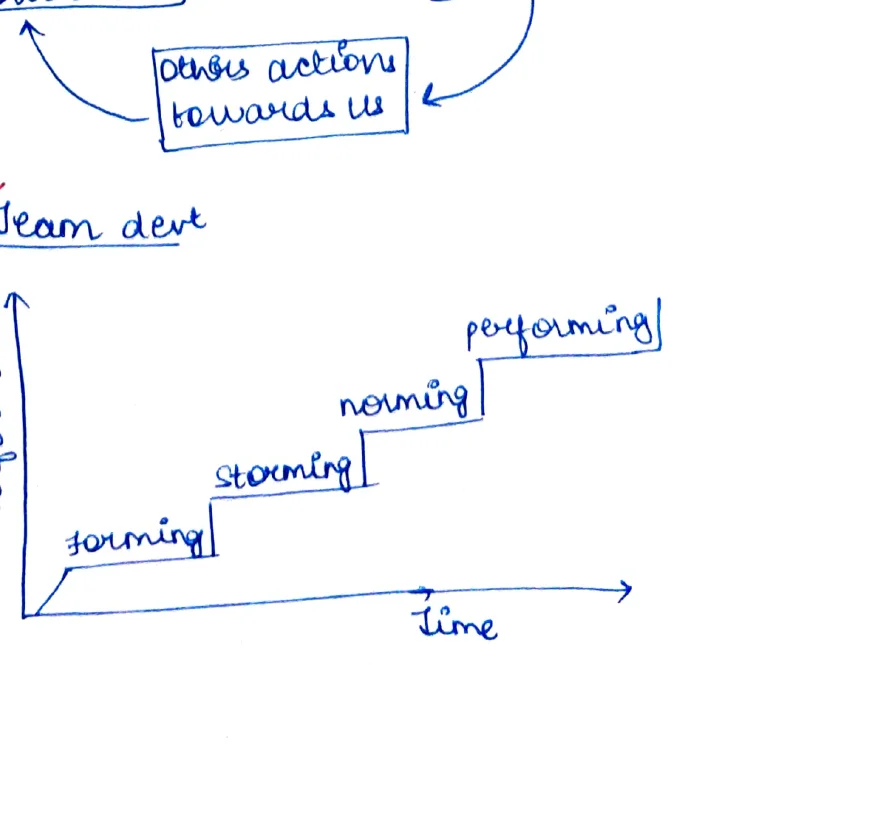
- X-axis: Time
- Y-axis: Performance
- Stages (in order):
- Forming
- Storming (performance dips)
- Norming (recovery)
- Performing (peak)
- S-curve trajectory rising after storming dip
#Page 9 — Diagram 1: Triple Bottom Line
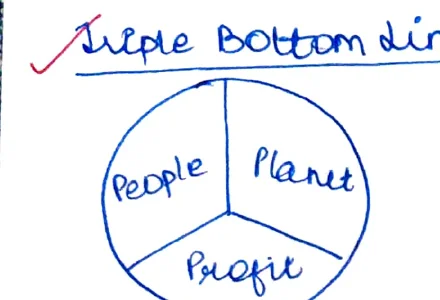
- Three overlapping circles:
- People
- Planet
- Profit
- Centre intersection = Triple Bottom Line
#Page 9 — Diagram 2: UCC / Social / Religious / Constitutional Values
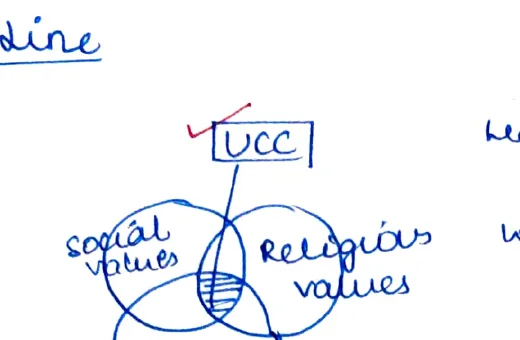
- UCC [boxed] at top
- Three overlapping circles below:
- Social values
- Religious values
- Constitutional values
- Centre: shared intersection
#Page 9 — Diagram 3: Ensuring Publicity / CoC Leadership Triangle
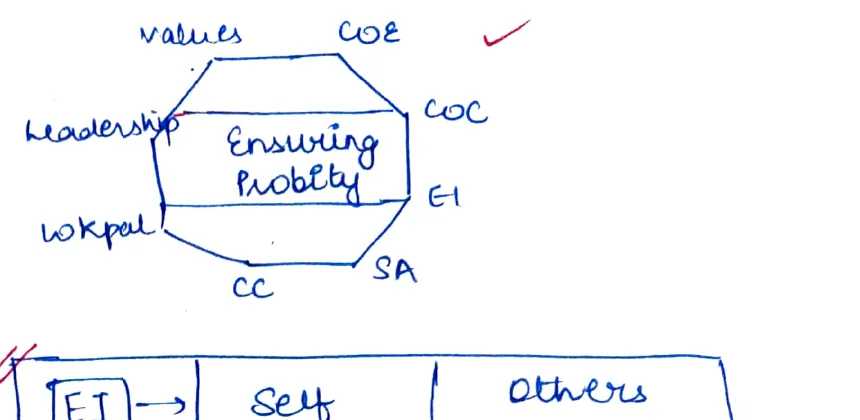
- Triangle:
- Top: Ensuring Publicity / CoC [Code of Conduct]
- Left side label: E1 (CoC)
- Right side label: SA (2A)
- Base: CC (left) — E1 (right)
- Lokpal / Workplace labels on sides
- Values: CoS [?]
#Page 9 — Diagram 4: IKIGAI
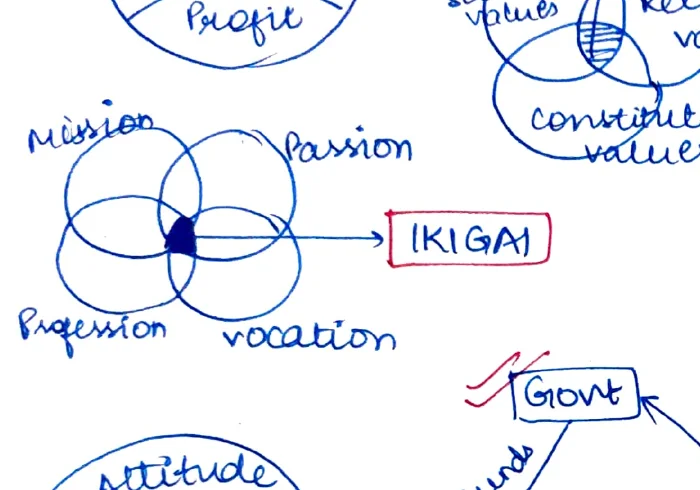
- Four overlapping circles:
- Mission (top-left)
- Passion (top-right)
- Profession (bottom-right)
- Vocation (bottom-left)
- Centre (all four overlap): → IKIGAI [boxed in red]
#Page 9 — Diagram 5: Emotional Intelligence (EI) — 2×2 Table
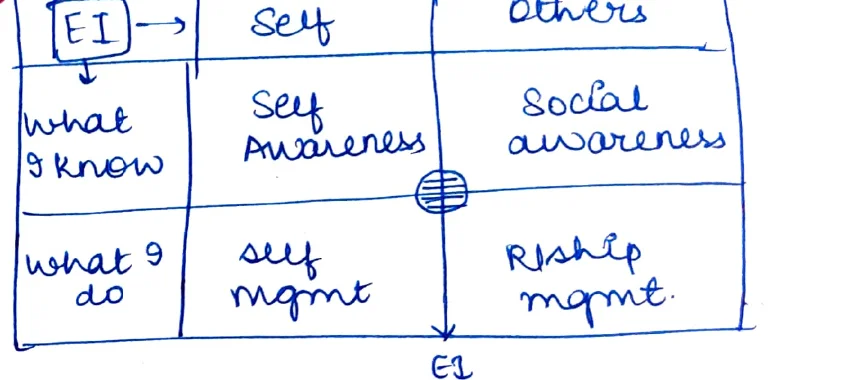
| Self | Others | |
|---|---|---|
| What I know | Self Awareness | Social Awareness |
| What I do | Self Mgmt [Management] | R[elationshi]p Mgmt [Management] |
- EI → self (left column) & others (right column)
- Label: EI at top-left and bottom-right corners of table
#Page 9 — Diagram 6: Govt → Admin → Citizen Hierarchy
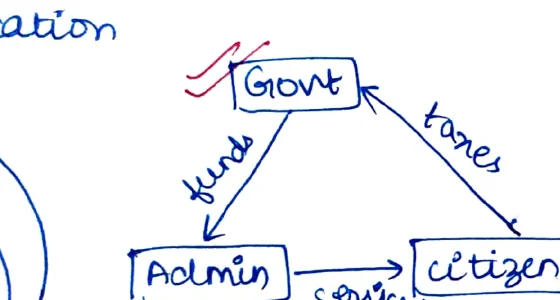
- Govt [boxed] at top
- Provides: taxes / loans
- → Admin [boxed]
- Serves:
- → Citizen [boxed]
- Note: "Sends" (Govt → Admin) / "Serves" (Admin → Citizen)
#Page 9 — Diagram 7: Attitude / Values / Belief Concentric Circles
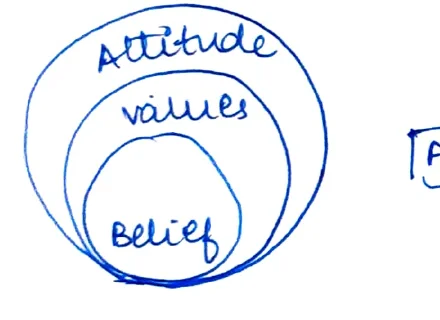
- Outer ring: Attitude
- Middle ring: Values
- Inner core: Belief
#Page 9 — Diagram 8: Thoughts → Integrity → Action / Emotion Triangle

- Triangle with:
- Apex: Thoughts
- Centre: Integrity
- Bottom-left: Action
- Bottom-right: Emotion
#Page 9 — Diagram 9: Beliefs/Values → Attitude → Habits → Behaviour Chain
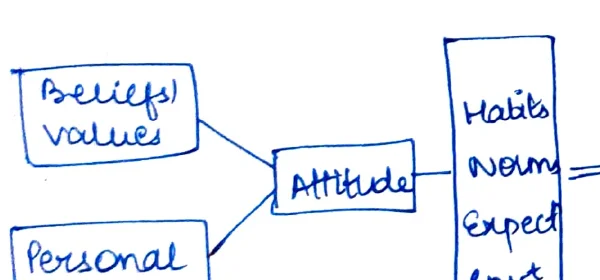
- Beliefs / Values (left box) →
- Attitude (middle box) containing:
- Habits
- Norm
- Expect[ation]
- Env[ironment]
- → Behaviour (right box)
- Personal needs also feed into Attitude
#Page 9 — Diagram 10: Antar Drishti (Insight) Triangle
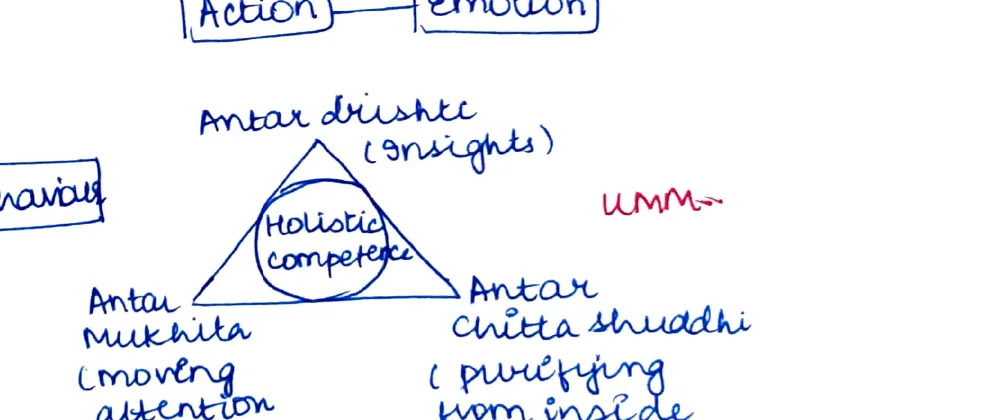
- Antar Drishti [insight] — triangle with UMM~ label
- Left side: Antar Mukhita (moving attention inside)
- Right side: Antar Chitta Shudhi (purifying from inside)
- Base: Holistic components
#Page 9 — Diagram 11: Social Value Decides Constitutional / Governance Values
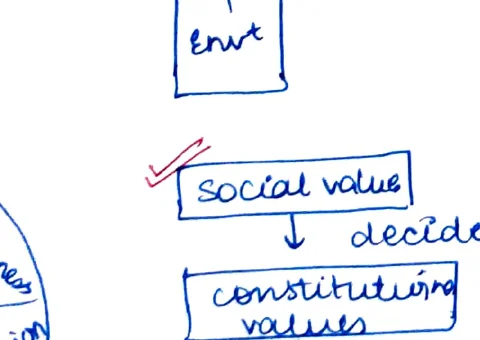
- Social value (top) → decides
- → Constitutional values
- → affects
- → Governance values (bottom)
#Page 9 — Diagram 12: IKan [IAS] Leadership Pyramid
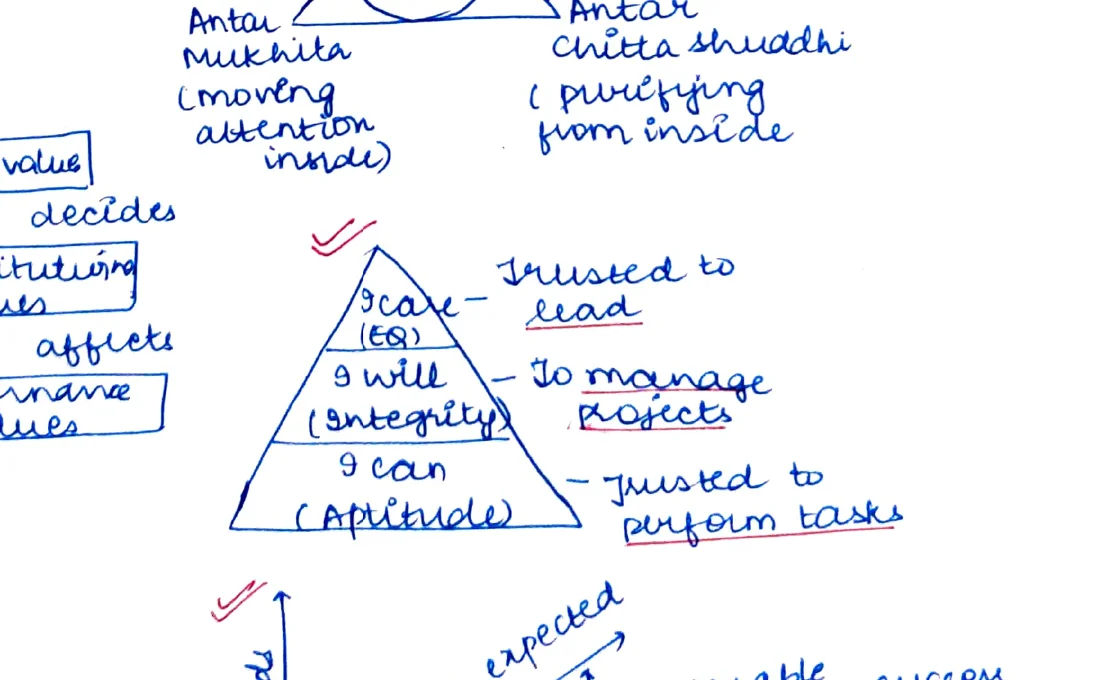
- Three-level triangle pyramid:
- Top (apex): 9 Care (EQ) — Trusted to lead
- Middle: 9 Will (Integrity) — To manage projects
- Base: 9 Can (Aptitude) — Trusted to perform tasks
#Page 9 — Diagram 13: Mindfulness / Empathy / Compassion — EI Concentric Circles
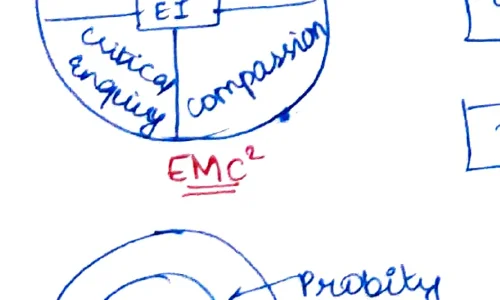
- Concentric circles (outer → inner):
- Compassion
- Empathy (with EI label)
- Mindfulness
- Centre label: CMC [?]
#Page 9 — Diagram 14: Probity Onion + Transparency/Accountability
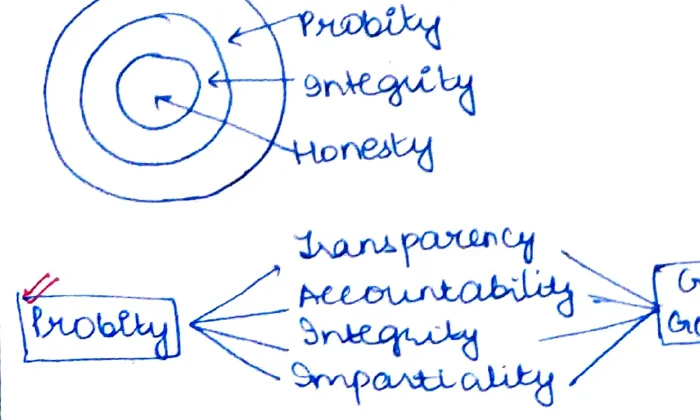
- Concentric circles (outer to inner):
- Honesty
- Integrity
- Probity
- Below (linear chain):
- Probity → Transparency → Accountability → Impartiality → need → Governance [boxed]
#Page 9 — Diagram 15: Rewards Expected vs Received (Gap Graph)
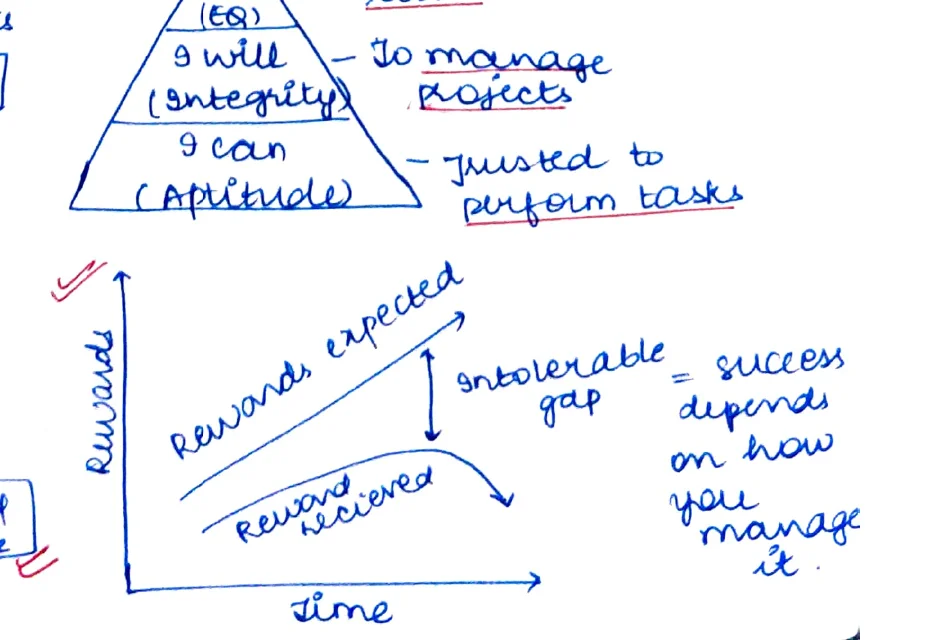
- X-axis: Time
- Y-axis: Reward
- Two trajectories:
- Rewards expected (steeply rising)
- Rewards received (flat / slow rise)
- Gap between = intolerable gap
- Caption: Success depends on how you manage it
#Page 10 — Diagram 1: Sympathy vs Empathy (Venn Diagram)
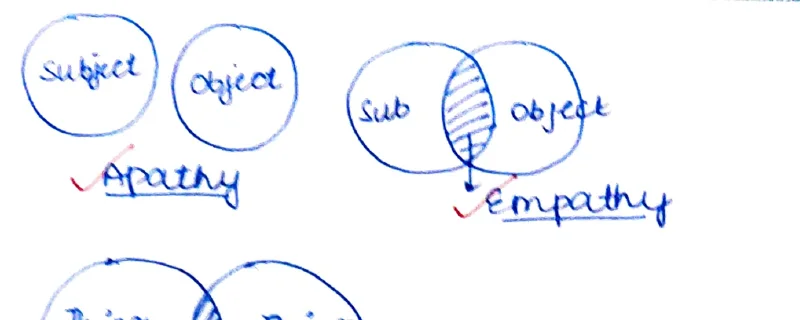
- Large left circle: Subject
- Large right circle: Object
- Small overlapping circle between them: Sub [Empathy — partial overlap]
- Label right: Empathy (subject merges with object's perspective)
- Label below left: Apathy (no overlap/connection)
#Page 10 — Diagram 2: Focus Circle (Sphere of Influence)
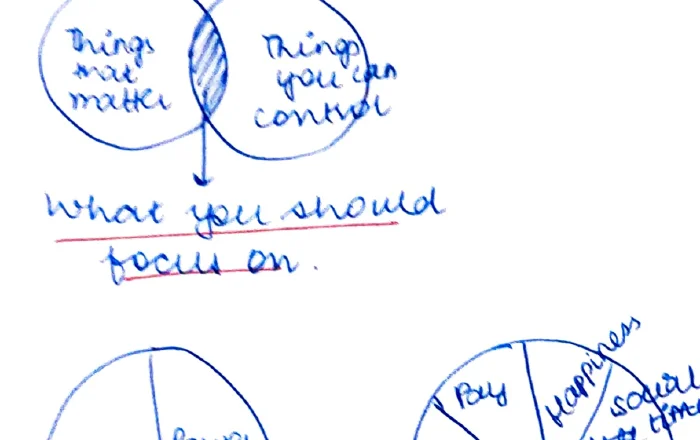
- Two concentric circles:
- Inner: Things you make / Things you can control [hatched zone]
- Outer ring: Things you can't control
- Arrow pointing inward → Where you should focus on
#Page 10 — Diagram 3: Pie of Life / "Success to Me" Wheel
![Left pie chart (3 slices: Pay, Power, Position) = "Success to some"; Right pie chart (8 slices: Pay, Power, Position, Peace, Health, Family, Free time, [illegible], [illegible]) = "Success to me"](assets/img/quotes_examples_and_diagrams_p10_03.webp)
- Left pie (3 slices) = "Success to some"
- Pay
- Power
- Position
- Right pie (8 slices) = "Success to me"
- Pay
- Power
- Position
- Peace
- Health
- Family
- Free time
- [illegible segment 1]
- [illegible segment 2]
#Page 10 — Diagram 4: Engagement–Ethos–GEs of Bureaucracy Flowchart + ARC II + Sevottam
-
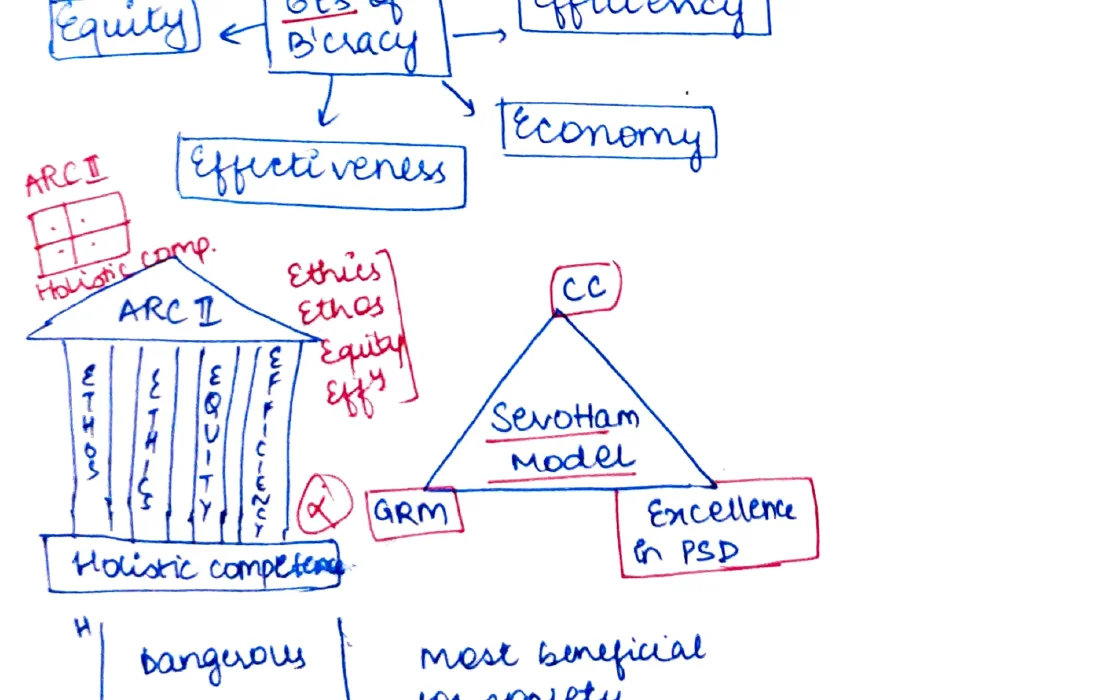
GEs of Bureaucracy [central box] connected to:
- Engagement (top-left)
- Ethos (top-right)
- Efficiency (right)
- Economy (bottom-right)
- Effectiveness (bottom-left)
- Equity (left)
-
ARC II [boxed in red] — temple/pillar diagram
- Pillars (left to right):
- E — Ethos
- T — Ethics [illegible partial]
- H — [illegible]
- I — [illegible]
- Q — Equity
- Y — [illegible]
- Efficiency
- Effectiveness
- Economy
- Label: Holistic Competence / Holistic comp
- Cross mark [×] at base — ARC II reform
- Pillars (left to right):
-
Sevottam Model — triangle [separate, on right side of page 10]
- Apex: CC [Citizen Charter]
- Bottom-left: GRM [Grievance Redressal Mechanism]
- Bottom-right: Excellence in PSO [Public Service Organisation]

Sevottam Model Triangle — CC / GRM / Excellence in PSO
#Page 10 — Diagram 5: Skills / Values Matrix (Danger Matrix)

| Value (Low) | Value (High) | |
|---|---|---|
| Skills (High) | dangerous | most beneficial for society |
| Skills (Low) | fence sitter | skill them appropriately |
- X-axis: Value (L → H)
- Y-axis: Skills (L → H)
#SUPPLEMENTARY NOTES & CROSS-REFERENCES
#Key Concepts Recurring Across Pages
- Pygmalion Effect — our beliefs about others shape their behaviour and loop back to confirm our beliefs (self-fulfilling prophecy)
- Broken Window Theory — disorder breeds disorder (crimes, waste, spitting etc.)
- Ethical Fading — gradual moral desensitisation, normalisation of unethical acts
- Institutional Sclerosis — institution fails to keep pace with changing times
- Diffusion of Responsibility — "someone else will take care of it" syndrome
- Moral Blind Spot / Moral Fall / Moral Equanimity — gradations of ethical failure
- Harm Principle (J.S. Mill) — freedom until harm to others
- Zero Tolerance Policy — slippery slope / broken window overlap
- Minimalistic Life — 90/90 rule for decluttering and focus
#Seven Sins (Gandhi's)
| Code | Sin |
|---|---|
| W | Wealth without work |
| Sc | Science without humanity |
| CM | Commerce without morality |
| RS | Religion without sacrifice |
| PP | Politics without principle |
| KC | Knowledge without character |
| [PP] | Pleasure without conscience |
#Key Attributed Quotes Index
| Quote | Attributed To |
|---|---|
| Ask not what the country can do for you… | John F. Kennedy |
| Patience is the strength of the weak | Kant |
| Honesty is the cheapest book of wisdom | Thomas Jefferson |
| To do a great right, do a little wrong | Shakespeare |
| Difference between what we do & are capable of… | MK Gandhi |
| Feed just one, no great things… | Mother Teresa |
| How is it that we have so much info but know so little? | Noam Chomsky |
| Genius takes you to heights, character keeps you there | Albert Einstein |
| Punished not for your anger but by your anger | Buddha |
| Co-existence or no existence | Bertrand Russell |
| Weapons can kill terrorists, edu[cation] can kill terrorism | Malala |
| If you want others to be happy, practice compassion | Dalai Lama |
| All my best ideas were born of anger | Kailash Satyarthi |
| Useless laws weaken necessary laws | Montesquieu |
| Youth should be combo of manliness & saintliness | Swami Vivekananda |
| Tagore — Buddha not Alexander conquered the world | Tagore |
| Every saint has a past, every sinner has a future | [unattributed] |
| See the light in each other, be the light | Homeo Empathicus |
| Injustice shall never be answered with injustice | Socrates |
Personalities
Topper handwritten notes#CHAPTER 15 — GOVERNOR GENERALS AND VICEROYS OF INDIA
Sources: A New Look at Modern Indian History by B.L. Grover and Alka Mehta; Indian History by Praveen Kumar
#Key Issues (Personalities covered in Ch. 15)
- Warren Hastings
- Lord Cornwallis
- William Bentinck
- Lord Dalhousie
- Lord Lytton
- Lord Ripon
- Lord George Nathaniel Curzon
#Warren Hastings (1772–85)
#Administrative Reforms
- The Court of Directors decided to end the Dual System of administration set up by Clive and in 1772 required the President and Council to 'stand forth as the Diwan' and take over charge for the entire care and management of the revenues of Bengal, Bihar and Orissa.
- Warren Hastings dismissed the two Deputy Diwans, Mohammad Reza Khan and Raja Shitab Rai. The Governor and the Council formed the Board of Revenue and the Company appointed its own officers called Collectors to manage revenue affairs.
- The treasury was removed from Murshidabad to Calcutta. Thus, the entire internal administration was transferred to the servants of the Company and the Nawab deprived of even an ostensible share in the government.
#Revenue Reforms
- In 1772 Warren Hastings made a five-year settlement of land revenue by the crude method of farming out estates to the highest bidder. Acting on the presumption that the zamindars were mere tax-gatherers with no proprietary rights in the settlement of 1772 no preference was given to them and in fact in certain cases they were actually discouraged from bidding.
#Judicial Reforms
- Better success attended Warren Hastings' efforts in judicial matters. Before Hastings the judicial system in Bengal was summary and unsatisfactory. The zamindars decided civil and criminal cases and the systems of arbitration was very popular.
- Warren Hastings tried to build up a framework of justice after the Mughal model. In 1772, a Diwani Adalat and a Faujdari Adalat were set up at the district level. The Diwani Adalat was presided over by the Collector who was competent to decide all civil cases including those concerning inheritance, caste, marriage, debts etc. In case of Hindus, the Hindu law was applicable; in case of Muslims the Diwani Adalat followed Muslim law. The Diwani Adalat decided cases involving sums up to Rs. 500 above which appeals lay to the Sadar Diwani Adalat at Calcutta presided over by the President and two members of the Supreme Council assisted by Indian officers.
#Commercial Reforms
- Warren Hastings sought to clear the bottlenecks in the internal trade of Bengal. The various custom houses in the zamindaries were suppressed. Hence forth only five custom-houses at Calcutta, Hugli, Murshidabad Dacca and Patna were to be maintained.
#Cornwallis (1786–93)
#Cornwallis Code
- Cornwallis' judicial reforms took the final shape by 1793 and were embodied in the famous Cornwallis Code. The new reforms were based on the principle of separation of powers. The Cornwallis Code divested the Collector of all judicial and magisterial powers and left him with the duty of administration of revenue only.
#Reform of Criminal Law
- If Warren Hastings had asserted the right of the Company's government to interfere with the administration of law, Cornwallis maintained that the Company had the right to reform the criminal law itself. Thus non-Muslims could give testimony against Muslims in criminal cases — not permitted so far according to the Muslim law of evidence.
#Police Reforms
- To supplement and implement the judicial reforms important changes were introduced in the police administration. In the districts the zamindars were deprived of all police powers and they were no longer to be considered responsible for robberies committed in their estates unless their complicity could be proved. The English magistrates were given control of the district police.
#Revenue Reforms
- Cornwallis reorganised the Revenue Department. In 1787 the province of Bengal was divided into fiscal areas and each placed under a Collector. The number of Collectorships was reduced from 36 to 23.
#Commercial Reforms
- Cornwallis found corruption rampant in the Commercial Department. Cornwallis reduced the strength of the Board of Trade from eleven to five members. The method of procuring supplies through contracts was given up and the method of procuring supplies through Commercial Residents and Agents begun.
#Europeanisation of Administrative Machinery
- Cornwallis suffered, like most of his countrymen in later years, from the evil infection of racial discrimination. He had a very low opinion about Indian character, ability and integrity. He regarded every native of Hindustan to be corrupt. He sought to reserve all higher services for the Europeans and reduce Indians to the position of hewers of wood and drawers of water.
#William Bentinck (1828–35)
No previous Governor-General of India had ever tackled social problems with greater courage than Bentinck did. He tried to reform Hindu society by abolition of the cruel rite of sati and suppression of infanticide. He crushed the gangs of assassins called thugs and made peaceful living possible.
#Abolition of Sati and Cruel Rites
- Regulation No. XVII of December 1829 declared the practice of sati or of burning or burying alive of widows illegal and punishable by the criminal courts as culpable homicide.
- The Regulation of 1829 was applicable in the first place to Bengal Presidency alone, but in 1830 was extended in different forms to Madras and Bombay Presidencies.
#Suppression of Infanticide and Child-Sacrifices
- Although infanticide had been declared illegal by Bengal Regulation XXI of 1795 and Regulation III of 1804, the in human practice still continued. William Bentinck took vigorous steps to suppress this immoral and in human practice.
#Suppression of Thugi
- The operations against the thugs were put in the charge of Colonel William Sleeman. The rulers of Indian states were invited to co-operate in this task.
- Colonel Sleeman arrested as many as 1,500 thugs and sentenced them to death or imprisonment for life.
- Thugi on an organised scale ceased to exist after 1837, although individual bad characters continued their nefarious activities.
#Removal of Humiliating Distinctions in Recruitment to Public Service
- In matters of recruitment to public services, William Bentinck sought to efface the humiliating distinctions between Europeans and Indians introduced by Cornwallis and upheld by subsequent Governors-General. Fitness was now laid down as the criterion for eligibility.
- Section 87 of the Charter Act of 1833 provided that no Indian subject of the Company in India was to be debarred from holding any office under the Company "by reason of his religion, place of birth, descent and colour".
#Liberal Policy Towards the Press
- Bentinck's policy towards the press was characterised by a liberal attitude. He believed the press to be a safety valve for discontent. The reduction of bhatta and other financial measures were subjects of severe criticism and even abuse in the press.
#Educational Reforms
- Perhaps the most significant and of far-reaching consequences were Bentinck's decisions about education in India. Macaulay's views were accepted and embodied in a Resolution of March 7, 1835, which decreed that English would be the official language of India in the higher branches of administration.
- Since then English language, English literature, English political literature and English natural sciences have formed the basis of higher education in India.
#Financial Reforms
- Bentinck appointed two committees, one military and one civil, to make recommendations for effecting economy in expenditure.
#Judicial Reforms
- The Provincial Courts of Appeal and Circuit set up by Cornwallis were burdened with excessive duties and usually arrears accumulated. The judicial procedure followed in these courts was cumbersome and often resulted in delays and uncertainties.
- William Bentinck abolished these courts, transferring their duties to magistrates and collectors under the supervision of Commissioner of Revenue and Circuit.
#Lord Dalhousie (1848–56)
#Administrative Reforms
- This imperialist took care to consolidate the gains of the East India Company. To relieve the Governor-General for his wider responsibilities, Bengal was placed under the charge of a Lieutenant-Governor. For the newly acquired territories, he introduced the system of centralised control. This was known as 'Non-Regulation' system. Under this system he appointed a Commissioner over a newly acquired territory who was made directly responsible to the Governor-General.
#Military Reforms
- Dalhousie's annexations had extended British India from Bengal in the east to the Punjab and Sind in the west. Dalhousie foresaw danger in the great numerical increase of the Indian army particularly during the Second Anglo-Sikh War.
- He proposed reduction in the strength of the Indian element in the army which despite some reduction stood at 2,23,000 men in 1856, as against 45,000 Europeans.
- A new 'Irregular Force' was created in the Punjab under Panjab administration with a separate system and discipline. Gorkha regiments were raised and their strength continually added to. These regiments proved of great value to the British during the crisis of 1857-58.
#Educational Reforms
- In the field of education a number of important reforms were introduced in Lord Dalhousie's time. In 1853, the Thomasonian system of vernacular education was recommended for the whole of the North-Western Provinces, Lower Bengal and the Panjab with such modifications as their various circumstances might be found to require. Similar instructions were sent to the Bombay and Madras authorities.
- In July 1854 Charles Wood, the President of the Board of Control, addressed to the Government of India his famous education despatch known as "Wood's Despatch" which provided for the creation of "a properly articulated scheme of education from the primary school to the university."
#Communication System
- Railway Development: Under Dalhousie, British dominion in India was bound together by ironlines. Strategic railway lines were planned to provide for internal communication for the defence of India. The broad outlines of the scheme were laid down by Lord Dalhousie in his famous Railway Minute of 1853 which formed the basis for the future railway extension in India. The first railway line connecting Bombay with Thane was laid down in 1853.
- Electric Telegraph: Postal Reforms were also introduced by him.
- Public Works Department: Before Lord Dalhousie the construction of Public Works had been a part of the job of the Military Department. A separate Public Works Department was set up for the first time and large amount of funds began to be spent on works of public utility.
#Commercial Reforms
- Ports of India were thrown open to the commerce of the world. Free-trade principles were becoming a passion with Englishmen of the mid-nineteenth century.
#Lord Lytton (1876–80)
#Free Trade Policy
- Notwithstanding the poor financial condition of India caused by famine, Lytton abolished import duties on twenty nine articles including sugar, sheetings, drill and some other varieties of cloth though all the members of the Viceroy's Executive Council were arrayed against him like "all the elephants of Porus." Thus the claims of Indian administration were subordinated to the needs of British production.
#Financial Reforms
- The policy of financial devolution begun under Lord Mayo was continued. Another step forward was taken in that direction. The Provincial governments were given the control of the expenditure upon all ordinary provincial services including those of revenue, excise, stamps, law and justice, general administration etc.
- For the discharge of the newly transferred services, the provincial governments were not given any increase in their fixed grants, but handed over specified sources of revenue (e.g., law and justice, excise, licence fee) from their respective provinces.
#The Royal Titles Act, 1876
- The British Parliament passed the Royal Titles Act, investing Queen Victoria with the title of Kaiser-i-Hind or Queen Empress of India.
#The Vernacular Press Act, March 1878
- In March 1878, the Vernacular Press Act was put on the statute books. Act IX of 1878, an Act for the Better Control of Publications in Oriental languages, empowered a magistrate to call upon the printer and publisher of any vernacular newspaper not in a bond undertaking not to publish anything likely to excite feeling of disaffection against the government or antipathy between persons of different races, castes or religions among Her Majesty's subjects.
#The Arms Act, 1878
- Another repressive measure of Lytton's administration was the Indian Arms Act. Act XI of 1878 that made a criminal offence to keep, bear or traffic in arms without licence.
#The Statutory Civil Service
- Lytton proposed the forward course of closing the Covenanted Civil Service to Indians and instead to create 'a close native service' to meet the provisions of the Act of 1870. Steps were taken to discourage Indians from competing for the said examination by lowering the maximum age from 21 to 19 years.
#Lord Ripon (1880–84)
#Repeal of the Vernacular Press Act, 1882
- The obnoxious Press Act of 1878 was repealed by Act 1882 and newspapers published in vernacular languages were allowed equal freedom with the rest of the Indian press.
#The First Factory Act, 1881
- To improve the lot of factory labourers, the Government of Ripon passed the first Factory Act which sought to regulate and improve the condition of labour in Indian factories.
#Financial Decentralization, 1882
- Lord Ripon continued the policy of financial devolution inaugurated under Lord Mayo. As the first experiments in financial decentralization worked well, the Government of Ripon decided to increase further the financial responsibilities of the provinces. The sources of revenue were divided into three classes, viz. Imperial, Provincial and Divided.
#Resolution on Local Self-Government, 1882
- Perhaps the most noble work of Ripon was the Government Resolution on Local Self-Government. Ripon set at work the municipal institutions of the country, for there, as he said, began the political education of the people. The development of Local Government was adopted not with a view to efficiency of administration, but as an instrument of political and popular education.
#Educational Reforms
- In 1882, an Education Commission was appointed under the Chairmanship of Sir William Hunter to review the progress of education in the country since Wood's despatch of 1854 and to suggest measures for further implementation of the policy laid therein.
#The Ilbert Bill Controversy, 1883–84
- Sir C.P. Ilbert was the Law Member of the Viceroy's Council. At the instance of the Viceroy, he introduced a bill popularly known as the Ilbert Bill, in the Legislative Council on 2 February 1883. The Bill sought to abolish at once and completely "every judicial disqualification based merely on race distinctions". The Ilbert Bill sought to correct this anomaly and give equal powers to Indian and European judges.
- The Bill was most unpopular with the European community in India. Englishmen, particularly of the planters class, ill-treated and even on occasions beat their servants to death. In London, The Times told four variants which is based on hereditary occupations of Ripon. On the basis of its recommendations the Ilbert Bill proposed.
- In 1884 Ripon bowed before the storm of agitation and a compromise was reached in 1884 which virtually surrendered the very principle for which the bill had been introduced.
#Lord George Nathaniel Curzon (1899–1905)
#Police Reforms
- In 1902, a Police Commission was appointed under the presidentship of Sir Andrew Fraser to enquire into the police administration of every province. The report of the Commission submitted in 1903 was described by Curzon thus: "No more fearless or useful report had ever been placed before the Government of India."
#Educational Reforms
- Curzon found fault with the existing system of education, lamented the deterioration of standards and growth of indiscipline. He believed that educational institutions had become factories for the production of political revolutionaries.
- In 1902, a Universities Commission was appointed to enquire into conditions of universities in India and to recommend proposals for improving their constitution and working. On the basis of the Commission's report the Indian Universities Act (1904) was passed.
#Economic Reforms
- Curzon's administration passed legislation relating to Famines, Land Revenue, Irrigation, Agriculture, Railways, Taxation, Currency etc.
#Judicial Reforms
- Curzon also aimed at improvement of the judicial set-up. The number of judges of the Calcutta High Court was increased to cope with increased work. He also increased the salary and pension benefits of the judges of the High Court as well as subordinate courts. Above all, the Indian Code of Civil Procedure was revised. However, nothing substantial was done to improve the procedure followed or delay caused in the decision of cases.
#Army Reforms
- The work of the reorganisation of the army was mostly the work of Lord Kitchener, the Commander-in-Chief in India from 1902 to 1908. In each division there were two or three brigades, two of native battalions and one of British battalion. Every Brigadier was to be responsible for the efficiency of his brigade. A training college for officers on the model of Camberley College of England was set up at Quetta. Better arms were supplied to the British troops. Above all, every battalion of the army was subjected to a severe test called, 'The Kitchener Test'. The reorganisation of the army naturally meant an increase in expenditure on this department.
#Calcutta Corporation Act, 1899
- In the name of efficiency Curzon sought to undo the noble work done by Lord Ripon in the field of local self-government. The Calcutta Corporation Act reduced the number of elected members, thereby giving the official side a definite majority both on the Corporation and on its various committees. In fact, the Resolution was reduced to the position of a mere "rubber course."
#Ancient Monuments Act, 1904
- He was a keen student of history and deeply interested in archaeology; he passed an Act to repair, restore and protect the historical monuments in the country. A sum of £ 50,000 was sanctioned for carrying on the repair of historical buildings in India. He also put pressure on the Indian states to safeguard the heritage of India in the Ajanta-Ellora Caves, at the Sanchi Stupa etc. He urged the provincial governments to open museums for the safe custody of rate objects; thus Curzon paid his homage to "the poets, artists and creators of the past."
#CHAPTER 16 — IMPORTANT PERSONALITIES
Sources: Makers of Modern India by Ramachandra Guha; A New Look at Modern Indian History by B.L. Grover and Alka Mehta
#Dadabhai Naoroji
- Reverentially remembered as the Grand Old Man of India; associated with the Indian National Congress from its inception.
- From his early life Dadabhai was active in taking steps for the social and political advantage of his countrymen.
- He founded Dnyan Prasarak Mandali and founded a Girls High School at Bombay.
- The credit for establishing the Bombay Association in 1852, the first political association of its type in the Bombay Presidency also goes to Dadabhai.
- During his stay in England, from 1855 to 1869, he spared no efforts in educating British public on Indian affairs through the London Indian Association and the East India Association. His services in England made him a national hero in the eyes of his countrymen.
- In politics, Dadabhai was conscious of the numerous benefits that India derived from British rule in India and pledged "loyalty to the backbone" to the British crown and desired "the permanent continuance" of British rule in India (Calcutta session, 1886).
- As the Congress movement passed the period of adolescence, it demanded Swaraj. Although Tilak was the first to raise the slogan "Swaraj is my birth right and I shall have it," the credit for demanding Swaraj from the Congress platform for the first time goes to Dadabhai Naoroji.
- Dadabhai exposed the exploitative nature of British rule in India. He was the first Indian to draw the attention of the Indians as well as the British public to the drain of wealth from India to Great Britain and the resulting poverty of the Indians.
- In his monumental book Poverty and un-British Rule in India published in 1901, he piled up statistics to prove his thesis.
#Gopal Krishna Gokhale
- A follower of Mahadeva Govind Ranade; popularly known as the Socrates of Maharashtra. Like his master Ranade, Gokhale was a strong believer in the policy of moderation and sweet reasonableness.
- Gokhale was Gandhiji's guru.
- He worked as Joint Secretary of the Indian National Congress and later in 1905 presided over the Benaras session. In 1906 he went to England to educate the British public about the situation created by the Partition of Bengal and played a great part officially and unofficially in the formulation of the Minto-Morley Reforms of 1909.
- In 1910, Gokhale was again elected to the Imperial Legislative Council.
- In his political philosophy, Gokhale was a true liberal. He was a staunch believer in moderation and sweet reasonableness. He was firmly convinced that regeneration of the country could not be achieved "amid a hurricane of political excitement." He appealed to the better nature and sense of fairplay of the English public.
- He believed in purity of aims and purity of actions. It were really these principles that attracted Gandhi who became Gokhale's political pupil.
- Gokhale played a difficult role of an intermediary between the rulers and the ruled. He interpreted popular aspirations to the Viceroy and the Government's difficulties to the Congress. This, on occasions, made him unpopular with both. The Extremists in the Congress found fault with his moderation and dubbed him a 'faint-hearted Moderate,' while the Government on occasions charged him with holding extremist views and being 'a seditionist in disguise'.
- In 1905, Gokhale laid the foundation of the Servants of India Society with a view to "the training of national missionaries for the service of India and to promote, by all constitutional means, the true interests of the Indian people."
- This society has trained social workers of the stature of V. Srinivas Shastri, G.K. Devadhar, N.M. Joshi, Pandit Hirdaya Nath Kunzru and is a standing monument to the spirit of service of society whose true embodiment was Gopal Krishna Gokhale.
#Bal Gangadhar Tilak
- Reverentially remembered by Indians as Lokamanya and the 'Uncrowned King of India'; played a leading part in popularizing the cult of patriotism and making the Congress movement broadbased.
- Tilak was the first nationalist leader who sought close contact with the masses and was in this respect a forerunner of Gandhiji. With that object in view Tilak started akharas, lathi clubs and Anti-Cow-Killing Societies.
- The Shivaji and Ganapati festivals were started to inculcate among the people the spirit of service to the nation.
- He also started two newspapers entitled 'The Maharatta' (English) and 'Kesari' (Marathi) to propagate his views.
- Tilak was the first Congress leader to suffer several terms of imprisonments for the sake of the country, an example emulated by Gandhiji and others.
- For criticising in strong language the treatment meted out to the Maharaja of Kolhapur, the Government tried Tilak and sentenced him to four months imprisonment in 1882.
- In 1897 he was charged with instigating the murders of Mr. Rand and Lt. Ayerst and sent to jail for 18 months.
- Again, in 1908, Tilak for commenting on the Muzaffarpur Bomb case was tried for sedition and sent to Mandalay jail for six years.
- Tilak emerged from these trials with an unbroken spirit and a stronger patriot.
- Tilak played a leading role in organising, in collaboration with Lala Lajpat Rai and B.C. Pal, the Nationalist Party (the Extremist Party) against the weakened party of the Old Guard (otherwise called The Moderates).
- If the birth of Extremism in Indian politics, as Mrs. Annie Besant puts it, began with the outbreak of plague and excesses of the officials in 1897, then the credit for bringing about a transformation in Indian politics belongs to Tilak.
- His 'extremist' views caused a split in the Congress at Surat in 1907 and Tilak was considered as the 'arch-offender' for the split.
- Tilak was the first again to openly declare the demand for Swaraj. "Swaraj is my birthright", he said, "and I shall have it."
- It was mostly due to his efforts and those of his associates that the Congress resolution at Calcutta (1906) demanding Self-Government, Boycott and National Education was passed.
- Tilak was not satisfied with the type of responsible government prevalent in the self-governing Dominions within the Empire. He demanded Swaraj. The Congress session at Nagpur in 1920 demanded Swaraj and authorized the use of 'all peaceful and legitimate means' for its attainment. Thus, Tilak's stand was vindicated immediately after his death in August 1920.
- Tilak believed in service and sacrifice and had the courage to defy the authority of the Government. It was mostly due to his efforts that the Congress from being the admirer of the Government turned into a great critic of the British Empire.
- Tilak favoured a policy of responsive co-operation. During the First World War, he urged the people to co-operate with the British Government. In return he expected the British Government to come forward with a reciprocal gesture and announce Home Rule for India. Disappointed, Tilak set up the Home Rule League at Poona in 1916.
- Tilak has been described as an Extremist in politics but a Moderate in matters of social reform. He did oppose the Age of Consent Bill, not because he did not see the necessity of social reform but because he believed that a foreign government should not legislate about social reform. He contended that social changes could better be brought about by educating public opinion.
Gokhale vs. Tilak — Comparison (Dr. Pattabhi Sitaramayya)
"Tilak and Gokhale …were both patriots of the first order. Both had made heavy sacrifices in life. But their temperaments were widely different from each other."
| Dimension | Gokhale | Tilak |
|---|---|---|
| Style | Moderate | Extremist |
| Ideal | Love and service | Service and suffering |
| Method to win the foreigner | Buy them over | Replace him |
| Dependence | Others' help; looked to classes and intelligentsia | Self-help; looked to masses and millions |
| Arena | Council Chamber | Village mandap |
| Medium of expression | English | Marathi |
| Objective | Self-Government — fit themselves by answering tests prescribed by the English | Swaraj — birthright of every Indian, without let or hindrance from the foreigner |
| Level | On a level with his age | In advance of his times |
#Lala Lajpat Rai
- Popularly known as the Sher-i-Panjab (The Lion of the Punjab); was a philanthropist, a social reformer and a true nationalist.
- If Sri Aurobindo Ghose was the prophet, B.C. Pal the hot-gospeller, Tilak the supreme strategist of Neo-Nationalism, then Lala Lajpat Rai was the standard of the revolt against the 'mendicant policy' of the old Guard.
- A true and dedicated Arya Samajist; associated in the foundation of the D.A.V. College, Lahore. He was a fearless journalist and founded and edited The Panjabee, The Bande Matram and the English weekly The People.
- Lajpat Rai suffered various terms of imprisonments for the sake of his country.
- In politics Lala Lajpat Rai was inclined towards 'extremism'. He was one of the trio-Bal, Pal and Lal-who organised the Extremist Group in the Congress.
- He along with Gokhale went to England in 1905 to educate the English public about the problems and aspirations of Indians.
- He returned home a greatly disappointed man and told his countrymen that the British Government was too busy with its own affairs to do anything for India; that the British Press was not likely to champion their aspirations and that it was very difficult to get a hearing in England.
- He told his countrymen that if they really cared for their Motherland "they would have to strike a blow for freedom themselves and they should be prepared to give unmistakable proof of their earnestness."
- In 1920 he was elected to preside over the special session of the Congress (Calcutta, September 1920). At first Lajpat Rai was not in favour of the policy of non-cooperation but later on fell in line with Gandhiji. He along with many others protested against the withdrawal of the Non Cooperation Movement in 1922. This resentment found expression in the formation of the Swaraj Party which was organised by Lajpat Rai, C.R. Dass and Motilal Nehru. Lajpat Rai entered the Central Legislature as a Swarajist.
- Lajpat Rai was a true nationalist. He had the fighting spirit and pride in his Motherland characteristic of a true Arya Samajist. A staunch believer in Hindu-Muslim unity; Lajpat Rai was not prepared to sacrifice Hindu interests in any policy of undue appeasement of other minorities.
- This led him to co-operate with Pandit Madan Mohan Malaviya in organising the Hindu Sangathan movement.
- In 1928 Lajpat Rai led a demonstration against the Simon Commission when it visited Lahore. He succumbed to the injuries he received from the brutal lathi charge on the procession. He died a martyr on 27 November 1928.
#Mohandas Karamchand Gandhi
In January 1915, Mahatma Gandhi returned to his homeland after two decades in South Africa. Till then, despite of the diversities in faith, languages, caste, class and gender, the idea of one nation was born. But it was Gandhi who nurtured this idea of India as a nation with his teachings and values. While other leaders possessed conceptions of what India could be, Gandhi was able to put forward a notion of the good where political freedom was sought after spiritual liberation. In this light, he sought to transform the nation and those who were in it. He was one of the few leaders who had a vision for how the nation of India should function.
#Gandhism
- Gandhism is a body of ideas and principles that describes the inspiration, vision and the life work of Mahatma Gandhi.
- The term "Gandhism" also encompasses what Gandhi's ideas, words and actions mean to people around the world and how they used them for guidance in building their own future.
- Gandhism also permeates into the realm of the individual human being, non-political and non-social.
- However Gandhi did not approve of Gandhism. He never tried to give any message but always maintained that his life is a message. A person should be known by his actions rather than his thoughts and should always keep on applying and experimenting with his belief structure through his action.
- This will help in real internalization and integration of morality with the behaviour.
- The sense of morality and the substance of ethics are never frozen and one should keep on experimenting in order to test his morals and thus becoming better in the process.
- He had a self-based approach. He once said: "There is no such thing as 'Gandhism,' and I do not want to leave any sect after me. I do not claim to have originated any new principle or doctrine. I have simply tried in my own way to apply the eternal truths to our daily life and problems…The opinions I have formed and the conclusions I have arrived at are not final. I may change them tomorrow. I have nothing new to teach the world. Truth and non-violence are as old as the hills."
#Concept of God
- The fundamental basis of Gandhism is the conception of god who is self existent all knowing living force which inherits every other force known to the world.
- He believed in a god who is kind and responsive to the prayers of the devotee. He equated god with truth which can be realized by spiritual experience, pure and disciplined holy life and by the persistent endeavour to concretize the norm of ahimsa in one's action and motivation.
- Gandhi though believed in spiritual experience never negate rational arguments and practical observation. He claimed to be a true scientist in the sense that he constantly experimented with truth and tried to make his propositions sounder by the repeated observation.
- All the movements and agitations initiated by him from Champaran to Quit India were the experiments in which the norms of faith in god, truth and non-violence were tested through the techniques of fasting, civil resistance (non-violent resistance) and prayers.
#Means-End Relationship
- Values are attached both to the process as well as to the result. It is not only important that we have achieved the goal but it is also important that how we have achieved it. Gandhi advocated the purity not only of ends but also of means.
- It was Gandhi who made us realized that means are also important. For him, if independence is achieved through violence and killing then there is no reason to become independent.
- The whole process of Satyagraha was based on sanctity of means. He always said that the end of every human endeavour should be absolute truth that is god. We don't know what absolute truth is but purity and truthfulness of means is of utmost importance.
- He once said: "What difference does it make to the dead, the orphans, and the homeless, whether the mad destruction is wrought under the name of totalitarianism or the holy name of liberty and democracy?"
- In fact all his experiments and movements were based on a strong value system. For him, ends must be achieved but not at the cost of values. If a person has the value of welfare, then it must be achieved through truth only i.e. peace and non-violence.
- There is a very old principle of jurisprudence that "Not only must justice be done; it must also be seen to be done." If someone has committed a crime, than justice is to be done by punishing him. But it is also necessary that it must be followed in a right way. It should be proved in front of everyone that the person has committed a crime and according to set procedures equal for all; he has been punished in today's world where people are ready to do anything for fulfilling their materialistic need.
#Sarvodaya
- Gandhi always believed in the supremacy of ethical values and Sarvodaya (the good of all). Good for all is good for everyone. One should think about others before thinking about himself. The good of the individual is contained in the good of all.
- The philosophy of Sarvodaya is based on the concept of unity of existence i.e. the entire universe is permeated by the supreme god. It implies a perpetual fight against cruelty on human beings and animals. It teaches universal love as the only law of life.
- It refuses to be satisfied with the progress and well being of a class or a nation but advocates the emancipation and realization of the good of all living beings.
#Satyagraha
- Satyagraha which means holding firmly to truth is the exercise of the purest spiritual force or truth force against all injustice, oppression and exploitation.
- Suffering and trust are attributes of spiritual force. The active non-violent resistance makes an immediate appeal to the heart. It wants not to endanger the opponent but overwhelmed him by the over flowing power of innocence.
- When a person is truthful and non-violent, he will be able to generate love and guilt in the heart of those who are involved in exploitation. It is there guilt which will change them rather than the violence shown by the exploited.
- In fact if you show violence, it will reinforce the government to use violence as a justified source of curbing any kind of resistance.
- Satyagraha cannot be resorted to for personal gains. It is a love process and the appeal is to the heart and not to the sense of fear of the wrong doer. Thus Satyagraha is based on personal purification.
- If the government does not represent the will of the people and if it begins to support the dishonesty and terrorism than it should be disobeyed but one who wants to vindicate his rights should be prepared to bear all kinds of sufferings.
- The Gandhian stress on purity and truth as criteria of political power is a great contribution to the political thought. One cannot conceive people governing themselves rightly through a government imposed from without.
- For him every ruler is alien that defies public opinion. A state which cannot assure the interest of downtrodden and starving must be is an anarchy that should be resisted peacefully.
Gandhi laid down strict code of moral discipline for a Satyagrahi:
- He must have unshakeable faith in god otherwise he will not be able to bear calmly the physical atrocities.
- He must not hanker after wealth and fame.
- Obey the leader of the Satyagrahi unit.
- Practice Brahmacharaya and should be absolutely fearless and firm in his resolve.
- He must have patience single minded purposefulness and must not be swayed from the path of duty by the anger and any other passion.
#Non-violence
- According to Gandhi Ahimsa means infinite love and this in it turns means infinite capacity of sufferings. Gandhi considered truth and non-violence as absolute binding. It is the duty of Satyagrahi to make endless endeavors for the realization of truth through non-violence.
- The idea of non-violence should not be lowered as a concession to one's weakness. Non-violence is the strongest force known which can be used against the most powerful government.
- Gandhi stressed that non-violence alone could lead to true democracy. As in this case only internal changes will lead to external changes. First your heart, your soul will accept democracy and then external changes will be made.
- And believe in democracy can only be achieved through non-violent and truthful methods. Democracy not only requires democratic structure but also responsible citizens who can respect and follow the ideals of democracy.
- The true democracy in India can evolve only through decentralization of power, Satyagraha, growth of village industries, primary education through handicrafts, removal of untouchability, communal harmony and non-violent organization of labour. He regarded it holy wrong and undemocratic for the individuals to take the law into their own hands.
#Swaraj
- To Gandhi, Swaraj or self governance or freedom from the colonial ruler consist not only national freedom as emancipation from the bondage of alien rulers and exploiters but also moral freedom as emancipation from the slavery of passions and spiritual freedom as emancipation and realization of truth.
- According to Gandhi Swaraj is a part of truth which is god. He also advocated freedom of speech and pen that is freedom of expression and freedom of press.
#Secularism
- Gandhi described his religious beliefs as being rooted in Hinduism and, in particular, the Bhagavad Gita. Though he was a Hindu, yet one can say that he was one of the best practicing secularists. People often call themselves a secularist but when it comes to the application of this principle, Hindu and Muslim hidden inside them wakes up. Every person cherishes and admires secularism but seldom practice it. Secularism is not about not practicing any religion but it is about giving respect and showing tolerance towards other religions while practicing one's own religion.
- For Gandhi, all religions contain truth and therefore are worthy of toleration and respect. Gandhi believed that at the core of every religion was truth (Satya) and non-violence (Ahimsa). For Gandhi, it is the religion which forms the basis of morality as religion and morality are synonymous with each other. And actually they are.
- Despite his belief in Hinduism, Gandhi was also critical of many of the social practices of Hindus and sought to reform the religion. For him, no religion is perfect and hence cannot be regarded as greatest. Untouchability, caste and their sub-divisions, religious practices, Sati were all the creations of humans and must be destroyed to purify the religion.
- Gandhi was critical of the hypocrisy in organized religion, rather than the principles on which they were based.
- Later in his life when he was asked whether he was a Hindu, he replied: "Yes I am. I am also a Christian, a Muslim, a Buddhist and a Jew."
#Economic Views
- Gandhi has always appeared to be a ruralist. He stood for safeguarding the integrity and foundation of villages. He gave the slogan "back to the villages."
- He accepted the concept of economic equality. All persons should be supplied with the necessaries to satisfy their natural needs. For the concrete realization of economic equality it was essential that more emphasis should be given on village industries.
- He always opposed large scale industrialization and mechanization and condemned western commercialization and imperialism as disease.
- They believed in limitless expansion of capitalism and this result in exploitation of weaker sections. "Industrialize and perish" was his slogan.
- In Gandhian conception of socialism the prince and the peasant, the poor and the rich, the employer and employee to were to be treated equally but this socialism was not to be attained by the conquest of political power but by an organized party.
- It was of the utmost importance that socialist should be truthful, non-violent and pure hearted. In this case, Gandhi was a little rigid but later on, he said that re necessary but major emphasis should be on the promotion of cottage industries.
#Internationalism
- Gandhi always emphasized his role as a citizen of the world. The South African and Indian politics had been the laboratory in which he experimented with his formulas of truth and non- violence.
- His conception of the final victory of truth is in contrast to the conception of survival of the fittest.
#Untouchability
- Gandhi played a memorable role in uplifting the untouchables. Gandhiji popularized the word "Harijan" meaning "the people of God" who was adopted by him to reduce the usage of word Achoot or untouchables which itself was derogatory and disrespectful.
- After the civil disobedience movement which came to an undesirable end, Gandhi announced his retirement from INC in 1934 and started devoting his time to remove evil practices of Indian society. He made it his life's mission to wipe out untouchability and to uplift the depressed and the downtrodden people.
- He said that "If untouchability is not wrong, then nothing in the world is wrong."
- He always maintained that the practice of untouchability is a leper wound in the whole-body of Hindu politic. He always regarded it as "the hate fullest expression of caste."
- As a servant of mankind, he preached that all human beings are equal and hence the Harijans too have a right for social life along with other caste groups.
- However, Gandhi believed in the four-fold division of the society into four varnas which is based on hereditary occupations. He regarded untouchables as Shudras and not as the Panchamas or fifth Varna. Varnas are four to mark four universal occupations — imparting knowledge, defending the defenseless, carrying on agriculture and commerce, and performing service through physical labour. These occupations are common to all mankind, but Hinduism, having recognized them as the law of our being, has made use of it in regulating social relations and conduct. Varna ensures hereditary skills and it may lead to specialization in particular fields. It leads to limited competition.
- For him, they are just labels and there is nothing derogatory if someone is called Shudra or it's not a complement if someone calls you a kshatriya.
- It is wrong to destroy caste because of the out caste, as it would be to destroy a body because of an ugly growth in it or of a crop because of the weeds. Untouchability is the product, therefore, not of the caste system, but of the distinction of high and low that has crept into Hinduism and is corroding it.
- The attack on untouchability is thus an attack upon this 'high-and-low' ness. He was of the opinion that the practice of untouchability was a moral crime. He said that "if untouchability is not wrong, then nothing in the world is wrong."
- He believed that [continues to page 13+]
#Mahatma Gandhi (continued from Part 1)
#Gandhi and the Harijans (continued)
- A change of heart on the part of the Hindus was essential to enable the social and cultural assimilation of Harijans
- Gandhi was very much moved by their social distress and started a nationwide movement to remove their disabilities
- He sincerely felt the need for bringing about a basic change in the caste structure by uplifting the untouchables and not by abolishing the caste as such
- He appealed to the conscience of the people to realize the historical necessity of accommodating the "Harijans" by providing them a rightful place in the society
- Gandhi had much compassion for the Harijans; he said: "do not want to be reborn. But if I am to be born, I would like to be born an untouchable, so that I may share their sorrows and sufferings."
- Gandhiji was not just a preacher — he practiced what he preached
- He could win the hearts of millions of Harijans because of his sincere approach: he lived with the Harijans and shared their distress by indicating in them the ideas of better social adjustment with the rest of the Indian community
- He advocated equal opportunities of education and intermingling of Harijan students with those of the upper castes
- He fought for various legal protections against several kinds of injustices done to them
- As a result of his sincere efforts and strong recommendations, untouchability was declared illegal under the Indian Constitution
- At his behest, an opportunity was given to Dr. B.R. Ambedkar, leader of the depressed classes, to join the Central Cabinet and to be the chief architect of the Indian Constitution
#Seven Deadly Sins
- As per Mahatma Gandhi, there are seven things which destroy us:
- Wealth Without Work: Our tendency to earn more by doing less; such tendency forces us to compromise with our morals
- Pleasure Without Conscience: Acting without the sense of responsibility — e.g., putting a high-powered sports car in the hands of a teenager who is high on drugs
- Knowledge Without Character: "You are a doctor, but instead of curing patients, you are involved in taking out their kidney. Knowledge in wrong hands is very dangerous."
- Commerce (Business) Without Morality (Ethics)
- Science Without Humanity: Human touch should always be there; all creations and innovations in sciences should be for the development of the society rather than for the destruction of humanity
- Religion Without Sacrifice: Religion teaches us tolerance and sacrifice
- Politics Without Principle
#Empowering Women
- Gandhi strongly favoured the emancipation of women and opposed Purdah, child marriage, untouchability and the extreme oppression of Hindu widows including Sati
- He especially recruited women to participate in the salt tax campaigns and the boycott of foreign products
- Gandhi's success in enlisting women in his campaigns — including the salt tax campaign, anti-untouchability campaign and the peasant movement — gave many women a new self-confidence and dignity in the mainstream of Indian public life
#Leadership
- Gandhi was one of the greatest leaders ever born
- His ability to rally thousands of common citizens towards the cause of Indian independence against the state was stupendous
- He was a reformer as he was aware of the problems of Indian society; his concept of Satyagraha was not only against the alien ruler but also against the evil practices of Indian society
- He was focused on women empowerment and always put great emphasis on education
- Gandhi had a great sense of mass psychology; the way he used to dress like a saint — symbolism like charkha, khadi etc — increased his popularity to an unprecedented level
- Thus, Gandhi was saint and a moral revolutionary who believed that peaceful solution of our problems was not only possible but was the only way to have a real solution
- He had achieved a calmness of spirit and an integration of personality which are reserved for the blessed few
- He absolutely stuck to the cardinal concepts of truth, non-violence and non-accumulation
- Gandhism is not merely a political creed — it is a message; it is a philosophy of life
- His teachings of non-violence are greatly relevant to the modern world infected with lust and power politics
#Jawaharlal Nehru: Architect of Modern India

- Nehru as an architect of Modern India was an ardent believer in qualities like rationality, humanity and respect for individual, independence of spirit and secularism
- His policies are reflection of these ideals
- He wanted to build a socialist society which was equitable, egalitarian, just, and humane with democratic and civil libertarian polity
- Under his leadership India had an independent foreign policy which wasn't inclined towards either of the two blocs — US and USSR
- He was also responsible for the economic policy of making the nation self-reliant and self-sustaining
#Key Facets of Nehru's Leadership
| Aspect | Detail |
|---|---|
| Nehru: The Institutional Builder | He set upon building world class institutions in science and technology; develop indigenous capabilities for research, public sector industries for strategic sectors and self-sufficiency in agriculture. Nehru believed that independence depended on economic strength of a country. |
| Nehru and Tolerance | The motto of Unity in Diversity was a good example of his ideology. He recognised that the separatist factors like casteism, regionalism, communalism which had transcended during the independence struggle had risen again. India had to embrace all diversity and yet remain united. |
| Nehru and National Integration | Nehru succeeded in keeping the secessionist forces in check and at the same time pushed forward the process of national integration and nation building. |
| Nehruvian: A True Democrat | Nehru believed in the power of democracy. He pushed forward the system of parliamentary governance based on universal adult franchise and secret ballot. He made elections the norm not exception. His firm commitment to democracy, civil liberties, free speech and press, independent judiciary are what made India into a vibrant democracy. He always believed that democracy and civil liberties were not means but ends and a diverse country like India would remain united only when democracy flourished as it would allow different viewpoints to come forward. |
| Nehru and Socialism | Nehru was attracted by Socialism. However he didn't want the Soviet version of socialism but the idea behind socialism like a society free from inequalities, class distinction, having equal income distribution, just and humane society. He favoured co-operative ownership of means of production rather than the capitalist view of profit making. But he knew that equitable distribution can be of riches not poverty so a country should have tremendous economic growth. |
| Nehru the Consensus Builder | He believed in keeping people together and making decisions. He preferred the approach where decisions had to be delayed as consensus had to be built. He believed that the leaders were to exist only for implementing people's mandate. A good decision if opposed by majority in the society would lead to fascism as the large section would start a counter revolution and overthrow democracy itself. |
#B.R. Ambedkar

- B.R. Ambedkar was great intellectual and social reformer
- In his early stage of career, he realized the plight of untouchables; he dedicated his whole life for socio-economic upliftment
- Ambedkar has arisen as a major political philosopher with the rise of dalit movement in contemporary times
- He emerged on the Indian socio-political scene in early 1920s and remained at the head of all social, economic, political and religious efforts for upliftment of the lowest layer of the Indian society called untouchables
- Babasaheb was a great researcher who made exceptional contributions as an economist, sociologist, legal luminary, educationalist, journalist, Parliamentarian and as a social reformer and supporter of human rights
- Babasaheb organised, united and enthused the untouchables in India to effectively use political means towards their goal of social fairness
- Dr. Ambedkar wrote three scholarly books on economics:
- Administration and Finance of the East India Company
- The Evolution of Provincial Finance in British India
- The Problem of the Rupee: Its Origin and Its Solution
- The first two signify his contribution to the field of public finance:
- First work — evaluating finances of the East India Company during the period 1792 through 1858
- Second one — analysing the evolution of the Centre State financial relations in British India during the period 1833 through 1921
- Third book — a seminal contribution to the field of monetary economics
#Ambedkar and Nation Building
| Theme | Detail |
|---|---|
| Ambedkar and Upliftment of Poor | As a member of the Bombay Legislative Assembly, Ambedkar gave real expression to the protests of the rural poor through his mass movements. His positive struggle against the prevailing land tenure system called Khoti liberated a vast majority of the rural poor from an extreme form of feudal exploitation. His successful agitation against Mahar Vatan liberated a large section of the rural poor from virtual serfdom. He presented a bill in the State Assembly aimed at preventing the malpractices of money-lenders hurting the poor. |
| Ambedkar and Industrial Workers | He set up the Independent Labour Party. While the prevailing trade unions fought for the rights of workers, they were indifferent to the rights of untouchable workers as human beings. The new political party took up their cause. Consequently, as the Labour Member of the Viceroy's Executive Council from 1942 to 1946, Dr. Ambedkar was instrumental in bringing about several labour reforms including establishment of employment exchanges, generally laying the foundations of industrial relations in Independent India. |
| Ambedkar and Caste System | He attacked on the caste system was not just aimed at challenging the hegemony of the upper castes but had broader connotation of economic growth and development. He contended that the caste system had reduced the mobility of labour and capital which in turn, obstructed economic growth and development in India. He strongly suggested democracy as the 'governing principle of human relationship' but stressed that principles of equality, liberty and fraternity which are the foundations of democracy should not be interpreted narrowly in terms of the political rights alone. |
#Annihilation of Caste
| Theme | Detail |
|---|---|
| Caste and Division of Labourers | He rejected the defence of caste on the basis of division of labour and argued that it was not merely a division of labour but a division of labourers. The former was voluntary and depended upon one's choice and aptitude and was, therefore, rewarded with efficiency. The latter was involuntary, forced, killed initiative and resulted in job aversion and inefficiency. |
| Caste and Myth of Purity | He argued that caste could not be defended on the basis of purity of blood, though pollution is a hallmark of the caste system. |
| Morality of Caste | Caste destroyed the concept of ethics and morality. The effect of caste on the ethics of Hindus is simply deplorable. Caste has killed public spirit. Caste has destroyed the sense of public charity. Caste has made public opinion impossible. A Hindu's public is his caste. His responsibility is to his caste. His loyalty is restricted only to his caste. Virtue has become caste-bound. He offered critique of caste system through scientific basis. He painfully maintained that Hindu society was a collection of castes, fixed in watertight compartments with graded inequality, and made corporate life virtually impossible. Ambedkar was convinced that political empowerment was key to the socio-economic development of the untouchables. |
#Differences with Gandhi
- Both Gandhi and Ambedkar strove for the improvement of the cause of depressed classes; both advocated a future vision for India beyond the formal independence of the country; however, both differed on political and social issues
| Comparison Axis | Detail |
|---|---|
| Hindu Fold and Caste System | Gandhi perceived depressed classes to be an integral part of Hindu society, whereas Ambedkar perceived depressed classes beyond the Hindu society. While Ambedkar was in favour of annihilation of caste system as it was beyond reforms, Gandhi wanted to reform it by changing the hearts and minds of high Castes. Gandhi did not support the abolition of caste or Varnashrama order. |
| Hindu Philosophy | Ambedkar equated Hinduism with Brahmanism and claimed that he was born not as Hindu. On the other hand, Gandhi had great appreciation of Hindu Dharma particularly its qualities of tolerance and adjustment. |
| Method of Struggle | Gandhi believed in peaceful political struggle like non-cooperation and civil disobedience and other forms of Satyagraha, but Ambedkar believed in the constitutional means of change and improvement. |
| Leading the Struggle for Annihilation | Ambedkar believed that the movement for the amelioration of the cause of depressed classes cannot be launched by high castes. It should be led by depressed classes only. Gandhi believed that such movement may be launched by any person. |
| Panchayat System | Gandhi gave a central place to village autonomy and self-sufficiency in his vision of future India. Ambedkar was highly critical of the village as a unit of local administration. He claimed that the village in India is a den of localism, communalism and narrow interests. The empowerment of village Panchayats would thus lead to erosion of individual liberty. |
#Sardar Vallabhbhai Patel

- Sardar Vallabhbhai Jhaverbhai Patel was an Indian barrister and statesman, one of the leaders of Indian National Congress and one of the founding fathers of the Republic of India
- He was a freedom fighter, a strong administrator, a devoted patriot and a dedicated servant of the nation
- He was a man of tremendous patience and absolute simplicity who devoted vast energies to concretize some of the Gandhian techniques for political fight during the struggle for freedom
- He is known to be a social leader of India who played an unparalleled role in the country's struggle for independence and guided its integration into a united, independent nation
- He was a great organizer and was regarded as a strong man of INC
- He was an established lawyer but gave up his practice during the time of non-cooperation movement in order to follow the path of non-violent struggle shown by the Mahatma Gandhi
- As a leader of the farmers and one of Gandhi's closest associates, he forced the mighty British Government to accept defeat
- As the first Deputy Prime Minister and home minister of free India, he brought about the merger of hundreds of princely states with the Indian Union, and became the architect of the integrity of India
- He has been called as the "Iron Man of India" for his ruthless policy with regard to consolidation of the political map of India
- He is also remembered as the "Patron Saint" of India's civil servants for establishing modern All-India Services
#A Realist
- Patel was a realist and a visionary
- Inspite of his conflicts with Nehru, Patel warned Nehru against counting on the Chinese friendship in his famous letter written few months before his death
- As a realist, he was perturbed over Chinese imperialistic policies
- There was a tussle between Nehru and Patel, since 1946, for leadership and economic ideas which had the tendency to become a political menace
- It was Patel who averted the situation by giving up the candidature for the post of PM
- Patel always believed that India was a vast country and had still a long way to go for her industrialization; Indian economy was primarily rural and thus small scale industries on cooperative basis should be preferred over large scale industrialization imposed by the state
#Patel and Integration of Princely States
- Patel took the heroic lead in the liquidation of the various princely states and in the integration of their territories with the rest of India
- With regard to the princely states, Patel said that the amputation of a limb is a painful process but it would be a horrible tragedy if the body of India itself was torn to pieces
- He wanted, nevertheless, that the people should not ridicule or lower the dignity of the rulers
- Using frank diplomacy, backed with the option and use of military force, Patel's leadership persuaded almost every princely state which did not have a Muslim majority to accede to India
#Secularism
- Religion played a secondary role in the life and politics of Patel
- After Jinnah's demand for Pakistan, Patel became identified in the public mind with the championship of Hindu political interest but one cannot say that there was any element of religious devotedness in his personal life
- Patel was keen about Hindu-Muslim reconciliation
- In his presidential address at Karachi in 1931, he declared that as a Hindu he would present the Muslims with a Swadeshi fountain pen and ask them to write out their demands and he would accept them without any condition or amendment
- He always believed that Hindu-Muslim unity can be built only on the basis of trust and equality; accepting the demands of Muslims without any discussion and debate shows his commitment to the cause of harmony between Hindu and Muslims which was necessary for the early freedom of India from the British Raj
#Social and Political Views
- As a disciple of Gandhi, Patel swore by the gospel of non-violence which he felt had given to the suppressed poor a consciousness of their rights and their political values and ideals
- Sardar Patel was strong non-cooperator and took great part in propagating the ideas of Gandhian non-cooperation
- For Sardar Patel any movement of social and economic emancipation in India could succeed only with the reconstitution of the agrarian system
- He said that the whole world depended upon agriculturist and the laborers; nevertheless they were being terrorized and penalized; hence he wanted the peasants to brave; he wanted them to realize that the British Empire had negated the concepts of rights and justice
- But unless the people were ready to fight without any fear of sufferings, they could not make the government realize their legitimate claims
- In 1931 he became the president of the congress at Karachi; it was at Karachi that the congress passed the resolution on fundamental rights
- He criticized government for the execution of Bhagat Singh inspite of the universal demand for the commutation of the death sentence
- He always believed that the government should be open and receptive towards the public opinion and aspirations; only then it will be able to maintain stability and order in the society
#Conclusion
- Patel was a realist in politics but his realism would never imply the exaltation of force, fraud or assault of the opponents
- He was a man of action and did not have much time to engage in speculations of abstract political philosophy
- Nevertheless there were certain basic ideas by which his political activities were guided and his basic political concept was nationalism
- Patel was a Gandhian but never believed in the absolute sanctity of non-violence; thus it appears that Patel accepted non-violence only as a policy and not as a philosophy of life
#Maulana Abul Kalam Azad

- Maulana Abul Kalam Azad occupies a position of prominence in the galaxy of our patriots and heroes of our freedom struggle, who relentlessly fought to achieve freedom for our motherland and forced the British to leave India
- He was a sagacious statesman and the tallest among nationalist Muslims, who disagreed and challenged the two nation theory challenged by Mohammad Ali Jinnah
- Maulana Azad determinedly fought for a united India alongside Pandit Nehru and Sardar Vallabhbhai Patel; these giants constituted a trio, and carried out negotiations to usher in freedom, and laid the foundations of a secular society in India
- Maulana Azad's first brush with politics came with the partition of Bengal in 1905, when he rejected the pro-colonial mainstream of the Muslim middle class, who supported partition, and associated himself with the Nationalist movement against the British
- He was also part of some of the secret groups which came into being after the partition of Bengal; during this period, he came into contact with, and was associated with leaders like Sufi Ambaprasad, Ajit Singh, Aurobindo Ghosh, Shyam Sundar Chakravorty and Lala Hardayal
- Maulana Azad was amongst the young Muslim leaders, who challenged the ideology of Islamic modernism and support of imperialism, propounded by Sir Syed Ahmed Khan during the end of the 19th century, and looked upon Great Britain as a foreign power keen on belittling Islam Asia, and undermining its status in undivided India
- In this backdrop, Maulana Azad launched his Urdu weekly, Al Hilal, aimed at educating the Ulema [those learned in Islamic theology and law], in order to create a dedicated and ideologically oriented class within the Muslim community in India, which would bring about a moral and intellectual renaissance
- The launch of Al Hilal launched Maulana Azad into the national movement, and provided an outlet for his fearless nationalist ideas
- Through his weekly, he lashed out at the colonial distortions of history, and the pro-colonial mindset propounded by the Aligarh school of thought
- Maulana Azad felt that the freedom movement had a religious justification, and accordingly, urged Muslims to join the struggle
- He was instrumental in forging Hindu-Muslim partnership for the freedom movement, and drawing Muslims to the Indian National Congress in large measures
- His belief in Hindu-Muslim unity was strong, as is evident from his words: "If an angel were to descend from the high heavens and proclaim from the heights of the Qutub Minar: Discard Hindu-Muslim unity and within 24 hours, Swaraj is yours, I will refuse Swaraj but will not budge an inch from my stand. If Swaraj is delayed, it will affect only India, while the end of our unity will be the loss of our entire human world."
- Maulana Azad was also a dedicated member of the Indian National Congress, and in 1923, was elected President at its Delhi session, at the age of 35, becoming the youngest ever Congress President to date
- Maulana Azad adopted a rational, inquisitive, independent and non-conformist approach to the interpretation of the Holy Qur'an and conveyed to the masses, that Islam encompassed principles of individualism, social action, self-sacrifice and fight against injustice and oppression
- Maulana Azad tried his very best to negotiate the modalities of the transfer of power from the colonial government to Indians, with the British and the Muslim League; he held talks with the Viceroy of India, Lord Wavell, and Sir Pethwick-Lawrence, the British Secretary of State for India for this purpose
- He also attempted to start a dialogue with Mohammad Ali Jinnah, but Jinnah rebuffed him and refused to talk to him, labelling him a 'Congress Show Boy'
- Inspite of these obstacles, Maulana Azad tried his best to build bridges between the Congress and the Muslim League
- The partition of India in 1947 left Maulana Azad heart-broken, but he put up a brave front and proudly described himself as an Indian as well as a Muslim, and found no conflict between the two identities
- His statement in the Lahore session of the Congress, where the resolution for Pakistan was passed under Jinnah's leadership, is immortal: "I am part of this indivisible unity that is Indian nationality. I am indispensable to this noble edifice and without me, this splendid structure of India is incomplete. I am an essential element which has gone to build India. I can never surrender this claim."
- After Independence, Maulana Azad was a natural choice to be part of the Indian cabinet, and held the portfolios of Education, Natural resources and Scientific education
- Being an outstanding scholar and educationist himself, he played a vital role in shaping free India's education system, and amongst his manifold contributions:
- Establishment of the University Grants Commission [UGC] and the Indian Council for Cultural relations [ICCR] are the most predominant
- He was also instrumental in setting up the three academies — Sahitya Akademy, Lalit Kala Akademy and the Sangeet Natak Akademy to promote art, music and culture
- He also worked with Pandit Nehru to set up the Council for Scientific and Industrial research [CSIR] and establish a network of scientific laboratories in India
#Swami Vivekananda

- Swami Vivekananda was born in 1863 as Narendranath in a Bengali family
- He was monk, a chief disciple of the Indian mystic Ramakrishna and the founder of Ramakrishna Mutt
- In 1893 Vivekananda represented India and Hinduism in The Parliament of the World's Religion in Chicago
- In 1894, he founded the Vedanta Society in New York to study, practice and propagate the principles of Vedanta
- He was a key figure in the introduction of the Indian philosophies of Vedanta and Yoga to the Western world
- He raised inter faith awareness, as his two favourite books being Bhagavad Gita and The Imitation of Christ and contributed to the concept of nationalism in colonial India
#Vivekananda's Teachings
| Theme | Detail |
|---|---|
| Development of Physical Attributes | By physical quest he meant, taking care of the human body and undertaking activities to mitigate physical sufferings. Vivekananda was of the view that the youth can lead a successful life only when they are physically fit. Therefore he asked the youth to overcome fears and become stronger physically and mentally. |
| Social and Civic Responsibility | Vivekananda wanted the young to undertake social activities, not merely for the betterment of society but also for their individual evolution and growth. The quest involves undertaking activities in the day to day physical settings: running hospitals, orphanages and old-age homes qualify for this level. He taught that the men and animals around us are our gods deserve our worship and services. |
| Development of Intellectual Abilities | He advocated intellectual quest i.e. running schools, colleges and awareness and empowerment programs. Raising one's intellectual level, gaining knowledge and spreading and sharing it with society is the objective. He suggested that to rebuild the Indian society, education was the primary means for empowering the people. |
| Spiritualism | He then prescribes the highest level of spiritual service — one of dhyan and sadhna. He suggested that youth could learn many things from the West but must have faith in our own spiritual heritage. He challenged the youth to live for a noble reason, a mighty ideal and a higher state so that they were able to transcend the impermanence. |
#Vivekananda and Nation Building
- The purpose of these services was to raise the individual and national consciousness as a whole
- That's why he called upon the youth to focus their collective energies towards nation building
- His vision of India was that of a society inspired by dignity, freedom and individuality and rooted in strength, love and service
- He also talked about the unity of society, something that finds an echo in today's world when we witness conflict at various levels
#Relevance of Vivekananda's Teachings
- Swami Vivekananda is often aptly described as a karma yogi; he exemplified his teachings through his own life
- He chose the path of spiritual consciousness and tried to assuage the mental and physical sufferings of others in this physical world
- The relevance of Swami Vivekananda today is with the ideals and goals that he devised for the youth
- He was a great observer of the human mind and the human society at large
- Understanding Swami Vivekananda and his message and putting it across on youth can be the simplest way to address many problems faced by India today
#Madan Mohan Malaviya

- He was a great patriot, an educationist with a vision, a social reformer, an ardent journalist, reluctant but effective lawyer, a successful parliamentarian and an outstanding statesman
- Among Malaviya many achievements, the most monumental was the establishment of the Banaras Hindu University or Kashi Hindu Vishvavidyalaya
- In the course of his lifetime, Banaras Hindu University came to be known as a Capital of Knowledge acknowledged across India and the World
- He started composing poetry at the age of fifteen with the pen name 'Makarand'
- He established "Hindu Samaj" in 1880
#Making of the Banaras Hindu University
- Madan Mohan Malaviya was greatly inspired by Dr. Annie Besant; she started Central Hindu College at Kamachha in the city of Varanasi in 1889, which became the precursor of the Banaras Hindu University later on
- Malaviya, with help of the then Maharaja of Banaras, Sri Prabhu Narain Singh proposed to establish the University named the Banaras Hindu University in 1904
- In the year 1905, this proposal got the sanction of several Hindu organizations
#Social Works of Malaviya
- Madan Mohan Malaviya was the founder of several organizations and edited magazines of high standard in order to promote Hindu ideals of Sanatan Dharma, and to build India as a strong and developed country in the world
- In 1884, he became the member of 'Hindu Udhhari Pratinidhi Sabha'
- In 1885, he edited 'Indian Union' English weekly
- In 1887, he established "Bharata Dharma Mahamandal" to propagate Sanatan Dharma and Sanatan Dharma and Hindu culture; he was the editor of 'Hindustan'
- In 1891, he became barrister and started practicing at Allahabad High Court; he was famous for taking up many significant cases during these days
- In 1907, he started a weekly in Hindi, entitled 'Abhyudaya'
- He was also instrumental in bringing out an English Daily called 'Leader' in 1909
#Rabindranath Tagore

- Rabindranath was a philosopher, poet, dramatist, teacher, essayist and painter of outstanding repute
- His philosophy of life was based on the values of humanism, nationalism and rationalism
- Although he was an ideal philosopher, the thoughts of naturalism, pragmatism and individualism are also reflected in his philosophy
#Tagore's Values
| Theme | Detail |
|---|---|
| Idealism | Tagore believes that man should realize the "ultimate truth" which will liberate him from the worldly bondage. Experience according to him is within the world of illusion [Maya]. He thought that world is the place of both truth and illusion (Maya). |
| Humanism | Nature and man are created by supreme power. There is a strong link between man and nature. So man should act naturally to feel the presence of supreme power within him. Love fellowship with others in a natural way. Realization of self is the essence to realize the Godhood. |
| Naturalist | Tagore believes that nature is the great teacher which is not hostile to man. Nature is kind, generous and benevolent like mother. In his view, "Education diverted from nature has brought untold harm to young children." Man should develop his relation with the nature as his fellowmen. |
| Patriotism | Tagore was a great poet and patriot. His writings were filled with patriotic values. He had joined in freedom movement to make the country free from foreign intervention. He was always for patriotic feelings, national service, patriotic feelings and consciousness etc. "Jana Gana Mana Adhi Nayak Jai Hai" is the famous National song which elicited a strong sense of integration. |
| Internationalist | Rabindranath Tagore was in favour of world creation of unit amidst cultural, colour and social diversities. Cosmopolitan feeling is the need of the time for peaceful coexistence in the globe. Forgetting selfishness one we should work to establish world culture based on love, affection fellow feeling and mutual understanding. Cosmopolitan feelings are explicit in his writings and paintings. Tagore's internationalist thought and attempt for making united world is appreciated all over the world. |
| Vedantist | Tagore's philosophy reveals that he was a vedantist in true sense of terms. He had faith in diversities in the world as the Brahma. He finds unity in diversities in the world and a spiritual unity between human and man. The relationship between god and man must be like the relationship between love and joy. He believes both the presence of God in all manifestation of matter and spirit. |
#Ram Manohar Lohia

| Theme | Detail |
|---|---|
| Lohia and Socialism | He opined that socialism in India began with Gandhi's thought and action. He was greatly influenced by Gandhiji's ideals, values and methods. He held Gandhiji's "Satyagraha" and "non-co-operation" as original creation of 20th century. Lohia wanted the doctrine of socialism to be enriched by Gandhism. Socialism not only meant removal of poverty and inequality but also character-building and reform of the individual. It thus emphasizes upon spiritualism. But spiritualism alone is not socialism. Socialism implies a synthesis between spiritualism and materialism, social reform and individual reform. |
| Beyond Gandhiji's Spiritualism | Lohia was aware of the limitations of Gandhism. He believed that a rationalistic application of Gandhian propositions will strengthen the cause of Indian socialism. He tried to integrate the Gandhian technique of Satyagraha and the socialist principle of class struggle. |
| Opposed Sarvodaya | He also differentiated "Sarvodaya" from socialism. It as a distortion of socialism, as he did not contain the method of social change. He held Sarvodaya as the greatest fraud of the 20th century. He was also a critic of the Bhoodan movement of Vinoba Bhave, as it did not prescribe and comprehensive formula to solve the land problem. |
| Anti-Communist Views | Lohia also opposed communism. It was associated with perversions and distortions. Communism favoured violence, centralization, loss of human freedom. He agreed with Marxism in so far as it regarded class struggle as the dynamics of social change. But he disagreed with the aims and methods of communism and so considered it to be unsuitable for India. |
| Lohia and Nehruvian Socialism | Lohia was a critic of socialism as enunciated by Nehru. Nehru had considered that a sort of leftist nationalism was necessary for an effective struggle for independence. Till the death of Gandhiji, Lohia hoped that there would be a socialist transformation of the Congress. But he was soon disillusioned. He, therefore, wanted to build a progressive and dynamic alternative which would bring about a radical transformation in the country. Lohia held that the greatest flaw of Nehru's socialism lay in this fact its source of inspiration did not lie in the removal of poverty and inequality through social reform or socialization of wealth. |
| Socialism and Caste | He emphasized upon the socio-cultural features of socialism. Hence although nationalization could usher in socialism in the Soviet Union, India was burdened with evils emanating from differences in caste, creed, religion, language etc. So unless these barriers were removed, economic, equality could not be attained. |
#Bhagat Singh

- Bhagat Singh, who was born on 28th September 1907, barely completed 23 years of age when he was judicially murdered by the British on 23rd March 1931
- The ideas of Bhagat Singh surprised many at that time including the British Government
- He was attracted to the writings of Marx and Lenin and the idea of 'Anarchism' was very close to him
- He believed that Anarchism is complete independence where no one will be obsessed with religion, money and other desires
- Bhagat Singh, a non-believer of Gandhian ideology, believed that 'Satyagraha' politics would do nothing good to the nation would only replace one set of exploiters with another
- Bhagat Singh was a mature political thinker; although, his life was plucked so early, during the short period of life he lived, he literally aroused the devotion of the youth towards their country
- In his two years of imprisonment in the Central Jail, he used to write articles and books
- He gave terms like 'Inquilab Zindabad', 'political Prisoner' etc. that served as the source of inspiration for the revolutionaries in the independence struggle
- Even today when Indian Youth protests, be it against 'corruption', Inquilab Zindabad still happens to be the only word which conveys the spirit of solidarity and independence so well
#'Why I Am an Atheist'
- Bhagat Singh was a non-believer of god; he was attracted neither by the Hindu notion of rebirth nor the Muslim promise of a paradise
- Singh believed that his religion was 'independence', his god was 'socialism' and his slogan was 'Inquilab Zindabad'
- The most interesting idea that attracts people is the way Bhagat Singh valued criticism; he believed that why just follow anyone blindly, why to trust anyone blindly? Even on the concluding page of his book on Atheism, he mentioned that do not blindly believe what I say! Read, think and criticize my writings, that can only make me feel good as a writer!
- Bhagat Singh strictly believed in the 'power of ideas'
- He thrashed the British government with his saying: "You can only suppress me as a person, but you cannot suppress my thought and ideas"
#Key Aspects of Bhagat Singh's Thought
| Theme | Detail |
|---|---|
| Formative Years | Bhagat Singh came from the family who were involved in Ghadar movement. Thus the seeds of armed overthrow and revolution were deeply sowed in his mind during his early years. Jallianwala Bagh massacre had a deep impact on him, he became anti-colonialist and anti-capitalist. His readings of Italian philosopher Mazzini inspired him to opt for an armed revolution. Suspension of NCM [Non-Cooperation Movement] has deeply impacted him. He took up leftist Revolutionary movement by joining Hindustan Republican Association. The death of Lala Lajpat Rai deeply impacted him to opt for individual revolutionary route. |
| Bhagat Singh Communalism | He was ardently opposed to communalism, advocated social ownership of national assets. He opposed Superstition and overt belief in God. Rather he promoted reason, Atheism, free-thinking, adherence to Marxism, and Leninism. |
| Bhagat Singh and Violence | Though initially he was inclined to violence later on he realised that terrorism was futile rather he called for 'revolutionary' consciousness in the masses. These show that he was never in the path of Stalinism or even Fascism. He believed that deaf need loud voices to hear and masses need to be stirred by dramatic example for which he chose himself as the protagonist. |
#Chakravarti Rajagopalachari

- He gave up his practice during the Non-Cooperation Movement; he held the post of the General-Secretary of the INC and was a member of Congress Working Committee
- He hosted the Civil Disobedience Movement in Tamil Nadu and was arrested for leading a Salt March on the Tanjore coast
- He was elected as the Chief Minister of Madras in 1937 Elections but resigned from INC in 1942 for not accepting the Cripp's Proposal
- He prepared the CR Formula for Congress-League Co-operation
- He served as the Governor of Bengal and was the first and last Indian Governor-General of India (1948-50)
- He became the Minister Home Affairs in the country's first Cabinet; he was awarded the 'Bharat Ratna' in 1954
- He founded the Swatantra Party in 1959
- His rational ideas are reflected in the collection Satyameva Jayate
#Sarvepalli Radhakrishnan

- An educationalist from Tamil Nadu; Radhakrishnan was associated with many educational institutions in India
- He served as the Vice-Chancellor of Andhra University (1931) and Banaras Hindu University (1942)
- He gave lectures on theology and philosophy in western countries
- He was President of UNESCO's [United Nations Educational, Scientific and Cultural Organization] University Education Commission in 1952
- He was twice elected as the Vice-President of India (1952-56 and 1957-62) and served as the President of the nation from 1962 to 1967
- His works include:
- The Ethics of the Vedanta and its Material Presupposition (1908)
- The Philosophy of Rabindranath Tagore (1918)
- Idealistic view of Life (1932)
- Eastern Religion and western Thought
- Indian Philosophy
- Kalki on the Future of Civilization