GS Paper IV — Ethics, Integrity & Aptitude
Ethics theory and case studies — topper notes plus two model answer copies.
Ethics — Section A
Topper handwritten notes#Page 1 — Pvt & Public Realm; Ethics (Family); Role of Family
#Pvt & Public Realm
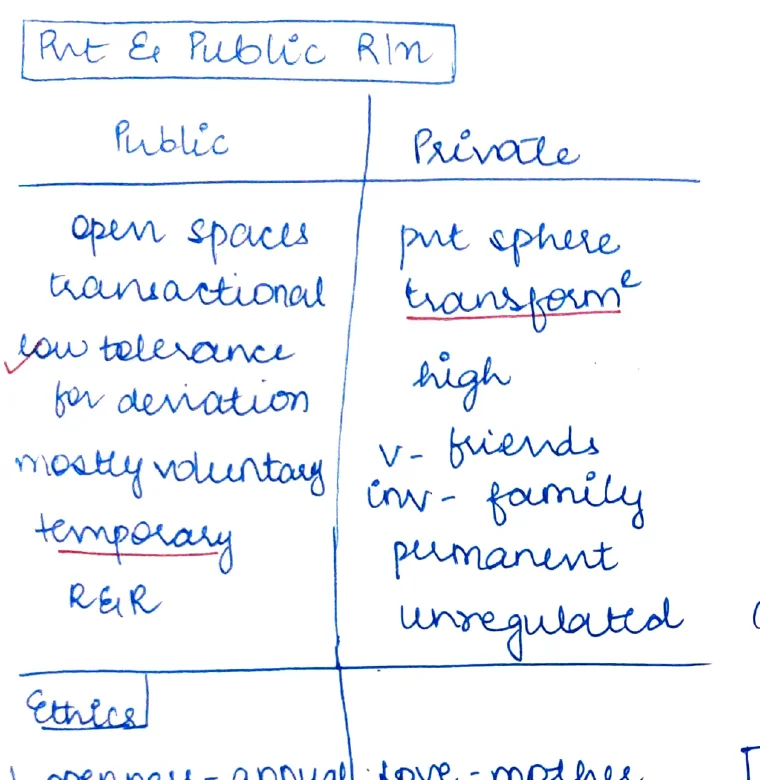
- Two-column comparison table: Public | Private
- Public: open spaces; transactional; low tolerance for deviation; mostly voluntary; temporary; R&R [Rules & Regulations]
- Private: pvt sphere; transform[ational]; high; V – friends; inv – family; permanent; unregulated
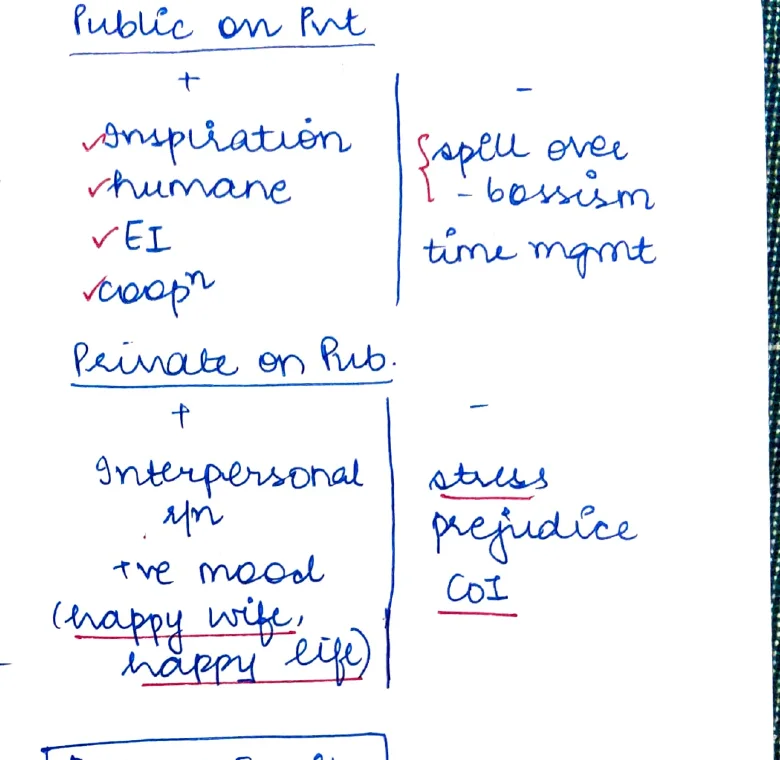
- Public on Pvt (+/–)
- (+): inspiration; humane; EI [Emotional Intelligence]; coop[eration]
- (–): spell over; bossism; time mgmt [management]
- Private on Pub (+/–)
- (+): interpersonal ↑m [improvement]; +ve mood (happy wife, happy life)
- (–): stress; prejudice; COI [Conflict of Interest]
#Ethics (in Family context)
-
Ethics [section heading with underline]
-
- openness – annual reports of co [company]
-
- Honesty – pol[itical] promises
-
- Respect – IR [Industrial Relations]
-
- RoI [Rule of Integrity / Return on Investment]
-
- Equality
-
- [illegible]
-
-
Right side of Ethics column:
- love – mother care – sister compassion
- mutual underst[anding]
- young & old
- Respect – elders
- Sacrifice – job for family
- support – could
#Role of Family
- bedtime stories
- bonding
- TV shows / outing (BBC rejects red list) [note in red]
- DM process (can?) [illegible]
- gender sensitivity
- react to everyday events
- discrimination
- politics / respect for law (traffic rules) [in red]
- scientific vs superstition
- festivals
- money value
- reward or punishment?
- Conformity or Innov[ation]?
- (tu ka beta bhi) [Hindi phrase: "son of so-and-so"]
- Means of bnds [bonds]
- way of life
- public vs pvt life
#Why Separate?
- diff[erent] values
- problem of one-x-on [one-on-one] filter
- fusion → repo[rts]; fam[ily]
- are judged differently in both sphere — Bill Gates divorce
- prevent COI [Conflict of Interest] [boxed in red]
#Problems with Sep[aration]?
- not feasible
- desirable
- manageable
- separable (common values)
- e.g. [KC Sen] [boxed in red] — opposed child marriage as office holder but married off his daughter to cover rivals marriage
#Page 2 — Role of Society; Human Values; Value Education; Role of Education
#Role of Society
-
→ Anekantanada [concept reference]
- Religion – Gandhi, Islam (zakat)
- 'kad' [illegible] – tolan [tolan/courage]; custom? – takni [commit?]
- local community – Dongria; Kondhs
- materialistic or spiritual?
- festival / cultural values
- Leadership – KS, SW [Krishnamurti Subramanian, Swaminathan?] [boxed in red]
- Diversity
- creat[i]bility
- Reinforcement – tx = respect
- Corruption (ski? folklore) [in brackets]
-
–ve [negative] role:
- misdirected – LGBTQ [boxed]
- orthodox – women role
- boomerang effect – child becomes rebellious if excessively controlled
- social comparison – jg hic [illegible]
- tolerance – nce [not?] lrching / maintaining [illegible]
#Human Values — value sheet
Value Education
-
inculcating human values & concern for well being of all
-
head, hand & HEART [underlined, in red box]
-
holistic devt [development]
-
tolerance / respect
-
- value composition (holochin?) [illegible]
-
moral & social fit [fitness/fulfillment]
-
Intellectual Integrity
- knowledge w/o character = Sin [boxed]
- Technical edu[cation] is replacing VE [Value Education]
- NEP emphasizes
-
Quotes:
- "we must have life building, man making & character building edu" — Swami Vivekananda [underlined]
- "the duty of uni[versity] is to teach wisdom, not trade; characters not technicalities" — Churchill [underlined]
- "Educating the mind without educating the heart is no edu[cation] at all"
#Role of Education
- formal & informal
- curriculum – but[ton] westernized
- History – Harappan civili[sation]
- Team / vxi [?] / coop[eration]
- empathy – classroom #pc fracture
- Mannerisms – japan toilet cleaning lessons
- field visits (museums / old age home)
- sports / competition / creativity
- problem solving approach
- Attitude formation [boxed in red]
- Teacher's role
- Rote learning, plagiarism [boxed in red, negative point]
#Page 3 — Integrity; Responsibility & Accountability; Ethics in AI; Probity
#Integrity
- Definition: Acc[ording] to Mopersonal, a person with integrity is one who consistently [boxed] behaves in an open, fair, transparent manner, honours one's commitm[ent] & works to uphold pub[lic] service values
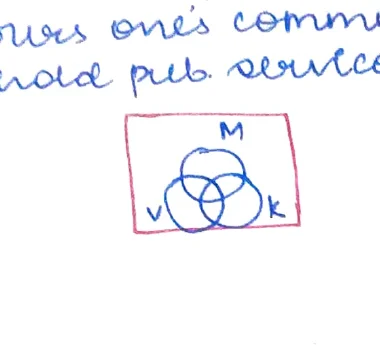
-
Venn diagram description: Three overlapping circles labelled M (top), V (bottom-left), K (bottom-right) inside a red-bordered rectangle — representing overlap of Moral / Values / Knowledge dimensions of integrity
-
Sources of I[ntegrity]:
- conscience
- const[itution]
- COC + COE [Code of Conduct + Code of Ethics]
- Rewards & awards
- found 'value internal'
-
Type: moral, intellectual, people, financial; Socrates, Gandhiji [boxed]
-
G[ood] eg[examples]:
- effective use of power
- corruption(s)
- ethical + GG [Good Governance]
- Alc'y [?]
- public faith / trust
- independent DM [Decision Making]
-
OIC – a person with impeccable I [boxed in red with arrow]
#Responsibility vs Accountability
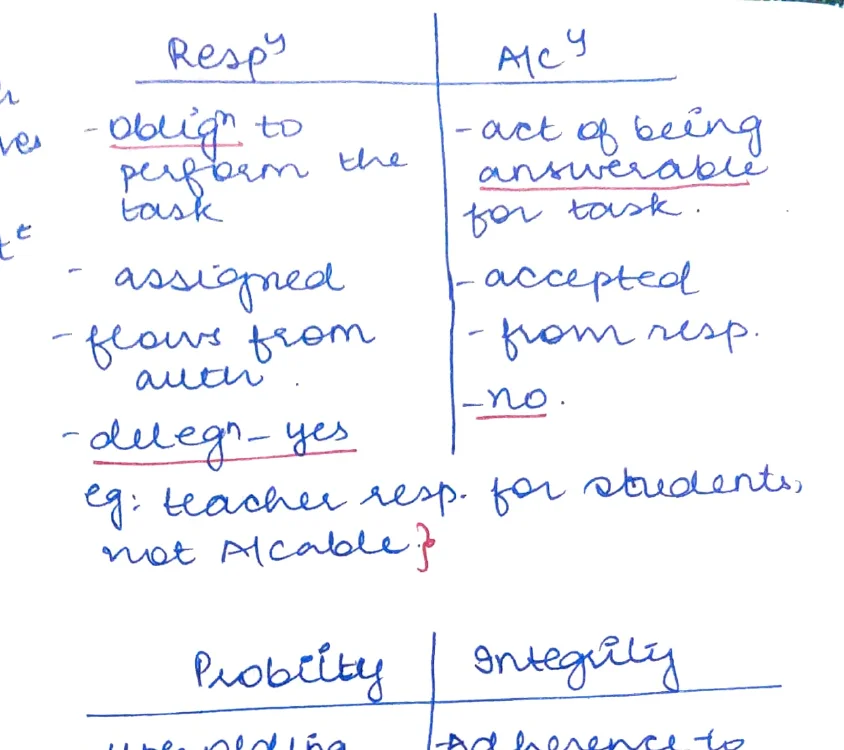
| Resp[onsibility] | Acc[ountability] |
|---|---|
| oblig[ation] to perform the task | act of being answerable for task |
| assigned | accepted |
| flows from auth[ority] | from resp[onsibility] |
| deleg[ation] – yes | no |
| eg: teacher resp. for students, not Acable [Accountable] |
Probity vs Integrity
| Probity | Integrity |
|---|---|
| upholding highest std of conduct | adherence to std values in prof[essional] / personal |
| Charter | Onal [personal?] |
| RTI / CC / SA [Right to Information / Conduct Code / Service Act] | teal whistle blowing [sic] |
-
Reasons for decline [of integrity]:
- acquisitive soc[iety]
- colonial attitude
- pol [political] → (the heading circles) [note]
- COC
- A3I [?]
- COI [Conflict of Interest]
- Pressure for perf[ormance]
-
Structural fix[es]: PCA 1988, CS conduct Rules, CVC, CBI, CBI [?], UPSC (I pact[s]) [boxed]
-
Ways to improve:
- add column in ACR / 360°
- was it (actions) for handling misconduct
- I survey (I testing) → NVC policy dept [boxed in red]
- I keep (int) awards
- RTI to leak & appeal
- value tracker
#Ethics in AI
- eg: Alexa, predictive texting, FB's friend suggestion suggestions
- money: MATRIX [boxed] machines change money by using humans themselves
- TERMINATOR [boxed] – machines trying to kill humans
Ethical Concerns:
- envt [environment] degraded
- Rights violated (human as means)
- digital exclusion
- monopoly of cloud world
- unemp[loyment]
- may learn human biases [boxed] – eg: AI?: Tesla, cab driver car accident in US
- privacy
- cyber warfare
- "whole of society approach"
#Page 4 — Neutrality & Impartiality; Stakeholder Capitalism; Probity; Integrity
#Neutrality & Impartiality
-
Neutrality: is absence of bias criteria; = no assoc[iation] of supporting either (Switzerland)
-
Mother is not neutral but impartial
-
pol[icy] neutral vs politics neutral [distinction]
-
"n is a robotic sin" [boxed in red]
-
"forest of biracy" [sic – "forest of piracy"?] — PM Nehru [attribution]
-
Impartiality: judging on merit / criteria; = equal assoc[iation] of supporting both
#Stakeholder Capitalism
![Stakeholder Capitalism circular diagram — Companies/profit, Civil Society/purpose, Countries & States/equity, Int[ernational] Community/peace — all interconnected through People & Planet at centre](assets/img/ethics_section_a_p4_01.webp)
- Diagram description: Circle diagram with People and Planet at centre; four boxes around the circle:
- Top: Companies / profit
- Left: Civil Society / purpose
- Bottom: Countries & States / equity
- Right: Int[ernational] Community / peace
- Title box: Stakeholder capitalism
#Probity
-
quality of having strong knowledge of moral principles & integrity
-
= a maximalist approach [boxed] where one adheres to best moral ideals
-
NOT simply avoiding corrupt means
-
Non-maleficence = Minimalist
-
Beneficence = Maximalist
How to Inculcate [Probity]?
- Value edu[cation]
- Transformational leadership
- EI [Emotional Intelligence]
- Ethical literacy [boxed in red]
- Work culture
- Independence [of] spar[e?] [illegible]
#Page 5 — Attitude; Functions of Attitude; Attitude Change / Persuasion; Content/Component
#Attitude
- = expression of favour/disfav[our] towards an obj[ect]
- = a predisposition (TFA) [Tripartite / Tri-component model of Attitude]
- affects group behaviour (B) [Behaviour]
- can be explicit / recent events & implicit / past trauma
How Formed?
- Learn[ing] by Asso[ciation] – parents / fam[ily]; school; orgn [organisation]
- eg: love physics due to teacher's asso[ciation]
- Instrumental cond[itioning] – reward / punish[ment] [boxed in red]:
- yoga to school = My Good health = +ve (A)
- late for school = punish[ment] = negative (A)
- Learn[ing] through modelling (observing others): Eklavya – Guru Drona; learnt from grandmother [note]
- Through cultural norms – touch feet = respect for elders
- By exposure to info – read about Holocaust, WW4 [sic, WW2], SBM [Swachh Bharat Mission] through ads
#F[unctions] of Attitude
- Knowledge – about a co[mpany]
- Utilitarian [boxed in red] – (A) towards desert[?] / junk food; smoking
- Object appraisal – smoking junk food
- Ego defensive – British justified their rule (White Man Burden) [in red box]
- Social adjustive – like cars that are popular choices; cause [social signalling]
- Value expression – (A) towards waiter in restaurant / down trodden [underlined]
- Emotions express[ion] – horror movies [boxed]
#Attitude Change / Persuasion
- Info – VS on CC [context change?]
- Normative – work[ing] on a gender diverse exp so (A) of women skills changed
- Source credibility – dentist on toothpaste vs ad
- message – ATB [boxed] both provided; eg: BBBP [Beti Bachao Beti Padhao]
- Mode – personal appeal by leaders
- Consistency – frequent ads
- Social proof – Mukti Vahini of KS [Krishnamurti Subramanian?]
#(A) [Attitude] and (B) [Behaviour]
- quality of person – key awareness (A) – veg [boxed]
- " [same quality]
- (B) accessibility
- situation / pressure
- (survival instincts)
- vested interest – corruption
- Exposure to (A) obj – power misuse [boxed]
- social acceptance eg: inter caste marriage
- (A) of others – drink coz peers [boxed]
- perceived relevance of (A) eg: voting [boxed]
#Content / Component [of Attitude — Tripartite Model]
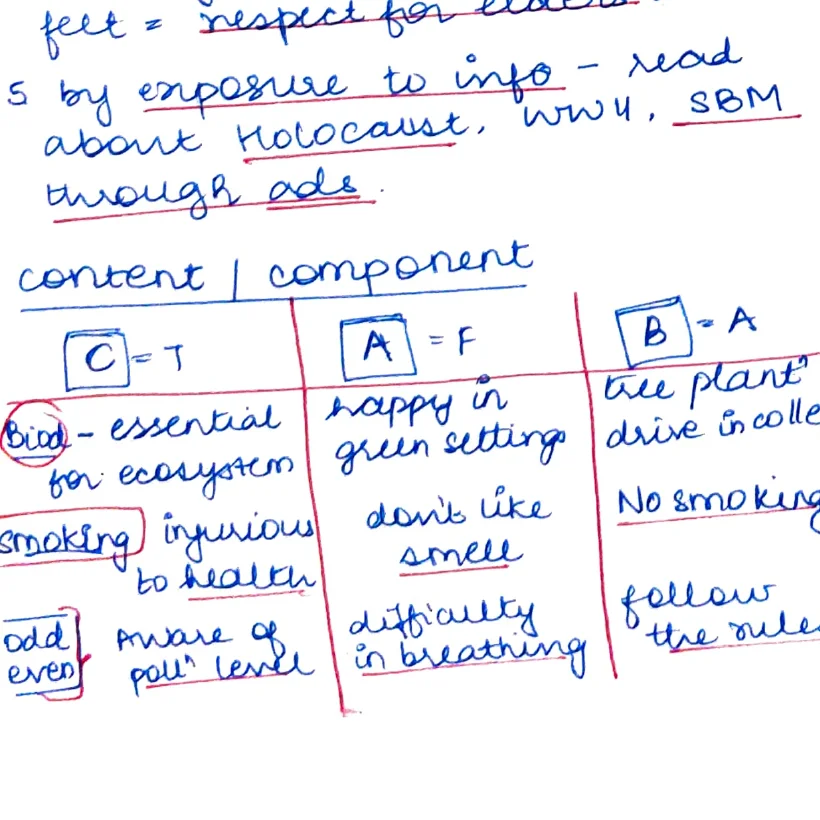
| C – T [Cognitive – Thinking] | A – F [Affective – Feeling] | B – A [Behavioural – Action] |
|---|---|---|
| (bud) – essential for ecosystem | happy in green setting | (be plant) drive in college |
| smoking: injurious to health | don't like smell | No smoking |
| odd (or even?) – aware of pol[lution] level | difficulty in breathing | follow the rules |
#Page 6 — How (B) Affects (A); Social Influence; Prejudice; Aptitude; Pol. (A) [Political Attitude]
#How (B) [Behaviour] Affects (A) [Attitude]
- Helmet – eventually ↑ve (A)
- public visits govt office, good services → A↓ (personal exp[erience])
- selfie with denigrate(s) [BBBP] → (A)
- ↓ norms / values → (A)
How to ↑↑↑ (correct)?
- EI [Emotional Intelligence]
- A[ttitude] literacy [boxed in red]
- connect / empathy / consequences
- integrity
#Social Influence
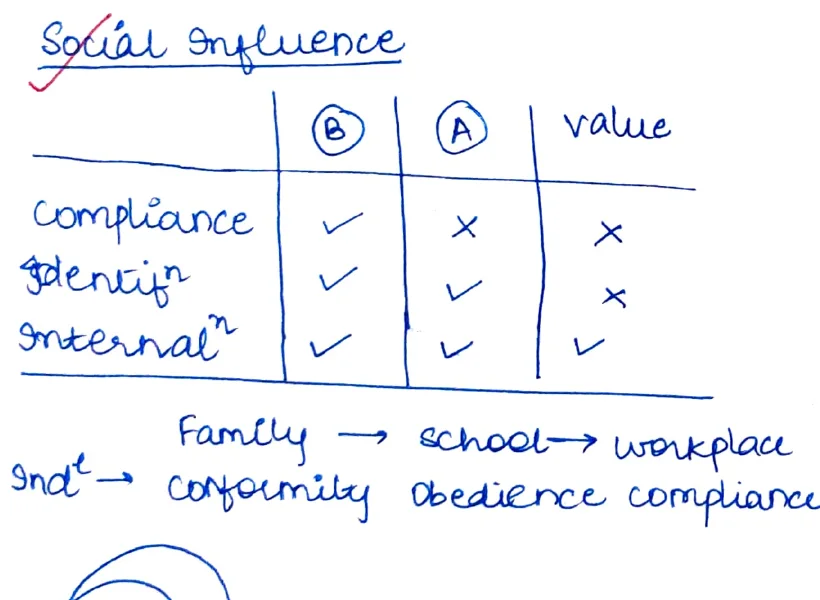
| (B) [Behaviour] | (A) [Attitude] | Value | |
|---|---|---|---|
| Compliance | ✓ | ✗ | ✗ |
| Identity | ✓ | ✓ | ✗ |
| Internal[isation] | ✓ | ✓ | ✓ |
- Family → school → workplace
- 2nd → conformity; obedience; compliance
#Prejudice
- = (A) [attitude] where affective component dominates over cognition[al]
- eg: Nazi Germany towards Jews; AIDS; LGBTQ
Why? → Scapegoat (B) [Behaviour]
- Kernel of truth concept [boxed in red] (only a small part is true, over gen[eralised])
- Self fulfilling prophecy (target group confirm +ve expect[ations])
How (A)?
- De-emphasise narrow social identity
- EIC (IEC) [Information, Education, Communication]
- Interact with others / direct engagement
#Pol[itical] (A) [Attitude]
-
Factors – fam / media / edu[cation] / own exp / peer / observ[ation] / socio-eco; cand[idate] (rich don't vote)
-
Venn: B (inside) A [Behaviour inside Attitude]
- college pol[itics] diagram [Venn circle, B within A]
#Aptitude vs (A) [Attitude]
| Aptitude | (A) [Attitude] |
|---|---|
| mental + physical | mental |
| Innate | learnt |
| What you'll do [boxed in red] | How you'll do [boxed in red] |
| quasi-role – long run | eg: Dhoni, Sachin |
| 1 African in track & field event |
- Skill = learnt in past
- Ability = present knowledge
- Aptitude = future potential
#Page 7 — Emotional Intelligence; Importance of Emotions; Building EI; OCEAN Model
#Emotional Intelligence
-
= ability to assess, manage, control (A) of self & others (AMC)
-
Elements — Daniel Goleman [underlined, boxed]:
- Self Awareness
- Requl[ation] [Self-Regulation]
- Internal Motiv[ation]
- Empathy
- Social Skill
- (SMEAR) [mnemonic, in brackets]
-
"Rule your feelings, lest your feelings rule you" — Syrus [boxed in red]
-
"As much as 80% of adult success comes from EQ" — DG [Daniel Goleman]
-
(orchid → avoid → last resort) [note on avoiding conflict]
#Impact of Emotions
- charity / blood / food donation
- navm [naivety? / navam?] [illegible]
- sensitivity
- Good Samaritan [boxed in red]
- GS [Good Samaritan] Talisman is based on emo[tion] & serves as guide to action
- part of (A) [Attitude] (Affect)
- help in survival (Darwin)
- +ve emo = +ve action
- eg: respect parents more after watching Baghbaan [film, boxed in red]
If not managed properly, then:
- anxiety
- stress
- depression } = prod[uctivity] ↓
- anger
- frustration
How to Manage –ve [Negative] Emo[tions]?
- Appraise situation objectively
- Self monitoring
- Self modelling – be the ideal for yourself
#Importance of EI to CS [Civil Services] → manage (3) of crisis / decision / conflict
-
organ[isational] rel[ation]ships
-
negotiation
-
stress & anger mgmt [management]
-
work life balance
-
prevent COI [Conflict of Interest]
-
pol[itical] neutrality; withstand pressure [underlined]
-
enforced DM [Decision Making]
-
conflict resol[ution]
-
targeting policies better
-
motivating subord[inates]
-
change mgmt [management]
-
better communic[ation]
-
eg: Gandhiji, Swami Vivekananda [underlined], MLK Jr. etc. at WP of religions [World Parliament of Religions]
-
–ve [negative] examples: Hitler [boxed], terrorist; sign & propaganda
Being Creative:
- Be creative [boxed] – IS [?] all my best ideas during anger
- Nurture good rel[ationships]
- Empathy
- Community service – (expressed by helping others)
- Yoga / meditation
#Building EI
- emotional literacy [boxed in red]
- communic[ation] skills
- self awareness – know your stressors
- empathy
- stress mgmt [management]
- communic[ation]
- taking resp[onsibility]
- mindfulness
- expression of emotions
#OCEAN Model
- O – openness to ideas [boxed]
- C – conscientiousness [boxed]
- E – Extraversion / Expression [boxed]
- A – Agreeableness [boxed]
- N – Neuroticism [boxed]; (anxiety handling)
#Page 8 — EQ Formula; Rights vs Duties
#EQ Formula
-
EQ + IQ + LQ + AQ + SQ [boxed in red, EQ formula with components:]
- EQ [Emotional Quotient]
- IQ [Intelligence Quotient]
- LQ [Love Quotient]
- AQ [Adversity Quotient] [boxed in red]
- SQ [Spiritual Quotient]
-
Quotes:
- "people don't care how much you know (IS) until they know how much you care" — (EQ) [boxed, attributed in red; IS = Inspirational Stories?]
#Rights vs Duties
-
⊕ Every R[ight] is a R[ight] to do one's duty [boxed]
-
R = claims of people
-
D = commitment or oblig[ation] of people
-
D&R? D is prime [boxed in red] because R are demanded when someone doesn't perform his/her D
-
eg: MNREGA [Mahatma Gandhi National Rural Employment Guarantee Act] became a R[ight] after state failed to oblige its duty to provide livelihoods
- NFSA → food security
- RT Privacy, RTE, RTI etc.
Inseparable twins (tasks):
-
a) D of citizens to use R in a way that contributes to social richness
-
b) enjoy of R puts D to let others enjoy theirs
-
c) since state protects my R, I should also perform my D
-
"Giving R is only a symptomatic sol[ution] while performing D is the sustainable choice" [boxed / bracketed in red]
#Page 9 — Corporate Governance (Ethics Part A); CSR; Values (Democratic, Prof, Medical, Envt, Corporate)
#Ethics — Part A [heading at top]
#Corporate Governance
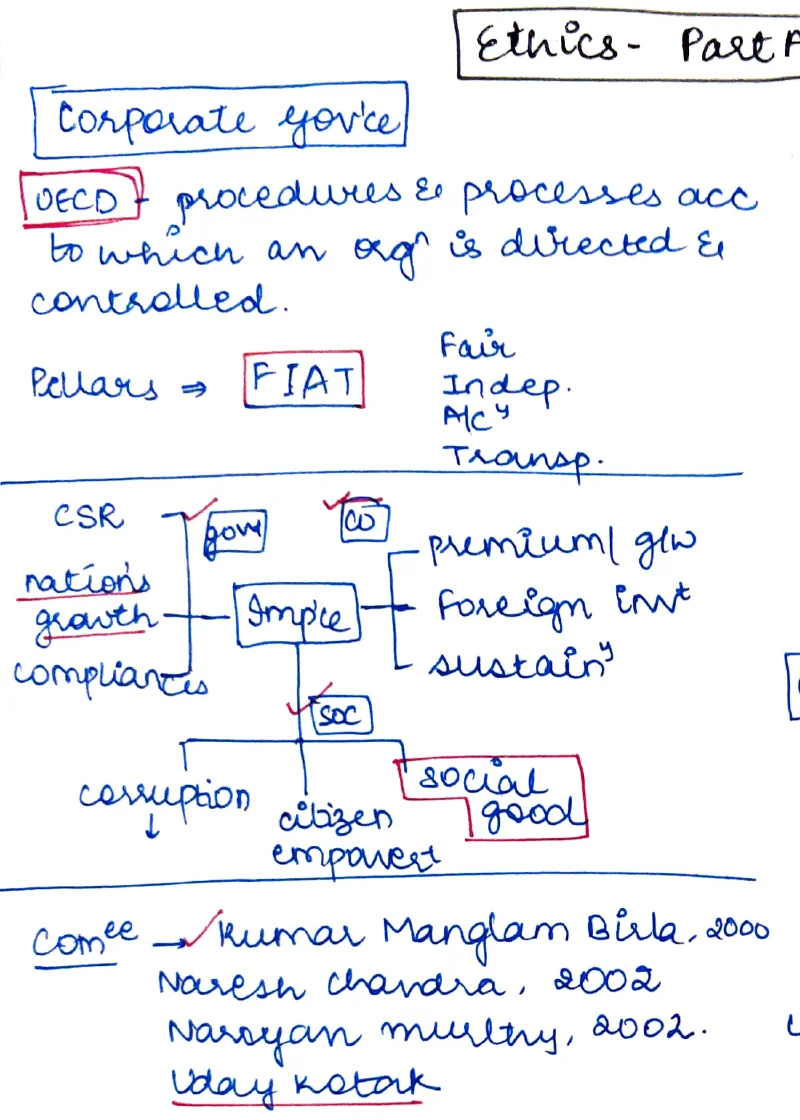
-
OECD [boxed in red]: procedures & processes acc. to which an org[anisation] is directed & controlled
-
Pillars → FIAT [boxed in red]:
- Fair
- Indep[endent]
- MC [?]
- Transp[arent]
-
Flowchart nodes (left to right):
- CSR → [profit] → (co [company]) → premium gth [growth]
- ration[alisation] → Simple → Foreign Invt [Investment] / sustain[ability]
- compliance → SSC
- social good
- citizen empower[ment]
- corruption → citizen empow[erment] (negative loop)
-
Comm[ittees]:
- Kumar Mangalam Birla, 2000
- Naresh Chandra, 2002
- Narayan Murthy, 2002
- Uday Kotak
-
Measures: Co Act 2013; NCLT; SEBI; CA; CCI [all listed]
#Good CG (Corporate Governance) Diagrams
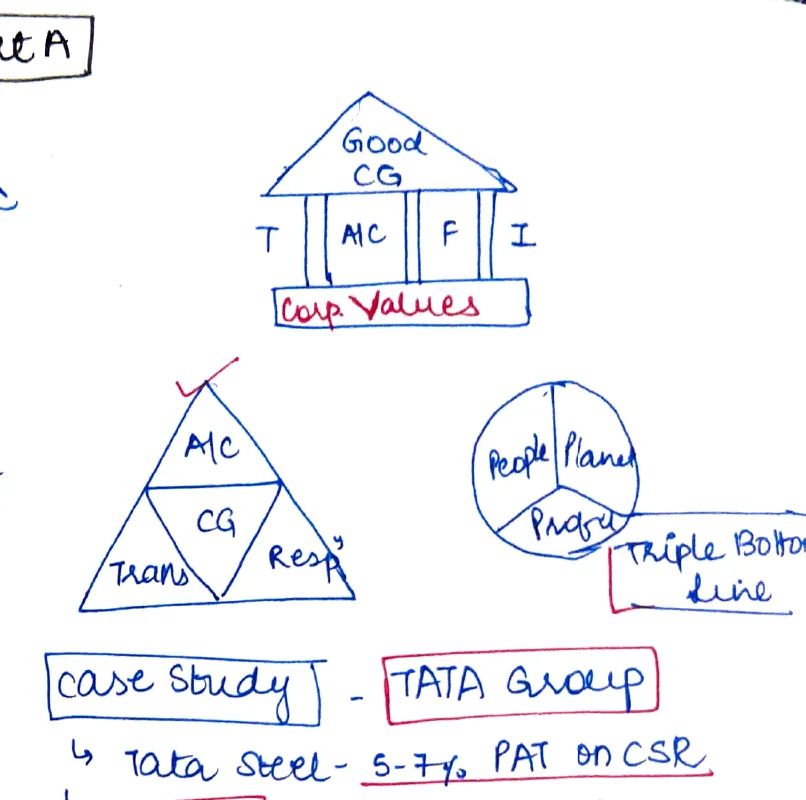
-
House diagram (Good CG):
- Roof: Good CG
- Columns: T [Transparency] | MC [?] | F [Fairness] | I [Independence]
- Foundation: Corp[orate] Values [boxed in red]
-
Triangle diagram:
- Vertices: MC [?] (top); Trans[parency] (bottom-left); Resp[onsibility] (bottom-right)
- Centre: CG [Corporate Governance]
- (Red tick mark on left side)
-
Circle diagram — Triple Bottom Line:
- Sectors: People | Planet | Profit [Pr/gft?]
- Label: Triple Bottom Line [boxed in red]
#Case Study — TATA Group
- Tata Steel – 5–7% PAT on CSR
- (Ahuliya) [Ahluwalia?] — inductive of Tata Tea
- Vocational train[ing] to physically challenged in making recycled paper
- MANSI [boxed in red] by Tata Steel to ↓ IMP [infant mortality / illegal mining prevention?] in states like Jharkhand
- Facebook [underlined in red]
#CSR
- +ve → CG wala [Good Governance oriented]
- –ve:
- no robust policy
- no Implem[entation]
- Duplic[ation]
- viewed as add'al corp tax [boxed in red]
- skewed pattern → 65.1 [%?] → health & edu[cation]
Issues:
- collusion — DHFL case [boxed in red]
- promises led boards (Naresh) [gaps – illegible] always
- no oversight
- 'Faut' – Chanda Kochar
- to bribe – Tata – Mistry case
- ivory coop? – coal blocks
- credit rating – ILeFS [IL&FS]
- → Gandhiji's Trusteeship [boxed in red arrow]
Issues (continued):
- insider trading (Rajat Gupta case) [boxed in red]
- gender discrim[ination] (13) in senior mgmt [management] (4.14 in sectors)
- air products
- predatory pricing (800 CEOs) [note in red]
#Way Fwd [Forward]:
- Inject Stimulus [boxed in red]:
- tax deduct[ion]
- align with SDG[s] [Sustainable Development Goals]
- local net balance
- impact assess[ment] for see above
- CSR exchange portal
- greenwashing
#Page 10 — Dimensions of Ethics; Values across Domains
#Dimensions [of Ethics]
Social —
- edu[cation]
- Hunger
- Regional
- Communal
- Caste
- Tribal
- Health
- LGBTQ
- Women
- Old
- Children
- Youth
Pol[itical] —
- election – money / muscle
- citizen-centric
- Parl[iament] – defect[ion] / crim[inal] / opp[osition] / SP [?]
- (1) delay / MC / corrupt[ion] [boxed in red]
- sexual / ADR [Association for Democratic Reforms]
- Gov[ernance]
- laws
- encounter[s]
- PRIs [Panchayati Raj Institutions]
Eco[nomic] —
- Labour
- mfg [manufacturing]
- agri[culture]
- Inflation
- PDS [Public Distribution System]
- ineq[uality]
- Infra
- IQ [?]
- GR [?]
- empt [employment]
Envt [Environment] —
- forests
- animals
- mtn [mountain] occup[ation?]
- life ↓ [issues]
- silver
- pollution
- plastic
- overhead
- water
- last day
- CC [Climate Change]
- (SW) Treaties [boxed in red]
- DM [Disaster Management]
Int[ernational] —
- N-S [North-South]
- security
- WW [World Wars]
- immig[ration] / refugees
- colonisation
- global commons protect
- FON [Freedom of Navigation]
- terror
- Trafficking
Science —
- AI
- Designer baby
- GM crops
- CRISPR (Cas) [boxed]
- euthanasia
- Abortion
- clinical trials
- vaccine
- nuclear spots [?]
- gene drive
- IPR [Intellectual Property Rights]
- biotobot [biobot?] robots
#Values [across domains]
Democratic —
- Rd [Rule of] neutrality
- LFFJ [Liberty, Fraternity, etc.?]
- MC [Majority / Minority Considerations]
- citizen-centric
- SMART legality [boxed in red]
Prof[essional] — [boxed in red]
- ES [Emotional Stability?] – excellence; leadership
- 'Innov' [Innovation] quality
- COI [Conflict of Interest]; COC [Code of Conduct]
- Due diligence [boxed in red]
Medical —
- beneficence; non-maleficence
- HR [Human Rights]
- consent
- Oath; life; alertness; agility
Envt[al] [Environmental] —
- SD [Sustainable Development]
- envt stewardship
- coexistence; ecocentricism
- regeneration
Corporate — [boxed in red]
- adhd [?]; org[anisational] culture
- multi-stakeholder; fiduciary
- resp[ect]; orgal [organisational] loyalty
- commit[ment]; ethical / companied [?]
- cap[acity]; open; honesty
Family —
- care; love; sharing
- empathy; coop[eration]; honesty
- understanding; respect for elders; kindness / forgiveness
- sacrifice; tolerance
End of Ethics Section A — 10 pages transcribed
Case Studies
Topper handwritten notes#Page 1 — Case Study Framework: Introduction & Ethical Tools
#Case Study Structure
- Intro → stakeholders
- Ethical issues
- Value mapping
- [Constitutional] articles (if) unique
#Body
-
1) Common Good Approach
- Good of individual & common good are inseparable — Aristotle
-
2) Doctrine of Double Effect
- An action having foreseen harmful effect is justifiable if:
- a) Right Intention
- b) Good effect should be intended, not bad
- c) Due diligence
- d) :: cond[itions]
- An action having foreseen harmful effect is justifiable if:
-
3) Whistle blowing only when:
- facts are verified
- Internal hierarchy has been approached
- Intentions
- :: Impact (not for small things)
- be ready to bear the consequences
- (Gandhi was ready to go to jail)
-
4) Utilitarian — POSPA [land acquisition], Rehab
- (whenever larger pub[lic] interest)
-
5) Categorical Imperative is Universal Law
-
6) Virtue
#Right-Column List (Ethical Touchstones & Frameworks)
- 7) Justice / Fairness
- 8) Duty bound — prof[essional] / citizens
- 9) Rights
- 10) Conscience — Ekta Chalo Re (boxed in red)
- 11) Seven Sins / Talisman
- 12) CS [Civil Service] Conduct Rules
- 13) Great leaders / reformers / teaching / quotes
#Quotes / Maxims on Conscience & Cowardice
- → shelf life of lie is very small
- → wrong is wrong even if everyone is doing it
- → world suffers due to silence of good men
- → — anywhere is a threat to — everywhere
- → human beings are ends etc.
- → so see what is right & not do it is worst form of cowardice ✱ (boxed in red)
#Course of Action
Should be (arrow pointing up-left)
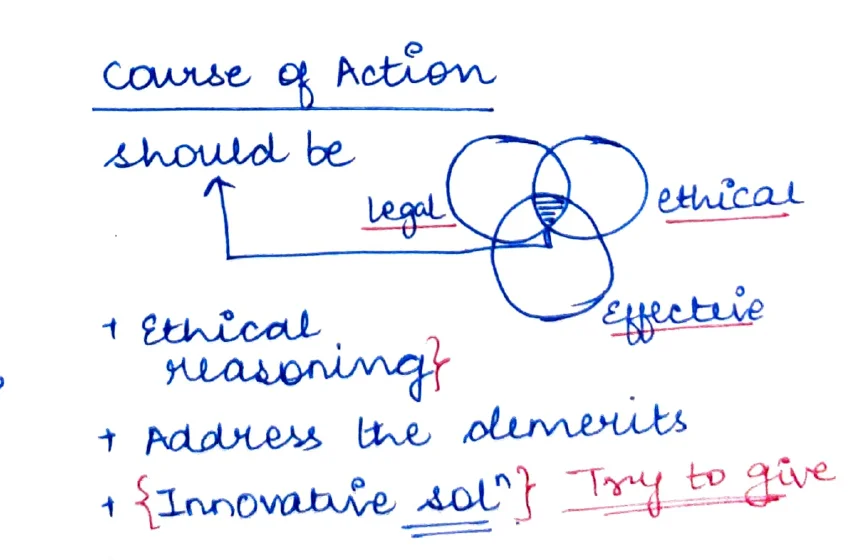
- Three-circle Venn diagram: Course of Action should lie at the intersection of Legal, Ethical, and Effective
- + Ethical Reasoning (with question mark)
- + Address the demerits
- + {Innovative sol[ution]} — Try to give (underlined, in red)
#Decision Tests
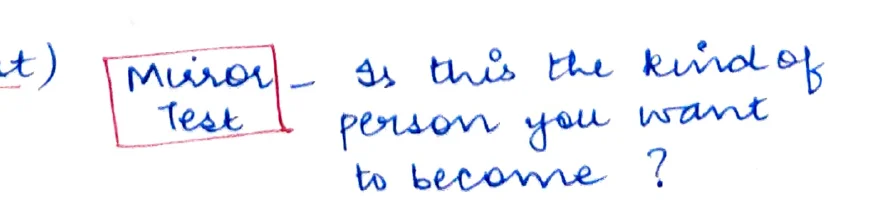
- Mirror Test (boxed in red) — Is this the kind of person you want to become?
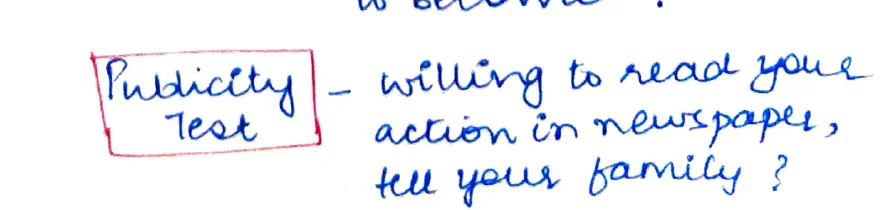
- Publicity Test (boxed in red) — willing to read your action in newspaper, tell your family?
#Page 2 — Conclusion Framework, Options, RTI Sections
#Opening Line (continuation from context)
- Can you live with your choice?
#Conclusion Framework
-
↳ Address the SYSTEMIC ISSUE (boxed in red) — work culture, internal audit
-
↳ Project your vision
-
↳ Long term sol[ution]
- (Include all chapters of PA [Public Administration]) (annotated in red)
#If Asked to Make a Policy
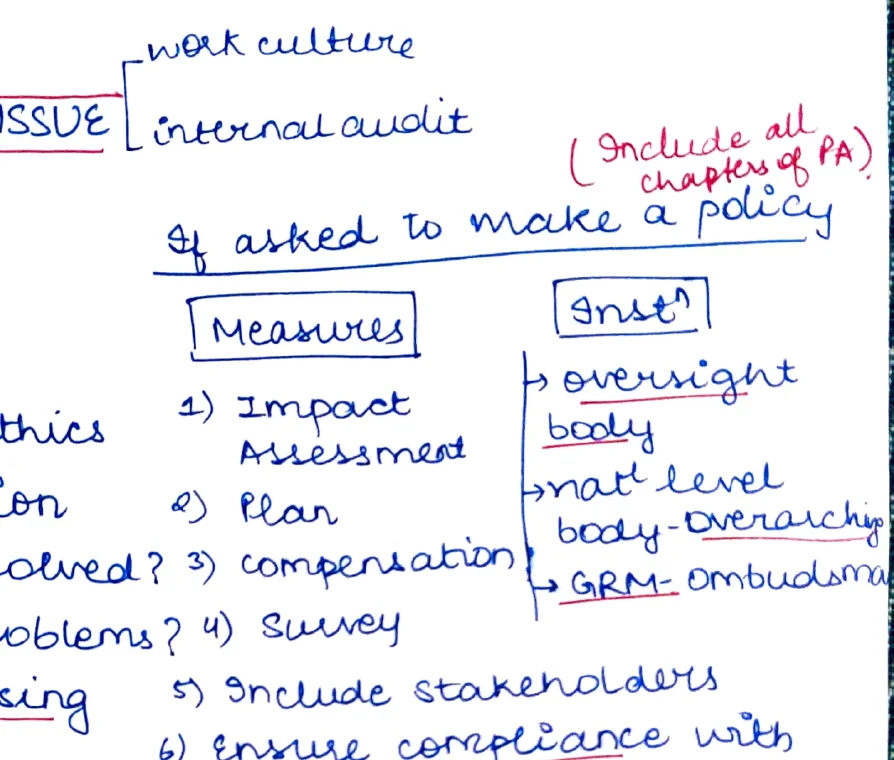
-
Two-column framework:
Measures Inst[itutions] 1) Impact Assessment → oversight body 2) Plan → nat[ional] level body — Overarchy 3) Compensation → GRM [Grievance Redressal Mechanism] — Ombudsman 4) Survey 5) Include stakeholders 6) Ensure compliance with: — parent law — FRI[DPS] / [Constitutional] values 7) TPA [Third Party Audit] 8) Publicize 9) Public hearings / part[icipation] 10) Clause (boxed in red) for not following
#Options
- Resign — Value ethics
- (Std[ard] arguments) — Reputation
- — Problem solved?
- — Future problems?
- — Buck passing
- (Std[ard] arguments) — Reputation
- Slippery slope (boxed in red) → easy to do again
#Decision Tree in Course of Action in Ethical Dilemmas
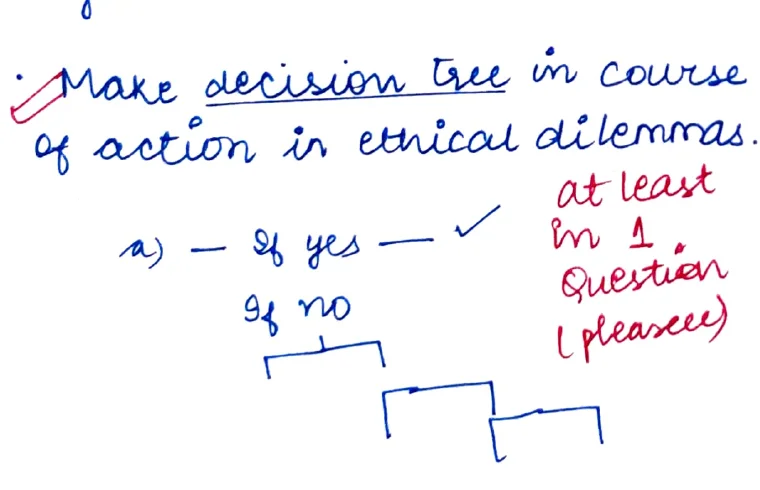
- Make decision tree in course of action in ethical dilemmas
- a) — If yes — ✓ → at least in 1 Question (please)
- If no → [branching tree structure with nested options below]
#RTI Sections Reference
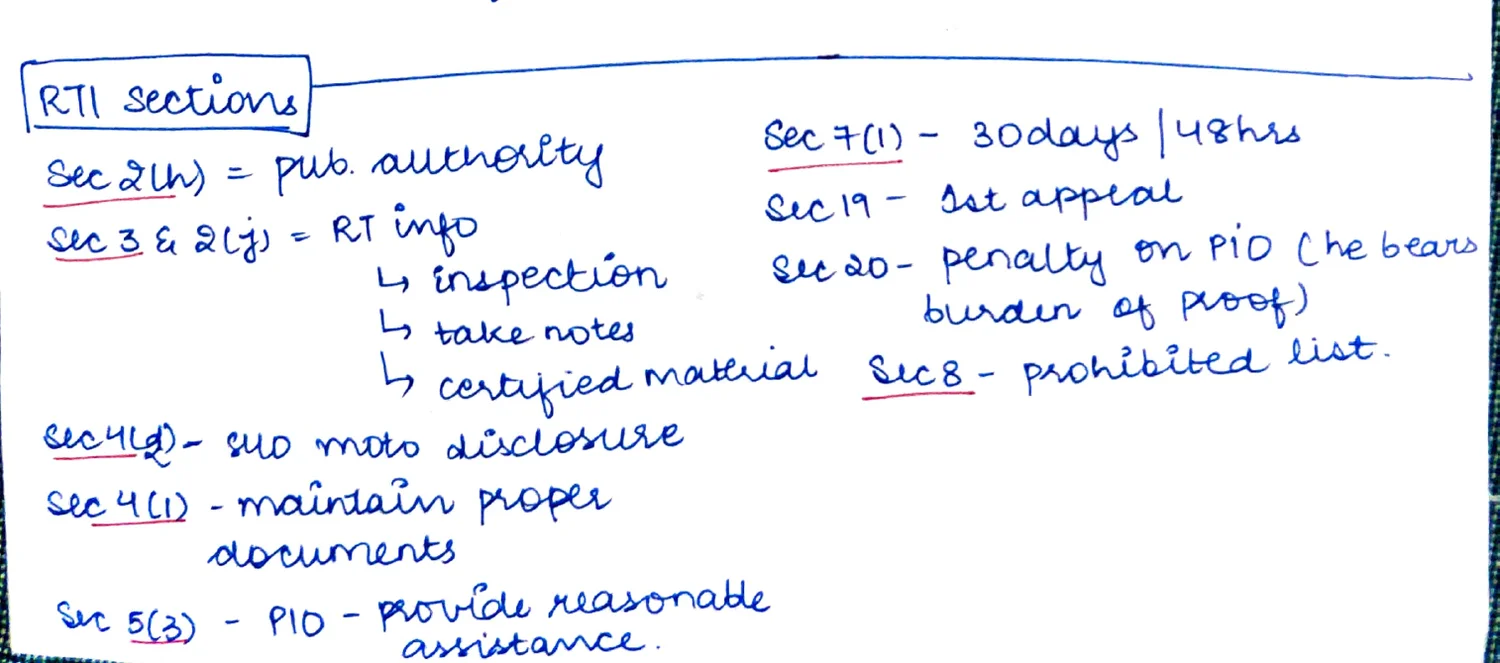
| Section | Provision |
|---|---|
| Sec 2(h) | = Pub[lic] authority |
| Sec 3 & 2(j) | = RT[I] info — ↳ Inspection; ↳ take notes; ↳ certified material |
| Sec 4(1)(b) | — suo motu disclosure |
| Sec 4(1) | — maintain proper documents |
| Sec 5(3) | — PIO — provide reasonable assistance |
| Sec 7(1) | — 30 days / 48 hrs |
| Sec 19 | — 1st appeal |
| Sec 20 | — penalty on PIO (he bears burden of proof) |
| Sec 8 | — prohibited list |
#Page 3 — Social Issues, Gandhian Law, Pegasus, Corruption, Conflict of Interest, Reservation
#For Social Issue-Based Case Studies
- Try using UNESCO (boxed) Malnutrition type flow [framework]
#Gandhian Idea of Law vs Conscience
-
→ Law can be broken if:
- Law of conscience is followed
- Done non-violently
- Violator is willing to pay full penalty of such violation
-
A law is just only if:
- → by approp[riate] auth[ority]
- → for common good
- → physically & morally possible
- → conformity to natural law
- → justly distributes burden & favour ✓
-
"A law is justified / bind[ing] only if it satisfies the unwritten code of public ethics" — Gandhiji
#Catch 22 — Situation with No Escape b/c of Contradictory Rules (boxed in red)
- Use Saam, Daam, Danda, Bheda approach in case studies (Kautilya)
#Pegasus (bullet list)
- surveillance state
- digital liberty
- cybercrime
- threat to [constitutional values]
- violation of IT Rules / Act
- Distrust
- Authoritarianism
- Demise of democracy
- RT[I] privacy
#How to ↓ Corruption?
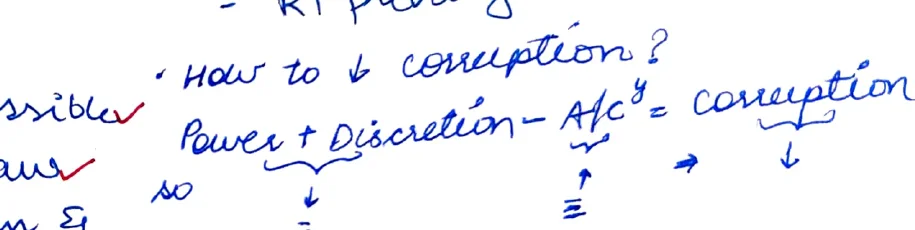
- Power + Discretion − Afc[Accountability] = corruption
- so ↓ [Power] ↓ [arrows showing decrease]
- [signs/symbols indicating]: ≡ → ↓
#Conflict of Interest
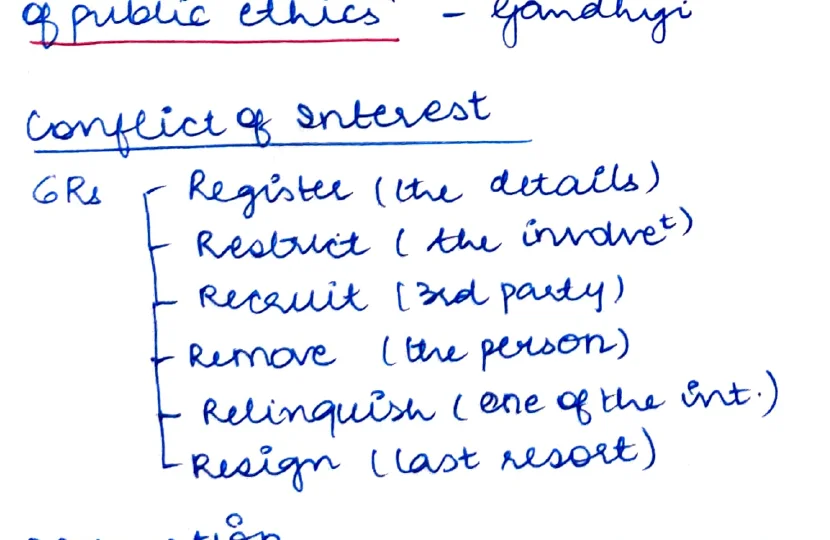
- GRs (6-step escalating framework):
- Register (the details)
- Restrict (the involv[ement])
- Recruit (3rd party)
- Remove (the person)
- Relinquish (one of the int[erests])
- Resign (last resort)
#Reservation
- → multi-layered repre[sentation] index (boxed) (yogendra yadav)
- → reparation / compensation for past injustice
- teacher comp. — incentivise diversity (boxed)
- kurnool comp. — diversity [symbol] based on diversity index
- sub-quotas — Equal opportunity [symbol]
- in & out approach
#Page 4 — Attitude Change, Dimensions for Quotes, Protagonist Paradox, Innovative Solutions
#Attitude Change
Use of EI [Emotional Intelligence] & Persuasion Techniques:
- Movies
- Role Model
- Local Influencers
- Explain benefits of [method] A (circled)
- Counter prevalent narrative
- Nukkad Natak [street play]
- Engage supporters
- Role playing
- Sensitivity training
- How (underlined) — hardware approach is needed at times
#Additional Attitude Change Examples (right column)
- 4. Sharonchish Semwanshi — Removed office (boxed in red) for nutri[tion] Rehab students centre
- 5. Wall of Kindness
- 6. BMC Pothole Challenge type Initiative
- 7. [box] — on wheels to ↑ accessibility / visibility
- 8. Pedal police (look for low cost sol[utions]) — community policing
- ↳ exp[erience]
- ↳ message of fitness
#Dimensions for Quotes
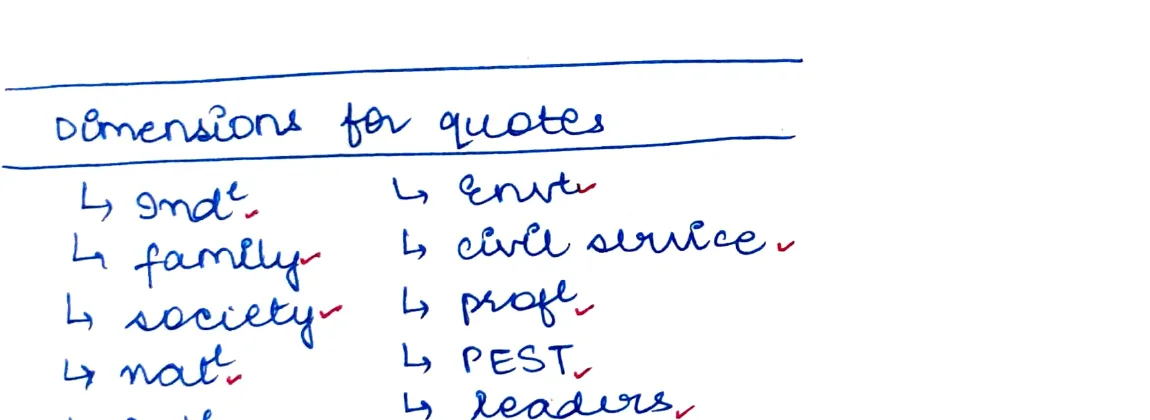
| Column A | Column B |
|---|---|
| ↳ Indv[idual] | ↳ Envir[onment] |
| ↳ family | ↳ civil service |
| ↳ society | ↳ prof[ession] |
| ↳ nat[ional] | ↳ PEST |
| ↳ [one more — partially visible] | ↳ leaders |
#Protagonist Paradox (boxed in red)
- both alt[ernatives] look equally convincing
- e.g. lockdown vs opening up
- none = Catch 22 (boxed in red)
#Innovative Sol[utions]
-
Pune JP appealed citizens to donate old smartphone / laptop for children edu[cation]
-
Gootnadpura — MP gave extra MPLADS fund[s] (boxed in red) to those Village which will end s[u]p cremation grounds
-
Saurabh Kumar — Bastesuada — lunch with collector — direct [career] (boxed in red) counselling
Pathak — Ethics Notes
Pathak Ethics — handwritten notes#PAPER IV — ETHICS, INTEGRITY & APTITUDE
#Instructor: Mr. NURUL PATHAK — PSYCHOLOGY
#Page 1 — Introduction & Name Reason
#Name Reason (Why Ethics + Integrity + Aptitude?)
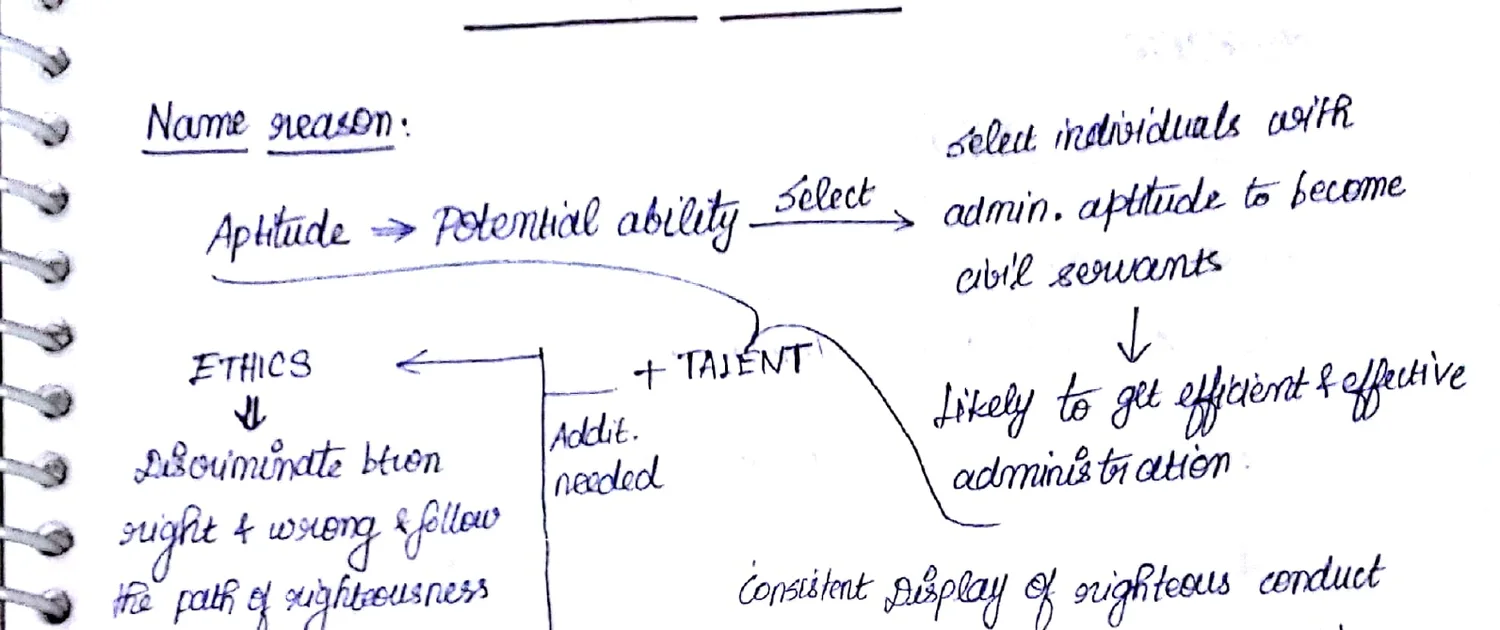
- APTITUDE → Potential ability → SELECT → select individuals with admin. aptitude to become civil servants
- ↓ (downward from Select)
- Likely to get efficient & effective administration
- ETHICS ← [combined with] + TALENT (additionally needed)
- Discriminates between right & wrong; follows the path of righteousness
- → INTEGRITY → Consistent display of righteous conduct over time & across situations
- 3 GUNAS [qualities]:
-
- SATVIK
-
- TAMSIK
-
- RAJSIK
-
#Core Statements
- Life is about DON'Ts & DO's
- Ethics is about PRESCRIPTIONS & PROHIBITIONS
- DON'Ts → lead to DO's
- ↓
- Preserve ourself / Growth — Add strength
#Three Bodies of Knowledge
- Psychology → Behaviour — in context of Governance
- Public Administration → Governance / Administration
- Philosophy → Logic & Thought
#Page 2 — Reading Sources & Common Dilemma
#Reading Sources
- Newspapers — Ethical dilemma issues (Ex: Lufthansa, Abortion)
- Class Notes
- Yellow Books of Institute
- My Experiments with Truth — Mahatma Gandhi
- ARC [Administrative Reforms Commission] — Ethics & Governance
- → must read — Intro; conclusion; some points of body
- [Reading these books (readers) have an edge in producing good answers in Ethics]
- → Analysis more important; No memorising
- → Read Surface, but even more Deep [Tip — Iceberg]
#Most Common Dilemma in Life?
- How much SELFISHNESS should I exercise?
- Ethics — will help to travel in path of SELFLESSNESS
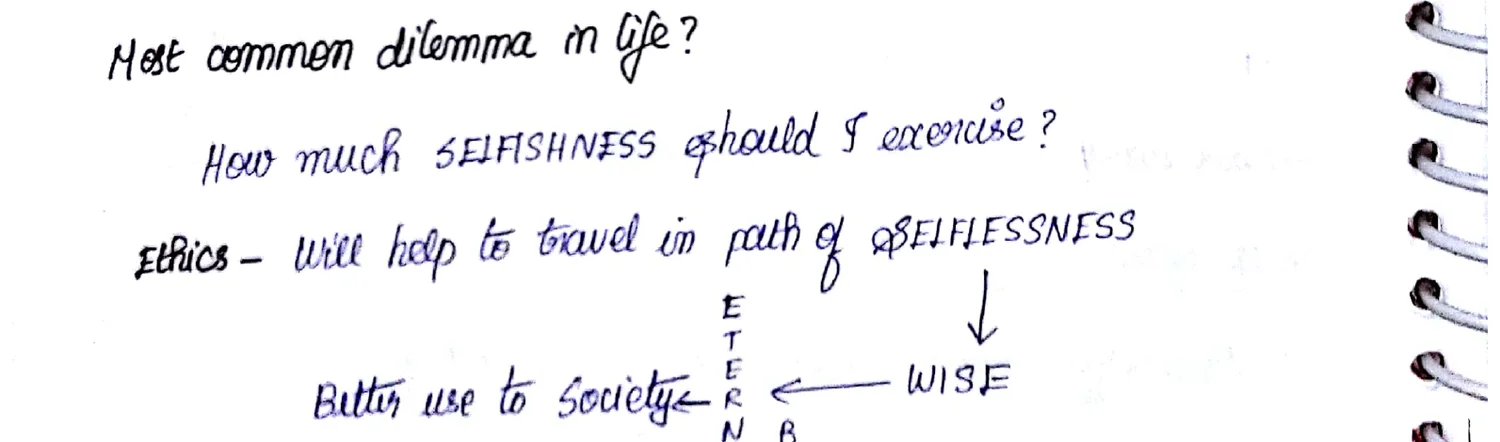
- Ethics → SELFLESSNESS ↓
- Better use to Society ← ETERNAL
- (E-T-E-R-N-A-L written vertically)
- ← WISE
- Better use to Society ← ETERNAL
"If I am for myself, then who am I? If I am not for myself, then who shall be for me?" — KHALIL GIBRAN
#Page 3 — 5 Categories of Questions
#5 Categories of Question
#① DIRECT
- Ask the reproduction of factual information — easiest
Example question (in red): What do you understand by the term empathy? How is it useful for the administration?
- Empathy ∝ 1/[Bureaucratic Apathy] → Alienates people
- Admin needs cooperation between admin & people — better people participation can make Administration:
- Responsive, Responsible, Impartial, Efficient
- Transparent ← write like this (admin POV)
#② DERIVE
- "Empathy is the ability of a person to understand the experience of others & experiencing it in oneself" — Good Intro
- To make it clear & answer more concretely:
- Good examples of EMPATHETIC personalities
- Ex: Mother Teresa; Baba ……. (leprosy patients service)
- → No personal figures but well acclaimed people
★ LANGUAGE SUPERIORITY is needed in Ethics & Essay ★
#Page 4 — Question Types Continued & Physics vs Ethics
#② QUOTATION / THINKER BASED QUESTIONS
[Box on right side of page — Self-note:]
Try to associate our life experiences with ethics class — DO IT → Self-Discipline
- i) Context in which the given statement was made
- ii) How relevant is the statement in present-day context
- iii) Can it be associated with administration in any way
How? Example: "Relativity applies to physics & not Ethics" — EINSTEIN
| PHYSICS | ETHICS |
|---|---|
| Positive science → 'WHAT IS' | Normative science → 'WHAT OUGHT TO BE' |
| Universal | Societal variations in norms — Era variations |
| More absolute | Less absolute |
- Despite being clear of the notion that physics is more absolute and ethics is more relative, yet Einstein says relativity doesn't apply to Ethics, for a better understanding of what 'ETHICS IS' only, can lead to applying science for betterment of humanity
- Luxury of Disagreement → Physics ✓; Ethics ✗
- Threat of effective application of Ethics → Code of Ethics [Govt.]
"Let us have forgiveness, let us have genes in togetherness" — GIBRAN
#Page 5 — Justice in Distribution & Reservation
Question (in red): "For the society to progress, there should be Justice in Distribution & Justice in Resolution"
- One must treat equals equally & unequals unequally
- RESERVATION → Higher caste ; Lower caste
- ↓ Social equals ; Unequals
- — Not much help needed ; — Differential help necessary for devt.
- If unequals are made to swim at pace of equals, they might suffer bcs they don't have the → PARAPHERNALIA [resources] to cope up with the social stigma — so we must give a FAIR CHANCE for them to rise up to match pace in long run
Example: We can forgive a child who fears dark but the real tragedy of the society is when men are afraid of light
Example continued (in red): "We can forgive a child who fears dark but the real tragedy of the society is when men are afraid of light"
- Only when we accept the limitations, can we travel towards progress — child can't understand it but adult should
- "MOTION IS THE SIGN OF LIFE" — Swami Vivekananda
- Not admitting mistakes is injurious — we need responsible administration to admit mistakes & have the courage & ability to come out of it & move towards rectifying it
#Page 6 — Open Ended Questions & Happiness
#③ OPEN ENDED QUESTIONS
- Require the use of illustration drawn from personal life
Example question (in red): What does Happiness mean to you? Has your definition of happiness changed over time? Illustrate with the help of an example.
- Don't write — loose definitions
- — Personalised definitions
- — Generalised definitions
- [Public welfare > Personal welfare → I, I, I <<< holistic approach]
- How my happiness is different from others?
- Socialization, B.G. [Background], Upbringing, specific goals, principles
"Happiness is a state of subjective well-being"
- Dimensions of happiness:
- a) Social b) Economic c) Occupational d) Spiritual
- e) Mental f) Emotional g) Physical
- → Self-fulfilment
- → Life satisfaction
- → Dominance of +ve emotions over -ve emotions
- → Relatively conflict-free existence
[Box — Repeated Terms in Exam:]
★ HAPPINESS ★ WELL-BEING ★ QUALITY OF LIFE
#Page 7 — Happiness Dimensions & Material vs Non-Material Self
#Three Pillars of Happiness (continued)
-
i) AUTONOMY
- On my own terms
- Democratic — Better happiness
- Totalitarian — Less happiness
- Authoritarian — Joy
-
ii) RELATEDNESS
- Feel with ppl with unconditional love
- Social support
- "SECOND ANIMAL"
- Having good ppl is a gift — But ppl always go after those who reject us than who embrace us
-
iii) COMPLIANCE
- [text continues from p6]
"People are unhappy because they want only specific type of enjoyment"
- Harmonious co-existence of thoughts, emotions & actions
- Distaste ppl can't sing & dance — can't understand the enjoyment around (circle)
- → Peacock dancing on a raining day — Beautiful — Enjoy it
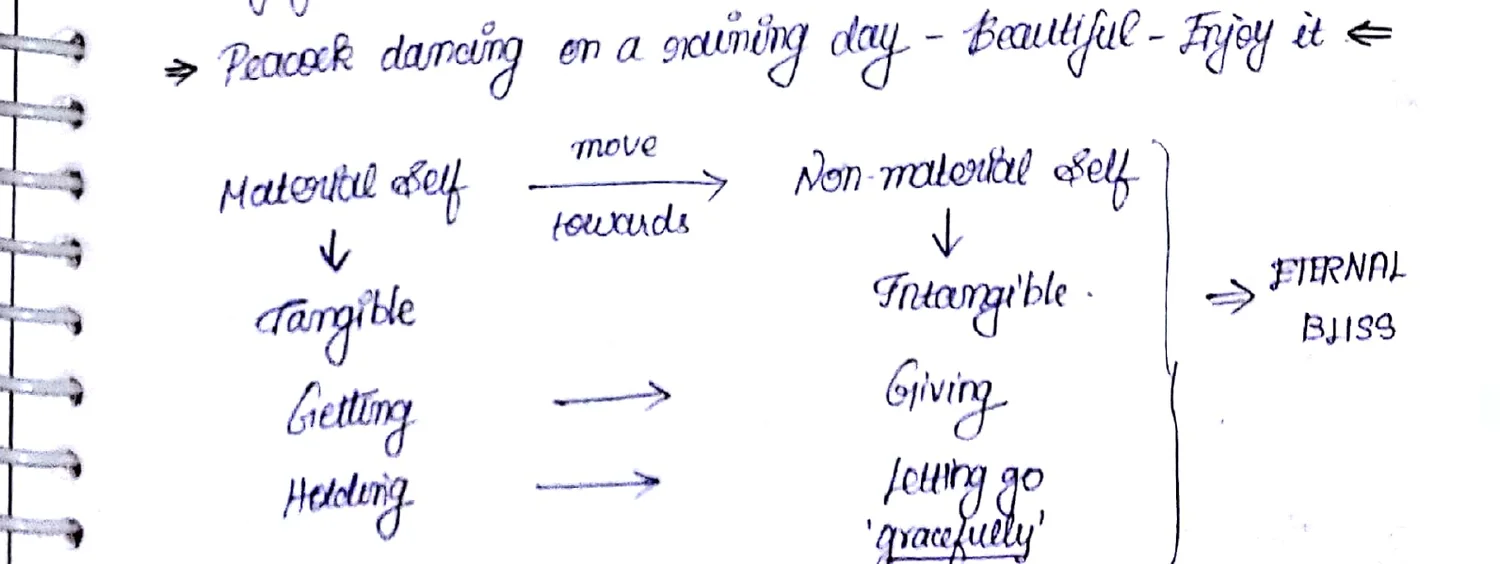
- Material Self — move towards → Non-material Self
- ↓ Tangible ; ↓ Intangible → ETERNAL BLISS
- Getting → Giving
- Holding → Letting go 'gracefully'
[When we move toward selflessness, we will enjoy ethics' growth]
#Page 8 — Indirect Questions & Economics vs Ethics
#④ INDIRECT QUESTIONS
- Require Association building between concepts
Example question (in red): "Whenever there is a conflict between Economics & Ethics, it is the economics that wins"
- i) Economics > Ethics (Majority) — not always
- ii) Ethics > Economics
- iii) Cooperation between Eco & Ethics
- iv) b) "Sound ethics makes great economics"
- D) Materialistic — Survival → Economics > Ethics
- Quantifiable
- → Self-preservation vs Self-realization
- — Hungry man can't/don't have ethics
[Side box — Ethics & Law:]
-
Where law ends, Ethics begins
-
Law — evident step
-
Ethics — man knows & conscience
-
"If a law, a person is guilty when he violates civil rights, but no ethics even when he thinks of doing so" — KANT
-
Threat of punishment vs Threat of guilt
-
e) But there are many historical persons who sacrificed themselves — so not always: Economics > Ethics
-
f) CSR — Long back by TATA, willfully
-
Ex: Pharmaceutical — R&D → Drug for treatment Investment — pressure to price / you don't price people to pay loan
- Can survive in long run with more R&D
- → To give access to all people ← Voluntary
#Page 9 — Profitless Prosperity & Good Governance
- ★ Profitless Prosperity → Small benefits from many ppl ↓
- ★ Profiteering → Big benefits from less ppl
- — Achievement → Robbing people / cheat
- — Profit → Unfair practices
- — Extortion → Taxing money from ppl
- → NO GOOD WILL
- → NO TRUST
- [Side box: Good-Will, Trust → ppl will support them cheerfully. Ex: TATA housing]
Example question (in red): "When public administrators invest in social capital, the outcome is good governance"
- No need for His word to be good by itself; must be good
- But morality is not so, so good is needed
Good Governance → Decisions implemented for public welfare on letter and spirit
- → Zeal of public interest, Fairness, Transparency
SOCIAL CAPITAL — Bonds of Trust & Mutuality among the members of a collective
How to generate Trust?
- Citizen Involvement/Engagement
- Impartial admin
- Grievance redressal
- Transparent process
"The moral arch of universe bends at the elbow of Justice" — Martin Luther King Jr. In Law vs Ethics, Law wins Ex: Laws in favour of men, white vs women, blacks
#Page 10 — Probity & Integrity + Case Study Questions
#⑤ [Probity, Integrity — continued from end of p9]
Ex: A collector in communal area — Req. to permit road show for tribal persons; accepts — my members too asked; rejected due to tension (social) possibility — But she was not seen impartial — ppl took it good — because she generated SOCIAL CAPITAL ↓ Trustworthiness; Mutuality
#⑤ CASE STUDY QUESTIONS
↓
- a) Environmental
- b) Gender-based Issues
- c) Child Labour
- d) Inter-group & Interpersonal Conflict
- e) Corruption — Conflict of Interest / Whistle-blowing
#Things to Identify in answer:
- i) Ethical dilemma
- ii) Stakeholders — satisfy legitimate aspirations of all
- iii) Rule of Law vs Rule of Will — "The moral arch…" — MLK Jr.
- — Law prevails
- iv) Response options — many
- → Merit / Demerit
- ★ PUBLIC FAVOUR 1st ★ PERSONAL FAVOUR last
#Page 11 — Case Study Framework & Example
Ex: My employer polluting river — my dilemma
- Job / Public stake
- Should be the primary concern ← Health
- i) First try to solve within 4 walls of company
- ii) If fails, then go to authorities, public
Values displayed → Integrity, Impartiality, Objectivity, Compassion, Empathy
If I have discretion — Factors that will decide my behaviour:
- i) Inherent nature of action contemplated
- ii) Motive / Interest
- iii) Circumstances
Ex: Yudhishta also told half-truth — but needed at that time. Motive — Dharma — far less dangerous — No personal gain
Ex: (Rescue scenario — numbered stakeholders)
- i) Additional Chief Secretary of neighbouring state ① — Empowered — has presence
- ii) Businessmen ④ — Responsibility of district — will lose morale
- iii) Women & children (WC) ② — mom & child can't be separated
- iv) Senior citizens ⑤ — can help in rescue if they are fit
- v) Regional party peers & their relatives ⑥
- vi) Hospital patients ① — can't help themselves; doctors & facilities can be used in rescue
- vii) Tourists & Picnic ⑥
- b) ① If foreign tourists
#Page 12 — How to Rescue & MEWA Introduction
#How Should I Rescue?
- ALAP — All Lives Are Precious
- Empathy, Compassion, Integrity, Impartiality
- Decision only after complete ground analysis
- Even then, if can't rescue all at once, then put the order based on degree of vulnerability
#Ethics Class 2

- M E W A
- ↙ ↘ ↗ ↘
- Morals — Values — Ethics — Attitude
Aspects [of MEWA]:
- Definition
- Structure
- Function
- Nature
- Interrelationship
- Development
#[I] Definition of MEWA
MEWA are mental constructs that often serve as the instrument for BEHAVIOUR REGULATION.
- Mental — pertaining to (HEWA) — mind
- BRAIN — Biological Reality
- HIND [MIND] — Hypothetical Reality
#Page 13 — How MEWA Regulates Behaviour
#How MEWA Regulates Behaviour?
By invoking in an individual:
1) GUILT — when our behaviour violates our MORALS. Guilt is a discomforting state that is an outcome of NORMAL TRANSGRESSION.
- → Internal induction → Conscience pressure
2) THREAT OF SOCIAL OSTRACIZATION — when our behaviour violates our ETHICS. (Ostracization = Banishment)
-
→ External induction → Societal pressure
-
COMMON OUTCOME → Behaviour regulation
-
Morals are stronger than Ethics because Morals are closer to heart. If one is bound by 2), it may wither away when external pressure goes off but if one is bound by 1), it remains with us because it is from inside us.
3) DISSONANCE — when our behaviour violates our ATTITUDE
- It is a NEGATIVE DRIVE STATE that occurs due to:
- Attitude-Behaviour Discrepancy (in the presence of 1/more Incompatibles) or presence of 1/more incompatible cognitions
- BEHAVIOUR — Working hard for UPSC → Contradiction in BRAIN → there is DISSONANCE
- COGNITION/ATTITUDE — Need to clean UPSC
- ATTITUDES — mental construct
4) CONFLICT — when our behaviour violates our VALUES
- Disagreement between 2 parties — can happen between anyone for any reason
#Page 14 — Conflict, Immoral Behaviour & Justification
All-States of CONFLICT → values are all encompassing; Morals & Ethics are offshoots of values
"All morals & Ethics are values but not all values are morals & Ethics"
- Since Guilt; Threat of Ostracization; Dissonance; Conflict produce in the individual DISCOMFORT, therefore individual generally strives for CONSISTENCY BETWEEN MEWA
Why do people indulge in immoral behaviour inspite of the presence of Moral fibre?
- i) Incentive — Monetary / Social approval
- ii) Probability of being caught — Very low
- iii) Probability of being Punished when caught — Very low
- iv) Severity of Punishment — Very low
JUSTIFICATION — Available:
- Internal — to oneself
- External — to others
If we could justify our immoral behaviour — No
- i) 2) 3) 4) — even when there is moral fibre — immoral behaviour continues
#Page 15 — Corruption Control & Structure of MEWA
- People are insensitive to improprieties
- Improprieties become settled practice
- Overtime, gets public acceptance & becomes a part of Societal practice
To control corruption in India:
- Remove incentives & low-probabilities of caught, punishment severity and availability of Justification
- Don't give money & property back to criminals after bail from prison
[Side box — ALCOHOL: Double-edged sword]
- Giving → Authoritarian, Undemocratic
- "Child rearing press" — Main base of problem — No level playing field in Education — Excellence should prevail — not caste
- — Reservation alone can't promote social equality
#STRUCTURE OF MEWA
#THREE BUILDING BLOCKS OF MEWA
- Cognitive Component
- Affective Component
- Action Tendency Component
#1) Cognitive Component:
- i) Our beliefs, opinions & ideas regarding MEWA object
- ii) Our beliefs may or may not be factually correct
- iii) It has reciprocal relationship with Affective component
#Page 16 — Three Components of MEWA (Affective & Action Tendency)
#2) Affective Component:
- i) Feelings & Emotions one has with MEWA object
- ii) Generally one has mixed feelings toward MEWA object
- iii) Affective component provides energy for Action
- iv) It makes MEWA an evaluative tool
- (If we don't have emotions we won't see ppl as Good & Bad)
#3) Action Tendency Component:
- i) Our predisposition to respond towards MEWA object in specific ways
- ii) Readiness for response. But presence of readiness doesn't always manifest in the form of an overt response
These 3 components are generally consistent with one another because any conflict between them can cause discomfort to the individual. (BRAIN-HEART conflict)
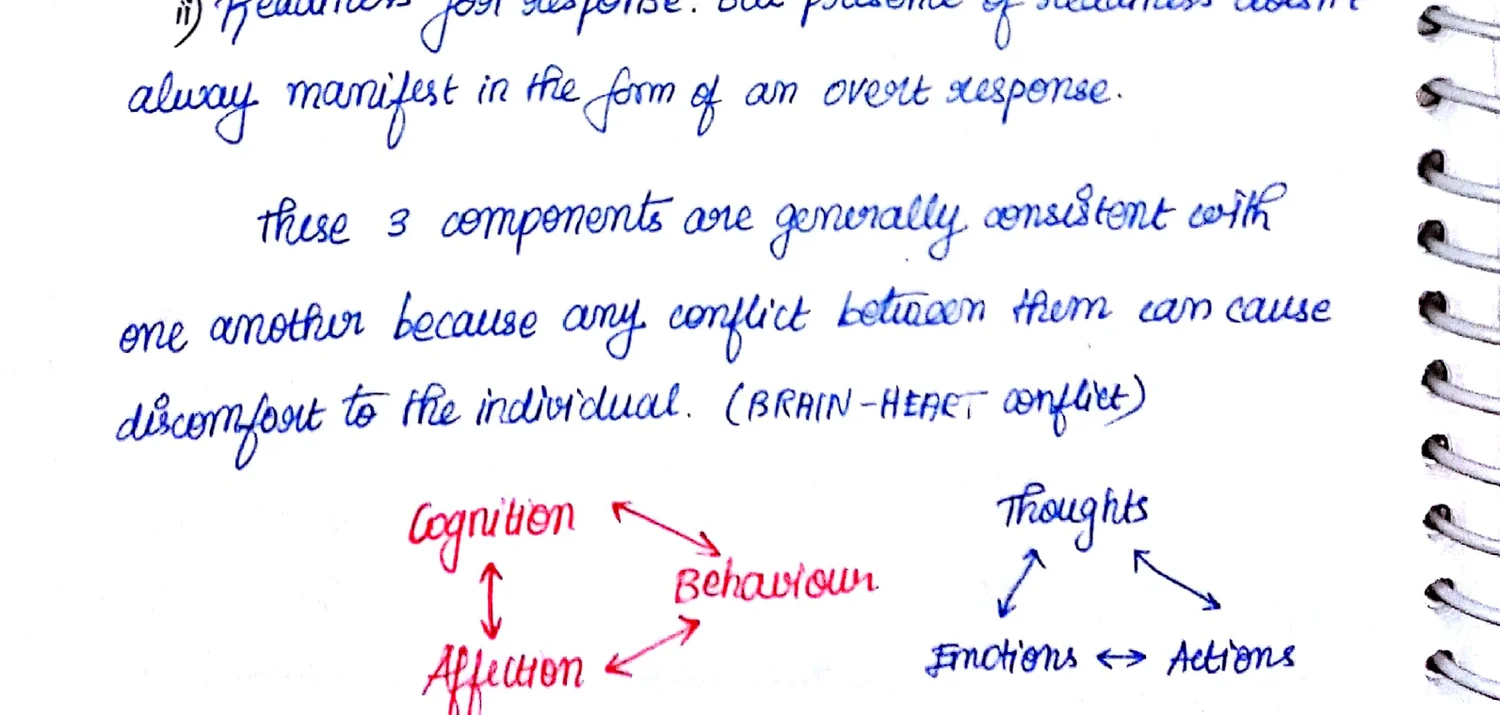
- Cognition ↔ Behaviour → Thoughts
- ↑↓
- Affection ← → Emotions ↔ Actions
[Strategies to change MEWA — if even not, use:]
-
- Try educating ppl
-
- Try invoking emotionally
-
- Beat-Black & Blue
- → To enforce laws better
- Ex: India vs Singapore following rules
#Page 17 — Functions & Nature of MEWA
#Functions of MEWA
I. MEWA facilitates JUDGMENT & DECISION MAKING; they make behavioural choices PARSIMONIOUS [economical-limited choices — lay-driven]
II. MEWA is the basis of Individual's IDENTITY (Who am I actually)
- Our identity provides with a frame of influence to deal with objects, events & people around us
- [the self I know / myself; the self from outside; how the world around me deal with the world around me]
III. MEWA makes individuals ACCEPT RESPONSIBILITY for their behaviour.
IV. Facilitates SOCIAL INTEGRATION and reduces social conflict.
V. Facilitates EVALUATION OF SITUATION as Good, Bad & Ugly.
VI. It increases our COMMITMENT to do what is Good, Right and Appropriate.
VII. It EMPOWERS the stakeholders.
#Nature of MEWA
- ① Static Vs Dynamic
- ② Culture-specific Vs Universal
- ③ Intrinsic Vs Instrumental
- ④ Innate Vs Acquired
- ⑤ [continues] Absolute Vs Relative
#Characteristics of Values (MEVA) — Contd.
#(i) Static vs Dynamic
-
Dynamic
- Keeps on changing
- MEVA → Identity crisis [if values change too rapidly]
-
Static
- Immutable
- Environmental changes → MEVA enables to form a stable equation with environment — to keep equation BALANCED or else → MISFIT
-
Better to call: Relatively Permanent — Why?
i) MEVA forms basis of an Individual's Identity
- Individual identity is developed after investment of considerable labour, time & energy
- Identity will resist change — not subject to easy change
- Frequent change → Identity Crisis → Emotional Turmoil
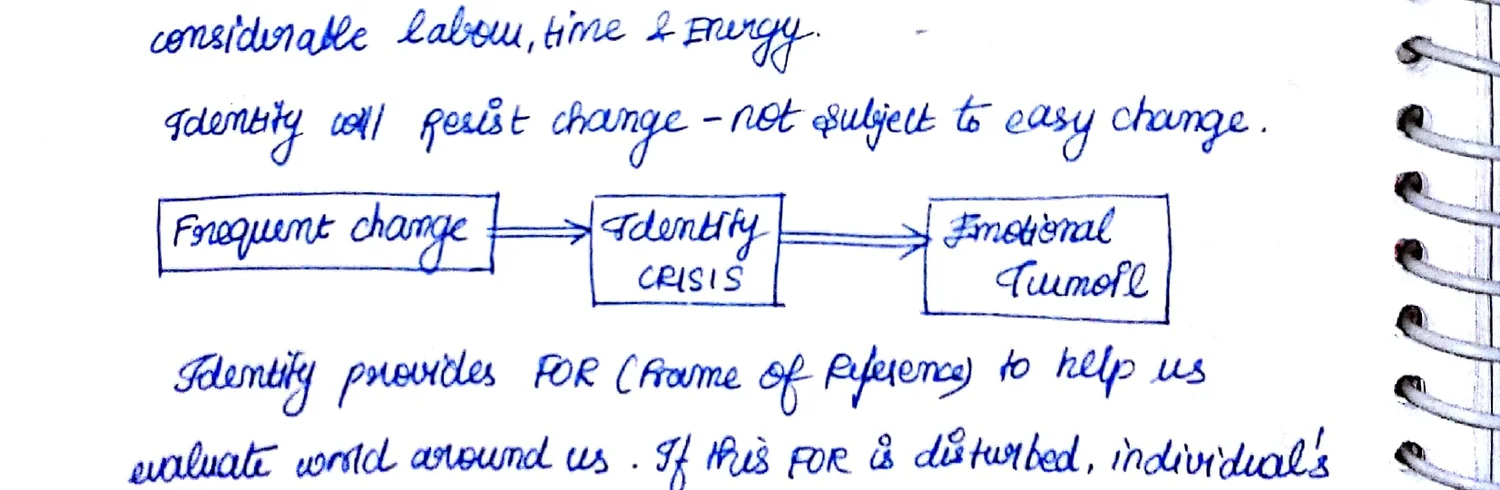
- Identity provides FOR [Frame of Reference] to help us evaluate world around us
- If this FOR is disturbed, individual's organised existence in world would be threatened
ii) Environment is dynamic — MEVA helps us to adjust in our own environment, so they shall change with changing environment
- MEVA = Relatively Permanent — what undergoes change to meet the demands of changing environment is NOT MEVA but the behaviours that are admitted under Morals, Ethics & Values
- Values are manifested through behaviour; that behaviour may be in various forms but value or objective is same
- Ex: I believe in Peace — I prefer to express it through behaviour of writing articles rather than cheating
- Different style of teaching of teachers of institute guided by a common objective — EXCELLENCE
#Table of Values (with situational dependency)
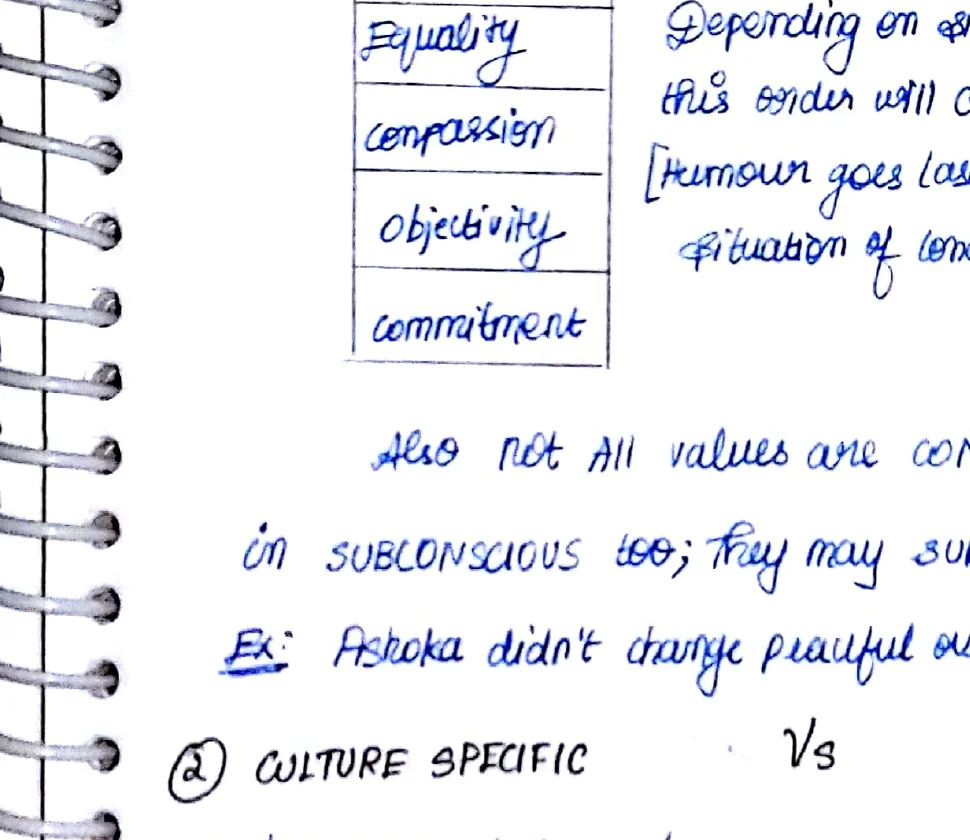
| Humour | Depending on situations, this order will change |
|---|---|
| Equality | [humour goes last in a situation of condolence] |
| Compassion | |
| Objectivity | |
| Commitment |
-
BUDDHA: Hedonism → Altruism
-
Not all values are conscious; there are values in SUBCONSCIOUS too; they may surface at a certain situation
-
Ex: Ashoka didn't change peaceful overnight (ruling war) but — gradual
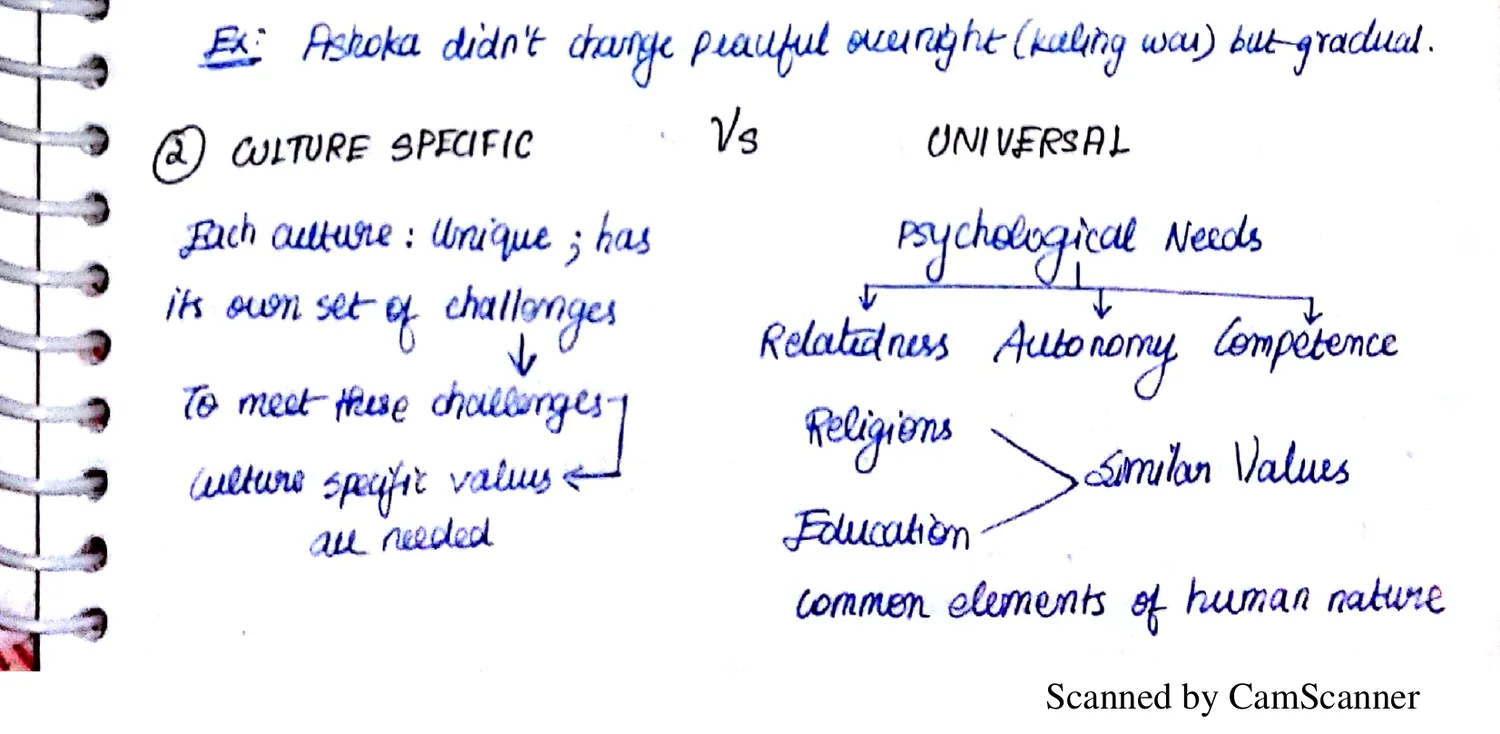
#(A) Culture Specific vs Universal
#Culture Specific
- Each culture: Unique; has its own set of challenges
- To meet these challenges → culture specific values are needed
#Universal
- Psychological Needs
- Relatedness, Autonomy, Competence
- Religions → Similar Values
- Education → common elements of human nature
#Universal (continued)
- Religion — Brotherhood — common human threads in nature — Nations want to bind people together & so they tap on these threads
- Degree of Adherence } Not universal, even though
- But: modes of expression } expression may be universal
- Degree of expression }
- Ex: US Bureaucrats } PUBLIC WELFARE
- Indian Bureaucrats } — universal value
#Culture Specific (continued)
- Different social systems due to cultural differences
- Different Economy → needs different values
- Different Political → different requirements
#(3) Intrinsic vs Instrumental (Extrinsic)
(Class note: 13/1/18, Cl-3)
-
Intrinsic
- An end in itself
- Tied to no separate outcome
- Ex: Being honest only for honesty — for no reason other than honesty
- Ex: Book reading joy → learn
-
Instrumental (Extrinsic)
- Means to an end
- Tried to a separate outcome
- Ex: Being honest not for honesty, but for other reasons such as Promotions, etc.
-
Intrinsic is more important/stronger as it is genuine whereas Instrumental may change once the desired outcome is fulfilled
- Hence: MAN SHOULD BE TREATED AS END IN ITSELF
-
ii) Instrumental may remain Instrumental even when aim/intended earlier is achieved because some other aim could've gained more interest
- Ex: Honesty for → Honesty for Promotion → Public accolade
- If sense of achievement is less, Instrumental may not continue
- Ex: Respect for parents for [illegible] of property
-
OCCUPATIONAL SUCCESS — I re-invent myself always so that my value remains intact
- Helps a lot in inter-personal relationship
- NEBULOUS COUPLE: Articulation is the key
-
i) Intrinsic may change into Instrumental & own a course of Time/Situation
-
ii) Instrumental may change into Intrinsic
- Ex: Book for exam → for joy
#(4) Innate vs Acquired
-
Innate (Inherent/Inborn)
- Intra-Emotional predispositions
- Behavioural predispositions
- Ex: Empathy & hardwired into human infants (In hospital, all babies cry when one starts — to show solidarity)
- "There is no unhappiness except Natural conditions. All are mental constructs"
-
Acquired (Got/Acquired late)
- Values are principally acquired (result of socialisation)
- b) somebody's calamity is your opportunity
- b) taught into schools
-
Ethics & Essay note (margin):
- Challenging because — it demands good vocabulary & expression
- Concrete things can be expressed easier than abstract things
- Identify the difference
- Ex: Joy vs Ecstasy
#(5) Absolute vs Relative — Lost perspective
-
Absolute = Context Independent
- "Ends can't justify Means"
- Focus is on Means rather than on Ends
- KANT: It may cause temporary pain but long term gain
- "Right is right even when nobody does it & Wrong is wrong even when everybody does it."
- Every life is precious. No killing one for 100 or 100 for one → Absolutism
-
Relative = Context Dependent
- Teleological approach [Telos = Ends]
- Ends based approach — favourers
- Consequentialism → "Ends justify means"
- If End is Greatest Good for Greatest Number → Case of Ethical Altruism
- SHAKESPEARE: "All that ends well is well" / "All is fair in Love & War"
- People don't know where to draw lines and life is all about drawing lines
- Ethical Egoism → My needs prior → Nepotism — Dangerous
- Cronyism — Conflict of Interests
- 100 lives more important or special people more important → Relative Altruism
#Issues with Relative Values
- Too much commoditisation → Monetary value suppresses other values & emotions
- (Gun lives) Instruments to kill from distance → Before, Biological struggle (the one to be killed is enough to meet the person who is killing). But now, since killing from distance — No such need → Murders
- JALLIKATTU → Ethical Relativism can be used to justify it
- Proper utilisation of Energy which otherwise would've been exercised in violence
- (Or) Animal Rights to oppose it
Train Dilemma
- i) I am not the one to pull lever
- ii) Lot of people in train; change of track may derail train
- iii) Why to compromise an intelligent child
#Interrelationship of MEVA
(Diagram at back)
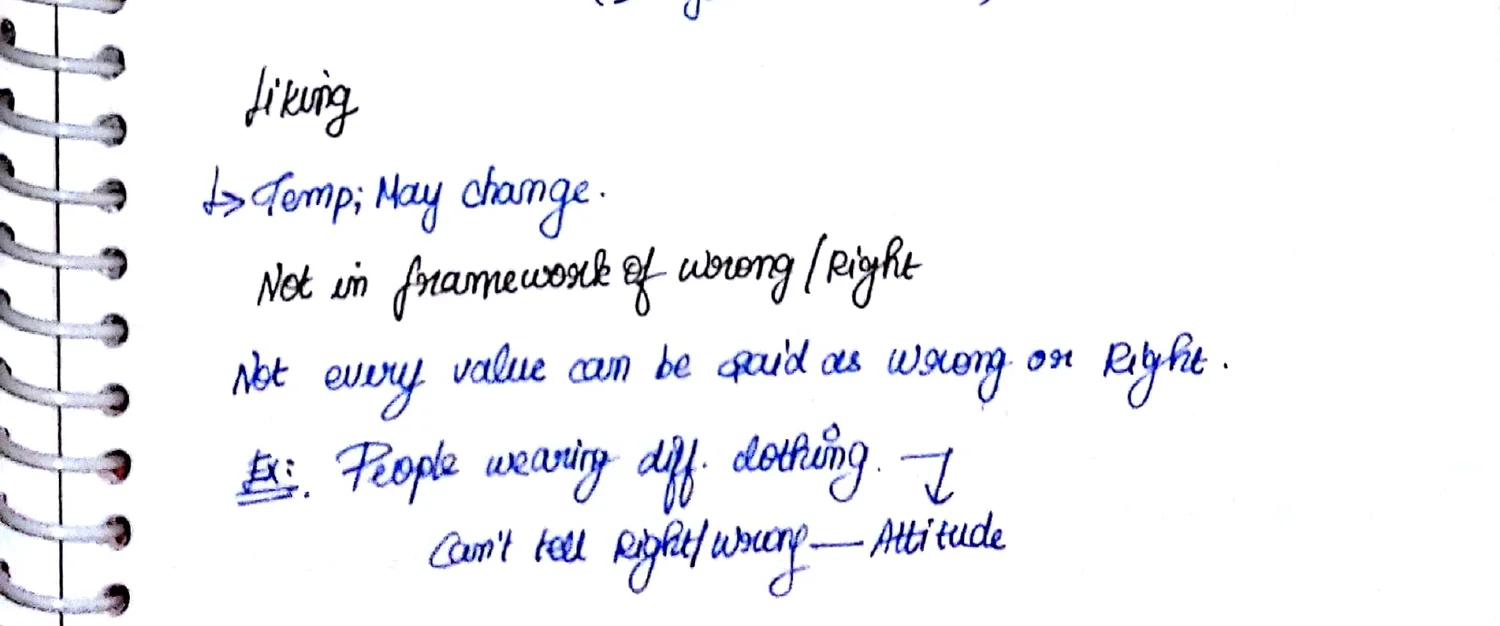
#Liking
- → Temporary; may change
- Not in framework of wrong/right
- Not every value can be used as wrong or right
- Ex: People wearing different clothing — Can't tell right/wrong — Attitude
#PREFERENCE — Flowchart
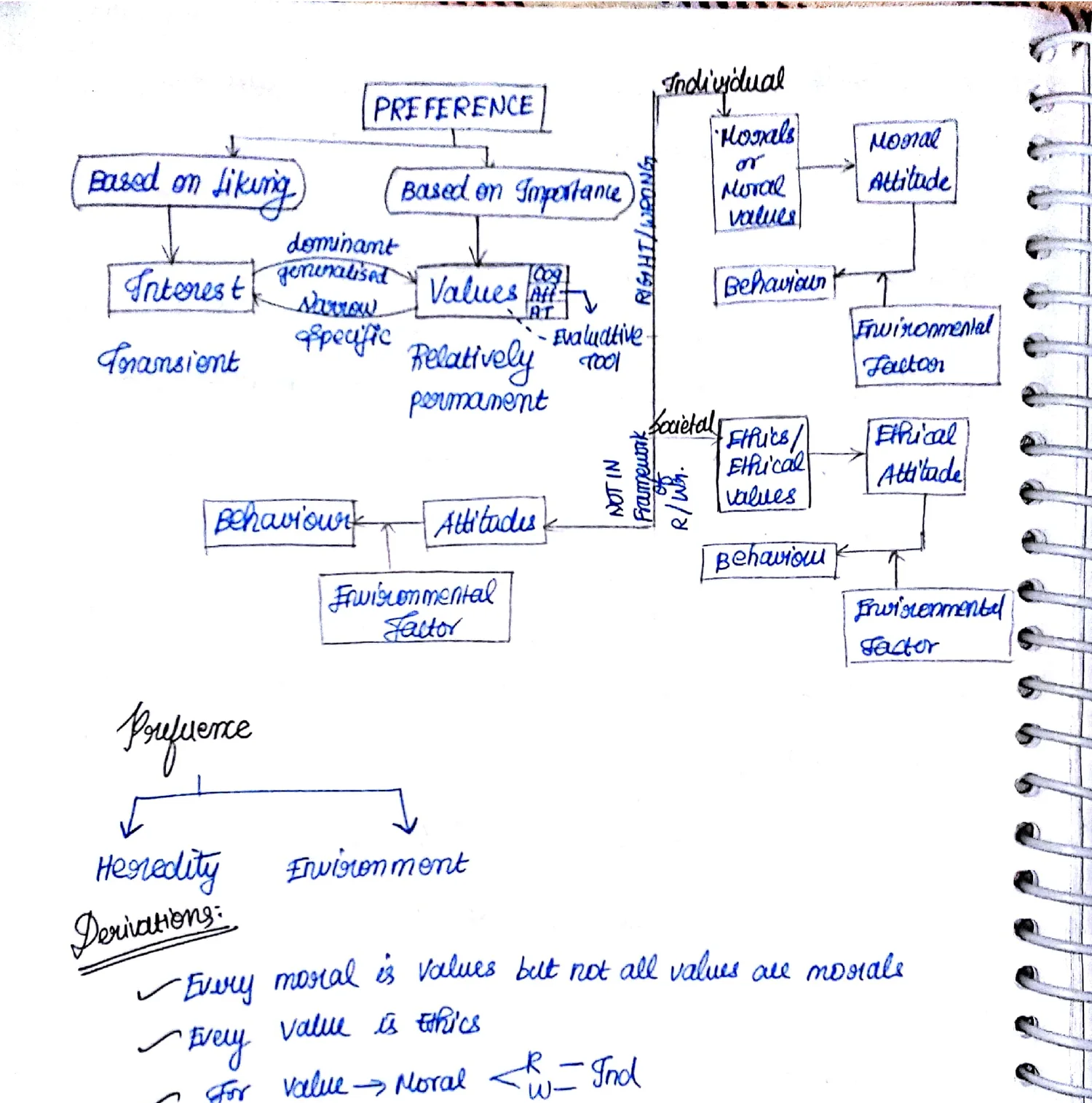
- PREFERENCE splits into:
- Based on Liking → Interest (Transient; dominant, personal, narrow, personal)
- Based on Importance → Values (at root; relatively permanent)
- Individual →
- Morals or Moral Values → Moral Attitude → Behaviour ← Environmental Factor
- Ethical/Ethical Values → Ethical Attitude → Behaviour ← Environmental Factor
- Behaviour → Attitude (NOT in framework of R/W)
#Influence → Heredity / Environment
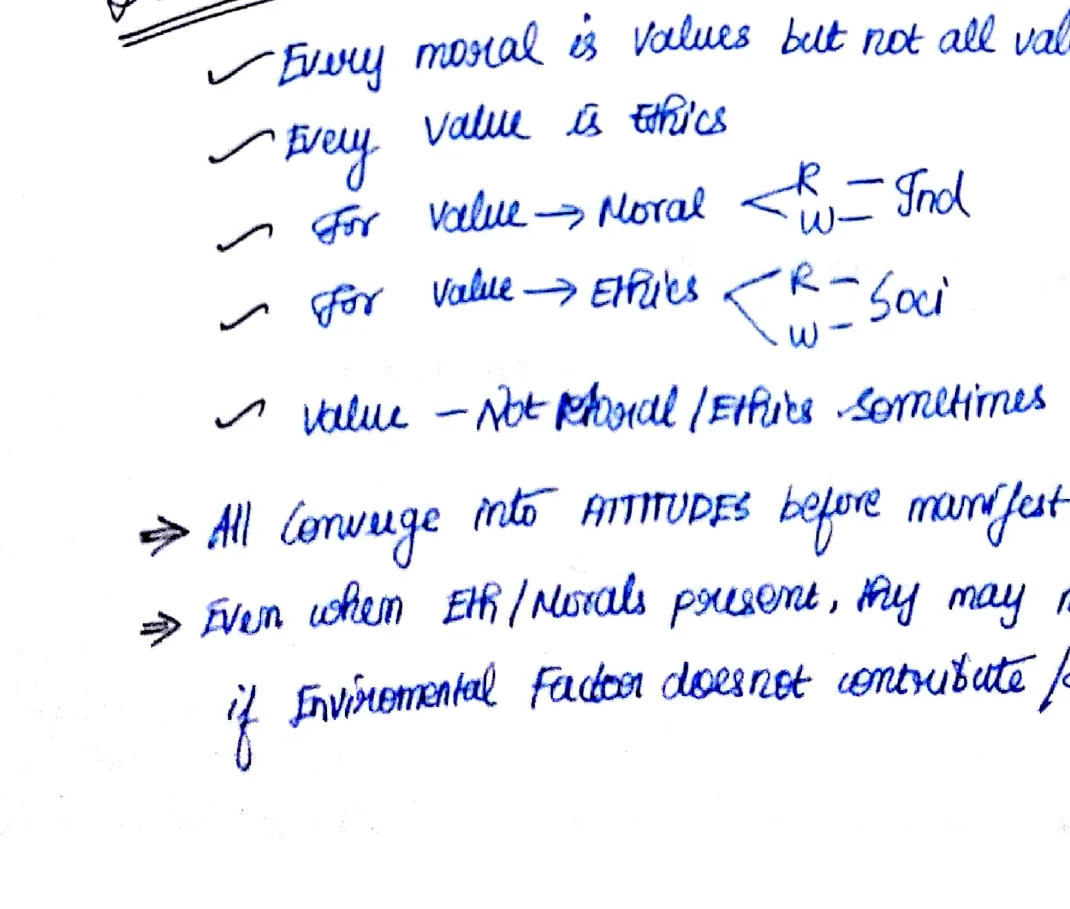
#Derivations
-
Every moral is a value but not all values are morals
-
Every value is Ethics (R [relatively] w [wider] → Ind [individual])
-
For Value → Moral (R [relatively] w [wider] → Ind [individual])
-
For Value → Ethics (R [relatively] w [wider] → Soci [social])
-
Value — Not Moral/Ethic — Sometimes
-
All converge into ATTITUDES before manifest into Behaviour
-
Even when Eth/Morals present, they may not manifest into Behaviour if Environmental Factor doesn't contribute/support it
#Attitude precedes Behaviour; Measurement of Behaviour Predict
- Is easy through Attitude than through Values
- VALUES are GLOBAL
- ATTITUDES are SPECIFIC
- Environmental Factor →
- SUPPORTIVE — Attitude prevails
- ANTAGONISTIC — Attitude may/may not prevail
#Fight Against Corruption
- Finishing Factors:
- Societal support
- Family support
- Threats of Vested Interests
- Ex: KHEMENI, SANDEEP CHATURVEDI → upswing ppl fight against corruption
#Relationship between MEVA
#Values
-
→ Global
-
→ Abstract
-
→ Guide Behaviour
-
→ Not object tied
-
Values that are put into Objects is Attitude
- Ex: Peace into Gandhi → I see Gandhi positively as I value peace
- That is why we always try to OBJECTIFY THINGS
- Ex: He is serving ↔ He is like Napoleon
#Relationship between MEVA — Full Diagram
-
NORMS — Rep a person's CHARACTER
- Attack on character = personal
-
Environmental factor:
- Supportive ✓
- Non-supportive ✓
- (or) Attitude congruent
- (or) Attitude discrepant
#Values — General determinants of Behaviour
#Attitudes — Specific determinants of Behaviour
-
Morals → Ethics → Norms → Laws
-
Crusade of Raja Ram Mohan Roy against Sati — fortunate transformation [of society]
-
Not all Morals will undergo this transformation; it may stop with oneself (may be due to Environmental factors)
#Cost-Benefit Analysis
- Young Sector — flying career — will NOT fight
- Retiring Sector — flying elsewhere — will fight
#Morals vs Ethics
- Morals will prevail — as they are personal
- But in most times society lines Morals & Ethics same to prevent any conflicts
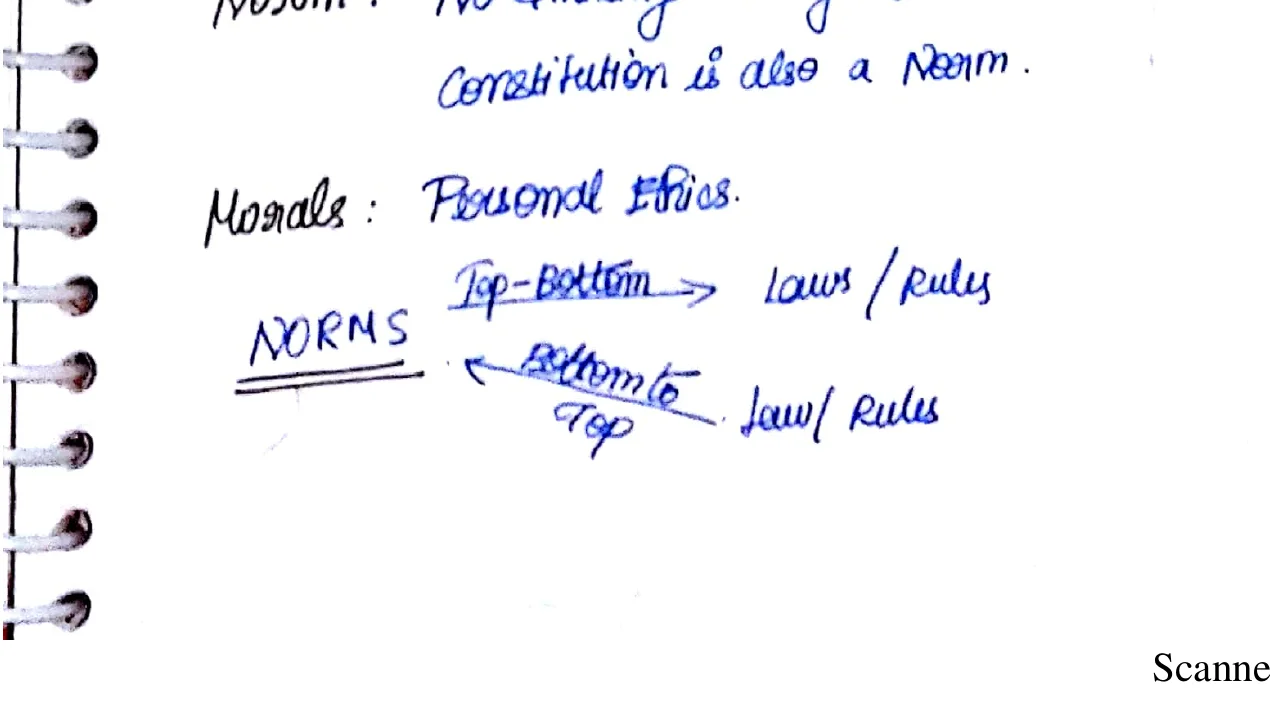
- Norm: No smiling during Funerals. Constitution is also a Norm
- Morals: Personal Ethics
- NORMS:
- Top-Bottom → laws/rules
- Bottom-to-Top → laws/rules
#Concentric Circles Diagram — MEVA Hierarchy
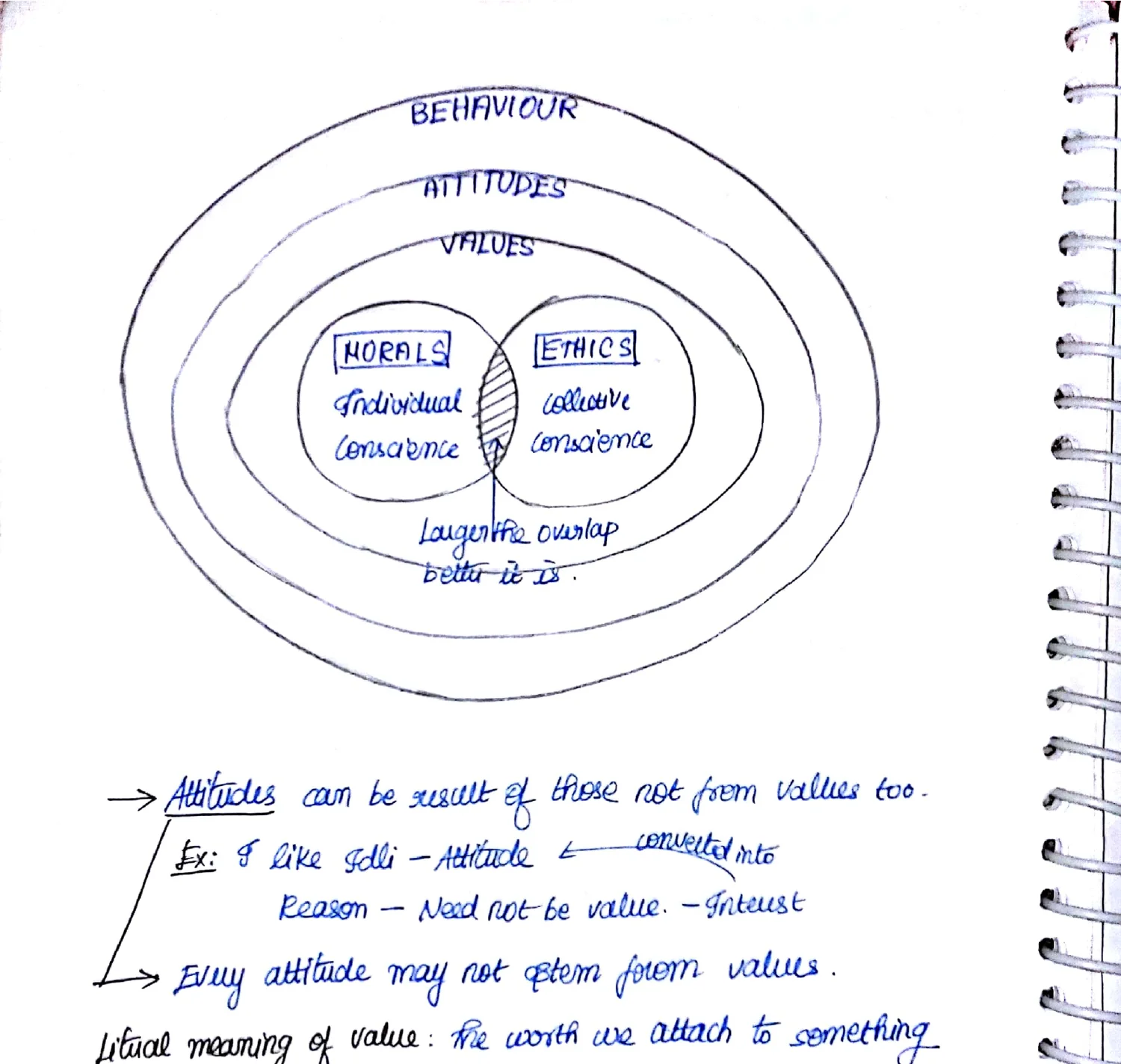
-
Concentric circles (from outermost to innermost):
- BEHAVIOUR
- ATTITUDES
- VALUES
- MORALS (Individual conscience) ∩ ETHICS (collective conscience)
- Larger overlap, better it is
- VALUES
- ATTITUDES
- BEHAVIOUR
-
Attitudes can be result of these [liking/interest], not from values too
- Ex: I like gold — Attitude ← converted into; Reason — need not be value — Interest
- Every attitude may not stem from values
-
Literal meaning of value: the worth we attach to something
-
Behaviour may not be result of morals/V/Eth/attitude always
- Ex: Winking — Attitude; Blinking — Natural
#Derivations (Contd.)
- Encapsulated within Values are Ethics & Morals
- More overlap → More consensus than personal & societal
- Values → Today → Abstract ideals ↓ Norms; Attitude kept outside
- Reflexive behaviours have no genesis in MEVA; only Biological behaviours
(Margin note: Values are the worth we allocate to something → Can't be OBJECTIVE → Never complete consensus)
#(D) VALUES
(Class date: 21/3/18, Cl-4)
- VALUES are the beliefs of a person/a social group, in which they have emotional investment
- Values can be defined as biased preferences concerning appropriate courses of action or outcome
- VALUES are abstract ideals positive/negative not tied to any specific object or situation & represents the person's beliefs about the modes of conduct
- Values are broad preferences; they are abstract in nature, are global, they serve as Internal guides, they have an evaluative element; they can be held by individual/group; they are strongly entrenched in our personality & by applying our values as Benchmarks, we can make subjective judgement about the things that we encounter in the world around us
#Values vs Norms
- VALUES are different from NORMS — in that they are more Global and Abstract
- NORMS are rules/behaviour in specific situations; any deviance from the set norms invites severe punishment from other group members
- Ex: Displaying our National Flag on Republic Day is a Norm and it reflects the Value of patriotism
- Some experts classify values into INTRINSIC vs INSTRUMENTAL category
- Intrinsic value is something that is valued purely for itself; generally physiologically determined values are considered as intrinsic
- One Ex: the tendency/desire to seek pleasure and avoid pain
- Instrumental Value implies that something is valued because it is a means to achieve some other end which in turn is more important; this value plays an important role in 'Teleological moral systems' — which are the theories of morality that argue that moral choices are those which lead to best possible outcome
#Values Differ in
- i) Poland [or value] we hold — we may hold peace — Both of us
- ii) Degree of expression — But Mode; the method we choose to express peace may be different
- So, VALUES ARE PRIMARILY SUBJECTIVE, not Objective
#(2) MORALS
- Morals are the values that provide behavioural rules by which we make decisions between RIGHT & WRONG
- Morals, therefore, are far more above good & bad than other values
- We judge others more strongly on MORALS than VALUES
- A person can be described as IMMORAL & yet there is no word for them not following their values
- Like Values, MORALS are relatively CONSISTENT & STABLE and can have existence both at personal & social levels
- For an Individual: MORALITY → defined as set of personal standards that make up the individual's character; (or) the degree of individual's attachment to the generally accepted standards of behaviour held within a society at a particular point of time
- For the Society: MORALITY → defined as accepted standards of behaviour within the society at a given time
- Morals have a greater SOCIAL ELEMENT than Values & tend to have broad acceptance; Our Moral Judgements express our VALUES but not all expression of our Values are Moral Judgements
#(3) ETHICS
- Ethics refer to the rules for deciding the CORRECT CONDUCT
- They are well founded standards of RIGHT & WRONG that prescribe what humans ought to do usually in the terms of Rights/Obligations/Benefits to society/specific virtues
- Ethics tend to be CODIFIED into a formal system or a set of rules which are explicitly adopted by the people
- Ethics does not always dictate a single moral course of action but provides a means of evaluating & deciding among the competing options; Society requires a code of ethics in order to provide for SOCIAL ORDER, prevent strife between individuals & provide basis for settling conflicts between the competing values
- Ethics define how things work according to rules; they are dependent upon others for definitions; they tend to be consistent within certain context but may vary between contexts
- In contrast, Individual's moral code is usually unchanging & consistent across all contexts
- Lawyer Ethics vs Doctor Ethics — different; [crossed out: legal ethics vs law]
#Common to MEVA
#(4) ATTITUDE — Learned, Enduring Predisposition to respond consistently either in favourable or unfavourable manner towards objects, events and/or persons
(Unique to Attitude: DIRECTED)
#Development of MEVA — By Socialisation
#From WOMB to TOMB
- D1: Life long process of shaping individuals' social tendencies so that he/she becomes & remains a useful & a productive member of his/her society
- D2: Process by which culture is transmitted from one generation to next; individual develops his personality by learning the contents of his culture
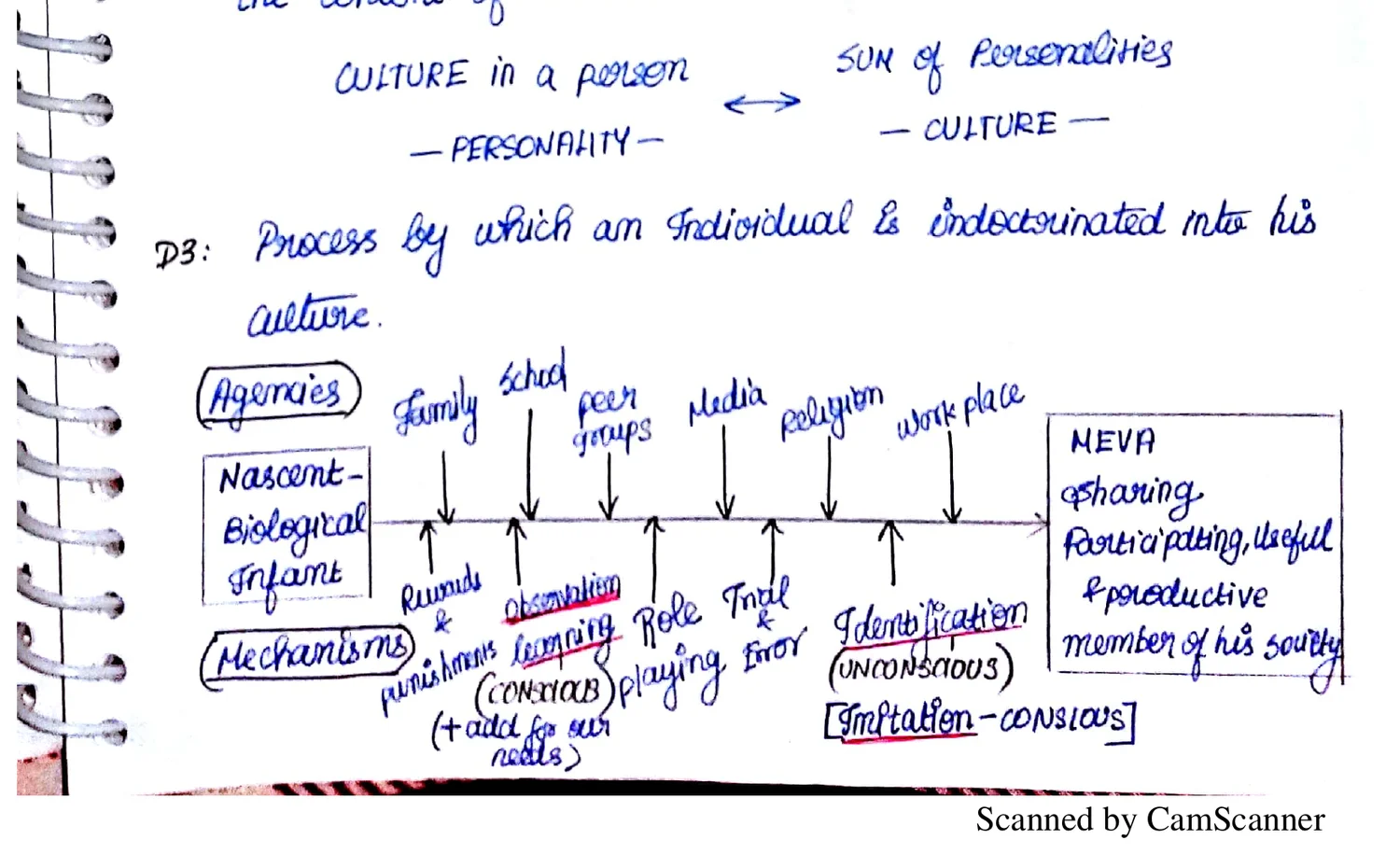
- CULTURE in a person: PERSONALITY ↔ SON of Personalities — CULTURE
- D3: Process by which an Individual is indoctrinated into his culture
#Agencies of Socialisation
| Agencies | Family, School, Peer groups, Media, Religion, Workplace |
|---|---|
| Nascent Biological Infant | ↓ (via mechanisms) |
| Mechanisms | Rewards, Punishment, Imitation (Conscious [+add for one's role]), Role play, Identification (unconscious), Imitation (conscious) |
| → | MEVA: Sharing, Pursuing, Useful & Productive member of his society |
#Socialisation: Self Preservation → Relatively Selfless Being
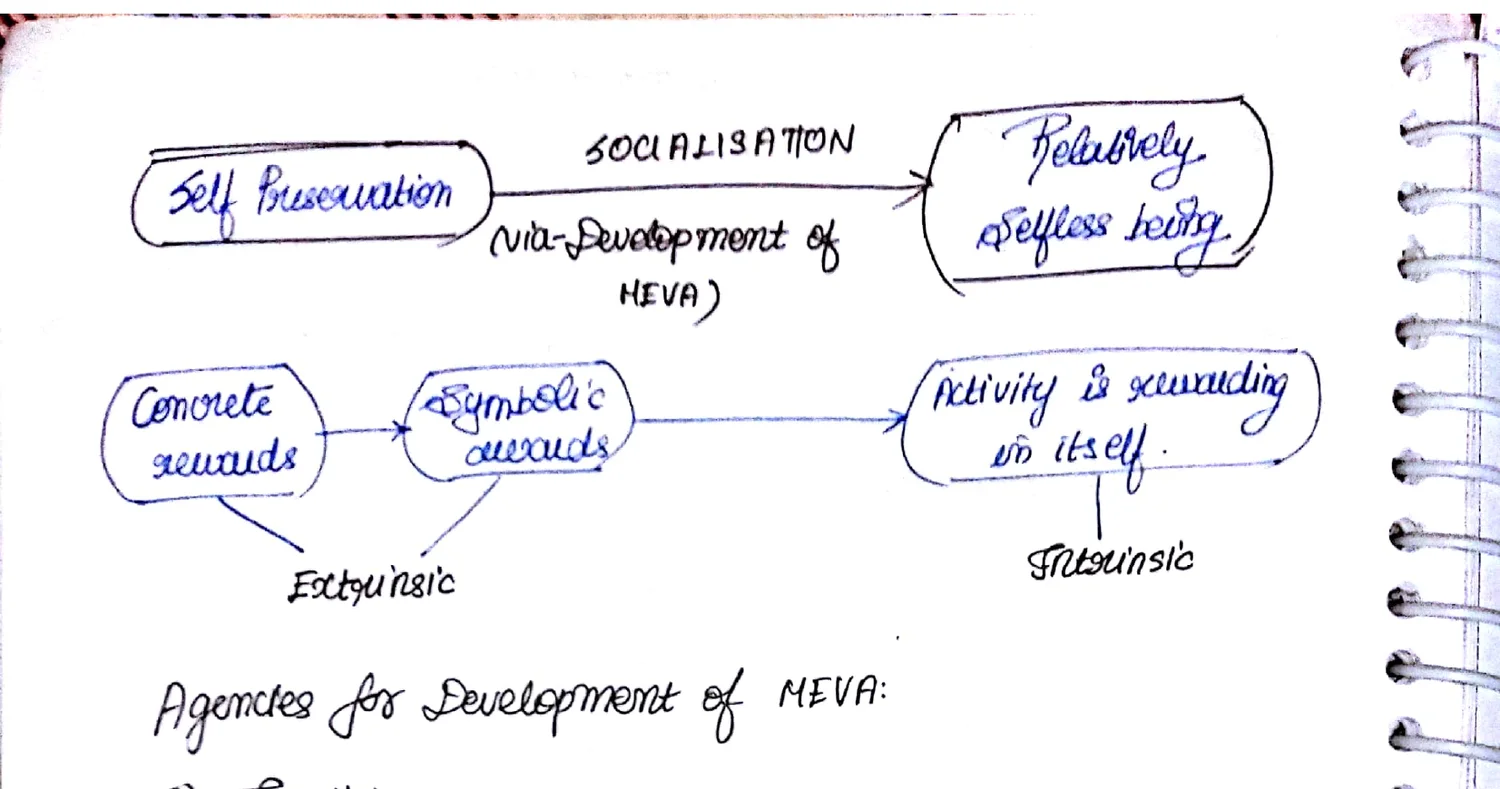
- Self Preservation → (via Development of MEVA) → Relatively Selfless Being
- Concrete rewards → Symbolic rewards — Extrinsic
- → Activity is rewarding in itself — Intrinsic
#Agencies for Development of MEVA
#(1) Family
- It is a NETWORK OF RELATIONSHIPS marked by co-operation, continuity & emotionality not duplicated in any other system
- Role of family in Dev. of MEVA:
- → Parenting style
- → Role of mother
- → Role of father
i) Styles of Parenting: Child rearing practices adopted by the parents to inculcate in their children self-discipline & self control; depending upon demands placed & resources provided there can be 3 TYPES OF PARENTING STYLE:
a) AUTHORITARIAN → believe in restricting the autonomy of children; Primary means is physical punishment to discipline children; Parents force their children to imbibe their value system; Often children don't arrive at their value & belief system
#Socialization & Value Development (Continued)
#Authoritarian Parenting — Continued (Page 35)
- On their own they generally do not show high order commitment to the value system that they profess
- As children are denied independence and are forced to inculcate certain pro-social behaviours, they develop resentment and hostility towards the authority figures in general and parents in particular
- This hostility is repressed out of the fear of parent's retaliation and it gets manifested in the form of ABJECT SERVILITY towards the authority figures and the tendency to ruthlessly dominate and exploit those who are positioned at the lower rungs in power, status and economic ladder
-
Authoritarian parenting is likely to develop in children:
- Hierarchical mindset
- Opportunism
- Self-centric attitudes
- Low self-esteem
-
SYCOPHANCY
- Egoist → I am myself
- Egotist → I am better than you
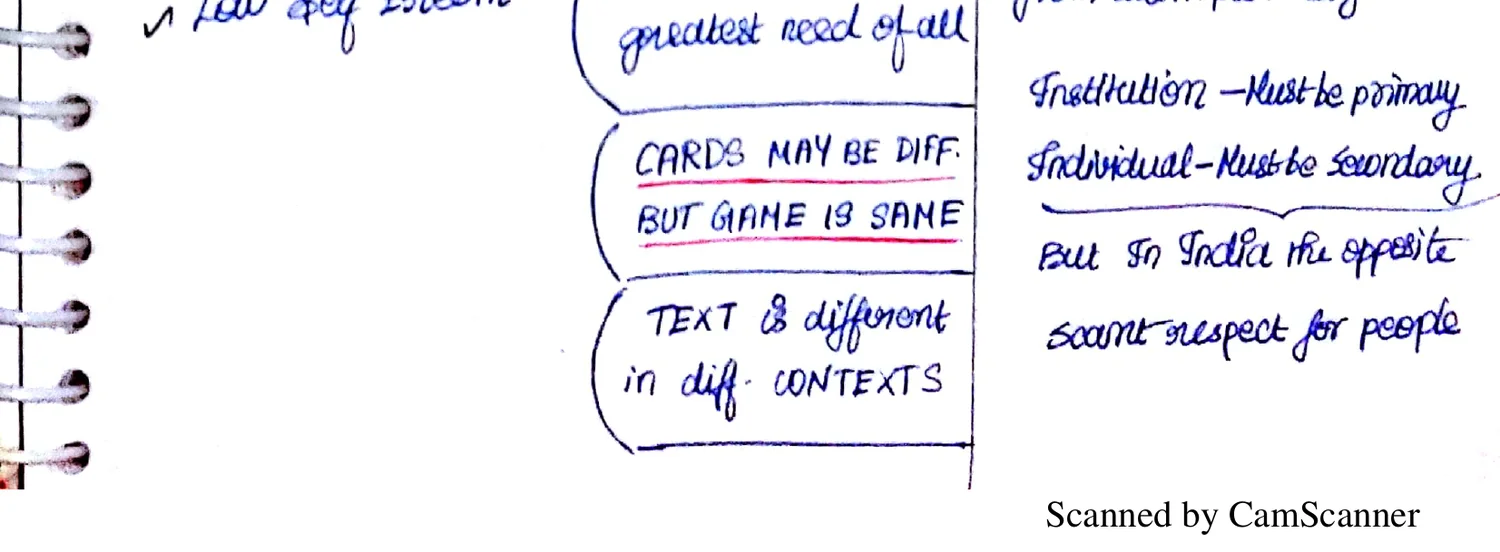
- POWER NEED is the greatest need of all
- CARDS MAY BE DIFFERENT BUT GAME IS SAME
- TEXT is different in different CONTEXTS
-
Nation is a Family — kind of Gov [Government] → Parenting Style
- In India: Democratic in spirit — Authoritarian
- Lack of Democratic mindset due to the ABJECT SERVILITY resulting from authoritarian parenting style
- Institution — must be primary; Individual — must be secondary
- But in India: the appetite → scant respect for people
#Parenting Styles
#b) DEMOCRATIC Parenting (Page 36)
- Deal with their children in rational issue-oriented manner
- i) Use positive threat of withdrawal of love as means to discipline their children; they rarely rely on physical punishment as the means
- ii) Provide their children the autonomy to experiment and explore in the world around them and then arrive at a personal decision regarding values and belief system to be adopted
- iv) They however do assist their children to take an informed decision if the need be
-
× AP [Authoritarian Parenting] / Reality Demon → [crossed out / negative example]
- High on Demandingness
- Low on Nurturance/Responsiveness
-
→ BALANCE → Democratic Parents [CDP]
-
Pro-social Values (characteristic of democratic parents):
- Empathy, Compassion → serve as stable role models
- Tolerance, Patience → fair and consistent in supply of R+ve [positive reinforcement] for children
- Integrity, etc. → children often internalise the value of their parents
#c) PERMISSIVE Parenting (Page 36)
- High on Nurturance/Responsiveness
- Low on Demandingness
- Give their children as much freedom as is consistent with child's physical survival
- It is characterised by unlimited freedom; poor parental control
- Children end up many times identifying with negative role models and develop negative values
#ii) Role of Mother (Page 37)
- Date: [illegible] / R-5
- Mother's love during childhood and infancy is as important for the child as are vitamins and proteins for physical health
- By the time children are 1 year old, they get attached to their mother
#ATTACHMENT
-
It is the emotional bond that the children establish within their parents and significant others
-
Attachment serves 2 important functions:
- i) It serves as a base for future interpersonal relationships
- ii) It provides the child the courage to explore uncertain world
-
× Unresponsive Mothering → leads to Insecure Attachment
-
× Frequent Mother-child Separation
- Such children display Anxious and Avoidant and Ambivalent behaviours
- Children with insecure attachment display a host of undefined values and behaviours such as:
- Non-cooperative attitude
- Self-centric orientation
- Low levels of empathy and compassion
- Poor integrity
- High degree of opportunism — ["somebody's calamity, my opportunity"]
#Warm and Responsive Mothering (Page 38)
- Warm and Responsive mothering → produces Secure Attachment
- Children with secure attachment display bold and confident behaviours
- Secure attachment → development of Pro-Social Values:
- Empathy, Compassion, Objectivity
- Impartiality, Tolerance, Patience
- Dedication, Integrity, etc.
#iii) Role of Father (Page 38)
- Father's role in [HEVA — Human, Ethical, Value Acquisition] development is no less important than that of mother
- By the time children get attached to their father, much in the same fashion that they get attached to their mother
- If father presents himself as a stable role model who happens to be just and fair in the treatment of his children, children acquire the values acquired/held by their father and make them an integral part of their personality structure
- Boys generally acquire their gender-appropriate behaviours through the identification with their father
- Girls acquire heterosexual adjustments by relating themselves to their father
#3) School (Page 39)
-
Represents the example of 1st FORMAL AGENCY OF SOCIALIZATION that steps in the life of children when they are 4–5 years old and socialises the children to the culture they live in
-
Objective of the school → to facilitate ALL ROUND DEVELOPMENT of the child by imparting him the skills that contribute to the development of:
- i) Vocational Competencies — skills to get job/work
- ii) Cognitive Competencies — sharpen the mind; formal input
- iii) Social and Civic Competencies — behaviour with people, society, etc.
- iv) Personal Competencies — mental strength, true self-confidence
- v) Emotional Competencies — ability to control one's emotions
- vi) Psychomotor Competencies — inferential input from school
-
3Rs + R → Reading; Writing; Arithmetic + Relationship
#a) Curricular Activities (Page 39)
- Debates
- Discussions
- Lectures
- Allegorical methods
- Demonstration and Participation
- Curriculum enables the child to know:
- The history of her society
- Cultural achievements of her society
- Scientific and technological progress of her society
- Geography of her surroundings
- Opportunities that lie ahead of her in future
#For Curricular Activities to be Meaningful (Page 40)
- i) Must be culturally congruent and relevant
- ii) Must have practical bias
#b) Extra-curricular Activities (Page 40)
- These are the activities that are outside the ambit of textual framework and are not tied to marks
- Many values that are difficult to teach within the classroom settings can be imparted via extra-curricular activities performed in the FIELD SETTINGS
- Some of these values include:
- Leadership — Team building and Team spirit
- Morale building — Cooperation and Togetherness
- Resistance — Delegation of work
- Empathy and Compassion — Tolerance and Patience etc.
- Ex 1: Lesson of cleanliness during recreational activity/hour
- Ex 2: Principal encouraging football captainship — less easy, lesson to win [lesson to lose]
#c) Role of Teachers (Page 40)
-
Friend → Philosopher → Guide
-
Motivation → Guide manager → Info provider
-
Confidence builder → Empathic listener
-
WITHIN CLASSROOM → Excellent Teaching →
- Building up of curiosity
- Interest
- Inquisitiveness for learning
- Striving for excellence
-
II. Non-partisan and Unbiased class treatment →
- Equality and Impartiality
- Patient handling of students
- Tolerance; Patience; Kindness
-
OUTSIDE THE CLASSROOM
- I. Exemplary personal conduct → Integrity
- II. Helping students solve their personal problems → Compassion and Empathy
#3) Peer Groups (Page 41)
-
Peer group association implies interaction among equals — something that is not possible in our association with more powerful adults in the form of teachers and parents
-
Wide spectrum of topics can be undertaken for discussion and opinion to be formed on them
-
Peer group discussions can help to overcome value confusions
-
Importance of peer group reaches maximum during ADOLESCENCE which is a period characterised by Identity Crisis
-
Peer group association alleviates the tension and anxiety associated with adolescence identity crisis by providing with:
- Social support — Information support
- Emotional support — Material support
-
Thus, to overcome identity crisis and establish a clear set of values
-
Positive peer group association → leads to development of PRO-SOCIAL VALUES
-
Negative peer group association → leads to the development of ANTI-SOCIAL VALUES
-
PGPA [Peer Group Peer Association] also influences the setting up of individual's life goals and occupational goals and motivation to achieve these goals
#4) Media (Page 42)
#On: Media and Changing Face of Society
-
i) No denial of higher impact on HEVA [Human, Ethical, Value Acquisition] of children more than adults nowadays
-
ii) Media, as a force is gaining importance daily and today it is greater than ever. However, it could be incorrect to say that it will supplant the role of family in value development because:
- Media → Vicarious Reinforcement → Indirect
- Family → Vicarious and DIRECT Reinforcement → Direct and Indirect
-
iii) Technology has increased the impact of media:
- Interactive Tool
- Multimodal Tool
- Ability to combine media in normative activities
- Tips in entertaining manner without much labour (INFOTAINMENT)
- Increased time spent on media
#Increased Gender Equality and Greater Autonomy of Children (Page 43)
- Day care centres; women (Mom) goes to work
- Dilution of role with children
#Mass Media — Definition (Page 43)
- Media → refers to mode of communication and when it appeals to mass, it becomes a case of → Mass media
- Mass media, therefore, refers to the entire family of technological devices that make the communication among the masses possible
- Mass media socialisation refers to the manner in which mass media institutions like TV, Radio, etc., contribute to socialisation in the terms of:
- Behaviours; Attitudes
- Role Expectations; Value Structures; Belief Systems
- Mass media socialise people not only through values that they teach but also by providing the TOPICS OF CONVERSATION and common experiences that they can share with others, thereby creating a mediated background against which socialisation takes place
- Though the influence of mass media continues throughout life, researches suggest that mass media happen to be a significant special source in life of CHILDREN AND ADOLESCENTS
#Scripts for Living (Page 44)
- This is because media provides young people with SCRIPTS FOR LIVING that explains the types of behaviour that are acceptable and appropriate in various situations, create expectations about the kinds of consequences that are likely to follow from the behaviours and define the numerous contingencies that can operate in given situations
- Mass media influence the social behaviour by shaping the expectations and the norms children hold regarding various behavioural situations
- Mass media influence the children's PERCEPTION OF SOCIAL REALITY
- Mass media not only bring about an ATTITUDE CHANGE but, at times, also serve to STRENGTHEN EXISTING ATTITUDES
#I. Social Change Tool (Page 44)
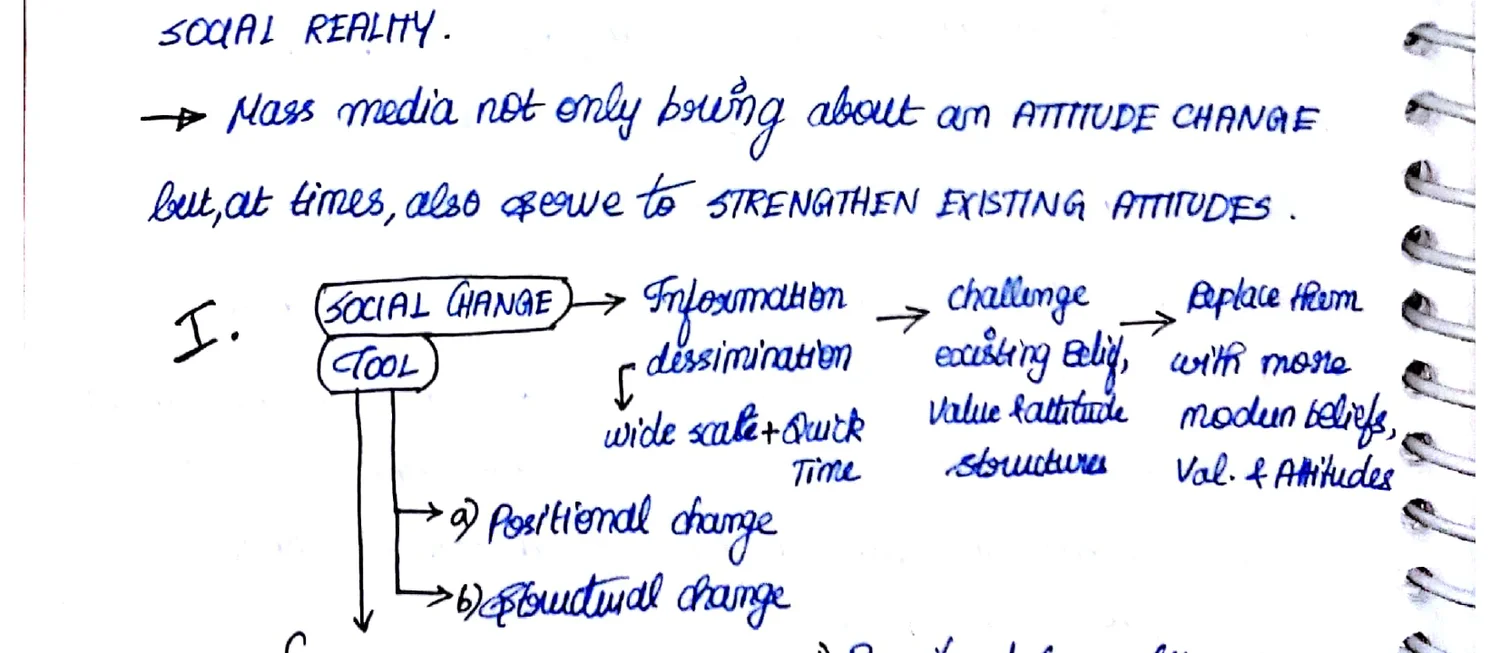
- I. [SOCIAL CHANGE TOOL] →
- Information dissemination → challenge existing beliefs/value attitudes/structure → Replace them with more modern beliefs, values and attitudes
- Positional change
- Structural change
- Temporal summation →
- Privileged group (Haves)
- Disadvantaged (Have nots)
- Sensitise haves about plight of have-nots
- Empowers have-nots — making them aware of rights and ways to achieve them
#India-Specific Social Change via Media (Page 45)
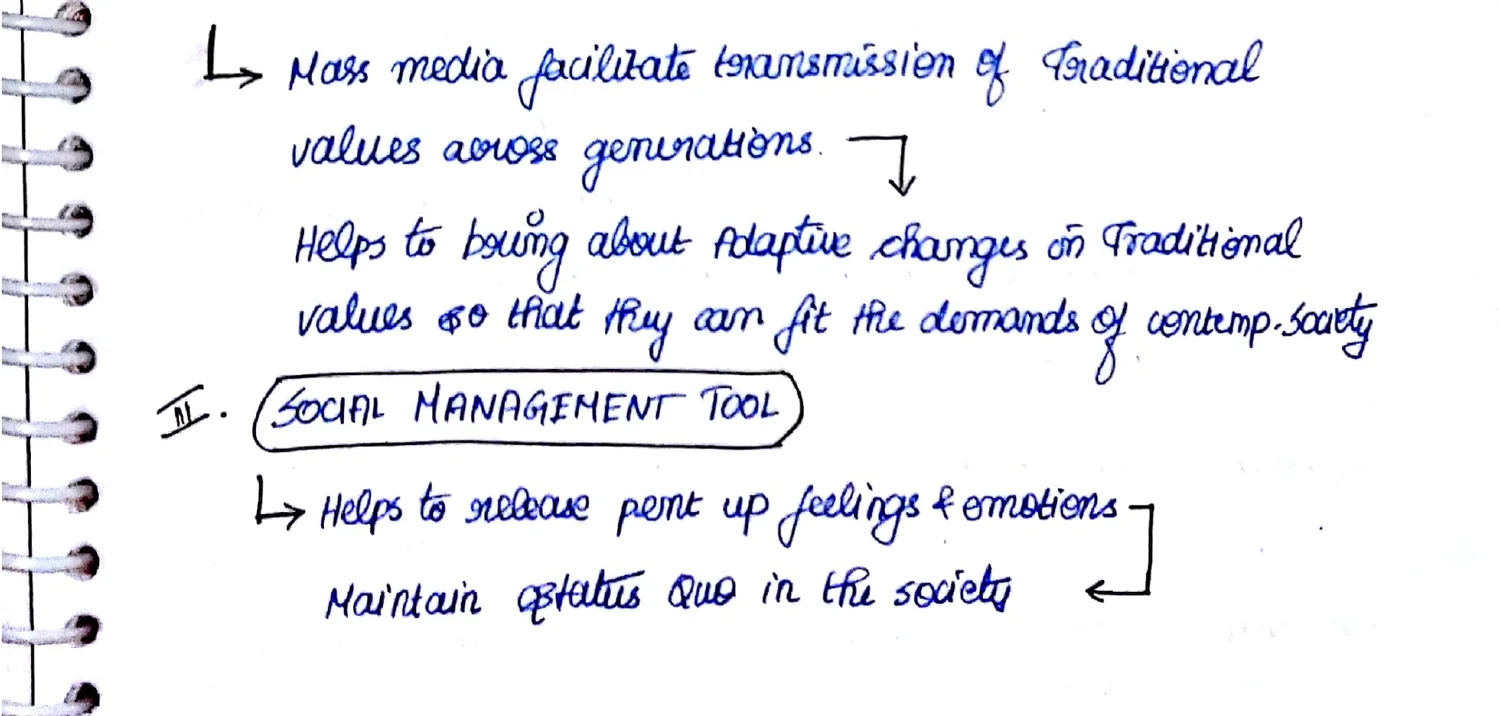
- In India, it has done restructuring of human relationships:
- Political; Social; Economic; Technological
- 'MOBILE MULTIPLIER' — by
- Social media produces Mobile Personality (on the move, not attached to son/soil) and Mobile Societies → Increase in SCIENTIFIC TEMPER
- × Parochial × Narrow × Self-centric
- Our Indian society is struggling because of these:
- POSITIONAL CHANGE → STRUCTURAL CHANGE [gradually leads to]
- Positional Change: limited no. of persons of some groups go up (e.g., SC/ST → IAS)
- Structural Change: All persons [CA CB CC CD] acquire equal status
- POSITIONAL CHANGE → STRUCTURAL CHANGE [gradually leads to]
- 'IN GROUP' — 'we' feeling → 'IN GROUPISM' — Nepotism; Bribery; Soft work culture [illegible partial]
#II. Social Continuity Tool (Page 45)
- Mass media facilitates transmission of traditional values across generations
- Helps to bring about adaptive changes in traditional values so that they may fit the demands of contemporary society
#III. Social Management Tool (Page 45)
- Helps to release pent-up feelings and emotions
- Maintain status quo in the society
#Negative Impacts of Mass Media (Page 46)
- Generally, mass media is controlled by Bourgeoisie and hence they don't like structural changes
- Negative impacts of Mass media:
-
- Commodification
-
- Consumerism
-
- Relative Deprivation
-
- Blurred distinction between illusion and reality [e.g., lynching]
-
- Desensitisation and inhibition towards sex and violence
-
- Aspiration explosion
-
- Biased presentation of sex, caste and occupational roles — leading to Prejudice Development
-
#5) Religion (Page 46)
- Date: [illegible] / R-6
- Religion is a collection of belief systems, cultural systems and world view that relate humanity with spirituality and sometimes to moral values
- Many religions have narratives, symbols, traditions and sacred histories that are intended to give meaning to life or explain the origin of life or universe
- Religion is like an ethnic or cultural category making it less likely for an individual to break from her affiliation
- Parental religious participation is the most important part of religious socialisation
- Children raised in religious homes are more likely to have some degree of religiosity in life
#Religion and Moral Values (Page 47)
- Religion facilitates the development of moral values by:
- i) Informing the children during their formative years with the idea of Sacred or Profane
- ii) Identification with a particular religion provides its members a sense of belongingness. It promotes a feeling of exclusion in all those who are outside the group. The collective identity that the religion provides ensures that those who fail to follow religious norms will be ex-communicated
-
World view of a man in Traditional Society:
- GUILT, SHAME
- HOPE, OPTIMISM
- Super Natural > Natural [Super Natural circle dominates]
-
World view of a man in Modern Society:
- Natural, Super Natural [balanced / Natural circle dominant]
-
Functions of religion (from diagram/list):
- Social control — SN [Supernatural] sanctions
- Social integration
- Meaning in life
- Infotainment / Entertainment
- Explanation for unknown
- Identity
-
iii) Religion, by providing supernatural sanctions to the values and activities suggested by it ensures diffuse compliance by the followers
-
iv) Religion provides man with spiritual world view. It exposes the spiritual dimension of culture. It lifts the man above material and carnal satisfactions to practical acknowledgement of universal, transcendental, absolute God
#Further Functions of Religion (Page 48)
- v) Religion provides motivation to people to continue with goodness by making them accept even negative life experiences as divinely pre-destined and aimed at their benefit in longer run as it is almighty's way to educate them. Thus it provides society and people with positive framework to manage their frustrations
- vi) Religion shapes collective beliefs into collective identity. Religious rituals like funeral ceremony and b'day celebrations promote group solidarity and provide occasions to learn new values and reinforce the already present ones
- vii) Religion, assigning to itself the duty of a watchdog thus, religion plays a quasi-non-voluntary role by calling to order both man and society when there is a drift towards self-destruction and immorality
#6) Work Place (Page 48)
- Organisational Socialisation is a process in which new employees are acclimated to the culture of new workplace
- Most organisations engage in some type of formal socialisation for the new hires
- In some cases this occurs through an orientation/training program that the new employees undergo before assuming the functions of the new position
#Social Values — Hofstede's Framework (Page 49)
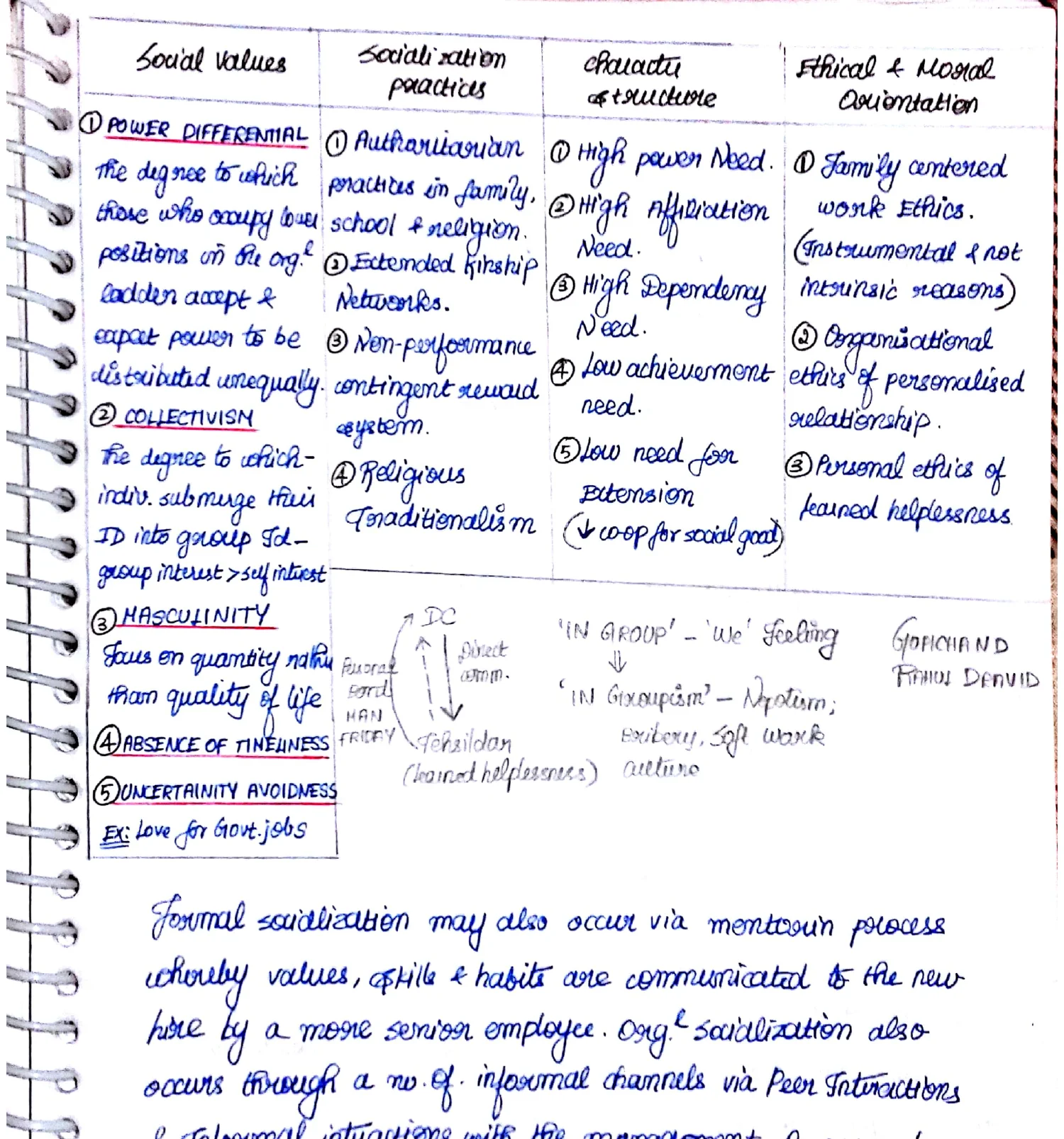
| Social Values | Socialisation Practices | Character Structure | Ethical and Moral Orientation |
|---|---|---|---|
| 1) POWER DIFFERENTIAL — The degree to which those who occupy lower positions on the org[anisational] ladder accept and expect power to be distributed unequally | 1) Authoritarian practices in family, school and religion; 2) Extended kinship networks; 3) Non-performance contingent reward system; 4) Religious Traditionalism | 1) High power need; 2) High Affiliation need; 3) High Dependency need; 4) Low achievement need; 5) Low need for Extension (low co-op[eration] for social good) | 1) Family-centred work ethics (Instrumental, not intrinsic reasons); 2) Organisational ethics of personalised relationship; 3) Personal ethics of learned helplessness |
| 2) COLLECTIVISM — The degree to which indiv[iduals] submerge their ID [identity] into group ID — group interest > self-interest | 'IN GROUP' — 'we' feeling → 'IN GROUPISM' — Nepotism; Bribery; Soft work culture | Yamcha N.D. [illegible]; From Devoid [illegible] | |
| 3) MASCULINITY — focus on quantity rather than quality of life | |||
| 4) ABSENCE OF TIMELINESS | |||
| 5) UNCERTAINTY AVOIDANCE | |||
| Ex: Low for govt. jobs |
- Mini diagram: DC [Democratic Culture] with direct agency, person → man → tradition (learned helplessness) circle
#Formal and Informal Socialisation at Workplace (Page 49 cont.)
- Formal socialisation may also occur via mentoring process whereby values, spirit and habits are communicated to the new hire by a more senior employee
- Org[anisational] socialisation also occurs through a no. of informal channels via peer interactions and informal interactions with the management
- As new employees become socialised, they learn the history, culture and values of the organisation
#Work Culture and Indian Context (Page 50)
- The work and org[anisational] culture in India are the part of a larger societal culture
- Indian culture possesses certain values which interact with external events and imperatives to shape organisational and work culture
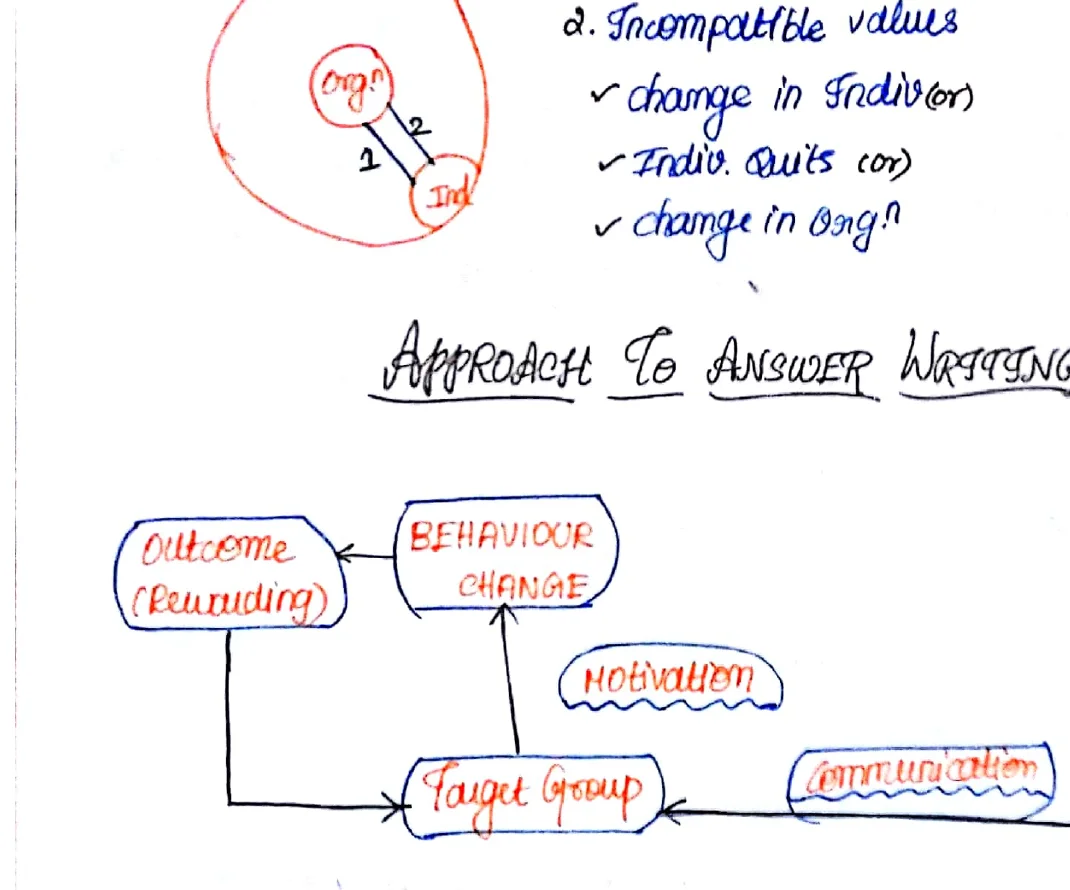
- Compatible values = Person-Orgo-Fit [Person-Organisation Fit]
- Incompatible values:
- Change in tradition
- India suits [sic]
- Change in org[anisational culture]
#Approach to Answer Writing (Page 50)
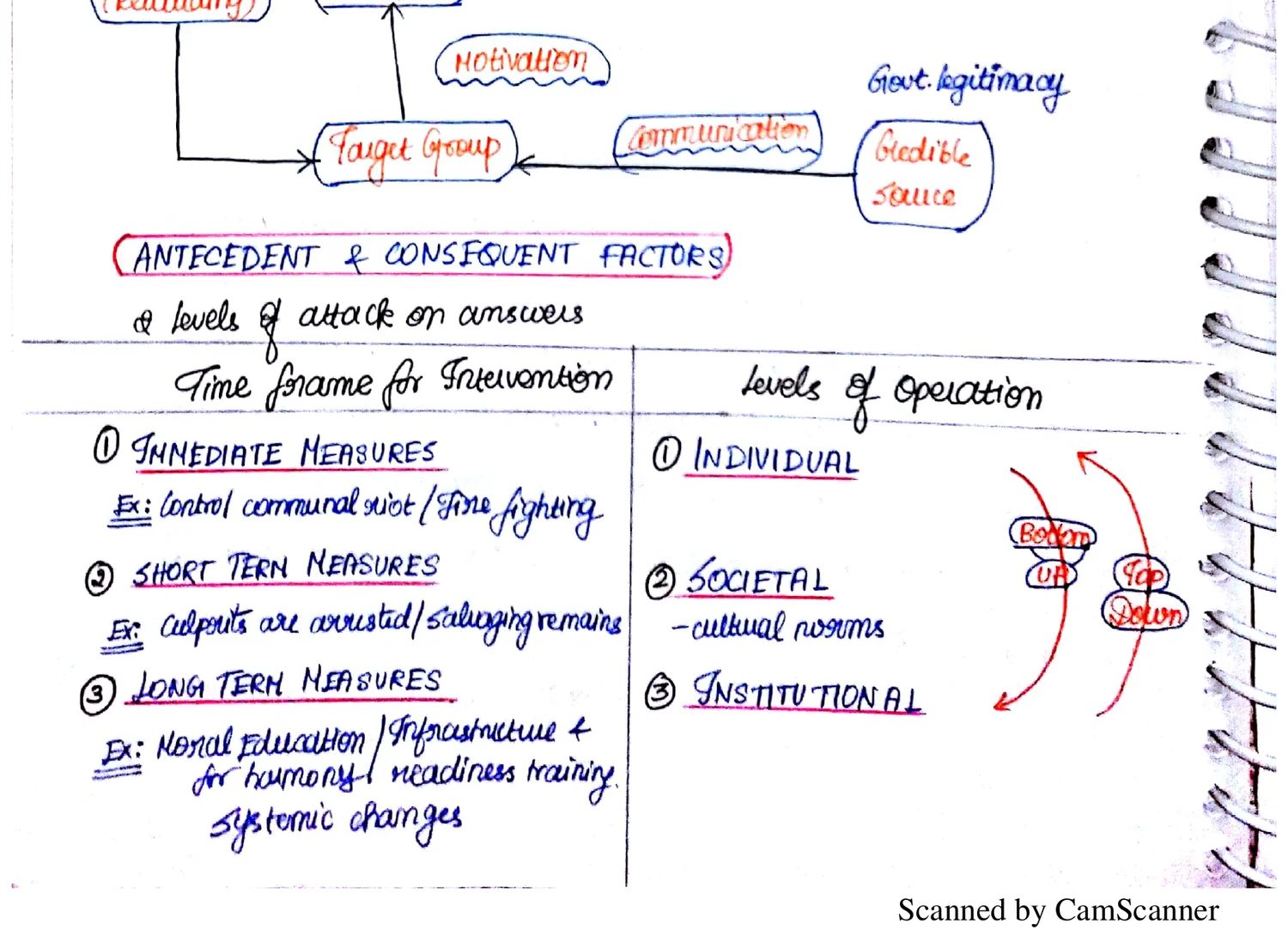
- Framework:
- Outcome (Rewarding) ← Behaviour Change ← Motivation
- Target Group ← Govt. Legitimacy; Social Influence; Credible Source
- [ANTECEDENT and CONSEQUENT FACTORS]
#Levels of Attack on Answers / Time frame for Intervention
| Time Frame | Level of Operation |
|---|---|
| 1) Immediate Measures — Ex: Control communal riot / stop fighting | 1) INDIVIDUAL |
| 2) Short Term Measures — Ex: Culprits are arrested; safeguarding remains | 2) SOCIETAL — cultural norms [arrows indicating societal-individual interplay] |
| 3) Long Term Measures — Ex: Moral education; infrastructure and harmonious mindset training; systemic changes | 3) INSTITUTIONAL |
#Change Agent and Social Influence (Page 51)
-
EI [Ethical Intelligence / Emotional Intelligence] — Attributes and Values of Target Group — understanding:
- Integrity — Empathy
- Tolerance — Patience — Values
- Compassion
-
Change Agent (Idea) →
- PERSUASIVE [top arc]
- influence (tactics)
- → Target Group (Citizens) → Social Influence
- COERCIVE [bottom arc]
- Feedback [feedback loop]
- EI [arrows to/from Change Agent]
- Power [linked to Change Agent]
#POWER
- Power = Potential to influence target group's behaviour in intended direction
- Types of Power:
-
- Expert
-
- Reward
-
- Coercive
-
- Legitimate
-
- Referent
-
- Information
-
#Social Influence
- Social Influence = It is the measure of degree of behavioural change that occurs as a result of influence factors used
[End of pages 35–51]
#PERSUASION
Date noted: 26/9/13, Q-7
- Persuasion is the process of changing the attitude and behaviour of the target group [TGM] in the intended direction.
#According to Aristotle — 3 Modes of Persuasion
- m1) Logos — Facts & Reason
- m2) Ethos — Trust & Reliability
- m3) Pathos — Passion
- Triangle diagram: Logos at top, Ethos bottom-left, Pathos bottom-right, labelled "3 Modes of Aristotle"
#4 Elements of Persuasion
- e1) Persuador [Persuader] — source of the message; begins the process of persuasion as it has some need
- e2) Persuadee — it is the target group that needs to be persuaded
- e3) Persuasion Appeal — it is the message [msg] that is delivered from persuador to persuadee
- e4) Channel — it is the medium through which msg/information is delivered
#4 Steps of the Persuasion Process
- s1) Attention
- s2) Comprehension
- s3) Acceptance
- s4) Retention
#STEPS OF PERSUASION — DETAILED (Page 53)
- ATTENTION is the deployment of concentration on the object of interest and utility
- COMPREHENSION is the understanding of message by target group [TGM]
- ACCEPTANCE is yielding to message presented by persuador
- RETENTION refers to remembering the msg presented by persuador
- Only when the msg is remembered, it is likely to be acted upon
#Minimum Discrepancy Principle
- For successful persuasion to occur, there should be MINIMUM DISCREPANCY between the intended and perceived meaning
- For this to happen, the Field of Experience of persuador and persuadee must OVERLAP
- Field of Experience → refers to characteristics like:
- MEVA [Motivations, Emotions, Values, Attitudes]
- Caste
- Language
- Region
- Religion
- Customs
- Traditions etc.
#Cases of Overlap / Trust
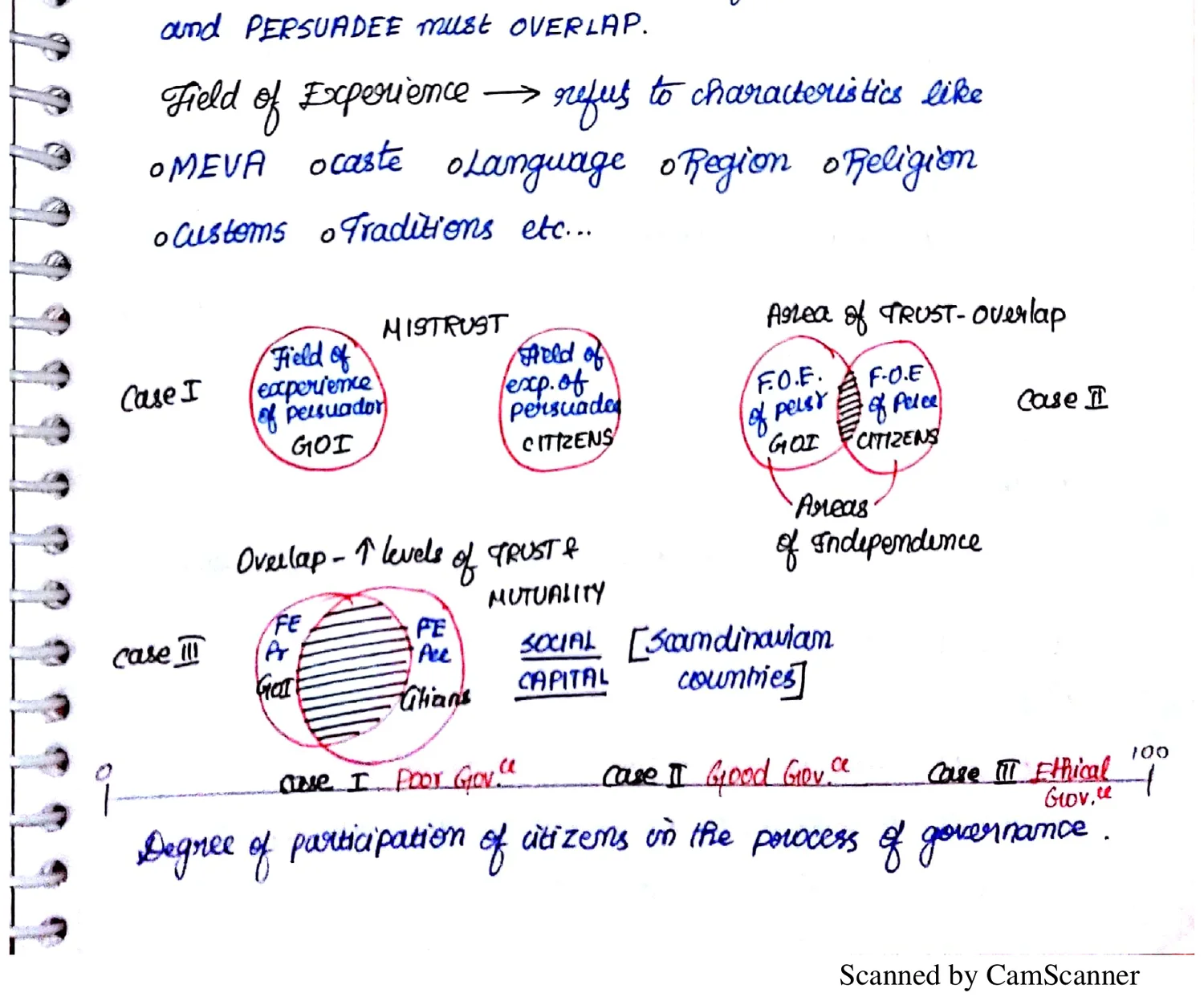
- Case I (MISTRUST): Field of Experience of persuador [GOI] and persuadee [Citizens] are completely separate — no overlap at all
- Case II (Area of Trust-Overlap): Field of Experience of GOI and Citizens partially overlap — area of trust + areas of independence
- Case III (SOCIAL CAPITAL / MUTUALITY): Fields of Experience [FE] overlap extensively — Govt & Citizens; example: Scandinavian countries
Scale beneath diagram:
- Case I → Poor Governance
- Case II → Good Governance
- Case III → Ethical Governance (scale 0–100)
- Degree of participation of citizens in the process of governance
#SOCIAL CAPITAL (Page 54)
- People for Government & Government for people — mutually
- People have great trust in institutions of Government
#Process of Persuasion — Barriers
- The process of persuasion is likely to produce desired results if persuador can overcome SEMANTIC, PSYCHOLOGICAL & PHYSICAL BARRIERS that operate between the persuador and persuadee
CASE OF INDIA (sidebar):
- Normlessness
- Hopelessness
- Helplessness, dejection of lower levels of Bureaucracy [superiors not leaving them to do new duty]
- Some [illegible] in system can hijack it
- EXTORTION industry: Padmanur, Mob lynching
#Semantic Barriers
- Semantics is the science of meaning
- Semantic barriers arise because words can have more than one meaning
- Semantic barriers may also arise from Discrepancy between verbal and non-verbal aspects of the message
- The presence of foreign & technical words in the message can also produce semantic barriers
To Overcome Semantic Barriers, the Persuador Must:
- a) Keep the msg short & simple — KISS (Keep It Short and Simple)
- b) Use receiver-friendly symbols
- c) Provide relevant illustrations to support the msg
- d) As far as possible, make verbal and non-verbal aspects of msg congruent [Smile, eye-contact, tone]
#PSYCHOLOGICAL BARRIERS (Page 55)
- Psychological barriers arise because of the discrepancies in the attitude & value positions of the persuador and persuadee
- This discrepancy creates in the target group ANXIETY & APPREHENSIVENESS, thereby leading the target group to SELECTIVELY PERCEIVE & INTERPRET the counter-attitudinal message
- Psychological barriers are difficult to overcome as they are the result of personality differences between persuador and persuadee
SWACHH BHARAT (sidebar example):
- How to reach msg to ppl? Use traditional channels
- Cleanliness is next to Godliness — Focus around temples & mosques as draw [for semantic barriers]
"It is always important to create PLEASANTNESS in ppl and not distress. An INSECURE PERSON can never make anyone happy/peaceful."
To Overcome Psychological Barriers:
- The persuador needs to create a PLEASANT environment so that the ANXIETY of target group is alleviated
- Then present them counter-attitudinal messages
- Explain to them how the adoption of the msg is likely to result in their NEED FULFILLMENT
#PHYSICAL BARRIERS (Page 56)
- They arise because of DISTURBANCES in the environment that OBSTRUCTS the process of persuasive communication
- Physical barriers can easily be overcome by bringing about the desired changes in the environment in which persuasion takes place
#Characteristics in Persuasion — Tree Diagram
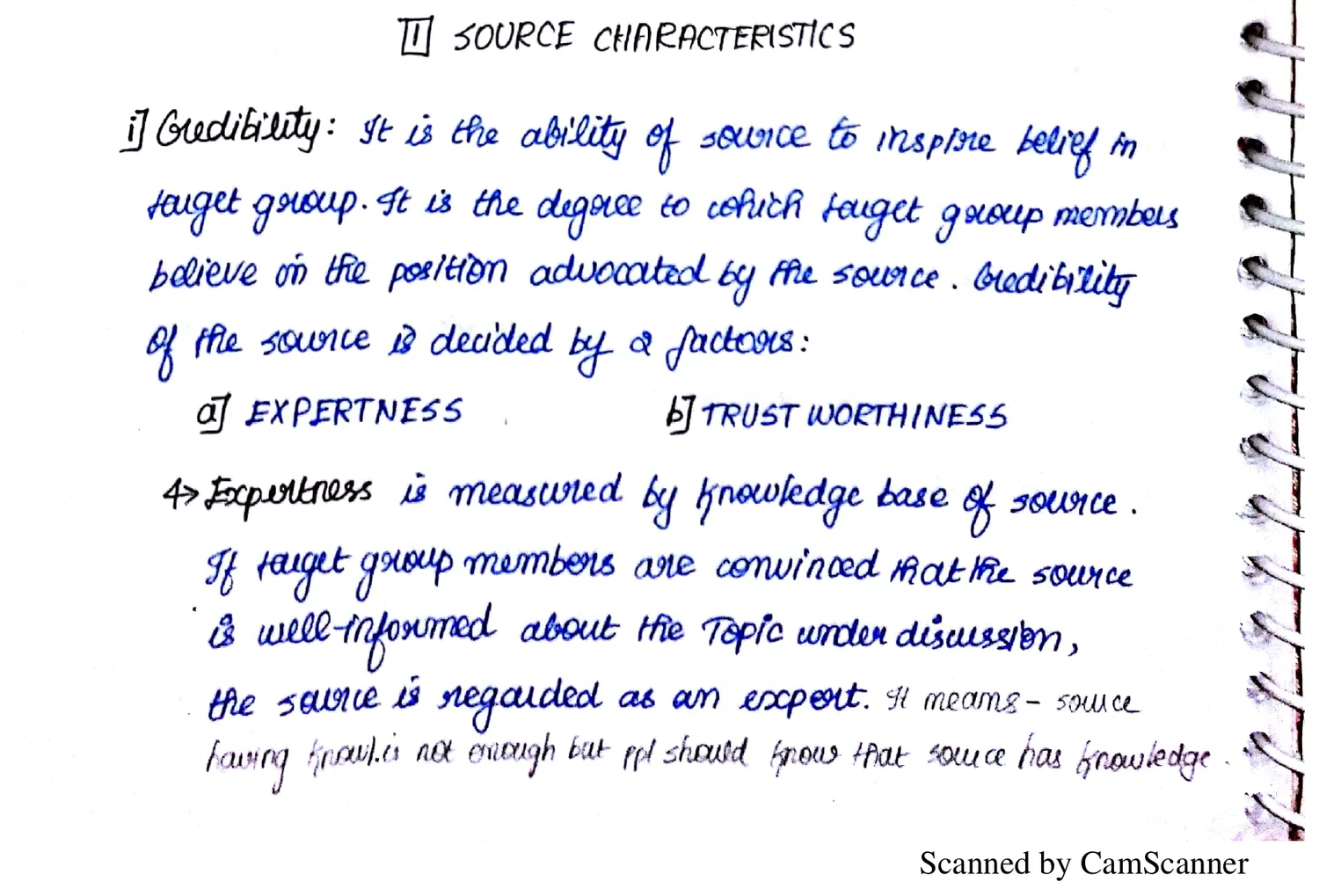
- Three branches: Source → Credibility, Attractiveness, Power | Message | Receiver
#SOURCE CHARACTERISTICS
#I. Source Characteristics
i) Credibility
- It is the ability of source to inspire belief in target group
- It is the degree to which TGM believe in the position advocated by the source
- Credibility of the source is decided by 2 factors:
- a) EXPERTNESS
- b) TRUSTWORTHINESS
a) Expertness
- Expertness is measured by knowledge base of source
- If TGM are convinced that the source is well-informed about the topic under discussion, the source is regarded as an expert
- It means source having [knowledge is not] enough but should prove that source has knowledge
#TRUSTWORTHINESS (Page 57)
b) Trustworthiness
- Refers to Truthfulness of source
- It is measured by finding out whether the source has a vested interest in persuading us
- The greater the vested interest of source, lower is its Trustworthiness
- Also measured by finding out whether the source is consistent in expression of its values over time — greater the consistency of source, higher is its Trustworthiness
High Trustworthiness & high Expertness go hand in hand. However, if there is conflict between two, it is the TRUSTWORTHINESS that gets the upper hand.
Ex: RAM JETHMALANI, E. SREEDHARAN
- ✓K ✗T vs ✓T ✓K [Expertness present, Trust absent vs both Trust and Expertise present]
Effects of High Credibility Source
- A source with high credibility can bring about greater attitudinal change than a low credible source because:
- TGM pay greater attention to msgs that are delivered by high credibility source
- They expose themselves more to msgs that are given by high credibility source
- They are less likely to raise doubts on msgs given by high credibility source even when they happen to be controversial — they are convinced that the source is well-informed about the topic being discussed
#LOW CREDIBILITY SOURCE (Page 58)
- Sometimes, even a low credibility source may be more successful in bringing about attitude change in TGM compared to the high credibility source
- This is when it is seen as ARGUING AGAINST its fundamental interests
- Ex: Environmentalist vs Industrialist talking about environment — Industrialist is talking against personal interest, willing to protect environment at own cost → so he is more credible/successful among audience
#ii) Attractiveness
- It refers to the degree to which the source is perceived as LIKEABLE by the target group
- Greater the likeability of source, higher is the possibility of TGM accepting the counter-attitudinal msg
- There are many factors that determine the likeability of the source; the most prominent ones are:
- a) The ATTITUDE & VALUE COMPATIBILITY between source and target group
- b) COMMUNICATIVE VERSATALITY [versatility] of the source
- c) The PHYSICAL MAKEUP of the source
- d) PHYSICAL PROXIMITY with the source
#SOURCE POWER & TABLE (Page 59)
#iii) Power
- It is the ability of the source to INFLUENCE the target group
- Greater is the dependency of TGM upon source for fulfillment of its needs, the higher will be the power over TGM enjoyed by the source
- [CAM] Counter-attitudinal msgs of the powerful sources are more likely to be accepted by the TGM
Source Characteristics Table
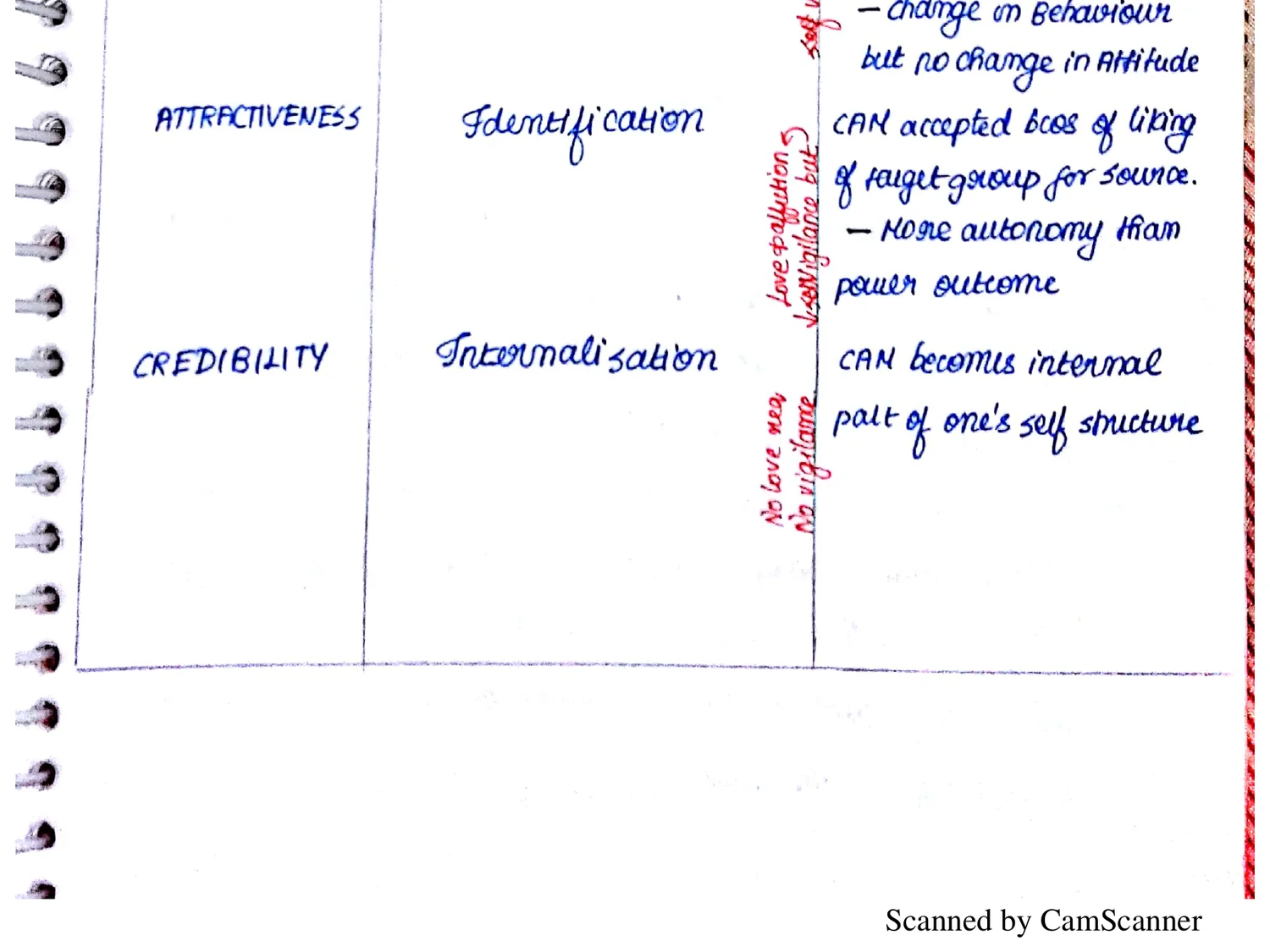
| Source Characteristic | Mechanism Underlying the Attitude Change | Outcome |
|---|---|---|
| POWER | Compliance | Outward acceptance of CAM but Internal rejection of the same → change in behaviour but no change in Attitude |
| ATTRACTIVENESS | Identification | CAM accepted because of liking of TGM for source — More autonomy than power outcome |
| CREDIBILITY | Internalisation | CAM becomes internal part of one's self-structure |
- Note (red ink in original): No love was, No nightmares
#MESSAGE CHARACTERISTICS (Page 60)
#II. Message Characteristics
i) Message Discrepancy
- It refers to the degree of counter-attitudinal orientation the source should introduce in the message
- We must prepare the TGM to attend to CAM and not much discomfort by identifying common characteristics of TGM to reach them in best comfortable/pleasant way
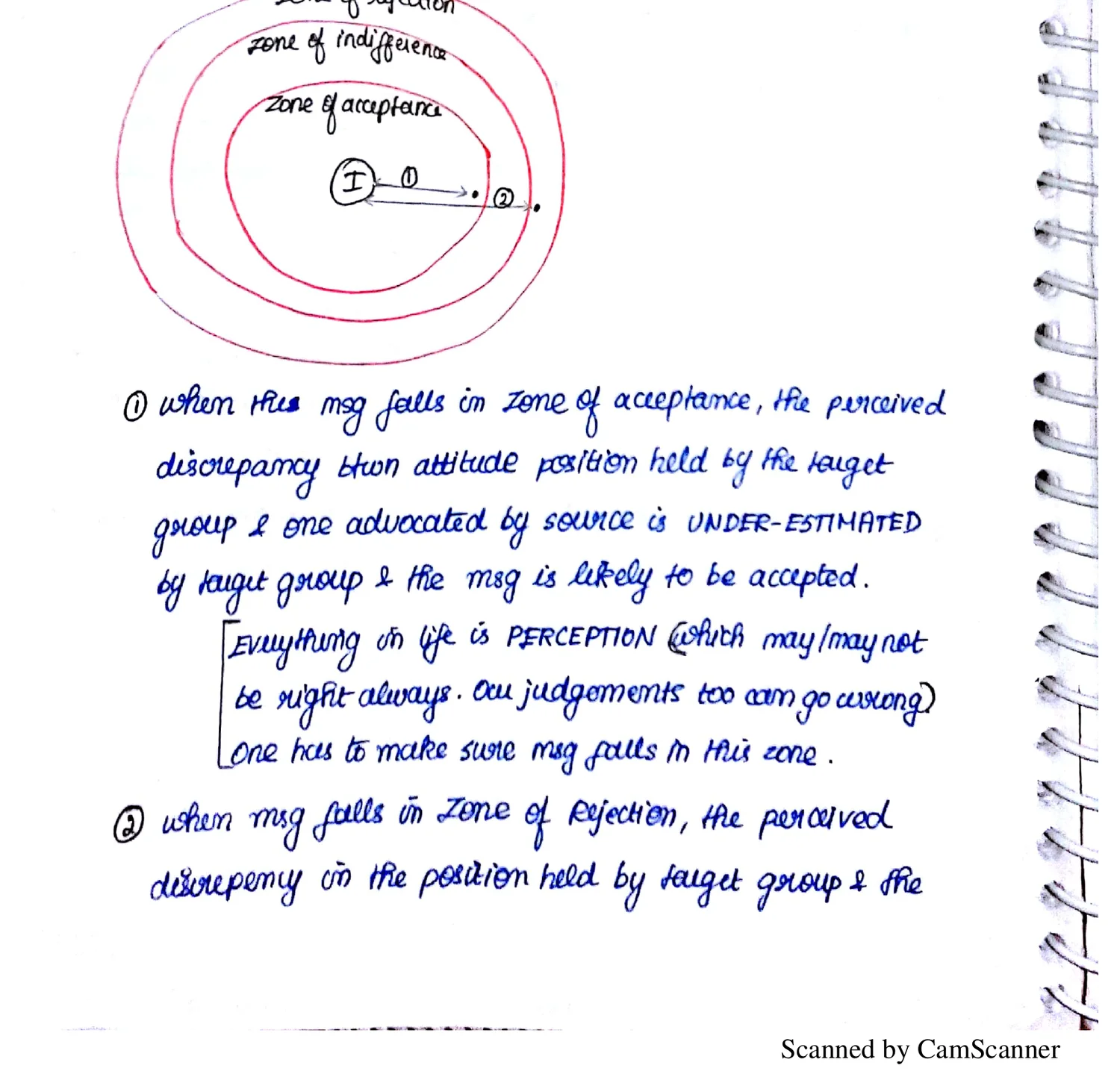
- Concentric circles diagram: innermost = Zone of Acceptance (I = self, O = other point), middle = Zone of Indifference, outer = Zone of Rejection
Zones Explained:
-
When the msg falls in Zone of Acceptance, the perceived discrepancy between attitude position held by TGM and one advocated by source is UNDER-ESTIMATED by TGM → the msg is likely to be accepted
"Everything in life is PERCEPTION (which may/may not be right always — our judgements too can go wrong). One has to make sure msg falls in this zone."
-
When msg falls in Zone of Rejection, the perceived discrepancy in the position held by TGM and the one advocated by source is OVER-ESTIMATED by TGM → the msg is likely to be rejected
#ZONE OF ACCEPTANCE — CASE STUDY (Page 61)
#Useful Case Study: How can I influence the zone of acceptance of TGM?
- Being a credible source can be seen as credible [illegible] or having someone who is credible to deliver
- Framing of message: watchdog vs dog who watches — one who highlights +ve things (1st and last) → +ves can have more impact; don't touch sensitive areas of TGM but touch +ve culturally congruent areas
- "U will have long life" vs "You will outlive ur children"
Ex: GANDHI vs SUBHAS C. BOSE
-
(Zone of Acceptance) vs (Zone of Rejection)
-
Gandhi:
- ↑ EQ
- ↓ clothes
- Fasting
- Sit on road
- Just IRRITATE THEN — maze only injures
- He was not doing enough to annoy him but enough to disrespect and irritate them
- Some ppl don't use foul words but invite frustrable [frustrating] others to use those words
- He didn't take up large issues only addressing smaller issues
-
Subhas Bose:
- ↑ IQ
- Bullet and freedom
- FIGHT THEN — chance to lose life
Why misuse/issue note resolving? (sidebar):
- Govt is not seen as credible source by them
- Govt has broken many promises → no Trust
Key Contrast:
- He [Gandhi] practised what he preached; he was and lived with ppl
- He never played majority vs minority and had a parochial [pluralistic] mindset country
#MESSAGE APPEAL — SCHOOL CASE (Page 62)
Ex: SC [School] look on school case
- Create a small group of ppl to tell parents [1st target — well educated, relatively liberal ppl among them] how their actions will affect children if not to go to school or not eat meals [esp. mom — more sympathetic to children]
- From DC himself can eat the food made → wider zone of acceptance
#Relevant (Aavante) [illegible term]
- Fear and reward has to be used interchangeably
- Whatever it is, make ppl believe that they are making the CHOICE ON THEIR OWN so that they can bear the consequences
- Example of camel story: Lead mule due to master's greed → Pressurizing will backfire in long run
- Aggressive pesturing [pestering] by parents on children won't work for long — also sends wrong signals
Why thin area between Z.O. Acceptance and Z.O. Rejection?
- Ppl are uncertain/indecisive; they immediately want to go with one side — take a stand as they can't stay in dilemma for long
#Fear Appeals
- Mild fear appeals are generally more successful in bringing about desired attitude change than strong fear appeals
- Strong fear appeals often NEVER snatch away a person's hope and faith in life
#STRONG FEAR APPEALS — CONDITIONS (Page 63)
-
Result in DEFENSIVE AVOIDANCE wherein the TGM members insulate themselves against the msgs given by source and reduce their level of trust in the source
-
Strong fear appeals however do work in certain situations, particularly when:
- They pose threat to loved ones
- Issued by source of high credibility
- Issued on topic that the TGM are not knowledgeable about
- Issued to TGM with low perceived vulnerability to threat
-
The effectiveness of fear appeal enhances many-fold if it is accompanied by the suggestions about the behaviours that when followed by TGM can bring the fear level down
#ii) Drawing Conclusions
- It is advisable when:
- TGM are not very educated and intelligent
- They don't see drawing conclusions as an insult to their intelligence
- The msg is not related to the intense attitudes of TGM
- Information presented to them is abstract or unstructured
#CHANNEL FACTORS (Page 64)
#Channel Factor
- Channel is the medium through which info/msg travels
- To enhance the persuasiveness of the msg, it is essential that the channel selected must be compatible with:
- Characteristics of the msg (imp msg to be in written)
- Characteristics of target group
Date noted: 13/11/12, 11-3
#III. Receiver Characteristics
Three sub-dimensions:
- Intelligence
- Personality Factors
- i) Anxiety
- ii) Self Esteem
- Selective Exposure, Attention and Interpretation
1) Intelligence
- Intelligence is the info processing ability of an individual
- Intelligent people because of their superior critical thinking ability are unlikely to be persuaded by the messages that rely upon unsupported generalities
- However, if presented with logical appeals that have empirical validation, some success in persuading them can be achieved
#PERSONALITY FACTORS
2) Personality Factors
i) Anxiety
- Anxiety → is a state of uneasiness caused by impending threats
- Individuals with high anxiety level can easily be persuaded by the messages that promise to bring their anxiety level down
Sidebar (empowerment note):
- mk → Raise confidence — (1)
- Dharma — [illegible] gender equality
ii) Self Esteem
- Self Esteem → is the self image of a person that results from evaluation of one's self concept
- Individuals with high self esteem are difficult to persuade but once persuaded, the likelihood of them continuing with the new position irrespective of circumstances is very high
- To persuade them, one generally needs a FACTUAL APPEAL and mix it up with the right kind of emotions
"Nobody can humiliate me w/o my consent" — Gandhi
Empowerment sidebar:
- Legal provisions are not enough; need reconstruction of self in +ve sense
3) Selective Exposure, Attention and Interpretation
- Many times the TGM [Target Group Members] don't deliberately avoid counter-attitudinal message, but because of the culture in which they operate, they get exposed only to that information which supports their existing viewpoint
- To overcome this problem of selective exposure, the change agent must provide CAM [Counter-Attitudinal Message] in a CULTURALLY CONGRUENT MANNER, and must provide these messages at regular intervals to facilitate temporal [illegible] TGM [assimilation]
#SELECTIVE ATTENTION CONTINUED
- Even when TGM has been exposed to CAM, there is a possibility of them not accepting those messages because of selective attention and interpretation
#Ethical Dimension of Persuasion
- Small tree: Persuasion → Ethical | Unethical | Misused
- Ex: statue building, symbolisms
#To Overcome this Problem, Change Agent Must:
- Make use of receiver-friendly symbols
- Keep messages short and simple
- Present them in an interesting manner
- Provide relevant illustrations to support the CAM
#COGNITIVE ROUTE TO PERSUASION (Page 66)
#Elaboration Likelihood Model
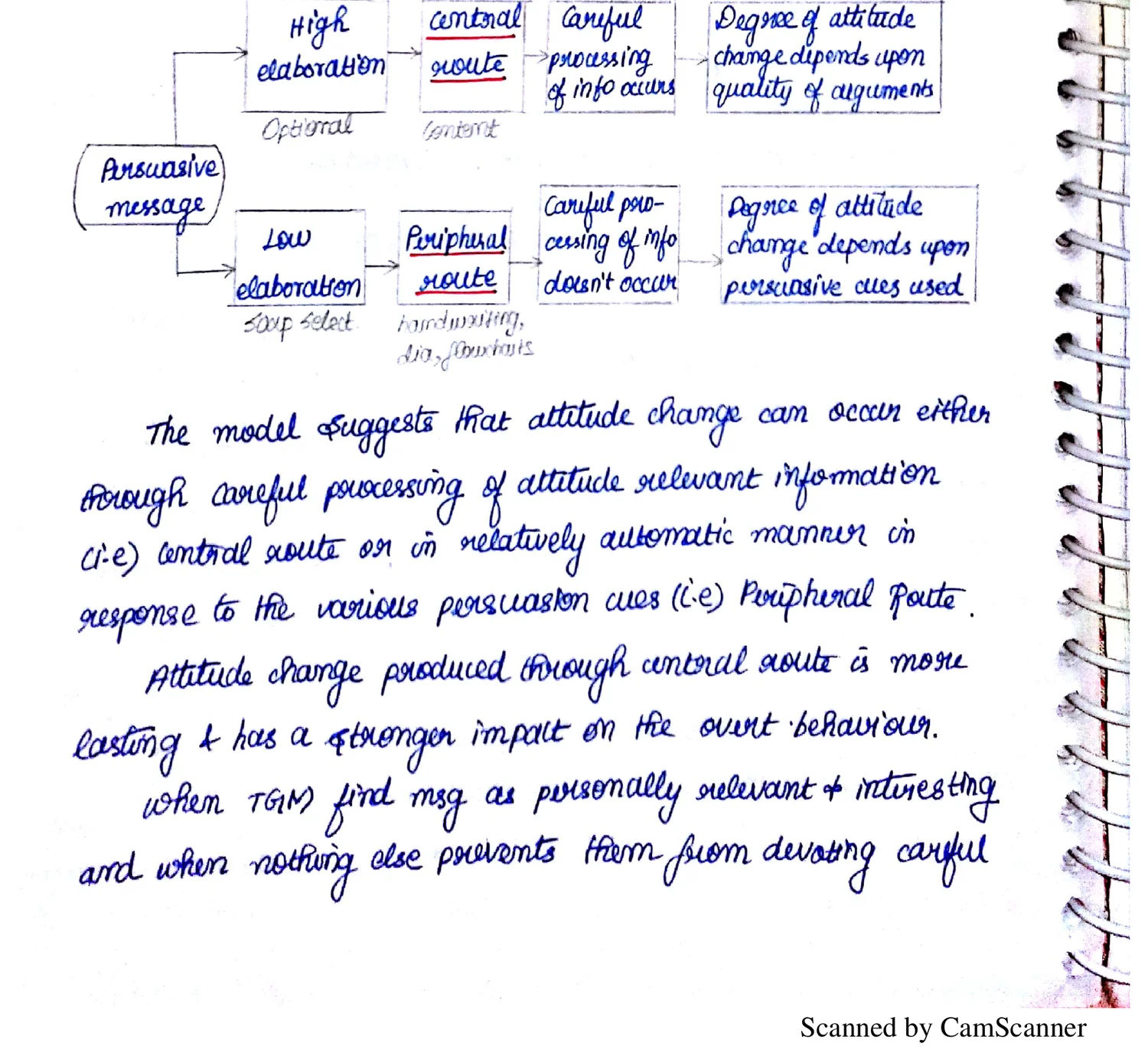
- Flowchart: Persuasive message → splits into:
- High elaboration → Central Route → Careful processing of info occurs → Degree of attitude change depends upon quality of arguments
- Low elaboration → Peripheral Route → Careful processing of info doesn't occur → Degree of attitude change depends upon persuasive cues used
#Explanation of the Model
- The model suggests that attitude change can occur either through careful processing of attitude-relevant information [i.e. central route] or in a relatively automatic manner in response to the various persuasion cues [i.e. Peripheral route]
- Attitude change produced through central route is more lasting and has a stronger impact on overt behaviour
- When TGM find msg as personally relevant and interesting and when nothing else prevents them from devoting careful attention to it, in such cases they may examine the msg in careful and thoughtful manner evaluating the nationality [rationality] of the arguments made
- If they find arguments as appealing, they may change the existing cognitive structures and persuasion occurs
#PERIPHERAL ROUTE (Page 67)
- In contrast, if they find the msg as uninteresting or uninvolving they may ~~be motivated~~ [struck through in original] not be motivated to process it carefully but still the persuasion may occur, this time through Peripheral Route
- If msg contains something that induces +ve feeling or the source of msg is very high in status and prestige, under these conditions attitude change may occur w/o critical analysis of the msg content
#Attitude Change via Central Route is More Desirable Because:
- It lasts longer
- It is more resistant to later attempts at persuasion
- It is more closely related to behaviour than the attitude change via peripheral route
Vishakha Yadav — Ethics Answer Copy 1
Vishakha Yadav (Rank 6, 162) — answer copyCandidate: Vishakha Yadav Medium: English/Hindi Center: Karol Bagh Registration Number: 245520 Date: 6/9/19 Test Code: 1235
#SECTION – A
#Answer the following questions in not more than 150 words each:
#Q1(a) — The golden rule of conduct is mutual toleration, seeing that we will never all think alike and we shall always see Truth in fragment and from different points of vision. Mahatma Gandhi. [10]
The given statement implies a constructivist view of the truth which can have different meanings based on different perceptions and understandings. Similar study has been done by scholars such as Foucault and Derrida to find accomodative meanings behind the various discourses.
Gandhiji was a spiritual person who advocated truth (Satya-agraha — insistence on truth) to conduct his personal and political life. A person can be tolerant only if he/she has the persevistant audacity to see the instances of truth, rationality and mutual respect for different viewpoints.
Indian constitution also recognise the value of toleration and pluralism as the bulwark of Indian society.
Today, when we see rising instances of the mob lynching, intolerance in society and the religious fundamentalism, the values of mutual toleration and Satyagraha find even more importance.
Globally, to address the diverse non-conventional threats among differing nations to deal with climate change, non-state actors we need accomodation and mutual toleration as the global golden rule of conduct.
#Q1(b) — The mind of the superior man is conversant with righteousness; the mind of the mean man is conversant with gain. Confucius. [10]
This statement of Confucius tries to explain the fact that a well formed great mind, a man with sound ethical framework would always be guided by courage and righteousness in his actions. On the other hand, a narrow minded person would simply limit himself to simple cost to benefit analysis in a given situation.
We can give the example of Lal Bahadur Shastri, a great humblest of politicians and leaders, who took a moral righteous path by taking responsibility of the loss of lives under his tenure as a railway minister. He resigned from the post although nowhere he was legally required to do so.
We can quote another global leader like Stalin who took narrow perspectives of the things in USSR during his tenure as a President, cultivated centralised fenced leadership which further exacerbated the hardships of economically downtrodden people. His narrow minded tended to run after power foregoing the larger welfare of people.
This quality specially holds true for a civil servant who is supposed to take an impartial, conscientious right path given the challenging and dynamic nature of his job to resolve ethical dilemmas such as public over private sphere.
#Q2(a) — Impersonal management, a characteristic feature of a Weberian bureaucracy, develops over time into indifference, especially with regard to weaker sections of the society. Critically discuss. [10]
Max Weber a great scholar who gave the "Ideal Type" model of a sound, Impartial and efficient Bureaucracy.
Impersonal management simply corresponds to the impartial and neutral nature of the civil servant. Ex: The instances of giving preference to public over private sphere. Organisation over personal gains. It helps maintain the meritocracy and efficiency.
However, impersonal management should always be coupled with the application of conscience. In a country such as India we see the presence of 28% of population in multidimensional poverty deprivation (WB).
To meet the needs of the constitutionally mandated social justice (Art 46) adherence and indifference isn't right. The classical case here would be the:
- "Development vs Rehabilitation / Displacement" Debate
- "National Interest vs Public Interest"
In such situations, it is important to use conscience, emotional intelligence and an impartial attitude rather than mere neutrality bringing the idea of "common good".
Nehru once remarked — "Neutrality in civil services would bring about fossilisation of the administration"
#Q2(b) — In pursuit of political power, means are often compromised that leads to competitive reliance on unethical practices resulting in erosion of public trust. Discuss. [10]
Scholars like Machiavelli, Kautilya said that there's no place of ethics in politics.
However, this isn't always true. The political power is a position of popular sovereignty where Govt act as a trust holding public faith. To compromise the means and resorting to unethical practices such as Bribes, collusion, nexus with corporates, freebies, persuasion, playing religion and caste politics. This stains the public image and integrity of the politicians.
Gandhiji axiom of the convergence of means and ends is the guiding light in the times marred with increased political expenditure (Lokniti: 67,000 crores 2019) 17m is elections.
However, there are some instances where unethical means not always result into the favourable results. A study shows (CSDS-Lokniti) that Indian population despite receiving the freebies (laptops, cash) choose to vote according to their requirements.
Thus, there is a hope of light in the tunnel with rising middle class and young energy of the rising demographic dividend which forms rational choices.
ECI, SC and GoI has taken many steps to root out the culture of corruption in electoral politics. It is time that a common man also ensures a civic participation to beat the commercialisation of the politics in India.
#Q3(a) — It takes more than a corporate governance policy to inspire ethical behavior and sustain a truly ethical workplace. Discuss. [10]
Corporate governance is the art of conducting day to day operations of a company with internal and external stakeholders.
Policies of the CG:
- The Companies Act 2013 has been formulated to ensure the BOD to look over transparent, fair governance and transactions amongst shareholders and employees.
- Committees such as Uday Kotak, Kumar Mangalam has further strengthened CG by constituting the independent directors (50%) atleast one being woman.
- Injeti Srinivas company recently advocated for better utilisation of CBR funds — Social accountability.
- MoCA mandated disclosure of ICC reports in annual reports highlighting sexual harassment.
However to be truly ethical and inspiring CG needs —
- Compassionate capitalism concept of Mr Narayan Murthy focussing on 3Ps — People, CG, Profit, Planet.
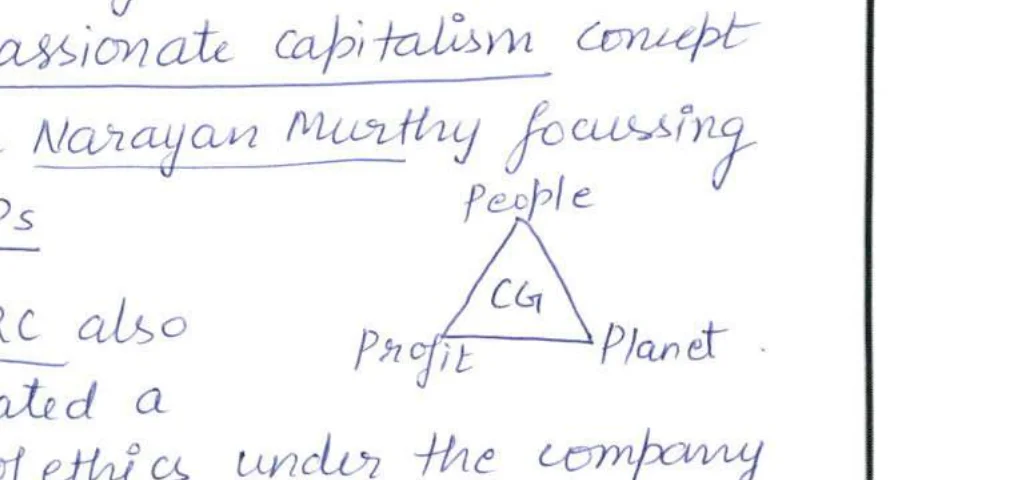
- Hand-drawn equilateral triangle with "People" at apex, "CG" inscribed at centre, "Profit" at bottom-left vertex, "Planet" at bottom-right vertex — illustrating Narayan Murthy's triple-bottom-line "3Ps" model of compassionate capitalism.
- II ARC also stipulated a code of ethics under the company law with proper soft skills training and quarterly assessment and tests.
- The social responsibility under the CSR funds disbursal should be whole heartedly taken.
Corporates need to be "agents of change" following sustainable growth principle as followed by Bill and Melinda Gates Foundation, Tata Trust, etc to make India achieve an inclusive growth (SDG 8.)
#Q3(b) — "Law should be so succinct that it can be carried in the pocket of the coat and it should be so simple that it can be understood by a peasant." Discuss. [10]
Law is the statement of reasons to achieve the common good by a sovereign.
Since the ultimate goal of the laws formulation is the public interest and welfare. Its understandability and awareness form the most crucial pathways to achieve it. A legal framework should be so compact / succinct that it can be compressed and carried along. As opposed to the complex, "lawyer's paradise".
It should also be very simple to understand given for a country like India where only 78% literate people are present.
We can quote the global example of "US Plain Writing Act" which mandated federal agencies to write rules, regulations in clear, succint and legible manner.
Indian constitutional and legal framework is sometimes criticised for its voluminous and complex nature. It discourages the most vulnerable sections to access to justice. "Justice delayed is justice denied" Example: The land titling laws and disputes — LARR 2013 is full of inconclusive clauses and opacity.
Thus, to ensure Justice — economic, political and social as envisaged in Preamble and Art 46 of constitution, Govt should work towards ensuring the accessibility, readability of laws.
#Q4(a) — Ethics in international relations has the potential to cater to the diplomatic challenges of 21st century. Examine. [10]
Ethical IR constitutes the art of conducting the foreign relations which create a harmony between the National Interests and ethical human values.
21st century politics is characterised by the presence of a great number of challenges. Few of the Conventional threats such as resource utilisation (Neo-Imperialism), terrorism, arms control, peace and sustainable development.
Non-conventional threats of climate change and its implications, human security, trans organised crime and maintenance of law and order, etc require ethical dimensions of various issues to be addressed.
UN recognises the CBDR-RC (Common but differentiated responsibilities) between North and South to form Cooperation framework guided by ethics of equality and human dignity.
Human Rights Watch Report "Time to deliver" highlighted the growing menace of global migration. Various reasons such as security, climate induced displacement (LDCs) or civil wars due to great power rivalry (Syria, Afghanistan).
Thus, Global IR actors need to be guided by humanitarian interventions and ethos of the peace, sustainability and relinquish the predatory power struggle.
A small country such as Vietnam, Vanuatu could frame a law for acceptance of the Rohingyas refugees legally are guided examples.
#Q4(b) — Nolan Committee provides for one of the most comprehensive statements of what constitutes ethical standards for holders of public office. Elaborate. [10]
Nolan Committee in UK in study called "Probity in Governance" formed the bedrock of the ethical standards for the public servants.
- Selflessness: The ability to dissociate the personal interest over public welfare.
- Honesty: Bulwark of the human character and public work. Act of truthfulness. Ex: Publishing correct data + reporting custodial deaths due to police negligence.
- Integrity: The consistency in the speech, thoughts and actions based on ethical principles. Ex: Non-corruptible attitude.
- Openness: Transparency with the public and administrative acts that ensure faith in public office of citizens.
- Accountability: Formal answerability on account of the actions due to position of power and discretion. Ex: To seniors for a contract (PPP) in roads.
- Objectivity: An objective emotionally intelligent and impartial assessment of a difficult and challenging situation. Eg: Communal rights, banning of a movie by public against court order (Padmavati).
- Leadership: A visionary, inclusive and motivating leader could push his juniors and staff to perform better personally and professionally. Ex: Sagayam T.N. — disclosure of assets prompted staff to do same.
#Q5(a) — The sharper the socio-economic disparities, the greater the incentive towards corruption. Analyse. [10]
Oxfam India highlighted that 1% of the population held 73% of country's wealth.
Such sharp socio-economic disparities coupled with cultural historical factors make a country "den of corruption".
Various reasons such as lack of an agency, bare minimum sustenance, opportunities deficit, occupational distress (farm sector), inadequate Govt support prompts people to go for unethical corrupt means to fulfil their needs.
Transparency International (TI) highlighted that India ranks 78 in 2019 showing high corruption level. The lower strata and rung of administration is driven by slogan "corruption is needed to grease the wheels of administration" (ARC).
[Pages 1–19 end here. Answers continue from page 17 onwards — Q5(a) answer continues on the next batch.]
#Q5(a) — [continued from page 19] The sharper the socio-economic disparities, the greater the incentive towards corruption. Analyse. [10]
[Continuation of answer begun on page 19]
Globally, the African arc of instability has countries such as Botswana, Ghana, Nigeria facing resource curse and crime marred with unprecedented corruption.
We have Afghanistan with lower (0.3) HDI value showing high levels of political corruption.
As contrast to this, Sri Lanka — our neighbourhood with more equitable society has lower corruption than India.
Globally, scandinavian countries such as Denmark, Sweden have almost zero levels of corruption showing highly equitable standard of living.
"Inclusive, Equitable and Sustainable growth is thus need of the hour to weed out corruption rotting the life and breath of country" — SC
#Q5(b) — The moral worth of an action depends not on the consequences that flow from it, but on its motivation. Explain the statement with the help of suitable examples. [10]
This statement highlights the dichotomy between the means vs ends.
While the deontologists such as Kant, Gandhi say that the moral worth of an action depends on the motivation and means to reach the end. The teleologists such as Bentham, Mill held that the ends justify the means taken.
An act of killing a thief to prevent house robbery may have saved lives but the action inherently is an immoral action.
Similarly, taking Bribe from a big businessman to help the poor rehabilitated people in slums, might have logical outcome but the act is wrong.
An action guided by wrong motives will always be negative, even if its results into a positive spill over effect.
Example: Deliberately Killing a terrorist in custody is wrongly motivated although its good for the country and national interest. Moral worth of such an action can't be justified.
Alternatively, a positively motivated action can bring about a negative effect and still be called moral.
Example: A lawyer's profession to defend a murder is the commitment to the rule of law and his duty. If held free, lawyer would not be morally corrupt unless he had an unfair, biased means.
Thus, our thoughts, purpose and action should be in harmony to act morally.
#Q6 — The universal adoption of common good approach poses the ethical dilemma of putting collective interests over and above the individual interests. Discuss with examples. [10]
The principle of common good guides an individual ethically to choose an option and act in a particular manner that would bring about a positive change/impact in the lives of larger section of people.
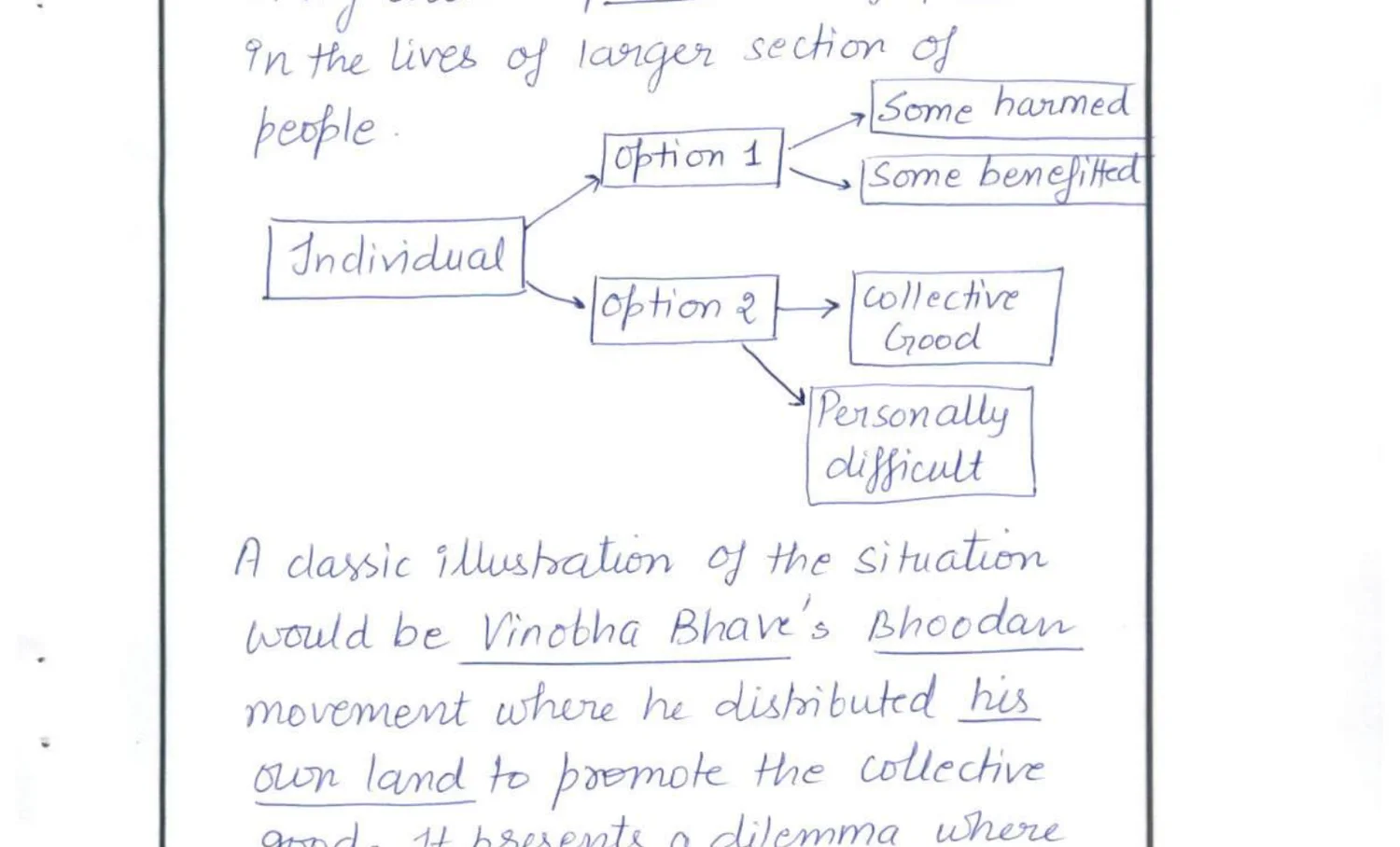
- Hand-drawn flowchart: box labelled Individual branches into Option 1 (arrow pointing to "Some harmed / Some benefited") and Option 2 (arrow pointing to "Collective Good" with sub-label "Personally difficult"), illustrating the ethical dilemma of common good vs individual interest.
A classic illustration of the situation would be Vinobha Bhave's Bhoodan movement where he distributed his own land to promote the collective good. It presents a dilemma where one sacrifices his personal interests over the public good.
Similarly, a civil servant whose appraisal is dependent on the successful completion of a road project. It demands him to relocate small marginal farmers whose livelihood would be destroyed.
The decision of not displacing them and rejecting the tender would be a common good approach.
Environmental aspect of the issue could be human-animal conflict where an elephant is destroying fields but the farmer chooses to not fence the electric barbed wire rather look for alternatives with forest officials.
Globally, the rising menace of refugee crisis and giving humanitarian intervention over narrow national interest is also a common good (Germany).
#Q7 — Compassion should never be considered as weakness, but rather as an essential element for providing a congenial administrative working environment. Discuss. [10]
Above statement can be aptly understood in the framework of situation of "Impartiality vs Neutrality", "Bureaucratic Rigidity vs Democratic Ethics".
Compassion is an act of empathising with others emotions, deprivations and troubles. A civil servant needs this quality in a developing country like ours where more than 45% of population suffer from one deprivation or other.
It is not an act of weakness but rather a test of emotional intelligence.
It helps in understanding the needs of public welfare suitably in a humane manner.
Rigidly following the rules do not bring about a desired solution to a needful situation.
Example: Compassion with an old woman stuck in regulatory hurdles to get her pension, displaced people due to dam construction, farmers distress during failed monsoon, as a natural calamity and consequent SOP for saving lives.
It thus creates a congenial working environment. NCRB highlighted the reports of increasing suicides among the public servants (Maharashtra, Bengal) due to pressure, and loss of public-private balance in lives.
Thus, for a vibrant, efficient, "Steel Frame" of India, it is of utmost importance to be compassionate following ethos of human dignity.
#Q8 — Explain what you understand by the following values and discuss their importance for civil services. [10]
#(a) Professionalism
The competence or a skill that is expected of a professional person in his workplace is called the professionalism.
Conducting the work place relations without any biasness, laxity or impersonal behaviour is characteristic of the professionalism.
The professional ethics of an actor such as Amitabh to reach on time on set is one example. Playing on field without any ill will or personal rivalries by a sportsperson like Sachin is also professionalism.
The impartial impersonal conduct of a civil servant in home district is also professionalism.
#(b) Nishkama Karma
Nishkama Karma is the act of selflessly indulging in an act without the expectation of a return or result.
This maxim is culturally embedded in our ethos of "Service to man is Service to humanity" or the Gita which states that "one shouldn't be concerned with the outcome of the result, just put wholehearted effort to the task".
It is also said that there is no virtue higher than selfless duty for a public servant and dedication to duty is the highest form of worship.
Gandhiji's Hariyan programme and Vinobha Bhave's Bhoodan are the Nishkama Karma examples.
#Q9 — [SECTION – B] There have been widespread agitations both in favour of and against extending reservation in educational institutions and government jobs to a certain section of the society. You have been appointed as the head of a high level committee, constituted by the government to examine the matter and make recommendations. So far, the committee has found no compelling reasons to extend reservation to this section. While the report is pending finalisation, you get an impression through the media that the government is inclined to accept the demand for extending the reservation, regardless of the findings of your committee. Some members of the committee are also inclined to support the government stand. [20]
(a) Discuss the dilemma, if any, that you face in this situation. (b) What course of action would you take? Give reasons for the same. (c) Also discuss the ethical issues involved with the policy of affirmative action in India.
Indian Reservation scheme is the largest affirmative action program aimed to address historical injustice of a medieval discriminatory society towards more equitable egalitarian society (Art 76, 15, 16).
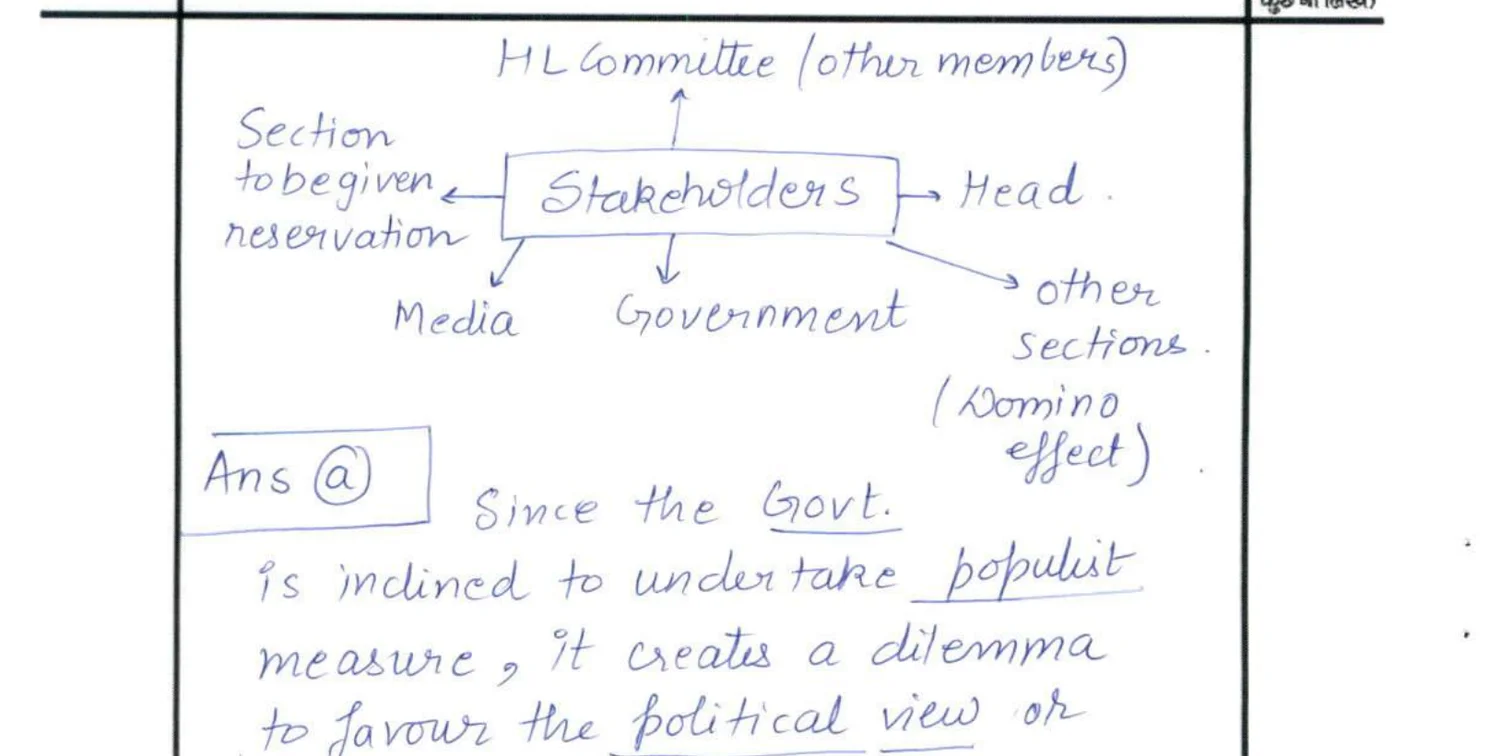
- Hand-drawn stakeholder/flowchart diagram: central box labelled Stakeholders with arrows pointing to HL Committee (other members) (top), Head (right), Media (bottom-left), Government (bottom), other Sections (Domino effect) (right-bottom), and Section to be given reservation (left).
Ans (a) Since the Govt. is inclined to undertake populist measure, it creates a dilemma to favour the political view or undertake an honest objective assessment of the case.
Also, the reports and impression is created through media. There is a fear of backlash in case of the negative proposal from the concerned section (Eg: Jat agitation).
There is also an internal divide amongst the members that might create a biased report.
Ans (b) My course of action is very clearly the one which involves an impartial, honest and objective analysis free from any political pressure or the media interference merely based on some opinions and views.
- I would undertake a robust baseline survey to study the conditions (social, educational and economic — constitutionally prescribed) and find the eligibility parameters are fulfilled or not.
- I would urge my team member to take an impartial and conscientious viewpoint in the preparation of report.
- The findings would be properly documented and based on the empirical analysis. I'd suggest the solution to Govt.
- Since committee doesn't find substantive proof, I'd write and disfavour the given proposals.
- If asked by mediapersons, I'd adhere to my rulebook and conduct rules to maintain integrity of process until the Govt. takes a final stand.
Ans c Ethical Issues in the Reservation regime of India:
- Inclusion errors where the affluent (large agri farmers and advanced) section gets included.
- Presenting the false documents and escaping the creamy layer exception due to non-reporting of the honest income.
- Exclusion errors (A study highlighted only 8% of the STs population who is needy get employment and educational opportunities).
- Absence of creamy layer criteria in the SC/ST (Nagraj Judgement).
- Presence of vacant posts and delays in promotions due to inadequate data collation.
- Fear of the reverse discrimination due to breach of the 50% quota of reservation (compromise to Meritocracy).
- The recently introduced economic criteria (Jarnail Singh case) includes 98% of population within 10% bracket.
- Similarly, 55% of OBC population under the 27% bracket.
- Means of the populist electoral vote bank politics (Patedar, Jats).
- Fear of the Pandora's Box of demands.
#Q10 — You are an honest and responsible civil servant. You often observe the following: [20]
(a) If one wants to remain effective and powerful to create impact on the lives of people, one should remain loyal to those in power. (b) Following ethical means may not be practical and effective at all times. (c) Petty corruption expedites the service delivery.
Examine the above statements with their merits and demerits.
Ans a The argument tries to portray the fact that loyalty is supreme virtue to attain efficiency, power and an impactful work in public.
| Merit | Demerit |
|---|---|
| Emphasises on the value of loyalty as a feature of permanent executive towards the temporary executive. | Blind adherence to loyalty is dangerous. |
| This will ensure smooth coordination and implementation of the policies without the internal factions. | Civil Servant is supposed to give neutral advice. Such as Negating farm loan waiver although it seems a lucrative option. |
| It'll ensure a smooth career transition without the political pressure and divergence of the interests. | Morally unethical means can never be justified in the name of loyalty. Eg: Hiding the data of public interest (custodial violence, communal deaths). |
Impact on the lives of the people can be created while being politically neutral (eg: Ashok Khemka, Mr. Sagayam).
Ans b Merit | Demerit
| Merit | Demerit |
|---|---|
| Teleological approach of utilitarians found consonance with the justification of the ends over means. Eg: killing of the mafias/criminals to control the urgent public disorder issue without the due procedure of arrest and investigation. | As Gandhiji said a wrong means adopted for a right result is never truly correct (Deontological). In similar example although the public security is safeguarded in practical manner, the violation of HRs of the criminals and right to life is never justified. |
Thus, the perfect harmony of the means and ends would result into a truly perfect act. For practicable purposes the ethical morality can't be made flexible to achieve an objective howsoever the dire need seems.
Ans c It is said that "corruption greases the wheels of administration" — II ARC
| Merits | Demerits |
|---|---|
| Although a weed such as corruption can never be positive, yet it's seen that petty bribes can expedite the service delivery through levels of red tapism. | SC has said that the corruption is "rotting the life and breath of this nation". The scams of Commonwealth, 2G, coal scam, BOFORS — |
| Eg: A pension certificate of the old aggrieved person. Eg: To steadfast the processing of a DL by bribes culture at RTO in common ways of life. | adversely impact economy and public welfare. It leads to erosion of public faith in democratic institutions and imbibes a culture of "chalta hai". |
Corruption in any form at any level needs to be tackled to truly make our Nation great. Japanese culture is an eye opener. Asian example: GoI is bringing various laws to deal with political (EBS), economic (Black money, FEOBU), and institutional (PCA amendment) measures.
#Q11 — Recently, two national level sportspersons who are integral members of their team, made some comments in a talk show which were perceived as being grossly misogynistic and racist. This created a huge controversy and they were temporarily suspended from the team pending an enquiry. In light of these events, answer the following questions: [20]
(a) Do you think public figures have an additional responsibility in so far as expressing their views on matters of public importance is concerned? Give reasons. (b) According to you, what are the reasons that some prominent public figures make such misogynistic comments, and even get away without any consequences? (c) As the person in charge to enquire into the conduct, what factors would you consider to examine it and what punishment, if any, would you prescribe in this specific case?
Freedom of Expression (under Art 19) itself doesn't give a free leeway to defame, or pass any grossly inappropriate statements. Restrictions in the name of public order, decency and morality are placed.
#Q11 — [continued from page 39] Sportspersons / Talk Show Misogynistic Comments [20]
[Continuation of answer begun on page 39. Reproduced stakeholder diagram:]
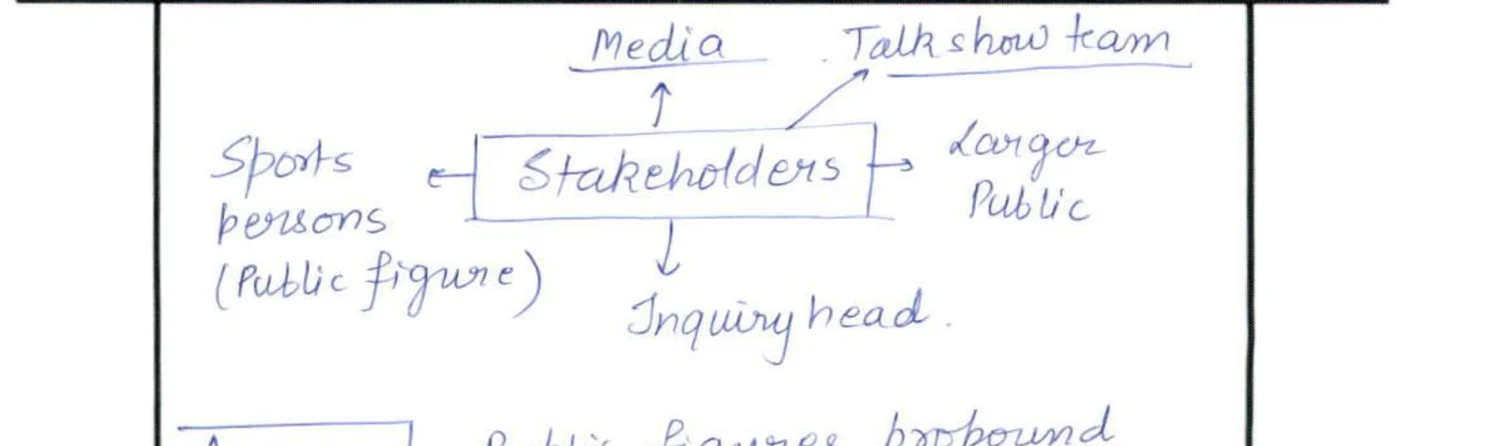
- Hand-drawn stakeholder map: Stakeholders box at centre; arrows pointing to Media and Talk show team (top), Larger Public (right), Inquiry head (bottom), and Sports persons (Public figure) (left).
#Ans a
Public figures propound a role model figure which can sometimes be called as Goodman's Syndrome in our culture. Yes, they constitute a huge responsibility due to following reasons —
- (1) Influence on such a large section of population (eg: Bollywood stars Amitabh Bachhan)
- (2) People look up to them in their every day life (Eg: The cosmetic products advertised by celebrities affect the sales hugely)
- (3) Political personalities such as Narendra Modi, JP Narayan, Nehru, Gandhi touch upon thousands of dreams with their motivating speeches and words (Behavioural change)
- (4) Dr Kalam inspired hundreds of students to take up scientific space exploration studies
- (5) Recently, even the GOI has taken measures to regulate the indecent and false advertisements of the products, making an ethical onus on the celebrity to promote authentic responsible use (Consumer Protection Act 1986)
#Ans b
Several public figures are said to have commented misogynistic or otherwise but are carried out of the chaos without responsibility because of multifold reasons:—
- (a) Influence of power, prestige and money
- (b) Lack of clear legal and stringent framework against vocal speeches
- (c) Access to high class corporate lawyers with expertise to drag them out in case of any legal dispute
- (d) Overall, the declining moral strength and degrading ethos of Indian culture
However, we can't neglect the figures such as Sachin, Amitabh, Dravid, Ganguly who devoted their lifetime balancing good work and social prestige, who are an inspiration even for the generations to come.
#Ans c
As an incharge, I'd consider following factors:—
- (1) Nature and reach of the show
- (2) Impact it has on population. Today's context social media is vital in this context
- (3) A mere slip of tongue of genuine intention to cause harm
- (4) The action taken by the person and the talk show authorities thereafter
My action would obviously be under the relevant and available legal framework:—
- (1) Since there is no law explicitly banning such general comments, a showcause notice can't be raised
- (2) I'd request the person to clear the air by taking moral responsibility of the action on public platforms (Apology)
- (3) A temporary ban on the sports participation would also set an example
#Q12 — Leather industries in industrial town — emission control vs economic growth [20]
There are large number of leather industries in a major industrial town of India. They provide employment to large number of people and are also a prominent source of revenue for the state. Lately it has been observed that despite following the present emission control rules, the collective ecological footprint of these industries remains quite high affecting the ecological dimension in an adverse manner. The new technologies available for emission control are quite costly and thus acts as a disincentive for the owners of the industries for adopting them.
In light of this information, the government is contemplating the following options:
(a) Shutting down the industries in the region (b) Relocating the industries to a new region (c) Making the emission control rules stricter (d) Providing incentives to the industry owners for adoption of new technology
Analyse the above options in terms of their merits and demerits. What course of action would you choose and why?
For a fast growing developing country as India, Sustainable development vs Economic growth is to be guided by principles by SDG 9
- Handwritten boxed emphasis note on the guiding principle (SDG 9) for balancing sustainable development with economic growth.
#Option a — Stakeholders: Shutting down industries
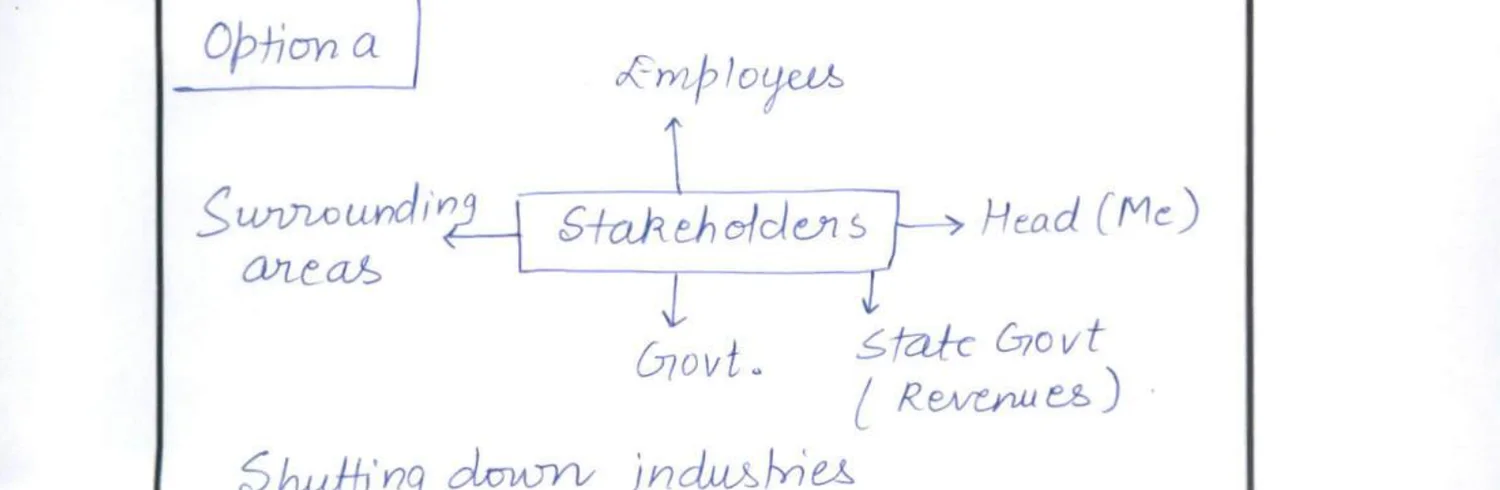
- Hand-drawn stakeholder web: Stakeholders at centre; connected to Employees (up), Head (Me) (right), State Govt (Revenues) (lower-right), Govt. (down), Surrounding areas (left).
| Merits | Demerits |
|---|---|
| (1) Immediate relief to the pollution issue | (1) An employment loss disaster on large scale |
| (2) Easiest option to choose | (2) Adverse impact on economic growth |
| (3) Aid to India's climate commitments (Paris Pact – INDC) | (3) State revenues and fiscal deficit to increase |
#Option b — Relocating to a new region
| Merits | Demerits |
|---|---|
| (1) Solves the problem of given area | (1) Doesn't address the root cause of problem |
| (2) Govt.'s order would have positive environmental impact | (2) It'd shift the burden to a new area risking new lives |
| (3) Save lives of many due to the pollution | (3) The revenue loss issue and local unemployment |
#Option c — Stricter emission rules
| Merits | Demerits |
|---|---|
| (1) Comparatively better option; it'll arrest the adverse ecological footprint and save the livelihood of thousands | (1) Affect the productivity of the capital-deprived sector which can't invest in high technologies |
| (2) Affect overall GDP contribution of the sector |
#Option d — Incentives to owners
| Merits | Demerits |
|---|---|
| (1) Address their resource crunch and funding requirements | (1) The incentives might not be sufficient to arrest the complete requirements |
| (2) Incentivise them to shift to green technologies | (2) It might take time to show results |
#Ans — My Choice: Blend of Option 3 and Option 4
My choice would be a blend of option 3 and option 4 as follows for following reasons:—
- (1) There shall be stringent pollution norms since the ecological footprint is reported to be quite high by authorities. It'll affect India's climate commitments (Paris deal COP21, SDGs) and also risk millions of lives in the neighbourhood (WHO — Air pollution related deaths quite high in India)
- (2) Keeping in mind the labour-intensive, economic growth contribution, it's of utmost importance to support the sunrise sector ensuring the livelihood security of workers. Schemes such as capital subsidy 25% under TUFS — technology upgradation, market retention can be provided.
- (3) It'd also be beneficial to involve R&D institutions such as ISRO, DRDO, IISC to undertake research and indigenous innovative interventions which are low cost. Thus, reducing import dependence over the foreign green technology
- (4) Platforms like AIM, IMPRESS, IMPACT can be utilised to tap the innovative minds of young people
- (5) Lastly, capacity building and skilling (NSQF) of workers would additionally boost the sector
#Q13 — Coal mines district — inhuman working conditions, NGT closure, nexus [20]
Many coal mines in a district subject the workers to inhuman working conditions with little safety measures in place. As such, there have been several accidents and many workers have died in the past. In recognition of a recent accident where fifteen workers were trapped and died, the National Green Tribunal has ordered for closure of all such mines. Some of them have shut down, but many still continue to operate by getting an exception from the government, sometimes using the unholy nexus of politicians-miners-bureaucrats. In absence of alternative employment, the locals have no other choice but to work in mines. The mine owners are in fact inciting the workers to protest to simultaneously put a pressure on the state to completely overturn the ban. As a District Magistrate of this district, you have been asked by the State government to prepare a report on this issue and give recommendations to resolve it. In this regard, answer the following questions:
(a) Identify the interests of State and analyse whether there may be a conflict amongst them? (b) Given that economic growth is often achieved with a large human cost, identify the principles and strategies which could be used in the given case to achieve desirable outcomes.
This case study highlights the deplorable conditions of labour in mining sector facing occupational safety hazards in India. Instances of deaths due to Rathole mining in Northeast, poisonous gases in Chhattisgarh are found. Despite NGTs orders, the actual ground condition remains a concern, matter of Stakeholders in the case:
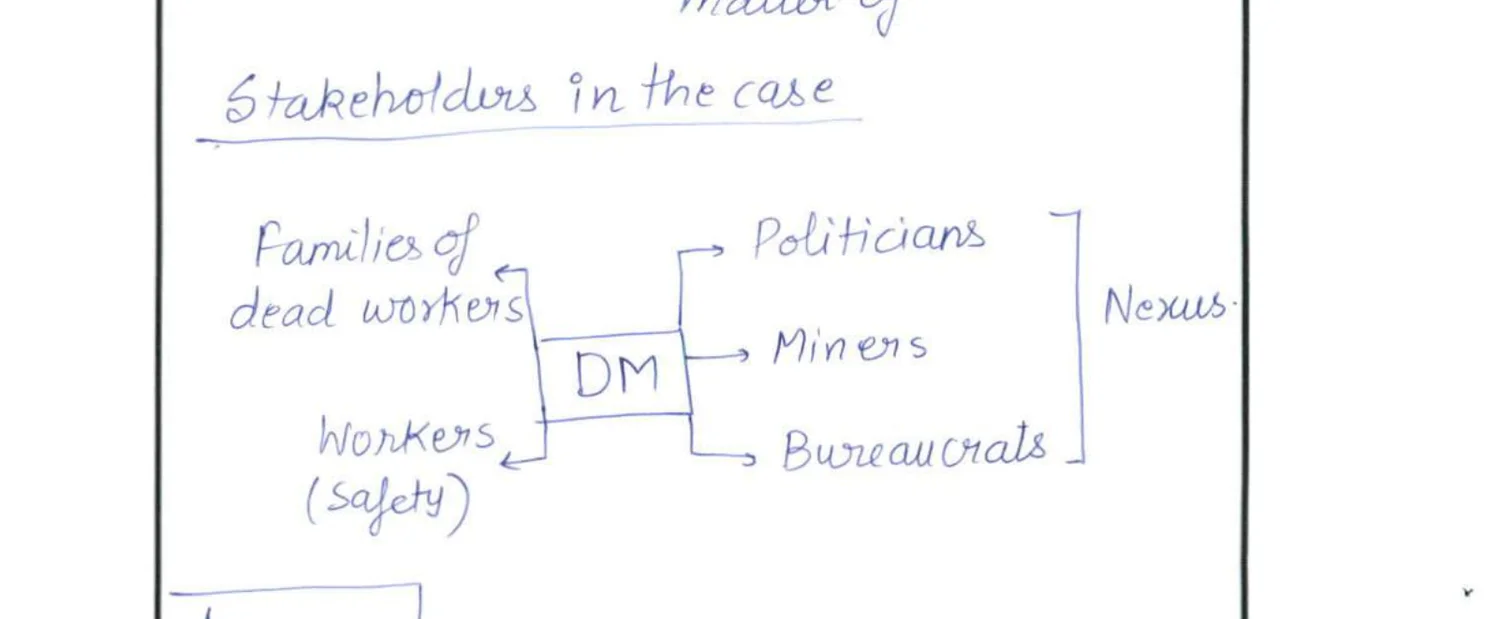
- Hand-drawn diagram: DM at centre; left side — Families of dead workers and Workers (Safety); right side — Politicians, Miners, Bureaucrats (grouped with bracket labelled Nexus).
#Ans a
State's interest in the given situation are multifaceted:—
- (1) Since India has huge reserves of coal and is dominated by the thermal power (61% of energy mix — Eco Survey 2017–18), state needs to ensure energy security of the country and meet the rising energy demand which is predicted to double by 2030 (IRAI)
- (2) The mineral exploration potential remains low, only 10% of the resources are exploited thus, state also aims to increase the mining exploration (NITI@75) potential
- (3) The economic growth vs development is conflicted when state also needs to ensure livelihood security and Right to life of the workers
- (4) Under Art 39 State is legally mandated to ensure the employment opportunities. Also, safety of the labour working there
- (5) Our coal mining policy also puts onus on the contractors and miners to ensure the protection equipments
#Ans b
Economic growth entailing huge human costs defeats the purpose of inclusive sustainable growth
Principles to follow:
- (1) A social security and insurance provisions to the workers in case of mishappening
- (2) Sustainable mining in harmony with the ecological and economic growth
- (3) Ensuring the Right to Life and Safety of each worker
- (4) Responsibilities in case of the death to the director, team lead or the mining head of area
- (5) A culture of ethics to break the nexus of Bureaucrats–politicians and miners
Strategies to follow:
- (1) Use of digital technology to reduce the corruption, cutting the nexus bringing transparency. A real time tracking and reporting of the illegal and mishappenings
- (2) An effective Grievance redressal mechanism and clear cut SOP by DG of Mine Safety during accidents
- (3) Miners and contracts to have contractual obligation to ensure the insurance of each life
- (4) Dynamite used blasting in open cast mining be replaced with better advanced hydraulic fracturing
- (5) Provisioning of the alternative sources of employment in the Mining Corridors and clusters. GOI has recently drafted 4 Labour codes which is a further boost
#Q14 — District Magistrate in agricultural district — bonded labour [20]
Recently you were posted as a District Magistrate of a predominantly agricultural district, which has been one of the best performers in agriculture since the last decade. In one of your field visits, you find that the large landowners, who are a socially, politically and economically powerful group, employ domestic helps and agriculture labour who are informally bonded to them and have been working there for several generations. In return, these workers are provided basic amenities like food and shelter apart from some money. However, you do sense a violation of basic human rights in this situation.
In light of the above case, answer the following questions:
(a) Identify the stakeholders, their interests and ethical issues involved in the case. (b) How does denial of choice amount to violation of human rights? (c) What course of action would you take? Give reasons.
Human dignity and freedom forms the inviolable part of right to life. Our constitution also ensures the same through Article 23 making it a fundamental right preventing any form of Bondage.
#Ans a
Stakeholders Involved:
- (1) DM (Myself)
- (2) Group of large landowners
- (3) Informal Bonded Agricultural Labourers
- (4) Rest of the District population and farmers
① DM
| Interests | Ethical Issues |
|---|---|
| (a) Ensuring the continued district performance | (a) Violation of the human rights of informal labourers |
| (b) Protecting the human rights of bonded farmers as per law | (b) Exploitation by the few large landowners |
| (c) Course of action that would be beneficial to all | (c) Provisioning of decent standard of living to farmers |
② Large Landowners
| Interests | Ethical Issues |
|---|---|
| (a) Profitable production | (a) Bonded Labour in any form is wrong |
| (b) High performance with minimal costs applied | (b) Providing only bare sustenance not a living standard |
③ Informal Bonded Farmers
| Interests | Ethical Issues |
|---|---|
| (a) To secure a livelihood and basic amenities | (a) Form of begar and lack of the agency to make choices |
④ Rest of the population — An example to be set infront of all the farmers.
#Ans b
Denial of choice amounts to the refusal of the lack of agency of an individual to make subjected choices.
Human rights form the essence of the dignity of an individual providing basic rights integral to human life. Using tied labours with mere basic amenities over generations denies them the freedom to go for other work, grow economically. They are subjected to permanent subjugation of the owner's pecuniary interests.
UNHDR also identifies human freedom and self determination as "integral part of human rights doctrine"
#Ans c
My course of action would be as follows:—
- (1) As per my rulebook and guided by Art 39(b)(c) which prevents concentration of resources within a few hands, I would form a committee to go through detailed inspection and field studies for the actual situation
- (2) As per the findings of report, I would consult by my seniors for the further course of action since landowners are politically, economically and socially influential
- (3) I'd request written orders from the superiors to send a notice to the landowners stating to provide good livelihood opportunities as per legal framework and allowing the rebenchment of workers who wish to leave
- (4) The SP of the area would be intimated to keep forces stationed in case of the mismanagement or social disruption
- (5) I would submit the report to the higher authorities stating my comments clearly
India is signatory to ILO conventions, covenants of social, economic right (ICSEC), the machinery needs to dutifully with courage of conviction needs to implement same in true **s
Vishakha Yadav — Ethics Answer Copy 2
Vishakha Yadav (Rank 6, 162) — answer copy#Cover Page (p. 1)
Test Code: 1227 · General Studies (Test Code: 1227)
- Name of Candidate: Vishakha Vadav [Yadav]
- Medium Eng./Hindi: English
- Center: Karol Bagh
- Registration Number: 595580
- Date: 6/9/19
INDEX TABLE
| Q. No. | Maximum Marks | Marks Obtained |
|---|---|---|
| 1(a) | 10 | |
| 1(b) | 10 | |
| 2(a) | 10 | |
| 2(b) | 10 | |
| 3(a) | 10 | |
| 3(b) | 10 | |
| 4(a) | 10 | |
| 4(b) | 10 | |
| 5(a) | 10 | |
| 5(b) | 10 | |
| 6 | 10 | |
| 7 | 10 | |
| 8 | 20 | |
| 9 | 20 | |
| 10 | 20 | |
| 11 | 20 | |
| 12 | 20 | |
| 13 | 20 | |
| 14 | 20 | |
| Total Marks Obtained: |
INSTRUCTIONS (printed, not handwritten — skipped per instructions)
#Evaluation Indicators (p. 2 — printed, skipped)
#Q1(a) — Test of morality goes beyond doing a simple cost benefit analysis. Discuss with suitable examples. [10]
Answer the following questions in not more than 150 words each:
Morality is the convergence of our values, beliefs and ethics done for the greater public good emphasising on the right means.
Gandhiji's Talisman provides the perfect marker for the Test of morality in any situation. It goes beyond the simple mechanical cost-benefit analysis to encompass the consequences of our action and effect it creates on the lives.
Dr. Rajendra Prasad gave up his lucrative law practice to touch upon the welfare of lives of thousands of farmers and workers.
A linear cost benefit analysis doesn't cover the deontological and teleological aspect of the morality of an action which creates a classic case of ends vs means.
Satish Dhawan, the pioneer of Indian Space Tech, took the moral responsibility of the failure of launch of MOM in the I test launch, shielding his team and project directors and even resigning from the renowned post of Chairman of ISRO.
Thus, it can be said that morality goes beyond the simple linear framework of cost and benefits.
#Q1(b) — Explaining what an ethical dilemma is, discuss how it reflects not merely a choice between competing interests and values but also a test of strength of one's character. [10]
Ethical Dilemma necessitates the choice between two competing sets of principles. It arises due to —
- Lack of clarity in policies, structures
- Conflict of Interest
- Different ideology and perspectives
- Changes in the society — Dynamism
- Corruption, Nexuses, etc
- Ministerial responsibility and Civil servant anonymity
Example: Denial of the PDS at ration store to starving children due to absence of Biometric Aadhar verification over old Ration cards.
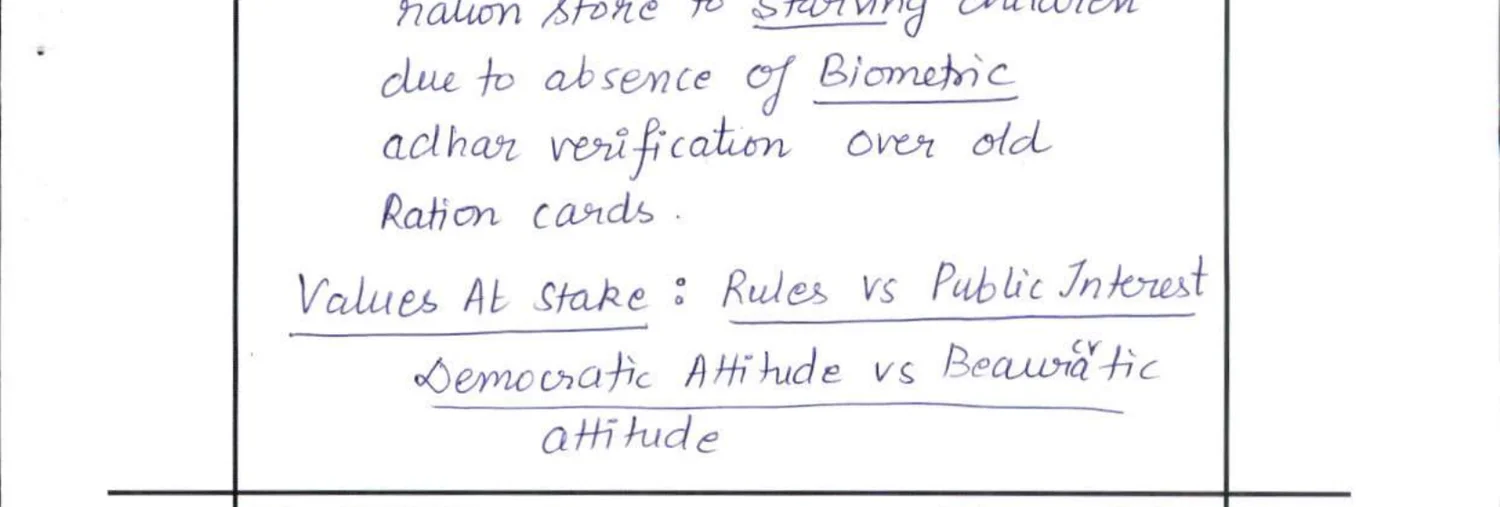
- Hand-drawn underlined heading "Values At Stake : Rules vs Public Interest / Democratic Attitude vs Bureaucratic Attitude"
Values At Stake: Rules vs Public Interest Democratic Attitude vs Bureaucratic Attitude
Laws/Order vs Conscience Impartiality vs Neutrality
Thus, following competing interests are involved.
Solving through application of —
- Courage of conviction
- Conscience and human dignity
- Exceptional situation and larger public welfare → Allowing them to prevent the life at stake (Incident: Jharkhand Starvation case)
Thus, it involves strength of one's character as it requires application of — Emotional Intelligence, objectivity and innovative application of mind, courage and values of Democracy, democratic leadership and public welfare.
"Remedy should never be worse than diseases"
#Q2(a) — Discuss Vivekananda's views on nationalism. Do you think nationalism has become more a divisive force in the world today than one that integrates? [10]
Swami Vivekananda propagated the essence of Humanism, Rationalism and development of Scientific Temper among individuals and society and Governance at large.
He diverged from narrow views of Nationalism to the concept of Daridra-Narayan (service of mankind). He called for the amalgamation of the Western and Indian values i.e. cosmopolitanism, Vedic culture coupled with socialistic liberal values.
The values of equality, brotherhood and equality with freedom of speech and expression calling for compassionate Nationalism at World Conference on Religions, Chicago.
- With the rise of sovereign states, security threats and protectionism there has been concerns over the values guiding Nationalism.
- Xenophobia, racialism and religious fundamentalism are few outcomes of the trends.
- This breeds the fertile ground for terrorism, divisiveness and discrimination (Eg: In Europe, with different middle east-Syria narratives).
However, the Cosmopolitan values of thinkers such as Tagore, Vivekananda and liberal values of institutional dialogues and culture exchange give a future of hope with rising common threats of climate change, terrorism (Eg: Paris Pact, Montreal Protocol)
#Q2(b) — What is the relationship between Ethics and Law? Explain with examples. [10]
Law is the statement of the reasons designed to achieve common good in the society under the command of the sovereign.
Ethics acts as a moral compass in formulation, regulation and implementation of the laws.
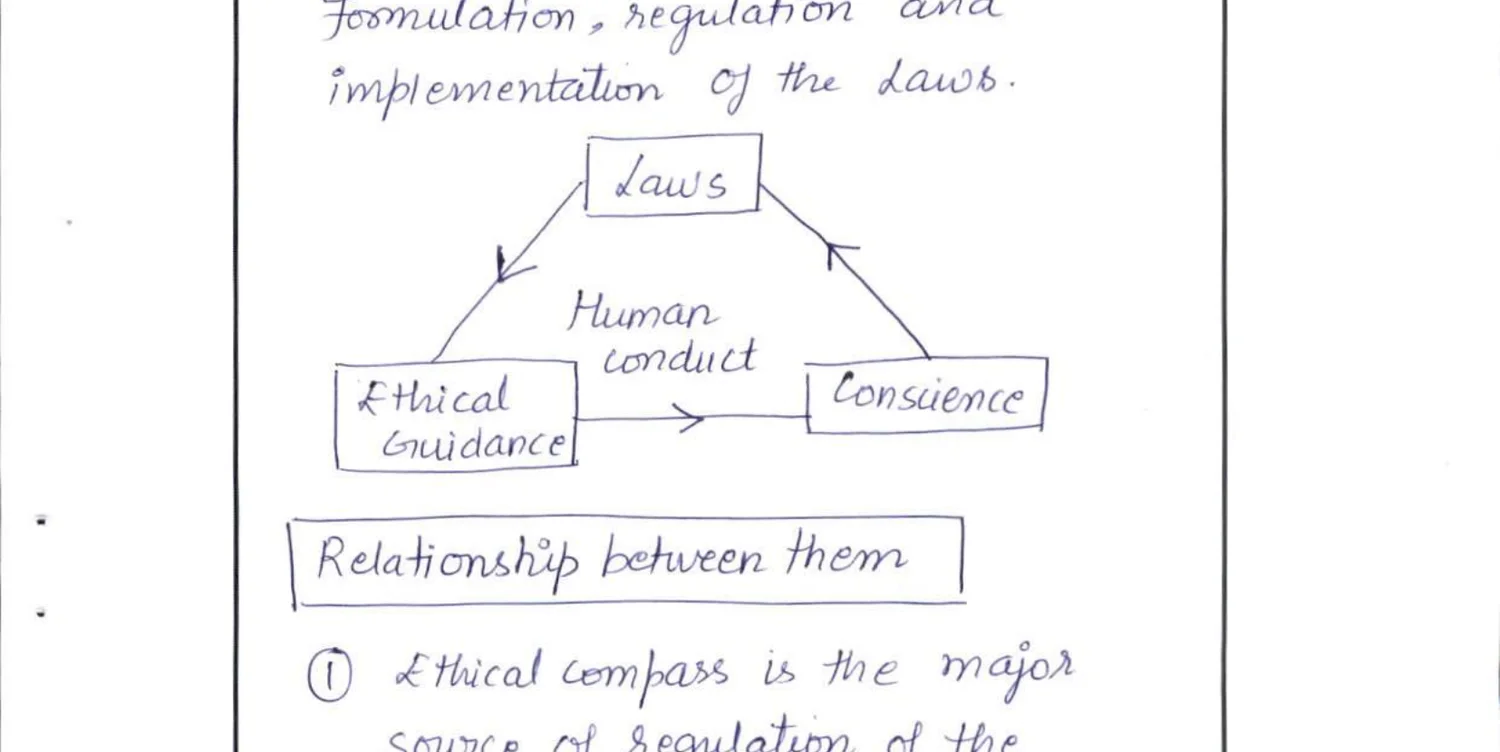
- Triangle diagram: Laws at apex; arrows pointing to Human conduct at centre; Ethical Guidance (boxed, left) and Conscience (boxed, right) at base; arrow from Ethical Guidance → Conscience; below: boxed heading "Relationship between them"
Relationship between them:
-
Ethical compass is the major source of Regulation of the law.
- Ex: The Income Tax Act 1961 puts an onus to pay taxes for broader welfare functions by state but people misuse and escape by loopholes. Thus, legal but not ethical.
-
Laws act as external check and ethics an internal guide for human conduct.
- Eg: The Traffic rules formulation where people tend to escape and violate by bribing, paying challans, whereas a moral person would tend to follow diligently.
-
It puts contractual and moral obligation on law makers to formulate laws responsibly and morally (Eg: Aadhar Act balancing privacy and socio-eco welfare).
In the end we can quote Aristotle:
"Law isn't needed if people are law abiding"
#Q3(a) — What do you understand by Emotional Intelligence? Highlight its importance for civil servants. [10]
Emotional Intelligence (EI) is about understanding one's emotions, knowledge and recognition of other's emotions and regulating them in socially desirable manner.
Daniel Goleman gives four components —
L→ Self Awareness
L→ Self Management
L→ Social Awareness
L→ Social management
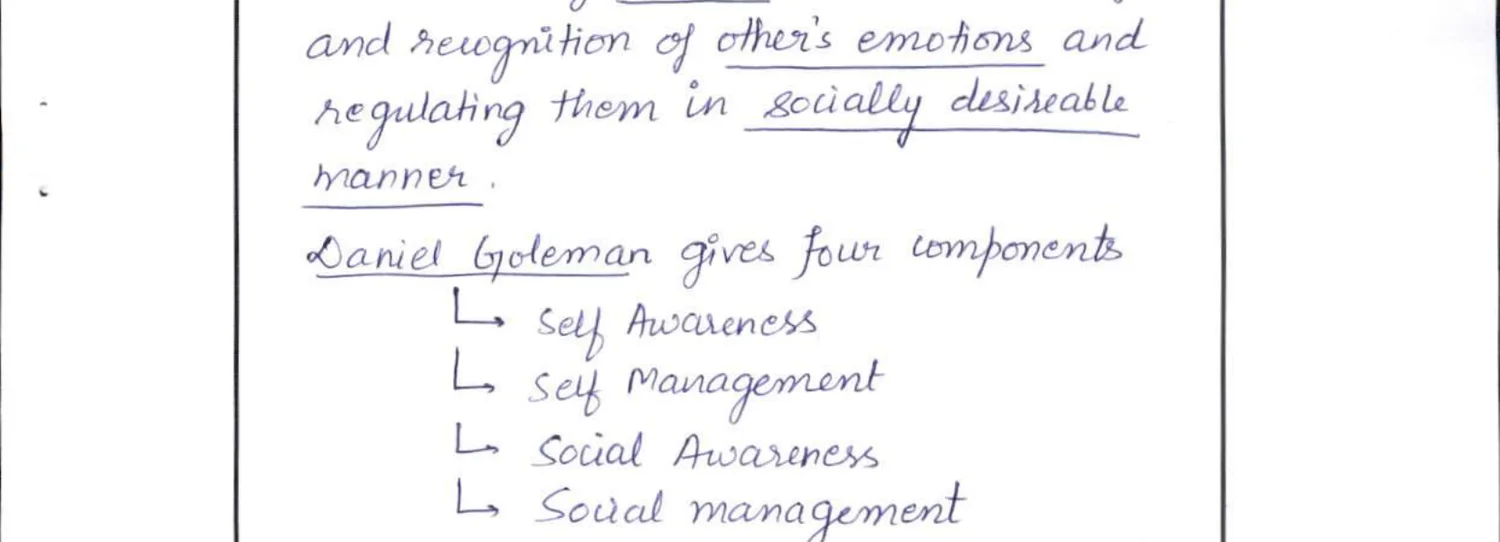
- L-branch tree: Daniel Goleman gives four components → Self Awareness, Self Management, Social Awareness, Social management
Importance for Civil Servants
- Intra organisation relations which deals with most comprehensive control and order
- Translating sound policy into action with limited resources
- A citizen friendly efficient and friendly admin–citizen interface
- Solving larger problems of the society at minute level such as street vendors, informal workers, communal issues, crisis emergency situations.
- A healthy work-life balance (CSDS studies show the increasing number of suicides and resignations among civil servants)
Way Forward
- Soft skills training (II ARC)
- Friendly work culture and sensitisation training.
- Stress management and self expression training, counselling support (c.s.)
- PM on Civil Services Day called for outcome and change oriented C.S. with social, emotional & ethical competence.
#Q3(b) — Explain the importance of probity in governance. What measures have been undertaken for ensuring probity in governance in India? [10]
Probity is an upright, straightforward, non-compromising conscientious mind adhering to civil service values.
Importance of Probity
- Upholding the civil services values as envisaged by Nolan Committee (Honesty, Integrity, Leadership, etc)
- Reducing the menace of the Sanskritisation of corruption (Kaushik Basu)
- Ensuring a service motive and Quality of service delivery
- Upholding philosophical foundation of building social capital through Satyagraha (Gandhi)
- Ensuring uniformity, responsibility and responsiveness
- Promote a healthy work culture and pride of workmanship
Measures Undertaken
- Vigilance Institutions: CVC — a tool of probity, CBI, NHRC, SIT, etc
- Code of Conduct: CG Conduct Rules 1964, AIS Rules 2014, CCS Rules
- Sunshine law of the RTI Act increasing accessibility
- Work Culture: PLIS, CCE, 360° appraisal, Biometric Monitoring System, Lateral Entry, Voluntary Retirement scheme
- Digitisation of Services: e-Gov, PRAGIATI, etc
- Lokayukta, Lokpal constitution
- Prevention of Corruption Act
A code of ethics and Ethics Commissioner (II ARC) with Sevottam model can be further guiding light.
#Q4(a) — What do you understand by corporate ethics? Explain its significance for socio-economic development. [10]
Corporate Ethics deals with the standards of governance in Business sector and the way a company behaves towards its internal and external Stakeholders. It encompasses broader aspect of the Corporate Governance.
It includes Inclusivity of all stakeholders, accountability, transparency in the structures and values as given by the Kumar Mangalam Committee.

- Double-boxed heading: "Significance in socio-economic Development :"
Significance in Socio-Economic Development:
- Due to increasing globalisation and liberalisation there has been rise in corporate scams (Ketan Parekh, Satyam, Sharada, Harshad Mehta). It'll help reduce the corporate failures, scams and corruption.
- Increase the efficiency and the transparency (financial disclosures) of the work culture.
- As envisaged by Uday Kotak Committee, a sound corporate ethics would give rise to sound corporate governance which results in economic growth of the country.
- Concept of the compassionate capitalism (Narayan Murthy) where there is a social responsibility as done in Scandinavian countries.
- Also, helps in the Redistributive justice through CSR funds (2% of Net profits) utilisation.
In the end, the principle of "wealth without work and commerce without morality" need to be remembered (Gandhi).
#Q4(b) — Ethics plays an important role in sports. In this context, explain the importance of the virtues of fairness, integrity, responsibility and respect for sportspersons. [10]
Sports ethics constitute one of the prominent arenas of socialisation and collective behaviour of an individual. They are guided by social norms, an unwritten set of standards of ethical behaviour.
Eg: Guidelines by International Olympic Association Committee (IOAC)
Importance of:
-
Fairness: Deontological aspect of winning by fair means rather than focusing just on results. (Not fixing a match)
-
Integrity: ensures individual's consistency in its conduct based on some principles. (Eg: Refusal to take bribe)
-
Responsibility: ensures a spirit of leadership and onus on a person leading to moral accountability of actions. (Eg: Sachin taking credit as a captain for losing match despite scoring century)
-
Respect: for one another promotes a healthy social culture and team spirit recognising human values. (Eg: A heartfelt congratulations to opposite team despite losing world cup match)
Thus, these qualities strengthen the character, attitude and resilience of a person through informal institutions of socialisation cultivating Sportsmanship.
#Q5(a) — Discuss the importance of being a role model for achieving success as a leader. In this context, what do you think are the qualities that separate a leader from a manager? [10]
A leader involves the act of influence i.e. a person who influences the behaviour of larger section of people with views, values, personality and acts.
- Leaders who aspire to be a role model provide positive connotation to their conduct.
- Gandhi, as a political leader could achieve success with his values of truth, non-violence, spirituality which left larger imprint.
- Similarly, the success of corporate icons such as Jeff Bezos and Steve Jobs could inspire a large section of aspiring minds with their discipline, hard work and management.
(Page 19 ends mid-answer — continues on subsequent pages beyond p. 19)
<!-- End of pages 1–19 -->
UPSC GS Paper 4 — Ethics, Integrity & Aptitude | Rank 6 | 162 Marks
#Q4 (contd.) — Qualities of a leader not just a manager [marks not shown on these pages]
(Continued from Part 1)
- Responsibility of a failure and appreciation to team for success
- (eg: Dr. Sarabhai resigned on 1 failure of launch of MOM)
- Create a healthy work culture where there's a room of personal development of each
- (Organising 1-on-1 meetings)
- A source of motivation and an exemplary example
- (eg: Gandhi during QIM)
- Courage of conviction in difficult situations (leading a team in communal violence)
- Promoting decisiveness, transparency, energy and communication among individuals.
#Q5 — Explain the meaning and importance of the following civil services values with appropriate examples [10]
(b) Explain the meaning and importance of the following civil services values with appropriate examples: 10
उचित उदाहरणों के साथ निम्नलिखित सिविल सेवा मूल्यों के अर्थ और महत्व की व्याख्या कीजिए: i. Selflessness / निःस्वार्थता ii. Objectivity / वस्तुनिष्ठता iii. Accountability / जवाबदेही iv. Fortitude / दृढ़ता v. Integrity / सत्यनिष्ठा
#(i) Selflessness : Decisions solely on the public interest. Ensures no illegal gratification of kith and kin. Good policy making, effective citizen friendly Governance.
- (Rescuing a flood victim without the juniors' help)
#(ii) Objectivity : Action based on observable phenomenon on facts and merits.
- Act as per merit to ensure the impartiality and sense of justice; promotion of scientific temper
- Ex: Decision in matters of faith and public order
#(iii) Accountability : Formal answerability for the acts done in official capacity.
- Ensures discipline, uniformity, code of conduct because of the larger audience and discretion in power
- Eg: For preparing a report on a project
#(iv) Fortitude : The act of the resilience and dedication in work.
- Promotes an effective and good governance, public welfare and a culture of responsible work
- Ex: Working late hours to investigate an issue
#(v) Integrity : Condition where our thoughts, speech and action are consistent with our principles, values.
- Bedrock of internal and external life in services; reduces corruption, malfeasance and other evils
- Eg: Vinod Rai's consistent efforts towards corruption
#Q6 — What are the problems arising out of declining ethical standards among public servants? Suggest certain strategies to address the same. [10]
लोक सेवकों के मध्य नैतिक मानकों में गिरावट से उत्पन्न होने वाली समस्याएं क्या हैं? उनका समाधान करने के लिए कुछ रणनीतियों का सुझाव दीजिए।
A recent Lokniti study highlighted the increasing instances of corruption, elitism and irresponsible behaviour in civil servants. The declining ethical standards thus need to be arrested as soon as possible.
Problems arising —
- Sanskritisation of the Corruption — Kaushik Basu
- Loss of public faith and trust in administration
- Impacts decision making affecting public welfare functions at large
- (eg: diversion of MPLADS funds — CAG Audit Report)
- Decline of the social capital in country
- (TI Corruption Index ranked India at (78)) — 2018
Strategies to address —
- A code of ethics and an Ethics Commissioner (2nd ARC)
- Arresting politicisation of Bureaucracy by cultivating in-house training and accountability mechanisms
- An effective Grievance Redressal using anonymity and digital technology (Online complaints filing)
- A comprehensive law strengthening corruption control on lines of US "Fraud Net" and Right to Service Act as in Malaysia
- Taking the pride of worksmanship
- Using Nudge Behavioural economics to bring about a change to culture of honesty, perseverance and integrity
"Public morality is placed on higher pedestal than private because it carries public trust" — SC
#Q7 — Differentiate between the following [10]
निम्नलिखित के मध्य विभेद कीजिए:
#(a) Horizontal and Vertical Accountability
क्षैतिज और ऊर्ध्वाधर जवाबदेही
Horizontal Accountability consists formal relationships where one actor imposes checks and balances on one another without a hierarchy.
- Eg: Collective Responsibility of COM to Lok Sabha
Vertical Accountability draws a hierarchy and chain of command where the lower rung is answerable to the higher authorities.
- Eg: During elections ECI → SEC → DEC → RO, etc.
- A CEO and subordinates
#(b) Code of Ethics and Code of Conduct
नैतिक आचार संहिता और आचरण संहिता
- Code of conduct is legal enforceable structures and processes ensuring discipline, accountability. It is external push.
- Eg: AIS Rules 2014, CCS Rules 1964
- Code of ethics deal with moral sanction of an act with personal responsibility mostly internal based on conscience.
- Eg: Service Motive, Welfare of public (2nd ARC)
#(c) Belief and Attitude
विश्वास और अभिवृत्ति
Attitude is a learned predisposition acquired through the process of socialisation dealing with reaction towards objects.
- Eg: A considerate rational attitude towards a poor
Belief : A system of thought believing something to be true even without any rationality or evidence.
- Eg: Cultural Beliefs, Religious beliefs.
- It involves element of subjectivity.
#(d) Persuasion and Manipulation
अनुनय और व्यवहार कौशल
Persuasion is a deliberate act of the social influence to convince, encourage or motivate a person in desirable manner.
- Eg: Swachhagraha in SBM — by role model acts
Manipulation : Also a deliberate act with a negative connotation where the convincing act is for the private or illicit means and ends.
- Eg: Manipulating voters to vote based on religious lines.
#Q8 — Write short notes on the following [10]
निम्नलिखित पर संक्षिप्त टिप्पणी लिखिए:
#(a) Relation between public and private ethics
सार्वजनिक और निजी नीतिशास्त्र के मध्य संबंध
Public ethics are standards guiding impersonal, organisational and professional ethics/standards whereas private ethics deal with personal relations.
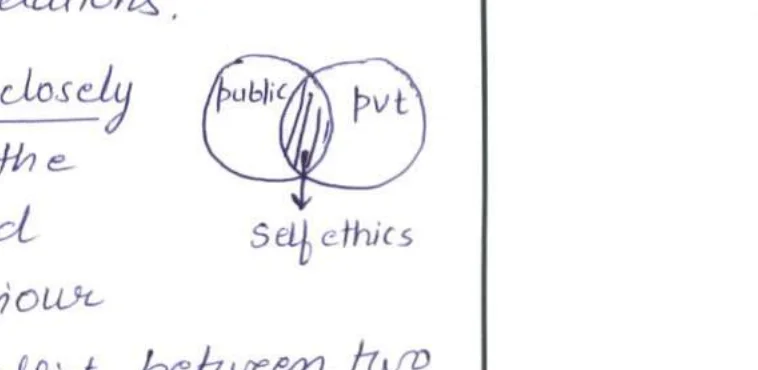
- Venn diagram: left circle = public, right circle = pvt, overlapping region shaded; arrow pointing down to self ethics
- Both can be related closely since it depends on the integrity system and consistency of behaviour.
- When there's a conflict between two axioms:
- Organisational over personal interest
- Public over private welfare
- Private subordinated to public
- For civil servants there is a strict control over public and private ethics (Rameshwar Prasad case). It places a fiduciary responsibility to subordinate private ethics over public welfare.
As Vivekananda said "cultivation of self is ethics" common to both public & private realm.
#(b) Role of family in inculcating values
मूल्यों को विकसित करने में परिवार की भूमिका
Family forms the primary point of informal socialisation of an individual, specially the nascent phase of childhood.
As a child, like a clay he/she is moulded into a desirable and qualitative behaviour. Respect towards elders, empathy, emotional intelligence, physical and mental development.
Role of the quality parenting is the most influential. A charter of dos and don'ts with adequate sensitivity is required.
Present times, with nuclear families proliferation, assertion, independence and degradation of moral values, it is very important for parents to provide a rock-strong foundational values.
Most glaring example: could be value of gender equality, respect for women that can help address the numerous societal evils against women.
#Q9 — Sexual misconduct on social media [SECTION B] [20]
Full question (printed text):
A woman employee has levelled allegations of sexual misconduct on social media against the Head of Human Resources department. This has been in the context of the recent phenomenon of women coming out against powerful men who have sexually harassed them in the past. Given the frenzy around the issue, your company is under immense pressure to act quickly against this person. You have the following options before you:
(a) Accept the statement of allegations and take departmental and legal action quickly.
(b) Investigate the matter through an internal complaints committee and take action after it submits its findings.
Analyse the given options and suggest which course of action would you choose? Suggest what measures would you take to prevent occurrences of such instances in your company in future.
[Hindi translation of question also printed on page — not transcribed separately.]
Given situation presents glaring situation of Gender Injustice and Inequality. NCRB data 2017 shows increase of 16% in cases of sexual harassment against women.
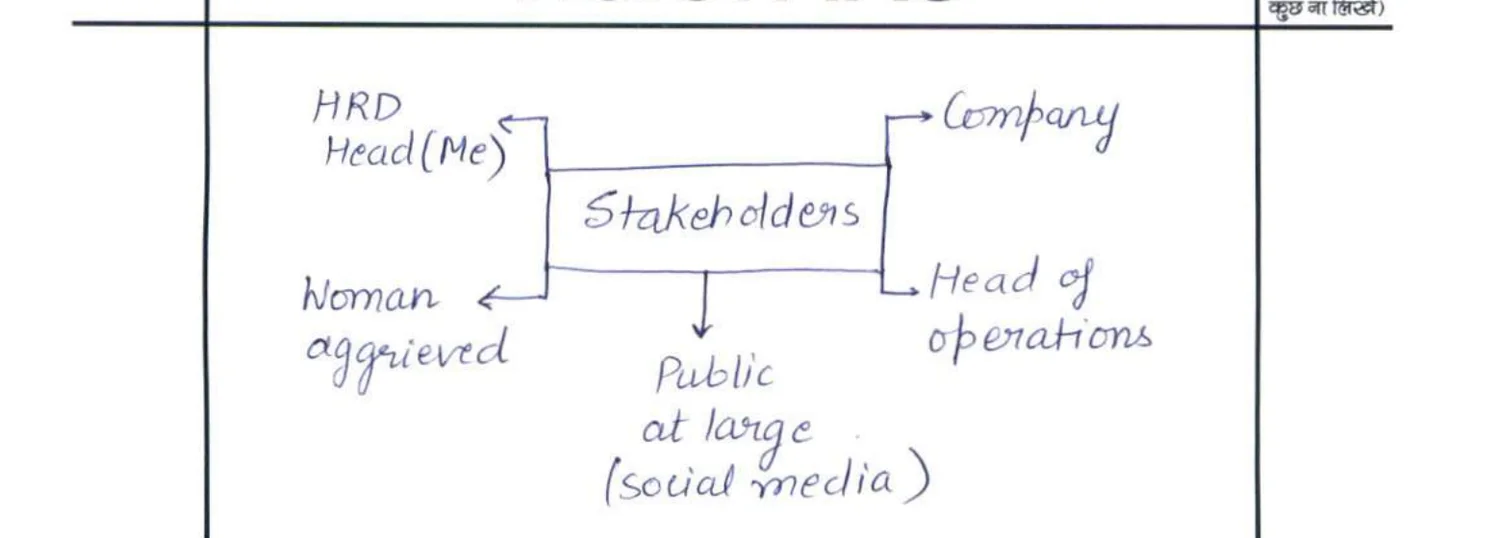
- Box diagram: HRD Head (Me) → Stakeholders box → Company (right), Head of Operations (right), Woman aggrieved (left), Public at large (social media) (bottom)
#Option 1 — Accept the allegations and quick legal action
Merits:
- Quick resolution of the thriving anger, resentment and redressal
- In the digital age, it takes minutes to go such news to be viral, thus creating all the more pressure
- Gender Justice — a core philosophy and value
- Relief to the woman — upholding her dignity
Demerits:
- Irresponsible as a head without any due diligence
- Likelihood of a false disgruntled complaint
- Not according to established rules and process
#Option 2 — Investigation through ICC, reports thereafter
Merits:
- Due process of law and due procedural law of the Company followed (VISHAKHA GUIDELINES)
- An objective assessment of the situation
- Institutionalised method as envisaged in Internal Complaints Committee — Sexual Harassment Act 2013
Demerits:
- Time consuming exercise
- There might be a backlash and pressure due to delays
#Measures I would Take
- I would follow option two since it follows a rule-based, objective approach and ensures justice in substantive ways without any errors.
- Other than that, as the head of HRD, I would ensure the ICC is constituted as per provisions of the law with inclusive representation.
- There shall be fair, clean and transparent investigation conducting interviews and involving all the stakeholders.
- After the report submission, an appropriate action — policing, dismissal of person to be taken.
- Since the person is in influential position, there shall not be any nexus and illicit means to default the investigation.
- Also, if the complaint turns out to be socially motivated and frivolous, I'll try to ensure stringent action against woman to create deterrance effect.
Art 46 of the Constitution also mandates the Govt to provide and safeguard gender welfare. The recent #MeToo, #TimesUp is a growing strengthening and assertiveness of the same globally.
#Q10 — State notorious for high rate of crimes and illicit activities [20]
Full question (printed text):
A state has been notorious for high rate of crimes and illicit activities. An understaffed police force along with sheer volume of criminal instances makes it difficult for police to duly investigate and pursue all cases till their logical end. The criminal justice system is also burdened and it takes years to deliver justice. Given the nexus between criminals and politicians, it is difficult to conduct investigation without external influences. A sense of lawlessness has prevailed in the society. In this backdrop, it has been observed that police has been resorting to increasing number of encounters of alleged criminals rather than catching them and follow due process. Popular public sentiment is also supportive of this method and the result has been a general declining trend in crime. Given this scenario, answer the following questions: 20
(a) Analyse the issue from different ethical perspectives.
(b) What could be the effects on the police administration and the society of such a strategy?
(c) As an advisor to the Chief Minister of the State, what advice would you give to improve the law and order situation?
[Hindi translation printed — not re-transcribed.]
The situation includes the inefficiencies of the criminal justice system on the whole as studied by Malimath Committee too.
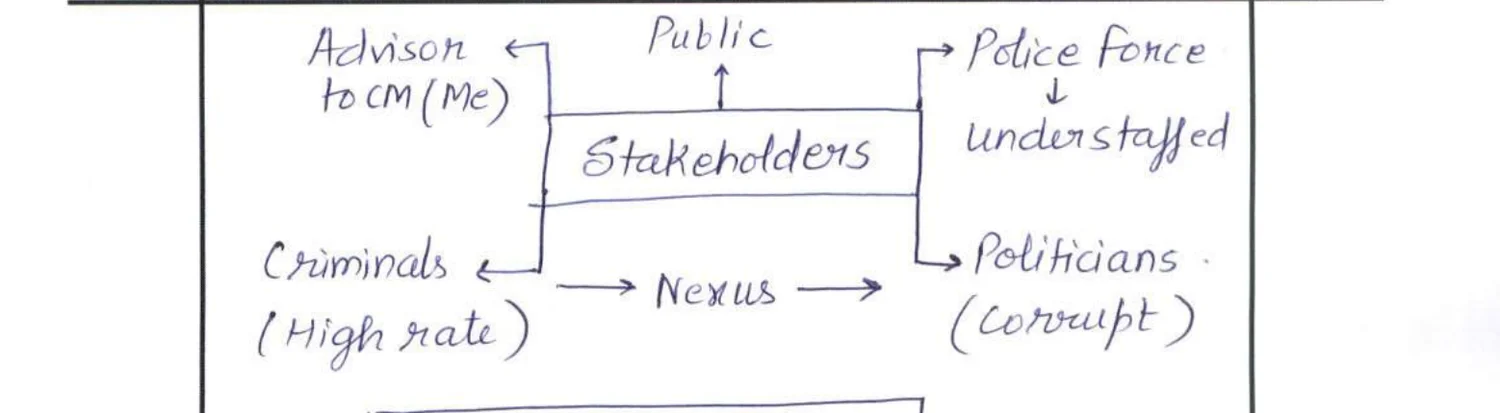
- Box diagram: Advisor to CM (Me) ← Public → Police Force / Understaffed (right); Criminals (High rate) ← Nexus → Politicians (Corrupt) (right)
#(A) Ethical Perspectives
Scenario 1 : Right to Life vs Public Welfare
- The killing of criminals without following due process of the law questions the legitimacy of the state actions.
- Allegedly innocent people could also die.
- Public sentiment though positive, is creating a culture of tolerance towards unethical and violent means.
- SC in PUCL case reiterated that every life is inviolable/precious.
Scenario 2 : Rules-based System vs Corruption/Truth
- The nexus between the politicians and criminals ultimately impacts policy, governance and public.
- The ministerial orders and influence further complicates and pressurises police to eradicate crime.
Scenario 3 : Duty vs Capacity/Security
- The understaffed force poses a great hurdle to investigate following due process of law.
- Additionally, answerability due to the increasing number of cases creates dilemma.
- The lawlessness needs to be arrested as soon as possible for state security.
#(B) Effects — As discussed above, the effects are multi-fold —
1. Police Administration
- Lack of accountability
- Refusal of lawful process
- Complacency and violence
- Inefficient in long term
2. Public/Society
- De-sensitisation towards life
- Culture of tolerance towards violence
- Not arresting the root cause of the issue — staff deficit and corruption
#(C) As an advisor — my advice
Short term Advice:
- Increase the deputation at lower levels to address the staff deficit
- Provisioning of arresting and not shoot at sight
- Public to maintain calm
Long term — Multifaceted Issue:
- Implement the recommendations of committees such as Prakash Singh, Malimath in true spirit
- Fill up the vacancies
- Strong actions against the politicians involved breaking the nexus
- Provisions of increased cells capacity and constabulary
- Ensuring mechanisms of the accountability stringently through senior officers
- Fast track courts for quicker disposals
- Set a legal example to Public
"The arc of the Justice should always bend towards reformatory justice"
#Q11 — Tobacco district magistrate scenario [20]
Full question (printed text):
Tobacco is one of the major commercial crops cultivated in a district, where you have been posted as the District Magistrate. But being a signatory to the UN Framework Convention on Tobacco Control, it is obligatory upon India to phase out its tobacco cultivation by 2020. The state government has constituted a committee, which has recently submitted a report to gradually phase out its cultivation and rehabilitate farmers who shift to alternative crops. However, fearing loss of livelihood, farmers have blocked the railway lines, causing disturbance at various places. They are demanding written assurance from the state government that tobacco cultivation will be allowed to continue. 20
(a) What are the ethical and administrative issues involved in this matter?
(b) What are the options available to you as the District Magistrate?
(c) Evaluate each of the options and choose the option, which you would adopt, giving reasons.
[Hindi translation of question printed — not re-transcribed.]
Tobacco is a highly injurious substance to health, specially in a developing country like India which faces 65% Burden of NCDs.
(Answer continues on next pages — not in scope of pages 20–39)
[End of pages 20–39 — page 37 of booklet shows "Page 37 of 56"]
#Q11 — (Continuation from Part 2) [20]
(Answer continues from previous pages. This section covers the farmers/pesticide case study — stakeholders, ethical issues, administrative issues, options available, evaluation, and conclusion.)
#Stakeholders Diagram (p. 40)
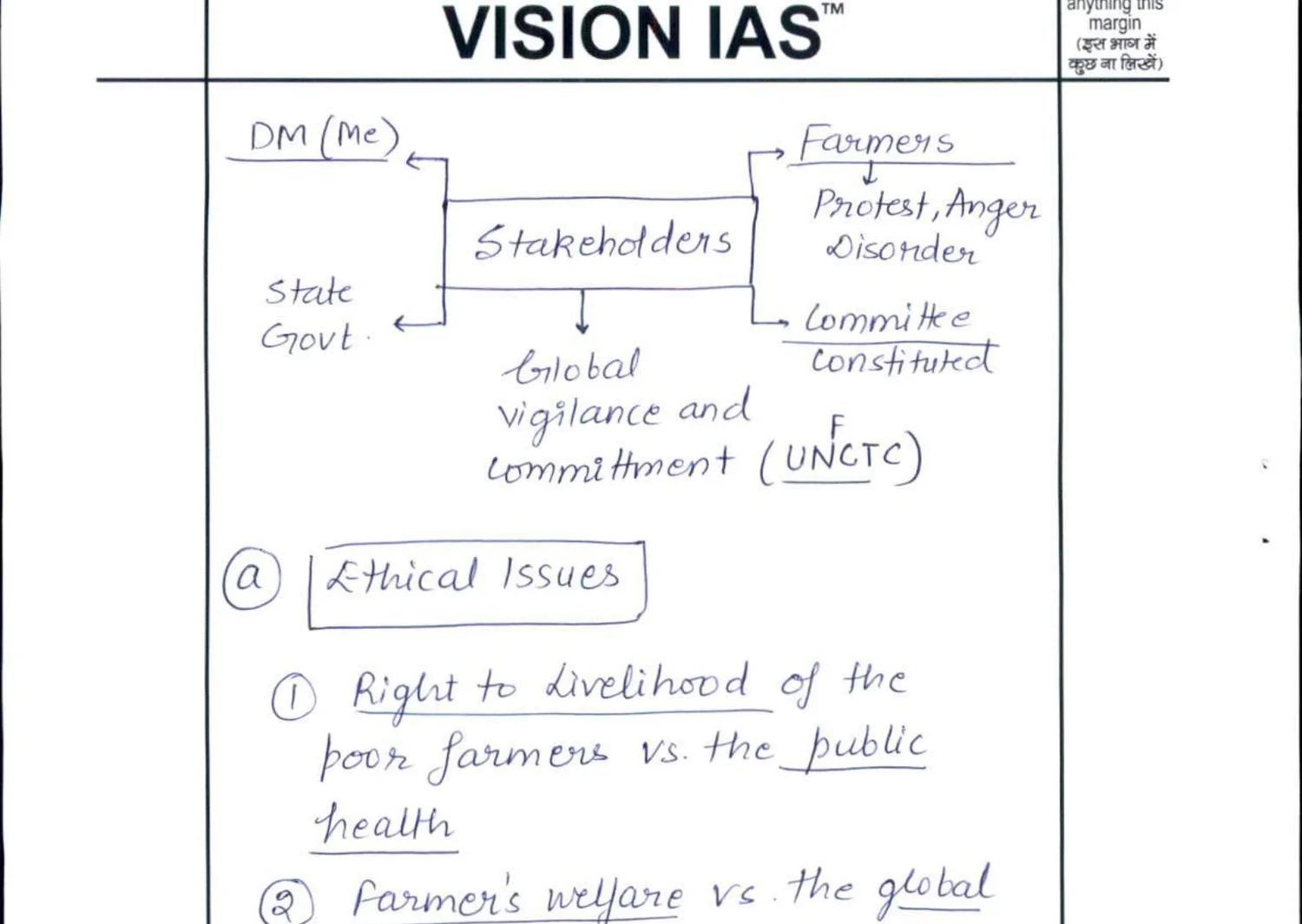
- DM (Me) and State Govt are the administrative stakeholders
- Farmers — expressing protest, anger, disorder
- Committee Constituted — formed to address the issue
- Global vigilance and commitment (UNCTC) — international oversight dimension
#(a) Ethical Issues
- Right to livelihood of the poor farmers vs. the public health
- Farmer's welfare vs. the global commitment and obligation
#Administrative Issues
- Handling the law and order due to disruption caused by farmers' protests
- Unblocking Railway Lines — critical to smooth movement of freight and passengers
- Rehabilitation provisions of the displaced farmers
- Helping in the alternative sources of livelihood transition
- Implementing the committee's recommendations smoothly
- Also, ensuring the interests and balance of all stakeholders
#(b) Options Available
- Outrightly implement the orders → stringent policing action to mellow down the protesters
- Not implement and ask for the written permission as per farmer's wishes
- Take an objective view and follow a consultative approach — ensuring satisfaction of the needs of farmers as well as state
#(c) Evaluation
Option (a)
| Merit | Demerit |
|---|---|
| Farmer's livelihood pushed to alternatives | Disruption of further order |
| Quicker resolution | Increased grievances of farmers |
Option (b)
| Merit | Demerit |
|---|---|
| Ensuring the job security | Against international and legal mechanism |
| Demands of farmers fulfilled | Will impact larger public health |
| No disruption of order |
Option (c)
| Merit | Demerit |
|---|---|
| Inclusive dialogue | Time consuming |
| Democratic approach of finding a middle ground | May not yield desirable results as farmers may be adamant |
| A gradual phase out simultaneously ensuring efficient rehabilitation |
#My Choice and Additional Steps
I would choose Option (c) based on above merits and additionally —
(a) Ensure the farmers a written recommendation from state for rehabilitation and compensation support through CAMPA funds
(b) Easier credit and inputs availability in the newer crop plantation
(c) Process to remain gradual and not forced
Food Security and Health — "All" twin principles need to work in tandem to be a welfare state today.
#Q12 — An international soft drink company has a signature soft drink that it sells all over the world. In India, the version of the soft drink contains Indian food and health regulations, but is less healthy and less safe than the drink sold in the European market where the law is stricter. A recent study in a respected health journal has indicated that this product can lead to severe public health issues in the years to come. The government has appointed a committee under your chairmanship to look into the issue and submit a report with suggestions. In particular, identify the various stakeholders and examine the various socio-economic and ethical issues involved in this case. [20]
Constitutionally, Govt has been mandated under Art 47 to ensure health and intoxicated drinks injurious to health to be phased out.
#Stakeholders Diagram (p. 44)
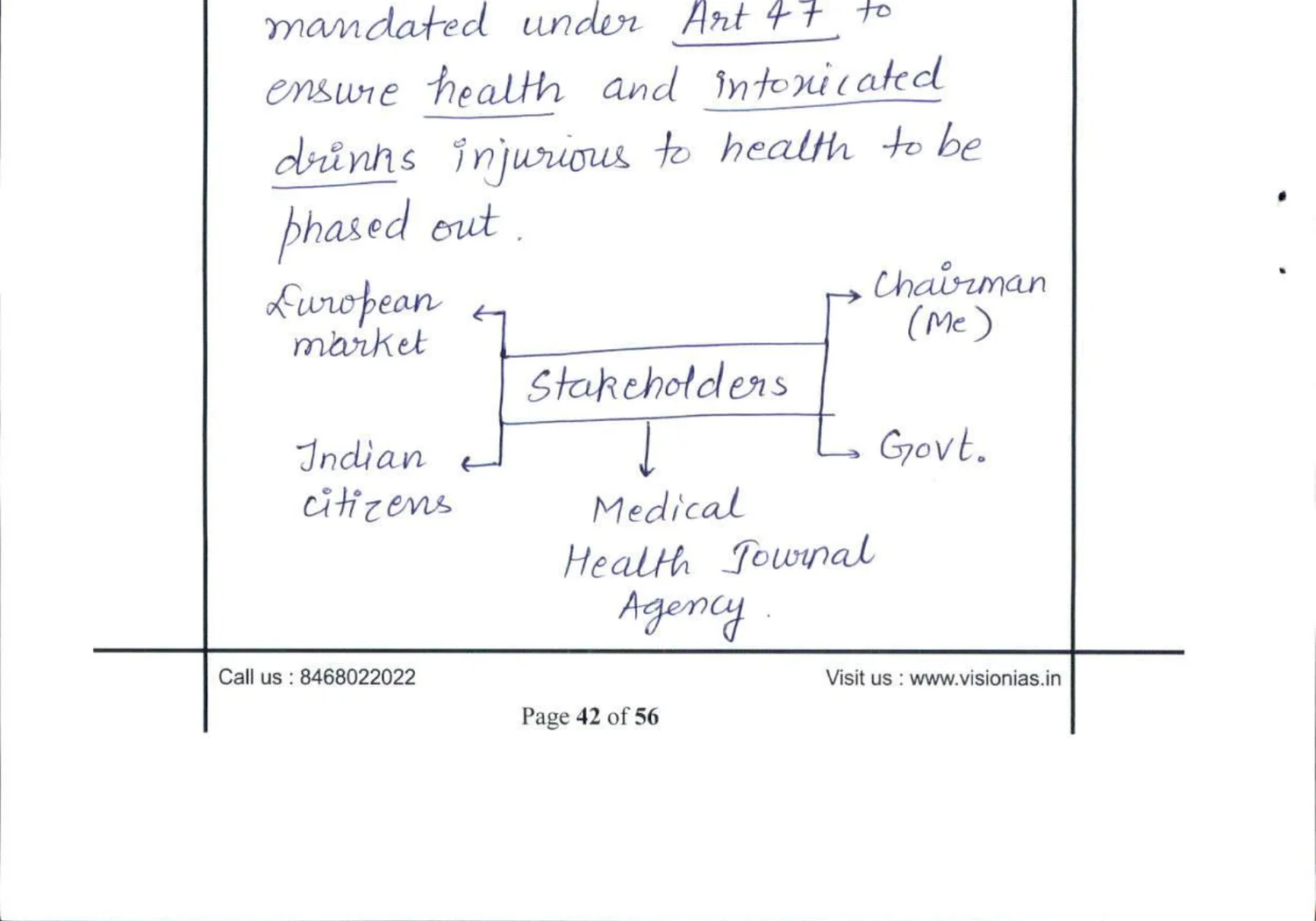
- European market — sells the safer, stricter version
- Indian citizens — consumers of the inferior product
- Chairman (Me) — head of the government-appointed committee
- Govt — the appointing authority with constitutional mandate
- Medical Health Journal Agency — source of the health study
As the chairman of the committee I need to ensure the IPR rights of the foreign company, the rights of the indigenous company and the public health broadly are balanced.
#Factors to be Considered
- Foremost, the authenticity and data of the report of Health Journal
- Study of the law and the stricter health standards in European market
- An independent assessment of the Indian drinks company to be considered
- A list of the casualties in reality
- The IPR rights of the European firm
- The commercial rights of the Indian firm
- The health of our public
#Ethical Issues
- The IPR Rights of the international firm vs. the commercial rights of Indian firm
- Public Health vs. Business Ethics
#Socio-economic Issues
- The profitability and business of the Indian firm is impacted due to the stringent sanitary and phytosanitary methods
- Conversely, there is a threat of loss of market share to cheaper drink by the international firm
- Might increase the OOPE of public if health issues are detected
#My Suggestions Broadly Would Encompass
- An objective clinical trials of the drink with authenticity
- On ground evidence based data based on actual threats to the health
- Involving and guiding FSSAI, BCI and accreditation (NACI) agencies to strengthen their standards in future
- An urgent ban on further production and removal of stock if found guilty
- Stressing on strengthening the IPR regime of the country including the Patents Act
- WTO has provision of the compulsory licencing based on public interest which is present in Sec 84 of Patents Act — I'll ensure the misuse of provision isn't done
#Q13 — You are appointed as the principal of a school, which is located in a backward district. A colleague brings to your attention that a group of boys indulge in smoking during school hours within the vicinity of the school. The same group has also been caught consuming alcohol in the school premises. No form of punishment seems to be effective while dealing with this particular group. Upon investigation, you find that the boys belong to low-income families and have picked up the habits from elders at home and neighbours. The teachers are concerned about the effect it will have on other students. You also realise that this problem has to be addressed as quickly as possible. In this context, answer the following questions: [20]
(a) Identify the factors that make young people take up such harmful habits? What is the role of educational institutions in inculcating right habits among the students?
(b) How would you address the immediate issue? Analyse the options available to you in this regard.
(c) How will you bring about a behavioural change among students in this case?
Art 47 of the constitution persuades the Govt. to ensure there's no consumption of the intoxicating drinks legally.
#Stakeholders Diagram (p. 50)
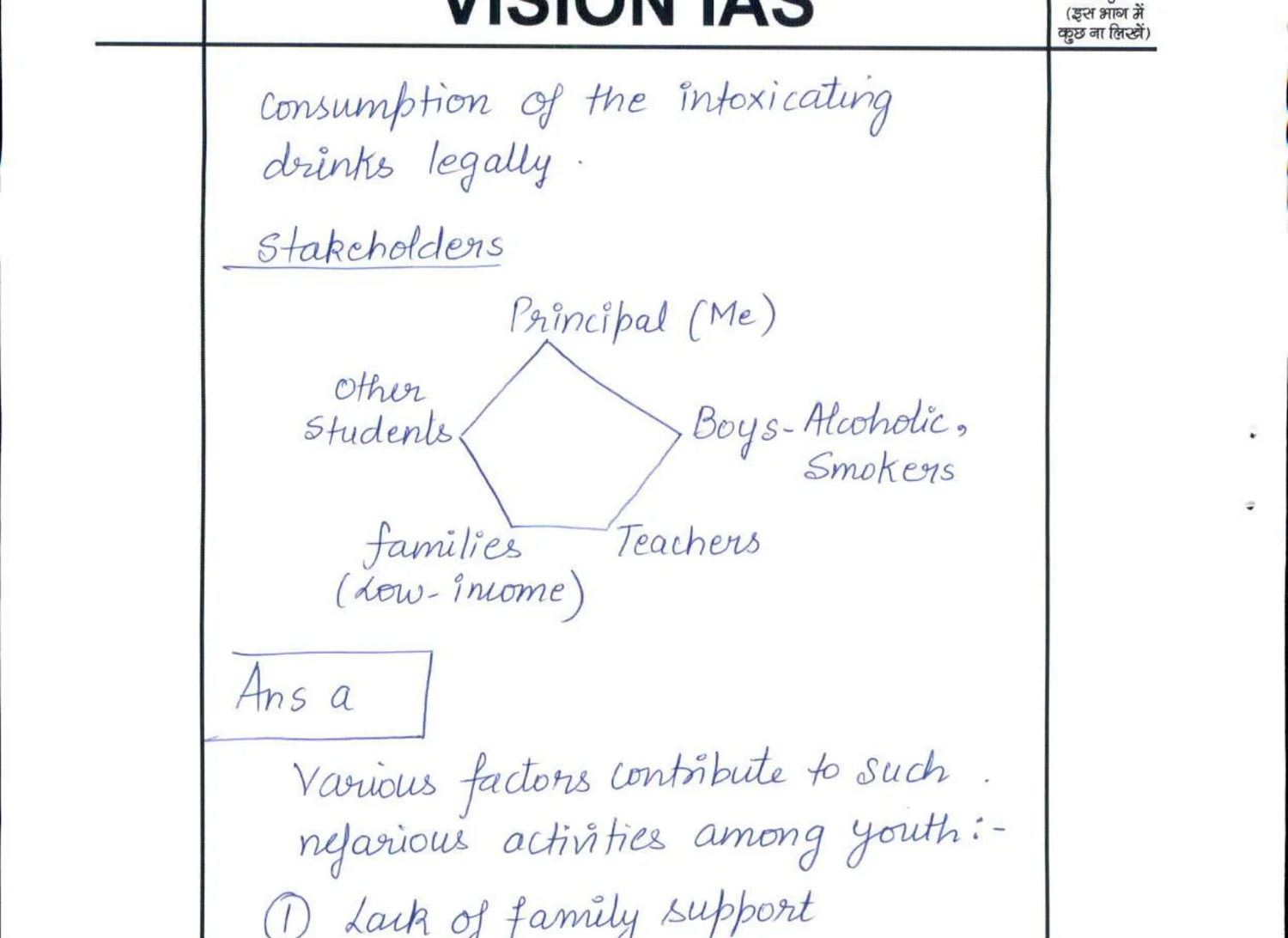
- Principal (Me) — decision-maker and responsible authority
- Other Students — affected by the behaviour
- Boys — Alcoholic, Smokers — the group under concern
- Families (low-income) — root source of the habit
- Teachers — concerned about wider impact
#Ans (a) — Factors and Role of Educational Institutions
Various factors contribute to such nefarious activities among youth:
- Lack of family support
- Emotional distress (NCRB — data says 35% of children suffer from PTSD)
- Financial crunch especially to poverty stricken households
- Domino effect — by watching other kids and falling easier prey to increasing westernising influence
- Neglect at school — important level of socialisation
- An escape mechanism from real troubles
Role of educational institutions has been constitutionally mandated under RTE 2008 to provide education to children till 14 years of the age:
- Second level of socialisation and learning after the family
- Education forms the bedrock of the guiding principles and knowledge accumulation
- Positive impact of the teachers in value inculcation
#Ans (b) — Addressing the Immediate Issue
Option 1: Expel the kids immediately and send notices to their homes
| Merit | Demerit |
|---|---|
| A stringent example | May deter the students to further not attend classes — impacting GER |
| Deterrance effect since all forms of punishment ineffective | Ruin their lives |
| Not addressing the root cause |
Option 2:
- Call up a parents teacher meeting
- Propagate strict guidelines to attend classes under school timings
- Keeping a strict regulatory watch
- Punishments: in the form of extra school hours, increased assignments instead of physical punishment (coercive)
| Merit | Demerit |
|---|---|
| A healing touch and perfect balance of stringent and reformatory approach | May not be effective |
| Parents' cooperation is needed |
#Ans (c) — Behavioural Change
- Ensuring good teaching practices
- Lessening the financial burden by strengthening MDM, Tithi Bhojan, provisions under ICDS scheme
- Making school a more attractive place for kids to come
- Rehabiliatory support to the kids who are worst affected
- Awarding well performing kids with increased scholarships and awards
#Q14 — In your personal life you are a religious person and strongly believe in the preservation of socio-cultural beliefs. Your recent posting as an IPS officer has brought you to a district with a widely revered shrine. Shortly after you take charge, you find considerable tension building up in the district on the question of women's entry in the shrine. In this backdrop, the Supreme Court has ruled in favour of women being allowed to enter the shrine. You are aware that there is considerable resentment against the decision. Additionally, several political parties, religious bodies and groups have launched a campaign to defend the tradition. In few weeks the traditional annual pilgrimage to the shrine is going to commence. You suspect that if the situation is not diffused it might lead to law and order problems. [20]
(a) What are the key issues at stake here?
(b) Do you see any dilemmas in the unfolding situation?
(c) In this context, what steps would you take to discharge your duties?
Freedom of Religion (Art 25–28) and Secularism enshrined in Preamble form the bedrock of Indian constitutional scheme.
#Ans (a) — Key Issues at Stake
- Protection of the religious rights of the women with regards to the entry in shrine
- Preservation of traditional religious practices under the religious freedom of institutions (Art 29 of Constitution)
- Social balance with the resentment and backlash, political interplay giving rise to instability and politicisation of the issue
- Upholding constitutional ethos of the right to gender equality (Art 14 and 17)
- Smooth conduct of the annual pilgrimage and upholding rule of law — orders of SC
#Ans (b) — Ethical Dilemmas
- Religious freedom vs equality and gender justice
- Balance between personal religious beliefs and public religious order
- Court's order vs the political ploy and social public order preservation
- Upholding the law and order and stakeholders' interests
#Stakeholders Diagram (p. 56)
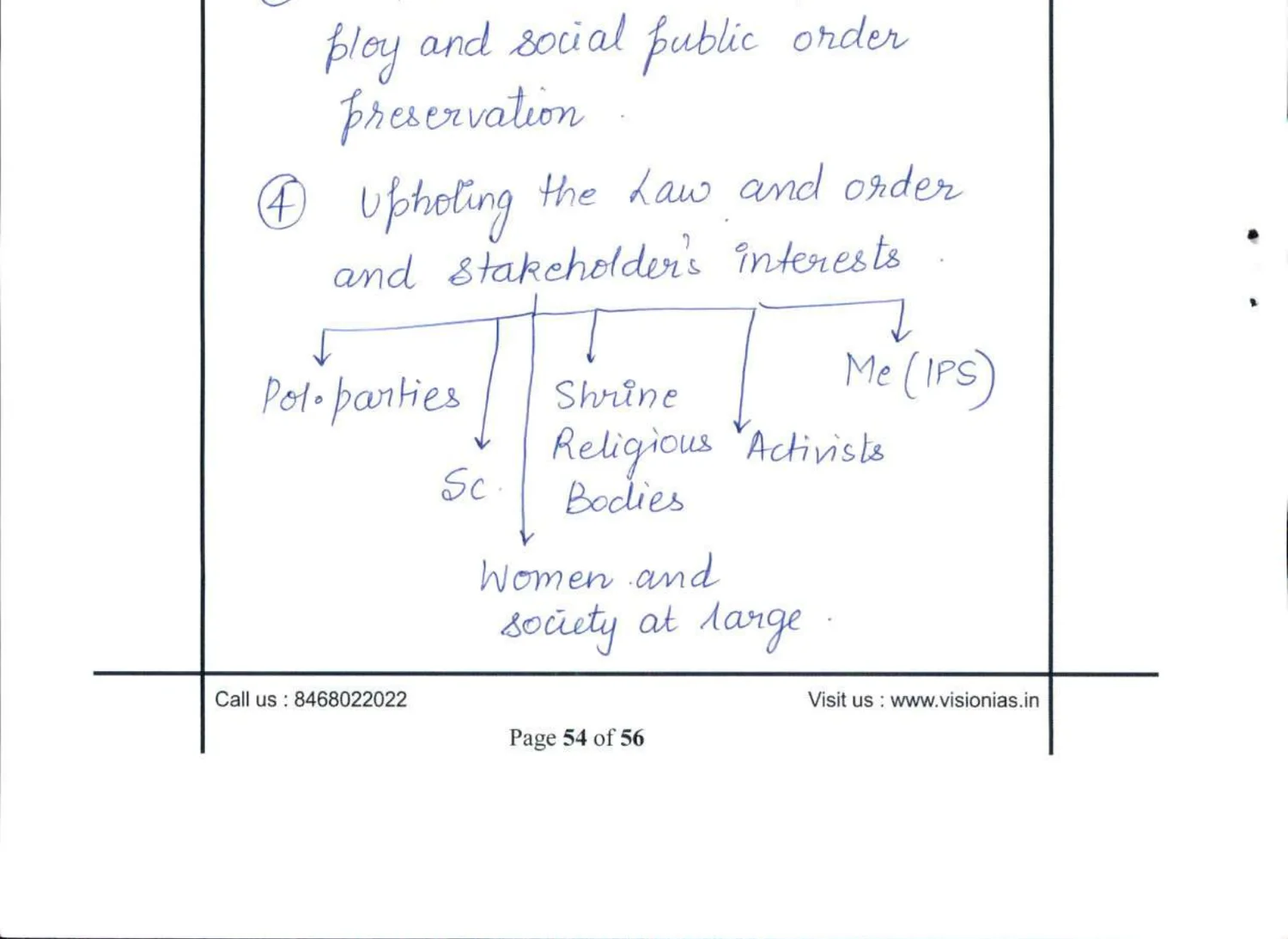
- Me (IPS) — the officer responsible for law and order
- Political parties — fuelling the campaign
- SC (Supreme Court) — ruling in favour of women's entry
- Shrine / Religious Bodies — defending the tradition
- Activists — supporting women's right of entry
- Women and society at large — the primary stakeholders affected
#Ans (c) — Course of Action
As an IPS officer, my foremost duty would be to uphold the rule of law, preserving social ~~ems~~ order and ensuring the smooth conduct of the annual pilgrimage.
Course of Action:
- Build up institutional framework — the forces at hand to ensure proper security to the women who choose to undertake the pilgrimage
- Conduct a multi-stakeholder meeting before the opening up of shrine visits and try to reconciliate a desireable course of action
- Ensure the political activism and dissent is ensured through peaceful, non-violent means without any tangible harm
- Widely publicising the SC order and requesting people to uphold the law and order unless a final petition or solution is reached
- In the end, I will make sure that my religious perceptions and discourse doesn't interfere in the public morality and my duties in non-partisan, neutral manner