Essay
Essay paper — material, structured introductions, quotes, and answer-writing technique.
Essay Notes (theme-wise)
Topper handwritten notes#WOMEN EMPOWERMENT

- Figure p1-01: Nehru epigraph handwritten at top of page; "Women Empowerment" as large stylised title beneath it; Sidwal branding logo visible top-right
"To awaken the people, it is women who must be awakened. Once she is on the move, the family moves, the village moves & the nation moves." — J.L. Nehru
-
Opening quotes / hooks
- "No better tool of empowerment than women themselves." — Kofi Annan
- "Each time a woman stands up for herself, she stands up for all women."
- "Women Empowerment is not about making women strong. They are already strong. It is about changing the way the world perceives their strength."
- "The inferiority of women is man-made." — paternal policies
- Whispers Break Silence
- Rid Dot [campaign reference]
-
Women rulers — [boxed] Razia Sultan
-
INM [Indian National Movement] and role of women
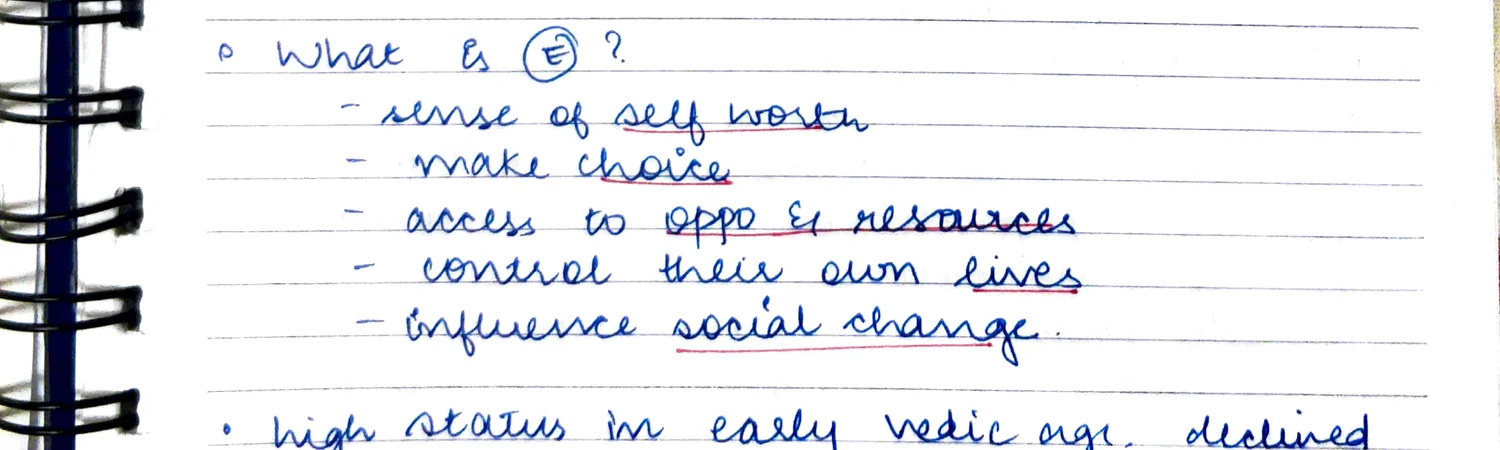
- Figure p1-02: Circle labelled "What is E [Empowerment]?" with four nested bullet points: sense of self worth; make choice; access to opportunities & resources; control their own lives; influence social change
#DIMENSIONS
(1) Socio-Cultural
- [side note: Sex vs gender divide]
- Reproductive health
- Edu[cation] decisions
- Marriage & marital rapes + honour killings
- Mobility
- Lifestyle — # Aint No Cinderella
- Genital mutilation — Dowry
- Tragedy — revered as Goddesses but refused to enter temple
(2) Economic
- [side note: 50+ pop[ulation] but only 5% businesses owned by women]
- Care economy
- Pink collared jobs
- Feminization of agri[culture]
- Sexual harassment — # MeToo, # Times Up
- Top positions
- [Glass ceiling]
- Dual roles — 2nd shift
- Dependent on family planning
(3) Political
- Women rep[resentation] in P[arliament]
- Leadership roles
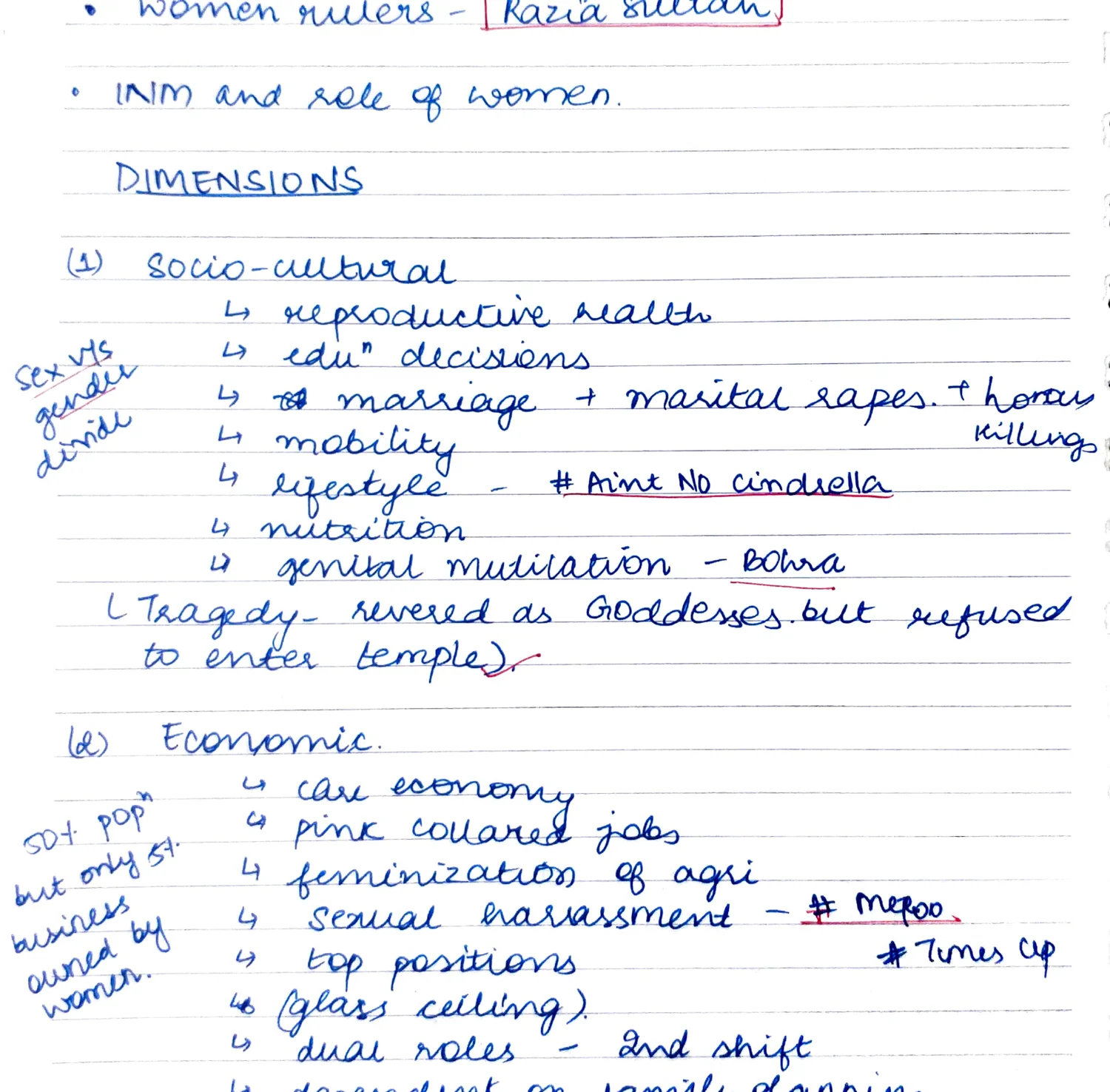
- Figure p2-01: Full DIMENSIONS heading; (1) Socio-Cultural block with side annotation "Sex vs gender divide"; (2) Economic block with side annotation "50+ pop but only 5% businesses owned by women"; hashtag callouts #MeToo and #TimesUp visible; [Razia Sultan] boxed at top; INM note
"Imposter Syndrome" [noted as a concept relevant to women in leadership]
- Panchayat — 33% reserv[ation] but Panchayat Pati [proxy representation]
- Huge gaps in E[economic], B[usiness], G[overnment]
- Only 1 woman PM till date [India]
- (78 women MPs in present LS [Lok Sabha])
- Odisha [model noted]
(4) Environmental
- Women & CC [Climate Change]
- Eco feminism
- Cyclone [Nargis] in Myanmar — 60%+ were women [affected]
- Produce 80% of world's food but receive 0.1% of grants
- [Most affected, yet have the least say]
(5) Historical Angle
(6) Technological
- Less in STEM
- 14/100 scientists are women
- Red vulnerability in 4th IR [Industrial Revolution]
- Last to be hired, first to be sacked
(7) Sports
- Viewed as a male bastion
- Pay parity?
- Sexual harassment
- Post-retirement sports
- Rep[resentation] of women in governing bodies
#Intro / Conclusion
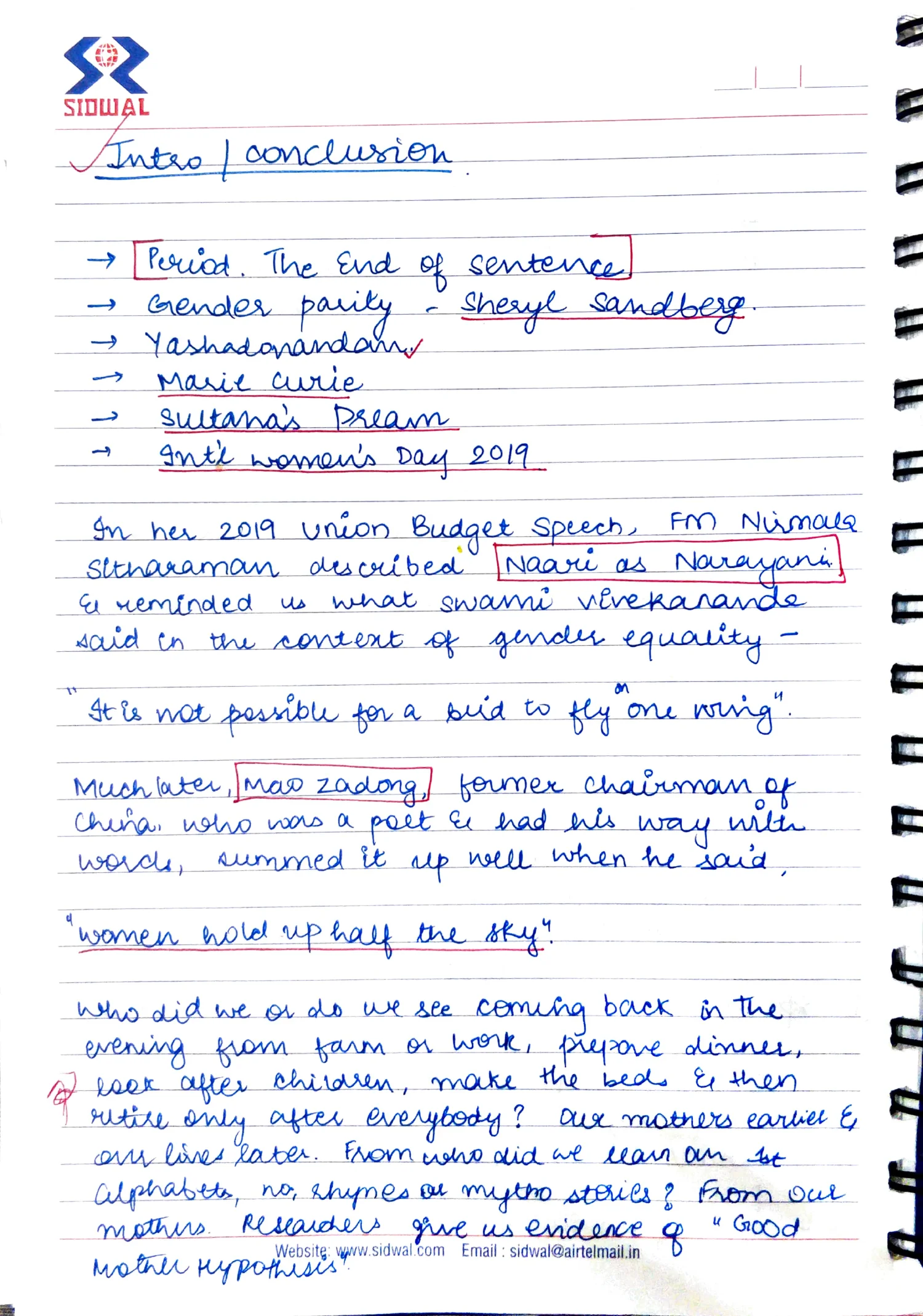
- Period. The End of Sentence [documentary reference]
- Gender parity — Sheryl Sandberg
- Yashoda Nandanam [song/reference]
- Marie Curie
- Sultana's Dream
- Intl Women's Day 2019
-
Figure p4-01: Full p.4 intro/conclusion section; [Period. The End of Sentence] boxed; [Naari as Narayani] boxed in orange; [Mao Zedong] boxed; "Women hold up half the sky" underlined; "Good Mother Hypothesis" in final line
-
Anecdote (intro):
- In her 2019 Union Budget Speech, FM Nirmala Sitharaman described [boxed] Naari as Narayani & reminded us what Swami Vivekananda said in the context of gender equality —
- "It is not possible for a bird to fly on one wing"
- Much later, [boxed] Mao Zedong, former Chairman of China, who was a poet & had his way with words, summed it up well when he said — "Women hold up half the sky"
- Who did we or do we see coming back in the evening from farm or work, prepare dinner, look after children, make the bed & then retire only after everybody? Our mothers carried & our lives later. From whom did we learn our alphabets, nursery rhymes or mythological stories? From our mothers. Research gives us evidence of "Good Mother Hypothesis"
#Positives / Examples
- Triple Talaq [abolished]
- Iron Lady of India
- Pratibha Patil
- Armed forces have female personnel
- 2018 — IAF inducted 3 female combat pilots [traditionally reserved for men]
- Making of Human Rights Charter
- [Indian] Const[itution]
- PCPNDT Act, various schemes like BBBP [Beti Bachao Beti Padhao], SSA, MOWCD [Ministry of Women & Child Development], Nari Shakti Puruskar
- Defence Minister, Finance Minister
- (SHG [Self Help Group] Movt)
- Sports — PV Sindhu, Sakshi Malik, Phogat Sister, Dipa Karmakar, Dipa [Das]
- SDG (5) [Gender Equality]
- Odisha model
- Malala Yousafzai
- [boxed] Sana Marin — NZ PM at 34, Jacinda Ardern [New Zealand PM examples]
- Khaps getting girl-friendly — Mukhya Ghar ki [Begumpuri], Selfie with Beti, Hold the Baby High
- [boxed] Tanya Shergill led an all male contingent on this Republic Day 2020
- SC [Supreme Court] allowed women to take up Permanent Commission in country's military
#Pledge / Conclusion Points
-
"Let us take the pledge:"
- Together we will protect girls' human rights in all circumstances
- Foster girls' capabilities in every field at all time
- Make girls' voices heard in DM [Democracy]
- Promote & harness girls' leadership
- Unleash girls' power in all its dimensions
- Ensure that girls' full potential is realised, gen after gen
-
[boxed] Planet 50-50 by 2030 — "there is where we all want to go. The SDGs are our today but it is also about our collective tomorrow & gender equality is our destination"
-
"All the evidence tells us that despite the enormous obstacles that remain, there has never been a better time in history to be born female. But the data leads to a second conclusion:"
- "That despite all the progress, we're just not there yet."
#Extended Examples / Anecdotes
-
Benazir Bhutto became the PM of Pak in 1988 but that didn't reflect the true state of women's participation in elections & Punjab. Women's turnout in Pak was one of the lowest in the world. In some villages like Dhurnal in Punjab of Pak, no woman had ever voted until the general elections of 2018. Pak had to promulgate a law in 2017 to announce that a constituency's vote count would be nullified if female voter turnout didn't reach 10%.
-
"Ladki hai ghar me rahegi to acha hai" [She is a girl, it is good she stays home]
-
Sudha Murthy was doing PG [Post-Graduation] at IISC in 1974 & became 1st woman to work on TELCO shop floor, opening way for other women. Is now a successful writer & chairman, Infosys Found[ation]
-
"Padhli likhke kya karogi, Karna toh ghar ka kaam hi hai" [What will you do after studying, you'll have to do household work anyway]
-
[boxed] Tessy Thomas — Director General of Aeronautical Systems & former Project Director for Agni-4 missile in DRDO. 1st woman scientist to head a missile project in India — Missile Woman
-
"Uthar le kitna dhoj jayegi" [illegible — approximately: How far will you take it?]
-
[boxed] Margala Mani recently became 1st Indian woman to live in Antarctica for 403 days. An ISRO scientist of expedition
#EDUCATION
- Manohar Parrikar Anecdote [reference to intro story]
- What is Education?
- Philosophy, psychology
- Ancient Indian schools/universities — Taxila & Nalanda — Vedic system, Gurukul
- Present Education System
- [boxed] South African Uni Board — message [reference]
- Strengths — Edu[cation] vs literacy
- Emphasised during freedom struggle — in, Gandhiji's [boxed] New Talim
- Need recognised — made a [boxed] Right — RTE 2008
#Problems — At Primary Level
- Out of school children — 92 lakh
- High dropout, low attendance
- Basic facilities (x) [absent]
- Poor learning outcomes — ASER [Annual Status of Education Report]
- Support outside school (x) [absent]
- Use of edu[cation] [quality issue]
Curriculum
- Caste [issue] [illegible partial note] — [side note: "Caste vs merit vs admission"]
Higher Education — Enrolment & Equity (GER — 25%)
- Regulatory issues
- Pol[itical] interference — SU [Students' Union]
- Attack on autonomy
- Steep fees
- Lack of outcomes
- Lack of research quality
- Employability — Arts only!
- World Class Uni[versity]?
- What academia–industry linkage?
- [boxed side note: JNU issue]
#Stakeholders
- Parents — Home is 1st school, parents are 1st teachers
- Students — Thirst for knowledge, not for rat race, ethics
- Teachers — Task of modern educator is not to cut down jungles, but to irrigate deserts
- "Commercial[isation]" of edu[cation], outdated tech → knowledge, pay, adhocism (DU [Delhi University])
- Govt — School is a building which has 4 walls with tomorrow inside
#Data / Facts
- Exp[enditure] on edu[cation] — 2.8% of GDP (2017-18)
- Brazil, South — 5.8%
- Bhutan — 9%+
- Vocational Edu[cation] = Tap the NEET pop[ulation]
- Menace of coaching institutes — Kota, Rajesh, Nayak [reference]
#SDG 4
- DSP — A41 ...
- A45, 46
- RTE [Act] 2009
#Way Forward / Conclusion
-
Physical Edu[cation]
-
Value Based / Moral (E) — [boxed] Sa Vidya Ya Vimuktaye [Education is that which liberates]
- With (E) we finally attain mukham [liberation]
-
Govt Initiatives:
- BBBP [Beti Bachao Beti Padhao]
- Kasturba Gandhi [Balika Vidyalaya]
- Eklavya
- Swayam
- e-Digi Board
- e-Pathshala
- JoE [Joy of Education?]
- RISE [Revitalising Infrastructure and Systems in Education]
-
BYOG — Online Edu[cation]
-
Finland [model]
-
Gandhi's New Talim
-
REID
-
Collaboration
-
Enthship [Entrepreneurship], Innov[ation] & Research
-
AA Edu[cation]
-
Security in school — Gurugram case
-
1% Exp[enditure] on (E) — Demo Dividend, Leverage tech
-
Innov[ative] pvt sector — Azim Premji Found[ation], Pratham
#Quotes on Education
- "Knowledge is the only instrument of prod[uction] not subject to diminishing returns" — JM Clark
- "Edu[cation] w/o moral is like a ship w/o a compass, merely wandering nowhere" — Martin Luther King Jr
- [boxed] "Every single problem you can think of...poverty, peace...the case is solved with edu[cation] or including edu[cation]"
- "He who opens a school door, closes a prison" — Victor Hugo
- Vidya Dadati Vinayam
- Vidya Dhanam Sarv Dhanam Pradhanam
#MEDIA
-
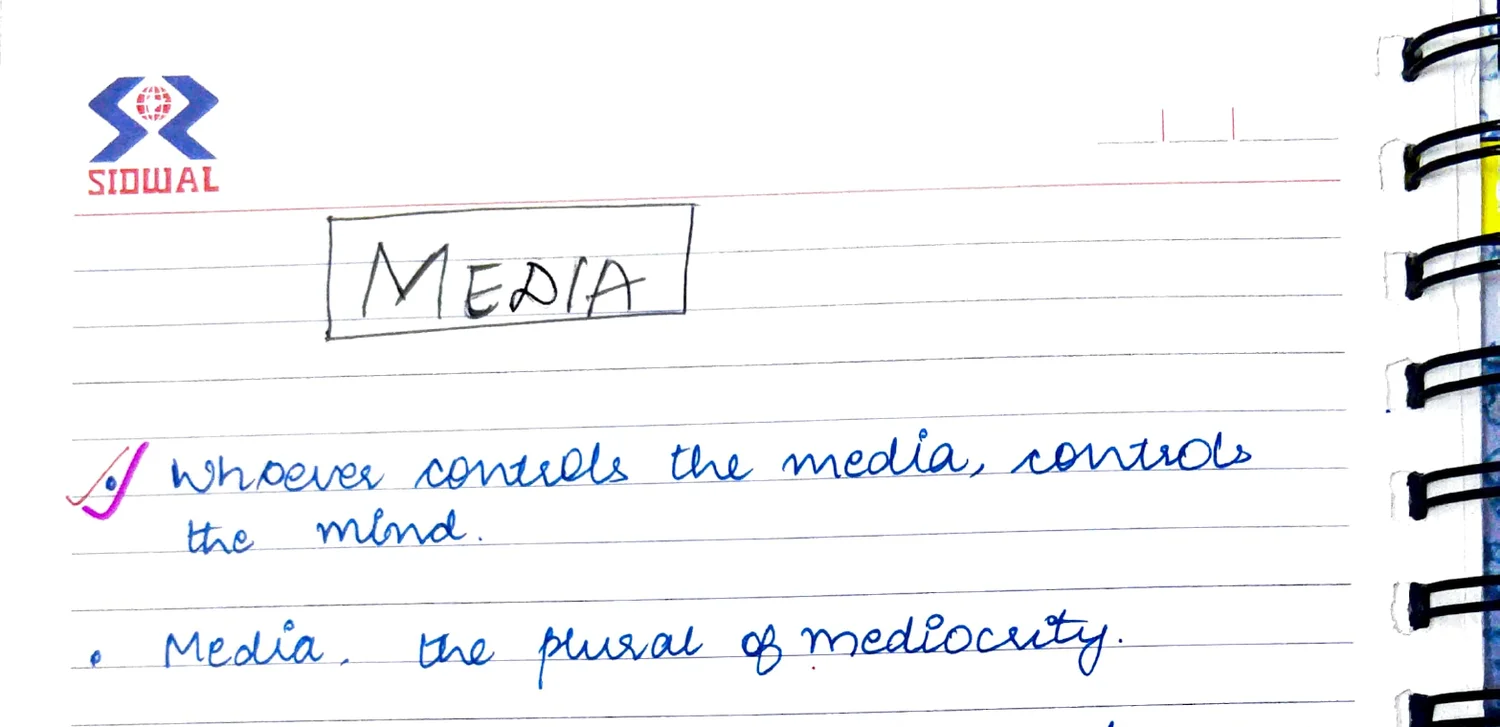
Figure p12-01: "MEDIA" handwritten inside a drawn rectangle/box (prominent heading); first two opening statements visible below
-
"Whoever controls the media, controls the mind"
-
Media — the plural of mediocrity
-
"The advancement & diffusion of knowledge is the only guardian of true liberty"
-
"It's amazing that the amount of news that happens in the world, everyday, always just fits exactly the newspaper" — Jerry Seinfeld
-
"It is said that media is a [boxed] soul-less lawyer. Give it any opinion & it can argue."
-
"Television saved the movies. The Internet is going to save the news business."
-
"In a time of [underlined] universal deceit, telling the truth is a revolutionary act"
-
"Don't believe everything you read on the internet, just because there's a picture with a quote next to it" — Lincoln
#Social Media — Role in Democracy
-
In 2010, Time Magazine chose Mark Z[uckerberg] as its annual "Person of the Year". He said that his platform had turned the "lonely, antisocial world of random chance into a friendly world, a serendipitous world"
-
A year later POTY [Person of the Year] was replaced by that of "The Protester" — the figure represented those who had voiced dissent often by org[anising] on FB/TW against authoritarian rulers in Bahrain, Egypt, Libya, Syria, Tunisia & Yemen
-
Fast forward 6 years, and POTY was Donald Trump. He responded through his fav[ourite] communication channel (Twitter) — "Thank you to TM & TF for naming me POTY-a great honor!"
-
Indeed, the power of social media in a democracy can't be disputed
-
Napoleon Bonaparte — "Four hostile newspapers are more to be feared than a 1000 bayonets"
#Thomas Jefferson Quote
- "If it were left on me to decide whether we should have a govt into newspapers or newspapers into a govt, I should not hesitate a moment to prefer the latter" — Thomas Jefferson
#Historical Role of Media
- British era — denied
- Major role in IFS [Indian Freedom Struggle]
- Enhanced role & responsibility on Indice [Independence]
- Strongly regulated during 1975 Emergency
- Came out stronger post that (print + electronic)
#Functions / Roles of Media
- Watchdog of govt
- Bridge b/w people & govt
- Shape demo[cratic] society by emphasising even sticky/niche issues like sexual assaults, child care, domestic violence
- Empowerment through Info[rmation]
- 4th pillar
#Constitutional Position
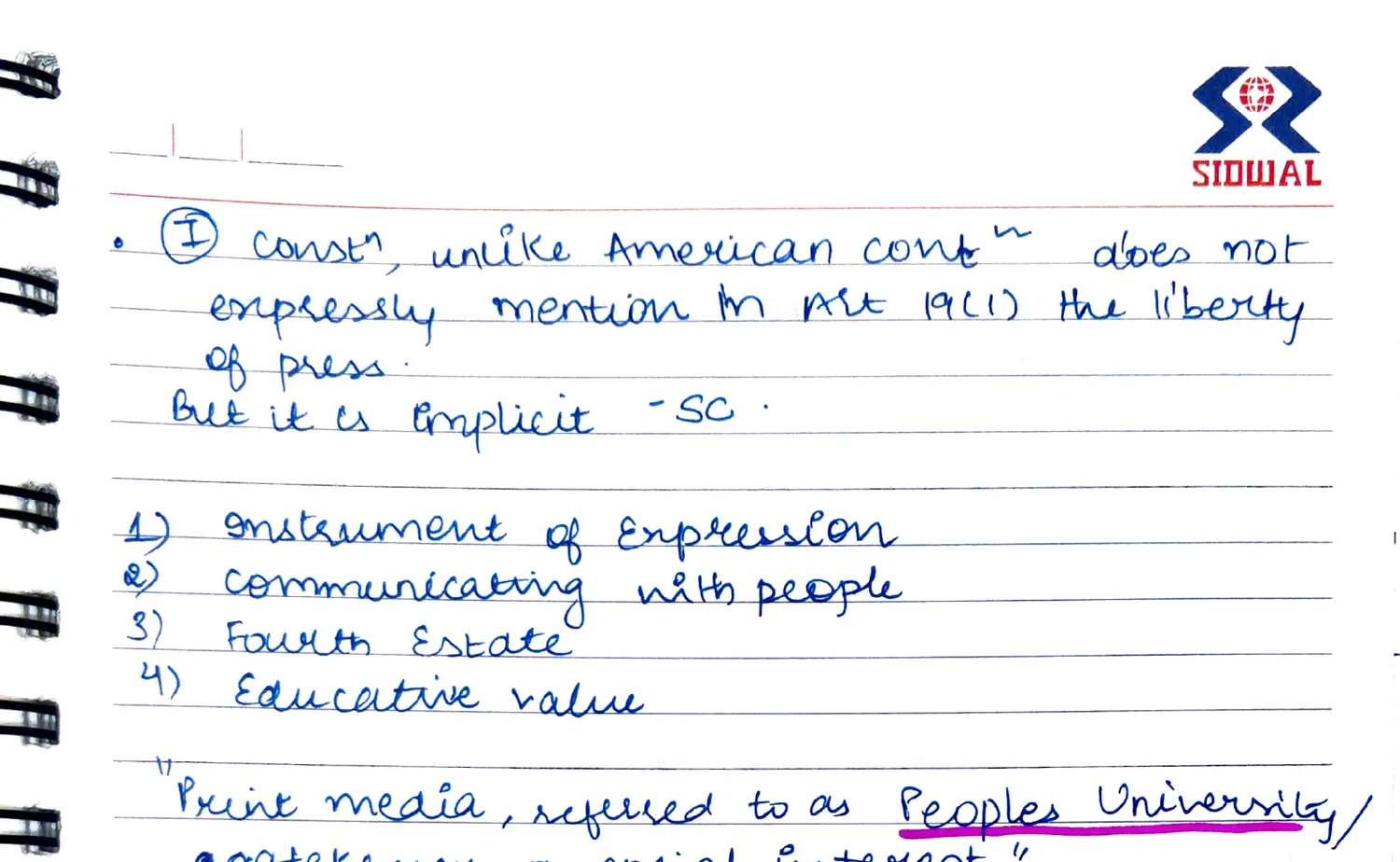
-
Figure p15-01: Note that Indian Const. unlike American Const. does not expressly mention liberty of press in Art 19(1) but it is implicit (SC); numbered roles 1-4 (Instrument of expression, Communicating with people, Fourth Estate, Educative value); "Peoples University / gatekeepers of social interest" underlined
-
(I) Const[itution], unlike American Const[itution], does not expressly mention in Art 19(1) the liberty of press
- But it is implicit — SC [Supreme Court]
- Instrument of expression
- Communicating with people
- Fourth Estate
- Educative value
- "Print media, referred to as [underlined] Peoples University / gatekeepers of social interest"
- Helps to bring change — behavioural
- Making the world smaller & closer
- Nation building
- JL Nehru — "I would rather have a completely free press with all danger enshrouded in the wrong use of that freedom, than a suppressed or regulated press."
- Role in politics / democracy
- "John F Kennedy might never have been American Pres[ident], were it not for his brilliant profile on TV"
- "Even a powerful pers[on] like [underlined] Richard Nixon was forced to leave the house due to exposure"
#Media & Democracy — Roles of Media (continued from p.15)
#Positive Roles of Media (continued — page 16)
-
by media on the notorious Watergate Scandal
-
- Human rights
-
- Global Village — LPG [Liberalisation, Privatisation, Globalisation]
- media helps in globalising culture
-
- Telefilms / documentaries — social issues
- (Period: The End of Sentence)
-
- Quiz-based TV shows, skills learning — cooking, drawing, dancing, coding etc.
-
- Radio & TV in rural India's transformation:
- a new perception of womanhood
- progs [programmes] on health, agri [agriculture]
- talk shows
-
- Media & Women Empowerment:
- ltd [limited] coverage of women's issues
- "commodify" of women
- social influence — cookery shows, beauty tips, weight loss, fashion, glamour
- "depict" of women in TV serials
-
- Corruption in public life & media:
- TH [The Hindu] exposed Bofors scandal
- (also raised a flag in Rafale deal)
#Media & Democracy — Roles of Media (page 17)
#Investigative Journalism / Media Watchdog Role
-
Tehelka magazine in exposing BJP: Perse, Bangaru Laxman
- investigative journalism
- sting operations
- holding public debates — Aap Ki Adalat
- conducting opinion [illegible] polls
-
Quote: "Information is regarded as lifeblood of democracy." Info is power.
#16) Media can contribute to Governance by:
-
→ catalyzing effective implement[ation] of RTI Act, 2005
-
→ providing info to citizens & building awareness on the Act
-
→ giving voice to citizens
-
→ acting as watchdog
-
Quote: "Media must consider its independence to be its most valuable, commercial, editorial and moral asset."
-
- Media & Parliamentary Privileges
-
- Films, freedom of expression & censorship
#Media & Democracy — Issues (page 18)
#19) Decency, morality & law of ethics
#20) Media Trial / Trial by Media
- is impact of media coverage on the reputation of a person by creating a widespread perception of guilt regardless of any verdict in a court of law
- eg: anti-[illegible] slogan on JNU issue — some doctored videos circulated
- Jessica Lal case — helped to find guilty
- Arushi Talwar case — Talwars were shown as murderers by many media orgs [organisations]
#21) Media Ethics
#22) Bigger but not better — Indian media industry expanded massively since the 90s.
- 1,00,000 registered newspapers
- 400 news channels
- 150 channels are awaiting clearance.
#Media & Democracy — Issues (page 19)
#Issues (continued)
- Paid news
- Blatant Blackmail — Zee News (2012) did ₹100 cr from Jindal Power & Steel Ltd. to dilute their networks campaign against the co. in the coal scam.
- JSP [Jindal Steel & Power] chairman & Cong MP Naveen Jindal conducted a reverse sting to expose them
- Media Industry — profit motive [TRP] — "senseational" [sensational] of news
- Eng v/s local lang media:
- encourage more masala news
- Infotainment — Info for entertainment
- A journalist is a generalist
- Freedom of the Proprietor, not the press.
- No Al Jazeera or BBC in India.
- Terrorism & Press Freedom — attacks on journalists. Jamal Khashoggi
- Crony holdings
#Media & Democracy — Issues (page 20)
#Issues (continued)
- Post-truth / mfd [manufactured] consent
- Yellow Journalism — little or no legitimate well-researched news while using eye-catching headlines for ad sales.
- Social media & pol [political] micro-targeting
- eg: FB & CA [Cambridge Analytica] case
- Chinese media's response to COVID-19 outbreak
- => State control on media
#Environment
#Opening Quotes / Invocations (page 21)
-
In their hymn to Earth, the sages of the Atharva Veda chanted:
- "What of thee I dig out, let that quickly grow over. Let me not hit thy vitals. Or thy heart."
-
The growing awareness of "one earth" and "one env[ironment]" should guide "one humanity"
-
Indira Gandhi — Stockholm Speech, 1972:
- I am reminded of an incident in one of our tribal areas. The vociferous demand of elder tribal chiefs that their customs should be left undisturbed found support from noted anthro[pologists]. & we accepted their advice.
- I was amongst those who entirely approved. However, a visit to remote part of our NE [North-East] frontier brought in touch with a diff [different] pov [point of view] — the protest of younger elements of that while the rest of India was on the way to modern", they were being preserved as "museum pieces".
- Could we not say the same to affluent nations?
#Environment (page 22)
#Indira Gandhi — Stockholm Speech, 1972 (continued)
- Are not poverty & need the greatest polluters?
- Till we do not provide the forest dwellers with alternatives, we can't prevent them from combing the forest for food & livelihood.
- When they themselves feel deprived, how can we urge the preservation of animals?
- The env[ironment] can't improved in "cond[itions]" of poverty nor can poverty be eradicated w/o [without] use of S&T [Science & Technology].
#Edicts / Ancient Indian Environmental Consciousness
- Throughout India, edicts carved on rocks & iron pillars are reminders that 22 centuries ago, the Emperor Ashoka defined a king's duty as not merely to protect citizens but also to preserve animal life & forest trees.
#Human Being — An Imperilled Species
-
Human being — an imperilled species.
- In poverty, he is threatened by malnutrition & disease
- in weakness by war
- in richness by the pollution brought about by his prosperity.
-
Quote: "The future will either be green or not at all." — Bob Brown
#Environment (page 23)
#Greta Thunberg — Youth Climate Speech
-
"I'm only a child & I don't have all the sol[utions]."
- "But I want you to realize, neither do you!"
-
"You don't know how to fix the holes in our ozone layer. You don't know how to bring salmon back up a dead stream. You don't know how to bring back an animal now extinct. And you can't bring back forests that once grew where there is now desert. If you don't know how to fix it, please stop breaking it!!"
#Technology & Environment
- Technology is often touted as a "sol[ution]" to the world's envt [environmental] challenges but is also a part of the problem. Sending 1MB email equals 20gm of CO₂ emissions.
#World Business Council for SD [Sustainable Development]
- Peter [Werhane / illegible], a few yrs back had emphasised the willingness of big corp[orations] to extend support for science-based targets. He said that the aim of business community was to move from
- "Turbulent Teens" (Decade 2010–20) to the
- "Transformation Times"
#Environment — Plastic Pollution (page 24)
[Note at top: "matter from GS notes"]
#King Midas Analogy (Intro/Conclusion idea for Plastic Pollution essay)
-
When the Gods granted King Midas one wish, he wished that everything he touched would turn into gold. Midas was delighted. Trees, rocks, buildings, petty things all gold.
-
But soon he found to horror that his food turned into gold as well. When he hugged his daughter to soothe her pain, he realized his mistake too late.
-
The richest man in existence was STARVING, HEARTBROKEN & ALONE
-
Humanity got a similar wish granted when we learned how to turn brown, stinky goo into magic — PLASTIC. Cheap, sterile & convenient, it changed our lives. But this wonder of tech got a little out of hand. Plastic has invaded and saturated our env[ironment] to the extent that it even finds way into our bodies today!
#Conclusion idea for Plastic Pollution essay
-
Conc[lusion] — We found a magic material & we had a really good time with it. But we need to be careful or just like Midas, we'll end up in a world that we didn't wish for.
-
When plastic comes of age, it shall clog the arteries of those who invented it.
#Environment (page 25)
#God's Garden Has Become Man's [junkyard]
[Title at top, with "junkyard" handwritten at top right corner]
- 5P — People, Profit, Planet, Peace, Partnership
- 9Rs + Recover — Redesign — Remfr — Rethink — Reuse — Replace — Repurpose + Rejoice
- Tragedy of Commons + CBPR [Community Based Participatory Research / Common But Differentiated Responsibilities]
#Eskimos — Traditional Ecological Knowledge Example
- Eskimos live in inhospitable climate in Alaska. They lived in harmonious r/ship [relationship] with env[ironment] & resources available. Americans gave them guns. They practiced excessive hunting making their livelihood unsustainable.
#Recent Environmental Losses
- To recount the species that we lost just in 2019 — 3 bird species, 2 frogs, a shark, a famous snail & one of the 4 largest freshwater fish.
- The California wildfires 2020 burned roughly 100 mn acres of land, affecting lives and livelihood.
- These instances signal that if ecological problems are not urgently attended to, the world may not need world wars to destroy itself.
#Vedic Precept
- We will have to keep the Vedic precept on our mind — माता भूमि: पुत्रो अहं पृथिव्या: (This earth is our mother & we are its sons)
#Health
#Intro (page 26)
- From all over the world, people needing hip replacements, cardiac bypasses or even bone marrow transplants are singly flecking I [flocking] for treatment.
- Top flight hospitals in Mumbai, Delhi, Chennai & elsewhere are performing sophisticated procedures on 100s of 1000s of 'medical tourists' each year, thanks to the renowned Indian doctors & the comparatively low cost of a hospital stay.
- Considering how successful our health care systems has become at delivering effective & affordable treatment for foreigners, the prospect of decent care for all Indians might seem to be within our grasp. Unfortunately, the dream remains as distant as ever.
#Health — Challenges (page 27)
#MMR & Inequalities
-
- Take IMR [Infant Mortality Rate] — At ___/1000 live births, the rate in India is x times higher than in China, y times (↑) than in SL [Sri Lanka] & Thailand & even (↑) than in Bangladesh & Nepal.
-
- Equally discouraging are inequities that exist within one country. An infant born in MP [Madhya Pradesh] is 6x more likely than her peer born in Kerala to die before her 1st bday [birthday].
-
- A new metric for measuring India's progress — the healthy life expectancy of a tribal girl born in MP.
-
- eg: Aravind Eye Care Model — Clinics can subsidise care for the poor with funds charged to patients who can afford to pay.
- Swasthya Slate — a tablet device to perform various diagnostic tests like ECG, blood sugar, BP, heart rate.
- ?) Can India assure good health to every citizen at all stages of life? Of course it can, but doing so will entail an enormous collective effort, dedicated to addressing the needs of that baby girl from MP.
#Health — Concepts & Quotes (page 28)
#Definitions / Frameworks
-
Modern concept of health = absence of illness = -ve [negative] approach
-
Ancient India = physical, mental, emotional, spiritual, social well-being.
-
Amartya Sen — Health is a social good. A person should be termed healthy if he is able to actively participate in soc[iety].
-
आरोग्यम् परमम् भाग्यम्, स्वास्थ्यम् सर्वार्थसाधनम्
- Good health & greatest blessing. Health is means of everything.
-
Health Insurance → Assurance
-
India = Yoga — a way of life
- Also I [India] = Diabetes capital of w[orld] = Lifestyle diseases
-
Health = a social good
- pol [political]
- economic
- ecological
- ethical
-
SDG #3
-
M.G. — "It is only health, which is the real wealth."
#Health — Challenges (page 29)
#List of Health Challenges
-
Weak primary healthcare
- 1 bed → 614 people — Goa
- " 8789 " — Bihar
- Doctor pop[ulation] ratio = ♥ <1 per 1000 pop[ulation] (0.7)
- 70% exp[enditure] → OOP [Out Of Pocket]
- SCe [Scheduled Castes] = poverty; 50% women = anaemic
- eg: Gorakhpur case
-
Inadequate finance = 1.28% of GDP
- le 2–3 rs per day per citizen
-
- skewed pattern → favour of NCDs [Non-Communicable Diseases]
-
Weak regulatory flw [framework] & pvt [private] sector
- eg: MCI & corruption
- Fortis, Gurgaon charged 16 lacs from dengue patient
-
Rural-Urban divide, gender divide, N-S [North-South] divide
- Urban = 73% of public bed but 69% pop[ulation] in rural areas.
-
Fragmented health info[rmation] system
-
Weak govce [governance] & A[c]cability [Accountability]
-
Med[ical] Edu[cation] — NEET controversy
#Health — Challenges (page 30)
#Challenges (continued)
- Health research exp[enditure] = 1% of total HC [Health Care] exp[enditure]
-
- Hidden Hunger
-
Social reasons — poverty, unemp[loyment], lack of edu[cation], open defecation, poor sanitation, diseas[es] (TB/HIV)
-
AMR [Anti-Microbial Resistance] & rise in epidemics
-
Low key support of indigenous systems
-
Lifestyle diseases + Mental Health
-
Transgender health
-
Decline in med[ical] ethics — organ trafficking, sex selective abortions, customer mindset, abortion, euthanasia etc.
-
Geriatric health
-
One Health concept — COVID-19
#Achievements
- → Generic Drug / Pharmacy of the world. 1 in every 7 persons in world has med supplied by India.
- → Med[ical] Tourism — > 3bn USD + exporter of healthcare professionals.
- → Cost effective solutions.
- → Rt [Right to] health win Ayush + DPSP [Directive Principles of State Policy]
- → Ayushman Bharat / NHP [National Health Policy] 2017 / Mission Indradhanush
#Healthcare (continued from Part 2) — Fixing the Broken Healthcare System
#Government Schemes & Initiatives (p.31)
- Jan Aushadhi Kendras
- Mental Healthcare Act, 2017 = rights based approach
- CSOs [Civil Society Organisations] — Smile India (F) [Foundation] — quality healthcare at doorsteps
- Mobile Ambulances
- Rural Healthcare (F) [Foundation]
- Int'l org [organisations] — WHO, UNDP, Bill & MGF [Melinda Gates Foundation], Doctors Without Borders
#Best Practices (p.31)
- Delhi Mohalla Clinics
- Odisha e-healthcare (Telemedi — 127 centres)
- ASHA health workers
- Int'l [International] — S. Korea, Nordic countries, SL [Sri Lanka]
#Essay Angle — Fixing the Broken H.C. [Healthcare] System (p.31)
- Curative → preventive h.c. [healthcare]
- Econ -ve → +ve conception of health
- Women as agency of health = how edu'n [education] in women & malnutrition rates in children
- Tech Rev'n [Revolution] & Biotech.
- Bottom up approach
- Revamp Ind'l [India's] systems (eg COVID 19)
- Ethics & regulatory f/w [framework]
- AAA ie Inclusive Health Agenda
- UHC [Universal Health Coverage]
- CSR [Corporate Social Responsibility]
#Healthcare — Quotes & Anecdotes (p.32)
#Amartya Sen Analogy
- To borrow Amartya Sen's analogy, it's he reps an island of California (achiever!) in a sea of sub-Saharan Africa (challenges)
#Poem / Quote on COVID-19 / Pandemic
- Imagine a virus smaller than a grain of salt, that brought the world to a halt, Exposing the fragile sand castles of kings clad in white, and govts [governments] & their rulers and all their might
#Social Media (p.33–38)
#Quotes — Technology & Social Media (p.33)
- "Social Media have brought power back to the people"
- "Whoever controls the media, controls the mind" — Jim Morrison
- "Connectivity is a human right" — Mark Zuckerberg
- {Offline is the new luxury}
- No liking, no posting, just pure living
- In a world of algorithms, hashtags & followers, know the impact of human connection
- {A million likes won't be enough if you don't like yourself}
- → "Digital Detox"
#Examples — Power of Social Media (p.33)
- eg: power of social media
- US Presidential Elections 2012
- Arab Springs 2010
- #MeToo Movt [Movement] — global
#Definition & Context (p.34)
- [Header keywords] "Netplugged" / SM addict — avoid
- Man is a social animal — pigeon post → postal letters → telephones → smart phone → social media
- Not only changes way of (how) of comm'n [communication] but also what of [content of communication]
- SM [Social Media] = umbrella term for websites & apps that enable users to create/share content & interact → Social N/ws [Networks] are formed
- Golden Era of Social Media — with the dawn of the millennium:
- 2001 — Wiki
- 2003 — My Space
- 2004 — Fb [Facebook] (only for Harvard)
- 2005 — Youtube [highlighted in pink box]
- 2006 — Twitter
- 2007 — Whatsapp
- 2014 — Fired [Periscope/live broadcasting]
- Global users of SM — 3.196 bn [billion] (2018)
- No. of DAILY W-App [WhatsApp] Fb [Facebook] messages — 60bn [billion] = SILENT REV'N [Revolution]
- Why is SM so popular? Indispensable? 1st choice for everything from news to governance to commerce to social movt [movement]?
#Information Society / Super Industrial Society (p.35)
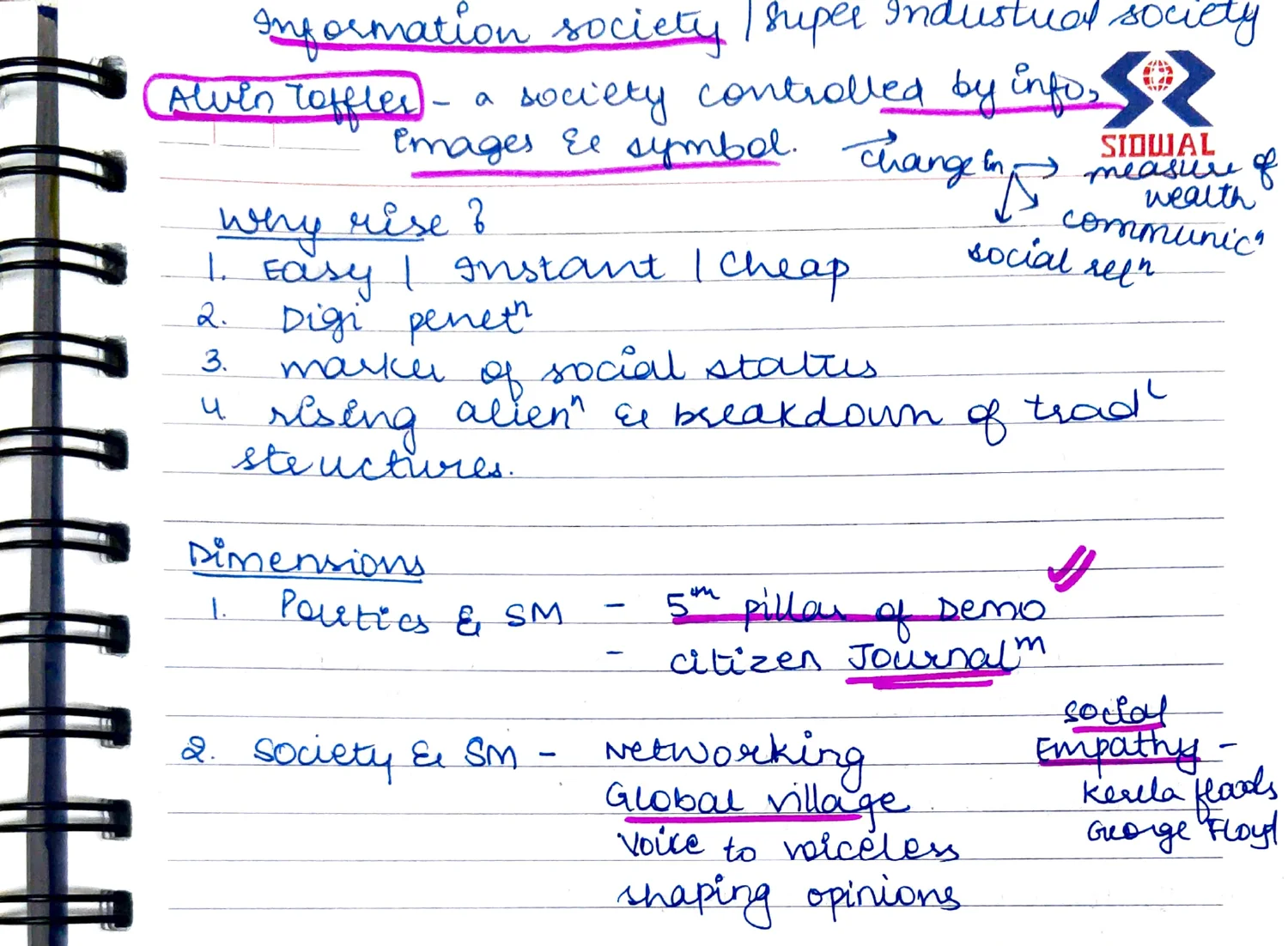
- Information society / Super Industrial society
- Alvin Toffler — a society controlled by info, images & symbols. Change → [leads to] media of wealth, communication, social use
- Why Rise?
- Easy | Instant | Cheap
- Digi pen'n [Digital penetration]
- Marker of social status
- Rising alien [alienation] & breakdown of trad'l [traditional] structures
#Dimensions of Social Media (p.35)
- Politics & SM — 5th pillar of Demo [Democracy]
- Citizen Journal'ism [Journalism]
- Society & SM — Networking
- Global village
- Voice to voiceless
- Shaping opinions
- Social Empathy — Kezia Floyd, George Floyd [written as side annotation]
- Economy — ↑ reach of co. [companies]
- New source of emp't [employment] — PR managers, SM handlers, Insta [Instagram] influencers, Youtubers
- PROSUMER [boxed] — PROducer + consumer
- E-commerce
- Digital mktng [marketing]
- Ecology & SM — Awareness Movt [Movement] (#Play for Amazonia [boxed])
- Independent activism
- Fund raising
- Mob on protest (AA [Amazon] forests in Mumbai)
- Global trendsetters
#Ethics & Governance Dimension (p.36)
- Ethics & SM — free speech, tolerance, diversity, responsibility, universal brotherhood & love
- Governance & SM — MEA [Ministry of External Affairs] w/ [with] Sushma Swaraj; Mumbai Police Tweet, Kiran Bedi on Fb [Facebook] etc. citizen–govt [government] engage ↑
- SM as 'Arbiters of truth' [boxed/highlighted]
- Donald Trump's tweet fact checked & [Presi] called Twitter "an editor with a viewpoint"
- Amul's Atc [account] temporarily suspended for promoting 'Made in India' product
#Challenges / Negative Dimensions (p.36–37)
- Empowers AI over Human wisdom
- Absence of MCJ [Moral Code of Journalism]
- Privacy issues — govt [government] bans SM apps
- Perceived partisan censorship
- Illegal content — disregard IPRs [Intellectual Property Rights] (Unacademy videos)
- Political manoeuvring — Cambridge Analytica & US elections
- Fake News
- Character assassinations
- Invertinity [Insta] — Sushant's last images
- Has become primary source of info
- Decides rise & fall — Ranu Mondal
- Degrades quality of life — click before eating food, show off etc.
- Follow–Unfollow — new ruthna–manana [Hindi: sulking–reconciling] — no stable friendships [relationships]
- Affects IR [International Relations] too — Israeli PM wishes PM Modi on Friendship Day, spikes up tensions by quick & prompt replies; eg US Pres'n [President] pump on China's COVID response; diplomatic troubles
- Ethical issues — crimes, AI, mockery, deceit, etc. disregard of human emotions
- Governance challenges — how to regulate content, control crimes etc.
- Internal security — fundamentalism, recruitment, Blue Whale challenges, PokemonGo, Kiki challenge (Drive and dance) [highlighted in yellow]
- Loss of revenue to govt [government] — GAFA tax etc.
#Way Forward (p.37)
- German Model [boxed] — German law reqs [requires] platforms with over 2mn [million] users in Germany to receive user complaints & takedown illegal content. Law fines co. for not having robust GRM [Grievance Redressal Mechanism]
- Independent oversight body
- {Digital socialism — a commons based sol'n [solution] embodying principles of self governance, self discipline, decentral'n [decentralisation] to transform SM from a profit-seeking enterprise to a global democratic commons}
#Additional Concepts (p.38)
- Data protection
- Fact checkers
- Orwellian society — society portrayed by Orwell in his novel 1984 characterised by totalitarian govt & irrational pet concepts
- Andrew Keen book "The Cult of the Amateur" [boxed] — writes that "out of this anarchy, it suddenly became clear that what was governing the infinite monkeys now inputting away on the Internet was the law of Digital Darwinism or the survival of the loudest & most opinionated" [underlined]
- FAD — Facebook Addiction Disorder
#Conclusion Paragraph (p.38)
- Social Media is a great space. It can bring social rev'n [revolution] like Arab Spring. It can be bulwark of f/o [freedom of] speech & expression. However, it can also degenerate into Echo Chamber & place of online trolling. There is need to reform it to bring Social Resp. [Responsibility]
- Joker from the Batman series has said an amazingly insightful statement — "Give a man a mask, he will show you who he truly is." A 'mask' or a veneer of anonymity is all it takes to bring out the worst qualities of a human being. And social media often acts as that mask}
#Poverty (p.39–42)
#Opening Quote / Frame (p.39)
- Roosevelt — "The test of our progress is not whether we add more to abundance of those who have, it is whether we provide enough to those who have too little."
#Data (p.39)
- B/w 2005–15, incidence of multidim'l [multidimensional] poverty in India almost halved, climbing down to 27.5% from 54.7%. Within years, 271 mn [million] people were lifted out of poverty.
- Focus not just on poverty eradication but on creating prosperity.
#Multidimensional Concept (p.39–40)
- A Multidimensional concept —
- Economic — income / resources
- Pol [Political] — voice in pol [political] affairs; equality
- Social — status in soc [society], crime rate, drug [abuse]
- Cultural — (activities, contrib'n [contribution])
- Mental — health, edu, oppo [opportunities]
- Learning poverty (WB [World Bank])
- Technological poverty
- Envr'l [Environmental] poverty
- {Poverty is hunger. P [Poverty] is lack of shelter. Being sick & not being able to see a doc. Not knowing how to read & having access to edu. Rob of future. Not having a job. Living one day at a time. P is powerlessness & no freedom.}
- Sen's Capability Approach
- Acc to Galbraith, po [poverty] itself may be a source of pov. It continues itself.
#Faces of Poverty (p.40)
- Rural v/s Urban
- Men v/s Women
- Adults v/s Children
- Youth v/s Elderly
- Po & Envr'l [Environmental] degrad'n [degradation]
- Pop'n [Population] explosion
- National progress
- {While humanity shares 1 planet, it is a planet on which there are two worlds, the rich & the world of the poor?}
#Causes (p.40)
- Colonial exploit'n [exploitation]
- ↑ in pop'n [population]
- Natural calamities
- Rise of or unorg'd [unorganised] sector
- Distressed agri [agriculture]
- No inst'l [institutional] support
- Social factors
- Corruption
- No entrep'ship [entrepreneurship]
- No infra [infrastructure]
#Government Measures (p.41)
- Gram Swarozgar Yojana — PMAY [Pradhan Mantri Awas Yojana]
- SHGs [Self Help Groups] — MGNREGA [Mahatma Gandhi National Rural Employment Guarantee Act]
- NURM / NRLM — UBI [Universal Basic Income]
- DDUAY [Deen Dayal Upadhyaya Antyodaya Yojana]
#Data Point (p.41)
- Acc to World Poverty Clock, close to 44 times Indians are escaping from extreme poverty each minute.
#Poverty & Global Linkages (p.41–42)
- "Saving our planet & lifting people out of poverty they are the same fight" — Ban Ki Moon
- {The islands of prosperity can't survive for long in oceans of poverty. Poverty generates the tides of instability, conflict, war, disease, terror, crime, envr'l [environmental] degrad'n [degradation] & unrest which threaten to wash away the prosperity even from the far distant shores.}
Poverty & AIDS (p.41)
- AIDS — origin in Mexico, but today UN & rich nations have to spend bn on containment. SARS Similarly: Ebola, SARS, avian flu}
Poverty & Envt [Environment] (p.42)
- P & Envt [Environment] — P [Poverty] is the biggest polluter.
- "When there is no earth to live, there is no prosperity left to be created"
Poverty & Crime / Revolution (p.42)
- P & Crime — Poverty is the mother of crime & rev'n [revolution]. Arab Spring, Naxalism, Extremism, Terrorism.
- {"Poverty of goods can be easily cured but poverty of soul is irreparable"} [highlighted in pink]
#Globalisation (p.43–45)
#Opening Frame (p.43)
- Indian culture is wary about 'Kupamanduka' — the frog that lives in the well & knows nothing else. Its impact suspicious of everything outside it.
#History of Globalisation — In Recent 100 Years (p.43)
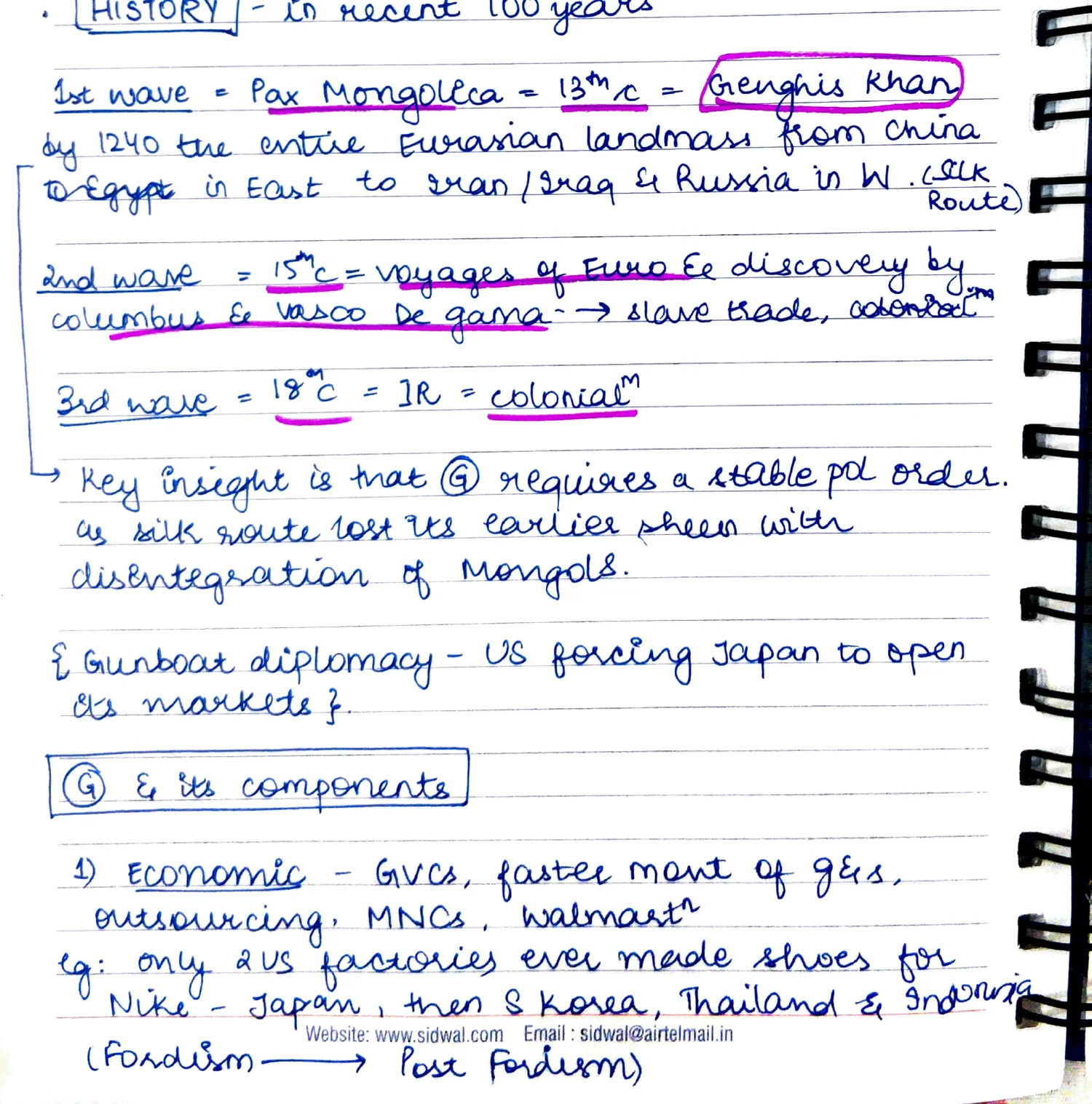
- [HISTORY] — In recent 100 years
- 1st wave = Pax Mongolica = 13th c. = Genghis Khan [highlighted]
- By 1240 the entire Eurasian landmass from China to Egypt in East to Iran/Iraq & Russia in W. (Silk Route)
- 2nd wave = 15th c. = Voyages of Euro [Europeans] & discovery by Columbus & Vasco de Gama → Slave trade, colonial'sm [colonialism]
- 3rd wave = 18th c. = IR [Industrial Revolution] = colonial'sm [colonialism]
- Key insight is that G [Globalisation] requires a stable pol [political] order. As Silk route lost its earlier sheen with disintegration of Mongols.
- {Gunboat diplomacy — US forcing Japan to open its markets}
#G [Globalisation] & its Components (p.43–44)
- Economic — GVCs [Global Value Chains], faster mant [movement] of g&s [goods & services], outsourcing, MNCs, Walmart'n [Walmartisation]
- eg: only 2 US factories ever made shoes for Nike — Japan, then S. Korea, Thailand & Indonesia (Fordism → Post Fordism)
- Political — rise of multilateral inst'n [institutions] to ensure a rule based global order [Mongols?] so IMF, WB, WTO, Free trade regime
- Socio-cultural — historically, expansion of Buddhism under Ashoka to SL [Sri Lanka], SE Asia, China
- "As goods travelled to faraway lands, so did culture & religion" [underlined]
- Arabs brought Islam to India
- McDonalds & McCulture
- Yoga, Ayurveda
- Glocal [Glocalisation]
- Econ'm [Economic], consumer'm [consumerism], material'sm [materialism] > spiritual'sm [spiritualism]
- Impact on health, edu [education], gender equality, music, lifestyle
#Is G [Globalisation] Inevitable? (p.44)
- Is G [Globalisation] inevitable, unstoppable or will it come to a dead blow?
- Historically, G [Globalisation] has been a fragile pheno [phenomenon]:
- Pax Mongolica disrupted by Black death / Plague which killed 25 mn people in 14c [14th century]
- Age of Empires (colonial & imperial) disrupted by wars & Great Depression [underlined]
#Future of Globalisation (p.45)
- "Battle of Seattle" in 1999 marked the unofficial start of anti-G [Globalisation] movt [movement] — critical of its impact on people, poverty, envt [environment] etc.
- Economists like Friedman believed that "to stop the G [Globalisation] rise is to stop the rising sun." He was once asked if he supported the Capta'l [Capital] (Caribbean). He said yes. "I don't know what it's [like]. I only use the two words 'Free Trade' & I support it."
- Future of Global'n [Globalisation]?
- → Rise of protectionism
- → Brexit
- → US said not TPP [Trans-Pacific Partnership]
- → Trade war b/w US & China
- → Covid 19 pandemic
- → US 2001 attack
- → CC [Climate Change] leading to wars
- → Absence of effective global governance inst'l [institutions]?
#Closing Quotes on Globalisation (p.45)
- "There are no simple answers to complex questions" [underlined; "complex" written over "simple"]
- Kofi Annan — "Arguing against G [Globalisation] is like arguing against the laws of gravity. It is no surprise that even the anti-G [Globalisation] movt [movement] is the most globalised movt [movement]."
#Globalisation / Politics (Page 46 — continuation)
- "Economics may have gone global, politics remain local"
- One person, one vote being replaced by one dollar, one vote
#Agriculture
#Opening Quotes / Intro Lines
- "If agri goes wrong, nothing else will have a chance to go right to our country" — M S Swaminathan
- "When tillage begins, other arts follow. The farmers, therefore, are the founders of human civili[sation]."
- An industry that feeds you, is an "industry worth fighting for."
- "You can't build a peaceful world on empty stomachs & human misery" — Norman Borlaug
#Essay Angle / Sub-themes
- Agriculture is life
- A gift for sustainable life
- It affects the Nation's future
- It binds country's growth like a suture
- Still, its not worth for many hands
- But a hope is there that [none] of these will end
#Poem / Verse (bracketed — used as intro)
- The king may rule over land & sea
- The lord may live right royally
- The writer thinks, the poet sings
- The doctor heals, the lawyer pleads
- The miner follows the precious leads
- But 'tis of that whatever befall,
- The farmer, he must feed them all!
#Anecdote — Kamalamma (Women in Agri / Success Story)
- From barely making ends meet with traditional [trad'] farming, 38 yr old Kamalamma, a class 10 passout is now the richest woman in a tiny village of Ramnagara district
- She is fondly called "Capsicum Amma" — DDOS [District Development Officer / Source]
- Half acre plot; the polyhouse now earns 15L annually; training at Gandhi KVK [Krishi Vigyan Kendra]
#Data / Statistics
- Since the adoption of GR [Green Revolution], India's food prod[uction] has ↑ 3.7 times while the pop[ulation] ↑ by 2.55 times → 45% ↑ in per capita food prod[uction]
- [Bottom corner note: Ben Gurion]
#Water
#Opening Anecdote — Tashigang Village
- Tashigang, an innocuous looking village in Lahaul & Spiti [Himachal Pradesh], situated at 15,256 ft above sea level has the rare distinction of being the highest polling booth in the world
- This picturesque village looks otherworldly even as harsh winters freeze everything in its wake
- Yet, despite its hostile weather, Tashigang stands tall as a testimony to Indian democracy
- Recently, it achieved another feat: the first HH [household] tap water connection was provided in the village in Sept 2020
- If a polling station in Tashigang bears witness to the fact that no one is left behind from expressing their choice, the HH tap connection bears testimony to the philosophy of Sabka Sath
#Anecdote — Ben Gurion / Israel Water Transformation
- It was the legendary Ben Gurion, the 1st PM of Israel, who guided by the wise words of Old Testament, exhorted his countrymen to convert desire into the promised land, and Israel turned from a water scarce nation to a water secure nation
- The PM of India has done the same: he has elevated water [Pani] to that of God (Parameshwar) and Paras (Elixir), giving the encouragement to take the blessing of water to each home & each person
#CSE Report / Traditional Water Harvesting
- CSE in its report in 1980s, Dying Wisdom, documented trad[itional] tech[niques] for rainwater harvesting in ecologically diverse regions of India
- The slogan was "Rain is essential & so is the ad for water" — so capture rain when & where it falls
#Key Insights
- Our water future is about our water wisdom, and in this, we must recognise that water & culture go together
- Water shortage is not about the mere failure of rain. It's about the failure of society to live & share its water environment. So, we can be water-secure because we are water-wise
- Civilisations around rivers — IVC [Indus Valley Civilisation], Mesopotamia
- Water as a leveller — denial of public water sources to lower caste people in early times
- "Water, water everywhere, not a single drop to drink" [Coleridge reference]
- When man explores another planet for his settlement, he first looks for possibility of water
#Polity / Democracy
#Opening Quote
- "A great democracy must be progressive or it will soon cease to be a great democracy." — Theodore Roosevelt
#Historical Roots of Democracy in India
- Ancient scriptures dating back to Vedic times have reference to Republics and Democracy prevailing in various parts, where people chose heads of the great Vaishali ganatantra [republic] to lead them in times of peace & war
#Gandhi on Democracy
- Gandhiji visualised, "I understand democracy as something that gives the weak the same chance as the strong."
- Elections constitute the signpost of democracy & are the medium through which beliefs, attitude and expectations of the people towards their pol[itical] env[ironment] are reflected
- "The temple of democracy as Indians have long hailed their Parliament, has been soiled by its own priests"
#BR Ambedkar Quote
- "My def[inition] of democracy is a form & method of govt whereby revolutionary changes in social life are brought about without bloodshed." — BR Amb[edkar]
#Abraham Lincoln / Other Quotes
- Ballot is stronger than bullet — A. Lincoln
- "The spirit of demo[cracy] cannot be established in the midst of terrorism — whether govt[al] or popular" — Gandhiji
- "The death of democracy is not likely to be an assassination from the ambush. It will be a slow extinction from apathy, indifference and under-nourishment." — Robert Hutchins
- Demo[cracy] doesn't guarantee equality of cond[itions] but only equality of opps[opportunities]
- "Democracy is never a thing done. Demo[cracy] is always something that a nation must be doing."
#Sports
#Chak De India — Start / Intro Framework
- Hockey team is least interested
- Preethi — humiliation by Abhimanyu as her sport is not as popular
- Vidya — Married woman problems
- Mary Kaur & Molly Zilnik (Jharkhand)
- Nithra Reddy, called Madrasi
- Playground given for Ramleela practice
#Sports as Social Mirror
- Sports is a reflection of larger social phenomenon:
- → which sport is mostly played
- → who plays which sport
- → who gets selected in nat[ional] team
- Eklavya was not taught archery by Guru Drona
- Kerey koodge ish [illegible] kharaab
#Examples — Key Personalities & Films
- Mithali Raj (cricket)
- Birsa Das
- PV Sindhu
- Neeraj Chopra
- Abhinav Bindra
- Mary Kom
- Naomi Osaka — Mental health
- Billie Jean [King] (Transgender) — American Tennis player
- Lagaan — British monopoly over cricket
#Economic Dimension
- Economic aspect → earlier king used to give reward; today ads / sports popularity, economic infra for training (Abhinav Bindra)
- Class based sports like Golf; Olympic winners get crore of rupees
- South African players in track & field events
- Chinese strategy
- Sports diplomacy — cricket b/w [between] India & Pak[istan]
#Character & Values
- "Sports do not build character, it reveals it"
- → Martial arts
- Olympics 1936 → Dhyan Chand by Hitler [salute incident]
- Bias in women sports → viewership
- Kane Williamson
- Aus[tralian] cricket team against RL → Scott Morrison as waterboy
- Khelo India
#More Examples / Anecdotes
- It is in this country where bare footed athletes from a small football club defeated English champions for Durand cup & today national team hardly reaches the semis
- Selection is decided by the dictum — "Those who serve well, play well!"
- "One who is concerned about dal-roti [2 sq meals], how can he devote everything to sports?"
#Quotes / Olympics
- [India's] Olympic oath — "For the honour of my country and the glory of sport"
- Games like Chess, Badminton, playing cards, Polo originated in India
- Cricket as a religion & Sachin as God; + commercialisation of cricket
- Sports for All / Sports for Excellence
#Multipurpose Examples
#Herbert Hoover — Democracy / Accountability
- Americans voted Herbert Hoover onto office in 1928 with one of the biggest landslides in their history — 444 electoral votes. They voted him out in 1932 with a landslide in the other direction — mere 59 votes!
#UN Sec General Guterres — Gandhi as Talisman
- Lately UN Sec General Guterres said that "M Gandhi gave us a talisman to judge any policy & indeed any action — to assess if the proposed action would enhance the life, dignity & destiny of the poorest person we had met."
- Sanitation, maternal health, primary edu[cation], gender balance, women empow[erment] formed the basis of Gandhi's life & practice, long before the MDGs or SDGs were designed
- "In fact, the SDGs are Gandhian philosophy in action!"
#John F Kennedy Quote
- "Geog[raphy] has made us neighbours. History has made us friends. Economics has made us partners and necessity has made us allies. Those whom God has so joined together, let no man put asunder." — John F Kennedy
#Jacob Zuma — Corruption / Power Corrupts
- Jacob Zuma, a leader of African Nat[ional] Congress & a prominent face of struggle against the Apartheid Regime, was later involved in corruption & nepotism when he became the President of S[outh] Africa
- The veracity of the adage can be verified from history
#Nasadiya Sukta — Philosophy of Life
- The concept of life has always intrigued humans. The Nasadiya Sukta, the 1st section of Rig Veda contains nothing but questions — questions about origin of life, the meaning & purpose of life, its creator etc.
- In ancient Greek city state, great thinkers like Socrates, Plato, Aristotle also tried to delve upon what constitutes a good life
#Atomic Bomb / 20th Century — Wisdom vs Power
- During the 20th century, with the detonation of the atomic bomb, humanity entered a new era (we gained the power to destroy ourselves, without the wisdom to ensure that we must avoid doing so)
#River as Life Metaphor (Intro/Conclusion)
- The way a river that originates from high mountain makes its path through all the barriers on the way, keeps gaining in volume & might and ultimately reaches its destination in the peaceful arms of the vast ocean.
- We never find it grumbling. All its ways, it gives pleasure to the beholder, sweet water to the thirsty & charming music to the passerby.
#No One Can Force Change — Inner Gate Quote
- No one can persuade another to change. Each one of us guards a gate of change that can only be opened from inside.
#NRI / Diaspora — Dual Loyalties Critique
- We run to America to bask in their glory & praise their system. When New York becomes insecure, we run to England. When it experiences [unemployment / unrest], we take the next flight to the Gulf. When the Gulf was secure, we demand to be rescued & brought home by the Indian govt.
#Isaac Newton — Pandemic / Adversity as Opportunity
- Sir Isaac Newton was similarly sent home by Trinity College, Cambridge, b[e]c[aus]e of Great Plague of London in 1665. During this year, Newton, then a 23 yr old college student, developed some of his profound discoveries incl[uding] early calculus and the theories of optics.
#Discrimination — Housing / Caste / Religion
- A couple turned down for a home they wish to rent, b[e]c[aus]e they are Muslim. A qualified prof[essor] rejected for a job b[e]c[aus]e he uses a wheelchair. A pair of students denied facilities on campus b[e]c[aus]e of their caste / ethnicity. An air hostess dismissed for being above the weight deemed desirable.
- Such incidents are all too common in our society. Silent segregation on account of marital status, caste, gender, etc. are rampant.
Essay Introductions & Quotes
Topper handwritten notes#Opening / General-purpose Quote
- "The world has achieved brilliance without wisdom, peace without conscience. Ours is a world of nuclear giants and ethical infants." — (general opening quote)
#Women Empowerment
#Introduction — Sultana's Dream (1905), Rokeya Sakhawat Hossain
- Dialogue excerpt used as a hook:
- "What is the matter, dear?" she said affectionately.
- "I feel somewhat awkward," I said in a rather apologising tone, "at being a purdahnashin woman; I am not accustomed to walking about unveiled."
- "You need not be afraid of coming across a man here. This is Ladyland, free from sin and harm."
- Narrator becomes very curious to know where the men were; sees more than 100 women walking, but not a single man.
- "Where are the men?" I asked her. — "In their proper places, where they ought to be."
- "Pray let me know what you mean by 'their proper places'." — "Oh, I see my mistake; you cannot know our customs as you were never here before. We shut our men indoors."
- "Just as we are kept in the zenana?" — "Exactly so!"
- In her dream, Sultana visits a magical country where gender roles are reversed:
- Men are confined to the home and observe purdah.
- Women are busy scientists, vying with each other at inventing devices that control the clouds & regulate rain, and machines that fly (air cars).
#Collapse of Education
#Introduction — message posted at the entrance gate of a university in South Africa
- "Destroying any nation does not require the use of atomic bombs or long-range missiles. It only requires lowering the quality of education and allowing cheating in the exams."
- Patients die at the hands of such doctors.
- Buildings collapse at the hands of such engineers.
- Money is lost at the hands of such economists & accountants.
- Humanity dies at the hands of such religious scholars.
- Justice is lost at the hands of such judges.
- "The collapse of education is the collapse of the nation."
#Private Initiative
#Introduction
- Founder of Tesla Motors company, Elon Musk released all Tesla patents to help fight CC [Climate Change] & save the Earth.
- It was a remarkable move in an industry where the smallest idea or unit of innovation is carefully guarded to protect its monetary value.
- Tesla Motors was created to accelerate the advent of sustainable transport.
#Women Fighting Odds
#Introduction
- Marie Curie, the 1st woman to win a Nobel Prize, the 1st person to win twice & the only person to win a Nobel Prize in 2 different sciences, couldn't legally attend college because she was a woman.
- She went to an illegal school that worked underground. Her husband refused to accept it alone.
#Elon Musk
#Introduction
-
Elon wanted a safe payment method, so he created "Paypal". He wanted to drive an electric car, so he founded Tesla Motors. He wanted to go to space & hence
(continued from page 4 — Elon Musk entry leads into page 5)
#Quotes / Reflections (top of page 5)
- [Hindi/Sanskrit quote — illegible] — A little bit for yourself and everything [a lot] for others.
- "The one who plants trees, knowing that he will never sit in their shade, has at least started to understand the meaning of life." — R.N. Tagore
- [Hindi quote — illegible] — It is far, yet it is within.
#Never Give Up / Positive Attitude
#Introduction
- On the night of Dec 9, 1914, Edison Industries were destroyed by fire. The loss exceeded 2 million dollars, along with the majority of Thomas Edison's work.
- At 67 years of age, the great inventor watched his life's work go up in flames.
- The next morning, he surveyed his charred dreams & retained hope.
- As he looked at the scene he said:
- "There is a great value in disaster. All our mistakes are burned up. Thank God we can start anew."
- 3 weeks after the fire, Edison produced one of his greatest inventions: the 1st phonograph!
- So the final word is: YOU CAN START AGAIN.
- Fall 9 times, stand up? ❤️
#Quotes
- "Education is not only for Employment but also Empowerment & Enlightenment."
- "The Internet is becoming the town square for the global village of tomorrow." — Bill Gates
- "The world is round & the place which may seem like the end may also be the beginning."
- "1000s of candles can be lighted from a single candle & the life of the candle will not be shortened. Happiness never decreases by being shared." — Buddha
- "In a gentle way, you can shake the world." — Gandhi
#General Quotes (Page 6)
#Quotes
- "The philosophers have only interpreted the world, in various ways. The point, however, is to change it." — Marx
- "Religion is the opium of the masses." — Marx
- "Poverty is the parent of revolution & crime." — Aristotle
- "Good people do not need laws to tell them to act responsibly, while bad people will find a way around the laws." — Plato
- "Men are mortal, so are ideas. An idea needs propagation as much as a plant needs watering, otherwise both will wither & die." — Ambedkar
- "India of the ages is not dead, nor has she spoken her last creative word; she lives to say still something to do for herself & the human peoples?" — Aurobindo
- "Education is the kindling of a flame, not filling of a vessel." — Socrates
- "Free people, remember this maxim: we may acquire liberty, but it is never recovered if it is once lost." — Rousseau
- "Unjust laws weaken the necessary laws." — Montesquieu
- The severity of laws prevents their execution.
- Countries are well cultivated, not as they are fertile, but as they are free.
- "If you can't feed a 100 people, then feed just one. There are no great things, only small things done with love. Do not wait for leaders, do it alone, person to person." — Mother Teresa (action orientation)
#Environment
#Introduction
- From a Chipko pamphlet of 1974: "If trees remain, the mountains remain & so does the country. If trees remain, there will be no flooding on Alaknanda & other rivers. To be against trees is to deny your own identity. Destruction of trees is the destruction of common person."
#Quotes
- "Relativity applies to Physics, not Ethics." — Einstein
#Learning / Knowledge / Struggle
#Introduction
- One Friday morning, an eager young Stanford Uni student stood before Neil Ganis [a well-known mentor]. He was seeking employment. Ganis informed him, "All I need is a stenographer."
- The young man said, "Fine, I'll take the job but I can't come back until Tuesday."
- Ganis agreed and the next Tuesday, the young man reported for work.
- "Why is it that you couldn't come for all these days?" he enquired. The young man replied, "Because I had to rent a typewriter and learn how to use it."
- The young typist was Herbert Hoover, whose can-do attitude eventually led him through the doors of the White House to become one of America's Presidents.
- Your willingness to learn today will prepare you for tomorrow's opportunities. No skill you learn will ever be lost. All successful people have one thing in common — They never quit learning!
#Poverty
#Introduction
- "Overcoming poverty is not a task of charity, it is an act of justice (like slavery & apartheid, poverty is not natural). It is man-made & it can be overcome. It is eradicated by the actions of human beings."
- "Sometimes it falls on a generation to be great. YOU can be that great generation. Let your greatness blossom." — Nelson Mandela
#Quotes
- "Play is the highest form of research." — Einstein
#The Silence Retreat
#Introduction
- 4 monks decided to meditate silently, no speaking for 2 whole weeks. They began with enthusiasm & nobody said a word the whole day. By nightfall, the candle began to flicker & then went out.
- 1st monk — "Oh no! The candle is out!"
- 2nd — "Hey! We're not supposed to speak!"
- 3rd — "What is this? Why did you 2 break the silence?"
- 4th — "Wow! I'm the only one who hasn't spoken!"
- Each monk broke the silence for a different reason, each of which is a common stumbling block in our inner journey: distraction, judgement, anger & pride.
- "It is the presence of knowledge to speak. It is the privilege of wisdom to listen."
- As we learn to truly listen, witness & observe without impulsively reacting with distraction, judgement, anger & pride, then we understand the true meaning of silence.
#Man vs. Tech
#Introduction
- Elon Musk — Computers are much smarter than humans on so many dimensions.
- [But he] computers may be clever, but human beings are much smarter (he invented the computer — he's never seen a computer driving a human being).
#Employment
#Introduction — Amartya Sen
- Amartya Sen once quipped that India's employment figures were low enough to put many developed countries to shame.
- Prof. Sen was not commending the country's record in employment creation, but instead highlighting the difficulties involved in measuring employment & unemployment in a developing country.
#India — Civilisational Greatness
- "India is the cradle of the human race, the birthplace of human speech, the mother of history, the grandmother of legend & the great-grandmother of tradition. Our most valuable & most instructive materials in the history of man are treasured up in India only." — Mark Twain
#Fear / Overcoming Fear
#Introduction — Franklin D. Roosevelt
- In his first inaugural address, during the depths of the Great Depression, US President Franklin D. Roosevelt famously told Americans that "the only thing we have to fear is fear itself."
- Invoking the Book of Exodus, he said "we are stricken by no plague of locusts." Nothing tangible was causing the depression; the problem in March 1933 was in people's minds.
#Assorted Quotes
- "The machine can do the work of 50 ordinary men. There is no machine that can do the work of one extraordinary man."
- "We worked hard to achieve our freedom; we shall have to strive harder to justify it." — Sardar Patel
- "Men build too many walls & not enough bridges." — (attributed to Newton)
#Women / Gender Parity
- At the rate we are going, it will take 99.5 years to achieve gender parity, according to the WEF — not until the year 2119 will women across the world have equal outcomes & opportunities across health, education, economy & politics.
- The report highlights the need for companies, governments & leaders to act now to address gender gaps. A century is far too long to wait.
- "While students are just 10% of our population, they are 100% of our future."
- "The tragedy of life is not that we aim too high & miss it, but that we aim too low & achieve it."
#Optimism, Perspective & Purpose
- "Two prisoners look out from the prison cell — one looks at the mud below, the other at the moon above."
- Bryan Dyson (former CEO, Coca-Cola) sees life as a game of juggling five balls — Work, Health, Family, Friends & Spirit. Work is a rubber ball (it bounces back); the other four are glass — if dropped, they shatter.
- A blind person asked Swami Vivekananda, "Can there be anything worse than losing one's eyesight?" The Swami replied, "Yes — losing your vision!"
- "Success introduces us to the world & failures introduce the world to us."
- Shakespeare: "Laughing faces do not mean there is an absence of sorrow, but that they have the ability to deal with it." If we can't find the brighter side of life, we must learn to polish the darker side.
- "The purpose of life is a life of purpose."
- "He who gives no light shall never become a star."
- "You don't have to see the whole staircase, just take the first step." — Martin Luther King Jr.
- "To do a great right, do a little wrong." — Shakespeare
- "I am a great believer in luck. The harder I work, the more I have of it." — Thomas Jefferson
#Sport & Resilience — Milkha Singh ("The Flying Sikh")
#Introduction
- As a 16-year-old boy, Milkha Singh lost his family during the violence of Partition. Homeless in India, he briefly served time in Tihar jail and drifted towards petty crime before a job in the Army helped him discover his calling as an athlete.
- He became the country's most celebrated runner and earned the title "Flying Sikh."
- Achievements: first Indian to reach an Olympic athletics final; first to win an individual athletics gold at the Commonwealth Games (CWG).
- The title "Flying Sikh" was reportedly given by Ayub Khan in Pakistan; orphaned by Partition, he is said to have helped "unite the two countries" through sport.
- Despite many successes, it is his one near-miss (missing bronze by ~0.1 seconds) at the 1960 Rome Olympics that remains his most famous run.
#Crime Against Women / Women's Safety
#Introduction (as framed in the notes)
- The intro recalls two cases that shook the nation as symbols of women's unsafety: the November 2019 case of a 27-year-old veterinarian in Hyderabad, and the 2012 Delhi case of the young woman remembered as "Nirbhaya" ("the fearless one") — so called because she fought on until her body gave up.
- The essay's point: each time, what followed were condolences & apologies, candle marches & slogans, debates & a blame-game — "and nothing changed." (Used to argue that outrage without structural reform is hollow.)
#Nature vs. Man — William Wordsworth
- Lamenting the deteriorating relationship between nature & man, and man & society, Wordsworth wrote:
- "If this belief from heaven be sent, / If such be Nature's holy plan, / Have I not reason to lament / What man has made of man?"
#Impermanence of Power — Shelley's Ozymandias
- "My name is Ozymandias, King of Kings; / Look on my works, ye Mighty, and despair! / Nothing beside remains. Round the decay / Of that colossal wreck, boundless and bare / The lone and level sands stretch far away."
#I Have a Dream — Martin Luther King Jr.
#Introduction (Adapted)
- When the architects of our republic wrote the magnificent words of our [Constitution], they were signing a promissory note to which every Indian was to fall heir.
- It is obvious today that India has defaulted on this promissory note, insofar as its citizens/women/Dalits etc. are concerned.
- Instead of honouring this sacred obligation, India has given its people a bad cheque, stating insufficient funds.
- But we refuse to believe that the bank of justice is bankrupt; we refuse to accept that there are insufficient funds in the great vaults of opportunity of this nation.
#Child Labour
#Introduction (Poem / Appeal to Conscience)
- We have entered the 21st century by performing great deeds; Exploiting the little angels has become our daily need.
- A simple question to our decayed mentality:
- Hopeful eyes, happy smiles, soft hands, million dreams — Is this not the identity of a child? Why do they have to bear their masters' rod? Are they children of a lesser God?
#Climate Change
#Introduction — Green Preamble
- "We, the citizens of Mother Earth, solemnly resolve to create this world into a clean, green & pristine place and to permeate among all, the pious traits of sustainable development, maintaining the dignity of our nature & ensuring prosperity for all living beings."
#Introduction — Poem / Irony
- We walked on moon, we saw the Mars, we are heading to Interstellar — But how do we live on Earth? We need to ask a fortune teller!
#Climate Change / Human Wrongs
#Introduction — Humanity's Paradox
- Humans — the most intelligent of species on this planet. Or maybe even in this universe, until time proves otherwise.
- The perfect culmination of the evolution curve.
- The masters of the land, the sea & the sky.
- The bravehearts who tamed wild elephants, ferocious lions and galloping horses.
- The thinkers who outthought the rest.
- The inventors of fire, the wheel & the power to dream.
- The virtuosos who unified the world through lang[uage] & made it a small place.
#Introduction — Humanity's Paradox (continued from p18)
- The artists who painted ceilings divine.
- The singers who made skies weep.
- The writers who penned history. And the visionaries, who wrote the future.
- We are the wizards who turned air into water & water into light.
- The brains who fought diseases & delayed death. The Einsteins, the Teslas & the Musks.
- The geniuses that put a vehicle on the Red Planet, a man on the faraway moon & that plastic bag in the ocean!
#Food Security / Green Revolution
#Quotes
- "You can't build peace on empty stomachs." — Norman Borlaug, 1970 Nobel Peace Prize
- His story of Green Rev[olution] demonstrates how the combo of science, edu[cation] & social entrepreneurship can transform the world — save mn[million] of lives.
#Education / Girls' Education
#Quotes
-
"I refuse to accept that the world is so poor when just one week of global military exp[enditure] can bring all our children into classrooms." — Kailash Satyarthi, 2014 Nobel Peace Prize
-
"If one girl can change the world, what can 130 mn girls do?"
- In 2012, Malala Yousafzai was shot 3 times in an attempt to stop her from speaking out for girls' edu[cation]. Today, the Nobel laureate is a leading advocate for girls' rights.
#Climate Change (continued)
#Introduction — Earth Day / Apollo 8
- In April 1970, the first Earth Day was inspired by a photograph from Apollo 8: an image of Earth as a fragile blue ball in the vastness of space.
- Many hoped this vision of a vulnerable world would catalyse env[ironmental] consciousness & bring a planetary healing, dissipating the rancour of social & pol[itical] antagonism.
- As the 50th anniv[ersary] of this moment nears, in 2020 we seem to be edging even closer to ecological catastrophe. And yet the alternative remains.
#Motivation & Grit
#Introduction — Against-All-Odds Examples
- If experts were to be believed, after the total destruction [in] WW II Japan had no future. But the same Japan in just 3 decades or so made us cry at the marketplace.
- If experts were to be believed, Israel should have been wiped out from world map by Nats[ions] but the fact is diff[erent].
- As per the rules of aerodynamics, the Bumblebee cannot fly. But it flies because it does not know the rules of act[ion].
- If [experts were to be believed], we [too] should have been nowhere in '83 World Cup; Wilma Rudolf, the 1st American lady to win 4 gold Olympics in Athletics, should not have been in a position to walk.
#Introduction — Abraham Lincoln / Perseverance
- If we want to learn about somebody who didn't quit despite repeated failures only to savour the fruits of success eventually, we should look no further than the celebrated US President Abraham Lincoln.
- Seeing the trajectory of his life, one can easily say that no defeat is final until we stop trying. Born into poverty, Lincoln was faced with numerous defeats — he lost 8 elections, twice failed in business & suffered a nervous breakdown.
#Quotes / Aphorisms
- "Opportunities are like sunrises. If we wait for too long, we may miss them." — William Arthur
- While some succeed because they are destined to, more succeed because they are determined to.
- Failure should never go to heart & success should never go to head.
- When the Goliath of fear knocks the door, we must send David of courage to open the door.
- The Leaning Tower of Pisa is actually a mistake but it has immortalised its architect.
- Even when everything is lost, future still remains.
- All arguments have 2 sides, but no end.
- "A good newspaper, I suppose, is a nation talking to itself." — Arthur Miller
#The Greatest Wonder — Yaksha Prashna
#Introduction — Mahabharata
- One of the famous Yaksha Prashnas (questions of the Yaksha) to Yudhishthira was: "What is the greatest wonder on earth?"
- "Day after day, countless people die. Yet the living wishes to live forever." — Yudhishthira replied.
- The answer states the anomaly of human behaviour: every human being knows that he is heading towards the end of life but still wishes to live forever.
#Inequality & the Geography of Development
#Introduction — Aravind Adiga, The White Tiger
- The protagonist makes a comment about the role of geography in development in India & countries. He says: one is the India of Light, and the other is the India of Darkness.
- The ocean brings light to the country — every region near the ocean is well-off; but the rivers bring darkness to (inland) India.
- Economic "Big Bang" theory (EBB) happened with the IR [Industrial Revolution]: some countries were thrown onto a high-growth trajectory.
- Wealth ratio of Rich : Poor = 3:1 in the 1820s; it is ~100:1 now.
- "How can one not speak about war, poverty & inequality when people who suffer from these afflictions don't have a voice to speak?" — Isabel Allende
#Rural–Urban Divide
#Introduction — Leo Tolstoy
- More than 50 years ago, Leo Tolstoy — one of the greatest novelists & thinkers of the world — writing in his book What Then Must We Do, wondered and asked:
- "If everything of value and substance is produced in the rural areas, why then are the villages mired in poverty and the cities awash in wealth?"
- The question continues to befuddle us.
#Sports as a Force for Peace & Equality
#Introduction — Olympics & Peace
- The example is cited of North & South Korean athletes marching under one flag at the opening ceremony of the 2018 PyeongChang Winter Games — an example of the Olympics using sport to create peace.
#Introduction — 1936 Berlin Olympics (Jesse Owens)
- The 1936 Berlin Olympics was the biggest sporting event in the world and was meant to be a stage for the host regime to push its agenda of racial "supremacy".
- James Cleveland "Jesse" Owens, a 23-year-old African-American athlete from Alabama, single-handedly dashed that propaganda with a performance that made him the most successful athlete of the games.
- He won 4 golds — for his country and as a victory for his community.
- "Sometimes I want to ask God why he allows poverty, famine & injustice when he could eradicate it all — but I'm afraid he might just ask me the same question." — [attributed to a Cabo Verde youth leader]
#What Makes Us Human / Meaning
#Introduction — Yuval Noah Harari
- The simplest of living beings strives only for its own survival & needs. But what makes humans a superior species?
- Yuval Noah Harari, in his book Sapiens, argues that it is our unique ability to cooperate & work towards common goals by attaching meaning to them.
- "If I were asked under what sky the human mind has most fully developed some of its choicest gifts, has most deeply pondered on the greatest problems of life & has found solutions, I should point to India." — Max Müller
- Poem:
- "Tiger got to hunt, bird got to fly; / Man got to sit & wonder 'why, why, why?'
- Tiger got to sleep, bird got to land; / Man got to tell himself he understand."
#Legacy & Working for Peace — Alfred Nobel
#Introduction
- About 100 years ago, a man looked at the morning newspaper and, to his surprise & horror, read his own name in the obituary column — the paper had reported the wrong person's passing by mistake.
- The obituary called him a "merchant of [destruction]" for inventing dynamite.
- He asked himself: is this how I am going to be remembered? From that day on, he started working towards peace.
- His name was Alfred Nobel, now remembered for the Nobel Prize.
- "I start early & I stay late, day after day, year after year. It took me 17 years and 114 days to become an overnight success." — Lionel Messi
#Perseverance & Patience
#Quotes & Metaphors
- "Lives of great men all remind us, we can make our lives sublime, & departing, leave behind us footprints on the sands of time." — Henry Wadsworth Longfellow
- The Chinese Bamboo Tree: for the first 4 years no growth is visible above ground — only a small bulb with a shoot. Each year it is fertilised, cultivated & watered, yet little to no growth shows. Then, in the 5th year, the bamboo tree grows up to 30 m in 6 weeks. (A metaphor for patience and delayed, compounding success.)
Fundamentals of Essay & Answer Writing (book)
Anudeep Durishetty (AIR 1, 2017) — bookThis book also contains GS-1 to GS-4 model answers and a "Useful Statistics" section; the statistics are datable and are fact-checked in the relevant GS papers.
#Preface
My UPSC journey was long and brutal, consisting of three failures, five attempts, and six long years. Throughout the journey, there were moments of absolute despair and deep disappointment. But, what agonised me the most was that I couldn't figure out the reason why I was failing. It was only in my fifth attempt that I understood my inadequacy: I wasn't able to write good answers in the exam. Once I realised it, I worked on my answer writing skills. As my answers became better, so did my marks, ultimately helping me secure All India Rank 1.
If I knew back in 2012, what I now know about the exam, my journey surely would have been shorter and sweeter. Though I have no regrets, I wouldn’t wish anybody else to go through the same agony solely because there is no guidance. So, after the result, I felt the urge to share these learnings with the aspirants who are struggling with this exam and this led to me blogging about my UPSC journey. What I posted had one common theme: They not only mention the resources and book lists, but also illustrate how to write effective answers.
I believe that this practical perspective resonated with a lot of aspirants. I received a lot of mails telling me how those posts have helped them write better answers and score well. Every time I read a thankful message or comment, it has filled me with happiness and reinforced my motive to provide guidance on answer writing to as many aspirants as possible.
There are tons of resources on the web telling aspirants what to read and where to read from. But, there is hardly any book that tells you how to apply what you read in the exam hall. In the UPSC exam preparation, which source you refer to does not make much of a difference. Whether it’s Indian Express or the Hindu, Spectrum or Bipin Chandra — they cover almost the same content. What makes the difference is how an aspirant is able to apply that learning in the actual exam. The examiner checking your copy will have no idea about the number of books you’ve read or the number of hours you’ve slogged. Your answers are all that he has to judge you on. So, it makes sense to learn, practice, and perfect the art of answer writing.
It is this specific addition on the topic of answer and essay writing that this book seeks to make. In the following pages, I have refined and condensed everything I learnt about essay and answer writing. This is a book I wish someone gave me when I started my preparation in 2012.
#How Should You Use This Book?
No two aspirants are the same. Some might be just starting out with Prelims, while others may be struggling with scoring well in Mains. Given this diversity, I tried my best to make this book relatable to everyone.
Given the practical nature of the book, I’ve made an effort to include many examples to drive home the point I am making. Though many would be tempted to use the same examples in your exam, I urge you to desist from it. The best way is to understand the principles and try to come up with your own examples.
Moreover, it would be a mistake to think that reading this book alone would be sufficient to write great answers. This book is merely a compass. Don’t just read this book. Get into the habit of writing consistently, and incorporate the learning as you write. Doing is the best form of learning.
#Acknowledgement
No idea is entirely unique or original. Every idea is inspired from something or someone else. The same goes for this book. Over the years, I have benefited immensely from the works of great authors whose writings have helped me become a better writer, a better thinker, and a better person. In the book, I’ve given due credit wherever I referred to their work.
For their advice and assistance, my sincere thanks to Varun Reddy (IAS 2019), Koya Sree Harsha (IAS 2018), and Apurva Pandey (IAS 2018).
I am grateful to my friends and family for their love, support, and understanding.
This book is a personal project. It has no professional editor, proofreader, marketer or a distributor. I just wanted to write and share the knowledge. I hope you enjoy reading it as much as I enjoyed writing it.
#Copyright
This ebook is for your personal consumption only. It may not be re-sold or given away to other people. If you want to share this book with another person, please purchase an additional copy for each recipient. Kindly stay away from the pirated versions.
I have worked on this book for many months, investing more than 500 hours in researching, writing, proofreading, and publishing. Please stay true to your integrity by purchasing only a genuine copy of this book. Thank you for respecting my hard work.
I also have a personal blog where I write on UPSC exam preparation, my experiences in the service, and other topics of general interest. You can get new updates delivered to your inbox by subscribing to the blog.
#Subscribe
#PART I: Essay Writing
#How to Prepare for the Essay
Essay paper carries the same marks as any GS paper, yet it does not get the equivalent attention that it deserves from aspirants— first timers and experienced aspirants alike. They believe that since they have already studied a ton for the GS papers, it would be sufficient to write a good essay. This is a miscalculation. Knowledge from GS papers is necessary but not sufficient to score well in the essay paper.
In my initial attempts, I did not allot much time for Essay preparation. Therefore, it is not a coincidence that in all of those years, my essay scores hovered around just 100. Once I realised my failings, I started collecting useful quotes, preparing notes, and even making rough drafts for frequently asked topics in the essay paper. All this effort helped me score 155, much higher than in any GS paper.
Below are some tips necessary to conquer the essay paper.
#Master Gs Topics
The core content of your Essay will come from your GS preparation. For example, to write an essay on a topic like NAM and its relevance, you need to have a solid grip on India’s foreign policy, how it has evolved, what its core tenets are, and which major treaties we’ve signed. Without such knowledge, any essay you write will sound shallow and unimpressive. Therefore, it should be clear that being good at GS is a necessary prerequisite for writing good essays. Along with this core knowledge, other components of essay such as anecdotes, quotes, good command over language provide a backbone in making your essay persuasive. Therefore, your GS preparation indirectly helps in your Essay preparation. However, as mentioned above, it does not suffice to just prepare for GS papers and expect to get a great score in the essay. There are other aspects (mentioned below) that are equally important.
#Develop A Hobby Of Reading Non- Fiction Books
Reading non-fiction books helps you develop a mature thought process. Apart from imparting knowledge, they will also familiarise you with good figures of speech, art of argumentation, powerful rhetoric and unique content. For example, in an essay on Artificial Intelligence, I took ideas from Yuval Harari’s Homo Deus to argue that AI is an imminent threat to humanity. Or if you read a book like Why Nations Fail, you will understand the importance of innovation, political and economic freedoms in propelling a nation forward. So apart from UPSC related material, develop the hobby of reading non-fiction books. It is not to suggest that you should read one non-fiction book per topic to get good scores in Essay, but reading them occasionally in your free time will benefit you in the long run, even after you become a civil servant.
#Collect Information From Specific Magazine Issues
Specific issues of Yojana are useful in preparing for topics like tribal development, disaster management etc. These magazines will also help you know the positives and criticisms of govt policies in that sector. Apart from magazines, Economic Survey is a rich resource for latest statistics and schemes in a particular sector. Make a note of these in a separate notebook and revise them from time to time.
#Read Newspapers Daily
Regular newspaper reading helps in two ways. One, your language and vocabulary will improve over time. Second, newspapers contain many good real life stories, anecdotes, and quotes which can be used in the essay paper. When you come across these in papers, note them in a book or your computer. If you are reading online and you find something useful— a quote, a phrase or a story— use Evernote or some online note making tool to file it in the Essay section and revise before the exam. Use this notebook for noting down the latest statistics and findings of important reports in sectors such as health, economy, education, judiciary etc.
#Prepare A Rough Draft Of Major Essay Themes
A useful exercise in your essay preparation is to pore over previous year essays and understand major themes which are asked in the essay. You’d find common themes such as education, agriculture, women empowerment, science & tech, innovation, foreign policy, security, health, economic reforms etc., For these frequently asked topics, prepare rough essay drafts. This draft need not necessarily be a complete essay, but an outline in which you jot down major points and roughly think of what you will write in the introduction, main body and conclusion. This exercise helps immensely in getting rid of the writer's block and developing the habit of brainstorming and preparing a quick framework for a topic.
#Practice Writing Full Length Essays
You’d not learn how to write good essays by merely reading this book. You get better only when you actually write them. Write as many essays as you can and then analyse for yourself as to what you have missed. Try to implement the ideas that you find useful here in the mock tests. Learn from your peers. If it helps, join a test series for essay to get into the habit of consistently writing full length essays within the given time limit. As for evaluation, take a look at some of the toppers’ essays and check how your essay compares with theirs. You can also rely on coaching institutes, but most of their work is substandard. So, take their feedback with caution.
Getting good at essay writing is going to be a gradual process. But once you learn it, the essay paper will reward you well.
#Essay Introduction
The movie Inglorious Basterds opens with a glorious scene. The shot doesn’t reveal much about the story or the characters, but it’s so engrossing that once you watch it, you are hooked. That scene accurately captures the importance of a great introduction to a film.
Introduction to an essay is like an opening scene to a movie. It should start strong, give a brief idea of what’s coming ahead, and make your audience wanting for more. A well-crafted introduction creates that urgency and curiosity in the minds of the readers, captivating them into reading the rest of the write-up. A splendid introduction is, therefore, a prerequisite for a splendid essay.
An effective introduction to the UPSC essay should be around 120-150 words and should meet three basic conditions: a. It must generate interest in the reader b. It must be relevant to the question c. It must be concise.
Now the question is ‘How do we meet these conditions and make the essay impactful?’ We can accomplish it in the following ways:
#Tell A Story
It’s a fundamental psychological principle that humans are fascinated by stories. Create characters, give them fictitious names and weave a narrative relevant to the question asked. For an essay on healthcare reform in India, you can create a character from a rural village who is neglected by the PHC, misguided by the private clinics and fleeced by the local medical store. A short story on it powerfully brings out the problems of our public health sector. Similarly, for a topic such as Fifty Golds in Olympics: Can this be a reality for India?, you can introduce your essay with a short narration of India winning fifty Olympic gold medals in 2032. You can then transition to the main body discussing how to make that a reality. So, with topics where you feel that a story can accurately bring out the core theme of your essay, go ahead with this method. Just be mindful of keeping your story short and relevant.
Topic: Cyberspace is the new battlefield Introduction: It is a fine winter morning in 2025. As commuters travel to work, the metro rail crashes to a grinding halt. Concurrently, planes in the airspace lose communication with the ground control. Banks report breach of confidential data from their servers. Government websites are hacked with threatening messages splashed all across the screens. The energy and nuclear power plants control systems are infected with strange viruses. In 30 minutes, the country’s critical infrastructure collapses and within an hour, it becomes clear that the country has become a victim of a coordinated cyberattack— cyberwar. This scary scenario, confined earlier to sci-fi movies is now a potential reality. With increasing networking and interconnectedness, cyberspace is emerging as a new arena for warfare in the 21st century. How India prepares for this combat is a critical challenge of our times.
#Narrate An Anecdote
Write about an incident or story you’ve read in the newspapers or books. Or write a historical anecdote related to the question. This is merely a variant of the fictitious story mentioned in the first category. The only difference is that, here, it’s a real- life incident. Care must be taken to ensure that you pick an incident that’s widely known. Do not write about an obscure event that the examiner might not have heard of. For instance, if there’s a question on women's empowerment or gender justice, one can start with the Nirbhaya episode or PV Sindhu’s rise to the top of Badminton.
Topic: Be the change you wish to see Introduction: It was 1893. A bright, young lawyer was travelling first class on a train in the British colony of South Africa. During the journey, a white man objected to his presence in the compartment, despite the lawyer possessing a valid ticket. The white man insisted that ‘coloured’ men like him were supposed to ride in the third class and not in the first class. When the lawyer refused to give up his seat, he was thrown off the train. Insulted at this discrimination, the young man resolved to fight injustice with truth and non-violence. He went on to become the force of change he wished to see in the world. He was Mahatma Gandhi.
MENTION A STARTLING FACT OR STATISTIC State a fact that pulls the reader out of comfort zone and builds curiosity about the topic.
Topic: Alternative technologies for a climate change resilient India Introduction: Around 1 million plant and animal species are on the verge of extinction, with alarming implications for human survival, according to a United Nations report. Our natural resources are getting depleted, rains are getting erratic, and the air is turning toxic. The scientific consensus is clear about the cause behind this dangerous trend: carbon emissions from human activities are irrevocably damaging the environment at a rapid pace. It’s not climate change anymore. It is a climate emergency. This poses an imminent danger to the world, especially to the developing countries like India which have to balance the need for rapid economic growth with reducing carbon emissions. To tackle this challenge and make India climate change resilient, the country requires imagination and innovation — especially in alternative technologies.
POSE A QUESTION A series of rhetorical questions that encapsulate what you will discuss next. These questions act as thought-provoking tools and engage the attention of the reader by adding flair to your writing.
Topic: A good life is one helped by compassion and guided by humanity Introduction: What is a good life? This is a fundamental question that captured the human’s imagination for eternity. And we often hear many answers. Is it one with enormous wealth, power and status? Or is it one filled with compassion and empathy for fellow living beings? From Mahatma to Mandela, Lincoln to Luther King, if there is one common thread that binds these great lives, it is that they led a life full of compassion and love for fellow humans. From the lives of these great people who have left a remarkable legacy, what can we learn? How do we live a life full of purpose and meaning? How can we inculcate these learnings to become better individuals, build better societies, and shape great nations? Let us explore these fundamental questions.
#Begin With A Quote (Or A Poem)
A famous poem or quote is a time-tested way to start the essay. After you write the quote, the rest of the introduction must be an elaboration of the quote, explaining its significance and relevance to the question.
Topic: Can Capitalism bring inclusive growth? Introduction: “It was the best of times, it was the worst of times, it was the age of wisdom, it was the age of foolishness...it was the season of light, it was the season of darkness...”, so wrote Charles Dickens during the Industrial Revolution. These lines describe the paradox of those times: incredible riches coexisting with unimaginable poverty. One would be inclined to form a similar opinion of modern day capitalism. Advocates of capitalism claim that it has created immense global wealth for everyone and accelerated our economic progress. Yet, critics point out that it is deeply biased towards a privileged few leading to a fundamental debate: can capitalism be beneficial to everyone? Is capitalism a rising tide that lifts all boats? Or is it a rigged system of the rich, by the rich and for the rich? The endeavour of this essay is to carefully examine these claims and provide an answer to the debate.
#Provide Context To The Essay Topic
In this method, you write about the broad circumstances surrounding the issue. It can include any of these things: a recent legislation, a newly introduced government scheme, or a recurring current affairs topic. Writing about the topic’s context and its background information reads like a news report, and it might be something the reader already knows. So, on this front, it fails the first test of an effective introduction: to generate interest or curiosity. Use this method only when you cannot come up with other methods discussed above.
Topic: Aadhar and the right to privacy Introduction: The recent Supreme Court judgement in Justice Puttaswamy v Union of India case brought into sharp focus many important issues pertaining to Aadhar and its potential conflict with the privacy rights of the citizens. The Apex court ruled that the right to privacy is a fundamental right, and at the same time upheld the constitutional validity of the Aadhar Act. But critics of the Aadhar scheme point out that the empowering government to collect and store sensitive data of citizens such as biometrics is fraught with many risks and is prone to abuse of power. In this context, it is becoming increasingly important to understand the Aadhar scheme, its importance, drawbacks, and the potential solutions to balance the need of Aadhar with the requirement to protect the fundamental right to privacy of the citizens. Let us examine each of these issues in detail.
#Define The Terms Of The Essay
This is self- explanatory. In this method, break down the question in parts and define the meaning of each term. We use this technique extensively in GS papers. However, it is not the right approach for the essay. Remember that the essay is not meant to be written like a GS paper since the essay, apart from content, is also graded for language, flow, coherence and effective argumentation. Introducing your essay like a GS answer feels bland and clichéd, lacking any warmth or human element. So, it’s recommended that aspirants desist from using this type of introduction.
Topic: Fourth Industrial Revolution— Are we prepared for it? Introduction: The Fourth Industrial Revolution refers to the collection of breakthrough technologies that have emerged in recent times. They include the internet of things, Artificial Intelligence, Robotics and advancements in biotechnology. The Internet of things helps us to connect with material objects. AI is building brains that can now have the ability to think. Latest developments in Biotechnologies have given us the power to edit genes and engineer babies. All these technologies have the potential to fundamentally change the way we live our lives, but not always for the better. These technologies come with considerable risks, and therefore, require careful analysis and nuanced usage.
#Thesis Statement
A thesis statement is a single sentence near the end of your introduction that presents your stand on the given topic. The rest of the essay is about evidence and reasoning to persuade the reader of the logic of your claim. It is a roadmap for your response, conveying to the reader what to expect from the rest of the essay.
Topic: Globalisation— A curse or a blessing? Thesis statement: In this essay, we will discuss the history, meaning and the impact of globalisation on various facets of humanity. We will then focus on the reasons which drove this phenomenon and the impact it has had. Finally, we will discuss the solutions to overcome the ill effects of globalisation to make it prosperous for all.
In the initial days, I wrote a thesis statement in my essays. But as I became better at structuring my write-up in a coherent way, I stopped writing it. In the final UPSC exam, I did not write one. So my suggestion is, if your essay is fluid with each argument flowing into the next effortlessly, then there is no need to write a thesis statement. But if you are new to writing essays and want to make things clear upfront, without leaving anything to guesswork, then state it. As you write more essays and become better at flow and structure, focus on subheadings and coherence between paragraphs to make the thesis statement unnecessary.
#Main Body of the Essay
With a good introduction, you have captured the interest of the reader. Continuing from there, we must now develop the essay in the main body, in which we explain, interpret, describe or argue the topic at hand. Such elaborate narration requires a neat order and proper structure.
Moreover, the essay must also have a smooth flow from one paragraph to the next and a unified coherence. How you can achieve flow and coherence is dealt in detail in subsequent chapters.
In this chapter, let’s dive into the methods you can use to structure your main body. I’ve described some of those methods in the following list (not exhaustive) which you can use depending on the type of question. The examples I mention under each category are only for illustrative purpose. It’s not cast in stone that they must be written only that way. Experiment with different types of methods for each essay topic. This will let you become competent at developing new essay topics too.
#Structure
#Temporal: Past, Present And Future
In this method, you develop the main body in a way that captures the evolution of the subject from its origins to its current status and then to the future roadmap. This method is suitable for questions that are very broad in their scope. Below are such topics which were asked previously in the UPSC exam.
The language problem in India: its past, present and prospects Water disputes between states in federal India The global order: political and economic
For the last example, you can structure your main body as below:
Begin your main body by giving the historical perspective of the early political and economic order. You can briefly talk about the early huntergatherer society and then describe its evolution into neolithic agricultural societies. From then on to the age of empires to the rise of nations along with a brief analysis. Next, you move to the present global political and economic order, with reasoned analysis, consisting of issues, challenges and their causes, with a specific emphasis on India. Finally, you can conclude with the global order of tomorrow, with your suggestions as to what should be done. You can also include the role India has to play in the new world order of the 21st century.
DIFFERENT WALKS OF LIFE: INDIVIDUAL, FAMILY, WORKPLACE, SOCIETY, NATION, AND THE WORLD
Some topics are most suited to be elaborated under various facets of life. Consider a topic like “With great power comes great responsibility”.
This essay can be elaborated under how among different walks of life, powerful entities need to act responsibly or else if this power is misused, we face terrible consequences. You can also include analysis of it as to why and how power gets abused and how we can build responsible individuals, societies, and nations.
#Problem & Solution
Under this method, you discuss the concept, its history, and current status briefly. Then, you can mention its benefits, problems and end it with solutions. Useful for topics that are generally beneficial but have some negative effects: Think of: ‘Globalisation’, ‘Economic reforms’, ‘Judicial activism’, ‘Public-private partnerships’ etc.
#Debating For And Against
This method is best suited for essay topics that are posed as debatable questions.
Science and Religion: Are they compatible? Should we abolish death penalty? Can capitalism bring inclusive growth? Multinational companies— saviours or saboteurs?
In the main body, you briefly discuss the concept’s history and definition. And then divide the essay into two broad sections that have arguments for and against the statement. In conclusion, you can present your stand on the issue in clear terms.
SECTORAL: SOCIAL, POLITICAL, ECONOMICAL, ADMINISTRATIVE, INTERNATIONAL, ENVIRONMENTAL, HISTORICAL, SCIENTIFIC, SECURITY, LEGAL
Both these types are bunched together because they are closely related. Here, you analyse the statement across various sectors either to amplify or elaborate on the topic. Pretty useful when the question statement is philosophical in nature representing a generally accepted truth. This is a standard style that most aspirants use to develop their arguments. You take a statement and analyse it across various sectors and give your perspective on it.
Example:
Best for an individual is not necessarily best for the society
Political: How vote-buying and rigging may be beneficial for an unscrupulous politician, but has devastating consequences for a democratic society. Constitutional: Personal liberty is best for an individual but unchecked freedom for an individual is not best for a society. For example, the constitution under Art 19 imposes reasonable restrictions on speech that incites violence. Historical: World Wars were fought for the selfish interests of a few powerful individuals, and ended in catastrophic consequences for humanity. Economic: Laissez-faire capitalism is best for wealthy entrepreneurs and privileged people, but it doesn’t ensure equality or social justice for everyone. International: UNSC as it exists is in the best interest of a small set of nations. They get to call the shots and veto a decision. But this isn’t helpful for global security, as the Syrian crisis shows. Environmental: What has been best for individual species (humans) is now wreaking havoc with the global climate, causing irreparable damage to the planet.
#Subheadings
Use subheadings to delineate broad sections in the write-up. Ideally not more than 3-4 per essay. You may write them in all CAPS to make them stand out from the rest of the text. Also, be innovative in your titles. In an essay on ‘Nuclear energy’, instead of saying ‘Evaluation of Nuclear Energy’, you can write ‘Nuclear Energy: Promise or Peril? Also, for a section on negative effectives of Capitalism, write, ‘Capitalism: Of the rich, by the rich and for the rich’.
#Diagrams
Essay is a literary device to explore your writing skill, which is why a diagram is not the best tool to convey information. However, for some peculiar topics, a map becomes necessary. For instance, in topics like ‘Water disputes in India’, ‘Management of Indian border dispute is a complex task’, one can draw a map to illustrate geographical location or distribution.
#Conclusion
A conclusion needs to accomplish two goals: One, give the reader a comprehensive overview of the essay, two, leave a favourable impression on the reader's mind long after he/she finishes reading it. To that end, a good conclusion has two segments.
The first one— the conclusion segment— is a clear, concise summary of the arguments of the essay, refreshing the mind of the reader and bringing a sense of closure to the text. If the topic relates to a problem, a debate or a burning issue, then the conclusion segment must also present solutions and suggestions that will help solve the problem or address the issue at hand. This gives a sense of vision for the future.
The second segment— a rhetorical paragraph— is a short, eloquent passage that amplifies your position and leaves the reader with a favourable impression.
#Conclusion Paragraph
The conclusion paragraph should consist of about 250-300 words. To make the transition from the main body to the conclusion clear, begin by using phrases such as In conclusion, In summary, To sum up, In the final analysis, On the whole, All things considered, As discussed above, On balance etc. Then, briefly mention the major arguments, problems and pitfalls, context and consequences, significance and solutions related to the topic—basically, a snapshot of your essay. Remember to keep the tone futuristic with an emphasis on solutions.
Essay Topic: Can Capitalism bring inclusive growth?
Conclusion Paragraph:
To sum up, the conclusion is clear. Capitalism indeed helps in creating wealth. But by itself, it cannot bring inclusive growth.
Capitalism is like a powerful energy. Undirected and unchecked, it can cause immense damage. What we need is a new kind of capitalism—an inclusive capitalism— that has equity and fairness at the heart of it, and we must take urgent measures to ensure it.
Firstly, companies should not see Corporate Social Responsibility (CSR) as charity, but as part of fulfilling their rightful duty towards the society. CSR projects must be further improved to ensure that companies take up genuine projects that cater to the local needs and have long term benefits.
Secondly, as a society we must encourage philanthropy. Bill Gates contributed more than $1B of his earnings to alleviate suffering in Africa. Warren Buffet donated 85% of his savings to charity. Indian capitalist class must also take such initiatives and stand as role models for others.
Third, a carbon tax must be imposed on every polluting industry. Further, companies must bear the complete cost of rehabilitation and resettlement in a specified time limit for every development project that causes displacement of local people.
Fourth, the government must further simplify the process of setting up a business. Startup India, Stand Up India and MUDRA Yojana must be strengthened so that we nurture capitalist spirit among the disadvantaged sections of the society.
Last, the government must play a predominant role in sectors that are ignored by markets: health, education, rural livelihoods, poverty eradication and the like. This way, we strike a balance between equity and efficiency, wealth and welfare.
#Rhetorical Paragraph
Rhetoric is the art of persuasive speaking or writing. In a traditional sense, it refers to various figures of speech that orators use to make their speech compelling. In this context, it is construed in a more general sense of persuasive writing through various devices such as a poem, a quote or an anecdote.
The rhetorical segment is around 30-50 words. Persuasive writing generates a heightened sense of pitch. Any writing is persuasive to some extent but rhetorical devices amplify your message and attempt to convince the reader to accept your argument.
Below are some devices that you can use in your conclusion segment (the list is not exhaustive). Depending on the type and topic of your essay, choose what you feel is relevant. Also, since there are two essays, choose a different device for each. POEM OR SHLOKA
This is especially suitable for philosophical essays. Mention specific stanzas of a poem/shloka that resonate with your essay.
Topic: Freedom of Speech/ Privacy/ Human rights/ Development/ Education
Rhetorical ending:
As Rabindranath Tagore wrote in Gitanjali,
“Where the mind is without fear and the head is held high; Where knowledge is free… Where the mind is led forward by thee into ever-widening thought and action Into that heaven of freedom, my Father, let my country awake.”
#Your Vision
A normal futuristic conclusion. You describe the far future when the problem mentioned in the topic gets solved and the negatives that we see in society are eliminated. To make it compelling, use catch phrases such as inclusive India, or refer to the preamble or directive principles of the Constitution or the vision of the makers of modern India.
Essay topic: India as a five trillion economy:
Rhetorical ending:
Achieving a five trillion economy is challenging, yet possible. But we must ask ourselves— to what end? A 5 trillion economy should not be merely about shiny roads or skyscrapers or a superpower status. It must be about making a positive difference to every citizen of the republic. It must be a place where the poor become prosperous, women get equal opportunity and all children, irrespective of their birth, get to fulfil their potential. That is when we will have truly realised the goal that we set out in the Constitution's preamble of delivering every citizen justice, liberty and equality.
#A Quote
End with a powerful quote by a famous person to amplify what you’ve argued in your essay. It brings credibility to your stand and makes an emotional connection with the reader to make him/her accept your point of view. It will also linger in the mind of the reader, leading to a positive impression on the essay.
Essay topic: Change is the end result of all learning
Rhetorical Ending:
History has shown us that change is the only constant in life. Without learning and change, we risk stagnation as individuals, as a society, and as a nation. Let us avow to be constant learners and be agents of change so that we build a better world for everyone. For that to happen, learning should never cease and change must begin with us. As Gandhiji once said, “Our greatness lies not so much in changing the world as in changing ourselves.”
#Echo
If you have begun your essay with a fictitious story or a character, it’s nice to end your essay with a reference to that character or story. Such recall— the echo— binds the beginning and the end, giving the reader a sense of unity and coherence. Take a look at the example below:
Essay Topic: Science and Tech is a panacea for solving humanity’s problems
Introduction:
Narayana, a native of Ganjam district in Odisha, has been farming since the 90s. Back then, it was a difficult enterprise. He neither knew much about the kind of crops that suited his soil, nor was he aware of the measures he needed to take to improve soil fertility. He was always at the mercy of pests, rains, and the local traders. And how much life has changed in these two decades. Now, he uses a smartphone to get weather updates and scientific advice, uses genetically modified seeds to improve yields, and sells his produce via e-NAM, an online platform that gives him a profitable price. This is just one of the many such examples that illustrate the immense benefit science brought to many such ordinary people. But can we call it a panacea to all human problems?
In this essay, we will discuss the origins of science and technology and the positive impact it has had. We will evaluate the challenges it poses to humankind and see whether it can be called a panacea to all our problems. Finally we will conclude with the steps we must take to make the scientific enterprise beneficial to all.
#[Main Body Of The Essay]
#[Conclusion Paragraph]
Rhetorical Paragraph: Going by Gandhiji’s Talisman, the ultimate measure to determine whether our scientific and technological endeavour is a panacea is not to see how far can we launch rockets or how tall can we build skyscrapers. The ultimate test is to check whether it helps the poorest of the poor like Narayana. Science and technology must be carefully nurtured and guided to make it beneficial to all of humanity.
#Flow and Coherence
If you pay close attention to what’s happening inside your head, you will realise how crazy your thinking is. Most of the time our thoughts are impulsive, recurring, and rarely follow any logical sequence. They jump and pole-vault between subjects that have absolutely no connection. One moment, we fret about our pending office work. The very next, we are captured by the urge to eat something delicious for lunch, and moments later, we ponder on how to spend the upcoming weekend. If our thoughts were to be broadcast in real time, we would all be declared insane.
Writing, on the other hand, is refined thinking. It forces your brain to slow down, build on one single idea, and not let you abandon a thought midway. The sentence on the page has all the patience in the world for you to come back and build on it so that you can convey your ideas clearly and effectively to the reader. Thus, at the heart of any good writing is the aspect of clarity.
If you find anyone’s writing powerful and effective, observe why. You’d realise that it’s not because he/she uses complex vocabulary, powerful quotes or some rhetorical figures of speech. It is because it radiates a kind of clarity and simplicity that compel the attention of the reader. Every such compelling prose shares two fundamental attributes: flow and coherence.
In this chapter, we will discuss the tools to make your prose clear and coherent. The ideas I discuss here are neither original nor exclusively mine. I merely picked up these tips from reading a lot of non-fiction books. Specifically, two books come to my mind: Elements of Style by Strunk and White Jr and Sense of Style by Steven Pinker (Highly recommended books for anyone who wants to improve their writing.)
#Flow
Flow is the sense that each sentence builds on the information from the previous one. When two sentences are written in succession, we instinctively make a connection between them.
Consider the following paragraph:
Accountability is needed for effective governance. All acts of omission and commission by the officials must be made answerable to the public. RTI act is one of the key legislations that strengthened accountability. Transparency and fairness in decision making has been ensured as most of the government documents are now made accessible to the public. Corruption and leakages in many government schemes such as PDS and MNREGA are controlled by other similar tools such as social audit, citizen charter and e-governance. Right to Public Service law needs to be enacted to further strengthen accountability.
How does this paragraph sound? Choppy and nonsensical, I’m sure. Though each sentence is grammatically correct, we don’t see how it is connected to the previous one. The first sentence talks about accountability. Then, the subject shifts to acts of omission and commission by officials. Next comes transparency, and finally the subject moves to corruption and leakages in MNREGA. No rhyme or reason to this kind of writing.
When readers come across such jumbled writing, it leaves them frustrated.
Now consider the same paragraph, rewritten:
For effective governance, we must have accountability. It is the mechanism through which the public can hold the officials answerable for their acts of omission and commission. In India, one of the key legislations that strengthened accountability is the RTI Act. This act made government documents accessible to the public, ensuring transparency and fairness in decision making. RTI, along with other tools such as social audit and independent media, has been fairly successful in unearthing major scams such as 2G and CWG. Now the time has come to further strengthen accountability by enacting the Right to Public Service Law.
Observe how in the above paragraph, the words depicted in bold connect a sentence with the previous one. The first sentence talked about accountability and why it’s needed. The second sentence builds on that concept by defining it. The third sentence introduces RTI, a tool through which we enforce accountability. Then, we elaborate on this tool in the fourth sentence. The fifth sentence discusses other similar accountability mechanisms and the impact they’ve had. Finally, having talked about accountability, its importance and various methods of enforcing it, the author concludes by suggesting further steps needed to strengthen accountability.
So, here’s the point: you will get a sense of flow in your writing when each sentence is logically connected to the previous sentence. A cluster of such interconnected sentences make one orderly paragraph.
#Connectives
Connectives are words that help in linking sentences and making the transitions between the sentences clear. You can employ various connectives based on the logical relationship between the sentences. Below is a basic list of such connectives:
To show a cause and effect relationship between sentences— accordingly, consequently, hence, so, therefore, thus To show similarity— also, likewise, similarly, in addition To bring out contrast— but, however, in spite of, nevertheless, nonetheless, despite To show a sequence— first, second, third, … next, finally To establish time relationship— after, before, currently, during, earlier, immediately, meanwhile, now, recently, simultaneously, subsequently To add an example— for instance, namely, for example, specifically, to illustrate
The above tools will make your writing smooth. But, having the flow alone isn’t sufficient for good writing. Even when you use connectives, the paragraph may still feel incoherent as this example illustrates:
Artificial Intelligence poses an important challenge to the country’s economy. Our economy needs to generate new jobs as millions of youth enter the labour force every year. To this newly entering labour force, we must ensure the right skill development. Equipping them with adequate skills is crucial to make them employable in industries such as leather, textile and food processing. Specifically, the food processing sector has a tremendous potential to absorb the excessive labour currently concentrated in agriculture. However, to shift this workforce from agriculture to industry, we must first strengthen the manufacturing sector. This sector is being promoted by the government through the Make in India Programme.
In this paragraph, each sentence begins where the previous ends. There are adequate connectives too. But when you read it, you don’t really know what the writer wants to convey as it feels like an incoherent rambling about disparate topics. The missing piece here is coherence.
#Coherence
Readers not only want a natural transition between sentences, but they also look for a unifying idea, an underlying theme in each paragraph. This unifying idea is what makes a paragraph coherent.
Before we understand coherence, let’s first clarify the concept of ‘topic’ of a sentence.
#Topic
Topic is that part of a sentence about which something is being said. In other words, ‘topic’ refers to the central point of a sentence. This should not be confused with the subject of a sentence. Consider these examples:
Research has shown that to improve learning outcomes in schoolgoing children, the government must invest in teacher training programmes. (Subjects: research, government; Topics: learning outcomes, teacher training programmes)
Many anthropological studies indicate that in simple agricultural societies with no political frameworks beyond village and tribe, human violence was responsible for about 15 percent of deaths, including 25 percent of male deaths.(Subjects: anthropological studies, human violence; Topics: agricultural societies, human violence)
Depicted in bold are the central ideas of those sentences, otherwise called their topics. Once we grasp this concept, it’s easy to understand how to make our paragraphs coherent.
Fundamentally, when the topics of all the sentences in a paragraph are related to a limited set of ideas, the paragraph feels coherent. To that end, a coherent paragraph has two parts: a starting sentence that briefly introduces the key topics and the body of the paragraph which discusses the topics mentioned in the first sentence.
Here’s an example:
Despite its many benefits, Artificial Intelligence poses a serious challenge to the country’s economy and its social order. As per WEF report, AI is set to displace 75 million existing jobs through automation. On the other hand, with 50% of India’s population under 25, the need for new jobs is only going to increase. But as AI brings in efficiencies, more and more companies will be inclined to replace labour with AI algorithms, leading to a serious unemployment crisis. In addition, critics also argue that AI worsens inequality, as it tends to concentrate capital in the hands of a few wealthy entrepreneurs. With rising inequality and displaced labour, the consequences for the economy and the society can be dangerous. It will lead to social unrest, political upheaval, and a breakdown of law and order. If we are to harness AI’s benefits, it’s imperative that we must first address these challenges.
Observe the topics of the sentences in the paragraph: AI, jobs, automation, economy, society, unemployment, inequality, labour. They are all closely related to one unifying idea: the negative impact of AI on the economy and society. The first sentence briefly introduces these topics with the rest of the paragraph discussing them. This gives the reader a sense of unity and coherence. A series of such coherent paragraphs with logically flowing ideas makes a coherent essay.
#Transitioning Between Paragraphs
So far, we have discussed coherence within the paragraph. In order to make the whole essay coherent, we must take care to transition smoothly from one paragraph to the next. This can be done in three ways.
#Through A Linking Sentence
Here, at the end of a paragraph, you write a sentence that signals to the reader what’s coming next. For example, let’s say you have written a paragraph about the threat posed by Artificial Intelligence (AI) to jobs. At the end of it, you can write a linking sentence— “Further, we must be mindful of the fact that Artificial Intelligence poses a major challenge not just economically, but also ethically.” And in the next paragraph, you can write about the ethical issues concerning AI.
#By Asking A Question
Instead of a linking sentence, you can also add a question at the end of a paragraph so that the examiner's attention is carried to the next. To take a similar example as above, the question can be something like— “Thus we have examined the threat posed by AI to our economy, but what about the challenges brought by AI to our ethics and morals?” And in the next paragraph, you can write about the ethical issues concerning AI.
#Signalling The Shift At The Start Of The Next Paragraph
Here you can simply add a word or two at the beginning of a para that signals a shift in your subtopic. For example, in an essay on Globalisation, let’s say you have written a paragraph about its historical evolution and impact. You can start the next paragraph with something like— “Politically too, globalisation has had a tremendous impact……” This way the examiner immediately knows what to expect in the rest of the paragraph.
#Summary
Flow and coherence are the fundamental attributes of any good writing. Flow is the idea that a sentence should logically transition into the next sentence. Use connectives to signal transition.
Coherence is the notion that a whole paragraph conveys one unified idea. When the topics of every sentence in that paragraph are closely related, the paragraph becomes coherent. A series of such paragraphs conveying ideas logically and sequentially makes your entire essay coherent and compelling.
Some of you might feel a bit overwhelmed by these rules. But, remember that constant improvement is the key. Don’t worry if you can’t think of such granularity as you write right now. With adequate practice, it gets easier.
#Vocabulary, Language and Grammar
#Vocabulary
Words are the building blocks of language. Therefore, the importance of good vocabulary can never be overstated when it comes to the art of communication, be it in speaking or writing. Having a strong vocabulary helps you be apt in your choice of words, making your writing precise and conveying your ideas clearly to the reader.
There is a false notion among many that usage of complex, unfamiliar words must mean that the writing is better. That’s not entirely true. When you use complex words just for the sake of it, you fail at the core objective of communicating ideas. What is the use of such obscure writing?
This is why having a large vocabulary isn’t an end in itself. It is for the purpose of making your writing simple and clear. When you can convey an idea using familiar words, there is no need to find obscure synonyms that only make your writing feel opaque and pretentious. Therefore, the key is to choose a word which is apt for the context but at the same time, simple enough for the reader to comprehend.
Here’s an example:
Unfamiliar words: The populous legion of impecunious derelicts congregated near the sanatorium. Familiar words: The large crowd of poor, homeless people gathered near the hospital.
#How To Build Vocabulary
Most people maintain a book and note down new words sequentially. This method is ineffective for two reasons. Firstly, learning by rote doesn’t stay in memory for long. Secondly, even if you master all those words by rote, it’ll be difficult to recall a precise word when you are writing. This is why the best type of learning occurs when you come across new words being used in a context. Below are some proven ways to learn new words effectively.
Read Non-fiction Books & Newspapers: Newspapers and books are a rich source of new words. If it is the same newspaper that you read on a daily basis, you will see specific words being used over and over. Remember to be conscious and make a mental note of them whenever you come across them. Overtime, these words will become a part of your vocabulary.
Look up the new words: Get used to the habit of referring to the dictionary frequently. Better still, try to guess the meaning before you even check the dictionary. This exercise forces you to concentrate and understand the context in which a certain word is used.
Learn on the go: Look for interesting ways to learn words: Mobile app games are a very good way to learn new words. For example, Merriam-Webster app has word games that are both fun and useful.
Write consistently: The best and the most effective way to build vocabulary is to get into the habit of writing. It forces you to recall the right words to express your ideas. This will help in building a lasting memory of such words.
Improving vocabulary, like learning a new language, is a slow process. You can’t work on it for a week and expect to see tremendous results. Be patient and consistent. The effort will not be in vain and you will see a significant improvement over the course of time.
#Language
The following advice applies to essay and much of other writing. Strive to keep your language simple and lucid. If you read good English publications such as NY Times, WSJ, and The Economist, you’d realise how simple their prose is. They steer clear of everything that is unclear and verbose. When you make your language needlessly complex to sound knowledgeable, it makes your writing ambiguous and confuses the reader. Let the strength of your ideas drive your narrative, not the complexity of words or sentences that you use to convey those ideas. Simplicity over sophistication.
Here are a few tips for keeping your writing simple and clear:
#One Paragraph, One Major Idea
Our brains can only process so much information at a time. To make the job of the examiner easy, it’s advisable to write in short paragraphs with each paragraph expressing not more than one major idea. In the brainstorming session, as you categorise your arguments, try to outline your structure in such a way to ensure this one idea per paragraph.
#Keep Your Sentences Short
Long, winding sentences are difficult to read and understand. If you tack on one clause after another through conjunctions, what you get is a bad sentence sprawl.
Example of a bad sentence sprawl:
At the end of World War 2, on the one hand, while capitalism was successfully championed by the nations in North America and Europe, on the other hand, it was USSR that put Communism at the forefront due to which there was an ideological clash between the two superpowers which had led to proxy wars in various parts of the globe, a nuclear arms race and a rapid deterioration of the security of the world.
By the time readers finish reading it, they will lose their breath and the point of the sentence. Maintain this simple rule: If you run out of breath while reading a sentence, you should probably break it down. Rewriting the aforementioned example in a better way:
After World War 2, while the North American and European nations championed capitalism, USSR put communism at the forefront. This ideological clash between the superpowers led to several proxy wars, a nuclear arms race and a rapid deterioration of world security.
Shorter sentences are easier to read and comprehend.
#Avoid Jargon
Jargon means technical language specific to a field or a profession. A general reader may not necessarily be aware of what a particular technical term means. A common mistake aspirants commit is using their respective optional subjects’ jargon extensively in the essay. It’s completely fine to use your optional knowledge, but make it comprehensible for the general reader by choosing simpler words. Assume that your readers are intelligent, but do not assume that they know the subject as well as you do. Consider this example.
The historical particularism aptly criticises our commonly held, ethnocentric view of the world.
The above sentence accurately describes a theory in Anthropology, but it uses terms that are uncommon outside of Anthropology, which might confuse readers who are unfamiliar with the subject. Avoid such obscure writing. If you want to use complex jargon such as ‘Constitutionalism’, ‘Sanskritisation’, ‘Enculturation’ etc. define them in a sentence to make yourself clear. Clear writing is clear thinking.
#Grammar
Questions on grammar are one of the most frequently posed questions to me. Many aspirants, who had their schooling in a vernacular medium, want to improve their English skills and take the exam in this medium. This is a beneficial pursuit. No matter your profession or the medium of your exam, a workable knowledge of English language is incredibly helpful— both professionally and personally. It is worth the effort you put in to learn it.
Providing a complete guide to learn English language is beyond the scope of this book. But, here are some important topics that you need to master to be fluent in English comprehension, reading and writing.
Parts of Speech: Noun, Pronoun, Verb, Adverb, Adjective, and Preposition Sentence Construction: Subject, Verb, and Object Subject-Verb Agreement Phrases and Clauses Basic Tenses BASIC STEPS TO IMPROVE YOUR ENGLISH GRAMMAR
Refer to standard grammar books published by Oxford, Wren & Martin etc. Use grammar-related apps to apply the rules you learned Read an English newspaper everyday Watch good English films and documentaries with subtitles Converse in English with your peers.
#Choosing a Topic
Choosing an essay topic is of utmost importance. It is one of the key skills that determines whether you pull off a 150+ in this paper. Even the aspirants who might have written several mock tests, sometimes, find it a tough task to decide on a topic. Worse still, being in a dilemma as to which topic to choose makes many test takers lose precious time during the exam.
Having certain guidelines to help you pick a topic goes a long way in saving your time and giving you the confidence that you have made the right choice. Below are some key points in the order of priority that can help you choose the right topic for the essay.
The first and foremost factor is how well you understand the statement asked in the question. If there’s a term that you are not sure about, it’s better to leave that question. In 2015, there was a question that said ‘Are the standardised tests a good measure of academic ability or progress?’ I did not clearly understand what they meant by ‘standardised tests’. I absurdly chose the topic anyway and wrote a generic essay. I scored only 112. Similarly, there was another question: ‘Credit – based higher education system – status, opportunities and challenges’. Here credit does not mean loan. It refers to a unit used for grading the students in a semester. No matter how good your essay is, if you wrongly interpret the question, your effort will be futile. So be doubly sure that you understand what is being asked before you start writing the essay.
The second factor that should determine your choice is your comfort and knowledge level in the topic you have chosen. There is an unfounded notion among aspirants that if you choose an unpopular topic (to stand out, supposedly), you will get better marks. But, that’s not true. What matters most when it comes to scoring is whether your essay is well-written. Even in the most cliched essay topics, if you write a good essay, you will score well.
Finally, the number of points that you can generate on a topic is an important criterion. It goes in tandem with the above factor. Nonetheless, sometimes you might have a lot of knowledge about a subject but it falls short in terms of examples, anecdotes or statistics (eg. Literature). In contrast, an essay on a topic like democracy or environment can be a breeze with respect to the substantiation that you can generate for the ideas you write about.
Based on the above factors, once you decide on a topic, begin brainstorming.
#Brainstorming
Most aspirants hastily jump to the task of writing the essay once they have chosen the topic without thinking through what they are going to write about. All the unstructured essays have this aspect in common. But, you cannot write a good essay unless you know the direction in which it is going. Without planning ahead and creating an outline, you will be left clueless throughout. And, the eventual product of this attempt would be a disorderly, chaotic and mediocre essay.
Brainstorming is a freewheeling exercise of generating ideas on the given topic. It is an important step before the actual act of writing the essay. In this part, you write down every single relevant idea you can think of. Make a note of any example, perspective, quote and data that comes to your mind. The point is to write as many ideas as possible and then edit and organise them into a coherent whole. This rough draft will ensure that you won’t blank out in the middle for lack of content, as you will always have more content than necessary.
Your brainstorming process should be so elaborate that when you start to write it’s merely about putting these ideas into grammatical sentences. Also, relax and keep an open mind while brainstorming. If you are stressed, your brain will not be in a position to work freely and bring up creative ideas. Stay calm and confident. Lastly, it’s up to you whether you want to brainstorm on both essays together or one at a time. But, for the benefit of focus and concentration, it is suggested that you finish one and move to the next.
#Creating An Outline For The Essay
Once you have sufficient content, edit out unnecessary details. Make a rough structure of your essay— Intro, body and conclusion— along with subheadings. Fit in your ideas under these heads and weave your narrative.
After brainstorming, as you begin writing the actual essay, if you get a new interesting idea, simply add that also in the rough work to remind yourself to include it when you come to that section.
#Managing Time During The Essay
Many aspirants tend to give disproportionate time for the first essay and scamper through the second. No matter how good your first essay is, it will never be sufficient to compensate for the hurried, badly written second essay. Don’t commit this silly mistake. Both essays carry equal marks. So, please invest equal time.
Here’s how you can allot time for essay writing: 5 min for choosing both the topics 20 min per essay for brainstorming [Total: 40 min] 1 hr 5 minutes for writing each essay [Total: 130 minutes] 5 minutes for last minute checks; grammar and spelling corrections. 8. Writing a Philosophical Essay
Most aspirants find the philosophical and quote-based essays challenging for many reasons. To begin with, philosophical topics are not directly related to the GS syllabus and the questions are so abstract that, as we write, we feel a lingering sense of doubt if our interpretation of the question is correct. Also, with philosophical essays, sometimes, we tend to blank out in the middle for lack of content. Most importantly, these essays bring out the tendency among aspirants to steer away from the topic and write what comes to mind at that moment, rather than what is asked. Or towards the conclusion, they realise they missed out on some key points which makes them completely unhappy with their effort.
All these are valid problems. Hence, it is generally recommended that if you are not comfortable writing such topics and you have an option to leave them out, don’t think twice before skipping them.
But, in the past few years, UPSC is leaving aspirants with no choice but to attempt this essay as one set of questions is filled with philosophical topics. UPSC might be insisting on giving a philosophical essay as otherwise people end up writing two 1200 word GS answers, which often do not test their writing skills in terms of creativity and expression. Therefore, given the necessity, aspirants should now be comfortable with writing essays on philosophical topics.
Before you choose a topic, understand the statement clearly. Sift through all the questions and opt for the one you are most comfortable with. For instance, compare these two questions asked in 2018 Mains:
Reality does not conform to the ideal, but confirms it. A people that values its privileges above its principles loses both
Even by the philosophical-essay standards, the first one is toward the far end of the abstractness spectrum. These types of topics are best avoided. The more vague and abstract the topic, the harder it is to generate points on it. Hence, between two or more options, always pick the topic that you can make better sense of.
Once you understand the statement and have chosen a topic, make use of the following guidelines to structure the essay. Of course, there is no one best answer for writing philosophical topics. The following method is just one of the myriad ways you can write an effective essay (feel free to improvise). Here are some pointers:
#Introduction
A real-life anecdote is the best way to start a philosophical essay. The anecdote must be concise yet be relevant to the topic at hand. In brainstorming sessions, think of such anecdotes that best illustrate the topic. For instance, here is my introduction for the topic: Q. Change is the end result of all learning
In the 1980s, the Govt of Tamil Nadu was confronted with a serious problem. Education levels of school-going children kept dwindling and the dropout ratio became unacceptably high. The govt had commissioned a detailed study through which it learnt that ill-health and acute malnutrition were the primary causes of falling education standards and high dropout ratio. The state govt decided to introduce a unique scheme to solve the problem— the now popular mid-day meal scheme. Within a couple of years, the education levels started rising and the drop-out ratio was firmly kept in check. Even today, as Jean Dreze observes, the mid-day meal scheme is the primary reason for the high performance of Tamil Nadu in primary education, compared to any other state.
This incident proves the age-old saying that change is the end result of all learning. Both learning and change are indispensable in order for us to be better humans, build better societies, and shape great nations.
#Main Body (Elaboration + Analysis)
The abstractness of philosophical and quote-based essays cuts both ways. On one hand, you don’t have anything concrete to write about. But on the other hand, they offer you considerable freedom to choose the structure and content of your essay. The examiners also read your essay with an open mind because they know that there can’t be just one way of writing such essays. So for philosophical essays, you determine the interpretation, the outline and the flow of it. Here’s a useful way to build the main body for this kind of essay. Main body essentially has two parts: elaboration and analysis.
#Elaboration
Philosophical essay topics tend to be general truths that we all agree upon. Therefore, you can’t write arguments for and against such statements. In such a scenario, one useful way to build the essay is to elaborate the statement in various contexts and amplify the given statement. Also, substantiating each context with examples will make the essay more persuasive.
While elaborating the statement in different contexts, do not restrict it to a narrow reading of the statement. Give it a liberal interpretation and express it creatively.
#Analysis
Once you elaborate the statement in various contexts, the next segment in the essay will be an analysis of the topic. This can be accomplished by generating two or three critical questions on the topic. These analysis questions usually deal with the what, when and the how of the topic, and the issues/problems associated with that topic. Each paragraph should be a brief discussion on that question.
#CONCLUSION
In the analysis section, if you had discussed any problems, issues or obstacles concerning the topic, then ideally, you must address them in the conclusion by suggesting solutions. That way, conclusion assumes an optimistic tone with a vision for a better future. Finally, end the essay with a rhetorical paragraph.
To sum up, a general framework for a philosophical essay is as follows:
a. Anecdotal introduction b. Main body— Exploration of the concept in various contexts c. Main body— Analysis of the statement by discussing important questions d. Conclusion— Solutions and suggestions for a better future e. Conclusion— A rhetorical paragraph
Example
Q. Best for an individual is not necessarily best for the society
Anecdotal introduction (150 words)
Talk about the 2008 Financial crisis and narrate how what was best for individual firms (cheap credit, subprime lending, higher profits) turned out to be disastrous for the society. Which goes on to prove that what is best for an individual person or organisation may not necessarily be best for the society.
Elaboration of the statement in the Main body (400-500 words) Political: How vote-buying and rigging may be beneficial for an unscrupulous politician, but has devastating consequences for a democratic society. Constitutional: Personal liberty is best for an individual but unchecked freedom for an individual is not the best for a society. For example, the constitution under Art 19 imposes reasonable restrictions on speech that incites violence. Historical: World Wars were fought for the selfish interests of a few powerful individuals, and ended in catastrophic consequences for humanity. Economic: Laissez-faire capitalism is best for wealthy entrepreneurs and privileged people, but it doesn’t ensure equality or social justice for everyone. International: UNSC as it exists is in the best interest of a small set of nations. They get to call the shots and veto a decision. But this isn’t helpful for global security, as the Syrian crisis shows. Environmental: What has been best for individual species (humans) is now wreaking havoc with the global climate, causing irreparable damage to the planet.
Don’t confine yourself to these contexts or examples. Think of interpreting the statement in other sectoral dimensions such as Business, Media, Science & Tech, Government, Sports etc and add your own examples. This exercise will help tremendously.
Analysis (200-250 words)
What drives the interest of an individual— money, personal growth, well-being, freedom etc. What is in the interest of the society— equality, fairness, justice etc. What causes the divergence between the individual and societal interest— unchecked power, opaque laws, unfair policies, decadent institutions etc.
Conclusion (400-500 words)
How can we align the interests of the individual with those of the society? — Strengthening independent institutions, sharing of accountability, balance of power, checks and balances, democratic consensus etc., A summary paragraph to bring your whole write up together. It must briefly recap your central point in 3-4 sentences. A rhetorical paragraph to end the essay.
#Useful Quotes
#Education
Education is the most powerful weapon you can use to change the world – Nelson Mandela Live as if you were to die tomorrow. Learn as if you were to live forever– Mahatma Gandhi Children must be taught how to think, not what to think– Margaret Mead Education is what remains after one has forgotten what one has learnt in school– Einstein It is the mark of an educated mind to be able to entertain a thought without accepting it – Aristotle Intelligence plus character - that is the goal of true education. Education is a bridge from misery to hope Education is the manifestation of perfection already in man– Swami Vivekananda Education that does not mould the character is absolutely worthless – Mahatma Gandhi To educate a person in mind and not in morals is to educate a menace to the society – Theodore Roosevelt The object of education is to prepare the young to educate themselves throughout their lives. Educating the mind without educating the heart is no education at all– Martin Luther King You educate a man; you educate a man. You educate a woman; you educate a generation – Brigham Young
#Science And Religion
All thinking men are atheists— Ernest Hemingway The notion that Science and Spirituality are somehow mutually exclusive does a disservice to both— Carl Sagan Science without Religion is lame and Religion without Science is blind— Einstein What can be asserted without evidence can be dismissed without evidence— Christopher Hitchens Our scientific power has outrun our spiritual power. We have guided missiles and misguided men— Martin Luther King
#Democracy
The best argument against democracy is a five-minute conversation with the average voter–Churchill The tyranny of a prince in an oligarchy is not so much dangerous to the public welfare as the apathy of a citizen in a democracy– Montesquieu The ballot is stronger than the bullet– Abraham Lincoln There cannot be daily democracy without daily citizenship– Ralph Nader I understand democracy as something that gives the weak the same chance as the strong –Mahatma Gandhi Democracy is not law of the majority but protection of the minority.– Albert Camus In a democracy, the individual enjoys not only the ultimate power, but carries the ultimate responsibility– Norman Cousins Government exists for the interests of the governed, not for the governors– Thomas Jefferson The price good men pay for indifference to public affairs is to be ruled by evil men– Plato
#Materialism/Consumerism/Environm Ent
The Earth does not belong to us: we belong to the Earth The world has enough for everyone’s need but not enough for everyone’s greed– Mahatma Gandhi Water and air, the two essential fluids on which all life depends, have become global garbage cans We do not inherit the earth from our ancestors, we borrow it from our children. We never know the worth of water till the well is dry. PEACE/JUSTICE
When the power of love overcomes the love of power, the world will know peace– William Gladstone Peace and Justice are two sides of the same coin– Eisenhower Poverty is the worst form of violence– Mahatma Gandhi Every gun that is made, every warship launched, every rocket fired signifies in the final sense, a theft from those who hunger and are not fed, those who are cold and are not clothed – Eisenhower The greatness of humanity is not in being human, but in being humane.” There was never a bad peace or a good war. Injustice anywhere is a threat to justice everywhere. War does not decide who is right but who is left.” The arc of the moral universe is long, but it bends towards justice – Martin Luther King Jr. Loka Samasta Sukhino Bhavantu: Let the whole world be prosperous and peaceful
#Judiciary
Yatho Dharma Thatho Jayaha: Where there is justice, there is victory. CORRUPTION
As human beings, our greatness lies not so much in remaking the world but in remaking ourselves - Mahatma Gandhi Confucius - Righteousness is the foundation stone of peace and good governance. Buddha - Dharma is the foundation stone of good governance The worst disease in the world today is corruption. And there is a cure: transparency Nearly all men can stand adversity, but if you want to test a man's character, give him power. CASTE
The caste system is opposed to the religion of the Vedanta. Caste is a social custom, and all our great preachers have tried to break it down. —Swami Vivekananda CONCLUSION PHRASES
- Talisman
Whenever you are in doubt, or when the self becomes too much with you, apply the following test. Recall the face of the poorest and the weakest man whom you may have seen, and ask yourself, if the step you contemplate is going to be of any use to him. Will he gain anything by it? Will it restore him to a control over his own life and destiny? In other words, will it lead to swaraj for the hungry and spiritually starving millions? Then you will find your doubts and your self melt away.
Sarve Bhavantu Sukhina (May all be Happy) Sarve Santu Niramaya (May all be without disease) Sarve Bhadrani Pashyantu (May all have well-being) Maa Kaschit Dukh Bhagh Bhavet (May none have misery of any sort)
Vasudhaiva Kutumbakam (Whole world is one family)
Asato ma Sadgamaya From unrighteousness to righteousness ma jyotirgamaya From darkness to light Amritgamaya From mortality towards immortality
Sarva Dharma Sama Bhava – All religions are equal. -first used by Mahatma Gandhi in 1930 in Harijan
Seva Parmo Dharma (Service, in our Indian ethos, is the ultimate duty)
Satyamev Jayate (Truth alone triumphs)
Ahimsa Parmo Dharma
#Quotes By Mahatma Gandhi
The best way to find yourself is to lose yourself in the service of others. Happiness is when what you think, what you say and what you do are in harmony. An eye for an eye only ends up making the whole world blind. First they ignore you, then they laugh at you, then they fight you, then you win Satisfaction lies in the effort, not in the attainment. Full effort is full victory. Strength does not come from physical capacity. It comes from indomitable will. The good man is the friend of all living things. Intolerance is itself a form of violence and an obstacle to the growth of a true democratic spirit. The greatness of a nation can be judged by the way its animals are treated. Violent means will give violent freedom. There is higher courts than courts of justice and that is conscience. To believe in something, and not to live it, is dishonesty. A man is but the product of his thoughts. What he thinks, he becomes.
#Hunger
Hunger is actually the worst weapon of mass destruction. It claims millions of victims each year. There are people in the world, so hungry, that God cannot appear to them except in the form of bread.
#Privacy
They who can give up essential liberty to obtain a little temporary safety deserve neither liberty nor safety.
#Free Speech
If liberty means anything at all, it means the right to tell people what they do not want to hear – George Orwell
I do not agree with what you say, but I'll defend to the death your right to say it – Voltaire
Where the mind is without fear and the head is held high, Where knowledge is free Where the world has not been broken up into fragments, by narrow domestic walls Where the mind is led forward by thee Into ever-widening thought and action Into that heaven of freedom, my Father, let my country awake - Tagore 10. Components of a Good Essay
Here is a cheat sheet of what goes into a good essay. It’s not necessary to have all these components in every essay. Use these pointers as some broad guidelines that you can include in your essay.
Balanced Views: When there is a debatable topic, it’s important that you present both sides of the argument before taking a stand. Also, desist from taking extreme stands such as complete privatisation of health care.
Moderate Tone: Do not outrightly reject the question statement. For instance, take this question: Nuclear energy is necessary for India’s energy security. In this question, do not straight away dismiss the statement saying that nuclear energy is harmful and useless. Instead, present both benefits and fears associated with nuclear energy and then say how nuclear energy can be harnessed carefully.
Multidimensional Outlook: Extend your argument across multiple dimensions. Do not write a narrow, one dimensional essay. Your essay must stick to the topic but at the same time seek to explore various dimensions within the topic.
Effective Language: Basic grammatical and spelling errors will cost you marks. Take special care to not commit such fundamental mistakes.
Flow and Coherence: The reader should find each paragraph smoothly flowing into the next. And the whole write up must reflect unity of thought and argument.
Splendid Introduction: The intro must be short, relevant and generate interest in the reader’s mind. Desist from a GS-type introduction in which you simply define the terms in the question.
Compelling Arguments: When you are brainstorming, think of a lot of examples. International experiences, Constitutional provisions, latest reports from reputed organisations and the relevant statistics to add weight to your reasoning.
Sound Analysis: Apart from elaboration across various sectors, try to analyse the topic by discussing the issues/challenges and their causes pertaining to the subject topic.
Visionary Conclusion: Bring together the whole essay in a few sentences, provide solutions to the problems discussed in the essay, and end with a rhetorical flourish to leave a lasting impression on the examiner.
#Why You Should Write
Here’s a thought experiment from one of my favourite bloggers, Seth Godin.
Let’s say someone came up to you and said you should make a major motion picture. You will probably laugh at the idea because it requires an enormous budget. Or let’s say he/she told you that you should star in a popular TV series. That isn’t possible either, because what’s the probability of Netflix hiring you? Or someone says that you should make a chartbuster music album. It sounds equally improbable as that also requires crazy talent and prior expertise.
But, what if someone told you that you should publish your ideas? Well, it doesn’t sound as mind boggling, does it? It is something within the range of our doability. Writing is the easiest form of creativity we all can access. Despite that, writing is often thought of as a vocation pursued by literature grads and people of high sophistry. That isn’t true. It is a fundamental skill that every educated person should possess.
Especially for a civil servant, writing is crucial. As an officer, you will have to write letters, draft laws, pass judgements, issue policy memos and compile reports. Everything in your job centres around writing. Irrespective of the knowledge you possess, an efficient civil servant must be able to write clearly and persuasively. It is not for nothing that the Mains part of the exam accords so much importance to writing skills.
Given that most people do not put much effort in building this skill, this chapter makes a case for writing, its importance and why we must develop the habit of writing consistently.
#Why Write?
Writing is Powerful: My UPSC journey spanning six years taught me a lot. I felt that my experience with this exam would help other aspirants, especially those preparing from remote towns and far off villages. So, I started a blog detailing my failures and learnings during my long stint with UPSC. To my pleasant surprise, the response to the blog has been overwhelming. As of today, the blog has around five million page views, with thousands of new visitors accessing the site everyday. I think writing and publishing content on my blog has made me reach out to more people than would have been possible through YouTube videos or TV interviews. There is nothing more gratifying than receiving mails from readers thanking me for the articles and how my writings have helped them. These gratitude and appreciation mails reaffirm my belief that writing is incredibly impactful.
Writing Makes You Think Clearly: Our minds are mostly restless, jumping from one thought to another unconnected thought. The little voice that’s constantly chattering in our heads is one of the most insane, noisy and pessimistic ones you will ever hear. This is why it’s so hard to focus on one thought for long. You will eventually be distracted. But, when you write, you are forced to make connections between sentences and come up with a coherent narrative. Writing crystallises thinking in a way that thinking alone can never accomplish. It turns your fuzzy ideas into consolidated knowledge. You can actually call writing a mental workout. Just as physical exercise strengthens the body, writing strengthens your ability to think clearly. Another offshoot of it is that you’re speaking also improves. You will subconsciously learn to cut the clutter, structure your ideas, and argue coherently.
Writing is Therapeutic: Whenever you face a problem or feel low because something is bothering you, try writing it down. Often, our minds exaggerate the problem and make it look bigger than it actually is. As one famous quote reads, “We suffer more in imagination than in reality.” Just the act of putting down the negative feeling in words strips it of its nagging power and calms you down to deal with the problem. Journaling and documenting your life and thoughts also provide incredible perspective on how you’ve transformed and where you are headed in life, thereby helping you make wiser decisions.
Writing Improves Your Career: Good things come to those who write. When you write in public, you connect with people you would have not met otherwise. These interactions broaden your perspective, build good reputation and credibility among your peers and improve your professional opportunities. Your blog is like your resume, your LinkedIn profile and a proof of your work. With writing, you make your career grow in interesting ways. I learned new ideas, became a better speaker and built confidence to write this book. All of it was possible just because I started a blog and published what I knew.
Writing Makes you Curious: Once you start writing, the world springs to life for you. You will be more keen about what you observe, more alert to what you listen to, more curious about what you read. And as a corollary, consistent writing will push you to consume more interesting ideas. It’s a virtuous cycle. Writing makes you a better reader. And better reading makes you think and write about interesting ideas. Further, the act of writing itself generates more ideas. It is said that 80% of ideas come after you start writing.
Writing Brings Fulfilment: Deepest happiness often comes from creating something new. Passive consumption (like watching Netflix etc) may make us feel good in the moment, but it’s the act of creation that provides lasting fulfilment. Create what you consume. Don’t just watch sports, play them. Don’t just eat recipes, make them. Don’t just read books, write them.
Some of you might wonder, ‘But, what should I write about?’
Write about anything and everything that you care about. If you are passionate about cricket, write about the game and what it means to you. If you like reading books, publish a book summary and tell others why they should read the book. If you care about Geopolitics, write where the world is headed. There is no one to tell you what to write or not to write about. Often the most personal stories are the most relatable.
Do not for a moment think that the topic you are interested in has already been written about. There are more than a hundred biographies of Mahatma Gandhi and more than 500 films on World War II alone. And there are thousands of books on UPSC exam preparation too. That didn’t stop me from writing this book. It’s not your story until you write it.
Above all, write for yourself. You will be amazed at how much you learn by writing things down, even if no one but you reads them. Write about the meaning of life. Write about your pet dog. Write about deep questions, write about trivial topics. Whatever you feel passionate about, keep writing consistently and watch your world improve.
#PART II: Answer Writing
#The Mains Booklist
As you start reading the books I mention here for GS mains, please keep the following points in mind:
Along with these books, get a printout of the syllabus and read it thoroughly. Your final aim must be for each topic mentioned in the syllabus, you should have enough content to write a 250-word answer. Go through the past five years’ question papers to understand the breadth and depth of questions UPSC usually asks. It’ll give you a good perspective on what’s important and what’s not. Use the internet extensively (and prudently), especially for topics like Science and Technology and Environment. Your target must be to gain knowledge, be it through books or through the internet. For all subjects in the syllabus, you will have to combine theory with current affairs specifically for those in GS-2 and GS-3. For both these papers, current affairs form the nucleus. So, you will inevitably do a lot of reading on the internet. Use tools such as Evernote to organise and highlight content. Give adequate time for revision. Without it, you will not be able to recollect whatever you may have read. So, please dedicate enough time to it, whether you are giving a mock test or the actual exam. Many aspirants commit one fundamental mistake: they read and revise, over and over, but never practise writing answers. Remember that the examiner checking your copy will have no idea about the number of books you’ve read or the number of hours you’ve slogged. Your answers are all that he/she has to judge you upon. So it makes sense to learn, practise and perfect the art of answer writing. Mains exam demands not only our memory and intelligence but also endurance. If you lack prior practice, writing relentlessly for 6 hours a day and doing this for 5 days continuously will cause both mental and physical fatigue. The only way to overcome it is to practice enough to build the required stamina before the actual exam. General Studies papers demand only a peripheral understanding of an expansive set of topics. So it’s important that you try to gain minimum sufficient knowledge over a diverse set of subjects rather than obsessively focusing on one topic. For instance, it doesn’t make sense to read World History for three months at the expense of all other subjects. Always maintain that fine balance between all the topics and don’t get imprisoned in one. In GS, there will be very few questions about which you will have absolutely no clue. Even if you only have a vague idea, write those generic points. Sometimes, common sense and logic also provide you the answer that you need even if you haven't specifically read that topic. You must develop the skill to speed read a committee or an organisation’s report on your computer (reading online saves you a lot of time) and highlight important lines as you read along. In the second reading, this highlighted portion is what you need to revise. In GS papers, map of India is your most effective tool for illustration. For example, I drew India maps and labelled relevant parts for questions on river linkage (GS-3), North-East insurgency (GS-3), Inland navigation (GS-1), India’s 18th-century fragmented polity (GS-1) etc. Aim to draw and label the India map in under 60 seconds. If you are taking a test series, please give those tests with all the seriousness required for the final UPSC exam. Observe strict time limits. In the mock test, if you take 10-15 additional minutes to finish the paper, you are cheating no one except yourself. You will never feel content with your Mains preparation. There will always be a nagging tendency to just keep reading and procrastinate writing answers or skip an upcoming test. You have to overcome this reluctance through conscious effort. Suppose before a mock test if you were unable to finish the syllabus, you can postpone your test by a day or two, but don’t skip it altogether or prolong it endlessly. Perfectionism is your enemy. If you keep referring to countless sources to make those “perfect notes” or keep postponing your mock tests in order to write “perfect tests”, then you will be brought to ruin. Getting a good score in Mains is about attempting almost all questions to which some answers are excellent, some good and many above average. So, instead of waiting for that elusive perfection, start imperfect and then keep improving. When you are buying coaching material, always ask yourself: “Is this material adding something new to my preparation?” If you can’t answer that question convincingly, then the material isn’t probably useful. Just because I secured AIR-1, it does not mean that my notes are the best or that the book list I suggest is the last word. Success in this exam takes many roads. Mine is only one of them. What’s important is that you understand the concepts, memorise the facts, build a firm grip over the entire syllabus and apply them in your test papers. Finally, reflect on your performance in your mocks and improvise accordingly. Choose what works for you.
#Gs 1
Indian Art and Culture An Introduction to Indian Art – Class XI NCERT Chapters related to culture in Ancient and Medieval India NCERTs Centre for Cultural Resource and Training (CCRT) material Heritage Crafts: Living Craft Traditions of India -NCERT
Geography Fundamentals of Physical Geography XI NCERT India: Physical Environment XI NCERT Fundamentals of Human Geography XII NCERT India: People and Economy XII NCERT Certificate Physical and Human Geography: GC Leong PMFIAS (Excellent resource for understanding complex topics) Google and YouTube
Modern Indian History A Brief History of Modern India- Spectrum Publications India’s Struggle for Independence – Bipan Chandra (Read selectively for topics not covered in the Spectrum book)
India’s Post Independence History India Since Independence by Bipan Chandra
World History Patterns of Interaction by McDougal Littell (Chapter 22 to Chapter 36)
Indian Society NCERT Sociology Std XI and XII
#Gs 2
Polity, Governance and Social Justice Static Portion Laxmikanth My hand-written notes for Polity (Available for download on my blog: anudeepdurishetty.in) ARC 2
Current Affairs The Hindu, The Big Picture on RSTV, All India Radio – Spotlight Monthly current affairs compilation by any coaching institute PRS India for latest legislation
International Relations Any good book that adequately covers the historical aspect of India’s bilateral relations. Current affairs: The Hindu, India’s World on RSTV, CivilsDaily or Insights or ForumIAS depending upon the topic.
#Gs 3
Economy Macroeconomics – NCERT Class XII Indian Economy by Ramesh Singh Indian Economic Development – NCERT Class XI Mrunal.org articles Economic Survey The Hindu Internet for understanding concepts (Arthapedia, Google, Youtube) Budget (any coaching material compilation) Economic Survey (gist) Niti 3-year Action Plan report (a good resource for policy recommendations that come in handy while you write conclusion)
Current Affairs The Hindu Compilations by coaching institutes
Indian Agriculture, Land reforms, PDS, Food Processing, LPG, Infrastructure Mrunal.org Vision IAS The Hindu and coaching material for current affairs
Security Vajiram and Vision IAS material The Hindu and coaching institute material for current affairs
Disaster Management Fundamental reading: CBSE book
Environment and Ecology Shankar IAS book The Hindu and coaching institute material for current affairs
Science & Tech The Hindu Vision IAS Mains 365 YouTube
GS 4 2nd ARC Newspapers Internet
#Current Affairs Preparation
As mentioned in Essay and GS chapters, there’s no one best way to prepare for this exam. The rest of the chapter merely reflects my learnings; pick and choose what works for you and what you are convinced about. For instance, I read the newspaper meticulously everyday, but I never made any hand-written notes from it because I felt it was a waste of precious time. I found a better alternative in making notes online (more on this later). But if you are used to making effective hand-written notes from newspapers in limited time, don’t change it just for the sake of this book.
In this chapter, I list out 5 principles that helped me cover news comprehensively and score well in GS-1 (123 marks), GS-2 (123 marks), and GS-3 (136 marks).
#Principle 1: Limit Your Sources
A fundamental problem with Current affairs is the deluge of reading material. In my earlier attempts, I bought every current affairs material out of whim, in the delusional hope that more material meant more marks. My room used to be filled with CSR, Pratiyogita Darpan, EPW, Chronicle, Yojana and every random magazine you can name of. I’d buy them out of excitement, keep them safely on my desk, never to reopen them for lack of time. I learned the hard way that running after too much material is counter-productive. Choose quality over quantity.
My Current Affair sources:
• The Hindu (One English Daily) • Indian Express 'Explained Section' on their website (for comprehensive understanding of an issue) • One daily news compilation by any reputed institute • One monthly news compilation by any reputed institute • All India Radio— Spotlight and discussion • Misc (RSTV’s Big Picture, India’s World, and PRS India) • The Internet
Some aspirants spend an indefinite amount of time researching the ‘best website’ and the ‘best coaching material’ website for current affairs and invest less time actually reading them. Others have this perfectionist mindset that forces them to make copious notes and compilations from tons of material available in the market. Desist from this. Do your research for a day, decide on your sources, and stick to them. That will be sufficient.
#Principle 2: Limit Your Time
The problem with most aspirants is not that they neglect newspapers, but they overplay their importance. Some read newspapers for almost 3-4 hours a day, leaving themselves with no time to read other subjects.
Newspapers are important, but not to the extent that you invest a disproportionate amount of time in reading them. In my experience, one should finish reading a day’s current affairs ideally under 2 hours. 3-4 hours for everyday current affairs is an overkill.
My current affairs preparation consisted of
• Newspaper reading (30-45 min, no note making)— everyday • Online reading of the daily news compilation (choose any institute material for this)— every day (45 min, highlighting and capturing the material on Evernote) • A revision of last week’s issues, catching up on All India Radio (selectively), and internet research on select issues — weekends • Referring to a monthly news compilation (choose any institute material for this) — at the end of the month.
#Principle 3: Focus On Issues, Not News
What’s the difference? News talks about an incident. Issues focus on ideas. Let me give you a couple of examples.
- The Prime Minister talking about the $5 trillion economy is news. Merely focusing on the speech or what’s reported in the newspapers isn’t enough. You must research and understand the larger issue: Why the number 5 trillion? What sectors to focus on and what steps should the government take? How should we rapidly increase the pace of investment? What are the impediments facing the economy? How can we overcome them to realise the 5 trillion goal by 2024? etc. 2. The International Court of Justice’s (ICJ) verdict on Kulbhushan Jadhav is news. But the larger issue is about bilateral relation between India and Pakistan, ICJ— its structure and mandate, who are its subjects, how are the cases referred to the court, India’s role in global fora etc.,
So to understand any current issue, I used to follow the following framework:
• Reason— Why is it in the news? (This is usually reported in the newspapers) • Background Knowledge— (Data, facts, authentic reports etc.) • Current Status— What has the government done or not done so far? • Both sides of the issue— Pros and Cons/ Opportunities and challenges • Opinion/ Suggestions/ Way forward— What must we do about it?
Many times, coaching material covers issues comprehensively. If it doesn’t, use the internet to find quality content and make online notes so that you have the complete understanding of each issue.
#Principle 4: Learn To Make Notes Online
I never made any hand-written notes for current affairs. Online notes saved me a lot of time. I used to read the papers, and then use Evernote to capture and highlight the daily news compilations put out by coaching institutes.
But then, a follow-up question is frequently asked. Can I skip the newspaper altogether and just read these compilations? I wouldn’t suggest it because:
- Reading the newspaper gives a good summary of what’s happening, and it becomes that much easier to read the daily compilation later. Since you read it twice, you tend to retain it longer. 2. Presumably, the examiner will set current affairs questions from the newspapers. So recurring issues in newspapers will tell us how weighty an issue is and what we must focus on. 3. Anecdotes and examples for essay, ethics and interview can be sourced only from reading the newspaper. 4. Consistent reading of an English daily subconsciously improves your vocabulary and writing.
Besides, download Evernote Web Clipper extension from the Chrome web-store. This tool is very useful in clipping online articles. Highlight the important points on the spot and organise them neatly into your Evernote.
PRINCIPLE 5: READ. REVISE. EXECUTE.
The aforementioned methods will ensure that you capture 90-95% of current affairs in a manner relevant to this exam. But, current affairs is a continuous topic that keeps piling up by the day. The best way to retain the content is through revising them on a regular basis and using them in the answers you write during daily practice or test series. Even merely mentioning the relevant current affairs issue in a sentence or two will add tremendous value to your answers.
Besides, it’s best to revise current affairs immediately after you read the concerned static part of a paper. For example, if you are preparing for a GS-2 mock test, right after you finish the static part, revise that relevant current affair segment. This will help you subconsciously link the static topic with what’s actually happening in the real world and helps you write a good answer when you take the test.
Even after reading and revising, you may not be able to recollect all the current affair material in the exam hall. That’s okay. No one really can. Like perfect notes, perfect answers are a myth. Your job must be to write the best answer you can in the limited time you have. Trust your instincts and have that unflinching self belief. You will outperform your own expectations.
#GS-1
GS-1 is a colossus. The syllabus is huge with a lot of factual content and requires memorisation to master the subject. Among the general studies papers, this is the first you will be writing. If it goes wrong, it can badly affect your confidence and negatively impact the rest of the Mains papers. So, not just for this specific test but for the overall exam, it’s really important that you get this spot on.
GS-1 can be categorised into four broad sections:
Geography Art and Culture History (World history, Modern and Post Independent Indian history) Indian Society
In this chapter, let’s look how you can answer questions in each of these segments: GEOGRAPHY
This is a scoring portion of GS-1 as its questions tend to be objective and give you immense scope for maps and diagrams. If you write these questions well and max out your scores per question, you’ll see an overall jump in the final score as well. In geography, questions are pretty straightforward and most aspirants can easily grasp the demand of the question. However, I would like suggest the following points, which if incorporated will give you a slight edge over others.
#Illustrate Using Maps And Diagrams
For every question in geography, make it a point to illustrate your answer. It can be a map that depicts a location or a pattern, or a diagram that conveys additional information in less time and space. Every geographical phenomenon lends itself for pictorial representation. But, to draw it under the time constraints of the actual examination is difficult, which is why you must practise and prepare them as much as you can during your preparation itself. This will help you draw effortlessly within the time limit. Do not worry if your drawing skills not good. Just get the basics right. Marks will be awarded for accuracy of information not the beauty of the diagram itself.
Also, aspirants often shy away from drawing maps thinking that one needs specific data such as population density, quantity of rainfall, or oceanic salinity to label them. That’s not the case. Even if you don’t remember the numbers precisely, you can draw a map and categorise the space into different areas such as High, Medium, Low or Below National Average, Average and Above National Average. Whether the question is on monsoons, earth quake zones, or agriculture productivity, use this idea to represent those areas on the map.
To illustrate, consider the following question: Critically examine the challenges faced by India in upscaling Solar power as part of its energy basket.
To answer it, one may not know the locations of major solar power plants or the amount of annual solar power being generated. Yet you can represent the potential solar power locations as follows:
#Substantiate With Names Of Locations
This is well known fact, but needs to be emphasised. Geography answers stand out when you can support your points with examples from the country and around the world. For example, if the question pertains to Mediterranean climate, mention at least 3 places that fall under this category. If they ask about coal industrial location, give examples of 4-5 major coal bearing areas and locate them on the map. Even in human geography questions such as urbanisation, migration and such, give several examples to emphasise your point. For instance, any answer on watershed management would read much better if you quote examples like Ralegaon Siddhi and Hiware Bazar of Maharashtra. More the examples, better the answer.
#Enrich Your Answers By Adding The Human Element
Even if the question strictly pertains to physical geography, you can make it holistic by adding the human dimension— by explaining how that physical phenomenon affects the people located there. For instance, if the question pertains to rivers, add a point or two about how it results in cropping pattern, industrial location etc. Besides, practice diagrams for concepts in human geography too such as urban sprawl, heat island, flood plain encroachment, watershed management etc.
WHEREVER APT, LINK YOUR GEOGRAPHY ANSWERS TO CURRENT AFFAIRS.
Questions are routinely asked on latest happenings. In recent years, UPSC asked many questions on topics such as the smart city project, urban floods, and environment conservation. For such questions, mention the recent incidents to argue your point. For example, if there is a question on balancing forest conservation via-a-vis tribal rights, think of FRA legislation and live examples where it has been implemented successfully.
#Art And Culture
To write good answers in Art and Culture, one needs good memory and constant revision. Apart from memorisation of facts, the following three components— Analysis, Examples, and Diagrams make for a good answer in Art and Culture section.
Analysis: Art and Culture is a factual topic, but in recent years, the UPSC questions are leaning towards the analytical side. This analytical aspect of any art related topic can be understood by asking the question, what does this art signify? In any historical period, art emerges under a particular context that reflects the social, economical, and political systems of those times. For instance, when you read about Sangam literature, ask yourself, What does this tell about various facets of people living in those times? Similarly, Buddhist art should be co-related to Buddha’s life and how it intertwined with larger societal upheavals during those times. Same goes for murals, rock-cut architecture and puppetry. Once you prepare this way, you can handle analytical questions of art and culture easily. Apart from examples, always understand the larger perspective. This will help you write better answers.
Examples: Your analysis carries weight if you can substantiate it with relevant examples from that period relating to that particular kind of art. A rough rule of thumb is under every subheading there should be at least one example. Similarly, if you write about how Buddhist art reflects the life and teachings of the Buddha, make your answer diverse by first dividing your answer into various types of Buddhist art such as stupas, sculptures, rock cut architecture, wall paintings etc. Under each head, give an example of where such art is found.
Diagrams: Some concepts in Art and Culture can be illustrated through diagrams. For instance, questions on temple architecture can be depicted through a simple diagram of Dravida and Nagara styles, showing the basic differences. This way, you present more information in less time. Below are a couple of rough diagrams to give you an idea about how to practice and incorporate them in your answers.
#History
History is relatively easy and straightforward. It is nothing but an analytical account of past events to help us understand and predict the future. Hence, when you are studying history topics, don't fret over years and dates, put more focus on analysis, which usually consists of the underlying causes and consequences of a particular event. When you are writing your answers, do incorporate many examples to strengthen your points. For instance, a question asking about global spread of Cold War should inevitably have examples of Vietnam war, Afghan conflict, Korean War. Analysis coupled with examples is what makes a solid answer in History.
Just as with other GS subjects, one can draw relevant maps in History to illustrate information simply and methodically. Here’s an sample diagram that you can draw for anything related to decolonisation process post World War II.
#Indian Society
Most questions from this section are based on current affairs. But, the challenge we face in this portion is that, unlike geography or history, questions that are asked are often generic, making it difficult to write a coherent answer. Therefore, it helps to have a broad framework in order to churn out clear and objective answers. This can be achieved if we incorporate the following elements in the answer.
Crisp definitions: Many of the topics listed under sociology portion of the paper have conceptual nouns such as globalisation, communalism, regionalism etc. When a question is asked on such topics, simply start your answer with a brief definition of the term. To avoid scampering for definitions in the exam hall, prepare a clear, concise definition of all sociology related terms beforehand, so that you have a ready introduction to your answer.
Below is a list of some frequently used terms in this section and their definitions. There can be many definitions, these are merely indicative to help you understand how to break a concept down to its constituent parts.
Globalisation means the process by which different cultures, ideas, societies and nations integrate through a network of trade, communication and information technology. Secularism means separation of religion from the state and its politics. It treats religion as a private and a personal affair. Communalism is an ideology based on the belief that society is divided into religious communities whose politics, economic, social interest diverge and are even hostile to each other because of their religious differences. Regionalism is an ideology under which the interests of a region or a state are asserted in hostile opposition to the interests of other region, state or the country as a whole. Social Empowerment is the process through which we seek to create a fair society by giving equal rights, autonomy and opportunity to groups of people which have been subjected to discrimination based on their disability, race, ethnicity, religion, or gender.
Subheadings: Delineate phrases that are asked in the question, and use them as your subheadings. It gives a sense of structure and objectivity to your write up. Besides, to make your answer reasoned, substantiate your arguments with statistics, wherever apt. To illustrate, consider the following question:
Distinguish between religiousness/religiosity and communalism giving one example of how the former has got transformed into the latter in independent India.
The subheadings and the broad structure of the answer would be as follows:
Introduction: Define religiosity and communalism with an example each Differences between religiosity and communalism: Draw a table and list out 3-4 differences How religiosity transformed into communalism: Mentioning the various reasons (with substantiation) across various dimensions — economic, social, political, technological etc., Way forward: Give 2-3 suggestions along with Constitutional provisions to solve the problem.
Conclusion: For sociology topics, it’s always advisable to use Constitutional provisions especially the preamble and the directive principles to conclude the answer.
To sum up, for a good answer under the Society topic, you need: a short definition, statistics, exploration of wide dimensions, sub headings that replicate the terms in the question and a solution-oriented conclusion. This will ensure that even when the questions are generic, you will have a basic framework ready to write an objective answer.
#Sample Answer
- What is water stress? How and why does it differ regionally in India?
A. Water stress is a situation where the demand for water outstrips the available quantity in the region. India is home to nearly 17% of the world’s population but has only 4% of the world’s freshwater.
How water stress varies regionally
- High: UP, Bihar, Rajasthan, Gujarat, Tamil Nadu, AP, Maharashtra 2. Medium : Central and East India 3 Low: Kerala, North East, West Bengal and Jammu & Kashmir
Why it varies— Reasons
- Geographical: Availability of perennial rivers and high precipitation reduces chances of from water stress. Eg: Kerala and North East are water abundant whereas Vidarbha suffers from water stress. 2. Economic: Reckless industrialisation leads to water pollution(Eg: Yamuna river in Delhi, Belandur lake in Bangalore). Further, unplanned urbanisation leads to encroachment of lakes and river beds, thus affecting ground water recharge. 3. Agriculture: In UP, Punjab and Maharashtra, cultivation of water guzzling crops like paddy and sugarcane results in water stress. 4. Populist policies such as free power causes excessive extraction and depletion of ground water.
Way forward 1. Encourage water conservation practices such as watershed management(Ralegaon Siddhi), rain water harvesting through soak-it construction and waterbody rejuvenation (Eg: Mission Kakatiya of Telangana) 2. Effective urban planning and removal illegal encroachments on water bodies. 3. Increasing forest cover to at least 33% helps in preventing water run off and increased precipitation 4. Practicing sustainable agriculture by cropping as per agro-climatic zones. Encouraging farmers to cultivate millets and pulses in rain deficit areas
By these effective steps, we can achieve our sustainable development goal 6 of providing clean water to everyone.
#GS-2
GS-2 is tricky in the sense that it’s easy to find the sources and prepare from them, yet for many aspirants, scoring above 100 feels like an uphill task. In this chapter, we will break down the syllabus, examine each segment in detail, and discuss what changes you can bring in your preparation and answer writing to improve your scores.
Syllabus under GS-2 can be classified into two segments:
Polity, Governance & Social Justice International Relations.
A mistake many aspirants commit while preparing for this paper is to put too much focus on the current affairs part, at the cost of the equally important static portion. Questions from this topic pertain to Constitution, Government schemes, laws, governance and development sector etc, linking them all to some current affair issue. But, it’s not enough to just know about the issue, you need to also connect it to the theory part of the syllabus.
In the following sections, I lay out some fundamental guidelines for answering GS-2 questions.
#Polity, Governance & Social Justice
#Begin With Constitutional Articles
Example: The local self-government system in India has not proved to be effective instrument of governance. Critically examine the statement and give your views to improve the situation.
You can start the answer as follows:
A: 73rd and 74th amendments to the Constitution established local self government in India. Some important articles pertaining to local government are 243A (Gram Sabha), 243B (Panchayats), 243G & 243W(Powers and responsibilities of Panchayats and Municipalities), 243 ZD & ZE (District and Metropolitan Planning Committee).
This is a simple rule of thumb for Polity related questions, but works remarkably well. Whenever you read a question that has some Constitutional relevance, simply start it with the article number. Mentioning the article number will convey to the examiner that you have an idea about the fundamental principles of the Constitution and how it operates. Also, memorising them serves another useful purpose. Sometimes, questions are based on the Constitutional articles themselves without revealing other details. If you can’t figure out what that Article is about, you will be in no position to attempt that question. For instance, consider the following question:
“The Supreme Court’s use of its vast powers under Article 142 may have done tremendous good. However, it’s time to have some checks and balances.” Critically analyse the statement citing recent judgements.
If you don’t know what Article 142 refers to, you’ll be left clueless. Hence, it’s critical that you remember them like the back of your hand. At first, it might seem difficult to memorise so many, but with enough revisions, it isn’t that hard. Knowing Constitutional articles will help you across every stage and paper of the exam— Prelims, Essay, GS and even the interview. The complete list of important articles can be found on my blog anudeepdurishetty.in.
PRESENT BOTH SIDES OF THE ISSUE In GS 2, questions are usually asked on contentious topics where there is a possibility to take more than one view. In such questions, it helps to mention both sides of the argument even if not explicitly asked in the question and club them under relevant subheadings (arguments for/ arguments against) to mark a clear distinction between both. To illustrate, consider this question: “Simultaneous election to the Lok Sabha and the State Assemblies will limit the amount of time and money spent in electioneering but it will reduce the government’s accountability to the people. Discuss.”
This is a debatable topic and one may agree or disagree with the statement. A common mistake aspirants commit is to take a side in the introduction itself and use rest of the answer to justify it repeatedly. A better approach is to present both sides of the topic with substantiation (data, facts, reasoning) and conclude the answer with what you think is right.
#Use Subheadings
Adding subheadings in the main body of the answer helps in two ways: One, it will help you break down the question into smaller, manageable chunks and two, it will help you stay close to the topic that’s being asked. It will convey to the examiner that you are precisely answering the question. For the question: Explain the salient features of the constitution (One Hundred and First Amendment) Act, 2016. Do you think it is efficacious enough ‘to remove cascading effect of taxes and provide for common national market for goods and services’?
Subheadings for this question would be:
Salient Features of the Act GST and Cascading Of Taxes GST and Common National Market Problems in the current Act Way forward/Suggestions
Observe how the terms in the subheadings closely mimic the terms in the question. They also make your answer easy to comprehend for the examiner.
#Add Data And Statistics
GS-2 is mostly analysis based paper with questions asking for your opinion. Merely writing arguments without facts and data would make your answers sound shallow. You must be armed with data and facts and mention them wherever apt. They make your arguments credible. If you want to say that India is struggling under the burden of NPAs— mention by how much, and what’s the trend of such NPA figures— is it increasing or decreasing? If you want to argue how India’s public health is in bad shape, back it up with numbers like IMR, high percentage out of pocket expenditure, MMR, scarcity of doctors, WHO standards etc.,
Further, you can also cite authentic reports from reputed international and national organisations to drive home your point. For instance, Transparency International report findings on corruption, ASER on education etc.
#Mention Supreme Court Judgements
These add incredible value and authority to your arguments. In Mains, it’s always the opinion of the experts that matter. We merely convey those expert opinions. Since Supreme Court is the ultimate interpreter of laws and the Constitution, we must know about the landmark judgments of the Apex court and use them wherever relevant. Below are some of the important judgments in independent India’s history. These are by no means exhaustive. If you think I have missed some important judgements, please add and memorize this list.
NAME OF THE CASE JUDGEMENT SR Bommai Kept a check on the powers under Article 356. Keshavananda Bharati Propounded the concept of Basic Structure of the Constitution Waman Rao, Minerva Mills Upheld that Judicial review is part of the basic structure I.R. Coelho Clarified the limits of Ninth Schedule of the Constitution and upheld importance of basic structure Navtej Singh Johar Stuck down Sec 377 of IPC Maneka Gandhi Interpreted scope of Art 21 and gave the concept of due process of law AK Gopalan Interpreted scope of Art 21 and gave the concept of procedure established by law Golaknath Held that Parliament cannot curtail any of the Fundamental rights Kedar Nath Singh Clarified the scope of Sedition under Sec 124A Hussainara Khatoon Judgement on the plight of undertrials. Genesis of PIL. NAME OF THE CASE JUDGEMENT Olga Tellis Adjudicated on the rights of pavement dwellers Bachan Singh Gave the ‘rarest of rare’ doctrine for awarding death penalty. Sheela Bharse On custodial violence against women. Case was taken up based on a simple letter from a journalist. Indira Sawhney Adjudicated on the scope and extent of Art 16 (4) that provided for reservation Vishakha Established guidelines to prevent sexual harassment at workplace. Samatha Upheld tribal rights Three Judges Cases Genesis of Collegium system Shreya Singhal Struck down Sec 66A of IT Act, 2000. Puttaswamy (Privacy case) Upheld Right to privacy as a fundamental right Lily Thomas On disqualification of convicted elected representatives Shah Bano Begum Gave precedence to individual rights over personal laws.
#Recommendations Of The Committees And Commissions
For this paper, every committee that’s in news is important. But apart from these current affairs related ones, there are a few core committees of the past whose observations and recommendations have remained timeless. You can quote them in your answers to substantiate your opinion, especially in the conclusion. The following list is not exhaustive. 1st ARC 2nd ARC Sarkaria Commission Puncchhi Commission Law Commission Reports NCRWC
#ILLUSTRATIONS
Illustrations and diagrams should be drawn when it meets two conditions: one, when it helps you express more content concisely and in less time. Two, it adds value and illuminates your answer by way of introducing or explaining a concept simply; conveying geographical spread on a map etc.
So if you find an info-graphic, a map or a graph in the newspaper or the internet, note them down and use them in your answers. In the Mains exam, I drew a diagram for the GST related question as below to show how it overcomes the problems of cascading taxes.
#Ii. International Relations
Mastering IR is about grasping a few fundamentals and applying them in your answers. Below is a list of such basics that you need to cover while preparing for this section. HISTORICAL BACKDROP
With respect to every major bilateral relationship, you must know about the history and all the important agreements/treaties we had signed with those countries. For instance, Indo-Nepal treaty of Friendship, Kyoto protocol, Indo-Sri Lanka accord etc. might be dated agreements, but you must have a fair idea about them. List 4-5 core points of each agreement, and understand them. Adding these will add authority to your answers. FACTUAL DETAILS ABOUT A CURRENT ISSUE
For every current affair issue, have thorough factual knowledge related to it. Example: If International Court of Justice is in news, you must know about ICJ, its structure and mandate, how cases are referred to it etc., It will help you write better answers. MULTI-DIMENSIONAL PERSPECTIVE
Understand the holistic relation that India shares with important countries such as US, UK, and other neighbouring countries. It can be categorised in the following way. Technological: Includes all the scientific and tech related relationship. For example, India-US collaborates to address tech initiative. Economic: Trade and investment aspect of the bilateral relationship Global fora: How India is cooperating with that particular country in various international groupings. For example, India - Japan relationship you can mention how we are working together in ASEAN, UNSC status, how Japan is helping us at Nuclear Suppliers Group etc., Strategic & Defence: In your answers, give specific names when you write about nuclear or defence cooperation. Mention the name of the equipment such as BARAK (Israel), Apache Helicopter (US), S-400 (Russia) etc. or various military exercises (SIMBEX, MILAN, Varun etc). Educational and Cultural: Any student exchange, tourism, establishment of universities, people to people contact initiatives etc.,
Also, prepare suggestions to improve the ties/overcome a challenge/way forward for each diplomatic relationship (this will inevitably form the conclusion for most of your answers) ILLUSTRATIONS Maps are the most versatile, useful tools for illustration in your answers. Whenever you see a question, think of ways by which you can present better through maps. Every IR question gives you scope to draw a map. You should practise enough so that so that you can draw and label them under a minute.
For example: In India-China border dispute question, you can draw the following map and label the disputed areas.
#Sample Answer
In the context of the newly proposed amendment, discuss the need for establishment of a single, permanent tribunal to subsume existing tribunals with the purpose of speeding up settlement of Inter-State Water disputes.
Article 262 of the constitution deals with the resolution of inter-state water disputes. It envisages that: 1. Parliament may provide for adjudication of inter-state water disputes 2. Takes away powers of Supreme Court and other courts to entertain appeals against the tribunal award.
Issues with current system and need for a single tribunal
- Membership : Current system doesn't specify term limits tribunal members. 2. Award : 8 tribunals have been established so far, but out of them, only 3 gave final awards accepted by States. 3. Delay in implementation : Many awards are appealed against in courts via PIL. 4. Non-Publication of awards in gazette leading to festering of disputes 5. Institutional problems such as no River Board established as per the River Board Act,1953 Eg : Kaveri award was given in 2007, but not implemented because of court litigation
How the new amendment speeds up settlement of water disputes
- The proposed new amendment Bill subsume existing tribunals to establish a single, permanent tribunal. 2. Time limits have been specified for awards (2 years, extendable by 1 year). 3. Qualification of members, term limits are outlined clearly. 4. Experts from hydrology, geology etc will provide technical inputs. 5. Need for Gazelle publication is removed to expedite implementation. 6. A dispute resolution committee (DRC) will help in setting disputes amicably without going to tribunal (time limit - 1 year) Way Forward
Government must implement Mihir shah committee recommendations and establish a National water commission, subsuming Central ground water commission. Also, fora like Inter-state council, zonal council, NITI Aayog etc must be harnessed for better coordination and integrated water management.
#GS-3
GS-3 can be divided into five topics: Economy, Security, Environment, Disaster Management and Science & Technology. ECONOMY
Questions in this segment tend to be objective, straightforward, and sourced mostly from current affairs. If an aspirant has a good grip over fundamental principles of macroeconomics and followed the news diligently, he or she can effortlessly navigate through this section, garnering a good overall score in GS-3. The following points will help you refine your subject preparation and answer presentation.
#Opening Your Answers With A Statistic
How do we gauge the health of an economy? Through data. Data helps us accurately and concisely convey the status of a sector. Economy and statistics are so closely intertwined that data becomes a critical tool to illuminate the answer. Also wherever possible, it helps to mention the source of that data in parenthesis to establishes authenticity. The best sources for collecting latest numbers are the Economic Survey, Budget, Newspapers, and NITI Aayog’s 3-year action plan and other such research documents. Make a summary sheet of important statistics— sector or topic wise. It’ll help you to revise and recollect them quickly. For example, take this question: “Do you agree with the view that steady GDP growth and low inflation have left the Indian economy in good shape?” For such questions, instead of giving a subjective, opinionated statement, start your answer with data relating to GDP growth rates in recent years. Similarly, a question on MSMEs would require you to mention basic data relating to them such as their share in employment generation and in GDP. A question on boosting country’s exports would necessitate basic facts on the quantum of our exports and the current trade deficit figures. Data adds value to your arguments.
#Illustrating Through Graphs And Charts
To make a point about a particular trend or a pattern, say rising Non- Performing Assets in the banking sector or dwindling ground water levels, it is helpful if you can illustrate them through graphs. Within one snapshot, it conveys concrete information to the examiner. You will find graphs and charts extensively in the Economic Survey and newspapers. When you come across them, think of topics and questions in which you can use them. It’s not necessary that every question in economy section needs a graph. Be selective and experiment in your mock tests.
Example
#Structuring Through Subheadings
This advice applies to all GS papers and I’ve discussed this in previous chapters, but nevertheless needs to be repeated.
Divide the question into distinct parts and as you answer, give subheadings in a way that resembles the terms and phrases asked in the question. This gives a sense of coherence and order to your answer.
Example: How has globalisation led to the reduction of employment in the formal sector of the Indian economy? Is increased informalisation detrimental to the development of the country?
The above question has two parts and here’s how the structure of an answer should be:
Introduction— Definition of Globalisation and formal sector Subheading 1: How globalisation led to reduction in formal employment Subheading 2: Informalisation is detrimental because Conclusion
#Answering Broadly
Economy as a discipline is not merely about concepts such as inflation, GDP, taxes or investment. It is a much broader subject, impinging upon most aspects of our living. This is why in your answers too, make an effort to include a wide range of dimensions.
For instance, in a question on ‘inclusive growth’, try to include one point each from diverse categories such as health, education, skill development, agriculture, infrastructure, women, tribals, financial inclusion etc. mentioning the relevant government schemes (MNREGA, PMAY, PDS, Ayushmann Bharat etc).
Of course, this isn’t a blanket rule that you apply for all questions. It’s ideal for questions that deal with broad topics such as poverty reduction, inclusive growth etc. Sometimes if the number of points are very high, club them under broad categories. For example, in a question dealing with how India should resolve the LWE problem, there can be many solutions. So instead of listing them down without any order, categorise them under social measures, economic measures, cultural measures, political measures etc. and then write 2-3 points under each of these sub headings.
#Preparing A Topical Summary
Questions in Economy are often repeated with similar themes over years. Therefore, it helps to prepare 250-word summary for topics mentioned in the syllabus such as Planning, PDS, FDI, Inclusive growth, E-technology in the aid of farmers etc. For each concept, prepare on the lines of
Definition Latest statistics Govt policies and schemes in that sector Current status and the problems ailing the sector Expert recommendations and solutions (very important) Conclusion
Use Economic Survey to make these notes. These concise notes will help you recollect points quickly and effectively.
#Security, Disaster Management And Environment
#Introduction
Majority of topics under these categories are technical in nature: Subjects such as Environment impact assessment, disaster management, cyber security, terrorism and insurgency etc. For such topics, it’s helpful to start your answers with definition along with a suitable example or a statistic.
#Current Affairs
GS-3 questions are usually based on current affairs. So wherever possible, even though not asked directly, try to link your answer to the current affairs and govt initiatives. For instance, if there is a question on cyber security or data privacy, you can add value to your answer by quoting real life examples such as the Cambridge Analytica scandal. Similarly, any answer on energy scenario should mention current events such as the Paris agreement and India’s Intended Nationally Determined Contribution targets.
#Map And Diagrams
Be innovative in using maps and charts in these topics. Draw maps to illustrate in questions on border management, LWE affected areas (red corridor), illegal trade routes (golden triangle, golden crescent) etc., Even the concept of Border Security can be effectively depicted through a flow chart. In one of the mock tests, I drew the following to explain threats India faces from its neighbours.(I practiced this prior to the exam)
#CONCLUSION
Conclude your answer with recommendations from committees, if any. Also, in security and disaster management, prepare a collection of best practices in India and across the world and mention them in your answers. For instance, in Singapore, all critical installations and public spaces are 3D mapped in advance so that in the time of disaster, it will help authorities make an informed decision. Mentioning such innovative examples will make your answer stand out from the rest. Also keep a track of global initiatives, agreements and summits that are reported in the papers, and make it a point to mention them in your answers. SCIENCE AND TECHNOLOGY
Civil Services Exam is generalist in nature, testing only the basic knowledge of an aspirant about a diverse span of subjects. Even in a specific topic like Science and Tech, the crux of all questions is to test whether you have a foundational understanding of the concept. So, you need not understand specific equations for gravitational waves, but you are expected to know what this discovery entails, and how it is useful or detrimental.
In science and technology, first equip yourself well with static knowledge on topics— nanotechnology, space technology, bio technology, and the like. Apart from the above, you need to learn fundamental terms and technologies used in Space (PSLV, GSLV, Cryo Engine etc), Nanotech, Nuclear Research (Fast breeder reactor, Uranium enrichment, Nuclear fission and fusion etc.), Defence (Cruise missile, Ballistic missile, Stealth Bomber etc), Biotech (Gene editing, Stem Cells, GM food etc), Communication (LIDAR, RADAR, LiFi, 5G etc). Any comprehensive material of a coaching institute will be sufficient for this.
While preparing for this section, the following broad framework is helpful in answering most of the questions.
A simple explanation of the concept and its constituent parts (a schematic if apt) Why it is in news What are its potential benefits (wherever possible, make it multidimensional, across sectors) Potential threats it may pose and how we must tackle them What we can do to make it safe and beneficial for the public
#Sample Answer
Justify the need for FDI for the development of the Indian economy. Why is there is a gap between MoUs signed and actual FDIs? Suggest remedial steps to be taken for increasing actual FDIs in India.
FDI refers to a long-term investment by a company of one country in a firm located in another country.
FDI is needed for development of Indian Economy because:
- Stable long term investment and non-debt creating Inflow of capital into industries and backward regions 2. Transfers latest technology Eg: Amazon in Hyderabad 3. Human resource development, higher productivity and efficiency 4. Creates new jobs in the economy 5. Generates tax revenue for the government
MoU is an agreement between two parties which is not legally binding. There is a gap between FDI and MoU because:
- Litigation: Filing of PILs against setting up of industries causes hindrance in FDI project 2. Red tape in granting permissions. As per World Bank, days to start a business— Singapore 2, India 18 days 3. Land acquisition problems hinder FDI projects Eg: POSCO steel plant in Niyamgiri, Odisha. 4. Uncertain Tax policy Eg: Retrospective tax judgement on Vodafone.
Remedial Steps:
- Explore more opportunities for DTAAs and Bilateral Investment Treaties 2. Improve EoDB by establishing single window clearance— Eg: TSiPass Act of Telangana which gives automatic approval within 15 days. 3. Land reforms: Conclusive titling along with land leasing reforms are needed 4. Strengthening Insolvency and Bankruptcy code to ensure quick closure of firms 5. IPR: Robust legal protection of intellectual property rights 6. Ensure fair and predictable taxation policies
These reforms will go a long way in attracting FDI and help in realising a 5 trillion economy by 2024.
#GS-4
GS-IV can be confounding. That’s because the questions in this paper tend to be subjective with no single correct answer. There can be multiple ways to answer a particular question and all of them might be right. Hence, though aspirants are clear about the syllabus, they are often confused about how to answer ethics questions. Given this subjectivity and confusion pertaining to this paper, it becomes challenging to come up with a convincing framework for answer writing. However, some broad principles can guide us in structuring our responses.
In this chapter, we will go through some of those guidelines that can help you argue your case more clearly and make your ethics answer compelling.
GS- IV syllabus can be divided into two segments:
Theory Case Studies
#Theory
In this portion (and to some extent in case studies) questions are usually of three types. One, the definition of an ethical value; two, the significance of the value; and three, the application of that value in our daily lives. To put it short, theory answers contains the definition along with a vivid example.
Let’s take the term integrity. Three questions that could be asked about it are:
What do you understand by integrity? [Definition of the value] What is the importance of integrity? In its absence, what are the consequences for an individual, society, country or in different walks of life? [Significance of the value] What are the challenges in cultivating integrity? How do you overcome them? [Application of the value]
You may substitute other ethical values for integrity to see the kind of questions you may face in the test. Anticipate such questions and formulate a basic answer to all ethical terms given in the syllabus. This exercise will help you immensely in preparing for the theory portion.
#Prepare A Definition For Each Of The Terms In The Syllabus
If the question pertains to a specific ethical value, you must introduce the answer with a crisp definition, followed by an example. The definition can be a personal one, reflecting what it means to you.
Example 1: Integrity
Integrity means being honest and doing the right thing even when nobody is watching you. It can be conveyed through a simple example: Stopping at a red light signal at 3am in the night, even when the entire road was clear. This is an example of my integrity.
Example 2: Leadership
Leadership is the act of motivating a group of people towards achieving a common goal. Leadership provides inspiration, motivation and a vision for the future. Eg: Mahatma Gandhi showed exemplary leadership to unite the country in our fight for independence.
Always prefer a simple definition and avoid jargon. Simplicity is clarity. Another useful way of introducing your answers is by starting with an interesting quote and then proceeding to define the term.
Example 1: When you are answering a question on Emotional Intelligence, it can be started with the following quote: “As much as 80% of adult success comes from EQ” - Daniel Goleman
And then proceed onto defining the term.
Example 2: A question on RTI can be introduced with this quote: “RTI is the master key to Good Governance” - 2nd ARC
#Value Mapping
The idea is to take an eminent personality and then map him or her onto the values they stood for. Here is a small example to indicate how you can map it. Try and add other values that you think fits with a particular leader and repeat this exercise for all eminent persons.
Leader Values they stood for Babasaheb Ambedkar Social Justice, Human Rights, Rule of Law, Empathy and Compassion JRD Tata Ethical Capitalism, Philanthropy, Professionalism Leader Values they stood for Mahatma Gandhi
Integrity, Moral Courage, Humility, Leadership
As you map values onto the list of most important leaders, philosophers, or administrators, it will be easier to recollect and quote relevant thinkers in your answers to give weight to your Ethical analysis.
#Flow Charts And Diagrams
For some topics such as Emotional Intelligence, Good Governance, Civil Service Values, illustrating their features through flowcharts and diagrams makes your answers concise and neat. Prepare these flowcharts and diagrams beforehand and incorporate them in your mock tests so that it becomes easier to use them in the final test.
#Make A Database Of Real Life Examples
Examples are what make your answer come alive. They not only make the concept clearer, but also convey how the ethical principles and conflicts manifest in real life. Without them, an ethics answer would be a pointless theoretical rambling. Remember that the examiner is not evaluating how much you know about ethics. They want to see how well you can apply those principles in your day-to-day life. For this, examples are crucial.
Some important sources from which to collect these examples are:
Newspapers— When you read the newspaper, look out for interesting incidents and news that can be used in your ethics paper. There are tons of examples that are reported everyday. For example, when you read about ‘Selfie with Daughter’ campaign, you must be able to correlate with ‘Social persuasion’ topic of the syllabus. Or, say, a news article about civil servants working in remote districts of the country and how they are transforming them for the better. Even happenings in international affairs can be used as examples. Think of Cyber espionage, Syrian refugee crisis, Snowden controversy, Cambridge Analytica scandal and the moral issues pertaining to big tech companies like Facebook and Google. Such everyday examples are numerous, all you have to do is to link it with the syllabus and note them down for future reference.
Personal Life (School, College, Family): Littering on the street, jumping a traffic signal, cheating on a test, lying to your parents, shirking work at office. You can think of many examples from your everyday life to quote in your answers. Also, don’t restrict yourself to think from your own individual perspective. For instance, in your college, there might have been a case of sexual harassment and the authorities might have tried to cover it up. You can discuss such ethical violations from other's perspective which has come to your knowledge.
Workplace: Every profession has its peculiar set of ethical dilemmas. So when you are brainstorming for examples, don’t restrict yourself to your own profession especially for questions which asks examples from your personal life. Think of doctors, lawyers, teachers, engineers, civil servants etc and imagine the moral challenges they might come across in their respective professions. For instance, a lawyer who defends a client he knows to be guilty has an ethical dilemma. An SDM who has to protect government lands and remove encroachments might, in the process, make some poor families homeless. Once you brainstorm, you will have a rich repository of examples to cite from in your theory answers and case studies.
From the Lives of Leaders, Philosophers, and Administrators: Anecdotes, actions, stories, and quotes from the lives of eminent personalities can also be used as examples to drive your argument. Even mythology can be a rich resource to collect good examples. Lincoln's fight against slavery is an example of moral courage. Dr. Kalam's commitment to space and nuclear field is a testament to his professional competence.
Crowdsourcing: Many online portals such as Insights, IASBABA, ForumIAS, CivilsDaily run a daily module for answer writing practice. Sift through them and you will find some really good answers other people are writing. Note down good examples that you find in such answers.
The point of this exercise is to have enough examples for different kinds of situations so that you can easily pick the right one in the right context without wasting much time in the exam hall.
#Case Studies
More than the theory part, case studies bring out our ethical dilemmas and logical reasoning sharply. Done well, they can propel your score beyond 110. Gone wrong, they may restrict your marks to under 90.
The purpose of case studies is to make you ready for the field experience. Once you enter the civil service, you may face situations in which competing values clash. Would you strictly adhere to rules or stay flexible at times to help the needy? Would you suspend an erring subordinate, thereby curtailing his income, or overlook his misdeeds and close it with a warning, considering his dependent family? These are the real-life situations a civil servant confronts on a daily basis. Through case studies, the examiner can understand how you might behave if you were in a similar situation. So, one of the foremost tips (and one of the obvious) is to put yourself in the shoes of an administrator, and consider yourself a problem solver. This makes the whole exercise enjoyable and inevitably your answers exude passion and cogent articulation.
In this component, we will go through some pointers which can help you attempt the case studies well.
#A Standard Framework For Answers
Having a concrete framework ready while answering gives a sense of flow, coherence and structure to your case study. Else, it faces the risk of steering away from the question and exceeding the word limit. Therefore, it’s helpful to categorise your answer under the following subheadings:
Subject Matter : Briefly in a line or maximum two try to capture the entire case study. E.g. In a case Study dealing with an IAS aspirant heading for Interview but sees an accident on the way, subject Matter could be: Dilemma between achieving career ambition Vs responding to accident victim as a good samaritan.
Stakeholders: List down the set of people who would be directly and indirectly affected in the case. For instance, a case in which you as CEO of a PSU is facing severe unionism and strikes, affecting company profits. Stakeholders are yourself, employees, government, public at large, local families, investors and shareholders. You may also represent this information through a spoke and wheel diagram.
Ethical Dilemmas/Key Principles: Enumerate the ethical issues in the case study. This is a crucial part of your answer since you explicitly mention the conflicting values you face in your judgement. For instance, in a case involving mining in a tribal inhabited forest, ethical issues will be: development vs. nature conservation; public interest vs protection of tribal land rights, economic growth vs equitable prosperity. Mention these issues in bullet points, sequentially.
Options Available to You: Write 3-4 choices you have in the scenario, along with the pros and cons of choosing each alternative. Two choices inevitably will be the extreme options, which are generally avoided as your choice. The remaining ones should be the practical courses of action you wish to pursue.
Choosing an Option: Under this subheading, write about the course of action which can be a combination of the above mentioned options. It should be followed by clear articulation of your arguments (more on this below) along with quotes and examples to substantiate your point of view. The best option to choose in any given situation is not the most original but the most practical. If you come up with a spectacular innovative idea, but isn’t easily implementable, it’s as good as doing nothing. Search for options that can be executed amidst the constraints a govt servant faces. For instance, let’s say in your district, tribals are agitating against a mining company planning to raze the forests and explore the mineral wealth. In such a case, a decision to put a complete ban or a moratorium on mining in your district is impractical and sub-optimal. By prohibiting any form of mining, you will not help the cause of tribals who would have benefited from the new employment opportunities in the region. So choose an option where you balance competing interests.
#Articulation
Articulation is the beating heart of a case study answer. This follows 'choosing an option' section we discussed above.
In this segment, you reason out why you chose a particular option and elaborate on the further of course of action. More than the option you choose, it is the reasoning that led you to choose that particular option that matters more. It's helpful to narrate from the first person point of view: Use I, wherever possible. It will personalise your answer and therefore carries the weight of a good argument.
The course of action you wish to pursue must be mentioned in detail, enumerating the steps clearly. Put yourself in the shoes of the administrator, dive into the details, and make your answer as vivid and concrete as possible. Let me illustrate this through the following examples:
Consider a case study dealing with gender issues in the district. Don't say that you will ensure women empowerment in the area. Describe concrete steps by writing on the lines of: I will try to set up a livelihood opportunity based on their skills, help them produce marketable goods, procure that material in all govt departments, and then encourage local private sector to buy these goods. Quote examples of successful models like SEWA, Prajwala, Lijjat papad etc.
In a case relating to negligent monitoring of government schemes or projects, instead of saying I will collaborate with NGOs to ensure third party accountability, a better way of conveying would be: "I will speak to the reputed local NGOs, hold a meeting with them to take their views. Will give them specific inputs as to when they can go and inspect the schemes and project works discreetly and report to me in person or through WhatsApp." You can substantiate with a real life example such how Socialcops played a terrific role in effective implementation of Ujjwala Yojana.
Consider a hypothetical case where you are posted as the DM of a resource-poor district that has a history of vector borne disease outbreak. Monsoon season is approaching and you have to prepare for the challenge with limited funds at your disposal. You can narrate the following concrete steps. "Based on the previous years data, I will rank specific blocks in terms of their vulnerability and prioritise these hotspots for immediate attention. Fogging shall be done and anti-mosquito nets shall be distributed to these blocks on priority. Will conduct intense training sessions for ASHAs to help them detect of malaria/dengue promptly. I will try and use District Mineral Fund (if available) and local CSR funds to procure rapid diagnostic kits. I shall designate every Friday as Dry-day where households in the district will be encouraged to drain out stagnant water. I shall conduct a weekly review meeting with all health workers from village level to district level to assess preparedness and correct any issues."
For a case on eradicating child marriages in a remote area, instead of saying "I will ensure awareness on the subject and adherence to law", write— "I will take part in bi-weekly Gram Sabha sessions and make the community take a pledge against child marriages. I shall encourage rallies by school children and officers of all government departments. To monitor the on ground situation, I shall depute my officers as special officers responsible for set of blocks where they will tour, inspect discreetly and report to me. I will monitor complaints and grievances on the issue and ensure a resolution within 30 days." It helps to mention Govt. schemes like Sukanya Samriddhi Yojana or slogans such as MeriBeti-MeraGarv.
In a case where you, as the Chief, must change the work culture in your office— "At the start of every month, I will conduct a one-one meeting with each of my officers, take them into confidence and set mutually agreed goals. At the end of the month, I shall review each officer against these preset goals and rate them as per objective criteria. Best performers shall be given a letter of appreciation under my letterhead and put a copy of it on the notice board for others to see. The laggards shall be given a warning and if they don't heed, I will initiate disciplinary action as per the rules to ensure deterrence."
I don't mean to say these are the only solutions to these case studies. The point is whatever be your decision, be concrete and specific. It will strike the examiner as practical and implementable.
Towards the end of your answer, quoting a relevant thinker’s opinion or quote gives credence to your decision. For instance, if the ethical issue is about professional integrity, E Sreedharan and his leadership in executing a complex rail project should be quoted as an example. Or let's take a case study in which you are faced with a decision whether to give clearance to an important road project through a National Park (thereby helping the government save taxpayer’s money) or devising an alternate, but more expensive option (thereby preserving the ecosystem, but hurting govt finances). If you opt for the second option, you can stress on the importance of environmental economics and end with a quote saying: As environmentalist Wangari Maathai said, “We need to promote development that does not destroy our environment”.
Just the addition of the above sentence makes the argument powerful. Your arguments now have the moral backing of an eminent personality. The value mapping exercise we did for the theory section will be helpful here. So for every case study, try and add such relevant quotes to substantiate your points. It will show that you not only read the works of those eminent people, but also understand how to apply their teachings practically.
#Observe Time Limit
There is a tendency among aspirants to dedicate disproportionate time to case studies. But remember that they are worth only 120 marks. Irrespective of whether you start with theory portion or the case studies, dedicate time also be proportionate to their weightage. So for case studies, the maximum time you should be dedicating is 90 minutes i.e. 15 minutes per case study.
Further, you should realise that UPSC can change how it distributes marks across questions, but it cannot change the 250 marks assigned to a paper. So, whatever be the number of questions or distribution of marks across those questions, your target must be to write 80 marks worth of answers in the first hour, another 80 in the second hour and 90 in the final hour. This translates to 40 marks in the initial 30 minutes. So whether you start with Part A or Part B, aim to finish questions worth 40 marks in the first half-hour and then repeat this process. Always have an eye on the clock and if you think you are falling behind time, accelerate.
#Gain Adequate Practice
Ethics paper has an emphasis on articulation and practical examples, which comes only with adequate practice. Besides, case studies across the years tend to have similar themes and ideas. So practising many of them beforehand will give you a sense of confidence to tackle any type of question.
#Sample Answers
Q. How could social influence and persuasion contribute to the success of Swachh Bharat Abhiyan?
Social influence is the process through which a person's attitudes, opinions, or behaviour are changed through social communication. Persuasion is a method of social influence.
Social influence and persuasion contribute to Swacch Bharat Abhiyan (SBA) through:
- Behavioural change among all the stakeholders by changing attitude toward open defecation E.g: Campaigns like Darwaza Band, creating awareness through rallies by school children 2. Social pressure and peer pressure. By naming and shaming people who doesn’t have toilets they are forced to build one E.g: Children persuading their parents, Gram sabhas reading out names of households without toilets 3. Creating role model effect: When celebrities like Amitabh Bachchan persuade for SBA, it changes orthodox opinions about open defecation. 4. Community Ownership: Through Gram Swachhdhoots, SBA can be made community driven which makes it more enduring. Such persuasive methods were very successful in Bangladesh. 5. By creating healthy competition among stakeholders through initiatives like Swacch Survekshan.
Thus social Influence and persuasion techniques, by effectively targeting the social psyche and behaviour can accelerate the goal of Swacch Bharat.
Q. You are aspiring to become an IAS officer and you have cleared various stages and now you have been selected for the personal interview. On the day of the interview, on the way to the venue you saw an accident where a mother and child who happen to be your relatives were badly injured. They needed immediate help. What would you have done in such a situation? Justify your action.
Subject matter: Dilemma between achieving career ambition Vs responding to accident victim as a good samaritan.
Stakeholders involved: The mother, child, me, my family, society at large and UPSC.
Ethical dilemmas:
Personal ambitions vs. moral responsibility to help others Being punctual to the interview vs Saving life Personal and family’s dream to be civil servant vs moral obligation to relatives
Options available Options Merit Demerit Options Merit Demerit Ignore the accident and head to the interview * Will attend the interview * Realise personal ambition * Morally abdicating my duty to save life * Selfish and against my conscience * Will make poor example of an aspiring civil servant Skip interview and dedicate to helping the victims * Will rescue the relatives * It hampers the years of hard work to become civil servant * Failing my and family’s dream * Unbalanced decision making in response to multiple needs. Admitting them to a nearby hospital and also try and reach the venue in time. * Will rescue the relatives * Realise my career goals * Clear conscience * Might make me rush to the interview
Final Course of action:
I shall choose the last option because: I have a moral responsibility to help the victims, and a personal responsibility to myself, my family and my career. I worked hard to reach the interview stage, so it makes sense to balance both these obligations.
I will immediately transfer the victims in my cab. Using Google Maps, I’ll check for nearby hospitals and reroute. I will call the hospital, arrange emergency services and will admit the victims. Will pay admission charges, if any.
I will let the relatives/friends know about the accident and wait for their arrival. If it gets late, I will entrust the cab driver to kindly look after her, pay him his waiting charges and proceed to the interview. As soon as interview is done, I will come back to the hospital.
As remarked by Gandhiji “The best way to find yourself is to lose yourself in service of others”. By helping people, we not only make the world a better place but we also stay true to our conscience. It leads to harmony, balancing social good with personal ambition.
#Useful Statistics
Note: Aspirants should note that the following list of statistics is not exhaustive but merely indicative. I am including them to give an idea about data in important sectors that aspirants may use in answers to strengthen their arguments. Use them as per the demand of the question. It must be noted that the data is bound to change with time. Also the exact figure might differ from report to report. Though I have done my best to make it accurate, aspirants are requested to cross check and use their best judgement.
EDUCATION Higher Education
QS Higher Education rankings: In top 500, China has 22 universities, India has 9 GER of 25% in Higher education. South Korea: 93% No Indian university in the top 300 in World University Rankings 2020, published by Times Higher Education.
Primary Education
ASER(2019) : At least 25% of school children in the four-eight age group do not have age-appropriate cognitive and numeracy skills. Just 37% of children below six are able to recognise at least letters and only 25.6% can do additions, according to the report. Similarly, only 34.8% of children in Class II can read a text meant for the level below. Govt expenditure on Education : less than 4% of GDP; Target- 6% Gender Gap in Literacy: 80.9% for men and 64.60% for women JUDICIARY
Total pendency: Around 3 crore cases In Supreme Court alone - 65000 cases 85% cases take 10-12 yrs (DAKSH report) Currently we have 18 judges per 10 lakh population; Recommended: 50 judges per every 10 lakh 20% vacancies in lower courts
#Rti
Around 50 Lakh applications per annum 1% of electorate uses RTI every year At least 2% used the law
#Urbanisation
Currently it's 31% of population live in urban areas; By 2050, the figure is estimated to be 70% Urban areas contribute around 60-65% of GDP
#Corruption
Corruption Perception Index by Transparency International - India ranked 78th out of 180 countries
#Jan Dhan
Beneficiary Accounts - 35 cr Deposits - 1 Lakh Crore Rupay Debit Cards - 28 cr Over 50 per cent of the Jan-Dhan account holders are women
#Unemployment & Skilling
Informal sector : More than 85-90% workforce is informal Less than 5% rural youth are skilled 65% of the country comes under working age population (15-59) 50% of the population is less than 25yrs Employment increased at a CAGR of 3.3% over a four-year period from 2014-15 to 2018-19 compared with a CAGR of 7.5% in gross domestic product (GDP) during this period. 10 million enter workforce every year for the next decade
#Food Processing
100% FDI in automatic route Potential to create 9 million jobs by 2024 India’s huge potential: 300 million tonnes of annual food grain production; 7200km coast line India ranks second in the world in food and vegetable production. Only 2.2% of these are processed, compared to 65% in US, 78% in the Philippines. Nearly 40% of the food produced in India is wasted or lost.
#Disaster
World Bank estimates loss due to natural disasters is : $900B per year Vulnerability statistics for India: 65% is prone to drought; 5% flood; 59% - seismic hazard; 8% - cyclones
#Poverty
Around 22% of the population is below poverty line 138 million exited poverty 2005 - 2013 (BPL percentage reduced from 37% to 22%) More than 3 Lakh farmers committed suicide in last two decades
#Inequality
1% owns 58% wealth (oxfam) India: 8 billionaires hold same wealth as the poorest 50% World: Top 8% own 85% of global wealth India is among the countries with highest no. of billionaires 63 richest persons in India hold wealth higher than Union Budget of 2018-19
#Health
HDI : 129th/189 countries MMR: 122 per 1 lakh live births IMR: 33 per 1000 live births 51% of Indian women are anaemic Around 70% of healthcare delivery is owned by private sector, which has led to a high out-of-pocket expenditure of 67 percent. 43% of Under 5 children are underweight, 58% are stunted India spends 1.2% of GDP on health; WHO recommends 5% of GDP for better health outcomes Number of doctors— 0.7 per 1000 population; WHO recommends at least 2 per 1000 population Global Hunger Index: IN 2019, India ranked 102 out of 117 countries
#R&D,Science,Innovation
Science, Technology and Innovation Policy of India targeted expenditure of 2.5% Currently India spends 0.6% of GDP on R&D, China - 2.1% of GDP, South Korea - 4.2% of GDP Global Innovation Index Rank- 52nd /129 countries
#Economy
India GDP : $2.9 Trillion [Nominal] GDP per capita : $2172 per person [Nominal]
Financial Year GDP Growth Rate 2015-16 8% 2016-17 8.2% 2017-18 7.2% 2018-19 6.8% 2019-20 5% (Advance Estimate)
#Fy 2018-19
Exports : $330B Imports : $506B Trade Deficit: $176B Fiscal deficit : 3.4% Current Account Deficit: $57.2 billion [2.1% of GDP] FDI : $65B (Major investment from: Mauritius, Singapore, Netherlands, Japan, USA) Retail inflation: 3.4% Cash-GDP - 12% Tax-GDP - 11% [OECD average- 31%] Gross NPAs- 9% of total loans [Down from 11.2% in FY 17-18]
Sectoral Contribution to GDP
Agriculture: contributies 15% to GDP, 50% population dependent on it Industry: contributes 23% to GDP, 16% dependent Service: contributes 61% to GDP, 34% dependent
#Parliament
ADR Report: 43% of Lok Sabha MPs have criminal record 83% of MPs are crorepatis More than 85% of funds - less than ₹ 20000(anonymous) Women’s representation has steadily increased in the Lok Sabha. In the first-ever election, only 5% of the House consisted of women. Now, that has increased to 14%. Gender Gap Index: India ranked 112th out of 153 countries (WEF)
NGOs
31 Lakh NGOs 3000 NGOs got over ₹ 22000cr Only 10% filed annual returns
#Juvenile Justice
NCRB : 1.2% of total serious crimes by juveniles Vast majority of those juvenile crimes (more than 80%) are by 16 - 18 year olds
#Diaspora
17.5 million, largest in the world
#Energy
Installed power capacity : 366 GW Renewables: 83 GW Share of Renewables: 17%
Splitshare
Coal: 56% Large Hydro: 12% Wind: 10% Solar: 8% Biomass: 2.5% Nuclear: 2 % Gas: 7%
T&D losses : Around 20% Discom debt: ₹ 2.5 lakh crore
Targets
100GW by 2022 (National Solar mission) 175 GW of renewable energy by 2022 63 GW Nuclear by 2032 Wind : 60 GW by 2022 Reduce the emissions intensity of its GDP by 33-35% by 2030, below 2005 levels. 40 % of electric power from non-fossil fuel sources by 2030 Create an additional carbon sink of 2.5 to 3 billion tonnes of CO2 by 2030.
#Criminal Justice
Police numbers - 129/1 lakh World average - 350/1lakh One Rape reported every 15 min Rape conviction rate less than 32% [NCRB] 67 per cent of prisoners in India's jails undertrials Jail occupancy - 139%
#Water Scarcity
India has 18% of the world population, but only 4% of fresh water resources Agriculture has highest usage: 85-90%
#Digital India
Mobile users : 120 crore mobile subscriptions Internet users : 45 crores monthly active users [Digital Divide] Rural-Urban: Internet penetration in urban India is about 64%; it’s 20% in villages Gender divide: 50% all Indian men have a mobile phone, fewer than one in three women have one.
#Anthropology
Anthropology fascinates curious minds. The subject seeks to answer some of the most pressing and fundamental questions about humanity’s origins and evolution.
As an optional, the subject is easy to manage within a short span of time and has a good mix of science and humanities’ attributes, appealing to both arts and engineering students. In contrast to General Studies, in which questions can be surprising and subjective, Anthropology questions stay true to what’s mentioned in the syllabus and the themes get repeated frequently. Any sincere aspirant who finishes studying the entire syllabus will be in a position to attempt the paper without much trouble and get a decent score. But if you are aiming for 300+, your answers must have a special edge. Incorporating the following points in your answers could be helpful.
#Answer Writing In Anthropology
For Anthropology, the broad structure of answers remains almost the same as GS— i.e to break the question into parts and answers each under a separate sub-heading. Where Anthropology answers differ from GS ones is in the depth of the content you write in your answers.
Let us now look at these subheadings in detail. It must be noted that the following tips apply to both the papers. If there is a difference between the two, I made a special mention of it.
#Define The Concept In Your Introduction
For most questions in Anthropology, a scholarly definition is an apt way to start your answer. That is to say, you must mention the relevant definition, the Anthropologist who proposed it and the book in which it was discussed (year of publication too, if possible)
For example, if there’s a question on ‘Family’ begin your answer as follows:
Peter Murdock in his study Social Structure (1949) defines the institution of family as a social group represented by economic cooperation, common residence and reproduction. Ember and Ember defines family as a social and economic unit consisting minimally of one or more parents and their children.
Further, for a question on the concept of ‘Sacred Complex,’ here’s a good way to start the answer:
Sacred Complex concept was given by LP Vidyarthi in his work ‘Sacred Complex of Hindu Gaya (1961)’. He applied aspects of great and little tradition of Robert Redfield to Indian context and defined Sacred Complexes as centres of civilisation that serve as meeting place of different kinds of people and traditions, of castes and sects. Sacred Complex consists of three elements: sacred geography, sacred performances, and sacred specialists.
Sometimes you may even start your answer with a relevant quote by an Anthropologist. For example, for a question pertaining to Ethnocentrism, one may begin the answer with the following quote: “The purpose of Anthropology is to make the world safe for human differences.” – Ruth Benedict.
Therefore, for all the concepts in the syllabus, make a list of important Anthropologists, their quotes (selectively), path breaking works, year of publication and map these on to the topics in the syllabus. Since it involves memorisation, revise it often to make recollection easy and swift.
#Interlink Concepts Between Paper I And Ii
Do not see Paper I and II as distinct but as a continuum of the same subject. There is so much overlap between I and II that you can readily find examples. Moreover, such interlinking will show your command on the subject and conveys to the examiner that you are able to apply the concepts of Paper I to the Indian scenario.
#Use Diagrams And Illustrations
Diagrams are to Anthropology what equations are to mathematics. In this subject, illustrating with diagrams is not a choice, but an absolute necessity. Especially in Physical Anthropology. In fact, you must choose questions that have scope for drawing diagrams as they tend to fetch you higher marks. Diagrams add sense of objectivity to your answer, convey more information and make a good impression on the examiner. So, invest time and effort in practicing and labelling them correctly. There is no need to use pencil for this. Learning to draw with pen saves a lot of time.
Don’t restrict diagrams to only Physical Anthropology. Even in chapters like Growth and Development, Religion, and Economic Organisation, you can illustrate the concepts visually through flow charts. Naming the complete list of diagrams here will be unwieldy and beyond the scope of this book. In case you are interested, you can refer to the diagram list embedded in my blog: anudeepdurishetty.in/anthropology
#Answer Like An Expert
Optional subjects and GS papers require different approaches. In GS, only a broad understanding of the concept is enough. But in an optional paper, the level of answers must be of someone who has done Masters in the subject. Optional papers will be checked by professors who spent a lifetime studying and teaching it. So, it’s natural that they expect highstandard answers in their subject of expertise. Therefore, answer like an expert in the subject.
Further, have a solid grasp over all the important Anthropologists and their contributions to the subject. Every concept in Anthropology has a scholar related to it. So, make it a point to mention their names and their work. Even definitions, criticism of their work must, as far as possible, be by a scholar. For instance, in a concept like economic exchange systems, do not just write various types such as balanced exchange, redistribution and market exchange. Do mention Malinowski’s study of Trobriand islanders and the Kula Ring exchange.
Moreover, try to mention examples from India and the rest of the world in your answers. For the aforementioned case of exchange systems, write about Tswana Bantu tribe’s trade with !Kung, the pig feast ceremony of Tsembaga (New Guinea) and Indian examples such as trade between Birhor and Munda tribes. For every concept, make a summary sheet of examples and learn them by heart so that you readily recollect them as per the demand of the question. The point is your answers and examples must reflect a deep and a specific understanding of the subject.
#Structure Through Subheadings
Adding subheadings to your answer improves its readability and makes it comprehensive. For the examiner too, these headings give a snapshot view of the whole answer making it easier to parse through them. Get into the habit of using subheadings and underlining them to immediately draw the examiner's attention to the most important parts of the answer. Let’s examine the following examples and see how you can structure the answer using subheadings.
Q. Write a note on Neolithic Culture with relevant examples.
Definition and relevant scholars Age Climate Geographical distribution (illustrated with maps) Tools (illustrated with diagrams) Socio-Cultural features and significance
Similarly, for a question on the concept of Dominant Caste, cover every aspect of the concept by adding the following subheadings:
Definition, Scholar name, and his work Features of the dominant caste along with examples Reasons for the emergence of dominant caste Criticism of the concept Contemporary relevance
Without subheadings, your content runs the risk of going awry. Adding them will let you cover multiple dimensions and make the answer organised, neat and well-rounded.
#Case Studies
Case studies are relevant from the Paper II perspective, especially in the chapters related to tribal situation. Have one or two case studies ready for every topic in tribal issues— health, land alienation, indebtedness, malnutrition etc. Xaxa report is an excellent resource to gather such case studies. Incorporate these case studies toward the end of the answer to argue your point. Ensure that it is concise and relevant to the question asked.
For instance, when a question asks about evaluation of tribal development programmes, you can quote example of ITDA model and the Land Transfer Regulation of AP and Telangana. Make a list of case studies for all tribal issues and quote them wherever relevant.
#Incorporate Current Affairs And Latest Findings
In your answers, apart from writing the static content, put a separate side heading and mention the latest findings and research relevant to the topic. This may not be possible for every answer, but nevertheless use them whenever possible. This will make your answer richer in detail and contemporary. For Paper I, Ember and Ember is a rich resource of current research areas in the discipline (It’s usually given in a separate box).
For Paper II, Xaxa report coupled with annual report from the Ministry of Tribal Affairs can be used to understand current happenings, latest statistics, and government policies related to the tribal people. Collect these examples in a notebook for ready reference. Revise it often, and incorporate them in answers. Further, in Paper II, for questions related to tribes, it’s advisable to conclude the answer on a futuristic note incorporating suggestions for improvement. Xaxa report is again an excellent resource for recommendations. Further, when you are reading the newspaper, have an eye out for any news related to a case study or a new fossil finding. Collect and use them wherever necessary.
#Sample Answer
Q. Critically Examine Land alienation among Indian Tribes
Land alienation problem among tribes refer to the process whereby land is transferred from tribes to non-tribes through unauthorised means.
Causes of Land alienation
- Tribals borrow from usurious money lenders putting land as mortgage. Unable to pay, they surrender lands. 2. High influx of settlers result in land alienation Eg: Chenchu tribe dispute with Lambadas in AP 3. Casual enforcement of govt policies such as the Forest Rights Act and PESA Act. 4. Development-induced land acquisition by the State without proper rehabilitation
Case study: As per NGO Ekta Parishad, in Palakkad Attapadi (Kerala), three tribes— Muduga, Irula and Kudumber— were displaced for construction of Attapadi Valley Irrigation Project. But when the planned dam had not been constructed they were not given their land back. Even when the court had also passed a judgment for financial compensation, they did not receive any compensation yet.
Consequences of such land alienation
- Dire Poverty and destruction of livelihood. As per 2011 census, 45% of tribals all below poverty line, compared to 23% nationally. 2. Education and Health get adversely affected. As per NFHS survey, 60% of the Adivasi women are anaemic. 3. Such unauthorised alienation disturbs the Little Traditions of tribes and shakes the balance they have with nature as explained through Nature-Man-Spirit Complex concept of LP Vidhyarthi.
Way forward
As Xaxa committee recommended:
- Presumptive clause, Sec 3 of LTR Act of AP and Telangana must be enacted in all schedule areas 2. Faster justice, mobile courts to pass decrees and evict non-tribals who occupied illegally. 3. Rights- based approach to comprehensive rehabilitation. 4. Strong enforcement of PESA and FRA, and Gram Sabha participation in restoration of lands to tribes.
#Illustrations
Illustrations are effective tools in making your answers appealing. They break the monotony of text, catch the examiners’ attention and make their job easier and more enjoyable. Apart from this, illustrations are important for the following reasons:
When you draw and label well, you can convey extra information apart from your write-up. They simplify complex information and make it easier to comprehend. When you are severely running out of time (especially toward the end of the paper) diagrams and flowcharts come in handy in helping you finish the paper in time. They consume less time and space but are incredibly effective. The ratio of output to effort is really high.
#Types Of Illustrations In Gs
#India Maps
A well labelled India map pretty much goes with any question. If it’s a question related to river linking project, illustrate and show the major proposed projects; if the question asks about Buddhist art, label important sites on the map; if you are talking about border security, show the examiner the major challenges we have from our borders. Get into the habit of depicting information through maps, and they will become valuable in writing better answers.
#World Maps
These are helpful in Geography and International Relations sections of GS1 and GS 2 respectively. Through world maps, you can depict geographical features like the Pacific Ring of Fire, geographical phenomena like the pressure belts of the earth, ITCZ etc. Under International Relations, when you are writing about the latest happenings, try to show them on the map. For example, you can depict Chabahar port in Iran on a map to explain its strategic significance to India. So as you prepare for these topics, make a mental note of where all you can draw maps to present your answer better.
#Art And Culture Diagrams
In this section, you can depict important cultural sites on the map and also draw a rough diagram of that particular art itself. For instance, subjects such as Warli art, temple architecture, stupas can be shown through a diagram. There is no need to be precise here. Just try to get the basics right and that will suffice.
#Diagrams To Explain Concepts
You can also make use of diagrams to simplify concepts. You will find these diagrams in newspapers and on the internet. For example, in a question pertaining to WASH programme, I drew a diagram of a twin pit toilet to show how it can be a low cost solution. Similarly, topics like money laundering, watershed management, Goods and Services Tax can all be depicted through simple diagrams to make comprehension easier. It helps immensely to prepare them during your preparation itself.
#Flowcharts
These are universal and can be used in any paper. Basically three types of flowcharts are useful from the exam perspective. Linear flowcharts are useful in explaining the causality of events. A hub and spoke model chart is helpful in explaining the various dimensions of a particular topic. And a circular diagram is generally used to show the interconnectedness between various topics. It is useful to depict a virtuous or a vicious cycle of events.
The following examples explain these three better.
Linear Chart
Hub and Spoke Diagram
Circular Diagram
#Last Word
Diagrams only add value to your answer. They are not the answer in themselves. Always ask yourself: what valuable information is this illustration conveying? Once you are convinced, go ahead and draw. During preparation, take out some time for practising diagrams. This helps you to draw neatly and quickly in the exam hall.
Always be mindful of your time limit. One should be able to draw and label the diagram in under a minute. Experiment in your mock tests so that drawing them in the actual exam becomes second nature to you.
#Components of a Good Answer
Here is a cheat sheet of what goes into a good answer. It’s not necessary to have all these components in every answer. Use these pointers only as broad guidelines and not as rigid rules.
A good introduction should be crisp, relevant and provide something valuable to the question asked. Usually, an introduction either starts with a definition of the concept, a statistic or historical background or a recent incident to provide context to the question. Avoid writing insignificant, vague, opinionated statements in the introduction.
Answer what is asked in the question, not what you know. When you read the question, break it into distinct parts and address each part under a separate sub heading. This helps you stick to the question.
When there is a debatable question, present both sides of the argument before taking a stand.
Within the scope of the question asked, make your answer multidimensional. Short points across multiple dimensions is better than a long paragraph about one specific aspect of the question.
Use short sentences and simple language to express your answer. Simplicity is clarity.
Have a firm grip over data, constitutional articles, committee recommendations, and authentic reports in each topic. Use these in your answers to substantiate your arguments.
Try and follow word limit. It’s okay if you occasionally cross it for certain questions. But avoid doing it for every question as you risk running out of time.
Try and add illustrations wherever apt to make your answers appealing.
Underline keywords and concepts to draw attention of examiner to the crucial parts of your answer.
In conclusion, usually you bring together or summarise the whole answer in a sentence or two. But when the question pertains to an issue or a problem, try to conclude by writing about the solutions or committee recommendations or a way forward.
A good answer must also be written within the time limit. If you know too much about a topic asked in a question, don’t overshoot your time limit by trying to write perfect answers. No matter the question, just write the best answer you can within the time limit and move on. Always have an eye on the clock and if you think you are falling behind the time, accelerate.
UPSC can change how it distributes marks across questions, but it cannot change the 250 marks assigned to a paper. So whatever be the number of questions or distribution of marks across those questions, your target must be to write 80 mark worth answers in the first hour, another 80 in the second hour and 90 in the final hour. This translates to 40 marks in the initial 30 minutes. So whether you start with 10 markers or 15 markers or 20 markers, aim to finish questions worth 40 marks in the first half-hour and then repeat this process.
Finish an answer and the paper in time. No matter what.
#Closing Thoughts
The intent of this book is to help you write better answers and essays. In the preceding chapters, I’ve written everything I learnt during my preparation about writing answers in the UPSC exam. For some of you, the advice in this book may sound complex and overwhelming. For others, it may seem as though answer writing is very simple and easy and now that they know all about it, marks will inevitably follow. Both these perspectives are misguided.
The best way to get the maximum out of this book is to apply this advice in your mock tests and perfect the strategy overtime. If you are just starting out, the first answer you write may be the worst answer you’ll ever write. The first essay you write may be the worst essay you'll ever write. But it’s important that you write them. Learning happens through deliberate practice.
Back in 2017, as I was analysing my reasons for failing in the previous attempts, I realised that Mains part of the exam was my biggest stumbling block. I had to improve my score across subjects if I were to stay in the competition. To achieve it, I focused on one goal: write better answers.
Then came my first mock test. Despite the fact that I prepared very well and took 4 hours to finish the test, I scored very low. Normally, this would have made me quite disheartened. But, I only told myself this: “Let’s try to beat this score in the next test.” When I improved, I had the same goal for the next test. And the next. And the next. Even in tests I did well, I used to look at model answers of others and thought how I could make my answers better. It’s this obsession with improvement that I believe made me give my best in the actual test.
Continuous improvement. That’s it. That was the only thing I focussed on. My competition was not with the 10 lakh aspirants. It was with my own.I didn’t bother about what others were doing. I didn’t worry about the Top 100 rank. Least of all, I didn’t think about Rank 1. What I was obsessed with were small things: The next chapter I was going to read, the next answer I was going to write, the next mock test I was going to take.
This way the outcome or the results barely mattered to me. There were tests I did worse than the previous one. But again, instead of getting demoralised, all my effort, my focus and my energy went into doing the smallest possible improvement— no matter how small.
All this didn’t mean that success wasn’t important to me. Of course, it was. But I felt that success must come as a by-product of the effort I put in, not the time I spent obsessing about it. It’s a paradox that the more we obsess about the outcome, the less we think about the current task. The focus must be on the here and the now.
Moreover, I stopped caring about things outside my control. If you think about it, there are only things that are purely under your control: your thoughts and your actions. You can change them and do as you plan to work toward your goal. Your accountability is only towards the plans that you make and the goals you set for yourself. No one can take that away from you. The overall superset principle is to worry only about your thoughts and what you can control. It’s not in your control what the result is going to be.
This was the fundamental mindset with which I persisted throughout my preparation— and continue even today. The reason I talk about the psychological aspect of the exam is to tell you that disappointments are common during preparation as well as in life. It's about the perspective that we develop which determines whether you turn them into opportunities or obstacles. Even after getting into the IAS, it isn’t the case that I have no challenges or problems to deal with. After the exam, there were many projects I took on, both in the LBSNAA academy, and during my district training. I’ve succeeded at some, failed at others.
Or even this book project. Writing it has been incredibly hard. After gruelling work schedules, it was difficult to put in the hours required to write. Yet, I tried to be consistent. There were days when I had the zeal and wrote more than 1000 words. And, then there were days when I had absolutely no mood to write. I wrote anyway. I didn’t think how many pages it would come up to. I didn’t think about how many sales it would have to make. I didn’t think about how in the world I will write 50,000 words. I only thought about the next 100 words. This thinking helped me get a lot of writing done.
A peculiar question I get asked about is motivation. It’s a bad question. No one in their right minds is ever motivated to read Laxmikanth or Hindu newspapers. Motivation is fickle. It’s a trap. It presumes the notion that you need an external push factor to accomplish something. But, for most hard things— like running a 5 km stretch or writing a test or staying up late to complete a chapter-- you will never feel motivated. You have to do them anyway. Make motivation redundant.
Whatever you do, have high standards for the effort you put in, but low expectations for the results. This singular principle has helped me so much in taking up responsibility, being more confident, and overcoming failures. Consistency is more important than intensity.
Below is a concept that I found incredibly helpful during my preparation:
#The Flywheel Effect
If you feel you are not improving, this analogy applies to learning answer writing and much of other endeavours in life.
“Picture a huge, heavy flywheel—a massive metal disk mounted horizontally on an axle. Now imagine that your task is to get the flywheel rotating on the axle as fast and long as possible. Pushing with great effort, you get the flywheel to inch forward, moving almost imperceptibly at first. You keep pushing and, after two or three hours of persistent effort, you get the flywheel to complete one entire turn. You keep pushing, and the flywheel begins to move a bit faster, and with continued great effort, you move it around a second rotation… Three turns ... four ... five ... six ... the flywheel builds up speed ... seven ... eight ... you keep pushing ... nine ... ten ... it builds momentum ... Then, at some point—breakthrough! The momentum of the thing kicks in your favor, hurling the flywheel forward, turn after turn, its own weight working for you. You’re pushing no harder than during the first rotation, but the flywheel goes faster and faster.
“Now suppose someone came along and asked, “What was the one big push that caused this thing to go so fast?” You wouldn’t be able to answer; it’s just a nonsensical question. Was it the first push? The second? The fifth? The hundredth? No! It was all of them added together in an overall accumulation of effort applied in a consistent direction. Some pushes may have been bigger than others, but any single heave—no matter how large —reflects a small fraction of the entire cumulative effect upon the flywheel..”
Same with answer writing. If you write enough answers and finally become good at it, can you point to that one answer or one test that made all the difference? You cannot. It’s the cumulative effect of good answers, bad answers, and crappy answers.
Success is not a matter of overnight transformation but many small steps forged together toward a certain direction. As you write, so shall you improve. It is going to be a slow, painful process but consistent effort is the way towards it.
So don’t just read this book and be under the impression that it alone is sufficient. Think of it like getting fit. You won’t get fit by reading or strategising about it. You get fit only by exercising. So, start small, write one answer per day and use the advice in this book to improve the answer the next day. The book is merely a guide to help you navigate the territory. To improve, you must first make the journey. And to start the journey, don’t wait for some elusive motivation. Start before you are ready.
#PART III: FAQs
I am unable to manage my time during preparation. How do I split my schedule between reading the material and practising answer writing?
The amount of time you have to dedicate for answer writing depends on several factors: the number of times you have taken the mains exam before, your current writing skills and the time you have already invested in answer writing practice. So, there is no one size fits all time table for all the aspirants. But, there is a common mistake that many aspirants commit when it comes to managing time: they read and read, many times over, but don’t practise answer writing. They give in to the resistance that stops them from putting pen to paper.
So, the general suggestion for the majority of the students is plan in such a way that both reading and answer writing move in tandem. For instance, let’s take the topic International Relations. To master it, first decide on the number of days you want to allocate to this topic. Let’s say, 5 days. In those 5 days, incorporate both the static and the current portion. At the end of each day, try to write 2-3 answers to consolidate what you’ve studied and to learn how to present your knowledge on paper. Your first few answers will inevitably be bad. That’s okay. After you do this for 5 days, try to write a full length 3 hour test on the same topic. If you are already skilled in answer writing, you may choose to skip the daily writing practice and jump straight to three hour tests. This completes the cycle and you can move onto the next subject and repeat the process.
How do I convey more in fewer words?
Switch to bullet points. Incorporate flow-charts and diagrams. Use abbreviation for well-known terms. For example, Instead of writing ‘According to Annual Status of Education report’, write ‘As per ASER report’
Some other examples (list is not exhaustive):
Legislation, schemes etc: RTI, MNREGA, RTE, ICDS, NJAC, PDS, GST, DPSP etc., Organisations: WHO, UNDP, IMF, WB— EoDB, ISRO (PSLV, GSLV etc) Scientific terms: PSLV, GSLV, GMO, IPR etc.
There is no need to expand the above-stated abbreviations. Essentially, if you expect a reasonably well-informed person to understand an abbreviation, use it. Or, you can define an abbreviation in the answer at the beginning itself and use it in the rest of the write-up. Example: While writing on Judicial Activism, in the introduction, write ‘Judicial Activism (JA) means….’ In the rest of the answer, simply write JA to refer to Judicial Activism.
Remove bloated expressions. Here is a list (not exhaustive) of some examples. They will give you an idea of redundant phrases you can omit from your writing.
Instead of Replace with At this point in time Now Due to the fact that Because During the period During Instead of Replace with Has a requirement of Needs In a timely manner Quickly In accordance with By, following, per under In regard to About, concerning, on Pertaining to About Under the provisions of Under Until such time as Until With reference to About With the exception of Except
Further, wherever possible, use short phrases instead of complete sentences (this is applicable only to GS answers). Take a look at one of my mock test answers on judicial backlog.
Indian judiciary is saddled with high pendency which can be seen from the following facts:
12-15 year delay in adjudication (DAKSH Report) 4.5 Cr pending cases in lower courts (Law Commission Report) 65000 pending cases in Supreme Court alone 20% judicial vacancy in lower courts
Imagine writing this information in full sentences. Obviously, it will take much more time and space. Using short phrases in bullets helps in conveying the same information in a minimum number of words. This can feel a bit overwhelming for beginners but it is something that can be learned. More than anything, a consistent writing practice makes your answers concise and coherent. And, observing a strict time limit while writing— during the daily writing practice or during a full length test— will improve speed and precision.
While writing answers, I am unable to recall my notes. How do I improve retention of what I read?
No one remembers all the points anyway. Time, word limit, and memory constraint limit retention to around 70-75%. But, it’s crucial to present this 70% effectively. Two things are useful. First, requisite revision. Revising a multitude of times before the actual test helps in better retention. Second, write enough mock tests. Make all these mistakes in your mocks. Even if you forget in these tests, once you go back and see what you forgot in the mock test, that concept will get imprinted in your brain for a long time. So, revising and writing tests are your answers to improving your memory and consolidating what you’ve read.
When I get low marks in mock tests, I feel demotivated and discouraged to write another test. How do I overcome it?
Low marks are not a problem. Stagnation is. In my first mock test, I scored very low. Instead of getting disheartened, I directed my energy on improving. I explored model answers of candidates who scored well in that test, sifted through previous toppers’ answer booklets to understand and correct my mistakes. During those four months between Prelims and Mains, my learning curve had steadily climbed due to this approach. Had I got demotivated by my initial score and gave up writing mock tests, I would have failed again in Mains. It’s that consistency and slow improvement that helped me crack the exam. So if you keep improving, even if only marginally, it’s sufficient. Don’t let a bad score in one test affect your whole preparation. Persist, iterate, learn, and succeed.
How do I answer questions that I know only partially?
When you read a question, you either know the answer thoroughly, or know something only vaguely, or have absolutely no clue about it. It’s best you leave the questions of the third bucket. For instance, take this question: Elaborate the salient features of the constitution (One Hundred and First Amendment) Act, 2016. Discuss the benefits and potential drawbacks of this legislation. Now if you don’t know that the amendment is about the GST, there’s no way you can guess. It’s best to leave such questions.
But, the questions for which you can make an intelligent guess, you must attempt them. In such questions, write in generic, universal terms. Avoid statistics, authoritative reports, and committee recommendations (assuming you do not know). Write common sense answers. For example, a scientific discovery in agriculture will be more or less about increasing yields, controlling pests and lengthening shelf life. A new decision by RBI regarding banking sector will be inextricably connected to improving credit flow to key sectors, promoting financial inclusion, controlling NPAs, and improving banking security. A space mission to another planet will be about uncovering truths about its climate, mineral resource and gaining insight into earth’s formation and geology. A cyber security pact between India and some other country will mostly deal with controlling cybercrime, training personnel, data sharing between governments etc. Whatever be the topic, if you can find such generalities, just write those points. You might get only partial marks, but cumulatively they make a huge difference to your final score.
Is there a specific order in which I should answer the paper?
Pay attention to writing the best answer you can to every question(within the time limit). Everything else is a distraction. My suggestion is just start with the first question and go sequentially. Ultimately, choose what works for you.
How many points should I write in an answer? Is it important to fill up the space?
More points don’t necessarily mean more marks. Answer only what is asked in the question. If a 10 marker has to be finished in 7 minutes, then wrap it up in 7 minutes, irrespective of how well you know the answer. It’s a rookie’s mistake to spend excessive time on answers you know very well. Getting a good score in mains is mostly about writing excellent answers for some questions, above average answers for most and mediocre answers or a few and finishing the complete paper in time.
Writing excessively would eat into the time needed for other answers. So, even if you know a ton of information, write only what is possible in the time limit. Filling up the space is absolutely futile. There were answers for 10 markers which I wrote no more than 100-110 words. They had no impact on my score. Quality of content over length.
What should I do if I have a sudden blackout while writing an answer?
Relax. Leave the question and start the next one. Don’t waste time on one answer.
For essay, you don’t have the choice of switching the topic midway. This is why brainstorming well before you begin writing is crucial. During the ideation period, try to note down as many points as you can, without worrying about coherence or flow. Start with an abundance of ideas. Later edit out what is unnecessary. Make your blueprint for the essay from this material. So, when you lack ideas or face writer’s block, go through those scribblings to find points to write about.
To get good marks, is this the only way to write? What if I am not comfortable with your writing style?
When I sought to improve my answers (and my Mains score), I wanted to devise an all-encompassing strategy that helps me write a good answer irrespective of the question. This book is the framework I came up with. It helped me write answers quickly, directly and clearly. I did not have to waste time on framing my answer in the exam hall. I just had to pour the relevant content in the framework I already had. It was one less burden and a tremendous relief.
So you should always remember that the suggestions and tips I discuss in this book have helped me improve my score. It doesn’t necessarily mean this is the only way you can improve. I know some of my batch mates who wrote in paragraphs and bagged ranks under 100. In UPSC, there is no one best way to do things. What this book constitutes, ultimately, is personal advice. If you feel something isn’t right, ignore it. Imbibe only what you think is beneficial.
How important are directives such as ‘discuss’, ‘examine’, ‘comment’, ’critically analyse’ etc?
They don’t matter as much as people think. Remember that the text of the question determines the content of your answer. As long as the text of the question remains constant, substituting one keyword for another doesn’t really make any substantial difference. For every question, all you have to do is to understand the core essence and then write a well-rounded answer, with cogent introduction, body and conclusion, infused with separate headings for each subpart of the question. Consider the following question:
Examine the main provisions of the National Child Policy and throw light on the status of its implementation.
In this question, even if you replace the word ‘examine’ with ‘analyse’, ‘discuss’ or ‘comment’ the core demand of the question doesn’t really change and so should your answer. Coaching institutes sometimes tend to complicate things.
What about the word limit? Is it important?
Yes, absolutely. The word limit that UPSC mentions besides each question is already overkill. If you are exceeding that word limit, it clearly implies you are overshooting your time limit as well. If you do this for many questions, you will inevitably be forced to leave some questions unanswered. A grave mistake. No matter how well you know an answer, stick to the word and time limit.
Points vs Paragraphs. Which is better?
To comprehend lengthy paragraphs, readers need to invest two things: time and effort. An examiner has to check many papers and our goal must be to make his job as easy as possible. This isn’t a gimmick. Even professional writers strive to make their writing simple and easy to comprehend. There is the reason we don’t write paragraphs in PowerPoint presentations. It’s because complex information is best presented in bullets as it’s easier to digest.
Essay is a literary device meant to be written in paragraphs, but in General Studies there is no such restriction. In GS, writing in points is so much better because it:
Helps you convey dense information in less time and space Shapes your text in a presentable way (especially if you have bad handwriting) Makes it easier for the examiner to check and mark the paper Gives you a snapshot of number of distinct points you have covered
Essentially, if you are used to writing only in paragraphs and cannot switch to points, then try to write in short paragraphs. If you can make the switch, but are confused between these two styles, go with the bullet point format.
There are many opinion-based questions in Mains. Whose opinion are they asking?
In the UPSC interview stage, when the panel poses an opinionated question, it’s your opinion and reasoning that counts. However, in Mains, you state the opinion of a committee or ARC or some authoritative report to argue a point. Also, don’t state your opinion right at the beginning of an answer. Mention arguments on either side in the main body and take the help of a committee/authority/constitution to state your opinion in the conclusion.
For example, a question might ask: Do you agree that Civil Services is in need of drastic reforms?
For such debatable topics, always write both sides of the issue even if not explicitly asked in the question. For this, explain under a subheading why drastic reforms are needed. And in the next paragraph, counter by saying why drastic reforms are harmful. In the end, you can add the view of ARC 2, Hota, and Surendranath committees to convey your opinion and end it on a balanced note.
I am an engineer and I cannot write in prose. How do I overcome this obstacle?
Recent trends clearly show that engineering students, with humanities optionals, are clearing the exam with top ranks. Engineering degree is a poor excuse for any inability to write. With practice, anyone can become better at writing. Write more, write publicly, and write often. It will build the habit of putting your thoughts on paper. Anyone who can think can write.
When should I start with answer writing practice?
As soon as you finish reading a particular topic, you can start writing the answers.
I am preparing from home. How do I evaluate my answers?
Good answer is a collection of getting a few things right. I have written about ‘what makes a good answer’ in chapter 21. It will help you evaluate yourself and understand whether the answers are up to the required standards. Apart from that, you may ask your peers who are preparing for the exam to evaluate your answers. They might find mistakes that escape your eye. Also, check online portals like Insights, IAS BABA, Civils Daily etc. for their daily answer writing module. Go through the best answers that others submit. They also give a good indication of how to improve your answers.
Is daily answer writing helpful?
This is useful for aspirants who are just starting out with answer writing. Just the act of writing even one answer can be useful in getting insightful feedback. Apart from self-analysis, you can send out your answers to your fellow aspirants and ask for their inputs. If you are preparing alone, then go through the upvoted answers on various online platforms. Reverse engineer to see what makes those answers good and then incorporate those elements in your answers.
When you are just starting out, ignore the time limit and just focus on writing a good quality answer. Slowly increase your pace to reach the required level. A word of caution: Daily answer writing is a poor substitute for writing a complete three-hour test. So, even if you write answers daily, get into the habit of writing full length tests. Both these exercises will improve your skill, speed, and endurance.
What is the level of English required for the UPSC exam? If I am poor at English, will I get low marks?
The level of English needed for the UPSC exam is absolutely basic. You don’t need complex vocabulary. You don’t need figures of speech. You don’t need exceptionally good hand writing or rhetoric. Just plain English communicated in legible handwriting is enough. Many of my batch-mates did their schooling in vernacular languages and yet cracked the civils exam. All you need to understand are basics of grammar and syntax so that you don't commit errors like “I did went there” (wrong form of verb) or “My computer not working well” (sentence without a verb).
In UPSC exam, there is absolutely no need for flashy words, or complex vocabulary. In fact, it’s counter-productive. Writing in thick, dense language is a bad idea. Your writing should pass a simple test: class X students should be able to comprehend your answers and essays. If they can’t, your writing has a problem. Strive for simple English with good grammar. Or you can choose to write Mains in a different medium altogether. You are allowed to take the exam in any of the languages mentioned in the 8th schedule of the Constitution.
How to improve my language and vocabulary for Essay?
As I mentioned before, there is no need to memorise complex words for writing a good essay. But an occasional use of a powerful word, or a good phrase definitely gives your write-up an edge.
Also, I believe that learning numerous words by rote will not make them stick in your brain for long. The best way to build your vocabulary is by reading non-fiction and English newspapers. While reading these, if you come across a good turn of phrase, or a word that you don’t recognise, please note it down in a book, find its meaning and understand the context in which the word was used. This helps in long term memory. Having a dictionary app on your phone also helps.
Building vocabulary is a slow process, but with consistency, anyone can become better at using an expansive set of words. For more detailed write up, refer to chapter 6 in the book.
I overshoot the time limit. How do I finish the paper in time?
I faced this problem throughout my first 4 attempts. I was a terribly slow writer. In my 5th attempt, this was the biggest improvement I made that helped me finish all papers in time. You should realize that UPSC can change how it distributes marks across questions, but it cannot change the 250 marks assigned to a paper (in the current pattern). So, whatever is the number of questions or distribution of marks across those questions, your target must be to write 80 marks worth answers in the first hour, another 80 in the second hour and 90 in the final hour. This translates to 40 marks in the initial 30 minutes. So, whether you start with 10 markers or 15 markers or 20 markers, aim to finish questions worth 40 marks in the first half-hour and then repeat this process. Always have an eye on the clock and if you think you are falling behind the time, step on the accelerator.
I write slowly. How do I improve?
There’s no hack to improve writing speed. I did one exercise over a course of month to improve my pace. On a sheet of paper, I used to write at my normal writing speed for 7 minutes. At the end of time, I would count the number of words I am able to write. Ideally in Mains, we are required to write around 100-120 words in 7 minutes. So when I fell short of this figure, I would repeat the exercise and write at a higher pace to reach this threshold of 100-120 words. If you are struggling with a similar problem, this exercise may be helpful to you. Choose to sacrifice neatness of handwriting for speed. Once you are up to the mark, move on to writing actual answers at this speed (implement it during your daily writing practice).
What is the importance of test series? When is the right time to join one?
Joining test series is important. It’s not because you will get the same questions in the final exam. Questions in the final UPSC exam vary from what you encounter in your mock tests. That’s not the point. The real utility of test series is it helps you in four things: makes you manage exam time efficiently, gives an external push, builds your endurance to write for 3 hours, and provides objective feedback. What gets measured, gets done.
I cannot afford test series at a coaching institute? Can I take tests at home?
Absolutely. Download test booklets, print them, put a timer, and take tests from home. Send it across to your friends to get feedback. Analyse toppers’ booklets to see if you are writing well. Just this self-analysis will teach you a lot. If you follow this up, you become the best judge of the quality of your preparation and your answers. Don’t rely too much on coaching institutes’ advice. Many of them wouldn’t have ever written this exam. So, even if you don’t join test series at an institute, it is not a barrier.
Diagrams and illustrations: Are they necessary?
They will give your answers an edge for the following reasons:
They consume less time and space but are incredibly effective. The ratio of output to effort is really high. When you draw and label well, it helps you convey extra information apart from your write-up. For instance, if a question asks about the pros and cons of inter-river linkage, depicting important river linkage projects on India map adds incredible value. They simplify complex information and make it easier to comprehend. When you are running out of time (especially toward the end of the paper) diagrams and flowcharts come in handy in helping you finish the paper in time. Finally, a well-drawn diagram is aesthetically pleasing and immediately catches the examiner’s attention.
My handwriting is poor. Should I be worried?
With the same handwriting, I could not clear Mains in my previous attempts. Once I improved my content, speed and presentation, my marks improved drastically. This is the valuable insight I learned: content is the decisive factor in the UPSC exam. There are neither additional marks for beautiful handwriting nor penalty for average penmanship. Handwriting doesn’t matter as long as it’s legible. If a school student can read your text effortlessly, that’s sufficient.
I have no idea how to begin answer writing practice. How to overcome my inertia and confusion?
If you are a complete beginner, accept that your first 50 answers will be below average. Don’t burden yourself with writing quality answers right from the start. Your sole focus must be on churning out those 50 terrible answers to get you accustomed to it. Once you write those 50, turn your focus on improving quality. You can do it in many ways: getting feedback from your fellow aspirants, comparing your answers with topper’s answers to see the gaps and establishing a daily answer writing practice especially in public platforms such as Insights Secure/IAS Baba’s ILP/Civils Daily/ForumIAS etc. As you start writing publicly, take time to inspect how others are writing, scrutinise the model answers, understand what’s missing in your paper, and consciously try to improve. Over time, you will begin to write better answers.
Before you begin, there will be inertia, confusion and a stern resistance from within. You will procrastinate and wait for that right moment of inspiration. This is a trap. No matter how much you read or how well you understand toppers’ suggestions, unless you actually sit and write, you won’t improve. Think of it like getting fit. You don’t get fit by reading books and articles on fitness. You become fit only when you start exercising. Same goes with answer writing.
So don’t wait for that elusive motivation. Make motivation redundant. Start before you are ready.
I just cleared Prelims. What should be my plan?
Join a test series and kick start answer writing. You will always have a nagging tendency to keep reading and postpone writing your tests. Don’t make that mistake. Consciously remind yourself of the importance of writing answers and taking tests. Begin with exams based on a specific portion of the syllabus, and then gradually move on to full length tests. During this time between Prelims and Mains, write ten to fifteen mock tests. Just the act of preparing and taking those mock exams will help you cover the entire syllabus twice. And, take those tests as seriously as you would the real exam. Observe strict time limits. If you take additional time to finish the paper, you are cheating no one except yourself.
In Essay and GS, what matters more? Facts or analysis?
Facts without analysis are rote; analysis without facts is hollow. Both are crucial to make your essay convincing. Use facts to substantiate your arguments and analysis.
For instance, consider how in this paragraph the analysis and facts are interwoven.
Despite some lacunae, MNREGA has had a positive impact on rural economy. It increased rural wages, controlled distress migration and provided a safety net for marginal farmers and agricultural labourers. According to National Council of Applied Economic Research (NCAER), MGNREGA has reduced poverty by up to 32% and has prevented 14 million people from falling into poverty.
One rule of thumb: after you present an opinion, add a data point, an expert opinion, or an authoritative report to strengthen your argument. They lend weight to your write-up and make your argument persuasive.
Just a few days before Mains, what should I be doing?
I have attempted this exam five times and each time I learned something new about my strengths and inadequacies— of what works and what doesn’t. As you approach your Mains, here are some key points that will help you perform at your peak.
This Mains might be your first shot, or that it might be your last attempt and you are really, really desperate to crack it. Whatever it is, just don’t raise the stakes so high. We rarely perform to our potential under pressure. We give our best when we are in the moment, unmindful of the outcome but fully focused on the present. This is why it’s so important to have a Zen Mindset. A Zen mind is neither too psyched or excited, nor too indifferent or overconfident. To be zen is to be calm, composed and fully alert. That’s the mindset you need to cultivate. In the last ten days, dedicate at least a couple of days to writing two complete tests on a single day. This will train your body and mind to write for six hours a day so that in the final exam you don’t find the task overpowering. To perform well on the day of the exam, revising the syllabus the day before is absolutely vital. Revise as much as you can without getting mired in a single topic. While revising, it’s possible that you might feel that you’ve forgotten everything. Don’t panic. You’d be surprised how much you will be able to recollect in the exam hall. Once you are done with an exam, do not waste even a second in pointless speculation about the marks, the evaluation, or the difficulty level of the paper. Every time you spend a moment speculating, you take the time away from your next paper. Finish the paper in time, no matter what. You should realise that UPSC can change how it distributes marks across questions, but it cannot change the 250 marks assigned to a paper. So, whatever is the number of questions or distribution of marks across those questions, your target must be to write 80 mark worth answers in the first hour, another 80 in the second hour and 90 in the final hour. This translates to 40 marks in the initial 30 minutes. So whether you start with 10 markers or 15 markers or 20 markers, aim to finish questions worth 40 marks in the first half-hour and then repeat this process. Always have an eye on the clock and if you think you are falling behind the time, accelerate. It’s possible that you may not do all the papers equally well. So if one particular exam does not go as per your expectation, that’s not much of a problem. The problem comes when you endlessly ruminate over the mistakes you made and ponder on all the what-ifs. Don’t make that mistake. Once an exam gets over, take a clean break from it and focus on the next. Your behaviour in the last ten days must resemble clockwork— ruthless, efficient, and unemotional. The next advice might feel clichéd, but it’s probably the most important. We only realise the value of health once we fall sick. Staying healthy during this last lap is more important than ever. Eat healthy, stay hydrated and get adequate sleep. During my Mains, I always carried a thermos flask full of tea and used to drink a couple of cups during the afternoon break. It used to really uplift my senses. Such small things do matter. When you feel tense or the anxiety gets the better of you, practise controlled breathing. Whenever I felt restless, I used to do controlled breathing exercises to ease my anxiety and lower my stress. Fidgety people among you might find it especially useful. In the previous 3-4 months, you read all that you had to, and wrote all you could. Apart from the books and the strategies, Mains is also about mental toughness. During this time, your self-belief must be unshakeable. Focus on the process, not the outcome. Your goal must not be about getting a rank in top 100, or scoring 450+ in GS, or 300+ in optional. Your goal must be to write the best possible answers to those 20 questions and complete all the papers in time. Have small targets. Tick them off one by one. Final success will inevitably follow.
#PART IV: Sample Answers Essay
Q1. Can capitalism bring inclusive growth?
“It was the best of times, it was the worst of times, it was the age of wisdom, it was the age of foolishness...it was the season of light, it was the season of darkness…”, so wrote Charles Dickens during Industrial Revolution. These lines describe the paradox of those times: incredible riches coexisting with unimaginable poverty. One would be inclined to form a similar opinion of modern day capitalism.
Advocates of capitalism claim that it has created immense global wealth for everyone and accelerated our economic progress. Yet, critics point out that it is deeply biased towards a privileged few. This poses a fundamental question: can capitalism be beneficial to everyone?
Is capitalism a rising tide that lifts all boats? Or is it a rigged system of the rich, by the rich and for the rich? The endeavour of this essay is to carefully examine these claims and provide an answer to the debate.
#Capitalism: A Rising Tide That Lifts All Boats
Capitalism is an economic system in which the means of production are primarily owned by the private sector with a minimal role for the government. On the other hand, inclusive growth means economic growth that encompasses all sections of society— especially the vulnerable and the marginalised.
Adam Smith in his book The Wealth of Nations states that the increase in profits of private entrepreneurs creates collective wealth and prosperity. Proponents of capitalism argue that such wealth eventually trickles down to the poorest, helping them get out out of poverty, thus promoting inclusive growth. To substantiate, in India, post liberalisation reforms of 1991 that unleashed the power of private sector, the proportion of the population below the poverty line fell from around 44% percent in 1990s to less than 22% today. Capitalism creates businesses which in turn create jobs providing wide opportunities to traditionally neglected sections of society such as women, SC, ST and rural population. Today, a woman from Kalahandi can earn her living by teaching English on YouTube, a tribal from Bhadrachalam can sell his produce on Amazon and young entrepreneurs from small towns can launch billion dollar startups like Ola and Swiggy. e-NAM is another wonderful example of how free markets help in giving profitable incomes to farmers. This way Capitalism promotes inclusive growth of everyone.
Further, to run rural development schemes like MNREGA, government incurs huge expenditure. Private businesses help the government fund these welfare schemes indirectly through income and corporate taxes.
Capitalist enterprise even helps in efficiently delivering citizen services like public transport (Eg: L&T and Hyderabad Metro) and software (Eg: Infosys and GSTN). Thus it is argued that capitalism directly and indirectly benefits all sections of society.
Moreover, historically when the state ignored capitalism and took sole control of the economy, the results have been disastrous. The collapse of USSR and the Great Leap Forward of China are all failed experiments. State is not best suited to run businesses because it is prone to inefficiencies and corruption. It is through capitalism and a thriving private enterprise that we can produce wealth, create jobs, slash poverty and promote economic growth.
But if Capitalism is beneficial, why is there an extreme poverty in the world? Why is our country still a place of staggering inequality?
#Capitalism: Of The Rich, By The Rich, For The Rich
Critics state that the wealth fostered by capitalism tends to concentrate in few, leading to a disparate society. As per Oxfam report, top 8% of the world own 85% of the global wealth. Closer home, 1% of richest Indians own 58% of country’s wealth.
Even though poverty came down after 1991 reforms, critics of capitalism point at the skewed nature of our economic growth, especially towards the service sector, ignoring agriculture and manufacturing. Also, globalisation resulted in dumping of cheap imports that led to destruction of our local handloom workers and farmers. How can we call such economic growth inclusive?
Unscrupulous capitalism can exclude citizens from their democratic rights. Opaque funding of political parties by powerful companies, lobbying for illegal favours can render people’s vote irrelevant. 2G scandal and Coal scandals showed how crony capitalists can rig the system. Cambridge Analytica controversy showed how a powerful company like Facebook can tilt public opinion for or against a particular political party. French Revolution, Arab Spring, Occupy Wall Street Movement warn us about the ill effects of such exclusion of the common citizen from having a say in governance.
The exclusive nature of Capitalism is also evident in its effect on environment and its impact on the poorer sections of the society. A tannery in Kanpur discharges effluents into Ganga but the cost is borne by the local public. Reckless mining in the name of development especially in tribal, forested areas harms both tribals and forests. Vedanta’s fiasco in Niyamgiri, Orissa is a case in point. How can we call such growth inclusive if it strips tribals of their rights?
In addition, Capitalism fails to direct investment in sectors that do not have immediate payoffs. Sectors like primary education, affordable health care, decent housing etc all cater to the disadvantaged sections of the society, yet are generally ignored by the markets.
Morally too, this desperate need to chase profits often blinds capitalism to horrible crimes. Corporations like East India Company that plundered India, Africa and maintained slaves show the depths to which capitalism can fall to. Even today, unethical practices like illegal drug trials on tribals and women by Pharma companies are striking examples. Financial crisis of 2008 caused unspeakable suffering to millions of people— all because a few financial companies ignored their basic responsibilities in search of profits. What is the solution to this problem?
#Inclusive Capitalism: Towards Equity & Public Welfare
The conclusion is clear. Capitalism does help in creating wealth but, by itself cannot bring inclusive growth.
Capitalism is like a powerful energy. Undirected and unchecked, it can cause immense damage. What we need is a new kind of capitalism—an inclusive capitalism— that has equity and fairness at the heart of it.
First, companies should not see Corporate Social Responsibility (CSR) as charity, but as part of fulfilling they rightful duty towards society. CSR projects must be further improved to ensure that companies take up genuine projects that cater to the local needs and have long term benefits.
Second, as a society we must encourage philanthropy. Bill Gates contributed more than $1B of his earnings to alleviate suffering in Africa. Warren Buffet donated 85% of his savings to charity. Indian capitalist class must also take such initiatives and stand as role models for others.
Third, a carbon tax must be imposed on every polluting industry. Companies must bear the complete cost of rehabilitation and resettlement in a specified time limit for every development project that causes displacement of local people.
Fourth, government must further simplify process of setting up a business. Start up India, Stand Up India and MUDRA Yojana must be strengthened so that we nurture capitalist spirit among the disadvantaged sections of society.
Last, the government must play predominant role in sectors that are ignored by markets: health, education, rural livelihoods, poverty eradication and the like. This way we strike a balance between equity and efficiency, wealth and welfare.
As Amartya Sen remarked once, a country should be judged not by the efficiency of its richest, but by the well-being of its poorest. Toward that well-being, our economic policies must ensure that there is food for every mouth, work for every hand, spark in every eye and joy in every soul.
Q2. Change is the end result of all learning
In the 1980s, the Govt of Tamil Nadu was confronted with a serious problem. Education levels of school-going children kept dwindling down and the dropout ratio became unacceptably high. The govt had commissioned a detailed study through which it learnt that ill-health and acute malnutrition were the primary causes of falling education standards and high dropout ratio. The state govt decided to introduce a unique scheme to solve the problem— the now popular mid-day meal scheme. Within a couple of years, the education levels started rising and the drop out ratio was kept firmly in check. Even today, as Jean Dreze observes, the mid-day meal scheme is the prime reason for high performance of Tamil Nadu in primary education, compared to any other state.
This incident proves the age-old saying that change is the end result of all learning. Both learning and change are indispensable in order for us to be better humans, build better societies and shape great nations.
In this essay, we will examine what is meant by ‘learning’ and ‘change.’ We will then examine how learning led to change throughout history and across geography. Next we will discuss the problems and hindrances in learning and changing. Finally, we will conclude by seeing how we can instill change in our lives through consistent learning.
#Learning And Change: Definition
Learning can be understood as the process of acquiring new ideas, processes and examples that add value to our knowledge and thinking. For instance, when we teach a child that stealing is bad, he learns that he should not do it. When we teach children that men and women are equal, they learn that patriarchal society is unjustified and immoral. Thus, it can be seen that from learning comes change.
On the other hand, change refers to a fundamental transformation in our attitudes, values and belief system. The more we learn about the society and the world, the more amenable we become to change.
#How Learning Leads To Change: Across Space And Time
Historically, from 1500 to 1860, for 350 years slavery was considered the norm. But Abraham Lincoln showed the world that American civil war not only about saving the Union, but also about abolishing the unjust, immoral practice of slavery. As the US learnt a bitter lesson through war and bloodshed, it decided to abolish slavery through the 13th Amendment to the US Constitution.
Back home, Mahatma Gandhi united the country and taught the world about non-violent struggle. It made the world change its outlook and its attitude about violence.
Similarly in the economic field, it was earlier thought that Capitalism was the panacea for curing poverty. But unbridled capitalism has ravaged societies in poor countries of Asia and Africa. Today, no country allows complete freedom of markets. All countries have now moved towards a mix of capitalism and socialism as followed by developed Nordic nations such as Denmark and Sweden.
Further, GDP was the single parameter to gauge the prosperity of a country before 1990. Through Mahbub-ul-Haq and Amartya Sen’s efforts, we have learnt that human development index is a much better parameter to capture all-round development. This learning helped the nations of the world move from GDP to HDI to measure their holistic progress.
In politics too, there is always a constant flux. French Revolution was the result of learning that all humans are equal and that liberty, equality and fraternity are every person’s fundamental rights. This realisation led to abolishment of dictatorship and the establishment of the French Republic. Even today, the Arab Spring gives us a good example of how when people learn about new ideas, it leads to change. This relationship between learning and change extends to social sphere as well.
Before the 1950s, women were thought to be inferior to men. Their freedom was restrained and rights restricted. But as we learned about the inherent equality between men and women, we are constantly striving to achieve gender justice. India was one of the First Nations to grant universal franchise to all— thus marking the beginning of change.
Similarly, today our regressive attitudes towards LGBTQ community are constantly being demolished as we learn about the scientific and moral reasons to recognise and respect the LGBTQ community. The struggle to repeal Sec 377 of IPC symbolised that journey towards change.
Moreover, even in the administrative field, we see the interplay of learning and change. As we learn that corruption is a result of human discretion, the government is framing laws to move towards online delivery of services (Eg: Direct Benefit Transfer). Govt schemes such as soil health cards, e-Office etc are all results of learning and changing policies for a better future.
Lastly, learning and change are most relevant in tackling climate change. There is strong scientific consensus— 97% — that human induced causes are the prime drivers of climate change and planet destruction. This learning has challenged our previous beliefs that climate change was a natural phenomenon. And so, the world got together at Rio in 1992 to establish UNFCCC and changed the discourse on climate. Paris climate deal of 2016 is a step towards this major change so as to ensure the safety of our planet.
Having discussed the importance of learning and change and how learning has led to change throughout space and time, let us examine the obstacle to learning and change.
#Learning And Change: The Barriers
Firstly, change is never easy and there is always fierce resistance to it. There are always vested interests who want to maintain the status-quo. For instance, the way dictator Bashar-Al-Assad has crushed rebellion in Syria is a case in point.
Secondly, poverty, ignorance and disease keep people uninformed about their rights and prevent them from changing. For example, majority of Indians practice open defecation due to lack of viable, functioning toilets. Thus, even though a poor family wants to forgo that practice, they cannot do it due to lack of resources.
Thirdly, we must realise that free speech is fundamental for learning and change. The moment there’s a threat to free speech, we lose an opportunity to learn a new idea or a novel perspective, This keeps us in a perpetual state of ignorance and thus prevents us from changing. For instance, during Stalin’s reign in Russia, there was a firm clampdown on any criticism of the communist party or its ideology. This made the government ignore social justice and civil rights of people. Thus, dogma and intolerance are the enemies of learning and change.
Lastly, another major barrier is the phenomenon of fake news we are witnessing these days. Our lives have become so much dependent on online-content that any fake WhatsApp forward or a false story on Twitter can keep us entrenched in our own ideological echo chamber and prevent us from appreciating others’ perspective. So, how do we overcome the barriers so as to learn and change ourselves and our societies?
#Learning And Change: Towards A Better Future
As Nelson Mandela said, ‘If you want to change the world, start with children’.
Inculcating the right values and attitudes among children is essential to build a better tomorrow. Children must not be taught what to think, but how to think. Critical thinking, reasoning, and logic are tools that shape children’s thinking so that when are faced with a new idea or a new perspective, they evaluate it objectively rather than get mired in dogma. As children learn through imitation, teaching them examples from the lives of great leaders such as Mahatma Gandhi, Martin Luther King can mould them in a way that challenges any regressive beliefs constantly.
Similarly, for constant learning, education must be free and decentralised. With the power of technology, we have the tools to take ideas and education even to the remotest corners of the world. Further, our country also needs to set an example of how we can learn and change to better ourselves.
History has shown us that change is the only constant in life. Without learning and change, we risk stagnation as individuals, as a society and as a nation. Let us avow to be constant learners and be agents of change so that we build a better world for everyone. For that to happen, learning should never cease and change must begin with us. As Gandhiji once said, “Our greatness lies not so much in changing the world as in changing ourselves.”
#GS-1
Note: The answers in the following chapters are not perfect. With the time and word constraint in the exam hall, if you aim for perfection, you wouldn’t finish the paper. The crucial point is if you can write above average answers consistently— from Q1 to Q20— you will get 110+ easily. I’ve written the following examples assuming that all the questions were for 15 marks (250 word limit). Wherever you want to write a 10 marker for the same question, just cut down the less important points. The broad structure of the answer would remain the same.
#Geography
- What is water stress? How and why does it differ regionally in India?
A. Water stress is a situation where the demand for water outstrips the available quantity in the region. India is home to nearly 17% of the world’s population but has only 4% of the world’s freshwater.
How water stress varies regionally
- High: UP, Bihar, Rajasthan, Gujarat, Tamil Nadu, AP 2. Medium : Central and Eastern India 3 Low: Kerala, North East, West Bengal and Jammu & Kashmir
Why it varies— Reasons
- Geographical: Availability of perennial rivers and high precipitation reduces chances of from water stress. Eg: Kerala and North East are water abundant whereas Vidarbha suffers from water stress. 2. Economic: Reckless industrialisation leads to water pollution(Eg: Yamuna river in Delhi, Belandur lake in Bangalore). Further, unplanned urbanisation leads to encroachment of lakes and river beds, thus affecting ground water recharge. 3. Agriculture: In UP, Punjab and Maharashtra, cultivation of water guzzling crops like paddy and sugarcane results in water stress. 4. Populist policies such as free power causes excessive extraction and depletion of ground water.
Way forward 1. Encourage water conservation practices such as watershed management(Ralegaon Siddhi), rain water harvesting through soak-it construction and waterbody rejuvenation (Eg: Mission Kakatiya of Telangana) 2. Effective urban planning and removal illegal encroachments on water bodies. 3. Increasing forest cover to at least 33% helps in preventing water run off and increased precipitation 4. Practicing sustainable agriculture by cropping as per agro-climatic zones. Encouraging farmers to cultivate millets and pulses in rain deficit areas
By these effective steps, we can achieve our sustainable development goal 6 of providing clean water to everyone.
World History
- Analyse the causes and consequences of the Cold War. Do you agree with the view that its legacy can be seen even in today’s geopolitics?
Cold War refers to the period of political and military hostility between the two superpowers US and the Soviet Union between 1945 and 1991.
Causes that led to Cold War
- Bipolar world: WW-II gave birth two clear superpowers US and USSR. This led to each superpower’s aim to spread its influence across the world. 2. Mutual Suspicion: USSR’s actions in causing Berlin Blockade, its expansion into Eastern Europe, increased distrust. 3. Ideological differences between US’s capitalism USSR’s Communism, along with aid policies like Marshall Plan led to division and formation of separate alliances. 4. Policies such as Truman Doctrine, Brinkmanship and mutual fear of nuclear bomb further deteriorated the security situation.
Cold War consequences
- Space race: Accelerated space development such as launch of Sputnik by USSR and Apollo programme of US. 2. Arms race: Stockpiling of inter continental ballistic missiles (ICBM) and nuclear weapons. 3. Proxy wars in various countries such as the Korean conflict (1953), Afghan conflict (1979), Cuban missile crisis, Vietnam war etc. 4. Signing up of military pacts such as NATO, SEATO and Warsaw Pact. A new movement to stay neutral called the Non-alignment was also direct result of Cold War.
Impact on modern geopolitics
The current conflict in the Middle East, major powers interference in Iraq and Syria, and ongoing geopolitics over Nuclear Suppliers Group, Nuclear Proliferation Treaty is the lasting legacy of Cold War. Thus Cold War was an epochal event in history whose ripple effects can be felt even today.
Indian History
- Defying the barriers of age, gender and religion, the Indian women became the torchbearer during the struggle for freedom in India. Discuss.
Starting from the Revolt of 1857, women continued to play a crucial role in all phases of freedom struggle.
Pre-Gandhian Phase[1857-1905]
This phase was marked by limited but significant contribution from women.
- During the revolt of 1857, Rani Laxmibai of Jhansi and Begum Hazrat Mahal of Awadh revolted against the British. 2. Revolutionaries like Preetilata Waddedar was part of Chittagong armoury raid of Surya Sen.
Gandhian Phase [1905-1947]
After entry of Mahatma Gandhi, freedom struggle became mass based with active women participation from different segments of society.
- During Swadeshi and NCM, women protested through picketing of shops and burning of foreign clothes. 2. Activists like Annie Besant led the Home Rule movement 3. During CDM, many women like Sarojini Naidu and Kasturba Gandhi participated in Dandi March 4. Aruna Asaf Ali played a significant role during the Quit India Movement. Usha Mehta ran a secret radio during this time. 5. Captain Laxmi Sehgal led the Jhansi regiment of INA and led the troops in Burma.
Tribal uprisings
- In Kol, Santhal and Munda uprisings, tribal women played a central role in fighting the British. Rani Gaideniliu led a rebellion against the British in Manipur.
Thus women of all ages, of all religions, of all social background and all political ideologies actively participated and led from the front in the freedom struggle. Even after independence, stalwarts like Kamalini Chatterjee, Sarojini Naidu contributed towards nation building.
#Indian Society
- The spirit of tolerance and love is not only an interesting feature of Indian society from very early times, but it is also playing an important part at the present. Elaborate.
India society is one of most diverse in the world with hundreds of languages, religions and thousands of ethnicities. This was possible because of enduring spirit of love and tolerance in the society.
Love and tolerance during early times
- India is the land of Ashoka, Buddha and Mahatma. Their teachings of Dhamma and Satyagraha advocated ideas of peace, tolerance and love. 2. Throughout history, India has always wholeheartedly accepted and provided home to persecuted communities from neighbouring nations. 3. Sarva Dharma Sama Bhava was advocated by Ramakrishna Paramahamsa and that culture sustains even today in the saying: Vasudaiva Kutumbakam 4. Upanishads, Bhakti, Sufi movements encouraged people to transcend narrow identities. 5. Even during Mughal times, Akbar stood as a beacon of tolerance. His advocacy for Din-illahi is a great example.
Its role in modern times
- Our spirit of tolerance played a major role in our freedom struggle ensuring that all sections of society participated in it. 2. It helped shape our Constitution. Principle of Secularism (Preamble), with special rights to vulnerable sections (Art 15, 25), directive principles, Art 338 A (reservation), Schedule 5,6,8, all speak to the idea of inclusion and tolerance. 3. This spirit shapes our opinion on global issues. India’s role in Non- Alignment movement, nuclear disarmament, our fight against global terrorism, efforts to combat Climate change (Paris agreement) are testimonies to it. 4. This inclusive model has given us soft power and a huge diaspora which is playing an important role through trade, investment and jobs.
Thus the spirit of love and tolerance has been and continues to be at the heart of Indian society.
#Indian Art And Culture
- Chola architecture represents a high watermark in the evolution of temple architecture. Discuss.
Chola kings refined the Pallava style of temple architecture in a much grander and more intricate manner. The kings used their wealth to build grand temples that stood as symbols of Chola might and cultural advancement.
Why Chola temples represent a high watermark
- Chola temples bore massive structural designs. Eg: Brihadishwara temple in Tanjore is one of the biggest temples in the world. Gangaikonda Cholapuram, Airavathesvara temples are other similar grand temples. 2. These massive structures also had intricate designs. Fine sculptures of gods, goddesses and even kings and queens are present in the temple. Walls of temples decorated with paintings of gods, kings and queens. 3. These grand temples symbolised greatness not just in architecture but also in painting, sculpting and bronze casting. 4. Unlike Nagara style, here temples are enclosed by massive walls with a clear entrance called Gopuram. Ashtadikpalas stand as guardians in 8 directions. 5. These temples have a distinct Mandap (audience-hall), Garbhagriha (seat of diety) with a huge Vimana right above it, and a peak at the top called Shikhara.
Thus under Chola patronage Dravidian temple architecture reached its zenith which was later continued by the later Vijayanagara kings as evidenced in Vittala and Virupaksha temples of Hampi.
#GS-2
#Polity
- Initially Civil Services in India were designed to achieve the goals of neutrality and effectiveness, which seems to be lacking in the present context. Do you agree with the view that drastic reforms are required in Civil Services. Comment.
Art 312 of Constitution establishes Civil Services. Neutrality and effectiveness of civil service are ensured through the following instruments:
- Art 315 establishes an independent institution like UPSC to recruit civil servants 2. Art 311(1) and 311(2) provide protection against arbitrary removal. 3. All India Service conduct rules dictate objective behaviour and nonpartisanship for civil servants
But in present context, these seem to be lacking and there is call for drastic reforms.
Why drastic reforms are needed
- Corruption: Transparency Index - India ranks 78th out of 180 countries 2. Excessive red-tapism Eg: As per World Bank, time taken to start a business: India- 18 days vs 2 days in Singapore 3. Politicisation: Civil servants joining political parties after quitting service, motivated transfers and postings for upright officers. 4. Annual Performance Appraisal Report (APAR) remains a paper tiger. No incentive for high performance.
Why drastic reforms are detrimental
- Any sudden jolt to the system can damage the stability of administration. 2. The same civil services has been instrumental in fair conduct of elections, functioning of constitutional authorities like CAG, UPSC etc. 3. 4. to modernise civil services, reforms should be well-thought out and not drastic/knee-jerk.
Way forward
As ARC 2, Hota committee and Surendranath committees recommended, the following reforms must be carried out
- Civil Service Board must be established to deal with officers’ transfers and postings to insulate from politicisation. 2. Training: Mandatory training throughout the career and linking it with pay and promotion. 3. Performance appraisal: 360 degree appraisal and incentivising good performance with higher pay and faster promotions. 4. Domainisation: Encouraging civil servants to gain domain expertise in a specific field to improve specialisation. 5. Code of Ethics must be enacted that can serve as a guide to ethical decision making
These reforms can ensure that we have a 21st century bureaucracy for a 21st century India.
- In the context of the newly proposed amendment, discuss the need for establishment of a single, permanent tribunal to subsume existing tribunals with the purpose of speeding up settlement of Inter- State Water disputes.
Article 262 of the constitution deals with the resolution of inter-state water disputes. It envisages that: 1. Parliament may provide for adjudication of inter-state water disputes 2. Takes away powers of Supreme Court and other courts to entertain appeals against the tribunal award.
Issues with current system and need for a single tribunal
- Membership : Current system doesn't specify term limits tribunal members. 2. Award : 8 tribunals have been established so far, but out of them, only 3 gave final awards accepted by States. 3. Delay in implementation : Many awards are appealed against in courts via PIL. 4. Non-Publication of awards in gazette leading to festering of disputes 5. Institutional problems such as no River Board established as per the River Board Act,1953 Eg : Kaveri award was given in 2007, but not implemented because of court litigation
How the new amendment speeds up settlement of water disputes
- The proposed new amendment Bill subsume existing tribunals to establish a single, permanent tribunal. 2. Time limits have been specified for awards (2 years, extendable by 1 year). 3. Qualification of members, term limits are outlined clearly. 4. Experts from hydrology, geology etc will provide technical inputs. 5. Need for Gazelle publication is removed to expedite implementation. 6. A dispute resolution committee (DRC) will help in setting disputes amicably without going to tribunal (time limit - 1 year) Way Forward
Government must implement Mihir shah committee recommendations and establish a National water commission, subsuming Central ground water commission. Also, fora like Inter-state council, zonal council, NITI Aayog etc must be harnessed for better coordination and integrated water management.
#Social Justice
- Does the Rights of Persons with Disabilities Act, 2016 ensure effective mechanism for empowerment and inclusion of the intended beneficiaries in the society? Discuss.
As per Census 2011, there are more than 2.5 cr persons with disability (PwD) in India. Rights of PwD Act, 2016 is enacted to correct the loopholes of the earlier act.
Provisions of the current Act that ensure empowerment and inclusion
The Act—
- defines “person with disability” as a person with more than 40% of any disability as certified by a doctor. 2. Increases types of disabilities to 21, including acid attack victims, people with learning, speech and language disability. The Act empowers the govt to add more disabilities to the list. 3. Establishes a national and state fund to give financial support. 4. Provides for free education to every child with benchmark disability from age 6 to 18 5. Increases reservation in education and govt jobs from 3% to 4% 6. Provides for time limits within which infrastructure should be made disabled friendly 7. Establishes special courts to handle cases concerning violation of rights of PwDs.
Criticism
- The Act does not include mental illness as a disability 2. The Act states that discrimination against a disabled person can be allowed if it is for achieving a “legitimate aim”, which is not clearly defined. 3. Enactment of rules under the act has not been up to the mark in many states
Despite these deficiencies, the Rights of PwD Act is a laudable step to ensure compliance with United Nations Convention on the Rights of PwD. It goes a long way in ensuring that PwD can live life with freedom and dignity.
#Governance
- Multiplicity of various commissions for the vulnerable sections of the society leads to problems of overlapping jurisdiction & duplication of functions. Is it better to merge all commissions into an umbrella human rights commission? Argue your case. (2018)
As per Constitution and Laws, the following Commissions exist for vulnerable Sections
It is argued that in place of such various commissions, we need a unified human rights commission for vulnerable sections.
Advantages of a unified human rights commission
- Prevents duplication of work and ensures better coordination between various organs. Eg: A sexual assault case on minor girl can come under jurisdiction of Child Rights commission, Women’s commission and NHRC. Having one body prevents this redundancy. 2. Better management of human and financial resources. 3. Having to deal with one unified organisation creates better awareness among people and helps in arriving at holistic solutions.
On the other hand, there is stronger case for not merging them.
Why commissions must exist independently
- Improves specialised focus on particular vulnerable sections 2. Experts in that specific field help build competence within each organisation. 3. Govt can budget, monitor and evaluate each commission effectively 4. A unified organisation would be overburdened, leading to red tape and delay in justice.
The problem with the current set up is not multiple organisations but lack of empowerment. Hence instead of merging, the commissions need to be strengthened.
Way forward
- Annual Commission Reports must be mandatorily discussed in parliament and its standing committees. 2. Devolution of more funds 3. Clear SOPs, delineation of tasks, and more autonomy to be ensured for each Commission 4. It must be made legally binding to keep no posts in these bodies vacant for more than one month at Centre and at State
By these measures, we can strengthen the existing system and ensure justice to the vulnerable sections as expressed in the directive principles of the Constitution.
#International Relations
- China is using its economic relations and positive trade surplus as tools to develop potential military power status in Asia. In the light of this statement, discuss its impact on India as its neighbour.
China is leveraging its economic might and huge trade surplus with other countries (Eg: With India it’s $53B per year) to initiate regional projects such as Belt and Road Initiative (BRI), along with China-Pak Economic Corridor (CPEC), and String of Pearls, all of which serve a military and strategic purpose.
China and military power status in Asia
- In String of Pearls, China is increasing its military and commercial presence in various ports around India such as Chittagong (Bangladesh), Kyaukpyu (Myanmar), Hambantota (Sri Lanka) and Gwadar (Pakistan) 2. Through BRI and CPEC, China is building rail, road, ports and pipelines to expand its influence in Asia. Asian Infrastructure Investment Bank (AIIB) is another important instrument to fund new projects. 3. Aggressive claims on South China Sea by China reeks of military domination over the area to control trade and navigation.
Impact on India
- Sovereignty: CPEC project goes through Gilgit—Baltistan impacts sovereignty of India. 2. Economic: Cheap Chinese exports flooding regional markets affects both our local economy and our export competitiveness. 3. Global Fora: Chinese opposition to India at various global fora such as Nuclear Suppliers Group, UN(on Masood Azhar issue), ICJ are aimed to weaken India’s stature in these platforms. 4. Military and Strategic: As Doklam standoff showed, there might be increased hostility on the border with assertive Chinese claims. Also, Chinese presence in nearby ports can adversely affect India in the event of military hostility.
India has been pursuing Act East policy, neighbourhood first policy, in conjunction with economic aid to regional nations. We must further focus on modernising military and strengthening regional cooperation to counter Chinese designs in the region.
#GS-3
#Security
- Data security has assumed significant importance in the digitised world due to rising cyber-crimes. The Justice B. N. Srikrishna Committee Report addresses issues related to data security. What, in your view, are the strengths and weaknesses of the Report relating to protection of personal data in cyber space?
Data security (DS) means protection of data from unauthorised access. Data security is crucial given the fact that as per NCRB, India recorded more than 21000 cyber crimes in 2017 alone. In this context, Justice Sri Krishna committee’s report gave suggestions on privacy law and data protection.
Strengths of the report
- Data fiduciary shall use personal data only for clear and limited purpose 2. Data protection Authority is to be established to enforce the law 3. Consent of individual is made mandatory for collection and processing of user data 4. Exception: State can access personal data without user consent on the grounds of emergency, law and order, sovereignty etc 5. Data localisation: personal data deemed critical shall be processed and stored within India 6. Penalties for breach: Rs 15 cr or 4% of global turnover whichever is higher for breach of provisions 7. Amendments to laws: The committee recommends amendment to Aadhar and RTI Acts to strengthen oversight on personal data collection.
Weaknesses
- The necessity to store one copy of personal data within India might increase overhead costs of companies especially tech startups. 2. Critics point out that the report overlooks potential abuse of privacy breach by govt in the name of law and order. 3. The report does not recommend any reforms in the archaic surveillance laws like the Telegraph Act of 1887.
Despite these weaknesses, the report is much needed to enforce privacy as a fundamental right as ruled in Puttaswamy Judgement of the Supreme Court. It also helps us align with other global standards for privacy such as the GDPR (General Data Protection Regulation) of European Union.
#Environment
- With growing energy needs should India keep on expanding its nuclear energy programme? Discuss the facts and fears associated with nuclear energy.
Nuclear energy contributes only 2% to India’s energy basket whereas coal contributes more than 50%.
Nuclear Energy— Facts and its importance to India
-
It is a clean form of energy. Carbon emissions of nuclear energy is less than coal, solar, wind. 2. Nuclear waste is compact and easy to dispose off compared to fossil fuel and its green house gas waste. 3. To reduce emissions by 33-35% (of 2005 level) by 2035 as per Paris agreement, nuclear is the best way that helps in rapidly cutting down carbon emissions 4. Availability of rich Thorium deposits offers great strategic advantage to India 5. India already has nuclear agreements in place with France, US and Russia, making it easier for technology transfer. 6. Government’s objective of giving 24x7 power to all requires massive energy generation, which can be fulfilled by nuclear energy. Nuclear Energy— Fears
-
Nuclear proliferation: As seen with Iran, it is often feared that nuclear fuel for civilian energy can be diverted to military. 2. Nuclear Accidents such as Three Mile, Chernobyl and Fukushima raise concern of safety 3. Cancer and Radiation: It is feared that nuclear reactor will cause cancer to residents of nearby towns Eg: Kundankulam protests in Tamil Nadu 4. Waste management: Disposing nuclear waste safely is a major fear associated with nuclear energy.
With the need for sustainable economic growth, the demand for clean energy will be high in future. To fulfil this demand, India must expand its nuclear energy programme while following utmost safety standards.
#Science And Technology
- How can biotechnology help to improve the living standards of farmers?
Biotechnology is the use of living organisms or their components to produce useful products, usually for commercial purposes.
Biotechnology’s use for farmers
- Climate resistance: 65% of India’s sown area is drylands agriculture (based on rainwater.) Biotech can help in producing climate resistant crops especially in these areas. For farmers in drought prone areas like Vidarbha and Kalahandi, these are especially beneficial. 2. Shelf life: For perishable produce like fruits, meat, vegetables and flowers, biotechnology can improve their shelf life. Helps in exports and garnering higher profits for farmers. 3. Pest-resistance: Genetic methods of biotech can help in improving pest resistance in crops, thus saving cost on pesticides. Eg: Bt-cotton has been very effective in fighting bollworm. 4. Nutrition: Biotechnology helps in designing crops with higher amounts of nutrients Eg: Golden rice is rich in Beta-carotene helps combat Vitamin A deficiency. 5. Yields: Better yields and improved quality of produce results in higher incomes to farmers. Artificial insemination helps in producing offspring with higher milk yield. 6. Vaccines: For farmers rearing poultry, fish and livestock, biotech helps in production of new vaccines that help combat ailments such as Foot and mouth disease etc. Though biotechnology is immensely beneficial, care must be taken that field trials are conducted to evaluate it has no side effects. Through its judicious use, we can help in doubling farm incomes by 2022.
#Indian Economy
- Justify the need for FDI for the development of the Indian economy. Why there is gap between MoUs signed and actual FDIs? Suggest remedial steps to be taken for increasing actual FDIs in India.
FDI refers to a long-term investment by a company of one country in a firm located in another country.
FDI is needed for development of Indian Economy because:
- Stable long term investment and non-debt creating Inflow of capital into industries and backward regions 2. Transfers latest technology Eg: Amazon in Hyderabad 3. Human resource development, higher productivity and efficiency 4. Creates new jobs in the economy 5. Generates tax revenue for the government
MoU is an agreement between two parties which is not legally binding. There is a gap between FDI and MoU because:
- Litigation: Filing of PILs against setting up of industries causes hindrance in FDI project 2. Red tape in granting permissions. As per World Bank, days to start a business— Singapore 2, India 18 days 3. Land acquisition problems hinder FDI projects Eg: POSCO steel plant in Niyamgiri, Odisha. 4. Uncertain Tax policy Eg: Retrospective tax judgement on Vodafone.
Remedial Steps:
- Explore more opportunities for DTAAs and Bilateral Investment Treaties 2. Improve EoDB by establishing single window clearance— Eg: TSiPass Act of Telangana which gives automatic approval within 15 days. 3. Land reforms: Conclusive titling along with land leasing reforms are needed 4. Strengthening Insolvency and Bankruptcy code to ensure quick closure of firms 5. IPR: Robust legal protection of intellectual property rights 6. Ensure fair and predictable taxation policies
These reforms will go a long way in attracting FDI and help in realising a 5 trillion economy by 2024.
- How has globalisation led to the reduction of employment in the formal sector of the Indian economy? Is increased informalisation detrimental to the development of the country? (2016)
Globalisation refers to integration of ideas, cultures, capital and people across the world, and formal sector refers to economic activities which are taxed and monitored by the government.
How globalisation led to reduction of formal employment
- Globalisation attracted investment in service sector which is skill based. Thus, labour force in agriculture sector could not be absorbed into this sector. 63% of labour was in agriculture in 1991. Even today, the figure is 50% (approx.) which in very high in absolute numbers. 2. Globalisation led to increased automation and thus replacement of human jobs by machines. 3. Cheap imports from China, Thailand broke the back of traditional formal industries like leather and textile. 4. Global investment coupled with archaic labour laws has incentivised companies to outsourcing and sub-contracting of labour Eg: Rise in construction labour in real estate industry
Informalisation is detrimental because:
- No taxes: Informal sector pays no taxes, and gives rise to black economy. India’s tax-GDP ration is only 16% compared to OECD 31%. This hurts public finances. 2. Lack of data about informal sector restricts govt to plan effectively for credit inflow, technology upgradation etc. 3. Social Safety: For workers, it does not provide social safety net such as provident fund, gratuity fund and insurance. 4. Low wages: Human Resource in informal sector has low incomes and enjoy no job security 5. Productivity of informal firms tend to be very low productivity and thus less profitability.
By reforming land and labour laws, focussing on Skill India and Make in India, we can improve the share of formal employment in the economy.
#GS-4
#Theory
- What do you understand by the term ‘public servant’? Reflect on the expected role of the public servant.
A Public Servant means someone who is employed by the state and entrusted with the responsibility to work for the benefit of the people.
Role of a public servant
Upholding the Constitution and maintaining the rule of law is one of the foremost duties of a public servant. Eg: A police officer enforcing Sec 144 go maintain peace in the area Welfare role: for socio-economic development of the country. Eg: District Collector implementing PM Awas Yojana Democratic role: to promote and protect human rights Eg: SC Judges passing right to privacy judgement Facilitation and coordination role with various stakeholders Eg: A BDO facilitating MNREGA works in his jurisdiction, and at the same time coordinating with Gram panchayat, public, block administration and other local bodies.
To encapsulate, a public servant plays an instrumental and catalytic role in realising the Gandhian dream of Sarvodaya i.e. “Development for all.”
- How could social influence and persuasion contribute to the success of Swachh Bharat Abhiyan?
Social influence is the process through which a person's attitudes, opinions, or behaviour are changed through social communication. Persuasion is a method of social influence.
Social influence and persuasion contribute to Swacch Bharat Abhiyan (SBA) through:
- Behavioural change among all the stakeholders by changing attitude toward open defecation E.g: Campaigns like Darwaza Band, creating awareness through rallies by school children 2. Social pressure and peer pressure. By naming and shaming people who doesn’t have toilets they are forced to build one E.g: Children persuading their parents, Gram sabhas reading out names of households without toilets 3. Creating role model effect: When celebrities like Amitabh Bachchan persuade for SBA, it changes orthodox opinions about open defecation. 4. Community Ownership: Through Gram Swachhdhoots, SBA can be made community driven which makes it more enduring. Such persuasive methods were very successful in Bangladesh. 5. By creating healthy competition among stakeholders through initiatives like Swacch Survekshan.
Thus social Influence and persuasion techniques, by effectively targeting the social psyche and behaviour can accelerate the goal of Swacch Bharat.
- “In looking for people to hire, you look for three qualities: integrity, intelligence and energy. And if they do not have the first, the other two will kill you.” — Warren Buffet. What do you understand by this statement in the present-day scenario? Explain.
Integrity means following one’s moral convictions and doing the right thing in all circumstances. Warren Buffet’s statement throws light on the importance of integrity as the most fundamental characteristic of a person. And it is dangerous if a person has intelligence and energy but not integrity. E.g. Hitler was intelligent and charismatic but lacked integrity. And we know the devastation he brought onto the world. In the present scenario, it holds true in many other aspects of life: 1. Politics: A politician with intelligence, energy but without integrity would use all doubtful means such as vote buying, paid news to influence voters, thus subverting democracy 2. Business: In 2008 Financial crisis, what led to the downfall of companies is that they used their intelligence to do shady transactions 3. Administration: A government officer cleverly subverting public funds of his personal gain, thus damaging public trust and institution of government. 4. Sports: Cyclist Lance Armstrong had intelligence and energy but not integrity. His doping scandal destroyed his reputation forever. Intelligence and energy is directionless and can be channelled to both good and bad. It is Integrity that gives meaning, purpose and correct direction.
#Case Studies
- You are aspiring to become an IAS officer and you have cleared various stages and now you have been selected for the personal interview. On the day of the interview, on the way to the venue you saw an accident where a mother and child who happen to be your relatives were badly injured. They needed immediate help. What would you have done in such a situation? Justify your action.
Stakeholders involved: The mother, child, me, my family, society at large and UPSC.
Ethical dilemmas:
- Personal ambitions vs. moral responsibility to help others 2. Being punctual to the interview vs Saving life 3. Personal and family’s dream to be civil servant vs moral obligation to relatives
Options available Options Merit Demerit Ignore the accident and head to the interview * Will attend the interview * Realise personal ambition * Morally abdicating my duty to save life * Selfish and against my conscience * Will make poor example of an aspiring civil servant Skip interview and dedicate to helping the victims * Will rescue the relatives * It hampers the years of hard work to become civil servant * Failing my and family’s dream * Unbalanced decision making in response to multiple needs. Admitting them to a nearby hospital and also try and reach the venue in time. * Will rescue the relatives * Realise my career goals * Meets my conscience * Might make me rush to the interview
Final Course of action:
I shall choose the last option because: I have a moral responsibility to help the victims, and a personal responsibility to myself, my family and my career. I worked hard to reach the interview stage, so it makes sense to balance both these obligations.
I will immediately transfer the victims in my cab. Using Google Maps, I’ll check for nearby hospitals and reroute. I will call the hospital, arrange emergency services and will admit the victims. Will pay admission charges, if any.
I will let the relatives/friends know about the accident and wait for their arrival. If it gets late, I will entrust the cab driver to kindly look after her, pay him his waiting charges and proceed to the interview. As soon as interview is done, I will come back to the hospital.
As remarked by Gandhiji “The best way to find yourself is to lose yourself in service of others”. By helping people, we not only make the world a better place but we also stay true to our conscience. It leads to harmony, balancing social good with personal ambition.
- Rakesh is a responsible district level officer, who enjoys the trust of his higher officials. Knowing his honesty, the government entrusted him with the responsibility of identifying the beneficiaries under a health care scheme meant for senior citizens.
The criteria to be a beneficiary are the following:
(a) 60 years of age or above. (b) Belonging to a reserved community. (c) Family income of less than 1 Lakh rupees per annum. (d) Post-treatment prognosis is likely to be high to make a positive difference to the quality of life of the beneficiary.
One day, an old couple visited Rakesh’s office with their application. They have been the residents of a village in his district since their birth. The old man is diagnosed with a rare condition that causes obstruction in the large intestine. As a consequence, he has severe abdominal pain frequently that prevents him from doing any physical labour. The couple has no children to support them. The expert surgeon whom they contacted is willing to do the surgery without charging any fee. However, the couple will have to bear the cost of incidental charges, such as medicines, hospitalisation, etc., to the tune of rupees one lakh. The couple fulfils all the criteria except criterion ‘b’. However, any financial aid would certainly make a significant difference in their quality of life.
How should Rakesh respond to the situation? (2018)
Stakeholders: The old couple, Rakesh, the surgeon, government, public at large
- Dilemmas: 2. Adhering to law vs being compassionate to the old old couple 3. Objective criteria for beneficiaries vs Sarvodaya— “Welfare of all” As a public servant, Rakesh is bound by the rule of law and without discretionary powers, he cannot bend the law to benefit a few. So listing them as beneficiaries, even with good intention is not correct. Ends don’t justify means. Therefore Rakesh must try and help the couple through alternative means. He can pursue the following steps. Rakesh’s Response 1. He should write to the District Collector and authorities in Health department for any discretionary funds. Simultaneously he should inform the local public representatives for getting sanctioned under MPLAD, MLALAD or CM Relief Fund. 2. He should conduct a meeting with local NGOs working for senior citizens such as HelpAge India. 3. He should use his personal reputation to make a media appeal and ask for people to donate. A personal contribution to the donation will act as strong persuasion. 4. Reaching out to crowdfunding platforms like Keto, and media platforms like FB, Twitter and Google to collect funds will be helpful. 5. As a long term measure, he being in charge of identifying beneficiaries, may propose exceptions, with enough checks and balances, in the law itself to help such cases if they arise in the future. Swami Vivekananda espoused that Seva Paramo Dharma, meaning that it is our highest duty to help and serve others. For a public servant, law is only a tool, the ultimate goal is public service. Therefore Rakesh must do his utmost to help the old couple in need of the medical treatment while ensuring that the law is not violated. Anthropology
#Paper I
- Critically examine contributions of Clifford Geertz and Victor Turner to Symbolic and Interpretive Anthropology.
Symbolic and Interpretive branch of Anthropology studies cultural symbols such as rituals, myths, how those symbols are used and tries to understand that particular society.
Methodology
The main method that its proponents Geertz and Turner used in symbolic and interpretive Anthropology is participant observation.
Clifford Geertz
- Geertz viewed symbols as vehicles of culture. In The interpretation of cultures (1973) and Myth, symbol, and culture (1974) he argued that an analysis of culture should not be on search of explanation but one in search of interpretation and meaning. 2. He discussed thick description, which is an interpretation of the natives made by an outsider who cannot think like a native but is guided by anthropological theory. 3. For example, in his essay Deep Play: Notes on the Balinese Cockfight, Geertz identifies cockfighting as an art form representing status arrangements in the community and a self-expression of community identity.
Turner
- Turner was not interested in symbols as vehicles of culture, rather he investigated symbols as operators in the social process. 2. Turner argued that these symbols produce social transformations which tie the people in a society to the society’s norms 3. In his work, The Forest of Symbols: Aspects of Ndembu Ritual (1967), Turner explored whether symbols actually functioned within the social process the way symbolic anthropologists believed they did. 4. As per Turner, symbols instigate social action and exert influences inclining persons and groups to action.
Criticism
- Talal Asad argues that Geertz’s weakness lies in the disjunction between external symbols and internal dispositions, corresponding to the gap between cultural system and social reality. 2. Cultural ecologists criticise Geertz and Turner’s work to be too subjective, lacking scientific vigour.
Contemporary Relevance
Geertz and Turner work brought symbols to the forefront of anthropological thought. Through their theories, we can have better understanding of tribes with elaborate symbols such as the Kommu Koya and Bison Horn Maria.
Thus despite criticisms, Geertz and Turner made a lasting contribution to field of Anthropology.
#Paper Ii
- Neolithic Culture in India
Archaeologist Gordon Childe defined Neolithic period as a selfsufficient food producing economy. This period saw a decisive shift of Homo sapiens from hunting gathering to settled agriculture. In India, Neolithic age was between 7000 BC to 1000 BC.
Location
-
North: Gufkral and Burzahom in Kashmir 2. East: Chirand and Deojali hading in Assam 3. South: Sangankallu, Tekkalkota, Utnur, Nagarjunakonda Tools
-
They used polished axes, adzes, awl, borer and saddle quern. Polished stone axes were found from Cachar and GaroHills. 2. Pottery first appeared in this age 3. Bone and antler tools were found at Burzahom and Chirand.
Economy
-
Large number of animals and plants were domesticated, especially sheep and goat. 2. People farmed wheat, barley in settled agriculture pattern. Socio-Cultural features
-
Abundance of food supported populous settlements. 2. Writing was developed. Clear division of labour and hierarchy 3. Dwellings found at Burzahom shows that people lived in circular/ rectangular houses made from mud.
Neolithic age is aptly called a revolution as it paved the way for the the beginning of modern civilization.
- Critically Examine Land alienation among Indian Tribes
Land alienation problem among tribes refer to the process whereby land is transferred from tribes to non-tribes through unauthorised means. Causes of Land alienation
- Tribals borrow from usurious money lenders putting land as mortgage. Unable to pay, they surrender lands. 2. High influx of settlers result in land alienation Eg: Chenchu tribe dispute with Lambadas in AP 3. Casual enforcement of govt policies such as the Forest Rights Act and PESA Act. 4. Development-induced land acquisition by the State without proper rehabilitation
Case study: As per NGO Ekta Parishad, in Palakkad Attapadi (Kerala), three tribes— Muduga, Irula and Kudumber— were displaced for construction of Attapadi Valley Irrigation Project. But when the planned dam had not been constructed they were not given their land back. Even when the court had also passed a judgment for financial compensation, they did not receive any compensation yet.
Consequences of such land alienation
- Dire Poverty and destruction of livelihood. As per 2011 census, 45% of tribals all below poverty line, compared to 23% nationally. 2. Education and Health get adversely affected. As per NFHS survey, 60% of the Adivasi women are anaemic. 3. Such unauthorised alienation disturbs the Little Traditions of tribes and shakes the balance they have with nature as explained through Nature-Man-Spirit Complex concept of LP Vidhyarthi. Way forward
As Xaxa committee recommended:
- Presumptive clause, Sec 3 of LTR Act of AP and Telangana must be enacted in all schedule areas 2. Faster justice, mobile courts to pass decrees and evict non-tribals who occupied illegally. 3. Rights- based approach to comprehensive rehabilitation. 4. Strong enforcement of PESA and FRA, and Gram Sabha participation in restoration of lands to tribes.
Anudeep Durishetty — Handwritten Essay/GS Notes
Anudeep Durishetty — handwritten notes#Page 1 — Essay Writing Framework: Examination Across Various Stations
Date noted: 15-9-2017 · ANUDEEP DURISHETTY, AIR 1, CSE 2017
Core Framework: Examine an essay across various "stations" (lenses/dimensions)
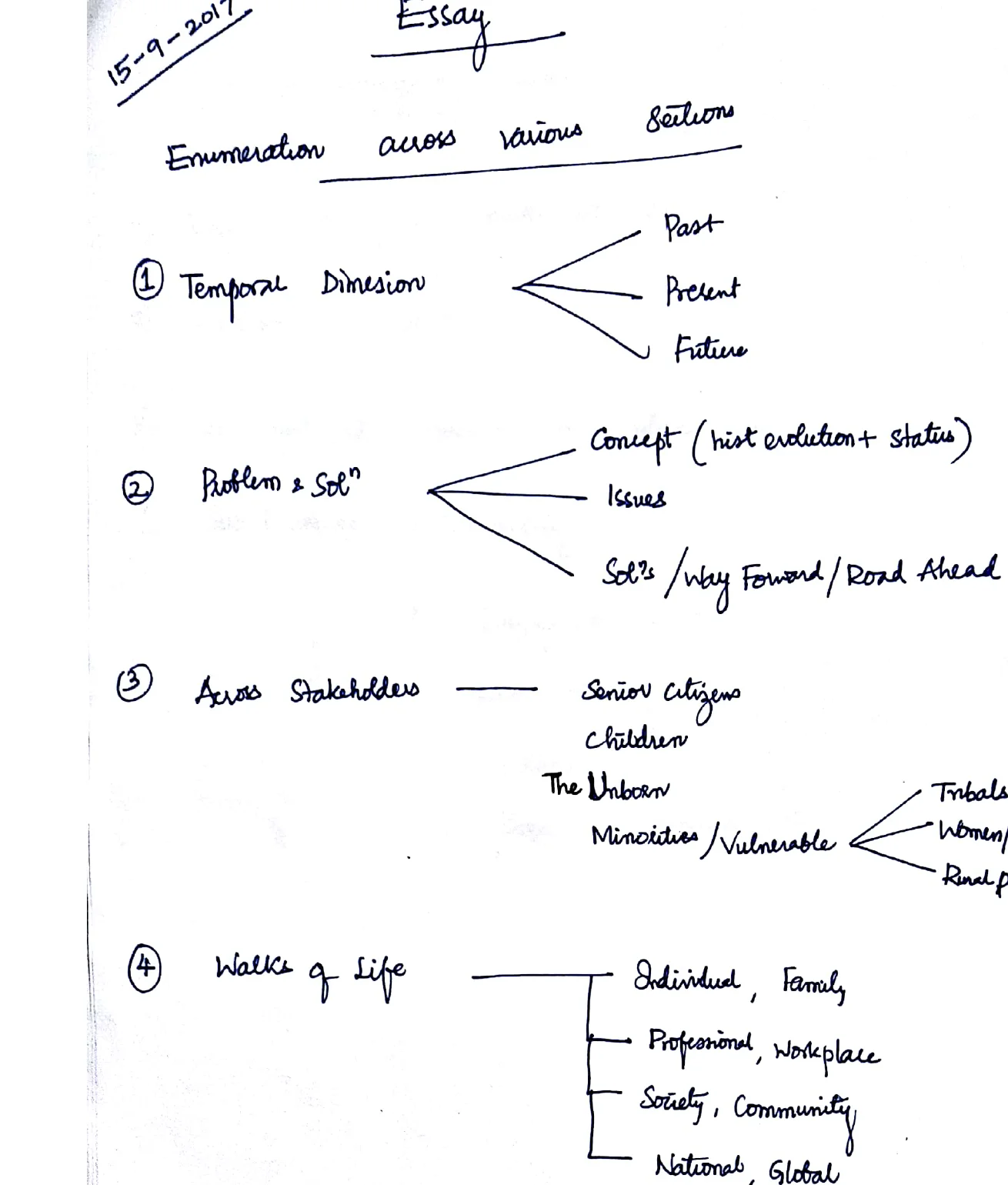
-
① Temporal Dimension → three branches:
- Past
- Present
- Future
-
② Problem & Solution → three branches:
- Concept [historical evolution + status]
- Issues
- Sol'n [Solution] / Way Forward / Road Ahead
-
③ Areas / Stakeholders → two main branches:
- Senior citizens
- Children
- The Unknown / Minorities / Vulnerable → further branches:
- Tribals
- Women / Children
- Rural poor
-
④ Walks of Life → four branches:
- Individual, Family
- Professional, Workplace
- Society / Community
- National, Global
-
⑤ Standard →
- Soc [Social], Pol [Political], Eco [Economic], Adm [Administrative], Int'l [International], Env't [Environment], Historical, Scientific, Beauty / Legal [illegible last word]
-
⑥ Various Sectors →
- Media, Sci-Tech [Science & Technology], Business, Sports, Religion, Polity/Adm [Administration]
- Personal, Nation, Govt [Government]
#Page 2 — Essay Writing Techniques & Structure
ANUDEEP DURISHETTY, AIR 1, CSE 2017
#Cohesion / Transition Devices
- Link sentence at the end of a paragraph → avoid meta-discourse
- Meta-discourse — avoid at the start of a new paragraph / new argument
- A dialectic question at the end of a para to link to the next para
- CAPS, black pen for Quotes and Subheadings
#Constitutional Provisions — sprinkle them
#International Experiences
- Strictly delineated and individually justified [arrow annotation]
- Parallelism — rhetorical device
#Emotional Rhetoric
- "The inherent vice of capitalism is unequal sharing of misery; the inherent virtue of socialism is the equal sharing of miseries"
- [right margin: intro — let us … / not in … / For, when a child … / we all suffer / and when a child … / [illegible] …]
#Conclusions
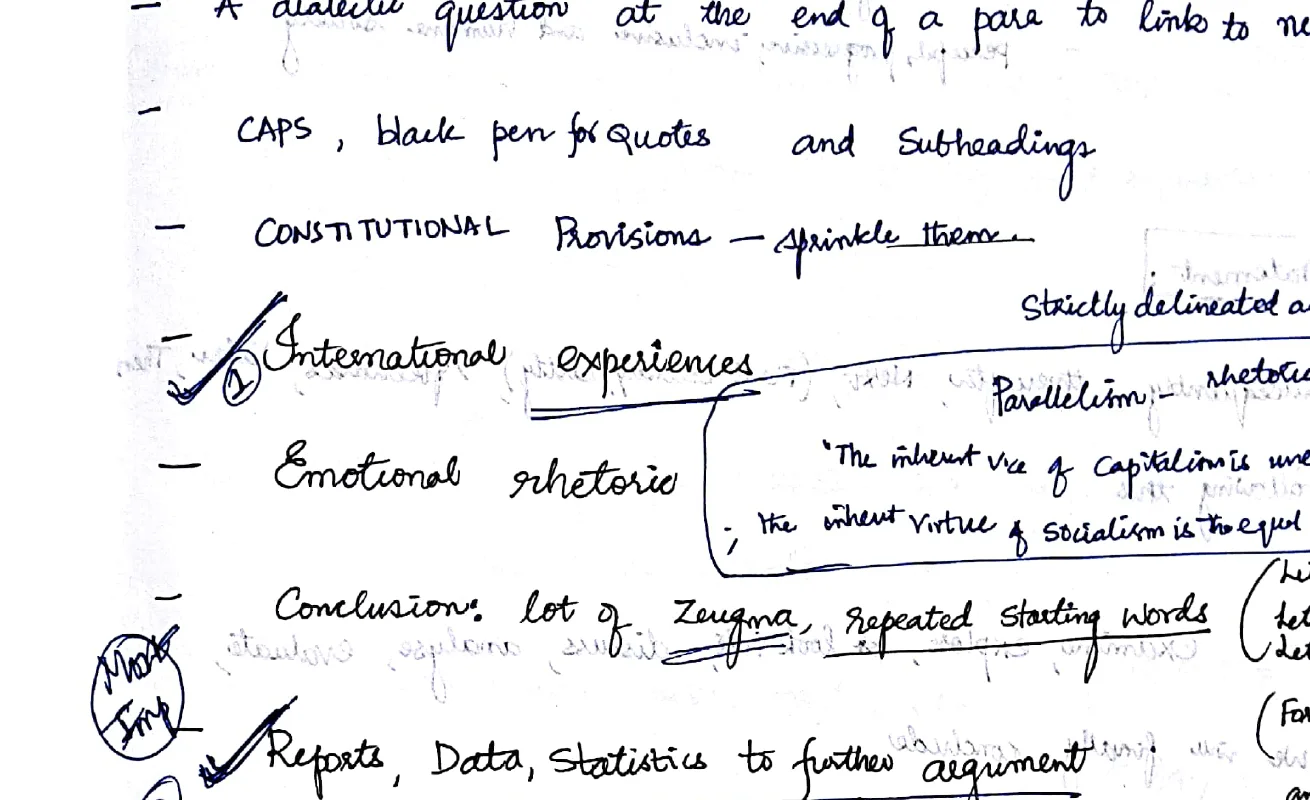
- Lot of Zenana [repetition / repeated starting words]
- [margin annotations: intro — / let us / not in]
- [For, when a child … / we all suffer / and when a child … / [illegible]]
- Repeats, Data, Statistics to further "argument"
- One or two Innovative Solutions
- Examples of:
- ① Incidents → ⑤ Constitutionalism → ② Lot of Examples → Conclusions
- [sub-branch] → ④ Examples / Anecdotes / → Reports / Incidents
- ① Incidents → ⑤ Constitutionalism → ② Lot of Examples → Conclusions
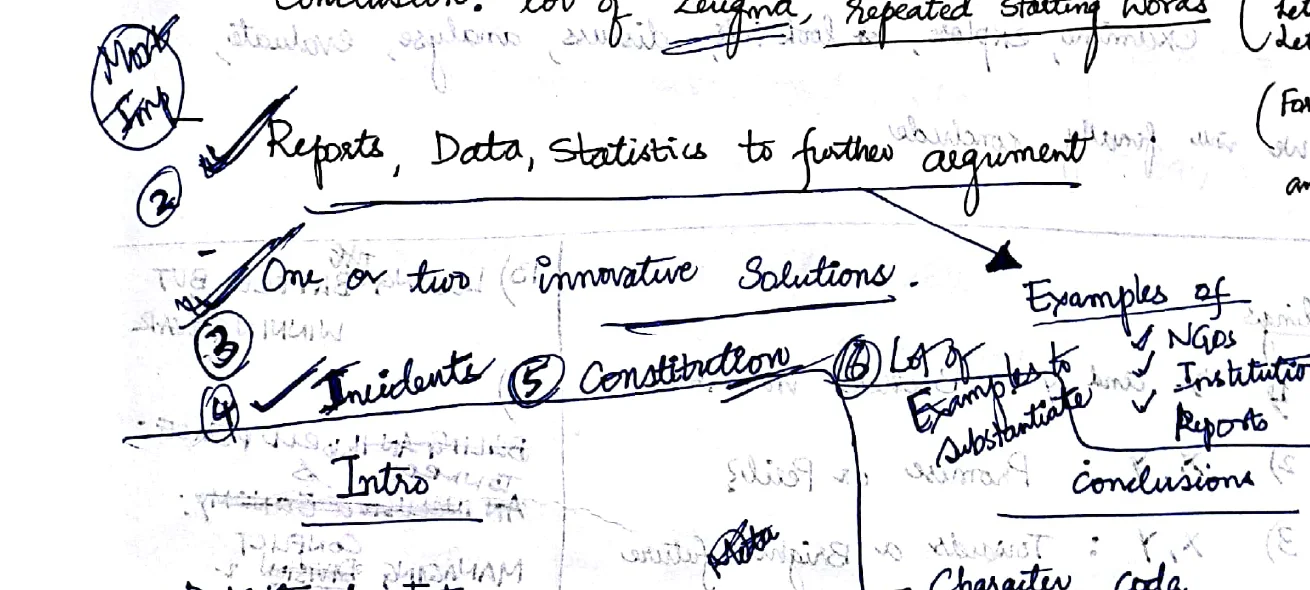
#Intro Techniques
-
"Intro" [box label]
-
Definitional Intro
-
Introduce a character or two [on the left side]
-
Quote +
- [right side list:]
- Character Coda
- Any Anabhigude (e.g. Talisman) [likely "Anabhigude" = unfamiliar; possibly Nehru's Talisman]
- Joy in every soul …
- Sabka Saath, Sabka Vikaas [Together with all, development for all]
- Samatvam [Equanimity / Sanskrit concept]
- Constitutional Ideals
- Tagore: Into that heaven of freedom
-
Shared context → problem → [branches]:
- Status → [illegible]
- Context → Solution
-
Thesis Statement
-
Scenario Approach: (Climate change, AI, Cyber-security, etc.)
#Page 3 — Conclusions & Standard Subheadings for X, Y Topics
ANUDEEP DURISHETTY, AIR 1, CSE 2017
#Conclusions (continued from p.2)
- Joy in every soul …
- Sabka Saath, Sabka Vikaas
- Coda character
- Quote by Mahatma Gandhi
- Peaceful, progressive, inclusive and humane society
#Thesis Statement [boxed]
- [marked with X — "Not suitable"]
- Subsequently, thereafter, next (first, secondly, lastly) / Afterwards, later, then [marked X]
- Following this [marked X]
- We will — examine, explore, look into, discuss, analyse, evaluate
- We will finally conclude [marked X]
#Standard Subheadings for X, Y Topics
[Right margin notes: "13) Losing the Battle, But Winning the War"; "14) [illegible] — World Peace: [illegible] / An Inclusive Session / Managing Conflict — Baldan Harmon" [some words illegible]]
- X and Y: Brothers in Arms
- X, Y: Promise or Peril?
- X, Y: Towards a Brighter Future
- X, Y: A Tumultuous Journey
- X, Y: The Journey So Far
- X, Y: Infection, Influence, Destruction & Extermination
- X, Y: A Double-Edged Sword
- X, Y: Two Sides of the Coin
- X, Y: The Problem of Unintended Consequences
- X, Y: Silver Lining & Cloud
- X, Y: Window of Opportunity
- X, Y: All That Glitters Is Not Gold
- [X, Y]: Losing the Battle, But Winning the War [right margin]
- [illegible] — World Peace / [illegible] / An [illegible] Session / Managing Conflict [right margin, partially illegible]
#Page 4 — Essay Topic: Health (Notes)
Date: 6-7-2017 · Essay — Notes · ANUDEEP DURISHETTY, AIR 1, CSE 2017
#Health [boxed]
Intro: Introduce a character (Aisha)
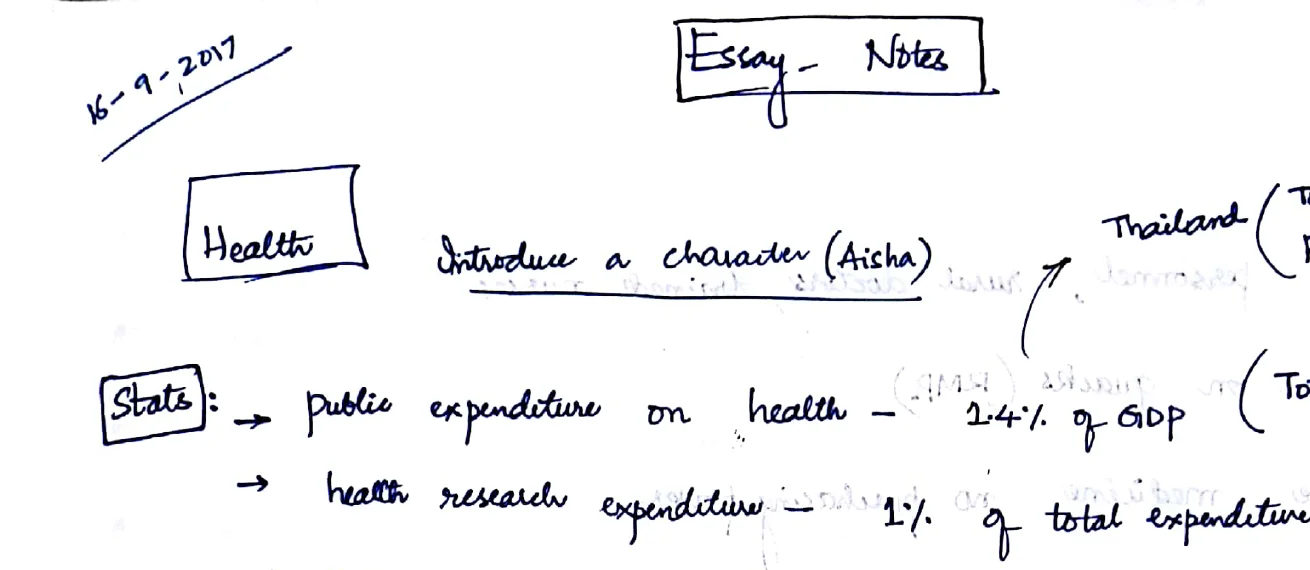
- Thailand box [top right]: Total = 4.2% [of GDP]; Public = 3.3% [of GDP]
#Stats [boxed]
- Public expenditure on health = 2.4% of GDP (Total: 4.2% of GDP)
- Health research expenditure = 1% of total expenditure on health
- 80% uninsured
- 69% expenditure on medicine
- IMR [Infant Mortality Rate]: [illegible] (was [illegible]) → MMR [Maternal Mortality Rate] = 167 (Nfg [National figure?] – 130) [numbers partially obscured]
- 50% women are anaemic
- [Some pencil annotations in this area — illegible]
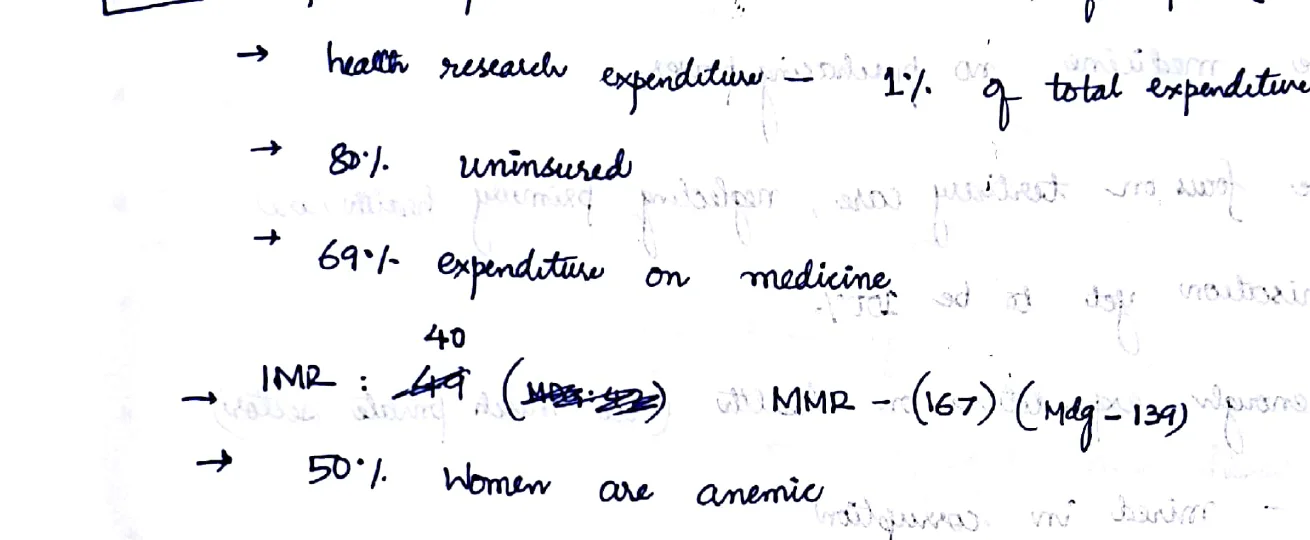
- Hunger: GHI [Global Hunger Index] rank = 78/119 nations
- 15% U-5 [Under-5]: Wasted (Severe under-nourished)
- 39% U-5: Stunted
- Communicable disease burden: 28% [some annotation illegible]
- Non-Communicable disease burden: 60% [some annotation illegible]
- Mental illness — 2%
- 0.7 doctors per 1000 people [WHO recommends 1 per 1000]
#Content [boxed]
- Bhore Committee
- Amartya Sen: Capability approach, development as freedom
- Int'l [International] examples:
- Meiji era — Japan
- Sri Lanka, South Korea, Japan and Thailand
- Nordic countries
#Page 5 — Health: Problems & Government Initiatives
ANUDEEP DURISHETTY, AIR 1, CSE 2017
#Problems [boxed]
- Lack of personnel: rural doctors, trained nurses
- (94%:) Dependence on quacks (RMPs [Rural Medical Practitioners])
- Expensive medicine, no purchasing power
- Excessive focus on tertiary care, neglecting primary health care
- Immunisation yet to be 100%
- Not enough expenditure on health (too much private sector)
- MCI [Medical Council of India] — mired in corruption
- Infrastructure: no beds, supply material … [Gorakhpur tragedy — annotation]
- MDR [Multi-Drug Resistant] TB, XDR TB (Ebola with wings) — Zarir Udwadia [TB specialist]
#Govt [Government] Initiatives and Good Case Studies [boxed]
- Jan Aushadhi Kendra [Generic medicine stores]
- On public health grounds, evergreening under 3(d) stopped — [illegible]
- [arrow] Competing [illegible]
- Tamil Nadu (effective social welfare schemes):
- ICOS [?]
- MDM [Mid-Day Meal]
- PDS [Public Distribution System]
- NELM [National Essential List of Medicines], Stent price cap
- National Health Policy
- Programmes: RSBY [Rashtriya Swasthya Bima Yojana], Janani Suraksha Yojana, MSY [?], Indradhanush [Mission Indradhanush]
- Swachh Bharat [Clean India Mission], etc.
- eVIN [electronic Vaccine Intelligence Network] network
#Page 6 — Health: Way Ahead, Quotes, Character Coda (Aisha)
ANUDEEP DURISHETTY, AIR 1, CSE 2017
#Way Ahead [boxed]
- Doctors — need more of them; incentivize rural postings
- Reform MCI
- Focus on primary health care
- Aadhar [Aadhaar], technology usage — target the users
- Universal Health Coverage as a goal
- Public expenditure: at least 4–5% of GDP
- Educating the public about hygiene, basic health care
- National Health Service
- Provide list of essential medicines for free; central procurement
- Encourage active lifestyle: walking / jogging
- Health Council similar to Thailand
- [Annotation: "Appel + Travel Knowledge"]
- Corporate Social Responsibility — channelise towards health
#Quotes [boxed]
-
"Sarve Bhavantu Sukhinah" [May all be happy]
- "Sarve Bhavantu [Santu] Niramayah" [May all be free from illness]
- (May all be Happy; May all be Healthy)
-
Character Coda (Aisha)
- Sarve Bhadrani Pashyantu [May all see auspiciousness / [illegible]]
- Maa Kashchit Dukha Bhaagbhavet [May none suffer]
- (May one live long / [illegible])
- Sense of urgency and will …
#Page 7 — Essay Topic: Education
ANUDEEP DURISHETTY, AIR 1, CSE 2017
Quotes: available in the word document [boxed note — refers to a companion digital file]
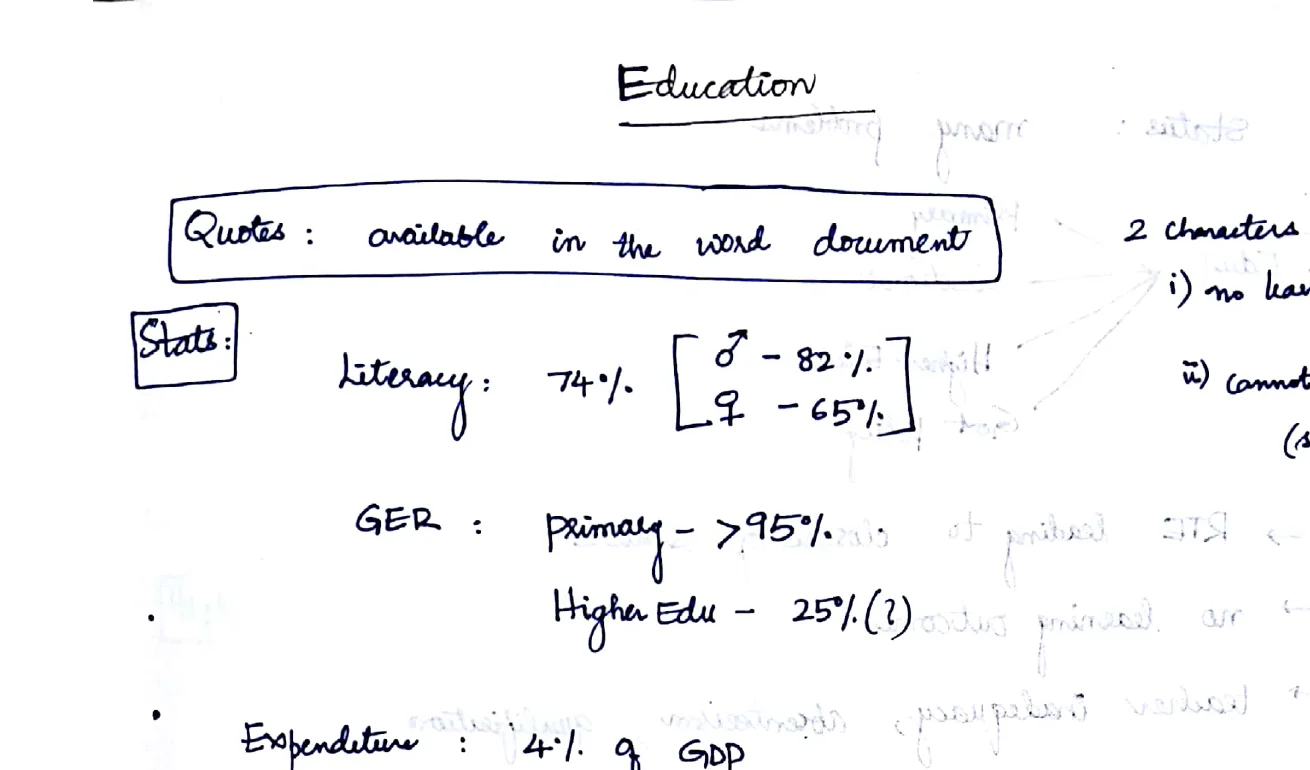
2 characters [for intro]:
- ① No learning outcomes (10-yr-old)
- ② Cannot afford higher edu (say, a farmer)
#Stats [boxed]
- Literacy: 74%
- Male: 82%
- Female: 65%
- GER [Gross Enrolment Ratio]:
- Primary: > 95%
- Higher Edu: 25% (↑)
- Expenditure: 4% of GDP
- India: 350 min [million]
- China: 1250 min [million] [students / enrolment figure]
- ASER [Annual Status of Education Report] findings:
- Class 5 who can read Class 2 text: 53.7% (2010)
- ↓ 47.8% (2015)
- [Some pencil annotations below — illegible]
#Content [boxed]
- How primary education is crucial for growth, development, employment, social order
- Int'l [International] experience: Japan, S. Korea, Finland
- Gopal Krishna Gokhale — 1910: Imperial Legislative Council [advocated free & compulsory education]
- British system: Macaulay, Wood's Despatch; focus on primary schools → only lip service
- Post-independence: primary edu [education] ignored; IITs, CSIR, IIMs …
#Page 8 — Education: Issues (Primary, Vocational, Higher Edu, Govt Policy)
ANUDEEP DURISHETTY, AIR 1, CSE 2017
#Current Status: Many Problems
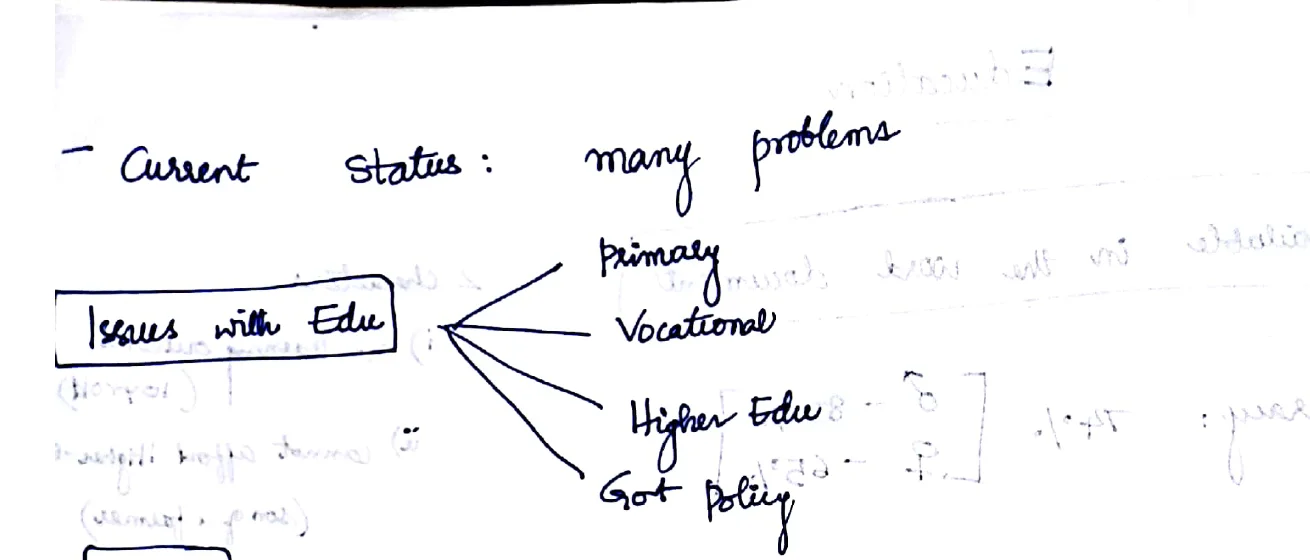
Issues with Edu [Education] → four branches:
- Primary
- Vocational
- Higher Edu
- Govt Policy
#Primary [boxed]
- RTE [Right to Education Act] leading to closure of schools
- No learning outcomes
- Teacher inadequacy, absenteeism, qualification
- Infra [Infrastructure]
- RTE issues:
- No detention policy (Section 16 of RTE)
- Strict Infra norms (don't apply to govt schools) — [deemed by?]
- No detention → CCE [Continuous and Comprehensive Evaluation] go hand in hand
- [but teachers not trained]
- → Students promoted regardless of learning
- Recognised under RTE Act subject to infra norms (Govt schools deemed)
- National Independent School Alliance (NISA): Around 10,000 shut down (2015–16)
- EWS [Economically Weaker Section] — reimbursed lesser amount
- Praband Edu [Prabandh Education] system … [illegible pencil annotation]
#Page 9 — Education: Vocational, Higher Edu, Solutions
ANUDEEP DURISHETTY, AIR 1, CSE 2017
#Vocational [boxed]
- Germany [as a model / best practice]
- [Pencil annotation: illegible full line]
#Higher Edu [boxed]
- Brain Drain
- [Large white space — page is sparse in lower half]
#Solutions [boxed]
- Quote: Poland, Singapore, autocriticism reports [illegible/partially legible]
- Progressive Edu in ethics, liberal studies: Gender Edu, Sex education, Financial literacy
- Dist [District] level Competition / Ranking among schools
- RTE: reform [with arrow]
- Funding
- Biometrics to monitor teacher absenteeism [arrow annotation]
- Internet-based Education: MOOC [Massive Open Online Courses], Swayam, Mobile Edu
- Autonomy to Higher Ed: IRAHE [?] [possibly HERA / HEERA — Higher Education Empowerment Regulation Agency]
- End with Coda
#Page 10 — Education: Quote + [Illegible Lower Half]
ANUDEEP DURISHETTY, AIR 1, CSE 2017
#Quotes [boxed]
-
MLK [Martin Luther King Jr.]:
- "Intelligence + character — that is the goal of real education"
-
[Lower half of page contains pencil writing that is largely illegible due to faintness — multiple lines of annotation visible but not confidently readable]
- [illegible — pencil, multiple lines]
- [illegible — appears to reference: "human products, intelligence, [illegible]"]
- [illegible — "solution of [illegible]"]
- [illegible — appears to include a percentage: "37%"]
#Page 11 — Essay Topic: Judiciary
ANUDEEP DURISHETTY, AIR 1, CSE 2017
#Quotes on Justice [boxed]
- "At his best, man is the noblest of all animals; separated from law & justice, he is the worst." — Aristotle
- "Injustice anywhere is a threat to justice everywhere."
- "Justice is conscience, not a personal conscience but the conscience of humanity."
- "Justice will not be served until those who are unaffected … are as outraged as those who are."
- "Arc of moral virtue is long … towards justice" [likely MLK paraphrase: "…arc of the moral universe is long, but it bends toward justice"]
- "Ideal of justice: cardinal pillar of C° [Constitution]"
#Statistics [boxed]
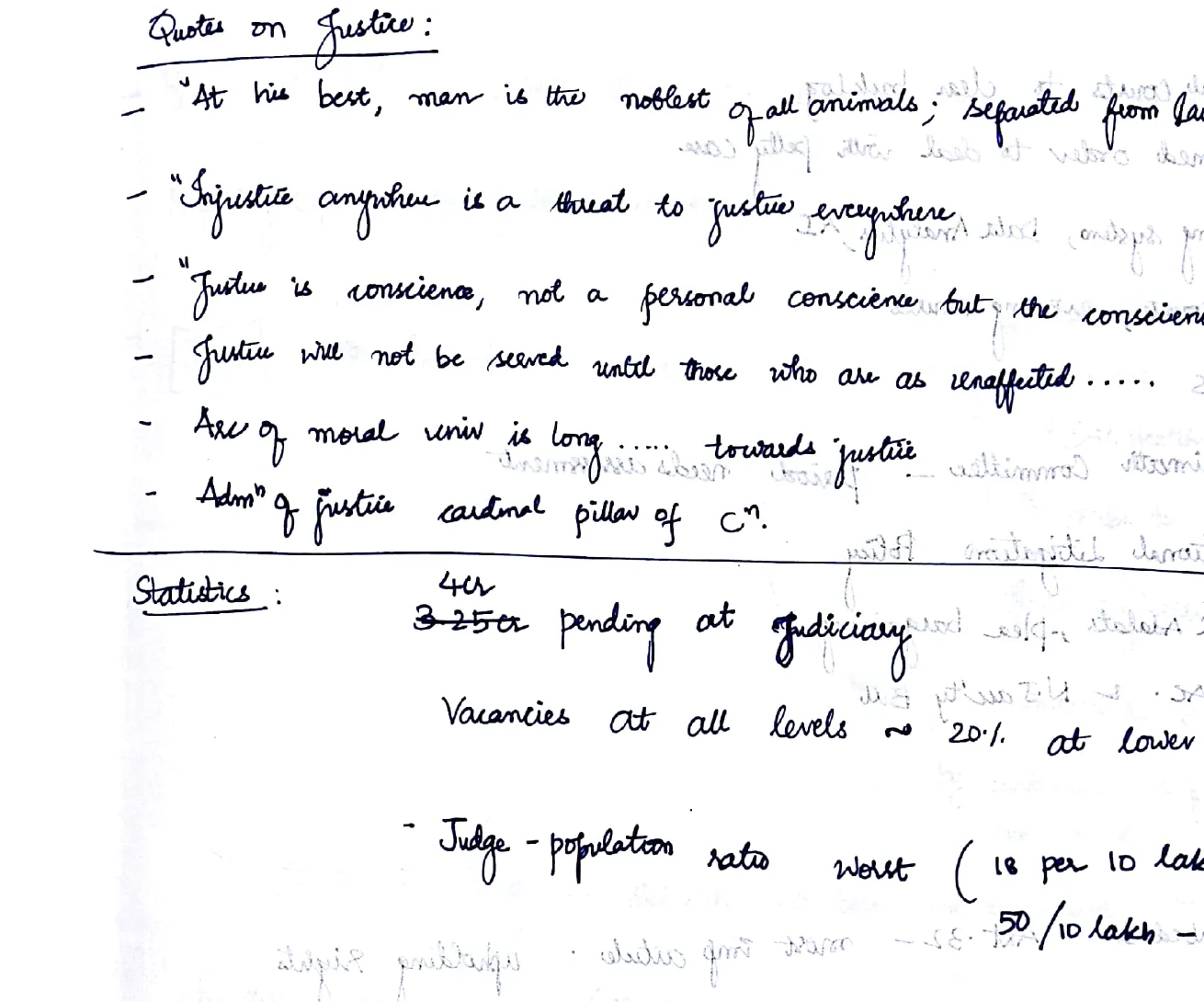
- 3.25 crore [32.5 million] pending at judiciary [courts across all levels]
- Vacancies at all levels → 20% at lower courts
- Judge-population ratio: worst (10 per 10 lakh [1 million])
- 50/10 lakh — recommended
#Highlights [boxed — left column]
- Privy judgement
- Keshavananda Bharati [case — Basic Structure doctrine]
- Oelho case [likely Coelho case — 9th Schedule review]
- Kesari [Kesavananda?]: judges opened SC [Supreme Court] at midnight [emergency midnight hearing]
- PIL [Public Interest Litigation] (origins — 1970s)
- Recent locus standi norms
- P. N. Bhagwati
- To uphold rights of poor & marginalised
- SIT [Special Investigation Team] on black money
#Issues [boxed — right column]
- Judicial activism → Judicial overreach
- Only via auction order, national women's [illegible]
- National anthem in theatres
- Cricket (misplaced priorities)
- Direct banning → NSRC [illegible] shut down
- [illegible] — SIT [?]
- NGT [National Green Tribunal]: unreasonable orders
- Corruption, delay, under-trials
- Opacity of collegium
- Allegation of harassment by lady intern [Justice AK Ganguly episode]
#Page 12 — Judiciary: Solutions & Conclusion
ANUDEEP DURISHETTY, AIR 1, CSE 2017
#Solutions [boxed]
- ADR [Alternative Dispute Resolution]
- Special courts to clear backlog
- Combined order to deal with petty cases
- Queuing system, Data Analytics, AI
- E-courts, evening courts
- AIJS [All India Judicial Service] … [some annotation illegible]
- Malimath Committee — periodic needs assessment
- National Litigation Policy
- Lok adalats [People's courts], plea bargaining [arrow] [illegible]
- NJAC [National Judicial Appointments Commission] and NJ act'y [NJAC] Bill
#Conclusion [boxed]
-
Ambedkar: Art. 32 — most imp [important] article [of the Constitution]
- → Upholding rights
- Guardian of C° [Constitution]
- → Upholding rights
-
"Indian Republic has come a long way since independence — with many spectacular achievements and some failings. Judiciary has played an indispensable role in shaping our nation. As we look ahead towards a New India, Judiciary — "
- "A gets true justice and B gets true prosperity."
- "This will ensure that" [connector phrase]
-
End with: "Yato Dharmastatato Jayah" [Where there is Dharma/righteousness, there is victory]
- (When there is Dharma [justice], there is victory)
- [Some pencil annotation below — partially illegible]
#Page 13 — Essay Topic: Science & Technology / Innovation
ANUDEEP DURISHETTY, AIR 1, CSE 2017
#Core Idea / Metaphor
- "If invention is a pebble traced in the pond, then innovation is the rippling effect that pebble causes."
#Intro [boxed]
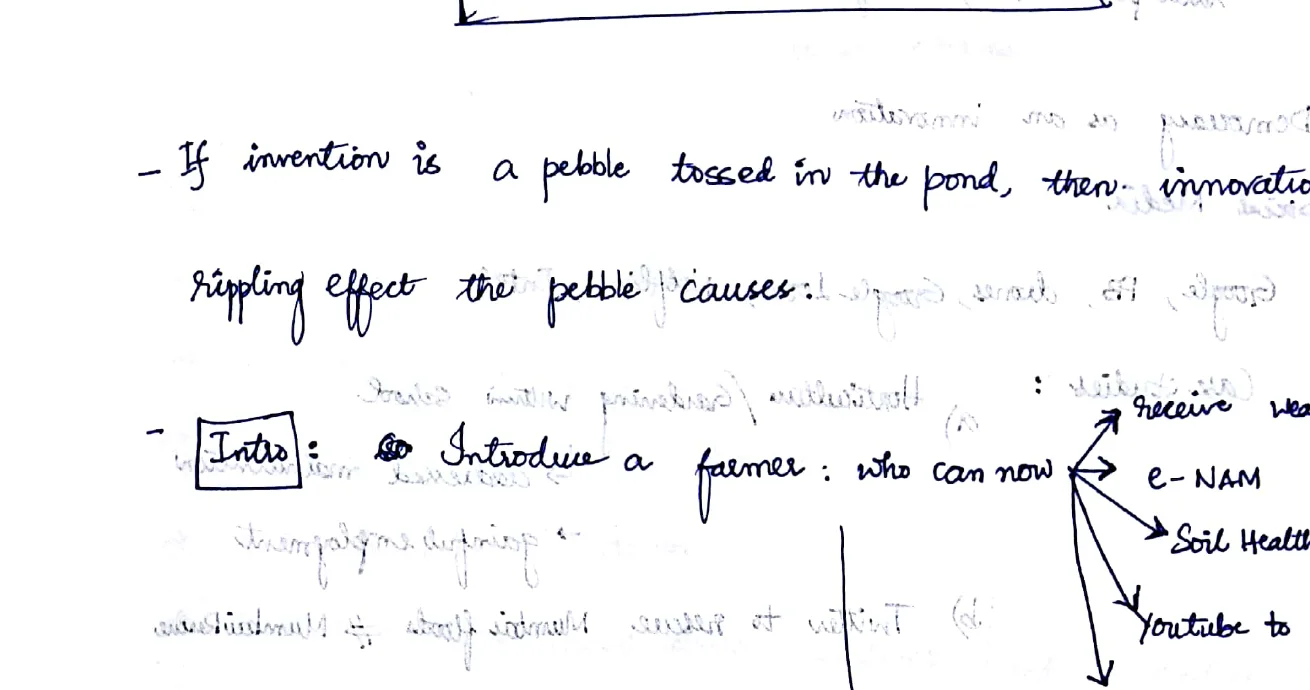
- Intro: introduce a farmer who can now →
- Receive weather info
- e-NAM [National Agriculture Market]
- Soil Health Card updated
- YouTube to know latest varieties
- Genetic engineering
- + add negative impact of CC [Climate Change], fuelled largely by unabated use of technology (unmonitored)
- "In a way" — Sci & Tech has been both boom and a bane [boon and a bane]
- "In this essay …" (Thesis Statement)
#Content: Across Various Dimensions [boxed]
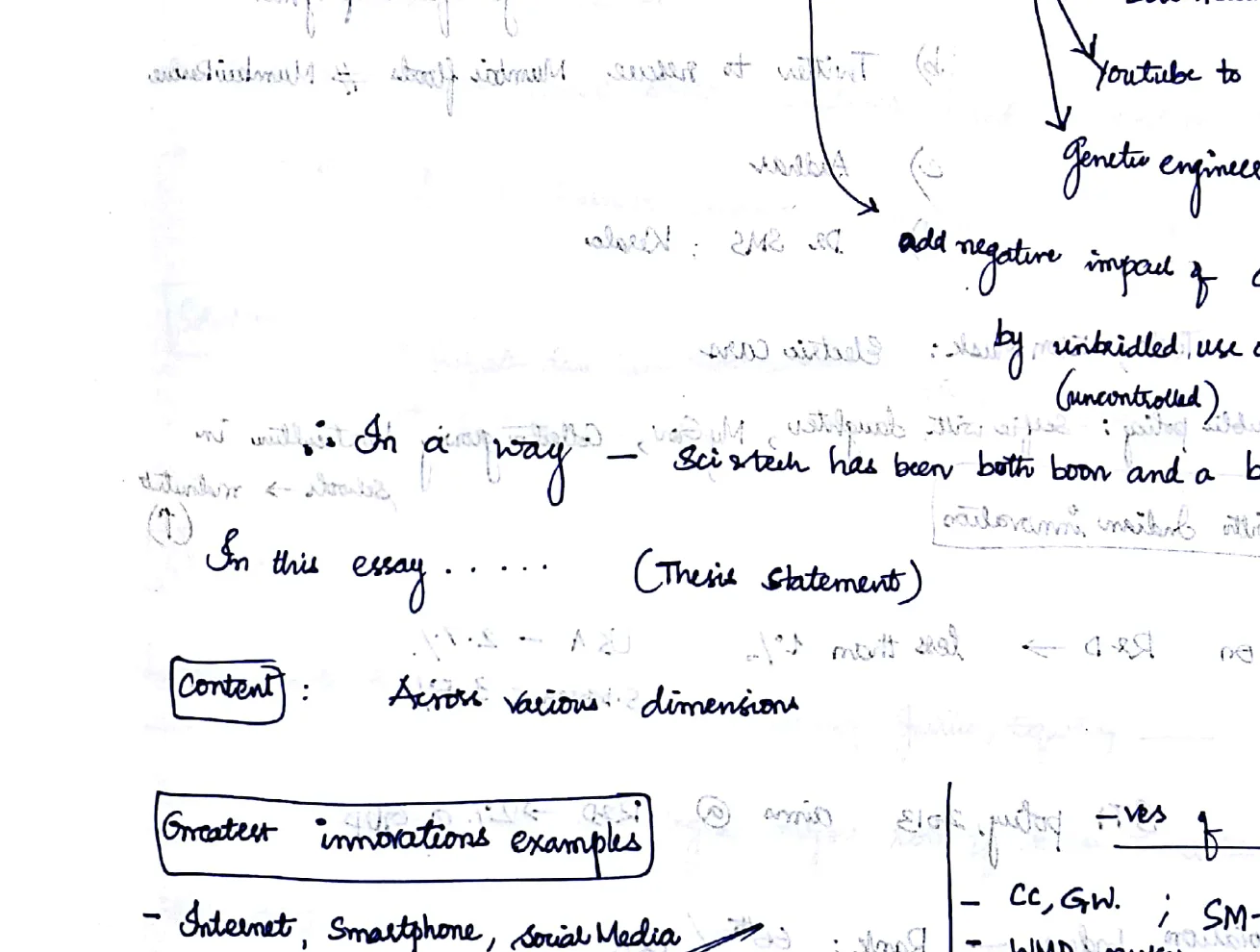
Greatest Innovations Examples [two-column list]
| Left Column | Right Column (S & T related) |
|---|---|
| Internet, Smartphone, Social Media | CC [Climate Control?] / Grid, SM — Command tools |
| Wheel | Web, media |
| Language, Writing, Printing Press | Beatrice — Playing God (designer babies) |
| Magnetic Compass (~14th century) | Online bullying, trolling & … |
| Currency (→ replaced abbreviated means) | Television |
| Edison, Transistor | A.I. |
| Transistor, Antibiotics (Penicillin), Alexander Fleming, Streptomycin | Surveillance … might? |
| Removal / Isolation [Isolation / Depression] | |
| Blue-whale challenge / Drug addiction in light | |
| Invasion of privacy |
- [Note below table:] Streptomycin — 20 lakh die to → 1% [reduction in deaths due to TB, annotation about impact]
#Page 14 — S&T / Innovation: Sectors, Case Studies, Problems with Indian Innovation
ANUDEEP DURISHETTY, AIR 1, CSE 2017
#Sectors of Innovation
- Steam Engine (energy → motor) → [led to] Jet/aeroplane, ICE [Internal Combustion Engine]
- Politics: Democracy as an innovation
- Media: Social Media
- Business: Google, FB [Facebook], Disney, Google Learn, Netflix, Intel
- Adm'n [Administration]:
- Case studies:
- a) Horticulture / Gardening within school
- → addressed malnutrition
- → gainful employment
- b) Twitter to rescue Mumbai floods ≠ Mumbai rains [Twitter used to coordinate flood relief]
- c) Aadhar [Aadhaar]
- d) Dr. SMS, Kerala
- a) Horticulture / Gardening within school
- Case studies:
- Leadership: Tesla, Elon Musk: Electric cars
- Innovation in public policy: Selfie with daughters, MyGov, Collector giving horticulture in schools → motivated [illegible]
#Problems with Indian Innovation [boxed]
- Expenditure on R&D → less than 1%
- USA — 2.7%
- S. Korea — 3.5% [with "Israel" annotation]
- STI [Science, Technology and Innovation] Policy, 2013: aims to R&D → 2% of GDP
- Innovation Index → Rank: 66th / 130
- India — 1400 research papers in HRI [High-Ranking Impact?] journals
- China — 9000 p.a.
- Higher Edu problem
- [Right margin: several arrows pointing right — some text illegible, appears to reference "Go" / [illegible] / "S&T" column with items illegible]
#Page 15 — S&T / Innovation: Start-Up Problems, Govt Initiatives, Solutions & Conclusion
ANUDEEP DURISHETTY, AIR 1, CSE 2017
#Start-Up Problems
- Funding, global glut, ecosystem, angel investors
- Patent problems
#Govt [Government] Initiatives [boxed]
- Startup India, Stand-up India
- STI Policy, 2013 (R&D →)
- Autonomy to higher edu institutions
- Niti [NITI Aayog] Innovation Foundation
- Hackathons: to crowd-source solutions | India Innovation Challenge
- IGNITE prog [programme] (to harness creative talent among school kids)
#Solutions [boxed] ✓
- → Replace day innovators' owner [illegible — possibly "Remove day-zero innovators' / owner bias"] [partially illegible]
- → Fund-apps [Fund startups in] innovation → towards grass-root problems
#Conclusion [boxed]
- India Constitution — Preamble: Liberty, Justice, Equality → [some annotation illegible]
- "Science & Tech will play a major role if we are to achieve these goals."
- End with Gandhi & Talisman:
- [lower portion of page has pencil annotations — partially illegible]
- [illegible — multiple pencil lines, possibly a quote or extension of Gandhi's Talisman]
- [illegible — "…along well with…" / "…always well with…" / [illegible]]
- [illegible — appears to contain: "always well with / with wise…" / "with sorrow of society / [illegible]"]
End of Pages 1–15
#Page 16 — Freedom of Speech (Essay Title / Intro Setup)
Note: Top half of p16 shows mirror-bleed from reverse side (p15 content reversed); actual p16 ink content begins at the bottom.
- Topic heading: Freedom of Speech
- Box label (right): [introduction / intro — boxed]
#Page 17 — Freedom of Speech
#Definition / What is FoS [Freedom of Speech]
- (The right to express one's thoughts & opinions w/o censorship, penalty, fear of persecution, retaliation)
- [Intro] label (boxed)
#Quotes
- a) "If liberty means anything at all, it means the right to tell people what they do not want to hear." — G. Orwell
- b) "I may not agree with you …… [but I'll] defend, to the death, the right." — Voltaire
- c) "It is a mark of an educated person to entertain a thought without necessarily agreeing with it." — Aristotle
- d) If freedom of speech is taken away, then dumb and silent, we may be led, like sheep to the "slaughter."
#History [boxed label]
- FoS as integral part of Enlightenment / Renaissance
#Evolution
- French, American Revolution: liberty, equality, fraternity
- Before that, tyrants & dictators kept a close watch
- UDHR: Free Speech = basic human right
- Indian Constitution — Art 19(1) guarantees FoS
#Why is it fundamental? [boxed label — diagram]
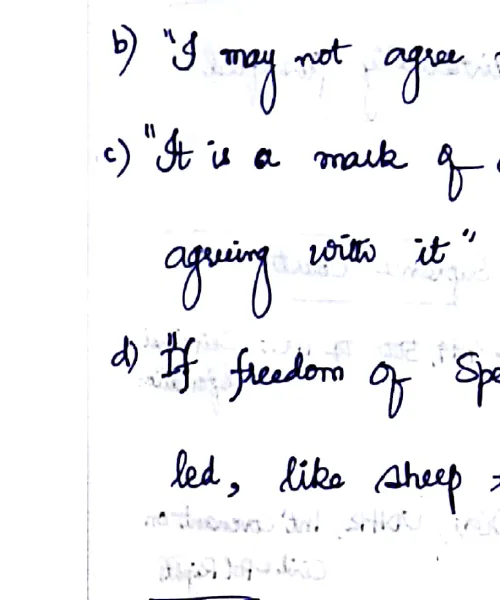
- Branching left side (individual/social reasons):
- discovery / finding — it means not putting on a filter; helps us share finding / facts; fix errors in our thinking; align with reality
- ① For a fulfilling existence
- ② Exchanging & circulating ideas (Karl Popper — Conjecture + Test)
- ③ Essential to democracy, bulwark against tyranny
- ④ Satire, humour, comedy — helps us look at a subject in a fresh way
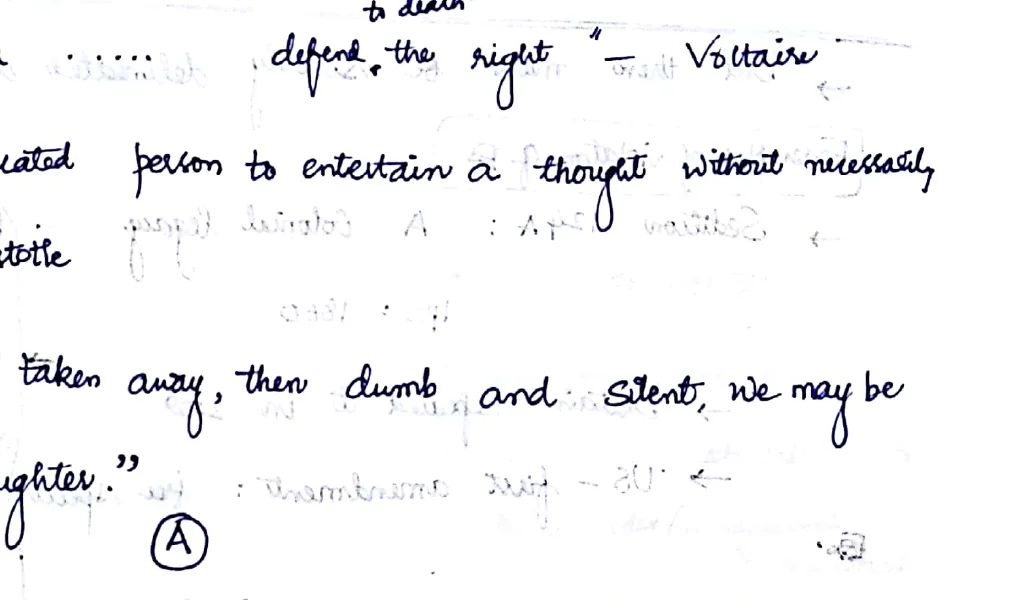
- S B I T (right-side box, arrows from Indian Constitution Art 19(1)):
- S — helps individual attain self-fulfillment
- A — assists in discovery & truth s-d-m [self-determination]
- I — Social change & progress
- ⑤ Brings together communities
#Page 18 — Freedom of Speech (Limitations & Examples)
#Limitations [boxed label]
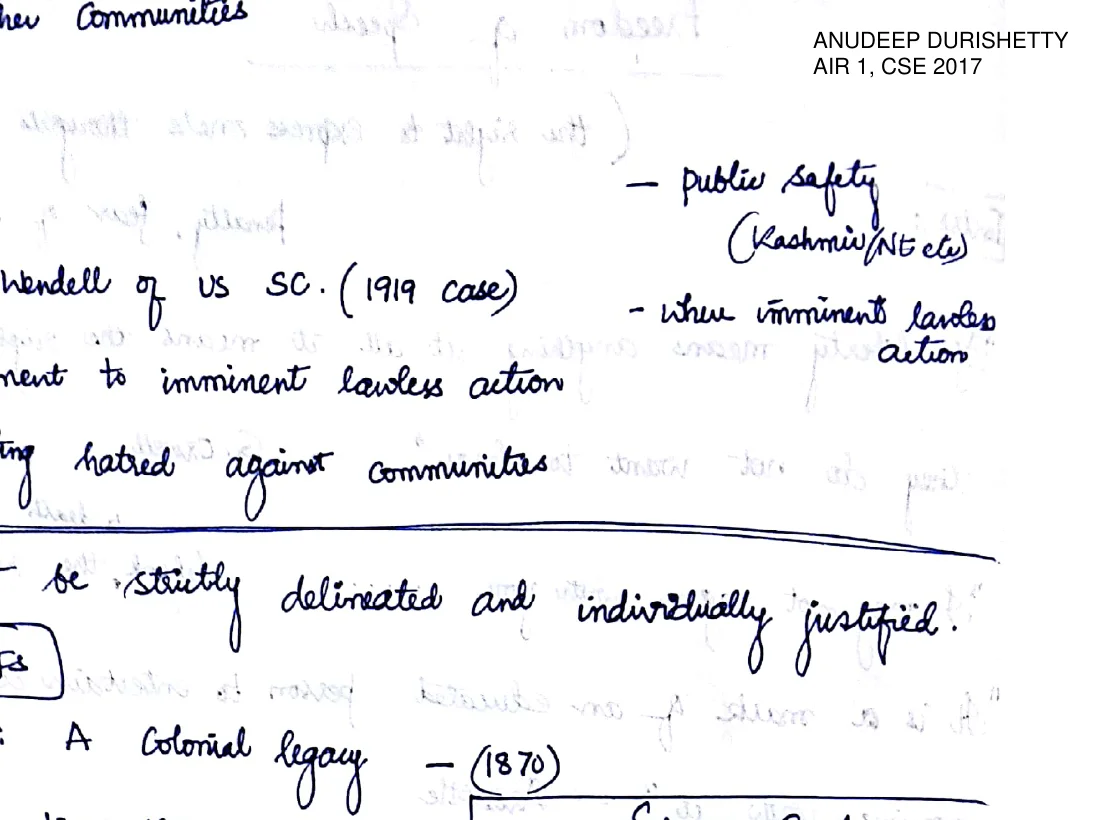
- Fraud
- Oliver Wendell of US SC (1919 case)
- Incitement to imminent lawless action
- Promoting hatred against communities
- → But these must be strictly delineated and individually justified
- Public Safety (Kashmir/J&K etc.) — when imminent lawless action
#Examples of violation of FoS
- → Section 124A [IPC]: A colonial legacy — (1870)
- IPC: 1860
- Supreme Court:
- → Upheld Sec 499, 500 of IPC: Criminal defamation
- → Struck down Sec 66A [IT Act]
- → FoS when reactivated due to public order (or imminent lawful action)
- → Britain repealed it in 2010 [Sedition law]
- → US — First Amendment: Free Speech
- Art 19(X), UDHR, Int'l Covenant on Civil & Pol Rights
- In hierarchy — FoS comes first
- 19(2): Restrictions: Security, friendly relations, defamation, public order, morality, contempt of court, integrity [of nation] etc.
- → James Damore fired from Google
- → JNU students
- → Oliver Wendell, 1919 case
- → Charlie Hebdo
- → Richard Dawkins disinvited for a speech
- → Campuses must be: melting pots of diverse beliefs and ideas
- Left, Right, Liberal, Conservative, Capitalist, Communist — beliefs must be allowed to thrive freely
- But left ≠ right ≠ right or liberal or Conservative or Communist — beliefs/opinions must be allowed to be expressed freely
- → A genuinely misguided person shouting anti-national slogans cannot / shouldn't shake a confident, liberal democracy. Remedy for such unpleasant speech is more speech and not enforced silence.
#Page 19 — Freedom of Speech (Threats & Remedy)
#Threats to FoS
- → Govt: Curbing free speech in the name of national security
- → Fake news
- → Terrorism & online recruiting
- [Gauri Lankesh — shot dead] (boxed note, right margin)
- → Violence, fundamentalism
- → Legal hurdles
- → Govt Surveillance
#Supreme Court [boxed]
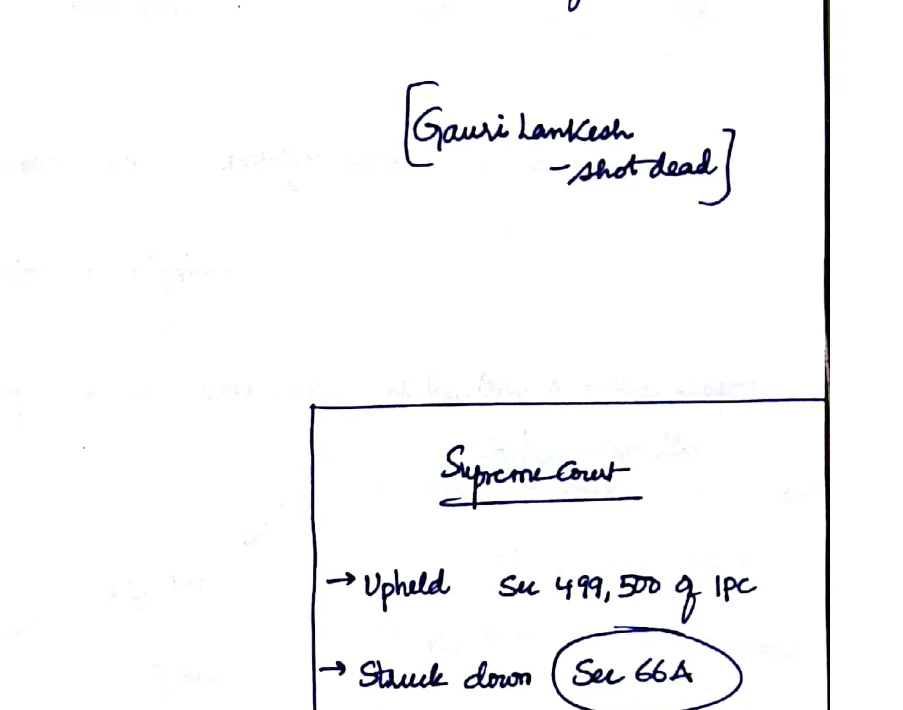
- → Upheld Sec 499, 500 of IPC
- → Struck down Sec 66A [IT Act]
- → FoS when reactivated due to public order (or imminent lawful action)
- → Ram Manohar Lohia exhorted people not to pay taxes & rejected. There must be proximate, imminent connection b/w speech & violence.
#Remedy
- Remedy for unpleasant speech is more speech and not enforced silence
- [K. + running lines — illegible pencil annotation]
- Mahatma Gandhi [boxed/circled] put autonomy of an individual at the forefront. In S. Afr [South Africa], India — he resisted State's brute force. (1960)
- In Savarj [Swaraj] he writes that State must step in only when there is imminent lawless action
- When counter-speech not possible, when there is threat to disorder — State can cut speech
- But each must be strictly delineated, individually & justified in courts ("strictest interpret.")
- (R. Tagore Gitele) → Conclusion
- Ext [boxed — End / Ext note]
#Page 20 — Nuclear Disarmament (Essay Title / Intro Setup)
Note: Top half of p20 is mirror-bleed / reverse-side show-through; actual new topic "Nuclear Disarmament" begins at the bottom of this page.
- Topic heading: Nuclear Disarmament
#Nuclear deterrence failed — Examples
- US couldn't prevent Berlin Blockade
- India — Pak War (1999)
- Israel – Arab Wars
- → Clearly deterrence has failed in the past.
- [Left-side margin: faint mirror-bleed text — illegible]
#Page 21 — Nuclear Disarmament / Energy
#Introduction
-
Hiroshima incident (Introduce → Isagumi — 20yr old girl)
- Aug 6, 1945
-
[Intro] label (boxed)
#Central Idea / Essay Outline
- A — Consequences of nuclear weapon use — unaffordable & unacceptable. This calls for a careful analysis.
- The central idea of this essay is to examine:
- a) History of nuke weapons + Indian perspective
- b) March towards disarmament (CTBT, NPT, PTBT, NSG)
- c) Problems with this regime
- d) Solutions
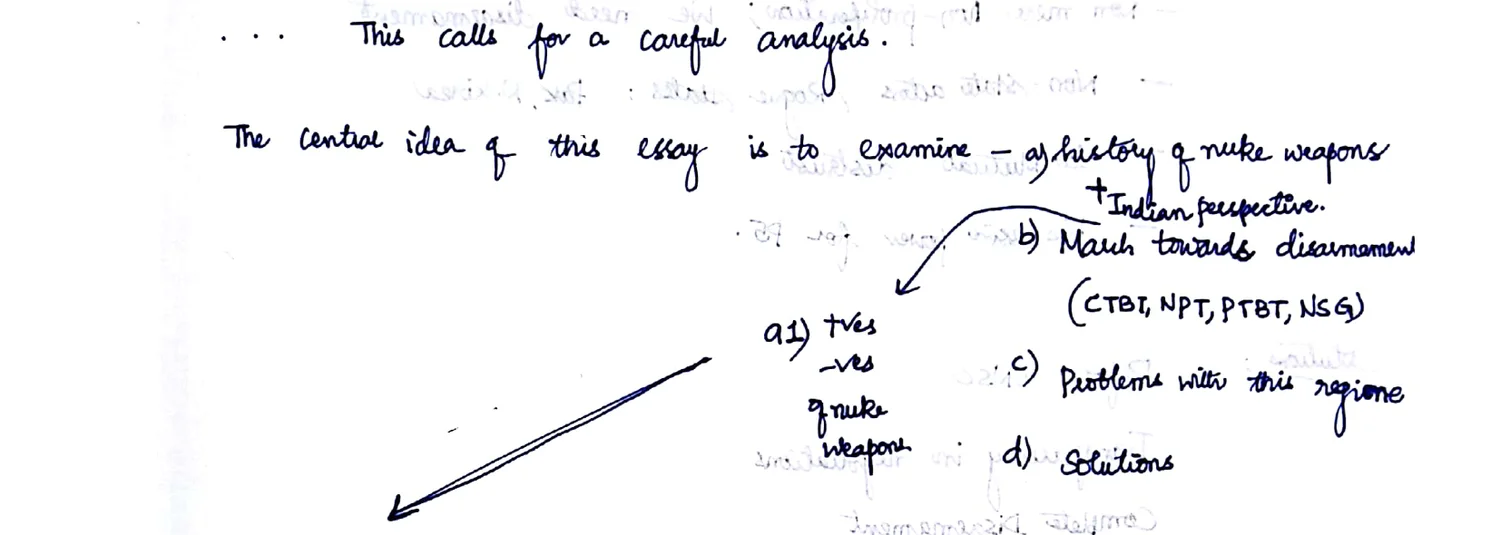
- a) tries / pros / grads / weapons [faint pencil] →
#Arguments For Nuclear Weapons | Arguments Against [two-column diagram]
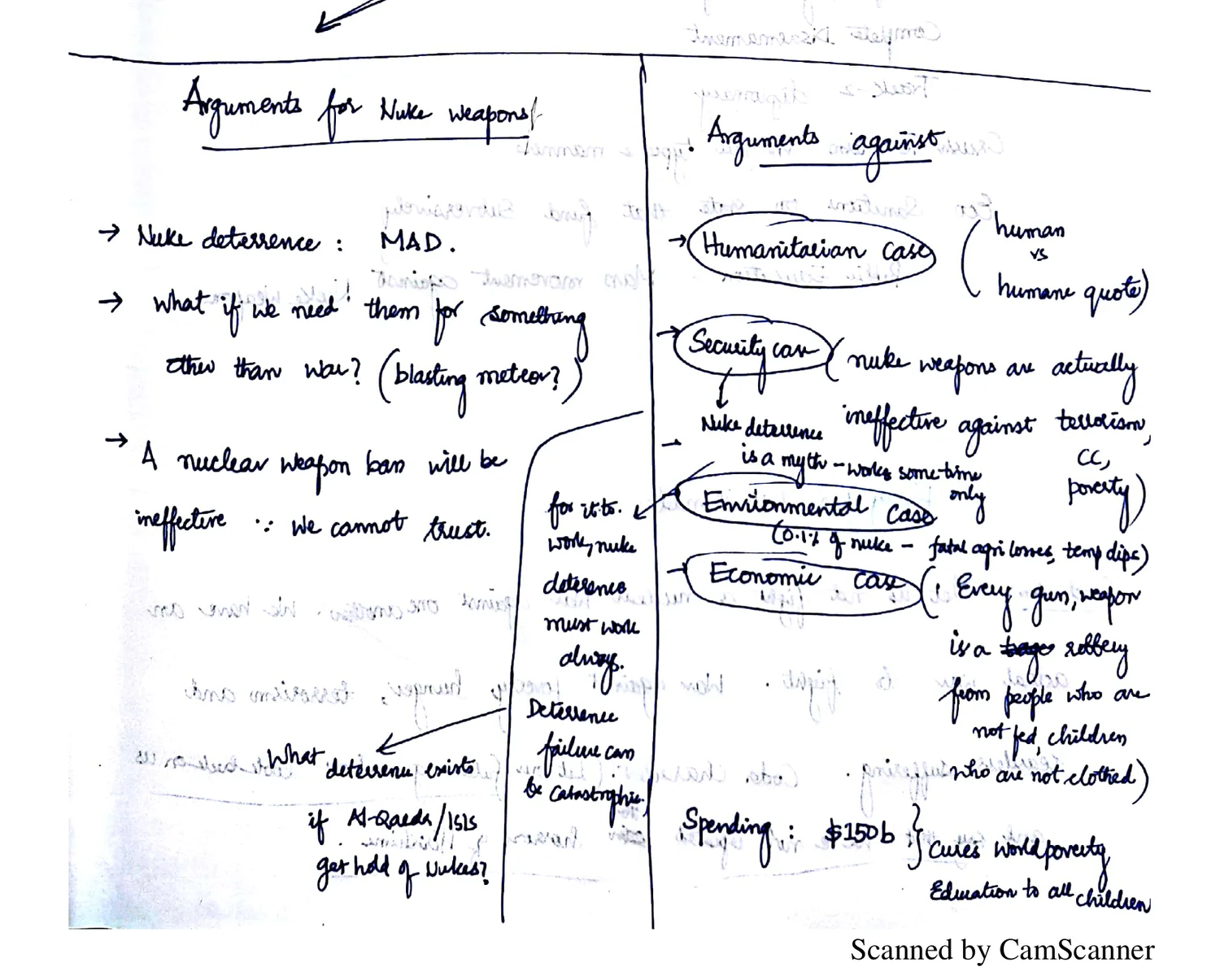
Arguments For:
- → Nuke deterrence: MAD [Mutually Assured Destruction]
- → What if we need them for something else than war? (blasting meteor?)
- → A nuclear weapon ban will be ineffective — we cannot trust [others]
- [faint pencil: Deterrence exists with nuke; without nuke deterrence must always remain under control]
- What deterrence exists if at-peace / ISS got rid of nuclear [illegible pencil]
Arguments Against:
- Humanitarian Cost — human [+] human quote
- Security Case — nuke weapons are actually ineffective against terrorism i.e. poverty; nuke deterrence is a myth — "works sometimes" [illegible pencil]
- Environmental Case — [illegible pencil] giddy-downs story [illegible]; every gun weapon is a huge robbing from people who are not fed, children who are not clothed
- Economic Case — Spending: $350b; [Could fund] quality education to all children
#Page 22 — Nuclear Disarmament (March Towards Disarmament / Solutions / Conclusion)
#March Towards Disarmament
- NPT, CTBT, PTBT, NSG, MTCR etc.
#Problems
- Unequal, unjustified [nature of regimes]
- Non-non [non-member] non-proliferation; we need disarmament
- Non-State actors / Rogue states: Pak, N. Korea
- [Too much] mutual distrust
- Excessive force for P5 [Permanent 5 members of UNSC]
#Solutions
- Reform UNSC
- Transparency in negotiations
- Complete Disarmament
- Track-2 diplomacy
- Crush Terrorism in all types & manners
- Eco Sanctions on states that fund Subversives
- Public Education — Mass movement against Nuke Weapons
- [Faint pencil: build bridges (one person?)]
- Every gun that is made [Eisenhower quote implied]
#Conclusion
- "Let us not fight a nuclear war against one another. We have an actual war to fight — War against poverty, hunger, terrorism and ceaseless suffering. Coda Character: Let our future generation look back on us and say that we're not injustice in [the] memory of Hiroshima."
#Page 23 — Capital Punishment
#Introduction
- Introduce a character — Shuja Graham
- Framed in the death of a Prison Guard
- 4 trials took place
- In 1976 → after Second trial → death sentence awarded
- California SC overturned death in 1979, thus avoiding a grave miscarriage of justice
#Central Idea (A)
- Life is a wonderful gift and to take it away is a matter of extreme gravity. This calls for a careful analysis.
- In this essay we will first examine:
- i) Status of Cap. punishment in India
- ii) Problems of Criminal Justice Sys.
- iii) Way Ahead / Solutions
#Statistics & Trivia [boxed label]
- 140 countries abolished — out of 199 UN recognised nations
- 54 countries still have it; India among them
- Recent of Rare — Bachan Singh — (1980): Aggravating in [weighing] against Bachan Singh
- Trial Courts — 1,800 death convictions; only 5% confirmed by SC (2001–2015)
#Page 24 — Capital Punishment (Cases & Arguments)
#Key Cases
- Shankar Kishen Rao Khade vs Maharashtra 2013
- Modified Machi Singh to say test: "no mitigating circumstances"
- "society-centric" parameter: (Is crime so abhorrent, so repugnant as to shake the conscience of the society?)
- 245 Law Comm → abolish death penalty. Retain only for terror cases.
- Tatlu Lodhi — case of child rape & murder: SC awarded life-sentence w/o [possibility of] release on revision
- In Bachan Singh v. State of Punjab: SC gave 3 tests:
- No mitigating factors should omit →
- Crime test
- Criminal test
- Rarest of rare
- Does it satisfy to be rarest of rare?
- No mitigating factors should omit →
- Aggravating → based on evidence, ample time for prosecution to argue
- Mitigation → merely on arguments ∴ Imbalance
#Arguments For Capital Punishment | Arguments Against [two-column table]
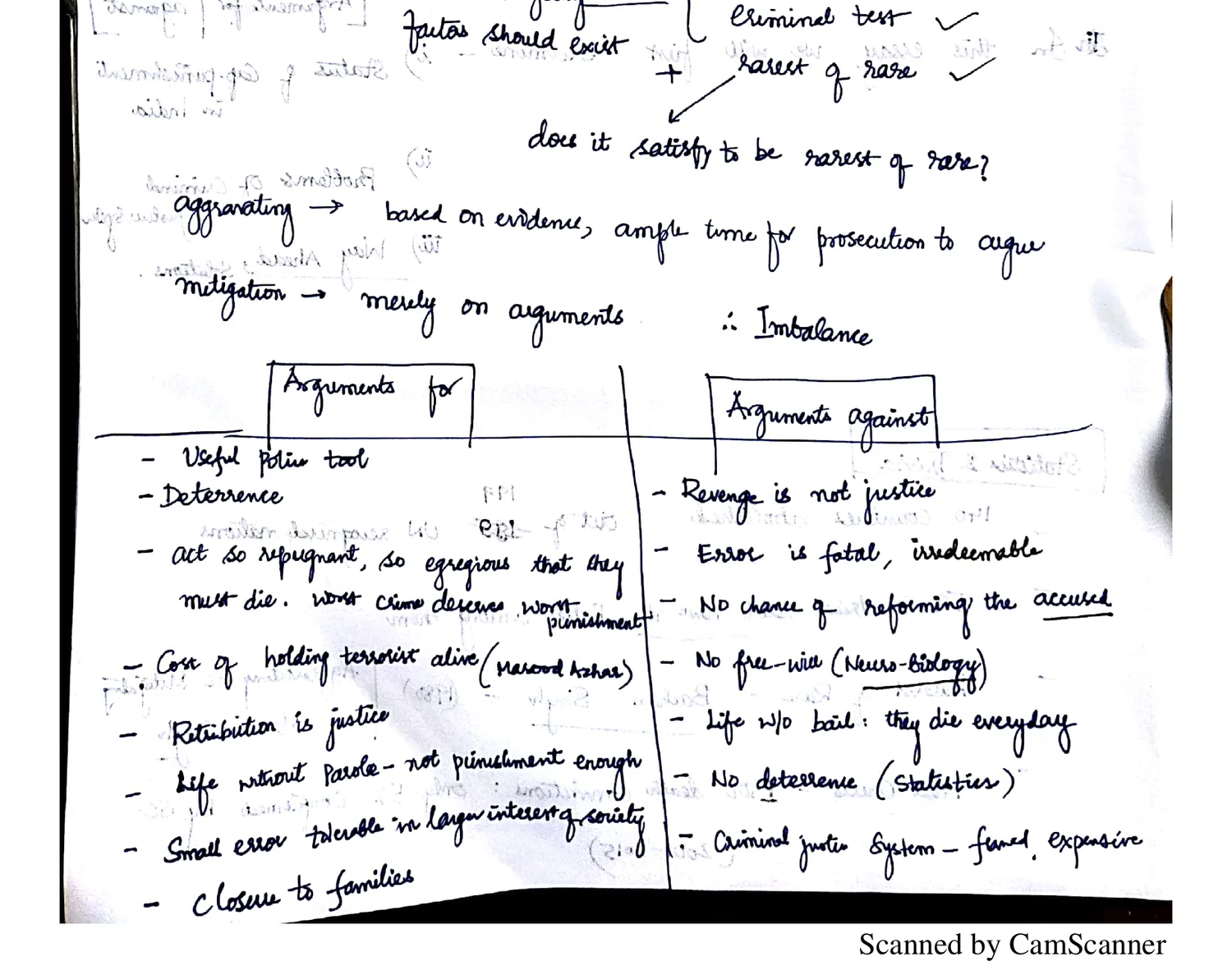
Arguments For:
- Useful policy tool
- Deterrence
- Act so repugnant, so egregious that they must die; none [can] deserve worse punishment
- Cost of holding terrorists alive (reserved values)
- Retribution is justice
- Life without parole — not punishment enough
- Small error results in large [sentencing] equity
- Closure to families
Arguments Against:
- Revenge is not justice
- Error is final, irredeemable
- No chance of reforming the accused
- No free-will (neuro-biology)
- Life w/o bail: they die everyday
- No deterrence (Statistics)
- Criminal justice System — flawed, expensive
#Page 25 — Capital Punishment (Deterrence Evidence & Way Ahead)
#Examples
- Aruna Shaunbag — Raped in a ward in a Mumbai Hospital; left her in vegetative state for 42 years; Thus, argue for retention / death penalty.
#Deterrence Stats [diagram]
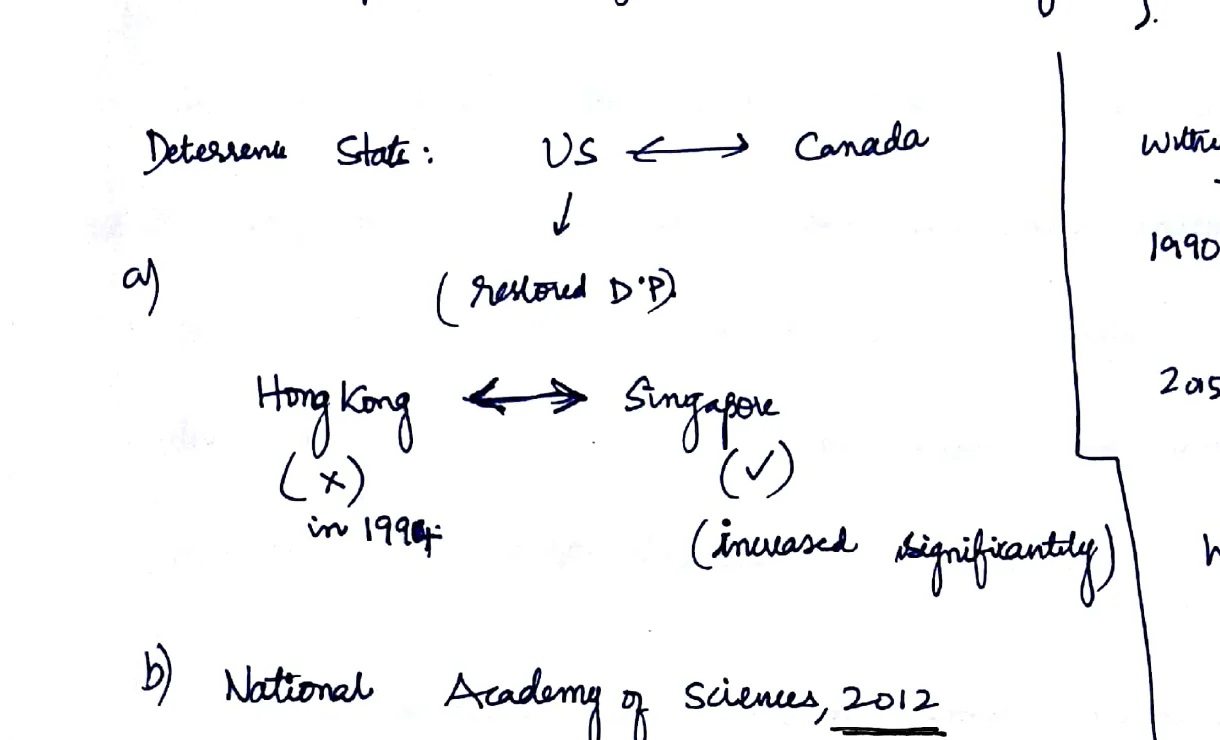
- a) US ←→ Canada (Abolished D.P. [Death Penalty])
- 1980: < 9.5/L (DP) [DP states] vs 9.1/L (No) [non-DP states]
- 2015: 5/L (DP) vs 14/L (No)
- Wrong Carlos: executed Carlos de Luna; Visited Carlos Hernandez
- Hong Kong ←→ Singapore (✓) (in 1998) — (increased significantly)
- b) National Academy of Sciences, 2012
#Way Ahead
- To conclude, we've seen that death penalty is an expensive and ineffective instrument to administer justice. It goes against fundamental norms of a civilised liberal society. Hence we must put an immediate moratorium on it and use it only for terrorism cases.
- "Eye for an Eye — blind."
- [Faint pencil below — illegible lines]
#Page 26 — Transition Page (End of Capital Punishment / Start of Terrorism)
Note: Top half of p26 is predominantly back-bleed / mirror-image from adjacent page — content illegible. Bottom half contains the first clear line of new topic.
- Insurgency: an organised armed struggle by a section of the pop[ulation] against the state, usually with foreign support.
- → D [arrow pointing to definition line]
#Page 27 — Terrorism / LWE [Left Wing Extremism] (Natale Youfain anecdote / Intro)
#Introduction — Character Narrative
- [Intro] label (boxed)
- Little girl Archana had a dream: Dream of becoming an air pilot as a child.
- She was inspired by the NASA astronaut Kalpana Chawla. She always thought that one day, she will touch the skies. But on a fateful day on 26th November 2008, while she was visiting to catch her train, she was brutally gunned down by terrorists. All her hopes, dreams and ambitions — extinguished in a fleeting moment. Archana was a victim of terrorism.
- Terrorism had inflicted untold miseries on innocent victims all over the world and it is time we put a firm end to this egregious menace. This calls for a careful analysis of the topic.
- In this essay we will first examine:
- i) Defn of terrorism & historical evolutions
- ii) Reasons / causes [SPELA / Jutt caused / + CCIT]
- iii) How can we crush it? (Way ahead)
#Definition [boxed label]
- Unlawful use of violence & intimidation especially against civilians in pursuit of political / religious / ideological aims.
- It is the act of demanding the impossible, and demanding it at gunpoint.
#Types [boxed label]
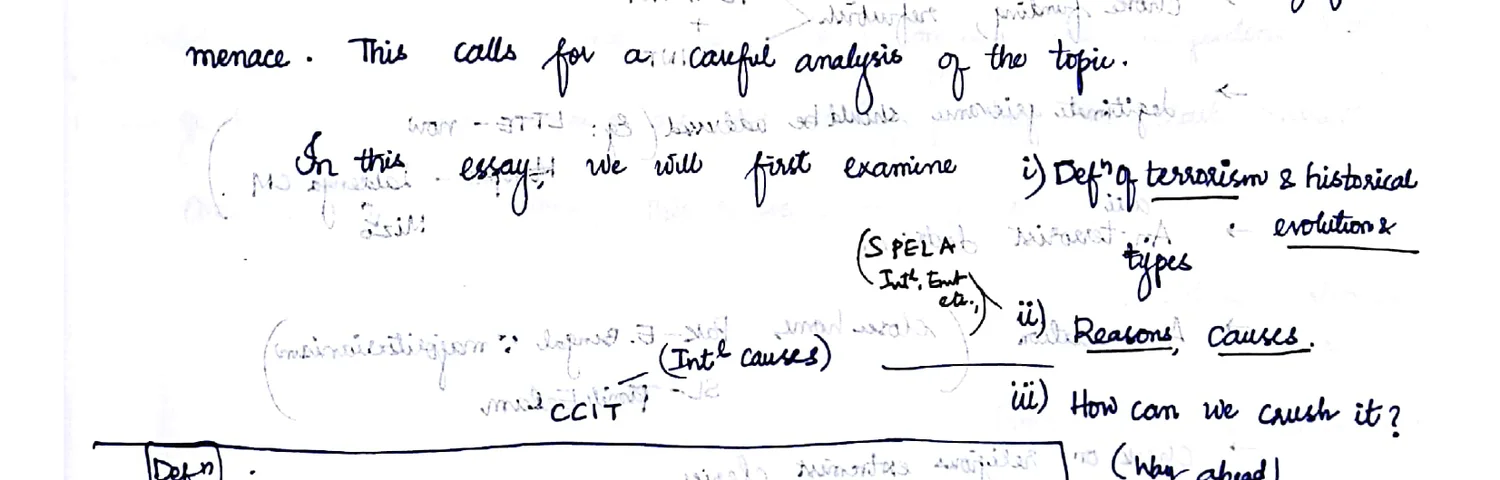
- i) State-terrorism / State-sponsored → Nuclear
- ii) Bio-terrorism → Narco
- iii) Cyber terrorism → Religious
- iv) Eco terrorism → Ideological terrorism
- (left-wing / right-wing)
#Page 28 — Terrorism (Reasons & Solutions)
#Reasons [boxed label]
- Separatism (LTTE)
- Political grievances (IRA, Kashmir, Palestine Hamas, Alienation)
- Terrorists cannot fight against mighty state; they create theatre of violence. Targets are not [the] but the people who watch it. (Yuval Harari in The Guardian)
- Social / Economic: Poverty, Misery, Injustice (Gaza), Illiteracy
- Religious misinterpretation — Al-Qaida, ISIS, Aum Shinrikyo (Japanese)
- [illegible pencil: involvement / growth in media is not?]
#Solutions [boxed label]
- → Education
- → Int'l Convention
- → Choke funding, refutation ← TECH INT [Intelligence] + HOM INT [Human Intelligence]
- → Legitimate grievances should be addressed (Eg: LTTE — now)
- Manipur — Lokbanga CM; Mizo
#Page 29 — Terrorism (Solutions contd.) & Human Development (New Topic)
#Terrorism — Solutions (continued)
- → Anti-terrorist doctrine?
- → Accommodation (close home; Pak — E. Bengal → majoritarianism; SL — Tamil Eelam)
- → Check on religious extremism / clerics
#End
- We've eliminated small pox, cure for many diseases, follow the ideals of Mahatma Gandhi.
- World must come together to eliminate this deadly scourge.
- Coda / Character → Natale Youfain [referring back to intro character]
- [Faint pencil: illegible lines below]
#Page 29 (bottom) — Human Development (New Topic)
#Introduction — Character Narrative
- (Introduce a character) — Fifty year old Ramnath is a resident of Kalahandi in Orissa, one of the poorest districts in India. As he goes to the local Panchayat office, he overhears the Sarpanch saying that India is now the fastest growing economy and is set to overtake the UK and is set to become the 5th biggest economy in the world. He looks on, wondering if this wealth can get his kids good education, get his wife health care and give him means for a stable living. And he wonders in hope for a better future. — THE DEVELOPMENT PARADOX
#Context
- Without FoS: India has come a long way since independence. Though [6DP growth], many such Ramnaths are still waiting for help. This stark contrast calls for careful analysis. (This raises some important Qs)
#Page 30 — Human Development (Structure, Stats, Conclusion)
#Essay Outline
- → Trajectory of India's development agenda
- → Problems with it → exclusively HDI
- Our failings: Edu, Gender, Health, Hunger, Inequality, Sanitation
- Japan, S. Korea, Thailand ← Int'l Perspective
- Salanku [Shalaku / Salaku — illegible] → Way Ahead
#Evolution: HDI [boxed]
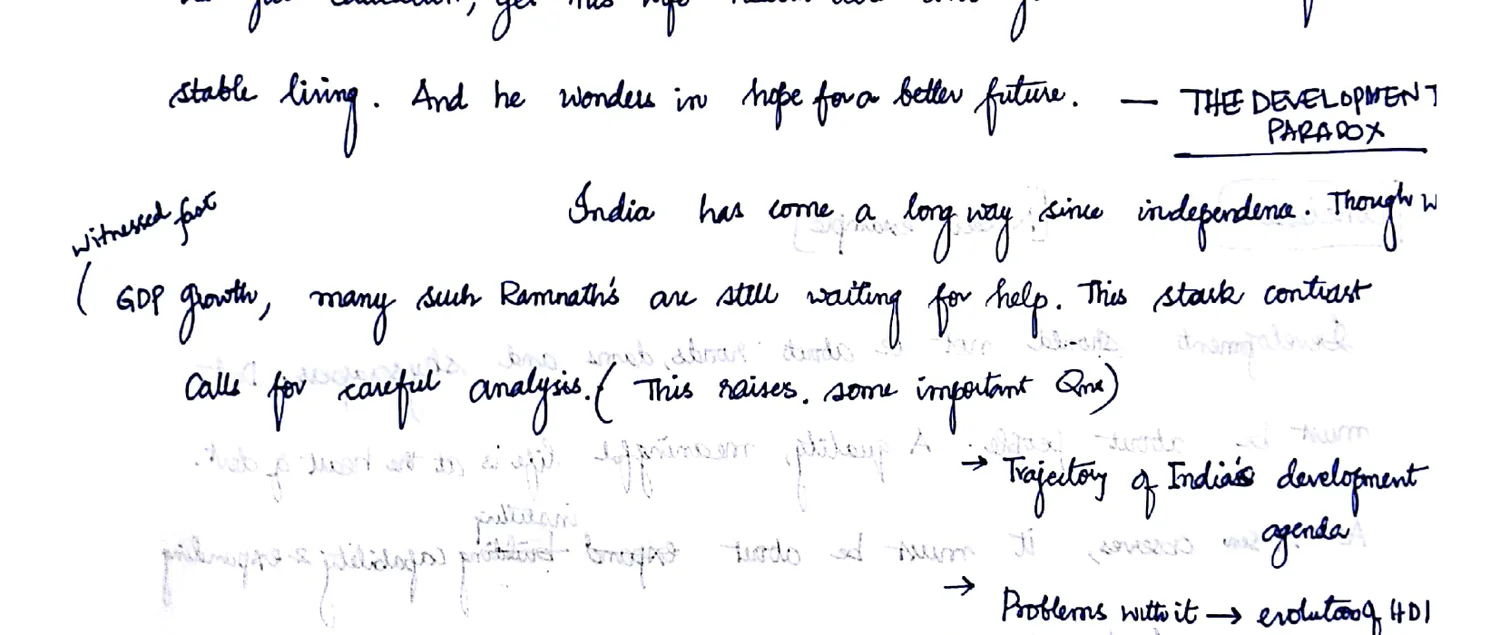
- Before 1990s: GDP [as measure] ✓
- 1990s — Mahbub-ul-Haq → HDI
- Later: Sen — Capability approach / Dev as Freedom
- India: 131 in HDI (/189); SL: 73rd; Maldives: 102
- Stats on:
- Edu ✓
- Health ✓
- Gender ✓
- Hunger ✓
- Livelihood ✓
#Statistics — "Missing Women" — Sen
- S. Asian Enigma
- HDI: 0.634 — but value falls 27% if adjusted to inequality → 0.45
- Gender Inequality Index: 125th / 159
- 12.2% Parliamentarians women
- Solution: 28% women labour force ≈ 80% Men; MMR: 174/100K
- Kutch to Kalahandi, Kashmir to Kanyakumari — every child must be ensured quality education
- [Faint pencil below — illegible notes]
- Conclusion — [Nordic example] not stated
#Conclusion
- [Conclusion] label (boxed)
- [Nordic example] (boxed)
- Development should not be about roads, dams and skyscrapers. Dev[elopment] must be about people. A quality, meaningful life is at the heart of dev[elopment].
- As A. Sen observes, it must be about expanding / installing capability & expanding freedoms — freedom to afford quality edu, freedom to access health care and freedom to enjoy political & civil rights. India has come a long way & much work yet to be done.
- This Dev[elopment] Story — Responsibly Jointly Drives [illegible bottom line]
- [Bottom: circled/underlined] → "Sabka Saath — Sabka Vikas"
- [Faint pencil margin notes — illegible]
#Page 31 — Effective Narration (Contd.)
#Effective Narration — Sen Quote
- Sen: "The violation of freedoms, infringement of basic needs, deprivation of gender justice exist even today despite unprecedented opulence."
- To illustrate: World GDP was [$1 trillion] in 1900 → $77 trillion [now]
- Increase of 70 times or but some problems remain [underlined]
"Focus of well-being of those at the bottom of society, not the effluence of those at the top."
#Page 32 — Privacy / Surveillance / Cyber Security
#Definitions
-
Privacy — a state in which one is not observed/disturbed by other people
- Freedom from public scrutiny / attention / surveillance
- Freedom from unauthorised disclosure of personal information
-
Cyber Security — the state of being protected against unauthorised use of electronic data or the measures taken to achieve this
- Is the body of technologies & practices designed to protect computer networks, data from outside & unauthorised access
#Intro
- Intro — See Edward Snowden [Quote — ?]
#Evolution [boxed]
- History
- Impact
#Examples [boxed]
- Snowden
- Iran Stuxnet Virus
- Data breach in Indian banks
- WannaCry Ransomware
- Bitcoins — threat to fin[ancial] system
- Online recruit by Jihadis
- Terrorism using encryption
- An example — use of Social Media Tools, [government] etc.
→ Cybersecurity is necessary. But it impinges on basic civil right of privacy
#Page 33 — Privacy: Why Is It Important?
#Privacy: Why is it important? [boxed]
- → Limits govt power & power of corporations — activists, journalists, dissent
- → Freedom of thought & Speech (< Social/political activities) + Association/Assembly
- → To Trust (between lawyer–client; doctor–patient) — no steps … [illegible]
- → Individual right for a fulfilling life; Reputation management; autonomy; ageing
"Arguing that you don't care about privacy because you have nothing to hide is no different than saying you don't care about free speech because you have nothing to say."
- → Misuse by govt/corporations (Eg: Eset Germany)
- → Identity theft / fraud [Eg: Jan Dhan accounts misused to deposit money & launder cash]
#Threats to Privacy [boxed]
- → Terrorism
- → Technology & increasing power of Corporations, govt
- → Lack of information among public
- → Misplaced sense & abuse of "national security"
- 3 levels:
- Govt
- Corporations
- Criminals / hackers
- 3 levels:
#Page 34 — Privacy: Balancing with Security / SC Cases
#Art 12 of UDHR
-
Art 12 of UDHR — "No one shall be subjected to arbitrary interference with his/her family, privacy, home"
-
Talk about how privacy will strengthen Digital India — as more people willingly connect w/o fear of surveillance [circled]
#Balancing Privacy & Security [boxed left] + SC [boxed right]
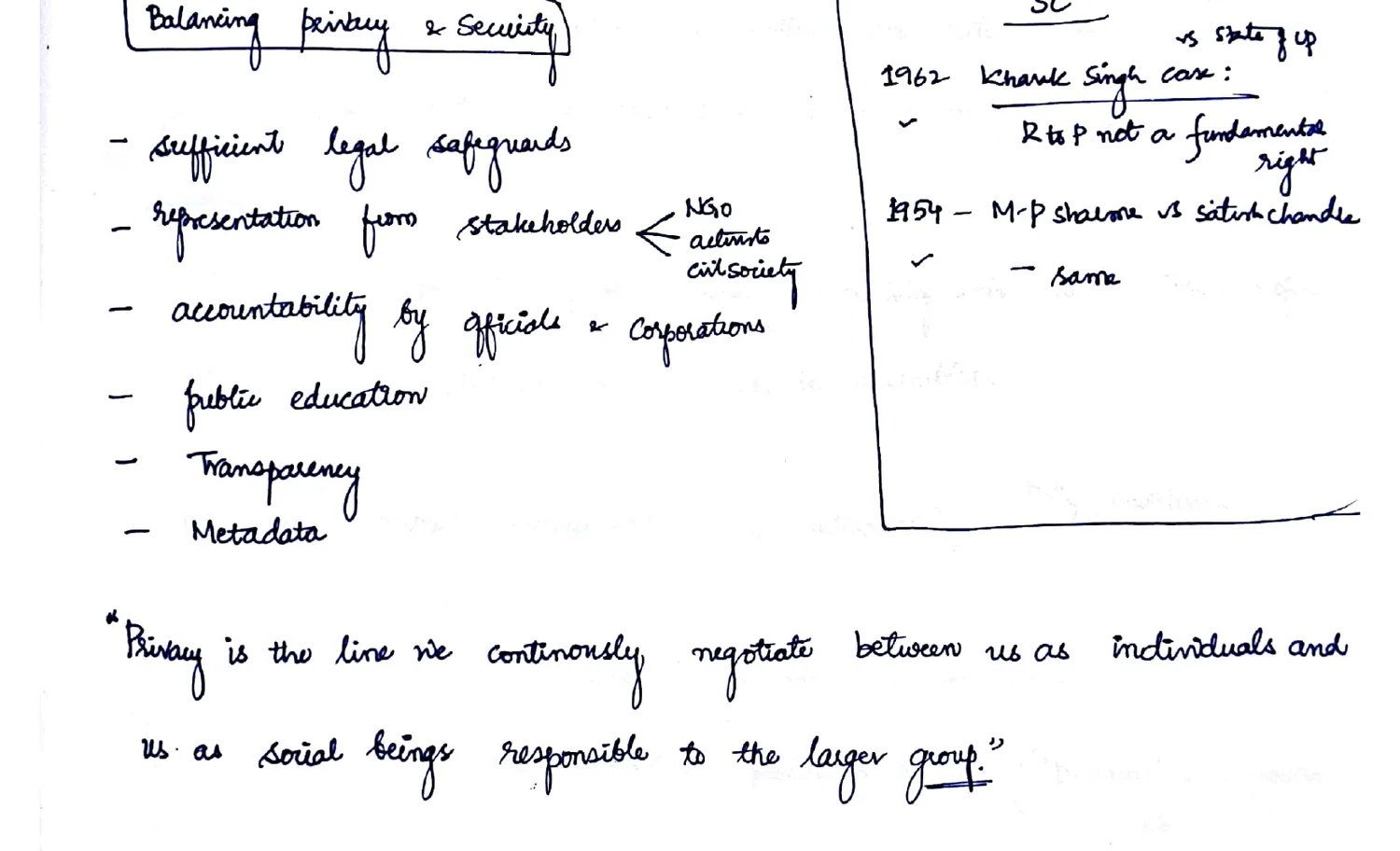
Balancing Privacy & Security:
- Sufficient legal safeguards
- Representation from stakeholders ← [NGO activists, civil society]
- Accountability by officials & Corporations
- Public education
- Transparency
- Metadata
SC [Supreme Court] — Is [right to] privacy a fundamental right?
- 1962 — Kharak Singh case:
- Right to Privacy not a fundamental right [underlined]
- 1954 — M.P. Sharma vs Satichchandie [Satish Chandra]
- Same [ruling]
"Privacy is the line we continuously negotiate between us as individuals and us as social beings responsible to the larger group."
#Page 35 — Corruption
#Corruption — Content & Intro
- Content from — ARC 2 and public/[pub.Ad] notes from (IGSA [?]) → problems/solutions
#Intro [boxed]: Introduce 2 characters — small stories
-
Ramayya and Archana are victims of Corruption.
- A character walking down to collect PDS ration — only to be turned away [be turned away]
- A child not getting healthcare — funds meant for children beds-rerouted/approved [off]
-
Two ordinary people merely exercising their rights. Their hopes shattered, dreams broken and life left in shambles.
-
Talk about moral corruption — (demoralisation), Petty, extortionary
- Gandhi quote: "As human beings, our greatness lies …."
- Confucius — righteousness as foundation of G[overnance] ("Dharmm" as propagated in Buddhism)
#Conclusion [boxed]
- Any quote ✓
- Sabka Saath, Sabka Vikas cannot happen unless the cancer of corruption is entirely uprooted. Only when its done — when every Ramayya has access to his food grains, every girl like Archana can afford quality healthcare and every citizen lives an honest, committed life….
#Page 36 — Civil Service / Bureaucracy
#Civil Service / Bureaucracy [boxed]
#Intro
- Sui dynasty — China
- Kautilya — Arthashastra:
#Necessity of Civil Service (VSITY [?]) [boxed left]
- Fragmented society
- Promote rational unity
- Smooth transition of [govt] power
- D'cy [Democracy] & B'cy [Bureaucracy] go hand in hand
- Impartiality
- From nation-state → state as primary provider of G[oods &] S[ervices]
#Problems
- Corruption
- Ivory-tower mentality: lust for power, control, fault-battle culture
- Professionalism [?]
- Apathy, lethargy, Red-tape
- Legal Flaws: HC Gupta → Conviction 13(i)(d) of PC[A] Act
- ↑ too much delay in prosecution — Sec 197 of CrPC; Sec 11 of BCA [?]
- Politicisation
- Art 311
- Accountability of public service ⓘ
- Pay commission → no incentive to shine
#Good Examples [boxed]
Examples:
- Telangana: TS-iPASS (Industrial Project Approval & Self Start Sys)
- Nilam [Nilan?] Cont = side of public life — HOLOLAS [?]
Intl [International] Experience:
- NZ, Aus, UK: Lateral Entry; Contractual [system] [for CPO [?] / [contract] pay]
- [TORA] Singapore: Service delivery law + Competitive pay
#Page 37 — Civil Service / Bureaucracy: Solutions & Conclusion
#Solutions [boxed] ✓
- [faint/illegible lines — several items too faint to read]
- [illegible] — plural[istic?] [illegible]
- [illegible] — republic [illegible]
- ways of [illegible] international [illegible]
- [illegible] kind of — [illegible]
- [illegible]
#Conclusion [boxed]
- [illegible introductory line]
- Role of Civil Service in shaping this Republic
- With change — 21st century C[ivil] S[ervice] for a 21st century New India
- [illegible faint line] → Quote & poster lines ✓
[Lower half of page — very faint pencil notes, mostly illegible]
- [illegible] → [illegible]
- [illegible] → [illegible] [several lines]
- [illegible] — [illegible] [several lines]
#Hand-drawn Map Figure (p37)
#Page 38 — Urbanisation
#Urbanisation [boxed]
- Refers to the population shift from rural to urban areas
#Intro [boxed]
- Little Sunita —
-
[illegible line] — victim of reckless urbanisation
-
As the nation grows in economy, urbanisation share ↑. As India hits lower 5th largest [?] — set [?] with ↑. This throws up many [many] questions and challenges such as:
-
→ Patterns & feeling of "utopia"[?]
-
→ Factors driving the shift
-
→ Challenges
-
→ Solutions
-
Gandhi: "Live locally" [from Gandhi — outside?] → Sustainable living
-
My — Zimbabwe; Vegas — [Bldesh?]
-
#Statistics [boxed]
- India spends $17 per capita per year on urban infra — far less than what Colombo / Bangkok / Rio de Janeiro spend ($60 per capita)
- Next 20 yrs require $1 trillion investment
#Pattern
- Mostly unplanned; urban sprawl on outskirts / on highways
- From nearly rural areas [note]
#Reasons [boxed]
Pull factors:
- Agri[culture] failure
- Caste oppression
- Search for better avenues
Pull [Push?] factors:
- Sanitation, Garbage [?] issues
- Better education for kids
#Page 39 — Urbanisation: Problems & International Best Practices
#Problems & Challenges [boxed]
- Lack of housing, sanitation, proliferation of slums, public transport, water, electricity, health, education
- Pollution
- Traffic Congestion
- Urban floods → # (Mumbai, Chennai)
- Poverty, Unemployment
- Communal issues (Kokrajhar, Assam) riots
#Institutional Issues [boxed]
- Disempowered local bodies
- 74th AA (left it to states)
- 3rd MPC [?] DPC (only 50+ are functioning)
- Funds, function, functionaries
- No accountability
- SFCs — paper tigers
- No master plans
- No trained personnel
#International Best Practices [boxed]
- Mayors — from London to Los Angeles; Paris to Seoul to Sydney
-
All major cities are governed by directly elected Mayors + for powers
-
Paid Parking [note]
-
Congestion Tax on particular roads [note]
-
In-situ slum development [note]
-
Sources of Revenue (CSR) [note]
-
M. Bloomberg
-
Rudy Giuliani
-
#Page 40 — Urbanisation: International Best Practices (Contd.) & Solutions
#International Best Practices (Contd.)
- Tel Aviv & Israel & Singapore recycle 75% of water
- London generates 40MW every year from solid waste biogas [?]
- Let Municipal Bonds by foreign markets
- Local govt to Empower RWA [Resident Welfare Associations], city townhalls & councils
- Real Estate Finance: use GIS tech to tag, Geo-tagging
#International Best Practices Table [boxed]
| City | Practice |
|---|---|
| London | SWM [Solid Waste Mgmt] 40MW |
| Tel Aviv | 75% water recycled |
| Singapore | Congestion Tax |
| Hong Kong | Paid parking, high taxes on personal cars → to disincentivise personal cars |
Referenced mayors: Rudy [Rudolph] Giuliani; M. Bloomberg; Sadiq Khan
#Solutions [boxed]
- It's a daunting challenge but also a great opportunity.
#Conclusion
- Coda — character. ✓
#Page 41 — Globalisation
#Globalisation [boxed]
- Process by which nations, regional economies, cultures have become integrated through global flow of trade, [commerce?], immigration & transport [?]
#Intro [boxed]
-
A little girl forced to drop out of school because of glue from China → fell in prices, shelling at oblivion, cannot afford her education. Yet at the same time, her classmate Arjun is happy at [with] his new class — made in USA.
-
"This is the paradox of Glob[alisation]. For those at the top, those with purchasing power, it has been an incredible blessing. For the poor and the marginalised, it has been a terrible nightmare."
- ⓐ — This calls for complex analysis.
- In this essay we'll examine:
- ① Meaning of G[lobalisation], evolution, reasons
- ② Impact on → [branches to: S[ocial], P[olitical], Sci[ence/Technology], Business/Admn[Administration]]
- ③ Problems
- ④ Solutions
#Essay Structure Diagram
#Positive Examples of G[lobalisation]
- → More choice for consumers
- → Interweaving of cultures, antidote against Xenophobia, parochial mindsets
- → Employment, IT, Tech transfer
- → Flow of info, ideas, innovation
- → Info explosion
#Negative Examples [boxed table]
-ve Examples:
- Erosion of sovereignty of Govt (drug patent, UNSC, WTO, climate change deals)
- Climate change
- Global Inequality (between nations & within nations)
- Unemployment, poverty in developing world
- Instability (Greece has no input on its own policy-making [?])
- Terrorism
#Page 42 — Globalisation: India & History of G[lobalisation]
#Indian MNCs → TATAs, Infosys [note]
- ← threat to native culture (Eg: Tribes)
- [illegible] — economic [?]
- GMO, agri[cultural] failure
- Surveillance, privacy issues
[Several faint/illegible lines in centre of page]
#Content [boxed]
History of G[lobalisation]:
- Sumer ↔ Harappa — 3500–2000 B.C.
- Silk Road — at cross roads in Damascus (silk from China)
- Silk from China
- Spice from India
- Shrouds traded
- Horses from Europe
Three Waves of Globalisation:
- G1: 1492–1800 (maritime exploration, trade, imperialism, mercantilism; ideas of Am[erica], Fr[ance] Rev[olution])
- G2: 1800–2000 (IR [Industrial Revolution], Steam Engine, Colonialism)
- G3: 2000 – present (Info Tech, Smartphones, Pop culture, MNCs, Service sector)
[Lower half of page — very faint pencil notes, illegible]
- [illegible] — [illegible]
- [illegible] — [illegible]
#Page 43 — Globalisation: Stats & G[lobalisation] vs G[overnment]
#Stats [boxed]
- 1% of world owns 3/4 of global wealth (WEF)
- Richest 8% own 84.6% of wealth
- World's 10 richest billionaires → own $500b > GDP of many countries
- India: 1% owns 50% of wealth (Global figure 50%)
- by Oxfam
- 8 billionaires have same wealth as poorest 50% of population
#G[lobalisation] vs G[overnment] [boxed]
- → Capabilities
- → Public > profit
- Govt must provide basic goods
- Nordic country examples
- Skill dev[elopment], Edu[cation], Technology Emp[owerment?]
#Page 44 — Ethics / Morals / Values / Character
#Ethics / Morals / Values / Character [heading — top of page]
[Some faint/illegible lines at top]
Key questions:
- Why are ethics important?
- How do you instil moral values/ethics in people?
- Consequences of bad values / lack of scruples
"Happiness is what you think, what you say and what you do are in harmony."
- Importance of ethics — personal, professional (workplace), Society (community)
- Expand to: National / [Global] level
#Importance of Ethics — Personal Level
Personal:
- a) Satisfies basic human needs (Security, help from others, Psychological/physiological needs)
- b) Contentment; meaningful, fulfilled life
- c) Better relationships (On their deathbed…)
- d) Trust building
#Professional Level
Professional:
- a) Meaningful work life — example (having values of loyalty, [?] contributed & earned our living)
- b) Team work — Eg: Army, Civil Service (Service to nation)
- c) Economic gain as natural consequence of ethical [behaviour]
- Eg: (Malya scandal, Satyam scandal)
#Community Level
Community:
- let Ethics/Values help us to live in harmony
#Page 45 — Ethics / Morals / Values: Community, National & International Level
#Community Level (Contd.)
- b) Mutual respect
- c) Intermix of ideas, knowledge diffusion — Eg: Nazi Germany ultimately failed
- d) Compassion, help for each other
- Even → clean out
- Eg: Inhumane treatment of ecology, c.cfg [?] → Hurricane Harvey (Texas), Cloud bursts
#National / Govt Level [boxed, arrow →]
-
→ Living in peace (Ashoka's Dhamma — united & peaceful)
-
Mauryan/Hitlerian/Aurangzeb's intolerant policies — crashed
-
Failure of ethics in Intl [International] Relations:
- → GW/CC (B[io]/ethics) → social welfare for the poorest
- → Nuke weapons
- → War
- → Cyber espionage / surveillance
- → Terrorism as state policy
- → Torture, capital punishment
- → Refugee humanitarian crisis (Aylan Kurdi / Rohingya)
- → Drugs, crime, human trafficking
- → Corruption: Swiss Banks secrecy; Money laundering
Right column (consequences / examples):
- → 2008 financial crisis: a moral failing
- → Human cloning
- → A-I — bit away [?]
- → Toppling regimes unfavourable to you
- → Neo-imperialism (Russia annexation of Crimea in 2013)
- → Genocide (Rwanda, [?] → Intervention (Iraq, Libya))