GS Paper I — Heritage & Culture, History, Geography, Society
Indian heritage and culture; modern, world and post-independence history; geography; Indian society.
Art & Culture
Topper handwritten notes- Salient aspects of Art Forms, Literature and Architecture from ANCIENT to MODERN TIMES
#Topic 1: Architecture
= design & construction of buildings
#Classification of Architecture
- Ancient
- Harappan
- Mauryan
- Post-Mauryan
- Gupta Age
- South Indian
- Medieval
- Delhi Sultanate
- Mughal Art
- Modern
- Indo-Gothic
- Neo Roman
Monuments Intro — Monuments are grappling hooks that bind one culture to another, one era to another
#A1. Harappan
- Harappa + Mohenjodaro
- Urban civic planning — roads, houses, drainage
- Rectangular grid pattern
- 3 types of structures:
- Dwelling house
- Public buildings
- Public bath
- Baked/burnt bricks
- No large monuments
- No temples / palaces
- Egypt + Mesopotamia connections [trade] ✓
- Granaries
- Wells + ventilation
- Loosely covered drains for cleaning & maintenance
- Cesspits
- Emphasis on hygiene (public + private)
#Harappan Citadel Diagram
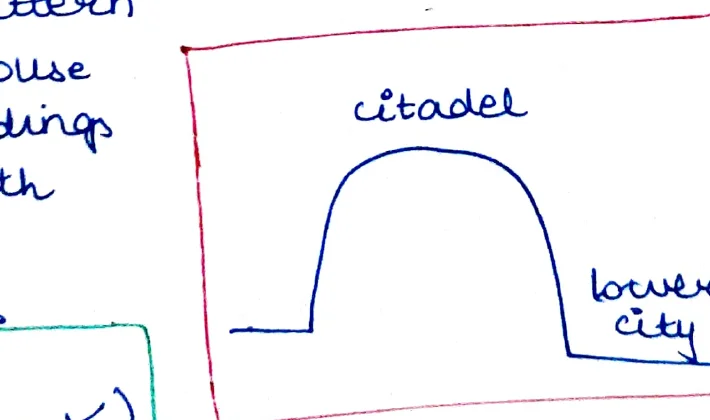
- Diagram shows: citadel (elevated mound, upper section) + lower city (ground level, broader base)
#Seals
- Pictographic
- Bi-directional writing
- No cow
- Both sides — commercial + communicative [nature]
- Discovered in Mesopotamia → trade
- Used as amulets
- Scientific purpose
- Math images = educational use
- eg: Pashupati seal, Unicorn seal
#Bronze Sculpture
- Lost-wax technique [cire perdue / Pinching method for Terracotta]
#Pottery
- Plain and Painted (Red & Black)
- Trees, birds, animals, geometry motifs
- Few handmade; mostly wheel-made
- Polychrome too (rare)
- Purpose:
- HH [Household] storage
- Decorative
- Perforated (straining liquor)
"Giant strides in field of arch + sculpture. From scientific city plan to artistic figures. IVC has left behind a legacy of skill & craftsmanship."
#Best-Known Works (Harappan)
- Great Bath
- Pashupati Seal
- Dancing Girl
- Mother Goddess
- Bearded Priest
- Male torso
#A2. Mauryan Art

- Court Art
- Palaces
- Pillars
- Stupas
- Popular Art
- Caves
- Pottery
- Sculptures
#Palaces
- At Kumrahar [Pataliputra]
- To reflect splendour
- Wood
- Massive
- Multi-storeyed
- Decorated
#Ashokan Pillars
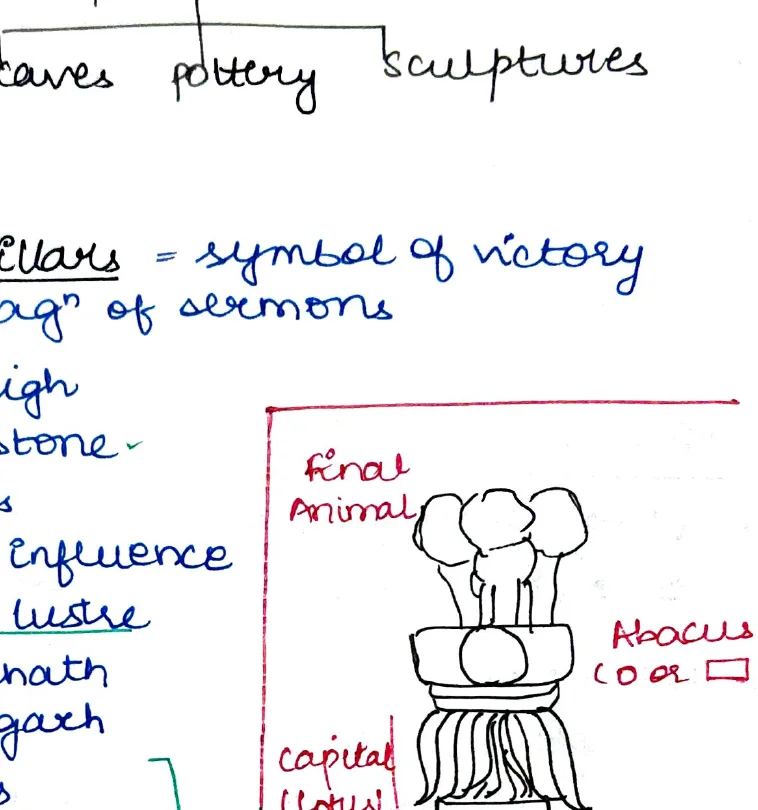
- Symbol of victory + "Propag" [propagation] of sermons
- 40 ft high
- Sandstone
- 4 parts:
- Final Animal (top)
- Abacus (circular or square)
- Capital (lotus bell)
- Monolithic shaft
- Iranian [Achaemenid] influence
- Polish / lustre
- eg: Sarnath, Nandgarh
- Abacus + animal = Nat'l [National] Emblem
- Independently erected
#Stupas
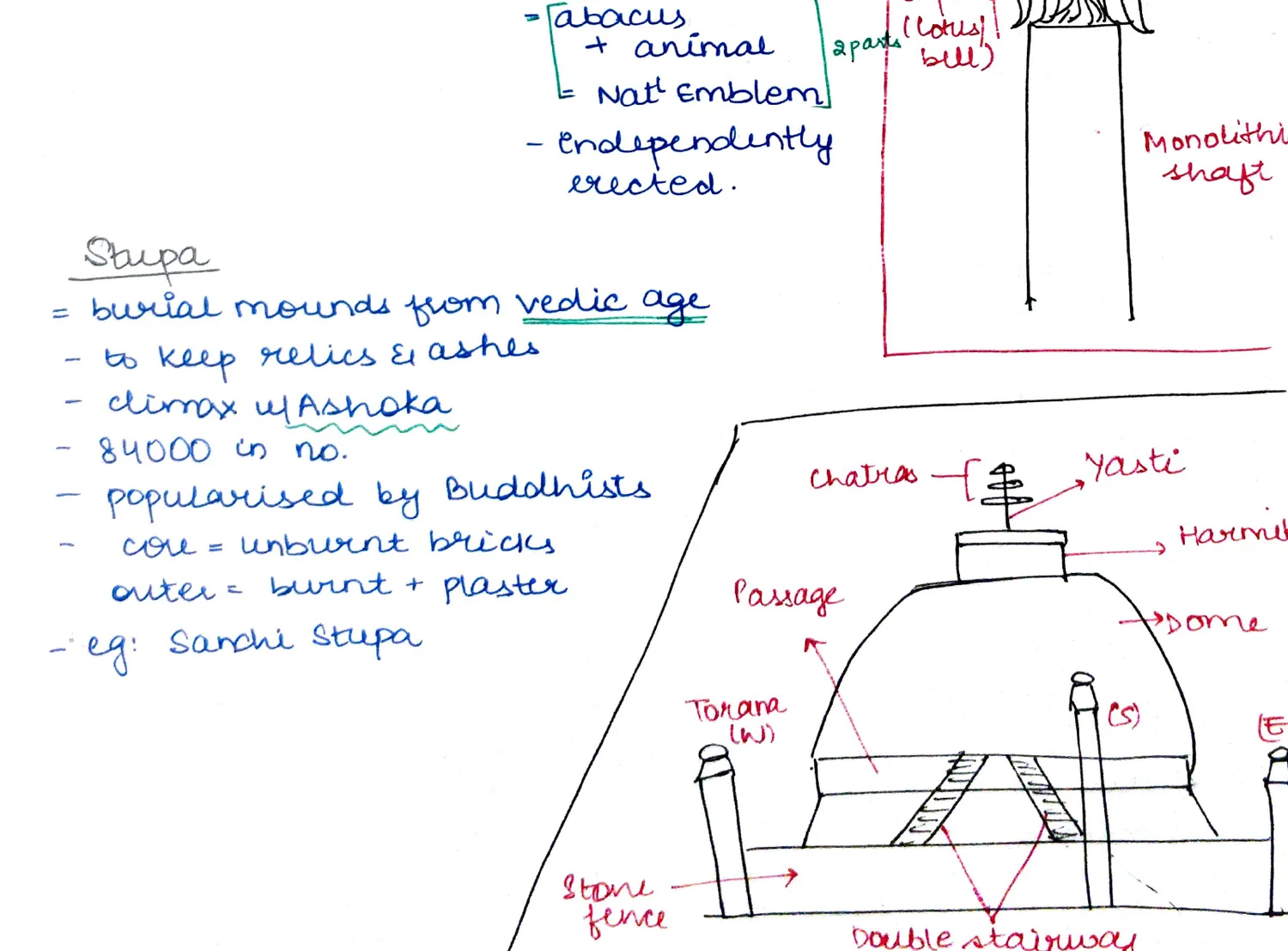
- Burial mounds from Vedic age
- To keep relics & ashes
- Climax with Ashoka
- 84,000 in number
- Popularised by Buddhists
- Core = unburnt bricks; outer = burnt + plaster
- eg: Sanchi Stupa
- Parts of Stupa (from diagram):
- Chattra + Yasti (umbrella + pole)
- Harmika (square railing on top)
- Dome (anda / solid mound)
- Passage (pradakshina path around dome)
- Torana (gateway)
- Stone fence (vedika)
- Double stairway
#Popular Art — Caves
- As Viharas [monasteries] for monks
- Ajivika + Buddhist monks
- Highly polished
- Decorative
#Popular Art — Sculptures
- Idea of stupas
- Yaksha & Yakshi (all 3 religions)
#Popular Art — Pottery
- Northern Black Polished Ware
- Highly lustrous
- Luxury items
- Highest level ★
#A3. Post-Mauryan
- North → Shungas, Kanvas, Kushanas, Shakas (rig [Rigveda influence])
- South → Satavahanas, Ikshavakus, Abhiras, Vakatakas (Shiva)
- Stupas + caves continued
- Sculpture = Climax
- Caves = Chaityas (new) + Viharas (old)
- eg: Udayagiri & Khandagiri [Odisha], Malika, Ranigumpha
- Stupas — larger; more decorated
- Stone > wood, brick
- Torana [by Shungas]
- Intricate carvings
- Hellenistic influence
- eg: Bharhut (MP), Torana at Sanchi
- Sculpture = Gandhara, Mathura, Amaravati
#Gandhara vs. Mathura vs. Amaravati — Comparison Table
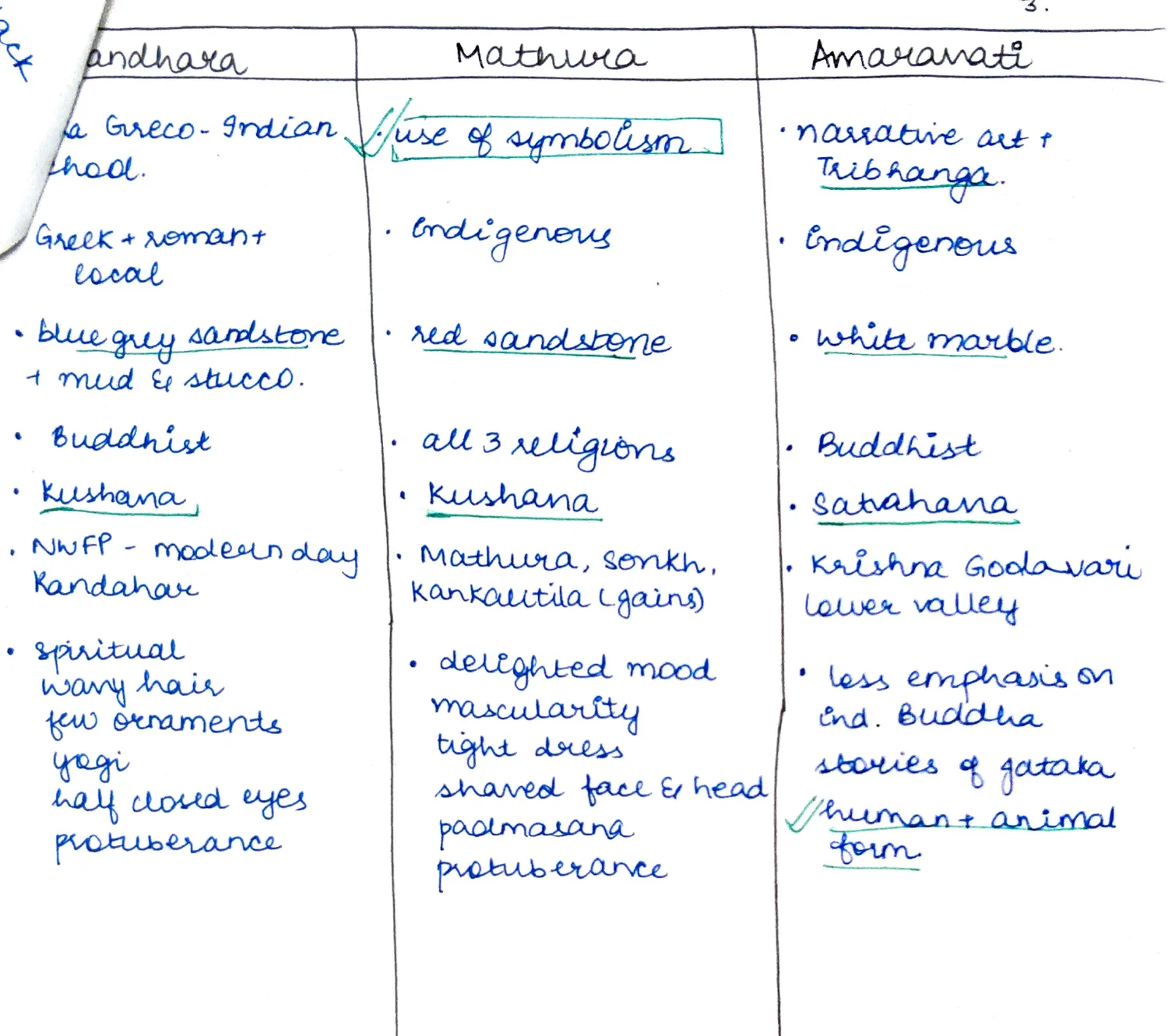
| Feature | Gandhara | Mathura | Amaravati |
|---|---|---|---|
| Influence | Greco-Indian — Greek + Roman + Local | Use of symbolism [highlighted] | Narrative art + Tribhanga |
| Origin | Indigenous (Greek-Roman-local) | Indigenous | Indigenous |
| Material | Blue-grey sandstone + mud & stucco | Red sandstone | White marble |
| Religion | Buddhist | All 3 religions | Buddhist |
| Patron | Kushana | Kushana | Satavahana |
| Location | NWFP — modern-day Kandahar | Mathura, Sonkh, Kankaultia (gains) | Krishna-Godavari lower valley |
| Style | Spiritual; wavy hair; few ornaments; yoga; half-cloud eyes; protuberance | Delighted mood; muscularity; tight dress; shaved face & head; padmasana; protuberance | Less emphasis on Bnd. [stories of] Buddha; stories of Jataka; human + animal form |
#A4. Gupta Age
- 4th century AD
- Golden period
- Climax = Temple arch [temple architecture]
- Buddhist + Jain Art
- ★ Mural paintings in caves — NEW ★
- eg: Ajanta, Ellora, Bagh (A type [Ajanta]), Junagarh (B), Nasik (B), Udayagiri & MP (H), Elephanta (Ellora type) — (H + B)
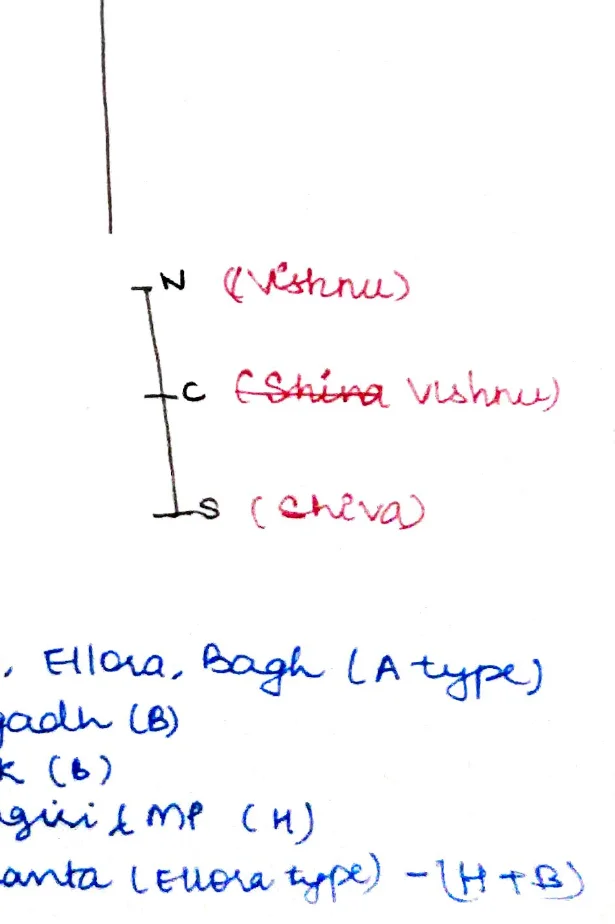
#Cave Classification (Gupta)
- N = [Vishnu]
- C = [Brahma / Vishnu]
- S = [Shiva]
#Caves — Ajanta vs. Ellora
#Ajanta
- Rock cut
- MH [Maharashtra] — Sahyadri
- 29 caves
- Vakataka-Harishena [patronage]
- Fresco painting
- Naturalism
- Absence of blue colour
- Buddhism
- Chinese A/C [accounts] — Fa-hien, Hiuen Tsang
#Ellora
- MH — Sahyadri
- 34 caves
- 1–12: Buddhist (cave 18–28 [corrected])
- 13–29: Hindu [Shaiva]
- 29–34: Jain
- All 3 Religions
- Newer than Ajanta
- Diversity in themes
- Cave 16: Kailash Temple (Lord Shiva) — Rashtrakuta-Krishnaraja
- Cave 10: Vishwakarma Cave
- Buddha in Vyakhyana Mudra
- Chatiya
- Bodhi tree
#Stupas (Gupta)
- Decline
- But Dhamek Stupa, Sarnath = ★
#Sculpture (Gupta)
- "Pern" [perhaps "perfect"] + cream colour + metal use + finely dressed + decorated halo
#Temple Architecture
#Evolution — Stages
- S1 = flat roof + square + shallow pillars + low
- S2 = high-raised + 2-storeyed + passageway (covered)
- S3 = Shikhara + Gayavan [Gayan] style + crucified ground
- S4 = same [as S3]
- S5 = circular temples + same features
(Lalalala — mnemonic)
#Temple Style Classification Tree

- Nagara (North)
- Dravida (South)
- Nayaka
- Vesara (N+D hybrid)
- Hoysala
- Vijayanagara
- Pala & Sena
#Nagara vs. Dravida — Detailed Comparison
#Nagara Style
- North
- Panchayatan style ←
- Assembly halls
- Images of river goddesses
- NO water tanks
- Upraised
- Pillared approach
- Shikhara (-)
- Latina — Rekha Prasad; square base
- Phamshana — broader base, short ht., steep slope
- Valabhi — rectangular base
- Amalaka + Kalash
- Rathas — 3, 5, 7, 9
- Covered pradakshina path
- No elaborate boundary walls / gateways
- 3 Sub-schools:
- Odisha — water tank
- Khajuraho — antarala
- Solanki — Surya Kund
#Dravida Style
- South
- High boundary walls
- Gateway k/a Gopuram
- Panchayatan
- Vimana (-)
- Kalash of N = Shikhara of D
- Only one Vimana (not on subsidiary shrines, unlike Nagara)
- Assembly halls
- Antarala (connector)
- Dwarpal — Mithun, Yaksha
- WATER TANK
- Continuation of Pallava architecture
- Sub-schools:
- Nayaka — Islamic influence; climax of Gopuram; Prakaram, huge corridor
- Vesara = N + D; curved Shikhara; carvings; square Vimana
- Vijayanagara — Indo-Islamic; mandap on all sides; monolithic pillars; secular buildings
- Hoysala — star / stellate [shape]
#Pala & Sena Style
- B + H [Bengal + Hindu] influence
- Curved sloping roof
#Basic Nagara Temple Diagram
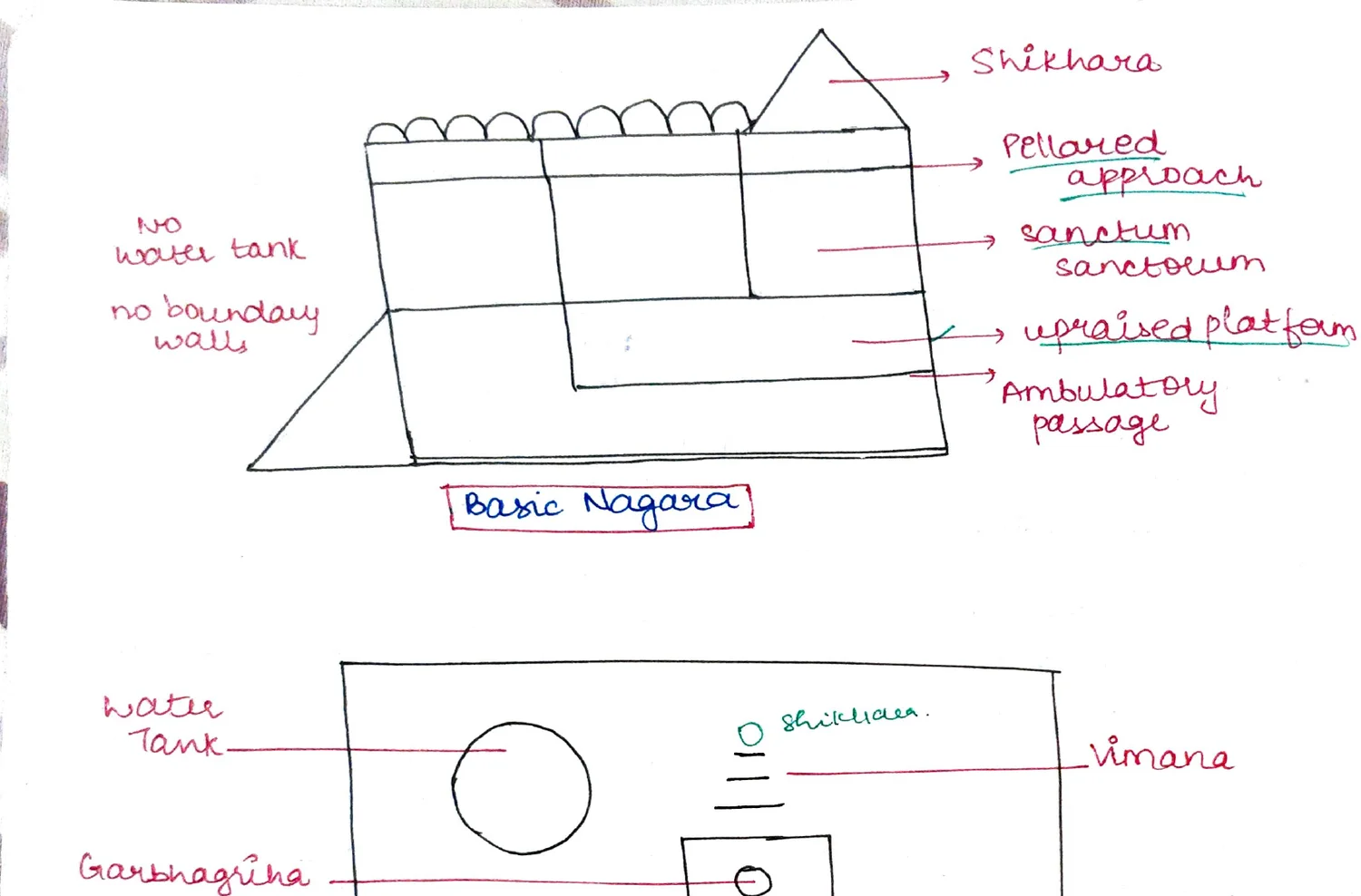
- Features labelled:
- Shikhara (triangular spire)
- Pillared approach (front porch)
- Sanctum sanctorum (garbhagriha)
- Upraised platform (jagati)
- Ambulatory passage (pradakshina path)
- No water tank
- No boundary wall
#Basic Dravidian Temple Diagram
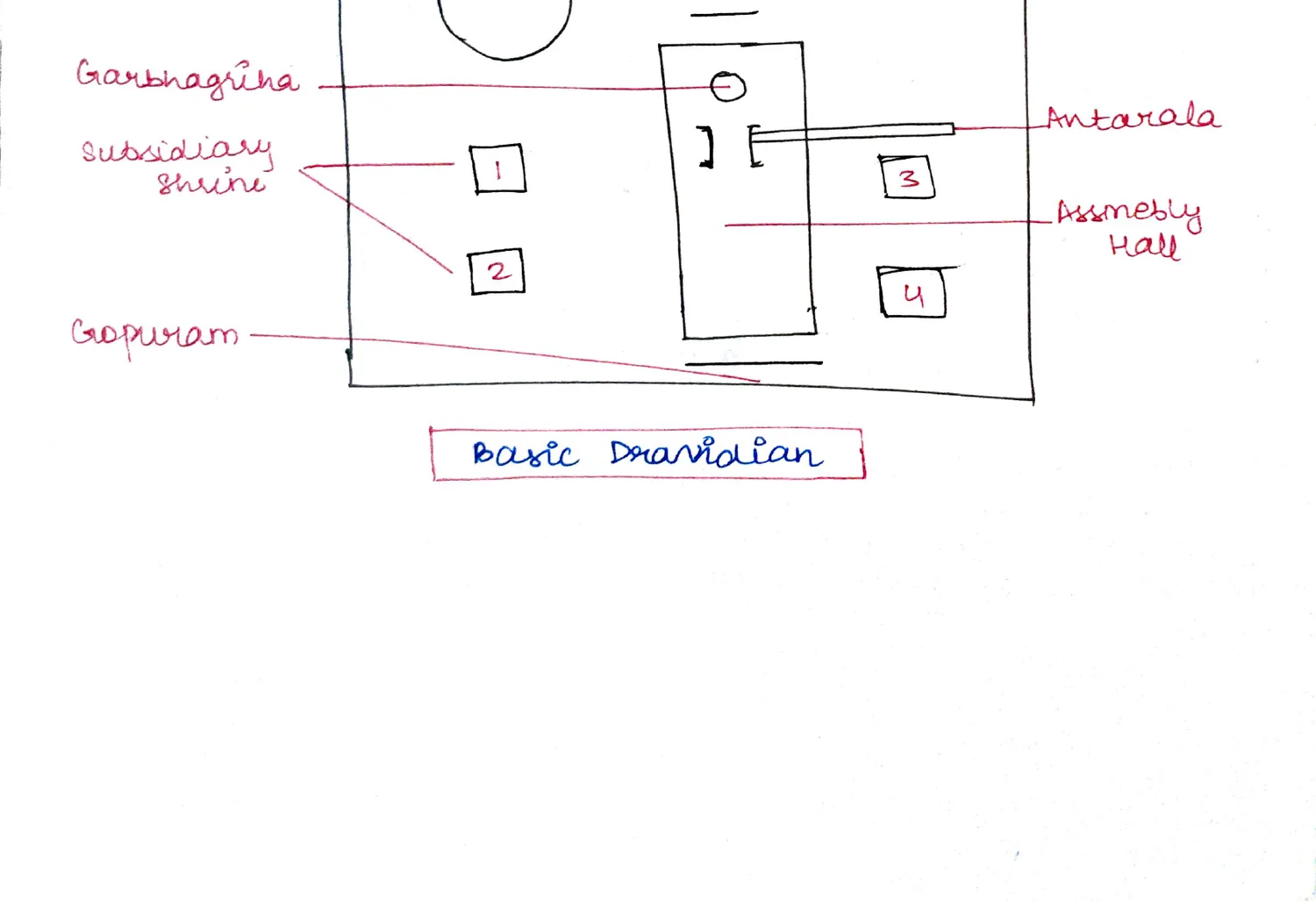
- Features labelled:
- Garbhagriha (sanctum with circle symbol)
- Antarala (vestibule/connector)
- Subsidiary shrines [1, 2] (flanking the main shrine)
- Assembly Hall [3, 4]
- Gopuram (monumental gateway)
- Water Tank
- Vimana
- Note: circle = Garbhagriha; rectangular compound = high boundary wall
#Medieval Art
- New elements = calligraphy, ornamentation using jali work, etc.
#Indo-Islamic Architecture
- Arch + dome
- Arcade style > Trabeate style
- Use of minaret
- Mortar
- No humans, animals
- Spacious, massive breadth
- Calligraphy
- Arabesque method
- Symmetry
- Jali work → religious / cooling / decorative
- Use of water
- Charbagh style
- Pietra dura aka Parchin Kari (S. Asia)
- Foreshortening technique
#M1. Delhi Sultanate
#Imperial Style
Slave Dynasty
- Remnant of Hindu structures
- Added burial pillars [minarets]
- eg: Qutub Minar [implied]
Khalji Style [highlighted]
- Red sandstone + mortar
- Arcades but not true dome
Tughlaq
- Dark / grey sandstone
- Batter [sloping walls]
- Focus on strength, not decoration
Lodi
- Back seat
- Only tombs
- Double domes
- H+H [Hindu+Hindu?] influence
- No decoration
- Gardens
#Provincial Style
Bengal
- Massive buildings
- Bangla roof
- Bricks + black marble
Malwa
- Coloured stone
- No minaret
- [illegible — partial word] / Hindu adaptation
- Era — Parhan school [?]
- Baoli, Bakra
Jaunpur
- Atala style
- No minarets
- Char [?]
Bijapur — Deccan style
- Bulbous dome + arches
#Mughal Architecture
#Babur
- Mosques + short rule → no development
#Humayun
- 1st time use of marble
- 1st garden tomb
#Sher Shah [highlighted]
- Mosque + Fort
- Transition from Lodi to Mughal style
- Grand Trunk Road
- Tomb at Sasaram
#Akbar — GOLDEN PERIOD [highlighted]
- Bulb [bulbous] arch / (4-centred arch)
- Red sandstone
-
- Agra Fort (further developed by Shah Jahan)
-
- Fatehpur Sikri (Ulmas + Pension) = "frozen moment"
- Employed Hindu workers, Hindu deco
- Climax = Jali work
- Started use of Kalaas [?]
- Built Govind Dev temple [in Vrindavan] + Humayun Tomb ★
#Jahangir
- Back seat
- More focus on paintings
- Akbar's Tomb + own tomb
- Moti Masjid, Lahore
- Shalimar Bagh, Kashmir
- White marble replaced sandstone [highlighted]
#Shah Jahan — CLIMAX of Mughal arch [highlighted]
- Taj Mahal · Red Fort · Jama Masjid · Shalimar Bagh (Lahore) · Shahjahanabad
- Peacock Throne
#Aurangzeb
- Decline
#Indian Paintings
- Since ancient times
- Primitive rock paintings of Bhimbetka, Mirzapur & Panchmahi (Zoo Rock Shelter)
- Painted pottery of IVC
- Real beginning = Gupta Age
#Pre-Historic Paintings
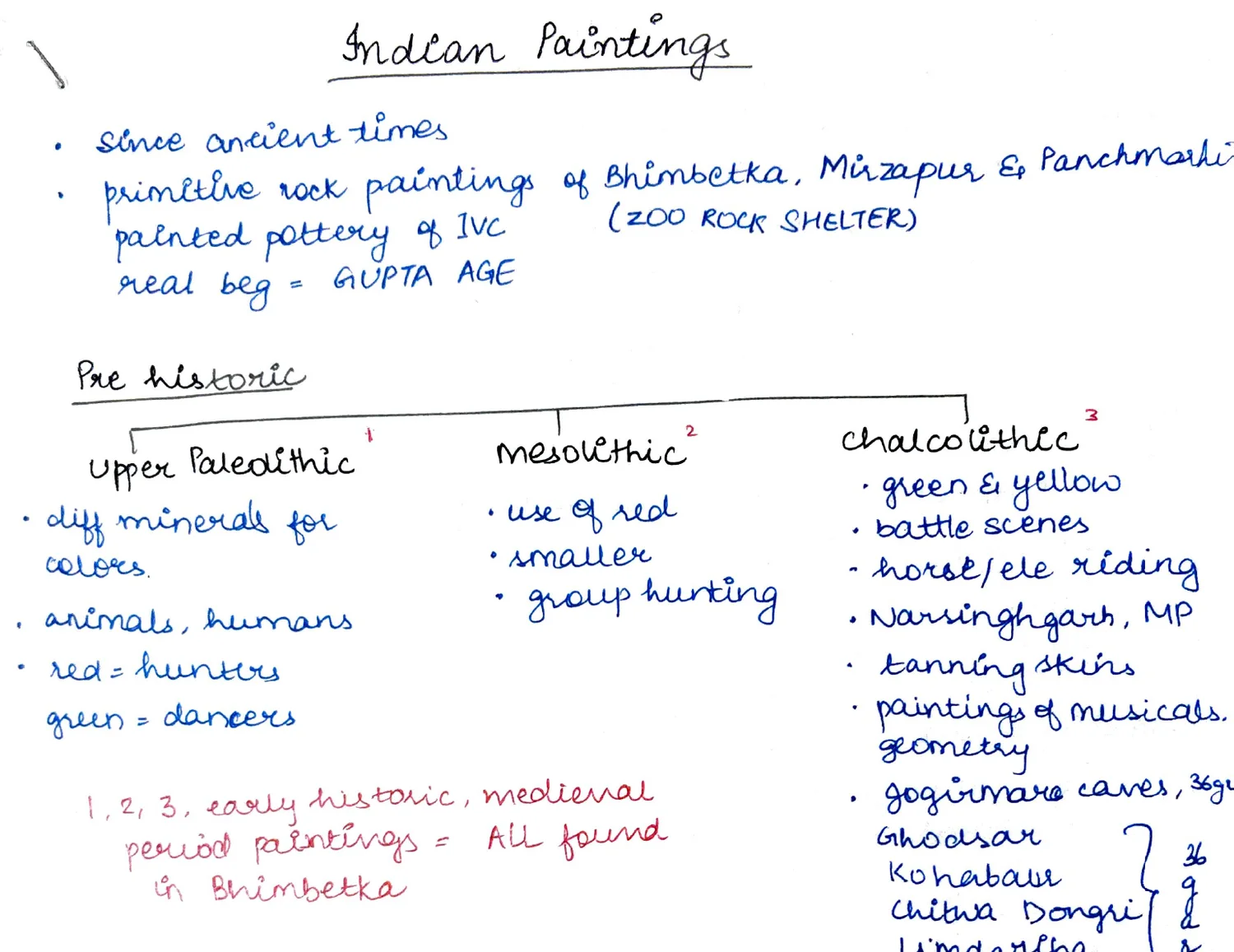
Upper Palaeolithic [Phase 1]
- Clay minerals for colours
- Animals, humans
- Red, hunters, green, dancers
Mesolithic [Phase 2]
- Use of red
- Smaller
- Group hunting
Chalcolithic [Phase 3]
- Green & yellow
- Battle scenes
- Horse / elephant riding
- Narsinghgarh, MP
- Tanning skins
- Paintings of musicals, geometry
1, 2, 3 + early historic, medieval period paintings = All found in Bhimbetka
- Chalcolithic cave sites:
- Ghoshgar
- Kohabaur [?]
- Chitna Dongri [?]
- Oogat [?]
#Mural Paintings
- On walls / solid structure
- Follow themes — H / B / J [Hindu / Buddhist / Jain]
- To adorn any mundane premise
- eg: ancient theatre room in Jogimara cave
- Unique because of size ★
#a) Ajanta [Mural Paintings]
-
100x 4–5c [century] of Mauryan empire
-
Cave 4–10: Shungas
-
Rest = Guptas
-
Cave 1–2 = most recent
-
Murals = Fresco painting
-
Tempera style [highlighted] & use of pigments
-
Pottery, human values + social fabric
-
Unique hairstyle
-
Chronology: Mauryas → Shungas → Guptas
#b) Ajanta Paintings — Details
- Birds & animals with emotions
- Jataka stories — common theme
- Used vegetable & mineral dyes
- Some important paintings:
- Tribhanga pose cave 1
- Dying Princess (16)
- Shivi Jataka
- Maari Poshaka Jataka
#b) Ellora Cave Paintings
- In 5 main caves, mostly Kailash Temple
- 2 phases:
- Vaishnava (Vishnu, Lakshmi, Garuda) → (Antiquity style)
- Shaiva
- Carving of cave — centuries later
- eg: Lakshmi + Vishnu, Shiva + followers, Apsaras
#c) Bagh Cave [highlighted]
- MP
- Ajanta school — design + execution + decoration
- More tightly modelled, stronger outline, more earthly & human
- eg: Cave 4 — Rang Mahal & Jataka ★
- Scanty & decayed
- Depicts religious themes in light of contemporary lifestyle of people = secular
#d) Sittanavasal Cave — TN [Tamil Nadu] + Jains (Milavar Koli)
- TN + Jains
- Bagh + Ajanta type
- Walls + ceilings + pillars
- Samsara theme [the cycle of life]
- Pallava period
- Veg + mandyes [?]
- Yellow, G, O, B, B, W [pigment colours]
- Central element: pond with lotuses ★
#e) Sittanavasal — Additional detail
- Central element: pond with lotuses ★
#f) Ravan Chhaya — Odisha + royal hunting lodge + Chola [?]
#g) Lepakshi ★
- AP [Andhra Pradesh]
- Virabhadra temple walls
- Vijayanagar period
- Religious — MB [Mahabharata], Ramayana, Vishnu
- Absence of primary colours
- Decline in quality
- Outline with black
#h) Jogimara CP [Chhattisgarh]
- Sargash [Prakrit/Sanskrit] + love story (Brahmi script) + red outline + rock-cut theatre + couples / elephant / fish
#i) Badami CP [Cave Paintings]
- Lost original grandeur & charm
- One of the earliest surviving Hindu paintings
- Ajanta + Bagh [style]
- Graceful human eyes
- P of Chalukyan kings, Jain scenes, Shiva-Parvati etc.
- Cave 3: 4-armed Brahma on his swan
- Ancient theatre = Jogimara caves, Chattisgarh
- Brahma on swan = Badami cave painting
#Miniature Paintings
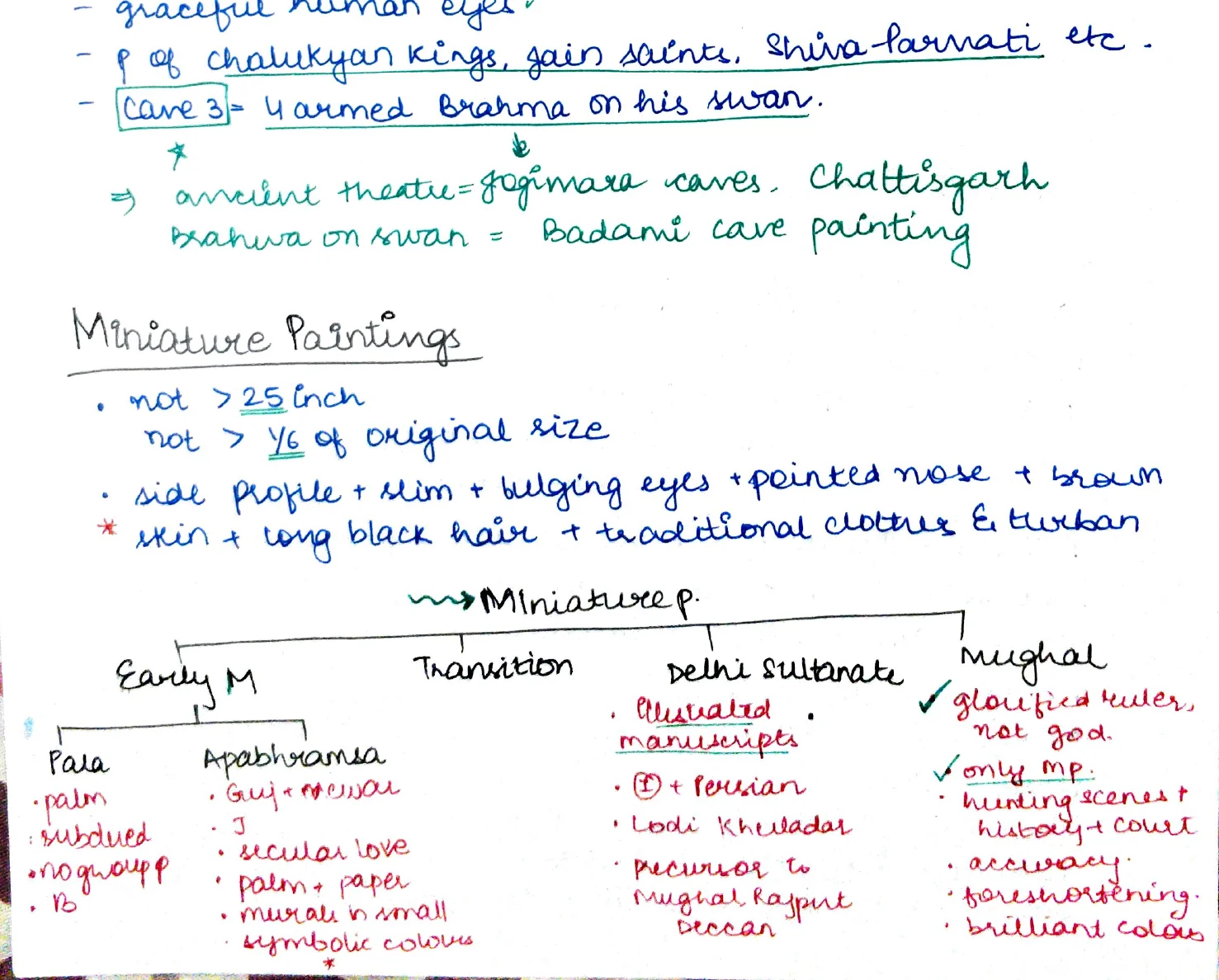
- Not > 25 inch
- Not > ¼ of original size
- Stout people + slim + bulging eyes + pointed nose + brown skin + long black hair + traditional clothes & turban
#Classification of Miniature Paintings
Early M [Early Miniature]
- Pala — palm leaf, subject: Buddhist
- Apabhramsa — small, few lines, circular paper, palm + paper, murals + small symbolic colours
- eg: [illegible]
Transition
Delhi Sultanate
- Illustrated manuscripts
- ID + Persian [influence]
- Lodi Khiladas [?]
- Predecessor to Mughal Rajput Deccan
Mughal
- Persian-influenced rules, etc.
- Only MF [miniature features]
- Hunting scenes + Nature
- Accuracy
- Foreshortening technique
- Brilliant colours
#Mughal Paintings
- Babur — no time + my family tree
- Humayun — interested but power struggle
- Akbar
- dept = Tasvir Khana + considered painting as a means of study & amusement + gave awards + INDIAN INFLUENCE
- started + 3D figures + finish + calligraphy + TRANSFORMATION → popular to court life
- e.g. Tutinama, Hamzanama, Collision of Gods, Murali-Suheli
- Jahangir — ZENITH + naturalist + flora/fauna + PORTRAIT painting + DECORATED MARGINS + artist himself + private workshop + none surviving → e.g. Zebra / Turkey / Cox
- Shah Jahan — ARTIFICIAL elements + low liveliness + EUROPEAN influence + pencil use + gold & silver + brighter
- Aurangzeb — Rehne hi do! :)
#Regional & Folk Paintings (from Book)
Imp!
- Madhubani — Bihar + GI tag
- Pattachitra — Odisha
- Patua — WB + religious / political / social themes
- Kalighat — WB + subaltern elements + social issues (religious) (1st ever)
- Paitkar — Jharkhand + post death life shown
- Kalamkari — AP + Hindu mythos
- Warli — MH + BW [black & white] / D [dot] primarily
- Thangka — HP, Ladakh, Sikkim, MNP [Manipur]
- Manjusha — Bihar + aka snake painting
- Phad — Raj.
- Cheriyal — Telangana + GI tag
- Pithora — Guj + MP + HORSES
- Saura — Odisha + similar to Warli + tribal deity
#Indian Dance Forms
- Sangeet Natak Academy = 8 classical dances
- M/o [Ministry of] Culture = 9 dances (8 + Chhau)
#Foundational Concepts (Natyashastra)
- Bharata's Natya Shastra
- Community dancing scenes at Bhimbetka
- Bronze Dancing Girl
- Lasaya & Tandava
- Nritta (dance), Natya (drama), Nritya (emotion)
- 9 Rasa
- 108 fundamental Mudras
#Bharatnatyam vs Kuchipudi — Comparison Table
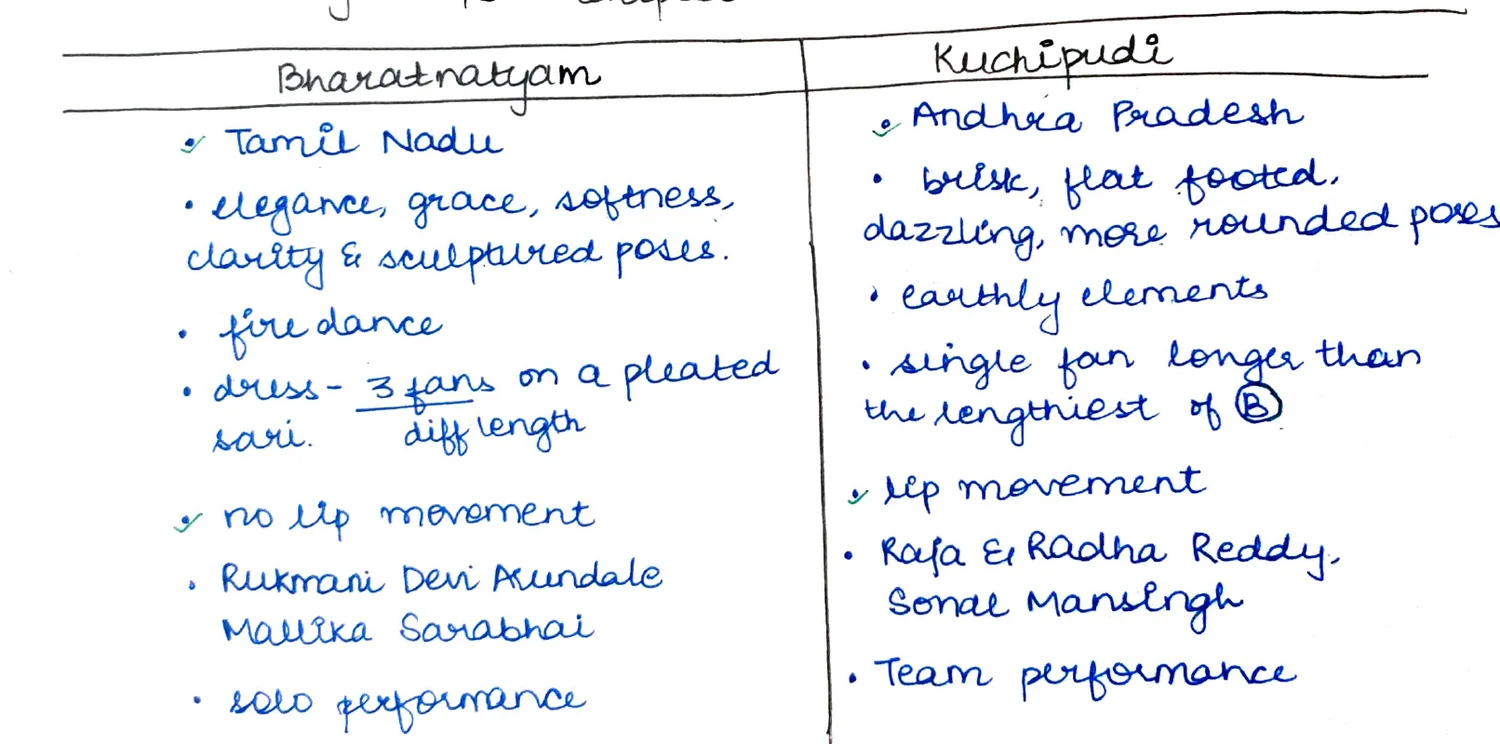
- Bharatnatyam vs Kuchipudi — hand-drawn comparison table showing key differences:
| Feature | Bharatnatyam | Kuchipudi |
|---|---|---|
| State | Tamil Nadu | Andhra Pradesh |
| Movement style | Elegance, grace, softness, clarity & sculptured poses | Bulk, flat-footed, dazzling, more rounded poses |
| Elements | Fire dance | Earthly elements |
| Dress | 3 fans on a pleated saxi [saree], diff. lengths | Single fan, longer than the lengthiest of [Bharatnatyam] |
| Leg movement | No lip [lower body] movement | Lip movement |
| Notable artists | Rukmani Devi Arundale, Mallika Sarabhai | Rafa & Radha Reddy, Sonal Mansingh |
| Performance | Solo performance | Team performance |
Similarities
- Both are classical dances from South India
- Have an ancient history & revived in modern times
- Carnatic music
- Mix of Tandava & Lasya
- Orchestra — violinist, flutist, mridangam player, vocalist
#Classical Dance vs Folk Dance
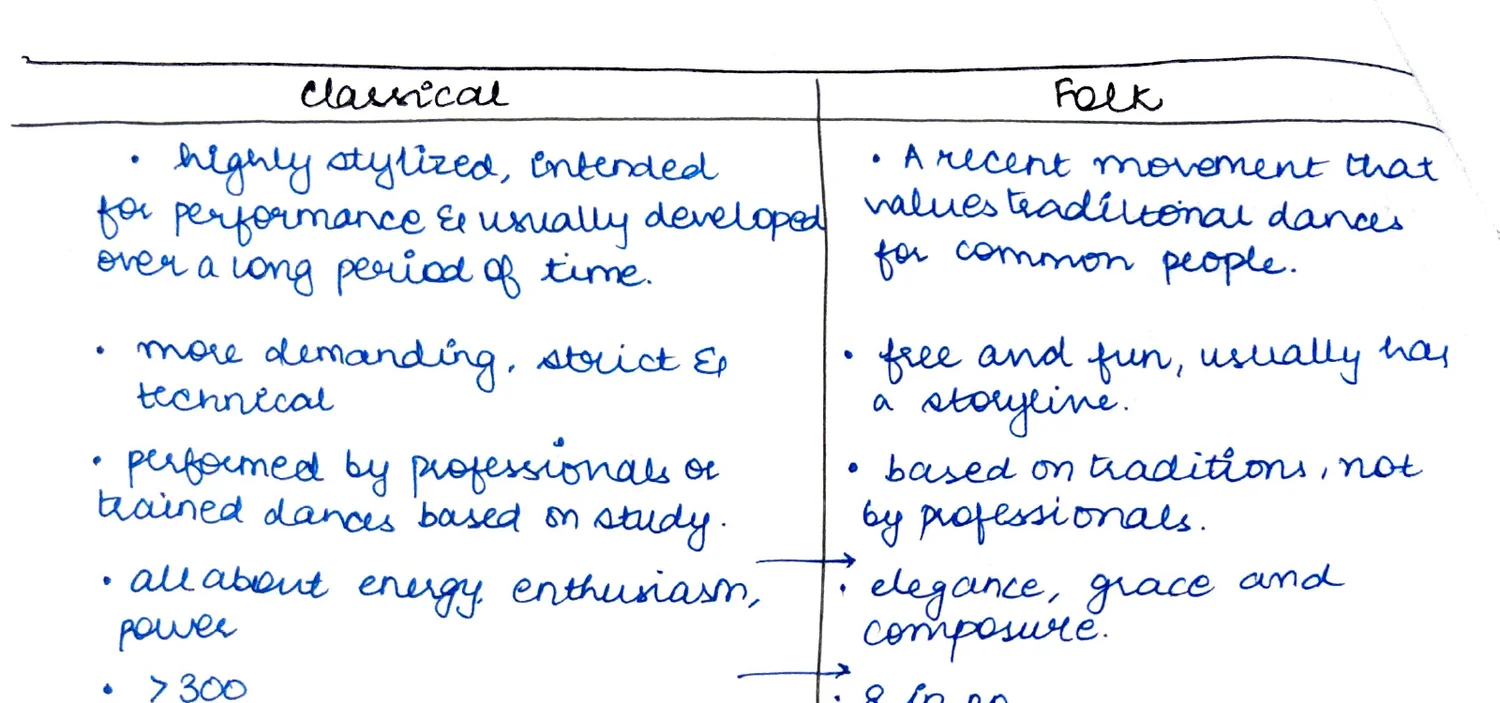
- Hand-drawn two-column table contrasting Classical and Folk dance:
| Classical | Folk |
|---|---|
| Highly stylized, intended for performance & usually developed over a long period of time | A recent movement that values traditional dances for common people |
| More demanding, strict & technical | Free and fun, usually has a storyline |
| Performed by professionals or trained dancers based on study | Based on traditions, not by professionals |
| All about energy, enthusiasm, power | Elegance, grace and composure |
| >300 [forms] | 8 to no. [approximately] |
| e.g. Chhau, Kalbelia, Ghoomar | e.g. Kathak, Sattriya, Odissi |
#Should Chhau Dance Be Declared a Classical Dance?
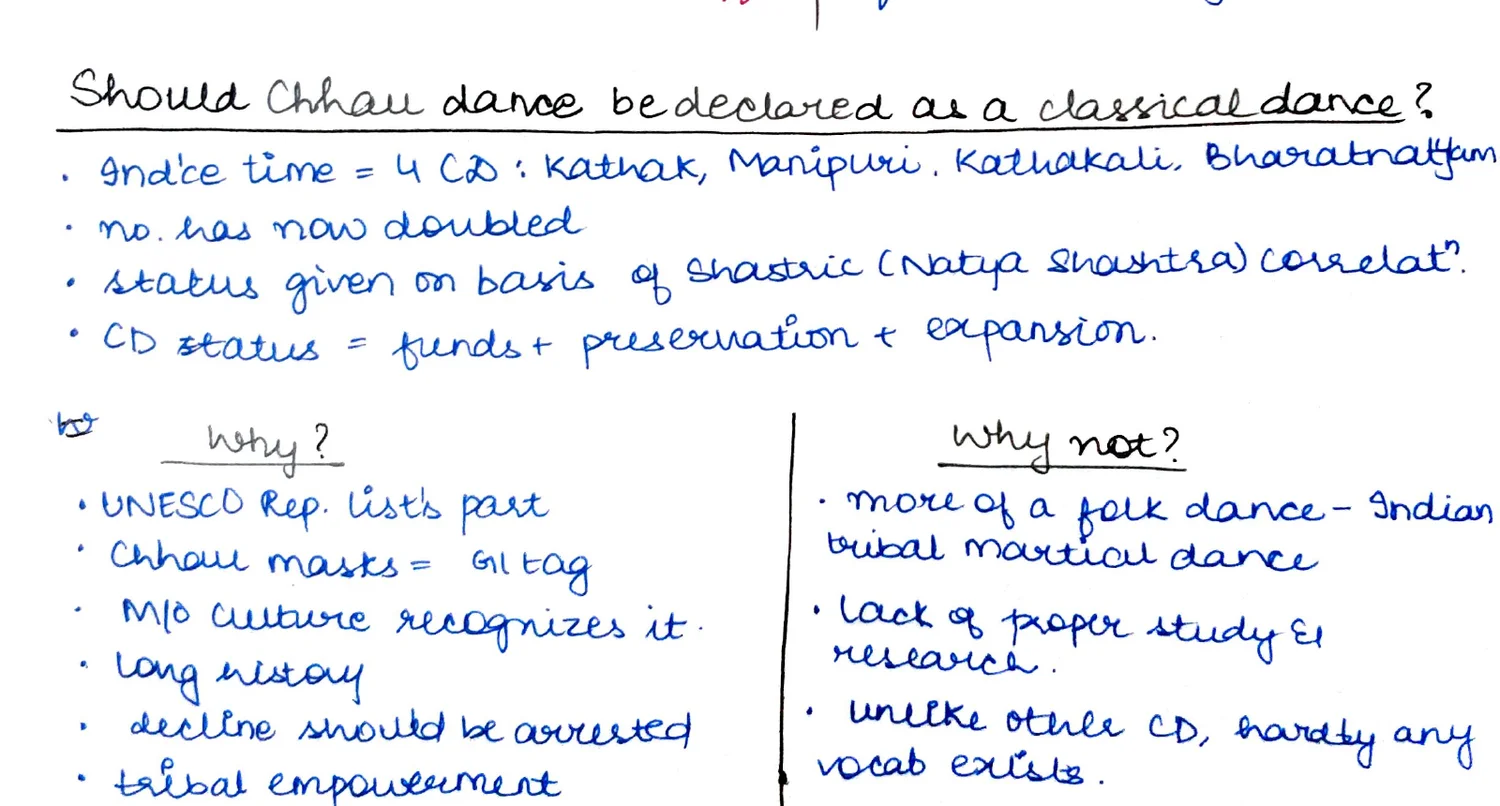
- Hand-drawn Why / Why Not table:
- Snake time [some time ago] = 4 CDs [classical dances]: Kathak, Manipuri, Kathakali, Bharatnatyam
- No. has now doubled
- Status given on basis of Shaastric (Natya Shastra) correlation?
- CD [Classical Dance] status = funds + preservation + expansion
| Why? | Why Not? |
|---|---|
| UNESCO Rep. List's part | More of a folk dance — Indian tribal martial dance |
| Chhau masks = GI tag | Lack of proper study & research |
| M/o Culture recognizes it | Unlike other CD, hardly any vocab exists |
| Long history | |
| Decline should be arrested | |
| Tribal empowerment | |
| Covers the 3 aspects of Nritta, Nritya & Natya as well as Tandava & Lasya |
#Indian Music
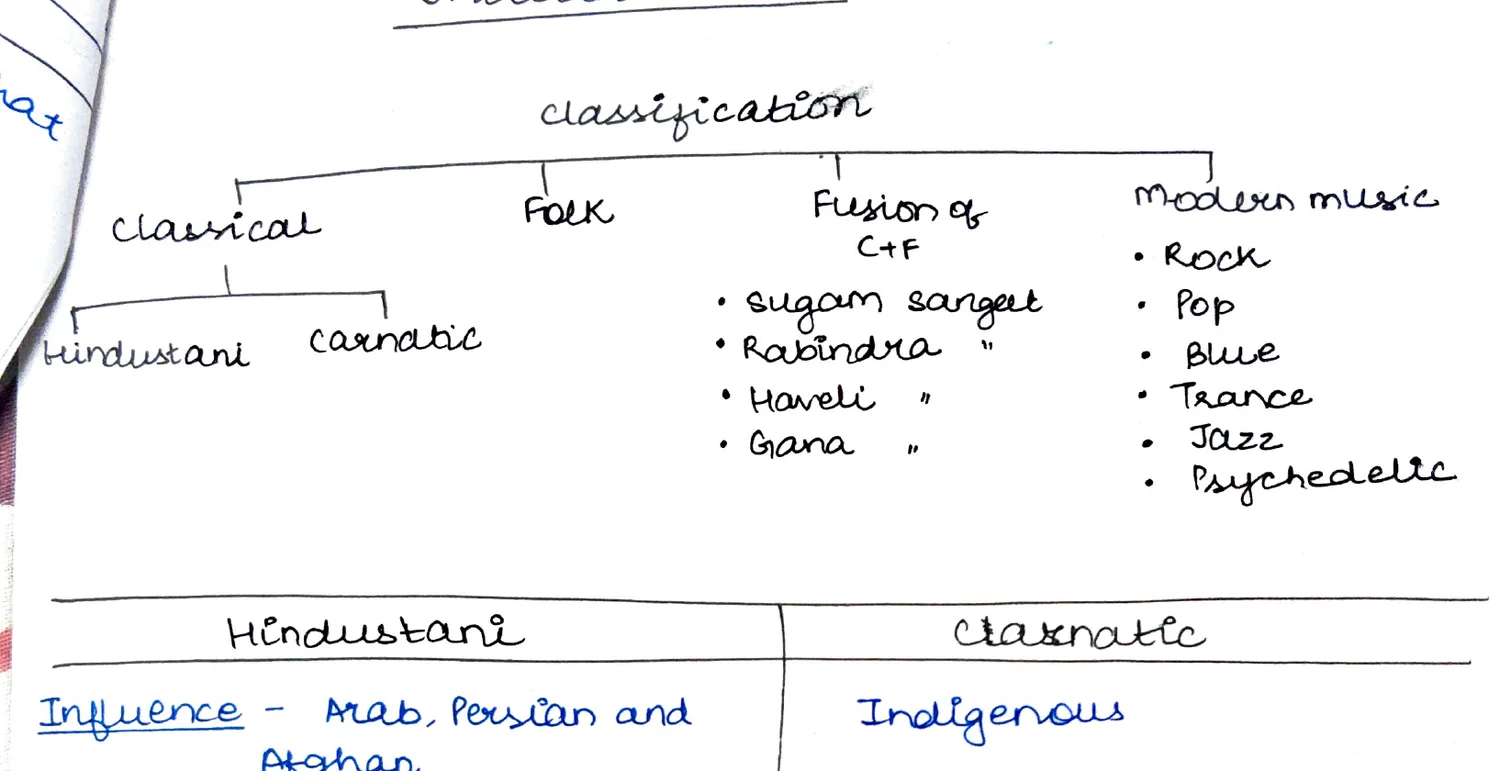
- Hand-drawn tree diagram showing classification of Indian Music:
- Classical → Hindustani / Carnatic
- Folk
- Fusion of C+F [Classical + Folk] — Sugam Sangeet, Rabindra [Sangeet], Haveli [Sangeet], Gana [Sangeet]
- Modern music — Rock, Pop, Blue, Trance, Jazz, Psychedelic
#Hindustani vs Carnatic — Comparison Table
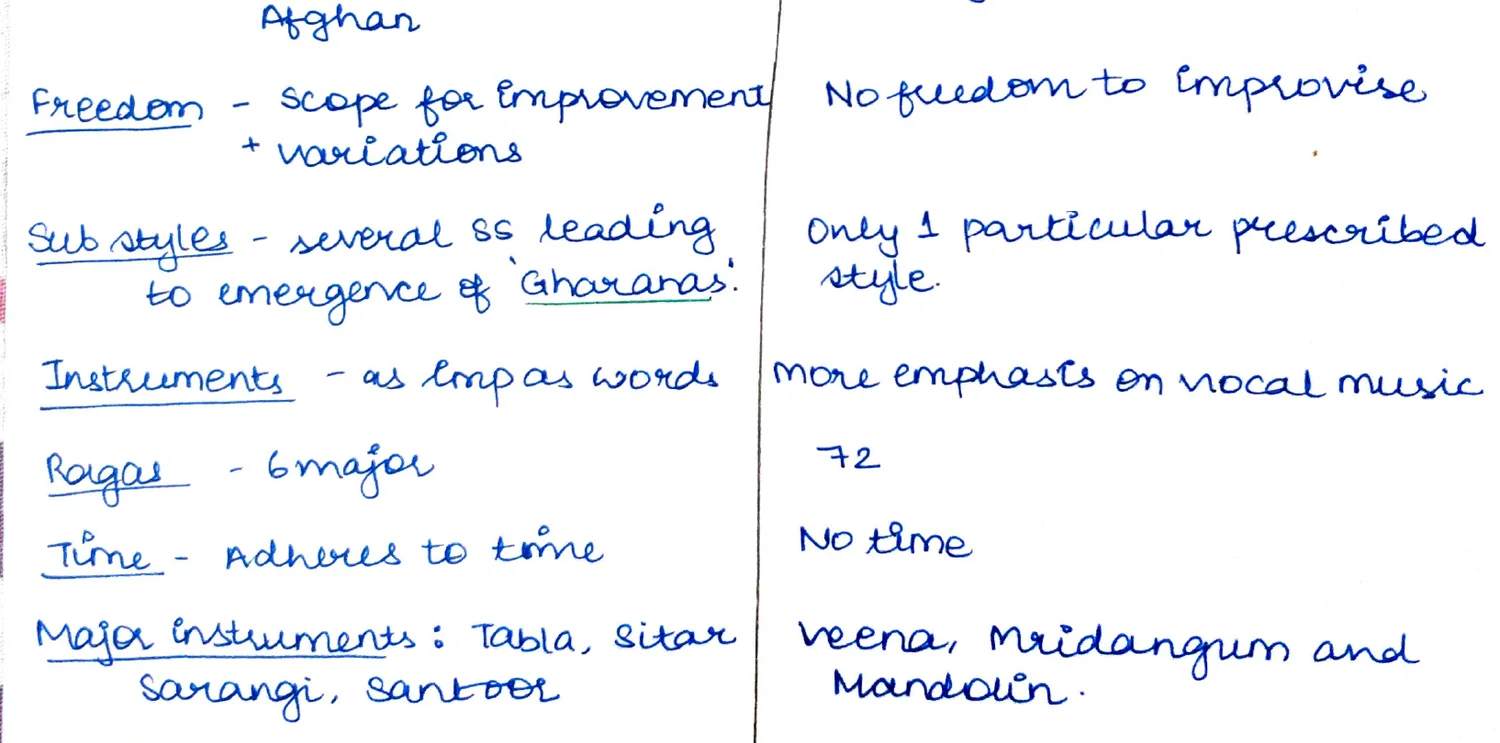
- Hand-drawn two-column comparison table:
| Feature | Hindustani | Carnatic |
|---|---|---|
| Influence | Arab, Persian and Afghan | Indigenous |
| Freedom | Scope for improvement + variations | No freedom to improvise |
| Sub-styles | Several SS [sub-styles] leading to emergence of Gharanas | Only 1 particular prescribed style |
| Instruments | As larpas [lampas] words [?] | More emphasis on vocal music |
| Ragas | 6 major | 72 |
| Time | Adheres to time | No time |
| Major instruments | Tabla, Sitar, Sarangi, Santoor | Veena, Mridangam and Mandolin |
| India | North | South |
| Octave | — of Natural Notes | Traditional octave |
| Origin | Vedic period | Bhakti movement |
Similarities between Hindustani & Carnatic
- Historical roots = Natyashastra
- Flute & violin
- Basic elements of Swara, Raga, Tala
- Association with religion
- Central notion of melodic mode = Raga
Read about diff. music forms from Book.
#Steps Taken to Promote Classical Dances
- Sangeet Natak Akademi — 1952
- Grand dance festivals @ Khajuraho, Konark, Ellora
- Established [PM/Government — Univ.] like Raja Man Singh Tomar Uni., Gwalior
- Listing in UNESCO — Chhau in 2010
- Odissi [included] in syllabus of IIT-Bhubaneshwar since 2015
Need? A National Cultural Policy.
#Laws & Provisions for Cultural Preservation
- A29 — Protect interests of minorities
- A49 — Protect monuments & places & objects of national value
- A51A(f) — Value & preserve rich heritage of Indian culture
#Key Legislation
- Indian Treasure Trove Act, 1878
- Ancient Monuments Preservation Act, 1904
- Antiquities Export Control, 1947
- Antiquities & Art Treasure Act, 1972
#Indian Theatre
- Sittabera & Jogimara Caves — oldest amphi[theatre] in world
#Sanskrit Classical Theatre
- Narrative art form
- Music + dance + acting
- Ashvaghoesha, Bhasa, Shudraka, Kalidas, Harshvardhana
- 10 types of plays:
- Happy endings (unlike Greek tragedies)
- Male protagonist
- Well defined opening, plot, pause, end
- Ritualistic progression
- 2 storeyed stage
- Sutradhar
- Curtains (yes)
- Nayas (no)
- Nayat, Nayika, Vidushaka
#Reasons for Decline of Sanskrit Theatre
- The dramatists began to diverge towards poetry thus lyrical writing became popular over drama
- Rigid director = restricted creativity
- Decreasing popularity among masses
- Confined to religious sphere — Brahmin domination
- Advent of Mughals → music & dance became sophisticated
- Urban oriented & sophisticated
#Koodiyattam
- Oldest + 8kt + Kerala + adheres to Natya Shastra's rules
- Chakiar & Nambiar caste + Prakit [Prakrit] & Malayalam
- Mudham [Precap — Precap/Prelude] + commentaries on social, philosophical & political
- Margi Madhu Chakya (person), urban oriented
#Bhakti & Sufi Movement
#Sufi Movement
- Sufism = Mystical arm of Islam
- Self realisation, tolerance, righteousness, universal love for all
- Sufi = garments of wool by ascetics
- Safa = purity
- Tiny materialism of caliphate = people turned to ascetism → rise of Sufis
- Intuitive knowledge > inherited sciences
- Dhawq = direct tasting of experience
- Pir-Murshid concept / Guru-Shishya
- Ultimate goal = union with God
- Love of God = love of humanity; service to humanity = service of God
- Spirit of tolerance
- Fana, Zikr, Tauba, Insan-e-Kamil (perfect man), Wahadatul Wazudi, Sama
- Rejected ritual
- No strict ascetism
- Borrowed from Hinduism, Christianity, Hinduism, etc.
- Dialectic monism = Vedantic philosophy
- Essential unity of all religions + equality of all humans
- Life of voluntary poverty
Stages of Sufism
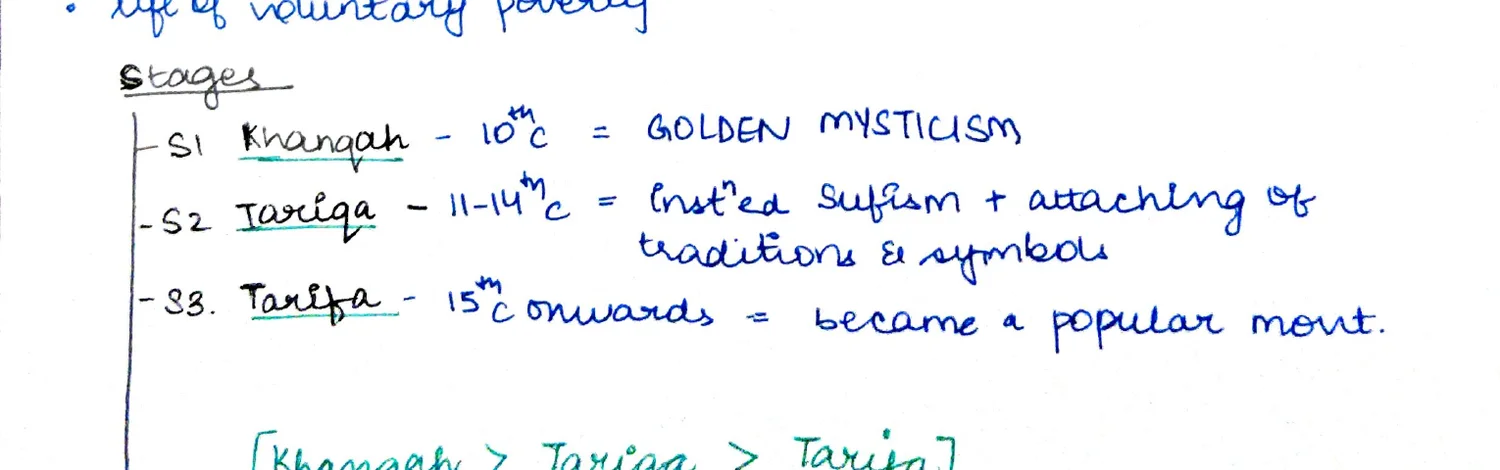
- Hand-drawn stages diagram with bracketed flow [Khanqah > Tariqa > Tarifa]:
- S1 Khanqah — 10th c. = GOLDEN MYSTICISM
- S2 Tariqa — 11–14th c. = Instituted Sufism + attaching of traditions & symbols
- S3 Tarifa — 15th c. onwards = became a popular movement
Sufi Orders
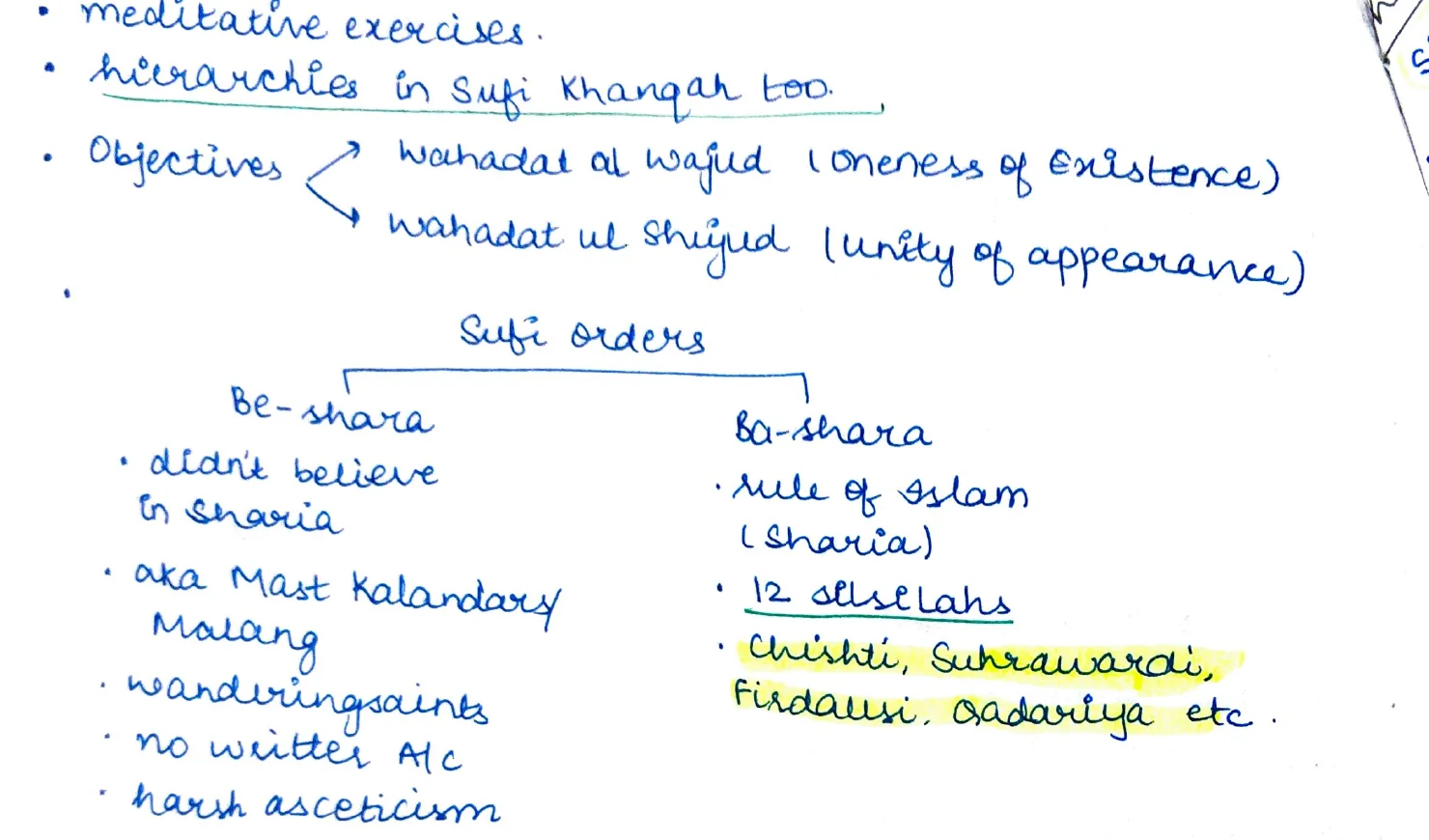
- Hand-drawn two-column table of Sufi Orders:
- Bodily [but] purif[ication] of hearts
- Meditative exercises
- Hierarchies in Sufi Khanqah too
- Objectives:
- Wahadat al Wajud (Oneness of Existence)
- Wahadat ul Shuhud (Unity of appearance)
| Be-shara | Ba-shara |
|---|---|
| Don't believe in Sharia | Rule of Islam (Sharia) |
| aka Mast Kalandars, Malang | 12 silsilahs |
| Wandering saints | Chishti, Suhrawardi, Firdausi, Qadiriya, etc. |
| No written A/c [accounts] | |
| Harsh asceticism |
Importance of Sufi Movement
- Received Inam/Inam & passed [title/land] to Sheikhus; descendants → economic base to move up the social ladder
- Spiritual authority over the world + protect sovereignty by protecting future kingship
- Vernacular language got popularised & enriched
- Economic, socio-political effects on masses
- Won hearts & allegiance more than Ulemas
- Simple living, high thinking
- Promoted religious brotherhood & equality
#Bhakti Movement
- Silent Revolution
- A galaxy of socio-religious reformers
- Medieval age
- Ritualistic + caste ridden Hinduism → rise of Bhakti saints (Buddhism & Jainism preached strict austerity + lack of patronage)
- Egalitarian + easy worship
- To satisfy emotional / spiritual needs
- Originated in South India, esp. TN [Tamil Nadu] by 7–12th c.; Northern belt by 15th c.
- Spoke on vernaculars
- Presence of priest not req[uired]
- Bhakti from Bhaj = share, participate & belong to
- Gita → Bhakti = attain salvation
- Sutras also mention it
- Intense love & devotion to God
- Universalism
- Repeat name of God again & again
- Rejection of rituals
- No caste discrimination
- Allowed both men & women
- Common kitchen
- Idea of Personal God
- Guru-Shishya concept
- Brotherhood + equality
2 Schools of Bhakti
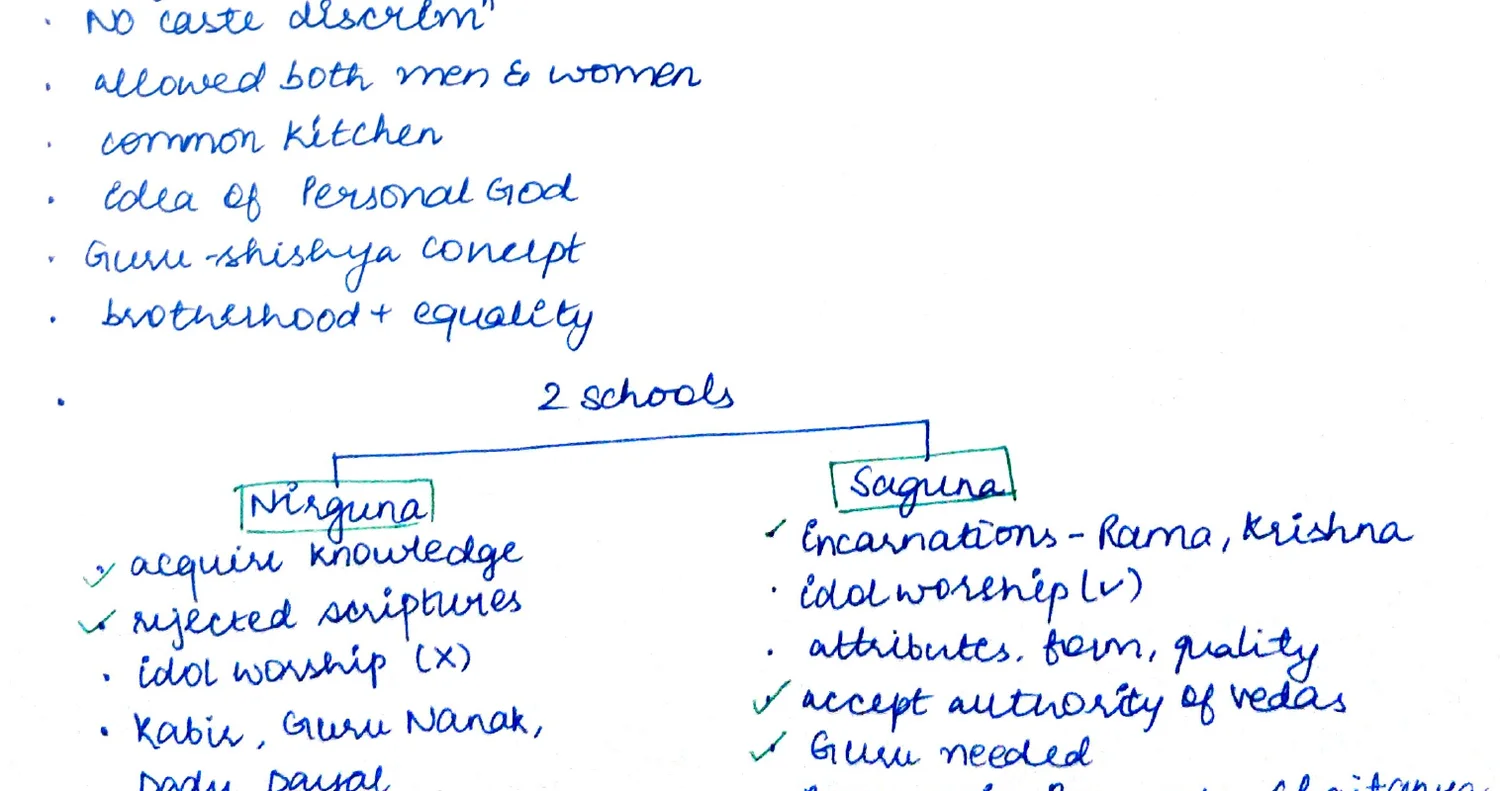
- Hand-drawn two-box diagram showing two schools of Bhakti:
| Nirguna | Saguna |
|---|---|
| Acquire knowledge | Incarnations — Rama, Krishna |
| Rejected scriptures | Idol worship (yes) |
| Idol worship (no) | Attributes, form, quality |
| Kabir, Guru Nanak, Dadu Dayal | Accept authority of Vedas |
| No attributes | Guru needed |
| Ramanuja, Ramananda, Chaitanya |
#Bhakti Movement in South India
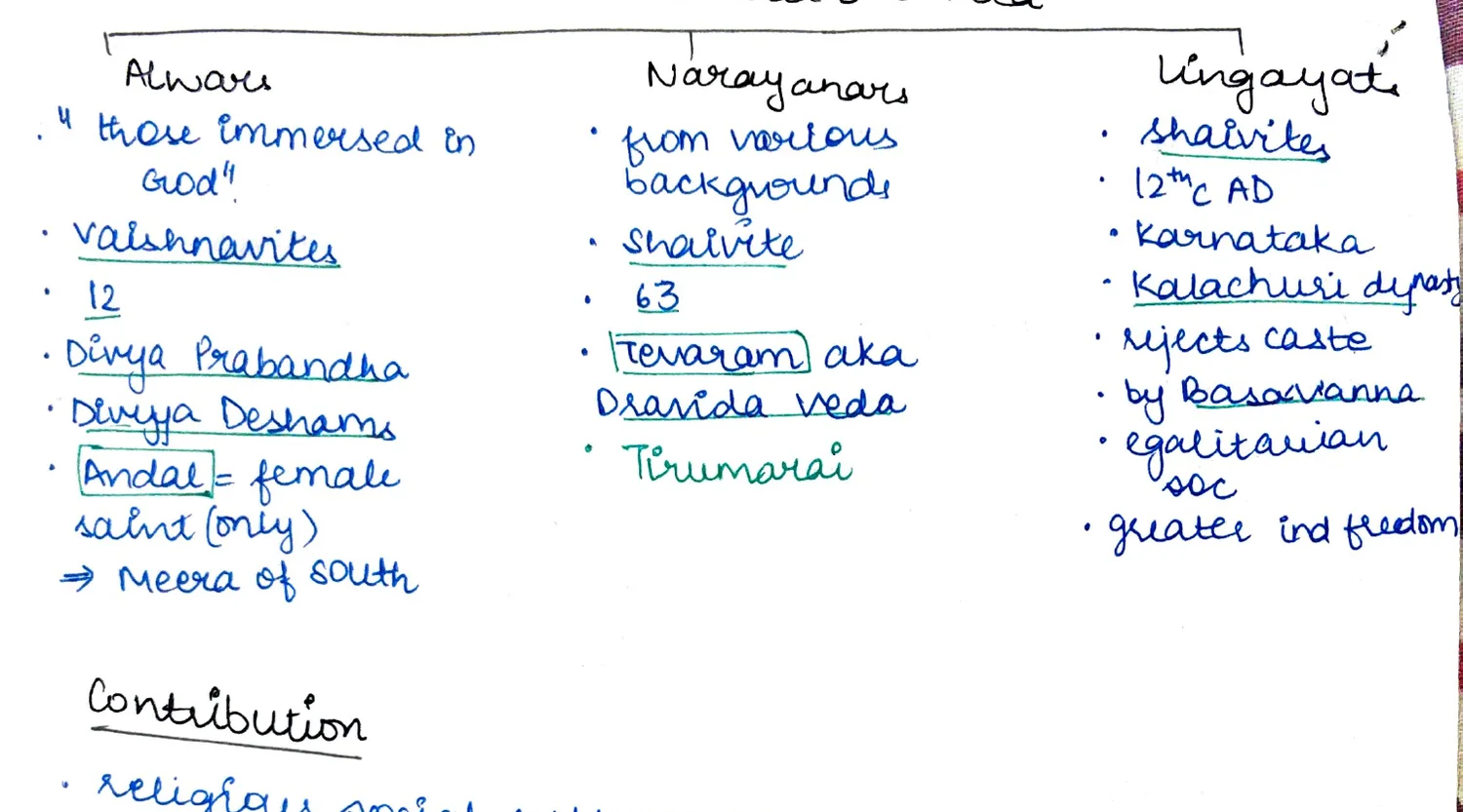
- Hand-drawn 3-column classification table:
| Alvars | Nayanmars | Lingayats |
|---|---|---|
| "Those immersed in God" | From various backgrounds | Shaivites |
| Vaishnavites | Shaivite | 12th c. AD |
| 12 [saints] | 63 [saints] | Karnataka |
| Divya Prabandha | Tevaram aka Dravida Veda | Kalachuri dynasty |
| Divya Desham | Thirumarai | Rejects caste |
| Andal: female saint (only) → Meera of South | By Basavanna | |
| Egalitarian | ||
| [more text cut at edge] | ||
| Greater ind[ependence] freedom |
Contributions of Bhakti Movement
- Religious, social, cultural reforms
- Against caste & gender discrimination
- Universal brotherhood + equality
- Brought them [Hinduism & Islam] closer
- Purity of thought & action
- Vernaculars
- Appealed rituals
- Personal God
Key Saints — Notable Connections
- Eknathara Mont — Shankaradeva, Assam
- Thirumarai — Nayanar hymn collection (Shiva)
- Ramananda — bridge between NE [North] & South
- Surdas was a disciple of Vallabhacharya
- Dadu Dayal was a follower of Kabir → contemporary of Akbar
- Tukaram — Abhanga poetry, contemporary of Shivaji
- Bal Gangadhar Tilak was a follower of Ramdas
- Navargin = unique combo of Vedanta & Sufism = Eknath
#Art & Culture — Broader Themes
#Reasons for India's Cultural Diversity
- Cultural contacts — Negroids, Mongoloids, Iranians, Greeks, Arabs, Turks, Europeans
- Difference in physical factors → diffuse in food, dress, houses, economic activity
- Secular outlook allows religious pluralism
- Universalism — peace & harmony
#How Golden was the Golden Age?
- Serfdom appeared
- Women became an item of property
- Rigid caste distinct[ions]
- Law & justice favoured higher castes
- Fa-Hein [Fa-Xian] — plight of Chandalas
- Change & continuity from any period shown through:
- Socio-cultural
- Religious
- Economic
- Political
#Role of Temple as an Institution
- Religious — devotion to God, rituals
- Cultural — Tamil poets, literature, music, dance forms developed, paintings etc.
- Economic — gave employment to people, be a focal point of exchange of goods, a rural bank
- Political — location of village assemblies
- Social — education to boys
- But also 'devdasi system' (negative) → high caste domination
#Nalanda vs Taxila — Comparison
| Feature | Nalanda | Taxila |
|---|---|---|
| Structure | Formal unit in modern sense of the world | Had off places [off-campus]; functioned under more informal cond. [conditions] (Guru shishya) |
| Classrooms | Had all infra — multiple classrooms, library, accommodation, etc. | No lecture halls, no residential quarters |
| Patronage | More structured; patronized by Gupta dynasty, Harsha, Pala | No degrees were awarded |
| Subjects | Maths / Science / Astronomy | No centralised system of schooling or syllabus |
| Other | Autonomous schools run by teachers | |
| Note | Taxila later became a trade hub |
#What Makes Indian Culture Unique?
- Assimilative — Turks to Mughals etc. (Sarva Dharma Sambhava)
- Change & continuity — Vedic period to modern times
- Resilient — Indianness still remains
- Inherently diverse — 780 languages, birthplace of 3 religions, countless cultural traditions
- Inclusive — Sarva Bhavantu Sukhinah
- Blend of spiritualism & materialism
- Peaceful co-existence
- Wholesome, youthful & delicate
- Blend of symbolism & reality
#Sanskrit Literature
- Religious text — Manusmriti, Dharmashastra
- Rules & grammar — Panini's Ashtadhyayi
- Drama — Kalidas, Malavikagnimitra
- Poetry — Harisena (Samudragupta), Meghduta (Kalidas)
- Scientific text — Charak Samhita (medicine); Panch Siddhantika (math/astronomy)
#Gandhi's Swaraj: A Multidimensional Concept
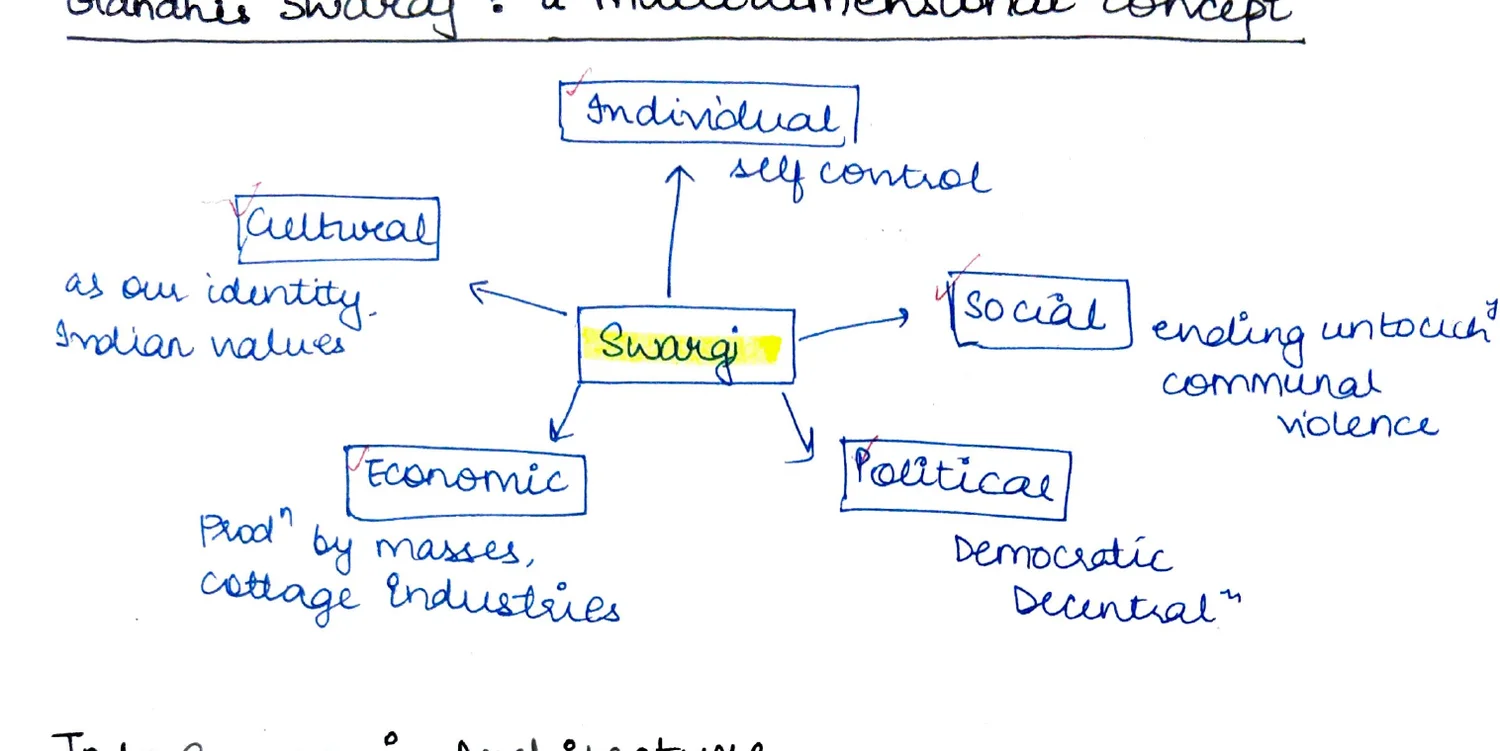
- Hand-drawn mind-map with 'Swaraj' at centre, 5 radiating dimensions:
- Individual — self control
- Cultural — as our identity, Indian values
- Social — ending untouchability, communal violence
- Economic — produced by masses, cottage industries
- Political — Democratic Decentralisation
#Indo-Saracenic Architecture
- Features — amalgamation of British & Indian style
- Grand scale — bulbous domes, kiosks, minarets (chajjas etc.)
- Adapt modern arch[itecture] to Indian climatic & aesthetic req[uirements]
- Pan-Indian (arch[itectural] unit?)
#A Shrewd Imperial Move
- An attempt to claim legitimacy after 1857
- To project Britishers as non-foreign rulers
- To suggest inter mingling of cultures
- Surpass Mughal architectural glory
- Needs served were British
#Neolithic Age as a Revolution
- Domestication of plants (Agri — Chirand, UP)
- D — Animals; Dog
- Higher pop[ulation] density due to 1.
- New tools — axes, celts, etc.
- Sedentary lifestyle
- 1st use of pottery
- Cultural progress
#Vesara Style (Temple Architecture)
- KN [Karnataka] region — under patronage of Chalukyas
- Found mainly in Deccan & Central India — as Nagara in North, Dravida in South
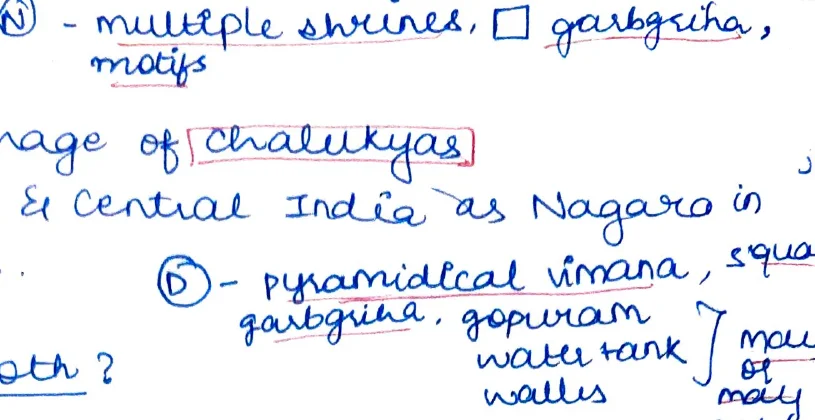
- Diagram shows: pyramidal vimana, aqua garbhagriha, gopuram, water tank walls — may or may not be present
#How it is different from both (Nagara & Dravida)?
- Height of these temples was reduced
- Miniature vimana, pyramidal towers
- Water tank & compound walls may or may not be present
- Indigenous quality in ornamentation
- Unique entrances — two or more entrances
- eg. Badami temple, Durga temple, Virupaksha Temple (Pattadakal)
- Star / stellar plan eg. temple @ Halebid, Belur
- Zig-zag walls & stairs under Hoysalas
#IVC [Indus Valley Civilization] Has Different from Other Civilisations of the Time
- Spread (geographical)
- Monuments & structures — Meso[potamia] ✗, Harappa ✓
- Burnt bricks in H[arappa], lesser extent to M[esopotamia], unknown in E[gypt]
- Temple in M&E, H✗
- Pol[itical] structure can't be decoded for H[arappa]
- Script not yet deciphered for H[arappa]
- Absence of wars
- Uxorial society — role of religion
#Jainism & Buddhism
#Similarities
- Inspired by Upanishads, against caste system
- No rituals, nirvana, denial of Vedas, moral & ascetic life
- ✦ fold path of a disciple — unlike that of Jainism
#Differences
- Mahavira: ahimsa, existence of soul, conduct, caste system, language of texts, royal support & patronage, propagation abroad
- Buddha: [implied opposites on each of above]
#Advancements in Science & Technology
#1. Maths — Sulvanitra by Baudhyana & Pythagoras [theorem]
- Zero in Brahmagupta's works — Lilawati
- Decimal system
- Sulbanitra by Baudhyana → Pythagorean theorem
#2. Astronomy — Khagol → Heliocentric theory
- Aryabhata — Ramagupta b/w Ch[apter] I as Kumaragupta
- Panch Siddhantika (Varahmihira)
- "Naga" — nowhere else; Bud conflict — Gujrara Pratihara & Rashtrakutas both claim ruling over all of Karnataka
#3. Engg [Engineering]
- IVC — planned cities, underground drainage
- Hydraulic engg — check dams at Dholavira
- Pandya / Chera period — well & tanks
- Chola King Karikal built Grand Anicut across Kaveri river to divert water for Ch[ola] I + Kichhari = coin to commemorate massage [passage] + irrigation
#4. Water Management
- Well & tanks in Chera period
#5. Metallurgy
- Iron pillar of Delhi
- Sword making (Wootz steel)
#Inscriptions
- Eran Inscription — Sati, famine — Mauryan / Shunga era plates
- Uttameru — LSG of Cholas
- Hayag Prashasti — Samudragupta
- Ashokan Inscriptions — dhamma → Suvarnata → Ajinka [Ajanta?]
#Coins
- Roman coins — int[ernational] trade
- Kusharo — flourishing trade
- Harsha — ↓ in trade
- Naga — nowhere else
- "gana" on coins of Yaudheyа = non monarchical
- Ch[ola] I + Kichhari = coin to commemorate massage [passage]
- Ashtumedha on Kumaragupta coins
- Samudragupta — Veena playing
- Sat vahana — potin, no gold, gods on coins
#Physics — Vaisheshika — atoms, 5 elements (philosophy)
#Medicine & Surgery
- Charata, Sushruta, Ayurveda
- Dhanwantri — god of medicine
#Travellers — Aspects of Social Life
#1. Caste System
- Megasthenes — Mauryan empire had 7 castes / class
- Al Biruni → Mughal period [Tugra]
#2. Religion
- Fa hein — Gangetic plains — land of Brahminism
- Hiuen Tsang — Buddhism during Harsha
#3. Food
- Peasant — Mughal diet
- Traveller / Hn Kings followed non-veg diet
#4. Dress
- Tavernier — dresses of light stuff
- Bernier — shawls
#5. Men
- Maharaimi festival of VN — elaborate dresses & headgear
#6. Women — Francois Bernier was in labour crucial in both agri & non-agri
#7. Lower caste — Chandalas
#Economic Life
#Agri [Agriculture]
- Meg[asthenes] — primary source during Mauryans
- Bartoса — details about rice cultivation in Malabar
#Industry
- Bernier — Karkhanas of Mughals (BK)
- Manucci — saltpetre prod[uction] (MS)
- Barboa — shipbuilding (BA)
#Trade & Commerce
- Fahein — looted on routes
#Transport & Communication
- Sarai (rest houses)
- Peter Mundy — a/c diff types of boats
#Science & Technology (continued)
#1. Sulvanitra by Baudhyana — earliest book on maths
- → Pythagorean Theorem
#2. Khagol was famous astronomical lab in Nalanda where Aryabhata studied
#3. Ganit Sara Sangraha — by Mahaviracharya
- 1st textbook on arithmetic (~9 AD)
- → LCM
#4. Lilavati (maths book) translated into Persian by Faizl (Akbar)
-
- Bhaskar's Bijaganita
#5. Takshila & Varanasi — centres for med[ical] learning
#6. Before Charaka — Atreya & Agnivesa had already dealt with Ayurveda
#7. Unani system came to India from Greece
#8. Panch Siddhantika (astrology) | Brihat Samhita (astronomy etc.) — Varahmihira
#9. Dhanwantri — god of medicine
- Katha sarit sagar — Somadeva
- Ayanka = compilation of ritualistic info on birth & death cycles + complexity of souls
- Akbar made Maths a part of edu[cation] system
#10. Sant tradition — Bhakti
- Dnyaneshwar (1275–1296)
- Namdev (1270–1350) — Varkari
- Eknath (1533–1599) — Vitthoba = Vishnu
- Tukaram (1598–1650)
- Vishuddhimagga — Buddhist text by Buddhaghоsha
#Calendars
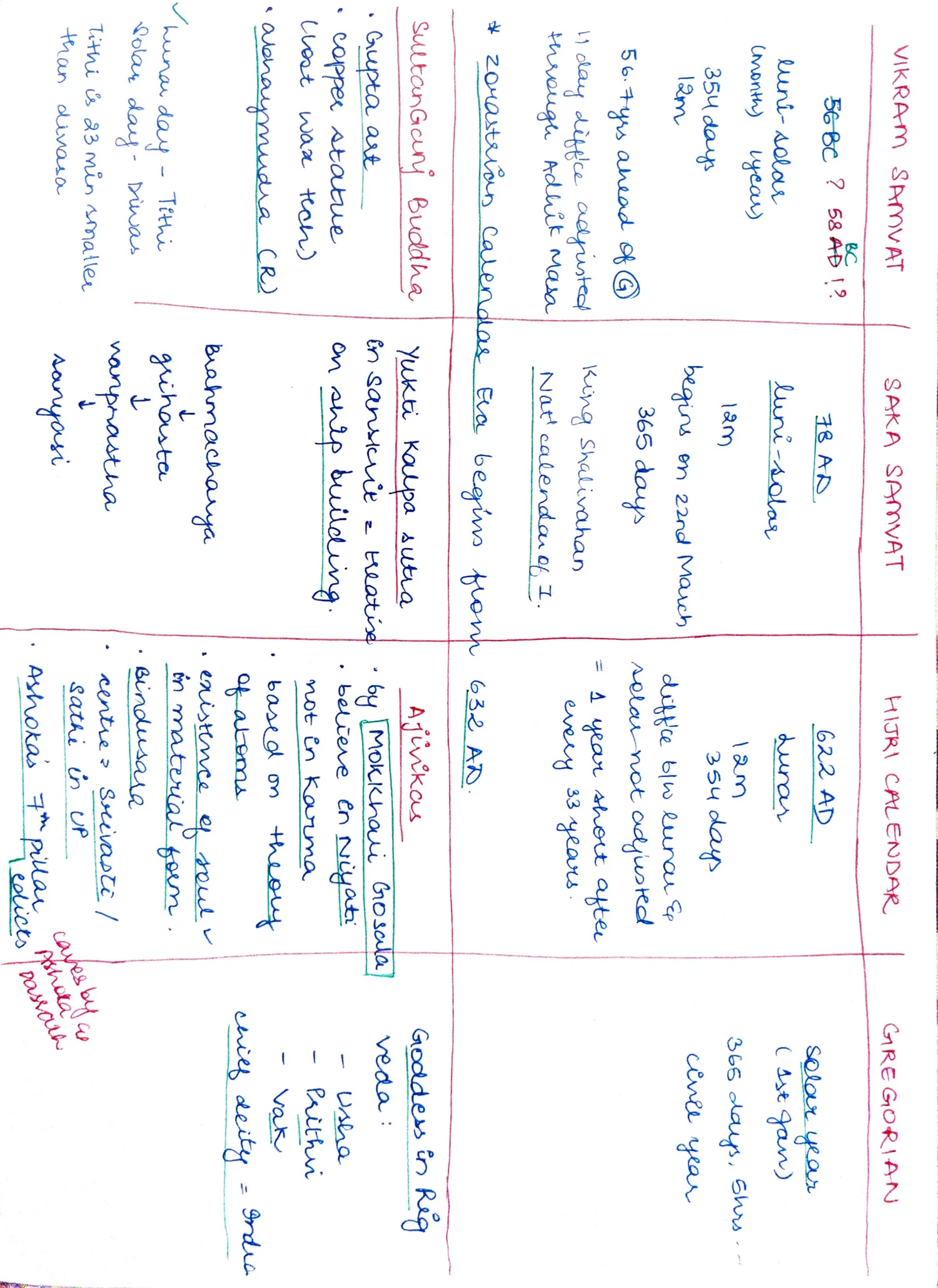
#Vikram Samvat
- BCE 57 sab13 [58 BC]
- Luni-solar (moon + sun)
- 12 months (~354 days)
- 35 yrs approx — if any little adjustment — through adhik maas (extra month)
- 11 days ahead of (S) [Saka]
- Zoroastrian calendar → Era begins from (e)
- By Sutragonal Buddha
- Dupas arc — Nikul Kalpa sutra on ship building
- Copper arch — copper & stucco on ship building
#Saka Samvat
- 38 AD [78 CE]
- Luni-solar
- 12m (~354 days)
- Begins on 2nd March
- 365 days — Krung Shuichuan [Kang Shoujun?]
- Nat calendar — I [Indian]
#Hijri Calendar
- 622 AD
- dwar [lunar]
- 12m
- 354 days
- A little like lunar — solar not adjusted
- = 4 years ahead after every 33 years
#Gregorian
- Solar year (last Jan)
- 365 days, 5 hrs — civil year
#Artiloca — By Mackintosh Christie
- Believe in higher — not to Karman
- Based on theory — historical evidence of past
- Existence of soul → material given
#Goddess in Rig Veda
- Usha — Prithvi
- Veda — Pulitsa
- Every deity = Shakti — snake
#Indian Philosophy Schools
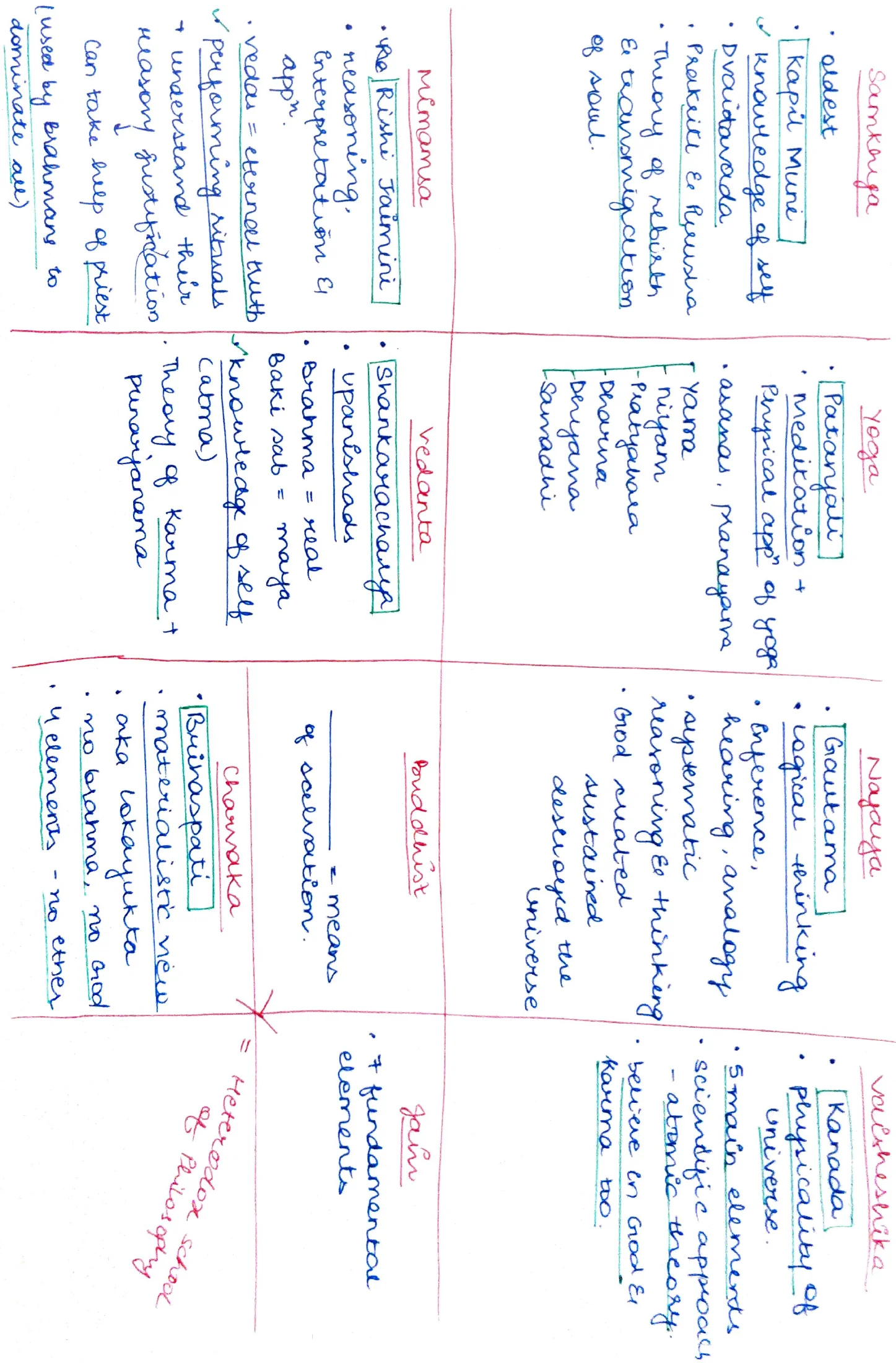
#Sankhya
- Oldest
- Kapila Muni
- Knowledge of all
- Pursuit to flourish
- Theory of liberation — democratization
- & Avail
#Yoga
- Patanjali
- Pratyaksh — practical
- Physical — practical age of yoga
- Vama, Rajaguru, Patanjara, Bhoga, Parasara, Managara
#Purvа Mimansa
- Jaimini
- Performing Nevele — concerned with Rituals
- Veda = eternal truth
- History of fiction — can look back at future — demonstrations etc.
#Vedanta (Uttara Mimansa)
- Shankaracharya
- Brahma = maya
- Karma = theory of self — percentage of self
- Theory of Karma + Purushorama [?]
#Nyaya
- Gautama
- Logical thinking
- Inference, analogy
- Adversarial thinking — analysed the described universe
#Vaisheshika
- Kanada
- Physicality of universe
- Smallest elements → Atoms
- Shloka elements — attempts to combine
- Believes to — karma no
#Buddhism
- = means of salvation
#Charvaka
- Brihaspati — means of salvation
- Materialistic view — eka lakanyukta — no God, no Brahma, no ether
- 4 elements — no ether
#Jain
- = 4 fundamental elements
- "Heterodox school of philosophy"
#Puppetry
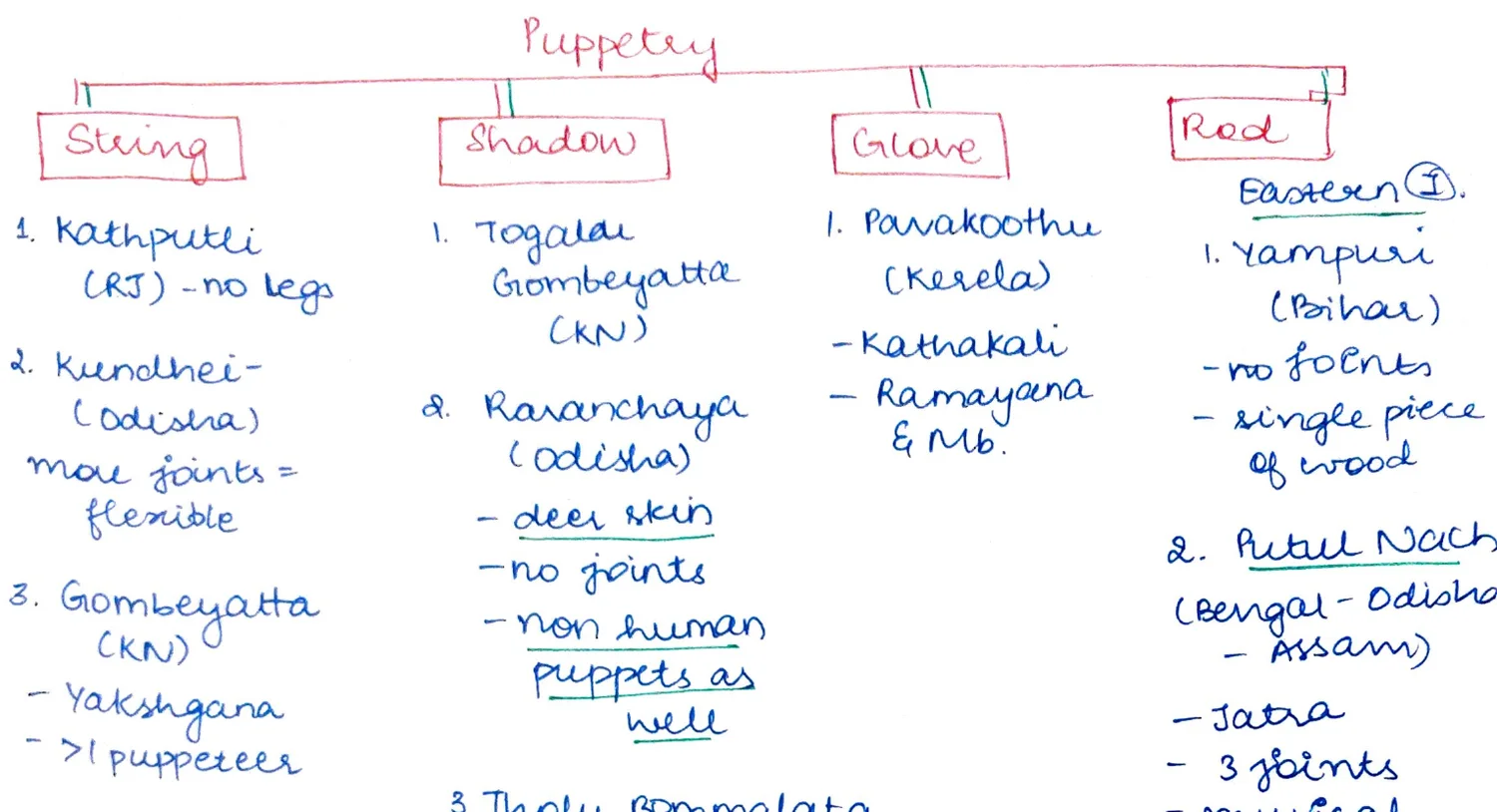
- Classification tree — String | Shadow | Glove | Rod | Eastern
#String (Rajasthan — no legs)
- Kathputli (RJ) — no legs
- Kundhei (Odisha) — more joints, flexible
- Gombeyatta (KN) — Yakshagana → puppeteers
- Bommalattam (TN) — Rod + string — largest, heaviest
#Shadow
- Togalu Gombeyatta (KN)
- Ravanchaya (Odisha) — deer skin; no joints; non-human puppets as well
- Tholu Bommalata (AP) — mythо themes
#Glove
- Pavakoothu (Kerala) — Kathakali; Ramayana & Mb[Mahabharata]
#Rod
- Eastern
- Yampuri (Bihar) — no joints, single piece of wood
- Рabbei Natch (Bengal–Odisha–Assam) — Jatra; 3 joints; musical
- In Odisha — a popular form of street theatre k/a Sahi gatra is prevalent
- Medaram Jatra — Telangana
- Theatres in N — emphasis on music + dance (= S)
#Yakshagana
- Oldest — AP & KN
- Vijaynagar empire
- Jakkula varu community
- Dance drama — single artist
- Variants:
- Taista (MH)
- Guarasi (GJ)
- Gandharva Gana (Nepal)
- Tal Maddale is its predecessor ✦ ✦
#Martial Arts
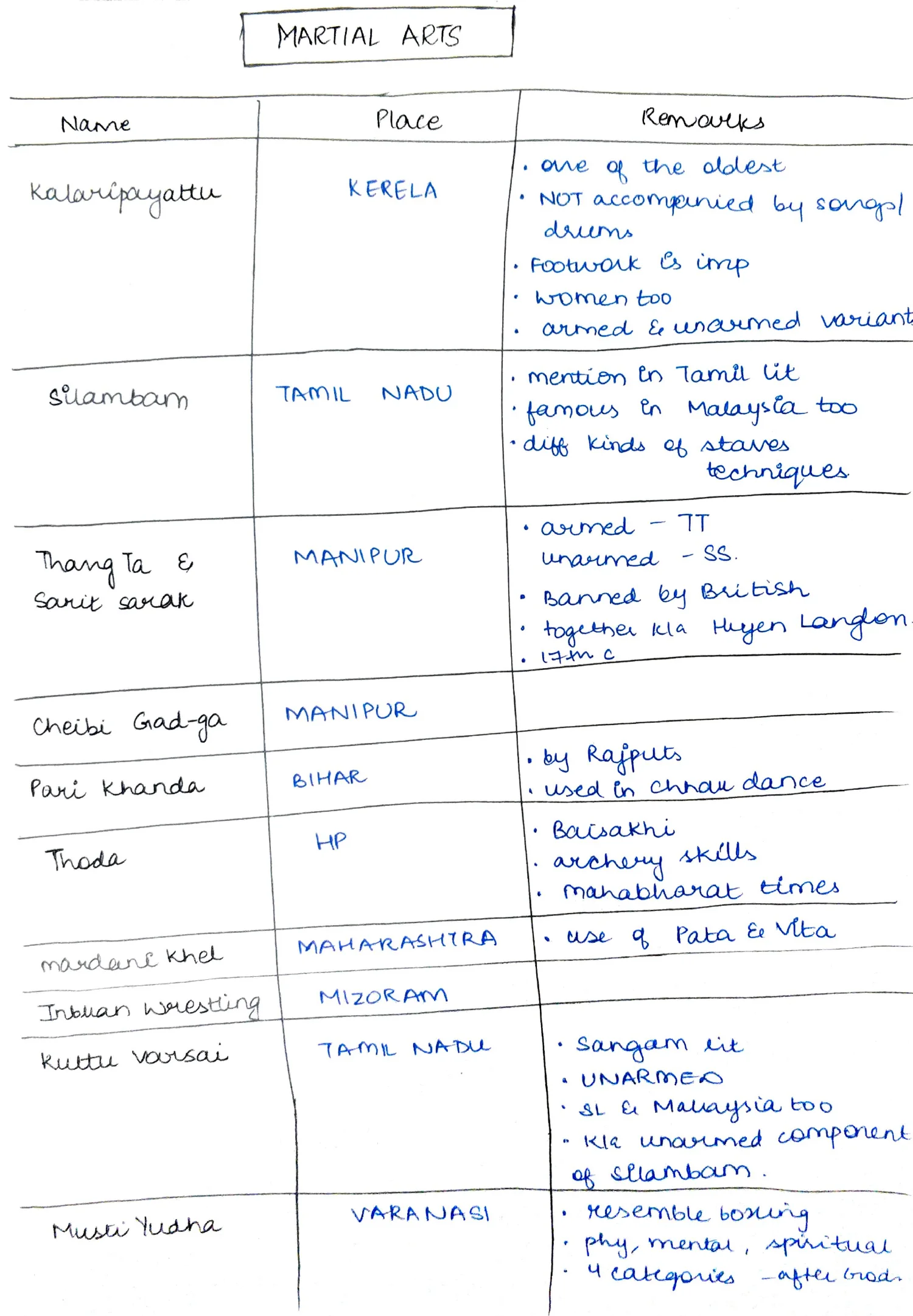
| Name | Place | Remarks |
|---|---|---|
| Kalaripayattu | Kerala | One of the oldest; NOT accompanied by songs/drums; footwork & imp; women too; armed & unarmed variant |
| Silambam | Tamil Nadu | Mention in Tamil lit; famous in Malaysia too; diff kinds of staves techniques |
| Thang Ta & Sarit Sarak | Manipur | Armed — TT; Unarmed — SS; Banned by British; together k/a Huyen Langlon; 17th c |
| Cheibi Gad-ga | Manipur | By Rajputs |
| Pari Khanda | Bihar | Used in Chhaau dance |
| Thoda | HP | Baisakhi; archery skills; Mahabharata times |
| Mardani Khel | Maharashtra | Use of Pata & Vita |
| Inbuan Wrestling | Mizoram | — |
| Kuttu Varisai | Tamil Nadu | Sangam lit; UNARMED; S & Malaysia too; k/a unarmed component of Silambam |
| Musti Yudha | Varanasi | Resemble boxing; phy[sical], mental, spiritual; 4 categories — after med |
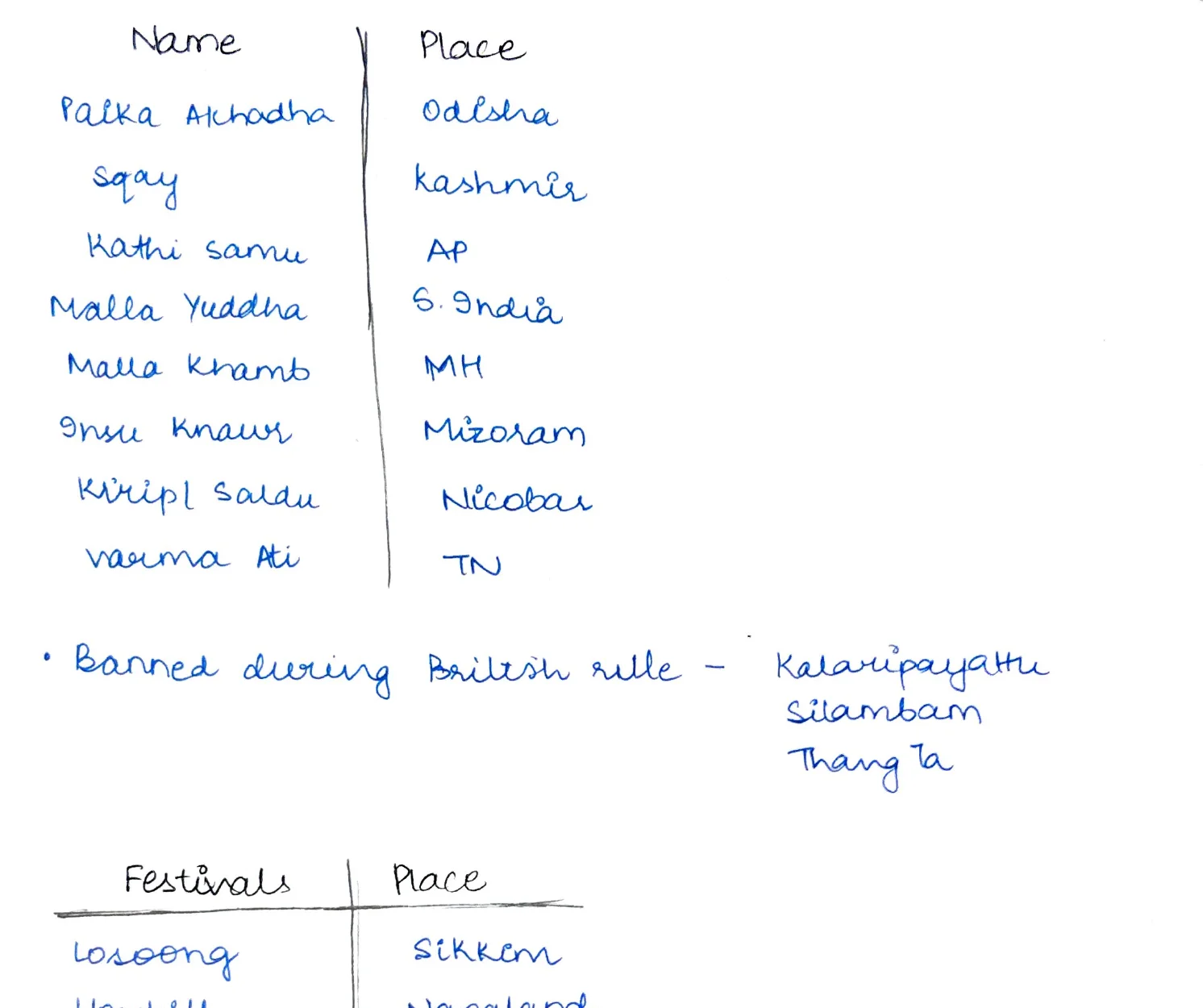
| Name | Place |
|---|---|
| Palka Akhodha | Odisha |
| Sqay | Kashmir |
| Kathi Samu | AP |
| Malla Yuddha | S. India |
| Malla Khamb | MH |
| Insu Knaur | Mizoram |
| Kiripl Saldu | Nicobar |
| Varuma Ati | TN |
- Banned during British rule — Kalaripayattu, Silambam, Thang Ta
#Festivals
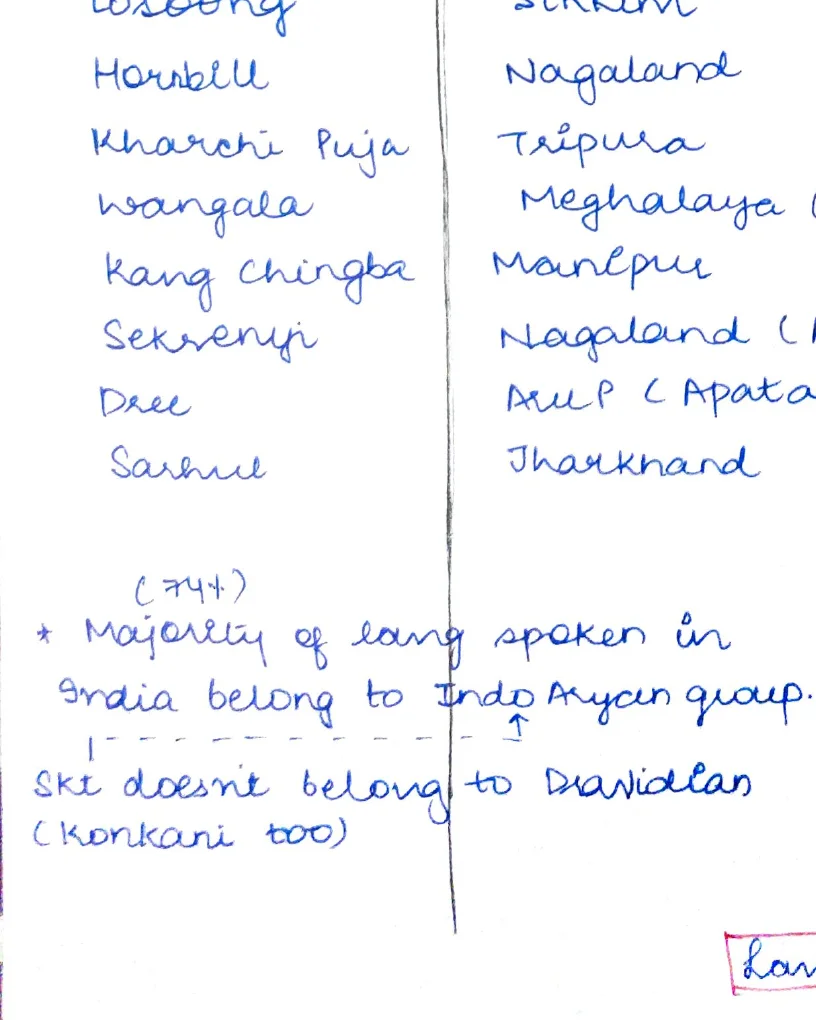
| Festival | Place |
|---|---|
| Losoong | Sikkim |
| Hornbill | Nagaland |
| Kharchi Puja | Tripura |
| Wangala | Meghalaya (Garo) |
| Rang Chingba | Manipur |
| Sekrenyi | Nagaland (Angami tribe) |
| Dree | ARP (Apatani tribe) |
| Sarhul | Jharkhand |
- (~34+) majority of lang[uages] spoken in India belong to Indo-Iranian group
- Ski dialect belongs to Dravidian (Brahui too)
#Languages
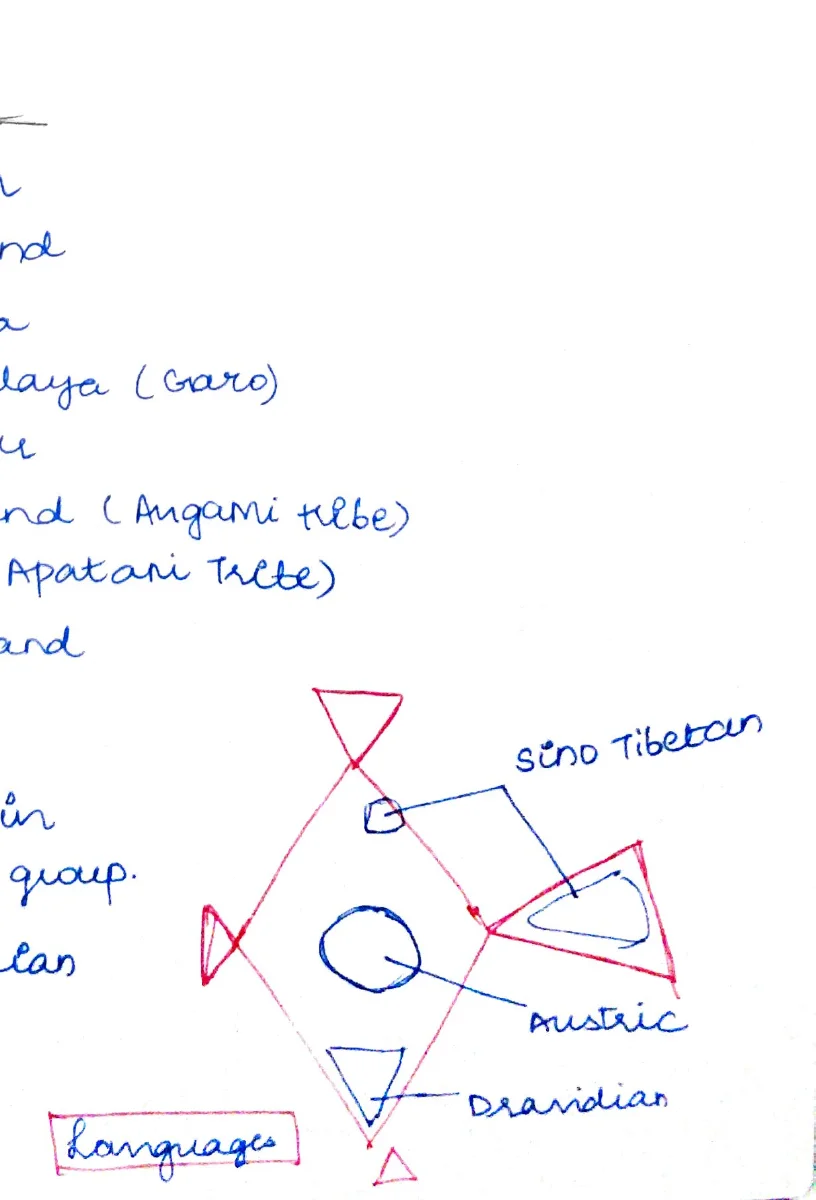
- Diagram shows overlapping triangles: Sino Tibetan, Austric, Dravidian
#ART & CULTURE DIAGRAMS
#Harappan Architecture
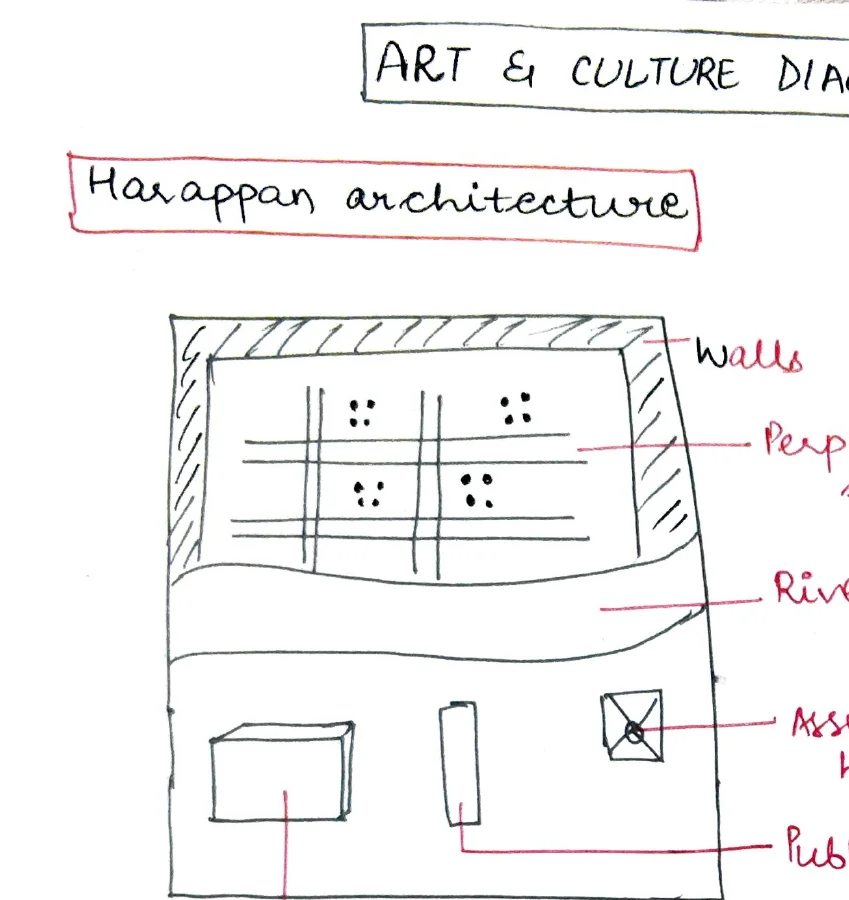
- Sketch labels: walls, perpendicular streets, river canal, assembly hall, public booth, granary
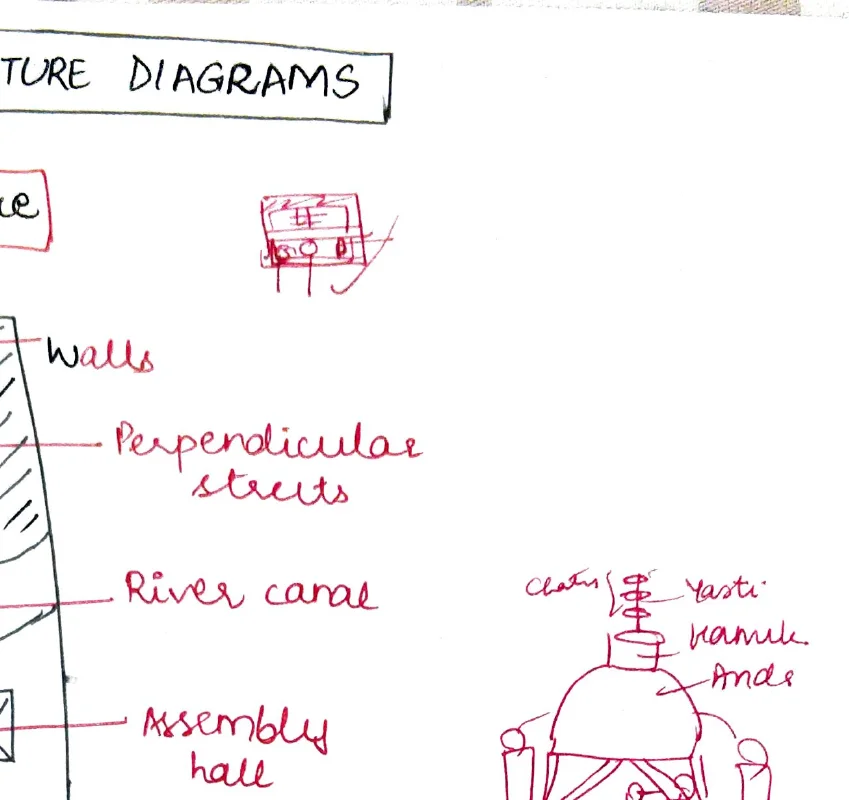
- Sketch of a dome structure labelled: chatri / vaulted brick — Toran
#Harappan Seals
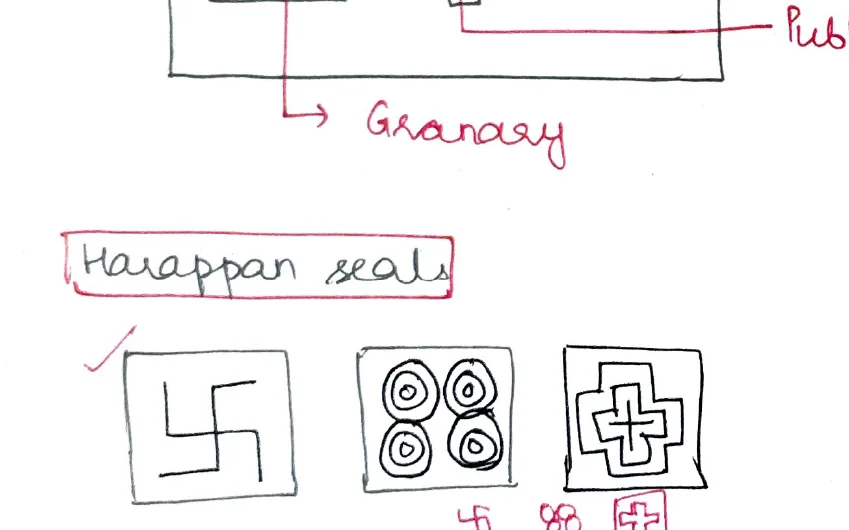
- Seals shown: swastika, circular concentric rings, cross/diamond, and two more geometric seals
#Harappan Pottery
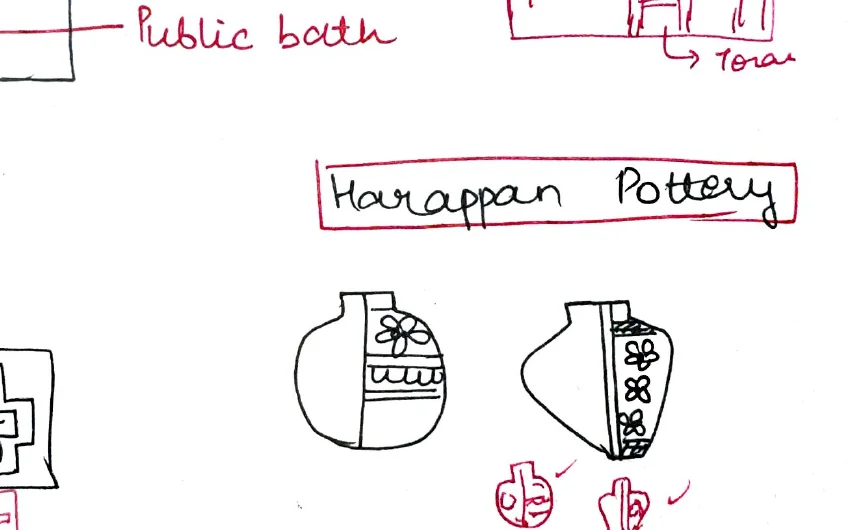
- Vessel shapes shown: jar, pot with narrow neck, small round pot, flat dish
#Mauryan Pillar
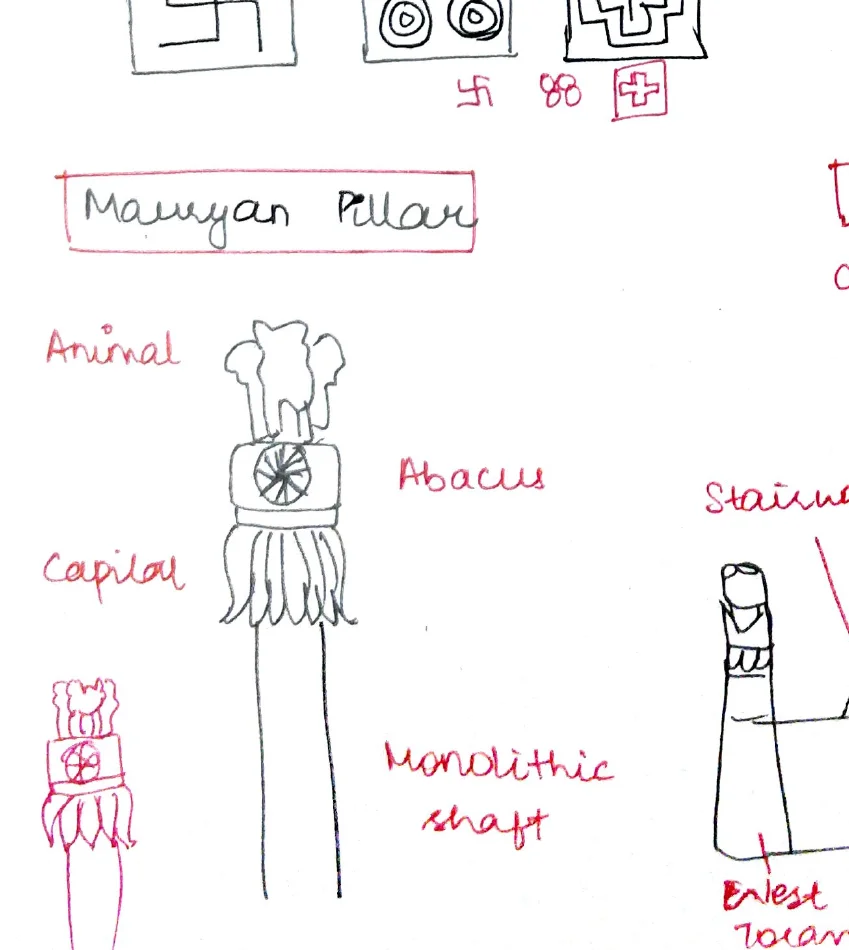
- Labels: Animal (capital), Abacus, Capital, Monolithic shaft
#Stupa
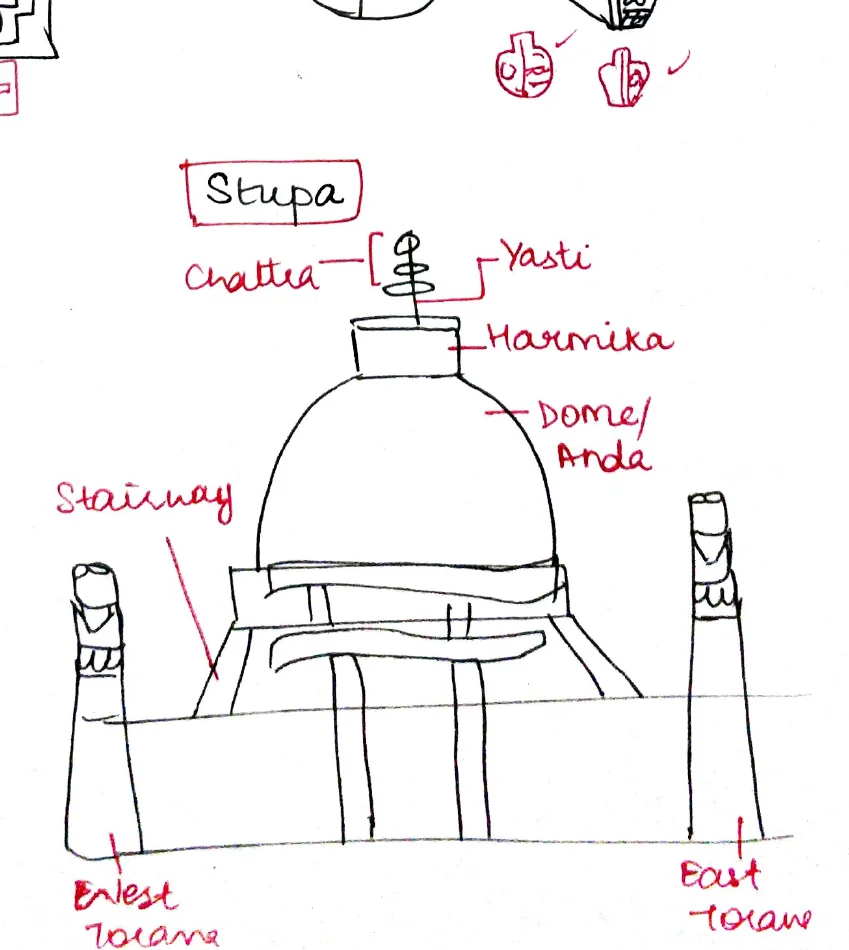
- Labels: Chattel [Chatri], Yasti, Harmika, Dome/Anda, Stairway, East Torana, West Torana
#Mughal / Indo-Islamic Architectural Motifs
Arabesque Design
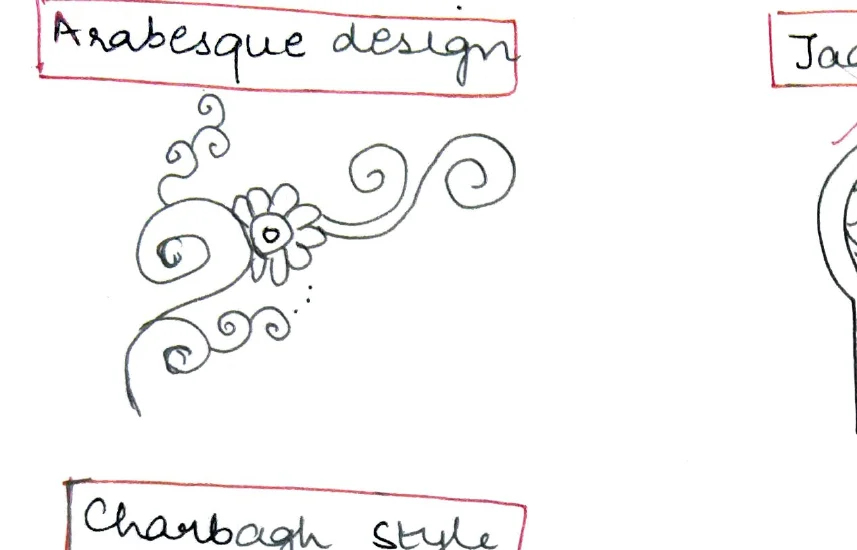
- Flowing floral/vine scroll pattern
Jaali Work
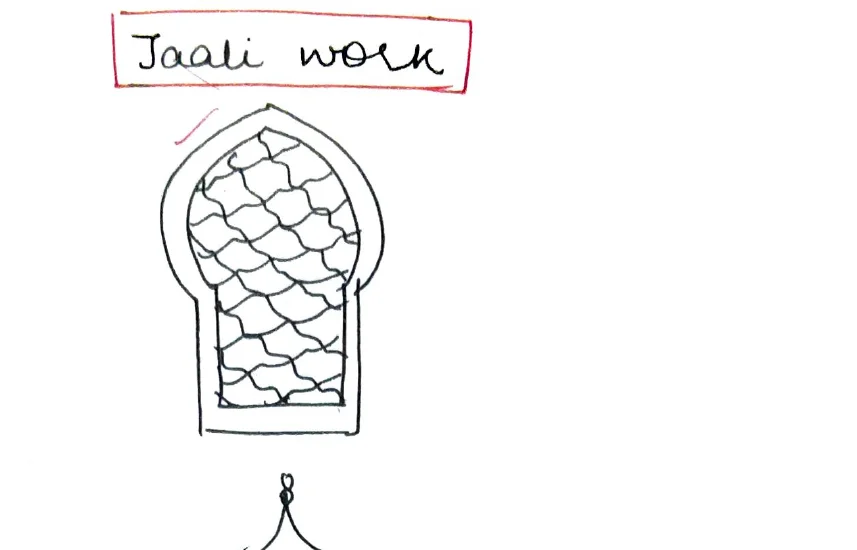
- Latticed stone/marble screen pattern
Charbagh Style
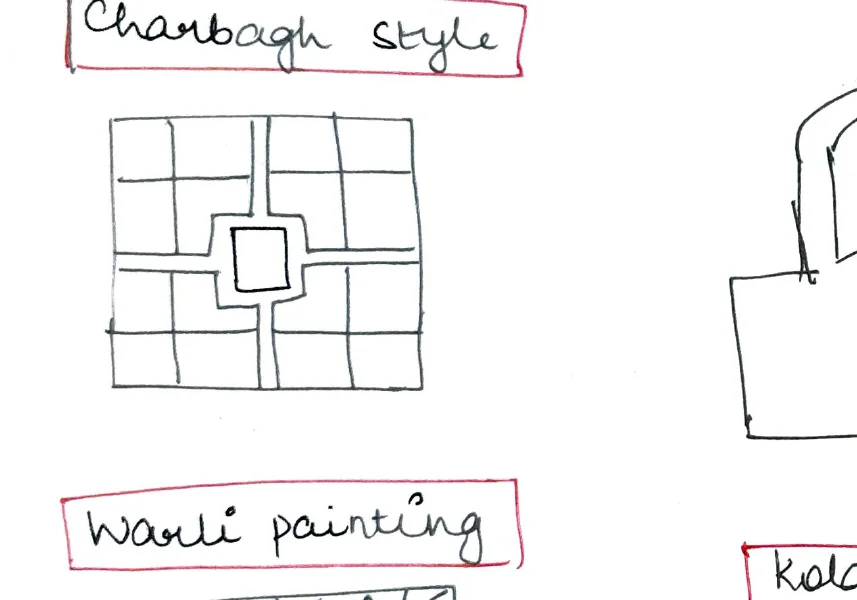
- 4-quadrant garden plan with central structure
Double Dome
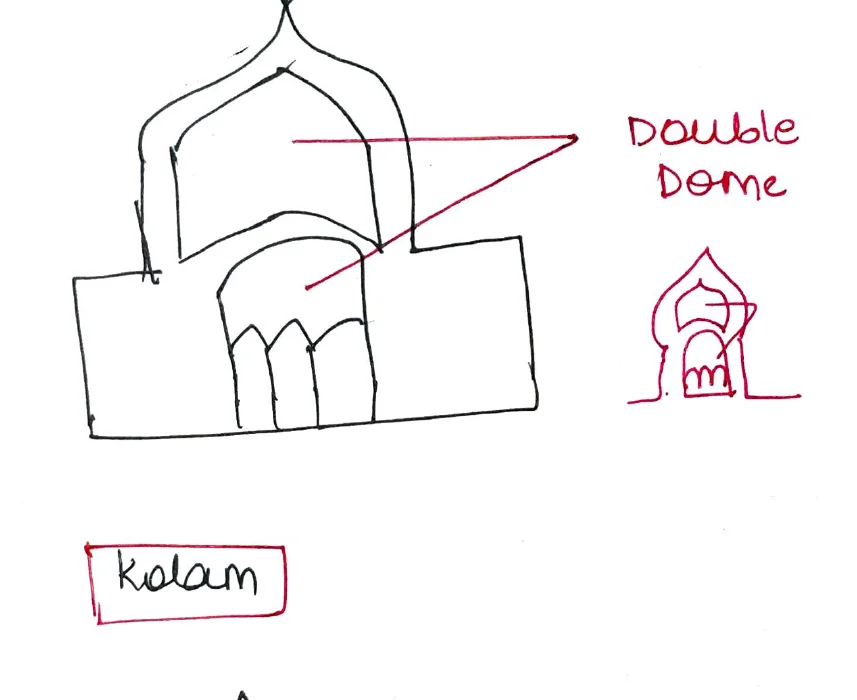
- Labels: Double Dome (inner dome + outer shell), minaret
#Folk/Tribal Art Forms
Warli Painting
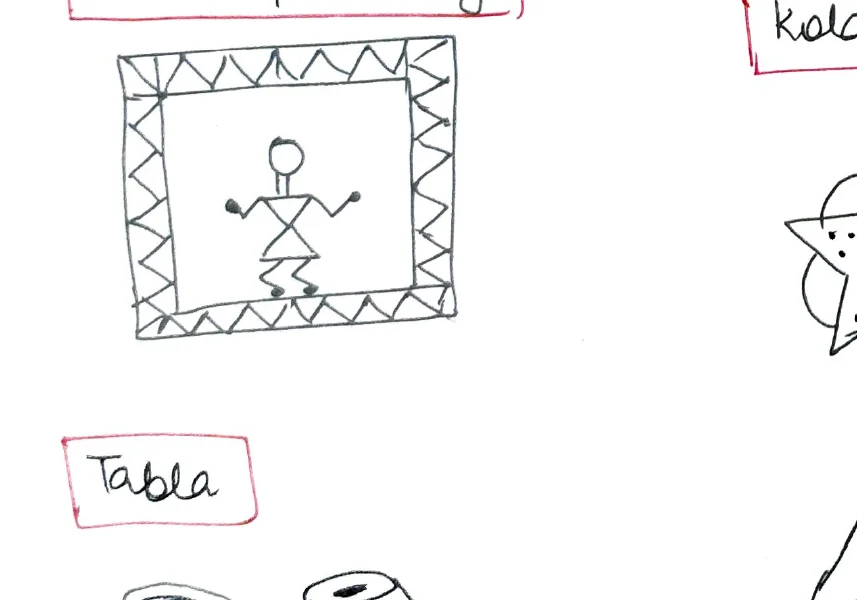
- Dancing human figure inside rectangular border
Kolam / Rangoli
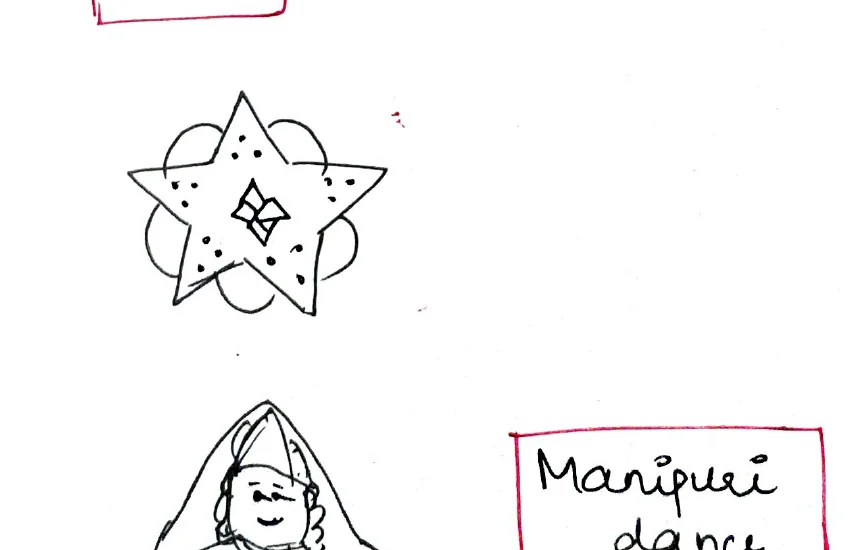
- Star-shaped geometric floor pattern
#Musical Instruments
Tabla
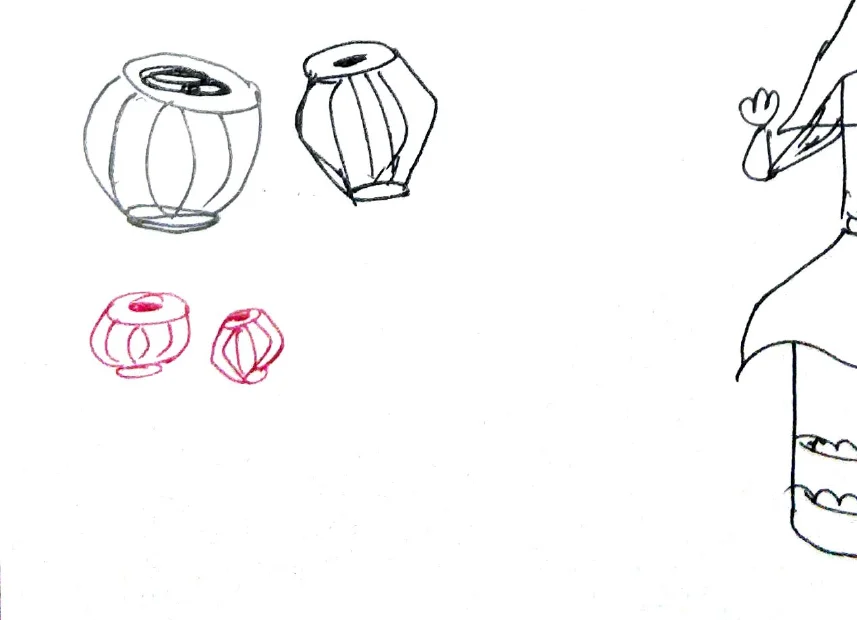
- Pair of drums: large (bayan) + small (dayan) + small round drum below
#Dance Forms
Manipuri Dance
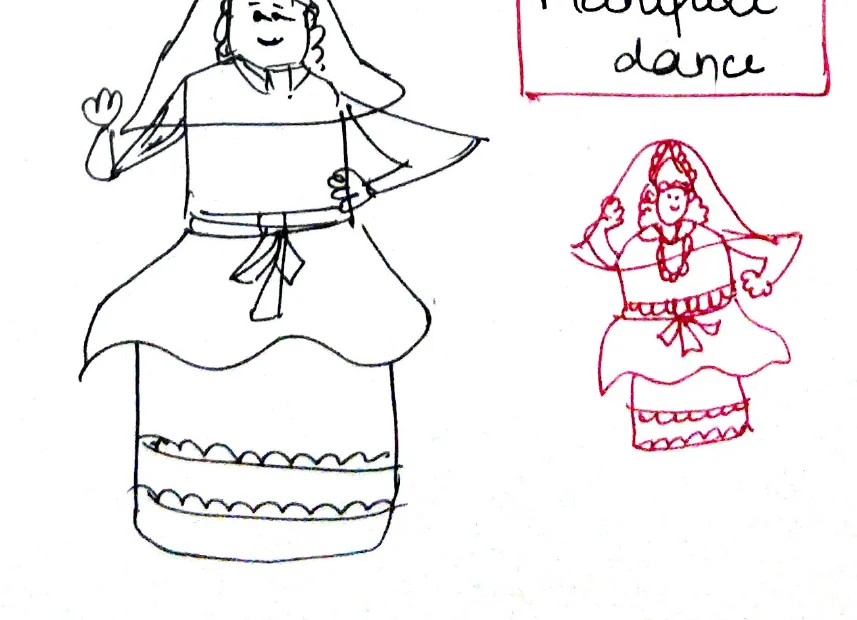
- Female dancer in cylindrical skirt (potloi) and veil
#Puppetry Illustration
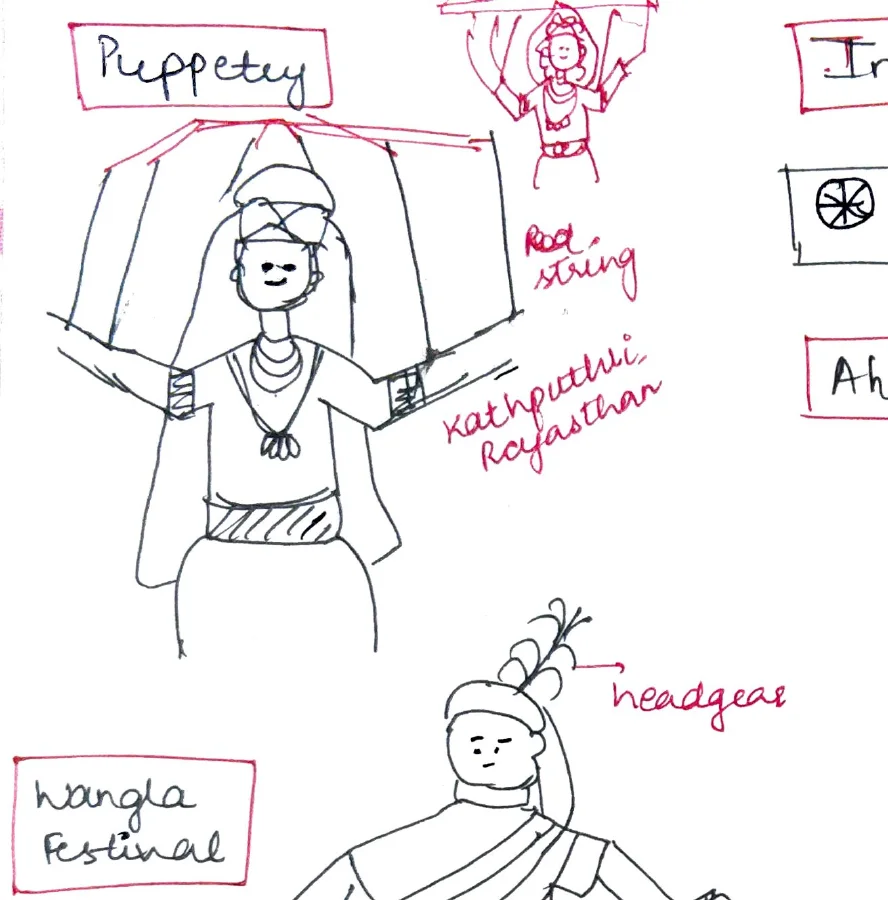
- String puppet: ornate costume, red string, Rajasthan style
#Indus Script Symbols
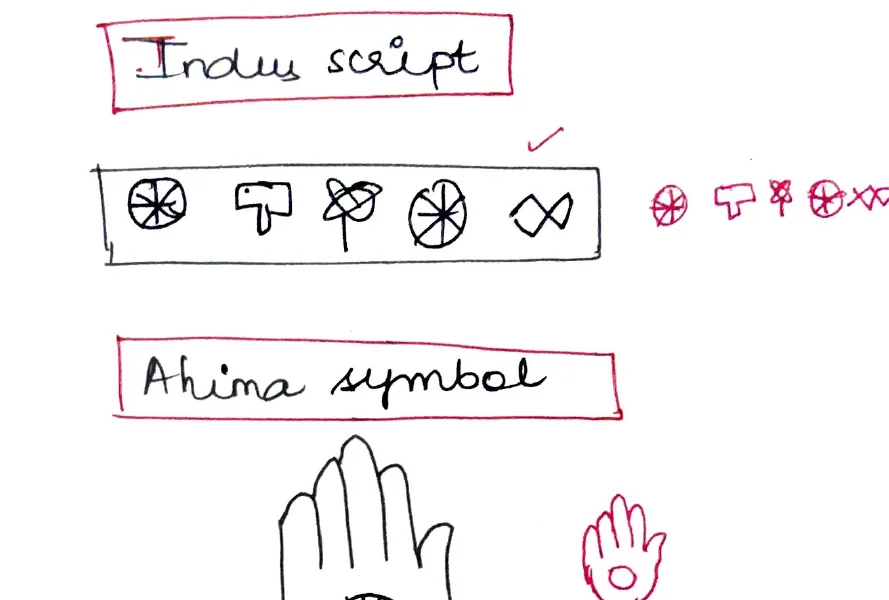
- Row of Indus script symbols including: circle with cross, T-shape, fish, cross, zigzag, and additional glyphs
#Ahimsa Symbol (Jain)
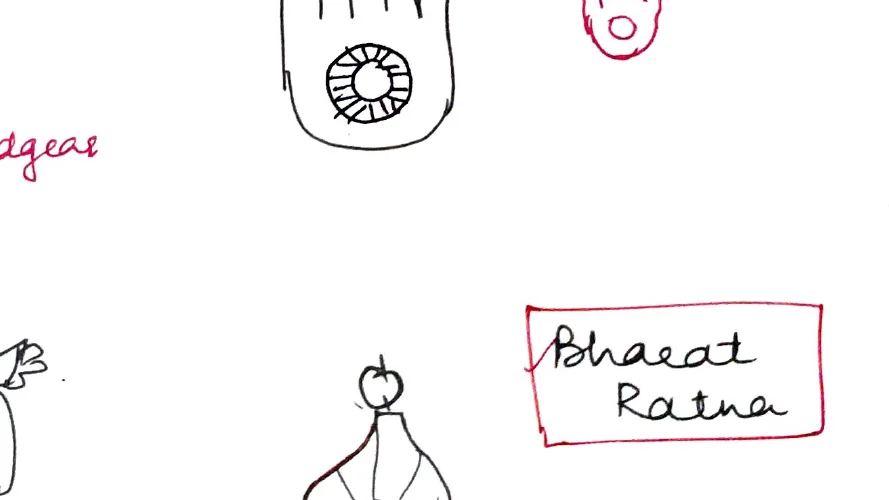
- Open palm with wheel (chakra) in centre = Ahimsa
#Nangla Festival / Folk Performer
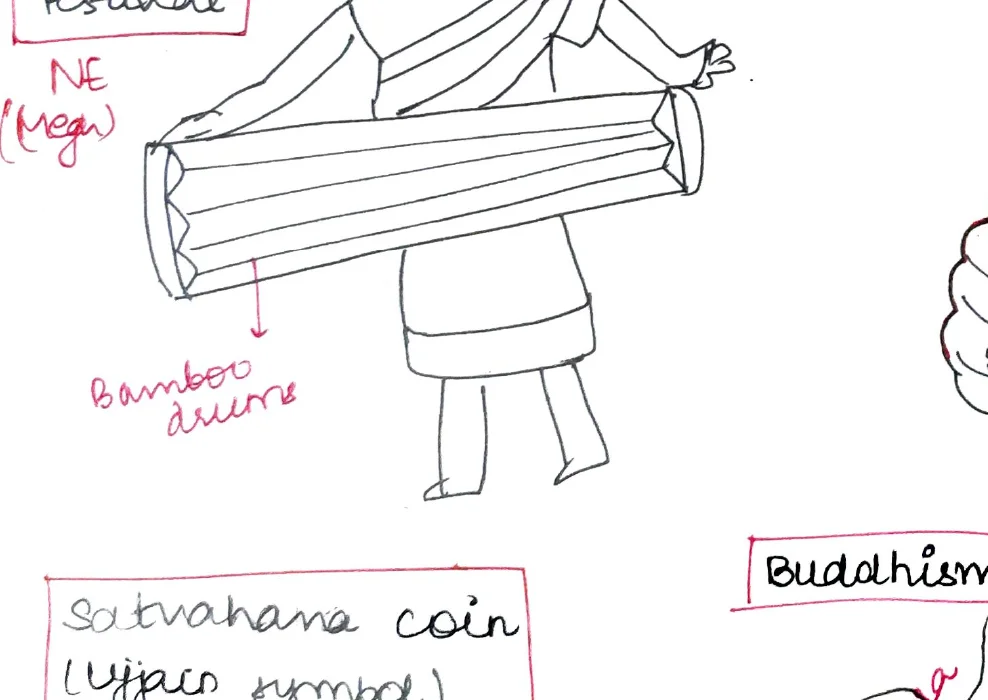
- Performer in headgear holding bamboo flute/drum — NE [paga / Northeast]
#Bharat Ratna Award
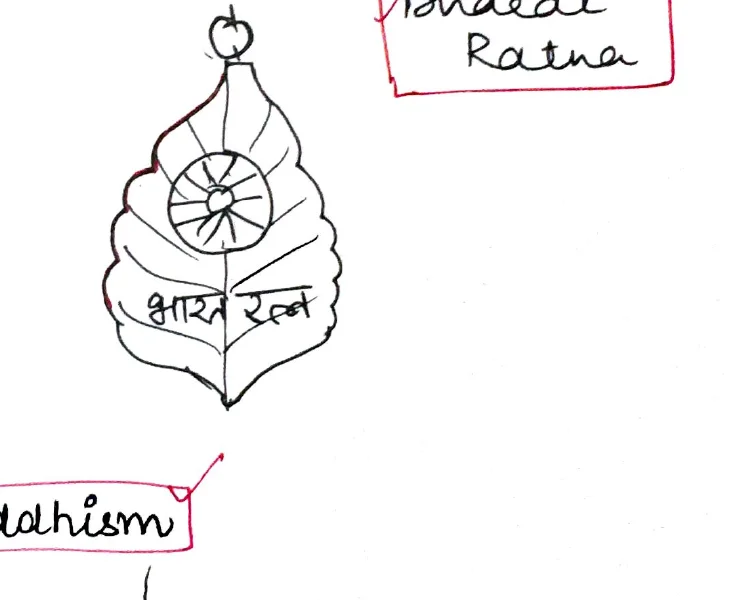
- Peepal leaf shape with sun design — India's highest civilian award
#Satavahana Coin — Ujjain Symbol
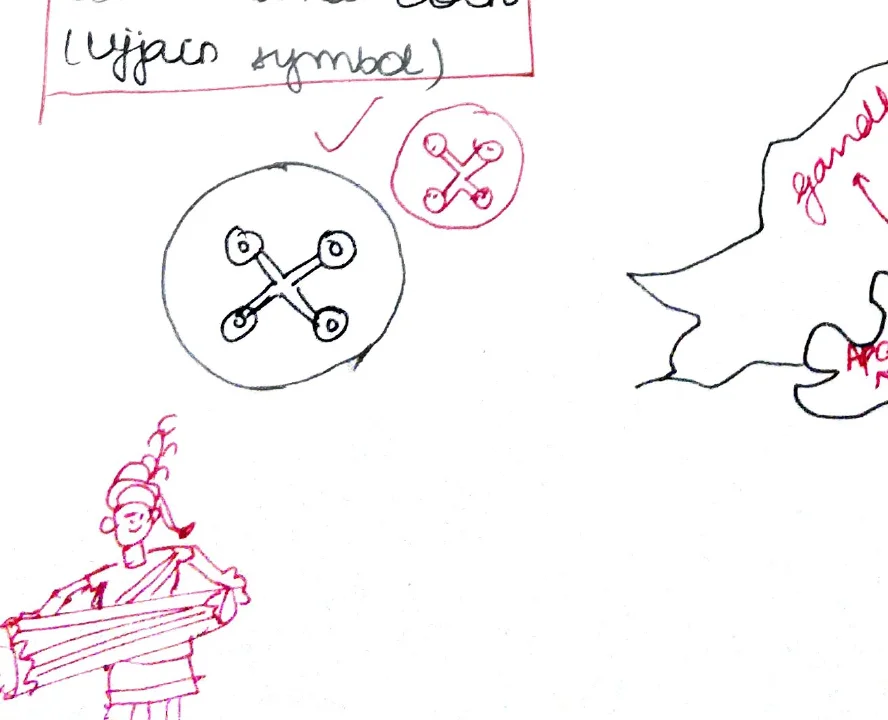
- Circular coin with Ujjain symbol (4 circles/arcs in cross pattern)
#Buddhism Spread Map
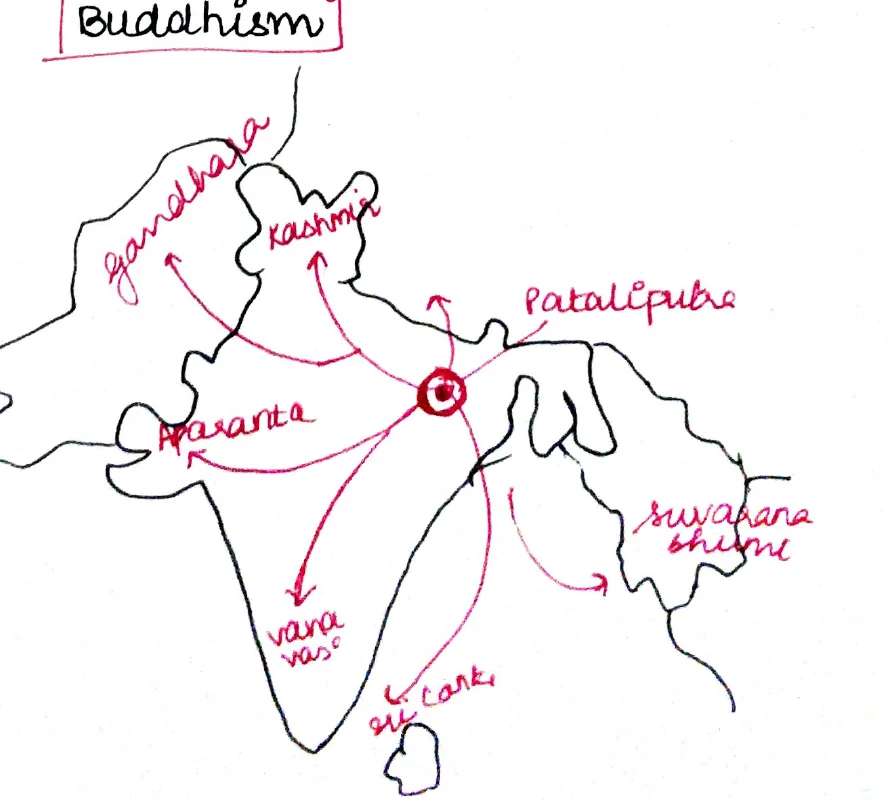
- India outline; central point circled at Pataliputra
- Arrows radiating to: Gandhara, Kashmir, Pataliputra (hub), Aparanta (west coast), Vana Vasi, Lanka (Sri Lanka), Suvarna Bhumi (Southeast Asia)
#Temple Architecture Diagrams
#Nagara Style
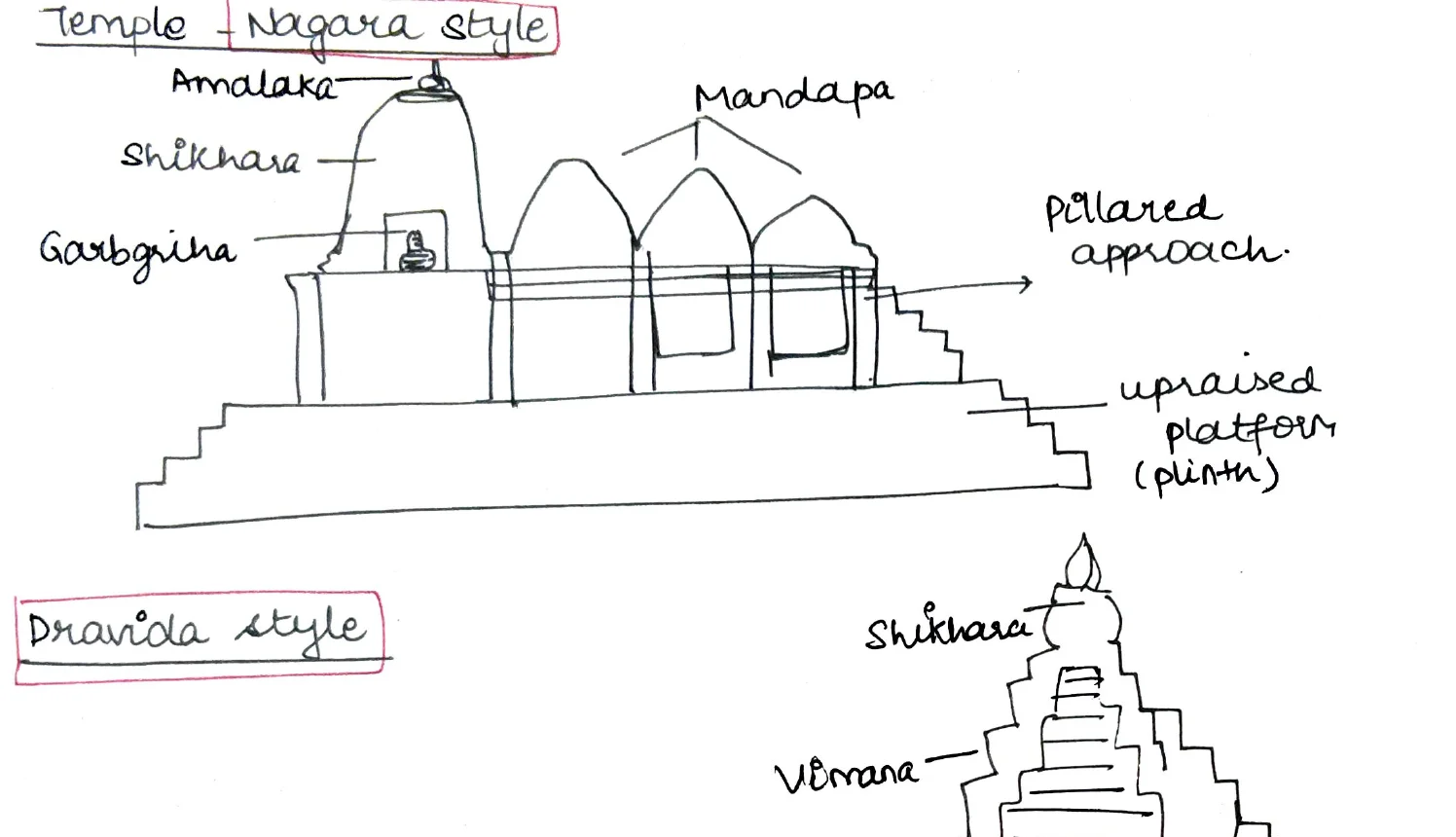
- Labels: Amalaka (top disc), Shikhara (tower), Garbhagriha (sanctum), Mandapa (hall), Pillared approach, Upraised platform (plinth)
#Dravida Style
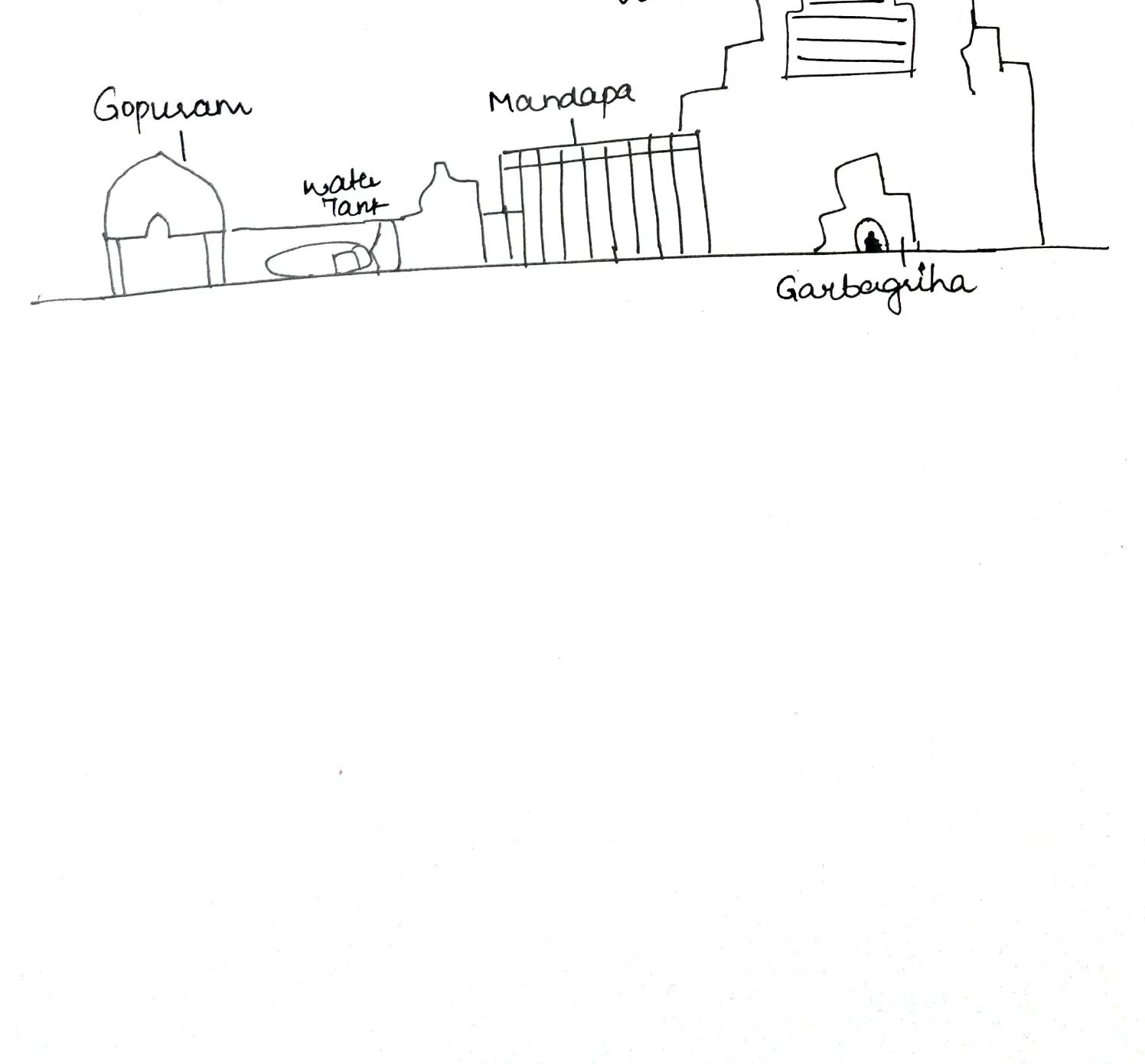
- Labels: Gopuram (gateway tower), Water Tank, Mandapa (hall), Shikhara (over sanctum — smaller/stepped), Vimana (tower), Garbhagriha (sanctum)
Modern History
Topper handwritten notes#Revolt of 1857
#Causes
- Economic = revenue settlement, heavy taxes, usurious rates; artisans & no modern industries; forfeiture of land rights
- pressure on agriculture & lop-sided [exploitative] debt
- (Lapse of [Doctrine of] Lapse, MI Moraji, Doctrine of EIC)
- pressure on agriculture & lop-sided [exploitative] debt
- Political = Subsidiary Alliance, Doctrine of Lapse, Doctrine of EIC [East India Company]
- Administrative = corruption, foreign & alien character
- Socio-religious = racial overtones, reforms, taxes on religious places, role of missionaries
- Serial events = Afghan Wars (1838–42), Punjab Wars, Crimean War
- psychological repercussions
- Discontent among sepoys = service cond[itions], conflict with religious beliefs, loss of caste, no foreign service allowance, annexation of Awadh, racial discrimination
Sepoy = peasant in uniform
- The army voiced grievances other than its own, & the most "spread beyond the army"
- Immediate cause = greased cartridge
#Why the Revolt Failed?
- No All India pan — EWers [East-Westerners/Europeans] were unaffected; Zamindars, educated Indians, rulers [were not supportive]
- All classes didn't join — zamindars, educated Indians, rulers
- Few arms & equipment; uncoordinated & poorly organized [Zakon was already dead]
- No unified ideology
#Nature of Revolt
- Hindu–Muslim unity
- Revolutionary war = Mughal leadership act
- Popular revolt — artisans + peasantry + artisans + shopkeepers
- day labourers + zamindars + religious minds
- priests & civil servants
- Sepoy mutiny — just one of causes to X
- Not all India
- Planned war of India — vs Savarkar (1857)
- Began as religion fight but ended as a war of India — S.N. Sen
- Soldier peasant vs feudalism = Marxist
"Far more than a mutiny, yet much less than a 1st war of India" — Stanley Wolpert
Moved by personal interests
#Consequences / Significance
- GOI Act, 1858 — British Crown
- Queen's proclamation
- End of era of annexations & expansion
- Reform of religion
- Equal & impartial protection u/law
- Army reorg[anisation] = Indians & Euro[peans], martial races, linked battalion scheme, artillery units defunct, high posts reserved for Euro[peans]
- Indian Mutiny — better resistance, returned home
#Significance (Political/Social)
- Conservative brand of nationalism — end of reforms era
- More autocratic empire
- Frustration in educated middle class → national[ism]
- Policy of Divide & Rule
- Systemic economic loot
- Social based & suspicion tho [through]
- Whiteman's burden
- Shortcomings in co-rule
- Brought out grievances of people
#SRRM [Social-Religious Reform Movements]
#Factors for Rise of SRRM
- Impact of British Rule
- Social cond[itions] → religious & social ills
- → oppressing position of women
- → caste problem
- → opp[osition] to West[ern] culture
- New awareness — rational[ism], economic forces, edu[cation], Western ideas & culture
- Middle class Intelligentsia
- Intellectual criteria of rationalism, religious universalism, and humanism
SR [Social Reform] regen of India was only occasioned by colonial process/presence, not created by it.
Reference to past was used as an aid & an instrument. Neither a revival of past nor a break from it was envisaged.
#SRRM — Classification
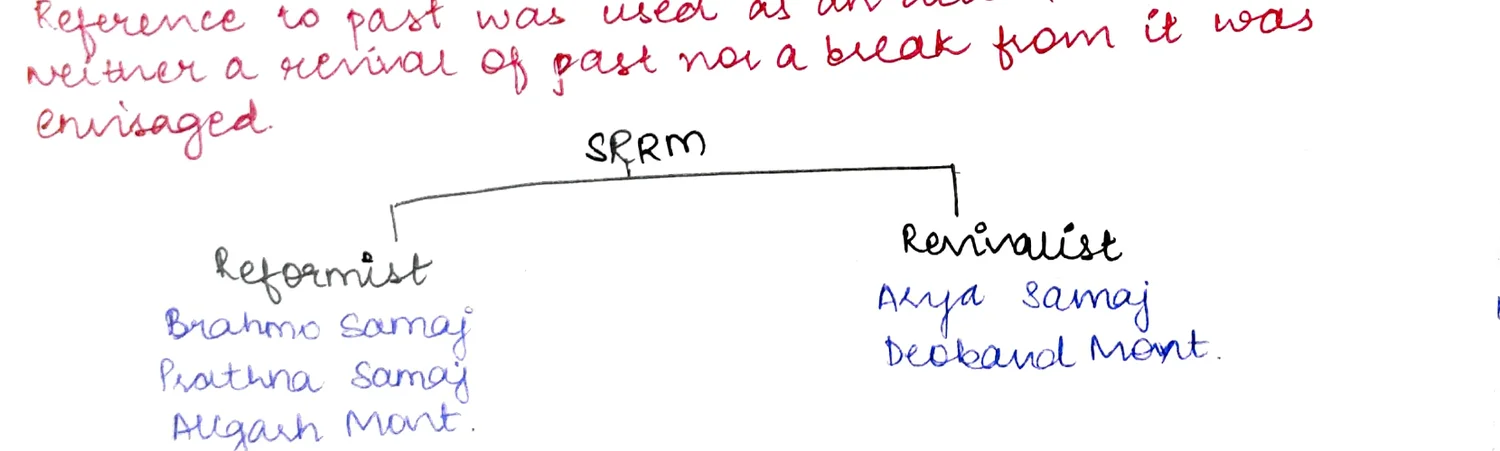
- Reformist branch:
- Brahmo Samaj
- Prarthana Samaj
- Aligarh Movement
- Revivalist branch:
- Arya Samaj
- Deoband Movement
#Consequences of SRRM
Positive
- God liberation [liberation in concept of God]
- Worship was now a personal experience
- Reason ↑
- Corrupt elements (X) [eliminated]
- Cultural roots to cling to
- Sense of humiliation ↓
- Secular, rational, modern outlook
- Notion of pollution & purity (X) [challenged]
- Modern[ism] > Western[ism]
- Ended it's cultural & intellectual isolation from ROW [Rest of World]
- National consciousness
- Resist ideological hegemony
Negative
- Abuse, persecution, fatwas, assassination attempts
- Narrow social base
- Encouraged mysticism in new garbs
- Pseudo-scientific outlook
- Compartment[alisation] of Hindu, Muslim, Sikh, Parsi
- Discourage of high caste Hindus from low caste
- Ancient √ ? — Thomism theory
- Medieval √ ?
- Communal consciousness along with nat[ionalism]
It was out of this struggle that a new society evolved on India
#Modern Nationalism
Reason: result of colonial policies + reaction to colonial policies
#Factors
- Understanding of contradictions [in] Indian & colonial interests
- Pol[itical] admin[istration] & eco[nomic] unif[ication]
- Modern means of transport & communication
- Western thought & edu[cation]
- Role of press & literature — 169 newspapers till 1877
- Rediscovery of India's past
- SRRM
- Rise of Middle class Intelligentsia
- "It was a minority of Indian society but a dynamic minority. It had a sense of unity of purpose & of hope"
- Impact of contemporary movt on the world — Greece, Italy, Ireland etc.
- Reactionary policies & racial arrogance of rulers (Lytton)
- → Vernacular Press Act in 1896 [1878]
- → Delhi Durbar of 1877 (famine)
- → VPA, 1878
- → Arms Act, 1878
- → Ilbert Bill, 1883–84
#Moderate Phase
- Dadabhai Naoroji, DE Wacha, SN [Surendranath Banerjee], Pherozeshah Mehta
- Liberal[s] & moderate politics
- 2 pronged methodology:
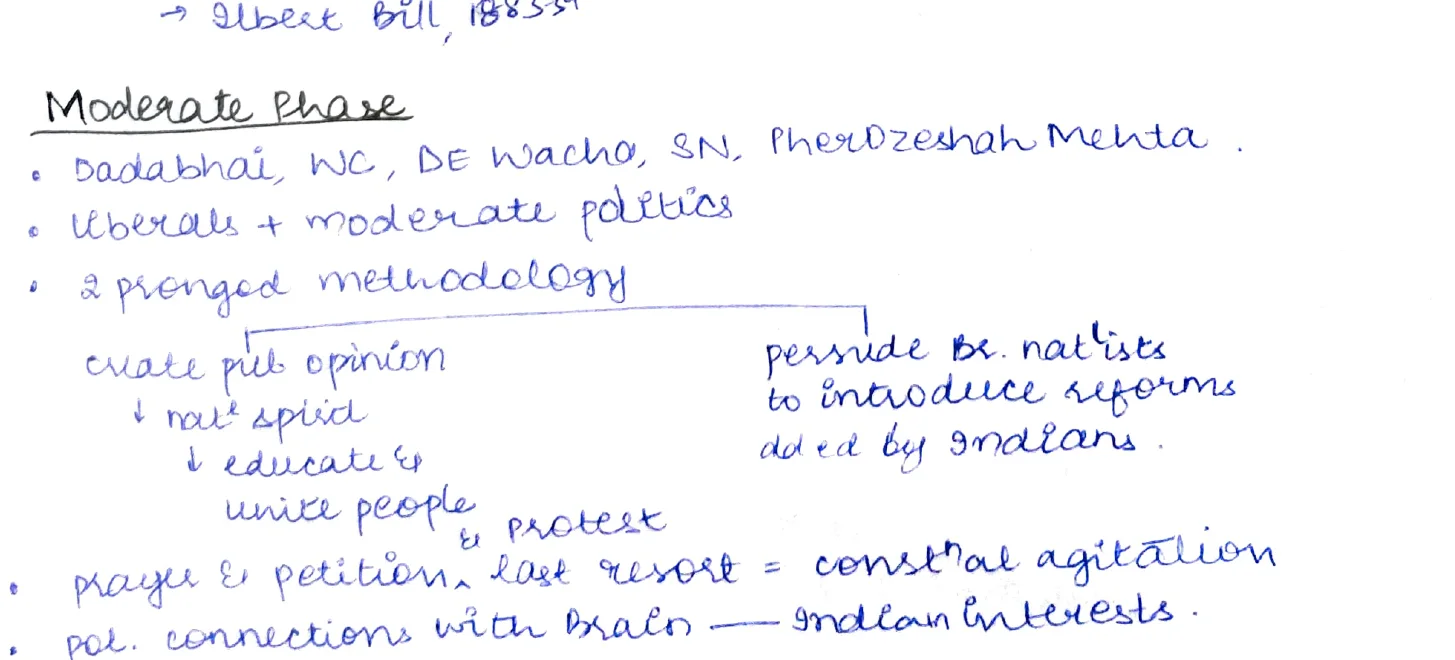
- Creat[e] pub[lic] opinion:
- raise spirit
- educate &
- unite people
- → protest
- Persuade Brit[ish] nat[ives] to introduce reforms to be done by Indians
- Prayer & petition, last resort = constitutional agitation
- Pol[itical] connections with India[n]s — Indian interests
"Pol[itical] Mendicancy", "Old Guard"
#Contribution [of Moderates]
- Economic critique — drain theory
- Constitutional reforms & propaganda on it
- → expansion of councils
- → reform of councils
- Long term obj[ective] of Democratic Self-Govt
- No taxation into rep[resentation] & majority of elected + control on budget
- Demands
- Councils → venting popular grievances, exposing defects of policy, criticising govt, raising eco[nomic] issues
- Generating anti-imperialist sentiments
- Criticism of aggressive FP [Foreign Policy]
- Call for ↑ in exp on welfare (health, edu, agri) + better treatment for Indian labourers abroad
- Protection of civil rights — RT [Right to] speech, thought, asso[ciation] & free press
- Wide nat[ional] awakening
- Trained people on pol[itical] work & popularised modern India[n politics]
Limitations [of Moderates]
- Narrow social base
- No masses, no militant position
- Ltd [Limited] scope of did
- Leaders earn British goodwill — seditious Brahmin-disloyalty labels, factory of sedition etc.
- Encouraged reactionary elements like Sir Syed Ahmed Khan
- Undue faith in Br[itish] intentions
- Not did right to vote for all
- No women
"The period from 1858 to 1905 was the seed time of Indian nationalism & the early nationalists sowed the seeds well and deep." — Bipin Chandra
#Era of Militant Nationalism
#Reasons for Growth
- Recognition of the true nature of British rule
- Economic miseries & famines & plagues
- Growth of confidence & self respect
- Growth of edu[cation] (rise in unemp[loyment])
- Social influences (Japan)
- Reaction to "Tng [Turning] West" : Role of thinkers — "India for Indians"
- Dissatisfy with Mods [Moderates]
- Reactionary policies of Curzon
- Existence of militant school of thought — Lal, Bal, Pal; Aurobindo Ghosh, Chiplankar, Raj Narain Bose
- Emergence of trained leadership
#Moderates vs Extremists
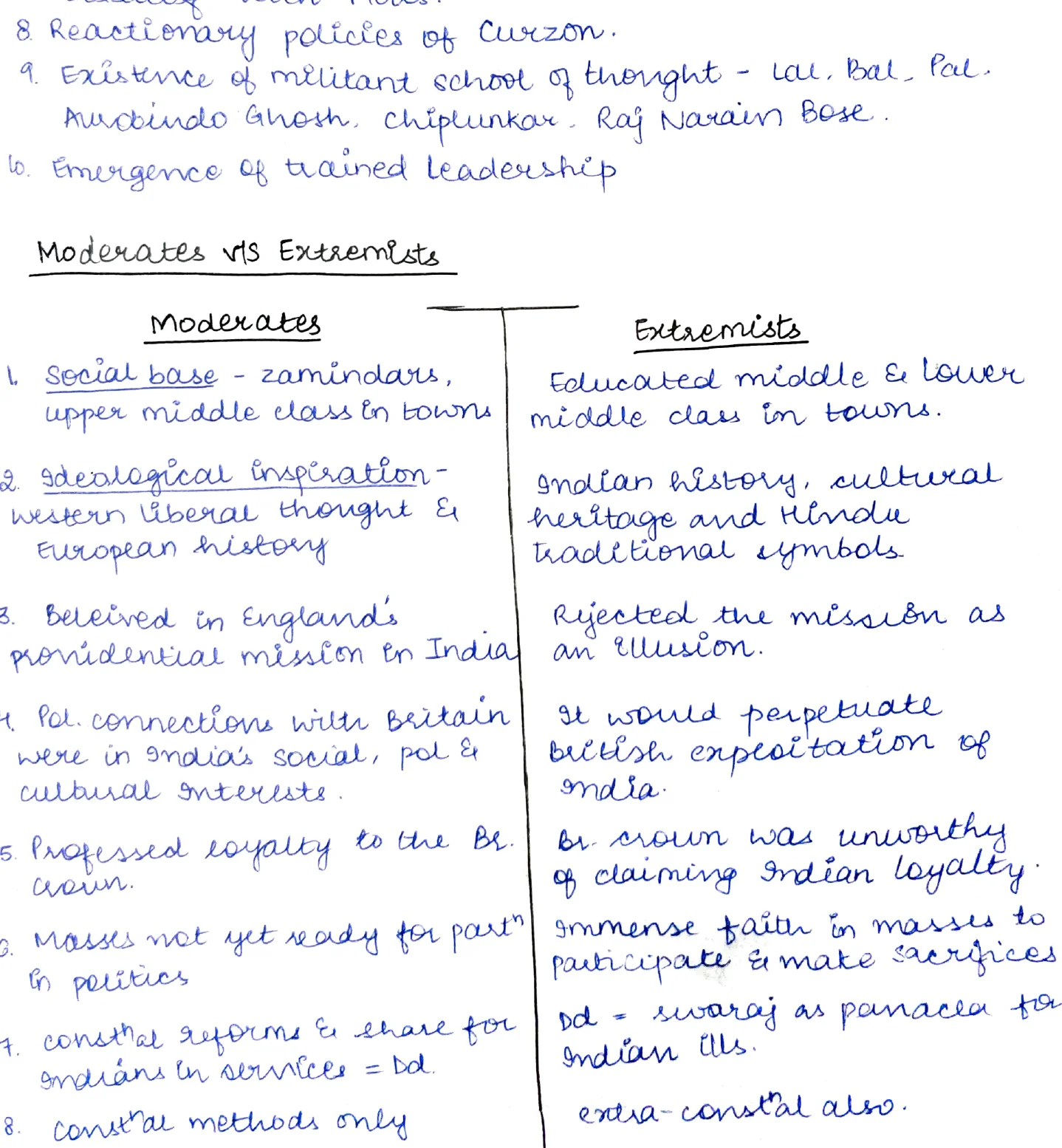
| Aspect | Moderates | Extremists |
|---|---|---|
| 1. Social base | Zamindars, upper middle class in towns | Educated middle & lower middle class in towns |
| 2. Ideological inspiration | Western liberal thought & European history | Indian history, cultural heritage and Hindu traditional symbols |
| 3. Believed in England's providential mission to India | Yes | Rejected the mission as an illusion |
| 4. Pol[itical] connections with Britain | Were in India's social, pol[itical] & cultural interests | Would perpetuate British exploitation of India |
| 5. Professed loyalty to the British Crown | Yes | The crown was unworthy of claiming Indian loyalty |
| 6. Masses not yet ready for part[icipation] in politics | Yes | Immense faith in masses to participate & make sacrifices |
| 7. Constitutional reforms & share for Indians in services = bld [bold] | Yes | bld = swaraj as panacea for Indian ills |
| 8. Constitutional methods only | Yes | Extra-constitutional also |
#Why Bengal was Important for British?
- Richest province of Mughal empire
- Vast area = control over Bengal meant more authority
- Vital trading interests as >50% of Br[itish] imports from Asia consisted of goods from Bengal
- Pol[itical] cond[itions] of the state offered oppo[rtunity] to Br[itish] to exploit the region for personal gains
- Rest of India was not insulated from revolts & invasions like Bengal e.g: Jai, Maratha revolt, foreign invasions etc.
- Highly populous region + fertile + indigo
- Access to sea — port dev[eloped] by Br[itish]
- Emerged as a hub of nationalism later
- Control of mainland India as against French Pondicherry
#Workers' Contribution in INM [Indian National Movement]
"India broke her British fetters with a Western hammer"
- Dual challenge [imperialist pol[itical] rule / economic exploit[ation]"]
- Earliest attempts by philanthropists like Sasiplada Banerjee — Isolated, sporadic, localised
- Soon nationalist leaders BC Pal, GS Aiyar, Lalaji etc wanted labour reforms
- → alignment of LM [Labour Movement] with INM
- → was evident in SM [Surat Movement?] 1905
- → alignment of LM [Labour Movement] with INM
- WWI + Gandhian pol + AITUC = broad-based INM with active mobil[isation] of workers
- Radical & militant tinge due to communist influence
- e.g: General strike in Bombay textile mills (1928)
#Role of Vernacular Literature
- Ideas of SRRM propagated to diff sections
- e.g: Samvad Kaumudi in Bengali
- Broke monopoly of high castes over edu[cation]
- Ventilation of sufferings & grievances of lower castes
- e.g: Gulamgiri [in] Marathi by Jyotiba Phule
- Ideas of INC reached every nook & corner
- Instilled sense of pride & belongingness
- e.g: Bankimchandra Chaterjee
#Local Government
#Why Done?
- Financial difficulties due to over-© [overextension] made dec[entralisation] imperative
- India's tring [growing] contact with Europe = need for civic amenities led
- Nat[ional]ism was based on improved basic facilities
- An instrument to check politicisation of it
- Utilisation of local taxes for local welfare
#Stages
- Mayo's Reso[lution] of 1870 — financial dec[entralisation] → local taxes
Ripon's Resolution, 1882
-
Father of LSG [Local Self-Government]
a) Devt [Development] of LB to improve admin b) Definite duties & sources of revenue c) Non-official majority d) ↑ chairperson too e) Min official interference f) Official © [government] sanction kept in certain cases
Pitfalls:
-
→ Ltd [Limited] franchise
-
→ District boards control to be headed by DO [District Officer]
-
→ Govt retained strict control
-
→ Official © [official government] sanction
-
1908 Royal Commission on Dec → progressive so not applied
-
July 1919 also
-
LSG was a democracy but Finance — reserved
-
1935 Act — some powers transferred, others → [illegible] → other [illegible]
#Economic Impact of British Rule in India
Beginning of 19th c[entury]: India's share in world economy = 23% 1947 → 3%
#1. Deindustrialisation — ruin of artisans
- One way free trade
- No step toward modern industry
- Loss of patronage
- Ruralisation = pressure on land
#2. Impoverishment of Peasantry
- Permanent settlement ←— 4 colonial eco[nomic] policies
- No spending on ↑ land productivity
- Huge powers to zamindars ←— 2 ruin of handicrafts
- Lega[cies] ←— 3 new land revenue system
- Moneylenders & debt cycle ←— 4 no admin[istration] exp[enditure]
- Triple burden of — govt + zamindars + moneylenders △ [triangle]
- Famine & scarcity
- Peasants became landless
- Indigo cultivation
#3. Emergence of Intermediaries, Absentee Landlordism, Ruin of old zamindars
#4. Migration & Deterioration of Agriculture
#5. Famine & Poverty
#6. Commercialisation of Indian Agri[culture]
- → Spread of money economy
- → Custom & tradition ——→ contract & competition
- → Emergence of unequal [money-lender] relationships
- → Growth of internal trade
- → Improvement in comm[unications] through rail & road
- → Hurt to external trade by Br[itish] finance capital etc.
#7. Destruction of Industry & Late dev[elopment] of Modern Industry
- → Textile, shipping, steel industry &
- → Deficit policy, no tariff protection, unequal competition, lopsided devt [development]
#Role of Women in Indian Freedom Struggle
IFS [Indian Freedom Struggle] would be incomplete w/o women
- Fought with true spirit, courage
- Began in 1817 — Bhima Bai Holkar (guerilla warfare) — much before Rani Channama, Kittur; Rani Begum Hazrat Mahal, Awadh (in 1857 revolt)
- 1857 — Credible role:
- Rani of Ramgarh, Rani Jindan Kaur, Chauhan Rani etc.
- Rani Laxmi Bai of Jhansi — tariff *
- Mostly belonged to educated & liberal families + from all caste/religion/communities
- 20th century — Sarojini Naidu, Kasturba Gandhi, Vijayalakshmi Pandit, Annie Besant
- "Empress of a shittier empire of glory"
#Key Women Leaders
Sarojini Naidu — Nightingale of India
- Writer & poet
- Pres[ident] of INC
- Comm[itted to] Salt Satyagraha
Besant [Annie Besant]
- Launched Home Rule Movement
- Pres[ident] of INC
- Reforms, labour organiser & strike leader
- Edu[cation] — college & schools set up
Madam Cama
- Social worker
- Unfurled flag in Germany
Kamala Nehru
- Forefront of NCM [Non-Cooperation Movement]
- Organised picketing
- Delivered Jawaharlal's speech after her arrest
Vi Pandit [Vijayalakshmi Pandit]
- 1st woman to become Pres[ident] of UNGA
- Arrested many times for CDM [Civil Disobedience Movement]
Muna Asaf Ali
- QIM [Quit India Movement]
- Flag in Bombay
- Edited "Inquilab"
- Bharat Ratna awardee
Kalpana Dutta
- Joined Bose
- Chittagong armory raids
Kasturba Gandhi
- With Gandhiji all her life
- Leader of women Satyagraha
- Social reform & constructive work
Usha Mehta
-
Simon Go Back
-
Underground radio during QIM [Quit India Movement]
-
Others — Sucheta Kriplani, Lakshmi Sehgal, Kamladevi
#Gandhiji's Methods for Women's Inclusion
Gandhiji ke aage se kaafi badhaava mila
-
Needed for Satyagraha:
- Self sacrifice
- Tolerate
- Endure suffering
- = Perfect for non-violent struggle
-
Nehru too encouraged (Western influence) & Bose
-
Not only non-violent: women participated ferociously in picketing shops, protests, Prabhat Pheris, social work, role as messenger, jailed during Bande Mataram march, assassinations & raids, underground activities
-
Fought for their rights too
-
Legislative councillors bhi bangi [also became]
-
MNC [Modern National Congress?]
-
Labour movt too — Mill strike (Anusaya Ben)
-
Laid down their lives (countless of them) — as equals to the big leaders
-
Integral role as messengers, supporters, wives, mothers and leaders
#Social Composition of Early Congress
- Uneven regional rep[resentation] + more East
- Total exclusion of non-elite groups
- Western educated people dominated
- Lawyers = 40%; also traders, journalists, doctors etc.
- Hindu dominated (2 decades) — Hindus means the Brahmins & upper castes
- Except Badruddin Tyabji
#Why INC Accepted Partition?
= success/failure dichotomy
- Acceptance was a final act of long process [1916 ML SE dd Nehru Report etc]
- Mountbatten plan
- Mass mobil[isation] by ML [Muslim League] & its unrelentingness
- Communal violence
- Chances of immediate independence
- Hope for relief
#Commercialisation of Agriculture
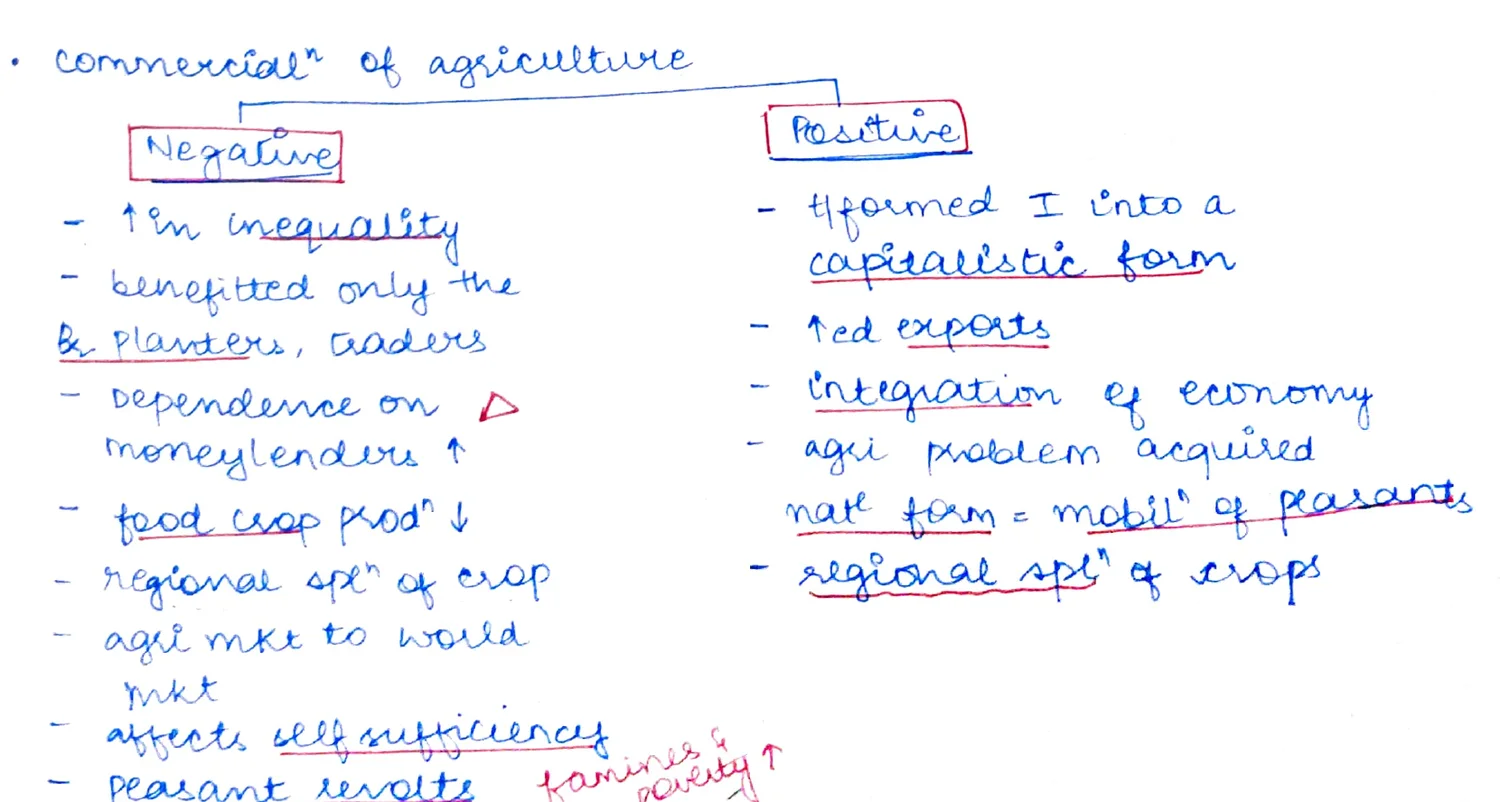
| Negative | Positive |
|---|---|
| ↑ in Inequality | ↑ Transformed I[ndia] into a capitalistic form |
| Benefited only the big planters, traders | Led exports |
| Dependence on △ [triangle] moneylenders ↑ | Integration of economy |
| Food crop prod[uction] ↓ | Agri problem acquired new form = mobil[isation] of peasants |
| Regional agri of crop ↓ | Regional app[lication] of crops |
| Agri unable to avoid risk↓ | |
| Absent self-sufficiency | |
| Peasant revolts, famines, scarcity ↑ |
#Missionaries
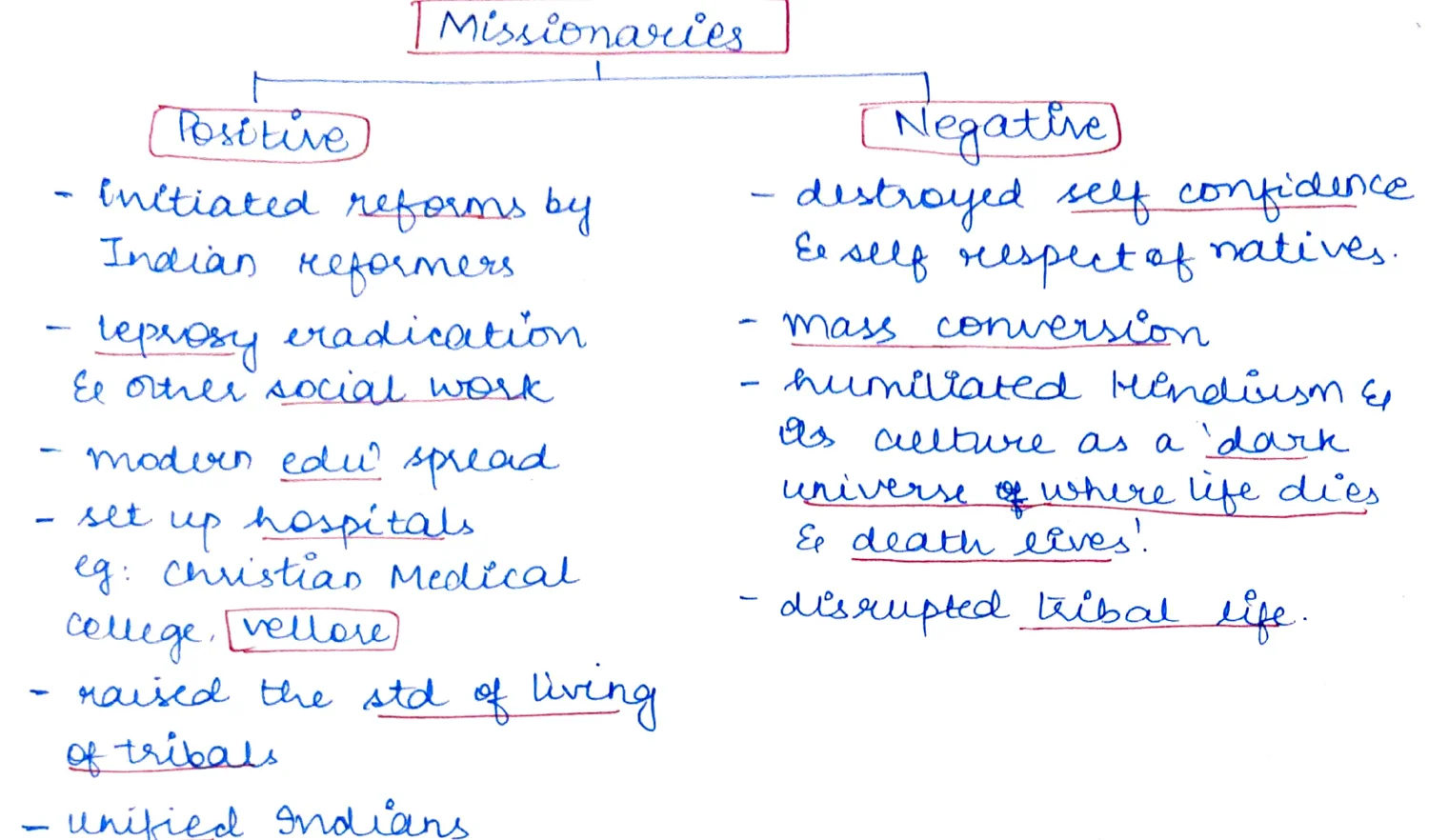
| Positive | Negative |
|---|---|
| Initiated reforms by Indian reformers | Destroyed self confidence & self respect of natives |
| Leprosy eradication & other social work | Mass conversion |
| Modern edu[cation] spread | Humiliated Hinduism & its culture as a "dark universe of whose life dies & death lives" |
| Set up hospitals e.g: Christian Medical College Vellore | Disrupted tribal life |
| Raised the std[standard] of living of tribals | |
| Unified Indians |
#Factors for Growth of Dalit Consciousness
- New edu[cational]/pol[itical] system based on individual liberty, equality, democracy
- Reaction against the high handedness of Hindu upper castes
- Help through British Divide & Rule policy
- Influence of Westernphile [Western-educated] — "Rights of Man" — Jyotiba Phule
- Commerciali[sation] of agri — new contractual rel[ationships], more opportunities
- Social reformers — Phule, SNDP, EV Naicker [Periyar]
- British policy & acts — reservations?
- Gandhiji's work
- C[onstitution] of India
- BR Ambedkhar [Ambedkar]
"There comes a time in the life of every nation when it stands at crossroads of history & must choose which way to go." — Shastriji
#Permanent Settlement
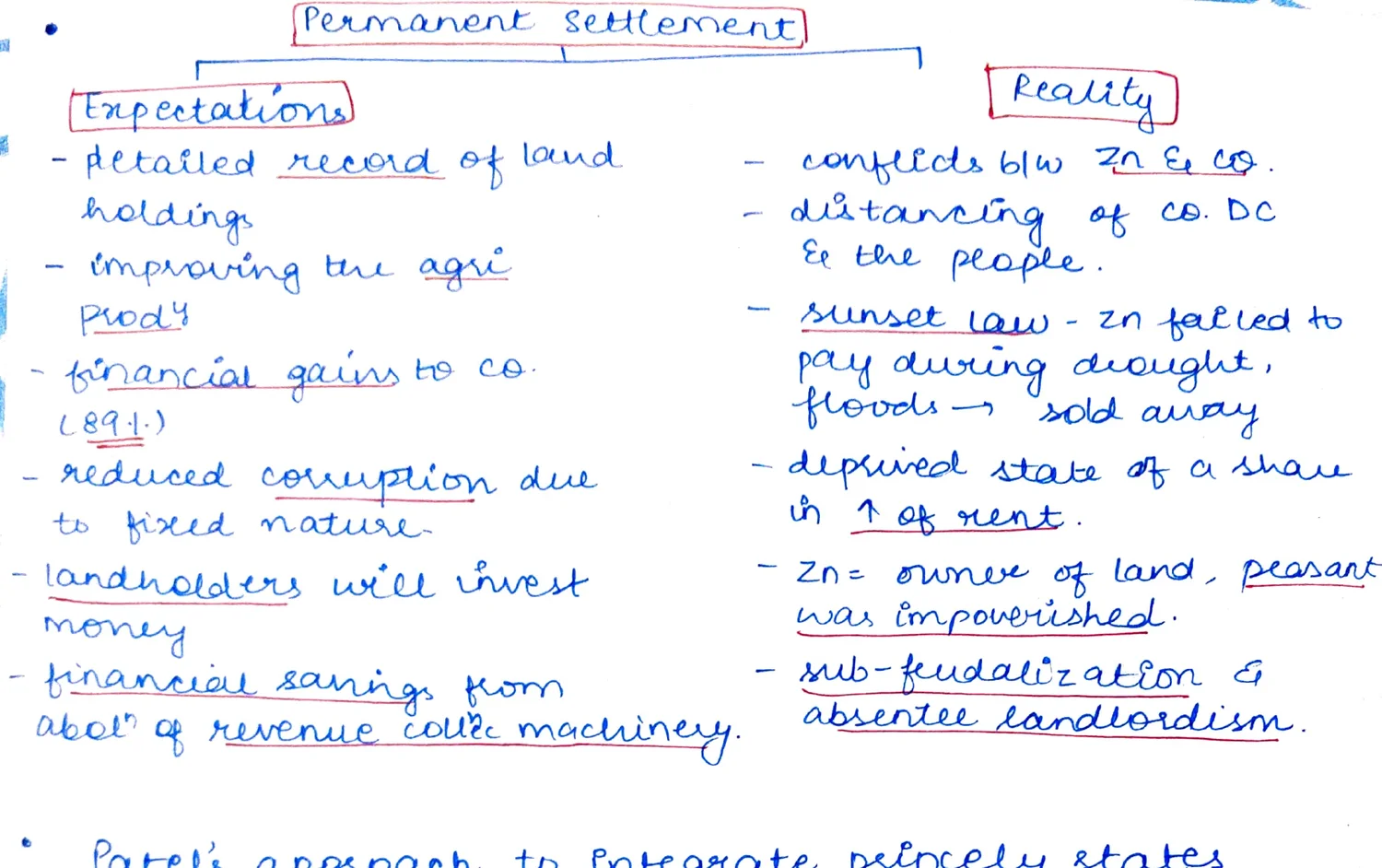
-
Expectations (left column)
- Detailed record of land holding
- Improving the agri [agricultural] prod [production]
- Financial gains to co [Company] (£91?)
- Reduced corruption due to fixed nature
- Landholders will invest money
- Financial savings from abcl [abolition?] of revenue collection machinery
-
Reality (right column)
- Conflicts b/w [between] Zn [Zamindars] & [and] EIC [East India Company]
- Distancing of co [Company] DC [District Collector?] & the people
- Sunset law — Zn [Zamindars] failed to pay during drought, floods → sold away
- Deprived state of a share in ¼ of rent
- Zn = owner of land, peasant was impoverished
- Sub-feudalization & absentee landlordism
#Patel's Approach to Integrate Princely States
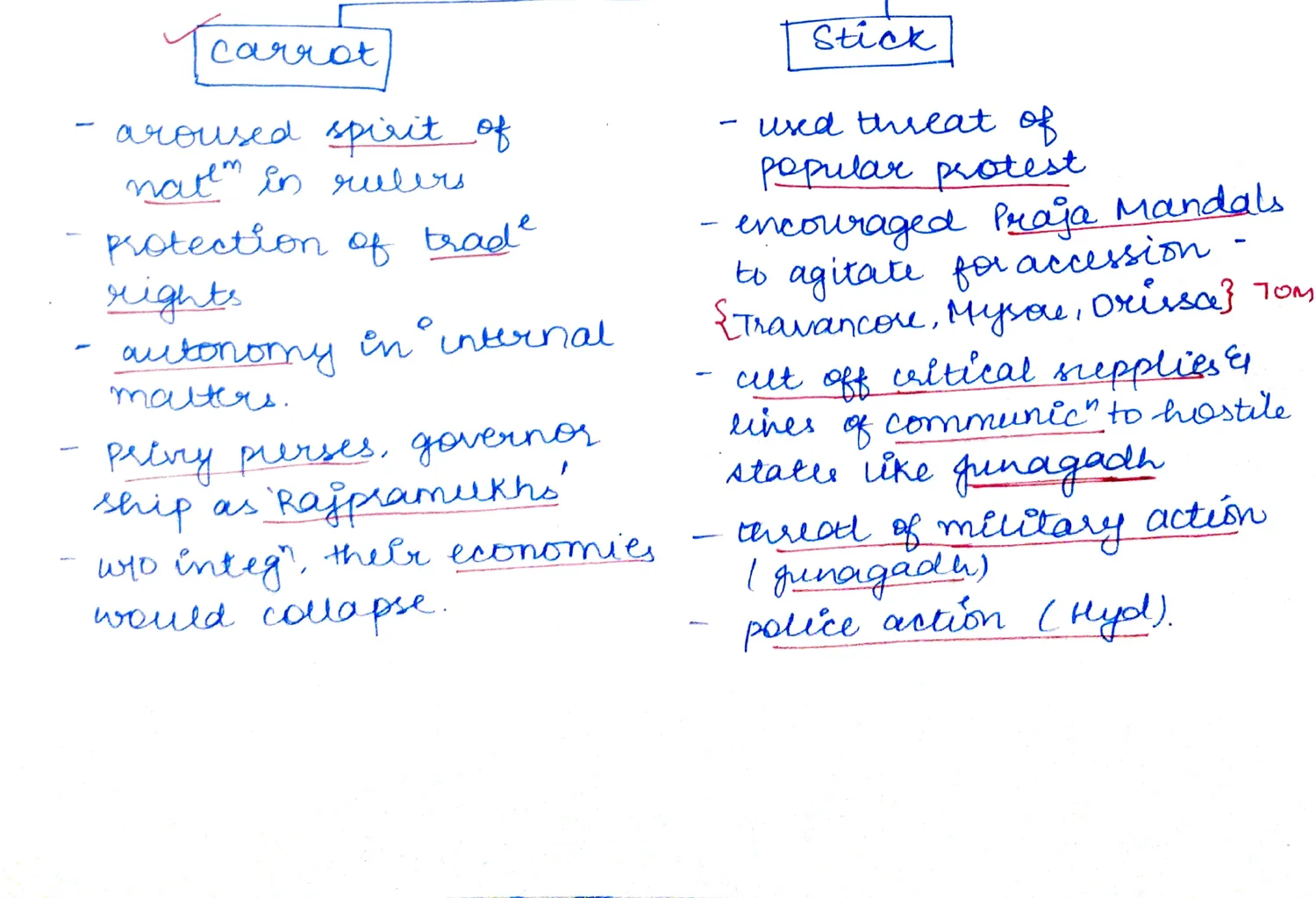
#Carrot (incentives offered)
- Aroused spirit of "nat" [nationalism] in rulers
- Protection of trade rights
- Autonomy in internal matters
- Privy purses, governor ship as Rajpramukho [Rajpramukh]
- Woo [wooed] integr [integration] — their economies would collapse
#Stick (coercive methods)
- Used threat of popular protest
- Encouraged Praja Mandals to agitate for accession — [Travancore, Mysore, Orissa] — too [many]
- Cut off critical supplies & "lines of communication" to hostile states like Junagadh
- Threat of military action (Junagadh)
- Police action (Hyd [Hyderabad])
#Impact of C [Central] Asian Contact on India
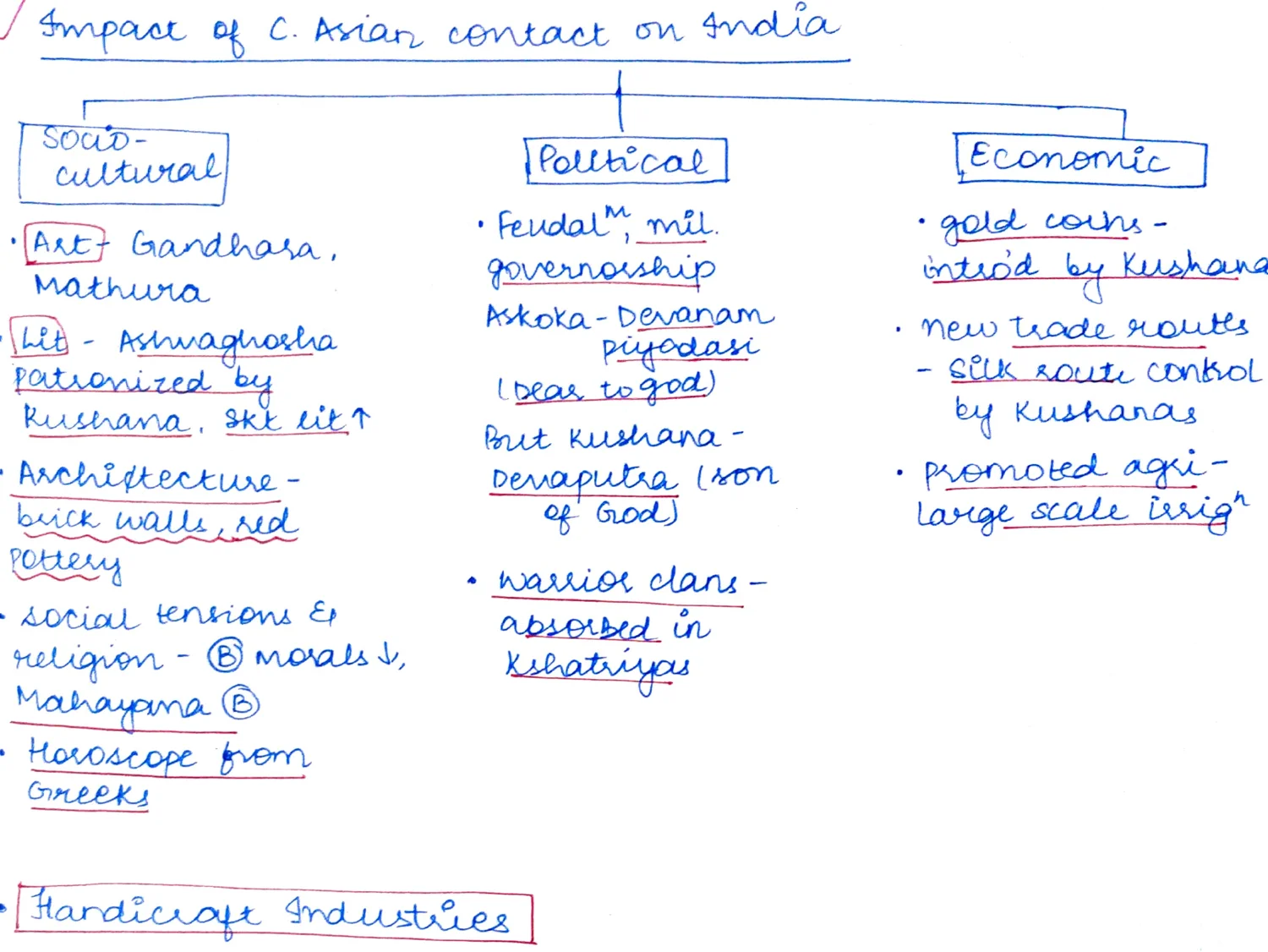
#Socio-Cultural
- Art — Gandhara, Mathura
- Lit [Literature] — Ashwaghosa, patronized by Kushana. Jkk lit?
- Architecture — brick walls, red pottery
- Social tensions & religion — ® [Buddhism] Morals &, Mahayana ®
- Horoscope from Greeks
#Political
- Feudal?, mil [military] governorship
- Ashoka-Devaram-Piyadasi [dear to god]
- Hut [first] Kushana-Devaputra (son of God)
- Warrior class — absorbed in Kshatriyas
#Economic
- Gold coins — intro [introduced] by Kushanas
- New trade routes
- Silk route control by Kushanas
- Promoted agri [agriculture] — large scale irrig [irrigation]
#Handicraft Industries
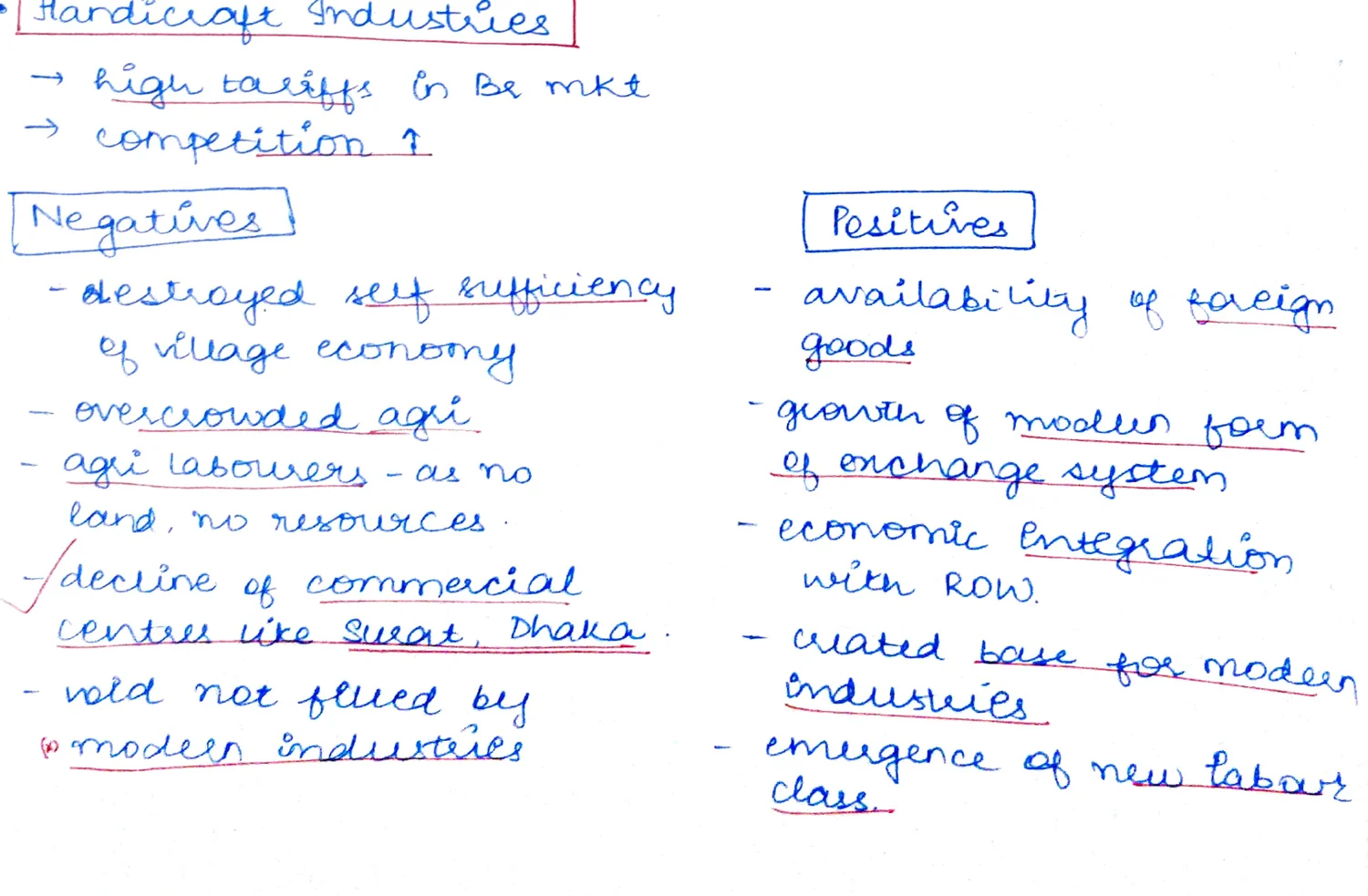
- → High tariffs on Br [British] mkt [market]
- → Competition ↑
#Negatives
- Destroyed self-sufficiency of village economy
- Overcrowded agri [agriculture]
- Agri labourers — as no land, no resources
- Decline of commercial centres like Surat, Dhaka
- Void not filled by → modern industries
#Positives
- Availability of foreign goods
- Growth of modern form of exchange system
- Economic integration with ROW [Rest of World]
- Created base for modern industries
- Emergence of new labour class
#Dyarchy
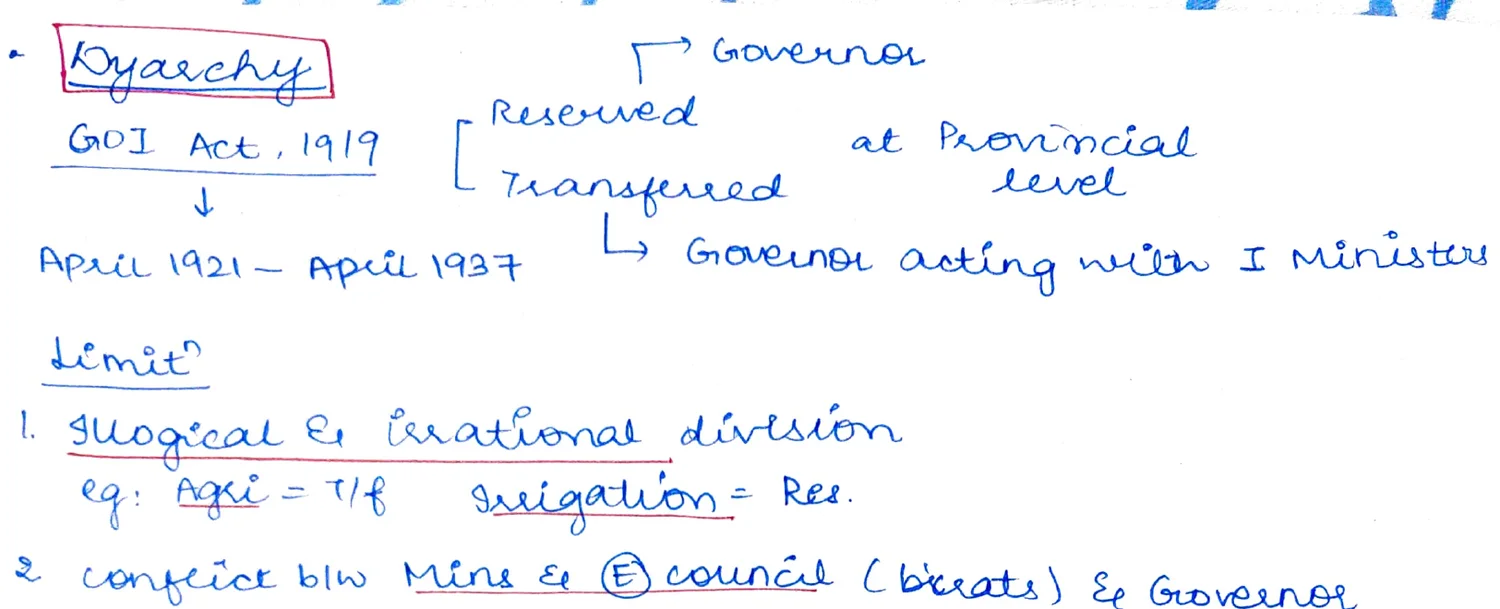
- GOI [Government of India] Act, 1919
- → Governor [at top]
- [Reserved] → at Provincial level
- [Transferred] → Governor acting with I [Indian] Ministers
- → Governor [at top]
- April 1921 – April 1937
#Limits of Dyarchy
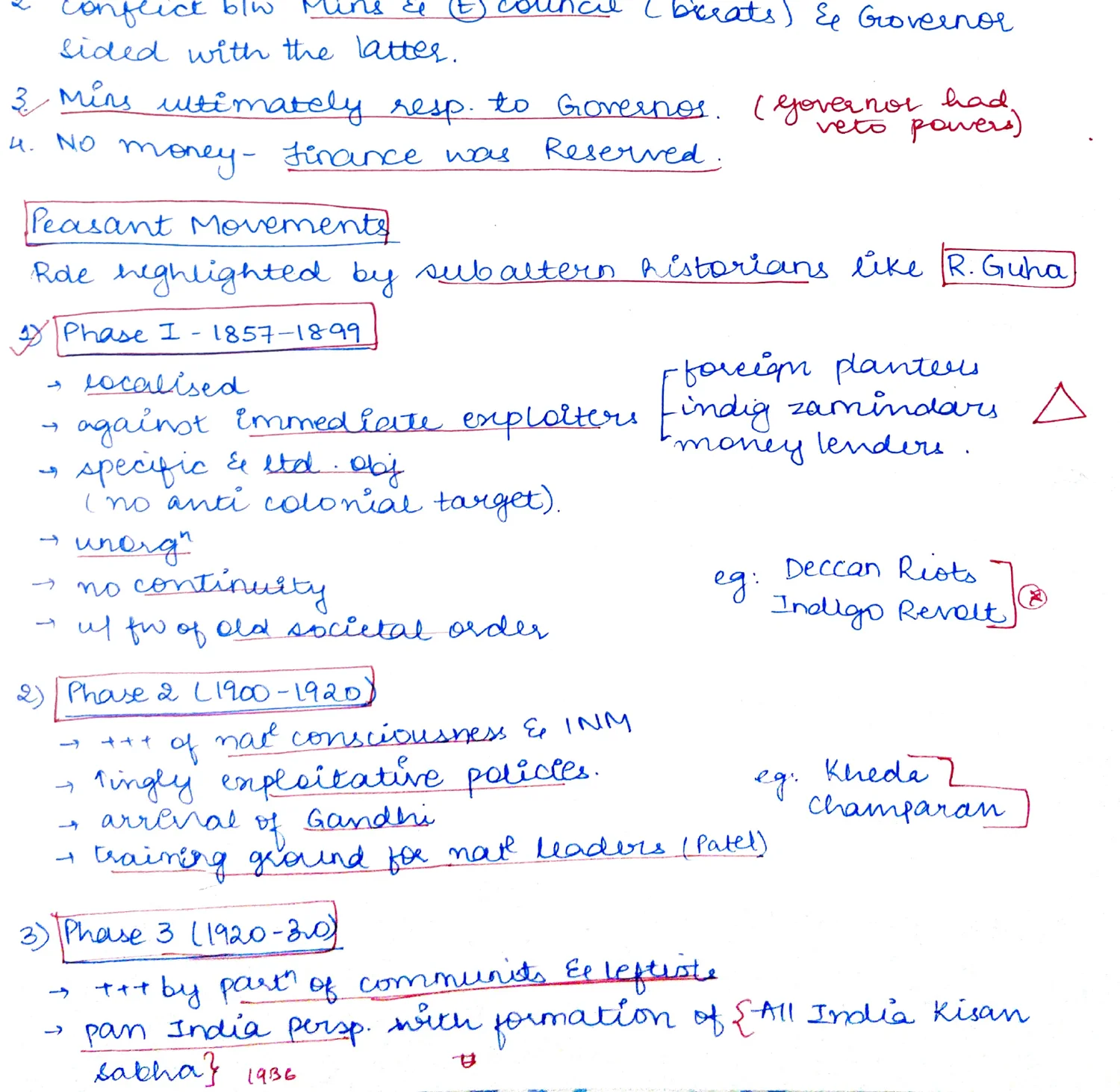
- Illogical & irrational division
- eg: Agri [Agriculture] = T/f [Transferred]; Irrigation = Res [Reserved]
- Conflict b/w [between] Mins [Ministers] & [Executive] Council (bicrats) & Governor
- sided with the latter
- Mins [Ministers] ultimately resp [responsible] to Governor (Governor had veto powers)
- No money — Finance was Reserved
#Peasant Movements
- Rec [Recognised/Highlighted] by subaltern historians like R. Guha
#Phase 1 — 1857–1899
- Localised
- Against immediate exploitation — [foreign planters, Indigo zamindars, money lenders] △ [triangle diagram]
- Specific & ltd [limited] obj [objective] (no anti-colonial target)
- Unorg [Unorganised]
- No continuity
- ut [ultimately] fry [fraying?] of old societal order
- eg: Deccan Riots, Indigo Revolt ✗
#Phase 2 — 1900–1920
- +++ of nat [national] consciousness & INM [Indian National Movement]
- Singly exploitative policies
- Arrival of Gandhi
- Training ground for nat [national] leaders (Patel)
- eg: Kheda, Champaran
#Phase 3 — 1920–2[0?]
- +++ by part of communists & leftists
- Pan India persp [perspective] with formation of All India Kisan Sabha 1936
#Peasant Movements (continued — page 19)
- → Autonomous peasant movt [movement]
- → General ad [demands] like ↓ land revenue, ↑ wages
- → Took communal tones sometimes (Mapila)
#Phase 4 — 1930 onwards
- Growth of ref [reformist] ideas among peasants
- Reinforced Gandhian ideals
- Decline struggle
- eg: Tebhaga Movt [Movement], Telangana Movt [Movement]
#Unique Features of Gandhian Movt [Movement]
- Non violent — eg
- Struggle-Truce-Struggle — undefined Technique / Strategy
- Defined Swaraj in widest possible sense
- All India character
- Women part
- Brought the subaltern into mainstream — Dalits, peasants
- Combined pol [political] reforms with socio-religious reforms (untouchability)
#Clive as Founder of Br [British] Empire — In → 4?
- +++ of trading co [company] into territorial power
- War against Sirajut Daulah in Battle of Plassey
- Battle of Buxar — Mughal empire [reference]
- Treaty of Allahabad → Dual govt [government]
- Siege of Fort & defeat of French in and [?] carnatic way
- Created [ICS] covenanted CS [Civil Service]
#Warren Hastings as Admin [Administrative] Org [Organiser]
- Revenue reforms — Board of Rev, Ijaradari
- Judicial — Sadar Diwani & Sadar Nizamat + cod [Code] of laws
- Trade — Abolished dastak, uniform tariff of £5-1 of Indian & non-I [Indian] goods
#Famines
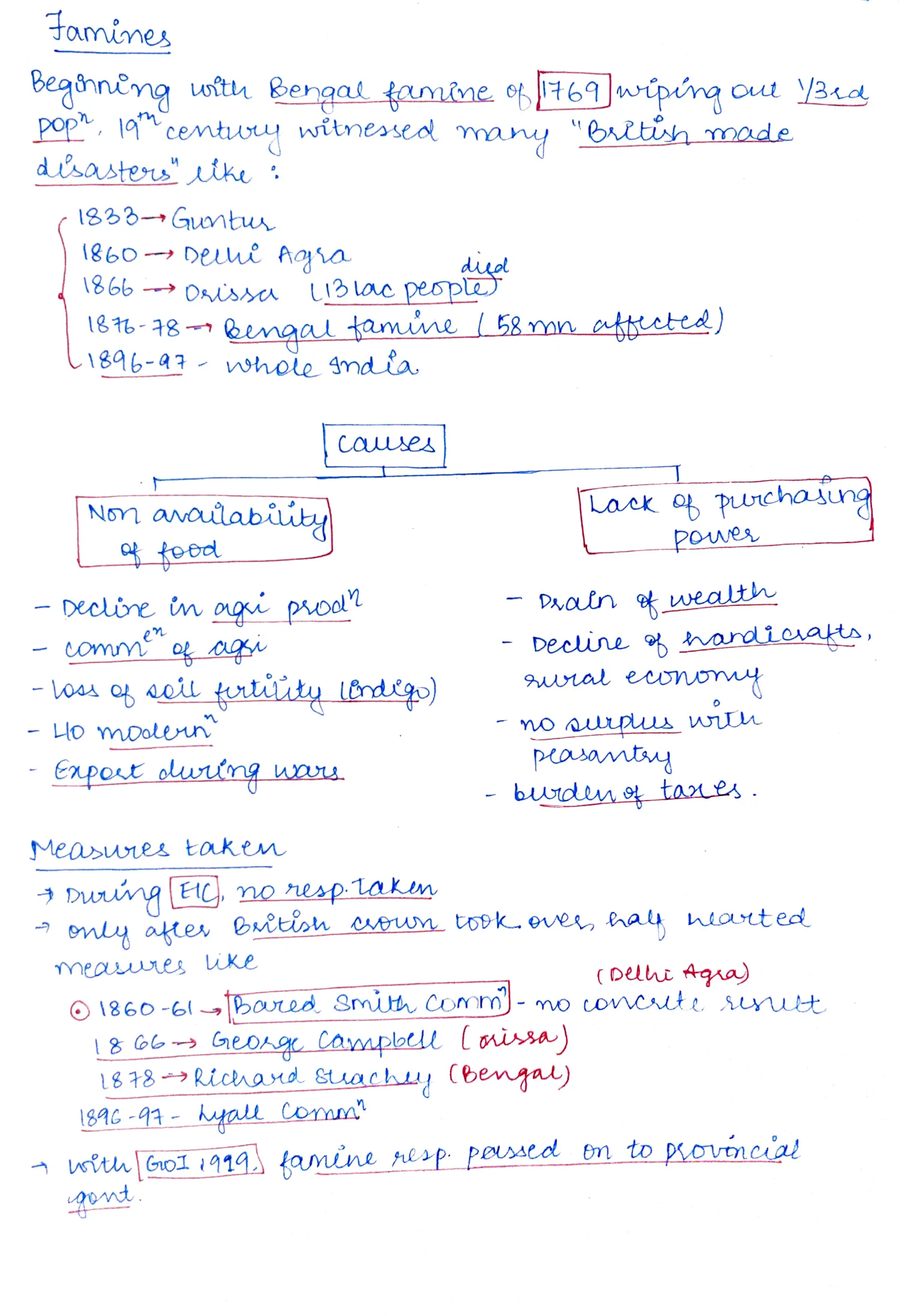
- Beginning with Bengal famine of 1769 wiping out ⅓ of pop [population]
- 19th century witnessed many "British made disasters" like:
- 1833 → Guntur
- 1860 → Delhi, Agra
- 1866 → Orissa (1.2 lac people died)
- 1876–78 → Bengal famine (58 mn affected)
- 1896–97 → Whole India
#Causes
Non-Availability of Food
- Decline in agri [agricultural] prod [production]
- Comm [Commercialisation] of agri [agriculture]
- Loss of soil fertility [Lord(s)?]
- No modern [?]
- Export during wars
Lack of Purchasing Power
- Drain of wealth
- Decline of handicrafts, rural economy
- No surplus with peasantry
- Burden of taxes
#Measures Taken
- During EIC: no resp [response] taken
- Only after British crown took over, half-hearted measures like:
- ⊙ 1860–61 → Board Smith Comm [Commission] — no concrete result (Delhi, Agra)
- 1866 → George Campbell (Orissa)
- 1878 → Richard Strachey (Bengal)
- 1896–97 → Lyall Comm [Commission]
- With GOI 1919, famine resp [responsibility] passed on to provincial govt [government]
#Role of Foreigners
- Social service — Mitre Teresa [Mother Teresa]
- Notary of peaceful, constructive methods
- Practised INC [Indian National Congress] (AB [Annie Besant]?, Nalini Sengupta, [?]) — people working with [?]
-
- Religion — Sister Nivedita — helped in Bengal famine. Also women, from Ireland. [Ramakrishna Mission]
-
- Edu [Education] & culture — AB [Annie Besant]
-
- Social work — N. Sengupta, Nura Ben, Sarla Ben
-
- Labour rights — Dinbandhu (CF Andrews) — [?]
-
- Tribals — Verrier Elwin (Badish, Seva Sandi Songs & Poona?, Sehur Gond Seva Mandal?)
-
#Annie Besant
- Irish, Theosophical Soc [Society]
- Central Hindu School @ Banaras (BHU later)
- Home Rule Movt [Movement]
- Reconciliation b/w [between] Moderates & Extremists
- New India & Commonweal [newspapers]
- INC Presi [President] 1917 — 1st women
#CF Andrews (Dinbandhu)
- Eng [English] missionary philanthropist
- Political & social morals [?]
- Championed labour rights — railways, cotton mills
- Worked with BR Ambedkar for Harijan date [cause]
- Title by [Gandhi] for his compassion for poor
- Advocated rights of Indians in S [South] Africa, West Indies
- Used his influence in England to further I [Indian] cause
- Negotiated with govt [government] in "for Gandhi's release"
#Miraten / Madelein Slade — English aristocratic from
- Gandhian Saharmate Ashram
- Toured I [India] to promote Khadi & Sg [Spinning?]
- Wrote articles in Young I, Toj [?], Harijan
- Role in setup of Seva gram near Wardha
- Went to Btr [Britain] with Gandhi
- [Mira Behn / Mirabehn identity note]
#Role of Press
- First = Bengal Gazette (1780) — 1780 [?]
- Moderate phase — calu [calculate?], political propaganda, consol [consolidation] of public opinion
- Int [International] events (Russian Rev, Crimean wars) were disseminated through newspapers
- Tool to criticise imperialist policies eg: Lytton's Delhi Durbar (VPA) eg: Bengalee of SN Banerjee
- Social reform eg Gandhi's Harijan
- Britain clampdown → VPA, 1978 [?]
- Sec 124A IPC
- PA [Press Act] 1910
- Ball & Tilak ] eg SN Bannerjee
- Way out — Quoting Br [British] newspapers, presenting criticism as advise to the chosen [Crown]
- Neel Darshan
- Ananda Math — Vande Mataram
#Middle Class in INM [Indian National Movement]
- Hailed as Middle Class Movt [Movement] — the prof [professional] like lawyers, doctor, vachir [?], pig [?], landlords etc
Reasons for Domination
- Edu [Education] awareness → Jobs → Eco interest → Social reform [four-box flow]
Limitations
- Failed to take up int [interest] of farmers/workers
- No path to masses
- Satisfied with minor concessions by Br [British]
#Role of Industrialists → FF [Freedom Fighters?] ISC [Indian Students Congress?]
- Part of movt [movement] of Jamnalal Bajaj [in?] NCM [Non-Cooperation Movement]
- Supporters of Nationalist struggle eg: GD Birla (SDM [?])
- Ambalas Sarabhai (since 2016?)
- Financial quarters eg Watchand Hirachand funded many activities of INC
- Created pressure groups to counter Br [British] policies
- eg: GD Birla founded FICCI
- Acquired industries — birla jute mills | Steam Nawafce by Albi? no Chadabhyogi [?]
- Constructive work eg: Jamnalal was Pres [President] of Gandhi Seva Sangh
- Own resources are high & starting rate
- (→ Anti NCM from(?) 1920 — Purshotamdas Thakurdas & others opposed second phase of com [?] for fear of strikes)
#Militant Nationalism
#Features
- Swaraj as final aim
- BC [British] could never favour I [Indian] cause
- Rejected their nat [national] predecessors ("pal mendicants")
- Used extra ©ational [?] methods also
- Faith in masses
- Use of force
#Reasons
- Reactionary policies of Br [British]
- Growth of confidence in own abilities
- Int [International] influence (Boer War)
- Dissatisfy [Dissatisfaction] with Mods [Moderates]
#Impact
- New forms of struggle
- Expansion of social base
- Beyond pol [political] demands
- Socialism [Socialism]
- Int [International] efforts
- Part of women eg w/surya Sen
#Limitations
- Unclear on idea of Swaraj
- Communal pol [politics] / Conservative
- No org [organisation] / party structure was created
- Didn't reconcile with Mods [Moderates]
- Didn't incorporate Muslims
- Killing of innocent people — women instead of Hardinge
#Role of Students
- Henry Vivian Derozio
- First party [participation?] in 1905 Bengal Partition
- Supported INC
- Split b/w [between] 2 groups after Surat
- M [Mahatma] Gandhi's followers — arrests
- 1920 — Sh [?] AISC → Nagpur — Lala Rai [Lajpat Rai?]
- Role in no-tax campaign, 1921, COM [?], Bandi Sg [Satyagraha?], Khadi, Mandal [?]
- Swadeshi
- 1936 — AISF — First student org [organisation] of I [India] — 1938 All Youth Congress
- AISF
- Aim as stimulus of youth move [movement]
- Aim as stimulus of youth movt [movement]
- Boycotted schools for large no [number]
- Mass processions & rallies
- Cut telephone wires, block adults etc
#Industrialists (separate note)
-
Jamnalal [?]means [?]
-
Faced labour issues
-
Cong [Congress] in 1950 dominated by socialists & communists
-
9 specific capacities [?] aid by Gandhi (11 [?])
- Stabling [Stabilising?] & minting rate
- [Promotion?] of cotton industry
- Removal of coastal shipping for Indians
#Cold War — World Map Diagram
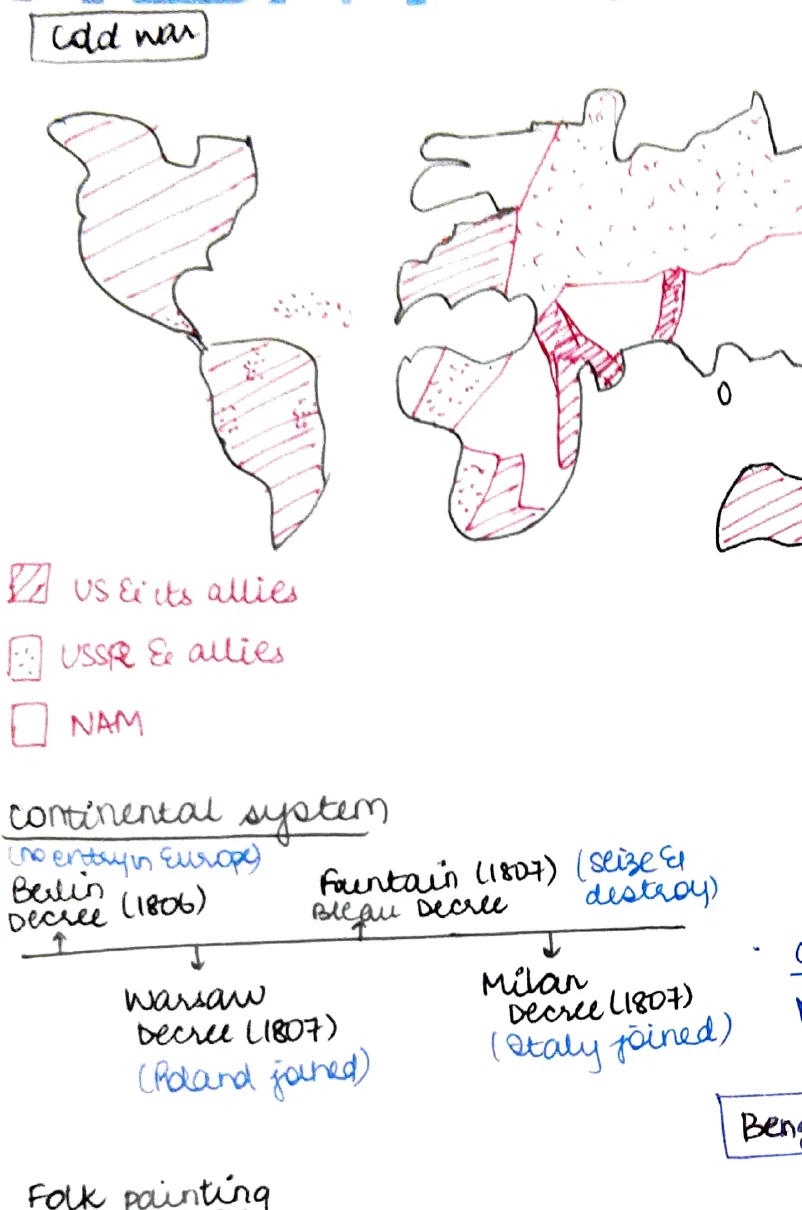
- Legend:
- [hatched] = US & its allies
- [cross-hatched] = USSR & allies
- [blank] = NAM [Non-Aligned Movement]
#Continental System
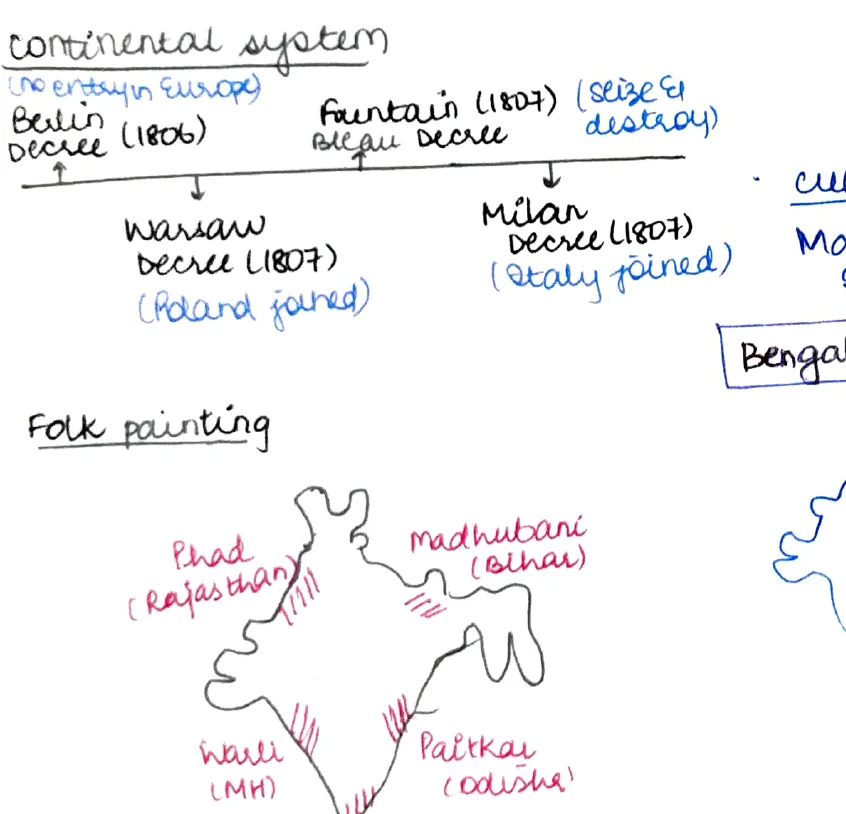
- (No entry in Europe)
- Berlin Decree (1806)
- ↓
- Warsaw Decree (1807) — (Poland joined)
- Fontainebleau (1807) [Bilbao Decree] — (seize & destroy)
- ↓
- Milan Decree (1807) — (Italy joined)
#Culture — Swadeshi Reference
- Made in India → Hand-made in India
#Folk Painting — Map of India
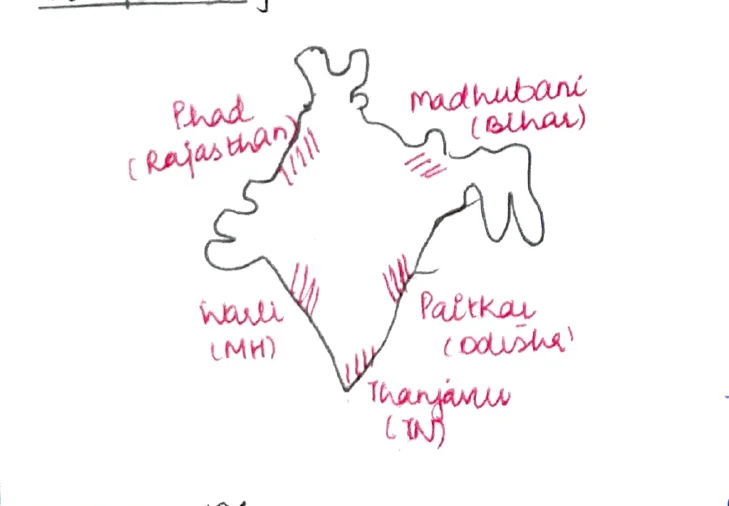
- Phad (Rajasthan) — NW India
- Madhubani (Bihar) — NE India
- Warli (MH [Maharashtra]) — W India
- Paitkar (Odisha) — E India
- Thanjavur (TN [Tamil Nadu]) — S India
#Bengal Partition
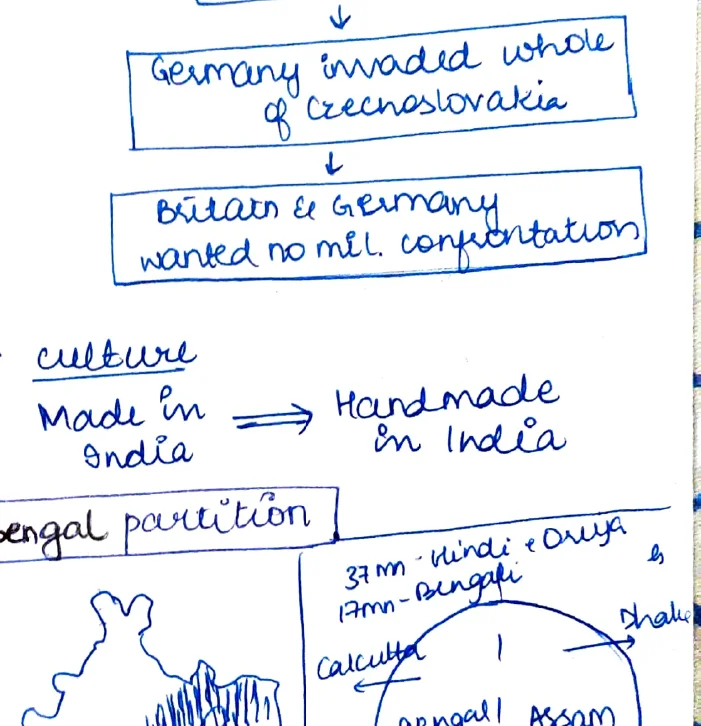
- 37 mn — Hindi + Oriya
- 17 mn — Bengali
- Calcutta [at centre of map]
- Bengal Province → W. Bengal
- Bengali → Assam → E. Bengal
- 4/5 1Hm : 1B/3 1Hm [40/54 Hindus : 18/31 Muslims — approximate]
- Hindu : Muslim ratio shown in divided Bengal
#Policy of Appeasement
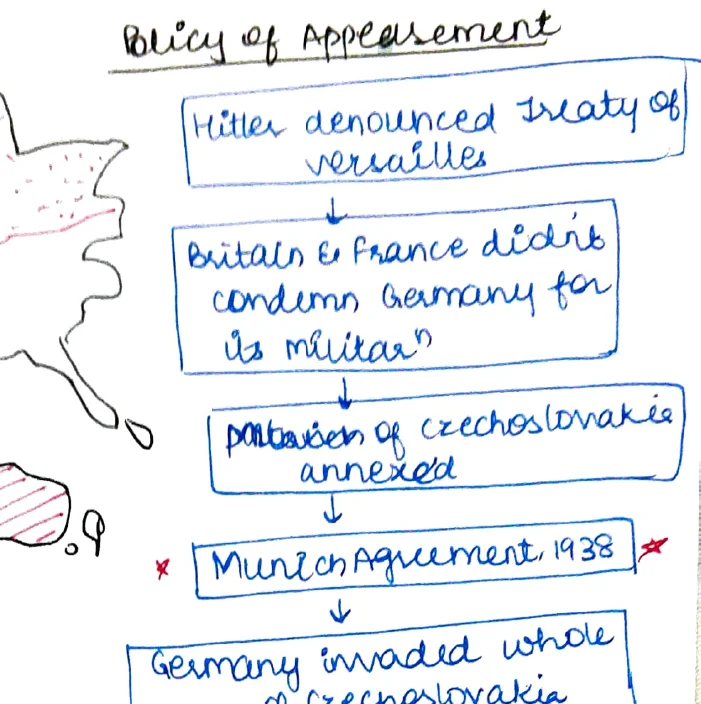
- Hitler denounced Treaty of Versailles
- ↓
- Britain & France didn't condemn Germany for its military
- ↓
- Pbt [Sudetenland?] of Czechoslovakia annexed
- ↓
- Munich Agreement 1938 ← ✗
- ↓
- Germany invaded whole of Czechoslovakia
- ↓
- Britain & Germany wanted no mil [military] confrontation
#Maratha — Rise and Fall
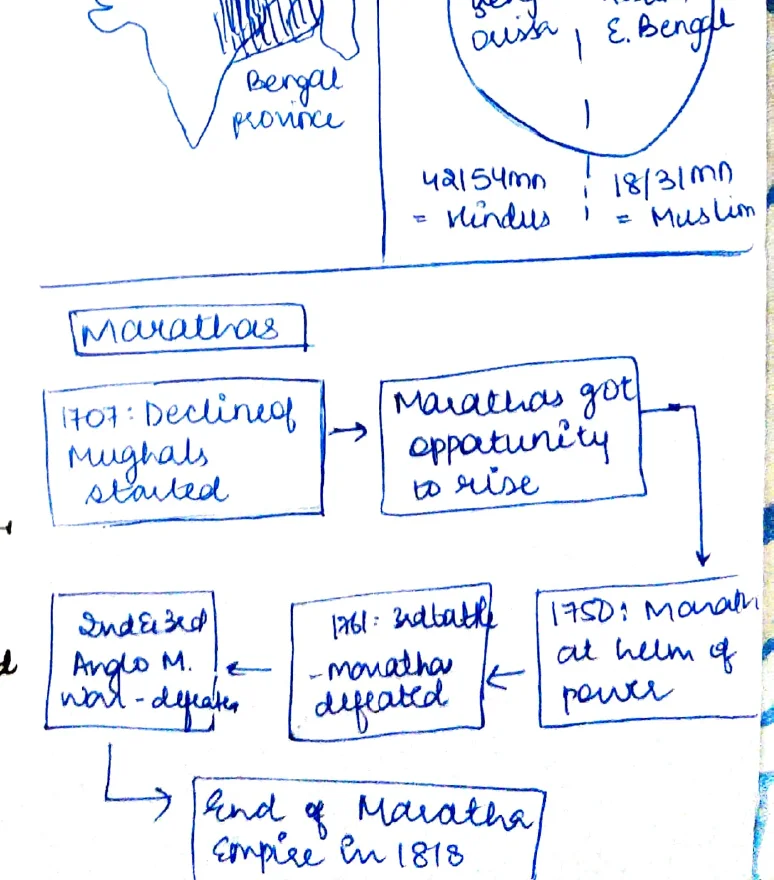
- 1701: Declining Mughals stabilised
- → Marathas got opportunity to rise
- Swaided [?] Anglo M [Anglo-Maratha] not equal
- ↓
- pol [political] inability — Maratha defeated
- 1750: Maratha at helm of power
- ↓
- End of Maratha Empire 1818
#Korean War Timeline
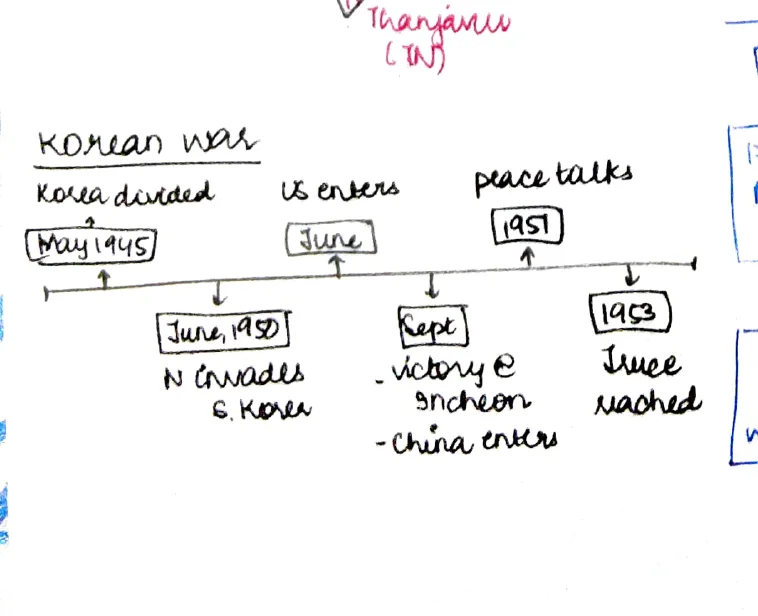
- Korea divided — May 1945 ↑
- June 1950 — N [North Korea] invades S [South] Korea
- US enters — June
- Sept — victory at Incheon / China enters
- Peace talks — 1951
- 1953 — Truce reached
#Nehru vs Gandhi
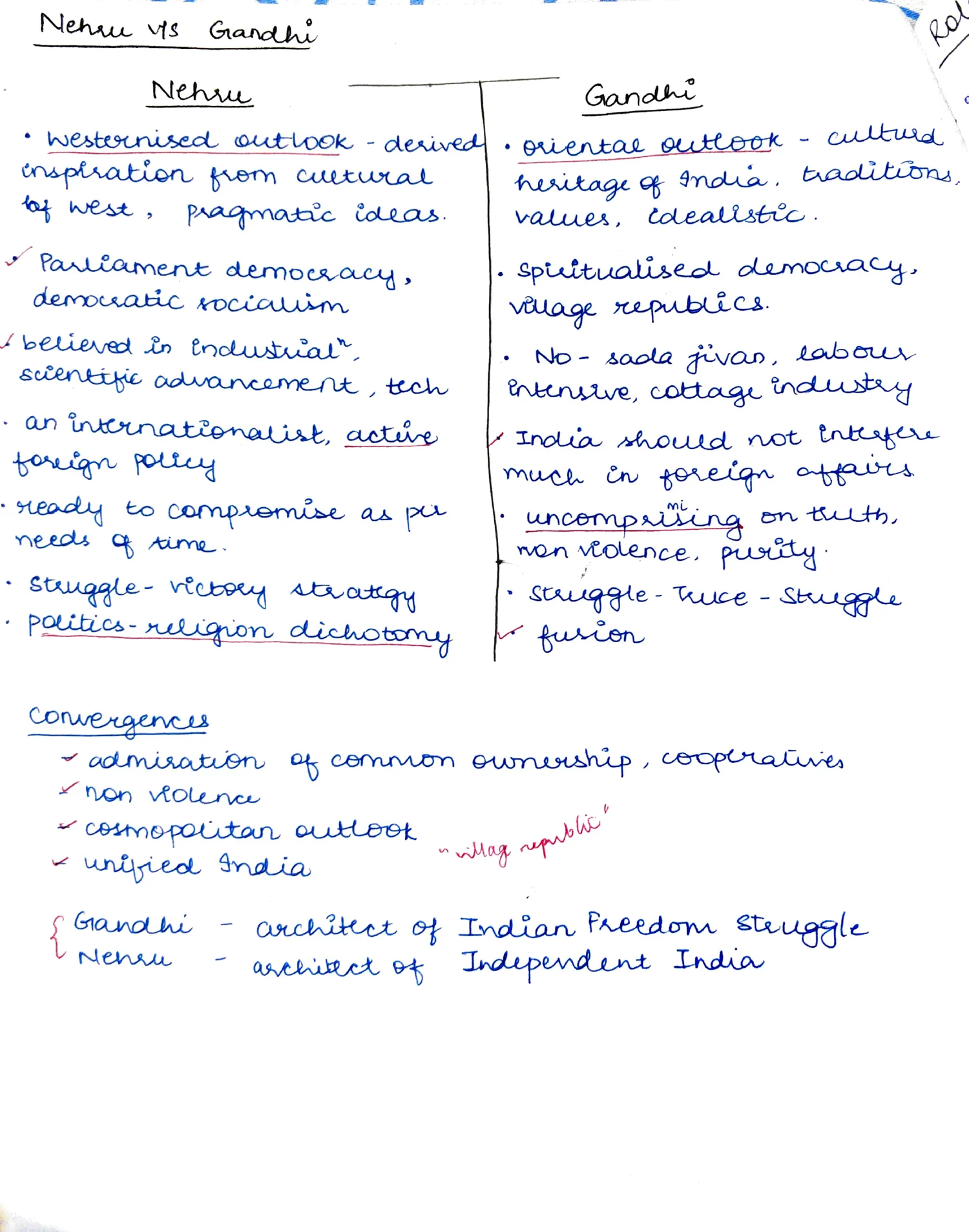
| Parameter | Nehru | Gandhi |
|---|---|---|
| Outlook | Westernised outlook — derived inspiration from cultural of West, pragmatic ideas | Oriental outlook — cultural heritage of India, traditions, values, idealistic |
| Democracy | Parliament democracy, democratic socialism | Spiritualised democracy, village republics |
| Industry | Believed in industrial, scientific advancement, tech | No — sada jivan, labour intensive, cottage industry |
| Foreign Policy | An internationalist, active foreign policy | India should not interfere much in foreign affairs |
| Compromise | Ready to compromise as per needs of time | Uncompromising on truth, non-violence, purity |
| Strategy | Struggle-victory strategy | Struggle-Truce-Struggle |
| Politics | Politics-religion dichotomy | Fusion |
#Convergences
- Admiration of common ownership, cooperatives
- Non-violence
- Cosmopolitan outlook
- Unified India — "village republics"
- Gandhi — architect of Indian Freedom Struggle
- Nehru — architect of Independent India
#Nehru vs Patel
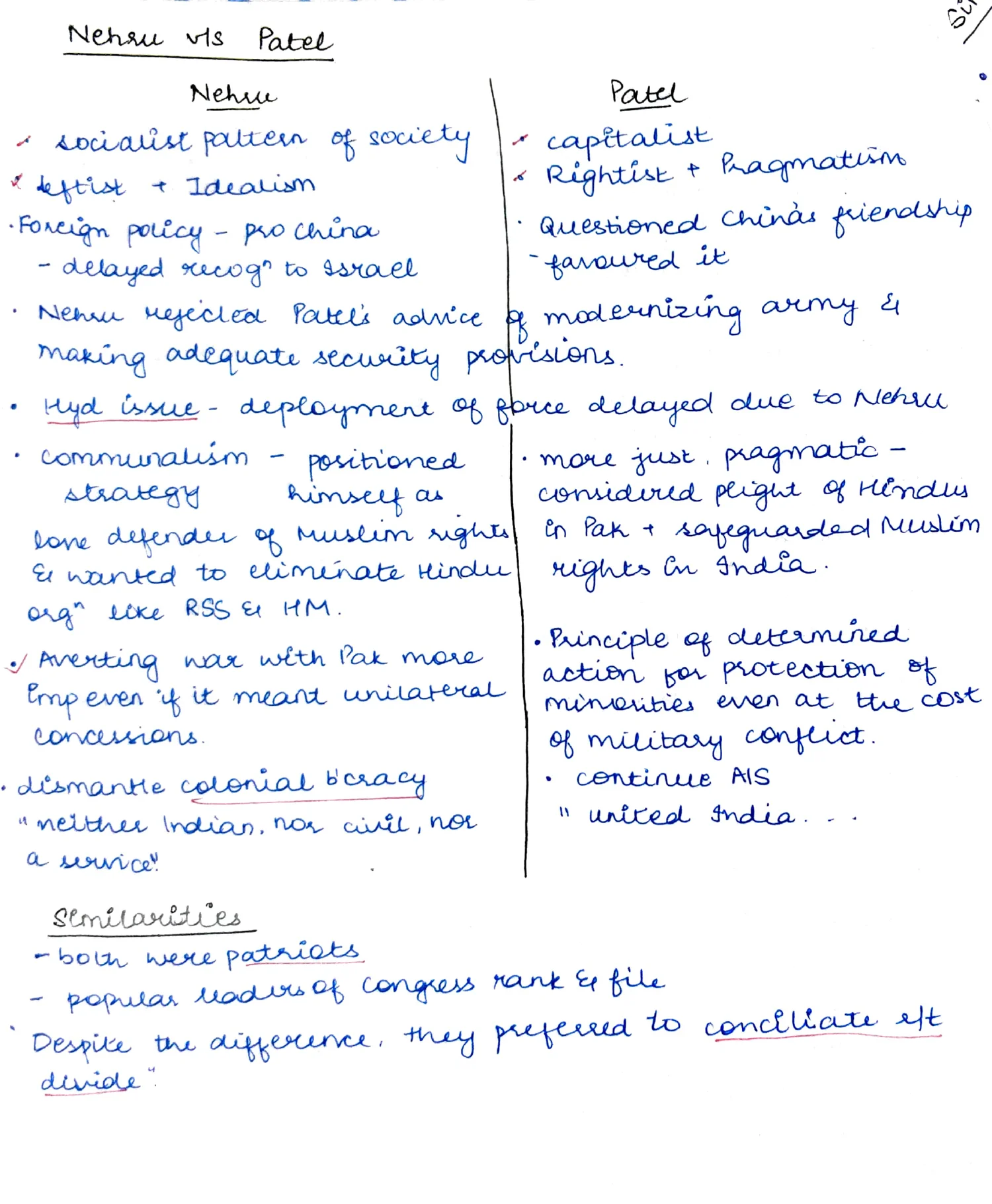
| Parameter | Nehru | Patel |
|---|---|---|
| Economic | Socialist pattern of society | Capitalist |
| Ideology | Leftist + Idealism | Rightist & Pragmatism |
| Foreign Policy | Pro-China — delayed "recog" [recognition] to Israel | Questioned China's friendship — favoured it |
| Army | Nehru rejected Patel advice of modernising army & making adequate security provisions | [implied: Patel recommended modernising] |
| Hyd [Hyderabad] Issue | Deployment of force delayed due to Nehru | [Patel favoured swift action] |
| Communalism | Positioned himself as lone defender of Muslim rights & wanted to eliminate Hindu org [organisations] like RSS & HM [Hindu Mahasabha] | More just pragmatic — considered plight of Hindus in Pak [Pakistan] & safeguarded Muslim rights in India |
| War with Pak [Pakistan] | Averting war with Pak more imp [important] even if it meant unilateral concessions | Principle of determined action for protection of minorities even at the cost of military conflict |
| Colonial legacy | Dismantle colonial legacy — "neither Indian, nor civil, nor a service" | Continue AIS [All India Services] — "United India..." |
#Similarities
- Both were patriots
- Popular leaders of Congress rank & file
- Despite the differences, they preferred to conciliate not divide
#Tagore vs Gandhi
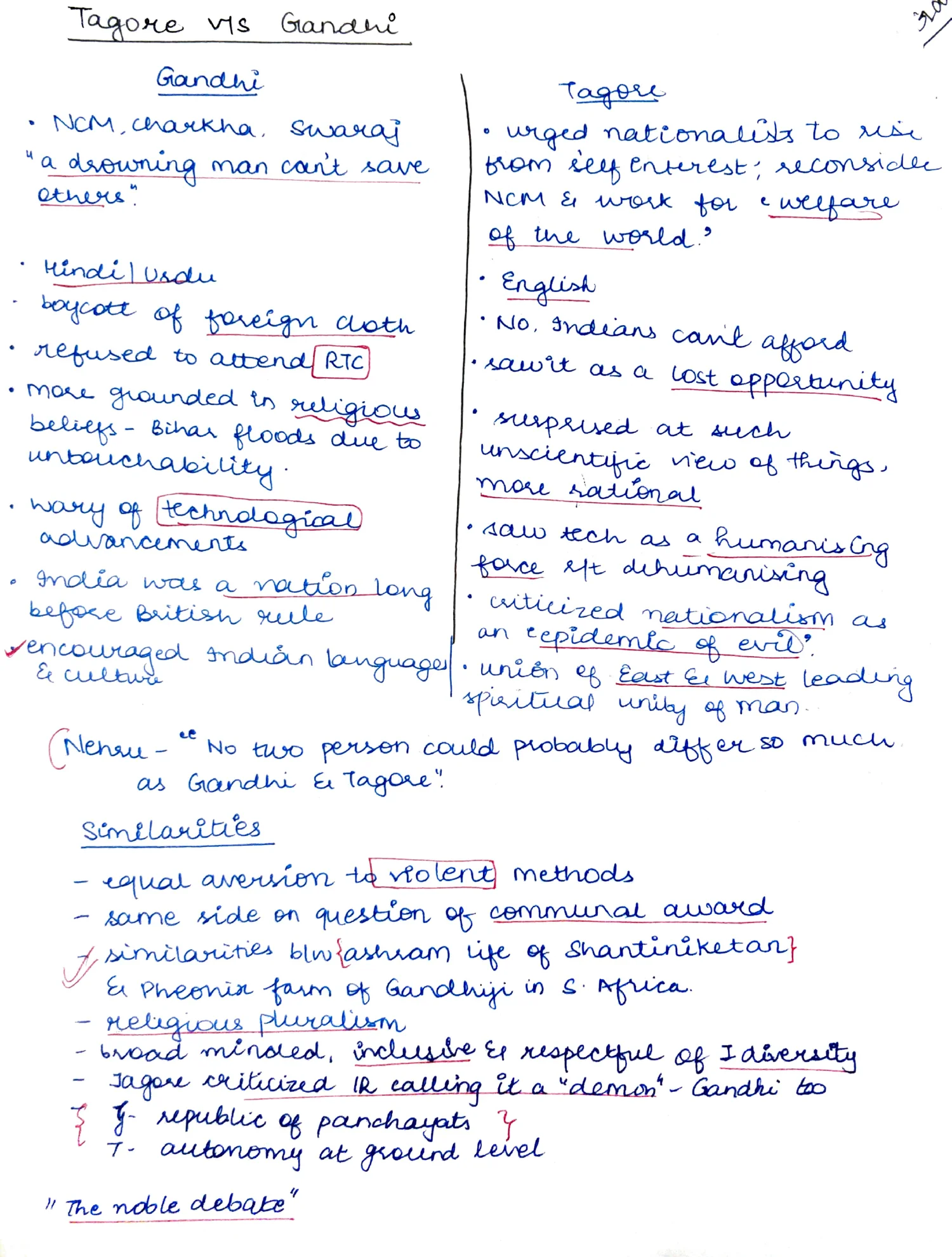
| Parameter | Gandhi | Tagore |
|---|---|---|
| NCM [Non-Cooperation Movement] | Charkha, Swaraj — "a drowning man can't save others" | Urged nationalists to rise from self-interest; reconcile NCM & work for "welfare of the world" |
| Language | Hindi / Urdu | English |
| Foreign cloth | Boycott of foreign cloth | No — Indians can't afford; saw it as a lost opportunity |
| Religion | Refused to attend RTC [Round Table Conference]; more grounded in religious beliefs — Bihar floods due to untouchability | Surprised at such unscientific view of things, more rational |
| Technology | Wary of technological advancements | Saw tech as a humanising force & dehumanising |
| Nation | India was a nation long before British rule | Criticised nationalism as an "epidemic of evil" |
| Language & Culture | Encouraged Indian language & culture | Union of East & West leading spiritual unity of man |
- Nehru — "No two persons could probably differ so much as Gandhi & Tagore"
#Similarities
- Equal aversion to violent methods
- Same side on question of communal award
- Similarities b/w [between] Ashram life of Shantiniketan & Phoenix Farm of Gandhi in S [South] Africa
- Religious pluralism
- Broad minded, inclusive & respectful of diversity
- Tagore criticised IR [?] calling it a "demon" — Gandhi too
-
- Republic of panchayats
-
- Autonomy at ground level
-
- "The noble debate"
#Gandhi vs Ambedkar
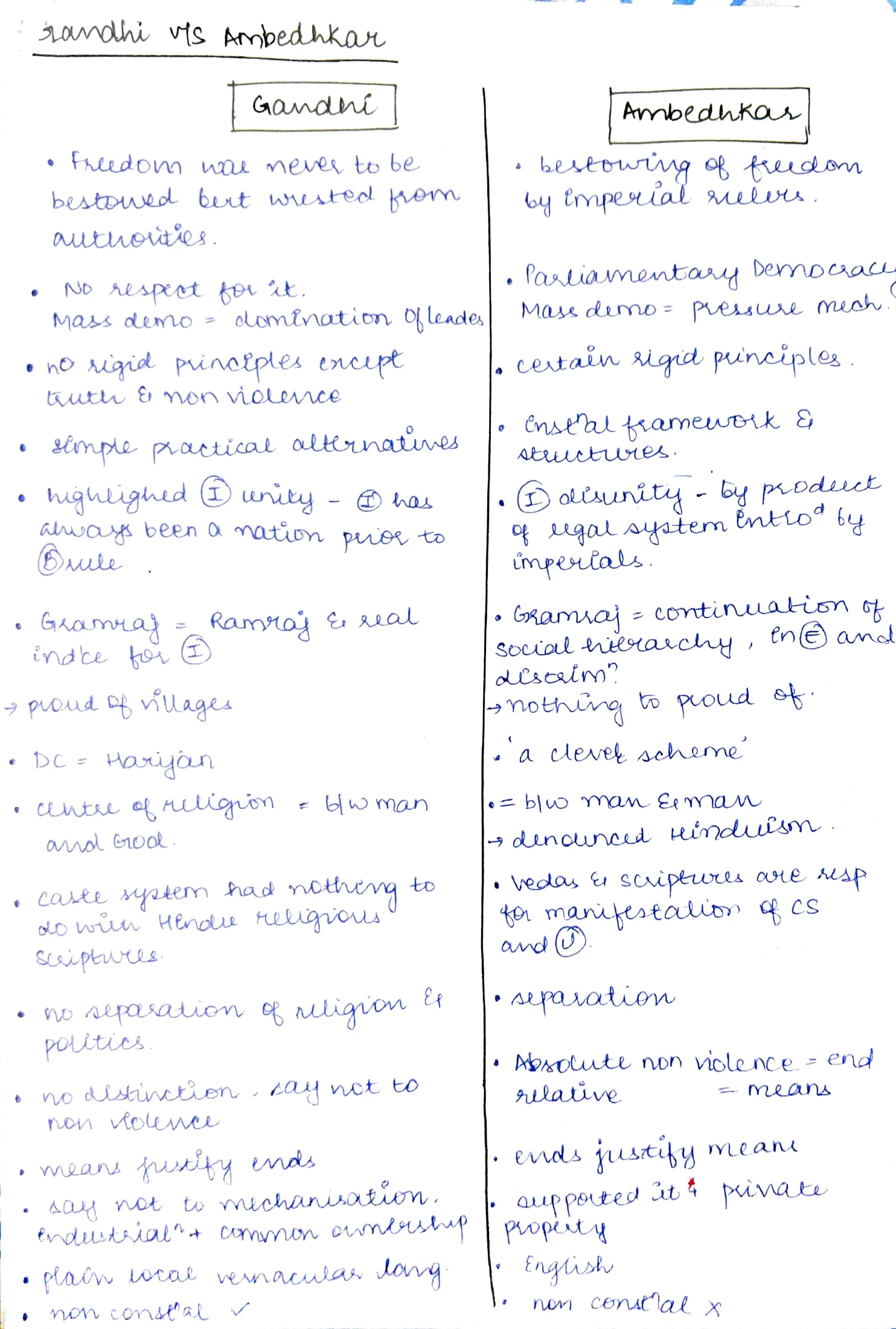
| Parameter | Gandhi | Ambedkar |
|---|---|---|
| Freedom | Freedom was never to be bestowed but wrested from authorities | Bestowing of freedom by imperial rulers |
| Democracy | No respect for it — Mass demo [demonstration] = domination of leaders | Parliamentary democracy — Macdemo = pressure mesh? |
| Principles | No rigid principles except truth & non-violence | Certain rigid principles |
| Structure | Simple practical alternatives | Institl [Institutional] framework & structures |
| Unity | Highlighted ® [community] unity — ® has always been a nation prior to Br [British] rule | ® [community] identity — by-product of legal system knit by imperials |
| Gramraj | Gramraj = Ramraj & real India for ® [Hindus] | Gramraj = continuation of social hierarchy, m® [middle?] and d [?] racism — nothing to be proud of — "a clever scheme" |
| Village | Proud of villages | = bio man German → denounce Hinduism |
| DK — Harijan | Centre of religion + human and good | Vedas & scriptures are resp [responsible] for manifestation of CS [caste system] and ® [?] |
| Caste | Caste system had nothing to do with Hindu religious scriptures | Separation |
| Politics | No separation of religion & politics | Absolute non-violence — end relative means |
| Abstraction | Say not to non-violence — say not to | Ends justify means |
| Means | Means justify ends — say not to mechanisation, individual + common authority | Supported ® [individual?] private property |
| Language | Plain local vernacular lang — non-const [constitutional?] ✓ | English — non-const ✗ |
#Gandhi vs Ambedkar (continued — page 29)
| Parameter | Gandhi | Ambedkar |
|---|---|---|
| ® [Community] | ® = integral part of Hindu whole | Religious minority & not a part of Hindus |
| ® [community problem] | ® = one of many problems | ® = major problem |
| Studies | Contemporary studies | Historical studies |
| ® solution | ® was a social & moral problem — reform of hearts | Solve ® through laws & const [constitutional] methods |
- "A democratic society must be machinery & more machinery, civilisation and more civilisation" [highlighted in red]
#Similarities
- Burning of fg [?] by Gandhi = Burning of Manusmriti by Ambedkar
- Salt from ocean ≈ Water drop from tank/well
- Represented bondage & slavery; were symbolic acts
- Edu [Education] to make end [?] desire for change, reform and integrate [?]
- Both agreed on the sovereign power of state
- "least govt = best govt"
- Religion as an agent of social change
- Social transformation through democratic & peaceful means — no violent overthrow practised
- Target group & aim converged at some point
- Immense contribution by both:
- Gandhi — architect of freedom struggle
- Ambedkar — architect of Indian Constitution
#Bose vs Gandhi
- The tussle was most evident in Tripuri session, 1939
- 1942: Gandhi called Bose "Prince among the patriots"
- "Netaji will remain immortal for all the time to come for his service to India"
- Bose — "service that G [Gandhi] has rendered to IFS [Indian Freedom Struggle] is so unique and united that his name will be written in gold on our Nat [National] History — for all time"
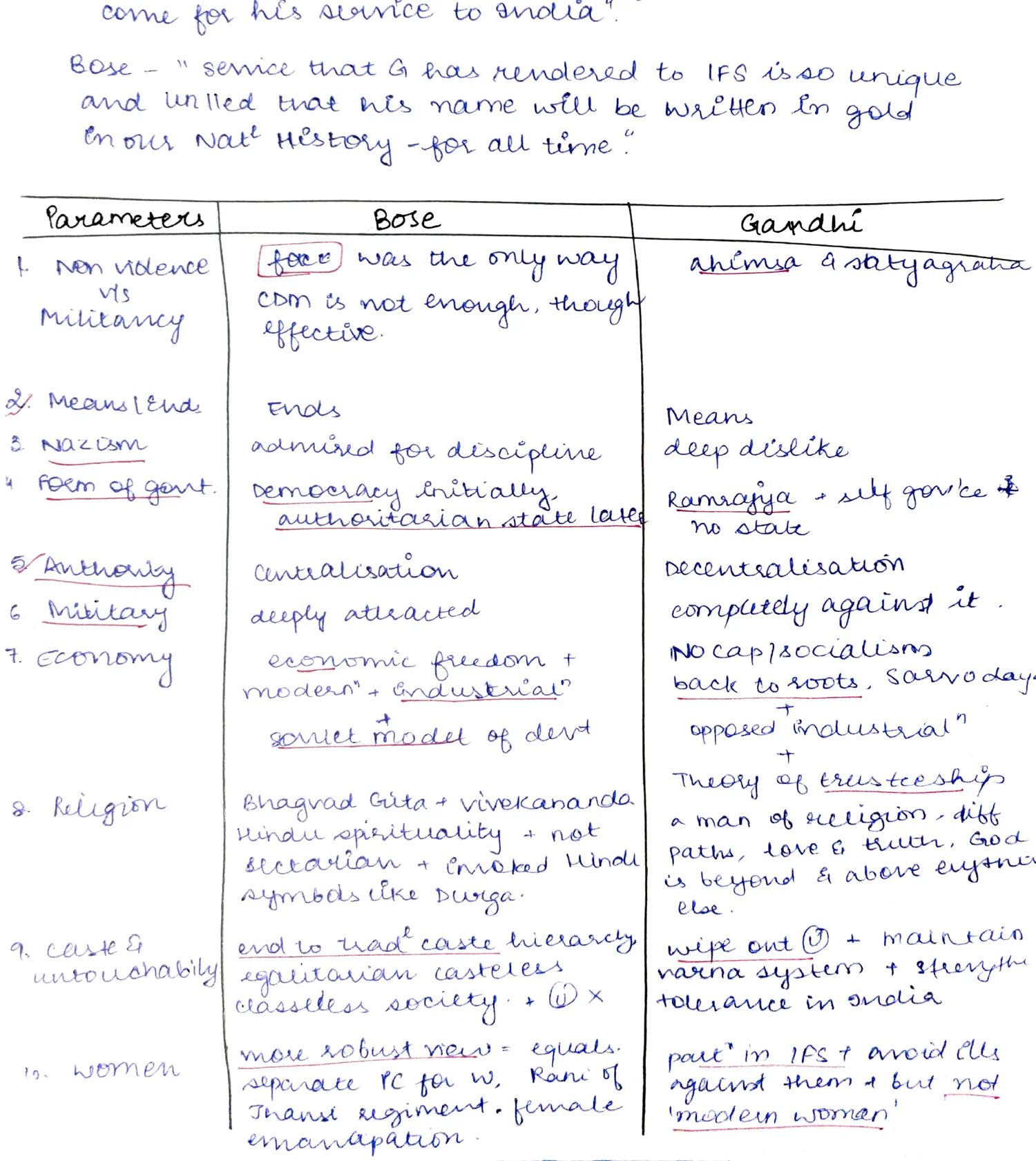
| Parameter | Bose | Gandhi |
|---|---|---|
| Non-Violence vs Military | Force was the only way — com [communication?] a not enough, though effective | Ahimsa & Satyagraha |
| Means/Ends | Ends | Means |
| NCM [Non-Cooperation Movement] | Admired for discipline | Deep dislike |
| Form of Govt | Democracy initially, authoritarian state later | Ramrajya — self-govt & no state |
| Authority | Centralisation | Decentralisation — completely against it |
| Military | Deeply attached [to military] | No cap [capital?] / socialisms — back to roots, Sarvoday — "opposed industrial" |
| Economy | Economic freedom + modern & industrial [?] — Soviet model of devt [development] | Theory of trusteeship — a man of religion, diff path, love & truth, God path & above economic [?] |
| Religion | Bhagvad Gita + Vivekananda — Hindu spirituality + not literarian — mixed Hindu approach, like Prince [?] | [implied broader, inclusive approach] |
| Caste & Untouchability | End to trad [traditional] caste hierarchy — egalitarian caste-less society × (?) | Wipe out ® & maintain varna system & strengthen tolerance in India |
| Women | More robust now — equals [?] — space for [?] for women, part of [?] — female emancipation — female regiment | Put in IFS & avoid [?] against them + but not "modern women" |
World History
Topper handwritten notes#Industrial Revolution (IR)
#Overview
- Replacement of manual work by machines
- Started in England
- Preceded by Agricultural Revolution [Agri Rev]
- Enclosure of land
- Mechanisation of farming
- Crop rotation
- Selective breeding of animals
#Prerequisites / Factors leading to IR
- Demographic Revolution → IR
- Agri Revolution [Agri Revol] → IR
- Commercial Revolution → IR
- Transport Revolution → IR
- (All four arrows converge into box labelled IR)
#Road to IR (Flowchart)
- Evolution of Textile Machines (weaving, spinning, sewing)
- → Steam Engine (power; needs coal/fuel)
- → Development of Transport (too much for roads; inland waterways, canals, railroads)
- → Lighting (bills / gas lamps)
- → Communication (telegraph, penny post, telephone)
- → Steam Engine (power; needs coal/fuel)
- Iron and Steel (blast furnace, iron bridge, ship)
#Causes of IR (England)
| CAUSES | IMPACT |
|---|---|
| Political stability & no church dom[inance] | Growth of pop[ulation] |
| Advantageous geo[graphical] location | Urbanisation |
| New inventions & machinery | Emergence of new classes: capitalists & proletariat[s] (labourers & workers) (−) |
| Entrepreneurial spirit | Social & pol[itical] conflict due to demand for equality among classes |
| Colonies — source of raw material & market for goods | Labour movement & socialist ideas |
| Unattacked land — mil[itary] battles fought elsewhere (foreign land) | Division of labour — factory system [symbol] |
| Steady growth of pop[ulation] | Expanding economy |
| Financial stability — revenue from colonies | Intellectual movement |
| Surplus capital | Large employment — "range" & comm[erce] |
| Positive world trade | Growth of colonialism & imperialism (−) |
| Suitable climate | Child labour |
| Abundant resources — coal, river | Globalisation |
| Common laws, currency & use of money | Sensitisation |
#Second Industrial Revolution — US
- Transformation of iron to steel [manufacturing]
- Large plant output
- Science-based industries — chemicals, electric power & electrical machinery
- Growth of automobiles — FORD
- Wider "dilat" of ownership through stocks
- Scientific way of [production] — Taylor
- Farm — combine harvester/thresher, fertilisers, pesticide, genetic plant breeding
- Sparsely [variated?] continent lay open to development & exploration
- More literate pop[ulation]
- Huge internal market & free movement of goods/people/ideas
#Causes & Impact of 2nd IR
| CAUSES | IMPACT |
|---|---|
| Abundance of natural resources like forests, coal, iron, oil, copper, gold, silver, lead | Mechanisation and standardisation |
| Availability of domestic & foreign capital (not was high) | Raised std [standard] of living |
| Labour from within the country & immigrants | Corporate ownership widens; gap b/w [between] rich ever (−) |
| Age of inventions | Pressure on traditional social institutions like family (work away from home) (−) |
| May poor techniques | Displaced agri[culture] (−) |
| Power of [trade] guilds [declined] | Urbanisation & city way of life |
| Able leadership | Red [increased] Immigration |
| Govt policy of laissez faire & aid to industries | Cultural development |
| Civil war helped in spreading [ideas] | Labour Union[s] |
| Gold rush — discovery of gold attracted people | Humanitarians came fwd to help labourers & thus progressive changes |
| Growth of [industries/entrepreneurs] | Change in pol[itical] philosophy: laissez faire × (high prices); free comp[etition] |
| Religious problems were absent | Wave of imperialism (−) |
| Free thinking of intellectuals | Degradation of env[ironment] (−) |
| Disparity b/w poor regions/communities |
#Industrialisation in Japan
- Last country in Asia to get industrialised
- Meiji [Meiji Restoration] history
- Setting up a ministry of industries
- Agri tax — [illegible] → urbanisation
- Railway lines laid down
- Machine tool factory
- Still not [self-sufficient] — import of [textile] machines
- Foreign techniques to train workers — tech[nology] in use
- Existing industries favoured
- [Govt] loan guaranteed by govt
- Mission [subsidies?]
- [Upskilling] [Encouraging?] etc.
- Investment & engineering to related skills
- Stress on heavy strategic military & chem[ical] industries
- Incl[uding] air & hydroelectric generation & high tension transmission
- [Illegible: "char labour & capital cars"]
- Limitation of [zaibatsu/military?] system [of] controlled by [few] families
- Due to [large] govt [direction] railway after iron [then] steel industry
- [Russia used national interest since] economic [stability] of [illegible] need
- What Europe did in 100 yrs, Japan did in 30 yrs!!
- IJS [abbreviation]
#Phases of Industrial Revolution
| Phase I (1760–1850) | Phase II (late 19c) | Ongoing |
|---|---|---|
| Mech[anisation] of textile industry | Scientific Invention | Comm[unication] tech |
| Mining & metallurgy | Steel | Internet |
| Steam engine | Chemi[cals] | Energy |
| Transport | Mass prod[uction] | Robots / AI |
| England, Netherlands | USA & Germany | 3D printing — digital [manufacturing] |
#Discussion Questions (from notes)
- Why did IR not begin in China/India?
- On your opinion, do the benefits of IR outweigh its sombre consequences?
#Is it a Revolution or just Evolution?
- Arnold Toynbee — "Indust[rial]" is an evolutionary process
Why Evolution?
- Time — 1760s to present
- Space / Geog[raphical] spread: Europe → America → Asia → Africa (last)
- Product / Commodity: Textile → [then] IoT
- Nature of fuel / [energy] prices: Coal → Nuclear → Renewable → did [continue]
- Factory — Labour → Robotics
| IR 1.0 | IR 2.0 | IR 3.0 | IR 4.0 |
|---|---|---|---|
| 18c | 19c | 20c | 21c |
| Water & steam / factory system | Electricity / mass prod[uction] | Use of IT & electronics | Cyber-physical goods |
Why Revolution?
- Complete economy rejuvenated
- Factory system (from cottage [industry])
- Industrial relations changed
- Political, economic, social institutions changed
#American Revolution (AR)
#Nature of American Revolution
- Violent & progressive
- Mass participation — popular revolution
- Democracy, equality, fundamental rights — progressive revolution
- Reactionary as it did not seek to change existing social or political scenario
- "Not of 'Total Rev'", more of a move for home rule
- Gave way to market economy
- Altered social structure
- End of slavery
- Not a social hierarchy or hereditary monarchy — big [breakthrough] of Democracy & Republican govt — pol[itical] revolution
- Spirit of freedom, secularism, sovereignty, social justice — ideological revolution
- Expansion of middle / trading / business class — Bourgeois Revolution
#Bourgeoisie Revolution
- Most affected section — tax at every nook & corner, [tax on] almost all [kinds of] goods
- Favoured the most [by the revolution]
- Harmed [the] constitution?
- American Constitution is an expression of hopes & aspiration of bourgeois class & hence called an ECONOMIC DOCUMENT
#Hamilton–Jefferson Debate
- Strong Centre vs Strong State
- Ultimately compromise in form of Federation
- Massachusetts Assembly — 1765 [Boston Tea Party?]
- Boston Tea Party — 1773
- Philadelphia Congress — 1774
- Dec[laration] of Independ[ence] — [1776]
- Rule of Ind[ia]
Virginia Plan (Large States) | New Jersey Plan (Small States)
| Virginia Plan | New Jersey Plan |
|---|---|
| (Big states) | (Small states) |
| Bicameral | Unicameral |
| Rep[resentation] based on pop[ulation] | Equal rep[resentation] |
| By Madison (proposed) | By Paterson |
- The Great Compromise again → Connecticut Compromise
#Consequences of American Revolution
- American colonies became free & USA was established
- Democratic govt with written constitution became a reality
- Bill of Rights ensured Fundamental Rights to US citizens
- Complete freedom of worship & prayer
- Intro of Democracy with separation of powers
- Capitalist economy is encouraged growth
- Bout to demand & hence industries
- Open ports for world trade
- Great blow to absolute monarchy → Impact on Britain
- American Revolution called as Mother of Federal Govt
- Inspired French Revolution
- Inspired anti-colonial revolutionaries throughout the world — Domino Effect in Europe
- Inspired nationalists in India
Decolonisation Timeline
| Year | Event |
|---|---|
| 1789 | France |
| 1836 | Latin America |
| 20c | Decolonisation |
#How AR Inspired FR [French Revolution]?
- Frenchmen like Lafayette fought against Brits with Americans & returned to France with ideas
- Am[erican] diplomats & revolutionaries like B. Franklin [—] French [philosophers] had lived in Paris & [shared their] ideas to [illegible] intellectuals
- Fr[ench] philo[sophers] — Rousseau's dream seemed realised in US — AR showed that it was possible to organise a govt on Enlightenment ideas in practice
- AR bankrupted France
#American Civil War
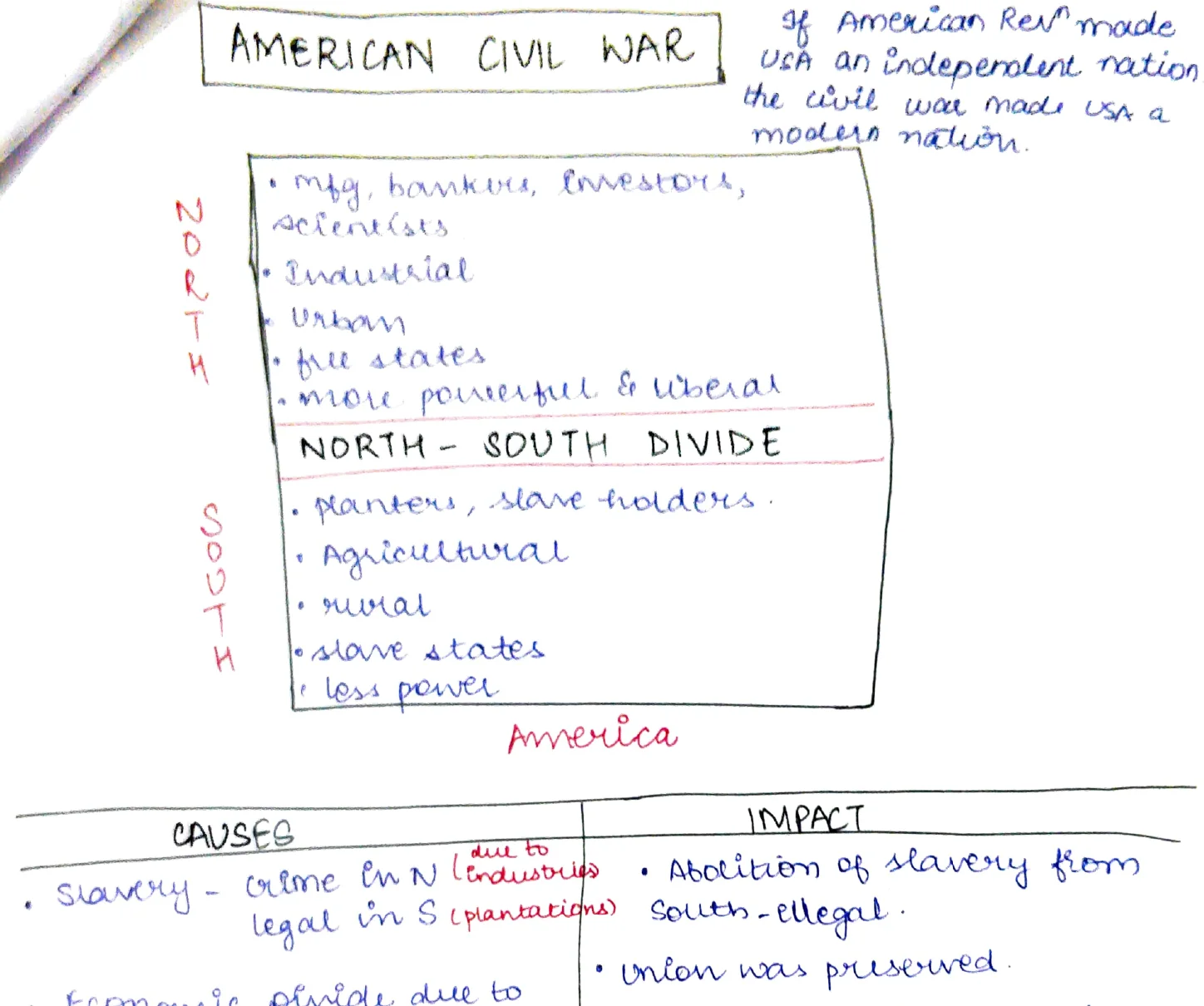
"Of American Rev[olution] made USA an independent nation, the Civil War made USA a modern nation"
#North–South Divide
| NORTH | SOUTH |
|---|---|
| Mfg [Manufacturing], Inventors, Scientists | Planters, slave holders |
| Industrial | Agricultural |
| Urban | Rural |
| Free states | Slave states |
| More powerful & liberal | Less power |
#Causes of American Civil War
- Slavery — Crime in N[orth]; but to [illegible] legal in S[outh] (plantations)
- Economic divide due to nature of business & mindset of people
- Had better connectivity & cosmopolitan outlook
- Social contrast — Discrimination on skin color, racial segregation (apartheid)
- Rise of industries in England → cotton boom → need [for] slaves
- Kansas–Nebraska Act — free [people] of a state to be decided by people
- Conditioned by N[orth] Republican [Lincoln]
- Election of Abraham Lincoln (N[orth])
- States vs Federal rights
- Abolitionist Movement — slaves to be freed immediately vs gradual [emancipation]
#Impact of American Civil War
- Abolition of slavery from South — [declared] illegal
- Union was preserved
- Policy of Reconstruction by Andrew Johnson
- Civil [rights] for rights of slaves
- Racial discrimination ended
- Right to vote for Blacks
- Abolition of apartheid
- Urbanisation & development of Roads, Railways, Industries
#Role of Abraham Lincoln
- Declared seceding of states as unconstitutional
- Wanted to save US solidarity
- Never encouraged slavery
- Did military mobilisation from N[orth] to S[outh]
- Issued Emancipation Proclamation
- Didn't immediately free a slave
- Led to those parts of America where control of armed forces was there
- Didn't apply to slave states because it would have been unconstitutional
- Lincoln took an active role to ensure passage of 13th CAm [Constitutional Amendment] through Congress — for slavery; a const[itutional] sol[ution] was found
- 14th & 15th CAm [Constitutional Amendments] expanded civil rights greatly
- Granted US citizenship to African Americans (14th)
- 15th CAm — right to vote (15th)
#US Constitution
- 1st written const[itution] of world — 1789
- Ideals of liberty, rule of law
- Natural rights of men — Bill of Rights
- Separation of power — Montesquieu
- System of checks & balance
#Criticisms of AR [American Revolution]
- No deep change in society (like FR)
- No universal rights — only to men holding property (15–20% of pop[ulation])
- No rights to slaves (30%+) or women
- Power taken from [old] white English men & consolidated into American men
- Ideas were very strong but policies/implementation were weak
#French Revolution
#French Revolution Timeline
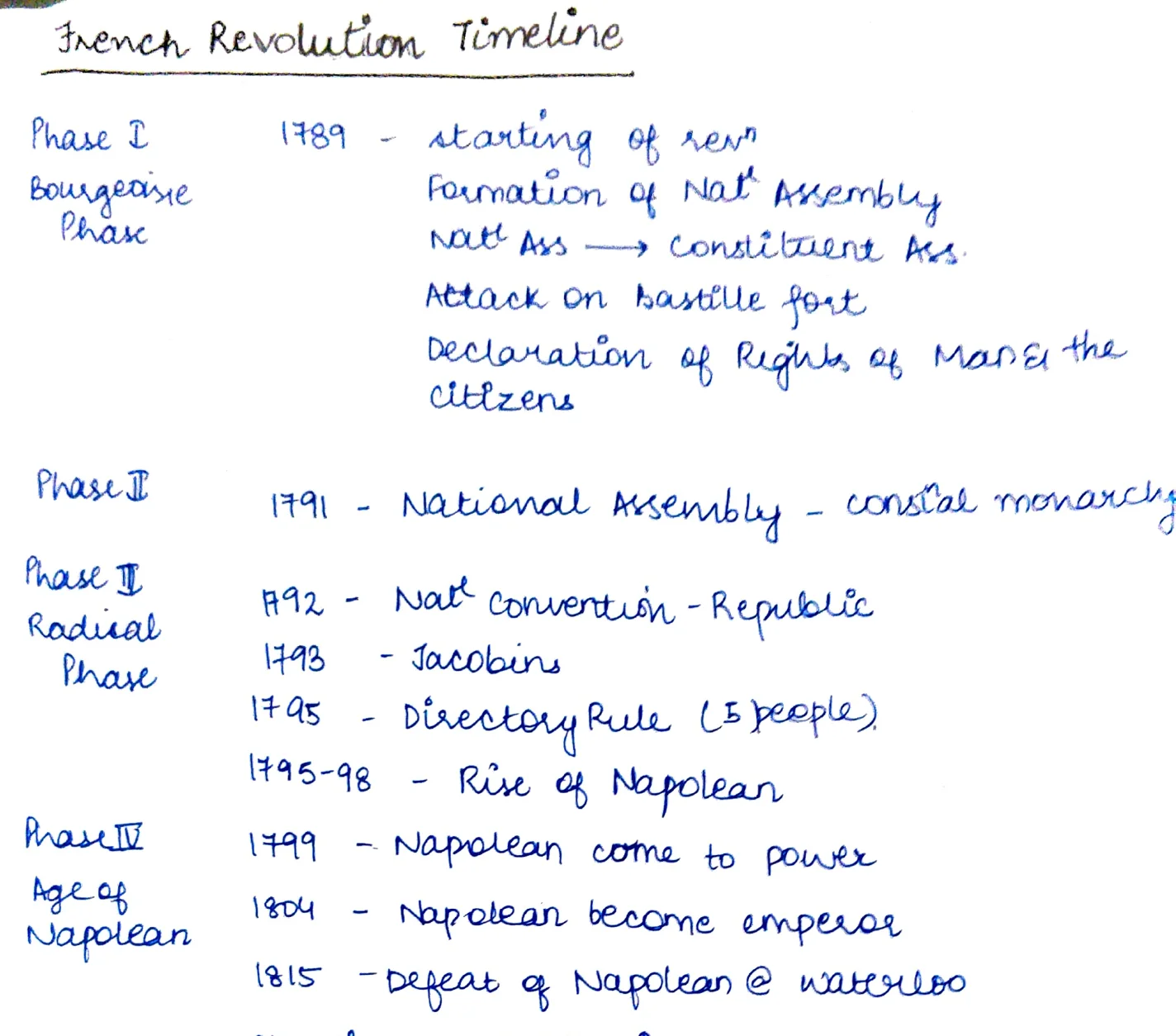
| Phase | Year | Event |
|---|---|---|
| Phase I — Bourgeois Phase | 1789 | Starting of Revolution |
| 1789 | Formation of National Assembly | |
| 1789 | Nat[ional] Ass[embly] → Constituent Assembly | |
| 1789 | Attack on Bastille Fort | |
| 1789 | Declaration of Rights of Man & the Citizens | |
| Phase II | 1791 | National Assembly — constitutional monarchy |
| Phase III — Radical Phase | 1792 | National Convention — Republic |
| 1793 | Jacobins | |
| 1795 | Directory Rule (5 people) | |
| 1795–98 | Rise of Napoleon | |
| Phase III — Age of Napoleon | 1799 | Napoleon comes to power |
| 1804 | Napoleon becomes Emperor | |
| 1815 | Defeat of Napoleon at Waterloo; starting of Metternich System |
#French Society — Estate System
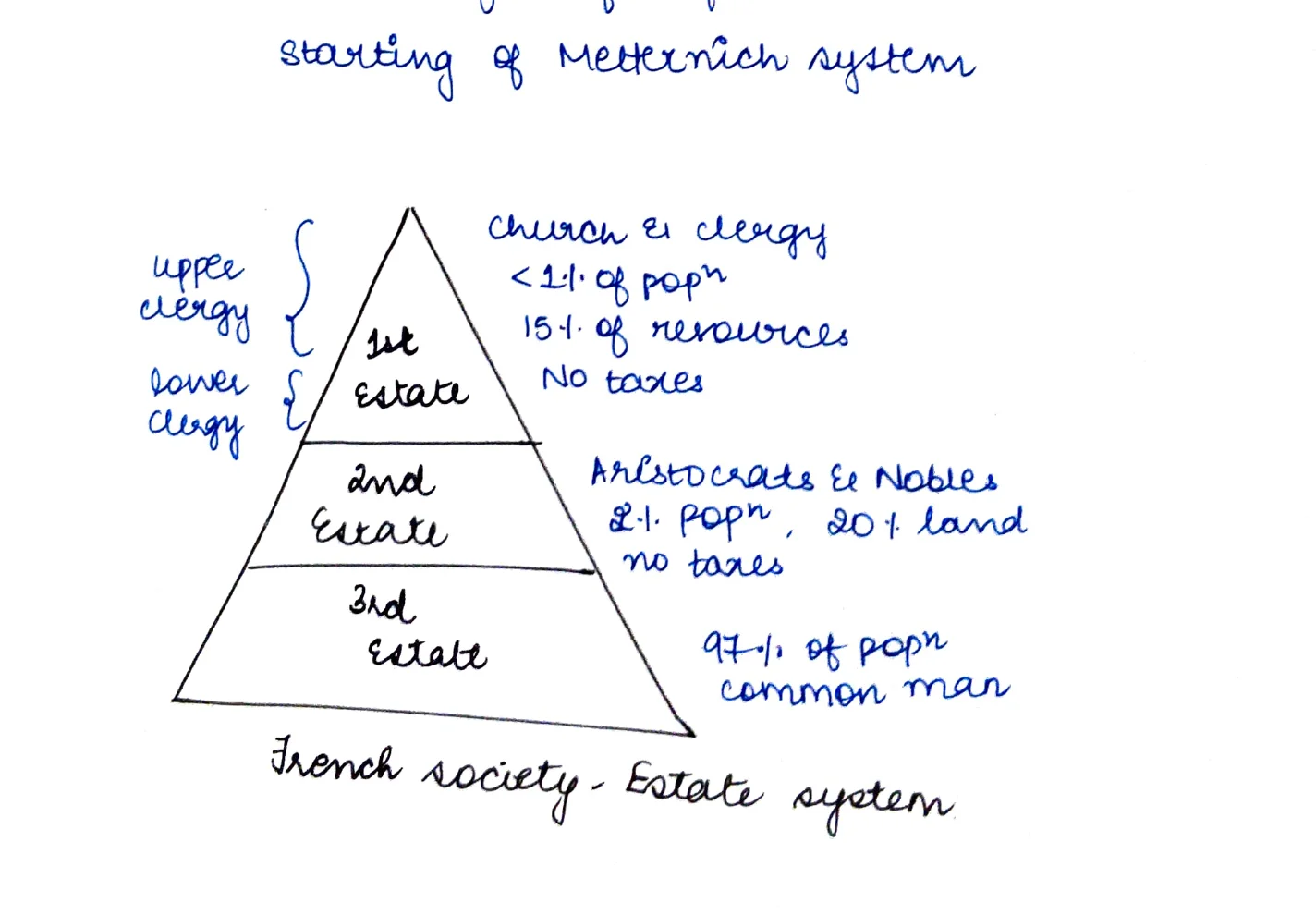
- 1st Estate — Church & Clergy
- Upper clergy & lower clergy
- < 1% of pop[ulation]
- 15% of resources
- No taxes
- 2nd Estate — Aristocrats & Nobles
- 2% of pop[ulation]
- 20% [of] land
- No taxes
- 3rd Estate — Common man
- 97+% of pop[ulation]
#Causes of French Revolution (FR)
- Political — Absolute monarchy
- Divine rights theory
- Social — Growth of industries & rise of middle class
- Growing burden of feudal dues
- Rising poverty
- Economic — Growing govt debt
- Attempt to tax nobles
- Tax burden on Third Estate
- Intellectual — Growth of new ideas e.g. everyone born free & equal
- American Revolution [as inspiration]
#Impact of French Revolution
| On French People | On Europe | On World |
|---|---|---|
| End of monarchy | Domino effect — Ireland, Poland | Emergence of nationalism & impetus to nation-state system |
| Church authority ↓ | Monarchy vs Revolutionaries | Unity of Germany, Italy etc. |
| End of principled [class]-based social system | Napoleon as architect of modern Europe | LEF [Liberal, Equality, Fraternity] ideals |
| End of feudalism & serfdom | Declaration of Rights of Man | |
| Admin & economic reforms | ||
| Economic changes |
#Napoleon — +ve and −ve
Positive (+ve)
- Centralised administration
- Army reforms — merit-based, speed & mobility
- State-led edu[cation] & French Uni[versity] system
- Nat[ional] — Bank of France estd[ablished]; railway, uniform tax policy, mkt [market] reforms, roads & bridges
- Secular policy — liberty to follow any religion
Negative (−ve)
- Curbed liberty — press censorship
- Underestimated nat[ional] Spanish elect
- Highly ambitious
- Continuous wars
- Couldn't challenge naval power of Britain
#Continental System (Napoleon)
- Called Britain as 'nation of shopkeepers'
- Planned to bring Britain to its knees
- Devised Continental System in 1806
- An economic blockade that restricted British goods from entering Europe
- Got support of Russians, Austrians & Prussians
- Hoped Britain would undergo a serious depression
- Meanwhile he was building his own ships
- Berlin Decree — banned British ships from entering European ports
- Milan Decree — against smuggling & states that neutral ships that stopped in Britain were subject to confiscation
- Britain retaliated through sea power & wouldn't allow ships to sail on what was then Britain's ocean
- This system boomeranged
- First, Portugal defied it; then Russia
#Vienna Congress (1815)
#Objectives
- To restore Europe to pre-FR times
- Isolate France in Euro politics
- Compensate war-affected countries
- Maintain balance of power
- Check revolutionary ideas
#Merits
- Protest against slavery
- Strong action against pirates
- Restoration of peace
- No oppt[opportunity] to German unity (German conf[ederation] after Metternich system)
- Reconstruction of Europe
#Demerits
- Unnatural unity (of Belgium & Holland) — Catholic/Protestant mix
- Disregarded liberalism & nationalism
- Revenge on France
- Ignored Eastern disputes
- Rise of Austria (as it affected Napoleon)
- End of Holy Roman Empire
#French Revolutions — 1830 and 1848
| 1830 | 1848 |
|---|---|
| Middle class revolution | Socialist revolution |
| Against reactionary policies of Charles X | Unpopularity of Louis Philippe |
| Democratic | Nationalist |
| For constitutional govt | For nationalist govt |
| Put another Bourbon King on throne | Declared a Republic |
| RI [restricted] vote given | RI [Right of] vote practiced |
#Russian Revolution
#Three Revolutions
| R1 (1905) | R2 (Feb/Mar 1917) — Julian Calendar | R3 (Oct/Nov 1917) — Gregorian Calendar |
|---|---|---|
| Bloody Sunday | October Revolution | |
| Immediate cause: Russo-Japanese war; plotting into housing [issue]; expiation; national humiliation; social economy; [poor] conditions | ||
| DUMA → Capital membership [bicameral legislature]; fundamental laws; addition & censorship |
R1 (1905) details
- Bloody Sunday
- Immediate cause: Russo-Japanese war, plotting into [issues of] housing
- National humiliation
- Social economy [issues]
- [Poor] conditions
- DUMA formed → capital [central] membership [bicameral legislature]; fundamental laws; abolition of censorship
R2 (Feb/Mar 1917) Causes
- Pol[itical] causes — Pol[itical]: divine right theory of kingship; Rev[olution] of 1905; autocratic rule of Czar; inefficient & corrupt bureaucracy
- Eco[nomic] causes — Outdated agri, no machines; cold climate; quasi-feudal tenure; irrational taxation; no state sponsorship to agri; financial sources; inhumane condition of workers
- Social discrimination b/w nobles (privileged, had huge land) & unprivileged workers; peasants [paid] taxes
"Rev[olution] of 1905 was a dress rehearsal for the 1917 Revolution"
#Role of Philosophers
- Exposed real character of monarchy
- Inspired by Karl Marx, Maxim Gorky, Bakunin
- Spread revolutionary ideas
#Role of War & Crises
- Russia & always wars by Czar
- Napoleonic War (1801–15) — dominance over Korea & Manchuria
- Crimean War (1854) — for capture of warm water port
- Russo-Japanese War (1905) — Immediate cause of 1905 Revolution
- First World War — Imm[ediate] cause of 1917 Revolution (fatal for Russia)
- Readily 5mn men lost; heavy losses — mutinies by army
#Nature of Russian Revolution
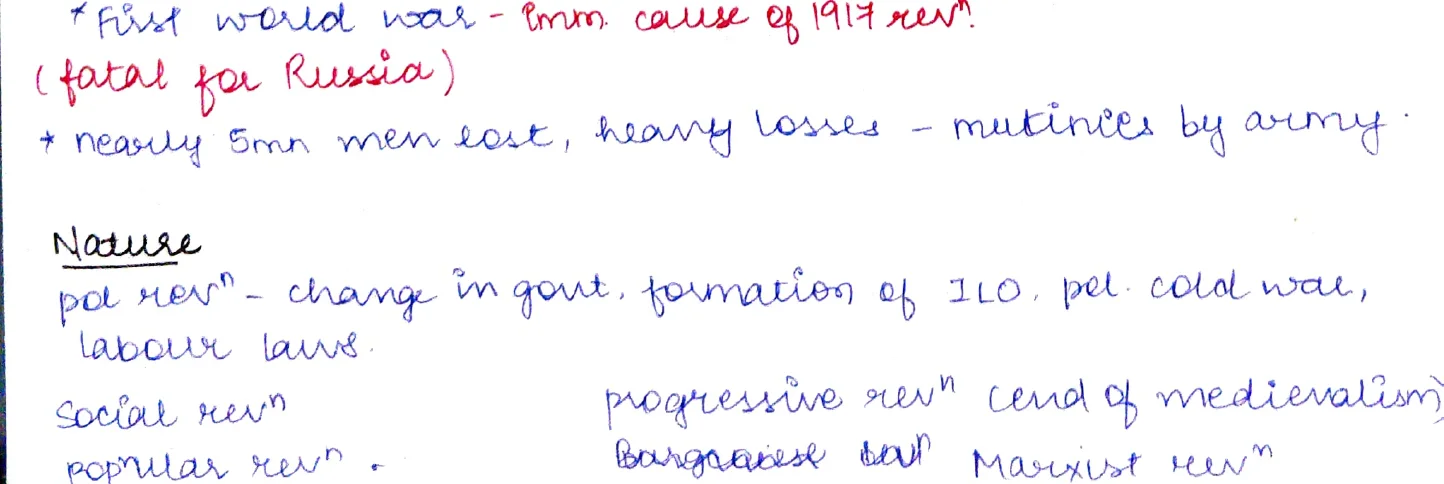
| Pol[itical] Rev[olution] | Social Rev[olution] | Popular Rev[olution] |
|---|---|---|
| Change in govt; formation of [new] political order | Progressive rev (end of [land] mediation) | Bourgeois [and] Marxist rev[olution] |
#Consequences of Russian Revolution
- War against economic oppression
- Destroyed rising of capitalism
- Foundation of Socialism — end of monarchy
- End of pvt [private] property
- Established workers' control over industries
- Centralised economy
- Five Year Plans — planning was an imp[ortant] contribution of Russian Revolution to the world
- Nationalisation of land
- Social equality
- Social benefits to people — free medical care, education, unemp[loyment] allowance etc.
- Rights of people
- Equality for women
- Concept of welfare state emerged
- Separation of religion from politics
- Abolition of old secret treaties
- Withdrawal claims over many areas
- Against imperialist Russia
"Russian Revolution organised millions of proletarians to make their own destiny & to form a new society, who wars, & exploitation, who classes into nations & into poverty & a communist society"
#Role of Lenin
- Aware of past failures of reform
- Able to accurately judge the possible sol[ution] in that situation
- Great personality
- Skilful tactician
- Galvanised Bolshevik party into a true rev[olutionary] group
- Opposed to parliamentary democracy — Bourgeois democracy he used to call it
- Cut approach [pragmatic]
- Criticism of imperialism & capitalism
- His book — "Imperialism is the highest stage of capitalism"
- Forwarded a programme — "peace, land & bread"
- Influenced by Marxist scientific socialism
- Did reforms:
- Abolished pvt property/gave lands to peasants
- Starting of factories/workshops with compensation
- Compulsory labour for all
- Introduced NEP in 1921
#NEP (1921) & Impacts
- Was [for political] & realistic & thus realised that to save communism, he must accept little capitalism
- Following steps:
- Regeneration of Agriculture
- Allowed peasants to sell their agri stocks in open market
- Removal of landlords
- Replaced collective farming by cooperative farming
- Nationalisation of agri
- Nationalisation of industries
- Beginning of private trade — through barter
- Currency reforms
- Regeneration of Agriculture
#Analysis of NEP
- Progressive step
- Aimed at pol[itical] & economic stability
- Capitalism was used to start development & then Lenin took control over economy
- Foreign [investors] nationalised if they paid part profits to state
- Influenced Nehruvian period in India & economic conditions of India: like land reform, agrarian, cooperative farming, industrial plans, labour reforms, foreign [relations], etc. — all influenced by Lenin's NEP
#World War 1
Also known as: The Great War / The War to end all Wars / Global War
#Why it was a turning point in world history
- Huge mobilisation of men
- Colonies were also made to fight → entire world participation
- New tools — aeroplanes, tanks, submarines
- Sea battles
- Civilian pop[ulation] were involved & became casualties
- Affected world economy
#Causes of World War 1
1) Radical Nationalism & Mad Race for Colonies
- Linked with extending areas of control & ↑ military strength
- French rev[olution]'s nationalism spread in entire Europe by Napoleon
- Balkan states — for wanted freedom of their people elsewhere
2) System of Secret Alliances
- Handiwork of Bismarck
- Triple Alliance & Triple Entente (F+B+R) [France+Britain+Russia]
- (A+G+I) [Austria+Germany+Italy]
3) Militarism
- Militarism became synonymous with national prestige
- Mad race for armaments
4) Absence of Int[ernational] Organisation
5) Economic & Imperialistic Rivalries
- Principal field: Africa (Scramble for Africa)
- For raw mat[erials] & market
- France & Britain — large colonial empire
- Germany & Italy too eyed Africa & Asia
6) Moroccan Crisis
- German intervention to support Moroccan Independence against French (given by Britain)
- Pact by Int[ernational] Conference: French won (1904–05)
#World War I — Causes (continued from Part 1)
#7) Balkan Crisis
- In 1911, Germany sent warship to protect against Britain — supported [by Triple Alliance]
- In 1908:
- Balkan states attacked Turkey to occupy Ottoman Empire
- 1908 — Austria annexed Bosnia here
- Was a [rude] shock of Russia's unpreparedness for war to support Serbia
- 1911 — Serbia wanted parts of Austria with Slavic pop[ulation]
Alliance Blocs Diagram — Balkan Flashpoint
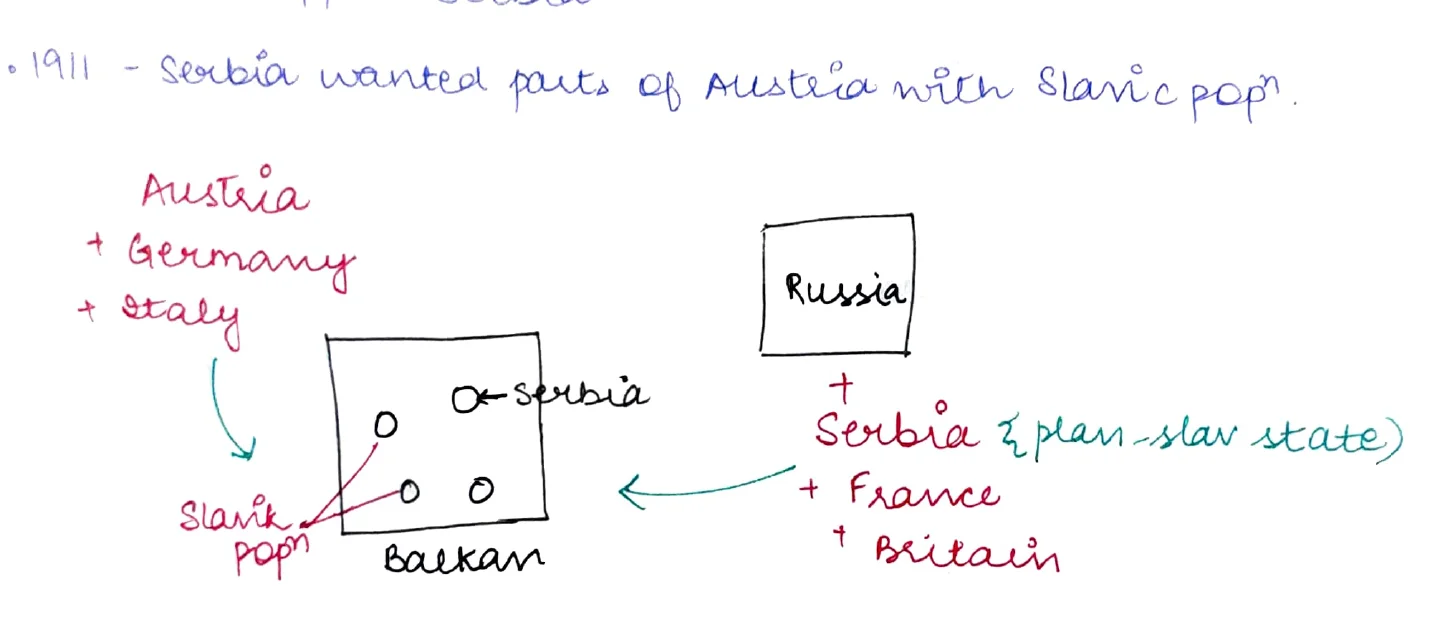
- Left bloc (Triple Alliance):
- Austria
- + Germany
- + Italy
- → Arrow pointing into the Balkan/Serbia square
- Slavic pop[ulation] label at bottom-left of square
- Centre: Serbia (o-Serbia marked with circles representing Slavic pop) inside Balkan square
- Right bloc (Triple Entente):
- Russia (box on right)
- + Serbia → [pan-Slavic state]
- + France
- + Britain
- Arrow ← pointing from right bloc into Balkan square
#8) Poisoning of Public Opinion by Newspapers
- Fanned aggressive nationalism
- Misrepresented situations & inflamed antagonism
#9) Immediate Cause
- Murder of heir[apparent] Habsburg by a fanatic
- (connection with Serbia not proved)
- ↓
- Then Archduke of Franz Ferdinand & wife visited Bosnia
- ↓
- Murdered by a Serb
- ↓
- Austria regarded it as provocation
- ↓
- Made demands — rejected by Serbia
- ↓
- Vienna declared war
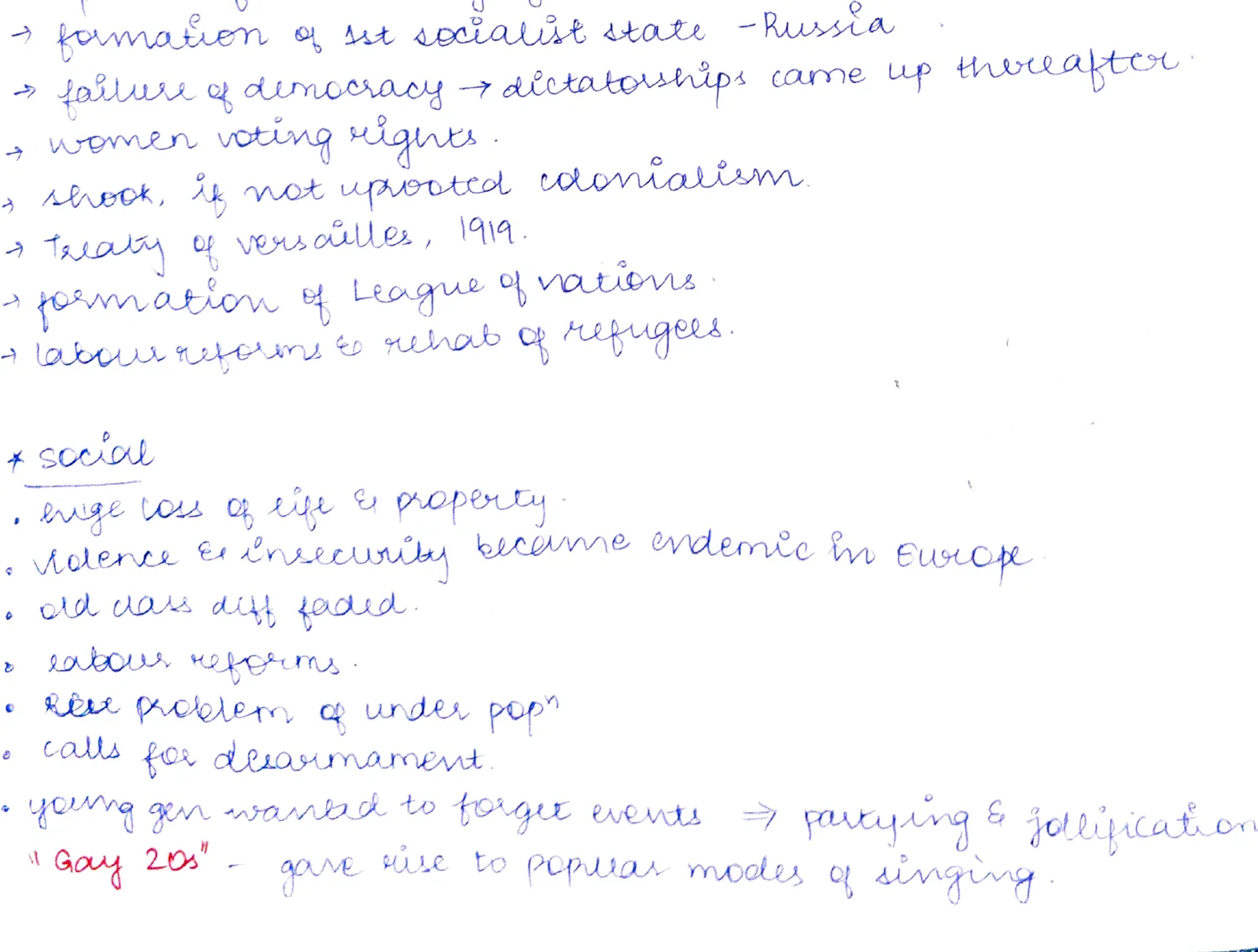
#World War I — Reasons for Defeat of Central Powers (Triple Alliance)
- Failure of Schlieffen Plan
- Allied power was stronger
- A deadly blockade caused food shortages
- German submarine campaign failed — brought US into the war — a big mistake
- Entry of USA = new resources (food, arms) for Allied
- Continuous wars → loss of best troops of Germany
- Spread of an epidemic of deadly Spanish flu — it [was severe]
- Defeat of Bulgaria → soldiers lost confidence
#World War I — Consequences
#Political
- Disintegration of empire → emergence of nation states
- Spread of democracy by US
- Formation of the socialist state — Russia
- Failure of democracy → dictatorships came up thereafter
- Women voting rights
- [Slow &] not uprooted colonialism
- Treaty of Versailles, 1919
- Formation of League of Nations
- Labour reforms & rehab[ilitation] of refugees
#Social
- Loss of life & property
- Violence & insecurity became endemic in Europe
- Old values/culture failed
- Labour reforms
- Race problem & under pop[ulation]
- Calls for disarmament
- Young gen[eration] wanted to forget events → partying & glorification
- 'Gay 20s' — gave rise to popular modes of singing
#Economic
- Economy of powers affected
- Industries destroyed
- Due to need of warfare → new skills/methods developed → more prod[uction]
- US became largest exporter of goods
- Decline in farm prod[uction]
- Prices shot up for all goods
- Issue of paper currency → inflation
- Western allies indebted to US
- Unemp[loyment]
- Food shortage + disease
- ↑ Industrial prod[uction]
- Boost to scientific research
- Faster means of communication
#WW1 — "Graveyard of Empires"
- WW1 is often called the Graveyard of Empires:
- German © — Hohenzollern
- Austro-Hungarian — Habsburgs
- Russian — Romanov
- Ottoman — Caliphate
Venn Diagram — Causes of WW1
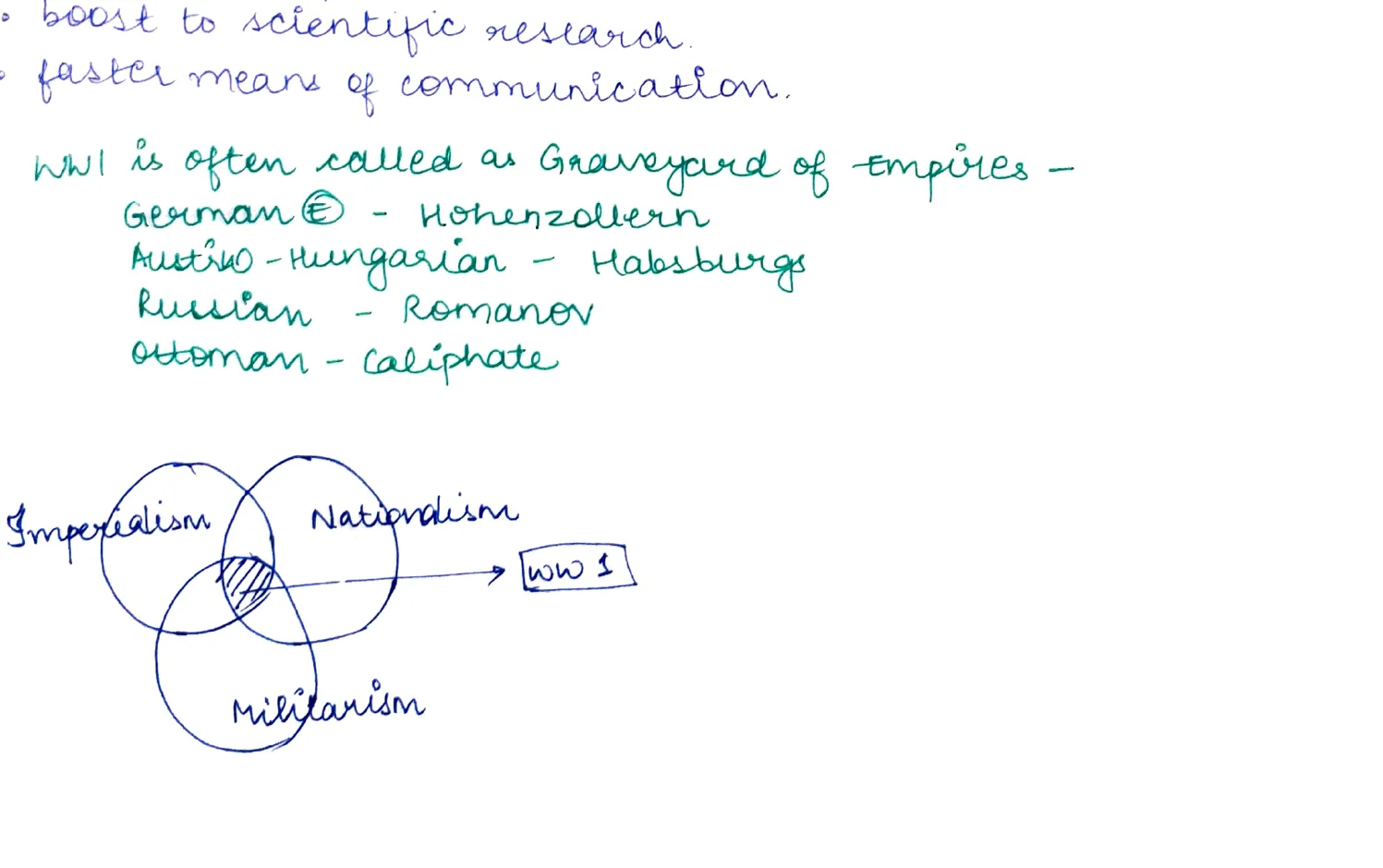
- Three overlapping circles:
- Imperialism (left circle)
- Nationalism (right circle)
- Militarism (bottom circle)
- Overlapping/intersection of all three → WW1 (boxed, arrow pointing right)
#World Between Two World Wars
- Wilson's 14-point — a hopeful architect of world peace
#Paris Peace Conference [PPC]
- Victor powers assembled in Paris
- US Pres[ident] Woodrow Wilson, British PM David George [Lloyd George], French PM George Benjamin [Clemenceau]
- Italian PM Orlando invited — ignored — left mid-way
#Clash of Interests at PPC
| US | Britain | France | Italy |
|---|---|---|---|
| To dominate European politics | To maintain balance of power | Completely security from Germany | Territorial gains promised to her |
| To destroy British naval power | Wanted to scale down reparations & thus received criticism | Comp[lete] disstr[uction] of Germany | — |
| Check rising Japan | Supremacy over naval powers | Alsace & Lorraine | — |
| Spread democracy | — | — | — |
- PPC was a conflict b/w [between] Idealism & Realism
#Treaty of Versailles
- Signed in June 1919
- Harsh treaty
- Imposed on Germany w/o [without] its consultations
- Ignored Wilson's 14 Points
- No right of Self-Determination to German people
#Provisions
- Germany was blamed as aggressor & forced to accept resp[onsibility] for the war — the War Guilt Clause
- Pay $6600 mn as compensation
- Coal mines under French control for 15 yrs
- Poland given an outlet to Baltic Sea
- German army ltd [limited] to 100,000
- Germany's colonial possessions divided amongst victor powers
- Alsace & Lorraine given to France
- Not allowed to use tank by Germans
- Rhineland was demilitarised
- Germans called it a "dictated peace"
- Germany could possess no submarines, no aircrafts, no heavy guns & build no fortifications
#Analysis of Treaty of Versailles
- Marked by element of revenge
- Unilateral & forcefully imposed
- Failure of human intelligence & wisdom
- Mish[mash] of both Idealism & Realism
- Outcome of bargains & compromises b/w PM of France, Britain & US
- Dictated peace
- Redrew map of Europe
- Constant humiliation for Weimar Republic
- Wilson accepted Isolationist policy
- Concessions were asked w/o reciprocity
- Reflected hatred & vengeance of allies
- Violated Wilson's 14-point
- No reciprocity on colonial question
- Principle of self-determination thrown to wind
- The promise of new life & peace for which people shed blood didn't find a place in the Treaty
- Compensation figure was astronomical
- It sowed hatred, bitterness & resentment
#League of Nations
- Obj[ectives]:
- Preserve peace
- Other issues — labour cond[itions], b/w human & drug traffic etc.
#Successes
- Early 1920s — settled territorial dispute b/w Finland & Sweden (Åland Is[lands]), Iraq & Turkey over Mosul etc.
- Combated Intl [International] opium trade
- Alleviated refugee crises in Russia
- Umbrella org[anisation] for ILO, Permanent Court of Intl Justice
- Model for future UN
#Reasons for Failure
- Many countries never joined — USA
- Germany & USSR were members only briefly (1926–33)
- Japan left after Manchurian crisis in 1933
- No armed force, dependent on members for military support
- Pacifist policy of Br[itain] & Fr[ance] → reluctance for sanctions & mil[itary] action
- The IR [internal relations] of members' countries conflicted with League's req[uirement] for collective security
- Unable to act quickly — met 4 times/yr + decision agreed by all
#World War II
- aka Total War / Global War
- WW-II was Hitler's personal war. In many senses.
- "He intended it, he prepared for it, he chose the moment for its launch & planned its course for 3 yrs."
- Fought b/w 1939–45, b/w Allied & Axis power
#Causes / Factors
- Severity of Treaty of Versailles
- Failure of collective security system — League of Nations
- Failure of Disarmament
- World Economic crisis & rise of dictators
- Spanish Civil War
- Policy of Appeasement
- Quest for security of France
- Growing Militarism
- Annexation of Ethiopia & Austria; Manchuria; Ethiopia [Abyssinia]
- Lebensraum — Living space [Hitler's concept of German territorial expansion eastward]
#Policy of Appeasement
- By Britain & France
- Avoided war with aggressors like Japan, Italy & Germany
- Gave away to all, if not very unreasonable
- 2 phases:
- a) Mid 1920 to 1937
- War must be avoided at all cost
- Accepted acts of aggression as breach of Treaty
- b) After 1937
- British PM Chamberlaine gave a new drive
- Wanted to find out what Hitler wanted & showed him they could be met by negotiation not war
- a) Mid 1920 to 1937
- Policy began with Dawes & Young Plan
Examples of Appeasement at Work
- No action on German rearmament
- Italy's annexation of Abyssinia
- Abyssinia was member of League
- Declared Italy as aggressor
- Application of sanctions by Britain & France (only half-hearted action)
- France did not mobilise troops at German re-occupation of Rhineland
- No intervention by Britain & France in Spanish War
- Hitler's fanaticism for the Great German Reich made him annex Austria
- Britain's lack of action encouraged Hitler to make demands on Czechoslovakia & later Poland
Why Such Policy by Britain?
- Belief that dictators could be pacified by meeting their demands
- Anxiety of Treaty & guilt
- Admiration of Hitler for rebuilding Germany after 1933 [post-Depression]
- Feared bombing & wars
- Remembered horrors of WW1
#Was Hitler to Blame for War?
- Historians outside Germany generally agree to this
- He attacked Poland on all fronts instead of Danzig
- He breached the Munich Agreement
- His motive was to remove stigma of WW1
- Pact with Russia was simply a way of lulling Russian suspicions — he always hated it
- He had his plan, his blueprint for action which means war was inevitable sooner or later
- But sometimes it seems that Hitler had no intention of war. He believed that Poland & Russia were weak & would be knocked out by Blitzkrieg
- German people were to blame as much as Hitler
- "Hitler was the creation of German history & German pressure. He would have counted for nothing w/o support of his people"
#Outcomes of the War
- Defeat of Axis powers
- Massive destruction
- No all-inclusive peace settlement due to distrust b/w West & USSR
- Social changes — refugees
- End of European dominance over the world
- Rise of nuclear weapons — change in techniques of warfare
- Emergence of superpowers — US & USSR (Cold War)
- Decolonisation
- Formation of UNO
- Development of Cold War
- Rise of Third World countries
- UN Declaration of Human Rights
- Adverse impact on demographic ratio
- Rise of regional org[anisations] — NATO, SEATO, Baghdad Pact
- Switzerland, situated right in middle of Europe, remained neutral in both WHWs [World Wars] — Woah!
- Balance of terror in place of balance of power
#Unification of Germany [1818–1919]
- Holstein & Schleswig under Dutch control
- Got unified in 1871
#[Pre-Unification Map Diagram]
- Oval labelled Germany at centre-bottom
- Inside oval:
- Austria (top)
- (Prussia) — written in brackets
- William I
- France (bottom)
- Arrow/label: Holstein & Schleswig under Dutch control (top-right of page, in red)
#Factors
Role of Napoleon
- Defeated Prussian & Austro-Prussian forces & established his rule
- He amalgamated 300 states into 39
- Est[ablished] free trade & means of communication
- Spread[ed] the ideals of French Rev[olution] → inspired people → nationalism → unity
Role of Philosophers
- Spread of ideas to awaken the nationals
- Utilised conservative system of Metternich
- Hegel & Herder highlighted problems of Germans & aroused irredentists
- Glorified German language & culture
- Inculcated confidence & love
Role of European Revolutions
- Key role in eliminating Metternich system
- Victory of nationalism, democracy & liberty
- Inspired people
#Role of Zolleverein [Zollverein] — "Mighty lever of German unity"
- A custom union formed in 1819
- Leading member — Prussia
- Believed in free trade & uniform tariff
- Led economic development & unity
- Its coal & iron policy → Industrialisation
- Raised huge army due to economic dev[elopment]
- Prussia won battle with this army
- Economic unity → political unity
#Role of Bismarck — The Process
- Wanted a unified Germany but with Prussian dominance (conservative)
Three-Column War Timeline:
| Austria + Prussia = ousted Denmark (1864) | Austria-Prussian war = ousted Austria (France + Prussia) → Battle of Sadova (1866) | Franco-Prussian war (1871) |
Bismarck's Blood & Iron Policy [detail]:
- Duchies of Holstein & Schleswig — German pop[ulation]
- → Provoked Austria & attacked Denmark in 1864 (a naval power now)
- Aroused popular revolt against Austria & promised Berlin/gains to France to make her neutral
- → Battle of Sadova in 1866, defeated Austria
- Spanish throne vacant, proposed to distant relative of Prussian king; manipulated letter, provoked France due to humiliation, declared war against Prussia
- → Battle of Sedan, 1870
- → Unified Germany :D
#Bismarck as Chancellor (by King William I)
- Policy of Blood & Iron
- Military reforms
- Clever like a fox & brave like a lion
- Maker of Germany — Iron man
- Fought socialism using repression & persuasion
- State socialism was embarked upon by him — insurance for sickness/accident, old age pension, Sunday holiday
- He wanted German union but not at the cost of Prussian monarchy, army or tradition
- He opposed democracy
- Governed state with a legal/tight budget
- "More than military exploits of Russia, it was Bismarck, by his diplomacy, by his act of purchasing friends and dividing enemies, that had not only achieved German unity but had also won for Germany virtual hegemony over the continent."
- He was like a juggler who keeps a no. of balls in the air at the same time — he could keep together mutually hostile powers (Austria vs Russia) & (Italy vs Austria) & succeeded in maintaining peace in his time
#Limitations of Bismarck
- He was Germany & Germany was his creation. He was almost a dictator.
- His laws were declared null & void by Catholics. He failed to create a German national church
- His alliances and juggling could not stand the test of time
- Voiced bitterness & hatred towards socialists
- Differences with King William II rose & he was made to go home & resign from his office
#Unification of Italy
- Most geographically fragmented state of Europe
- Control of French, Austria & Pope
#[Pre-Unification Map Diagram]
- Oval labelled ITALY (underlined)
- States labelled on top (outside oval, red): Lombardy, Venetia (Papal State [Papal States])
- Duchies of Parma, Modena, Tuscany
- Inside oval:
- Lombardy-Venetia → Austria (arrow right)
- Rome → Pope guarded by France (left label)
- Piedmont-Sardinia → Savoy dynasty (right label)
- Naples / South-Sicily → French (left label, arrow)
- Southern part: south-Sicily; French controlling south
#Factors
- Napoleonic reforms — reminded of glorious past & spread of nationalism
- European Rev[olution] of 1830 & 1848 — 1st attempt toward unity
- Mazzini — Young Italy
- Cavour
- Garibaldi
- Emmanuel Victor
#Unification of Italy Was Not the Work of a Single Man!
#Role of Mazzini
- Joseph Mazzini — revolutionary thinker & radical nationalist
- Spiritual force of Italian union
- Member of secret sos [society] Carbonari
- Served an 'open letter' to Charles Albert urging him to give Piedmont const[itutional] govt, to lead a national movt & expel Austrians
- Founded a society — Young Italy
- Propaganda to educate people
- Republican at heart
- Saint of Italian Movt & prophet of Italian Union
Limitations of Mazzini
- Was not very practical, only a theorist
- His wishes for a federation with a stronger argument for unity
#Role of Giuseppe Garibaldi
- Mentor of Young Italy
- Fought 14 years for freedom of Spanish colonies
- Followers were called as Red Shirts
- Conducted successful guerrilla war against Austria
- A daring captain capable of inspiring his followers with simple & passionate faith
- Full of heroism, chivalry & romance
- "He believed in Italy as saints believed in God"
- It was because of him that many patriots accepted an alliance with French
- Impressed by Cavour
Garibaldi's Campaign in Sicily & Naples
- Aided in liberation of Sicily & proclaimed himself Dictator of Sicily — countered by Cavour & had to surrender
- Advanced towards Naples — a triumphal march & people received him as a Second Christ
- He marched alone, stood up, folded his arms & looked them straight on their faces — soldiers saluted him & no one dared to shoot
- Naples was captured without firing a shot
- Towards the end of his life, he reaffirmed his ardent Republicanism of his youth
- "It was Garibaldi who cleft his way with his sword without which Cavour's diplomacy would have come to a halt."
#Role of Victor Emmanuel
- King of Sardinia — ruled as constitutional head
- A brave soldier, a perfect man with sound and independent judgement, a man of principle & loyal to his word
- Followed counsel of his PM Cavour
- Conflicted with him once but was 'wise' enough to appoint him as PM again
#Role of Cavour
- Started his publication 'Resorgimento' [Risorgimento] — Rebirth
- PM of Italy
- A great statesman & diplomat
- Realist & maker of modern Italy
- Promoted prosperity of bourgeoisie
- Carried out reforms like:
- → Free trade
- → Taxation reforms
- → Construction of roads, canals & railways
- → Separation of state & church
#Cavour's Diplomacy
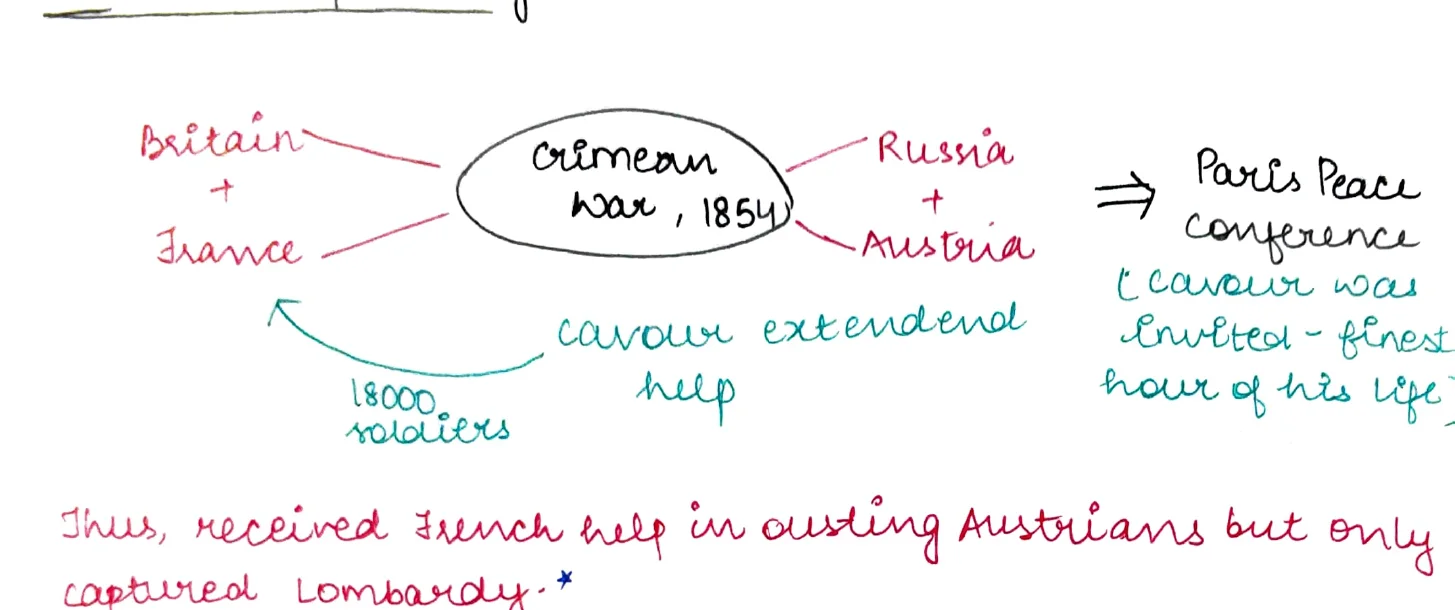
-
Britain + France ← Crimean War, 1854 → Russia + Austria → Paris Peace Conference
- (Cavour was invited — finest hour of his life)
-
Cavour extended help [to Britain & France]
-
18,000 soldiers [sent by Cavour]
-
Thus received French help in ousting Austrians but only captured Lombardy
-
Significant role in foreign policy
-
Crimean War — explain his tactics
-
Crimean war was neither beneficial for France, nor Britain but was a boon for Italy
-
French had to leave mid-way; Cavour wanted to go alone but opposed by Victor Emmanuel — Cavour resigned & revolts in Modena, Parma & Tuscany happened. He returned & promised unity from south.
-
He influenced Garibaldi to attack South & paved for unity
#Final Unification — Franco-Prussian War Used
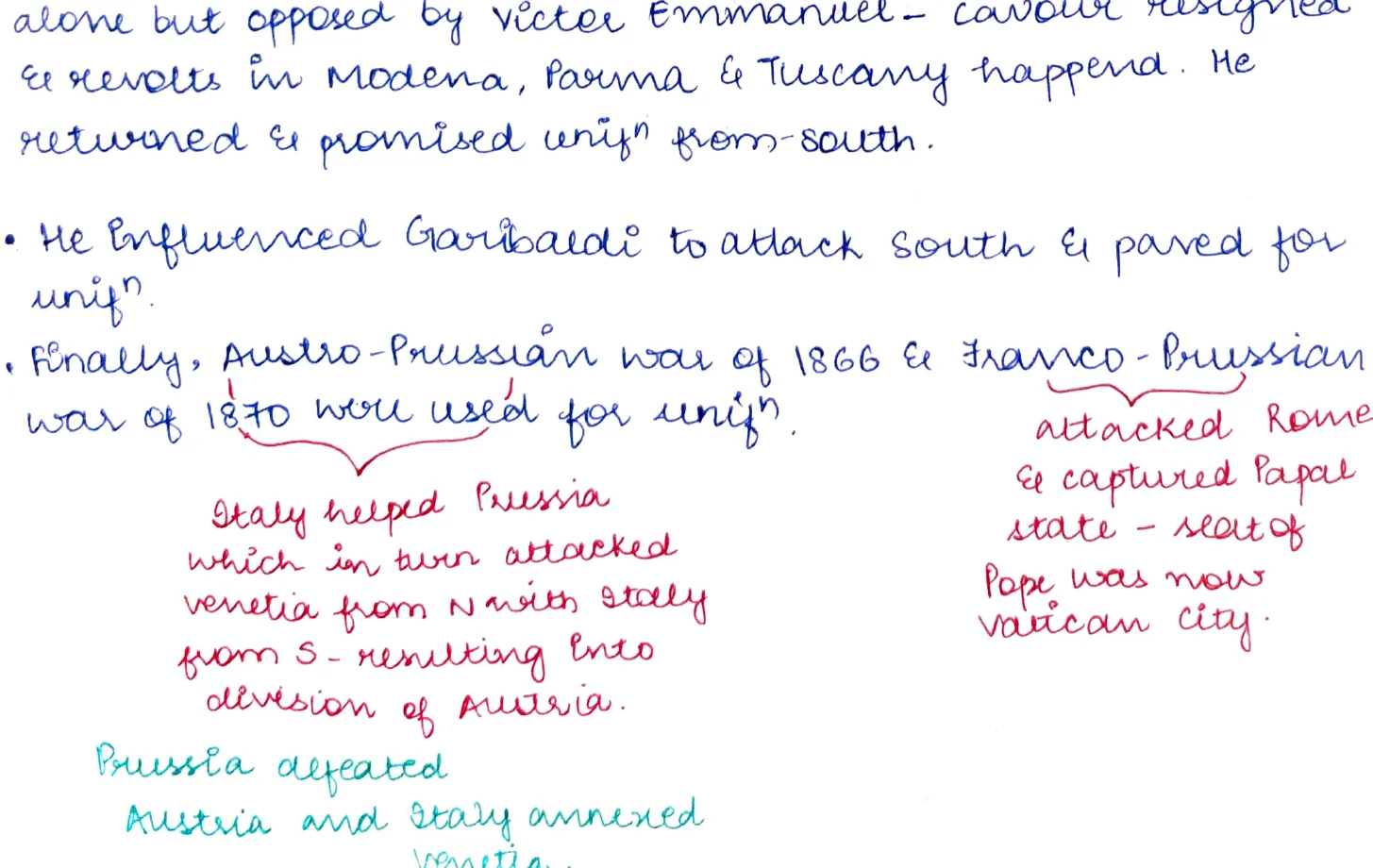
- Finally, Austro-Prussian war of 1866 & Franco-Prussian war of 1870 were used for unity:
- Left column: Italy helped Prussia, which in turn attacked Venetia from North. Italy [gained] from S[outh] — resulting into division of Austria
- Prussia defeated; Austria and Italy annexed Venetia [illegible — partially cut]
- Right column: Attacked Rome & captured Papal state — state of Pope — now Pope was now Vatican City
- Left column: Italy helped Prussia, which in turn attacked Venetia from North. Italy [gained] from S[outh] — resulting into division of Austria
Post-Independence History
Topper handwritten notes#Legacy of the Indian National Movement (INM)
- Inclusive, broad viewpoints
- Non-violent character
- Elite + masses both participated
- Area of civil liberties, democratic org[anisation] & tolerance
- "Liberty of press & liberty of speech give birth to a nation and nourish it" — TILAK
- Accommodative approach
- All-inclusiveness
- Mods [Moderates] support Tilak's RT [Right to] speech &
- Non-violent long tenure gave extensive support to Bhagat Singh
- Public Safety & Trade Disputes Bill to suppress Trade Unions were opposed by capitalists like G.D. Birla
- Unity in diversity + nat[ional] integ[ration] = composite nat[ional] culture
- Strong & self-reliant India
- Secularism
- Cons[traints]:
- No anti-caste ideology
- Partition
- Communal[ism] of [Indian] society
#Constitution
- Federal with strong centre
- → to overcome problems of communal, caste, region[alism] through strong pol[itical] leadership
- → shape a single nation through one social, pol[itical] integ[ration]
- A necessity, rather than a desire
- Union of states
#Challenges Before Independent India
#Overview
- Consolidation of I[ndia] and realisation of dream of true nationhood
- Unity — race/caste/religion/culture/region diversity
- Social & economic emancipation
- Self-sufficiency — Socialism was set as a guiding light
- Socialism was not an ideological dogma but a broad guide to dev[elopment] & change
- Nehru — socialism/communism helps to divide wealth but we have no wealth? All you can divide is poverty
- So, it was not a blind ideological goal but accommodated a lot of other ideas
- Nehruvian dev[elopment] strategy:
- → Planning
- → Public sector
- → Mixed Economy
#Early Challenges — Four-Column Table
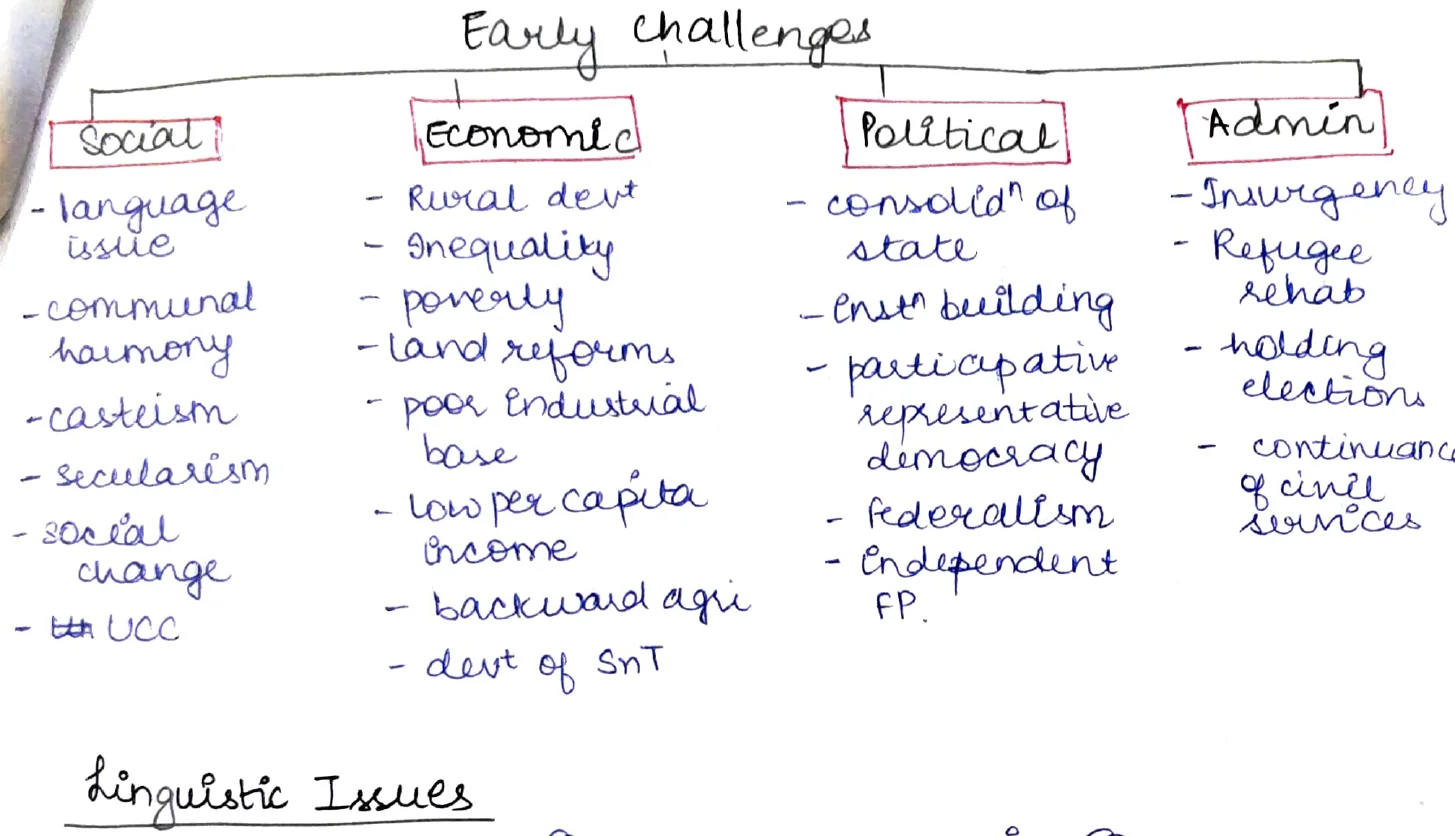
- Social:
- Language issues
- Communal harmony
- Casteism
- Secularism
- Social change
- UCC [Uniform Civil Code]
- Economic:
- Rural dev[elopment]
- Inequality
- Poverty
- Land reforms
- Poor industrial base
- Lower per capita income
- Backwardness
- Dev[elopment] of S&T [Science & Technology]
- Political:
- Consolidation of state
- Trust-building
- Participative representative democracy
- Federalism
- Independent FP [Foreign Policy]
- Admin[istration]:
- Insurgency
- Refugee rehab[ilitation]
- Holding elections
- Continuance of civil services
#Social Problems
- Caste
- Low literacy
- Women status
- No civil code
- Polygamy
- High expectations of people from their 'own govt'
#Tests of Democracy
- Early wars with Pak[istan] & China
- Emergency, death of leaders, communal flames
- Linguistic violence, Dravida Mov[ement], secessionism
- In NE, NE, LWE [Left Wing Extremism], failure of land reforms
- Agrarian distress, elite capture of politics
- Universal adult franchise to illiterate people
- Vote bank politics etc.
Foreign experts argued that Green Revolution could turn into Red Revolution
#Linguistic Issues
#Background
- 1920s — INC promised [linguistic] provinces for major [language] groups after Independence but didn't honour it due to partition & parochial disruptions
- Hindi = official lang[uage]; English = courts, services, inter-state common
- An emotive issue → repercussions on promotion of culture & govt job opportunity + pol[itical] power accessibility
- Divide over 2 lines:
- Hindi as official lang[uage]
- [Linguistic] ideology of states
- No nat[ional] lang[uage] = multi-lingual India = Const[itution] 8th sch[edule]
- Only Hindi & English had nation-wide reach:
- Hindi: obvious choice, as it was hybrid of many [language] groups, role in HHM [Hindi Heartland Movement]
- English: foreign roots so no!, symbol of Raj, language of oppression
- Hindustani in Devanagari Script = symbol of past [civilisation] & [communal] sects
- South said Hindi = lang with shallow history & literature = already in public ambit
- Thus, gradual transition from English to Hindi by 1965
#Hindi Imposition Issue
- Hindi speakers imposed it "using 'fanatic zeal' not mild persuasion" in '65
- → propaganda over dev[elopment] of lit[erature] & curiosity :/
- → No effort to simplify & rationalise Hindi
- → Sanskritised it to maintain purity
- Translation of major works/laws + Central Hindi Bureaucratic etc = suspicion ↑ — open opposition
- C. Rajagopalachari (S) opposed Ram Manohar Lohiya [Jan Sangh] = immediate imposition
- Official Lang[uage] Act, 1963 = ↑ deadline of 1965 to allay South
- M = Nehru died
- Hindi = alternative lang in UPSC
- → Strong anti-[Hindi] movement (TN, 1965):
- DMK → 26 Jan = day of mourning
- Student agitations (self-immolation)
- Violent protests
- Mini resigned
- Indira Gandhi visited Madras & reassured:
- Hindi + provincial lang in UPSC
- 3 lang formula
- Official lang problem = SORTED by 1969
#Reorganisation of States
- Fact: Congress promised [linguistic reorganisation] but postponed to address more urgent matters
- Dhar Comm[ission] (1948) × [rejected]
- JVP (1948) ×
- S&T [situation] ↑ — Telugu region of Andhra = ↑↑↑↑
- 1952 — Potti Sriramalu died (58-day fast) = Andhra created (no can bus!)
- Fazl Ali Comm[ission] 1953 [SRC — States Reorganisation Commission] ✓
- But non-veg[etarians] of Bombay & Punjab
- State Reorg[anisation] Act, 1956 = 14 states & 6 UTs
#Further Reorganisations
- 1960 — Gujarat & Bombay [split]
- 1966 — HP [Himachal Pradesh], Punjab, Haryana
#Evaluation of State Reorganisation
- Didn't hamper fed[eralism] but consolidated it
- Rational of map drawn arbitrarily by aliens
- Lang = an emotive issue
- No pol[itical] of lang since reorg[anisation]
- Promoted better admin in homo[geneous] pol units
- Strengthened (↑↑↑) nat[ional] unity
- Acceptance of diversity
- (−) Issue of minority lang is unresolved — more so for them (edu inst[itutions])
-
- Comm[ission] of [linguistic] minorities
- → Tribal lang issue
-
#Tribal Integration
- Heterogeneous community (>400)
- Naga, Meena etc = assimilated
- NE tribes = original culture retained
- Isolation + exploitation
- Forests = mainstay → taken away
- Threat from missionaries
- → Uprisings
- Nehru adopted a mid-way integrative approach:
"Tribal areas have to progress & progress in their own way."
- → Const[itution]:
- Art 46 (edu & eco dev[elopment])
- Sch VI
- Adl[itional] duties to Governor
- RT [Right to] property & free hand & residence curtailed in these areas
- State in [Schedule] reserved
- NCST + TAC [Tribal Advisory Council]
- But no real dev[elopment] happened
#India–China War, 1962
#Background
- Friends — both post-colonial rule + socialism
- India supported China:
- Recognised it
- Korea war
- UNSC seat
- No severe objection on Tibet occupation
- Panchsheel
- Chinese leadership in Bandung Conference, 1955
- Tibet refugees in India = angered China → border skirmishes → Massive attack on NEFA in 1962
- India sought to help but China attacked voluntarily
- → blow to NAM & Panchsheel
- Was not by a capitalist imperialist but a socialist friend
#Analysis
- V1 = Nehru failed to foresee the development of 'forward policy' followed instead of sorting border issues → China attacked in self-defence policy
- V2 = less military spending of India + focus on Indus[trial development] + need for secure neighbours
- Asetyat [Assessment] = not naïve but developed in India or blinded; not but due to UNEXPECTED NATURE of war
- Not integrated approach as IAF not used much
- No civilian-military coordination
- Failure of logistics, of intelligence, of morale of military
#Also — India was waiting to make her presence felt globally
- But suffered on many AfAs:
- Taiwan issue
- No UNSC seat
- US in Korea war
- Indo-China conflict
- Afro-Asian following India — friendship with US & USSR; not[hing] to isolate both US & USSR
- → China got isolated & frustrated
- It was thus a result of China's own compulsions rather than aggressive posture of India or misjudgement of Nehru
#Shortcomings of Nehruvian Era
- Didn't institutionalise its charisma
- No participation of masses except voting
- Unreformed civil services
- Overlooked emerging evils like corruption, bureaucratisation
- No steps for caste system, male dominance
- Edu system couldn't reach masses
- No active pol[itical] struggle against communalism
- Poor implementation of land reforms
- Strong party divisions
#Major Events — Era-wise Timeline
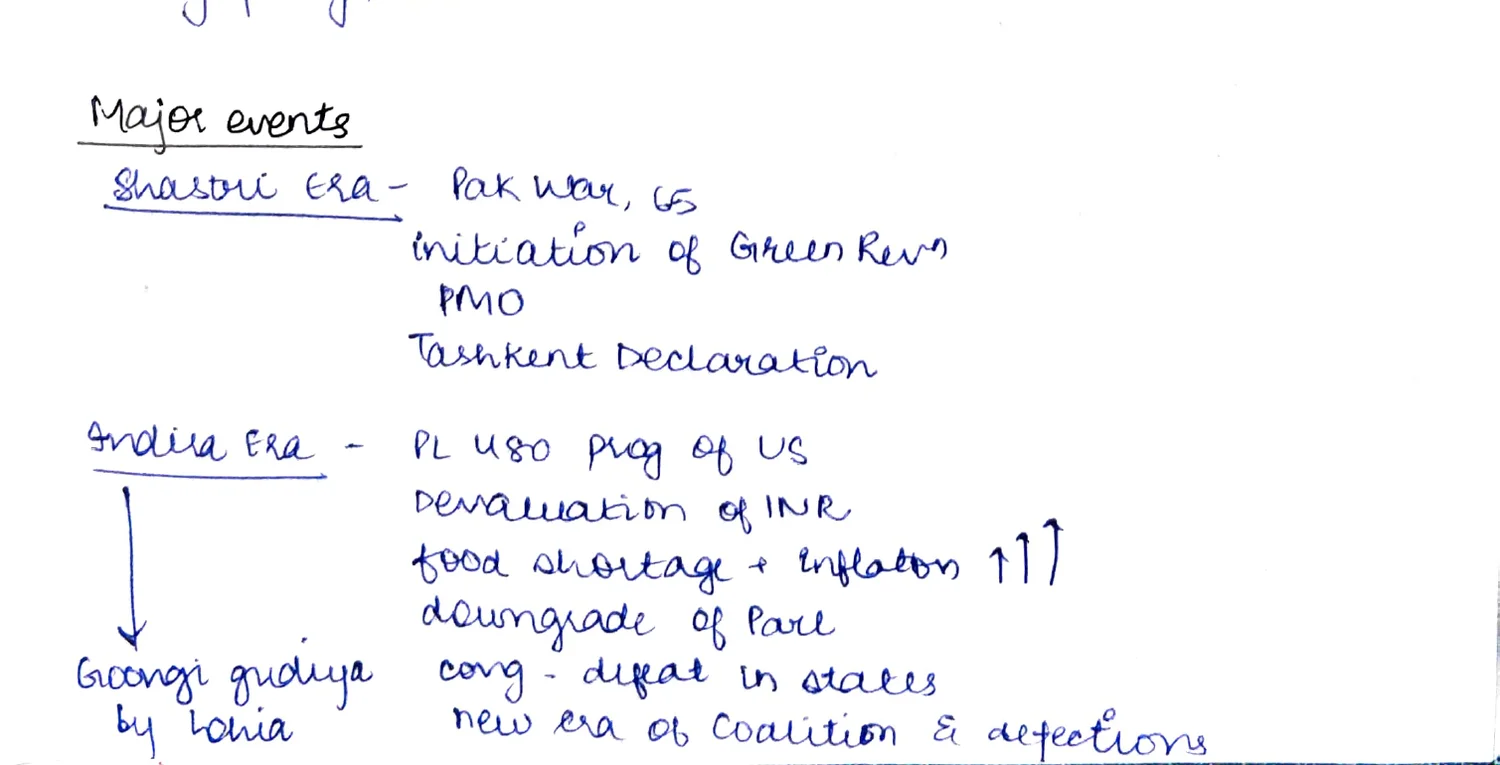
#Shastri Era
- Pak[istan] War [1965]
- US [relations]
- Initiation of Green Rev[olution]
- PMO [Prime Minister's Office established]
- Tashkent Declaration
#Indira Era
- PL 480 Programme of US
- Devaluation of INR
- Food shortage + inflation ↑↑↑
- Downgrade of Part[y]
- Congress — defeat in states
- New era of coalition & defections
- (Downward by Lohia — Goongi Gudiya)
#Indira Gandhi Era — Key Events & Policies
#10-Point Programme of Congress, 1967
- Eat[ing] of lantana [illegible — possible "eating of tanks" or agricultural reference]
- Ceiling on urban property & monopolies
- PDS [Public Distribution System]
- Land reforms implementation
- Abolition of privy purse
- Split in Congress — Congress (R) = Requisitionists (R) = Congress [exists today] / (O) = organisation
#Land Ceiling & Bank Nationalisation
- MRTP Act, 1969 [Monopolies and Restrictive Trade Practices]
- Land ceiling
- Garibi Hatao slogan (Grand Alliance for 'Sridha Hatao' is countered with Garibi Hatao)
#Bangladesh Crisis
- Friendship Treaty with USSR
- Shimla Agreement, 1972
- Nationalisation of Insurance & Coal Industry, 1972
- Rural Unemployment Guarantee Scheme
- Fairer Inclusion Programme
- 24th CAA [Constitutional Amendment Act] — power to amend FR [Fundamental Rights]
- 25th [CAA] — compensation for land acquisition
#Other Events
- 1974 Pokhran Test — Smiling Buddha
- JP Movement, 1974 → Total Rev[olution]/Sampoorna Kranti
- 1973 Oil Shock
- Railway strike of '74
- 1975 Allahabad HC = petition by Raj Narain; [declared her] corrupt in elect[ions] so HC has invalid[ated her]:
- → Resign, no tax payment, make govt impossible
- ↓ National Emergency, 1975
- Defence of India Act
- MISA [Maintenance of Internal Security Act]
- 42nd CAA, 1976
- 20-point prog[ramme] for economy
#JP Movement (Jayaprakash Narayan)
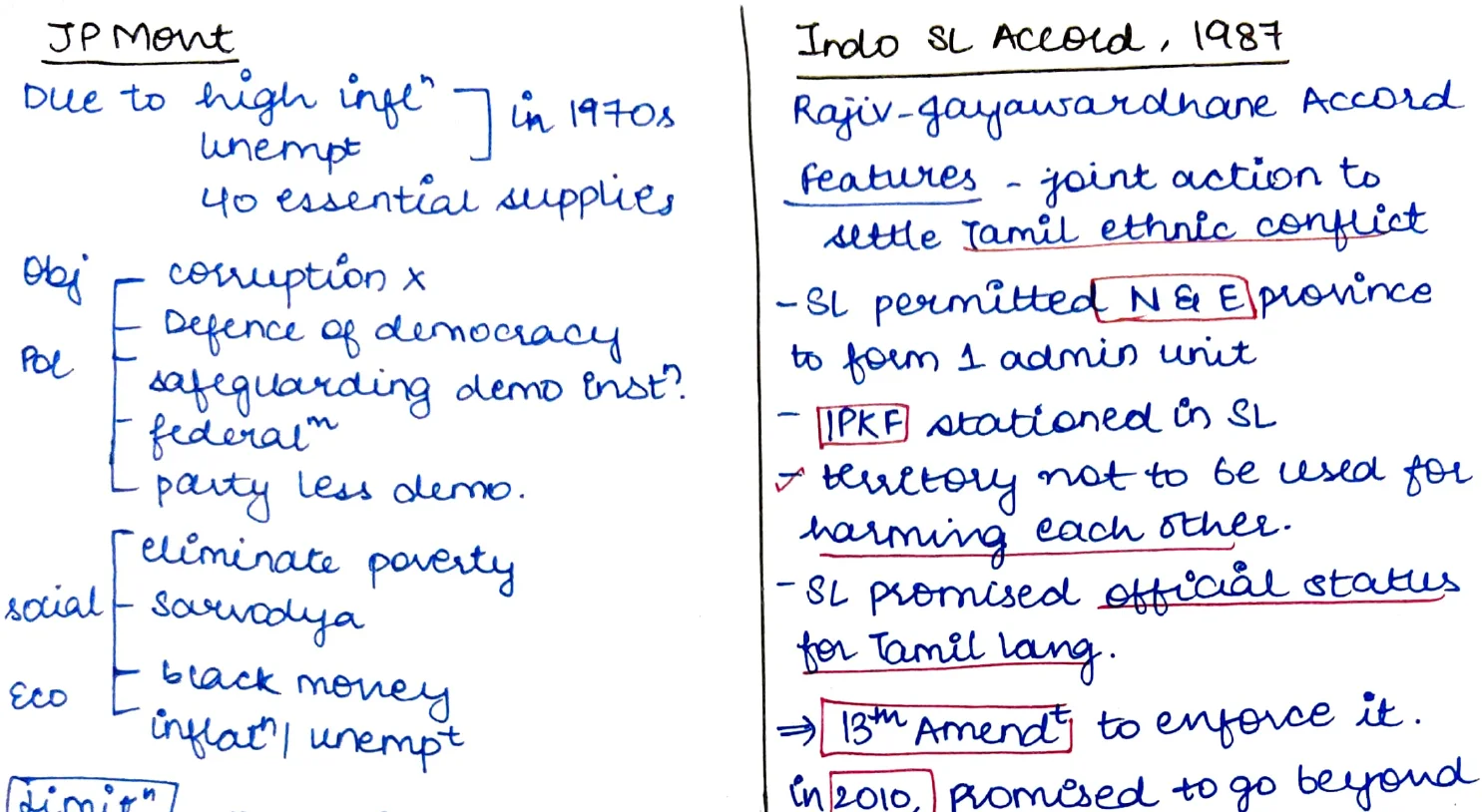
- Due to high inflation in 1970s, unemployment, 40 essential supplies [shortage]
- Obj[ectives]:
- Corruption ×
- Defence of democracy
- Safeguarding demo[cratic] inst[itutions]
- Federal[ism]
- Party-less demo[cracy]
- Eliminate poverty
- Social — Sarvodaya
- Eco[nomic] — black money, [reduce] inflation, unemployment
- 'Limits' — TR against demo ethics & elections
- Extra constitutional means
- No common min[imum] agenda
- Urban & middle class [driven]
#Indo-Sri Lanka Accord, 1987
- Rajiv–Jayawardhane Accord
- Features — joint action to settle Tamil ethnic conflict
- SL permitted N & E [North & East] province to form 1 admin unit
- IIPKF [Indian Peace Keeping Force] stationed in SL
- Military not to be used for harming each other
- SL promised official status for Tamil lang[uage]
- → 13th Amendment to enforce it
- (In 2010, promised to go beyond 13th A, to Kla [Colombo] 13+)
- Unfinished as:
- → India didn't devolve even basic autonomy
- [Press Rule] if mismanaged → can be declared void by court
- Prabhakaran not committed
#Impact of Indo-SL Accord
- ↑ in milk production
- Poverty alleviation
- Farmers income ↑
- Inclusive growth
- Women empowerment
- Dev[elopment] of other coops [cooperatives]
- Income insurance
- Nutritional security
#Operation Flood (White Revolution)
- AKA Billion Litre Idea
- By NDDB in 1970s to create a nationwide milk grid
- To replicate 'Amand pattern' [Anand Pattern]
- Aims:
- ↑ milk production
- Eliminate middlemen
- Regular income for producers
#Phases
- P1: 1970–80 — financed by sale of skimmed milk powder/butter oil donated under WFP [World Food Programme]
- P2: 1981–85 — milk sheds from 18 to 136; 43,000 coops across country; major cities; new self-sustaining model: cities
- P3: 1985–96 — ↑↑↑ infra, vet services; artificial insem[ination] edu; added 30,000 new coops; expanded new to many more
#Facts
- India's CAGR in milk @ 5% global @ 2%
- Largest milk producer for last 20 years
#Morarji Desai (Janata Party Era)
- 44th CAA [Constitutional Amendment Act]
- Decent planning
- Subsidies in agri
- Industry → rural sector
- Food for work programme = rural employment
- Genuine NAM in FP [Foreign Policy]
#Emergency (1975–77) — Evaluation
Shah Commission for 'excesses' during Emergency — bureaucracy when asked to bend, started crawling
#Evaluation of Emergency
- Govt had routine power to deal with the issues
- Threat was not to nation's unity / integrity but to ruling party EROM [?]
- Misuse of constitutional provisions meant to save country for saving personal power
- Restoration of democracy within a short span of time = India always prevails in [democracy]
- Made way to amendments on FR [Fundamental Rights] provisions
- More aware of value of civil liberties
- Police [and] bureaucracy [issues]
#Rajiv Gandhi Era
- 6 tech missions (Sam Pitroda):
- ↑ Drinking Water Mission
- ↑ Literacy Mission
- ↑ Immunisation
- ↑ White Rev[olution]
- ↑ Edible Oil Mission
- ↑ Rural Telephony Mission
- Panchayati Raj [73rd Amendment]
- PRI [Panchayati Raj Institutions]
- Liberal[isation]
- Jawahar Grameen Yojana
- Operation Blackboard
- ↑ Navodaya Vidyalayas
- Women empowerment
- M/o Environment
- Ganga Cleaning Project
- Anti-defection law; additional — consumer courts
- Extensive tours for FP [Foreign Policy]
- Delhi Decl[aration] 1986 — nuclear disarmament
- Sri Lanka Crisis (1985)
- Modernisation of defence + scams like Bofors scam, HDW scan
- Shah Bano Case, 1987
#V.P. Singh — Mandal Commission, 1990
#Narasimha Rao — LPG Reforms; Hawala Scandal
#Deve Gowda
#I.K. Gujral
#UPA Era — Key Legislation
- 2005 — RTI [Right to Information], MNREGA [Mahatma Gandhi National Rural Employment Guarantee Act], Domestic Violence Act
- RTE 2009 [Right to Education]
#Scientists of Independent India
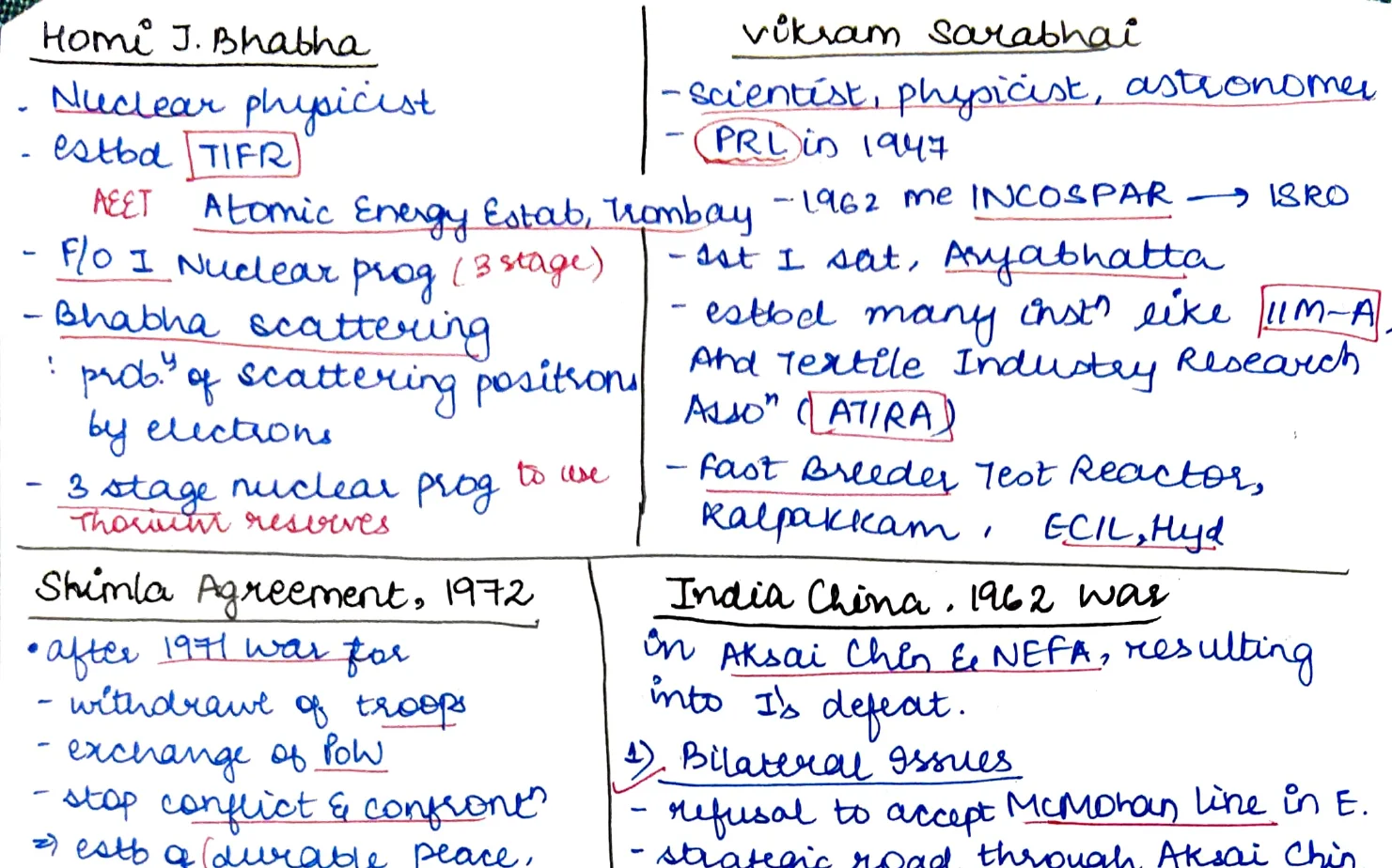
#Homi J. Bhabha
- Nuclear physicist
- Established TIFR [Tata Institute of Fundamental Research]
- AKA Atomic Energy Establishment, Trombay
- F/o [Father of] India's Nuclear Programme (3-stage)
- Bhabha Scattering
- Problem of scattering positrons by electrons
- 3-stage nuclear programme to use thorium reserves
#Vikram Sarabhai
- Scientist, physicist, astronomer
- PRL [Physical Research Laboratory] in 1947
- 1962 me [in] INCOSPAR → ISRO
- Set 1st satellite: Aryabhatta
- Established many inst[itutions] like IIM-A
- And Textile Industry Research Asso[ciation] (ATIRA)
- Fast Breeder Test Reactor, Kalpakkam
- ECIL, Hyderabad
#Satish Dhawan
- Initiated the Tikhka model [Tilak model]
- Space comm[ission] — PM to be headed by:
- DOS — Govt
- ISRO — [statutory] body (same inst[itution])
- Sat building (Aryabhatta, Bhaskar)
- Dev[elopment] of liquid engine tech (…vikas)
- Amalgamation of NAIR, Remote Sensing in ISRO
- RESPOND programme for R&D & collab[oration]
- Nurtured future leaders like APJ Kalam
#Shanti Swaroop Bhatnagar
- FIO [?] Research Labs → 1st DG of CSIR
- Improved crude oil drilling procedure
- Magnetochemistry — Chem Professor (1948)
- Industrial chemistry — bagasse → food cake (ash); established 12 Chem labs — pure on his name
- Sun Tzu — Best way to win a war is to prepare
#Shimla Agreement, 1972
- After 1971 war for:
- Withdrawal of troops
- Exchange of PoW [Prisoners of War]
- Stop conflict & confrontation
- → Establish durable peace, friendship & cooperation
- Mutually Agreed Principles:
- a) Respect Territorial sovereignty
- b) Non-interference
- c) Peaceful resolution through bilateral negotiation
- d) LoC in J&K
- "India won the war, but lost on diplomatic table."
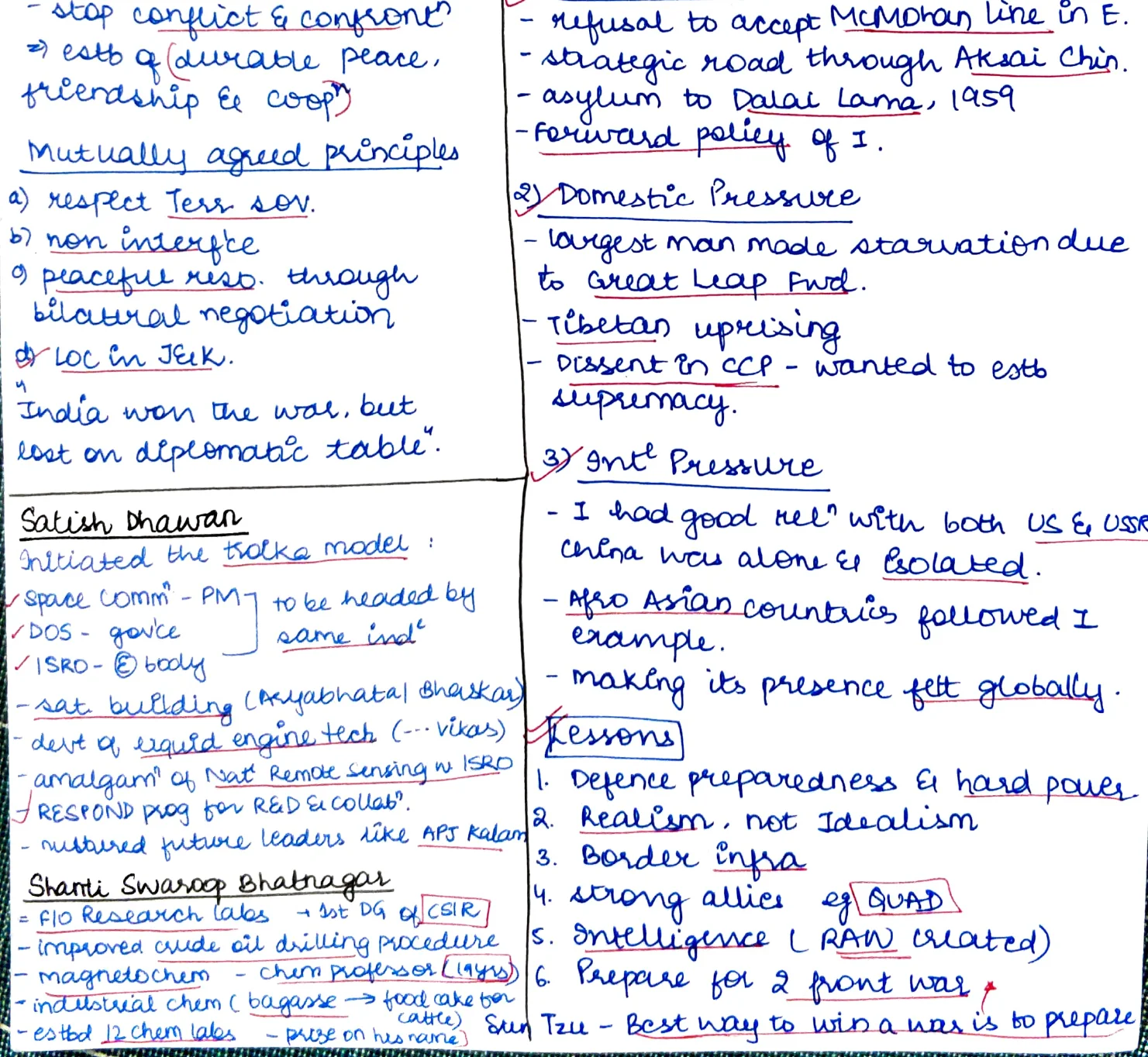
#India–China War, 1962 — Detailed Analysis
- In Aksai Chin & NEFA, resulting into India's defeat
#1) Bilateral Issues
- Refusal to accept McMahon Line in East
- Strategic road through Aksai Chin
- Asylum to Dalai Lama, 1959
- Forward Policy of India
#2) Domestic Pressure
- Largest man-made starvation due to Great Leap Forward
- Tibetan uprising
- Dissent in CCP — wanted to establish supremacy
#3) International Pressure
- China had good relations with both US & USSR; China was alone & isolated
- Afro-Asian countries followed India's example
- Making its presence felt globally
#Lessons
- Defence preparedness & hard power
- Realism, not Idealism
- Border infra
- Strong allies e.g. QUAD
- Intelligence (RAW created)
- Prepare for 2 front war
Sun Tzu — "Best way to win a war is to prepare"
Indian Society
Topper handwritten notes#Unity (Sense of Oneness)
- Unity = sense of oneness; based on:
- Similarity → traditional [trad'] societies
- Interdependence → modern societies
#Bonds of Unity in India
#1. Geographical Factor — Geo-political Unity
- Him [Himalayas] in N [North]; oceans on 3 sides; single citizenship; similar pol [political] culture; ditto [same] ethos etc.
#2. Geo-cultural
- Temple culture / rivers etc. to encourage pilgrimage (4 dham yatra [four abodes pilgrimage])
- Cultural → Religion
a) Intra-religious Unity
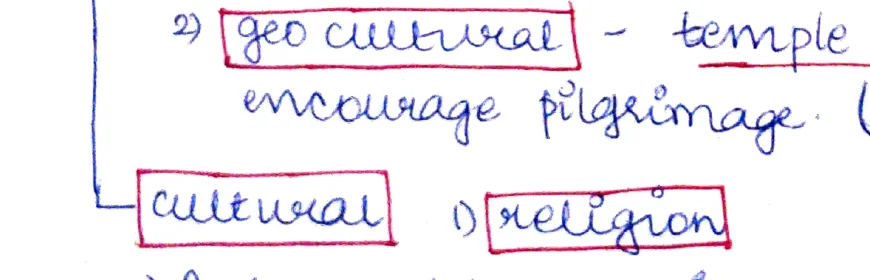
- Hinduism: sects / cults / mada → unified by teachings of scriptures
- All religions encourage peace, harmony, universal brotherhood
- All religious aim to attain salvation
- Hinduism → Moksha
- Islam → Jannat
- → Salvation
b) Caste — unified through eco [economic] coop [cooperation] or the erstwhile zamani [zamindari/jajmani] system
- Social status in society is also a unifying factor
- Eg: all SCs [Scheduled Castes] retaliate in unison against dilution in SC/ST Act → social cohesion
- Within linguistic diversity, SKT [Sanskrit] & English → unity
#3. Regional —
- Horizontal unity
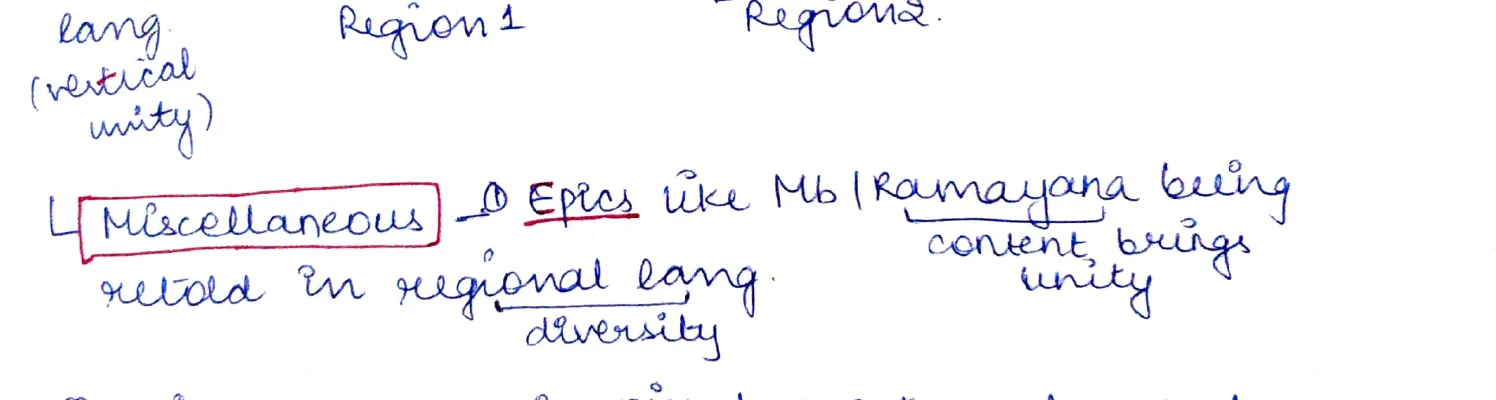
- Unified by a common lang [language] (vertical unity)
- Region 1: B / K / V / S
- Region 2: B / K / V / S
- Eg: Ek-wPak [erstwhile Pakistan] united horizontally by religion
#4. Miscellaneous
- Epics like Mb [Mahabharata] / Ramayana bring content bridge [bridging] unity — retold in regional lang [language] diversity
- Krishna legend inspired most of classical dance of India eg: Kathak, Bharatnatyam etc
- Broad features of trad' [traditional] Hindu society — Purusharthas, Dharma, Varna, Karma theory
- Modern edu [education]; social media; sports; patriotism; corporate culture; Bollywood [Bollywood]; Mela [fairs] → Music & dance
#Basic Attributes of Society
- Definite history
- Region
- Common culture
- Independent existence (culture etc.)
India doesn't have ③ so it can be better called an amalgamation of a different / multiple society.
- NARA — National Ambition, Regional Aspiration by PM Modi in 2019
#Unity in Diversity
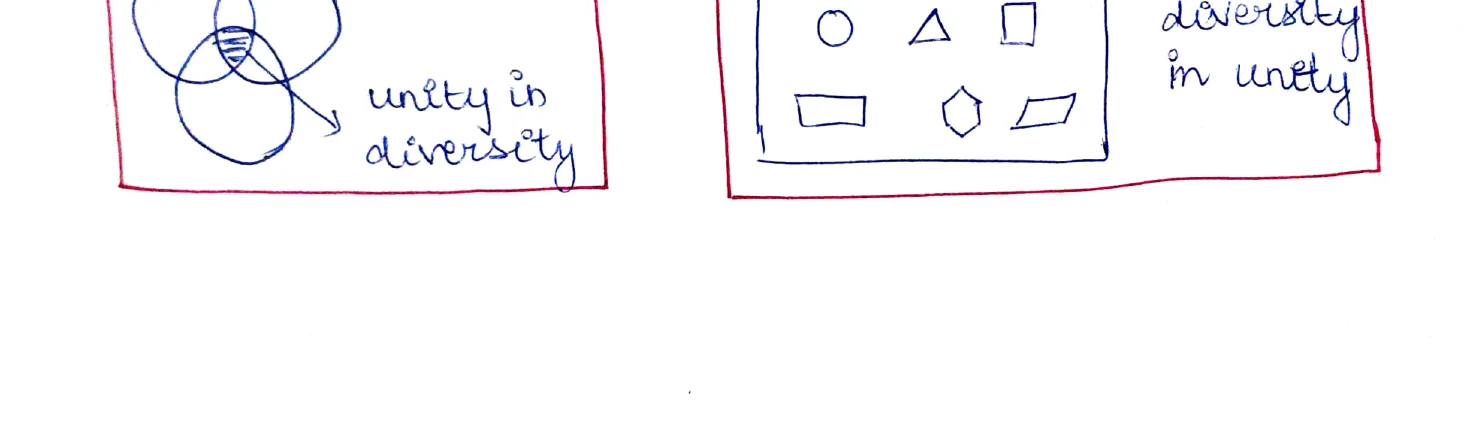
- Left diagram: Unity in diversity — Venn-type overlapping circles
- Right diagram: Diversity in unity — varied shapes coexisting in one frame
#Linguistic Diversity
- Extremely diverse (22 scheduled lang [languages]); 104 major lang with 1562 dialects and 6 classical lang
- Acted as a threat to diversity till 1947–67:
- Official lang issue
- Linguistic reorg [reorganisation] of states
- Both these issues were solved by 1967 as a no more a threat
- Contributes to nat [national] unity — Punjabi songs, Baahubali dubbed into regional lang; Hindi (works in entire country); Sanskrit as a source of all major lang
#Why Sons of Soil [Nativism] only in MH [Maharashtra], KN [Karnataka], NE [Northeast] not other areas?
- → no outmigration culture as in UP, PB [Punjab]
- → comp [competition] for middle class jobs
- Eg: Kerala no outmigration to Gulf — sometimes → people invested in land → influx of labour; but when global slowdown & migrants returned, no clashes as they were not looking for labour [jobs]
- → use by regional parties
- → feeling of relative deprivation
#Ghost Citizen
- A person who is a citizen of a country but can't enjoy the benefits of it
- Eg: prostitutes, women, migrants etc.
- Eg: Ramdan Hingabulshem vs Gyan Khant Rustle [illegible — case name]
#Salient Features of Indian Society
#Characteristics of Indian Society:
- Multi-ethnic
- Multi-lingual
- Multi-class
- Patriarchal
- Unity in diversity
- Coexistence of traditionalism & modernity
- Balance b/w [between] spiritualism & materialism
- Balance b/w individualism & collectivism
- Blood & kinship ties
#Features of Indian Society
#1. Caste System
- → hereditary endogamous group having a common name, traditional occupation, common culture & rigid rules of mobility
- → mainly associated with Hinduism
- → segmental division of society
- → hierarchy
- → endogamy
- → untouchability
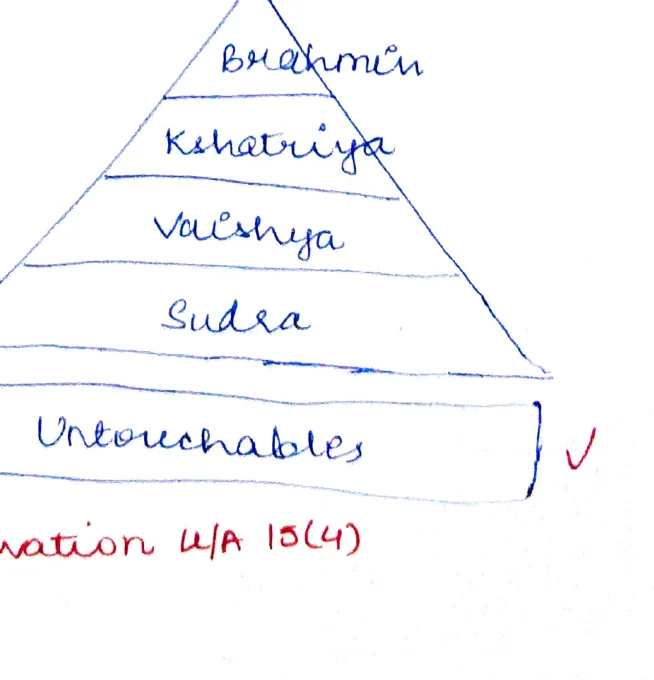
- Caste hierarchy (top to bottom):
- Brahmin
- Kshatriya
- Vaishya
- Sudra
- Untouchables
1.1 Changes in Caste System
- Trends for inter-caste marriage
- Challenging to orthodoxy
- New food habits
- Changes in occupation
- Improvement to lower caste
- Occupation of high posts (Reservation u/a [under Article] 15(4))
- Ted [Targeted] violence esp against women
- Manual scavenging
#Factors Affecting These Changes:
- Sanskritisation
- Westernisation
- Modernisation
- Industrialisation & urbanisation
- Democratic Decentralisation
- Caste & politics
- Legislative measures
#2. Religious Pluralism
#3. Kinship, Marriage & Familitarian Bonds
- Consanguineous — blood rel [relations]
- Affinal — marriage
- → North & South India
#Recent Changes in Marriage System (Intercaste Love)
- Aims & purpose — from dharma to life long companionship
- Form — monogamy dominates
- Age — post puberty to 18 to 21
- Indulgence & desertion cases — single parents ↑
- Live-in relationships
- Pomp & show — less ritualistic, more celebrations
#Family
#Characteristics:
-
Basic, infinite & enduring group
-
Smaller in size compared to other social groups
-
2001 census: out of 193m [million] HH [households], 7.98 cr [crore] or 51.7% were nuclear HH
-
In 2011 census the share grew to 52.1%
- → 52% nuclear family
#Framework for Impact of Global / Modern / Western on Any Institution
- Should not be +ve [positive] or -ve [negative] impacts
- It can be studied under: family → Structure, Functions, Interpersonal relations
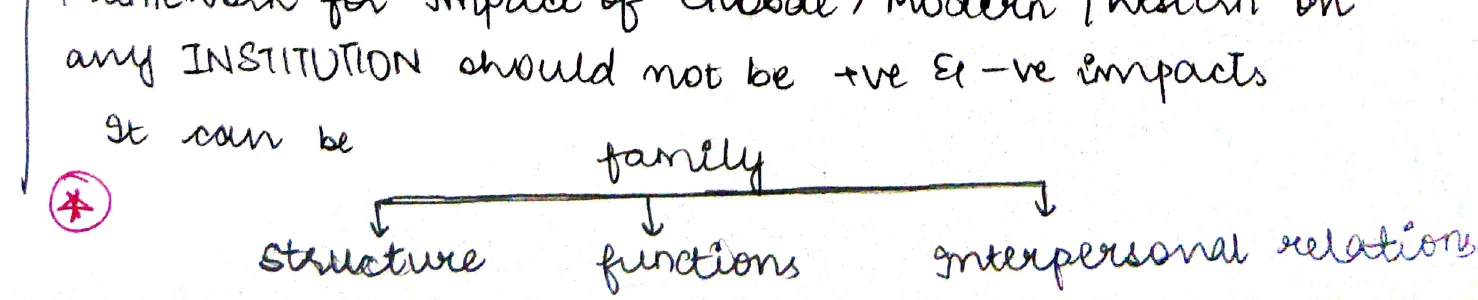
#Types of Family
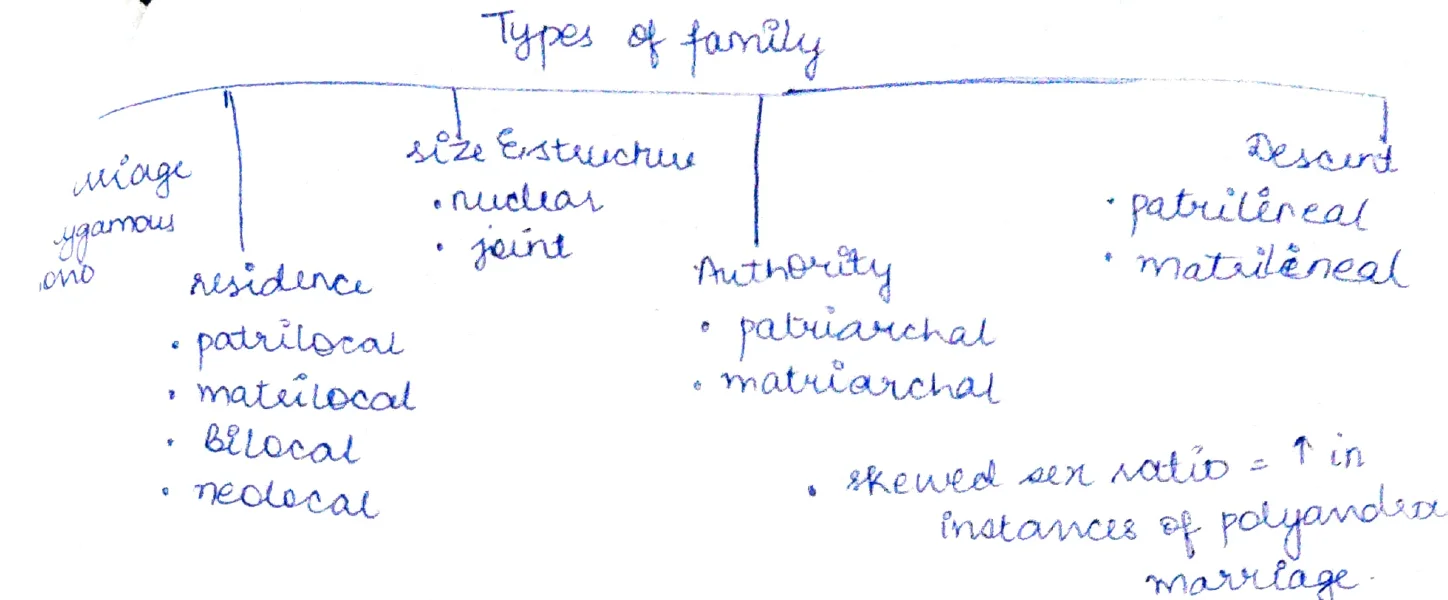
- Marriage (conjugal / [illegible])
- Size/Structure:
- Nuclear
- Joint
- Descent:
- Patrilineal
- Matrilineal
- Residence:
- Patrilocal
- Matrilocal
- Bilocal
- Neolocal
- Authority:
- Patriarchal
- Matriarchal
- → Skewed sex ratio → ↑ in instances of polygandrous [polyandrous] marriage
#Functions of a Family
Primary (boxed):
- Part in rearing of child
- Prevention of anomie [suicide]
- Instrument of cultural transmission
- Agent of socialisation
- Status of ascending f" [function]
- Agency of social control (suicide, delinquency)
- Agency of social insurance (old age/home)
Secondary (boxed):
- Economic
- Educational
- Religious
- Recreational
#Structural & Functional Changes in Indian Family System:
- Change in family
- Factory employment
- Influence of urbanisation
- Legislative measures
- Change in marriage system
- Influence of western values
- Changes in position of women
#4. Unity in Diversity
- Distinction = differences + inequalities
- Unity ≠ uniformity & diversity ≠ fragmentation (boxed)
- → religious diversity
- → linguistic
- → racial
- → caste
- → cultural
- → geographical
#Communalism
A phenomenon of religious diff [differences] b/w [between] groups that often leads to tensions b/w them. A man of religion is not communal but a man who practises politics by linking it with religion is communal. Hence we can define communalism as pol [politics] trade in religion.
- 3 stage — mild, moderate & extreme
- → multifaceted process based on Orthodoxy & Intolerance
- → propagate intense dislike of other religions
- → elimination of other rel [religious] & its values
- → adopts extremist attacks
- → exclusive in outlook
- → religious chauvinism
#Factors
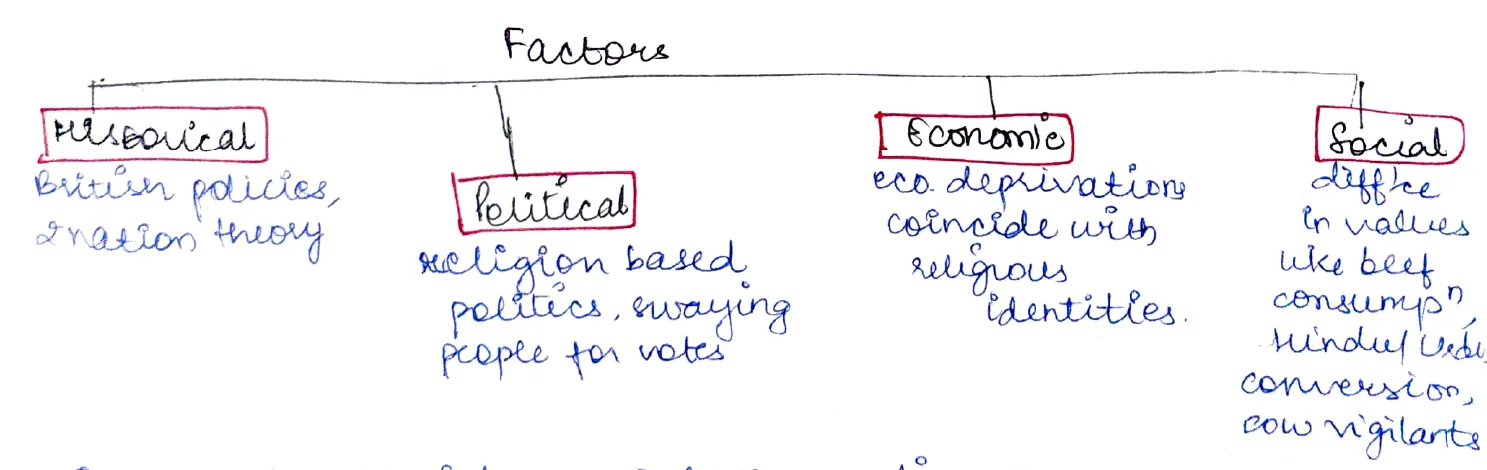
- Historical:
- British policies
- 2-nation theory
- Political:
- Religion based politics; swaying people for votes
- Economic:
- Eco deprivation; coincide with religious identities
- Social:
- Diff [difference] in values like beef consumption, Hindu-Muslim conversion, cow vigilantes
#Reasons for Persistence of Communalism:
- Slow dev [development] of economy
- Incapable cultural synthesis
- Perceived / relative deprivation
- Regional / racial imbalance
- Pol [political] mobilisation
#Measures to Address Communalism:
- Foster a secular culture — celebrating all festivals etc
- Swift & prompt response to radicalization
- Refrain pol parties from using religion
- Media should be sanitised & stopped from escalating cases esp of love jihad
- Strict action against mob violence
- Stern laws to be formulated by Parl [Parliament]
- Special courts for speedy justice
- Legal reforms & greater accountability of police in handling each case
- Encouraging pluralistic settlements
- Sachar Committee recommendation of creating an Equal Opportunity Court for Muslims should be implemented
- Secular edu = de-communalization of history edu
- Skilling members of minority communities to reduce economic disparities
- Role of religious leaders
- Uniform Civil Code
- Use of media, movies etc to promote religious harmony
- Ghettoization = concentration of a community in certain areas. Eg: NE exodus from Bangalore, Godhra 2002, Sikhs in Delhi after 1986 etc.
- ECI — any communal flavouring in election speech = ground for disqual [disqualification]
#Types of Communalism:
- Assimilation — eg Hindu Code Bill (no Hindu/Sikh/Buddhist gains) — not a threat (noted)
- Welfare of Jain scholarships
- Retractist — don't participate in politics — eg: Bahai faith of Islam
- Retaliatory — Hindu-Muslim — Threat (noted)
- Separatist — Punjab
- Secessionist — Khalistan
#Regionalism
A phenomenon in which people's political loyalties are based upon a region. It is rooted in Indian diversity of language, culture, tribe & religion & their geographical concentration.
- → conditioned by eco, social & politico-cultural disparities
- → a psychic phenomenon
- → built around group identity
- → exclusion of other people from taking benefits in a region
A pre-Independence phenomenon, which became predominant in the post-Independence period due to the following reasons:
- Democratic gov → all parts wanted benefits in the process → competition → regionalism
- Integration of princely states → people nursed loyalties to their old territorial units & princes (*)
- Reorg [reorganisation] of states on linguistic basis
- Personal & selfish ends of politicians
#Bases of Regionalism
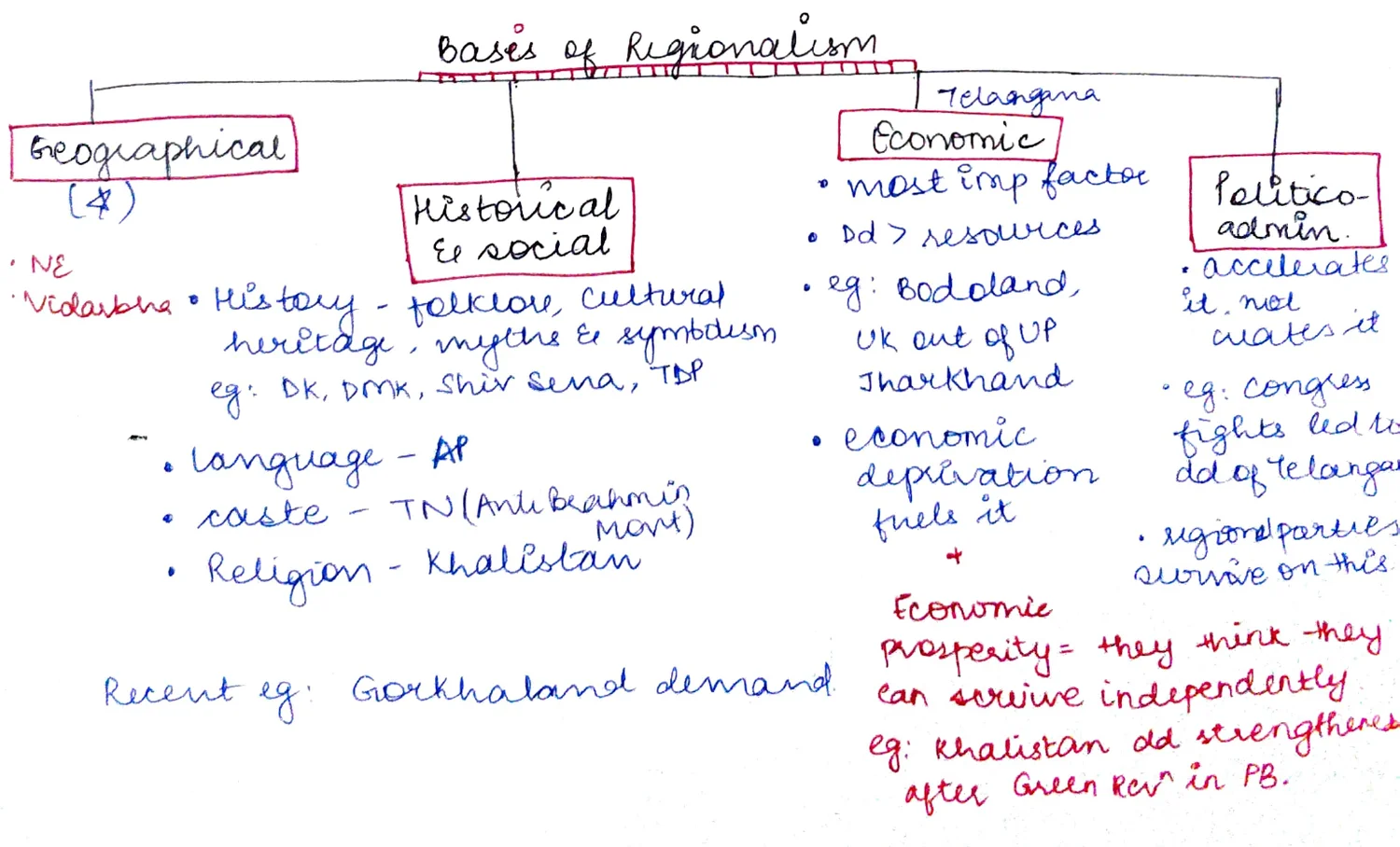
-
Geographical (*):
- NE
- Vidarbha — History, folklore, cultural heritage, myths & symbolism
- Eg: Dr. DM, Shiv Sena, 'TB' [illegible]
- Language — AP [Andhra Pradesh]
- Caste — TN [Tamil Nadu] (Mulk/Kashmiri [illegible])
- Religion — Khalistan
-
Historical & Social:
- Folklore, cultural heritage, myths & symbolism
-
Economic (most imp [important] factor):
- → D2 [demand for] resources
- Eg: Redland [Telangana], UK [Uttarakhand] out of UP, Jharkhand
- Economic deprivation fuels it
- Economic prosperity — they think they can survive independently
- Eg: Khalistan did strengthen after Green Rev [Revolution] in PB [Punjab]
-
Politico-admin [Political-administrative]:
- Accelerates if not attended
- Eg: converts rights led to delay of [illegible] language
- Expenditures divert on this
-
Recent Eg: Gorkhaland demand
#Forms of Regionalism:
- Demand for state autonomy — Nagaland socialist conference, Mizo National Front etc
- Supra state regionalism — more than one state is involved; Eg: North-South divide in India; groupings of NE states vs mainland on issue of Hindi imperialism
- Inter-state regionalism — eg river water disputes; changing; Eg: Vidarbha in MH [Maharashtra], Saurashtra in GUJ [Gujarat], Telangana in AP, Bagath [Baghelkhand] in MP etc; Gorkhaland [in W.Bengal]
- Son of soil theory — reservation of Marathi in MH, Delhi college 25% etc.
#Positive Impacts:
- Inter-group solidarity
- A source of identity in the world of "ting global"
- Induce competition → better promotion → economic dev [development]
- Renews federalism → Rep [Representation] democracy → fulfilll pol [political] aspirations
#Negative Impacts: (diff [difficult] to bring reforms eg [illegible])
- Hampers rational integration — "Ek Bharat, Shreshtha Bharat" [One India, Best India]
- Used for political gains
- Unbalanced dev → to curb it, regionalism
- Disturbs law & order, violence etc
- Gives a leeway to external factors eg: terrorism, extremism (national security)
- Federal & nat [national] foreign policy — Eg: India involvement in Sri Lanka due to Tamil issue
#Is Regionalism a Threat to NI [National Integration]?
- No — both R&N [Regionalism & Nationalism] can exist together in creative partnership. Both are in favour of dev [development]. It can make federalism a greater success & will reduce the centralising tendencies in a nation
- Should not be seen as crisis of unity but as crisis of dev [development]
- Either can be tackled through balanced growth, decentralisation, grass roots democracy & strengthening multicultural values
#Crime Against Women
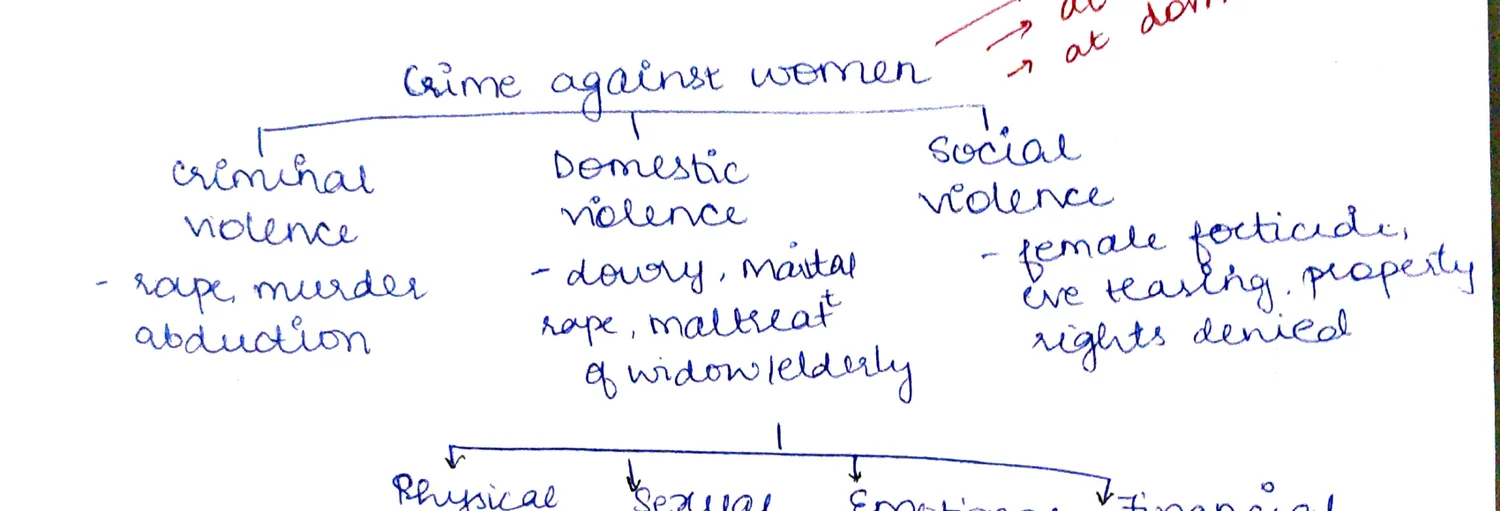
- Criminal Violence: rape, murder, abduction
- Domestic Violence: dowry, molestation, rape, maltreatment, abandonment
- Social Violence: female foeticide; live-in healthy property rights denied
- Types: Physical → Sexual → Emotional → Financial
#Gender Stereotyping → Social Manifestation:
- Caring & nurturing — domestic division of labour
- Soft skills — pink-collared jobs
- Emotional & lack rational DM [decision making] — glass ceiling
- Domestic resp [responsibility] — dual burden
- Weak, passive, dependent — violence
- Acc [According] to UN, women empowerment has 5 dimensions:
- Sense of self worth
- Access to Resources — socio, pol [political], eco [economic]
- Mobility to make decisions
- Control over their lives
- Ability to influence the direction of social change
#Children Issues
-
UNCRC [UN Convention on the Rights of the Child] — 18 yrs — In India:
- Child Labour Act < 14
- JJA [Juvenile Justice Act] < 16 to 18
- POCSO [Protection of Children from Sexual Offences] < 18
- Factories Act < 15
-
Rights → RT [Right to] survival; edu [education]; development; protect[ion]; participation; health & nutrition
-
→ India formulated Nat [National] Child Policy 2013 (13 key [illegible] satisfied)
-
NCRAG [Nat [National] Coord[ination] Action Group] for monitoring it
-
Gurupadsamy Report (1979) → ① pe aya child labour act, 1986 had said that till the time poverty exists in India child labour can never be eliminated
#Issues:
-
Child abuse (#3 children have faced — MoWCD [Ministry of Women & Child Development]) — causes: socio, psychic
-
Child labour
-
Child marriage (2011 census — 30% of all women married before 18)
-
Juvenile delinquency
-
Bal Panchayat
-
Acc [According] to Thomson Reuters Survey, India is the most dangerous country in the world for women.
-
33,601 no. 1 in child rape cases in 2010–14 — NCRB
-
Child Labour Prohibit Act, 2016:
- < 14: banned except [family enterprise, audio visual (except circus)]
- 14–15: allowed except prohibited industry [mines, hazardous process, inflammable sub]
- (list editable by G [Govt] info ①)
-
PMMVY [Pradhan Mantri Matru Vandana Yojana] → Rehab [rehabilitation]
-
Child & Adolescent Fund
-
(−ve): <14 supposed to study — dual burden → no diff [difference] of family enterprise = misuse → discourages secondary edu by allowing 14–15 → prohibited industry ↑ from 23 to 3 into further editable → no mobility for the fund
#Women's Movement
Genesis in Indian Freedom Struggle (MH [Maharashtra] stuff)
Post-Independence: 2 defining moments
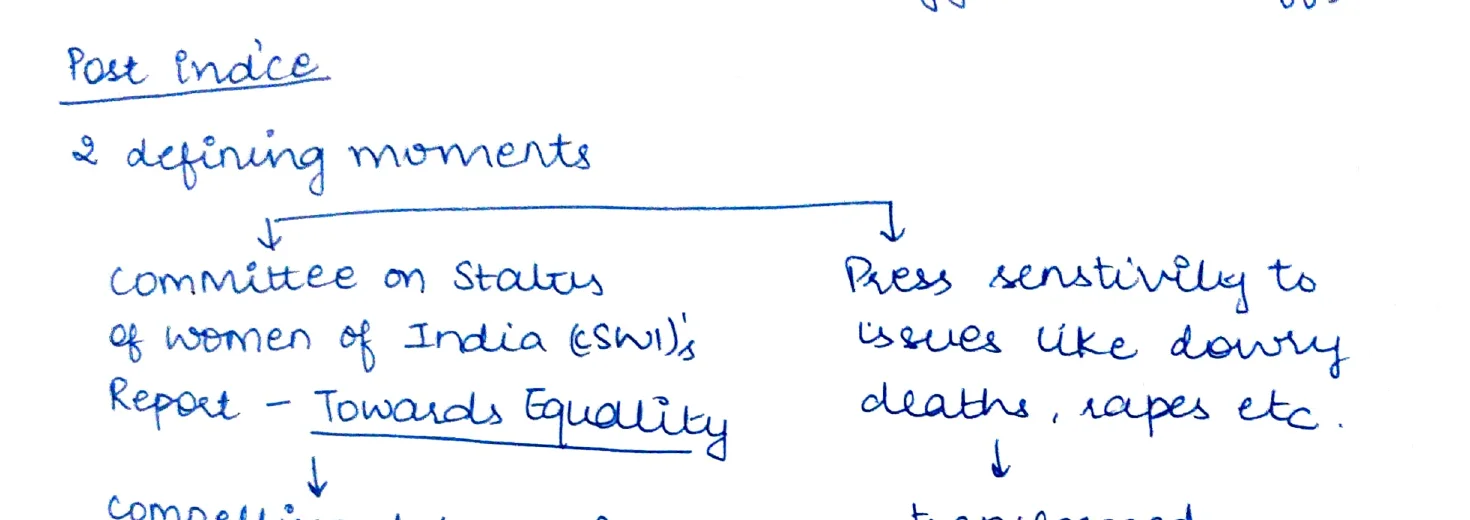
-
Moment 1: Committee on Status of Women of India (CSWI) Report — Towards Equality → compelling debates in Parl [Parliament] (before Emergency)
-
Moment 2: Press sensitivity to issues like dowry deaths, rapes etc → transformed consciousness
-
1980s = period of org [organisation] building & alliances / coalitions
#Issues Raised:
- Dalit women (Nat [National] Fed [Federation] of Dalit Women in 1987):
- Socio/eco/pol justice
- Rising sexual violence by upper caste
- Caste-based discrimination — state trust (police)
- Environmental / Green Mont [Movement] (Chipko etc.)
- Tribal Women
- Anti-alcohol (Guj [Gujarat] Nav Nirman Andolan [movement])
- Change in agenda due to Global:
- Women reservation bill in 91 & Parl [Parliament]
- Reproductive rights incl alternate sexualities
- Financial rights / property rights
- Workplace harassment (#MeToo)
- Climate change & women
- Campaign for reforms in family law (UCC [Uniform Civil Code])
- Dress code in public
#Phases of Women's Movement
- Bhakti marg [path] saints like Mirabai, Andal talked about equality — crude form
- But in true sense, started after British arrival
- Colonial period movement
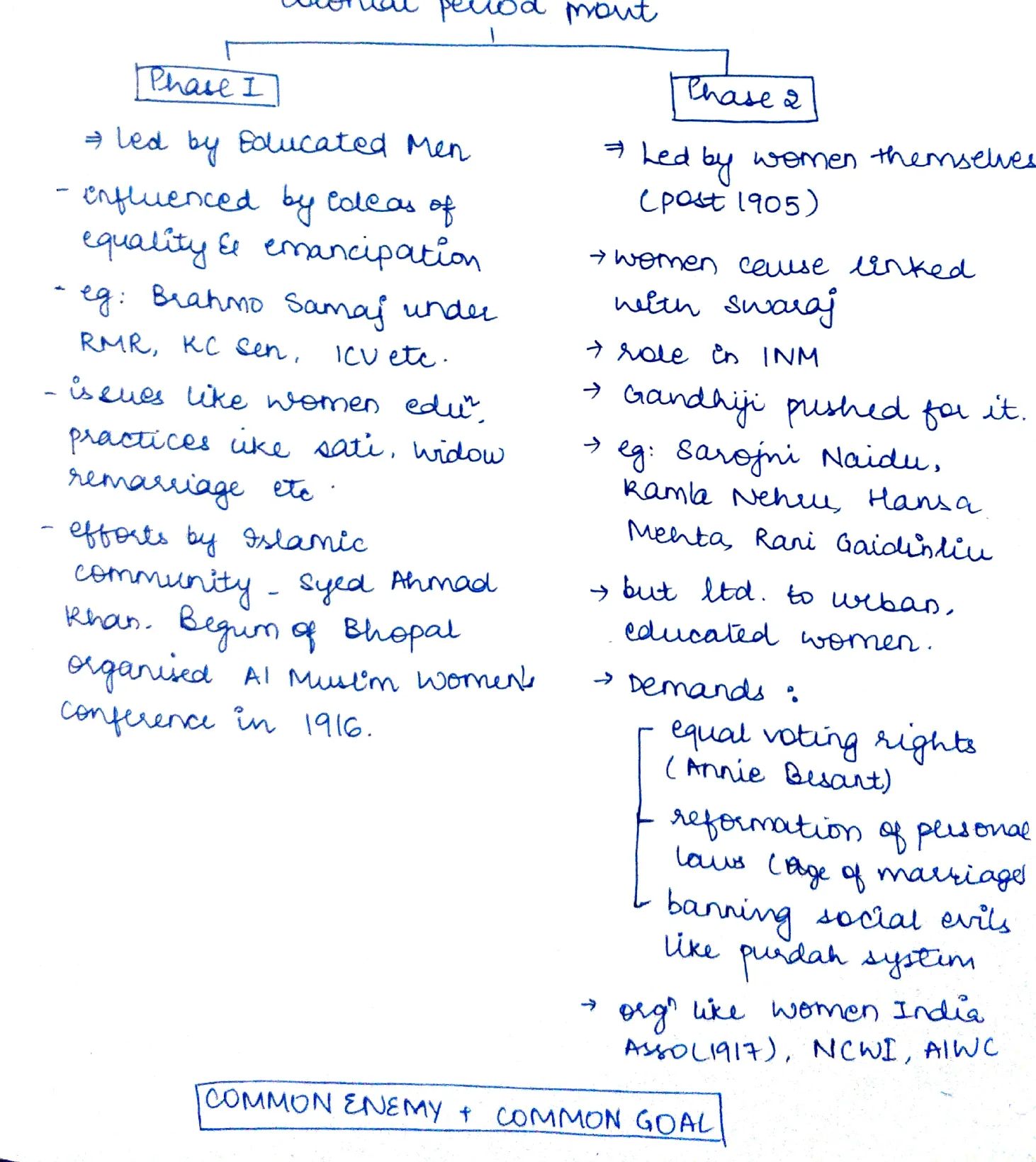
Phase 1:
- Led by Educated Men
- Influenced by ideas of equality & emancipation
- Eg: Brahmo Samaj under RMK [Ram Mohan Roy], KC Sen [Keshab Chandra Sen], ICY [Ishwar Chandra Vidyasagar] etc.
- Issues like women edu [education]; practices like sati, widow remarriage etc
- Efforts by Islamic community — Syed Ahmad Khan; Begum of Bhopal organised Al Muslim Women's Conference in 1916
Phase 2:
- Led by women themselves (post 1905)
- Women cause linked with Swaraj
- Role in INM [Indian National Movement]
- Gandhiji pushed for it
- Eg: Sarojini Naidu, Kamla Nehru, Hansa Mehta, Rani Gaidinliu [illegible — last name uncertain]
- But limited to urban, educated women
- Demands:
- Equal voting rights (Annie Besant)
- Reformation of personal laws (age of marriage)
- Banning social evils like purdah system
- Orgs [organisations] like Women India Asso [Association] (1917), NCWI [National Council of Women in India], AIWC [All India Women's Conference]
COMMON ENEMY + COMMON GOAL (boxed)
#Post-Independence Women's Movement
#Weakened as:
- No common enemy
- Built on nat [national] leaders
- Women leaders joined pol [political] parties
- Complacent due to const [constitutional] prov [provisions], social laws etc.
- (Women withdrew from public life)
#But when they started participating in social & economic sphere → faced discrimination
- → Rejuvenation of women's movement
-
- UN Decade of Women (1975–85)
-
- CSWI Towards Equality Report
#Major Movements:
i) Pol [Political] Movt — All India Democratic Women Asso [Association] (AIDWA) in 1981 (part of CPI)
- Dalit feminism (Mahila Samta Sainik Dal)
- Events like Shah Bano case gave pol [political] rallying points
ii) Non-Govtal [Non-Governmental] Movt — led by auto [autonomous] women org [organisations]
- Adopted protest policies
- Eg: 1972 SEWA [Self Employed Women's Association] by Ela Bhatt
- Progressive org [organisation] of women (1974); Hyd [Hyderabad] for removing sexual dev [division] of labour
iii) Issue Based Movt — anti-dowry, anti-rape
- Anti-sati (in 1987 new married Rajput widows Roop Kanwar was made sati on Sikar, Raj [Rajasthan])
#Women's Movement & Feminist Strands (contd. from Part 1)
#Issues Addressed by Women's Movements
- Alcoholism
- Domestic violence
- Eco [Ecological] feminism — Narmada Bachao & Medha Patkar
#Consequences / Outcomes
- Separate Ministry [for Women & Child Development]
- 33+ [33%] reservation in PRIs [Panchayati Raj Institutions]
- Progressive laws like:
- Domestic Violence Act, 2005
- Indecent Representation Act
- POSH Act, 2013
- Maternity Benefit [Act]
- Gender Budgeting
- Nat'l [National] Comm'n [Commission] for Women
- Inheritance rights in Mitakshara Hindu Law
- Efforts by corporates:
- eg: Zomato recently announced 10-day of menstrual leaves for women ee [employees]
- (CORPORATE FEMINISM)
#"Personal is Political"
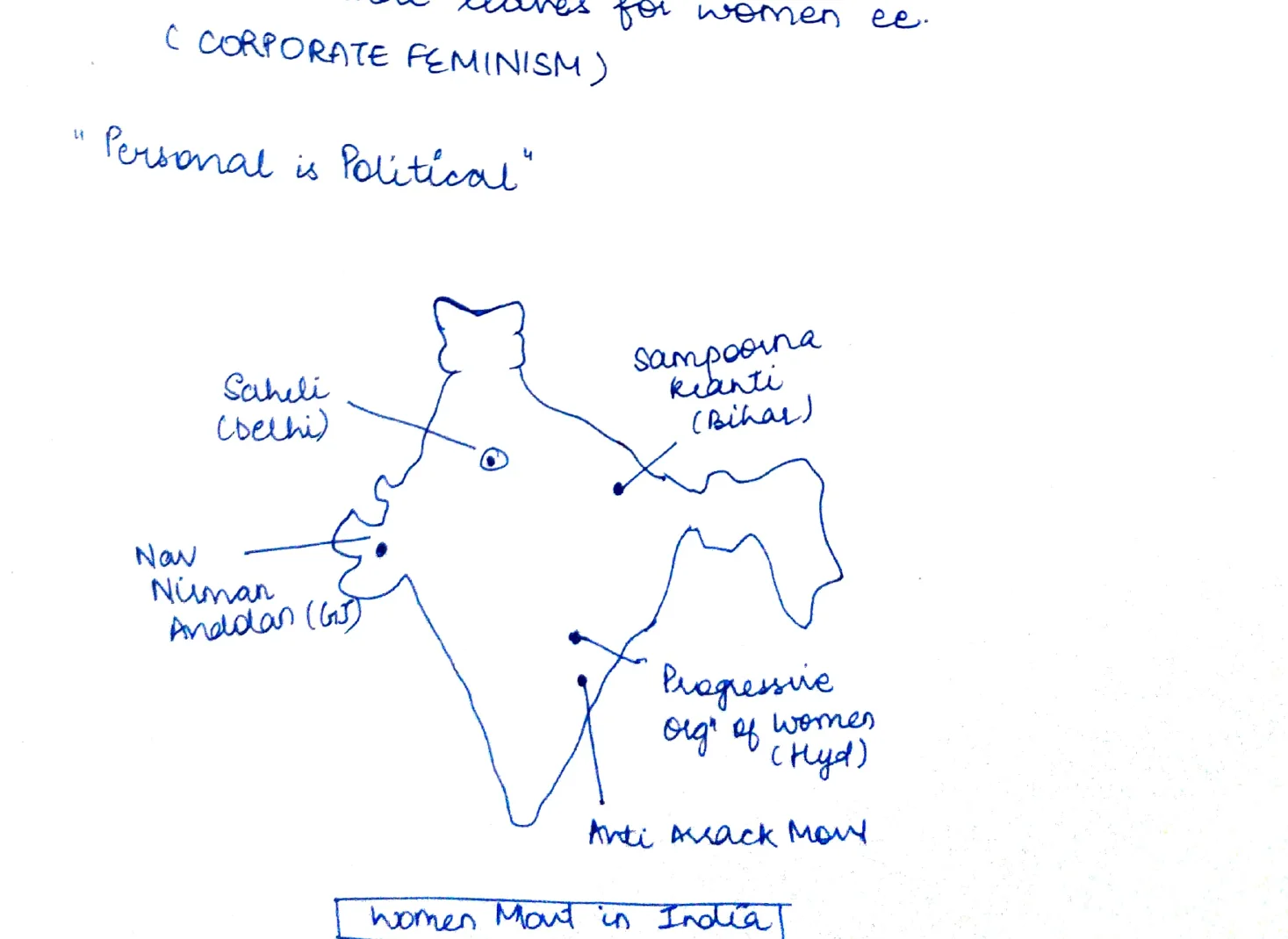
- Map showing Women's Movements in India:
- Saheli (Delhi)
- Sampoorna Kranti (Bihar)
- Nav Nirman Andolan (Gujarat [Guj])
- Progressive Org'n [Organisation] of Women (Hyderabad [Hyd])
- Anti Attack Mov't [Movement] (South India)
- Box label: Women Mov't in India
#Prevention of Sexual Harassment Act, 2013 (POSH)
- It clearly defines SH [Sexual Harassment], Aggrieved women & Workplace; applicable to both — formal & informal
- ICC [Internal Complaints Committee] — a local comp't [competent] comm'n [commission] chaired by woman, 50% members women
- Complaint filed within 3m [months] of incident
- ICC has power of civil court
- Enquiry to be done in 3m [months]
- Prov'n [Provision] of counter conte [conte = counter] in case of false complaints
- Non cognizable, bailable offence
- Mandatory for ee [employer] to estb [establish] ICC; penalty of ₹50,000
- Not gender neutral
#Domestic Violence Act, 2005
- In the backdrop of growing misuse of this Act, it is termed as 'New Legal Terrorism' by SC [Supreme Court]
- DV [Domestic Violence] is defined as:
- Actual abuse
- Threat of abuse
- It is verbal, physical, sexual, emotional, financial abuse
- Not gender neutral
- Women live in partner / wife / mother / sister / widow / single women / divorced wife
- It's a civil law which deals with secure housing, custody of child, compensation
- But becomes a crim'l [criminal] law in 1 matter — RT [Right to] protection
- Recently, the Act was amended to remove the term 'Adult Male' so as to make it gender neutral. However there are some concerns:
- Will encourage husbands to file counter cases
- An apprehension that about putting juveniles under the Act
- Since relief is only final & can be claimed only against adult
#Dowry
- NCRB data — highest dowry deaths in UP [Uttar Pradesh] followed by Bihar
- Considered main cause for skewed sex ratio
- Causes:
- Acceptance of dowry culture by both men & women
- Culture of consumerism
- Give & take culture (considered an inv't [investment])
- Lack of eye witness
- Delay in justice as dowry related accidents are projected as kitchen accidents
- 304B & 498A deal with dowry in IPC
- 498A deals with crimes committed both by husband & in-laws. It was cognizable, non-bailable & non-compoundable in law. It was cognizable & non bailable & non bailable but recovery if dowry items will not be basis for denying bail & parties can go for out of court settlement if they approach HC
- Problem of dowry can be addressed if there is attitudinal changes:
- Mass marriage
- Adarsh marriage by well-off peo[ple]
#Juvenile Delinquency
- "A child who has not attained a certain age at which he can be held liable for his criminal acts"
- JD = anti-social / criminal act of the child which violates the law
-
11lc [11 lakh] crimes are committed by JD today
-
50% of such JD cases were against women
- JD cases have constantly ↑ during last 5yrs
-
#Causes
- Poverty
- Family disintegration (at JF [Joint Family])
- Social media → peer culture
- Neighbourhood
- Mental health
- Virtual world
- Substance abuse
- Peer group (–ve [negative] influence group)
- Corruption of value system — Global? no value edu'n [education]
- Mostly a socially mfg'd [manufactured] act → Ashish Nandi
- Labelling theory
#JJ Act, 2015
- Sec 379 of BPC [CrPC] — offenders below age of 15 could be sent to Reformatory Schools estd [established] by SG [State Government]
#Reducing the Age of JDs?
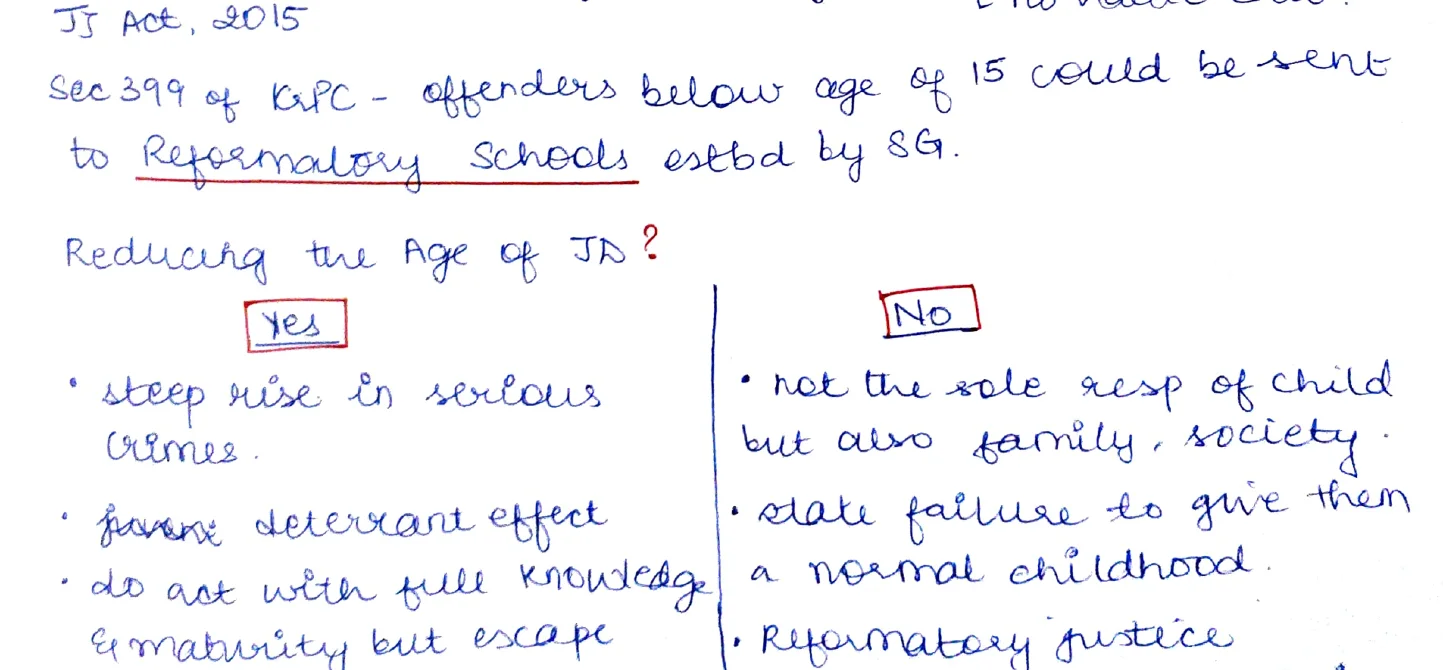
| Yes | No |
|---|---|
| Steep rise in serious crimes | Not the sole resp [responsibility] of child but also family, society |
| Proven deterrant effect | State failure to give them a normal childhood |
| JDs are with full knowledge / maturity but escape punishment | Reformatory justice |
| More toughened criminal after spending yrs in jail |
- → Juvenility should be decided on the basis of state of mind & not state of body solely
- Child guidance agencies
- UN Declaration of Rights of the Child
- Implications → Ind'l [Individual] / family / society / nation
#Indian Urbanisation
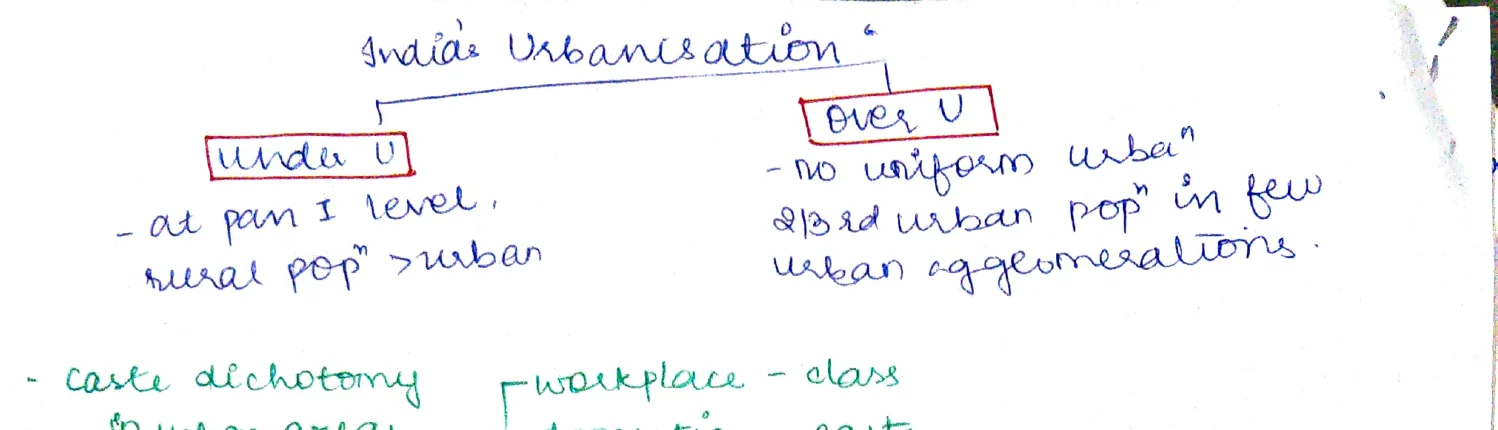
-
Under U [Urbanisation]:
- At pan I [Pan India] level
- Rural pop'n [population] > urban
-
Over U [Urbanisation]:
- No uniform urban [growth]
- 2/3rd urban pop'n in few urban agglomerations
-
Caste dichotomy in urban areas:
- Workplace → class
- Domestic → caste
-
Urban labourers commit max suicides
#Urban Areas Dichotomy
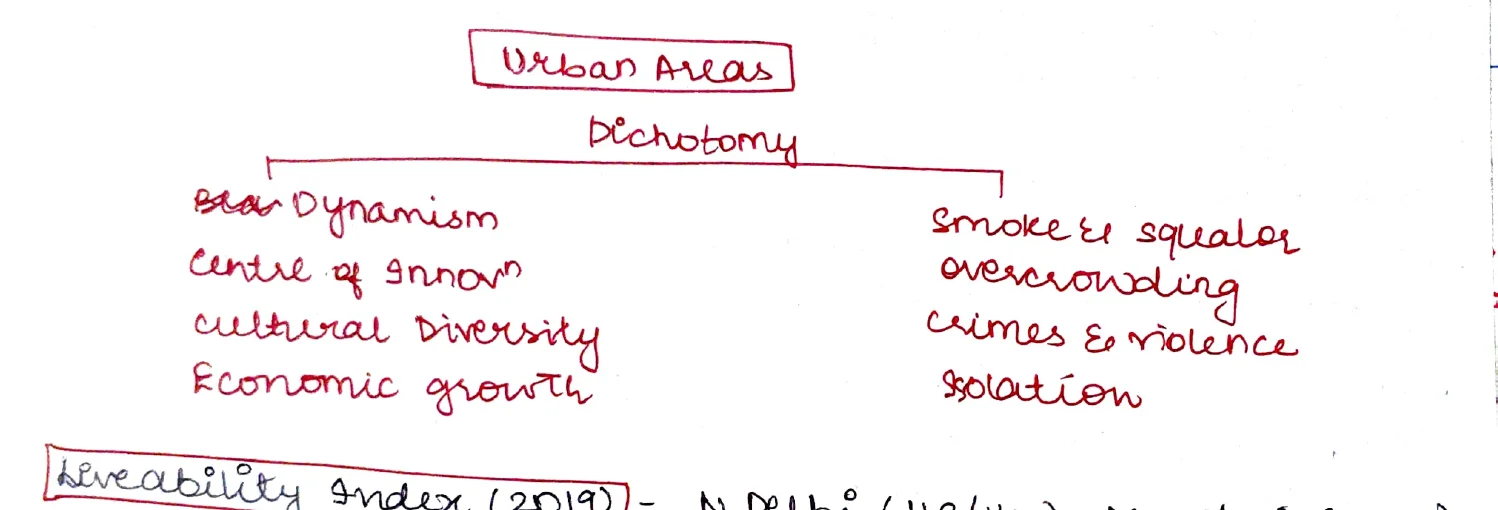
-
Urban Areas
- Dichotomy:
- [Positive side]:
- Star Dynamism
- Centre of Innov'n [Innovation]
- Cultural Diversity
- Economic growth
- [Negative side]:
- Smoke & squalor
- Overcrowding
- Crimes & violence
- Isolation
- [Positive side]:
- Dichotomy:
-
Liveability Index (2019) — N Delhi (118/140), Mumbai (119/140)
#Marginal Man
- A city dweller while living amidst a sea of fellow city dwellers & detached from them socially
- "acute isolation due to social rejection"
- Residential segregation
- Pockets of diff [different] groups — based on social status / profession etc; do not mix with others
- Urban pandemics
#Social Effects of Urbanisation
#1. Family & Kinship
- Loss of bonds; nuclear due to migration
- Caste system tends to diminish, but not complete elimination; it often co-exists with class (Caste-Class nexus)
- Women empowerment — but also crimes & all
#Problems of Urbanisation
"ToI [Times of India]: I live in sub std [sub-standard] house"
1. Housing & Inflated Land Prices
- SS [Supply Side] factors contributing to artificially high prices:
- As a legacy of Urban Land Ceilings Regulation Act, 1976; large chunks of vacant land have disappeared from land mkt [market]
- Many Govt PSEs [Public Sector Enterprises] occupy huge pieces of land
- CGSS [Central Govt] occupies substantial Urban unused land
- High compensation under LARR 2013
- Stringent land conversion rules
- Low permitted FSI [Floor Space Index]
"ToI report: 33:1. I live in space less than what an American Prisoner gets"
2. Housing Eslums [E-slums / Slums]
- Over-crowding
- Water supply — drainage & sanitation
- 30% of urban pop'n do not get safe drinking water — 2011 census
- Transportation & Traffic
- Pollution
- Governance Issues — 7
- Financing urban infra is a concern
- Strengthening municipalities
- While cities/towns → more inequality; [illegible] corps [corporations] high FSI — c'th [Commonwealth] report — recommendations for Urban Governance:
- Give them responsibility for water supply
- Sanitation to be given priority
- Encourage community participation & co-prod'n [co-production] of services
- Municipal bodies should take resp [responsibility] of power distribution
- PPP projects for garbage collection & disposal of garbage, where pop'n > 1 lakh
- Setting up of Urban Transport Authorities to be M/o [Ministry of] Unified Metropolitan Transport Authorities in cities with pop'n > 1 million
#Slums
- "Any area where those dwellings which are detrimental to safety, health or morale of people"
- Dilapidation
- Overcrowding
- Narrow, compact, faulty street arrangement
- Lack of proper lighting, sanitation, open spaces
#Factors for Rise [of Slums] — by Nat'l [National] Institute of Urban Affairs:
- Demographic dynamic of city attracting more people from rural area
- Its incapacity to meet huge housing dd [demand]
- Existing urban land policies which prohibit the access of poor to urban land mkt [market]
- Slums have their own way of life sometimes described as "Culture of Poverty"
- Slums = failure of welfare state = product of moral issue (apathy of govt)
#Govt Approach to Slums
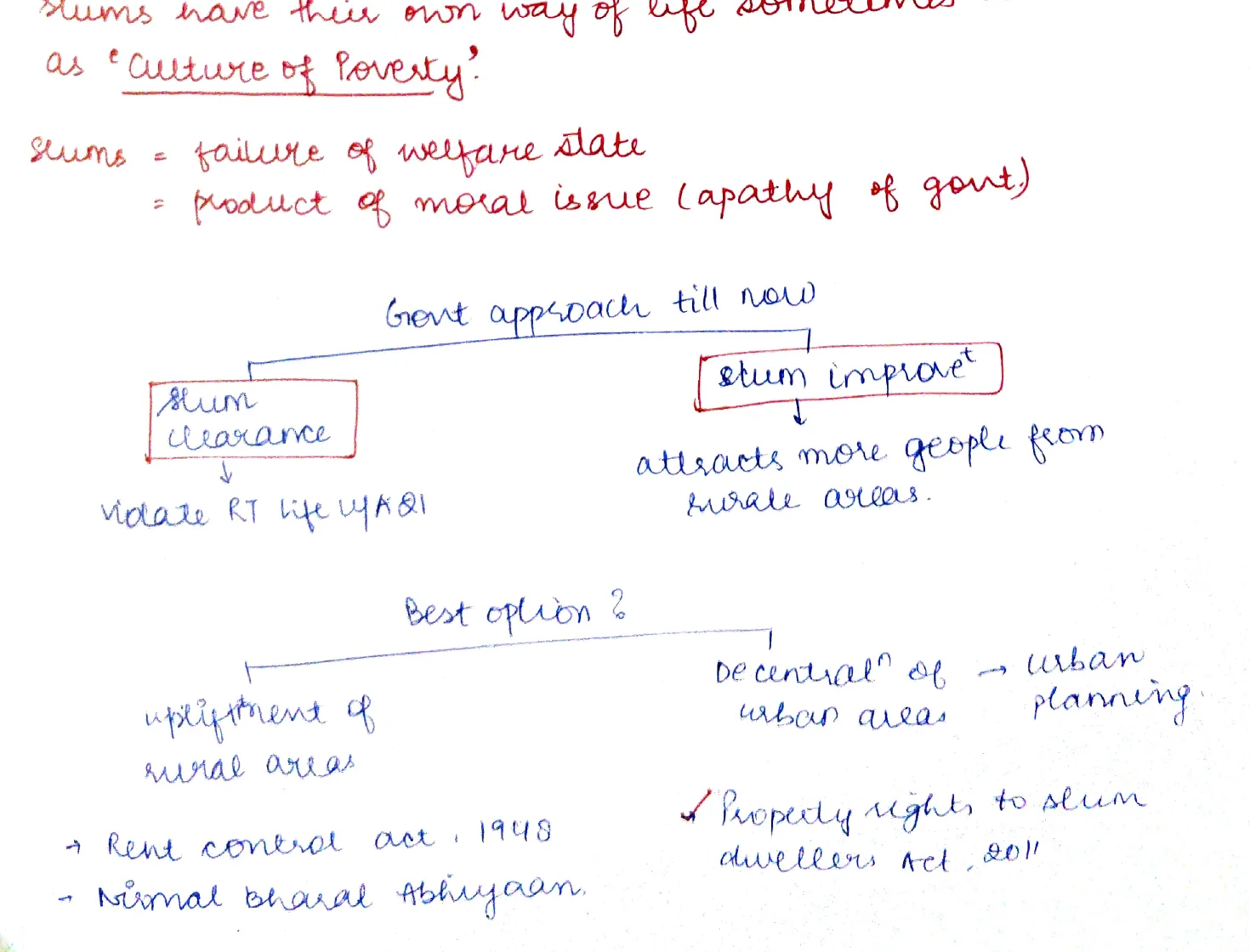
- Govt approach till now:
- Slum Clearance → Violate RT [Right to] Life (Article) 21
- Slum Improv't [Improvement] → attracts more people from rural areas
- Best option?
- Upliftment of rural areas:
- Rent Control Act, 1948
- National Bharat Abhiyaan
- De-central'n [Decentralisation] of urban areas → Urban Planning
- Property rights to slum dwellers Act, 2011
- Upliftment of rural areas:
#Globalisation = Integration of 4Fs [Food, Film, Fashion, Finance? / Factors of Production]
#Impact on Indian Culture
- Cultural diffusion
- Cultural revival
- Cultural clashes
#Homogenisation vs Glocalisation
- Glocal: Strategy adopted by MNCs dealing with local traditions to enhance their marketability; eg: Onidpp [Onida], Hindi Kaun Banega Crorepati [KBC], Mc [illegible]
- Ritzer (2001) coined the word Glocalisation — groups impose, org [organisations] tend to expand globally & to impose themselves on the local
- "Think Global + Act Local" = "Glocal"
| Homogenisation | Glocalisation |
|---|---|
| 1. Family → nuclear | 1. Food — Paneer Tikka Pizza |
| 2. Food — fast food taking over; paranthas' role over; filter, local restaurants replaced by McD, KFC | 2. French, German, Spanish being taught in school — "hybrid" |
| 3. Taking loans is becoming more acceptable | 3. Popularity of foreign movies; Korean, Chinese, cricket but dubbing |
| 4. Multiple theatres over old cinema halls | 4. Festivals — Valentines, Friendship [Day] |
| 5. Use of English | 5. Marriage forms are changing but it has not declined as an inst'n [institution] |
| 6. Yoga, etc. |
#2. Revival of Culture
- Yoga — for career by Bari Shankar, Svital [Srithal?] yoga day
- Revival of Ayurvedic medicine
- Held Cram Physia in US though Amazon
- Incentive for local handicraft of Banarasi, chikankari
- Identity & traditions are being preserved for showcasing to global tourists
#3. Cultural Clashes
- Adults do not approve of live-in, PDA [Public Display of Affection] etc
#Impact of Globalisation on Women
#Positive vs Negative
| Positive | Negative |
|---|---|
| More opportunities | Exploitation of women — law, pay, social security, safety norms etc |
| Higher pay → confidence & Index | Not relieved of domestic chores — a full time jobs (DUAL burden) |
| Urbanisation → greater recognition of women's role & their self-sufficiency | Sexual harassment at workplace, while commuting, foreign city / country |
| Shift in family s't [structure] — women go out to work; husband vin [in] duo cooperate | Global has occurred with persistence of patriarchy → commodification of women / rising violence against them |
| Feminism — women are becoming more vocal | Prostitution, abuse & dowry on rise |
| Use of women → improved health | ↑ in mental health = ↑ in suicides (33% of women suicide in India) |
| Red [Reduced] use of contraceptives, even in rural areas | |
| More acceptance to western clothes | |
| Equal partners in growth | |
| Growing awareness about their rights | |
| Work from home |
#Impact on Youth
- Paradox of red [reduced] economic opportunities & ever rising unemployment
- Migration is more frequent — job & edu'n [education]
- Wisdom to blur [blur] from traditional family norms, occupation
- Most highly regarded careers like CSS [Civil Services], Engg [Engineering], Medicine are giving way to high paying jobs in tech
- Obsessed with $$$ [money] / carry & quick money
- Fit for cosmopolitan society
- Globally influenced opinion
- Global Icons — they belong to a much bigger community than the comm'y [community] they were born into
- Embracing of western culture
- Growing consumerism
- Decline of traditional dress, food & way of life
- Not close to grandparents — decline in family values
- A lot uncertainty
#Impact of Globalisation on Family
- Weakened family net'k [network] due to red [reduced] mobility
- New forms emerging — single parents, live-in, female headed
- Dual career family
- Loosening of family bonds
- Care of aged has declined
- Shall'w [Shallow] extramarital, love marriage
- State has taken over family's role in edu'n [education] of child
- Some int'l [institutions] intact — primary agency of child / agency of social control
- Shift of authority from eldest male towards bread winner
- Greater role of women
- Growing burden to young gen [generation]
- Due to techno-connectivity with extended kins has improved
#Impact on Caste
- Weakened due to red [reduced] economic opportunities, edu'n [education] & liberal thoughts
- Inter-caste marriages gaining more acceptance
- Breakdown of traditional division of labour
- Red [Reduced] interaction b/w [between] members of diff [different] caste
- Urban → secular pattern of living & de-separation of context aspect
#Socio-Economic Impacts of Globalisation
- Red [Reduced] rate of growth
- ↑ in innovations & culture of startups
- Access to global capital resources
- LPS allows in PSUs
- ↑ in Tourism
- Boost to urban & industrial [sector]
- Expansion of sectors like IT, Telecom, Aviation, Ecommerce
- Quality products & ↓ed prices
- Improved access to tech — health but also greater spread of diseases / Medical Tourism
- ↑ing poverty — "trade is good for growth; growth for poor"
#Impact of Globalisation on Employment
- Encourage FDI — greater emp't [employment]
- ↑ Interpersonal & inter-regional income inequalities — casualisation of workers — low pay, casual work arrangements
- Gig economy / freelancing
- Increased job hikes due to FTE [Free Trade]
- ↑ in real wages of casual labour
- Shift in composition of labour in favour of skilled labour
- Rural mobility of workers
- Feminisation of workforce
- Child labour — substitution effect [replaced by adult female]
- Since IR [Industrial Relations] — long consultation, cooperation & consensus
#Impact on Informal Sector
- Shift from secure self emp't [employment] to more precarious w't [work]
- Subjects them to enhanced competition
- Weak bargaining power
- Pressure on low-skilled workers & pay reductions
- Lack of skills → more men enter informal sector → pushes females to lower income end
- Reinforces links b/w [between] gender, poverty & informality
- New opportunities for informal workers + new market
#Impact on Agriculture
- Local / traditional crop → Cash crops
- Progress in farm mechanisation, though its spread has been uneven (~40% in India)
- Emulation of global best practices — Israel's drip irrigation
- Intro of new water saving methods — drip irrigation
- Subsistence farming → Capitalist & contract farming
- Red [Reduced] access to local markets but constraints like inferior, stringent quality norms
- More special cos & ↑d seed prices
- Red [Reduced] funding of agri products
- Feminisation of agri [agriculture]
#Impact on Environment
#Negative Effects
- Reduced genetic diversity in agri, loss of wild species, spread of exotic species, "pollution" of air / water / soil
- Accelerate climate change, depletion of resources, social & spiritual disruption
- Red [Reduced] consumption = disturbed ecological balance
- Ozone depletion — GHG emissions
- Oceanic acidification, pollution, threat to marine life, oil spills
- Red [Reduced] use of chems [chemicals] → interferes with genetic makeup of plants
- Clearing of forests, mountains
- Red [Reduced] vulnerability of ecosystems & core
- Livelihood of poorest at risk
#Impact of Env'n [Environment] on Global [economy/politics]:
- Natural resources are drivers of global [economy]
- Need for env'l [environmental] amelioration can extract core from economy & siphon resources away from dev't [development] goals
- Env'l [Environmental] crisis can trigger alternative tech paths of renewable energy
- Env'l kids influence patterns of trade
- eg: EU vs deal
#Globalisation as a [Framework]
- Prescription [Normative]:
- Liberal of nat'l [national] & global; mix in the belief that free flow will lead to better human welfare
- Description [Descriptive]:
- Describes widening & deepening of int'l [international] culture, flow of cap't [capital], tech, etc.
#Factors for Rise [of Globalisation]:
-
a) Tech
-
b) LPG reforms [Liberalisation, Privatisation, Globalisation]
-
c) Int'l [International] org'n [organisations]
-
d) Improved mobility of cap't [capital]
-
e) Rise of MNCs
-
f) Comparative advantage in economies
- Economies of scale
- Diff'ce [Difference] in tax regimes
-
Walmartisation: Big fish eating small fish (Matsyanyaya)
#Secularism
#Models around the World
1. British model — pseudo
- Calls itself secular but provides financial assistance to church; welfare org'n [organisations] (not to ethnic)
- [In practice] "in public spaces"
2. American model — complete sep'n [separation] + allows rel'n [religion] in private life
3. French model — secular in true sense but prohibits citizens from carrying religious symbols in public spaces
- No Turkish Burqa (kla [aka] Laicite)
4. Communist model — state is anti-religion
5. Turkish model — 99% are Islam-fellows yet state suppressed its secular majority community in name of secularism
6. Israel model — Jewish state but declares itself as secular but the very found'n [foundation] of country is on religious lines
7. Indian model
#Indian Model — Rajeev Bhargava's "Principled Distance"
- State interferes in diff [different] religion in diff [different] context on diff [different] time
#Features:
- No strict boundary b/w [between] religion & state
- eg: Sabrimala, Kumbh Mela, Somnath temple maintained by Orissa [Odisha] govt
- No active hostility against any rel'n [religion]
- Not guided by any particular ideology
- Context-specific — ethnically sensitive & pol'y [politically]-negotiated
- Diff [different] rel'n [religion] present in founder of state (FRs [Founding Rulers?])
- Moral ↑ [uplift] — tolerance
- No prohibition on use of religious symbols in public sphere
- Judiciocrism — Judiciary's over involvement in religious matters
- Sarnaxa — Nikhil Soni vs Rajasthan HC
#Indian Secularism vs Western Secularism
- Western model = Neutrality + Apathy → Impartiality
- Indian = " " + Empathy → Harmony
#Untouchability
- Not just avoidance of physical contact but the social distance that various castes maintain from lower caste
- Efforts of BR [Bhimrao Ramji] Gandhi → Art [Article] 17 to ©
- Manifest practices checked but still exists in latent forms:
- (Social problem resolved by Pol [Political] method = didn't work)
- Job mkt [market] — manual scavenging, garbage collect'n [collection]
- Sep [Separate] utensils to house
- Sep [Separate] burial grounds in rural areas
- Caste-based politics
- Still live in outskirts → subculture / culture of poverty
- Labelling theory → crimes, alcohol
- Caste-class nexus
- Endogamous marriage — honour killings
#Way Fwd [Forward]:
-
Edu'n [Education] & emp't [employment]
-
Eco dev't [Economic development]
-
Encourage inter-caste marriage
-
Leverage tech (Bandicoot [robotic scavenger])
-
CSOs [Civil Society Organisations], IVOs [Integrated Volunteer Organisations]
-
Strict enforcement of laws
-
In India, wall b/w [between] state & religion is selectively porous:
- State can intervene in religion
- Religion can't [cannot] intervene in state
- Diagram: Two circles labelled S [State] and R [Religion] with a dashed line (porous wall) — arrow from S → R (state can intervene in religion); arrow from R to wall blocked with X (religion cannot intervene in state)
#Tribal Communities in India
#Definitional Problems — Assumed to be... but:
- Living in forest — tribals of Surat in plains
- Primitive religion — continuance from tribal gods to Hinduised tribes to Christianity, Islam
- Geographic isolation — Bhils, Santhals integrated in RJ [Rajasthan], MH [Maharashtra]
- Economic backwardness — self-sufficient & better than many cases; eg: Khasi, Gond, Bhil
- Common language — E [Eastern] vs [and] NE [North-East]
#Constitutional Safeguards:
- A15(4) — edu'n [educational] advanc't [advancement] of STs → reservation
- 46 — State Promote edu'n & eco [economic] interest of SC [Scheduled Castes] & ST [Scheduled Tribes]
- 330 — seats reserved in LS [Lok Sabha] & VS [Vidhan Sabha]
- 332 — [same as above for states]
- 338B & 1A — NCST [National Commission for Scheduled Tribes]
#Initially Tribals Were Ignored Because of [→ "Internal Colonialism"]:
- Partition
- States re-org'n [reorganisation]
- Land reforms
- Need for industries (1952 policy based on paramount nat'l [national] needs)
- Forest
- Less pol [political] mobil'y [mobility]
- Wars etc.
#Colonial Policies & Tribes = CAFE = Excl [Exclusion]:
-
Christian missionaries, Admin pol [policy], Forest policies — Exclusion (policy of isolation)
- Santhal ris'g [rising]
- Govt. discretion → Dalhousie:
- Leak: a state property by Dalhousie
- 3 types of forests
-
1952 policy → 1988 policy → PRA 2006
-
Sex ratio in ST = 990 !
#Tribal Issues — Integrationist vs Isolationist Debate
#Integrationist Approach — Tribal Panchsheel of Nehru (CLTOR)
- C — No imposition; encourage tribal genius & culture
- L — Land & forest rights to be respected
- T — Train & build a team of tribals to further develop tribals
- O — Over-administration to be avoided
- R — Results to be judged not in quantitative but qualitative terms (human character evolved)
- → Policy endorsed & elaborated by Dhebhar Comm [Dhebhar Commission]
- → Successfully implemented only in MNP [Malabar/[illegible] National Park — context unclear; likely "AMP"]
#Problems Faced by Tribals
- Displacement
- Rights over forest
- Naxalism
- Poor dev [development] indicators
- Stigma over tribal identity
- Lack of voice & choice
- Tribal elites capture benefits
- Environmental degradation affecting their lives & livelihoods
#Xaxa Comm [Committee] (2)
- Empower Gram Sabha
- Tribal co-ops for mining
- No to big dams
- Naxalite killings to be probed
#Govt [Government] Efforts
- TSP [Tribal Sub Plan]
- MOTA [Ministry of Tribal Affairs]
- TRIFED [Tribal Cooperative Marketing Development Federation]
- PESA [Panchayats (Extension to Scheduled Areas) Act]
- NCST [National Commission for Scheduled Tribes]
- MFP [Minor Forest Produce]
- Tribes India [scheme]
- Van Bandhu Kalyan Yojana
- FRA [Forest Rights Act] review
- PAAGATI [scheme]
- DMF [District Mineral Foundation]
- PVTGs [Particularly Vulnerable Tribal Groups]
- Eklavya schools
#Middle Class in India
#Definition
- The Economist defn [definition] — If more than 1/3rd income is left after paying for food & shelter
#Evolution — 4 Phases
- Phase I — Colonial period — tax collectors etc.
- Phase II — Indian Renaissance — modern edu [education], freedom movt [movement] etc.
- Phase III — Post-Indce [Post-Independence] — edu [education], reserv'n [reservation], GR [Green Revolution] etc.
- Phase IV — Post LPG [Liberalisation, Privatisation, Globalisation] — salaried class ↑
#Causes for Rise
- Political — democracy, part [participation] in DM [decision-making], adult franchise etc.
- Social — sanskritisation, spread of edu [education] etc.
- Eco [Economic] — commercial & industrial
- (MC [Middle Class] are still in the process form'd [formed], not yet acquired a stable form)
- Rural vs Urban MC
- Denationalised MC
#Great Indian MC [Middle Class]
- 2005 — 5%
- 2015 — 20%
- 2025 — 40%
#Features — Tremendous growth in nos. [numbers]
- Changed class structure:
- Rich → Rich
- Poor → MC [Middle Class] + Poor
- Role in PEST [Political, Economic, Social, Technological]
- Social Hfg [Hashtag/Harbinger?] in policies & there role as 3Is [Initiator, Indicator, Integrator]
- (Initiator, Indicator, Integrator)
- Globally becoming Glocal due to large MC in India
- eg: McD [McDonald's] local menu
- Alienated due to:
- Ambitions
- Nuclear [family]
- Denationalised
- Consumeristic culture
#Transgenders
#Key Data
- 4.8L [4.8 lakh] transgenders in India as per Census 2011
- 89% have no jobs (50-60% → no school)
#Definition
- A person whose gender does not match with the gender assigned at birth
#Yogyakarta Principles (mentioned as side note)
- 13 transgenders in police service in 3 govts [governments]
#Flowchart — Cycle of Marginalisation
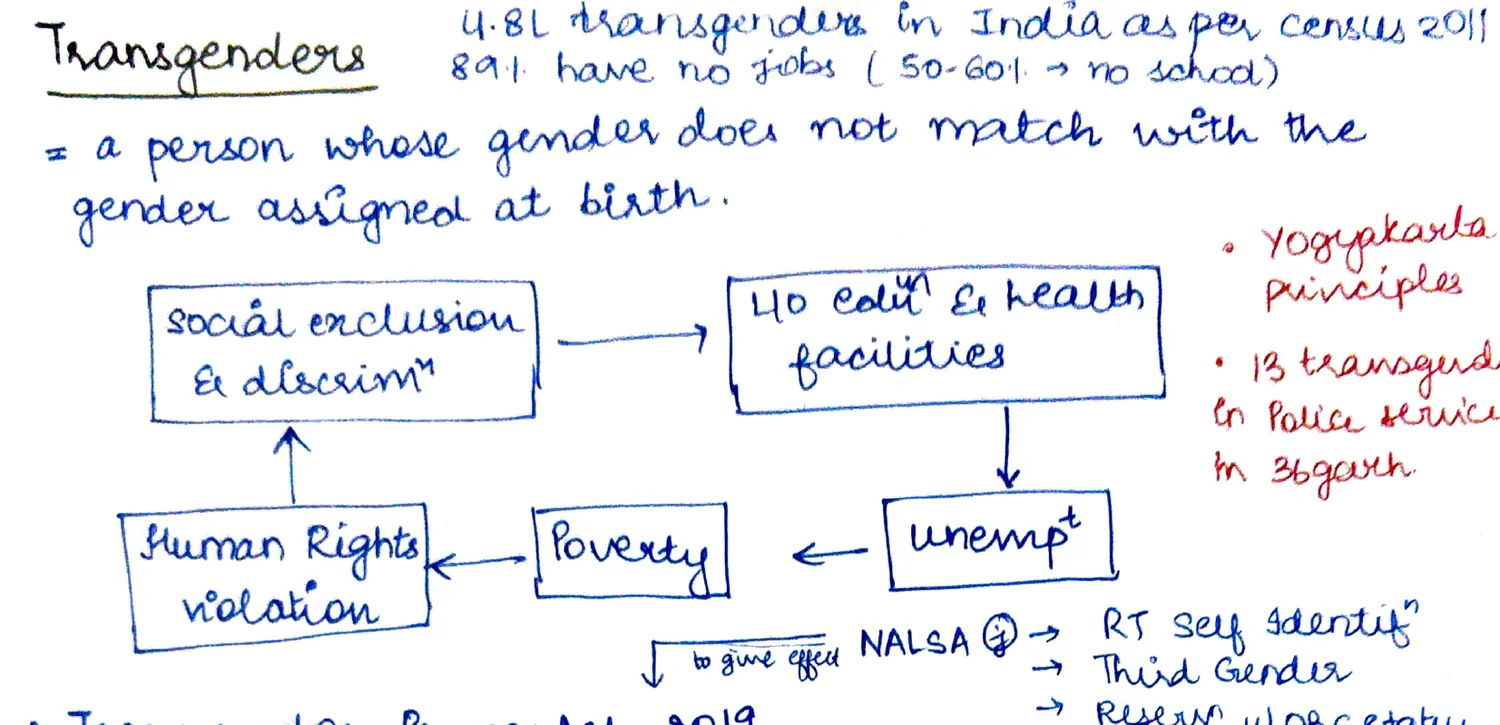
- Social exclusion & discrimination → No edu [education] & health facilities
- → Unemployment → Poverty → Human Rights violation → (back to social exclusion)
- → via NALSA (Q):
- RT [Right to] Self Identify
- Third Gender
- Reserv'n [Reservation] under OBC [Other Backward Class] status
#Transgender Persons Act, 2019
- Bring community into mainstream
- Prohibit discrimin [discrimination] in edu [education]/emp [employment]/healthcare
- Includes transmen/women/persons with intersex variations
- Right to self-perceived gender identity
- Recognises forced labour, physical/sexual/emotional abuse, denial of use of public places etc. as criminal offence
- Establish a Nat'l [National] Council for Transgender Persons (NCT) with Mo Social Justice as Chairperson (Advisory)
#Concerns
- Criminal & personal laws are not gender neutral
- Members of community name their blood source of income to be protected under law
- NALSA judgement of SC [Supreme Court] talked about need for reserv'n [reservation] in emp't [employment] & edu [education] but no explicit prov'n [provision] in Act
#Manual Scavenging
#Definition
- Practice of manual cleaning of human excreta from service/dry latrines
#Data — Safai Karamchari Andolan
- Highest no. of dry latrines → UP [Uttar Pradesh]
- Max sewer deaths in T. Nadu [Tamil Nadu]
#Measures Taken So Far
- AIR + PCRA, 1955 [likely SER + PCRA — [illegible] abbreviation]
- NCSK Act, 1993
- Employment of Manual Scavengers (Prohib'n [Prohibition]) Act, 1993 → 2013 [amended]
- NSK [National Safai Karamcharis] Finance & Dev Corp, 1997
#Sanitation Schemes
- Nirmal Bharat
- SBA, 2014 [Swachh Bharat Abhiyan]
- Scheme for self emp't [employment] for rehab [rehabilitation] of MS [Manual Scavengers], 2013
- SKA, 1995 (CSO) [Safai Karamchari Andolan]
- Rashtriya Garima Abhiyan (2002)
#Why Still Persists?
- → Cont'd [Continued] presence of insanitary latrines
- → No infra [infrastructure] & inst'al [institutional] machinery
- → Social perception (cultural occupation)
- → No implement'n [implementation] of rehab scheme
- → Loopholes in legal protection (2013 act ban hazardous cleaning not protective headgear)
#Way Forward
- → MtDI [Mission to Dignity] — Life of dignity
- Bandicoots [robotic scavenging machines]
- Social reengineering
#Elderly — Ageing
#Header Note
- Eco [Economic] adv [advantage] due to ↑ in life expectancy
- Active Ageing, Healthy Ageing, Longevity Dividend
#Data
- 2011 census — 104 million
- 53 mn [million] females
- 51 mn [million] males
- UNPF → 173 mn [million] by 2026
- Kerala has max % of elderly in its pop'n [population] (12.6%)
#Side Note
- Ageist — (found 1:4 of OP [Old People] are suffering from depression)
#Challenges Faced
1) Social
- Ageist stereotypes (how we think) — Prejudices ("feel") — Discrimination ("act")
- Changing family structure
- No social support
- Rapidly changing world — global tech advancements
2) Health
- Medical problems (4A's)
- 2A of healthcare
- But → UberHealth (but only 2A; affordable?)
3) Economic
- Financial dependency
- No social security/insurance
4) Psychological
- Powerlessness/Inferiority/Depression, uselessness/Isolation etc.
#Initiatives Taken by Govt
- MLAI (DRLP) [illegible abbreviation]
- IPOP [Integrated Prog [Programme] for OP [Older Persons]]
- Maintenance & Welfare of Parents & Senior Citizens Act
- IGNOAPS [Indira Gandhi National Old Age Pension Scheme]
- RVY [Rashtriya Vayoshri Yojana]
- PMVVY [Pradhan Mantri Vaya Vandana Yojana]
- Nat'l [National] Policy for OP [Older Persons], 1999
#Way Forward
- → Create emp't [employment] for OP [Older Persons] (WFH [Work from Home], think tank, achieve, [illegible], self-help corps, age-friendly [illegible], aged tech)
- → Age-friendly envr [environment]
- → Address diversity in old age
- → Long term care (MP Time Bank Model)
- → Research in Geriatrics
#Census Data 2001–2011
- 35% ↑ in old age people (>60 yrs)
- Rural'n [Ruralisation] of old age — 70% stay in rural areas
- Feminisation of old age — 1033/1000
#Disability (Yojana)
#Medical Model vs Social Model
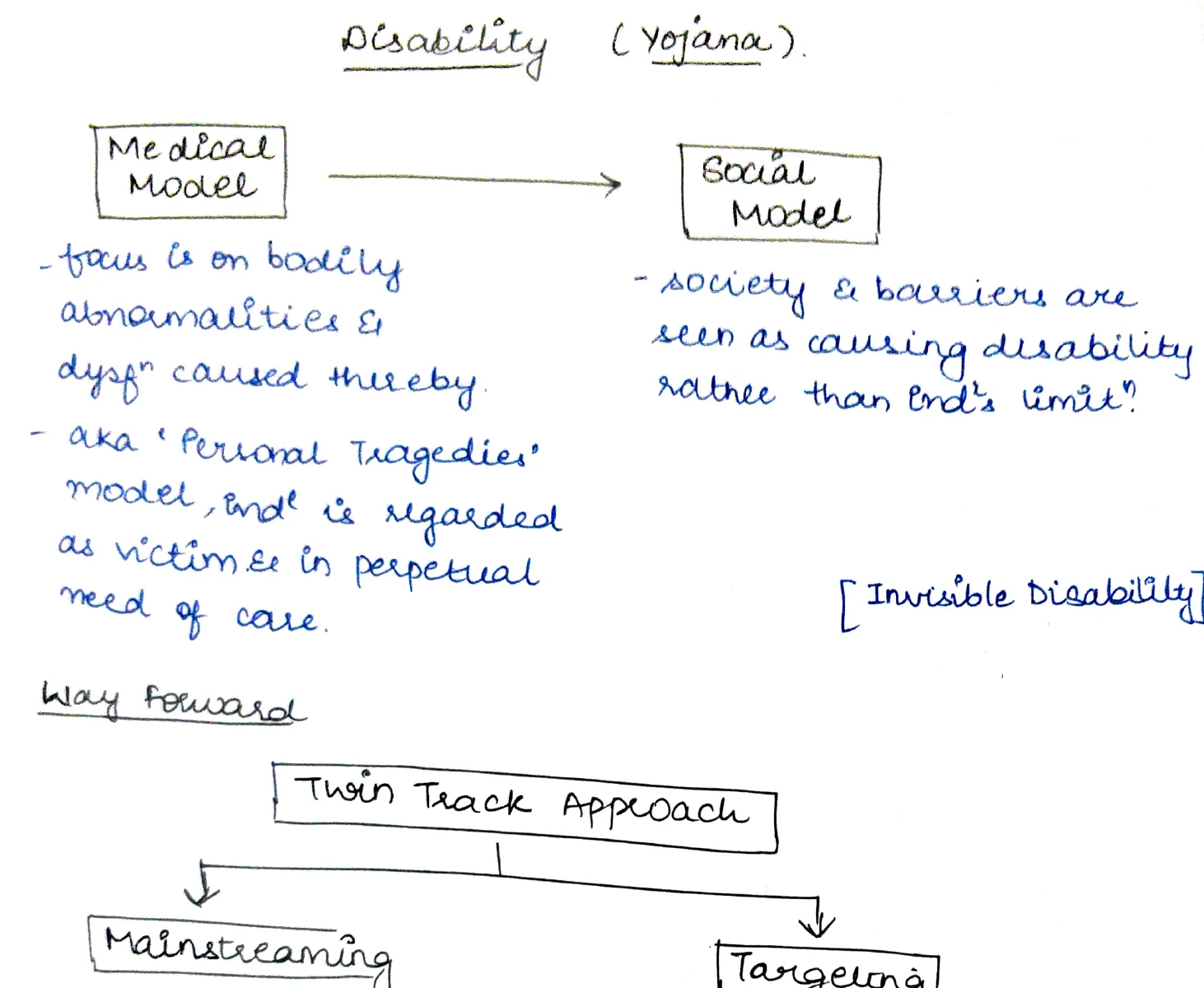
Medical Model
- Focus is on bodily abnormalities & dysfn [dysfunction] caused thereby
- aka "Personal Tragedies" model; ind [individual] is regarded as victims in perpetual need of care
Social Model
- Society & barriers are seen as causing disability rather than ind's [individual's] limits
- [Invisible Disability] — noted as side concept
#Way Forward — Twin Track Approach
Mainstreaming
- Ensuring PwDs [Persons with Disabilities] have access to their basic needs in all policies & prog's [programmes] on an equal basis with others
- eg: SSA [Sarva Shiksha Abhiyan] (zero rejection policy)
- RBI's disability-inclusive banking
- Kudumbashree
Targeting
- Addressing specific needs of ind'l [individual] in order to empower them & improve their situation
- eg: RPD Act, 2016
- DEO PwD
- RCI [Rehabilitation Council of India]
- Sugamya Bharat
- ADIP [Assistance to Disabled Persons for purchase/fitting of Aids & Appliances]
#Goal
- Equality of Rights & Opportunities for Persons with Disabilities
#Racial Intolerance — Concept, Causes, Implications
#Definition
- Race is a group of people with distinctive physical features like colour, height, texture of hair etc.
#Causes — Flowchart
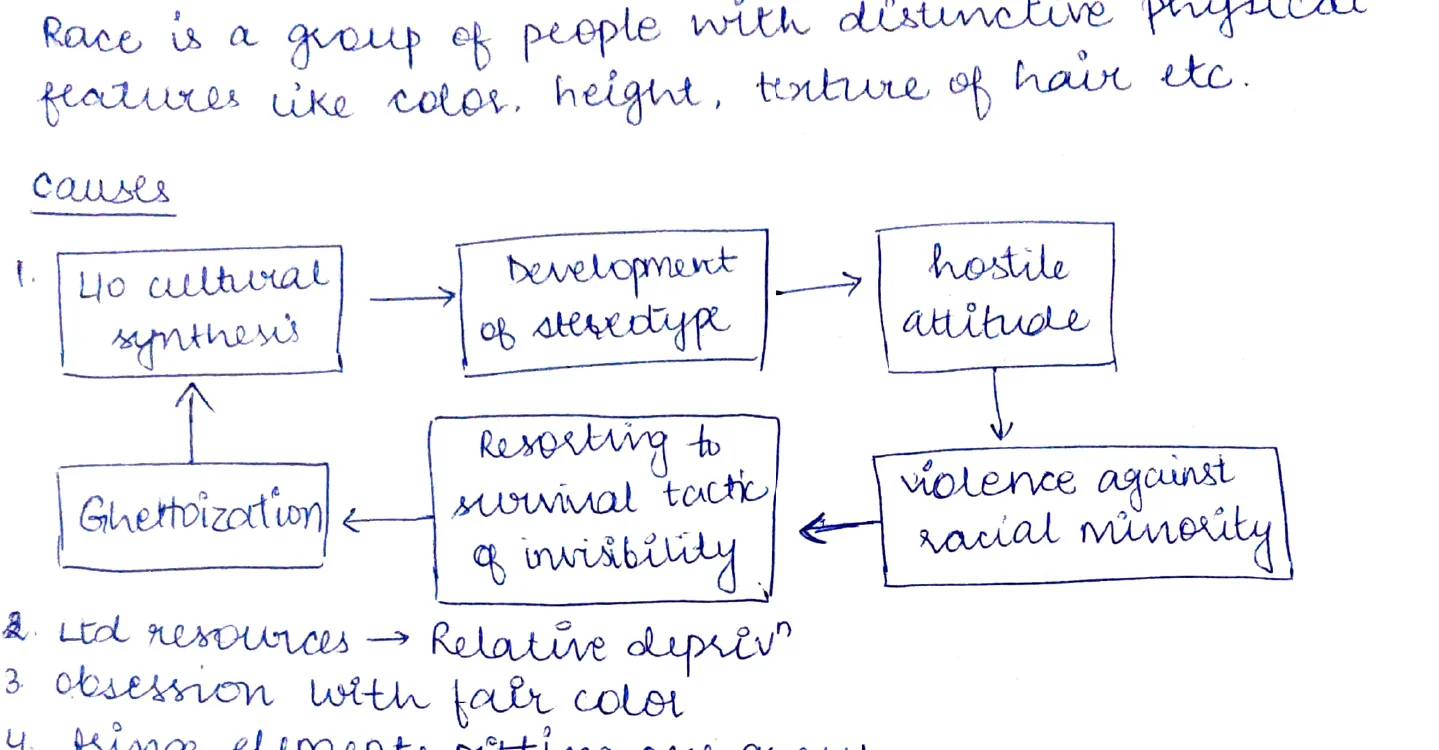
- No cultural synthesis → Development of stereotype → Hostile attitude
- Generalization → Resorting to normal tools of invisibility → Violence against racial minority
- Ltd [Limited] resources → Relative deprivn [deprivation]
- Obsession with fair color
- Rising elements pitting one group [against another]
- Poor law & order → domino effect
#Implications
- eg: Africa cancelled talks after [illegible]; Bangalore incident [noted in margin]
- → -ve impact on social harmony, cohesion
- → Social unrest & secessionist tendencies
- → Bilateral rel's [relations] get affected
- → Prospects of India as a destn [destination] for business & edu [education]
#Way Forward
- Sensitising prog [programme] for Indians
- Bezbaruah Comm [Committee]:
- Stringent laws
- FTC [Fast Track Courts] & spl [special] police squad be set up
- Intervention in edn [education] system
- Social media outreach
- Legal awareness campaign
- CPM [Community Policing Mechanism] to assure racial minority
- Workshops in residential areas about culture of RM [Racial Minority]
- Police sensitisation
#Drug Abuse
#Definition
- Use of certain chemicals for the purpose of creating pleasurable effects on the brain
- eg: Virtue of alcohol, opiates, cocaine etc.
#Facts
- Per UNODC Report, India is among the countries with highest illicit cultivn [cultivation] & prodn [production] of cannabis
- AIIMS 2019 — Alcohol is most common
- Most affected — NE [North-East] (esp Manipur) & NW [North-West] (esp Punjab)
#Causes
- Geog [Geographical] location (Golden △ & ☽ [Golden Triangle & Golden Crescent])
- Socio-eco [Socio-economic] factors — family history, unemp [unemployment], changing cultural values, peer pressure, media, ↑ accessibility, no social control
- Psycho [Psychological] — low self esteem, poor stress mgmt [management], childhood issues/trauma
- Weak law enforc't [enforcement] & regulatory control
#Impact
- Ind → family → social → nation
- Threat to demo dividend
- Interpersonal relations — child abuse, domestic violence
- Drug trafficking → Money laundering & terror finance
- Loss of revenue due to illicit prodn [production]
- ↑ Healthcare costs
- Social ostracization
#Constitutional & Legal Provisions
- Art 47 — State shall discourage intoxicants use
- NDPS Act, 1985
- Nasha Mukt Bharat (2020-21) for 272 most affected dists [districts]
#Way Forward
- Subst [Substance] abuse prevention prog [programme]
- Conducive legal & policy envt [environment]
- Efficient control
#Drug Abuse — Vicious & Virtuous Cycle Diagrams
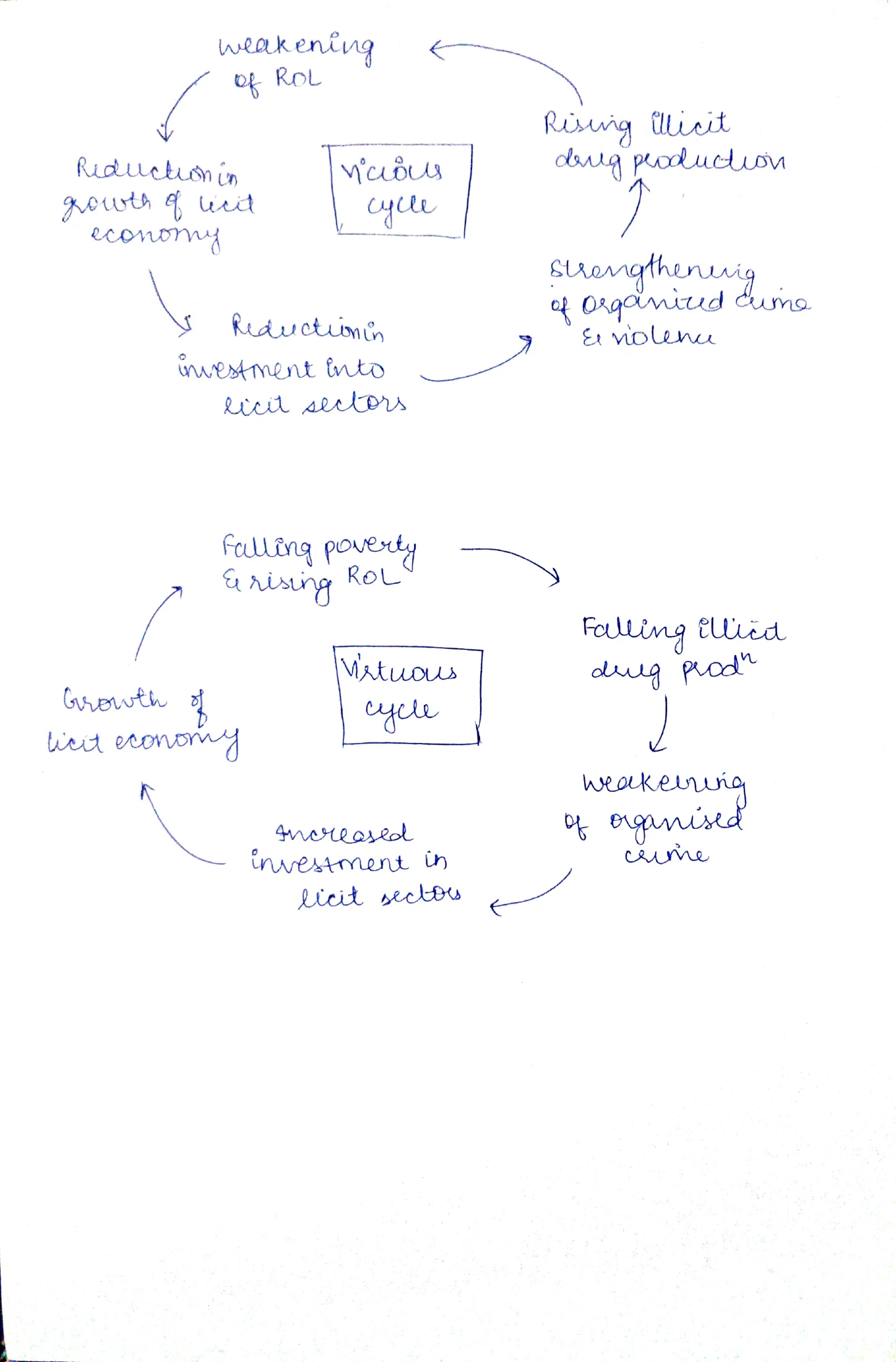
#Vicious Cycle
- Weakening of RoL [Rule of Law]
- → Rising illicit drug production
- → Strengthening of organised crime & violence
- → Reduction in investment into licit sectors
- → Reduction in growth of licit economy
- → (back to Weakening of RoL)
#Virtuous Cycle
- Falling poverty & rising RoL [Rule of Law]
- → Falling illicit drug prodn [production]
- → Weakening of organised crime
- → Increased investment in licit sectors
- → Growth of licit economy
- → (back to Falling poverty & rising RoL)
#Unpaid Work
#Key Data
- ILO, 2018 — 3/4 of unpaid care work by women
- NSC — 91:8% women part'n [participation] in UCW [Unpaid Care Work]; 20% men (in 2019)
#Why Always Women?
- Patriarchal norms — Men as breadwinners, women as caregivers
- No ability to participate in paid work
- No alternate care infra [infrastructure]
- Financial constraints
- ↑ in HH [Household] income
#Key Concepts
- "Dual Burden", "Second shift", "Double day" — one at home, one at work
- "Time poverty" — acute time pressure & no freedom to utilise one's time as per his/her choice
#Implications (for Women)
- ↑ Barriers to women LFPR [Labour Force Participation Rate] (2% women in paid work; 70% men)
- Disc'n [Discrimination] to hiring & pay
- ↑ Gender Inequalities
- Time poverty
- Health problems for women (eat last & least)
- Deteriorates quality of life
- ↑ Vulnerable to env'al [environmental] & eco [economic] changes
#For Society
| +ve | -ve |
|---|---|
| 1. Subst'd [Substituted] of market — lower cost of paid work | 1. ↓ economic gains (IMF — 27% GDP↑) |
| 2. Human capital form'n [formation] | 2. Undervaluation of paid "first" — domestic help |
| 3. Supplements govt duties — elderly care | 3. Quality of care |
#Recognising Unpaid Work as Economic Activity
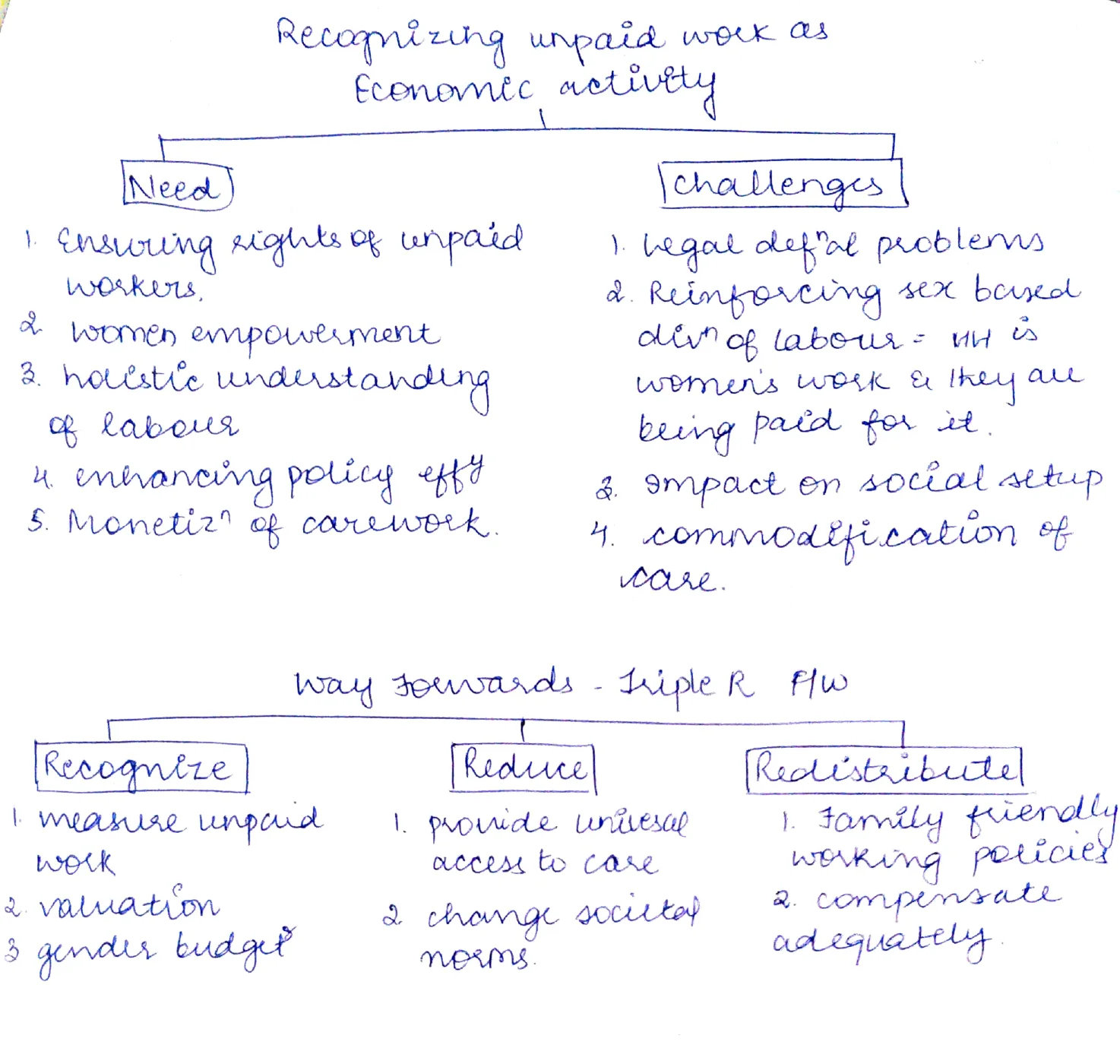
Need
- Ensuring rights of unpaid workers
- Women empowerment
- Holistic understanding of labour
- Enhancing policy eff'y [efficiency]
- Monetis'n [Monetisation] of carework
Challenges
- Legal defn'al [definitional] problems
- Reinforcing sex-based div'n [division] of labour — info is women's work & they are being paid for it
- Impact on social setup
- Commodification of care
#Way Forward — Triple R Flw [Framework]
| Recognize | Reduce | Redistribute |
|---|---|---|
| 1. Measure unpaid work | 1. Provide universal access to care | 1. Family-friendly working policies |
| 2. Valuation | 2. Change societal norms | 2. Compensate adequately |
| 3. Gender budget |
#Migration
#Key Data
- 450mn [450 million] as per 2011 Census
#Definition
- Movement of people from one place to another
#Nature of Factors
- Multifaceted factors — PES [Political, Economic, Social], ecological, personal ambition (push & pull factors) → depending on 8th [factor — Economic]
- Internal & External
- Long km [kilometres]
- Short
- 4 Economic factors (Push/Pull):
- Push: [illegible] back / [illegible] back
- Pull: [illegible] / [illegible]
- (Note: table shown with headers Push/Pull but content entries were [illegible] in the margin)
#Key Source & Destination States
- Key source — UP, Bihar, RJ [Rajasthan], MP, AP, CG [Chhattisgarh]
- Destination — DL [Delhi], MH [Maharashtra], GT [Gujarat], HR [Haryana], PB [Punjab], KN [Karnataka]
- 309 mn [million] Internal migration (30% of pop'n [population])
- 70% are women (marriage)
- Art 19 — Right to move throughout the country
#Impact
On Destination Region (PES)
| +ve | -ve |
|---|---|
| Labour addresses gap & economic remittances, skill devt [development], quality of life, social remittance, food & nutrition security (told by FAO), demographic adv [advantage], CC [Climate Change] adaptive mechanism | On source region; on destination region; on migrants (+ve/-ve) |
- 11/17 SDGs contain targets & indicators relevant to [migration]
-ve (Negative Impacts)
- Demographic profile — brain drain
- Pol [Political] exclusion
- Pop'n [Population] explosion
- Exploitation
- Slums ↑
Challenges
- Inclusion & Integration
- Psycho-emotional stress (Marginalised Man)
- Emp't [Employment] challenges (Visa barriers in US, Saudi Arabia)
- Contract wage system
- No MFN
- Exclusion from social benefits
- "Inter State Migrant Workers Act, 1979 shall be implemented in letter & spirit"
#Key Schemes
- Kovida Aawaz Health Insurance [illegible]
- Apna Ghar project
- Portable Rights (also supported by ILS 17 [illegible])
#RPD [Rights of Persons with Disabilities] Act, 2016
#Key Data
- 2.2% PwD as per 2011 Census
#Objective / Definition
- "Discrimination" is defined as any exclusion/restriction based on disability which impairs the act'n [action] of providing the social, pol [political], cultural, eco [economic] rights on equal ground; however discrimination is allowed if it is a fair means of achieving a legitimate aim
#Key Provisions
- Disability ↑ from 7 to 21
- 4% reserv'n [reservation] in edn [education]/govt [government] inst's [institutions]
- Clause of benchmark disability (40%+)
- Barrier-free access to all infra [infrastructure] & transport
- Spl [Special] prov'n [provision] for disabled women & children (6-18 yrs edn [education])
- Prov'n [Provision] for Nat'l [National] comm't [committee] removed & is reduced to office of Chief Commissioner & Advisory body
- NRDS [National Register of Disabled Persons] State fund
- Penalty & jail imprisonment in case of violence against PwD
#Way First [Forward]
- Spl [Special] courts
- E-learning/Inclusive edu [education] w/o [without] labelling
- SO [Social Organisations] + CSR [Corporate Social Responsibility] on disabled-friendly infra [infrastructure]
- Skill devt [development]
- Social awareness
#Disability — Poverty Cycle
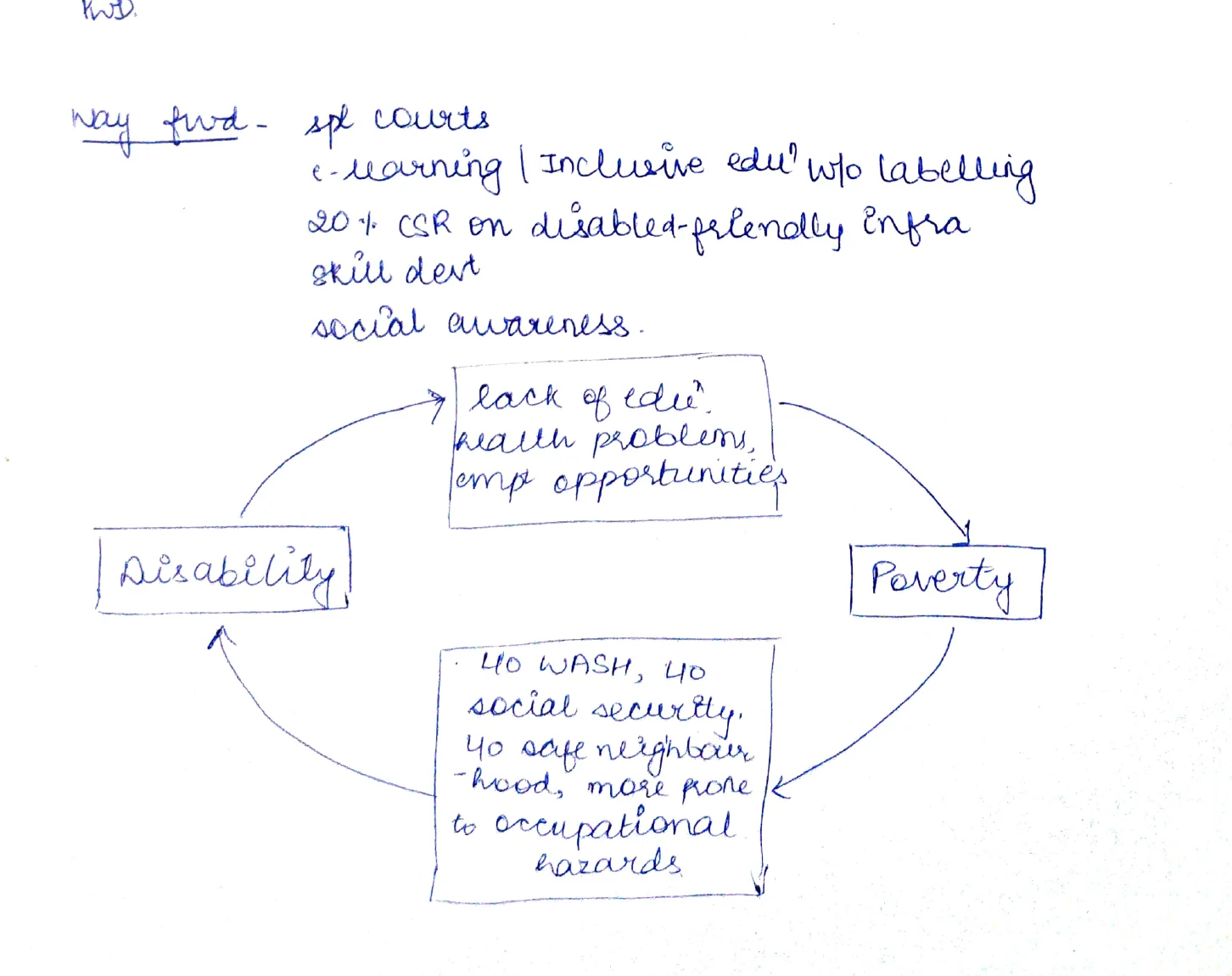
- Disability → Lack of edn [education], health problems, emp't [employment] opportunities
- → Poverty
- No WASH [Water, Sanitation, Hygiene]
- No social security
- No safe neighbrhd [neighbourhood]
- More prone to occupational hazards
- → (back to Disability)
- → Poverty
Society — Quick Notes
Topper handwritten notes#Page 1 — Indian Society: Core Concepts
#Indian Society — Overview
- Global → 4I [illegible expansion]
- Social exclusion
- Inequality
- Stratification
- Commodify / Commercial
- NARA [boxed] — Nat[ional] Ambition, Regional Aspiration
#Unity in Diversity
- Three overlapping circles meeting at centre = unity in diversity
- Unity based on:
- Similarities ↔ Differences
- Mechanic ↔ Organic (below / above)
- Similarly, global from [above/below]
- Glocal [boxed: "vocal for local"]
- Cultural clash
- Encounter
- Synthesis
- Diffusion
- Box diagram: circle △ square hexagon inside one frame = Diversity in Unity
#Nuclear Family → Rural to Urban Migration
- Nuclear fam[ily] in rural areas ↑ to 58↑; urban areas ↑ to 51–52↑
- Unity w/o [without] uniformity, diversity w/o fragmen[t]
#Secularism & Caste
- Secular → "pol[itics] of caste" → "as actual of caste"
- Relative deprivation
- Ghost citizens
- Social consequences of GR [Green Revolution]:
- = WED TRIM [underlined]
- Wages exploit, Displace[ment], 9 [nine] tenants
- Income only, Migrat[ion]
- Regional ineq[uality]
- = WED TRIM [underlined]
#Transform[ation] of System / Inst[itution]
| Trad[itional] Status | Forces of Change | Contemporary Reality |
|---|---|---|
| [arrow down] | [arrow down] | [arrow down] |
- Impact on Inst[itution]:
- {Ripple} → Structure
- → Function
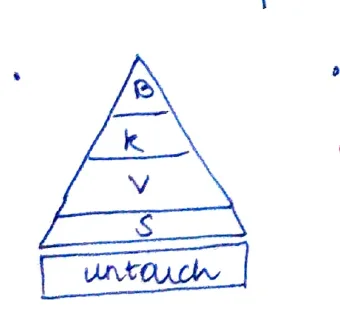
- Caste hierarchy pyramid (top → bottom): B (Brahmins), K (Kshatriyas), V (Vaishyas), S (Shudras), Untouchable
#Dimensions of Culture [boxed]
- Food — Festivals
- Dress — Language
- Music — Literature
- Dance — Marriage / Rituals
- Religion
#Tobacco
- 27 cr[ore] users in I [India] (2018) [boxed in red]
- Kills 1 mn [million] people each yr
- Lancet = leading risk factor for cancer in I
- "Dual Uses"
#Dalit Issues (Right side, Page 1)
- 8↑ inter-caste marriages [boxed in red]
- Dalits:
- Mandal of pol[itics]
- Vertical → Horizontal competition (new avat[ar])
- Entrenched vs ascendent caste
- DICCI + Nat[ional] Fed[eration of] Dalit Women, 1987
- Bhim Army, Dalit Sahitya, Vaish[ya] equal society
#NCRB Statistics — Dalits
- NCRB [boxed] = 49↑ 44↑ ↑ on violence against Dalit (2010–14) and further 5.2↑ from 2014 to 16
#Welfarism → Development → Empowerment
#Child Abuse
- 53↑ children have faced child abuse — MoWCD [boxed]
- 2011 census [boxed] — 30↑ of all women married were victims of child marriage
- 336↑ ↑ in child rape cases in 2010–14 → NCRB [boxed]
- Highest dowry deaths in UP, Bihar (NCRB)
- → IPC Sec 304B [boxed] & Sec 498A [boxed]
#Page 2 — Women in Society
#Women's Movement — Key Organisations (India Map)
![India map showing women's movement organisations by region: Saheli (Delhi), Nav Nirman Guy, Sampurna Kranti Abhiyas, Anti Atrocity Movement, Progressive [org] of women, Flgt [Fight], Manushi NP](assets/img/society_quick_notes_p2_01.webp)
- Saheli (Delhi)
- Sampurna Kranti Abhiyas [top right on map]
- Nav Nirman Guy [left side]
- Progres[sive org] of women, Flgt [centre right]
- Anti At[rocity] Mont[h] [centre]
- Manushi NP [north]
#Feminism Strands
- Corporate feminism
- Eco fem[inism]
- Dalit fem[inism]
- Zomato / Periodic [leave] (Asia) [example of corporate feminism]
#Women's Economic Gaps — Venn Diagram
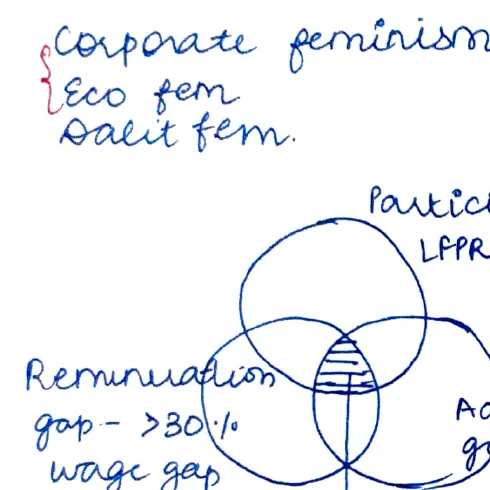
- Circles: Participation gap (LFPR = 23↑), Remuneration gap (>30↑ / wage gap), Advancement gap (>13↑ in senior mgmt)
- Centre overlap = Economic Deprivation of Women [boxed]
#NCRB Statistics — Women
- NCRB [boxed] → 300 crimes against women per day (let convicted rate 625 in [illegible])
- [a] dowry deaths daily [boxed, highlighted]
- 92↑ women do unpaid care work — 90↑ men (2017) → NSO [boxed]
- Global Gender Gap 2021 — 140↑ [rank]
- 10mn child labour (census)
- MDM [Mid-Day Meal] — P[M] as best practice
- 4 82↑ children u/i [under / in] MDM
- 4 eggs/bananas twice a week
#POCSO [boxed]
- <18 yrs of age
- 32↑ conviction rate (last 5 yrs avg)
- 90↑ pendency
- Always (Kathua case — 6mn even when act says max 1 yr)
- 4/100 crimes committed by juveniles + 50↑ of those crimes against women
- 3R flow → Recognise, Reduce, Redistribute
#Economic Deprivation of Women — Graph
![Line graph showing decline in women's economic participation; y-axis values 445, 193, [illegible], x-axis years 1971, [illegible], 2017; arrow pointing to ">63mn missing women"; annotation "more men not getting wives"; "low CSR"; "crime against women → become bare branches"](assets/img/society_quick_notes_p2_03.webp)
- Graph shows decline in indicator (445 → 193 → … over 1971–2017)
- → >63 mn missing women
- Low CSR [Child Sex Ratio] → more men not getting wives → "Become bare branches" [sociological term]
- Crime against women: rape, trafficking
#Empowerment / Inclusive Growth Timeline Graph
![Graph with x-axis 1949–2017 showing stages: Race approach → Empow[erment] → Inclusive growth → Gender Mainstream; annotations: remuneration gap →>30↑ wage gap, advancement gap →>13↑ in senior mgmt](assets/img/society_quick_notes_p2_04.webp)
- Timeline: 1949 → Race approach → Empow[erment] → Inclusive growth → Gender Mainstream
- X-axis: 1949, [illegible], 2000, 2017
- Race approach era; Empowerment era; Inclusive growth era (2000 onward)
#Mean Age of Pop[ulation] (2020)
- US & China = 37
- Europe = 45
- Japan = 49
- India = 29
- Global economy → shortfall of 56mn [boxed] shortage of young
- India will have surplus of 47mn [boxed]
#Family Planning in India — Table
![Table: Family Planning Experiment — Women & Child welfare; columns 1951, 75, 2000; rows: CLHRC [illegible], NFP[P] 52; See NFP 96, integration with maternal & child care; 2WNPP 2010, contraception home delivery, Mission Parivar Vikas](assets/img/society_quick_notes_p2_05.webp)
| Year | Programme | Key Feature |
|---|---|---|
| 1951 | Family Planning (first programme in world) | CLHRC / NFP[P] 52 |
| 1975 | [illegible] | See NFP 96, integrate[d] maternal & child care |
| 2000 | 2WNPP [National Population Policy] 2010 | Contraception, home delivery, Mission Parivar Vikas |
#Page 3 — Urbanisation, Slums, Religion & Migration
#Child Poverty / Malnutrition — State Data
- Bihar (34↑)
- Sikkim (1.19)
- [1.5–2] [illegible range]
- 3/3 children in 0–14 from UP / Bihar [handwritten annotation on India map]
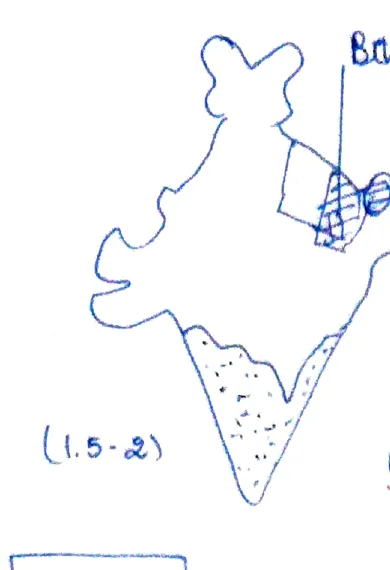
#Slums [boxed, red]
- 13↑ / 14↑ urban pop[ulation] (Census 2011)
- Clearance — Improvement — Attracts more slum
- SDG → [illegible]
- Rural = "Decennial" of urban areas
#Urban Issues
- TOI Report — 33↑ Indians live in spaces less than what an American prisoner gets
- 30↑ urban pop → no safe drinking water
#Census 2011 — Urban Table
| Indicator | Present (2011) | 2030 |
|---|---|---|
| Urban pop | 377mn | 600mn |
| Megacities | 5 | 8 |
| GDP share | 62↑ | 75↑ |
#Rural-Urban Divide (2011) — Table
| Indicator | Rural | Urban |
|---|---|---|
| Electricity | 55↑ | 93↑ |
| Piped water | 35↑ | 71↑ |
#India's Urban Dichotomy
- Under (at peri [periphery] level, rural >>> urban) vs Over (2/3 of urban pop in few urban agglomerates)
- Dichotomy
- Delhi on 118 / 140 on Liveability Index 2019
#Secularism & Religion — State-Religion Diagram
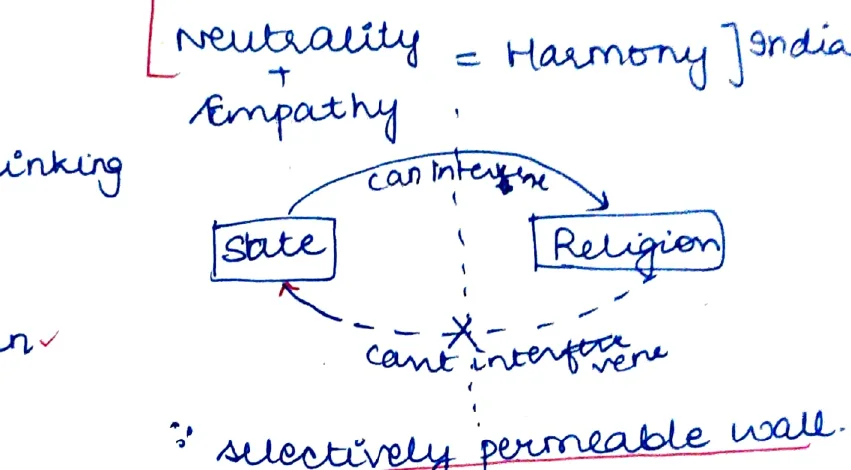
-
Notality = Impartiality [West]
- Apathy
-
Neutrality = Harmony [India]
- Empathy
-
State ←→ Religion:
- Solid arrow: can integrate
- Dashed arrow (crossed): can't interfere
-
∴ Selectively permeable wall
- (A) Arms-length distance
- (T) Principled distance
-
Santhara — Nikhil Soni v/s SC [ORI?]
#Great Indian Middle Class — Bar Chart
- 2005: 5↑
- 2015: 20↑
- 2025 (projected): 40↑
#Internal Migration
- 450mn migrants — 2011 census
- 20↑ of pop = internal migration
- Census study / Tessta [result]:
- Poorer health insurance
- Apna Ghar Project
- Portable rights
- 11/17 SDGs relate to migration
#Tribal / Forest Data
- [1 & 3/4] ↑ pop = FWD [Forest Dwellers]
- Only 36↑ enrol[led] — census 2011
- 75↑ don't attend any school
#Page 4 — Disability, COVID-19 Impact, Elderly, Hunger
#Disability — Medical vs Social Model
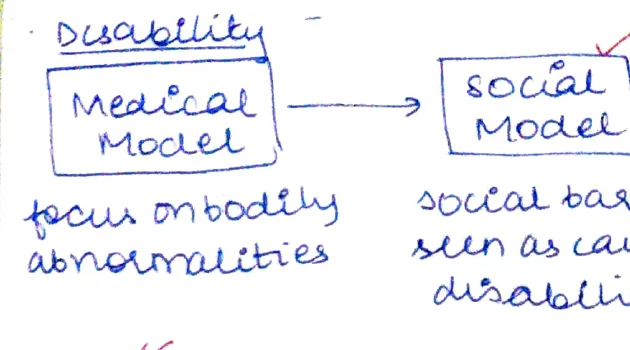
- Medical Model: focus on bodily abnormalities
- Social Model: social barriers seen as causing disability
#Twin Track Approach
![Twin Track approach diagram: Mainstream (SSA, ID reject policy) + Targeting (IRP 2016, Sugamya Bharat, ADIP) → Equality of rights & opp[ortunity] for PwD](assets/img/society_quick_notes_p4_02.webp)
- Mainstream [left track]:
- SSA (0 reject policy)
- [illegible] inclusive banking
- Targeting [right track]:
- RPD 2016
- Sugamya Bharat [Accessible India Campaign]
- ADIP [Assistance to Disabled Persons scheme]
- → Equality of rights & opportunity for PwD
#Other Disability / Inclusion Data
- Highest no. of day labourers [in] [illegible] — max sewer deaths in TN [boxed]
- 4.5↑ transgenders — census
- 3 transgenders in 36 garh [Chhattisgarh] police
- [illegible] vakasha principles
- NALSA judgement
- 84↑ have no jobs
#Elderly
- 104 mn elderly [53mn female, 51mn males]
- Kerala — max ↑
- ↑ (1.3↑)
- Agewell found — 48↑ suffer from depression
- 1033 females / 1000 males ← best in rural areas
- Global Pension System = 1 = 22 / 37 [boxed]
- Healthy Ageing Decade (2020–30)
- Longevity dividend
- Silver economy
#COVID-19 Impact [boxed, red]
- Child marriage — Lancet: 2.5mn more girls at risk
- Shadow pandemic — VAW — 1 in 3 women acc. to UN
- 100mn women at risk of poverty
- Red fem[inisation] of agri
- NCRB [boxed] ↑ in cybercrimes — 54 complaints in April '20 against 37 in April '19
- Child labour — globally 9mn add[ed] children (ILO)
- Mental illness cases ↑ by 20↑ (WEF)
- No. of poor in 1 ↑ from 6cr to 134cr due to COVID-induced recession — Pew Research [boxed]
#Global Hunger Index — 101 Rank [boxed]
- Undernourishment — 15.3↑
- Stunting — 34↑ [34.1]
- Wasting — 17↑
- VS [Versus] Mortality — 3.4↑
#Urban Asymmetric Indices
- Urban Asymmetric (↑) [boxed]:
- 621 waste [illegible unit] access
- 63↑ HH [household] water tap
- 1938 / 1300 ULBs have Master plans
#Gandhi Quote
"Our ability to reach unity in diversity will be the beauty & test of our civil" — Gandhiji [boxed]
#Age Crime Curve
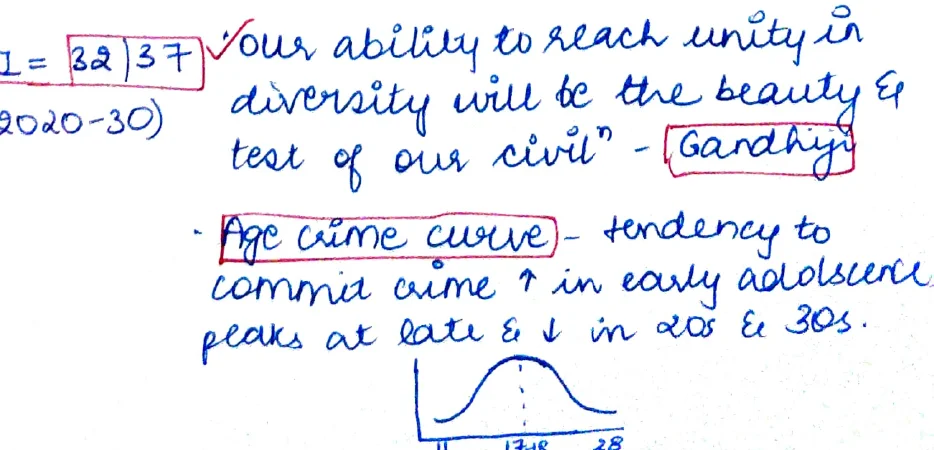
- Age Crime Curve — tendency to commit crime ↑ in early adolescence; peaks at late teens & ↓ in 20s & 30s
- Healthy Ageing Decade (2020–30)
- Longevity dividend / Silver economy
- Global Pension System = 1 = 22 / 37 [boxed]
#Page 5 — Child Malnutrition, Food Security, Fake News, Road Safety
#UNICEF Flow for Child Malnutrition
![UNICEF causation tree for child malnutrition: Child Mal[nutrition] → under nourishment, stunting, wasting, over(O)/obesity; Immediate cause: Inadequate diet + Diseases; Underlying cause: (A)(A)(A) = poor child care + poor wash practices; Basic cause: Quantity & Quality of human/financial/organisational resources](assets/img/society_quick_notes_p5_01.webp)
- Manifestation of problem:
- Child Mal[nutrition] →
- Under nourishment
- Stunting
- Wasting
- Over (O) / Obesity
- Child Mal[nutrition] →
- Immediate cause:
- Inadequate diet ← → Diseases
- Underlying cause:
- (A) (A) (A) [three A-factors] → Poor child care + Poor WASH [Water, Sanitation, Hygiene] practices
- Basic cause:
- Quantity & Quality of resources:
- Human
- Financial
- Organisational
- Quantity & Quality of resources:
#Malnutrition — Girl / Boy / Adolescent Triangle
![Triangle diagram with labels: mal[nourished] girl at top, mal[e] mother on left, mal[e] (B) adolescent on right — intergenerational cycle](assets/img/society_quick_notes_p5_02.webp)
- Mal[nourished] girl (top)
- Mal[e] mother (left)
- Mal(B) [male/boy] adolescent (right)
- Represents intergenerational cycle of malnutrition
#A Rich / Progressive Country
- Not where the poor have care
- But where the rich use public transportation
- India is not running out of water; water is running out of India
#REPLACE Framework [boxed]
- Review
- Promote
- Legislate
- Assess
- Create
- Enforce
#WEb → 1↑ poverty leads to 0.7↑ ↑ in child labour [boxed]
#Food Security
- People facing food insecurity ↑ by 47cr [crore] during COVID19 [boxed]
- Largest foodstock in the world: 120mn tonnes [boxed] (July 2021) also for a quarter of all food insecure people
- Why?
- High economic distress
- High unemp[loyment]
- High inequality
- High & fluctuating food pric[es]
- Informal economy
- Men as breadwinners, women as caregivers
- Time Poverty
- 3R flow — Recognise, Reduce, Redistribute
- → And shift / divi[de] day
#Sahi Poshan, Desh Roshan [scheme name]
#Fake News
- Sec 505 of IPC
- IT Act 66D of 17 Act, 2000
- IT Sec 54 D, DM Act, 2005
- AI system by FB
- My Gov's Vashna [Vishwa?] news desk
- PIB fact checker
- Kerala govt — Fake news classes
- Alliance of self-verify?
#MP Time Bank Model [boxed]
- Women earns = 19↑ to GDP as per 2018 Mercury Report [illegible]
- LFPR in Sweden is 88↑
#Road Safety / Accidents
- Road [accident] → 1.5 lakh deaths due to road accidents in past 10 years out of which 50↑ can be saved (are preventable) [boxed]
#Page 6 — Hunger & Malnutrition (cont.), Drug Abuse, Migration
#Hunger & Malnutrition [boxed]
- #101 on GHI [Global Hunger Index]
- Under → 15↑
- Mortality — 3.4↑
- Wasting — 17↑
- Stunting — 17.3↑ [or 17.31]
#Reasons for Hunger / Malnutrition
- Poor maternal health
- Sanitation → Absorption
- Eco distress
- NFSA [National Food Security Act] issues — not universal
- Not apply in times of war / flood / drought / [illegible] / [illegible]
- Cereal centric
- CRS [?] SDG = 49↑ beneficiaries yet to be identified by SG
- 42↑ food wastage
- Unstable prices
- R2U migration [Rural to Urban]
- Corruption
#SO? (Solutions)
- Mother edu[cation]
- Dietary diversity (AP [Andhra Pradesh] model)
- ONDRC [?]
- Gov[ernance] reforms
- SBM [Swachh Bharat Mission] | Maternal & child care
#Drug Abuse — Vicious Cycle Diagram
![Circular flowchart: Drug abuse (header) → Drug use disorder → Ltd. edu[cation] → Ltd. empl[oyment] → Poverty → (back to) Drug use disorder; label in centre: {Vicious cycle}](assets/img/society_quick_notes_p6_01.webp)
- Drug use disorder → Ltd. edu[cation] → Ltd. empl[oyment] → Poverty → Drug use disorder (vicious cycle)
#SC in Sucheta Srivastava vs Chandigarh Admin [boxed]
"SC in Sucheta Srivastava vs Chandigarh admin case held that women's freedom to take reproductive decisions is a part of personal liberty u/A 21."
#Migration [boxed]
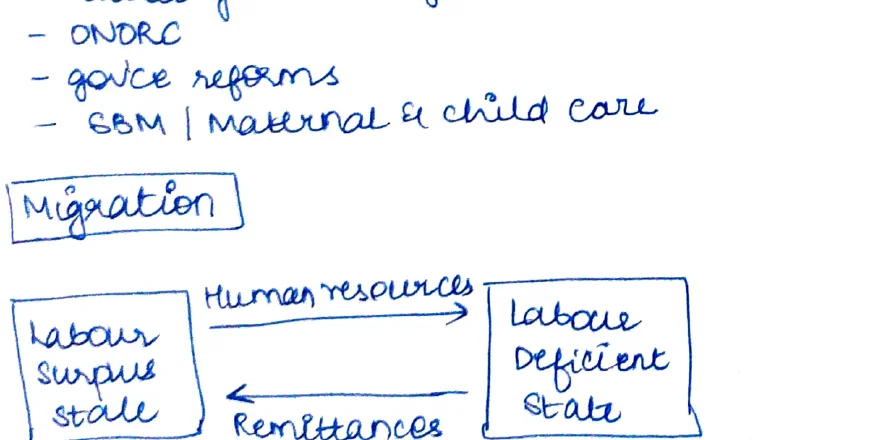
- Labour Surplus State → [Human resources →] → Labour Deficient State
- Labour Deficient State → [← Remittances] → Labour Surplus State
- Promotes balanced regional devt
- Tool to reap Demographic Dividend
- {Skill map}
#Kerala Model
- Apna Ghar Project
- Changathi — Library campaigns
- Portable benefits
- Health — Arwaz Scheme [or Aswaz Scheme]
[illegible] spots noted: p2 conviction rate denominator; p3 tribal FWD percentage prefix; p4 sewer deaths state (partially read as TN); p4 vakasha principles heading; p5 Alliance name; p6 CRS acronym expansion; p6 ONDRC expansion.
Geography
Topper handwritten notes#GS1 – Geography
Alfred Weber – Theory of Industrial Location: RM [raw material] is used where transport cost of RM + factory is min [minimum]
#Factors Responsible for Location of Industries
#IT Industry
-
Factors guiding the location are: resource availability, cost & infra [infrastructure]
-
Silicon Valley, California
-
- Top notch unis [universities] around the valley = skilled, technical HR [Human Resources] (Stanford)
-
- Temperate climate
-
- Low cost land (fruit orchards → business parks)
-
- Good interstate port connectivity in Oakland to cheaply ship out semiconductor products
-
- Strong local infra & rich investors
-
- Govt labs & research
-
-
Bangalore, India
-
- Mild climate (computers are sensitive – history of [illegible] to heat & dust) – cheaper
- Hub for startups
- Close proximity to [illegible] admin [illegible]
-
- IISc, Bangalore
-
- Govt labs related to space & defence research
-
- Infosys, Wipro
- Large pool of techies – highest no. of engg. & prog. college in world [illegible]
- Cosmopolitan culture
-
#General Factors Affecting Location
- Govt policy
- Integrated transport & communication facilities
- Access to market
- Reliable power supply
- Access to agglomeration economies
- Labour cost
- Skilled & unskilled labour
#Iron & Steel Industry
- Raw material – heavy & weight losing
- Eg. Chota Nagpur region
- TISCO at Jamshedpur (Jharia coalfields) / Mayurbhanj ore / Damodar valley
- Kolkata port – [illegible]
- Markets – Product is bulky, transport cost ↑
- TISCO – near Kolkata (MKt)
- Visakhapatnam Steel Plant – X-M [export-import] facility
- Labour – Chota Nagpur
- Durgapur, WB [West Bengal]
- Singhbhum – 7 districts [illegible] / Mayurbhanj / Dharia coal / Sundargarh Limestone / [illegible] – DVC [Damodar Valley Corporation]
- Availability of water for cooling
- Eg. Bokaro on Damodar River
- Nearness to Industrial town
- Govt policy – Bhilai in Segauli
- Power – TISCO, Bokaro → Damodar Valley Corp[oration]
- Transport – TISCO – Kolkata, Mumbai, Chennai
#Why Pharma Industry in West?
-
A footloose industry – – – → so scattered over India
- Proximity to ports (Kandla, Bhavnagar) = easy access to Africa, Europe etc.
- Favourable state policy of Gujarat & EDB [Export Development Board] (SEZ)
- Proximity to petrochemical hubs near Gujarat coast & Mumbai
- Easy capital (Guj [Gujarat] + MH [Maharashtra])
- Historical spirit of entrepreneurship
-
Steel – India is 2nd largest producer
- 1.5% of GDP
- 8.5 lakh people employed
- Natl [National] Steel Policy, 2017
- PLI [Production Linked Incentive]
- Steel Research & Tech Mission
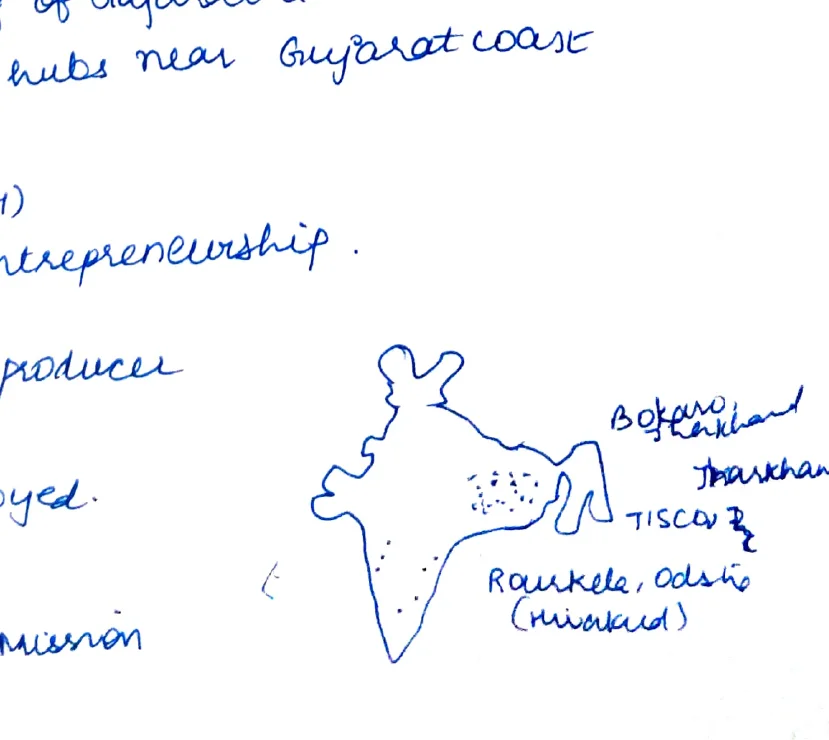
- India map sketch showing:
- Bokaro / Jharkhand (NE cluster)
- TISCO (central-east)
- Rourkela, Odisha (Hirakud noted)
#Why Gujarat Has Diamond Industry?
-
Diamonds just like spices is a community-based business – guarded by Jains & Patels
-
Connectivity with ports & overseas logistics network
-
Skilled labour in Surat & Mumbai
-
Govt policy (focused on it)
-
Finance
-
But diamond popularity is ↓ due to jewellery fashion & its modern? [illegible] but also abroad also
-
→ Health issues due to dust from cutting–polishing
-
→ India doesn't produce RM for diamonds, only value add – so it is linked with industry in Africa & [illegible]
-
→ Surat affected due to GST & demonetisation
#Automobile Industry – Footloose Industry
-
Requires variety of RM – steel, non-ferrous metals, plastic, rubber, glass, wood, paint, cables, textile etc.
- Best location is an [illegible] region
-
Detroit = Car capital of world
- Transport – Detroit river linked to Lake Huron
- Labour – long tradition of building machines
- Agglomeration industry
- Entrepreneurs – Henry Ford
- RM – Steel from Pittsburgh
-
Toyota – Nagoya, Japan
- High unemployment + cheap labour
- Drive by reverse engg [engineering] from US tech
- Transport – metropolitan area + ports
- Govt policy – cheap land for factory
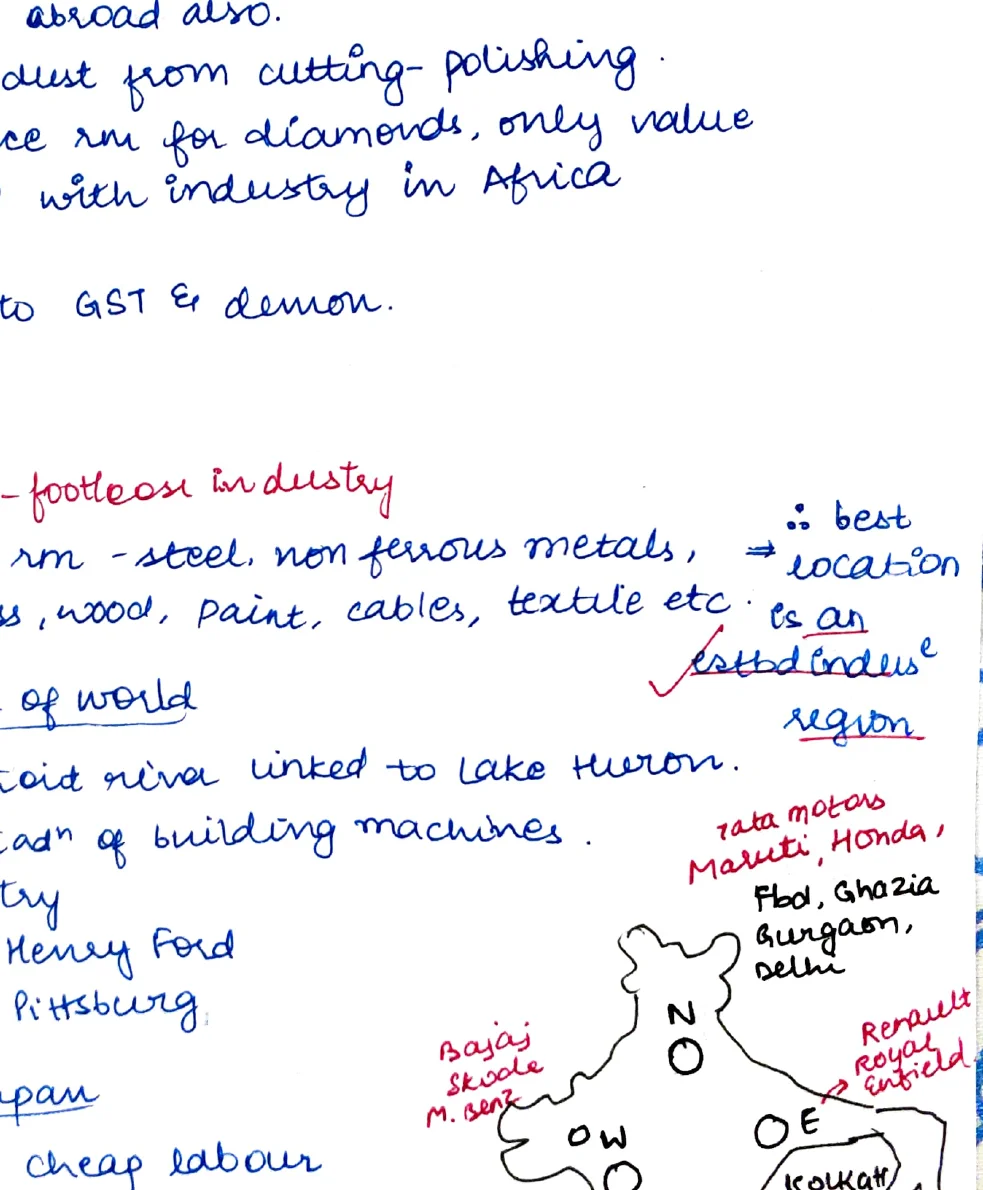
- India map sketch showing:
- Tata Motors, Mahindra, Honda (central)
- Maruti, Suzuki (NW)
- Royal Enfield (S cluster)
- Bajaj, Piaggio (W)
- Renault, Nissan, Yamaha (far S)
- N – Mumbai, Nashik, Pune, Sanand, Vadodara
- S – Bengaluru, Vellore, Chennai, Kanchipuram
#Petroleum Refineries
- 2 stages: [1] Production / Drilling; [2] Refining
- RM was less decisive factor as industries were already setup near coalfields & didn't move away (Industrial Inertia)
- No weightloss of RM
- All byproducts can be used
- So refineries can be set up:
| Location Type | Details |
|---|---|
| Near RM | Digboi, Assam / Koyali, Guj [Gujarat] — Disadv: ref[inery] will become useless after oil is exhausted; increased market cost |
| Near Market | For export-oriented & imported markets — eg. Japan (imports) so near ports — India's Jamnagar refinery near Sikka port (can make use of RM/oil from more than 1 oilfield) |
| At any intermediate location | — |
#Factors Affecting Jamnagar Refinery
- RM – Reliance has pipeline to transport oil from Salwa [illegible] to its Jamnagar refinery
- Energy – own thermal power plants in the district
- Labour – need skilled L [labour] (mobile) so not a deciding factor; + Sethupa township for 2500 employees
- Transport – district connected to NH8 + Sikka port for exports
#Synthetic Fibres Industry Also Near Refineries
- Main RM (benzene) is:
- Evaporable + hazardous → RM based (easy/light to transport so not market based)
- → Reliance entered synthetic business, petroleum refinery
- & even garment [only Vinat] = VERTICAL INTEGRATION
#Steel Plants
| Integrated | Mini | |
|---|---|---|
| Description | Handles everything in 1 complex from procuring RM, making coal, blast furnace, steel & other alloys | Runs on electric furnace with scrap metal as input & located near industrial towns for recycling |
| Construction | Takes years to construct | Long gestation period |
| Location | In India concentrated in Damodar Valley Region | Usually away from integrated plants to meet local demand & to avoid competition from them |
| Examples | — | Eg. MH [Maharashtra] |
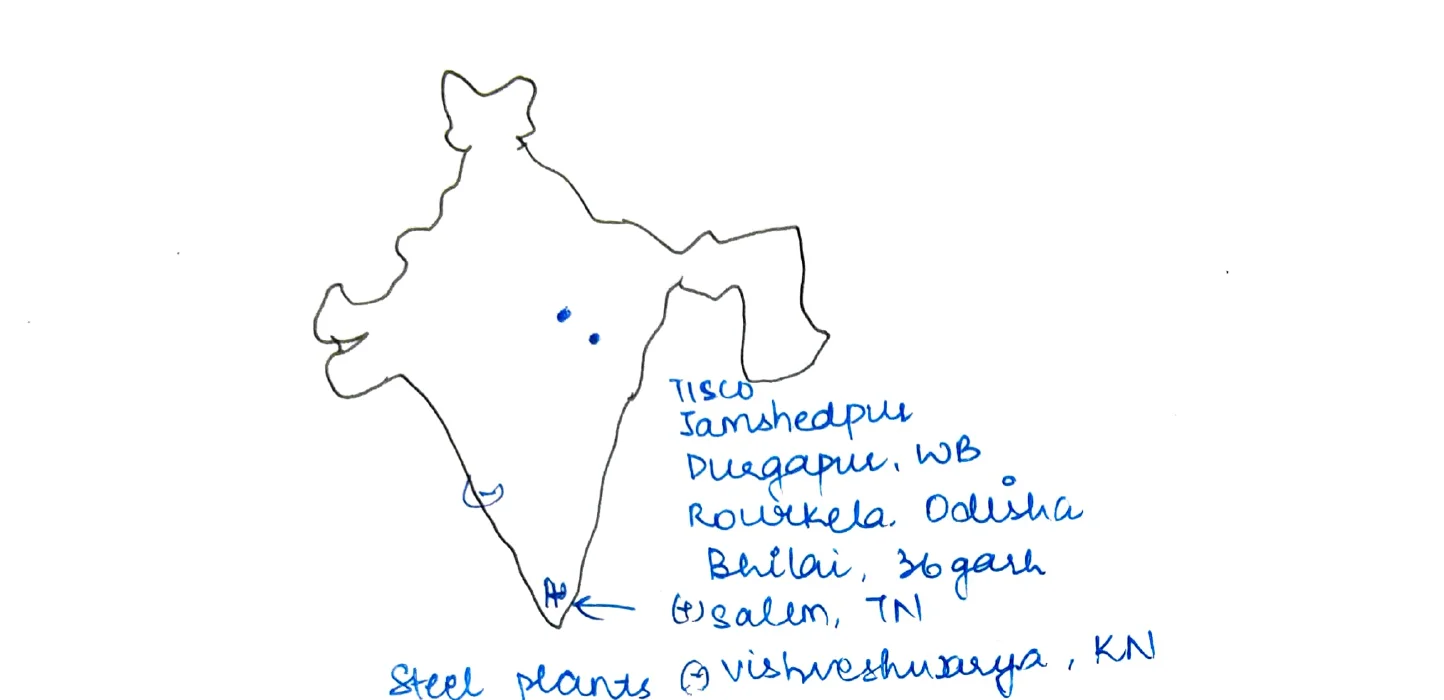
- Map labels:
- TISCO / Jamshedpur
- Durgapur, WB
- Rourkela, Odisha
- Bhilai, Segauli
- (4) Salem, TN
- Steel plants @ Vishweshwaraya, KN [Karnataka]
#Coffee Plantations
#Key Factors
- Temp – protect from sunlight
- Topo – abundant moisture but no waterlogging; hilly slopes
- Cheap labour for handpicking
- Market – loses flavour after roasting so roasted in importing country
#Global Example: Brazil (São Paulo)
#India: Kerala (WG [Western Ghats])
- Red soil (best suited)
- Hilly areas of Kozhikhode, Palakkad
- Moderate temp
- Kochi port for transport
- IKE (Sealy through port) + local demand
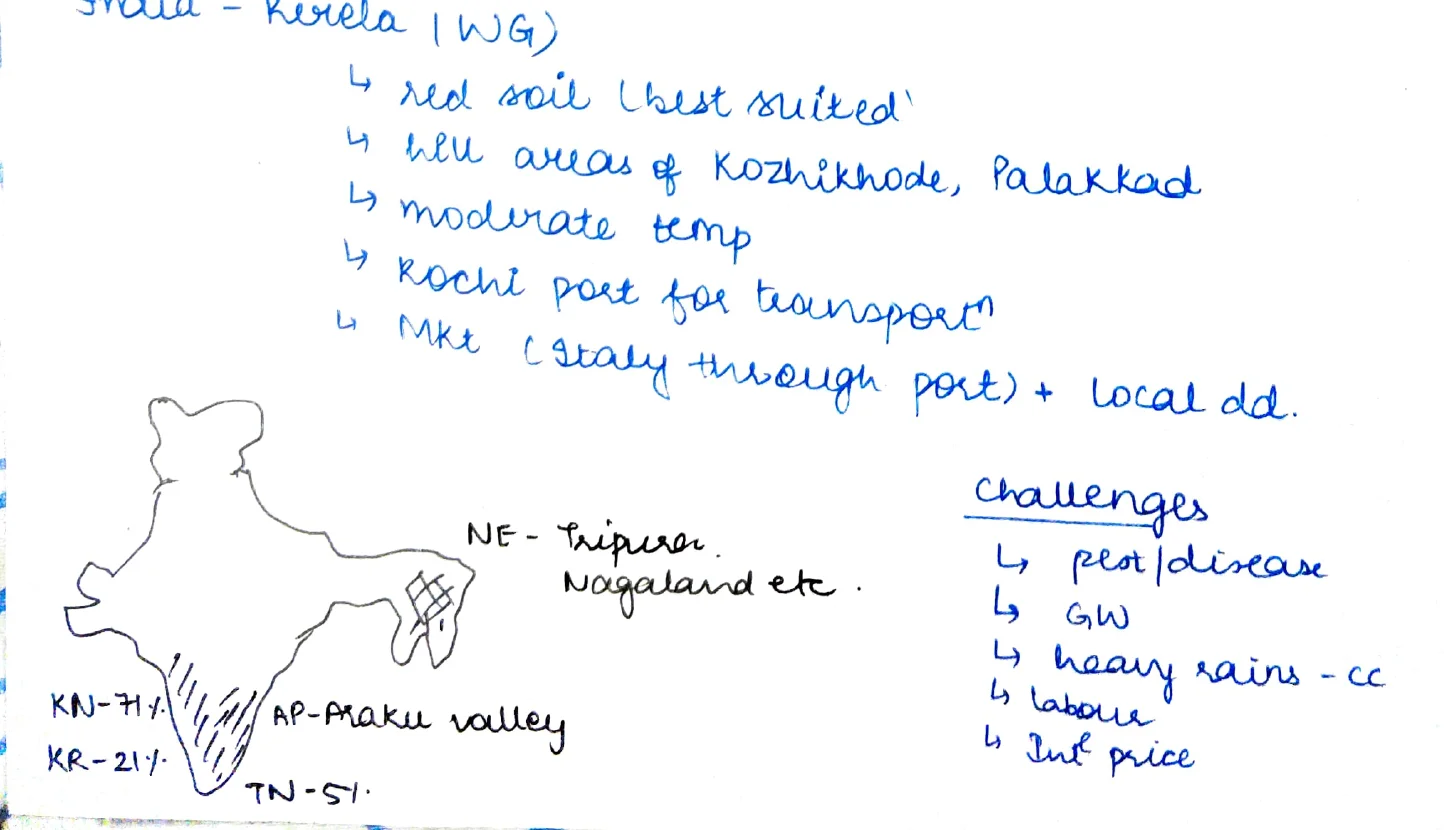
- Map labels:
- NE – Tripura, Nagaland etc.
- KN-TN (SW coast) / KP-Maku Valley / KR-21? / TN-ST-
- Challenges:
- Pendisease [pest/disease]
- Heavy rains – CC [Climate Change]
- Labour
- Low price
#Sugar Industry
#Sugar Mill vs Sugar Refinery
| Sugar Mill | Sugar Refinery | |
|---|---|---|
| Input | Sugarcane | Raw, coarse brown sugar |
| Output | Brown sugar → further processing; Bagasse → fodder, energy, paper industry; Molasses → ethanol | Brown & white sugars of various grades |
| Location Principle | Located near sugar farming areas & bulky + perishable eg. UP, MH | Japan (rely on imports); Refineries setup @ ports or near markets |
- In South India, no ILD [?] / no frost = ideal moderate temp = perfect for industry but still it is not as large as UP–MH belt as:
- North Indian farmers switched to sugarcane after Indigo cultivation
- Farmers in south have better cash crop alternatives like cotton / tobacco / coconut
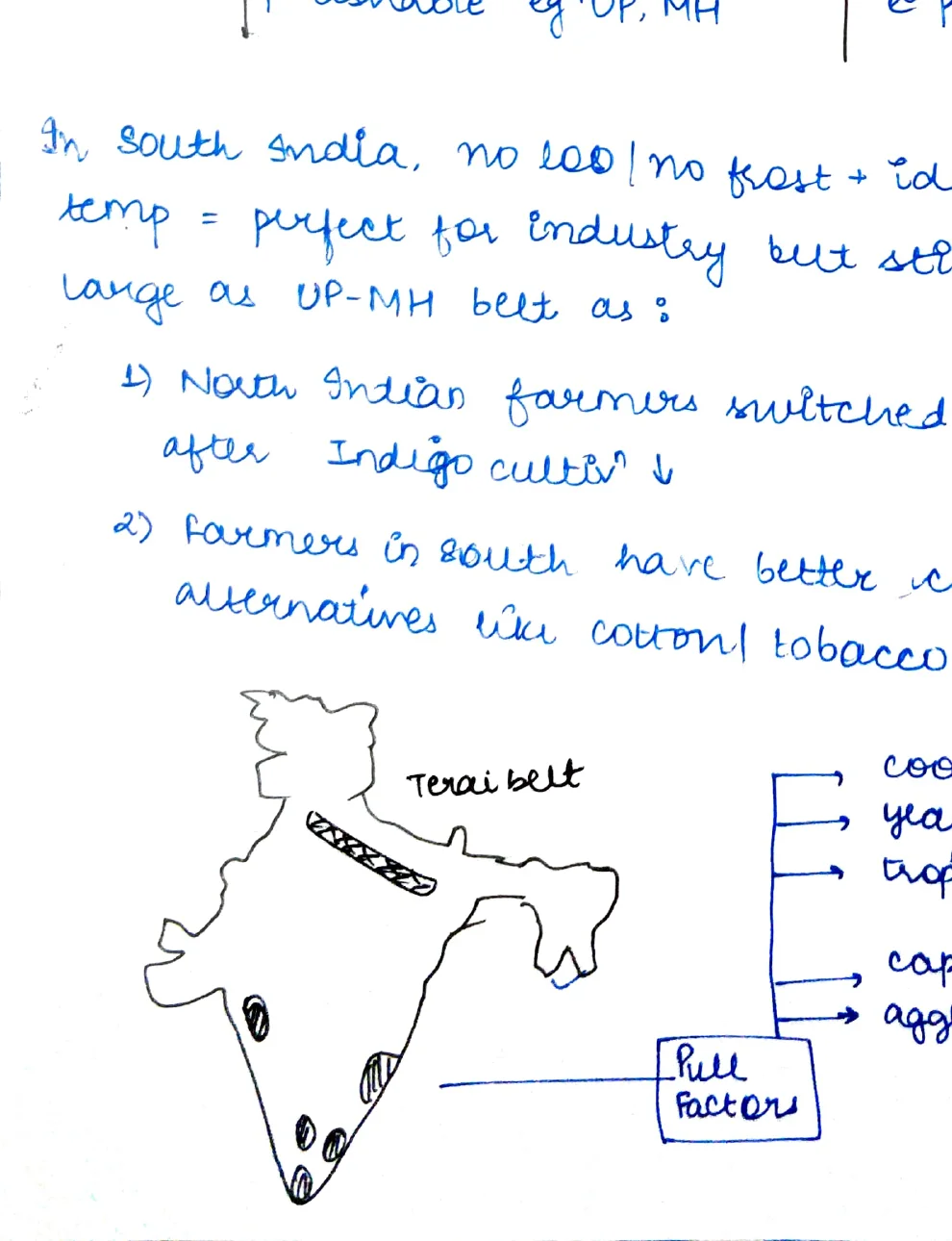
- Map labels:
- Terai belt (N India, hatched area)
- Pull Factors:
- Coops [cooperatives] in S
- Year long crushing
- High variety – high sucrose content
- Capt [capital] avail[able]
- Agglomeration benefits
#Rubber Plantations
#@ Malaysia (Tropics)
- Climate – hot, moist, equatorial climate
- Labour – immigrants from China + Tamils from India
- Tech – Research Institute @ KL [Kuala Lumpur]
- Govt policy – active support for replanting + quality control for exports
#@ Kerala
- Climate – neither cold + abundant moisture
- Soil – laterite is good for growth
- Labour – skilled, needed, available
#Jute Industry
#@ West Bengal
- RM – 90% cultivation in Kolkata hinterland; Jute can withstand flooding of the region
- Energy – Raniganj & Jharia coallines [coalfields]
- Water – Jute processing (washing → bleaching → retting) from Hooghly river
- Labour – from Bihar, Odisha, WB
- Capital – had good banking facilities as it was the capital [of British India]
#Challenges
- Wage rates to be linked with goods → resentment by TUs [Trade Unions]
- After partition, mills in India, producing areas in Pakistan
- Outdated tech + no new investment
- Competition from Bangladesh + synthetic fibres
- Lack of marketing strategy to promote Indian jute
#Commercial Fishing
-
Well developed in N America & Europe but not in Asia:
- Tropical climate (Asia) = fish can't be stored for long while cool temperate climate favours it
- Coastline – relatively smooth in Asia + less harbour (natural) + continental shelves are narrower
- Capital – CF [commercial fishing] requires large ships + high-tech equipment to scan fishing waters & thus high capital which is available in Europe/NAm [North America] but not in Asia
- Species variety – tropical regions of Asia: multiple varieties but not in small groups → not good for large scale CF
- Trop[ical] fish = higher oil content = less desirable for eating
-
Leading nations: Japan / Norway / Dogger Bank, George Bank
#Problems of Sugar Industry [boxed note on p9]
- No govt juice packaging
- Dual prices
- Strict copra [?] / trade policies [illegible]
- Cane reserve policy
- Obsolete machinery
- By-products [under-utilised]
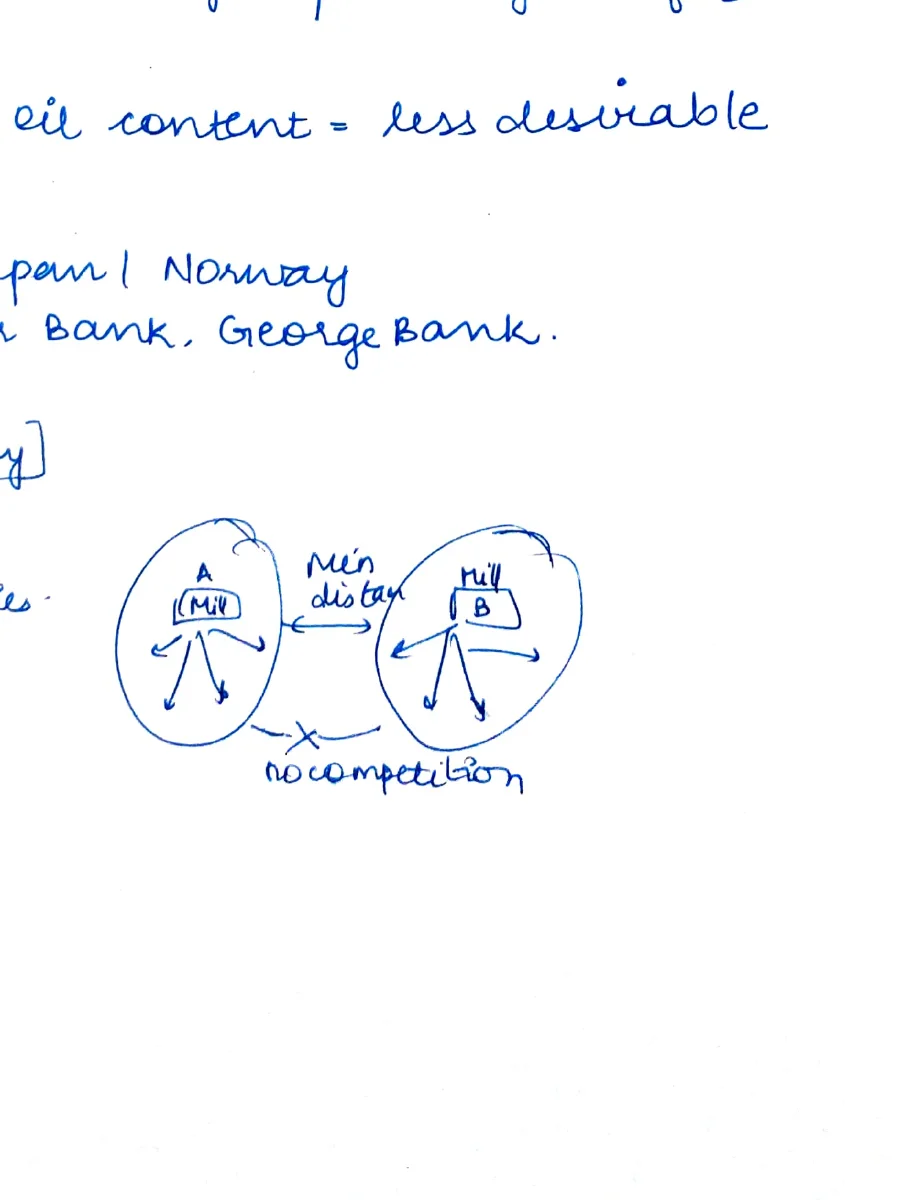
- Diagram shows:
- Circle A (Mill) – arrows pointing outward showing market catchment
- Circle B (Mill) – arrows pointing outward showing market catchment
- Minimum distance between A & B
- "X = no competition" labelled between circles
- Concept: Mills located far enough apart that market areas don't overlap → no price competition
#Geography Mains
#Polar Vortex
-
Characterised by:
- Strong upper level winds
- Surround N Pole & S Pole
- Counter clockwise direction
- Polar low pressure system
-
Distortion leads to waves allowing cold air to push southwards
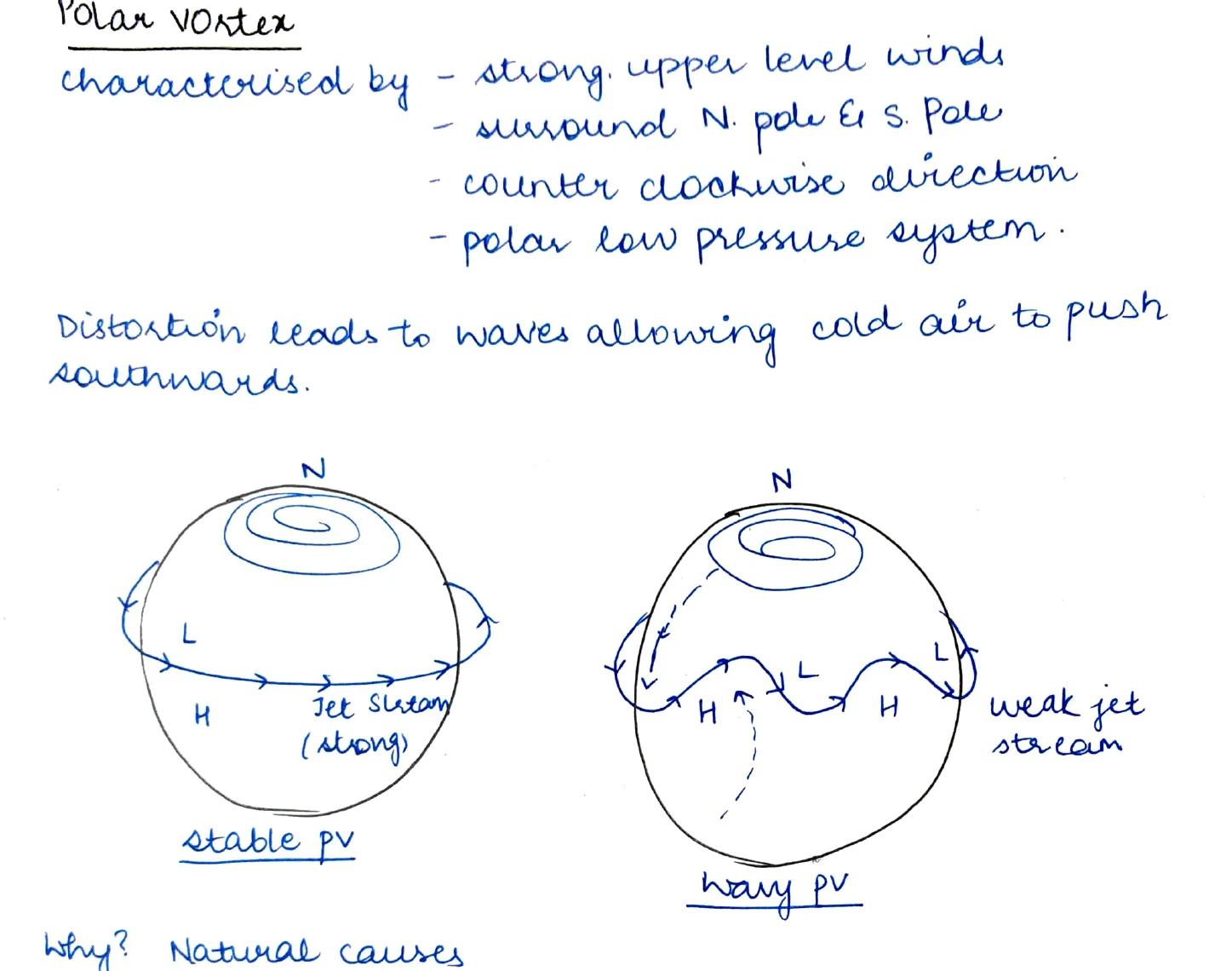
- Stable PV: N pole at top; strong jet stream (labelled); L (low) at pole, H (high) at mid-lat; tight circulation
- Wavy PV: weak jet stream; L pushed off-centre; H intrudes higher; cold air spills southward
#Why? Natural Causes
- ↓ in temp difference between Arctic & equator = weakened jet stream [JS]
- Retreating ice = heat released in atm [atmosphere] = spurious winds that disrupt PV
#Humans
- CO₂ ↑ in atm → cools polar stratosphere = ↑ temp difference between pole & equator = ↑↑↑ PV
#Mangroves
- Benefits – buffer zone protecting land from erosion; shield against cyclones; biodiversity; fuel/timber/fodder; incense [income]
- Threats – clearing, overharvesting; river changes (dams, freshwater diversion); overfishing; coral reef destruction; pollution; CC [Climate Change] (extremely sensitive to sea level changes)
#Monsoon Prediction & Challenges
- On monsoon relies the fate of almost 50% of 1 pop[ulation]
- Difficult to predict due to:
- Topography of India makes the monsoon system very complex
- Weather systems destabilize faster than extrapolation making studies difficult
- Affected by multiplicity of factors
#Challenges in Forecast
- Paucity [scarcity] of parameters – IMD [India Meteorological Dept] collects temp, humidity, wind etc through 679 auto stations, 550 surface observatories, radars & 3 satellites
- Still not enough (aerosols, dust, soil moisture etc)
- Poor infra – 40 supercomputers, well calibrated & cleaned weather stations
- 1 in pol[?] – aerosols tend to change shape & characteristics of clouds = extreme rainfall but weakened monsoon
- Impact of El Niño but exact reason still unknown
- Western models not fine-tuned for Indian setting
- 40 professionals
- National Monsoon Mission
- State of art climate model
- ✓ Time scale (16 days to one season)
- ✓ Improved predict[ion] of temp / rainfall
- ✓ Dynamic model with prediction on short, medium, extended range
- Indo-US Expedition (Sagun Nutri) to study SW [South-West] monsoon
- Supercomputing Mission
#Marine Ecosystem
- ~70% of earth; high salt content in water; extend from shore to deep sea floor
- SDG 14 – Life Below Water
| Near Shore | Offshore |
|---|---|
| Marshes | Surface ocean |
| Estuaries | Deep sea |
| Mangroves | Hydrothermal vents |
| Lagoon | |
| Coral reef |
#Significance
- Provisioning services – seafood, energy, biomedicine, transportation
- Regulating – climate, shoreline protect[ion], flood prevention, local climate
- Cultural – educational, recreational, heritage, tourism
- Supporting – bed maintenance, nutrient recycling, carbon sequestration, gas regulation
- (Produce 50% of O₂ & store 50% more CO₂ than atm [atmosphere])
#Threats
- Overfishing, global warming, deforestation, pollution
- Unplanned urban overexploit[ation] of resources
- Offshore energy plants (bio[?]), ocean acidification, ocean heat waves
- Changing land use patterns
#Marine Heatwave
- Avg temp of water remains exceptionally high for 5 consecutive days
- ↑ by 50% over past 3 decades
Impacts:
- Bleaching of corals – temp sensitive; eg. Caribbean coral reef
- Destruction of kelp forest – need cooler water; eg. California
- Dying sea grass (Mediterranean)
- Ability to sequester carbon ↓
- Thermal expansion of water
- Local climate [disruption]
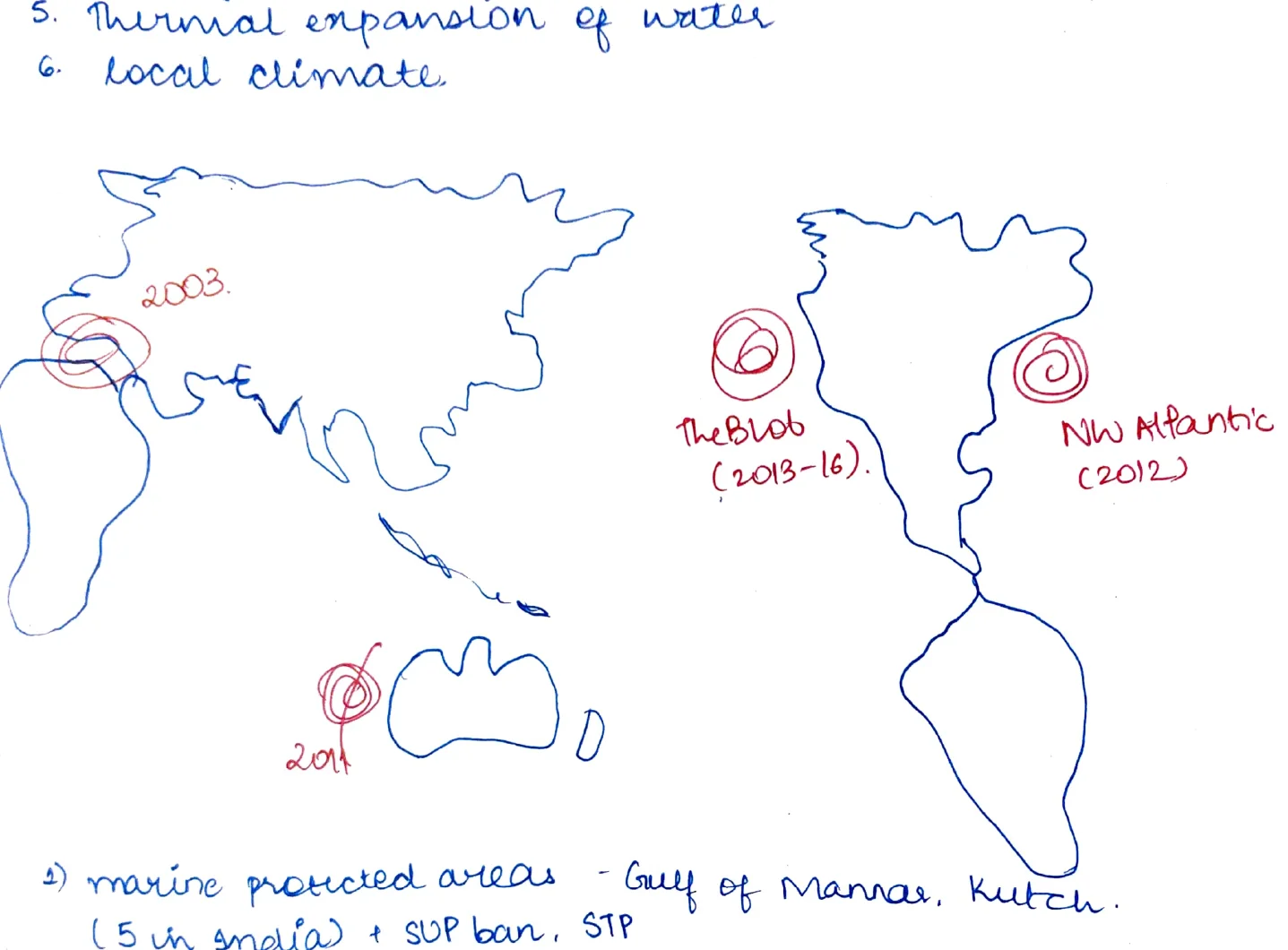
- Map annotations:
- 2003 – spiral mark near Indian Ocean / Bay of Bengal
- 2011 – spiral near W Australia coast
- The Blob (2013-16) – large oval in NE Pacific
- New Atlantic (2012) – large oval in NW Atlantic
Marine Protected Areas:
- Gulf of Mannar, Kutch (5 in India) + SOP ban, STP
- MARPOL
- Greenpeace
#Marine Pollution – Causes
- Sewage, chemicals, land runoff
- Oil spills, ocean mining, plastic, noise, CO₂, coastal tourism, ports, aquaculture
Effects: Marine animals, coral reef, BOD ↓, dead zones, eutrophication, food chain, food security
#Role of Dust in Monsoon
- → Solar dimming effect – cause land surface to cool → rainfall ↓
- → Elevated heat pump pheno[menon] → hot sand rises in air → change in air pressure in atm → rainfall ↑ (feedback loop)
- → Cloud formation ↑
- → Snow darkening effect → ↑ in temp gradient / [illegible]
#Ocean Temperature
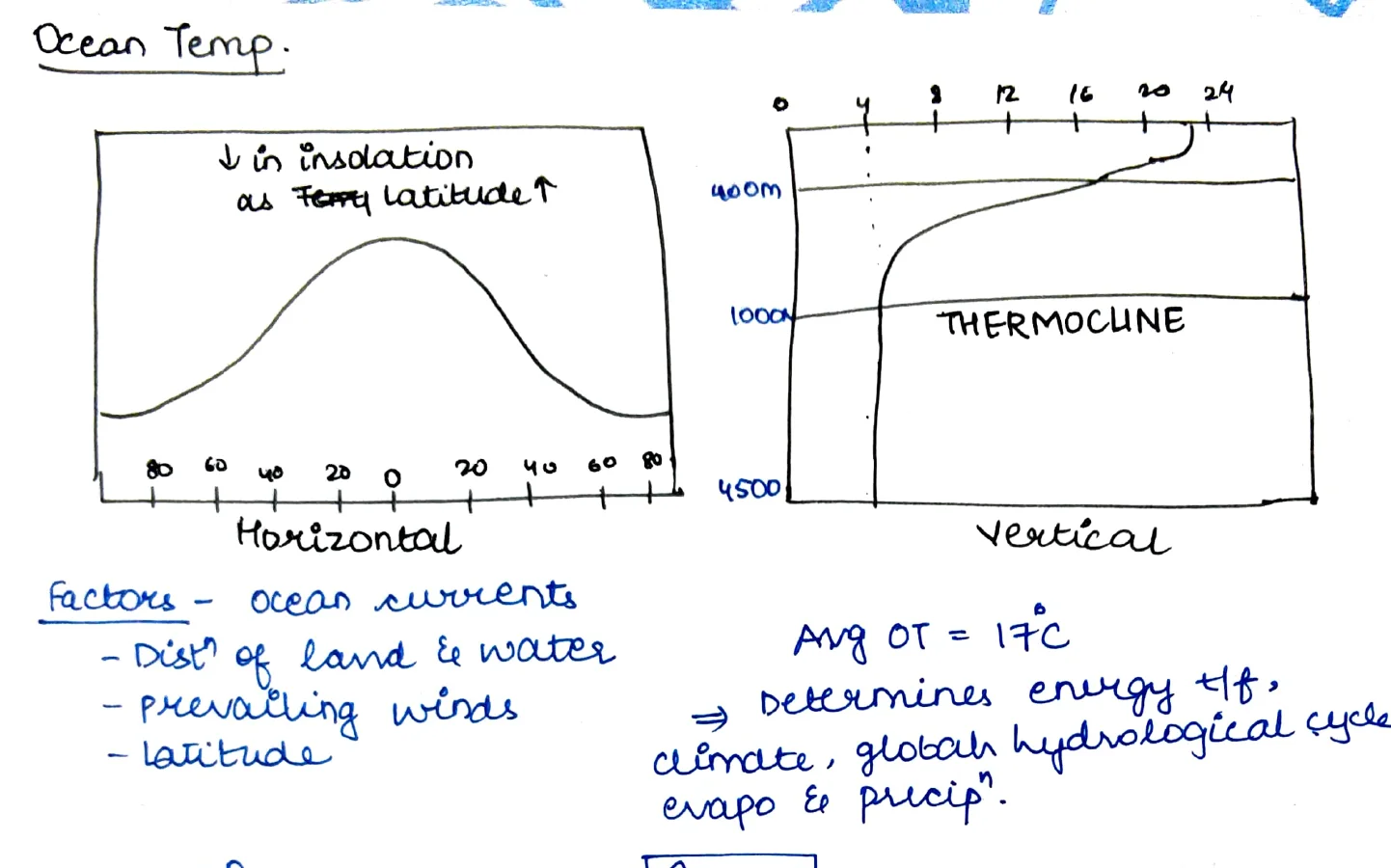
-
Horizontal OT graph:
- X-axis: 80°N → 0° → 80°S (latitude)
- Y-axis: Temperature
- Shape: bell curve – highest at equator, falls steeply poleward
- Note: ↓ in insolation as temp + latitude ↑
-
Vertical Thermocline diagram:
- Y-axis: Depth (400m → 1000m → 4500m)
- X-axis: Temp (0 → 8 → 16 → 24°C)
- Thermocline: sharp gradient layer between warm surface & cold deep water
-
Avg OT = 17°C
- → Determines energy eff[iciency]
- → Climate, global hydrological cycle
- → Evapo & precip[itation]
#Factors (Affecting Ocean Temp)
- Ocean currents
- Distribution of land & water
- Prevailing winds
- Latitude
#Ocean Pollution
- Oil spills, eg. Brazil, MX [Mexico] – [illegible] 700 kl [?]
- Mining
- Effluent discharge
- O[zone] warning [?]
- Plastic
- Noise
Impacts:
- ↑ habitat / marine ecosystem
- O₂ depletion
- Ocean acidification
- Fish production ↓
- Human health – food chain; eg. Minamata
- Livelihood
#Ocean Warming – Cascade Flowchart
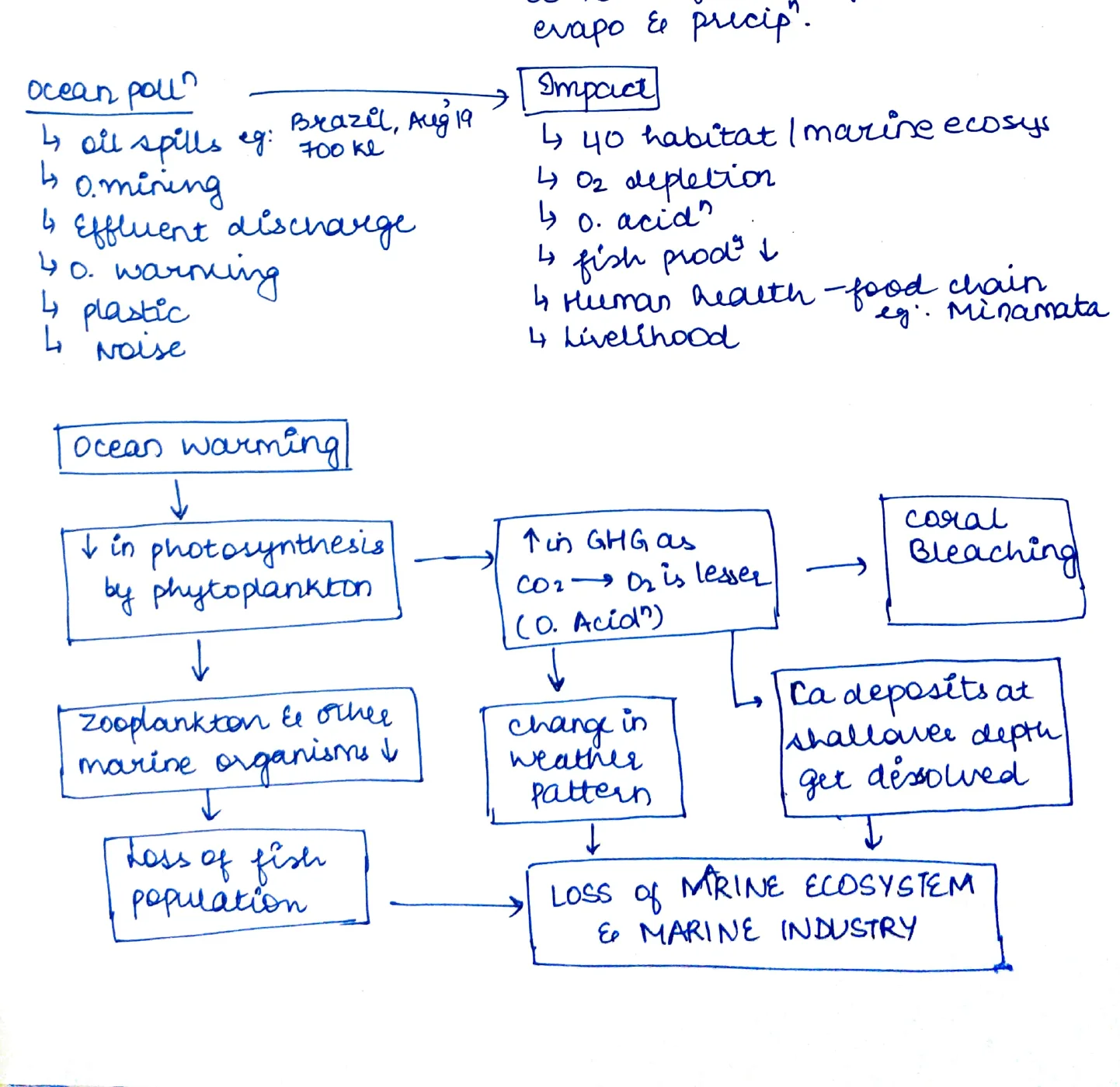
- Box 1: Ocean Warming
- → ↓ in photosynthesis by phytoplankton
- → Zooplankton & other marine organisms ↓
- → Loss of fish population
- → Zooplankton & other marine organisms ↓
- → ↓ in photosynthesis by phytoplankton
- Box 2: ↑ in GHGs as CO₂ → O₂ is less (Ocean Acid[ification] ↑)
- → Change in weather pattern
- → Coral Bleaching
- → Ca [Calcium] deposits at shallower depths get dissolved
- → Change in weather pattern
- All paths converge → Loss of Marine Ecosystem & Marine Industry
#Water Stress
- Water footprint, Virtual water
- NITI – 21 Indian cities incl. Delhi – out of GW [groundwater] by 2020
- 70% water contaminated
- 6% GDP
- 2/3rd M. [million] litres lost by ₹100 [illegible]
#1. Water Pollution – Arsenic, Fluoride
- Frothy lakes & rivers
#2. Groundwater Crisis
- Largest extractor
- 90% towards agri
- Privately owned yet common pool resource
Causes of Groundwater Crisis:
-
↓ natural rate of recharge (5% of rainfall)
-
Drying of Mitra post monsoon = river recharge not possible [illegible]
-
Concretisation = ↓ area for recharge
-
Diversion of dam water meant for irrigation to industrial use = farmers turn to GW + cheap electricity + easy availability
-
Groundwater pollution – arsenic, WB
-
GRACE-FO → is water table ↓ at 0.3m/yr rate
#Cleaning Ganga – Aviral Dhara (Eflow)
- Longest river – 2500 km; 26% of landmass, 43% pop[ulation]
- Waste generated > treatment potential (particularly in UK–UP [Uttarakhand–UP] stretch)
- (12000 mn l[itres]/day generated vs 4000 mn l[itres]/day treatment capacity)
- Source:
- Chemical effluents
- Distilleries
- Sugar mills
- Paper mills
- Sewage
- Dead bodies
- Excreta
- Chemical effluents
- Bit industrial reason but disproportionate impact due to toxicity
End of Part 1 (Pages 1–15)
#Namami Gange & Water Bodies — Criteria and Plan
- Criteria — coliform bacteria level, pH, BOD [Biochemical Oxygen Demand], dissolved salts (CRB [Central River Board] priorities)
- Namami Gange — STP [Sewage Treatment Plant] = 63
- Ring Alarm — toilets in 1644 villages
- Industries — 1100 units closed down
- Rivers front cent = modern: 46 182 ghats, 115 cremation
- How? Plan (NMCG) [National Mission for Clean Ganga]:
- → STP (HAM [Hybrid Annuity Model] mode)
- → replace woodfired crematoria with electric ones
- → river Dolphin [Gangetic Dolphin], place turtles
- → planting trees
- → tanneries — major polluters — min. discharge + treat it
- → efforts by controlling dams
- → NMCG — 37 permanent members mandated but only 3 [functioning]
- → cooperation b/w states
- Bhuvan Ganga mobile app — people can report sources
- Ganga Prahari
- CSR → waterless chrome tanning
#Impact of CC [Climate Change] on Water Bodies
- Intensify of global hydrological cycle
- alter river flow regimes → surface water avail. ↓
- extreme precipitation → floods
- sea level rise
- warming of oceans
- ↓ precip. & ↑ evapotranspiration = ↓ gw [groundwater] recharge
- ↑ dol. [demand] for water = stress on WBs [water bodies] ↑
- coastal waters
- ↑ amt. of water that atm. [atmosphere] can hold = more rainfall
- heavy rainfall = ↑ runoff & less seepage = more water flows to WBs
- pressure on water reservoirs
- ↑ glacier melting = ↑ river flow in short run, ↓ in long run
#Flash Floods
- eg. Hyderabad flood 2019 — 191 mm of rain in a few hrs, 70 died
- = excessive rainfall in short period of time
#Why?
- → rivers which are narrow & steep
- → small rivers in urban areas with hard surfaces (rainwater doesn't seep in)
- → a dam or levee failure
- → urbanisation + deforestation
- → difficult to predict
#How to Avoid?
- → planting vegetation, terracing hillsides, construction of floodways
- South Asian Flash Flood Guidance System
#Heatwaves
- = period of abnormally high temp. more than normal max. temp.
- → typically in Mar–June
#IMD [India Meteorological Department] Criteria
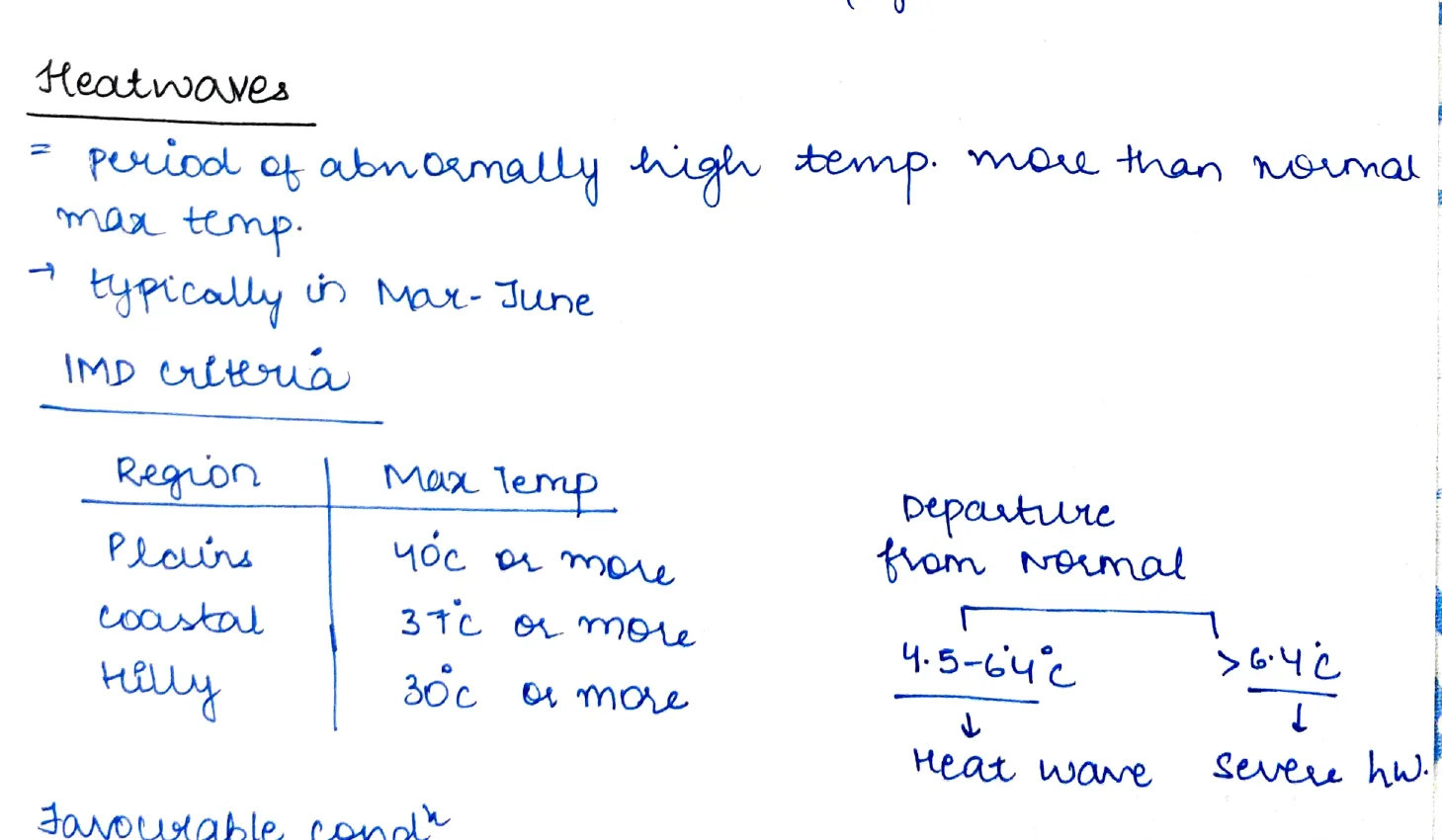
- IMD Criteria Table:
| Region | Max Temp |
|---|---|
| Plains | 40°C or more |
| Coastal | 37°C or more |
| Hilly | 30°C or more |
- Departure from Normal:
- 4.5–6.4°C → Heat wave
-
6.4°C → Severe heat wave
#Favourable Conditions for Heatwaves
- prevalence of hot air over a region
- absence of moisture in upper atm. [atmosphere]
- cloudless sky
- anti-cyclonic conditions
#Usually Develop Over NW India
- due to presence of above normal [temperature] there & spread towards E & S but not W since prevailing winds are westerly to north westerly
- Map shows NW India (Rajasthan/Punjab area) as heat origin, spreading E & S
#Health Impact
- heat cramps
- heat exhaustion
- heat stroke
#Delhi Pollution
#Why Rises in October Each Year?
- withdrawal of monsoons by Oct & predominant wind change to N. Westerly
- drop in temp & low air movt. [movement] = concentration of pollutants
- laws in PB [Punjab] & HR [Haryana] delaying sowing paddy makes farmers to burn stubble to sow wheat
- Diwali time
#Steps Taken → CRAAP [Comprehensive Action Plan for Air Pollution]
- → BSIV–BSVI from April 2020
- → NAAQs [National Ambient Air Quality Standards] → NASI [?]
- → ban on burning biomass
- → green crackers
- → smog towers
- → happy seeder
#Himalayan Ecosystem
- fragile & diverse
- 51 mn. who practice hill agri. [agriculture]
#Importance
- ecological security, forest cover, feed the perennial rivers — drinking water, aug. [augment] HEP [Hydroelectric Power], biodiversity hotspot, spectacular landscape for tourism, role in monsoon, cultural importance, trad. knowledge (medicines)
#Key Concerns in IHR [Indian Himalayan Region]
- socio demographic MH [migration hazard] — out-migration
- stewardship degrad. — human WR [wildlife] conflict, forest fires, springs drying up
- security — depop. [depopulation] from border & remote areas
- synergy deficits
#Recommended → Global Sustainable Tourism Council
- For a destination → destination mgmt, tourism seasonality mgmt, CC adapt., crisis & emergency mgmt, solid waste mgmt
- For hotels/tour operators → legal compliance, integrity pact, cultural interaction
#Action Agenda for States
- CBM [Capacity Building Measures]
- REID [?]
- Finance & MRE [Monitoring, Reporting & Evaluation]
- Plan → Implement → Monitor [boxed/highlighted]
#Thermal Power Plants
#Impact
- located in water scarce areas
- resource intensive
- polluting [CSE [Centre for Science and Environment] says TPPs account for 40% of total freshwater withdrawn by all industries]
- responsible for 40% of total freshwater withdrawn by all industries
- emissions cause lung diseases, smog, acid rain
#Emissions from Industry Table
| Pollutant | % |
|---|---|
| CO2 | [illegible] |
| PM | 45% |
| CO2 | [illegible] |
| NOx | 30% |
| Mercury | 80% |
- CSE says TPPs account for 45% CO2, 30% NOx, 80% Mercury emissions from industry
#Himalayan Ecosystem (continued) — NMSHE [National Mission for Sustaining the Himalayan Ecosystem]
- est. 2010, 11 states, 2 UTs
- Obj. — formulate appro. [appropriate] policy to ensure sustained ecosys. [ecosystem] maint. [maintenance]
- sustainably safeguarding HE [Himalayan Ecosystem]
- address issues like glaciers, natural hazards, biod. [biodiversity] protection, trad. knowledge, restoration & rehab.
#Sustainable Tourism in IHR — NITI [Aayog]
- pilgrimage tourism → modern → mass →
- CAGR [Compound Annual Growth Rate] of 7.91 over last decade
- local people — eco & business oppo. [opportunity]
- states — revenue
- entrepreneurs — profit
- Himalayan circuit under Swadesh Darshan
#Impact
- → poll. [pollution], overexploit. of resources, food insecurity, ill-planned urban, traffic congestion, loss of indig. [indigenous] culture, natural disasters, waste disposal
#Unconventional Gas Reservoirs
- = occur in relatively impermeable sandstones
- more expensive to exploit
- eg. shale gas, CBM [Coal Bed Methane]
#CBM [Coal Bed Methane]
- trapped in coal seams
- accessed by drilling wells into coal seam & pumping large qty. of water. Water occupy gas & pushes out the gas
- I has estimated 100–990 bn. [billion] cubic m. of CBM
#Problems in Extraction
- capital intensive
- advanced tech
- pvt. co.-restricted laws + low price
#Shale Gas
- 1 — Cambay basin, Assam Arakan b. [basin], Gondwana b. [basin]
- tech. used to find shale k/a [known as] fracking [highlighted/boxed]
- deep vertically drilling → horizontal drilling in all directions → hydro-fracturing / fracking i.e. using HP [High Pressure] water to create fissures to push gas out
- guar [highlighted] grown in HR/RJ eases the process by turning water into gel
#Problems [of Shale Gas]
- envt. [environmental] damage due to fracking
- possible contamination of groundwater
- water intensive
#CBM vs Shale Gas
- CBM occurs much closer than shale gas, to the surface
- shale resources = 65 billion [boxed] cubic feet but CBM = 450 tcf [trillion cubic feet]
- so focus on less risky CBM
#Impact of CC [Climate Change] on Cyclones
- Trajectory/Origin — dev. [develop] around lower latitudes than usual (3–10°N). eg. Fani (2°E [?]) [circled/boxed] thus gathers more moisture & develops more severe
- Intensity/Time — usually Apr–May; now no cyclones but Fani
- Rapid Intensification — Fani meandered over sea for 11 days
- Post landfall — usually die off on hitting land, Fani reached Cuttack & Bhubaneswar (30–40 km inside)
- Location — occur in Arabian Sea now, not BOB [Bay of Bengal], but near SI [Sri Lanka] coast. Taukae on west coast
- Recurvature — towards E to W coast (Ockhi)
#Cyclone Ockhi Track Map
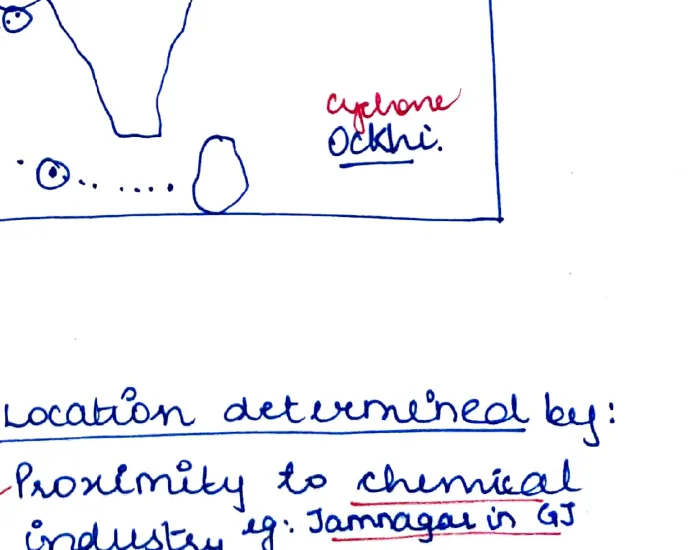
- Track: originates near Sri Lanka coast (Arabian Sea/BOB), curves northward, hits west coast
#Pharma Industry — Location Factors
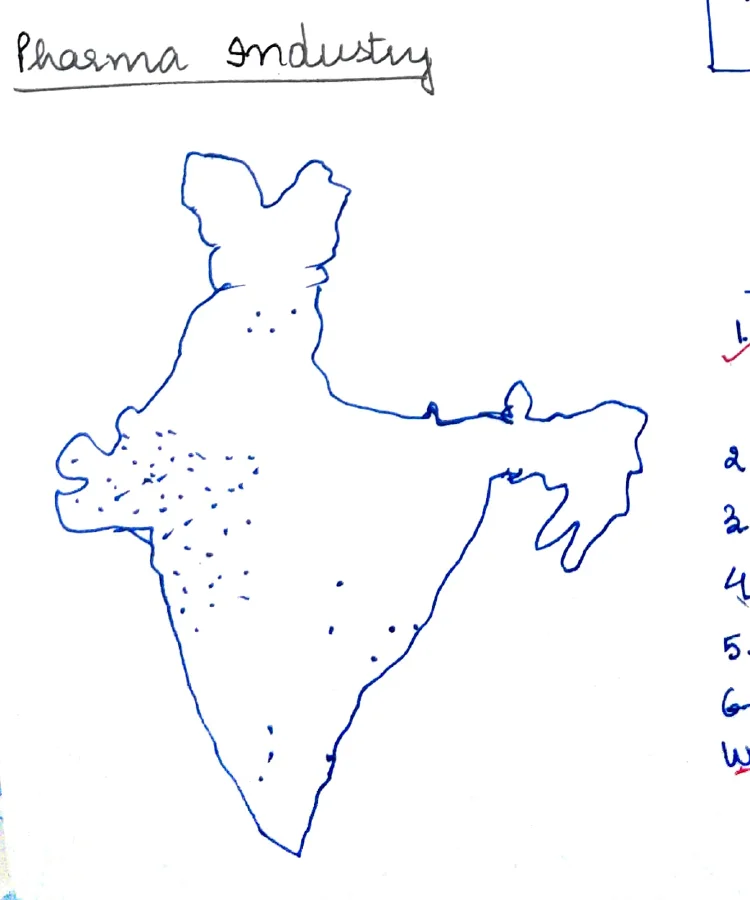
- Location determined by:
- Proximity to chemical industry eg. Jamnagar in GJ [Gujarat]
- To ports
- agri. [agriculture], low taxation
- favourable govt. policy
- Infra
- labour avail.
- avail. of pristine quality water — hilly states — for API [Active Pharmaceutical Ingredient]
#Earthquakes
- Eq. swarm — low intensity eq. [earthquake]
- localised region
- over a period of time
- no clear sequence of foreshock, mainshock & aftershock
- normal in peninsular India
- eg. Palghar, 30 in 2019
#Earthquake Zones in India
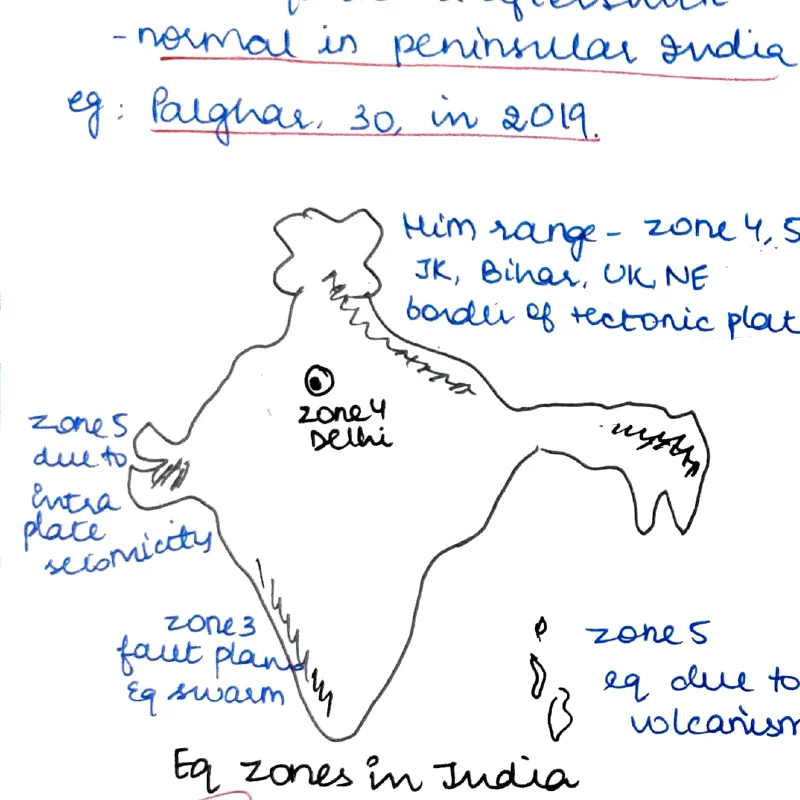
- Him. [Himalayan] range — zone 4, 5; JK [Jammu & Kashmir], Bihar, UK [Uttarakhand], NE; border of tectonic plate
- zone 5 due to intra-plate seismicity [west side]
- zone 3 fault plane, eq. swarm [SW]
- zone 4 Delhi
- zone 5 eq. due to volcanism [SE — Andaman]
- Eq. zones in India → GSI [Geological Survey of India] + BIS [Bureau of Indian Standards]
#Mitigation
- V. mapping
- community preparedness — DROP, COVER, HOLD → sensitize
- building codes — analyze soil types before design
- SARC [?] seismological agency
- Eq. plan for Him. [Himalayas]
- re-evaluate sites for large dams & nuclear installations from seismic p.o.v. [point of view]
#Volcanoes
#Causes
- convergent — subduction of 1 plate under another & melting of rocks which rises along fissure
- diverging — thinning of upper crust & ↑ in rock pressure, ↑ in melting pt. [point] formation of magma
- continental V [volcanoes] — due to stressing of plate & creation of faults
#Pacific Ring of Fire
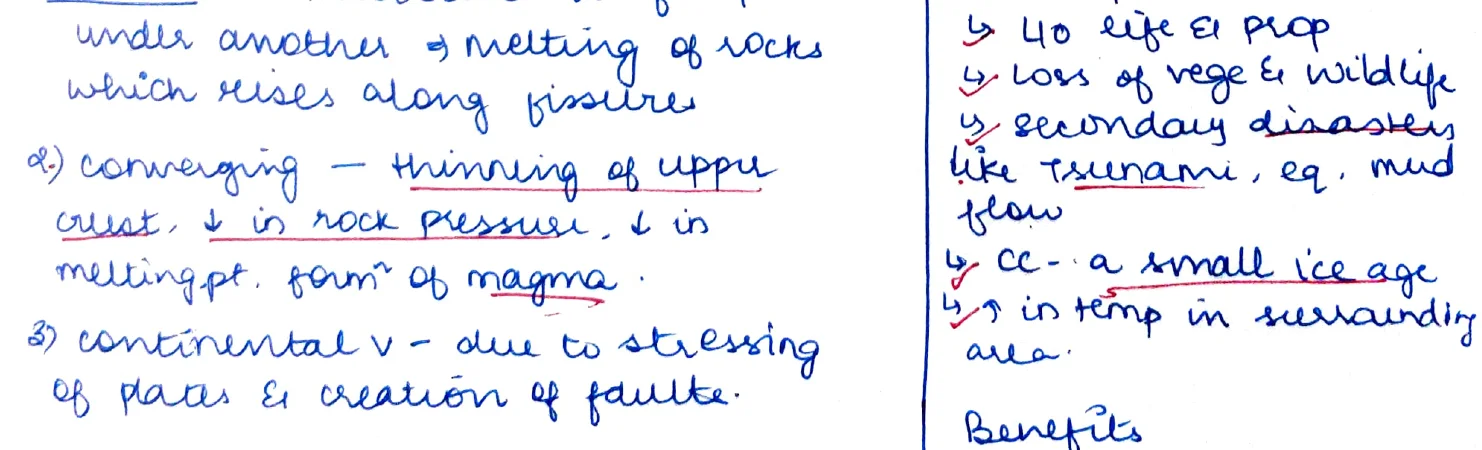
| N | S | |
|---|---|---|
| W | [illegible] | [illegible] |
| E | [illegible] | [illegible] |
- 14 V → 15 Q → W
- 25 V → 707 Q → W [illegible]
#Hazard of Volcanoes
- air poll. [pollution]
- ↑ life & prop. [property loss]
- loss of vege. [vegetation] & wildlife
- secondary disasters like tsunami, eg. mud flow
- CC — a small ice age
- ↑ in temp. in surrounding area
#Benefits of Volcanoes
- fertile soil
- scenic beauty
- add to extensive plateau/[illegible] V [illegible]
- produces valuable minerals & gases
- cooling effect
#Glacial Retreat — NTH [National Tribunal on Himalayas] — 4/3 [?] will retreat by 4100 [illegible]
- HK [Hindukush] Him. [Himalaya] Assessment reveals more than 35% of glaciers in region could retreat by 2100
- Causes — GHG [Greenhouse Gases], deforest., ice breaking ships, open water
- Consequences:
- ↓ alter river flows
- ↓ Irrig. [irrigation]
- ↓ hydropower
- ↓ ecosys. services
- biod. [biodiversity] loss eg. blue bear, penguins
- coral reef [bleaching] — due to rise in SL [sea level]
- scarcity of fw. [freshwater] — 70% of fw. is in glacial form
- ↑ in ocean levels
- ↓ GW [groundwater]
- affect monsoon
- ↑ Bioaccumulation of envt. [environmental] pollutants like DDT become airborne & get deposited on ice → released during melting
- ↓ alter river flows
#Aravalli
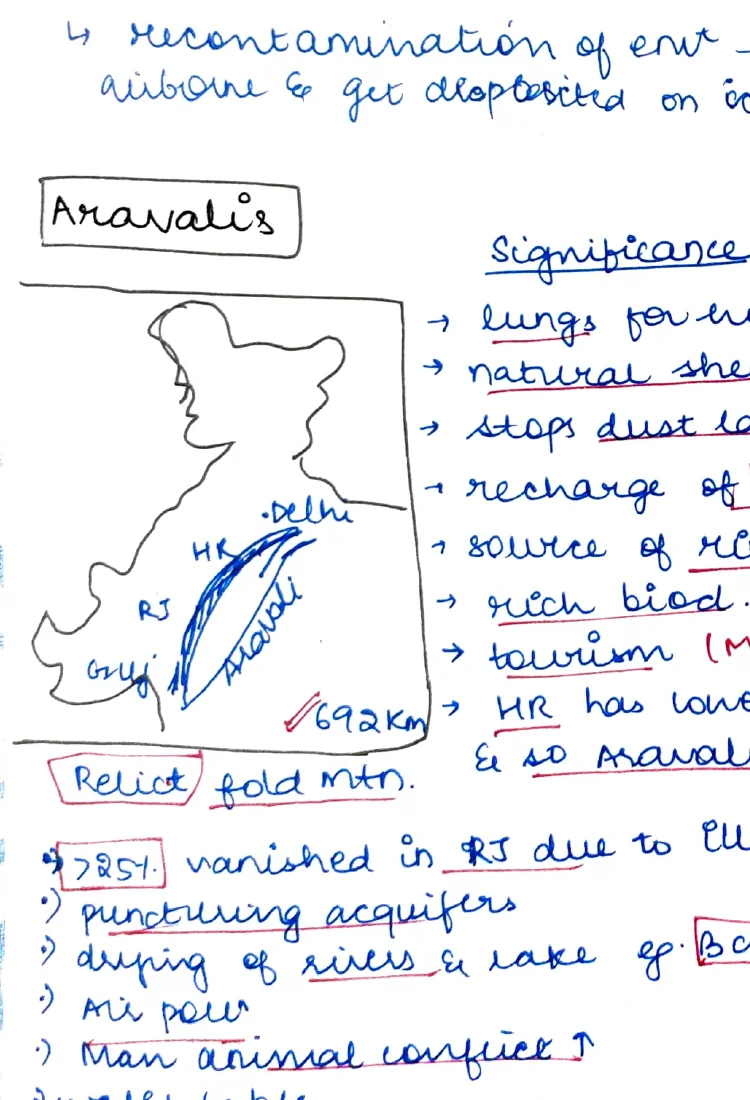
- Relic [old] mountains
- runs from Delhi to Mt. Abu
#Significance
- lungs for highly polluted Delhi NCR
- natural shield against creep of Thar Desert
- stop dust laden winds from RJ [Rajasthan]
- recharge of [gw] [groundwater] [boxed]
- source of rivers — Sabarmati, Banas, Chambal
- rich biod. [biodiversity] (Mt. Abu)
- tourism (Mt. Abu)
- HR [Haryana] has lowest forest cover — barely 3% [circled] — so Mewali [Mewat] is key
#Problems [with Aravalli]
- 28% [circled] vanished in RJ [Rajasthan] due to illegal quarrying
- depleting aquifers
- drying of rivers & lakes eg. Badkhal [boxed]
- air poll. [pollution]
- man-animal conflict ↑
- ↓ water table
#Illegal Mining
- no alternative livelihood
- high dist. of construction mat.
- → the irony of SC [Supreme Court] guide [?]
#Soil Formation
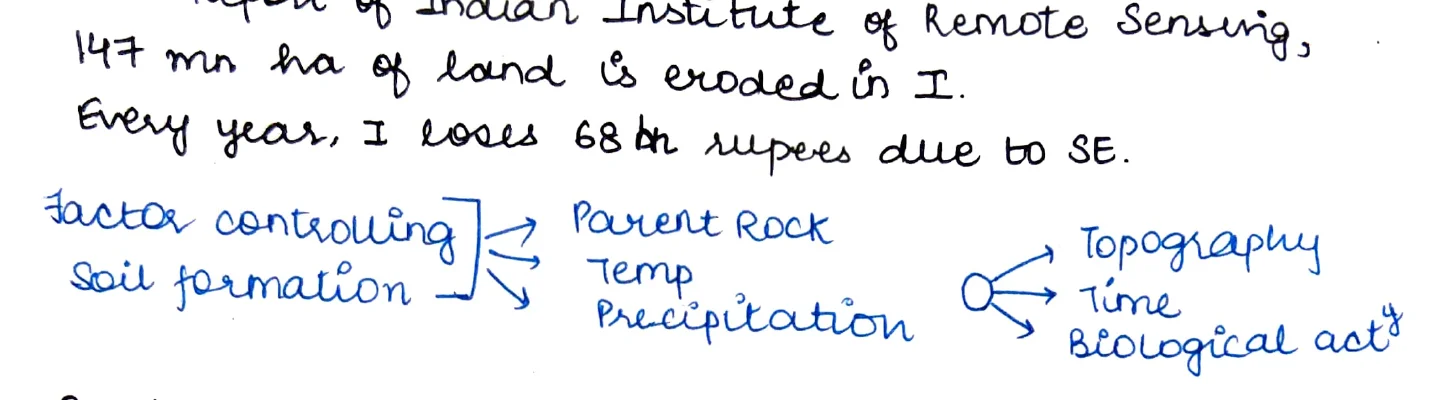
- 2015 Report of Indian Institute of Remote Sensing:
- 147 mn. ha of land is eroded in India
- every year, India loses 68 bn. [billion] rupees due to SE [soil erosion]
- Factors controlling soil formation:
- Parent Rock → [interacts with] Topography
- Temp. → [interacts with] Time
- Precipitation → Biological activity
#Fronts
- = boundary zone b/w 2 airmasses (frontogenesis)
- → middle lat. [latitudes], not trop. [tropics]
- → steep gradient in temp.
- → cause cloud form. [formation] & precip. [precipitation]
- → cond. [condensation]: temp. difference & opposite direction
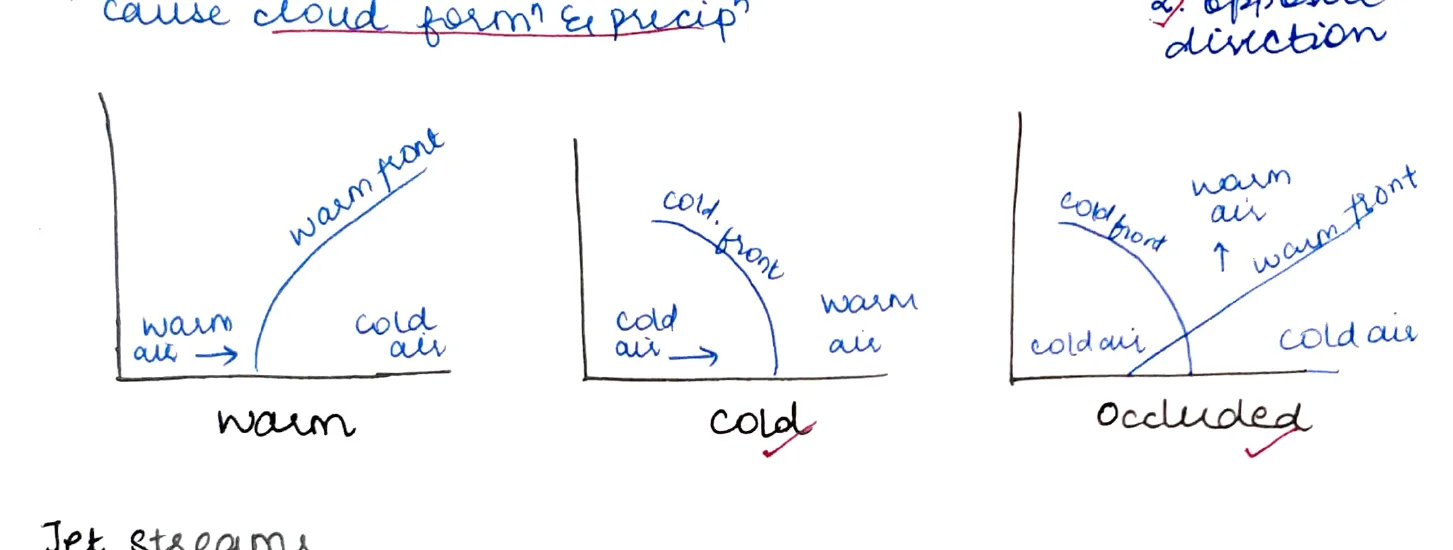
- Warm front — warm air → slides over cold air at gentle angle; warm front labelled; cold air below
- Cold front — cold air → undercuts warm air steeply; cold front labelled
- Occluded front — cold air (from both sides) + warm front + warm air lifted; cold air on both sides
#Jet Streams
- swift & narrow [highlighted] W-flowing winds
- in upper tropo. [troposphere]
- help to comp. [complete] global circuit [highlighted]
- found near junction of F, H, P [Ferrel, Hadley, Polar] cells [boxed]
- areas where air masses of diff. T [temperature] meet
- surface T [temperature] determines where JS will form
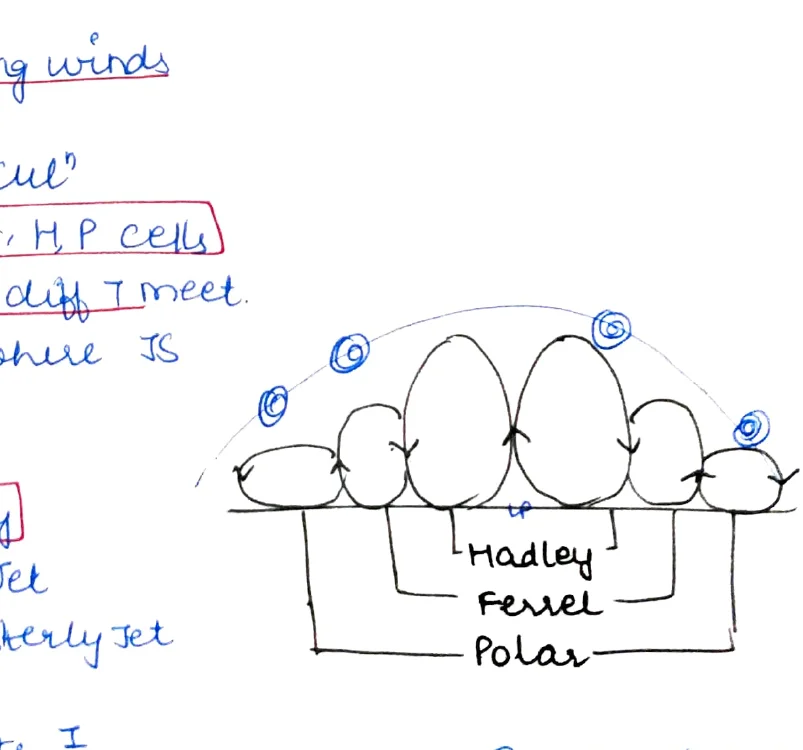
- Diagram shows 3 pairs of circulation cells (Hadley, Ferrel, Polar) with jet streams (circled) at junctions
| Type | Jet Streams |
|---|---|
| Permanent | ↓ Polar, ↓ Subtropi. [Subtropical] |
| Temporary | ↓ Somali Jet, ↓ Trop. Easterly Jet [affects monsoon] |
- temporary → affects I [India] monsoon
#Ocean Currents
- Factors:
- NH [Northern Hemisphere] → right; SH [Southern Hemisphere] → left [Coriolis effect]
- Heating by solar energy
- Earth's rotation → planetary winds
- Wind eg. Chilean tip delivers: [illegible] wind shift as Humboldt current
- Gravity
- Salinity
- Ocean bottom topo. [topography] eg. MOC [Meridional Overturning Circulation] in Atlantic
- Upwelling & downwelling
- Surface → warm; deep water → cold
#Effects
- regulate global climate
- free navigation eg. Gulf Stream [boxed] keeps Russia's [Arctic] port navigable
- distribute minerals, fishes
- W. [Western] coast by warm currents = climate [boxed] in check
- mixing of C [cold] — fishing grounds eg. Japan
- World map [mentioned — see page 26 original for detail]
#Deserts
- Regions of low precip. [precipitation] and having hostile cond. [conditions] for survival of plant & animal life
- → hot / semi-arid / coastal / cold
#Factors [for Desert Formation]
- Wind — (N 25°–30° N&S → offshore) eg. Sahara [underlined]
- cold currents eg. Atacama [boxed/underlined]
- leeward side aka Rainshadow desert eg. Gobi desert [underlined]
- absence of mtn. [mountain] to cause orographic rain eg. Marali [?] & Thar dune [underlined]
- cold deserts in polar areas due to v. [very] cold air
- weathering process
#Forest Fire Causes
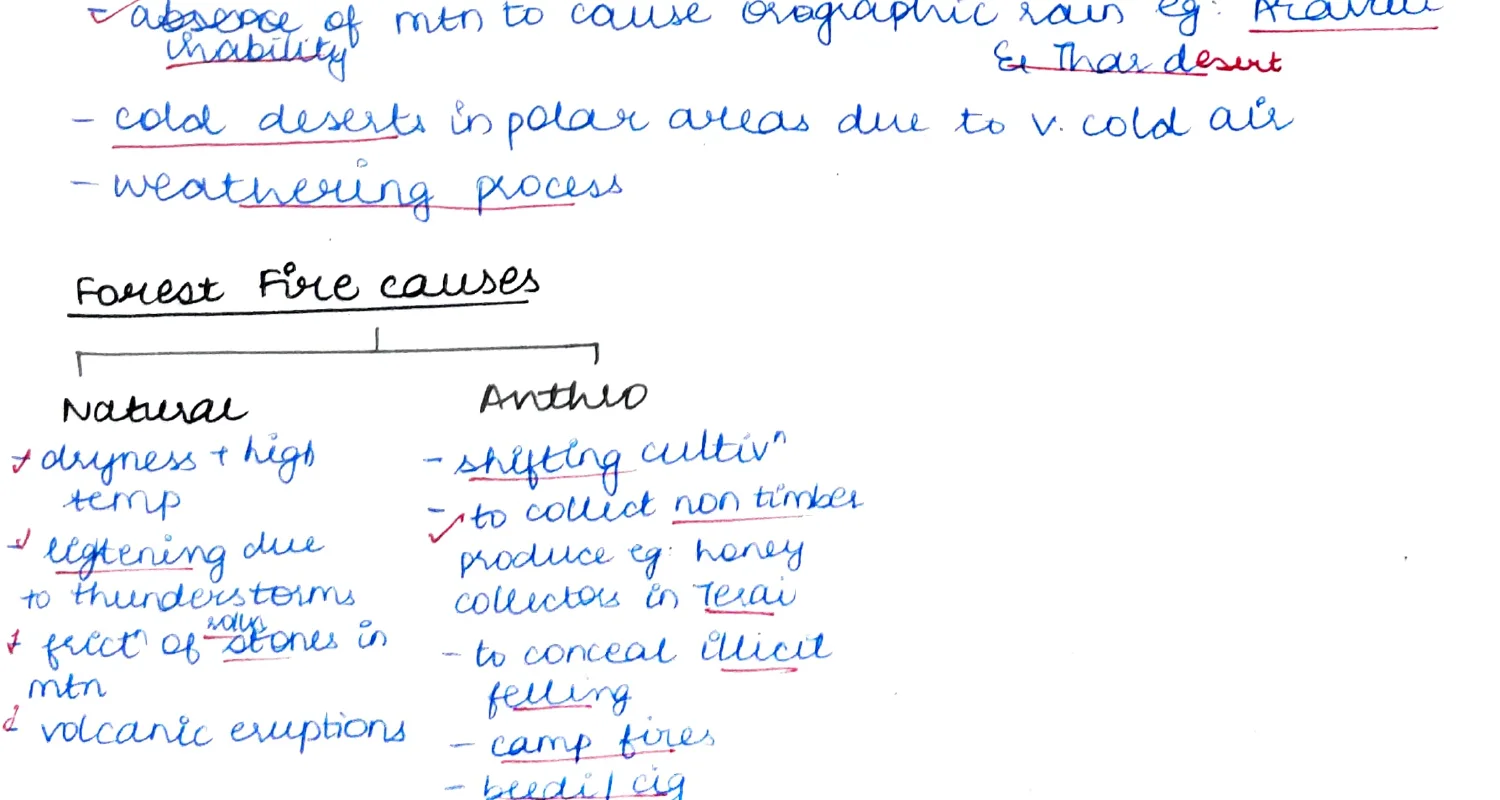
| Natural | Anthropic |
|---|---|
| dryness + high temp. | shifting cultiv. [cultivation] |
| lightning due to thunderstorms | to collect non-timber products of honey collection in [illegible] |
| heat of [illegible] in mtn. | to conceal illegal felling |
| volcanic eruptions | camp fires |
| beautify |
#Western Disturbances
- Temp. [Temperate] cyclones originating in Medi. [Mediterranean] & Caspian sea region during early winter to early summer
- → frontal [underlined] structure is usually missing
- → if present → occluded fronts [underlined]
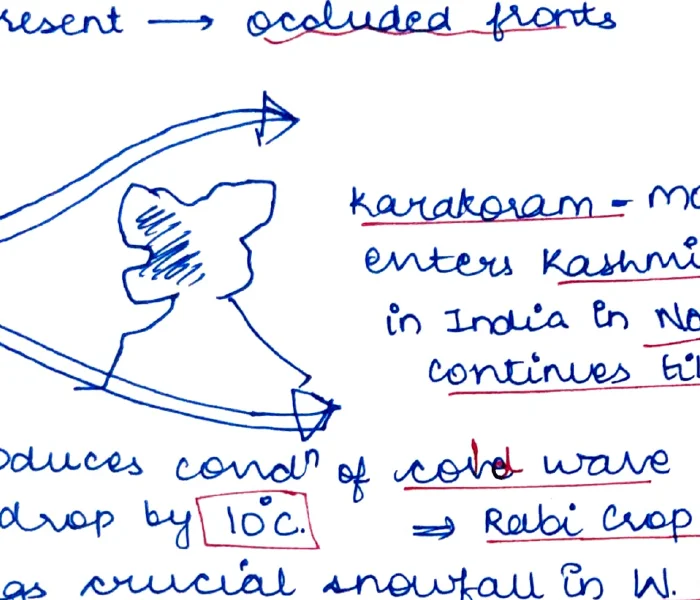
-
Karakoram = most impacted
-
enters Kashmir Valley in India in Nov. [November], continues till May
-
Consequences:
- (-) cold waves
- (-) extreme events
- (-) damage to Rabi [crops]
- (-) cloudbursts — 18 [?] 2013 big one, anomalous WD
- (-) systems that interact w. local features & cause regional [disasters]
- (-) dust storm
-
produces cond. [conditions] of cold wave → night temp. can drop by 10°C → Rabi crop in I. [India]
-
brings crucial snowfall in W. [Western] Him. [Himalayas]
-
frequency & intensity keeps decreasing till May
-
10% of rainfall in India due to WD [Western Disturbances]
-
Due to CC, intensity ↑ [changed] = ↑ in Feb–May = Rabi crops destroyed
-
frequency ↓
#"Any scheme/initiative is both enabler & beneficiary of other schemes"
- eg. Skill India of Digital India, Make in India, Smart City
#Dedicated Freight Corridors
- = mega-rail [underlined] transport project being undertaken to:
- ↑ transport capacity
- ↓ cost per unit
- improve service quality
#Significance
- Economic gain — multiplier effect — ↓ logistics cost
- green growth — shift from road to rail — 2.5 x less emi. [emissions] over 30 yr. [year] period [electric locomotives boxed]
- better operational profile of Railways — avg. speed 100 kmph → still ↑ in time
- Make in India
- decongested roads
- complement Bharat Sagar Mala
#Wetlands
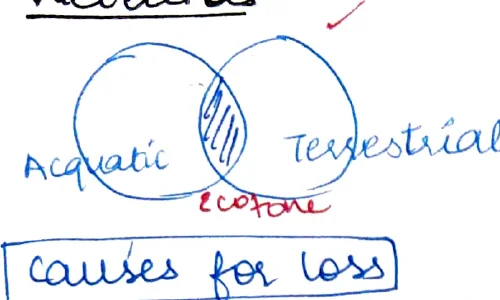
- Types: Aquatic, Terrestrial, Marine [3-circle Venn diagram]
#Uses
- biod. [biodiversity] rich — endemism
- flood control
- frontline defence [migratory birds]
- Earth's filters
- carbon sequester
- agric. [agriculture] / farming / livelihood
- water mgmt. eg. & Kolkata
- tourism & medicinal care
#Causes for Loss
- natural disasters
- agri [agriculture]
- poll. [pollution]
- waste disposal / mining
- construction of HEP [Hydroelectric Power]
- Infra dev.
#Measures
- [Natl] → NWCP [National Wetland Conservation Programme] — Wtld. Mgmt. Rules [highlighted]
- [Intl] → Ramsar [Convention]
- Natl. Wetland Atlas, 2011 — 2,01,503 wetlands
- eg. PB [Punjab] & HC [High Court] declaring [a wetland] a living entity
#Wetlands Mgmt. [Management] Rules, 2016
- follows wise use principle of RC [Ramsar Convention]
- CWRA — power to states
- no time limit for notif. [notification] (12m in 2010 rules)
- no 'restricted act.' [restricted activities list]
- no prov. [provision] of citizen check
#Issues
- → some wetlands dropped eg. paddy, UNESCO WHS etc.
- → states are susceptible to local pressure → mismanagement
- → CWRA = long experience & tech. know-how
- → no role to local people
- → trans-state W. [wetland] mgmt. will be affected
#Way Fwd. [Forward]
- data bank
- citizen check
- cooperative & localised approach
#HDI [Human Development Index]
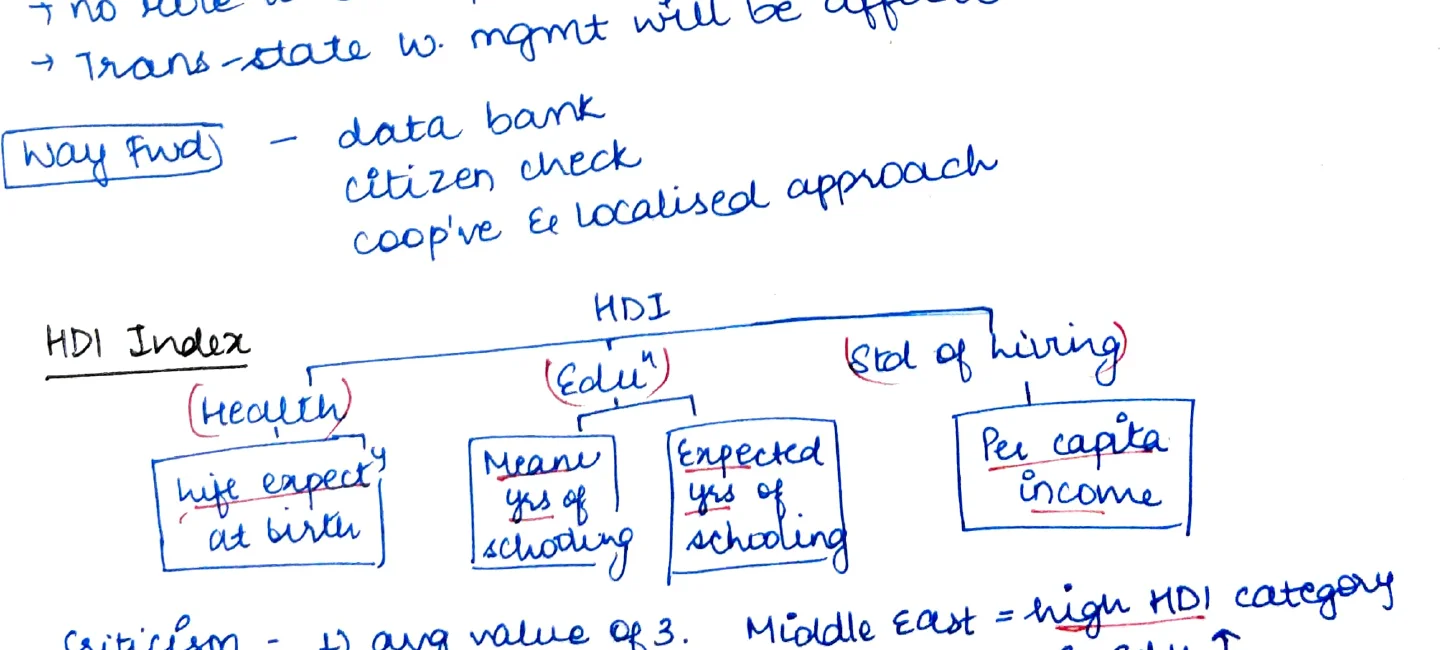
- HDI Index branches:
- Health → life expect. [expectancy] at birth
- Educ. [Education] → Mean yrs. of schooling + Expected yrs. of schooling
- Std. of living [Standard of Living / GNI] → Per capita income
#Criticism of HDI
- avg. [average] value of 3 — Middle East = high HDI category: income & edu. ↑ but health ↓
- spiritual well-being? narrow perspective
- neglected qualitative aspect of H&E [Health & Education]
#Apiculture
- = maintenance of beehives [for] honey, beeswax
#Favde [Advantages]
- agro-based act. [activity] to supplement farm income (2x)
- nutritional security
- pollination necessary for human survival
- sustains plant biod. [biodiversity] [underlined]
- beekeeping is benign — doesn't destroy habitat
- undertaken by landless farmers too
- creating value from wastelands [underlined]
- requires minimal funds (Rs.1–2L [lakh])
- Rs. 75 L [lakh] money to maintain 10,000 bee colonies [boxed] → employment & gen. potential
- Natl. [National] Comm. [Commission] on Agri. [Agriculture]
- export potential
#Monsoon in India
#Summer Monsoon Diagram
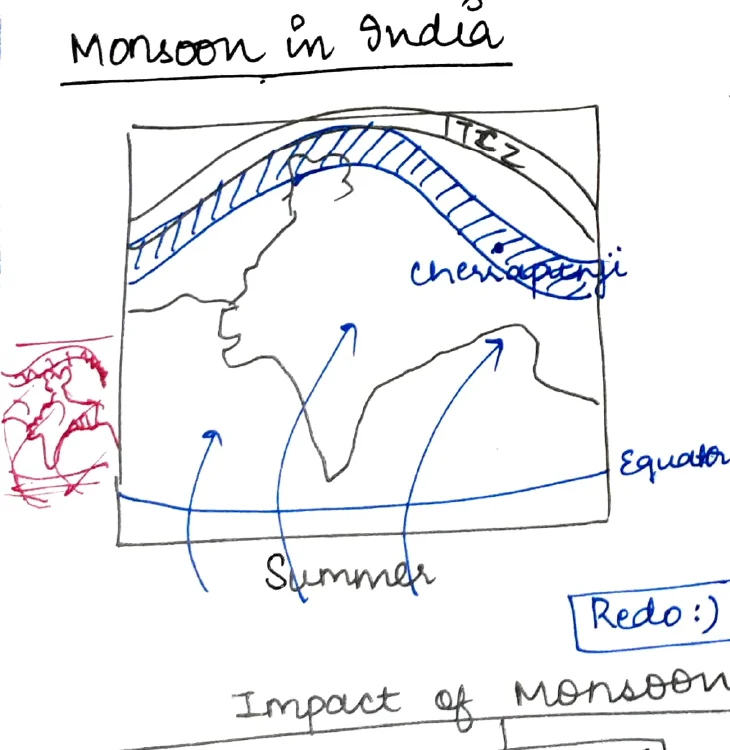
- Shows ITCZ [Inter-Tropical Convergence Zone] arching northward over India in summer
- Cherrapunji labelled (highest rainfall)
- Arrows showing moisture flow from equatorial region northward into India
- Equator marked at bottom
- [Note: "Redo :)" written on original — author marked this for revision]
#Winter Monsoon Diagram
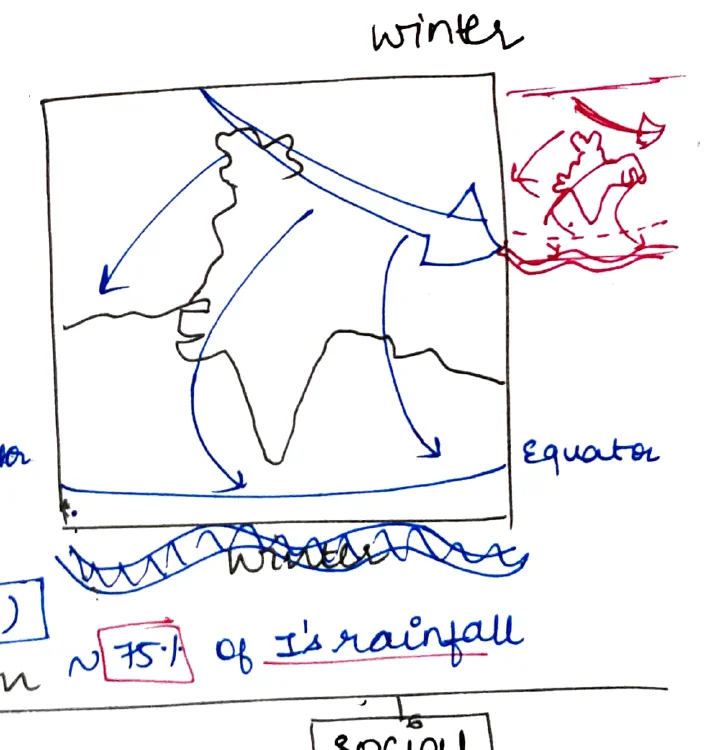
- Shows wind reversal in winter — outgoing flow from India towards equator
- 75% of Its [India's] rainfall [boxed] — boxed statistic on page
#Impact of Monsoon — 75% of India's Rainfall
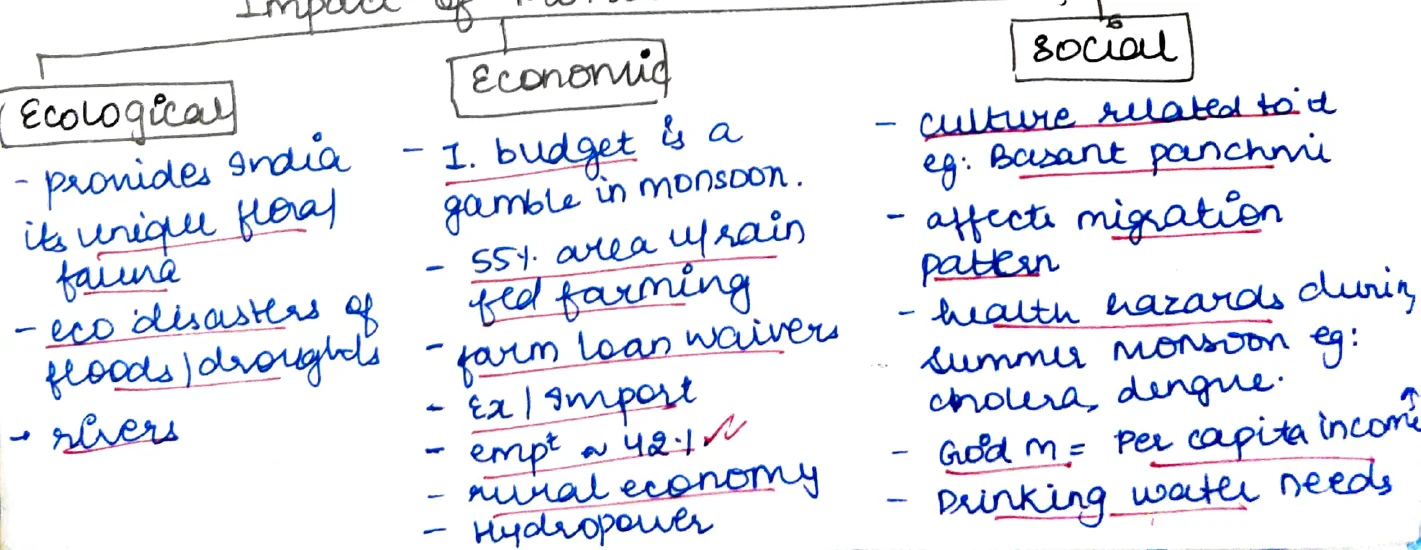
| Ecological | Economic | Social |
|---|---|---|
| provides India its unique flora & fauna | 1 budget is a gamble in monsoon | culture related to it eg. Basant panchmi |
| eco. [ecological] disasters of floods / droughts | 55% area w/in fed. [fed?] farming | affects migration pattern |
| rivers | farm loan waiver | health hazards during summer monsoon eg. cholera, dengue |
| Ex. & Import | GNI [?] = per capita income ↑ | |
| rural economy | drinking water needs | |
| emp. [employment] 48% [?] | ||
| hydropower |