GS Paper II — Governance, Constitution, Social Justice & IR
Social justice and international relations from the source set (Polity/Constitution/Governance are largely absent — flagged honestly).
Social Justice (health, education, poverty, vulnerable sections)
Topper handwritten notesSome sections here (Digital India, Skills, Telecom, Insurance) are GS-III economy/infrastructure — they carry a GS-III tag inline.
#Health
- Avg life expectancy — 69
- IMR — 32
- NMR — 24
- U5MR — 39 [Under-5 Mortality Rate]
- MMR — 122 per 1L [per 1 lakh live births]
- TFR — 2.3 (National Health Profile 2019)
- (2yr ↑ Raise GDP per capita by 4%)
- Immunisation coverage — 59% (0–5 children)
- Doctor : population — 1 : 1456 (LESA [latest estimate])
- Nurse — 1 : 538 (WHO → 1 : 1000)
- 8mn children missed vaccine in I [India] during covid — WHO
- 1.2% of GDP on health; 60% OoPE [Out-of-Pocket Expenditure] (Canada — 8%; 3.5 by 2025)
- 55 mn I [Indians] pushed to poverty every yr coz health exp. (>$34 deaths in I = NCDs [Non-Communicable Diseases] 2017)
-
60% deaths in I = NCDs
- 4/4 I [every 4th Indian] dying from NCD before reaching 70
- State of Global Air 2019 — every 3rd child in Delhi has impaired lungs; ↓ reduced avg lifespan by a few years (in 2021)
- Global Hunger Index — 94/107; 3rd most obese nation
- Diabetes cost of ₹ SDG 3
- Promotive, Preventive, Palliative, Curative, Rehabilitative healthcare
- Global Nutrition Report — Cse no. of stunted & waste children in India
#Education
- Literacy — 74%; (M — 85%; F — 64%)
- GER of girls > boys at all levels
- NSSO — >3cr [3 crore] out-of-school children
- Shortfall of 91 [lakh] teachers in govt elementary school (2016)
- <51% receive vocational training; 96% in S Korea
- Why?
- Poor perception
- Restricted focus
- Absence of well-defined pathways to continue with chosen vocation in HE [Higher Education]
- No vertical mobility
- Why?
- 4.4% currently — exp on edu.
- R&D as % of GDP — 0.7%; Israel — 4.3%
- Low GER in HE — 26% [approx]
- Only 3 institutes in Top 200 in QS Global Ranking 2021
- Only 91 colleges — A grade by NAAC; 1.47% of GDP on HE
- ASER survey:
- Std VIII → 85% lack basic reading skills; 50% lack numeracy skills
- PM e-VIDYA
- Samagra Shiksha, DHRUV, NISHTHA
- e-Pathshala, UDISE, AIM, IoE, SWAYAM
- 60% PHCs → 1 doc only
- NMn — ₹1/day is spent on every Indian on healthcare
#Education — Dimensions (FACE model)
- F — Flexible learning / Flip class
- A — At your own pace
- M — Mentorship
- E — Experimental learning
#Pedagogy (PLACE model)
- P — Pedagogy
- L — Language
- A — Adult edu.
- C — Curriculum
- E — E-learning
- D — Dropouts
#UNVERSE framework
- U — Understand & enable RTE
- N — Networked edu. (multi-stakeholders)
- V — ICT
- E — Vocational training
- R — Enhance Teacher Quality
- S — Revamp govt mech.
- S — Skill-oriented edu
- E — Access to funds
- L — Learning outcomes
#Key issues
- "Degree shop" / Degree weep — no adequate way to get a job; A great social leveller
- Unnayana Banka, Bihar — e-Taim, Bihar — video recorded lectures of best teachers
- RTE → RT learning [Right to Education → Right to Learning]
- Quantity W/O Quality syndrome
- Chalk & Talk → Digital learning
- Light but tight regulation
- US — skill, scale, speed, std
- Only building → Building Ches
- PRATHAM → Multi-level learning; focus on teaching at right level at right grade
- CAG 2017 — only 8% comply w. RTE
#Poverty
#MPI 2020 — 68/107
- 270 mn people out of poverty in btw 2005–06 and 2015–16
- Incidence of MPI almost halved in I, from 55% to 28% in just 10 years
- Tendulkar Cmtee — 28.1%
- Rural — 26%
- Urban — 14%
- Oxfam — 1% richest hold 3/4th of net wealth
- Total wealth of all 1 billionaires > full year budget of I [India]
- Gini coeff = 0.35
- WEF (Social Mobility Re.20) — I born in low-income family would take 7 gens to approach country's mean income
- % overall poverty rose till ↑ to 46% (higher than pre-2014 levels) due to covid-19
- Covid = 100mn I [Indian] women in extreme poverty by 2021 (UN Women)
- Kerala — 4% people are poor; Bihar — 52%; Guj — 8%
- Men own 50% more health than women
- SDG 1 — No poverty
- Poverty is not merely lowness of income but deprivation of basic capabilities
- Amartya Sen
- Not just absence of income but absence of value/hope/learness [sic]
#Urbanisation of Poverty
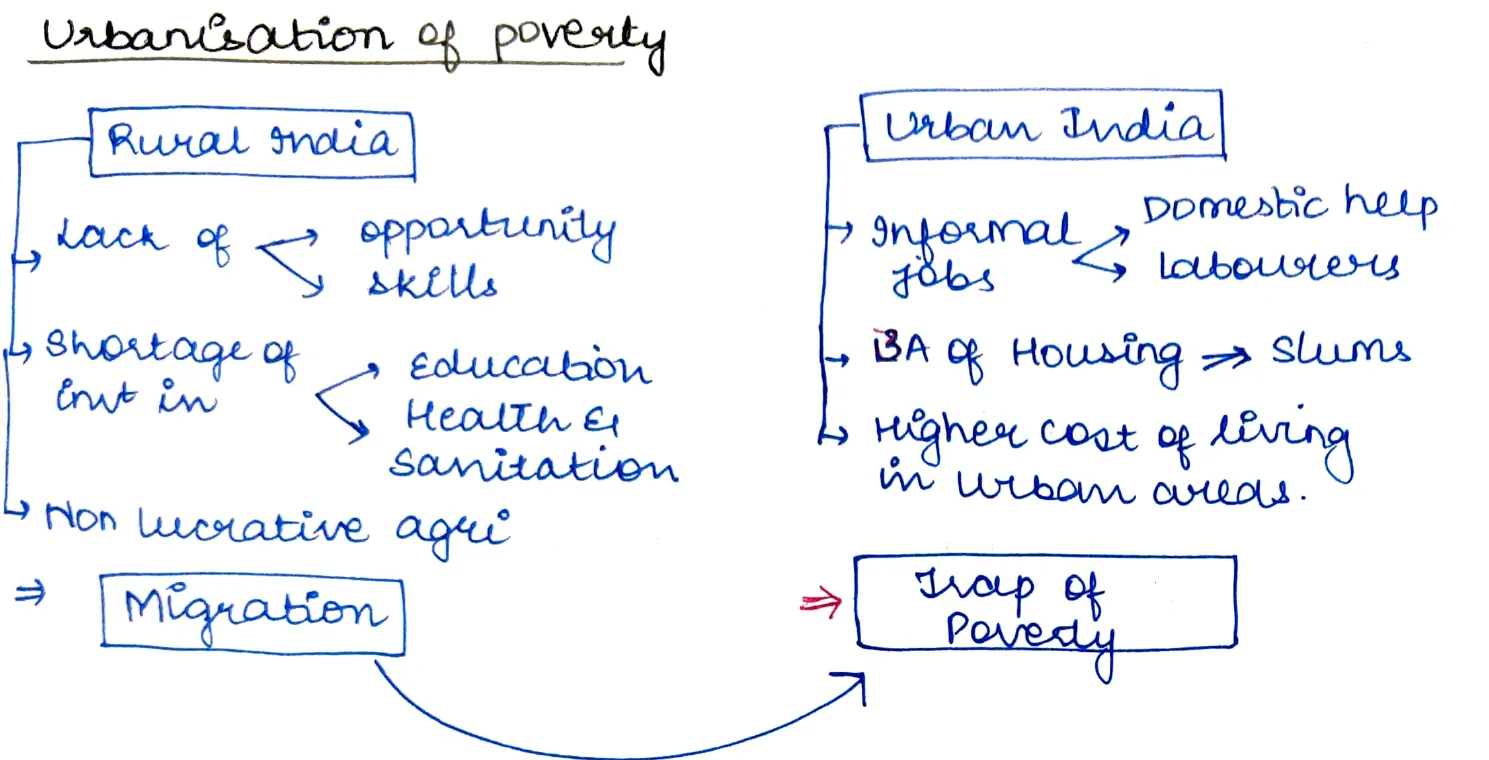
- Rural India causes:
- Lack of opportunity / skills
- Shortage of — Education, Health & Sanitation
- Non-lucrative agri [agriculture]
- ⇒ Migration
- Urban India causes:
- Informal jobs
- Domestic help / labourers
- Lack of Housing ⇒ Slums
- Higher cost of living in urban areas
- ⇒ Trap of Poverty
#Tackling Urban Poverty
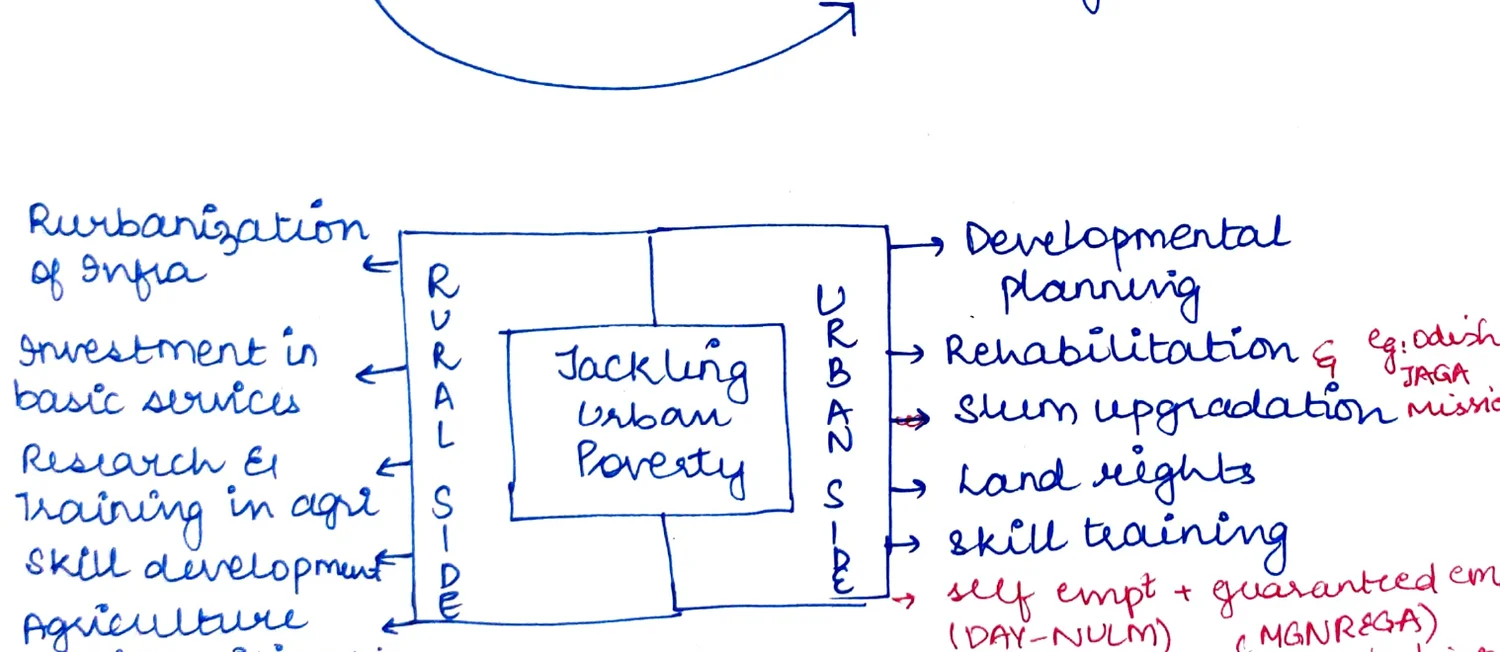
- RURAL SIDE (left):
- Rurbanisation of India
- Investment in basic services
- Research & training in agri
- Skill development
- Agriculture diversification
- URBAN SIDE (right):
- Developmental planning
- Rehabilitation (JAGA [Odisha], [Rajiv Awas Yojana])
- Slum upgradation
- Land rights
- Skill training
- Self-employment + guaranteed cost (DAY-NULM); MGNREGS
- [illegible — housing/building]
#Poverty — Discrimination — Social Exclusion Cycle
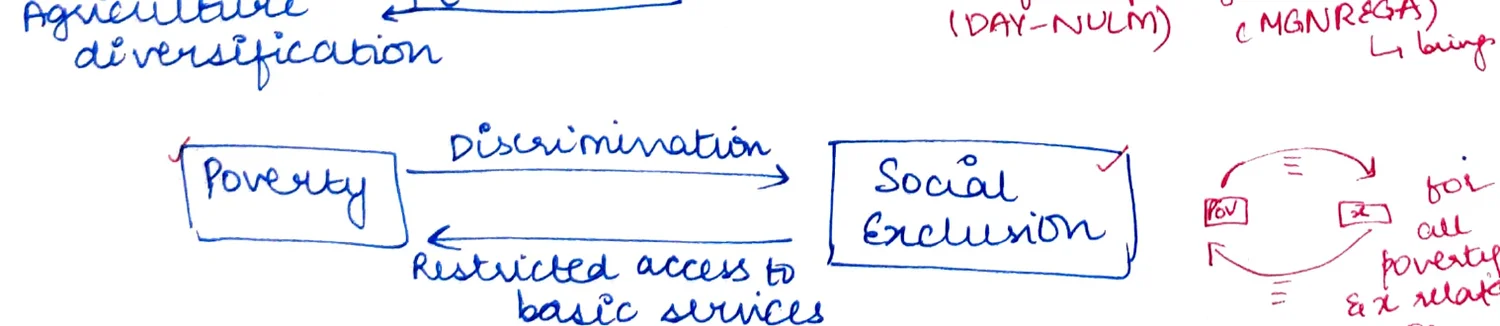
- Poverty ↔ Discrimination ↔ Social Exclusion
- Restricted access to basic services (feedback loop)
- [Boxed note, right side:] (All poverty & exclusion related — not all poverty is due to discrimination)
#Poverty Trap — Growth & Development Cycle
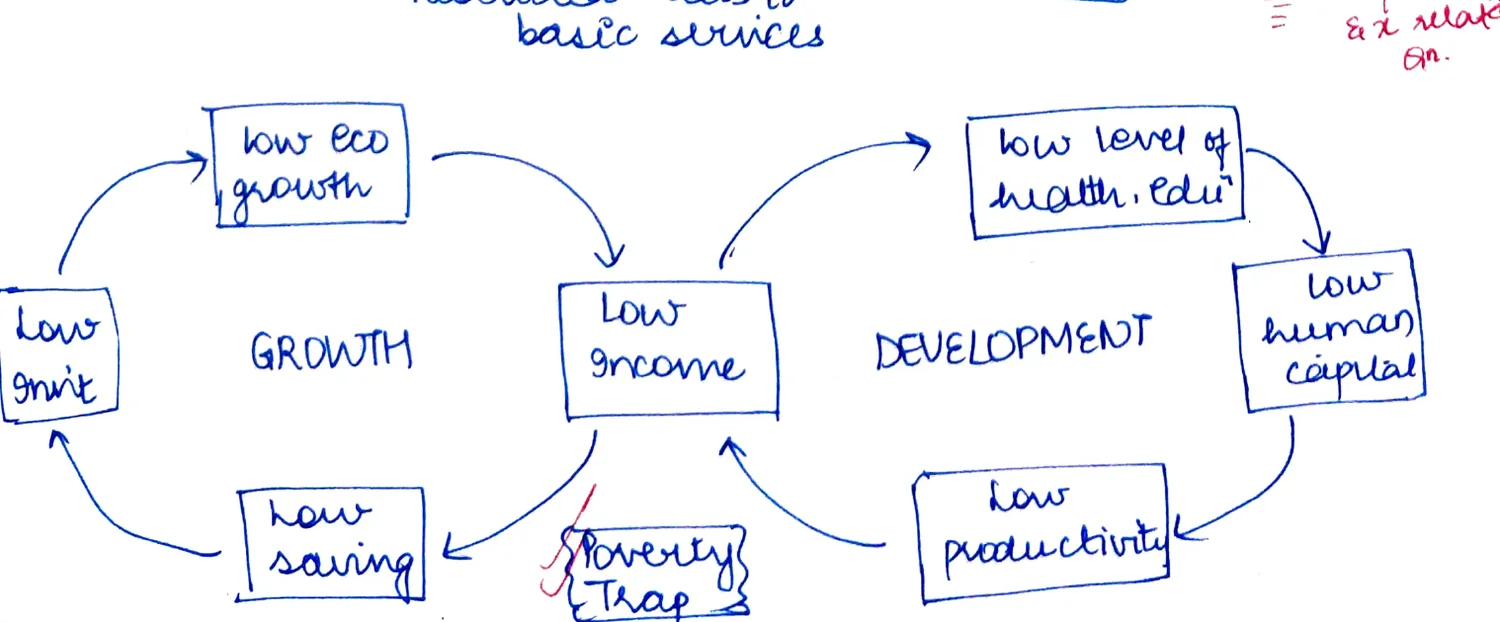
- GROWTH side (left):
- Low income → Low savings → Low growth → Low eco growth → Low saving → Low growth [reinforcing loop]
- DEVELOPMENT side (right):
- Low income → Low level of health & edu → Low human capital → Low productivity → Poverty Trap
- Low Income = central node connecting both cycles
- Poverty Trap label at bottom centre
#Women
- % Is [India's] Gender Gap — women paid 34% less than men (WEF)
- 62% women in agri; only 18% in services
- NCRB — avg 88 rape cases daily; 46mn missing women due to sex selection
- 14% rep in LS [Lok Sabha] even when 50% voters are women
- iNASSCOM — 9% startup founders are women
- Only 29% women internet users in I → For NCW [National Commission for Women] "We Think Digital", DigiMoms (PPP)
- Menstrual leave — Bihar, gone; Zomato
- "Empowering children/women/jobs, Transforming India"
- Ethiopia — Gender-balanced cabinet (50% women)
#Key data points (right column, page 4)
- 8.6% or 104mn elderly in I [India] (Census)
- 2.1% or 12 crore disabled people
- Elderly sex ratio — 1033 (2011)
- 4.88L Transgenders
- SC — 16.21%
- ST — 8.6%
#Global Carbon Budget 2019
- India's per-capita CO₂ emission is below world avg — 4.3t
- Lot of pop but 7% of CO₂ emissions
- 2% of global SO₂ emi
- 201 waste recycled (Global e-waste Monitor)
- I [India] 3rd largest waste gen [generator] in W [World]
- Ganga — total discharge/day — 1200 mld; treatment capacity — 40,000 mld; operational — 1000 mld
- CAG — 20% of allocated fund uses Namami Gange
- NASA — Gini table ↓ 0.3m every 4yr [groundwater declining]
- Global Air Report 2019 — Air pollution is 2nd highest cause of death in I [India]
- $150bn or 5.4% GDP loss
- WHO — 2nd rank — 1.24 mn deaths annually
#HEALTH (detailed)
#Ayush
Benefits — address gap in health services
- Low-cost HS in far-flung areas
- Lifestyle diseases
- Tobacco & drug abuse
- No side effects — natural treatment
- Best care for elderly
- (Medical pluralism)
Challenges — quality std
- No MRs due to better emp [employment opportunities elsewhere]
- Unutilised infra
Suggestions — R&D
- Cross-disciplinary learning
- AYUSH gram — herbal gardens + yoga camps by PRIs [Panchayati Raj Institutions]
- ICT
- Mainstream Ayush mission into NHM
#General Facts
- Health exp — 1.6% of GDP in 2019–20
- OoPE — 58.7% in 2016–17 (UN Data)
| Indicator | 1990 | 2019 |
|---|---|---|
| U5MR | 126 | 31 |
| IMR | 89 | 28 |
| NMR | 57 | 22 |
- 97% children at least 1 vaccine — mostly BCG
- Institutional delivery:
- 90% in rural
- 96% in urban
#Doctor–Population ratio
- 1 : 1456 (WHO = 1:1000); vs 1:20 in some nations
- HDR 2020 — 8.5 beds per 10,000 people
- Acc to NHP 2017 — [24%] pop covered by H insurance (corrected: 2014–2017)
- Bandhu Mukti Morcha case — RI [Right to] Health WA 21
#3 General Failures by Amartya Sen
- Neglect of primary healthcare
- Hasty & premature reliance on private
- Deficiency of informed public discussion on health
#Universal Health Coverage (UHC)
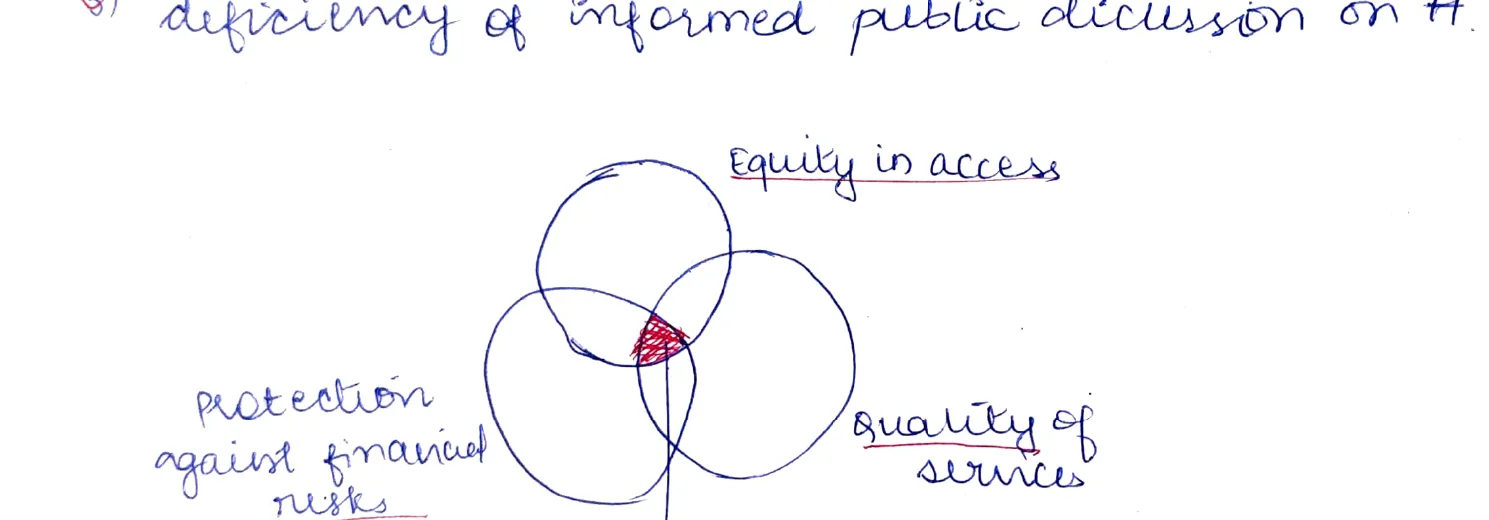
- Three pillars of UHC (overlapping circles, intersection = UHC):
- Equity in access (top circle)
- Protection against financial risks (bottom-left circle)
- Quality of services (bottom-right circle)
- NHP 2017 — 6.3 mn people are pushed into poverty every year due to healthcare costs
#Funding Models for UHC
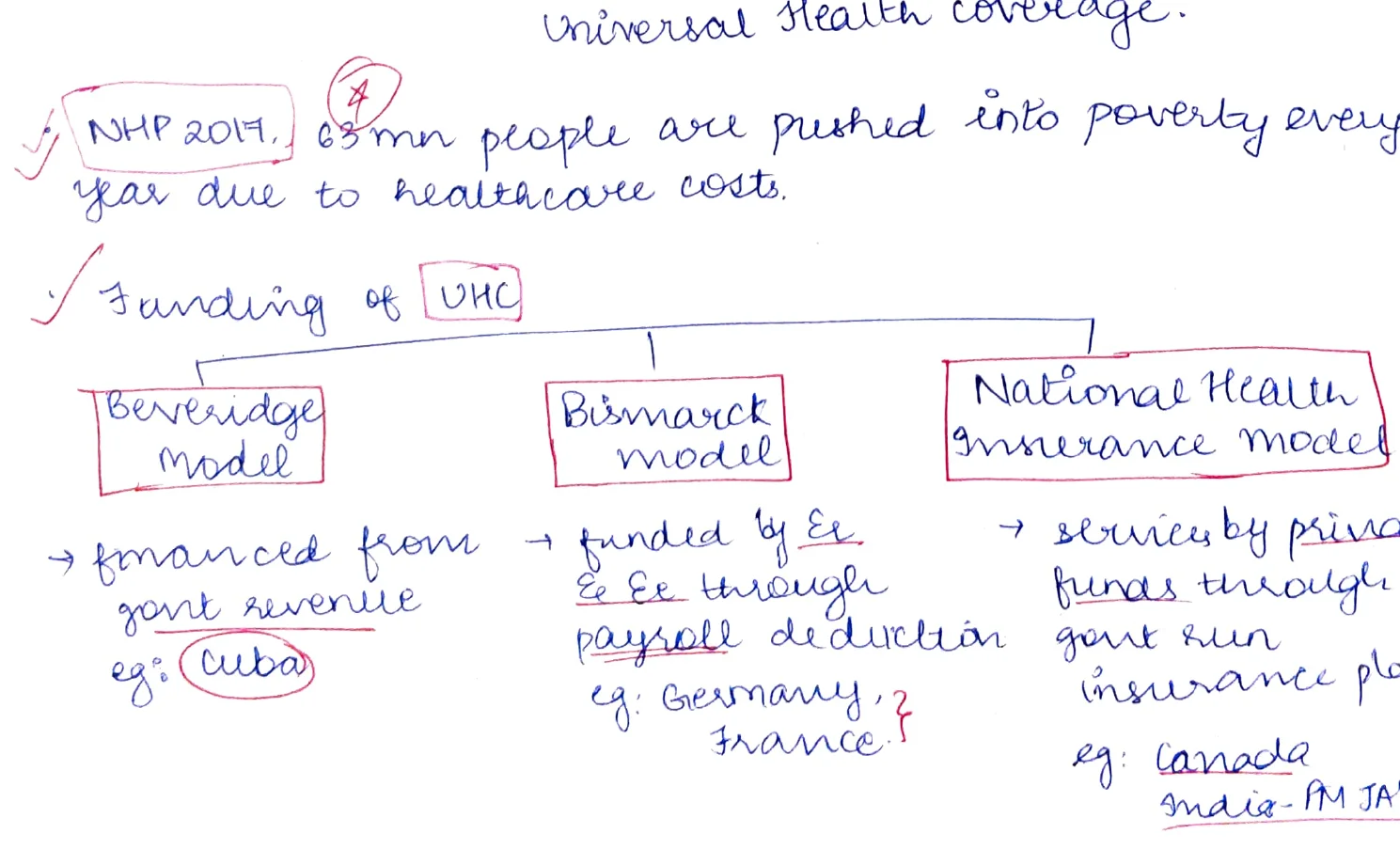
| Model | Description | Example |
|---|---|---|
| Beveridge Model | Financed from govt revenue | Cuba |
| Bismarck Model | Funded by Er [Employer] & Ee [Employee] through payroll deduction | Germany, France |
| National Health Insurance Model | Serviced by private funds through govt-run insurance plan | Canada, India — PM JAY |
#Mental Health
- Mental Healthcare Act 2017 defines mental illness to mean a disorder of thinking, mood, perception, memory or orientation
- Nat'l MH Survey 2015–16 — 13% of pop suffer from major mental disorders; 43% elderly
#Causes
- Modern & urban [lifestyle]
- Gender discrimination
- Media influence ↑ cybercrime
- Genetic & hormonal factors
- Age related — [illegible]
- [illegible]
#Implications
- Psycho-social
- Substance abuse
- Violence & distraction
- Suicidal tendency
- Economic
- Health costs in short
- ↓ prod [productivity] & income — long term
- Govt disease burden
#Efforts by Govt
Taken:
- NMHP, 2014 [National Mental Health Policy]
- MHA, 2017 [Mental Healthcare Act]
- NHM
- PM-Ayushman Bharat
Needed:
- Integrated approach
- Societal
- Awareness
- US [USA] M/o [Ministry of] loneliness — strategy tested with MH workplace
#Ayushman Bharat — Continuum of Care
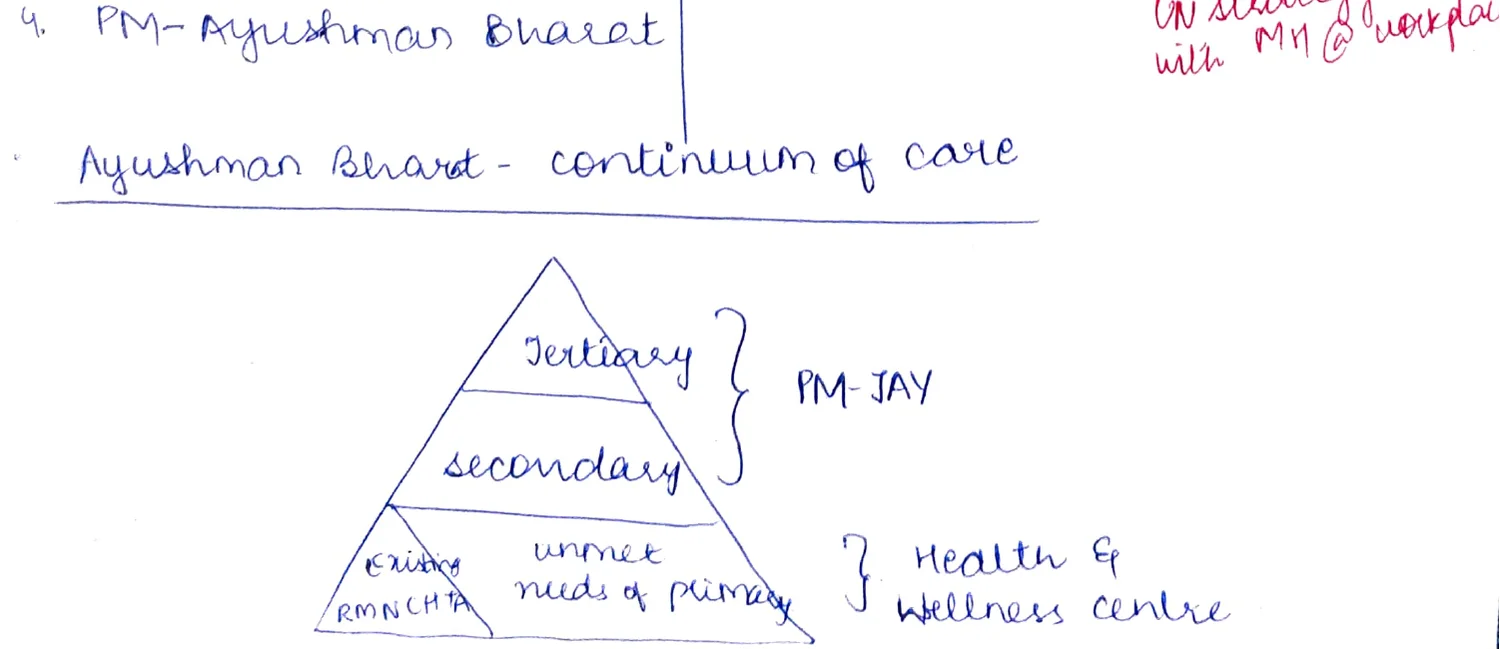
- Pyramid (bottom to top):
- Primary — Existing RMNCHA [Reproductive, Maternal, Newborn, Child, Adolescent Health]; Unmeet needs of primary → Health & Wellness Centre
- Secondary → PM-JAY
- Tertiary → PM-JAY
- PM-JAY covers secondary + tertiary
- Health & Wellness Centres cover primary + unmeet primary needs
#Tech in Health
- Tech-enabled Remote Health Services (Telemedicine)
- Quality H/care — NHA [National Health Authority] H. Stack
- GRMI & feedback — Mera Aspataal
- Health Awareness — NH Portal, Kilkari app
- Surveillance — IDSP, Mother & Child Tracking System, NIKSHAY
- Capacity building of health workers — Mobile Academy for ASHA, LaQshay etc.
- Pandemic control — Aarogya Setu, CORONTINE
- Health MIS — policy making
- Hospital Mgmt.
#NDHM [National Digital Health Mission] Components
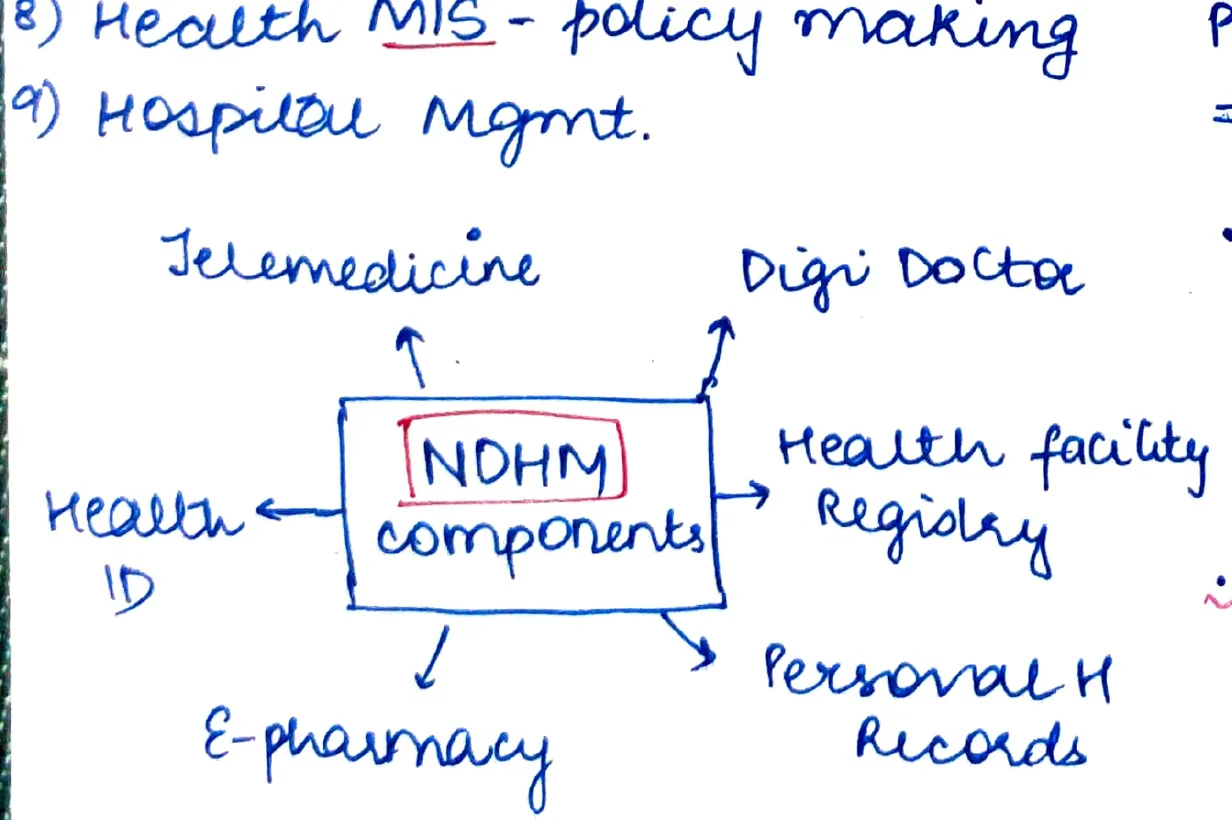
- Central node: NDHM components
- Spokes:
- Telemedicine
- Digi Doctor
- Health facility Registry
- Personal H [Health] Records
- E-pharmacy
- Health ID
#Digital India GS-III
#IAMAI — Digital in India Report 19
- Internet (I) penetration:
- All India — 40%
- Urban — 64%
- Rural — 32%
- 250mn 305mn urban users; 227mn rural users
- Males — 65%; Female — 35%
- Lot of ↑ in broadband penetration leads to 14% growth in GDP
#Digital Quality of Life Index 2020
-
Overall — 57/85
-
Afford² — 9th (outperforms US, UK, China)
-
Quality — 73th (slow, unstable)
-
Infra — 79th (below SL [Sri Lanka], Guatemala)
-
Electronic security — 57th
-
E-govt — 15th
-
2nd largest Internet subscriber — mobile
-
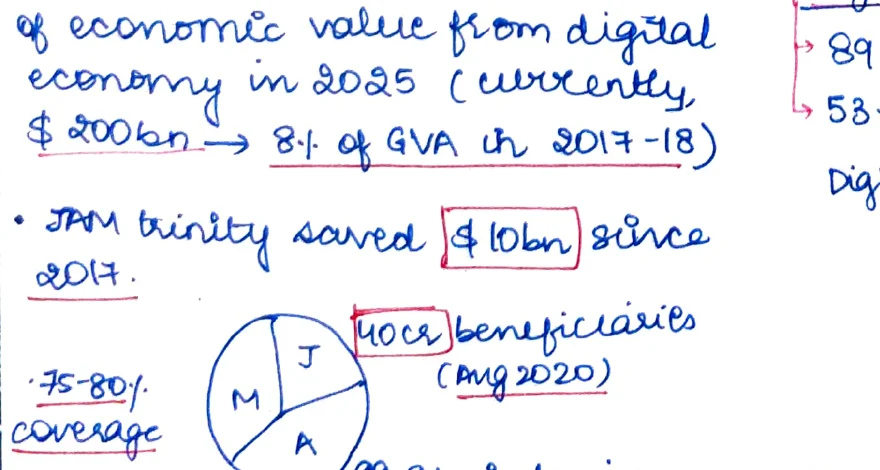
India can create upto $1 trillion of economic value from digital economy in 2025 (currently $200bn → 8% of GVA in 2017–18)
-
JAM trinity saved $10bn since 2017
- 75–80% coverage; M [Jan Dhan] + J [Jan Dhan] + A [Aadhaar]
- 40cr beneficiaries (Aug 2020); 99.9% inclusion
#Digital Divide — NSO 2017–18
- Access to computer:
- R [Rural] — 4%
- U [Urban] — 23%
- Internet:
- R [Rural] — 13%
- U [Urban] — 37%
#Digital Payments (2017–18)
- $10bn (NITI) to rise to $100bn by 2023
- → Ratan Watal Committee
- → Create DIPAYAN Fund [Digital Payment Action NIW]
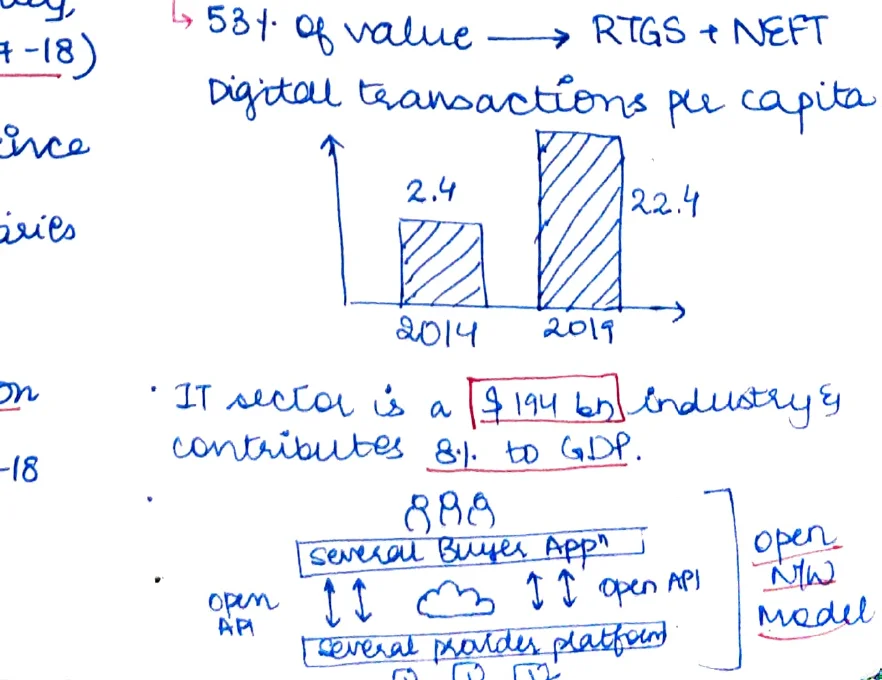
- Digital Transactions per capita: 2.4 (2014) → 22.4 (2019)
- 84% → still cash based
- 53% of value → RTGS + NEFT
#Digital Payments — more
- Digital heap; Digi footprint; Democrat of data; data as public good; Infodemic; Digital independence; digitally empowered SOC [society]; knowledge economy; citizens → netizens; Data Harvesting → Profiling
- BN Shrikrishna Comtee on Data Protection
- Kris Gopalан on non-personal data
#Data Economy
- US $1 billion digital economy
- Data governance — Quality India
#AAA [Account Aggregator Architecture]
![AAA open network model — Several Buyer Apps (top) ↕ open API ↕ Several Provider Platforms (bottom); Open NTW [Network] Model](assets/img/social_justice_p9_03.webp)
- Several Buyer Apps (top layer)
- Open API (bidirectional)
- Several Provider Platforms (bottom layer)
- → Open NTW [Network] Model
- IT sector is a $194 bn industry & contributes 8% to GDP
#Skills GS-III
- 54% formal skill as compared to 96% South Korea
- India Skills Report, 2020:
- 46% of youth employable
- 4 women (43%) are as employe [employed] as men (46%)
- 45% employers find it hard to get suitable candidates
- OECD survey — 30% I [Indians] youth in NEET [Not in Employment, Education, or Training] category
- 12mn enter labour market annually but present skilling capacity is max 7mn
- Under PMKVY, T&L [Training & Livelihood] people trained but only 21% got placements
#NSDM framework
- NSDM
- NCVET
- NSDC
- NSBF
#Need for Skilling GS-III
- Support structural Δ [change] in eco
- Gainful emp [employment]
- Harness demog div [demographic dividend]
- Plug Industry–Skill mismatch
- 3.5 trillion skills gap of workforce
- New age jobs
#Challenges
- Huge target — 300mn by 2027
- Deficient capacity
- 22mn+ run skilling schemes
- Complex eco
- No nodal regulator
- Quality to placements (24%) (2016–19)
- Rapidly ↓ local [funding]
- Social accepter of VE [Vocational Education]
- Multiple skills needed
#Solutions / Initiatives
- Allow vertical mobility
- Transferable skills (across occu [occupations])
- Re-skilling
- Behav & [behaviour change]
- Skills on Wheels (skill kicks in Brazil)
- PPP — FB–5mn Rural Youth in digi skills — SheMeansBusiness
- Inclusive skilling
- ASEEM portal [Aatmanirbhar Skilled Employee-Employer Mapping]
- 1 dis, 1 skill [One District One Skill]
- RTE → Vocational Edu
- SANKALP, STRIVE, YuWaah
- 1st Global Skills Park @ MP
Mehak ✓ [topper's name/checkmark]
#Telecom GS-III
- We 2nd largest
- 1.19bn subscribers
- Teledensity — 88% in FY21
- 2nd highest internet subscriber
- 3rd largest FDI recipient (7%)
- Emp [employment] to 3.2mn directly; 1.8mn indirectly
- Industry debt — ₹3.6 lakh / 5 cr
- 6% to GDP in 2019, target 8%
#Insurance GS-III
- 3.7% of GDP — 19 penetration (global avg — 6.3%)
- CAGR — 12%
- Density:
- ₹4,185 → ₹5,798 (2019)
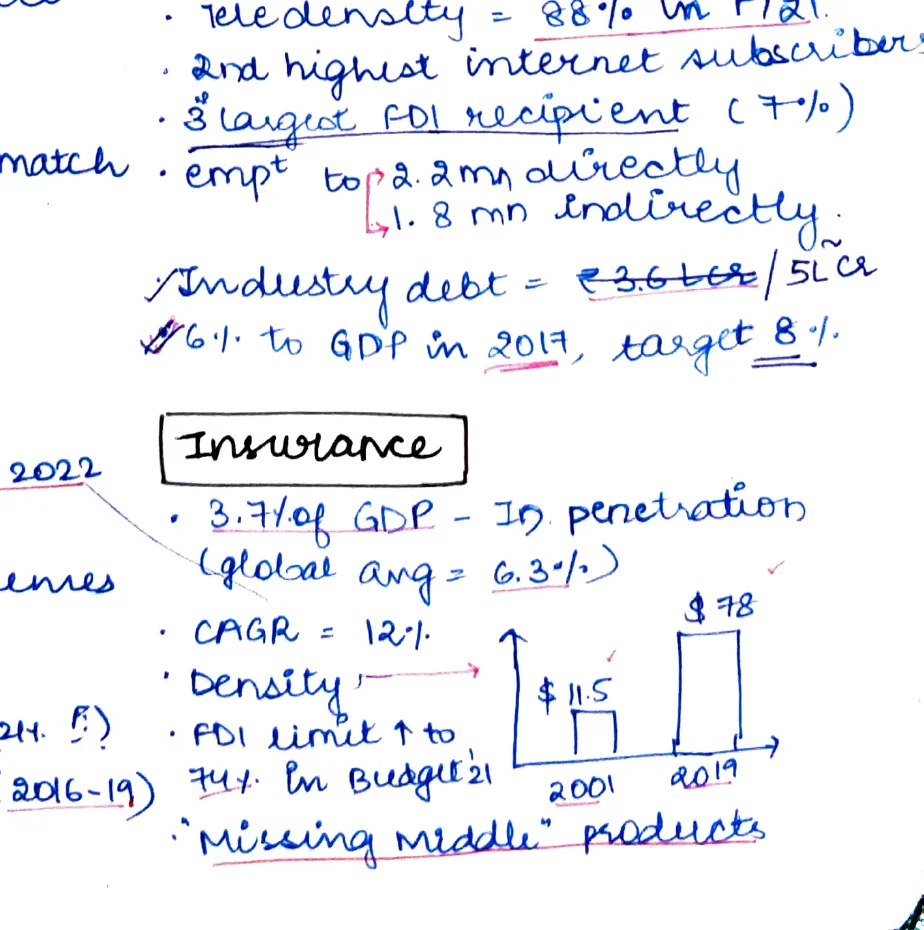
- PDI limited to 71% in budget 2021 [FDI in insurance raised to 74%]
- "Missing middle" products needed
#Case Studies / Examples
#Health
- CATCH — Sikkim
- Smart Anganwadi in Guj [Gujarat]
- Janta Clinic, Jaipur
- Health ATM @ Rly [Railway] Station
- Jaga Mission, Odisha — India's largest slum land title project
- Nirmaya — placement-linked skill training in J&K
- "Our green infra like Garden / Rain trees of China"
#Poverty
- Sikkim — LFPR [Labour Force Participation Rate] = 40% when nat. avg is 25%
- Sakala, KN [Karnataka] — Service Guarantee Act 2011
- SANGRAM — Maharashtra; Arjun ePDS
- Pyaar Praday Yoj, MP
- 7-star Rainbow scheme, HR [Haryana]
#Safety
- Safe City — Suraksha Setu — 04P [model]; model for safety in Surat
- Online police start — UP; Mo Sarkar, Odisha
- BMC Pothole Challenge — 41%; cases resolved within time = ₹500 to complainant if not fixed in 24hrs from local I's [Inspector's] salary
- Traffic police mannequin — Bangalore + pedal police (police on bicycle in park areas)
#Governance / Administration
- 5T Action Plan, Odisha
- Jan Soochna, Raj [Rajasthan]
#Digital India examples GS-III
- e-Cabinet — Uttarakhand
- e-Saathi — Manali, Sonipat
- 1st cashless island — Karang, Manipur; CUGiL app — EC
- Pune MC — ATT — issued ₹2200 cr bonds
- GIS mapping for property tax in Gujarat (Surat)
- Hailakandi (Assam) — go/giving of 5 saplings to parents of new born girl child → income + nutrition
- Mini banks in Gajapati, Odisha — in panchayats with banking facilities
- High density farming in Kupwara, Kashmir
- Bijli Panchayat, MR; Green temple — Tirupati; 100% LPG in HP
- Village Annamdix [Annadhi?] — 100% solar powered; Pani Panchayat — Odisha
#Women
- iNASSCOM — 9% startup founders are women
- Only 29% women internet users in I
- Menstrual leave — Bihar, gone; Zomato
- Ethiopia — Gender-balanced cabinet (50% women)
#Education
- ASER survey — Std VIII: 85% lack basic reading skills; 50% lack numeracy skills
- CAG 2017 — only 8% comply w. RTE
- PRATHAM → Multi-level learning
End of Social Justice notes — 11 pages transcribed
International Organisations & India’s Foreign Policy
Topper handwritten notes#ASEAN
- US $1 mn COVID-19 ASEAN Response Fund
#Importance for India
- Centrality in India's foreign policy (SAGAR [Security And Growth for All in the Region] & Indo-Pacific)
- Maritime security (40%+ of trade & energy)
- Investment opportunities
- Lucrative market
- Countering China (ASEAN sees India as a Balancer — boxed/highlighted)
- Integration with regional & global supply chains
- Addressing regional & environment issues
- Failure of SAARC → look outside the region
#Way Forward
- Bringing ASEAN into SCRI [Supply Chain Resilience Initiative]
- Cultural connect
- Review FTA to strengthen it
#India-ASEAN Relations — Timeline
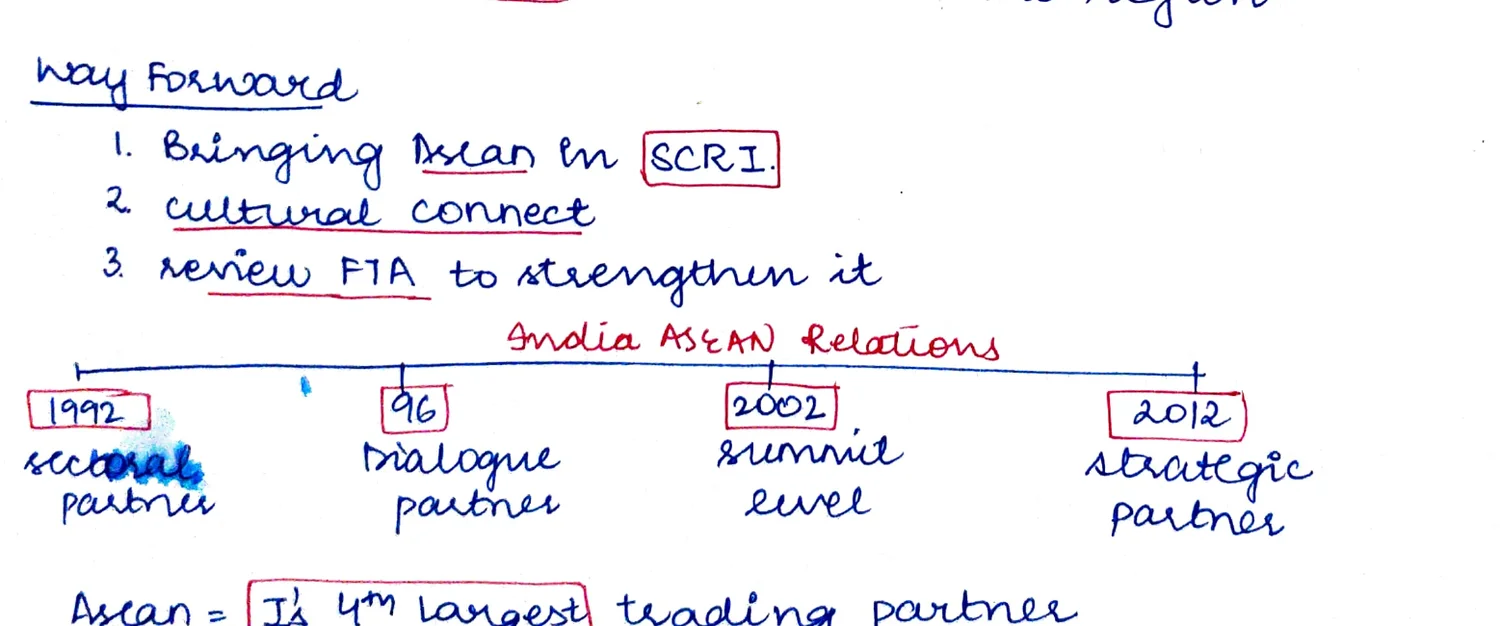
-
1992 — Sectoral partner
-
1996 — Dialogue partner
-
2002 — Summit level
-
2012 — Strategic partner
-
ASEAN = India's 4th largest trading partner
#Cooperation Areas (ASEAN pillars)
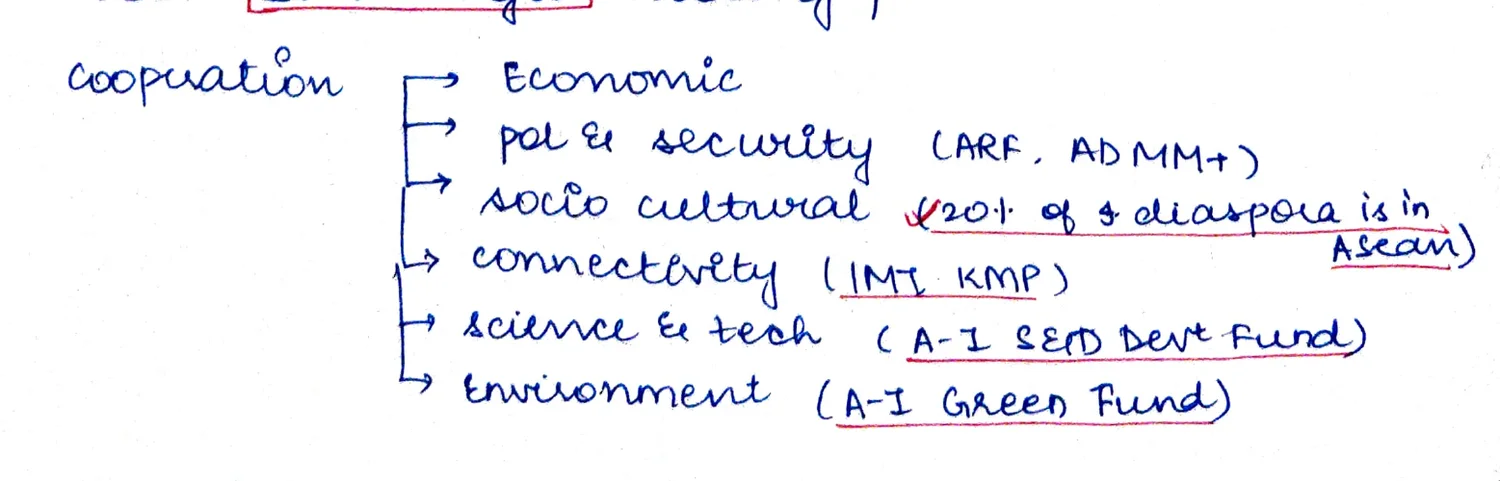
- Economic
- Political & security (ARF [ASEAN Regional Forum], ADMM+ [ASEAN Defence Ministers' Meeting Plus])
- Socio-cultural (sot of & diaspora; India is in ASEAN)
- Connectivity (IMT [India-Myanmar-Thailand], KMP [Kaladan Multi-Modal Project])
- Science & tech (A-I [ASEAN-India] S&D [Science & Development] Best Fund)
- Environment (A-I [ASEAN-India] Green Fund)
#BRICS
- 50% of world economic growth
- 42.1% of world population
- 23% of world GDP by 2018
#Significance
- Safe space to modulate rivalry (e.g. India-China engaged even during 2017 Doklam)
- Providing a transcontinental reach
- Boosting India's bid for multilateral reforms
- Contribution in creating an inclusive international financial architecture (NDB [New Development Bank])
- Trade dependency
- Expansion of agenda to include CC [climate change], SD etc.
- Focus on IBSA [India-Brazil-South Africa]
#Challenges
- Disparities among members
- Suspicion about Chinese regional & global ambitions
- Approach towards multilateral reforms — no unanimity
- Dependency on other global institutions (G20 during GFC'08)
- Changing world order
- No capital (in NDB as compared to WB / IMF)
- Low intra-country trade
#Achievements — NDB [New Development Bank]
-
→ 10bn for COVID-19
-
→ 62 large projects
-
CRA [Contingent Reserve Arrangement]
-
Medical cooperation: Ufa Declaration (2015) → BRICS [illegible] Vaccine R&D Centre mooted in 2018
-
BRICS Science, Technology & Innovation (STI) Framework Programme, 2015
-
Expanding trade (10+ of world, intra-BRICS exports 1 by 45%)
-
BRICS Rapid Info Security Council
#Way Forward
- Bottom-up (part of civil society & [illegible])
- Brasilia Declaration presented a vision for rules-based, transparent, non-discriminatory global trade
#G20
- 90% of world GDP; 75% of global trade; 60% of population
- Objective: Policy coordination
- Promote financial stability (2 tracks: Finance + Sherpa)
- New multilateral financial architecture
#Importance
- Policy coherence, analysis to support growth & development in developing countries
- Enabling environment for inclusive global growth & development
- Supports women issues, Agenda 2030, terrorism etc.
- Global representation
#Achievements
- 2008 GFC — Final reforms (LBBPs [Lehman Brothers-related bailout packages/reforms])
- Bolstering final regulatory bodies quality
- Support economies during COVID-19
- Trade Facilitation Agreement
- Increased lending capacity of IMF
- Large enough to make prompt decisions (20 members only)
#Challenges
- No objective flow to set goals & measure progress
- Every country adds new issues during its presidency
- Exclusivity of members
- Not all resolutions fully implemented
- Weakened authority due to dominance & sectarian interests
#Way Forward
- Continuity of issues
- Provide strategic vision
- Strengthen ties with UN
- Robust global supply chain [chains]
#SCO (Shanghai Cooperation Organisation)
- "Shanghai Spirit" — mutual trust, benefit, equality etc.
- 2 permanent bodies: Secretariat; RATS [Regional Anti-Terrorist Structure]
- Structure:
- Heads of State Council
- Heads of Govt Council
- 42% of population; 20% of GDP
#Relevance
- Controlling regional terrorism
- Participants in political dynamics of Afghanistan
- Political: renew bilateral ties
- Strategic: greater visibility in affairs of Eurasian region
- Economic: rich in iron / coal / oil / gas / gold / zinc / uranium
- Connectivity: TAPI [Turkmenistan-Afghanistan-Pakistan-India pipeline], IPI [Iran-Pakistan-India], CASA-1000 electricity Karimi
#Challenges
- Dominance of China
- Controlling Pakistan-sponsored terrorism
- Trust deficit
- No connectivity with CAR [Central Asian Republics] & beyond
#Way Forward
- Maintain independent voice
- Revitalize connectivity
- Constructively engage Pakistan
- Terrorism & deradicalization of youth
#SAARC
- Founded: 8 members, 1985
- Last summit: 2014
- 2016: Summit cancelled due to Pathankot and Uri attacks
- 2020: Virtual conference and health ministers meet to cooperate on COVID response
#Issues with SAARC
- Colonial legacy: Still entrapped in colonial legacy of communalism, unclear boundaries, etc.
- Mutual mistrust: It does not allow regional integration and cooperation (contrast Europe)
- Trade: Low regional trade leads to low integration (IInb [illegible] least integrated region)
- Domination: Fear of India's hegemonic role in the region — Big Brother (notation)
- Bilateral issues: India-Pak rivalry remains biggest obstacle for SAARC
- Charter: SAARC charter does not allow discussion on contentious and bilateral issues
- No connectivity → must focus on open issues like ECO
#Need to Revive SAARC
- Common issues: security, development, climate change and Himalayas
- Interdependence: cross-border rivers; landlocked members; lack of resource self-sufficiency
- EU and ASEAN: living examples of regional cooperation bringing economic growth
- Significance for India:
- Check China's influence by engaging neighbors in economic cooperation
- It offers India a platform to showcase its leadership abilities
#Way Forward
- Create mechanism for informal discussions → Distinct South Asian identity; Better People of SAFTA
- Form Conflict conciliation groups for resolving disputes
- Expedite sub-regional initiatives like BBIN motor vehicle agreement
#Intra-BIMSTEC Trade (1%) > Intra-SAARC Trade (5%)
(Notable implications)
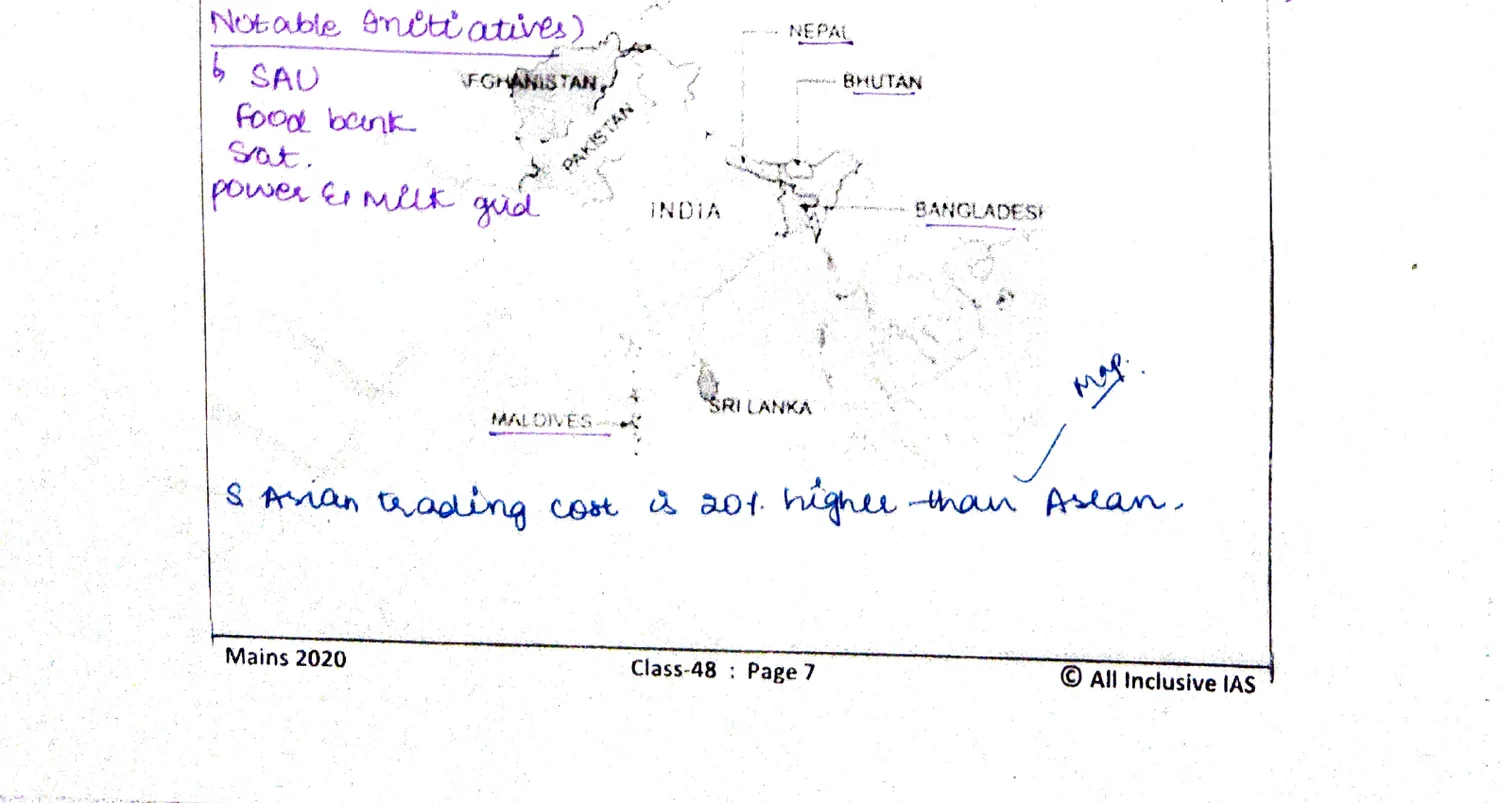
- Notable: Intra-SAARC trade (1%) > Intra-BIMSTEC Trade (5%)
- SAU: food bank
- Sol: [illegible]
- Power: [illegible] grid
- NEPAL, BHUTAN, BANGLADESH, MALDIVES, SRI LANKA noted on map
- South Asian trading costs are 20% higher than Asian average
#BIMSTEC (Bay of Bengal Initiative for Multi-Sectoral Technical and Economic Cooperation)
- BIMSTEC charter has been finalized and is expected to be signed in January 2021
- It will give BIMSTEC a long term vision and clearly outlines the roles and responsibilities of different institutional structures
#History
- Founded in 1997 through Bangkok declaration
- Secretariat in Dhaka established in 2014
- 1997 June: BIMSTEC established (Bangladesh, India, Sri Lanka, Thailand — Economic Cooperation)
- 1997 December: Myanmar joins
- 2004: Nepal and Bhutan also join
#Significance for India
- No Pakistan, so a better alternative to SAARC
- Restricts China's influence by stronger economic cooperation
- Bridge between South Asia and South-East Asia; supports India's neighborhood first and Act East policies
- Brings more development opportunities to India's NE region due to geographical location
- The region has huge untapped reserves of natural gas
#Challenges
- Limited interaction: Only four summits in last 20 years; delay in setting up Secretariat (CSOTSE [illegible])
- Lacks unity: Nepal & Thailand did not participate in Milex-18, the first military exercise by BIMSTEC
- Connectivity: Poor road and rail connectivity
#Way Forward
- Conclude FTA for greater economic cooperation
- Consider expanding membership to Indonesia, Malaysia, Singapore
#Indo-Pacific
- "Oceans are a single, shared, strategic space & what happens in 1 has implications in other"
- Area ranging from eastern coast of Africa to western coast of Americas
- It signifies the interconnectedness of Indian and Pacific Oceans, and their importance to security and commerce — "confluence of 2 seas"
#Growing Focus on Indo-Pacific
- Quad started in response to China's growing influence in Indo-Pacific (2017)
- USA renamed its Pacific Command to Indo-Pacific Command (2018)
- MEA set up a separate division for Indo-Pacific (2019)
- Germany announced its Indo-Pacific strategy (Sept. 2020)
#Global Focus Shifting to Indo-Pacific Because
- Rise of major economic powers — e.g. China and India
- Formation of important trade blocs e.g. RCEP (world's largest)
- Presence of natural resources — e.g. rare earth metals, methane hydrates
- Fear of Chinese domination:
- Militarization of South China sea islands
- Refusal to follow PCA ruling on South China Sea
- Leasing of islands (Maldives) and ports (Sri Lanka)
#India's Vision of Indo-Pacific — FOIP [Free and Open Indo-Pacific]
- Rules based order, respect for sovereignty and territorial integrity
- Nine dash line violates territorial integrity of SE Asian nations
- Freedom of navigation:
- FONOPS [Freedom of Navigation Operations] in South China Sea by US, UK, Australia etc.
- Responding power projections with partnerships
- Quad in response to China's domination
#Challenges India Faces
- Economically not big enough to match Chinese investments in small countries
- Low economic integration — India not part of RCEP
- Limited Naval capacity: e.g. India has just 20 submarines; China has 70
- Aggressive maritime strategy can create problems on land border
#Way Forward
- Joint Blue Dot network to counter Chinese BRI
- Strategic use of A&N [Andaman & Nicobar] islands; more pacts like Comcasa, Lemoa, Beca
- More collaboration with likeminded countries e.g. Quad + [ASEAN] + [illegible] Bilateral France
- Shore centrality [of] ASEAN
#Quad (Quadrilateral Security Dialogue)
#Quad Summit — Agenda Items (handwritten margin notes)
- Global health — donate 1.2bn doses vaccine
- Bob Health Security in IB [illegible] countries in [illegible]; [illegible] preparedness
- [illegible] India cloud group
- Climate supply value chain
- 2-3 brand new: Clean economy, climate SC, [illegible] TF
- 5G Quad fellow?
#Core Description
- Informal strategic forum between India, USA, Japan, Australia
- Maintained by semi-regular summits, information exchanges and military drills
- Started in 2007 as initiative of Japanese PM Shinzo Abe, to establish an "Asian Arc of Democracy"
- Inactive for 10 years; revived in 2017 to counter China's growing influence in Indo-Pacific
#Significance of Quad for India
- Presents a united front against aggressive activities of China
- Counters Chinese influence in Indian Ocean; supplements India's limited naval capabilities through patrol boats, info exchange, etc.
- Deepen ties with US, Japan, Australia; help India secure a place in the new world order
- Also: COVID-19 cooperation
#Challenges
- Quad lacks institutional framework; meetings are ad hoc; no joint statements
- Priorities differ — India's priority lies in Indian Ocean, while Japan and Australia are concerned about the Pacific
#Way Forward
- Set up mechanism for regular consultation
- Expand scope beyond Indo-Pacific (Cybersecurity, SG, etc.)
- Include other likeminded countries, like UK & France (but not too many) → Quad+
#October 2020
- Second meeting of Foreign Ministers of Quad hosted by Tokyo
- In departure from earlier secrecy, FMs made public a large part of their deliberations
- Outcomes: FM's meet will become annual affair; building infra and connectivity in the region; cooperate on pandemic
- US said that it intends to develop quad into a coalition to counter China's aggression in the region
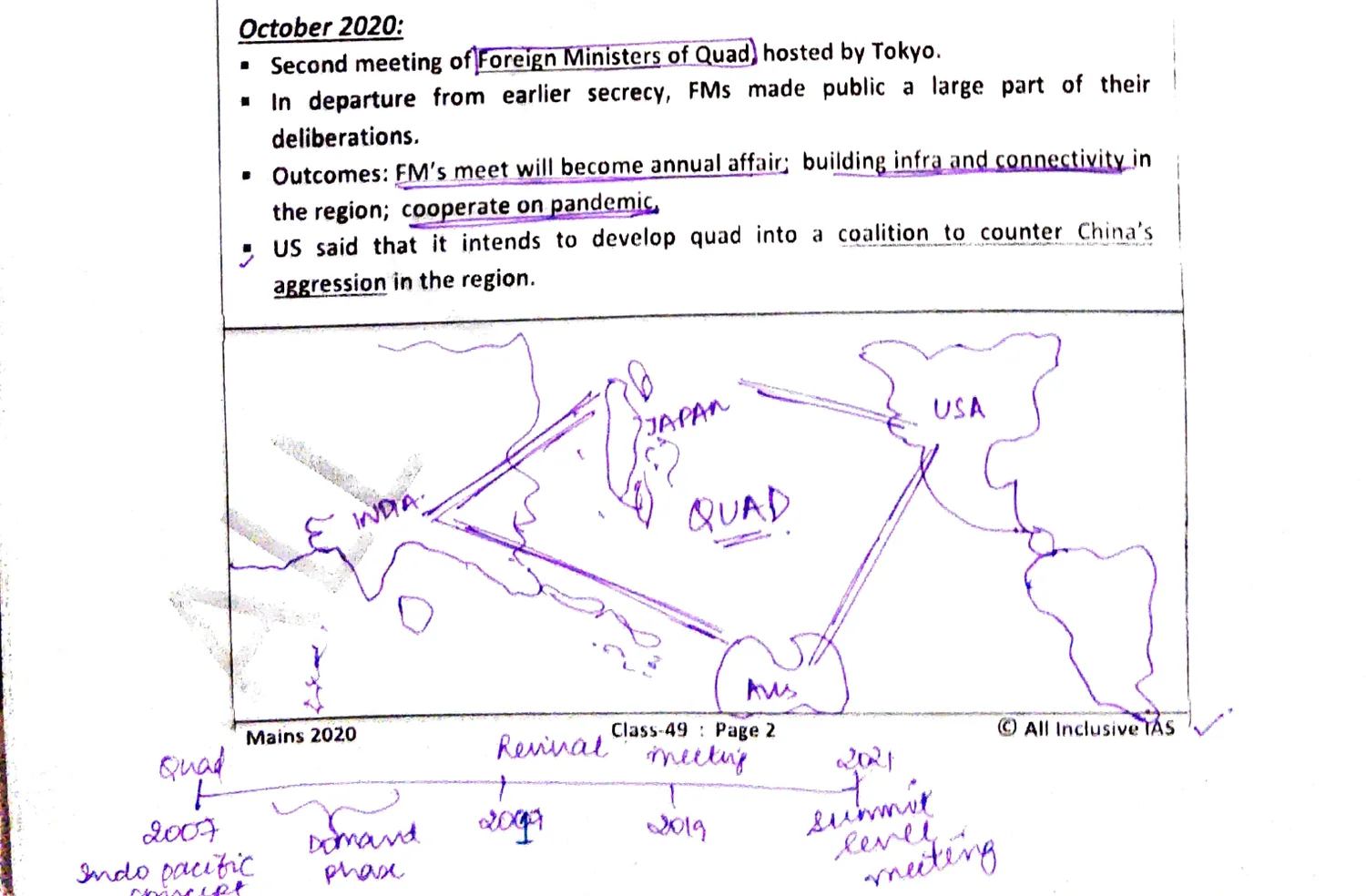
- Map shows: India, USA, Japan, Australia connected via lines across Indo-Pacific
- Timeline (bottom of page):
- 2001: [illegible] — [illegible] relevant meeting
- 2007: Annual meeting [illegible]
- 2008 [illegible]
- 2017: [illegible]
- 2021: 1st [illegible] Leaders Summit / Ministerial meeting
#WHO (World Health Organisation)
- WHO is a specialized agency of UN, responsible for international public health
- Established in 1948; headquartered in Geneva with six semi-autonomous regional offices
#Functions
- It sets international health standards
- Provides technical assistance to countries
- Coordinate response to health emergencies
#Structure
- World Health Assembly: member states; supreme decision making body
- Executive Board: technical experts; oversee implementation of programs
- Secretariat: headed by Director General; implements the programs
#Source of Funds
- Assessed contributions: paid by member states based on GNP and population
- Voluntary contributions: paid by member states, organizations, individuals, etc. — USA
#Achievements
- Eradication of smallpox; near-eradication of polio
#Issues: (funds, functions, [illegible])
- No stable source of funds; dependent on voluntary contribution (20% assessed, 80% voluntary)
- No single document to outline its responsibilities
- Unlike WTO, it has no powers to bind or sanction members; can only advise
- Lacks administrative strength for effective coordination; relies on bureaucracy
#Criticism in Handling COVID
- Delay in acknowledging human-to-human transmission: Taiwan informed WHO of it in December 2019, but WHO waited till mid-January for Chinese confirmation
- WHO urged countries not to spread fear by imposing travel restrictions
- Relied on Chinese data, instead of verifying the same; WHO team went to Wuhan only in mid-February; Praised China for transparency and effective COVID control
#Way Forward (In December 2020, India submitted 9 point reform plan)
- Empower WHO Director General to declare Public Health Emergency of International Concern (PHEIC) even without consensus in IHR [International Health Regulations] Emergency Committee
- For funding of WHO programs, pre-earmark voluntary contributions so that money can be used where it is needed the most
- Monitor expenditure at micro level for greater transparency and accountability in use of funds
- Set up a Standing Committee of Executive Board to supervise member states' implementation of WHO's recommendations
- Set up mechanism for fair and equitable access to vaccines and diagnostic tools (prevent vaccine nationalism)
#Brexit
#European Union and Britain
- 1957: European Economic Community (Treaty of Rome)
- 1963 & 1967: Britain tried to join, blocked by France
- 1973: Britain joined
- 1975: Referendum; Britons endorsed staying
- 2007: Lisbon Treaty (exit by negotiation)
- 2016: Referendum
- 2020: 'British Exit' from the European Union
#Why Britain Quit EU?
- Monetary contributions to EU seen as financial burden (net 9 billion pounds highlighted)
- Refugee crisis in EU and rising threat of terrorism in EU
- Political parties using populist nationalism and anti-EU sentiments
- Not integrated enough: did not use Euro currency, not part of Schengen area
#Impact on EU
- Weaken EU's reputation and strength at global forums
- Promote further disintegration; other countries too may be tempted to quit
- EU will no longer get the financial contributions from UK
#Impact on India
- India considers Britain as a gateway to EU; now with Brexit, India loses the advantage
- There are more than 800 Indian companies in Britain; with BREXIT, the business of these companies will be affected
- Could lead to the movement of skilled labour from India to Britain
- A new trade agreement with UK will be negotiated
#Cross-Border Flood Management
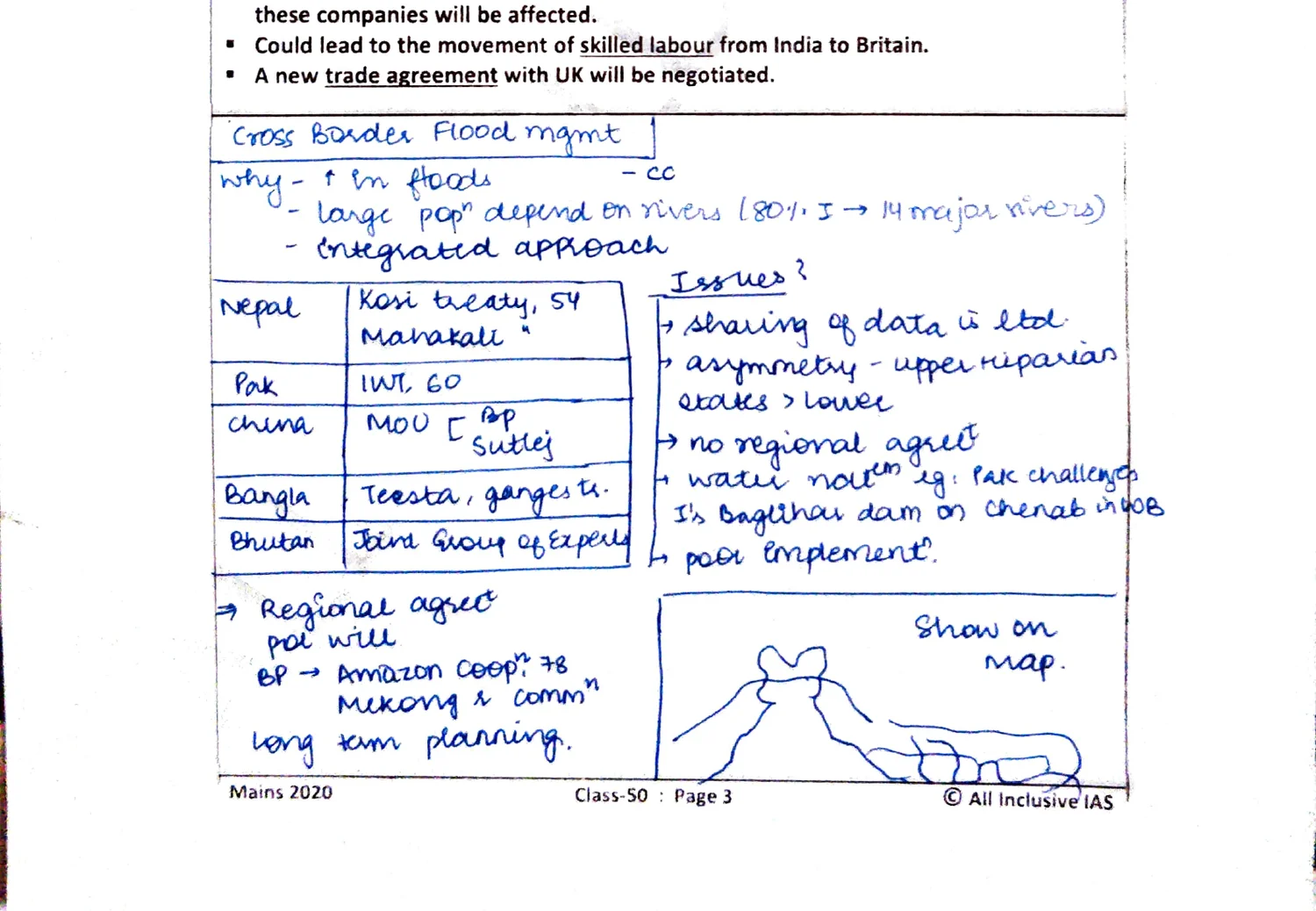
- Why: 1 in flood → CC [climate change]; large part depends on rivers (80%: 1 → 44 major rivers [illegible]); integrated approach
- Issues:
- Sharing of data is the [illegible]
- Asymmetry: upper riparian states > lower [states]
- No regional agency
- Water: [illegible] big tech challenges
- In Bangladesh: dam on Chenab [illegible]
- Poor implementation
#Country-wise Notes (from table)
| Country | Treaties / Notes | Issues |
|---|---|---|
| Nepal | Kosi treaty; SV [illegible] | [see above] |
| Pakistan | IWT [Indus Waters Treaty] 60 | [see above] |
| China | MOD [Ministry of Defence] / [illegible] subsidy | [see above] |
| Bangladesh | Teesta; Ganges etc. | [see above] |
| Bhutan | Some about [illegible] electricity | [see above] |
- Regional agency: pol will (of) Amazon COOP [cooperation] & [illegible]; long-term planning
- Shown on map
#WTO — Dispute Settlement System
(Also see class-45)
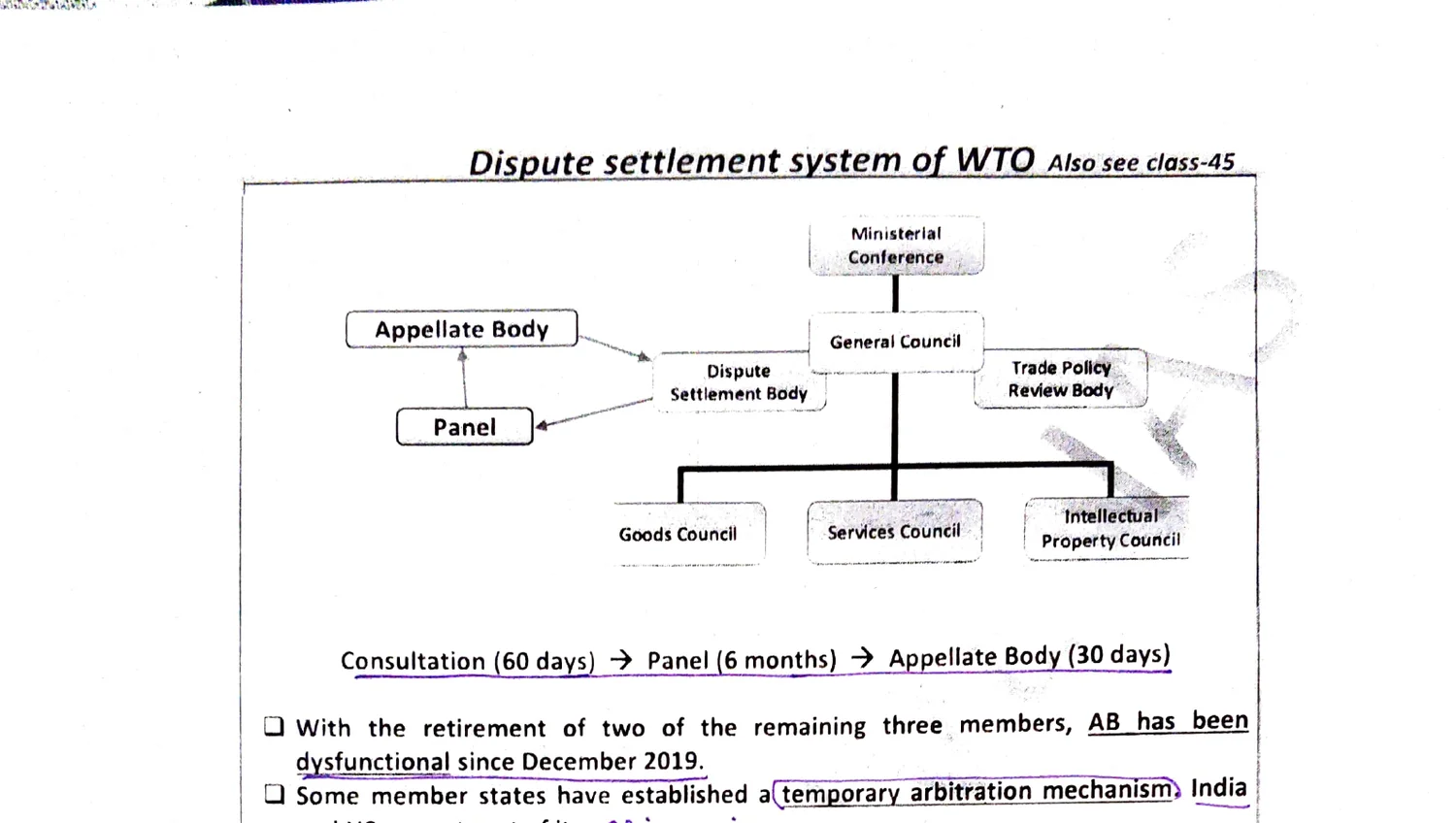
#Structure (flowchart)
-
Ministerial Conference
- General Council
- Dispute Settlement Body
- Trade Policy Review Body
- Goods Council | Services Council | Intellectual Property Council
- Appellate Body
- Panel
- General Council
-
Consultation (60 days) → Panel (6 months) → Appellate Body (30 days)
#Appellate Body (AB) Crisis
- With the retirement of two of the remaining three members, AB has been dysfunctional since December 2019
- Some member states have established a temporary arbitration mechanism; India and US are not part of it; China is
#Appointment Issues
- Problem: Appointment is by consensus method; so even a single member can block appointments (e.g. USA)
- Suggestions: Make appointment by majority, not consensus; increase term and number of AB members; automatic launch of selection process before expiry of term
#Delays
- Problem: Increase in procedural delays in past few years
- Suggestion: Increase administrative staff and lawyers, streamline the process
#Precedent Issues
- Problem: AB treats its decisions as precedents for future disputes; but AB has no such powers; also, most trade disputes are unique
- Suggestion: Allow AB to consider extent to which prior decisions can be used for new disputes
#Other Problems
- 94% of global [illegible] — failure of negotiations (e.g. Doha round); fishery subsidy; vaccine patent waivers etc.
- No respect of rules — e.g. US-China trade war
- Each push for their own agenda — e.g. e-commerce
- IT: [illegible] tension
- Opaque internal process of DG [Director General] of WTO
- Non-tariff barriers to trade
- Rise of bilateral and multilateral FTAs
- India's exports doubled in less than a decade
#UNHRC (UN Human Rights Council)
- Pakistan has been re-appointed to UNHRC despite poor human rights record
#What are Human Rights?
- They are inherent rights that all humans have; need not be granted by any state
- They are universal, and same for everyone
- Universal Declaration of Human Rights was adopted by UNGA in 1948
#UNHRC
- Established by UNGA in 2006 to protect human rights around the globe
- It has 47 members, elected for 3-year term, by UNGA, by simple majority
- It investigates violations of HRs; reports to UNGA; recommendations not binding
- Through UPR [Universal Periodic Review], it reviews human rights record of each UN member state (class 1 UBI [illegible])
#Issues
- Many UNHRC members are themselves systematic offenders (Pakistan, China)
- Many countries get elected unopposed due to geographical quota system
- Secret ballot allows rights violators get elected (China); countries not publicly accountable for their votes
- It has failed to prevent violation of human rights in most countries
- It has disproportionately high focus on Israel; US quit from UNHRC in 2018
- Largely ignores rights violation against weaker sections: like elderly, children, PwDs
#Way Forward
- Focus general issues like children & elderly, instead of country specific violations
- Focus on thematic issues like biotech & AI, which have significant human rights implications
- To ensure effectiveness, connect HRC's work with other UN organs
#India-EU Relations
(India-EU bilateral framework — from p12 bottom)
#India-EU Bilateral Overview
- Secretariat: China, Sudan [illegible]
#Areas of Cooperation
- Economic:
- EU is India's largest trading partner
- Dev: SDA [illegible]
- CC [Climate Change]: clean energy
- Father [illegible]
- EU offers GSP [Generalised System of Preferences]
- Largest FDI [source]
- EU offers GSP
- Defence & Security:
- IFC [International Finance Corporation] / counter piracy / [illegible]
- 000 [illegible] & students for euro [illegible]
#Issues (India-EU)
- Trade: India + EU — 1/7; China = 18+)
- Created IMTA [illegible]; return on CAA; KSTO [illegible]
- Protectionism, MFTA, anti-migration — Brexit
- BTIA [Broad-based Trade and Investment Agreement] Issues:
- Proposed BTIA when India EU; [illegible], in 2007; 15 rounds so far
- Lowering [illegible] of law in EU [illegible]: is legally binding clause on HR [Human Rights], labour, environment etc.
#India BTIA Issues
- Not a data secure country
- Service sector: I want access under MFN/MY, EU NHB
- Office on bilateral dispute settlement much: UK, France
- India: Hammont [illegible] bit with UK, France
#UNSC (UN Security Council)
- Recently, India became UNSC member for the 8th time
- India's overall objective during the two-year tenure will be achievement of NORMS
#New Orientation for a Reformed Multilateral System (NORMS)
- New opportunities for progress
- Innovative solutions for inclusive development
- Effective response to terrorism
- Greater coordination to check terror financing & use of ICT
- Reforming multilateral system
- UNSC should reflect contemporary realities
- Inadequate existing mechanisms — e.g. weak COVID response
- International peace and security
- Commitment to international law
- Reforms in UN peacekeeping operations
- Technology with a human touch
- Use of tech to reduce human suffering
- In achieving NORMS, India's efforts will be guided by the 5S approach: Samman (Respect); Samvad (Dialogue); Sahyog (Cooperation); Shanti (Peace); Samriddhi (Prosperity)
#What Should be India's Approach with Different Countries?
- With P5 members, avoid the temptation of taking sides
- With non-permanent members, aspire for their leadership
- With non-UNSC members, be the voice of the weaker nations
- Our success will depend on effectiveness in raising issues that go beyond the interest of the big five
#Strategy → Maximize support on UNGA; need resilience in UNSC
#Why UNSC Needs Reforms?
- UN members increased from 113 to 193, but UNSC composition remained same
- While Europe is over-represented, Africa is under-represented; Africa and South America have no representation at all
- Does not reflect contemporary realities (India, Japan, Germany)
- Use of veto power ends up blocking key decisions — e.g. on Israel
#What Constitutes UNSC Reform Agenda?
(Five sets of issues identified by the General Assembly)
- Regional representation
- Categories of membership
- The question of veto
- Size of an enlarged Council and its working methods
- UNSC-UNGA relationship
#Credentials for India's Bid for Permanent Seat
- Founding member of UN
- World's largest democracy; one of the fastest growing large economies
- India is a responsible nuclear weapons state
- One of the largest contributors to UN peacekeeping missions
- India is seen as a responsible power, which adheres to global rules and norms (Italian marine case; South China Sea case)
- Issues: poor socio-economic indicators; military projection limited to IOR; NPT; China
#UN Peacekeeping Forces
- Formed in 1945; it aims to help countries torn by conflict to create conditions for lasting peace
- Peacekeepers remain members of their respective armed forces
- It is not 'UN Army'
- It is collective responsibility of UN members
- Major successes: Sierra Leone (1999 to 2005); Burundi (2006)
- Major failures: Rwanda genocide 1994; Srebrenica massacre 1995
#India's Role
- More than 200,000 Indians have served in 59 of the 71 UN peacekeeping missions established around the world since 1948
- In 2007, India became the first country to deploy an all-women contingent to a UN peacekeeping mission
- Recently, Indian peacekeepers serving in South Sudan were awarded UN medal for their contribution to building peace in the region
#Additional Comments
- In practice, a nation's voice is in proportion to what it contributes
- Chinese funds give it a role in formulating peacekeeping mandates
- Troop contributions alone does not give much say in world power politics
- US 28%; China 15%; India 1%
#TPNW (Treaty on the Prohibition of Nuclear Weapons)
- Adopted in 2017 due to ICAN [International Campaign to Abolish Nuclear Weapons] campaign
- Force in [illegible]: 86 signed; 51 ratified
- No US / China / India / Pakistan / Britain / France / Israel / N. Korea
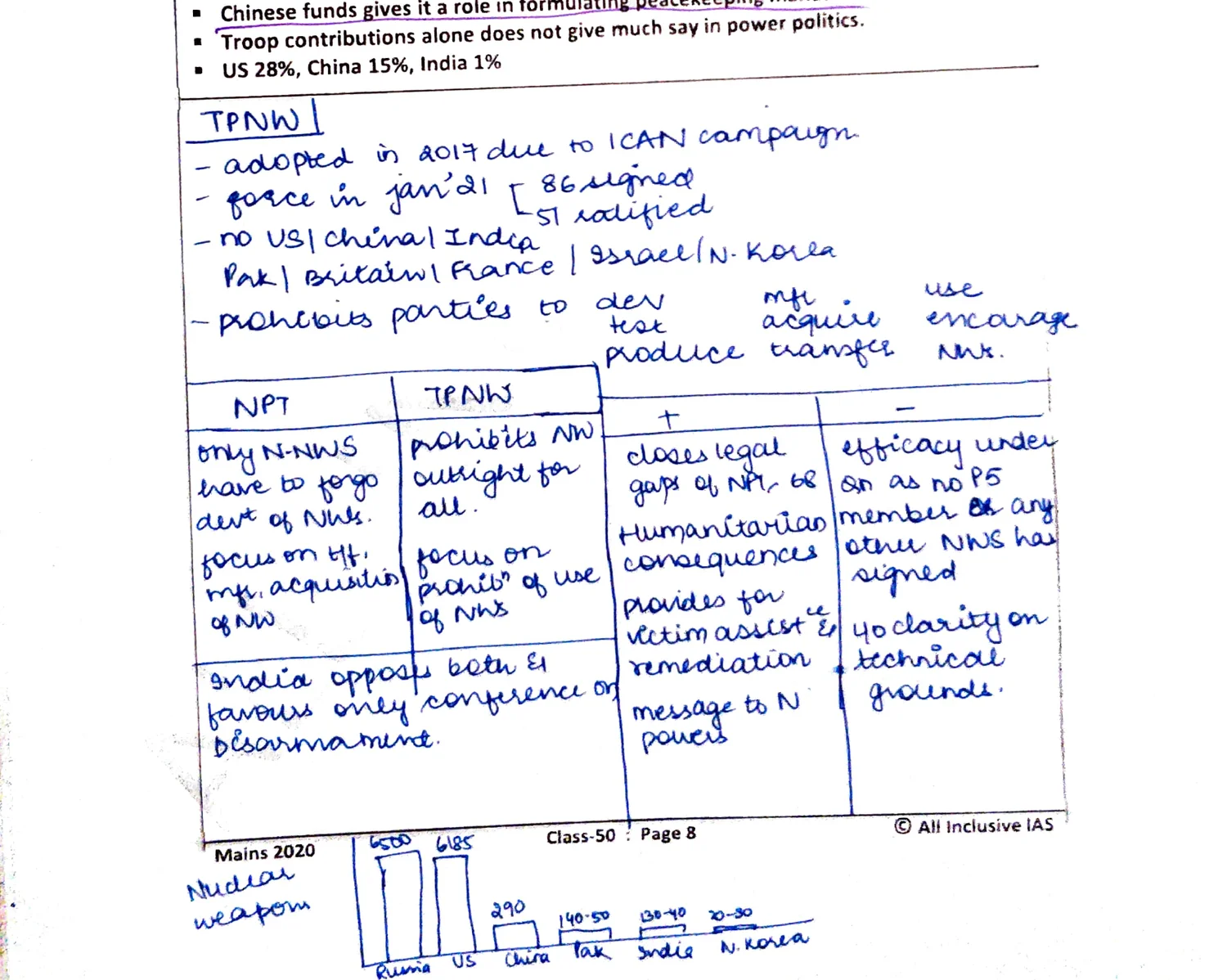
#NPT vs TPNW Comparison Table
| NPT | TPNW | |
|---|---|---|
| Other NWS [Nuclear Weapon States] | Have to forgo all of NWS | Prohibits NWS oversight for all |
| Focus | Focus on non-proliferation & use of NWs | Focus on prohibition & use of NWs |
| Gaps of NWs | Closes legal gaps of NWs e.g. as no P5 member be any other NWS has signed | Efficacy under [illegible] on as no P5 member be any other NWS has signed |
| Humanitarian | Humanitarian consequences | Provisions for [illegible] remediation |
| Message | [illegible] message to N. Power | No clarity on technical grounds |
- India opposes both; pursues only conference of disarmament
- Shown as bar chart: nuclear warheads by country (Russia, US, China, Pakistan, India, N. Korea)
#Nuclear Weapons Count (bar chart, bottom of p14)
- Russia: ~6500
- US: ~5600
- China: 250
- Pakistan: 140-150 (approx)
- India: 120-130 (approx)
- N. Korea: 30-40 (approx)
#NPT (Non-Proliferation Treaty)
- Proliferation → increase in number
- Nuclear proliferation → spread of nuclear weapons to non-nuclear weapon states
- NPT: signed in 1968 to prevent spread of nuclear weapons; in force since 1970
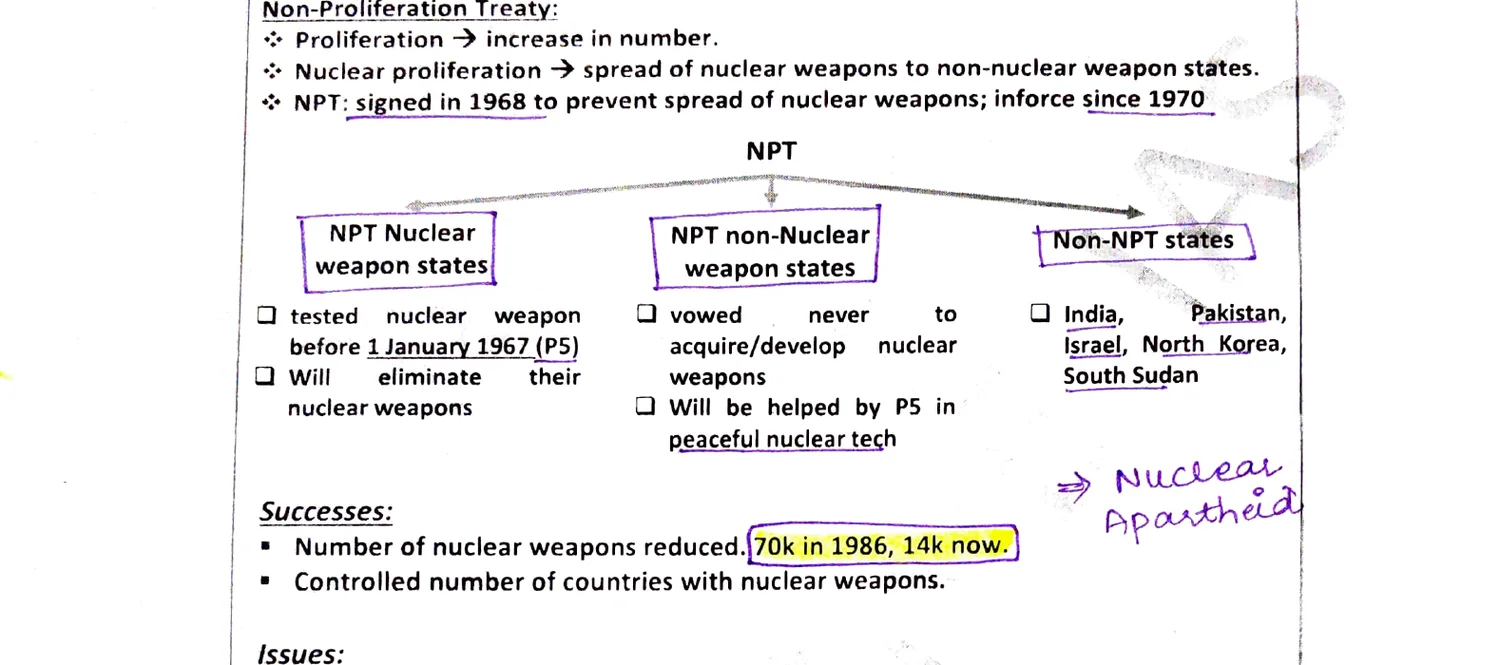
#Three Categories Under NPT
| NPT Nuclear weapon states | NPT Non-Nuclear weapon states | Non-NPT states |
|---|---|---|
| Tested nuclear weapon before 1 January 1967 (P5) | Vowed never to acquire/develop nuclear weapons | India, Pakistan, Israel, North Korea, South Sudan |
| Will eliminate their nuclear weapons | Will be helped by P5 in peaceful nuclear tech |
→ Nuclear Apartheid (annotated)
#Successes
- Number of nuclear weapons reduced: 70k in 1986; 14k now
- Controlled number of countries with nuclear weapons
#Issues
- No time limit for P5 to eliminate their nuclear weapons
- Could not prevent China from helping Pakistan and North Korea build nuclear weapons
#Why is India Not Signing NPT?
- Discriminatory:
- NPT is discriminatory; divides world into nuclear 'haves' and 'have-nots'
- Neighbours:
- Signing NPT would require India to destroy its nuclear weapons
- But India has two nuclear neighbours; Pak is India specific
- 2008 deal:
- India no longer needs to sign NPT as Indo-US Nuclear deal and subsequent NSG waiver has given it access to international nuclear cooperation
#CTBT (Comprehensive Nuclear-Test-Ban Treaty)
- It bans all nuclear tests of all purpose, in all environments
- After WW-2, hundreds of nuclear tests were polluting environment / destroying life
- 1954: Castle Bravo tests by USA; Nehru called for standstill agreement
- 1955: Nikita Khrushchev proposed CTBT; Negotiations began
- Problem: Can't verify other's underground tests
- Result? PTBT 1963 banned nuclear tests in underwater, atmosphere, outer space
- Problem? Underground tests continued
- 1980s: USSR and USA agreed on comprehensive ban
- 1996: UNGA adopts CTBT
- CTBT is still not in force, why? Because 8 countries have not ratified it
- Signed but not ratified: USA, China, Israel, Iran, Egypt
- Not signed: India, Pakistan, North Korea
#Foreign Policy in a Changing World
#Different Phases of Indian Diplomacy
-
1947-62: Optimistic Non-Alignment
- India's objectives in this phase were to resist dilution of its sovereignty
- Independent stand taken in Korean war & Suez canal crisis 1956
-
1962-71: Decade of Realism and Recovery
- Concluded defence agreement with the US in 1964
- From 1965 Tashkent agreement India started tilting towards USSR
- Signed Indo-Soviet Treaty 1971
-
1971-91: Greater Indian Regional Assertion
- Remarkable use of hard power in 1971
- Faced US sanctions after 1974 Pokhran
- US-China-Pakistan axis seriously threatened India's prospects as a regional power
-
1991-99: Safeguarding Strategic Autonomy
- Emergence of unipolar world encouraged India to change its approach
- Increased engagement with Israel, USA, ASEAN
-
2000-2013: India, a Balancing Power
- Indo-US nuclear deal strengthened ties with Russia; coordinated with China on climate change and trade; made BRICS into a major global forum
-
2014-until now: Energetic Engagement
- India's stature evident from world overlooking abrogation of Article 370
- India's policy of Non-Alignment has turned into Multi Alignment
#Way Forward
-
Need for greater realism in policy: "Desires of Delhi"
- India needs to change the image of a reluctant power
- Discomfort with hard power is reflected by lack of consultation with military
- Soft power diplomacy is not sufficient to protect the country
-
Need for strong economy:
- An expansionary foreign policy needs a strong economy
- China's assertiveness in foreign policy is derived from its economic power
-
Need for multi alignment:
- Today's world is characterized by complex interdependence
- Indian foreign policy requires strategic hedging like Howdy Modi & Mamallapuram (informal meetings with US and China); Quad and SCO; Israel and Palestine
#Cross-Border River Water Cooperation
#Need
- Rivers are not confined to national boundaries
- Construction of upstream dam affects downstream countries
- Climate change is affecting glaciers and water flow in rivers
- Water scarcity can push countries to war
- Change in river's course can create boundary disputes
#Way Forward
- Countries must adopt certain minimum systems of water governance
- Create multilateral mechanism where all co-riparian countries get due representation
- Bring transparency in data collection on river water flow
#India's River Water Cooperation with Neighbours
- Indus Water Treaty 1960 with Pakistan
- Ganga Treaty 1996 with Bangladesh
- Treaties on Koshi, Gandak, Mahakali with Nepal
- Data sharing pact signed with China in 2006, for Brahmaputra and Sutlej
#Conclusion Framework (General Framework for IR Answers)
- Unilateral — physical doctrine [illegible], soft power, aid
- Bilateral — India-Japan tech collaboration
- Regional — SAARC, BIMSTEC
- Sub-regional — BBIN [Bangladesh Bhutan India Nepal]
- Trans-regional — SCO, RCEP, QUAD
#Key Quotes and Concepts
- Enlightened self interest
- Hesitations of history / Dogma of Delhi
- Rit short-term reciprocity; both countries should eye a long-term win-win framework
- ASI — 3rd peace
- Multi-alignment aka Bismarck's Web of Alliances
- Fair & Free Trade
- Need for Creative Diplomacy
- OBOR× — Many Roads, Many Belts (MB, MR) ✓
- Concert of many, not power of few
- Asia of rivalry will hold us back; Asia of cooperation will shape this century
#SECURE Strategy (for SCO)
(S-E-C-U-R-E)
- S — Security of citizen
- E — Economic development
- C — Connectivity
- U — Uniting our people
- R — Respect for Territorial Integrity
- E — Environmental protection
#Delivery Deficit
- The India promises & China delivers
#World Order — Historical Phases
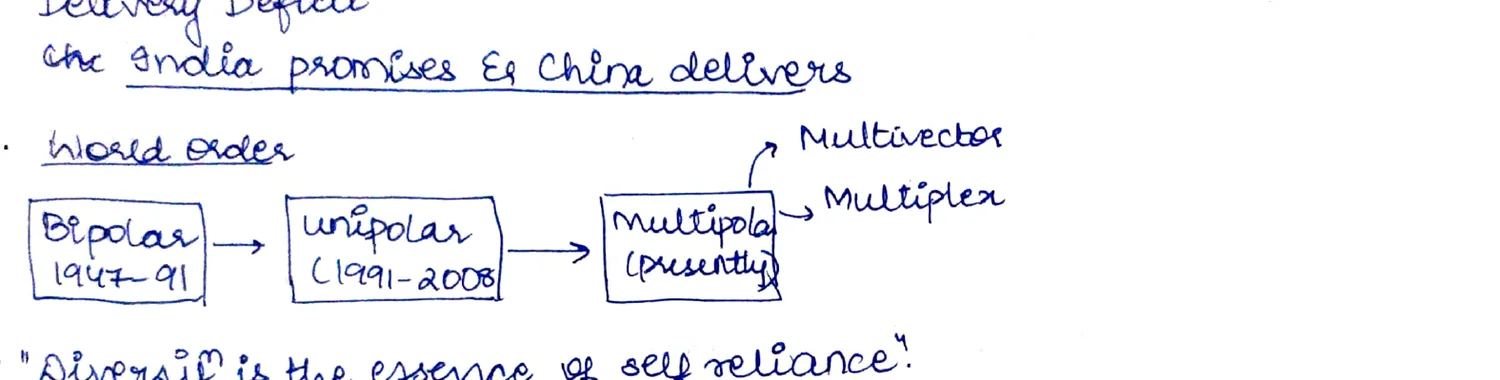
- Bipolar (1947-91) → Unipolar (1991-2008) → Multipolar (presently)
- → Multivector
- → Multiplex
"Diversiti is the essence of self reliance"
"Russia is an exception to the rule that there are no permanent friends in IR; [illegible] can lose situation"
"A nation with global ambitions cannot continue with unsettled borders" — MEA & Jaishankar
"The issue is not how US-China rivalry will play out but how the middle players / powers will play"
"India's 'inst' lag behind its ambitions" — Shyam Saran
"Regional groupings/multilateralism — goldilocks option"
#India and Afghanistan
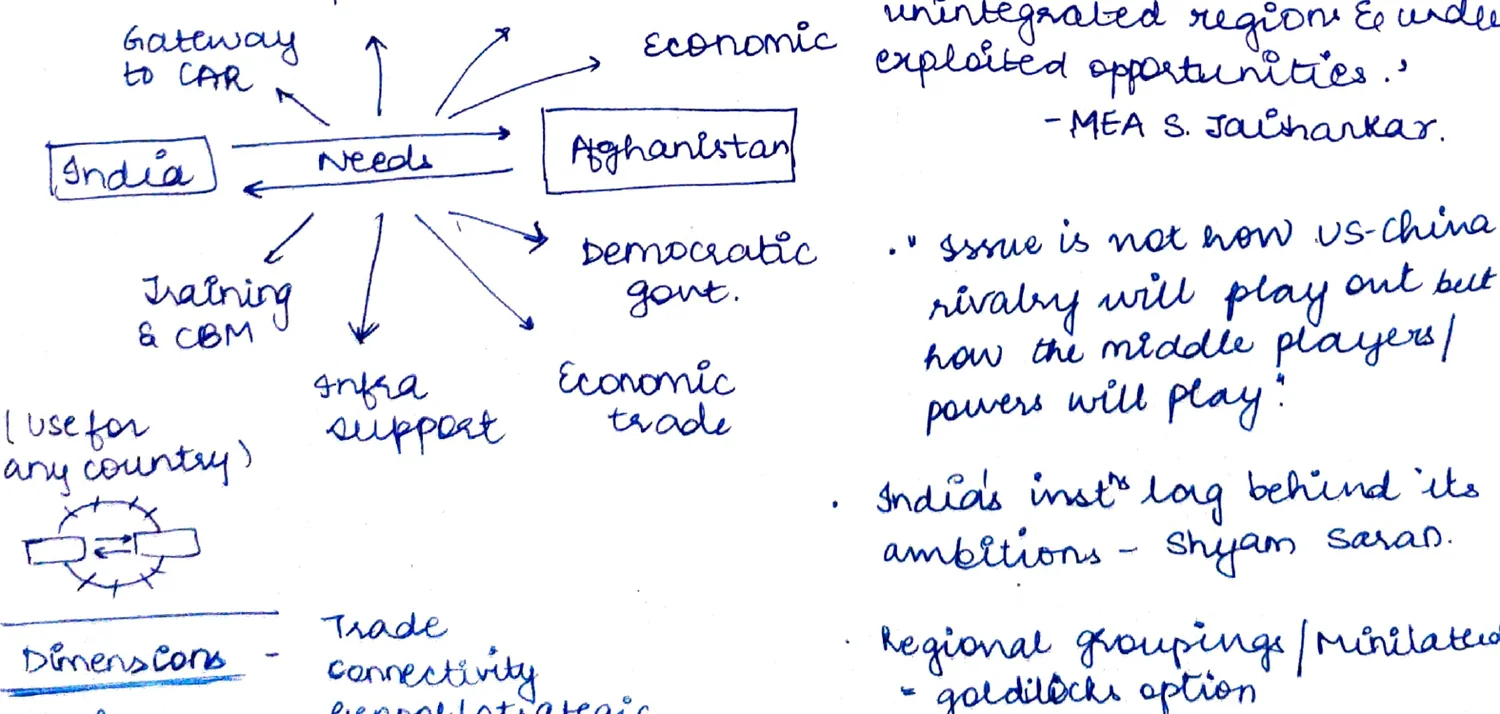
-
India needs Afghanistan for:
- Regional peace
- Link West
- Gateway to CAR [Central Asian Republics]
- Economic [ties]
- Democratic gone [zone]
- Inka support [India's support]
- Economic trade
-
Afghanistan needs India for:
- Training & CBM [Confidence Building Measures]
- (useful for any country)
#Dimensions of India-Afghanistan Engagement
- APC [illegible] — trade, connectivity
- Security — geopolitical / strategic
- Diaspora — [illegible]
- Defence — space
- Space — [illegible]
- Nuclear — [illegible]
- APR [illegible] — rule based order; UN/[illegible]
#Appendix Notes (margin annotations)
- "A nation with global ambitions cannot continue with unsettled borders, unintegrated region & under exploited opportunities." — MEA's Jaishankar
- "Issue is not how US-China rivalry will play out but how the middle players/powers will play"
- "India's inst[itutions] lag behind its ambitions" — Shyam Saran
- "Regional groupings/multilateralism — goldilocks option"