Optional — Political Science & IR (PSIR)
Topper answer copies (Ria Dabi, Shubhra Ranjan). Q1–Q4 = Paper I (political theory & Indian political thought); Q5–Q8 = Paper II (comparative politics & IR).
PSIR Answer Copy — Test 1
Ria Dabi — PSIR answer copy (Shubhra Ranjan)#Cover Sheet
- Name: RIA DABI
- Test Date: 19.10.20
- Test: Test 01
- Time Allowed: 3 Hours | Max Marks: 250
#Q1(a) — Normative Approach in Political Philosophy [10 Marks] Paper I
The normative approach in political philosophy is the oldest approach, which can be traced back to the works of Socrates and Plato.
Socrates, the father of Idealism, believed that we need to distinguish between the world of idea and world of matter, to gain true knowledge. World of matter is a world of illusion while world of idea is eternal and gives true happiness.
The method of dialectics has been suggested to gain this true knowledge. Socrates' Theory of Knowledge was applied by Plato in his Theory of Ideal State.
Plato believed that rule by the philosopher king is necessary to create an ideal state as he is a man of reason and symbol of knowledge and sacrifice.
Thus, the Normative approach is a study of ideas and is prescriptive in nature. It distinguishes between right and wrong and is change-oriented.
However, the Normative approach has been criticised as philosophical and unscientific. It deals with centuries old ideas and not with present problems. This led to the rise of Behavioural Movement in political science.
#Q1(b) — Feminist Theory of State [10 Marks] Paper I
Feminists believe that there is no feminist theory of state. Feminism is a meta-ideology which studies the power of women and not of the state.
However, in recent times, the state has been studied and seen as a patriarchal institution. Thus, Catherine McKinnon said, 'When I look at the state, the state appears male to me.'
Being a lawyer by profession, she studied the women specific laws in America and found loopholes in them as well as biasness to protect the guilty men. Even in the case of India, laws to protect and empower women have not given significant results.
Thus, Madhu Kishwar called them 'bizarre pieces of legislation'. Institutions like Panchayati Raj have not been able to empower women.
Feminists believe that the public and private spheres are not separate and the state must intervene in both to prevent sex based violence. Thus, Carole Hanisch coined the term, 'Personal is Political'.
While criticising the state, feminists take a contradictory turn when they say that only the state can protect women since the society is patriarchal.
#Q1(c) — Foucault's Theory of Power [10 Marks] Paper I
Foucault belongs to the Post-Modernist school of thought. He believed that 'Power is everywhere, flowing through society like a network of capillaries'.
He has studied power in 3 different dimensions:
-
Discipline — where disciplinary institutions like schools, army, hospitals, turn people into productive members of society. It is a place for reform and people have respect for it.
-
Bio-power — Discipline is for the individual but bio-power is for the collective. It is linked to homogenisation where people are categorised superficially in surveys to discipline them.
-
Governmentality — to instill in people the mentality to govern themselves. Foucault has used Bentham's Panopticon or modern prison where people have a fear of being watched all the time.
Therefore, freedom in modern society is a discourse. State keeps a watch on all citizens. But power can also be productive and power is necessary to liberate ourselves.
#Q1(d) — Aurobindo's Concept of Indian Nationalism [10 Marks] Paper I
Aurobindo was the greatest philosopher of modern India. He has given the strongest theory of nationalism.
Aurobindo was a critic of the Moderates who saw British rule as a 'blessing in disguise'. He was a supporter of Passive Resistance, Swaraj and boycott to end the colonial rule.
He advocated a cultural theory of Nationalism (Herder), where nation is a fraternity and consciousness is necessary to fight. He was inspired by Vivekananda's Sanatan Dharma and Bankim Chandra Chatterjee's idea of Mother India as Goddess Shakti.
He believed that Nation is not a piece of land or figment of our imagination. Nation is a faith, a religion, it is divine and has a spirit. India represents the spiritual element of the universal spirit and thus its rise as a nation is inevitable.
Aurobindo saw British rule as a 'hammer of God', necessary to wake the Indians and revive their glory. Aurobindo advocated Swaraj as complete freedom.
Swaraj would come when people have inner peace and harmony reflected in Satchitananda and Tap Yog Sadhna, and they achieve the state of super mind. Thus, his ideas contributed greatly to the freedom struggle.
#Q1(e) — Concept of "Dharma" in Indian Political Philosophy [10 Marks] Paper I
Indian political thought is associated with the concepts of Dharma and Danda. They differ in terms of degree and not kind.
There is no appropriate word available in any of the European languages which can be treated as exact translation of the Indian word Dharma. It should not be confused with religion.
According to Rig Veda, Dharma is that which holds life on this earth. If we do not follow Dharma then it will lead to anarchy and catastrophe and end life on Earth.
Dharma is discussed in Dharmashastra, for example the Manusmriti. Smriti is based on Shruti. Shrutis represent the Vedas. Shrutis contain the cosmic law.
Dharma is a law to govern the human society. It is based on Rta. Manusmriti contains the following ideas related to Dharma:
- i) Purusharthas or 4 goals of life — Dharma, Artha, Kama, Moksha
- ii) Concept of Ashrams
- iii) Concept of Varnas
Each Varna is to follow its Dharma. The most important duty of king is to ensure this. Thus, the king has the rod of danda. The king is always under dharma.
#Q2(a) — "One with immediate proximate territory is the natural enemy." (Kautilya). Discuss. How far is it appropriate to consider Kautilya as Indian Machiavelli. [20 Marks] Paper I
Kautilya has written the best book in the field of statecraft. He belongs to the danda tradition and the realist school of thought.
According to Kautilya, state is like an organism which has to expand in order to survive. Thus, land has to be acquired by the king to ensure well-being of the people since land is a source of material wealth.
Kautilya believes that the relations among states is like a jungle where strength of lion prevails. The struggle for power is reflected in his Mandala Theory.
The theory states that the neighbour is an enemy (ari) and neighbour's neighbour is friend or ally (mitra). Thus, several such concentric circles are drawn.
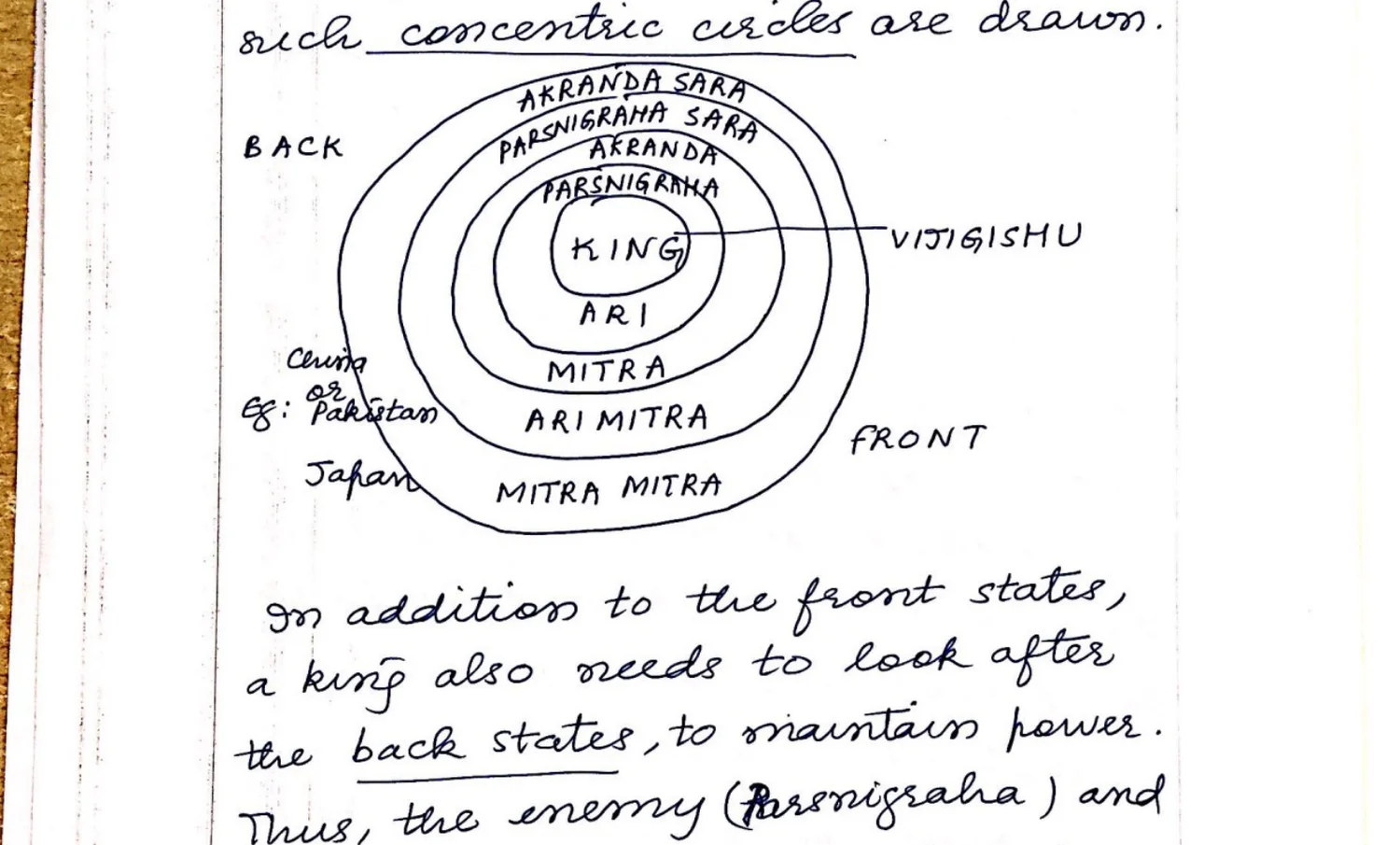
- Concentric circles with KING at centre
- Next ring: ARI (immediate enemy/neighbour)
- Next ring: MITRA (friend — neighbour's neighbour)
- Next ring: ARI MITRA
- Next ring: MITRA MITRA
- Outer rings: PARSNIGRAH, AKRANDA, PARSNIGRAH SARA, AKRANDA SARA
- VIJIGISHU (the conquering king) labelled at right
- BACK and FRONT directions marked
- Examples: China, Pakistan (back states); Japan (front states)
In addition to the front states, a king also needs to look after the back states, to maintain power. Thus, the enemy (Parsnigrah) and (Akranda) friend come into picture.
Kautilya also talks about two other kings. Udasina is the neutral king — e.g. Turkmenistan, Switzerland, while Madhyama is the buffer state — e.g. Bhutan, Nepal.
Support of these states would add to one's strength. Therefore, Kautilya's Mandala theory is considered as an important insight in geopolitics.
Nehru had called Kautilya as the Indian Machiavelli. However, chronologically speaking, Upinder Kaur believes that Machiavelli should be called the Italian Kautilya.
Both thinkers belonged to different space and time. However, their ideas are similar. They saw no role of ethics in politics, believed in nationalism and an imperialistic foreign policy.
The most important difference in their ideas is that Machiavelli saw Prince as above religion while Kautilya saw the king as under Dharma. Machiavelli gives generic advices while Kautilya has given specific advices.
Max Weber therefore saw Machiavelli's Prince as harmless and called Kautilya as more Machiavellian than Machiavelli himself. While Kautilya got his ideal king, Machiavelli could not get his Prince.
Thus, it would be appropriate to go with Upinder Kaur's idea and see Machiavelli as Italian Kautilya and not vice-versa.
#Q2(b) — Gramsci's Theory with its reconceptualisation of the relations between base and superstructure and recasting power as hegemony marks a major breakthrough in Marxist theory. Comment. [15 Marks] Paper I
Gramsci is considered the greatest philosopher in Marxism after Marx. He reconceptualised Marx's theory and gave rise to Neo-Marxism.
Gramsci believed that cultural nationalism plays an important role in constructing a nation. In his 'Prison Notebooks', he opposed Mussolini's rule and wanted to revive Italy's glory.
Taking cue from Benedetto Croce, he viewed culture as an important element. He did not see superstructure as dependent on the base, rather superstructure as autonomous itself. He is thus called the Theoretician of Superstructure.
[Answer continues beyond page 18 — pages 19–53 to be transcribed in subsequent parts]
#Q2(b) — Gramsci's concept of Hegemony [continued from p18] Paper I
He has given the concept of 'integral state' which combines both state and civil society.

- Stacked boxes showing: State or Polity / Civil Society (e.g. Church, Education) / Base or Economic Structure — bracketed together as Integral State
Gramsci believed that history will change only when the superstructure changes. He believed in a continuous revolution.
Gramsci believes that civil society manufactures the consent or builds hegemony for the ruling class. Hegemony defines the limit of common sense.
Eg: Patriarchy / Brahminism.
Gramsci points out the role of intellectuals in building the hegemony of capitalism, especially the traditional intellectuals like the Church Fathers. Gramsci advocates the use of organic intellectuals to build a counter-hegemony or coalition of the sub-altern class.
He suggests that supervisors in factories will be appropriate for this role since they belong to the working class and are in contact with the capitalists.
Through war of position and then war of manoeuvre, the workers will capture the state and civil society and thus change the superstructure, and build their own hegemony.
#Q2(c) — "Power is what keeps the public realm ...in existence." (Hannah Arendt). In light of the above statement, critically examine the relevance of Arendt's theory of power. [15 Marks] Paper I
Hannah Arendt is the only woman to be recognised as a philosopher. She belongs to the civic republican tradition.
According to her, power is often associated with the state. But power is actually for the people. She compares power with:
- Power vs Strength — where power is of the collective and strength of the individual
- Power vs Force — where power belongs to the world of humans and force is natural, e.g. force of wind
- Power vs Violence — where state used instruments of coercion to control people but power actually belongs to the people. Power is 'people acting in concert with each other'. People are powerful only when they are together. Power is itself legitimate.
Power is sui generis. It comes and disappears on its own as and when people have to act against the state. Thus, Hannah Arendt has given a phenomenological view of power.
Her view of power is quite relevant today when the powers of state are increasing and leaders are becoming authoritarian. People acting together and participating in the civic sphere is essential and a human condition, according to Arendt.
For example, the recent protests seen in Hong Kong against Chinese domination, or in USA for Black Lives Matter, or in Thailand against authoritarian leaders, are instances of people coming together to show their strength against state coercion. Arendt's theory of power becomes relevant for democratic rule.
#Q5(a) — Relative Autonomy Theory of the State. [10 Marks] Paper II
The Marxist theories of state can be classified as either Instrumentalist or Structural. The structural theory of state is also called as Relative Autonomy Theory of State.
Structuralist theory has been derived from Marx's work, 'The Eighteenth Brumaire of Louis Bonaparte'. Here state is also seen as a structure. State is not just a reflection of the base but it has autonomy of its own. It is not always conditioned by the base.
However, Marx continued to believe that economic structure is the basic structure. It means though he accepts the autonomy of state but not the complete autonomy, only relative autonomy.
It means under certain historical conditions, state does gain some amount of autonomy or freedom. He believed this occurs when a particular class does not control the entire economic structure, e.g. during Bonaparte's rule in France.
Since no class controls, state ceases to be the instrument of a particular class. It starts acting as an equilibrium maker. State appears neutral.
#Q5(b) — Affirmative Action. [10 Marks] Paper II
Affirmative Action is also called as Positive Discrimination, where certain disadvantaged sections of society are given benefits so that they come at par with the privileged classes.
Social liberals like Amartya Sen, Dworkin, etc. believe that such sections of society should get a fair equality of opportunity. Affirmative action has been derived from this principle.
In the context of India, the constitution makers found there was no level playing field and gave benefits to certain sections e.g. SCs, STs, OBCs, EWS in the form of reservations or quotas in government employment and educational institutions.
However, this policy has remained controversial and is criticised because it compromises merit, cannot be rolled back once introduced, has been politicised a lot and is a kind of reverse discrimination.
But affirmative action remains in force due to the backwardness of such sections and is a tool to empower them. It helps to equalise their capabilities as pointed out by Amartya Sen.
#Q5(c) — Relationship between Liberty and Equality. [10 Marks] Paper II
Liberty and Equality are the foundational values of any social institution. They are often considered inter-dependent.
Taking cue from Isaiah Berlin's Value Pluralism, values like equality and liberty are inherently pluralistic and incommensurable. They have been analysed by different schools of thought and remain a matter of debate.
Liberals and Neo-liberals advocate liberty as the absence of interference of state. Liberty is supreme virtue and cannot be compromised with. Liberals advocate equality before law and equality of opportunity. They believe that any efforts by state to compensate will backfire.
Socialists on the other hand prefer to use the term freedom and not liberty, to mean freedom from basic necessities. They see liberal view of equality as procedural and believe in equality of outcomes.
Rawls' Theory of Justice ties all three ideas together wherein justice means maximum equal liberty to all, maximum equality of opportunity and inequality if it benefits disadvantaged (Difference Principle).
#Q5(d) — Difference between Domination and Hegemony. [10 Marks] Paper II
Hegemony defines the limit of common sense. It means manufacturing consent for a particular idea. Domination is often associated with authority or coercion.
Hegemony in the extreme sense becomes domination. Eg: Capitalism has become the hegemonic ideology and now the world is dominated by capitalists.
Both concepts are seen in opposition to authority or legitimacy, that is, they do not reflect the consent of the governed.
There is no consensus or dialogue but certain ideas are imposed on the people forcefully.
However, a state cannot function solely on the basis of force. T.H. Green said that 'Will not force is the basis of a state', while Rousseau said that even the strongest man is not strong enough.
J.S. Mill held that a state cannot become great by dwarfing its own people. Eg: USSR collapsed when it did not listen to the people.
Hannah Arendt believed that power belongs to the people and not to the state. Therefore, a state cannot suppress the dissent of its people. It has to act for the people's welfare.
#Q5(e) — Concept of Overdeveloped State. [10 Marks] Paper II
Hamza Alvi has given the concept of overdeveloped state. He belongs to the Structuralist school of Marxism. He has studied the South Asian states which were earlier under colonial rule.
He calls such states as Bonapartist, meaning, where the executive is very strong. Eg: In Pakistan, we see a military-bureaucratic oligarchy while in India, we had Inspector Raj.
Hamza Alvi says that the Western states have both their political and economic systems as developed. However, in post-colonial states like India, the British introduced a modern political system while the economy remained feudal. Thus, the political system is overdeveloped in comparison to the economy.
Hamza Alvi says that in India, still colonial laws are followed, e.g. sedition, preventive detention. Thus, only the colour of ruling class changed and not their manner of rule. There was no revolution, only transfer of power.
The state received complete control over resources and negotiates between 3 classes — the metropolitan and national bourgeois and the propertied class.
#Q6(a) — "Deliberative democracy questions narrow and the limited conception of political participation in liberal democracies." Comment. Discuss the normative ideals related to deliberative democracies. [20 Marks] Paper II
Deliberation is considered as the heart and soul of any democracy. It helps to usher in inclusive growth, good governance and sustainable development. Deliberative democracy gives power to the powerless and voice to the voiceless.
Deliberation helps in the empowerment of masses. Tools such as RTI, Citizen charters, referendums, right to recall etc. help in strengthening democracy. Participation of people and dialogue helps to build legitimacy for policies of the state.
Consensus building is important in deliberative democracy and it also helps to protect the rights of minorities.
In contrast, Participatory democracy prevalent in liberal countries is just a shadow of real democracy. Only those who participate are heard, while the disadvantaged and deprived are often left out. Thus, Thomas Jefferson said, 'Democracy is not of the majority but democracy is of the majority who participate.'
Liberal scholars have emphasised the importance of deliberation. Aristotle believed that common men deliberating together can arrive at better decisions than philosopher acting alone.
Rousseau advocated direct [continues on next page]
#Q6(a) — "Deliberative democracy questions narrow and the limited conception of political participation in liberal democracies." Comment. Discuss the normative ideals related to deliberative democracies. [20 Marks] [continued from p35] Paper II
democracy which reflects the general will. J.S. Mill believed that freedom of speech is the most important and even dissent should be heard.
Hannah Arendt believed that participation in the civic sphere is a human condition and made no distinction between action and speech.
On the other hand, Marxists support grassroots movements and radical democracy or street politics. Habermas has given the idea of Ideal Speech Situation where the only way to make legitimate policies is through participation in the public sphere.
Joshua Cohen has given 5 features of deliberative democracy:
- It is an independent and ongoing association of people with expected continuity.
- Persons accept that deliberation will be the only decisive factor in formulation of policies.
- Existence of non-coercive environment
- Respect for pluralism of values
- Deliberation is a source of legitimacy
Thus, deliberative democracy makes democracy substantive and results into development of trust.
#Q6(b) — Fascism is a hotch potch of several ideologies and creed. Critically examine. [15 Marks] Paper II
Fascism is considered as a bad word, not to be used. It is seen as a propaganda, hotch potch and pure power politics.
Fascism was seen as an aberration or exception in the history of West. It emerged during World War II in countries like Germany, Italy, Portugal, Argentina, Japan.
Fascism is seen as rule of the elite junta with state censorship and autarky. It believes in imperialistic and nationalist foreign policy (Lebensraum). The state turns authoritarian.
Mussolini saw fascism as duty of citizens towards the state. He said, 'There is nothing against the state, above the state or over the state'. Democracy is the luxury of rich nations and Parliament is nothing but a talking shop.
Hitler saw fascism as creative destruction, to destroy the new and bring back the old, that is, counter-enlightenment.
Laski said that fascism is the desperate attempt to protect capitalism in its last stages. When capitalism faces crisis and cannot maintain its soft face, it suspends democracy to prevent mass protests.
Hannah Arendt called fascism as pathology, a form of totalitarianism due to crisis of modernity.
Fascism is seen as emerging due to political crisis, corruption or economic instability. However, Eric Fromm has analysed human nature to suggest that people fear freedom and desire security or a strong leader, thus favour fascism.
It is to be noted that people never rejected fascism and such leaders came to power through democratic means. Fascism had to be defeated in the war.
#Q4(c) — "Plato's philosophy is the most savage and most profound attack on liberal ideas which history can show." (Crossman). Discuss. [15 Marks] Paper I
Plato is known as the Father of Political Idealism. He was concerned with the decline of Greece (Athens) due to corruption by the ignorant ruling class. He wanted to create an ideal state based on peace, harmony and excellence.
Plato suggested that the soul has spiritual qualities of reason, courage and appetite. In his Myth of Metals, he believed that men of reason should rule the state since they have no lust for power and their first love is knowledge.
Thus, Plato believed that 'unless philosophers become rulers or rulers learn philosophy, there is no end to the predicament of human life'.
Further, to ensure an ideal state, Plato gave his ideas on education as a lifelong process and communism of family and property, as safeguards since even the philosopher has passions.
In response to such ideas, Plato was called the 'enemy of open society' by Karl Popper. Popper criticised Plato as a totalitarian and the first fascist. Plato has advocated absolute power to be given to the Philosopher King, which goes against liberal values.
In addition, Plato supports a highly regimented society, where the state controls one's family and property. Plato believes in wholesale social engineering.
Popper has said that the ideas of holism, historicism and essentialism of totalitarian ideology are applicable to Plato.
However, Levenson argues that Popper is comparing uncomparables. Rajeev Bhargava says that Popper's ideas are ideologically motivated and based on abstract premises.
Plato genuinely wanted to create an ideal state based on peace, harmony and excellence.
#Q8(a) — What were the intellectual factors responsible for the rise of Behaviouralism? Compare Behaviouralism with post-Behaviouralism. [20 Marks] Paper II
After the first World War, when several academic conferences were held, scholars of political science were not invited since they had nothing to offer. Political science was criticised for being philosophical, dealing with century old ideas, being unscientific with no field work and being only armchair theorists.
In response, the discipline undertook a revolution to become more scientific and connected with the present. Thus, Behaviouralism emerged. Lord Bryce had said, 'We need facts, facts, facts'.
The Chicago school led the efforts to reform the discipline and David Easton gave 8 features of the Behavioural Movement:
i) Systematisation ii) Regularity iii) Integration iv) Verification v) Value Neutrality vi) Quantification vii) Pure science viii) Technique
Behaviouralism proved to be successful in studying the political systems of the Third World, in comparative politics and analysing electoral behaviour.
However, in 1950s & 1960s, social movements emerged in USA where again political science had nothing to offer. It had compromised with the scope and relevance of the discipline. Ideas like justice, liberty and equality were needed to be studied. Rawls's theory proved to be a saving grace for the discipline.
David Easton in his speech 'Credo of Relevance' gave his Creative Theory based on action and relevance. He advocated taking behaviouralism forward as synthesis.
It was emphasised that technique can be compromised for the sake of relevance and there is no need to be value neutral as values are needed. Whatever research a person is choosing, it should be relevant and action oriented for the benefit of society. Theories should have the capacity to solve crises.
Political science is applied science rather than pure science. The responsibility of social scientists is bigger than that of natural scientists. Political science is an extremely useful discipline. It needs to be actively promoted by universities, research foundations.
Therefore, Aristotle rightly called political science as 'Master science'.
#Q8(b) — Explain the concept of political obligation. Elaborate Hobbes theory of political obligation. [15 Marks] Paper II
The concept of political obligation means the reasons why people obey the state. The entire western political thought deals with the issue of political obligation. E.g.: Plato and Aristotle believe that a good life is not possible without the state.
Hobbes is known as the first modern thinker as he gave the complete theory of sovereignty of state. Hobbes had a pessimistic view of human nature. He saw man as selfish, power seeking and individualistic.
Hobbes thus called the state of nature as a war of all against all. State of nature was short, nasty, brutish and poor. There was no scope for arts, letters, navigation or industry. It was a power struggle ending only with death.
Hobbes believed that man was utilitarian and since state of nature was painful, man would agree to enter into contract and create the state.
Man would give up all his rights and state would have absolute powers. Thus, state was Leviathan. State had the duty to protect right to life.
Hobbes thus said, 'Man has only two options, to live under absolute anarchy or absolute authority'. This is the basis of his idea of political obligation.
However, Hobbes being an individualist, also gave man the right to resist if the state fails to fulfil its duty. Otherwise, the state would control everything and liberty would be where the law is silent.
Hobbes also gave the state the power to punish those who violated law so that man never returns to the state of nature.
Thus, Hobbes' idea of political obligation is utilitarian in nature.
#Q8(c) — Compare and contrast the monistic theory of sovereignty with the pluralistic theory. Explore the relationship between globalization and sovereignty. [15 Marks] Paper II
Sovereignty of state means that a state can take its own decisions and no other power can dictate its terms.
The monistic theory was given first by Hobbes, who believed that state should have absolute authority (leviathan) to protect man's right to life. Thus, 'Law is the command of the sovereign'.
John Austin also believed that states have supremacy over all other associations. They remove the confusion prevalent in medieval times. It comes with power to punish as well.
The pluralist theory was given by Laski who believes that absolute state gives rise to totalitarianism, threatens rights of people and international peace. A state cannot fulfil all needs of people. MacIver said institutions like church emerged before the state and are autonomous. State is both child and Guardian of law and cannot act arbitrarily.
Duguit and Krabbe point out that multiple sources of law limit powers of state like customs, traditions, international law. However, monists argue that state attains supremacy due to special functions it performs. E.g.: State will solve a dispute between two associations.
Laski also becomes inconsistent when he says that state is the keystone of social architecture. Thus, the debate between monists and pluralists continues.
Globalisation is seen as compression in time and space and making the world a global village or borderless. Hyperglobalists argue that globalisation has limited the powers of state and made its borders porous and penetrable.
Skeptics however argue that states still remain the main source of authority while Transformationalists believe that both forces are at work and de-globalisation started after the global financial crisis.
It should be noted that the globalisation forces have not affected all states equally. The COVID-19 pandemic is said to have led to de-globalisation, where states closed their borders.
PSIR Answer Copy — Test 2
Ria Dabi — PSIR answer copy (Shubhra Ranjan)#Cover Sheet
Institution: Shubhra Ranjan — Political Science & International Relations
Course: Crash Course & Test Series - 2020
Test: Test 02
Time Allowed: 3 Hours · Max Marks: 250
| Field | Value |
|---|---|
| Name | RIA DABI |
| Test Date | 3.11.20 |
| Email Address | (blank) |
| Mobile | (blank) |
| UPSC Roll No | 0819907 |
Instructions (printed):
- There are EIGHT questions divided in TWO SECTIONS and candidate has to attempt five questions in all.
- Question Nos. 1 and 5 are compulsory and out of the remaining, any three are to be attempted choosing at least ONE question from each section.
- Content of the answer is more important than its length.
- Answers must be written in the medium authorized in the admission Certificate, which must be stated clearly on the cover of the booklet in the space provided.
- Content of the answer is more important than its length.
- Any page or portion of the page left blank in the Question-Cum-Answer Booklet must be clearly struck off.
- All parts of the question should be written at one place itself.
- Write the test in exam atmosphere.
- Filling all the details in BLOCK LETTERS is mandatory.
Evaluation Sheet (page 2):
| Criterion | Poor | Average | Good | Very Good | Excellent |
|---|---|---|---|---|---|
| Understanding of Questions | |||||
| Structure & Flow | |||||
| (a) Introduction | |||||
| (b) Conclusion | |||||
| (c) Overall | |||||
| Subject Knowledge | |||||
| Presentation | |||||
| (a) Underline | |||||
| (b) Paragraph | |||||
| (c) Overall | |||||
| Overall Remarks |
Dear Student, (blank remarks section) · "All the best for next test..!!!"
#Q1(a) — "The role of Prime Minister in India is wide and varied." [10 Marks] Paper I
(Pages 3–4, printed pages 1–2)
In a cabinet form of government, the Prime Minister (PM) is considered as the captain of the ship of the state. He is considered as the keystone of the cabinet architecture.
In practice, we find two models of the relationship between PM and Cabinet of Ministers (CoM):
-
Primus Inter Pares — First among equals
Eg. during Nehru's time -
Inter Stellar Luna Minoris — Moon among stars
Eg. after the death of Sardar Patel, the position of Nehru was like moon among stars because there was no other minister who had the charisma at par with Nehru.
The PM is appointed by the President but other ministers are appointed on his recommendation.
The PM in India chairs all the cabinet meetings, takes key policy decisions and communicates to the President as and when required.
The PM also represents India at the global level. He is the face of the ruling party at the centre. He chairs important bodies like Inter-State Council. When a coalition government comes to power, the powers of PM are weakened. He becomes the manager of the coalition. Thus, his role is wide and varied.
- Evaluation rubric table: Understanding of Questions / Structure and Flow / Subject Knowledge / Presentation / Overall Remarks (all blank — to be filled by evaluator)
#Q1(b) — The causes of internal migration [10 Marks] Paper I
(Pages 5–6, printed pages 3–4)
Migrants who move within the boundaries of their own country are known as internal migrants. There are 4 streams of internal migration:
- Rural to Urban
- Urban to Rural
- Rural to Rural
- Urban to Urban
The causes of internal migration found in India are:
-
Urbanisation — An increase in demand for labour in urban areas and better wages increase migration. The other pull factors are medical and educational facilities in urban areas.
-
Marriage — where females may move from one area to another.
-
Employment — Search for better jobs in industries, trade, transport and services results in rural to urban or urban to urban migration.
-
Education — Better academic opportunities are available in cities or urban areas.
-
Lack of security — Political disturbances and inter-ethnic conflicts eg. North East region.
Thus, internal migration is varied in nature. COVID-19 pandemic forced many to go back to rural areas.
- Evaluation rubric table: Understanding of Questions / Structure and Flow / Subject Knowledge / Presentation / Overall Remarks (all blank)
#Q1(c) — Economic reforms and working class [10 Marks] Paper I
(Pages 7–8, printed pages 5–6)
India witnessed major economic reforms in 1991 with liberalisation, privatisation and globalisation. These reforms had a varied impact on the Indian working class.
The positive impact of these economic reforms was:
-
The working class became more competitive, due to opening up of the economy, resulting in more productivity.
-
FDI into various sectors made better technology and management practices available to the workers.
-
On-the-job training became more prominent and workers started getting more wages, thus improving their standard of living.
The negative impact of economic reforms on the working class was:
-
Emphasis on automation and adoption of new technology led to mass unemployment. Eg. in automobile sector.
-
Many small industries (MSMEs) could not compete with the global brands and thus went out of business.
-
Women workers were exploited more with low wages and poor working conditions.
Therefore, we need to ensure that such reforms only benefit the workers.
- Evaluation rubric table: Understanding of Questions / Structure and Flow / Subject Knowledge / Presentation / Overall Remarks (all blank)
#Q1(d) — Language and politics in India [10 Marks] Paper I
(Pages 9–10, printed pages 7–8)
Language is considered as an essential part of our culture and identity. Language and politics have long been connected with one another.
The earliest example was seen in 1960s when protests took place to create the separate state of Andhra Pradesh. This further gave rise to demands for linguistic reorganisation of states and accordingly a commission was set up under Fazl Ali.
Thereafter, we saw the emergence of regional parties, formed on basis of language. Eg: AIADMK, TMC, DMK etc.
With regional languages in focus, rich vernacular literature also emerged, strengthening the identity of a state. Eg: Marathi or Tamil literature.
In present times, we see the rising debate on language to be taught in schools. The NEP 2020 was met with criticism by many states due to the provision of Three Language Formula. States want to protect their mother tongues and the issue is politicised by the parties.
Therefore, language and politics continue to be inter-linked.
- Evaluation rubric table: Understanding of Questions / Structure and Flow / Subject Knowledge / Presentation / Overall Remarks (all blank)
#Q1(e) — Role of civil society in Indian democracy [10 Marks] Paper I
(Pages 11–12, printed pages 9–10)
Civil rights are considered necessary for leading a civilised existence. Eg: Right to life, liberty, property etc.
The Indian National Movement was one of the largest civil rights movement, which demanded basic freedoms like freedom of press, greater representation in assemblies etc. This led Nehru to promise that there will be no black law in independent India.
Since then, there has been proliferation of civil rights organisations like Citizens for Democracy, Association for Democratic Reforms, Peoples Union for Civil Liberties, led by lawyers like Shanti Bhushan who preferred the path of judiciary to ensure the rule of law.
Civil society has helped in strengthening democracy:
-
Groups like Mazdoor Kisan Shakti Sangathan helped to bring Right to Information Law in India.
-
Groups like ADR, PUCL have helped in cleansing Indian politics eg. introduction of NOTA button, declaration of information by the party candidates about their assets, qualifications etc.
Thus, civil society has helped to empower citizens about their rights.
- Evaluation rubric table: Understanding of Questions / Structure and Flow / Subject Knowledge / Presentation / Overall Remarks (all blank)
#Q3(a) — Non-Cooperation Movement has been a turning point in Indian national movement. Elucidate. Critically evaluate the achievements and the failures of the movement. [20 Marks] Paper I
(Pages 13–16, printed pages 21–24)
The Non-Cooperation Movement is considered as the first pan-India struggle led by Gandhiji.
Gandhiji started the movement at that time (1920–22) since the political environment was conducive and people were looking for action. The reasons were:
- Rowlatt Act and suppression of civil liberties
- Extreme pain due to Jallianwala Bagh tragedy and frustration over report of Hunter Commission
- Economic distress due to First World War
- Khilafat movement as an opportunity to bring Muslims [into the national fold]
It was a turning point in the Indian National Movement because the INC adopted program of extra-constitutional mass struggle. Gandhiji described it as 'Right to refuse cooperation with the ruler who misrules'.
The strategy of NCM was about surrendering titles and honours, boycott of government schools, colleges, foreign clothes, no tax campaign, promotion of khadi, Hindu–Muslim unity and abolishing untouchability.
The movement saw mass participation by students, peasants, women, business class and so on.
However, after the Chauri Chaura incident, the movement was called off, leading to criticism by communists that Gandhi was fearful of masses acquiring power. However, the real reason was non-adherence to idea of non-violence.
The movement was a failure in terms of stated objectives, that is, swaraj in one year. However, the movement was successful in the sense that Gandhi got all that he wanted. He wanted to test the capacity of the masses for struggle. He was successful in establishing INC as the party of masses.
The movement therefore changed the nature of struggle against the British rule.
(Page 16 — printed page 24 — is blank with only evaluation table)
- Evaluation rubric table: Understanding of Questions / Structure and Flow / Subject Knowledge / Presentation / Overall Remarks (all blank)
#Q3(b) — Discuss in brief, the role of National Commission of Scheduled Castes. Do you agree to the view that it is a 'toothless' organisation? [15 Marks] Paper I
(Pages 17–18, printed pages 25–26)
The National Commission of Scheduled Castes is a constitutional body (Article 338). It was established for protecting the rights of SCs and to help them live a dignified life.
The role of NCSC is as follows:
-
The commission registers the complaints of atrocities against Dalits and has investigative powers like a civil court.
-
It carries out research about the problems faced by Dalits today and makes recommendations accordingly.
-
It submits a report to the President about its work and is placed before the Parliament as well.
However, despite having such powers, the Commission is often criticised as being a 'toothless' organisation because:
-
The commission suffers from elite biasness where members do not take their duties seriously.
-
The members also do not have the required training and expertise to deal with complaints.
-
The commission has limited investigative powers and has failed to check atrocities against Dalits.
(Answer continues beyond page 18 — remainder in Part 2)
Candidate: Ria | Institute: Shubhra Ranjan IAS Study
#Q3(c) — [Continued from Part 1] National Commission for Scheduled Castes (NCSC) — limitations Paper I
(Answer continues from page 18)
-
The commission's chairperson is often in conflict with the Union Minister for Social Justice.
-
The commission's recommendations are only advisory in nature and the reports are often not tabled on time.
Therefore, these limitations need to be urgently addressed. The NCSC should have more autonomy with a binding role. Only then can Dalits be protected and empowered. It is our duty according to Article 14, to establish equality in society.
#Q3(c) — India's federal experience already has a chequered history, the pandemic has added new stress and strains to it. Comment. [15 Marks] Paper I
Indian federalism has followed the Canadian model and has features such as division of powers, bicameralism, written constitution, independent judiciary etc.
However, K.C. Wheare has criticised Indian federalism and called it Quasi-Federal where centre is all powerful and states are like glorified municipalities.
India's federal experience has a chequered history due to the following incidents:
-
Imposition of President's Rule in states by the centre to topple the opposition party in power.
-
Dependency of states on the centre for funds and devolution of powers.
-
Power of centre to make laws on subjects in the State List.
-
Role of the Governor is criticised as being the agent of the centre.
-
Recent conflicts over creation of GST Council, NITI Aayog etc. taking away autonomy of states.
The pandemic has now added new stress and strains to Indian federalism:
-
Delays in payment of GST compensation to the states, facing a huge resource crunch.
-
Centre making decisions about national lockdown on its own.
-
The zonation of areas or containment zones without discussion with states.
Therefore, we need to bring in the model of cooperative federalism where the slogan of Sabka Saath, Sabka Vikas can be achieved.
Holding virtual meetings with Chief Ministers, cooperation with Railways to send back migrants etc. showed the true spirit of federalism during the pandemic. The Inter-State Council is one platform where federalism can be strengthened.
#Q4(a) — "Within the new context of political democracy, caste remains a central event of Indian society even while adapting itself to the values and the methods of democratic politics." (Rudolf & Rudolf). Explicate. [20 Marks] Paper I
It is said that in India, people do not cast their votes, rather they vote their caste. Due to this, Christophe Jaffrelot calls caste as the mosaic of Indian politics.
Caste remains a dominant factor in politics, right from choosing candidates to forming caste coalitions like AJGAR.
With the rise of dominant castes e.g. Marathas, Jats, Yadavs, M.N. Srinivas believes that caste has become a stronger factor. Satish Deshpande talks about the rise of OBCs in politics as the Mandalisation factor.
Some scholars believe that caste has strengthened Indian democracy. Rajni Kothari has coined the term Politicisation of Caste, where candidates are selected on basis of their caste. It helps them to gain secular benefits like reservation in jobs and education.
Yogendra Yadav has talked about the two democratic upsurges, which led to rise of consciousness and mobilisation among caste groups. First was when OBCs left the Congress and second when Dalits left Congress.
However, scholars like Andre Beteille and Ashutosh Varshney believe that caste has not played a significant role in Indian democracy. Forming caste coalitions has not led to any socio-economic transformation and the masses remain as powerless as before.
Christophe Jaffrelot believes that after 2014 elections, the narrative of Indian politics has changed. Now caste does not matter much because:
-
Saturation of caste politics after Indira Sawhney judgement placing 50% limit on reservation.
-
Rise of other factors like religion and class.
With 1991 economic reforms, the neo-middle class has emerged which does not care about caste, but about a better standard of living.
There is also a rise of Hindu nationalism and with decline of Congress, religion now matters more. Thomas Hansen Blom has called it "The Saffron Wave".
In present times, jatis or sub-castes are more researched upon, to win elections. Thus, with rise of BJP, caste's role has not ended but rather we see the reinvention of caste.
#Q4(b) — "The defenders of the British India often site the construction of rail roads or spread of English language, but as time passes, the evidence mounts that India would have been much better off on its own." In light of the above statement, critically examine the legacy of the British rule in India. [15 Marks] Paper I
Rabindranath Tagore had said that the British would leave so much dirt and filth behind that generations of Indians would not be able to clean it.
Though the British did introduce certain reforms in India, their rule cannot be glorified. The British had helped to introduce a modern political system with rule of law and judiciary. They had constructed railways, roads and brought telegraph and postal systems.
However, the legacy of British rule in India is evident in almost all spheres of life — from administration to art and architecture.
-
India even after independence continued to be the supplier of raw materials and a market for western goods. (Core & Periphery)
-
The continuing regional imbalance shows we have not been able to overcome the impact of colonialism e.g. rural backwardness, failure of land reforms, agricultural crisis.
-
The continuing social conflicts, politics of caste, religion can be seen as British legacy. (Due to Divide and Rule policy)
-
The GOI Act 1935 became the foundation for our political system. Draconian laws like Preventive Detention continue till date.
-
The education system (Macaulay) continues to produce clerks and emphasises on rote learning.
-
South Asia remains the least integrated and partition is one of the worst British legacies. Nehru's policy towards neighbours was based on Curzon's treaty diplomacy.
Thus, India reflects more of a continuity rather than change from British rule. Such negative consequences make us think about the so-called British Reforms.
#Q4(c) — Narrate the process of political democracy and economic development in India since 1991. [15 Marks] Paper I
Since 1991, India has witnessed many changes in both its political and economic spheres.
The political sphere witnessed decline of Congress and rise of regional parties. The two-party system was soon transformed into a coalition type of government. This led to fragmentation and regionalisation of Indian politics.
Coalition politics led to problems like policy paralysis, politicisation of role of speaker, horse trading and decline of Parliament.
This trend of coalition politics continued till 2014, after which the rise of BJP transformed the political narrative. Winning majority of seats again in 2019, the political system has now turned towards one-party system again.
Political sphere has also witnessed the criminalisation of politics and increasing centralisation of power.
The economic sphere was transformed after 1991 reforms, leading to integration with the global economy. Increased privatisation, trade, FDI inflows were witnessed. However, Amartya Sen believes that the reforms did not lead to a 'tiger like sprint'. Instead problems of inequality of income, unemployment, declining social indicators emerged.
At present, the COVID-19 pandemic has again shifted our focus towards self-reliance with the government calling upon Atmanirbhar Bharat and Vocal for Local.
Thus, the two spheres have changed drastically since 1991, leading to Hamza Alavi calling India as an overdeveloped state and Gunnar Myrdal as a soft state.
#Q5(a) — The role of media in democracy. [10 Marks] Paper II
Media is considered as an essential part of democratic culture. Gramsci had called media as part of civil society.
The Indian media has often played a positive role in strengthening democracy.
- E.g.: Making people aware about their rights, following cases to bring justice to victims, conducting sting operations to help the course of justice.
The media has also helped to better India's image at the global level. E.g.: Media widely supported the Indo-US civil nuclear agreement, leading to consensus among people and parties.
However, we also see a shortage of foreign correspondents, where only some journalists are posted abroad.
Indian media is also criticised for sensationalising the news, for supporting honour killings or extra-police encounters or harassing an accused without proof of any kind.
Thus, the media is sometimes seen as a pawn in hands of a ruling party, however it is essential to make it autonomous and utilise its positive role.
#Q5(b) — Gandhian principles in Indian constitution. [10 Marks] Paper II
Gandhiji is considered as the Father of the Indian Nation. Therefore, his ideas and beliefs have been incorporated in our constitution, rules and laws.
Most important are the Directive Principles of State Policy where various Gandhian principles are included e.g.: establishing cooperatives, abolition of untouchability (also in Article 17), forming cottage industries, prevention of slaughter of animals etc.
The 73rd Amendment Act is also a testament of Gandhian principles since Gandhi was always
(answer continues on page 36, beyond this section)
Candidate: Ria | Institute: Shubhra Ranjan IAS Study
#Q5(b) — Gandhian principles in Indian constitution. [10 Marks] Paper II
(Answer continues from Part 2, page 35)
…in favour of Panchayati Raj and he wanted villages to become self-sufficient little republics.
Gandhian principles of empowerment of women, bread labour, trusteeship, land reforms are also found in our Fundamental Rights and Fundamental Duties.
Most distinctive is his idea of promotion of Khadi and indigenous products, being now popularised as 'Vocal for Local'.
Thus, our constitution has been greatly shaped by Gandhi's ideas.
#Q5(c) — Different theoretical perspectives on the regionalism in India. [10 Marks] Paper II
Like all isms, regionalism is also a political ideology, with the objective of mobilising the people for political gains.
It is natural for a country like India with high level of diversity to face regional aspirations. Regional movements range from demand for autonomy, separate state or secession.
Different scholars have given different arguments in this context:
-
Rudolph and Rudolph believe in the Modernisation Theory where introduction of democracy in prismatic societies leads to elite mobilising people on basis of caste, religion etc.
-
Marc Jurgensmear talks about culture of poverty in North-east as a reason for regionalism.
-
Thomas Januzzi talks about culture of affluence e.g. Punjab.
-
Robert Hardgrave talks about theory of uneven development e.g. Telangana, Vidarbha.
-
Myron Weiner talks about the son of soil theory e.g. Shiv Sena in Maharashtra.
Therefore, regionalism is a complex ideology.
#Q5(d) — Interaction of ethnicity and politics in India. [10 Marks] Paper II
Ethnicity has been defined by James Manar as consisting of all factors like caste, race, religion, language etc. In India, ethnicity is part of our culture and identity.
Atul Kohli talks about how India's track record in dealing with ethnic movements is better than other countries. E.g.: Nehru dealing with Tamil question, Rajiv Gandhi and Mizo problem. It shows how political will can help solve ethnic questions.
SD Muni believes our ethnic identities are not frozen but are fluid and multiple. Thus, it is important to address it correctly otherwise it can hamper our unity. E.g.: Indira Gandhi and Punjab question, led to demand for Khalistan.
Charles Taylor believes that ethnic movements are assertions by marginalised communities.
Neera Chandoke believes that attempts to homogenise will only raise consciousness.
Dipankar Gupta believes that such movements are not popular fashion but preference of elites.
Sarkaria Commission report stated that these are not purely ethnic movements, rather socio-economic aspirations, which can be solved through economic development and devolution of powers.
#Q5(e) — Pressure group politics in post-liberalisation era. [10 Marks] Paper II
Pressure groups are known as 'invisible empires' by Finer. They are integral part of pluralist democracies.
Since 1990s, there is a growth of pressure group politics in India. According to Rajni Kothari, pressure groups are agents of modernisation and reservoirs of leadership. During domination of Congress, other opposition parties were like parties of pressure.
Since 1990s, pressure groups started gaining legitimacy as a result of liberalisation and globalisation. Government has incorporated different interest groups in policy making initiatives. E.g.: NAC, NSAB and now NITI Aayog.
There is a substantial increase in power of business groups. They are a part of delegation to foreign countries.
Communal pressure groups, rich farmers, caste groups etc. continue to play a dominant role.
However, Anand Chakravarty believes that India should show greater accommodation towards pressure groups as many of them are banned under UAPA.
Therefore, Pressure groups influence politics in many ways.
#Q8(a) — "The idea of secularism is ever present in public debates and discussions, yet there is something quite perplexing about the state of secularism in India." Comment. Mention some of the recent controversies related to the secularism debate. [20 Marks] Paper II
Secularism is called the child of Christianity and the gift of Modernity. In India, secularism means positive secularism and not a complete separation between state and religion, as followed in the West.
D.E. Smith believed that the success of secularism is rare in India because Hindus are in majority and the minorities are the guardians of secularism. But Muslims are bound by rigid personal laws and Sikhs by the politics of gurudwaras.
Rajeev Bhargava gave the concept of Principled Distance model where state often intervenes in religious life to remove evil practices e.g. sati, untouchability. State cannot be separated since religion is part of our culture and identity.
However, the rightist scholars have criticised this model. Pratap Bhanu Mehta calls it as hiding communalism and indulging in vote bank politics.
LK Advani has called Indian secularism as a pseudo secular idea while Arun Shourie believes that there cannot be special rights on the basis of religion.
Ashis Nandy, as a critic of modernity, believes that the western idea of secularism is not suited to India.
Akeel Bilgrami and Achim Vinayak point out that people should have autonomous identities and should not be bound by communitarianism.
Romila Thapar believes that to face the rising tide of communalism, we need a bold model of secularism.
Partha Chatterjee believes that the idea of secularism is messy, ambiguous and amorphous. Rather than secularism, we should focus on the idea of toleration.
Therefore, secularism remains a highly contested idea in India. Recent controversies have further fired up the debate:
-
Reading down of provisions of Article 370 and making J&K into UTs.
-
The Ayodhya judgement.
-
The attempts to bring in the Uniform Civil Code.
-
The law banning Triple Talaq.
In this context, Christophe Jaffrelot has called India as a de-facto Hindu Rashtra.
Thus, secularism needs to be re-defined.
#Q8(b) — "The actions of governors in recent time and rising tussle with the elected state governments has resurrected the debate on the role of governors in the scheme of constitutional governance." Elaborate. [15 Marks] Paper II
Governors are considered having dual role — as representative of the Centre and lynchpin between Centre and States.
In recent times, actions of governors have resurrected the debate on their role and powers:
-
Imposition of President's Rule arbitrarily, without giving a chance to parties to form the government. E.g.: Maharashtra, Karnataka etc.
-
The appointment of Governors is also contested as often they are retired bureaucrats or other functionaries and favour the party at the Centre. They were thus called 'Political footballs' by Punchhi Commission.
-
The discretionary powers of the Governor are often in conflict with the state government e.g.: giving assent to a bill, reserving bill for President's assent, dissolution of a government, choosing the Chief Minister in case of unclear majority.
-
Removal of the Governor is also problematic where once the party at Centre changes, the Governors of opposition parties are removed.
-
Misuse of Article 356 where it has become the most vocal letter despite Ambedkar referring to it as a dead letter.
Therefore, in this context, we need to remember certain recommendations:
-
Sarkaria Commission has suggested that apolitical persons should be made Governors, after consultation with CM.
-
B.P. Singhal and Raghukul Tilak cases where Governor should not be removed arbitrarily and should be seen as an office of dignity.
-
Following the priority order to choose CM as given by Sarkaria Commission and using Art. 356 sparingly, after giving warning to CM.
#Q8(c) — Discuss the evolution of Indian democracy since independence. How socio-economic inequality has played the role in shaping Indian democracy? [15 Marks] Paper II
Indian democracy has come a long way, facing both success and failures. After independence, the Congress remained in power for many years leading to rise of one party system (Morris Jones) or the Congress system (Rajni Kothari).
The opposition remained on the periphery as parties of pressure. However in 1960s, the Congress system started breaking down due to lack of intra-party democracy.
After the black period of Emergency, Congress gradually lost credibility and since 1990s, we see the rise of coalition politics. Bidyut Chakraborty called them negative coalitions where there was no ideological coherence and it was formed to prevent someone else from coming to power.
At present, since 2014 elections, with rise of BJP, we seem to be returning to one-party system. Suhas Palshikar announced the 2014 elections as death of Congress. Christophe Jaffrelot believes that insecurity among Hindus due to Muslim appeasement by the Congress, was a reason for rise of BJP today.
Socio-economic inequality has shaped Indian democracy as well. The formation of caste coalitions e.g. AJGAR, rise of dominant castes e.g. Marathas, Jats, Yadavs and Mandalisation of politics, were all a result of social inequality present in society.
Economic inequality has shaped Indian politics in such a way that middle class voters became prominent. Farmer groups influence politics e.g. recent protests over farm bills and poor sections of society are won through promises of jobs and wages.
Therefore, Indian democracy is complex, rich and diverse.
PSIR Answer Copy — Test 3
Ria Dabi — PSIR answer copy (Shubhra Ranjan)#Cover Sheet
- Institute: Shubhra Ranjan — Political Science & International Relations
- Series: Crash Course & Test Series — 2020, Test 03
- Time Allowed: 3 Hours | Max Marks: 250
- Candidate Name: RIA DABI
- Test Date: 17.11.2020
- UPSC Roll No: 0819907
Instructions (printed):
- Eight questions divided in TWO SECTIONS; attempt five in all.
- Q. 1 and Q. 5 are compulsory; from remaining, attempt any three choosing at least one from each section.
- Content of answer is more important than its length.
- Answers must be written in the medium authorized in the admission certificate.
- Any page left blank must be struck off.
- All parts of a question should be written on the page itself.
- Write the test in exam atmosphere.
- Filling all details in BLOCK LETTERS is mandatory.
(Pages 1–2 also contain a printed examiner evaluation sheet — ignored per instructions.)
#Q1(a) — Difference in pressure group politics in developed and developing countries. [10 Marks] Paper I
Pressure groups are known as invisible empires (Finer). They help in interest articulation and influence decision making. The difference in pressure group politics in developed and developing countries was explained by Gabriel Almond:
-
In developing countries, the institutional pressure groups e.g. bureaucracy, police, army etc. have offices of power in the government and influence decision making as well.
Hamza Alavi in his theory of 'over-developed state' had described the military as the deep state in Pakistan.
-
In developing countries, pressure groups are community based, based on birth and exclusive in nature. Eg: Caste based groups in India — Aggarwal Samaj, Kayastha Samaj. These are called Non-Associational Pressure groups.
-
The developed countries have Associational Pressure groups, which are interest based. Eg: Amnesty International, FICCI, Greenpeace. Here only ideology matters.
-
The Anomic pressure groups indicate normlessness. It represents crowd behaviour for a short duration. Eg: protests against car accidents. These are mainly found in the Third World.
#Q1(b) — Limitations of systems approach to international politics. [10 Marks] Paper I
The Systems Approach was given by Morton Kaplan. The objective was to create a grand scientific theory of international politics, at par with Newton's work. Influenced by David Easton, Kaplan has given 10 models which explain the past, present and future of international politics. Eg: Balance of Power, Bipolar, Detente, Unstable Bloc system etc.
The approach has been criticised by Stanley Hoffman as a 'huge misstep in the right direction'. The models are outdated, hypothetical and none of them explain the present world order.
The model does not capture even the basic stuff of international politics. It does not fulfil the basic requirements of systems approach i.e. understanding the environment, input, output process.
The theory ignores the purpose of how peace can be achieved and has no normative value. It does not take into account domestic variables, personality factors.
Thus, it is too generalised and has been called 'a strange parlous game'.
#Q1(c) — Democratic Peace Theory. [10 Marks] Paper I
The Democratic Peace Theory has been given by Michael Doyle. It has been influenced by Woodrow Wilson and Kant (Perpetual Peace).
The theory states that no two democracies go to war with one another. Hence, if democracy became universal, there would be peace in the world.
The theory assumes that democratic countries are guided by rational actors. They together form a zone of Toleration or sphere of Peace. It reflects the democratic culture of toleration.
As time passes, it becomes a habit for them to negotiate at table of diplomacy rather than going to war with each other.
Further, if any democracy does not follow this route, it is always constrained by public pressure and opinion.
This theory is controversial because it aims to justify the US interventions in other Third World countries, to establish puppet regimes, often at gun point.
Further, there is no logical or empirical reason behind the theory. Democracy does not determine peace. It can just be a coincidence. Also, there is no guarantee that democracy will always establish peace.
#Q1(d) — India's prospects in APEC. [10 Marks] Paper I
APEC aims to establish a Free Trade Area in Asia-Pacific. It comprises of 21 members and represents 60% of global GDP and 40% of global population.
India has not been allowed to join APEC, despite trying for many years. This is because the APEC feels that Indian economy is not liberalised enough. It still suffers from red tapism, lack of infrastructure, poor ease of doing business etc.
India will gain if it joins APEC since it will get access to a large market. It will help us become competitive. APEC is a low-risk venture as it represents soft regionalism. Further, it will complement our Act East Policy.
APEC seems like a good option since the WTO is on the verge of collapse, RCEP has not been signed and we have FTA only with ASEAN.
APEC will also benefit with India's entry by getting access to cheap labour, rich natural resources and services. India is the third largest economy in PPP terms and deserves a seat in APEC.
With no communique being issued for the first time and US-China rivalry increasing, India has good chances of getting entry into APEC.
#Q1(e) — Strengths of Political-sociology approach. [10 Marks] Paper I
The Political Sociology approach of comparative politics, operates at the interface of politics and society. It started with Aristotle's theory of revolution, Machiavelli's description of society to Marx explaining society in terms of base and superstructure.
The strengths of the approach are:
-
It ends the isolated study of politics, locates it in broad spectrum of social phenomena.
-
Duverger has explained how the approach emphasises on the essential unity of social sciences.
-
It also emphasises on the empirical and experimental methods rather than philosophical reasoning.
-
It has broadened the understanding of various political phenomena. It has opened new frontiers of research.
-
It has highlighted that politics does not take place only in government institutions.
-
With the Behavioural movement, the approach dealt with various factors e.g. caste, class, religion in Indian politics.
The approach has also given rise to the discipline of Neo-Institutionalism.
#Q4(a) — "It is time to stop thinking of EU as a single union. It contains multitude." Comment. Do you think there has always been a contradiction between transnationalism and nationalism, inherent in the idea of EU? [20 Marks] Paper I
The European Union is the most successful model of regionalism or regional integration. It has helped to establish a zone of peace, prosperity in Europe. It has focused on democracy and human rights.
It is time to stop thinking of EU as a single union as it contains multitude. The EU has been facing several challenges:
i) Brexit has revealed the various fault lines in EU. It has led to Euro-skepticism and can break the unity more.
ii) As EU is expanding, integration is weakening. EU countries can be divided into fault lines — Euro-phobic vs Euro-philic. Even in Europhilic, there is rise of rightist parties.
iii) There is a big difference in the value system of Old vs New Europe. New countries do not have similar commitment towards democracy and human rights. Most of them are semi-authoritarian and highly nationalistic e.g. Hungary, Poland.
iv) The economic policies vary in terms of core — strong economies like Germany, France, Austria, Belgium and Periphery or weak economies.
v) Between North and South Europe, a new faultline has emerged on the refugee issue. The south — economically poor and facing crisis — are more vulnerable to refugee crisis. They are the first point of arrivals.
The North like Germany favours a liberal refugee policy because it looks at refugees as a source of cheap labour.
There has been a contradiction between transnationalism and nationalism inherent in the idea of EU: Rise of neo-rightist parties, which are Euro-skeptic puts a question mark on transnationalism.
The rise of China and a retreating USA has guided the policies of individual European countries. Eg: while France, Germany remain skeptical about China, the crisis prone Italy has become the first G7 country to join the BRI.
Further, the EU remains divided on the issues of stability in Middle East, reduction of tensions with Russia, resolution of crisis in Ukraine, strengthening of multilateralism etc. Thus, the EU is a moving bicycle, which should continue to move or else will fall.
#Q4(b) — What is new regionalism? Do you think regionalism is the new globalization in the newly emerged global scenario post pandemic? [15 Marks] Paper I
New regionalism refers to a range of formal or informal mid-level triangular relations among not only states but also non-state actors, notably civil societies and private companies.
After the end of Cold War, shift in national systems of administration and cultural, economic and political organisation, led to rise of regional organisations that were more open with respect to trade than those that had formed in the era of old regionalism.
Regional bodies like EU, ASEAN, SAARC, leads to cooperation at a limited level of a region. Free trade agreements act as a protectionist regime and thus weakens the process of globalisation.
However, some scholars believe that regional bodies are the building blocks of globalisation. Integration at the regional level will lead to integration at the global level.
In the post-COVID-19 pandemic world order, it is believed that regionalism will be the new globalisation due to loss of faith in multilateralism. Eg: The WHO has been criticised for its handling of the pandemic and favouring China.
Institute: Shubhra Ranjan IAS Study | Candidate: Ria
#Q4(c) — Terrorism is a complex and a highly pervasive global problem. Comment. To what extent is international cooperation crucial in addressing the threat? [15 Marks] Paper I
(Answer continues from previous pages)
Frantz Fanon declared fervour as the weapon of the impotent. Terrorism can be dated back to the Reign of Terror in France. Today, terrorism has become more complex because:
i) Rise of state-sponsored terrorism — Noam Chomsky has called USA as the first terrorist state.
ii) Rise of non-state actors
iii) Seeing terrorism as a sacred duty, a religious jihad
iv) Increasing weapons of mass destruction and nuclear weapons
v) Rise of lone-wolf terrorism
vi) Terrorism has become leaderless and diffused and thus more difficult to control.
Terrorism is a highly pervasive global problem as it has affected both Western and Third World countries equally. Eg: Lone-wolf attacks in France, Austria, New Zealand, Sri Lanka etc.
The instability in the Middle East has further strengthened terror outfits like Taliban, Al Qaeda, ISIS etc. Online radicalisation is increasing day by day.
Therefore, international cooperation is crucial in addressing the threat. India has proposed the Comprehensive Convention on International Terrorism (CCIT) in this regard. It aims to adopt a universal definition of terrorism, help in information sharing, capacity building, transfer of technology, prosecution and extradition of terrorists and banning the terrorist groups.
India has worked hard to bring to the world's notice the terrorist activities of JeM and LeT. Eg: Sanctions of UNSC against Masood Azhar, FATF greylisting of Pakistan.
As Sri Aurobindo said, aggression is the law of nature. Global problems can only be solved through cooperation.
#Q5(a) — Give the relevance of NAM in 21st century. [10 Marks] Paper II
The NAM was called the biggest peace movement in history by Indira Gandhi. It is the contribution of India to the theory of international relations.
With the end of Cold War, many scholars called NAM as anachronistic. Further, India, the leader of NAM, stopped attending the summits. The absence of PM Modi in the last two summits was noticeable. In this context, Harsh V Pant argued that NAM is in a state of coma but nobody is sending the flowers.
However, we need to remember Narasimha Rao's words that end of Cold War does not mean that NAM is irrelevant. NAM has to work in the interests of Third World. Today, with COVID-19 pandemic and economic crisis, NAM is all the more relevant for South-South cooperation.
NAM can be the platform for voicing developing countries' interests on issues of reforming UN, terrorism, climate change etc.
NAM can also be the place for India's natural leadership in context of a rising China.
The recent NAM Contact Group summit, attended by our PM, shows that NAM has a long way to go.
#Q5(b) — What are the weaknesses of traditional approach to comparative politics? [10 Marks] Paper II
The traditional approach to comparative politics, was popular before the end of Second World War. It can be dated back to Aristotle's work on observing and studying 158 constitutions.
The weaknesses of the traditional approach are:
-
It focused only on the study on Western political systems since the Third World was colonised. Therefore, it is ethnocentric in nature.
-
The Western political systems did not differ much, thus it resulted in comparative Government (institutions) rather than Comparative Politics (Processes). Thus, it was criticised as being narrow, static and parochial.
-
Roy C. Macridis has also criticised the traditional approach. He believes it is formalistic, descriptive, case study oriented rather than genuinely comparative.
-
The approach also takes place in closed lab conditions, is resource-intensive and not challenging enough.
-
The systems approach, structural and functional approaches are more like a framework, less as a method and too generalistic. Values are needed.
Thus, the failure of traditional approach led to the rise of Modern approach.
#Q5(c) — Discuss the impact of pandemic on the nature of states in advanced industrial societies. [10 Marks] Paper II
The COVID-19 pandemic has transformed the nature of states in advanced industrial societies in the following ways:
-
It has resulted in rise of neo-rightist parties and populist leaders in Europe. Eg: Poland, Hungary, Austria, France.
-
Resurgent nationalism and increasing protectionism are found in USA, Germany, Britain (Brexit).
-
The backlash against globalisation is now coming from the core regions of liberalism i.e. the western countries.
-
The rise of China and risks inherent in over-dependence on global supply chains, have led to closing of borders, increasing tariffs, strict visa policies.
-
Agitation among the people have led to various social movements and protests. Eg: Black Lives Matter in USA, Democracy movements in Hong Kong and France.
Therefore, the pandemic has weakened multilateralism and led to increasing isolation. The economic crisis will further weaken globalisation.
#Q5(d) — Give your views on National Interest as a "pseudo theory". [10 Marks] Paper II
According to Morgenthau, father of Realism, National Interest is the prime motivation of foreign policy. Power is a means to secure national interest.
National Interest was first declared a pseudo theory by Raymond Aron, because it is vague, subjective and ambiguous in concept — hinders the formulation of acceptable theory of National Interest.
Marxists like Charles Beard criticised the theory. He said — "if citizens have to support the government .... what better term it can be other than National Interest."
Joseph Frankel said any search for theory of national interest is useless. It is used in variety of ways for variety of purposes. There is no single meaning and content.
Burchill Scott said despite the wide use of the concept, the theory lacks any substance.
Mohammad Yunus argues that national interest is a means to promote the interest of elites.
Therefore, the theory of National Interest continues to be treated as a dynamic concept.
#Q5(e) — What are the salient features of NAFTA 2.0? [10 Marks] Paper II
The NAFTA deal between USA, Canada and Mexico, was criticised by Mr. Trump as the worst trade deal ever. Thus, the US-Mexico-Canada Agreement (USMCA) came into force.
It is basically NAFTA 2.0, with some major changes:
-
Country of origin rules — Automobiles must have 75% of their components manufactured in Mexico, US or Canada to qualify for zero tariffs. (up from 62.5% under NAFTA)
-
Labour provisions — 40-45% of automobile parts have to be made by workers who earn at least $16 per hour by 2023.
-
US farmers get more access to the Canadian dairy market.
-
Intellectual property and digital trade — The deal extends the terms of copyright to 70 years beyond the life of author. It prohibits duties on music, e-books etc.
-
Sunset clause — A 16 year sunset clause. The deal is also subject to a review every 6 years, at which point the US, Mexico, Canada can decide to extend USMCA.
#Q6(a) — The new world order is clearly on the horizon. This gives strong reasons for rejuvenation of SAARC. However, to conclude that SAARC is returning to its active phase may be pre-mature. Discuss. [20 Marks] Paper II
The new world order is clearly on the horizon. The COVID-19 pandemic has led to many changes, which gives strong reasons for rejuvenation of SAARC:
-
The health crisis has revealed the fault lines inherent in public health systems. The SAARC countries, with poverty, illiteracy and large population size, need to cooperate, to deal with such crises.
-
The economic slowdown also presents an opportunity for SAARC members to increase trade, reduce tariffs and sign the SAFTA — to gain economic benefits.
-
China's increasing influence in the region, also makes it important for India to revive SAARC, to gain leverage in its own neighbourhood.
-
The increasing Indo-US cooperation, rise of concept of Indo-Pacific and the Quad, will be complementary to reviving SAARC, to counter-balance China.
-
India's Neighbourhood First Policy and shift towards BIMSTEC will be incomplete without rejuvenating SAARC.
Recently, the SAARC Virtual Summit was held amid the pandemic. A SAARC COVID-19 fund was also formed, wherein India pledged $10 million. India also helped its neighbours in evacuating citizens (Vande Bharat Mission) and providing medicines.
Thus, SAARC can be revived by doing more of such efforts.
However, to conclude that SAARC is returning to its active phase may be premature because:
i) India-Pakistan relations are at their worst today and it hinders cooperation regionally.
ii) Increasing influence of China in the neighbourhood is a challenge. Eg: China recently held a virtual summit with Pakistan,
(answer continues beyond page 35)
[End of pages 19–35 — answer to Q6(a) continues on subsequent pages]
Institute: Shubhra Ranjan IAS Study | Candidate: Ria
#Q6(a) — (continued from pages 19–35) The new world order is clearly on the horizon. This gives strong reasons for rejuvenation of SAARC. However, to conclude that SAARC is returning to its active phase may be pre-mature. Discuss. [20 Marks] Paper II
(Answer continues from Part 2 — challenges section)
- Nepal, Afghanistan.
iii) Intra-SAARC trade is just 5% and connectivity is poor. Further, it is said that while India promises, China delivers.
iv) Structural asymmetry in the region, trust deficit and lack of India's soft power in South Asia, are other challenges.
Therefore, it is important to prevent SAARC from being called a jammed vehicle (S. Jaishankar). We have to bring the day when we can have breakfast in Kabul, lunch in Lahore and dinner in Delhi, as Manmohan Singh dreamed.
#Q6(b) — "In the absence of comprehensive reforms, UN faces the crisis of confidence." PM Modi. Do you think the world has surplus of multilateral challenges but not enough multilateralism to address them? [15 Marks] Paper II
The UN was created not to create heaven on earth but to prevent it from becoming hell. The UN, while ushering in peace and stability in the world, also is in dire need of reforms. It faces several challenges:
-
The UNSC is crisis-ridden due to veto politics. Further, the five permanent members are considered bullies. Need for new members is urgent. Eg: G4, Coffee Club, L69 group.
-
The UNGA needs better coordination and should be able to override UNSC in case of a deadlock.
iii) The ECOSOC needs more streamlining while the Secretariat needs to cut red tapism and right-size the bureaucracy.
iv) The Trusteeship Council needs a new mandate e.g. governing global commons.
v) The UN Charter needs to remove the clause of enemy state and be able to intervene in domestic affairs.
vi) The budget of UN also needs to be increased. The UN Peacekeeping Force needs to be strengthened.
Thus, unless UN is reformed, it will face the crisis of confidence. That is why Gareth Evans said that no other body invokes as many dreams yet so many frustrations like the UN.
The world is facing surplus of multilateral challenges e.g. the COVID-19 pandemic, economic slowdown, climate change, terrorism, nuclear proliferation etc. Thus, we need multilateralism to address them. Isolationism is not the solution.
Unless the UN and its specialised agencies are reformed, no single state can handle these challenges. It requires international cooperation. Thus, we need to remember Ban ki Moon's words — 'We need more UN not less UN'.
#Q6(c) — The current backlash against globalisation and free trade mandates an overhaul of WTO. However, the reforms should not leave lesser negotiating space for developing countries. Elucidate. [15 Marks] Paper II
The WTO remains an indispensable organisation but it requires urgent modernisation. Members have to realise that WTO requires non-cosmetic, serious root and branch reform adapted to 21st century political and economic realities.
The problems faced by WTO are as follows:
-
The Doha deadlock since 2001 needs to be resolved urgently to deal with current economic slowdown.
-
The Appellate Tribunal has been rendered non-functional due to US pressures and needs to be revived as soon as possible.
-
The agriculture debate in WTO and 'politics of the boxes' is another challenge. India's demands in this context are legitimate.
-
The dumping of goods and using trade-distorting domestic subsidies, needs to be prevented.
-
The debate over intellectual property rights needs to be solved.
Such reforms should not leave lesser negotiating space for developing countries: The Third World, due to historic disadvantages and low levels of economic growth, need to be given concessions.
A rules based order, including the role of non-state actors is essential today. Negotiations should begin regarding agricultural subsidies, market access while recognising that food security concerns will not disappear.
A credible dispute settlement system, accepted by all is required. Open-ended plurilateral discussions to end the Doha deadlock are essential. New rules to keep pace with changes in market and technology are required. Only then will the Third World really benefit.
#Q8(a) — Discuss the salient arguments of structural realists. Highlight the post-modernist critique of structuralism. [20 Marks] Paper II
Realism is seen the dominant school of international relations where all other theories are considered the footnotes of realism. Realism has been influenced by scholars like Kautilya, Sun Tzu in the east and Thucydides, Machiavelli, Hobbes in the west.
Morgenthau is considered the father of Realism. He gave the first textbook of realism, 'Politics Among Nations'. His view is called as Classical Realism.
In criticism of Classical view, the structural realists like Kenneth Waltz and John Mearsheimer, emerged.
Waltz has criticised Morgenthau's view of human nature as non-scientific since human behaviour is not consistent. He has also criticised Morgenthau for focusing on unit level analysis.
Waltz in contrast has shifted the discussion to the structure level. He believes that studying foreign policy of countries is not important. The foreign policy does not change with the actor. Rather, it remains the same due to the anarchical structure.
In realism, states have to compete for their survival and this security dilemma leads to states gaining more power.
Waltz is a proponent of defensive realism and thus believes that a blind arms race is not the solution, rather states should go for balance of power, disarmament, creating buffer states and so on.
John Mearsheimer, on the other hand, is an offensive realist. He believes that states will not be satisfied with just any amount of power but will want more. Thus, offence is the best defence.
He has given two strategies to gain power — Bait and Bleed and Blood Letting, wherein states can keep their enemies engaged in warfare, to drain away their power.
Post-modernists like Der Derian and Richard Ashley believe that realism is a discourse and cannot be called a scientific explanation. They suggest that anarchy exists but the way realists describe it, is problematic.
When realists interpret anarchy as a security dilemma, they compel states to acquire power, leading to wars. When war happens, they assert that realism is a scientific explanation.
Thus, the Post-Modernist critique of structuralism is very powerful.
#Q8(b) — Do you think that the balance of Power is an ambiguous concept? Examine the relevance of Balance of Power in the 20th century. [15 Marks] Paper II
Balance of Power is a realist approach to management of power. It is called as common sense by David Hume. It is as old as maxim, traced back to Treaty of Utrecht 1713 and Concert of Europe.
Balance of power has been described as necessary by realists. In an anarchical world order, states have to fight for their survival. Security dilemma and trust deficit, can threaten stability. Hence, BOP through deterrence, disarmament, formation of alliances etc. is needed.
Critics believe that BOP is an ambiguous concept. Liberals believe that it does not lead to peace on a durable basis. Nehru described it as a 'nervous state of peace' and preferred collective security. Woodrow Wilson preferred collective defence in comparison to BOP.
Stephen Walt has argued that instead of Balance of Power, we should go for Balance of Threat, to establish more stability.
Kenneth Organski has given the concept of Power Transition where war is more likely rather than during BOP.
Bernard Brodie prefers deterrence over BOP while Social constructivists believe that it is construction of norms and 'anarchy is what states make of it'.
Today, the relevance of BOP has been challenged due to rise of non-state actors, complex interdependence, nuclear weapons and terrorism. However, as David Hume has said, 'BOP will be relevant as long as common sense remains relevant'.
At present, the US is trying to balance China in the Indo-Pacific with the help of Quad. Thus, BOP remains relevant.
#Q8(c) — Do you think nuclear deterrence is a myth and there is no realistic way to protect ourselves against deliberate or inadvertent use of nuclear weapons? [15 Marks] Paper II
Nuclear deterrence is a realist approach for management of power. It is an alternative to Balance of Power.
It is a psychological concept wherein we assume that the actors are rational and believe in the credibility of such weapons. To deter means to prevent the adversary from an act of aggression by raising the stakes or costs, compared to benefits. Eg: During the Cold War, the fear of mutually assured destruction, kept the war cold according to Kenneth Waltz.
Therefore, nuclear deterrence cannot be treated as a myth and continues to be part of defence policies of big states like US, France, Russia.
However, nuclear deterrence has been challenged by the rise of non-state actors and terrorism. Liberals believe that accidental use or falling into wrong hands, can have catastrophic consequences.
Social constructivists argue that we need to construct a nuclear taboo to prevent its use. Nina Tannenwald says that there is no room for complacency for nuclear weapons.
India's nuclear doctrine has also been criticised for failing to deter the Kargil misadventure and rising structural asymmetry with regard to China.
However, as Shiv Shankar Menon has argued, deterrence is about perception rather than posture. Being part of treaties like NPT, CTBT, will help to strengthen nuclear deterrence. Even today, the threat of MAD has prevented any such wars.
Therefore, nuclear deterrence is practical and desirable. In this context, the NEW START Treaty should be extended between US and Russia, to set an example.
[End of pages 36–52 — Test 3 complete]
PSIR Answer Copy — Test 4
Ria Dabi — PSIR answer copy (Shubhra Ranjan)#Cover Sheet (Page 1)
- Name: RIA DABI
- Test Date: 2.12.2020
- Email Address: (blank)
- Mobile: (blank)
- UPSC Roll No: 0819907
- Test: Political Science & International Relations — Crash Course & Test Series 2020 — Test 04
- Time Allowed: 3 Hours | Max Marks: 250
- Instructions: Eight questions in two sections; attempt five (Q1 and Q5 compulsory; at least one from each remaining section)
#Evaluation Sheet (Page 2)
(Printed examiner evaluation table — blank, no handwritten entries. Footer: "All the best for next test..!!!")
#SECTION A
#Q1(a) — India has no good reason to overturn its nuclear doctrine. [10 Marks] Paper I
(Pages 3–4)
India's nuclear doctrine is an example of defensive realism. It supports no first use and credible minimum deterrence.
There have been calls to change the doctrine, due to failure to prevent the Kargil misadventure, growing asymmetry with China and rise of non-state actors.
However; this change would not be practical because it would be costly to develop intelligence, surveillance and reconnaissance systems along with weapon delivery mechanism.
India has two nuclear adversaries and thus, it would require additional resources. Further, India's number of weapons is very modest and MIRVs are still not inducted.
Shivshankar Menon argues that deterrence is about perception rather than posture. Changing the nuclear doctrine would create a provocative situation in South Asia.
Further, India's reputation as a responsible player would be affected and getting entry into NSG would be difficult.
India supports universal disarmament and the nuclear doctrine should not be changed as it is part of our strategic culture.
#Q1(b) — India's role in UN Peace keeping. [10 Marks] Paper I
(Pages 5–6)
India has been one of the most active countries in the UN Peacekeeping operations. India contributes the 5th largest troops in UN Peacekeeping Forces.
India has served in many African countries as well as in Latin America, Korea, etc. India has sent medical units from time to time and women troops as well.
India believes in peaceful resolution of conflict along with rehabilitation and reconstruction. Indian peacekeeping forces are considered one of the most professional forces and have good rapport with the local people.
India has often criticised other troops like Pakistan and Bangladesh for mismanagement of funds and sexual violence.
India has suggested that there should be consultation with all troop contributing countries at all levels and the UN Peacekeeping Budget should be increased, to make it more effective.
India has worked with US troops in the recent past to diffuse violent situations in African countries.
#Q1(c) — As Sino Indian relations occur a free fall, New Delhi find itself on the margins of SCO. [10 Marks] Paper I
(Pages 7–8)
The Indo-China relationship has suffered a setback due to the current stand-off in Galvan valley. Many scholars have argued that due to this, China has lost India strategically to the West.
Further, the relations have become distant over China's increasing presence in South Asia, the COVID-19 crisis, steps taken by India to reduce dependence on Chinese imports, banning apps with Chinese links etc.
Shyam Saran has said that tensions may subside but the relationship may never be the same again.
Now, India finds itself stuck in the China-dominated SCO. C. Raja Mohan has said that India is the odd man out here but it looks cute. China's closeness with Pakistan and Russia is growing and India will find it difficult to navigate amongst such choppy waters.
However, India must learn to use this opportunity to its best interest. Like, in the recent SCO virtual Summit, India can target issues like cross-border terrorism and increase cooperation with Central Asian countries.
#Q1(d) — The role of PMO in shaping India's foreign policy. [10 Marks] Paper I
(Pages 9–10)
The PMO has played a huge role in shaping India's foreign policy, over the years. This is why K. Subrahmanyan has said that Indian foreign policy is always a leadership function and rarely commands consensus.
After independence, Nehruvian ideas of Non-Alignment dominated our foreign policy, leading to creation of Non-Aligned Movement and South-South cooperation.
During Indira Gandhi's rule, India saw a tilt towards the Soviet Union with the signing of Treaty of Peace and Friendship in 1971.
During I.K. Gujral's tenure, Indian foreign policy advocated close cooperation with our neighbours and thus the Gujral Doctrine promoted non-reciprocity and unilateral concessions.
The present government under PM Modi, has focused on promoting India's soft power through the Indian diaspora. PM Modi has called them the permanent and informal ambassadors of India.
Thus, PMO influences our foreign policy to a great extent.
#Q1(e) — China is a pivotal actor in South Asia's hydro diplomacy. [10 Marks] Paper I
(Pages 11–12)
South Asian subcontinent is filled with numerous rivers, which gives rise to water sharing disputes among the countries here.
China is a pivotal actor in South Asia's hydro diplomacy since it has expanded its influence in the region.
The dispute between India and China over Brahmaputra river has seen some positive steps like sharing of hydrological data. However, China's building of dams in upper riparian area, near Arunachal Pradesh, is a concern.
On the Indus Water Treaty, the calls for leaving the treaty by India have been rejected, because it could strengthen China's position and lead to water terrorism.
Even in conflicts with Nepal and Bangladesh over the Kali or Teesta rivers, China plays a dominant role. It is believed that Nepal acts on the behest of an external force, namely China, while China is helping Bangladesh financially to manage Teesta river.
Therefore, India needs to navigate carefully with its neighbours to prevent China's growing influence and increase trust levels in the region.
#SECTION B
#Q2(a) — Deconstruct the recent territorial dispute between India and Nepal. What are the possible factors behind escalation of the problem? What are the mechanisms available to address the dispute in structured and institutionalised manner? [20 Marks] Paper I
(Pages 13–16)
India and Nepal relations have a long history. The relationship is like a roller coaster ride with periods of mutual bonhomie and periods of deep distrust.
The recent territorial dispute between India and Nepal started when India inaugurated a link road in Uttarakhand. After that, Nepal criticised the move as unilateral and unacceptable.
Nepal has now issued a new map and given it constitutional status. It shows areas of Lipulekh, Kalafani, Limpiyadhura in Uttarakhand and Susta in Bihar, as its own territory, disputed by India.
The dispute became hurting when India said that Nepal acts on behest of an external force and Nepal said that the Indian virus looks more lethal than the one from China.
The possible factors behind this escalation are:
- India's recent move to change status of Kashmir has made the neighbours uneasy.
- KP Oli's nationalistic agenda to win support of local Nepali people.
- Interference of China in Nepal's domestic politics, creating a rift between KP Oli and Prachanda.
- Nepal applying cartographic aggression.
According to the Treaty of Sugauli of 1816, territory to the east of Kali river, belongs to Nepal. However, after accepting this treaty for so long, now Nepal is claiming areas to the west of Kali river.
Therefore, India needs to protect its territorial integrity and sovereignty by making this Treaty as the basis of negotiations with Nepal.
The mechanisms available to address the dispute are:
- Having a dialogue between top leadership of both countries. The recent visit of Foreign Secretary to Nepal, has helped to calm the situation and Nepal recently used the old map to greet India on Diwali.
- Having Special Representatives and confidence building measures in place to continue dialogue.
- Using the goodwill of the Gorkha armymen to address the conflict.
- Assuring Nepal that India is concerned about its development and wants to be the Sherpa for it to scale Mt. Everest.
As Rajnath Singh has said India & Nepal share roti-beti vyavahar. Thus, peaceful resolution of conflict will be in best interest of both countries.
#Q2(b) — West Asia has now become a centre of internal squabbling and rivalries with civilizational and sectarian dimensions. Elucidate. Suggest how the power struggle in west Asia affects India's interest? [15 Marks] Paper I
(Pages 17–18)
West Asia is considered as the extended neighbourhood of India. West Asia is considered as the least integrated and most sensitive region in the world. The region suffers from ethnic and religious conflicts.
Today, West Asia has become a centre of internal squabbling and rivalries. This can be seen in the recent Abraham Accords which signify the Arab-Israeli conflict coming to a close.
Further, Saudi Arabia is uniting all nations like UAE, Bahrain, Kuwait etc. that is the Sunni majority areas, to counter Shia Iran's growing influence.
The Palestinian cause is now seeming to look orphaned. Only Iran and Turkey are actively supporting it, to counter Israel's claims. Iran and Turkey both want to emerge as the leaders of the Muslim world.
With retreating US, Russia and China's role in West Asia is increasing with BRI and sale of arms. West Asia is now also fighting over oil supply.
Saudi and UAE are looking to diversify their heavily oil dependent economies and the OPEC is facing internal conflicts.
(Answer continues on page 19 — beyond scope of this part)
End of Part 1 — Pages 1–18
#PSIR — Ria Answer Copy — Test 4 (Part 2)
#Q2(b) (continued from Part 1, pages 17–18) Paper I
(Page 19)
This power struggle in West Asia has affected India's interests in the region. Due to US pressure, India had to reduce oil imports from Iran. Turkey's continued criticism over Kashmir and support to Pakistan, is also challenging.
Saudi and UAE adopting a softer stand for India is a positive sign. India has used clear-eyed realism to improve relations with Israel. Further, India is trying to secure its energy security.
Therefore, today India is following the policy of multiple alignments in West Asia.
(Page 19 — end of Q2(b))
#Q2(c) — Permanent seat in UNSC is neither necessary nor the only way for India to assert its arrival on global centre stage. Comment. [15 Marks] Paper I
(Pages 20–22)
The UNSC is considered as the only UN body with real teeth to bite. It has been the long-term ambition of India to get a seat on the high table of diplomacy, as has Nehru said, 'India's rightful place in the comity of nations'.
However, the aim of getting a permanent seat in UNSC is now not necessary and not the only way for India to assert its Great Power Status.
The UNSC is already been seen as an outdated body, under-represented and not reflecting the current world order. With veto politics and China's resistance, India may not get a permanent seat anytime soon. Therefore, as C. Raja Mohan has suggested, India should not allow itself to be victim of bullying nations but instead focus on strengthening its internal capabilities.
India can assert its power through the non-permanent seat in UNSC for 2021–22. It can help India to tackle issues like terrorism, climate change, COVID-19 pandemic and reforming the UN. Adopting NORMS (New Orientations for a Reformed Multilateral System) is the right step in the right direction.
Further, India now sees a rare alignment of stars for agenda setting with being chair of WHO Executive Board, being the host of G20 and BRICS and SCO in coming years.
India can assert its power in other ways as well e.g.:
- NAM and BRICS for Third World solidarity
- QUAD and BIMSTEC for maritime security and countering China
- SAARC for creating a neighbourhood first policy
Thus, India's rise as a nation is inevitable, as was pointed out by Sri Aurobindo.
(Pages 20–22 — end of Q2(c))
#Q10.5(a) — Delineate the relative degree of continuity and change in India's foreign policy in the light of the major initiatives taken by the present government. [10 Marks]
(Pages 23–24)
India's foreign policy has seen both continuity and change over the years. The present government's initiatives also point in such a direction.
(i) Shifting from Look East Policy to Act East Policy is seen as continuity towards strategic calculations. It will help increase India's influence in South-East Asia and counter a rising China.
(ii) Shifting focus from SAARC to BIMSTEC is seen as a change due to India–Pakistan hostilities after the surgical strikes.
(iii) The Doval Doctrine or hardline approach towards terrorism is seen as a change. e.g. covert operations.
(iv) Growing closeness with US, Japan, Israel and shifting away from Russia and China, is now evident as a change.
(v) India still believes in South-South cooperation and Third World solidarity as seen in continuity of summits of NAM, BRICS etc.
(vi) India still supports cooperation with its neighbours as seen in adoption of Neighbourhood First Policy and SAGAR approach.
Thus, Indian foreign policy is dynamic.
(Pages 23–24 — end of Q10.5(a))
#Q10.5(b) — How India should prioritise its economic, political and security needs in face of China's increasingly powerful and aggressive strategies? [10 Marks]
(Pages 25–26)
China is currently showing increased aggression, since the outbreak of COVID-19. The recent border stand-off was China's way of asserting its power vis-a-vis India.
In this context, India has tried to reduce its over-dependence on Chinese imports, supported the Supply Chain Resilience Initiative, not signed RCEP and is focusing on countering China economically. India's trade deficit with China has now reduced from $63 billion to $43 billion.
Politically, India is still cooperating with China through negotiations on platforms like SCO and BRICS. The Wuhan and Mamallapuram spirit needs to be preserved for regional peace.
Security concerns of India are also increasing with incursions at the border. China uses the unresolved border as leverage against India. Therefore, India needs to plug loopholes in its internal security and show China that it is not 1962.
Banning Chinese apps was also aimed as a digital strike against China to protect our data and privacy.
(Pages 25–26 — end of Q10.5(b))
#Q10.5(c) — The story of bilateral relations between India and Sri Lanka is a story of ups and downs. [10 Marks]
(Pages 27–28)
Shiv Shankar Menon has said that Sri Lanka is like an aircraft carrier, parked 14 miles from India. The bilateral relationship has seen both ups and downs.
-
The Tamil issue remains most controversial, with involvement of IPKF and assassination of Rajiv Gandhi. Since then, India has adopted the policy of non-involvement and wants the 13th Amendment to be fully implemented.
-
Both countries have also had conflict over straying of fishermen and maritime security.
-
India and Sri Lanka are now cooperating in areas of trade and defence. India is developing the East Container Terminal with help of Japan and Trincomalee Port.
-
China's growing presence is a concern e.g. Hambantota Port and Colombo Port City Projects are like a debt trap for Sri Lanka.
-
The re-election of Rajapaksha Brothers is being seen as a challenge. However, Gotabaya's first visit was to India where he described India as a close relative and China as a friend.
Therefore, India needs to adopt development diplomacy in Sri Lanka.
(Pages 27–28 — end of Q10.5(c))
#Q10.5(d) — How India's history as a dominant and oppressed entity affected and constituted India's foreign policy discourse? [10 Marks]
(Pages 29–30)
A. Appadorai has explained how a nation's history affects its foreign policy in different ways.
India's history of colonial rule shaped its support to the colonised African and Asian nations after independence. India thus wanted to protect its sovereignty during the Cold War and came up with the Non-Aligned Movement.
India's dominant identity in its neighbourhood, due to its size, resources and population, made it look like a Big Brother or Bully for its neighbours. Thus, General Ershad advocated the formation of SAARC. Today, the SAARC stagnates and one of the reasons is structural asymmetry between India and its neighbours.
India's colonial history also impacted its relations with the West, since India remained a closed economy till 1991 and remained under the security umbrella of USSR till its disintegration.
India's dominant entity has led to trust deficit in South Asia and poor relations with South East Asia as well.
Thus, history plays a major role in Indian foreign policy.
(Pages 29–30 — end of Q10.5(d))
#Q10.5(e) — Discuss the current state of India-Africa relations. Examine the challenges and opportunities. [10 Marks]
(Pages 31–32)
Nehru had said that India and Africa are divided by ocean but connected by history. The current state of relations can be seen as a positive phase of connect.
The challenges are:
-
Low diplomatic presence in Africa, with many embassies being headless and poor language proficiency especially in Francophone countries.
-
Increasing role of China in Africa e.g. extending BRI, taking control of naval ports.
-
Less number of visits to Africa and adoption of Banjul Formula. As Harsh V. Pant says, we have not utilised our historical advantage in Africa.
However, the opportunities for India are:
-
Strengthening initiatives like ITEC, TEAM9, Pan Africa e-network project, India–Africa Forum Summit, AAGC etc.
-
Strengthening oil supply and energy security from Africa to reduce dependence on volatile West Asia.
-
Africa will be the next Growth Pole. Thus India should increase Third World cooperation through NAM, BRICS and IBSA.
This will help India to become more entrenched in Africa.
(Pages 31–32 — end of Q10.5(e))
#Q10.6(a) — The relationship between India and USA is more robust than ever. However, the deepening of relationship is bound to bring its own challenges. Critically examine. Analyse the challenges and opportunities in India US Relations. [20 Marks]
(Pages 33–35)
India and USA are considered as Global Strategic Partners with like-minded democratic interests. Since the end of the Cold War, Indo-US relations have grown tremendously.
Today, the opportunities of this close relationship are:
-
Increased trade between the two countries. US and UAE are the only two major trading partners with which India has a trade surplus.
-
Increased cooperation in defence sector, with US supplying various equipments to India. India has now signed all the 4 foundational defence agreements with the US — BECA, LEMOA, COMCASA and GSOMIA. This has strengthened India's defence capabilities.
-
India and US are also increasingly cooperating to counter a rising China e.g. through the QUAD, Malabar Exercises, Indo-Pacific construct etc.
-
With the recent election win of Joe Biden, US and India can now further cooperate on climate change, getting GSP waiver again and reducing threat of CAATSA to import oil from Iran again. Biden's win will help reduce the policy uncertainty that was associated with Trump's tenure.
However, there are various challenges in the bilateral relationship:
-
India is still trying to pursue the policy of multiple alignments e.g. RIC and JAI, to get the best of both worlds.
-
India will not get in between US–China conflict since it has a border dispute with China and does not want to become a victim of US's Bait and Bleed strategy.
-
While US and Japan want Quad to be formalised, India [text continues beyond page 35 — end of page range]
(Pages 33–35 — Q10.6(a) continues beyond page 35)
End of Part 2 — Pages 19–35
Institute: Shubhra Ranjan IAS Study
Candidate: Ria
Note: Page 36 continues the answer to Q5 (India–US relations under Biden) from the previous chunk (Part 2, pages up to 35).
#Q5 — [Continued from previous pages] India–US Relations [Marks: see previous chunk] Paper II
(Continuation from p.35 — point 3 onwards)
-
India's response in the Shangri-La Dialogue — India pointed out how it was not against any particular country.
-
Joe Biden's win can lead to questioning of CAA and NRC and human rights issue in Kashmir.
Eg: USCIRF has already criticised India, supported by Democrats. -
Being in US's defence fold limits options for India since US is very particular.
Eg: S-400 issue.
Therefore, India is adopting a realist approach in its relationship with US to balance its interests.
#Q6(b) — Critically examine the impact of Abraham Accords on India's West Asian diplomacy. What has been India's response to the Accords? [15 Marks] Paper II
West Asia is considered as the extended neighbourhood of India. The region has seen conflicts over religion and identity. The recent Abraham Accords are a testimony to that.
The Accords signify the Arab-Israeli conflict coming to a close. UAE, Bahrain, Sudan, Egypt and Jordan have now formalised relations with Israel. In return, Israel has agreed to suspend its annexation plans in West Bank.
The Accords show how the Sunni nations are trying to counter Iran and Turkey. The Palestinian cause now seems orphaned.
These Accords have impacted India's West Asian diplomacy both positively as well as negatively:
-
India's closer relations with Israel can now become more acceptable.
Eg: PM Modi's stand-alone visit, the issue of NGO shared. -
India's growing closeness with Saudi Arabia and UAE will also increase since Israel is now being accepted in West Asia and they want to diversify their heavily oil-dependent economies.
-
However, India's relations with Iran will be affected further.
Eg: India being out of Chabahar–Zahedan rail project, less oil imports. -
India's relations with Turkey are already under stress due to Turkey's support to Pakistan over Kashmir.
India's response to the Abraham Accords has been positive. India supports Israel's growing acceptance in West Asia. India also still advocates the Two-State solution.
The agreement to suspend annexation plans has also been welcomed. India is trying to maintain cordial relations with all, to get the best deal in West Asia.
#Q6(c) — What do you understand by strategic culture? Do you think India has its own strategic culture? What are the salient features of India's strategic culture? [15 Marks] Paper II
Strategic culture signifies a country's attempt to integrate cultural considerations, cumulative historical memory and their influences in the analysis of state's security policies and international relations.
India's strategic culture can be traced back to Kautilya's Arthashastra, wherein his realist ideas have shaped Indian foreign policy.
Kautilya's ideas about state being an organism with the urge to expand and the Mandala theory, has shaped how India sees its neighbours. The Organic Theory of State of Kautilya has influenced India's domestic politics.
However, scholars like George Tanham and Teresita Schaffer have questioned India's strategic culture due to its colonial legacy, ideological foreign policy of non-alignment and the culture. Thus, Tanham says that India will remain an underperformer.
However, this is an incorrect analysis since India has a rich strategic culture. As Jaishankar has said, India is looking at things strategically.
The recent initiatives of India point towards its strategic culture:
-
Shifting from Look East to Act East Policy and serving the role of net security provider.
-
Joining Quad and BIMSTEC, allowing Australia in Malabar exercises.
-
The surgical strikes against Pakistani terror presents India's cold-blooded calculations.
-
Decision to revoke Article 370 and change status of Kashmir.
-
India's Nuclear Doctrine also reflects its strategic culture.
#Q7(a) — In recent times certain developments have given rise to the increasing concerns among India's strategic community with respect to its reliance on Russia. Elucidate. To what extent do you support the view that in order to protect its interest vis-à-vis China, India has to forget its reliance on Russia. [20 Marks] Paper II
India and Russia are considered as Strategic Partners. Both countries share a rich historical relationship, since the beginning of Cold War. Thus, PM Modi has said that everyone knows in India, who is our best friend.
However, in recent times, certain developments have created concerns for India with respect to reliance on Russia:
-
India and Russia cooperate largely in defence sector where Russia has provided various arms and equipment eg: T-90, Akula, BrahMos, S-400 system. This dependence on Russia is a concern since India should have indigenous defence capability. Further, servicing of Russian equipment creates dependency on Israel.
-
Russia's growing closeness with China and Pakistan is also a concern. Since US has cooperated closely with India, Russia shifted its attention to Pakistan.
Eg: joint military exercises, supply of arms.Also, Russia is now emerging as the junior partner of China. Thus, it will not aid India to counter a rising China.
On this context, scholars have pointed out that Russia needs to remember that it is not irreplaceable. A rising Russia will only be in interest of India and no other country. As PM Modi said, one old friend is better than two new ones.
It is believed that to protect its interests vis-à-vis China, India should forget its reliance on Russia. Russia and China are considered Blood Brothers, increasingly cooperating in defence, trade, Arctic eg: Power of Siberia pipeline.
India can therefore reduce its reliance on Russia, instead cooperate with US and build its national capacity.
However, in today's multipolar world, with a retreating US and revanchist Russia, the policy of multiple alignments is necessary. India should protect its interests but also not forget its traditional partner, ie Russia.
India and Russia, as Middle Powers, can do a lot — eg cooperating in other countries — Rooppur nuclear plant in Bangladesh, INSTC, ensuring stability in Afghanistan.
The recent Vladivostok Summit shows that India–Russia relations are stronger than before.
#Q7(b) — Enumerate some of the recent developments in the relations between Japan and India. To what extent India's decision to withdraw from RCEP creates dilemma for Japan? [15 Marks] Paper II
India and Japan are Global Strategic Partners today. According to Kautilya's logic, Japan is India's natural ally.
The recent developments in bilateral relations are:
-
Cooperating in Indo-Pacific through Quad to counter a rising China.
-
Reducing dependence on China economically through Supply Chain Resilience Initiative and CEPA between the two countries.
-
Cooperating in Africa through the AAGC initiative.
-
Japan has offered Official Development Assistance to India for development of North-East. Both have cooperated in fields of defence, nuclear technology and rare earth elements.
-
Due to Japan's demographic disadvantage, India serves as a saviour with export of services in healthcare, IT, fish packaging.
-
Cooperating in South Asia eg: East Container Terminal in Sri Lanka.
India's decision to withdraw from RCEP creates a dilemma for Japan because Japan was relying on India's economic might to counter China's unfair trade policies.
As democracies, Japan wanted India to counter China's authoritarianism, by both countries creating an 'Arc of Freedom' as an ideological snub.
However, with India's protectionist policy of Atmanirbhar Bharat, Japan now feels isolated within RCEP. Trade is an essential part of closer relations.
With India's Act East Policy and Quad initiative, Japan wanted RCEP to be another stepping stone.
Thus, now India needs to preserve its closeness with Japan in other ways.
#Q7(c) — India's decision to remain out of RCEP shows that it is retreating from its Act East Policy. Comment. Support your view with convincing arguments. [15 Marks] Paper II
The RCEP is the largest free trade agreement in the world, representing 30% of global GDP. It consists of 15 members.
India has chosen not to sign RCEP currently. It is being seen as retreating from Act East Policy because RCEP would have resulted in greater economic cooperation with ASEAN.
RCEP would have enabled India to pressurise China through complex interdependence (Keohane & Nye). RCEP would also have been significant given that WTO is in deadlock and India is not a member of APEC.
RCEP would have enabled India to assert its Great Power status in the region. This is why Shyam Saran said that RCEP is not just a trading arrangement. India's decision is a short-sighted move.
However, we need to do a cost-benefit analysis to see the rationale of India's decision. RCEP would have been a disaster for India since we have trade deficit with 11 members.
Further, India's recent steps to reduce exposure of China would have sat uncomfortably with commitments under RCEP. RCEP would have led to flooding of our markets with cheap Chinese products. India's concerns over Rules of Origin, Auto Trigger Mechanism, Base Year etc. were also not addressed.
India did not want to offer the same benefits to China which it does to its strategic allies, especially in face of recent border conflict.
Therefore, S. Jaishankar has argued that no pact is better than a bad agreement. Building on national capacity does not make India anti-global.
Therefore, India's decision should be treated separately from its Act East Policy.
End of Part 3 — Pages 36–52
PSIR Answer Copy — Test 5
Ria Dabi — PSIR answer copy (Shubhra Ranjan)#Cover Sheet (PDF p. 1–2)
Shubhra Ranjan — Political Science & International Relations Crash Course & Test Series — 2020 · Test 05
- Name: RIA DABI
- Test Date: 8.12.2020
- UPSC Roll No: 0819907
- Time Allowed: 3 Hours · Max Marks: 250
PDF p. 2 is a printed evaluation rubric sheet (Poor / Average / Good / Very Good / Excellent grid for Understanding, Structure & Flow, Subject Knowledge, Presentation) — left blank by examiner.
#Section-A
#Q1(a) — Hobbes' Theory of Political Obligation [10 Marks] Paper I
Hobbes is considered as the first modern thinker since he gave the theory of sovereignty of state. His theory of political obligation is based on the concept of utilitarianism.
He had a pessimistic view of human nature, considered people as selfish and materialistic. Thus, the state of nature for Hobbes, was a war of all against all. It was short, nasty, brutish and poor.
There was no scope for arts, letter, industry or navigation. Each person had an equal capacity to kill the other. Since the state of nature was so painful and man was utilitarian, he entered unto a social contract, to create the state.
Man gave up all his rights since he had only two options, either absolute anarchy or absolute authority. The state thus became all powerful or a leviathan.
Law became the command of the sovereign where right to life was the most important and people could resist the state if it did not protect their lives.
People obliged the state, to protect their right to life and avoid returning to the state of nature. Thus, Marx called Hobbes the father of all of us.
#Q1(b) — Deliberative Democracy [10 Marks] Paper I
Deliberative Democracy is considered as the real democracy, with deliberation by the people, at its root. It gives power to the powerless and voice to the voiceless.
Aristotle preferred deliberative democracy over Plato's Philosopher King. The common wisdom, of many, over the ages, was better than a single person working alone.
Rousseau talked about the importance of general will and deliberation in Geneva while J.S. Mill talked about the importance of freedom of speech and expression.
Hannah Arendt also talked about participation in the civic sphere, as a human condition. Habermas has given his ideal speech situation where people deliberating in public policy, is ideal.
Joshua Cohen has described how deliberative democracy gives rise to legitimacy, understanding of problems and their solutions, leads to development of trust as well.
Deliberative democracy thus leads to good governance, inclusive growth and sustainable development.
#Q1(c) — Saptanga Theory of Kautilya [10 Marks] Paper I
Kautilya is considered as an offensive realist, with Arthashastra as the ideal textbook of geopolitics.
Kautilya considers the state as an organism, which in order to grow, has to expand its territory. He considers land as the object of well-being for the people.
In this context, he has given his Saptanga Theory, where State has 7 elements of sovereignty:
-
King is at the centre or nabhi. He leads the state, gives it a sense of legitimacy. The king does his duties for the people's welfare.
-
Amatya or Ministers, who assist the king in his duties and should be skilled and carefully selected.
-
Durga or Fort which protects the kingdom from external attacks.
-
Janpada or Territory consists of the people and their homes.
-
Bala or Military power, which protects the state from invasions.
-
Kosh or Treasury where finance is important to run the state and its various activities.
-
Mitra or ally where a friendly state can come to aid in times of need.
These 7 elements present the organic theory of state.
#Q1(d) — Aristotle's Theory of Citizenship [10 Marks] Paper I
Aristotle is considered as the father of Political Science. He believes in both knowledge and observation (studied 153 constitutions) and presents the golden mean.
He believes that man is a political animal and thus always participates in the state and performs functions of law making, execution and judicial roles.
In his theory of citizenship, he however excludes some sections of society from the public sphere.
- First, the women, who do not have time due to their domestic duties at home.
- Second, the children are excluded because they do not have the required level of maturity.
- Third, the slaves are excluded because they do not have the required expertise, and only do physical work, to assist the masters.
- Lastly, the elderly are excluded because of their weak physical health.
Thus, Aristotle's theory of citizenship has been criticised for being narrow in scope.
However, his theory has influenced deliberative democracy and civic republicanism, found in Hannah Arendt's work.
#Q1(e) — Marxist Perspective of Politics as Class Struggle [10 Marks] Paper I
There is no one on this globe whose life is not affected by the ideas of Marx. Marx has given the idea of historical materialism, wherein matter is the moving force of history.
Throughout history, there have been haves and have nots, first in primitive times then slave society then feudal and capitalist society. Marx thus said that history of existing hitherto society has been history of class struggle.
The social relations have been relations of production. Marx believes that capitalism has led to exploitation of workers, making them dehumanised like cog in a machine. However, with law of dialectics, capitalism will soon be negated.
Marx thus inspires the workers to unite and revolt against the capitalist state.
The basic structure is economic structure and state, being part of superstructure, is only reflection of base. Thus, state is instrument of capitalist class.
After revolution, socialism and communism will arrive, thus stopping class struggle and it will be a classless and stateless society.
#Q2(a) — What are the differences between participatory and representative democracy? Do you think participatory democracy is possible in contemporary world? [20 Marks] Paper I
Democracy is considered as the ideal way of life, which can give power to the powerless and voice to the voiceless. There are different models of democracy.
The representative model of democracy believes in the mechanism of elections, where certain leaders come to power and represent the people, and their interests.
Representative democracy was criticised by Winston Churchill as the worst but the most practicable. It often leads to government by amateurs, delays in decision making and corruption. George Washington had also criticised it because it leads to factionalism and political fights.
In India, leaders like Gandhi, Lohia, M.N. Roy therefore preferred partyless democracy. However, scholars like J.S. Mill and Laski considered parties as the main architecture of representative democracy.
J.S. Mill is considered a reluctant democrat since he introduced aristocratic elements in democracy. Mill preferred that people have right to recall and [word struck through/illegible — next page continues]
Participatory democracy is one where citizens participate directly in decision making. Eg. in ancient Greece & Rome.
The proponents of participatory democracy are Aristotle, who supported wisdom of many over one; Rousseau, who supported general will and Geneva's direct democracy; and J.S Mill, who advocated freedom of speech and expression.
Hannah Arendt considered participation in civic sphere as a human condition. Marxists also support participative grassroot democracy or street politics.
Atul Kohli argues that India suffered from crisis of governability due to unstable politics & poor policies.
Participatory democracy like the type that existed in Ancient Greece, may not be possible today due to complex functions and large population size.
However, certain instruments like right to recall, referendum, constructive vote of no-confidence, plebiscite etc. can lead to such an approximate democracy.
People paying taxes, voting in elections, participating in festivals etc. are all signs of a participatory democracy. India is an example in this context.
#Q2(b) — "State is an individual writ large." In light of the above statement, critically examine Plato's theory of justice [15 Marks] Paper I
Plato is considered as the father of Political Philosophy. He belonged to ancient Greece, where the ruling class had become ignorant and corrupt. He thus wanted to revive the glory of state.
Plato believes that state is the magnified version of the individual. To ensure a just state, we first need to have just citizens. To find out what is justice, he enters into dialectics with sophists.
- Cephalus says justice is paying one's dues and doing one's duties.
- Polemarchus says justice is doing good to friends & bad to enemies.
- Thrasymachus says justice is interest of strong while Glaucon says it is interest of weak.
Plato however calls justice as a virtue, duty, characteristic of soul and does not involve harming anybody.
He presents the Myth of Metals where functional specialisation, proper stationing and non-interference is necessary. When just people do their duties then just state emerges.
The Philosopher King, symbol of reason and sacrifice, rules the state, bringing peace and stability. With a life long education and no lust for power, an ideal state emerges under Philosopher King.
In addition, Plato advocates communism of family & property to suppress any passions that Philosopher King might have. Thus, a just state emerges.
However, Plato's ideal state has been criticised by Karl Popper, who regards it as a totalitarian state, based on 3 principles of a fascist regime — essentialism, holism and historicism. The Philosopher King is all powerful and Plato supports wholesale social engineering.
Aristotle has also criticised Plato, for absolute power corrupts absolutely and common wisdom is better than a single ruler. Further, Plato's ideal state is not the best practicable.
However, it must be noted that Plato genuinely wanted to create an ideal just state, based on peace, harmony and excellence.
Thus, Plato's theory of justice continues to be relevant even today.
Institute: Shubhra Ranjan IAS Study | Candidate: Ria
#Q2(b) — continued from Part 1 [15 Marks] Paper I
(Pages 19 carries the closing paragraphs of Q2(b) — Plato's theory of justice)
However, Plato's ideal state has been criticised by Karl Popper, who regards it as a totalitarian state, based on 3 principles of a fascist regime — essentialism, holism and historicism. The Philosopher King is all powerful and Plato supports wholesale social engineering.
Aristotle has also criticised Plato, for absolute power corrupts absolutely and common wisdom is better than a single ruler. Further, Plato's ideal state is not the best practicable.
However, it must be noted that Plato genuinely wanted to create an ideal, just state, based on peace, harmony and excellence.
Thus, Plato's theory of justice continues to be relevant even today.
#Q2(c) — Compare the distinctive features of Hindu tradition with the Buddhist tradition of Indian Political thought [15 Marks] Paper I
The Hindu and Buddhist traditions of Indian political thought represent the rich strategic culture of India. The two traditions differ in various aspects.
While the Hindu tradition is realist and this worldly, represented by Manusmriti and Arthashastra, the Buddhist tradition is idealist and other worldly.
While Manu and Kautilya argue about expansion of state, nationalistic foreign policy guiding its actions, the Buddhist tradition believes in a peaceful foreign policy, guided by Ashoka's doctrine of sending ambassadors, spreading dhamma, non-killing of animals and non-violence.
The Hindu tradition is materialistic and power seeking, while Buddhist tradition is idealist, represented by the 4 Noble Truths and 8 Fold Path, and believes in renunciation like Buddha achieving enlightenment.
The Hindu tradition believes in monarchy where Manu was the first king and Kautilya advocated Chakravarti Samrat and Chandragupta Maurya as Vijigishu.
However, the Buddhist thought advocates republicanism, inclusion of slaves, lower castes and women as well. The Hindu tradition in contrast discriminates against lower castes and women.
Thus, B.R. Ambedkar said we should put dynamite on Vedas and Manusmriti.
However, both traditions also share some similarities such as duties of king for welfare of people, King as Paternalistic figure and action against corruption.
Thus, V.R. Mehta has called Buddhism as the rebel child of Hinduism.
#Q4(a) — Rawls' theory of justice returned political philosophy to many of its foundational questions since the times of Plato and Aristotle. Discuss. [20 Marks] Paper I
Rawls is considered as the greatest philosopher of the 20th century, because he pulled the discipline of political science out from state of decline, by giving his 'Theory of Justice' in 1971.
He belongs to the school of Liberal Egalitarianism. When the discipline was found to be compromising with its relevance due to Behavioural Movement, Rawls returned our attention to normative issues like justice.
Rawls' theory thus contributed to the success of New Behavioural Movement in 1970s. It led to returning back of values and relevance in the discipline.
Rawls' has called justice as the first virtue of any social system. He wanted to devise a theory, which was beneficial for both haves and have nots.
While utilitarianism benefitted the haves and ignored have nots, socialism benefitted the have nots and ignored the haves. Thus, he believed that no theory should be imposed upon the people, but should be constructed with consent and dialogue in a democracy.
He has used the construct of social contract to come up with his theory of justice. While Hobbes and Locke had used social contract for creating the state, Rawls takes it further.
Rawls suggests that people are in the original position, where they do not know about their capabilities. A veil of ignorance forces them to choose those principles which minimise their losses, are in benefit of all and unbiased.
Rawls presents the lexical order and gives 3 principles —
- Maximum equal liberty
- Maximum equal opportunity for all
- Difference principle where inequality is justified only if it benefits the disadvantaged
This gives rise to Reflexive Equilibrium.
However, Rawls' theory has been criticised. Communitarians like Michael Walzer argue that man is embedded in network of social relations and can never be in original position. Influence of community is always there.
Feminists argue that Rawls' theory is masculinist and instead suggests ethics of care and eternal feminism. Amartya Sen argues there cannot be ultimate idea of justice and we should instead try to reduce injustices in society.
Rawls' himself acknowledged the limitations of his work and came up with 'Political Liberalism' later. His work continues to remain relevant even today.
#Q4(b) — Critically analyse the relevance of multicultural perspective on human rights [15 Marks] Paper I
Human rights are those rights which are available to all, irrespective of caste, race, religion, gender, just because they are humans.
The Human rights perspective has been challenged by Multiculturalism. Multiculturalists argue that human rights cannot be universal but need to be culture specific and should give more focus to rights of minorities.
Liberals believe that it is the next logical step and only they are tolerant enough to accommodate diversity. Will Kymlicka argues that 'securitisation of Ethnic Rights' has given 3 special rights to minorities:
- Self governance rights — to frame their own rules and regulations
- Special Representation rights — to gain political power
- Special cultural or ethnic rights
But these are available only for national minorities, according to Kymlicka.
In contrast, post-colonial scholar Bhikhu Parekh has argued that the West cannot claim monopoly of multiculturalism. There should be dialogue among civilisations. Rights should also be extended to refugees and immigrants by applying the Harm Principle.
However, the multicultural perspective has been criticised. Feminists say it is bad for women. Amartya Sen argues that it leads to ghettoisation. Brian Barry argues that it leads to neglect of the developmental agenda.
Cosmopolitan scholars argue that multiculturalism prevents people from adapting to different cultures and cosmopolitan culture does not rise.
Chandran Kukuthas believes that there are minorities within minorities and state should intervene to help such groups.
Therefore, multiculturalism remains a debated concept. But its relevance increases with increasing diversity in the world.
#Q4(c) — Define Social inclusion. Suggest the role of affirmative action policies in addressing the social exclusion. [15 Marks] Paper I
Social inclusion is defined as the process of improving the terms of participation in society particularly for people who are disadvantaged, through enhancing opportunities, access to resources, voice and respect for rights, according to UN.
Social inclusion has been supported by social liberals like Amartya Sen, Rawls, Dworkin etc. who advocate fair equality of opportunity or affirmative action for social development.
Amartya Sen advocates the equalising of capabilities, to create level playing field in society. Dworkin has supported equality of resources while Rawls has given his theory of justice.
Marxists also support substantive notion of equality i.e. equality of outcomes.
In India, affirmative action has been introduced to correct the historical injustices, mainly for Dalits, tribals and OBCs, and now for EWS as well.
It provides reservation of seats in government jobs and educational institutes, so that these disadvantaged sections can secure a decent livelihood and live a life of dignity.
It provides a level playing field in society and leads to empowerment of these sections. It is in line with our constitutional values of equality and helping the disadvantaged, present in the Preamble and Directive Principles and Fundamental Rights.
Although, affirmative action is criticised as positive discrimination and compromising merit, such criticisms are not found to be true, since India continues to face Dalit atrocities and tribal discrimination. Thus, affirmative action is necessary for social inclusion.
#Q5(a) — Judicial Activism. [10 Marks] Paper II
Section-B
Justice P.N. Bhagwati has said that if judges run away from judicial activism, it is because they are avoiding responsibility and preferring to live in their comfort zones.
Thus, judicial activism is welcomed and helped to deliver justice to the people in various aspects:
-
Empowering women through Supreme Court's Vishakha judgement, Sabarimala judgement, decriminalising adultery, equal rights in property judgement etc.
-
Decriminalising politics through ADR, PUCL, Lily Thomas judgements.
-
Protecting the transgenders through NALSA judgement.
-
Empowering LGBTR section of society through Naz Foundation and Navtej Singh Johar cases.
-
Protecting the constitution from political adventurism through creation of Basic Structure Doctrine, limiting use of Article 356 through B.P. Singhal and Hargovind Pant cases.
Therefore, Judiciary is considered as favourite institution of Indians. However, the other 2 branches of government also need to start to fulfil their responsibilities.
#Q5(b) — Basic Structure Doctrine. [10 Marks] Paper II
(Answer continues into Part 3 — pages 36 onward)
The Basic Structure Doctrine is a unique experiment of the Supreme Court. It was established in the Keshavanand Bharti judgement, to protect the constitution from arbitrary amendments by the Parliament.
The Basic Structure Doctrine (BSD) has not been mentioned or defined in the constitution, but over the years, through various SC judgements, certain features have come to light:
- Judicial review is part of BSD as seen in Minerva Mills case.
Institute: Shubhra Ranjan IAS Study | Candidate: Ria
#Q5(b) — Basic Structure Doctrine [10 Marks] Paper II
(Answer begins p. 35; this section = continuation from p. 36)
-
Federalism is part of BSD as seen in the SR Bommai judgement.
-
Features like parliamentary form of government, rule of law, welfare state, fundamental rights, sovereignty, secularism and so on, are also basic features of the constitution.
The BSD continues to protect the constitution and rights of citizens from executive's arbitrary actions or misuse of power.
Thus, the BSD is an innovative structure of the Supreme Court in India.
#Q5(c) — 74th Amendment Act [10 Marks] Paper II
The 74th Amendment Act was introduced in 1992, to implement local self-governance in urban areas, following the 73rd Amendment for rural areas.
The 74th Amendment has various provisions in the 12th Schedule, for municipalities such as:
- Reservation of seats like women, SC & STs.
- Creation of separate State Election Commission and State Finance Commission.
- Creation of posts by elections held every 5 years, for small towns and cities.
However, the municipalities today suffer from problems like corruption, variation across states, elections not held regularly, poor financial powers, poor citizen participation, poor urban planning etc.
Therefore, it has been suggested that the municipalities be reformed for better governance. A separate administrative cadre, more financial powers, proper audits, citizen feedback mechanisms etc. can help in this regard.
This will help to usher in local self-governance in urban areas.
#Q5(d) — Article 32 [10 Marks] Paper II
Article 32 was called by Dr. B.R. Ambedkar as the "heart and soul of the constitution". Article 32 gives the right to constitutional remedies. If any citizen's fundamental rights are violated, then s/he can directly approach the Supreme Court for justice.
Article 32 provides various writs such as habeas corpus, mandamus, certiorari, quo warranto and prohibition.
On lines of Article 32, we also have Article 226 for citizens to be able to approach the High Courts, if their rights are violated.
In the Chandra Kumar case, the SC ruled that the writ jurisdiction of both High Court & Supreme Court constitute a part of the basic structure of Constitution.
Therefore, Article 32 is considered as a fundamental right in Part III of the Constitution. It is one of the greatest safeguards that can be provided for safety and security of citizens.
It is thus said that Article 32 is a fundamental right to all the fundamental rights guaranteed under the constitution.
#Q5(e) — Unorganized Labour in India [10 Marks] Paper II
According to the Arjun Sengupta Committee, around 92% of workers in India are employed in the unorganised sector. They thus lack fixed wages, decent working conditions and social security benefits, which are given in the organised sector.
During the COVID-19 induced nationwide lockdown in the country, the unorganised labour were the worst affected since they lost their jobs and suffered from poverty and hunger.
They had to go back to their homes and in absence of transportation, many deaths were also reported.
In this context, a new Labour Code on Social Security has been introduced, which aims to protect workers in the unorganised sector, namely migrants, gig workers and platform workers.
The need of the hour is to provide them good livelihood and skill training, to shift them to the formal sector. This will bring real economic development in India.
#Q7(a) — What features set Indian elections apart? What have been the main shifts and patterns in Indian elections in last two decades? [20 Marks] Paper II
Indian election system is very unique. Duverger regarded India as an exception to his law where a simple majoritarian election system coexists with a multi party system.
Indian election system has mainly been shaped by its political parties. Zoya Hassan has pointed out that ideology has lost relevance and now catch-all parties have emerged. These parties are office-oriented, lack connect with people. They are searching for a grand design.
Paul Brass has argued that India's election system is both traditional and modern. It lacks intra-party democracy. Yogendra Yadav has pointed out how parties' territorial reach is increasing but social base is declining. They are products of both institutionalisation and de-institutionalisation.
Bidyut Chakraborty has argued that coalitions in India are by political calculations and oversized. They are negative coalitions, to prevent someone from coming to power and lack ideological coherence.
Indian elections are also set apart by their focus on caste and religion. Identity politics is a part and parcel of elections. People are mobilised through their cultural identities. Eg. forming caste coalitions like AJGAR.
Indian elections were initially marked by Congress system, as coined by Rajni Kothari. Other parties were like pressure groups. However, after 1969, regional parties emerged due to linguistic reorganisation of states, rise of dominant castes and Green Revolution.
Congress saw further decline with democratic upsurges by OBCs and Dalits, as pointed out by Yogendra Yadav. With 1990s, a coalition culture emerged. Riker calls them as power sharing arrangements. This led to policy paralysis, horse trading and decline of Parliament.
However, with 2014 elections, the narrative has changed. Thomas Hansen Blom points out the phenomenal rise of BJP in a short duration. Suhas Palashikar calls it the demise of Congress.
Now caste politics has reached its saturation and class & religion are more important. With a strong leadership and strong grassroot base, the Congress & Left are weakened and BJP is shifting trend to one party system again.
#Q7(b) — Critically examine the role of Governors in India's federal politics [15 Marks] Paper II
Governors are considered as the lynchpin of Centre-State relations. They perform a dual role — representative of Centre at state level and nominal head of state.
However, the role of Governor has been criticised due to various activities. Punchhi Commission has thus called Governors as "political footballs".
The appointment of Governor is criticised due to executive's influence and there being only 2 qualifications — citizen of India and 35 years of age. Thus, it has been suggested a multi-member committee be set up or Inter-State Council prepare a list of eminent persons.
The discretionary powers of Governor under Article 163 have also been criticised — eg. reserving state bill for Presidential assent. It presents Governor as long arm of Centre at state level.
Article 356 or President's Rule continues to be controversial as seen recently in Maharashtra, Goa, Karnataka, Meghalaya etc. Ambedkar thought it would be a dead letter but it has become most vocal letters.
Sarkaria Commission's recommendations about warning the CM and declaring reasons openly and priority order for forming government, need to be implemented.
The removal of Governor is also criticised because as party at Centre changes, Governors of opposition are arbitrarily removed. The BP Singhal and Hargobind Pant judgements of Supreme Court thus prevent such incidents and present Governor as an office of dignity.
It needs to be remembered that Governor is not employee of Union and good governors can do great good, if the position is reformed.
#Q7(c) — "The status of India as a nation is fatally flawed owing to the divisions of religion, Caste and ethnicity." Comment. [15 Marks] Paper II
India is a country of huge diversity. People are divided on the lines of caste, religion, language, class and ethnicity.
Religion, caste and ethnicity are therefore part of identity politics and are utilised by political parties to win elections.
With rising nationalism, Islamic fundamentalism and rise of BJP since 2014, religion has become the centrepiece of Indian politics. Christophe Jaffrelot has thus remarked that India has become a de facto Hindu Rashtra.
Thomas Hansen Blom, in 'Saffron Wave' has explained how religion in politics has led to phenomenal rise of BJP in a short duration. Jaffrelot explains that Congress is seen a party of minorities due to appeasement of Muslims.
Cow protection movements, mob lynching incidents, UP state government's recent law against love jihad, are all examples of role of religion in India.
[struck-through word — illegible] It is said that people do not cast their vote in India, rather they vote their caste. Reservation politics, rise of dominant castes, Dalit atrocities eg. Rohith Vemula, Payal Tadvi, Mandalisation of politics etc. all point towards role of caste in India.
However, with neo-liberal reforms, class is emerging as another factor instead of caste.
Ethnicity in India has led to several secessionist movements like Khalistan, Greater Nagaland, Bodoland etc. As Atul Kohli points out, India's track record has been better, compared to other countries.
These are assertions by the marginalised and not purely ethnic movements. Sarkaria Commission points out that devolution of powers and economic development is need of hour.
End of Test 5 — Pages 36–52
PSIR Answer Copy — Test 6
Ria Dabi — PSIR answer copy (Shubhra Ranjan)#Cover Sheet (Page 1)
- Name: RIA DABI
- Test Date: 13.12.2020
- Email Address: (blank)
- Mobile: (blank)
- UPSC Roll No: 0819907
Test: Political Science & International Relations — Crash Course & Test Series - 2020 — Test 06
- Time Allowed: 3 Hours | Max Marks: 250
- 8 questions in TWO SECTIONS; Q.1 and Q.5 compulsory; any 3 from remaining (at least 1 from each section)
#Evaluation Sheet (Page 2)
(Printed examiner evaluation table — blank; not transcribed)
#Section-A
#Q1(a) — Explain the limitations of traditional approach to comparative politics. [10 Marks] Paper I
Comparative Politics is the sub-discipline of political science, where different political systems are compared with one another. Aristotle, who studied 158 constitutions, is called the Father of Comparative Politics.
The Traditional approach was in use till the Second World War. Here the political systems of Western countries were compared since rest of the world was colonised. The Western nations did not differ much due to similar levels of development.
Thus, the traditional approach was narrow, static, ethnocentric and non-comparative in nature.
Instead of comparative politics (processes), there was emergence of comparative government (institutions) due to use of legal-institutional method.
Roy C. Macridis has criticised the traditional approach as formalistic, descriptive, case-study oriented rather than being genuinely comparative.
The Systems, Structural-Functional approaches were too generalised and more of a framework, less as a method. Thus, the Modern approach emerged after World War II with Behaviouralism.
#Q1(b) — Differentiate 'New Social Movement' from 'Old Social Movement'. Substantiate the view that year 2020 can be considered as Year of Social Movements. [10 Marks] Paper I
Social Movements are a type of collective behaviour, in the interest of political sociologists, since it operates at the interface of politics and society.
The New and Old Social Movements differ from each other in following:
-
Issue: Old movements were concerned with basic issues like civil rights, women rights. New movements are concerned with quality of life issues e.g. sustainable development.
-
Class composition: Mainly lower class in old movements and middle class in new movements.
-
Leadership: Mainly elite class in old movements and middle class in new movements.
-
Methods: Protests, demonstrations, petitions in old movements and use of art, literature, theatre in new ones.
-
Ideology: Materialism in old and Post-Materialism in new.
The year 2020 saw many social movements such as Pro-democracy movement in Hong Kong, Fridays for Future for climate change action, Black Lives Matter in USA, Yellow Vest Movement in France, Anti-CAA movement in India etc.
Thus, social movements help in the mobilisation of people and resources.
#Q1(c) — "The pandemic has put the final nail in the coffin of globalisation." — Prof. Reinhart. Critically examine. [10 Marks] Paper I
The COVID-19 pandemic has transformed the world today. The skeptics believe that it has accelerated the decline of globalisation. Globalisation was already in crisis with trade wars, protectionism, rise of populist leaders and rightist parties.
C. Raja Mohan has said that sovereignty is certainly back and solidarity is under stress. Eg: China and Australia in tariff war, Britain & France in conflict over quarantine rules, Japan repatriating factories, India going for self-reliance etc.
The economic slowdown and absence of US leadership is leading to a smaller, meaner & poorer world, as argued by Shiv Shankar Menon.
However, we need to remember that globalisation is too entrenched to disappear completely. The pandemic also saw multilateral cooperation eg: doctors & scientists sharing knowledge, Germany & France forming Alliance for Multilateralism, holding virtual summits etc.
Therefore, at best, we are now seeing a Thinner model of Globalisation. We need Globalisation 4.0, which should be human centric and driven by Indian values of Vasudeva Kutumbakam & Sanatan Dharma, as PM Modi has said.
#Q1(d) — RCEP is a paradigm shift in Asian regionalism. Elaborate. [10 Marks] Paper I
RCEP is the largest FTA in the world, representing 30% of global GDP with 15 members in total.
It is considered as a paradigm shift in Asian regionalism because it shows how de-coupling from China is not a substantive idea in Asia. In spite of South China Sea dispute and formation of Quad, countries in Asia continue to be economically integrated with China.
In the times of COVID-19 pandemic, where countries are going for protectionism and self-reliance, Asia has signed RCEP, indicating that regionalism will be the new building block of Globalisation. It shows that countries are trying to cooperate to counter the ongoing economic crisis.
RCEP is also considered as a China-led trading bloc, which aims to counter hegemony of US in Asia-Pacific. India has not signed RCEP due to its economic concerns.
Shyam Saran has therefore said that RCEP is not just a trading arrangement and not joining it, is a short-sighted move.
#Q1(e) — If climate change is the defining security issue of our times, international community has failed miserably. [10 Marks] Paper I
Thomas Friedman has correctly remarked that we are moving towards an energy climate era. Climate change today is the new defining issue of the world, which requires global cooperation.
International community has however failed in this aspect. Eg: USA leaving the Paris Agreement despite being the second largest GHG emitter, the deadlock in COP25 in Madrid, with no consensus over carbon market, the UNEP Emission Gap Report showing how the world is behind the target of limiting temperature to 2°C.
However, various countries are now stepping up as well. Eg: India forming the ISA and CDRI, The Fridays for Future Movement in Europe, EU agreeing on net zero emissions by 2050, constructing green corridor in Africa.
As Aurobindo has said, aggregation is the law of nature and global problems are beyond the capacity of a single nation. Therefore, climate change should become the priority. Forming an exclusive UN body for it, would be helpful. India can help Third World to combat climate change.
#Q3(a) — "The new multilateralism must recognize that there is no one way to satisfy human needs and aspirations." Substantiate. Critically evaluate the relevance of multilateralism. [20 Marks] Paper I
Multilateralism can be defined as the cooperation and inter-dependence among nations, to solve global issues and make the world a better place to live in.
The old model of multilateralism was mainly led by the US and other western powers. It failed to recognise the needs and aspirations of the Third World. Multilateralism cannot be based on a 'one-size-fits-all' approach.
Therefore, the new multilateral model must come up with different ways to satisfy human needs and aspirations. It needs to be culture-specific and not eurocentric. It should be dynamic and flexible in nature.
Multilateralism cannot be based on a single approach. Eg: US leaving Paris Agreement, UNHRC, UNESCO etc. just because its demands were not met. It should be recognised that other smaller and poorer countries need such platforms to help in their development.
Thus, the new multilateralism should be mindful of the concerns of Third World and reforming multilateral bodies should be the priority. Eg: resolving the deadlock in WTO, making UN more representative.
Today, with COVID-19 crisis and backlash against globalisation, multilateralism's relevance is being questioned. Countries are becoming isolationist and protectionist.
Eg: Trade war between US & China, Brexit, America First, rise of neo-rightism, visa rules being exclusive, closing down borders and so on.
The economic slowdown and global health crisis has further accelerated tensions between countries. Eg: India & China border conflict, Israel-Arab conflict closing down, leading to action by Iran & Turkey.
However, multilateralism is most important today. With public health crisis and economic depression, multilateralism is needed more, to counter such threats.
Cooperation among countries can resolve such global crises. Eg: France & Germany forming Alliance for Multilateralism, India supplying medicines globally, reforming WHO, holding virtual summits etc.
Multilateralism is essential to tackle climate change & terrorism as well.
#Q3(b) — Explore the role of WHO in post-pandemic world and how it can be reconfigured, restructured and empowered to address the global health crisis? [15 Marks] Paper I
The WHO is the specialised UN agency, which deals with public health concerns. It was formed in 1948 and is headquartered in Geneva. It has 194 member-countries.
With the COVID-19 pandemic, the global health scenario has been transformed. The pandemic highlighted the fault lines in our health structures. The WHO was also criticised for its inept handling of the crisis.
The WHO was criticised for delaying the classification of COVID as a pandemic. Further, it did not show incentive to find out the origin of virus in China. The US thus called it the PR agency of China and left WHO.
The WHO was criticised for lack of funding, technical expertise, denying membership to Taiwan and mishandling of the pandemic.
Thus, in the post-pandemic world, it is important to reform the WHO since Africa & Asia depend on it for health issues. Countries should increase their donations and provide research resources for WHO.
WHO as a body should be more (continues on next page — page 18 ends here within the transcribed range)
[Note: Q3(b) answer continues beyond page 18 — transcription covers pages 1–18 only]
#Q[prev] — [Continuation from page 18: WHO Reform / Global Health Governance]
(Pages 19–19 continue a prior answer — question text on page ≤18)
transparent and quick to handle such health crises.
India as Chair of WHO's Executive Board, can help to restructure it. The WHO should focus more on Third World concerns and resolutions should be passed with consensus.
Regular elections and more funds along with a separate committee to handle epidemics, will be helpful. The WHO should not become a politicised institution.
Reforming WHO will help to counter health crises better in the future.
#Q3(c) — What were the factors behind the disintegration of USSR? How the event impacted global politics? [15 Marks] Paper I
The USSR or Soviet Union was a union of nations led by Russia, during the Cold War period, representing a communist bloc, to counter capitalist USA.
The USSR disintegrated in 1991, thus ending the Cold War and giving victory to USA. The factors behind its disintegration are still debated today.
Some scholars believe that Gorbachev's policies of Glasnost & Perestroika, led to its downfall. These reforms were seen as too little and too late. Also, there was rising nationalism among the satellite states, combined with a financial crisis, corruption, political authoritarianism and dissent among the people.
Robert Kaplan has coined the term 'Revenge of Geography', where Russia was destined to die a natural death due to its unsuitable terrain and geographical location.
Some scholars believe that Ronald Reagan's 'Beggar Thy Enemy' Policy towards USSR led to its downfall. By engaging USSR in a space and arms race, in Afghanistan, it made USSR financially weak. Also through insurgency in Chechnya & Dagestan, USSR finally disintegrated.
The event impacted global politics in a big way. The Cold War ended and victory of capitalism was celebrated with Francis Fukuyama claiming the 'End of History'.
India lost the security umbrella of USSR and was forced to improve relations with the West. China became more dominant in Asia.
The formation of WTO and US hegemony led to a unipolar world. Russia became a Middle Power and many East European states joined the EU. Thus, 1991 proved to be an eventful year in global politics.
#Q5(a) — India's economic diplomacy and Atma-Nirbhar Bharat [10 Marks] Paper II
(Section-B)
Since the outbreak of COVID-19 pandemic, India has changed its economic policy. Realising the over-dependence on global supply chains, India now stands for economic self-reliance.
The Atma Nirbhar Bharat package was announced, aiming to make India more resilient, an industrial power and major export hub.
India helped many Third World countries financially in this crisis, joined the Supply Chain Resilience Initiative with Japan and Australia, refused to sign RCEP and is now looking to focus on internal development.
India has reduced Chinese imports, thus lowering trade deficit from $63 bn to $43 bn. India also banned many Chinese apps as a digital strike against China and changed its FDI Policy for neighbouring countries.
As S. Jaishankar has said, building on national capacity does not make India anti-global. The Atma Nirbhar policy will only make India stronger, to emerge as an economic powerhouse in the world.
#Q5(b) — International Solar Alliance [10 Marks] Paper II
The International Solar Alliance (ISA) is a climate change mitigation initiative of India. It is the first treaty-based international organisation headquartered in India.
The ISA consists of mainly the countries located between the Tropics of Cancer and Capricorn, though it is open to all UN members.
The ISA aims to generate solar energy to reduce dependence on fossil fuels and combat climate change. The ISA is the perfect opportunity for India to cooperate with African, Asian, Latin American countries i.e. the Third World, to help them counter effects of climate change.
It is a place for India's natural leadership, to re-gain the lost space in the Third World. Along with France, the ISA helps India to strengthen cooperation with Europe as well.
The recent CDRI initiative, combined with ISA, is the strategic move by India to emerge as a leader in climate politics.
#Q5(c) — Assess the achievements of 'Gujral Doctrine'. [10 Marks] Paper II
The Gujral Doctrine was initiated by I.K. Gujral, former PM of India. It aimed at unilateral concessions and non-reciprocity towards the neighbouring countries, to counter India's image as a 'Bullying Big Brother'.
The Gujral Doctrine was successful in strengthening ties with the neighbours. It helped to increase hydro power cooperation with Bhutan, help Nepal in its economic growth through various credit lines.
The Gujral Doctrine also helped to increase cooperation with Bangladesh over sharing of river water and electricity generation.
The Gujral Doctrine helped to offer assistance to Sri Lanka, in rehabilitation of Tamils there and development of Northern and Eastern Provinces.
The Gujral Doctrine also helped to normalise ties with Pakistan, with increased development assistance and credit lines.
Thus, the Gujral Doctrine helped to reinforce the Neighbourhood First Policy.
#Q5(d) — Legacy of National Movement in formulation of India's foreign policy [10 Marks] Paper II
The Indian National Movement to overthrow British colonial rule, was an unprecedented mass struggle. It influenced India's foreign policy post-Independence.
Due to legacy of Partition, and British policy of Divide and Rule and Jinnah's Two Nation Theory, India maintained a peaceful stance towards Pakistan. The Nehru–Liaqat Pact aimed at protecting the minorities in both countries.
The legacy of the National Movement motivated India to help in the formation of Bangladesh by countering an aggressive Pakistan.
The legacy of the national movement made India adopt Non-Aligned Movement, to protect its sovereignty during the Cold War.
Hesitant to have close ties with the West, India became closer to the Soviet Union, with signing of Treaty of Peace & Friendship in 1971.
The formation of SAARC to cooperate with all neighbours, was also influenced by the national movement.
#Q5(e) — Afghanistan is a litmus test for India's ascendance as a global power [10 Marks] Paper II
Afghanistan, according to Kautilya's Mandal Siddhaant, is India's natural ally. With the decision of US to exit troops from Afghanistan and growing influence of Taliban, the situation has become complicated.
It is said that no country can become a global power solely on the basis of soft power. India therefore needs to start acting as a Revanchist Power in Asia.
Afghanistan is a litmus test for India's global power status because if India is included as a stakeholder in the ongoing talks, then it can increase its influence in West Asia. It will help India to protect its national security against a rising Taliban.
By becoming an equal partner in Afghan talks, India can also counter China & Pakistan. Therefore, India should offer more developmental assistance to Afghan government, increase its military footprint in the region.
As C.R. Mohan has said, India needs to overcome the Panipat Syndrome and stop navel gazing.
#Q7(a) — "Economy drives diplomacy, not the other way round." – S Jaishankar. Do you agree? How far it is relevant in the context of India? [20 Marks] Paper II
As Daniel Bell has pointed out, today we are witnessing the 'End of Ideology' where politics has taken a backseat and economics is the defining factor.
In this context, S. Jaishankar has argued that economy drives diplomacy and not the other way around. Today economic ties define a bilateral relationship.
For example, ties with China are defined by economic relations. Even though there are various areas of conflict like recent Galwan stand-off, String of Pearls strategy in India's neighbourhood, the BRI etc., India however continues to cooperate with China on economic issues like LAC trade, reforming WTO, etc.
As the Liberal scholars, Keohane & Nye, have pointed out, today we are witnessing complex interdependence. Due to rise of non-state actors and economic factors, countries are forced to love each other even though they would love to hate.
Therefore, it is rightly argued that economy drives diplomacy. Interdependence makes countries cooperate on less conflictual issues.
Economy drives diplomacy even in India's case. It is said that SAARC can be revived if the SAFTA comes into picture. By increasing trade and connectivity, India can re-gain the lost space in its neighbourhood and thus counter China.
On relationship with Pakistan as well, trade is a defining factor. With the Kartarpur Corridor, C. Raja Mohan has argued for the Punjabiyat factor, where increasing trade through Punjab, can help normalise ties with Pakistan and engage in back-channel diplomacy.
Continuation of answers from booklet pages 63–79 (PDF pages 36–52).
#Q7(a) — [Continuation from Part 2] — India's Foreign Policy and Economy [Marks] Paper II
(Page 36 — booklet p. 63)
Even in case of India's ties with West Asian countries, it is India's economic concerns of energy security (oil imports) that define diplomatic relations.
India's foreign policy is determined by efforts to engage in trading relations with countries — e.g. trying to get GSP status back, signing FTA with EU over the years, having FTA with ASEAN, trying to gain membership of APEC.
Therefore, economy is the determining factor of diplomacy.
#Q7(b) — "India's China policy is unable to take the strategic view and remains mired in hubris." Critically evaluate. [15 Marks] Paper II
(Page 37 — booklet p. 64)
According to Logic of Kautilya, China is India's natural enemy. The relationship has been a roller coaster ride with both cooperation and conflict, going side by side. The logic of history, geography and politics forces both countries to cooperate with each other.
It is often said that India's China policy is not strategic in nature. Starting from Nehru's mistrust in China and the resulting 1962 war, has affected the Indian psyche even till date.
In the areas of border,
(Page 38 — booklet p. 65)
India's policy is criticised for allowing China leverage, to gain control over Aksai Chin and the recent Doklam and Galwan conflicts.
In area of river water sharing and trade, India's policy is criticised for unable to check on China's dam building activities and trade deficit being huge.
However, with revival of interest in works of Kautilya, India is now looking at things more strategically, according to S. Jaishankar.
India has joined the Quad and BIMSTEC, to counter China in Asia-Pacific. India has shifted
(Page 39 — booklet p. 66)
from Look East to Act East policy, to increase its role as a net security provider. India has become closer with US and signed all foundational defence agreements, strengthening its national security.
India has now reduced its trade deficit with China to $43 bn, banned Chinese apps to digitally dissociate from China and refused to back down from Galwan, unless status quo ante is reached.
Therefore, India's China policy has become more strategic in nature and is now defined by clear eyed realism.
#Q7(c) — Discuss the future of nuclear deterrence between India and China. [15 Marks] Paper II
(Page 40 — booklet p. 67)
India and China are both nuclear powers, currently engaged in a border conflict and tensions are increasing between the two. Thus, South Asia is called the most dangerous place on Earth, due to high possibility of nuclear war.
However, as realism dictates, the threat of mutually assured destruction, leads to nuclear deterrence, as happened in the case of Cold War.
It needs to be pointed out that China is a big military spender and has more
(Page 41 — booklet p. 68)
nuclear warheads than India. In this context, the power asymmetry is growing between the two, in favour of China.
Many scholars have argued for India shifting to a first use stance, to counter China effectively. As Rajnath Singh has said, India's commitment to no first use is not sacrosanct and it depends on the circumstances.
However, it would be costly for India to develop weapon delivery systems, intelligence, surveillance & reconnaissance capabilities. India's nuclear arsenal is also modest and we are yet to induct MIRVs.
(Page 42 — booklet p. 69)
Further, as Shiv Shankar Menon has argued, deterrence is about perception rather than posture. First use policy could de-stabilise security environment in South Asia and damage India's reputation as a responsible player.
Therefore, nuclear deterrence between India & China will be determined by the perception of threat. India needs to strengthen its security architecture.
However, both India and China should continue to be guided by No first use and act responsibly.
#Q8(a) — Comment on India's contribution to Non-Aligned Movement. Do you think the movement is relevant at present? [20 Marks] Paper II
(Page 43 — booklet p. 70)
The Non-Aligned Movement has been called the biggest peace movement by Indira Gandhi. It is India's contribution to the theory of international relations.
The NAM was formed at India's initiative, during the Cold War, to protect sovereignty and integrity of nations. NAM is a platform for South–South cooperation.
India's contribution to NAM has been multidimensional. India used NAM to help Third
(Page 44 — booklet p. 71)
World countries become de-colonised. India offered financial assistance, knowledge, technical expertise to such countries.
India also helped NAM members to demand disarmament and a New International Economic Order, to stop exploitation of poor countries (Algiers Summit 1973).
Today, the relevance of NAM is being questioned by many. The most noticeable absence is that of PM Modi in the previous 2 NAM summits. It reflects India's disillusionment with NAM.
(Raja Mohan and Harsh Pant
(Page 45 — booklet p. 72)
have argued that NAM is in a state of coma and nobody is sending the flowers. Today NAM lacks a reasonable agenda and a strong leadership.
Further, the end of Cold War has made NAM anachronistic. However, we need to remember Narasimha Rao's words that it is unfortunate to limit NAM to the Cold War construct.
NAM stands for development of Third World countries.
NAM is still relevant today as it is the natural place for India's leadership. India is now better positioned to help poor nations.
(Page 46 — booklet p. 73)
It will help India to emerge as a leader of Third World. The recent NAM COVID Contact Group Summit being attended by PM Modi, shows that NAM's spirit is still alive.
Further, with global problems like COVID-19, climate change, terrorism etc., NAM is the perfect platform for nations to cooperate and find solutions.
Today, Non-Alignment 2.0 has emerged (C R Mohan, Varadarajan, Khilnani) where India is adopting multiple alignments, guided by its national interest.
#Q8(b) — Analyse the current developments in Indo-US relations. To what extent, they have become strategic? [15 Marks] Paper II
(Page 47 — booklet p. 74)
India and USA are considered as global and strategic partners, and like-minded democracies. Both countries have overcome the hesitations of the past and become natural allies.
The current developments in Indo-US relations, are guided by strategic interests. The cooperation over Quad, allowing Australia to join Malabar exercises, shows how both countries are counter-balancing China.
US and India are thus called the two bookends of peace & stability in the Indo-Pacific.
(Page 48 — booklet p. 75)
The signing of all four foundational defence agreements — COMCASA, BECA, LEMOA, GSOMIA, shows strengthening of defence ties between India and US.
The renaming of US military command as Indo-Pacific command, giving India a NATO ally like status, signing Industrial Security Annex and DTTI, shows growing closeness between the two nations.
The Howdy Modi Summit in Texas and Namaste Trump in Gujarat, shows the bonhomie between India and US.
US is also showing interest in India's neighbourhood — e.g. visits to Sri Lanka, Maldives.
(Page 49 — booklet p. 76)
Therefore, these recent developments indicate how both countries are cooperating to counter a rising China.
Through maritime and defence cooperation, US & India are strengthening security in the Indo-Pacific. India's Act East policy is complementing US's Indo-Pacific policy.
US security strategy has indicated Russia and China as revanchist powers and India as a valuable ally. Thus, both nations are best bet for each other today.
#Q8(c) — Do you think that India's current policy of non-engagement with Pakistan may have run its course? Substantiate your views. [15 Marks] Paper II
(Page 50 — booklet p. 77)
Shashi Tharoor has called India-Pakistan as Brother Enemies. The bilateral relations have not transformed since 1947. The colonial legacy hides like Banquo's Ghost.
The current relationship is at its worst due to the Uri, Pathankot and Pulwama attacks and India responding with surgical strikes.
Further, LoC trade has been suspended, India has revoked MFN status of Pakistan and Pakistan expelled the Indian High Commissioner, thus downgrading diplomatic relations.
(Page 51 — booklet p. 78)
In such context, India has adopted a policy of non-engagement — e.g. SAARC minus Pakistan approach, shifting focus towards BIMSTEC.
However, in international relations, cooperation is more beneficial than non-engagement. India thus needs to change its stance towards engagement.
In order to revive SAARC, counter China and bring stability in South Asia, engagement with Pakistan is the answer rather than adopting a muscular approach.
Therefore, as Shashi Tharoor has argued, India needs to utilise back channel diplomacy with Pakistan — e.g. opening of Kartarpur
(Page 52 — booklet p. 79)
Corridor can be utilised to increase trade through Punjab, engaging in dialogue with business partners, non-state actors etc.
Utilising the goodwill of the people, increasing P2P contact, using cricket and food to cooperate, can also help.
Engagement with Pakistan will help India to increase its influence in West Asia as well. Using composite dialogue mechanism and SAARC, to revive relations will be beneficial. Soft power is the key in improving Indo-Pak relations.
[End of Test 6 — pages 36–52 (booklet pp. 63–79) — no hand-drawn figures detected on these pages]
PSIR Answer Copy — Test 7
Ria Dabi — PSIR answer copy (Shubhra Ranjan)#Cover Sheet — Pages 1–2
- Name: Ria Dabi
- Test Date: 22.12.2020
- UPSC Roll No: 0819907
- Test: Test 07 — Political Science & International Relations · Crash Course & Test Series 2020
- Time Allowed: 3 Hours · Max Marks: 250
- Pages 2: printed evaluation rubric (Understanding of Questions, Structure & Flow, Subject Knowledge, Presentation) and "Dear Student / All the best for next test…!!!" — blank, not filled by examiner.
#Section-A
#Q1(a) — Negative and positive concepts of liberty. [10 Marks] Paper I
Liberty is considered as the core value of liberalism. The first detailed view of liberty was given by J.S. Mill. The second exhaustive work is by Isaiah Berlin in his "Four Essays on Liberty".
Berlin defines negative liberty as absence of restraints and minimum state interference. For him, liberty denotes the power of a person to control his life.
He has defined positive liberty as the capacity to act upon one's free will. However, he is against it as positive liberty creates the scope for state becoming totalitarian.
He instead emphasised on the value of Toleration. Instead of state helping in capacity building, state should exercise toleration.
T.H. Green has also given a detailed view on positive liberty. He has argued that "liberty is the capacity to do something worth doing".
His concept is based on idea of developmental individualism where state should aim towards welfare, in the absence of a level playing field.
India constitutionally adopts the concept of positive liberty e.g. idea of affirmative action.
#Q1(b) — The multi-cultural perspectives on rights. [10 Marks] Paper I
Multiculturalism focuses on human rights, in particular cultural settings, and mostly on the rights of minorities.
Liberal scholars believe that it is the next logical step for them as only they are tolerant enough. Will Kymlicka in his Securitisation of Ethnic Rights, has given 3 rights to minorities. These are self-governance, special representation and cultural rights. However, they are given only to the national minorities.
Bhikhu Parekh has criticised the Western world, claiming monopoly of multiculturalism.
He has suggested dialogue among civilisations, to reach consensus and applying the Harm Principle to include all minorities and their right to practice their culture.
The concept of multiculturalism has however been criticised:
- Amartya Sen believes it leads to ghettoisation.
- Brian Barry argues it leads to neglect of development.
- Cosmopolitan scholars argue it prevents people from adapting to each other's culture.
- Chandran Kukathas calls for protecting minorities within minorities.
- Feminists also consider it bad for women.
Thus, it is a debated concept.
#Q1(c) — The Marxian theory of social stratification. [10 Marks] Paper I
Marx has presented his ideas to inspire the workers to revolt against capitalism and bring in a communist state.
Countering Hegel, Marx believes that matter not idea is the moving force of history. He has presented the theory of Base and Superstructure where economy is the basic structure and state is part of superstructure.
Thus, capitalists controlling the economy, also control the state, which becomes the executive committee of the bourgeois class.
Marx believes that it is necessary to change the basic structure to change history.
Marx believes that the history of hitherto existing society has been the history of class struggle. Either people are haves or have-nots. Seen in slave society, feudal, capitalist etc.
Through the laws of dialectics, the contradictions of capitalism will lead to its negation and class struggle will thus end.
The role of state to resolve class struggle will be over and thus communism will emerge, which is classless and stateless. Production will now be social in nature.
#Q1(d) — Views of Gandhi and Ambedkar on 'social justice'. [10 Marks] Paper I
While Gandhi is called the father of the Nation, Ambedkar is called the father of the Constitution. Both differ on their views on social justice.
Gandhi believes in bringing Ram Rajya, i.e. a stateless society where villages will be self-sufficient little republics. The disadvantaged sections, through local self-government, will thus be empowered.
Gandhi also propagated the ideas of Sarvodaya, Trusteeship and unity of ends and means, to help the marginalised sections.
Ambedkar, on the other hand, believed in democratic socialism, inspired by John Dewey. He believed that for Dalits to lead a dignified life, rejection of Hinduism is needed.
He propagated state led affirmative action and political power, to empower the Dalits. He gave the slogan of "Agitate, Educate and Organise".
He did not want village rule as the caste system was more entrenched in villages. He thus supported inter-caste marriages and inter-dining for social justice.
#Q1(e) — "The discovery of Sovereign in a federal state is an impossible adventure". (Laski) [10 Marks] Paper I
Laski is known to be a supporter of Pluralistic theory of State, as opposed to Monistic theory. He argued for expelling the idea of sovereignty from the state.
He opposed centralisation of authority as it threatens rights of people, international peace and can lead to totalitarianism.
Laski believed that the state alone cannot satisfy all the needs of the people. Other actors are also needed e.g. pressure groups, private players etc.
Within a federal state, discovery of sovereign is impossible because there are other bodies which are autonomous. E.g. Church, is older than the state and independent. The state is both the child and guardian of law and thus limited.
There are other restraints as well e.g. public pressure, international law, which makes the state less powerful. Sociological sources of law, pointed out by Duguit & Krabbe, make the theory more realistic.
However, it has been criticised as state assumes supreme role, which resolving conflicts between other bodies. Laski contradicts himself when he calls state as cornerstone of social architecture.
#Q4(a) — Explain Gandhi's ideas regarding State and highlight their relationship with modern democracy and principles of anarchism. [20 Marks] Paper I
Gandhi is known as the father of the Nation and a mass leader. His ideas continue to find place in the constitution as well as in society.
Gandhi is considered an anarchist, taking inspiration from the ideas of Thoreau. He believes in a stateless society. Gandhi considers the idea of state as antithetical to the idea of freedom.
He believes that even the smallest amount of state requires coercion or using some instrument of violence. Thus, the state rule is in opposition to freedom and rights of people.
Gandhi believes in the idea of Swaraj i.e. self-rule or self-discipline. He considers the presence of state as a symbol of weakness of man.
Gandhi believes in the idea of local self-government where panchayats should be strengthened. Grassroot democracy should be ushered in. Gandhi wanted villages to emerge as self-sufficient little republics. This was his conception of Ram Rajya.
Compared to modern democracy, Gandhi's ideas find some place. Though India adopted the model of centralisation and Parliamentary democracy, Gandhi's idea of local government finds place in the Directive Principles under Article 40.
After the adoption of the 73rd and 74th Amendment Acts, Gandhi's ideas have acquired a more visible form through Panchayati Raj and urban self-government.
Gandhi also believed in achieving swaraj where the state should adopt the idea of Sarvodaya. It should look after the welfare of the disadvantaged. It is considered as Gandhi's socialism.
Gandhi also propagated the idea of redistributive justice through land reforms, reviving the cottage industries, bread labour and trusteeship.
He opposed the industrialisation of state and wanted India to focus on production by masses instead of mass production. He preferred use of charkha and khadi.
Thus, Gandhi is considered as a scholar of Anarchism, where his ideas are rooted in social justice and public welfare.
#Q4(b) — Explain how Machiavelli's application of empirical method to human affairs marks an important stage in the evolution of political science. [15 Marks] Paper I
Machiavelli's The Prince is considered the best book ever written in the field of statecraft. He is credited with making the discipline of political science as autonomous, by disengaging it from ethics and religion.
Machiavelli wanted to revive the glory of Italy and thus gave several advices to the Prince. He preferred to look at things as they are, rather than how they ought to be.
He examined human nature as selfish, fickle-minded, full of cowardice and greedy, thus advised the Prince to be a strong prince, ruling with an iron hand. He wanted the Prince to be a cold-blooded man, full of rationality and taking calculated risks.
He wanted the Prince to not trust anyone since people can change their loyalties. Thus, Machiavelli advised the Prince to be clever like fox and brave like lion.
He preferred the Prince to crush the enemy completely and use power as and when required. It is better for the Prince to be feared than be loved. He should also use religion rather than be used by religion.
[Page 18 ends here — answer to Q4(b) continues beyond page 18]
Institute: Shubhra Ranjan IAS Study, 25, Pusa Road, Karol Bagh, Delhi 110005
#Q4(c) [contd. from Part 1] — Machiavelli's Relevance [marks not shown on this page] Paper I
(Page 19 — conclusion of answer)
He advised the Prince that there is no role of ethics in politics, which is pure power game. Also, Machiavelli gave the concept of Dual Morality, where a Prince should not sacrifice the national interest for the sake of correctness of means.
Thus, Machiavelli believed that ends is more important than means in politics and such an empirical analysis has made his work relevant even today. It made political science less philosophical and more pragmatic.
#Q4(c) — Examine the conception of the state in the ideologies of Fascism and Marxism. [15 Marks] Paper I
(Pages 20–22)
The conception of the state differs in different ideologies although the state is the most universal form of authority. Political science is all about the study of Polis or state.
Fascism considers the state as supreme. Mussolini said that there is nothing outside, against or above the state. He believed that democracy is the luxury of rich nations and Parliament is nothing but a talking shop.
On Fascism, people only have duties towards the state. There is presence of state censorship, an elite junta, an imperialistic and militaristic foreign policy like Lebensraum and corporate links.
Liberal scholars like Laski have criticised it as a desperate attempt to protect capitalism in its last stages and Hannah Arendt has called it as pathology.
Marxists consider state as part of superstructure and as the instrument of the capitalist class. Marx had preferred communism where the state withers away.
Instrumentalist theory of Marxism considers the state as capitalist, leading to emergence of core and periphery — (Dependency school by A G Frank, Samir Amin, Immanuel Wallerstein).
The Structuralist theory, represented in Eighteenth Brumaire of Louis Bonaparte, considers the state as relatively autonomous, if many classes are present and equilibrium is achieved. (Nicos Poulantzas)
Hamza Alavi has called the post-colonial states as over-developed, with Bonapartist tendency: re-executive is very strong.
Thus, the conception of state is different in both ideologies.
#Q5(a) — Decline of Indian Parliament. [10 Marks] Paper II
(Pages 23–24)
The Indian Parliament is the cornerstone of our representative democracy. It has gone through various stages.
The decline of Parliament started during the coalition era where factionalism emerged. There was policy paralysis, increasing horse trading, decline of role of Speaker and role of PM was degraded to that of a manager.
Today, Parliament has further declined to criminalisation of politics. Parliament is a mirror of society and this trend is disturbing. 43% of MPs in Lok Sabha 2019 have criminal charges against them.
Today, the Parliament is again seeing trends towards one-party majority i.e. rise of BJP. There are concerns regarding defections and loss of autonomy of states.
The COVID-19 pandemic has also affected functioning of Parliament since sessions are not being held and even the Question Hour was removed. Thus, the Parliament should be reformed and revived.
#Q5(b) — Marxist understanding of India's freedom movement. [10 Marks] Paper II
(Pages 25–26)
The Indian freedom struggle is considered as the biggest mass movement in history. However, there are different interpretations of it.
The Marxist scholars like M N Roy, A R Desai, E M S Namboodiripad considered the Indian mass movement as elitist in nature. They consider Gandhi as a bourgeois leader, who made concessions with the British in the name of harmony between classes.
M N Roy has criticised Gandhi's movements as well. He considered the Quit India movement as leading to strengthening of fascist forces in the country.
Sumit Sarkar has also questioned Gandhi's leadership of the freedom struggle; he argues that it was not intentional and not necessarily against the masses.
Bipan Chandra has analysed the movement as efforts of Gandhi to unite the people and establish a nationalist consciousness.
Thus, the Indian freedom movement remains debated.
#Q5(c) — Differentiate Moderate Nationalism from Extremist/Militant Nationalism in terms of their objectives and means. [10 Marks] Paper II
(Pages 27–28)
The Moderate leaders like Dadabhai Naoroji, SN Banerjee, Ranade, considered the British rule as a blessing in disguise. They preferred to protest, demonstrate and petition against the British, and not adopt violence.
Their objective was to get concessions from the British but goal of Swaraj was not established. They used constitutional means and did not regard the masses as ready to be a part of the movement.
Bipan Chandra has termed called the Moderates as both leaders as well as learners.
Extremists were the next generation leaders like Lal-Bal-Pal. They called Moderates' methods as political mendicancy and preferred more direct actions like boycott, passive resistance, picketing, public burning etc.
Their goal was to attain Swaraj and wanted the masses to get involved e.g. Swadeshi Movement. They regarded the British as alien rule and unconstitutional.
Both factions paved the way for emergence of Gandhi, to lead the freedom struggle.
#Q5(d) — Examine the significance of the verdicts of the supreme court in the Golaknath and Keshavananda Bharti cases for an understanding of the scope of Article 368 in regard to Fundamental Rights. [10 Marks] Paper II
(Pages 29–30)
The Supreme Court is known as the guardian of the Constitution. On the two cases, Article 368 on power of Parliament to amend the constitution was examined.
In the Golaknath case, the Supreme Court held that Parliament could not curtail any of the Fundamental Rights. The power of amendment was held as an ordinary law under Article 13. This helped to protect the Fundamental Rights from arbitrary amendments.
Following petitions against the 24th and 25th Amendment Acts, the Supreme Court in the Keshavananda Bharti case held that although no part of the constitution, including Fundamental Rights, was beyond the Parliament's amending power, the Basic Structure of the Constitution could not be violated even by a constitutional amendment.
The Basic Structure Doctrine is an innovative mechanism which continues to protect people's rights. It has made fundamental rights as inalienable and unalterable.
#Q5(e) — "The principle of collective responsibility has eroded in the context of the emergence of coalition government in India." Comment. [10 Marks] Paper II
(Pages 31–32)
The principle of collective responsibility is present in Article 75 of the constitution wherein the Council of Ministers is considered as a group; they must support all decisions and if they do not privately support a decision, then they must resign.
The Council, if defeated in the floor test, must resign collectively. The PM leads them and without him, CoM will be dispersed.
With emergence of coalitions, the principle has eroded because coalitions are formed to gain power, and the partners do not share ideological coherence.
Therefore, decisions will be supported by some and opposed by others. This leads to conflict and factionalism. The CoM no longer operates as a collective.
Eg: the UPA coalition where the Congress supported the US civil nuclear deal but the left parties strongly opposed it.
Thus, coalition government has challenged the functioning of the CoM.
#Q7(a) — Discuss how far the politics of regionalism and communalism have affected nation-building in India. [20 Marks] Paper II
(Pages 33–35)
India is considered as a diverse country, with many emerging faultlines of caste, class, religion, language, race etc. Nation-building has thus proved to be a difficult process.
Regional politics has emerged as a challenge to nation-building. The feeling of belongingness to one's own region has hampered the national agenda.
Many states have faced conflicts due to backwardness, feeling of separation and parochial nature of their agenda. There have been various demands:
- i) Secession or state autonomy like in Khalistan, Bodoland, Greater Nagaland etc.
- ii) Supra state nationalism e.g. North-eastern states want greater powers and recognition
- iii) Intra-state disputes e.g. found in Vidarbha, Harat Pradesh [illegible — possibly 'Harit Pradesh'], Saurashtra
- iv) Inter-state disputes e.g. water disputes of Cauvery, Sutlej-Yamuna
Further, regional demands are aggravated by political leaders for their own vested interests e.g. son of soil theory in Maharashtra and Gujarat.
Such narrow-mindedness and opportunism affects nation-building and cooperation.
Communalism has also divided the nation, on the basis of religion. Eg: Babri Masjid demolition, Godhra riots, cow protection movements, mob lynching incidents.
With rising tide of Islamic fundamentalism and Hindutva due to rise of BJP, India has turned into a de facto Hindu rashtra, according to Christophe Jaffrelot.
Use of religion in politics gives rise to communal riots, trust deficit and stereotypes. The Sachar Committee report shows how Muslims lag behind the fruits of development.
(Answer continues beyond page 35)
Institute: Shubhra Ranjan IAS Study, 25, Pusa Road, Karol Bagh, Delhi 110005 | ☎ 011 45612719
#Q6 — [Continuation from Part 2] Secularism / Centre–State / Regionalism Paper II
(Answer continues from previous pages)
Thus, Romila Thapar has called for a bolder model of secularism while Partha Chatterjee propagates the idea of toleration. Bringing the Uniform Civil Code is also being considered as an equilibrium maker.
The Sarkaria Commission has called regionalism as overlapping with political and economic aspirations. Thus, devolution of powers, decentralisation and economic development are needed.
#Q7(b) — Make an assessment of the composition, functioning and the role of the Election Commission of India in the conduct of free and fair elections. [15 Marks] Paper II
The election process is considered as vital for the functioning of our democracy. The Election Commission is the main body which aims to conduct free and fair elections.
Under Article 324, the EC's composition and powers have been mentioned. There are 3 members — a CEC and two Election Commissioners. They are appointed by the President.
The EC conducts elections to the Parliament and State Legislative Assemblies. It recognises different parties, allots symbols to them, prepares the voter list, declares the date of elections, enforces the Model Code of Conduct and so on.
The role of EC is to ensure that no money and muscle power is used in elections, that there is a level playing field for all candidates and easy process of voting for the citizens.
The EC has given several recommendations to make elections free and fair, such as:
- Limiting the role of Speaker in defection cases
- Using VVPAT and EVMs
- Asking political parties to reveal reasons for selecting criminal candidates over others, etc.
However, the EC has been criticised due to its politicised appointment process, absence of qualifications and tenure for Election Commissioners and having no power to de-register parties.
In order to ensure free and fair elections, the EC's powers need to be strengthened, with:
- A multi-member committee for appointment
- Clear guidelines
- Making Model Code of Conduct statutory
- Deciding defection cases with President or Governor
#Q7(c) — Explain how pressure groups have been influencing public policy-making with suitable illustration. [15 Marks] Paper II
Pressure groups have been called as "Invisible Empire" by Finer. They do not aim for formal posts in the government like political parties, but still influence decision making.
They help in interest articulation — protecting rights of people and checking state's arbitrary powers. Pressure groups thus operate at the interface of politics and society.
Gabriel Almond has classified pressure groups, demonstrating their role in public policy making:
- The Institutional pressure groups, like bureaucracy, military, influence decisions through their inherent powers. Eg: the Inspector Raj in India, the military as deep state in Pakistan.
- The non-associational groups like caste organisations in India also influence decisions making through their exclusive membership and cultural practices.
- The associational pressure groups like Amnesty International, Greenpeace, FICCI, etc. influence decisions with their shared interests.
- The anomic pressure groups are of short-duration but lead to collective behaviour. Eg: protests against car accidents.
A relevant example is that of Mazdoor Kisan Shakti Sangathan (MKSS), which led the right to information movement, starting from Rajasthan. It led to the establishment of RTI Act.
Another example is that of ADR, PUCL, Public Interest Foundation which have influenced decisions of Supreme Court towards decriminalisation of politics.
Thus, pressure groups protect democracy and rights.
#Q8(a) — "Cooperative federalism produces a strong central, or general movement, yet it does not necessarily result in weak provincial governments that are largely administrative agencies for central policies. Indian federation has demonstrated this." (Granville Austin) Examine the uniqueness of Indian federalism in the light of the above statement. [20 Marks] Paper II
Indian federalism has taken inspiration from American federation. It involves division of powers, written constitution and an independent judiciary.
Article 1 of our Constitution calls India as Bharat — a union of states. The term federation has not been mentioned since it is not a result of agreement among states.
Indian federalism has been considered as a basic feature of the Constitution in the S.R. Bommai case. Alfred Stefan has called India as a "demos enabling model".
K.C. Wheare has called India as Quasi-federal due to centralisation and states having the status of "glorified municipalities". The constitution is considered as unitary due to provisions like:
- Residuary powers
- Article 356 or President's Rule
- Discretionary powers of Governor
- All India Services
- Dependence of states on centre for finance, etc.
However, NITI Aayog has propagated the idea of Cooperative federalism for changing such unitary features. Cooperative federalism is an alternative to dual federalism, found in USA.
In place of being watertight compartments, the Centre and states are considered as inter-dependent, mainly for policy implementation. Platforms like Inter-State Council, Zonal Councils help in this regard.
Competitive federalism, on the other hand, aims to minimise government and maximise governance, to establish Team India. It motivates states to compete amongst themselves to attract private investment. Eg: GST Council, Finance Commission, NITI Aayog platforms.
Such model of federalism aims to establish inter-linkages. However, Balveer Arora has criticised it as going against interests of poors and leading to regional imbalance.
The main objective should be to devolve more powers to the states and establish harmony. This will lead to Sabka Saath, Sabka Vikas and Sabka Vishwas.
#Q8(b) — What do you understand by Green Revolution? Do you think that a Second Green Revolution is needed to adequately address the agrarian challenges in contemporary India? [15 Marks] Paper II
The Green Revolution is considered as the brainchild of M.S. Swaminathan. It is based on the philosophy of capitalism for self-sufficiency in food grain production.
The Green Revolution has made India the largest exporter of rice and wheat, led to use of modern inputs in agriculture and more availability of credit for farmers.
However, the Green Revolution has also been criticised for leading to regional imbalances and poor productivity. VKRV Rao has argued that the economic gains of Green Revolution have come at significant social and political costs.
Vandana Shiva has criticised it for leading to ground water depletion, increasing use of chemicals and destruction of nature.
Therefore, a Second Green Revolution has been called for to deal with contemporary agrarian challenges such as:
- Stagnation of agriculture sector growth
- Poor remuneration to farmers
- Lack of an organised farmers' movement leading to their neglect in public policy
- Destruction of nature, monoculture, rise of small and marginal farmers
The Second Green Revolution should become a Rainbow Revolution. It should promote:
- Organic farming
- Private investment in agri infrastructure
- Allied activities and food processing
- Establish cooperatives and FPOs to increase their bargaining power
This will help to strengthen agriculture in India.
#Q8(c) — The Panchayati Raj institutions and district administration should develop a new relationship for achieving the goal of good governance. [15 Marks] Paper II
Grassroot democracy is considered the real democracy which gives voice to the voiceless and power to the powerless. It is in line with Gandhi's vision of local self-government.
The 73rd and 74th Amendment Acts have led to Panchayati Raj in India. However, they are criticised for their inefficiencies and called as "half-baked cake".
PRIs suffer from lack of:
- Funds
- Infrequent elections
- Lack of separate administrative service
- Ombudsman
- Poor representation — eg: Dalit chairmen not allowed to attend meetings or made to sit on the floors
In this context, PRIs should cooperate with the district administration for achieving good governance. Both stakeholders should cooperate in:
- Policy making
- Checking ground realities
- Ensuring regular elections are held
The district administration can provide insights to PRIs for governance — eg: implementing welfare schemes. It can ensure reports of PRIs are placed in assemblies and that devolution of funds does not face red tapism.
PRIs can help the district administration to know the demands of people better and address them effectively. Use of tools like Code of Conduct, Social Audit, RTI, right to recall can help to usher in good governance.
For better accountability and transparency, the use of technology is essential. This will help to bring inclusive growth and strengthen local self-government.
End of Test 7 — Pages 36–52
PSIR Answer Copy — Test 8
Ria Dabi — PSIR answer copy (Shubhra Ranjan)#Cover Sheet — Page 1
- Institution: Shubhra Ranjan — Political Science & International Relations — Crash Course & Test Series 2020
- Test: Test 08 · Time Allowed: 3 Hours · Max Marks: 250
- Name: RIA DABI
- Test Date: 24.12.2020
- Email Address: [blank]
- Mobile: [blank]
- UPSC Roll No: 0819907
#Instructions (printed)
- There are EIGHT questions divided in TWO SECTIONS and candidate has to attempt five questions in all.
- Question Nos. 1 and 5 are compulsory and out of the remaining, any three are to be attempted choosing at least ONE question from each section.
- Content of the answer is more important than its length.
- Answers must be written in the medium authorized in the admission Certificate, which must be stated clearly on the cover of the booklet in the space provided.
- Content of the answer is more important than its length.
- Any page or portion of the page left blank in the Question-Cum-Answer Booklet must be clearly struck off.
- All parts of the question should be written at one place itself.
- Write the test in exam atmosphere.
- Filling all the details in BLOCK LETTERS is mandatory.
(Evaluation grid table — examiner use only — omitted)
#Page 2 — Examiner Evaluation Sheet
(Printed rubric table: Poor / Average / Good / Very Good / Excellent for Understanding of Questions, Structure & Flow, Introduction, Conclusion, Overall, Subject Knowledge, Presentation, Underline, Paragraph, Overall. "Dear Student, … All the best for next test…!!!" — blank, no handwritten remarks visible.)
#SECTION A
#Q1(a) — "International politics, like all politics, is a struggle for power." Comment [10 Marks] Paper I
(Pages 3–4)
International Relations have been explained by Kautilya as a jungle, where the strength of lion prevails. Realist school of IR is considered the most dominant, with Morgenthau as the Father.
Realism considers the state as the most important actor and sovereignty as essential. It believes in an anarchical world order, where all states have to help themselves and due to security dilemma and trust deficit, they gain more and more power.
Realism believes that power [is the] struggle among nations, does not end and each nation looks out for its own national interest.
Eg: During the world wars.
Realism has however faced criticism from other schools of thought. While Liberals believe that international institutions and trade can bring peace, Feminists criticise realists for ignoring women security and ethics. For feminists, power can also be constructive.
Marxists believe that power only belongs to the capitalist class. Thus, the issue continues to be debated.
#Q1(b) — Critically examine globalization from a Third World perspective [10 Marks] Paper I
(Pages 5–6)
Globalisation can be understood as a borderless world, a global village or compression of time and space, according to Anthony Giddens.
From a Third World perspective, globalisation is seen as a buzz word for capitalism, according to Herst & Thompson. Marxists like Immanuel Wallerstein criticise globalisation for its drain of wealth and exploitative nature.
George Heine and Ramesh Thakur in 'Dark side of Globalisation' have pointed how it leads to income inequalities, destruction of nature and proliferation of MNCs, terrorism.
Amartya Sen has also showed how globalisation has not resulted in inclusive growth. Arundhati Roy has called it a mutant variety of colonialism while Noam Chomsky sees it as profits over people.
However, Amartya Sen has also pointed out that those who did not globalise, were worse-off. Jagdish Bhagwati in 'Defence of Globalisation' has showed how people have been lifted out of poverty.
Therefore, globalisation if implemented properly, can be helpful. It should be human-centric and guided by compassion and welfare.
#Q1(c) — Explain the meaning and application of the concept of 'strategic engagement' [10 Marks] Paper I
(Pages 7–8)
Strategic engagement means the ability of nations to cooperate with other countries, due to security, economic or political considerations. Relations will be guided by one's national interest.
Today, in a multipolar world, India is pursuing Non Alignment 2.0 or multiple alignments (C Raja Mohan, Varadrajan, Khilnani), based on our security concerns.
India, in order to counter China's growing influence, is strategically engaging with the US, Japan, Australia in Quad.
India has allowed Australia to join the Malabar exercises and is engaging with Japan in third countries eg. Sri Lanka's East Container Terminal, guided by security and economic interests.
At the same time, India is also engaging with Russia, for defence and energy security, with Saudi Arabia and Israel, for becoming a dominant stakeholder in West Asia.
Therefore, India's strategic engagements are being guided by clear-eyed realism today.
#Q1(d) — 'Building 'peace by pieces' is the basis of functionalism'. Elaborate [10 Marks] Paper I
(Pages 9–10)
The functional approach of international politics is guided by regional integration like the EU, ASEAN etc. Richard Cobden is the main scholar of functionalism.
According to him, in order to achieve peace, it is necessary to throw the politicians out. Cobden propagates the Peace by Pieces approach where we should compartmentalise the issues as high and low politics.
Cobden then argues for cooperation over the less conflictual issues and believes that such cooperation will have a spill-over effect, to resolve other problems among nations. Cobden believes that this process will lead to development of inter-linkages and functional dependence and war or conflict will seem as irrational.
Functionalism can be seen in the case of India and Pakistan where both can use the Composite Dialogue mechanism, to cooperate over small conflictual issues and then resolve the main problems.
Functionalism thus provides a liberal approach to achieve peace.
#Q1(e) — Should National Interest be viewed as a constant category or is it situation-specific? [10 Marks] Paper I
(Pages 11–12)
National Interest is seen by Realists as the determinant in international politics. They view power as the means to achieve national interest. Lord Palmerston has said that there is no permanent enemy and no permanent friend, but what is permanent, is national interest.
In this context, national interest can be seen as a constant category. Nations manage their relationships on basis of their interest.
Eg: US and China trade war is being guided by national interest, US–Russia relations or US–India relations are guided by threat factor and to counter-balance China, ie. each one's national interest.
However, national interest can be situation specific also since Raymond Aron has called the theory as vague and subjective. Joseph Frankel has argued that it is useless to find out any one theory of national interest.
Situations can make countries like Saudi Arabia and Israel enemies but also lessen the conflict, other times. eg Abraham Accords.
Thus, national interest can be both constant and situation-specific.
#SECTION A — Q4(a) — What are the great debates between 'classical' and 'modern' realists? Is there any thin line of continuity between these two traditions? [20 Marks] Paper I
(Pages 13–16)
Realism is considered as the dominant school of International Relations, where other schools are seen as footnotes of realism. It believes in state-centric, anarchical world order, where power is the means to achieve national interest.
Classical Realism can be traced back to Morgenthau's 'Politics Among Nations', where he has given 6 principles of realism. Morgenthau believes that human nature is power seeking and power is both ends and means, to achieve national interest.
Nations need to be dynamic and alert and there is no role of ethics in politics. Ideology is just to hide the real intentions and international relations is like pure power game.
Morgenthau has thus focused on unit-actor model, where state is the central actor.
In contrast, the Modern Realist school focuses on structure not the unit.
Kenneth Waltz and John Mearsheimer are considered the Structuralist Realist scholars since they shifted the analysis from state to structure. They believe that Morgenthau's analysis of human nature is subjective and there is no need to study the foreign policy of states.
Irrespective of the leader in power or a state's culture, they will adopt the same policy to gain more power since the international structure is anarchical and full of security dilemma.
There is a thin line of continuity in both schools since they both believe that power and security need to be maximised and national interest is supreme.
The Neo-classical school of realism, led by Fareed Zakaria and Randall Schweller, accepted that the structure is important but they also consider the actor or state as equally important.
Both schools have been criticised by the Post-colonial scholars like Amitar Acharya and Mohammad Ayoob, as it is an eurocentric idea. Third World countries suffer from insecurity dilemma ie. ethnic conflicts and civil wars.
Thus, all ideas need to be considered, to arrive at consensus.
#Q4(b) — Discuss the Systems Approach to the study of the International Relations [15 Marks] Paper I
(Pages 17–19)
Systems Approach has been suggested by Morton Kaplan, who was inspired by David Easton's system model. Kaplan wanted to build a grand scientific theory which was at par with Newton's law of gravity.
Kaplan has given 10 models of international relations, which explain the past, present and future of the structure.
- Balance of Power Model — eg. during Concert of Europe & Vienna Congress, during the Cold War as well.
- Bipolar Model — eg. during cold war
- Loose Bipolar
- Very Loose Bipolar
- Detente Model — eg. when US and USSR achieved detente to revive themselves during the Cold War
- Unstable Bloc System
- Hierarchical Actor model
- Universal Actor Model
- Unit Veto System
- Incomplete Nuclear Diffusion model
Kaplan's approach has been criticised by Stanley Hoffman as a 'huge misstep in the right direction'. Hoffman argues that the models are too generalised and it is like a strange parlour game.
Kaplan has also been criticised because his models are hypothetical, outdated and do not deal with current world problems. They also do not have any normative value.
Kaplan has not taken into consideration the domestic factors and personality politics. His models have no scientific basis.
Thus, the systems approach appears to be limited in application.
#Q4(c) — Describe the changing nature of the state in the developing societies in the context of inclusive growth in the 21st century [15 Marks] Paper I
(Pages 20–22)
Developing countries have always been seen as part of the Third World or Global South, in opposition to the Developed West. Western scholars have thus given ethnocentric analyses.
F.W Riggs has called developing countries as prismatic and entering into a Development Trap. Samuel P. Huntington has pointed out their Political Decay while Gunnar Myrdal has called them soft states due to poor law and order.
Even Hamza Alavi called South Asian States as overdeveloped with Bonapartist tendencies. eg: Pakistan having bureaucratic-military oligarchy.
However, the nature of developing states is changing in the 21st century, with special emphasis on inclusive growth. The ASEAN nations focus on development of all with Asian values in mind.
India, Bangladesh, Maldives have taken inspiration from ideas of Amartya Sen, Mohammed Yunus, Jean Dreze, for reducing income inequalities and improving social outcomes.
Even the African and Latin American nations are focusing on greater economic growth and achieving food security for all.
The Third World is utilising platforms like NAM, BRICS, UN specialised agencies etc, to usher in inclusive growth.
Developing countries have mostly turned towards democracy and engaging non-state actors like civil society, NGOs, MNCs, for greater development.
Citizen participation is now being seen as vital, for good governance.
[End of pages 1–18 transcription]
#Q4(c) — [Continued from Part 1] Critically evaluate Kaplan's systems approach to international relations. [Marks: see Part 1] Paper I
(Continuation from page 18)
the models are too generalised and it is like a strange parlour game.
Kaplan has also been criticised because his models are hypothetical, outdated and do not deal with current world problems. They also do not have any normative value.
Kaplan has not taken into consideration the domestic factors and personality politics. His models have no scientific basis.
Thus, the systems approach appears to be limited in application.
#Q4(c) — Describe the changing nature of the state in the developing societies in the context of inclusive growth in the 21st century. [15 Marks] Paper I
Developing countries have always been seen as part of the Third World or Global South, in opposition to the Developed West. Western scholars have thus given ethnocentric analyses.
F.W. Riggs has called developing countries as prismatic and entering into a development trap. Samuel P. Huntington has pointed out their political decay while Gunnar Myrdal has called them soft states due to poor law and order.
Even Hamza Alavi called South Asian states as overdeveloped with Bonapartist tendencies, e.g. Pakistan having bureaucratic-military oligarchy.
However, the nature of developing states is changing in the 21st century, with special emphasis on inclusive growth. The ASEAN nations focus on development of all with Asian values in mind.
India, Bangladesh, Maldives have taken inspiration from ideas of Amartya Sen, Mohammad Yunus, Jean Dreze, for reducing income inequalities and improving social outcomes.
Even the African and Latin American nations are focusing on greater economic growth and achieving food security for all.
The Third World is utilising platforms like NAM, BRICS, UN specialised agencies etc., to usher in inclusive growth.
Developing countries have mostly turned towards democracy and engaging non-state actors like civil society, NGOs, MNCs, for greater development.
Citizen participation is now being seen as vital, for good governance.
#Q5(a) — The New Cold War and India's interests. [10 Marks] Paper II
(Section-B)
The New Cold War or Cold War 2.0 is being seen as more to do with China's rise and US actions to counter it. Major areas of conflict are trade, defence, cyber security etc.
- Eg: US–China trade war, criticism of China over COVID-19, banning Huawei and Chinese apps, forming Quad, targeting China over Hong Kong, Taiwan, Xinjiang.
India becomes a major stakeholder since it is China's neighbour and an ally of US. With the Galwan border conflict, many scholars are saying that China has lost India strategically to the West. Shyam Saran has said that tensions may subside but the relationship may never be the same again.
India is also countering China with Quad, digital dissociation, self-reliance, developmental diplomacy in neighbourhood etc.
However, due to power asymmetry between India and China, India prefers to maintain peace and stability and not become a victim of US's bait and bleed strategy.
#Q5(b) — China's Middle Kingdom Complex. [10 Marks] Paper II
China, right from ancient times, sees itself as the centre of the world or as a Middle Kingdom. China believes that it is the leader of civilisation.
In this context, Napoleon had once said that when China comes out of its slumber, it will astonish the world. China is considered as a Yellow Peril by the West.
Xi Jinping has propagated the China Dream where China wants to reach to new heights of success, even to the Moon.
As a Middle Kingdom, China had used the Silk Route in the past, to control power. Now with Belt and Road Initiative, reaching even Italy and Germany, China aims to capture the world.
China is strengthening its defence capabilities and increasing economic power, to counter US. China is building its own financial architecture e.g. AIIB, NDB.
China is aiming to become an amphibious state (Spykman) to make the world China-centric.
#Q5(c) — India's nuclear doctrine. [10 Marks] Paper II
India's nuclear doctrine is an example of defensive realism. It aims at no first use, credible minimum deterrence and maximum retaliation and unacceptable damage on first strike.
India has committed to not use nuclear weapons against non-nuclear weapon states. It also has the choice to use nuclear weapons if biological or chemical weapons are used. The command rests with a civilian authority.
India is often criticised for its doctrine, as it accepts damage on first strike and due to Kargil misadventure and growing asymmetry with China. Rajnath Singh has thus said that NFU commitment is not sacrosanct.
However, India should maintain its doctrine since it is in line with the image of a responsible nation, which can get NSG and UN membership.
Also, as SS Menon has said deterrence is about perception rather than posture. Thus, India's nuclear doctrine reflects its strategic culture.
#Q5(d) — The New International Economic Order. [10 Marks] Paper II
The New International Economic Order or NIEO was a demand raised by the NAM grouping during the 1973 Algiers summit. It was in response to growing exploitation and West dominated economic order.
The Third World countries demanded NIEO because capitalism was leading to neo-colonialism and drain of wealth. Influenced by Marxist Analysis, these nations saw themselves as the periphery and the West as the core. (Dependency school)
The Third World wanted the NIEO to be inclusive and respectful of their concerns. Eg: Bretton Woods Institutions were always in favour of US and its allies.
They wanted NIEO to create new economic institutions, which would include participation by developing countries. Development was the main concern.
Led by India, the demand was successfully met with creation of WTO in 1995 and reform of World Bank and IMF.
#Q5(e) — India-US Defense cooperation. [10 Marks] Paper II
India and US are considered as special and privileged strategic partners today. With increasing cooperation over countering an aggressive China, both countries have strengthened their defence ties.
US has considered India as a NATO ally like nation and established the Defence Trade and Technology Initiative (DTTI). India has also been given the STA 1 status by the US.
The most important is the signing of all 4 foundational defence agreements ie. COMCASA, LEMOA, BECA and GSOMIA. This has made defence ties reach a new level.
US has also supplied India with various defence mechanisms like Apache helicopters, Seahawks, Boeing and others.
However, there are also concerns since this limits India's choices as US is very particular about defence partners. Eg: Threat to impose CAATSA sanctions for purchase of S-400 from Russia.
Therefore, such concerns need to be addressed for greater defence cooperation.
#Q7(a) — Comment on the essential elements of India's foreign policy that are required to secure energy and security in the Indian Ocean region. [20 Marks] Paper II
India is considered as the leader of the Indian Ocean region, due to its size, population and economic might. Indian foreign policy has always focused on cooperation in the Indian Ocean region.
The essential elements to secure energy and security in the region are such that they should be guided by India's civilisational values like Vasudhaiva Kutumbakam, Sanatan Dharma etc.
Indian foreign policy focuses on elements like SAGAR (Security and Growth for All in the Region) and Neighbourhood First Policy, for building trust.
India sees itself as a net security provider and can utilise the Gujral Doctrine for its purposes ie. non-reciprocity and unilateral concessions.
For energy concerns in the Indian Ocean region, India should cooperate with the BIMSTEC and IORA nations for hydropower generation, deep sea mining, tidal energy and economic trade. India's Deep Ocean Mission, can include collaboration with its neighbouring countries for this purpose.
India can also utilise its port facilities at Djibouti with France and AAGC with Japan, for greater energy security in the region.
With respect to security in the Indian Ocean, threats like terrorism, illegal fishing, pirates, smuggling etc. are some challenges. To address this, India can use Information Fusion Centre (IFC-IOR) to provide intelligence to others.
Institute: Shubhra Ranjan IAS Study, 25, Pusa Road, Karol Bagh, Delhi 110005
#Q7(b) — [continuation from Part 2] India and the Indian Ocean: Maritime Security [marks not visible on this page] Paper II
(Answer continues from previous pages)
India can also collaborate with the African nations and South Asian maritime states to conduct regular patrolling and joint military exercises.
- Eg: BIMSTEC's First exercise was conducted in 2019.
C. Raja Mohan has suggested that India uses Vanilla Diplomacy to cooperate with the Vanilla Islands, as observer in the Indian Ocean Commission.
Such steps will help to bring maritime security and connectivity.
#Q7(b) — Critically evaluate the approaches of Global South towards addressing environmental concerns. [15 Marks] Paper II
Thomas Friedman has pointed out that we are moving towards an energy-climate era. The threat of climate change and destruction of environment is increasing everyday and the Global South is at most risk.
On this regard, the Global South has participated in various UNFCCC COPs, implemented the Paris Agreement and set its INDCs.
- Eg: India and China as major polluters have shifted to renewable energy partially.
India, along with France has established the International Solar Alliance and recently the CDRI for combating climate change. India also hosted the 14th COP of UNCCD in 2019.
The Global South has also expressed concerns over deforestation, water shortages and loss of biodiversity and restricted exploitation by the West in this regard.
- Eg: ASEAN nations sending back plastic waste to Europe, Africa and Latin America restricting felling of trees, building green corridors and Israel, Singapore resorting to recycling of water.
The Global South has also raised concerns over lack of support from the West in terms of funds, technology transfers. The Global South finds it difficult to manage environment conservation along with need of economic growth, thus, their efforts are limited.
The Western countries should recognise the principle of Common but Differentiated Responsibilities and help the Global South in its efforts. NAM can be utilised for voicing environmental concerns, and help in knowledge and capacity building.
#Q7(c) — Do you subscribe to the idea that in the new evolving Asian dynamics, Japan and India have not only moved closer in economic cooperation, but also in strategic partnership? [15 Marks] Paper II
According to Kautilya's Mandal Siddhant, Japan is India's natural ally. Both countries share a strategic partnership and democratic values.
The Asian dynamics have changed due to a rising China and its aggressive behaviour, seen in South China Sea, Taiwan, Hong Kong and India's neighbourhood.
On this context, India and Japan have become close in economic sphere. Japan's Official Development Assistance to India, trade in rare earth elements, trade in defence and civil nuclear agreement are some examples. Both are also cooperating in Third countries eg: Sri Lanka's East Container Terminal and Asia-Africa Growth Corridor. India and Japan also have a CEPA.
Even in terms of strategic partnership, both India and Japan have become closer. Both share concerns over China's actions and want peace and stability in Asia. Thus, cooperation in Quad, Malabar exercises, is being seen in recent times.
However, there have been certain challenges in the relationship such as India not joining the RCEP, while Japan has done so — shows that de-coupling from China is not substantive in a regional sense.
Also while Japan wants Quad to be formalised, India is hesitant as highlighted in the Shangri-la Dialogue.
Both countries thus need to reach consensus and increase trade and P2P ties for closer relations. The Supply Chain Resilience Initiative is a step in the right direction, which will strengthen Cherry Blossom Time.
#Q8(a) — 'Indo-Pak relationship veers around the peaceful settlement of the Kashmir issue.' Critically evaluate various alternatives for its solution. [20 Marks] Paper II
Shashi Tharoor has called India and Pakistan as Brother Enemies. The relations have not transformed since 1947, since the Kashmir issue hangs around like the Banquo's Ghost.
The relationship has suffered further damage due to Uri and Pulwama attacks, surgical strikes, suspending of LOC trade, Pakistan expelling Indian High Commissioner, thus downgrading diplomatic relations.
Also, Pakistan's closeness with China, CPEC running through PoK, recent step to recognise Gilgit-Baltistan as the Fifth Province and hold elections there are some more irritants.
Pakistan has issued a new map, in response to India's move on Article 370, and has further aggravated the conflict.
Therefore, peaceful settlement of the Kashmir issue is necessary for normalisation of ties. There are various alternatives. India has adopted the hardline or muscular approach, seen in surgical strikes i.e. militaristic channel.
However, this approach has been seen as a knee jerk reaction by Suhasini Haider, which is not sustainable in the long-run.
India is also trying to resolve the Kashmir issue through diplomatic channels eg: by putting pressure on Pakistan through FATF grey listing, IMF, UN resolutions etc. However, this has made Pakistan retaliate by involving China in the conflict.
- Eg: China raising Kashmir issue at the UN.
Another alternative for resolution can be to use the Composite Dialogue mechanism or SAARC and SCO, for bilateral negotiations. This can be done through involving other countries also eg: US has offered to mediate in the Kashmir issue.
However, the best alternative would be to use back channel diplomacy for resolution eg: through trade, cricket, Kartarpur Corridor, P2P ties etc., as suggested by Shashi Tharoor.
Functionalism also dictates cooperation over less conflictual issues, to establish inter-linkages. This can be a peaceful long-term solution.
#Q8(b) — River water disputes are emerging as a major source of irritation between India and its neighbours. Identify the sources of conflicts and suggest the remedial measures. [15 Marks] Paper II
The Indian sub-continent is known as the land of rivers and often sharing of river water becomes a challenge due to conflict of interests.
River water disputes have emerged between India and its neighbours. India and China share the Brahmaputra river and conflicts emerge due to China building dams, near Arunachal Pradesh, stopping flow of water etc.
India and Bangladesh have conflict over the Farakka Barrage due to displacement concerns, over Tipaimukh dam on Barak river due to less flow of water and over Teesta river, due to West Bengal's reluctance to reach a consensus.
India and Pakistan also have conflict over the Indus river due to construction of dams, cross-border terrorism where India argues that blood and water cannot flow together.
India and Nepal also share conflict over the Kali and Mahakali rivers, due to no consensus over sharing of water.
We should remember Manmohan Singh's words that rivers should unite and not isolate India with its neighbours. Starting negotiations and being mindful of other's concerns is necessary.
India can use SAARC to resolve such conflicts and offer assurances over no-threat to water supply and increase hydropower cooperation.
- Eg: China sharing hydrological data, Bangladesh supplying Feni river water to Tripura, forming Indus Water Commission.
As Brahma Chellaney has said, India should use hydro-diplomacy in its full capacity.
#Q8(c) — Discuss the relevance of Non-Alignment in India's strategic calculus. [15 Marks] Paper II
Non-Alignment is seen as India's contribution to the theory of International Relations. Indira Gandhi had called NAM the biggest peace movement in the world.
NAM stands for South-South cooperation and protecting the interests of the Third World.
However, with end of Cold War, NAM was seen as anachronistic since it stood for not joining any camp during the Cold war.
Also, the most noticeable absence in NAM summits has been that of PM Modi, reflecting India's disillusionment with NAM.
C. Raja Mohan and Harsh V. Pant have argued that NAM is in a state of coma and nobody is sending the flowers. Today, NAM lacks an agenda and leadership as well.
However, we should remember Narasimha Rao's words that NAM should not be limited to the Cold War construct. It should stand for Third World development.
Further, NAM is the place for India's natural leadership and India is in a much better position now to lead it.
- Eg: over climate change, trade, terrorism etc.
NAM can help India re-gain the lost space in the Third World and also counter China in the region.
It should be noted that PM Modi participated in the NAM COVID Contact Group and India also helped many NAM countries in medical aid.
Therefore, NAM is still relevant today and India is now looking towards Non-Alignment 2.0, suggested by CR Mohan, Varadarajan and Khilnani. It aims at multiple alignments, in a multipolar world, guided by our national interest.
End of Test 8 — Pages 36–52